Development of an assessment tool to enhance
order process performance for an e-tail
fashion company
Maria João Coelho Santos
Master’s Dissertation
Supervisor at FEUP: Prof. Isabel Horta Supervisor at Farfetch: Nuno Borges
Integrated Master in Mechanical Engineering
2018-06-26Resumo
Nos últimos anos, verificou-se um crescimento abrupto na indústria de comércio eletrónico diretamente proporcional à competitividade a ele inerente. A rápida expansão deste mercado, levou ao aumento da complexidade dos processos, obrigando as empresas a reinventar as suas estrategias de forma a fortalecer o seu crescimento.
No entanto, o aumento da complexidade e do número de processos, num curto período de tempo, dificulta estruturação e consequentemente afetando a consistencia dos mesmos. Desta forma, existe uma necessidade crescente em melhorar os processos, redesenhando-os. A Farfetch, empresa onde o presente projeto foi realizado, faz parte da indústria de comércio electrónico, no setor de moda de luxo. O ritmo elevado de crescimento teve como consequencia o aumento das vendas. Como tal, tornou-se imperativo usar os dados e as ferramentas disponíveis para otimizar e simplificar os processos da empresa.
A presente dissertação visa desenvolver uma ferramenta de avaliação para melhorar o desem-penho do processo de encomendas. Durante o processo de encomedas, ocorrem imprevistos que podem impactar o desempenho de uma loja tais como atrasos da transportadora, artigos danifica-dos ou até mesmo preços mal cobradanifica-dos. Assim, essas questões devem ser avaliadas e validadas, de acordo com regras pré-definidas. O processo em questão era executado manualmente e de forma destruturada. Como resultado, existiram várias oportunidades de optimização do processo, per-mitindo não só a sua automatização como tambem melhorar o desempenho da equipa responsável. A ferramenta foi desenvolvida com base na metodologia Business Process Management (BPM), permitindo uma avaliação completamente autónoma e eficiente do processo. Posteriormente, as ferramentas de visualização de dados foram desenvolvidas usando o software Tableau, refletindo os resultados da ferramenta e monitorizando todo o processo.
O modelo desenvolvido aumentou a visibilidade do processo, permitindo a rápida identificação de problemas através da constante monitorização de todas as váriaveis dependentes deste. A eficá-cia da ferramenta de avaliação desenvolvida foi corroborada pelas poupanças obtidas, não apenas a nível monetário, mas também operacional, permitindo o planeamento estratégico do processo e o alinhamento global das operações.
In the last years, there has been an abrupt growth of the e-commerce industry, which is di-rectly proporcional to the market growth. This quick expansion increased process complexity, as companies are constantly reinventing strategies in order to strengthen their growth.
Increasing the complexity and number of processes in a short period of time makes it difficult to structure processes and impacts their consistency. Thus, there is an emerging need to improve processes, by redesigning them.
Farfetch, the company where the present dissertation was carried out, is part of the e-commerce industry in the luxury fashion sector. As a consequence of the accelerated growth pace, there was a significant increase in sales. As such, it became imperative to use the data and the tools available to optimize and simplify the company’s processes.
The present dissertation aims to develop an assessment tool to enhance ordering process formance. During the ordering process, there are unforeseen occurrences that can affect the per-formance of a boutique such as courier’s delays, faulty items or even wrong prices. These issues must be evaluated and further validated, according to pre-established rules. The process was com-pletely manual and without any structured standard. Therefore, there were several opportunities to improve and automate it, and consequently to improve the performance of the responsible team. The tool was developed based on the Business Process Management (BPM) methodology allowing a completely autonomous and efficient evaluation of the process. Afterwards, data visualization tools were developed using Tableau software, reflecting the tool outcomes and monitoring the whole process.
The developed model brought a clear visibility to the process, allowing the quick identification of issues through the constant monitoring of all the inherent variables. The effectiveness of the evaluation developed tool was corroborated by the savings achieved, not only at the monetary but also at the operational level, allowing for strategic process’ planning and the overall alignment of operations.
Acknowledgments
After 5 academic years, a journey full of mixed emotions is coming to the end. The present dissertation is dedicated to all the ones that cross my path, and somehow supported me and helped me to achieve my goals.
To my parents and sister for all the love, support, and care.
To my grandmother for all food cooked with love that saved me thousands of times. To my faculty friends for sharing the best time of my life with me, since the best to the worst moments.
To all the professors that, in a certain way, shaped my path over here.
To my supervisor at FEUP, Prof. Isabel Horta, for all the shared suggestions during this dis-sertation.
To Gonçalo, Magda, Miguel, and Kathleen for all advice during the developed project. To Supply team for all the support.
To Farfetch for giving me the opportunity to develop my dissertation in such an incredible company.
Albert Einstein
Contents
1 Introduction 1
1.1 Farfetch . . . 1
1.2 Global Operations Department . . . 2
1.3 Project Scope . . . 4
1.4 Project Goals . . . 4
1.5 Methodology . . . 5
1.6 Dissertation’s Structure . . . 5
2 Literature Review 7 2.1 E-commerce scope in luxury fashion industry . . . 7
2.2 Business Process Management . . . 8
2.3 Business Process Modeling . . . 10
2.4 Data Visualization . . . 11
3 Problem Description 13 3.1 Company’s Interfaces . . . 13
3.2 Ordering Process . . . 14
3.3 Key Performance Indicator (KPI’s) . . . 17
3.3.1 Speed of Sending (SoS) . . . 17
3.3.2 No Stock . . . 18
3.3.3 Net Promoter Score (NPS) . . . 18
3.3.4 Service 3.0 . . . 19
3.3.5 Exceptions . . . 20
4 Proposed Solutions 24 4.1 Exceptions Process Mapping . . . 24
4.1.1 Delivery Exceptions . . . 26
4.1.2 Zendesk Exceptions . . . 31
4.2 Redesigned Process’s Implementation . . . 32
4.2.1 Zendesk Combo Box . . . 32
4.2.2 Gathering Information . . . 33
4.2.3 Exceptions’ Model Automatization . . . 35
5 Final Outcomes 38 5.1 Exceptions Management Tool . . . 38
5.1.1 Tool Tracking Metrics . . . 40
5.2 Dashboards . . . 42
5.3 Proof of concept . . . 48
6 Conclusions and Future Work 53 Appendix A Mapping 57 A.1 Courier Failed Pickup . . . 57
A.2 Order Already Picked Up . . . 61
A.3 Zendesk . . . 63
Appendix B Queries 65 B.1 Exceptions’ Main Query . . . 65
Acronyms and Symbols
AWB Air Waybill
BPM Business Process Management
BPMN Business Process Management Notation
CFP Courier Failed Pickup
CS Partner Service
DO Double Order
FI Faulty Item
IPD Impossibility to Print Documents
IDP Impossibility to Decide Packaging
IT Information Technology
KPI Key Performance Indicator
NPS Net Promoter Score
NS No Stock
OA Order Already Picked Up
PPI Product Packaging Issue
PS Partner Service
SA Suggest Alternative
SR Size Recommendation
SLA Service Level Agreement
SoS Speed of Sending
UML Unified Modeling Language
VBA Visual Basic For Applications
WI Wrong Item
WP Wrong Price
WS Wrong Size
1.1 Farfetch’s Structure . . . 2
1.2 Global Operations Structure . . . 3
1.3 Project Methodology . . . 5
2.1 Business Process Management Life-Cycle. (Dumas et al., 2013) . . . 8
2.2 Pool and Lane . . . 11
3.1 Ordering Process Overview . . . 14
3.2 Steps of Ordering Process . . . 14
3.3 Step1-Check Stock . . . 15
3.4 Step2-Approve Payment . . . 15
3.5 Step3-Decide Packaging . . . 16
3.6 Exceptions Process Flow . . . 20
3.7 SALES Exception Management . . . 20
3.8 Pareto Exceptions’ Chart . . . 22
3.9 % of Exceptions in Boutiques Orders Volume . . . 23
4.1 Courier Failed Pick Up . . . 27
4.2 Order Already Picked Up . . . 29
4.3 "Farfetch’s Fault ?" field in PS Zendesk . . . 32
4.4 Exceptions Query Diagram . . . 34
5.1 Exceptions Tool Main Menu . . . 38
5.2 Exceptions’ Management Menu . . . 39
5.3 Tool Automatization Evolution . . . 41
5.4 Cost and Time Savings . . . 41
5.5 Workforce Allocation . . . 42
5.6 Exceptions Management: Workload and Flow I . . . 44
LIST OF FIGURES ix
5.7 Exceptions Management: Workload and Flow II . . . 44
5.8 Boutique’s Exceptions Performance I . . . 45
5.9 Boutiques’ Exceptions Performance II . . . 46
5.10 Boutique’s Exceptions Performance III . . . 47
5.11 Tool’s Performance Monitoring . . . 48
5.12 Exceptions’ Forecast . . . 49
5.13 Estimated Savings after tool implementation . . . 50
A.1 Courier Failed Pickup AS-IS . . . 58
A.2 Courier Failed Pickup TO-BE . . . 59
A.3 Courier Failed Pickup TO-BE - Sub-process . . . 60
A.4 Order Already Picked Up AS-IS . . . 61
A.5 Order Already Picked Up TO-BE . . . 62
A.6 Zendesk AS-IS . . . 63
3.1 Rules of SoS according to Service 3.0 . . . 19
3.2 Rules of NS according to Service 3.0 . . . 19
3.3 Exceptions’ Description . . . 21
4.1 Courier Failed Pickupmetrics’ recalculation . . . 28
4.2 "Order Already Pickup" metrics’ recalculation . . . 30
4.3 "Zendesk Exceptions’" metrics’ recalculation . . . 32
4.4 Courier Failed Pickup Outputs’ . . . 36
4.5 Order Already Picked Up Outputs’ . . . 36
4.6 Zendesk Outputs’ . . . 37
5.1 Forecast Assumptions . . . 50
Chapter 1
Introduction
Online sales have been positioning themselves in the global retail world expecting an increase from 10.2% (2017) to 17,5% (2021), according to Statista (2018).
Representing 8% of the global online sales (Borland et al. (2018)), luxury goods are the core of Farfetch business. This market is constantly growing being expected an arise of 12 % in global luxury goods sales until 2025, hence, reaching 1/5 of the global luxury goods sales (Borland et al. (2018)) and so is Farfetch. However, the meaningful growth brings complexity and new demands. At this point, it is crucial not only to structure the business, but also to ensure its scalability. Therefore, the processes must be readjusted to the needs of the business having a growth need for automatization.
This present project aims the standardization and further automatization of Exceptions’ pro-cess , an internal company’s propro-cess. Through the development of a dynamic tool for the im-provement of the Exceptions’ process and also to control and decrease the workload of the Supply Team.
1.1
Farfetch
Farfetch.com is a global online marketplace that bridges the physical gap between its part-ners, around 1200 boutiques and 10 brands of luxury fashion, and its potential customers around the globe in one platform. Founded in London, where it still has its headquarters, the company was launched in 2008 by José Neves and has been spreading strategic offices around the globe. Currently, Farfetch has around 2000 employees scattered across the 12 offices: Oporto, London, Guimarães, Lisbon, Hong Kong, Shanghai, Los Angeles, New York, Dubai, Moscow, São Paulo and Tokyo.
The motto of the company is to revolutionize the way the world shops for luxury goods through the most creative, exciting and diverse customer experience. The differentiating factor amongst the other e-commerce players is its business model. By controlling the process – from content
creation, until the item reaches customers’ house - by assuring the post-sales customer service and by displaying one of the widest variety of products in the market.
All the online items are held by the partners and later packaged and shipped from the respective boutique, or warehouse using third part logistics (3PL) partners, therefore, Farfetch does not store inventory. This competitive advantage brings with it a lot of complexity and challenges to the business. Not only, it does exposes the company to the risk of stock out and create a dependency on the partner’s performance to ship the orders on time, but it also increases the complexity of delivery. Nevertheless, it eliminates the holding costs, providing the company flexibility to scale and focus its workforce on improving all the supply-chain performance and logistic process.
There are 7 different departments working to assure the feasibility of the business in Farfetch Portugal, shown in figure 1.1: Merchandising, Account Management, Technology, Finance, Office Operations, Human Resources and Operations.
Figure 1.1: Farfetch’s Structure
Merchandising and Account Management work daily with boutiques providing them the best support, not only to ensure their competitiveness and growing sales, but also to help them with operational issues. The sales forecast and the definition of the best product assortments is Mer-chandising responsibility while Account Management aims to optimize plans according to the boutique’s needs.
The Technology department ensures the support of the back office (internal tools) and front office (website) by developing and improving the company’s platforms, while Finance controls the company’s cash flows. Office Operations and Human Resources are responsible for managing the office and for recruiting new people, respectively.
Finally, the Global Operations department, where this thesis was developed, is responsible for all operational tasks through the order and sales processes. In section 1.2 , this department will be analyzed in detail, explaining how it is divided and what the responsibilities of each of those teams are.
1.2
Global Operations Department
All the tasks related with daily e-commerce activities are responsibility of the Global Opera-tions Department.
1.2 Global Operations Department 3
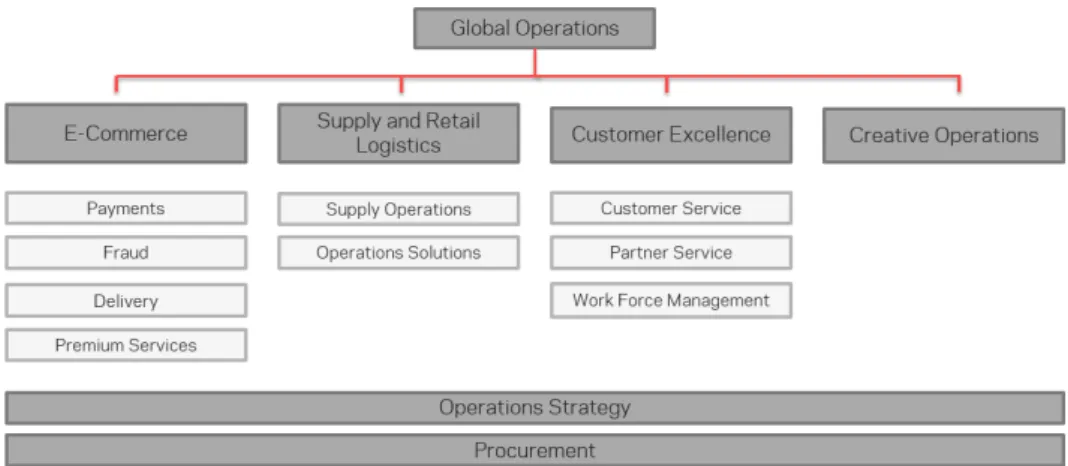
This department works hard to create standards that allow the company to deliver a consistent service while providing a luxurious experience. It is divided into 6 teams, as represented in the following figure 1.2: E-commerce Operations, Supply and Retail Logistics, Customer Excellence, Procurement, Operations Strategy and Creative Operations. These teams are structured, scalable and able to manage large volumes of orders and data.
Figure 1.2: Global Operations Structure
Customer Excellence connects the company with partners and customers through Partner Ser-vices (PS) and Customer Service (CS) teams. Customer Service provides all customer support to guarantee customers’ pre and post- order journeys satisfaction. CS has the challenging task to drive revenue through customer contacts. The goal is to make sure that the customer will shop again through the website by inspiring confidence. PS supports boutiques on operational issues and recommends strategic plans. The scheduling, planning and managing PS and CS performances are responsibilities of the Workforce Management team.
Creative Operations explores innovative ways to accelerate product online, improves the effi-ciency of the company product process and ensures the excellent service level to partners. This team photographs each item, controls its quality and identifies their materials and designation ensuring their availibity online.
Operations Strategy and Procurement are transversal to all the previous teams, working on the continuous improvement of processes along with all operations’ teams and purchasing software and material to support teams, respectively.
Supply and Retail logistics are accountable for controlling the service level provided for the partners and for measuring their KPI’s. Operations Solutions helps partners to set up their ware-house’s layout and advises them with the best practices to achieve the targets. Supply Operations is the specific team where this project was developed. This team controls and measures the partners KPI’s working alongside PS and CS teams and it is responsible for stock packaging management. Furthermore, the Supply Operations team is involved in all areas related to process improvement, providing to the Technology Department all the requirements for developing new back office tools, to facilitate and support operational teams.
1.3
Project Scope
With Farfetch’s the continuous growth of and consequently its orders, it is extremely important to assure the proper flow of the supply chain, which can lightly impact the customer satisfaction and experience. As a result, the company’s process performance is increasingly demanding, re-quiring redesigned processes to guarantee a healthy company growth.
Since an item is ordered, the order is processed on the website and automatically synchronized with an intern platform, where the ordering process begins. During this, some issues can occur, forcing the company to work with partners to solve them, avoiding further consequences. These issues correspond to exceptions in the order process. Exceptions represent deviations that happen throughout the process, which can change the normal path service. Internally, from the operational point of view, exceptions are a set of options available on the back office platform that allow boutiques to alert the responsible teams whenever an unforeseen situation prevents them from completing the ordering process. There are 13 different exceptions that boutiques can report and that will be further explored on chapter 3, section 3.3.5 .
Evidently, it is important to measure the performance of each partner, according to the com-pany’s service incentive, to assure the highest standards of customer experience. However, creating exceptions can have a negative impact on the boutique’s performance. Thus, to avoid harming the company’s partners, the Supply Operations team evaluates the time used to solve the situation and assesses whether it should be accounted for each boutique performance calculation or not.
Currently, the performance validation needs information from several sources and has a low level of automatization. All the process is done manually, with about 9000 exceptions per month arriving to the system and being handled one by one by the team. Afterwards, each exception is submitted for further financial analysis.
The purpose of this project is to redesign the exceptions’ analysis process, building a tool ca-pable of retrieving information from all sources and automatically analyze each exception through a dedicated model. It aims to increase the team responsiveness, the process accuracy and visi-bility through standardization, in addition to generating new reports and metrics to support the redesigned process.
1.4
Project Goals
The present dissertation has the intent to develop a tool with an appropriate model to automa-tize a current manual process in Farfetch. To do so, the following goals were established:
• Modeling and optimizing the exceptions’ process;
• Automatizing the process, increasing the process accuracy and supporting the team decision making and also allowing the reduction of the supply chain team’s workforce;
1.5 Methodology 5
• Building dashboards to monitor the process and the tool’s outcomes in order to assess the partner’s behavior when creating exceptions enabling easier identification of patterns and issues.
1.5
Methodology
Considering the previously objectives, it is important to define a methodology that will drive the project to achieve the final goal. The 5 phases of the project will flow as it shows in figure 1.3:
Figure 1.3: Project Methodology
First, it is important to perceive the company’s business model, as well as understanding its most significant KPI’s. After this, it is crucial to identify and deeply understand the current situ-ation that comes along with the problem that triggered this project. Exception process mapping, standards identification and KPI’s analysis are the tasks that will be ensured on 2nd phase.
The 3rd phase - Model Projection - is the main phase of this methodology, as the guidelines will be established for further testing and implementation. It is expected an analysis of the current processes, highlighting improvement opportunities and their re-design. Besides that, building an optimized tool to fulfill the range of requirements is extremely important, which will imply continuous and cyclic iterations until the guidelines fit the most of all the requirements gathered.
The tool’s development will take place on stage 4, following the previously established guide-lines.
Lastly, an analysis of the tool’s outputs is performed and exhibited in dashboards that will allow to monitor, not only the process and the tool performance but also the partners’ performance in exceptions’ process.
1.6
Dissertation’s Structure
The content of the present dissertation is divided into 6 chapters. Chapter 2 presents a literature review that combines the relevant subjects on the project development, including the e-commerce scope in luxury fashion industry, the Business Process Management and Modelling methodology and data visualization techniques.
Chapter 3, consists on a clarified view of the current handled processes and KPI’s, pointing out its limitations, according with the scope of this project.
Chapter 4 covers the design of the current exceptions process, the respective re-design and also the development of the solutions to the tool.
Regarding the chapter 5, it focuses on results achieved with the implemented solution, pre-senting the final tool and the developed dashboards to support the process.
Lastly, the chapter 6 highlights the results of the project implementation and future work con-siderations to the resulting improvements.
Chapter 2
Literature Review
2.1
E-commerce scope in luxury fashion industry
The connection amongst trade and technology has subsisted and perpetuated for a long time. These days, the web has turned into an irreplaceable segment of individuals’ lives (Jai et al., 2013), playing a powerful role in modern business (Okonkwo, 2009).
However, “There was no love at first sight between luxury and digital”, quoting Heine and Berghaus (2014). It may not be evident why e-commerce was not embraced right away by luxury industry (Okonkwo, 2009). Nevertheless, it can be explained by the very core of luxury industry: exclusivity (Okonkwo, 2007) and controlled retail distribution to keep up a premium status (Keller, 2009).
Breaking a lot of paradigms and taking the risk of overexposure, while maintaining a fragile perception of the restricted offer (Okonkwo, 2009), the percentage of luxury goods online in-creased to 8% in 2016. Although, it is predicted that this number increases to 25% until 2025 (Borland et al., 2018).
More and more E-tail -electronic retailing- business becomes a customer-to-customer (C2C) reality, where buyers can, in one click, access a wide assortment of luxury goods, sharing their lux-ury e-commerce experience with other consumers around the globe. The increase in online luxlux-ury sales and digital influence generates demanding consumers, forcing this e-commerce segment to reinvent itself and to adapt their strategies and approaches to the newest channels of communica-tion (Borland et al., 2018).
Nowadays, customers desire for multichannel deliveries, expecting an intimate service com-bined with a personalized experience (Kate McCarthy and Su., 2017). Big data and machine learning are creating opportunities to step up the relationship with each customer, thus taking their experience to the next level. Advanced analytics not only enable fast answer to changes on demand and to customer preferences but also highlight opportunities to incorporate tailored and authentic services for every customer and occasion(Borland et al., 2018).
Therefore, the luxury fashion industry should be, increasingly, aware of the continuous trans-formations on digital e-commerce, leveraged by advanced analytics in order to create chain value and empowering scalability businesses (Borland et al., 2018).
2.2
Business Process Management
Around the world, the constant economic, technologic and digital changes are affecting the way companies structure their businesses. More and more, companies are adopting process-oriented strategies to support the integration of their operations in the global business (Willaert et al., 2007).
A process is defined as a sequence of aligned activities and interactions carried out within an organization, with the purpose of producing a specific product or service. According to available resources and required information, a process can be characterized by its functional, behavioral, organizational and informational character (Bal, 1998).
Business Process Management (BPM) is a holistic approach that allows companies to struc-ture their operations through their modeling, monitoring and analysis, highlighting opportunities for further improvements (Zacarias et al., 2017). Bridging the gap of knowledge-base between technical and business people, BPM enables process re-engineering through the implementation of continuous improvements, empowering the process optimization (Kluza and Nalepa, 2017).
Hereupon, BPM follows an iterative cycle as figure 2.1 shows and it will be explained bellow (Dumas et al., 2013).
Figure 2.1: Business Process Management Life-Cycle. (Dumas et al., 2013)
The first step of BPM cycle is about problem identification. It comprises not only the relevant processes’ problems identification but also a deep understanding of their scope. Then, linking the relations between the processes, it is possible to set up the process architecture, hence having an overview of all process. During this step, it is also crucial to measure the main outputs of the process, by defining performance metrics. Only by measuring the main performance indicators it
2.2 Business Process Management 9
is possible to control the overall process’ performance and to understand the impact of BPM in the process. Depending on the process, these measures can comprise costs, lead time, work time or even error rates. The potential outputs can also be measured in the process analysis phase.
Once the global process architecture is structured, it is possible to start the process discovery phase, covering the documentation of the relevant steps. One of the main critical tasks of BPM is to collect the information and knowledge-base to model the process flow and to define its rules. According to Friedrich et al. , it represents 60% of the time spent on process management projects (Friedrich et al., 2011). Then, business analysts leverage the know-how in the business process modeling to organize all the information gathered in one single process. Business Process Model-ing is defined, by Boukadi et al. (2009), as a graphical approach of the process business flow and it will be analyzed in next the chapter 3. So, by analyzing the current processes and using business process modeling approaches, business analysts are able to model an AS-IS model, reflecting the picture given by the workers about how the process is currently done.
The third step of the BPM cycle consists of a deep analysis of the AS-IS model, highlighting non-valuable actions, weaknesses, bottlenecks, and opportunities to improve the current processes within companies. To do so, the business analyst must keep in mind the impact of the changes in the process, swinging with the expectable performance measure. Usually, the issues are doc-umented according to their impact and the effort to solve them, prioritizing the ones with most impact and effort. After setting the modifications in the process, its re-design phase takes place. This following phase is focused on redesigning and remodeling the current process, with the aim to visualize a future improved scenario, designated as TO-BE model. As interactive process anal-ysis and re-design may be, all the proposed changes that might come up while re-designing the process must be analyzed before moving on to the next step.
After the process re-design, the next step embraces the TO-BE model implementation. During this phase, there are two distinct tasks to perform: organizational change management and process’ automation. On the one hand, there is always a strong resistance to change. To contradict this, it must be clarified the process’ changes, to train process’ stakeholders, according to the new paradigm, and to explain them the benefits of the process’ implementation. Despite this being a hard task, stakeholders have a key role in the implementation phase, once they are the ones that are constantly testing the new processes and can identify easily its deficiencies. On the other hand, process’ automation involves the implementation or configuration of IT systems in order to support the TO-BE process. The IT tool should be intuitive, assisting the users to easily perform tasks.
After the implementation phase, the process monitoring and controlling phase take place. There is always room for improvement, so this phase helps analysts to detect outliers that are not expected, according to the requirements. Then, the BPM cycle starts again to perform the accurate adjustments.
2.3
Business Process Modeling
As it was stated in the previous chapter 2.3, business process modeling is a graphical and visual approach that supports and accelerates software development, upholding the management improving decisions and analysis. The models must use an intuitive notation (Fjeldstad and Snow, 2017) being usually represented by maps, which are easily understandable to the stakeholders. These maps should show how the process flows, representing inputs and outputs, linking tasks and assigning people involved in them. Furthermore, it enables the process standardization, helping to reduce the process variability (von Rosing et al., 2015).
Process modeling can have various levels of detail. However, it should follow a top-down approach, by starting to map the process from a macro to a more detailed level (Anjard, 1996).
There is a wide range of notations used in process modeling such as a flowchart, functional flow block, Unified Modeling Language (UML) and Business Process Model and Notations (BPMN) (Saini and Thiry, 2017). Considering the scope of this dissertation it will be emphasized the BPMN notation.
BPMN is a standard and intuitive notation based on flowchart techniques bridging the com-munication lack between business process and business implementation. This notation has four basic categories: flow objects, that comprises events activities and gateways, connecting objects, swimlanes, and artifacts. Bellow, it will be exposed the main elements of BPMN as also their description and notation:
• Events - Represents a specif moment that occurs during the business process. It can be a start, ending or intermediate event.
• Activities - Set of atomic or composed tasks carried out in a business process such as tasks, sub-processes and call activities. On one hand, the tasks represent atomic activities repre-senting a single unit of work. On the other hand, the sub-process represents a composed activity within a process that has a lower level process associated, and the call activity is a notation to reuse an activity within the process, or even in another process.
• Gateways - Used to control the logic flow, converging and diverging paths within the pro-cess. The most used are exclusive, inclusive and parallel. Exclusive is used to indicate alternative paths that can be followed. While, inclusive is used to create alternative paths based on a condition. It can be activated one or more conditions based on the process, however, the activated activities must be completed before merging. Finally parallel gate-ways are used to create alternative paths, however, all of them should be completed before merging.
• Connecting Objects - Used to guide the flow of the process by connecting the flow objects. There are 4 types of connecting objects: Sequence Flow, Message Flow, Association and Data Association. Sequence Flow guides the process by following the order of the activities, while Message Flow represents the exchanged messages between stakeholders. Otherwise,
2.4 Data Visualization 11
Artifacts are used to associate artifacts to flow objects. Finally, Data Association associates data with flow objects, in order to show the inputs and outputs of the activities.
• Swimlane - It contains elements named pool and lane, figure 2.2 which represent actors and their roles in a business process, respectively.
Figure 2.2: Pool and Lane
• Artifacts - Additional standardized information needed to understand and complete the process. It could be a annotation used to provide additional information and relevant notes of the process or data objects that represent data, singular and collections of objects, used in activities such as output or input. Group is another artifact that can be used to group activities that do not influence the process flow.
2.4
Data Visualization
BPM is divided into 6 phases, as it was presented in the previous chapter 2.3, where the last one is monitoring and controlling. Monitoring is a crucial phase in BPM life-cycle, allowing companies to measure the results of their goals considering their growing awareness regarding process performance (Weske, 2012). Therefore, it is needed to proceed with the creation of metrics that help to translate the process performance.
In order to monitor processes attending to the respectively established metrics, it is needed to develop reporting methods that directly extract data, displaying it in a clear and intuitive way. The most used tool for monitoring the process performance across companies is the dashboard. (Peral et al., 2017). A dashboard, according to Eckerson (2010) is a strategic management system that reflects the company’s strategy results through performance metrics, which allow real-time monitoring and works as an enabler to potentialize stakeholder’s proactive decisions, actions to improve and automatize processes. Defined as performance a management tool, by Yigitbasioglu and Velcu (2012), dashboards collect and organize data from a wide range of sources which allows the representation of process metrics in a summarized way, allowing the user not only to easily point out process anomalies but also to explore their limitations.
While structuring a dashboard, its visual and functional design features must be aligned, bal-ancing data complexity with visual representation, in order to organize information in a more usable way. Thus, visual features are linked to how efficiently the information will be perceived by the user and how effectively it will be used in decision making. On the other hand, functional
features refer to dashboards functionalities such as filtering capabilities (Yigitbasioglu and Velcu, 2012).
Likewise, data visualization covers a wide range of areas, embracing a lot of data and insights from distinct fields. Hence, Fry (2007) suggests to divide the data visualization process into 7 stages: acquire, parse, filter, mine, represent, refine and interact.
• Acquire the data;
• Parse and structure the acquired data; • Filter the relevant information;
• Mine the information by applying statistical and graphical methods to easily detect patterns; • Refine, by engaging the information in a more visual way.
• Interact, by selecting methods enabling an intuitive manipulation of data and visible fea-tures.
Suitable data visualization provides a consistent analysis of the relationships between the ana-lyzed data. The advantage of graphical representations over text-based reports is the capability to expose patterns and trends and spot potential issues. Contrarily, text-based reports do not present the information in a visual way, hiding the patterns and out-liers (Eckerson and Hammond, 2011). Summing up, data visualization is a powerful tool that improves company processes and en-gagement. It supports upper-level management decisions by understanding cross functional ca-pabilities that lead the company to profitable growth (Wind, 2005) and allocates the resources by strategically pinpointing continuous improvement opportunities (Lou et al., 2016).
Chapter 3
Problem Description
As previously mentioned in chapter 1, section 1.5 , the initial phase of the project’s method-ology focuses, not only on a business overview, but also on a general understanding of the main KPI’s, highlighting the supply chain processes’ flow and KPI’s directly connected with the project of this dissertation. Therefore, to follow the stated methodology, it will be adopted an approach based on the BPM method. This chapter will cover the first step of BPM approach, “Process Identification”.
3.1
Company’s Interfaces
Almost all processes involved in this project are aided by one or more intern platforms, so it is important to know them and their applicability. There are three main platforms: STORM, SALES, and Zendesk.
STORM is a web-based application integrated with the boutiques’ system that allows them to control the ordering flow, manage daily tasks (such as ordering process, stock management, and returns) and report current issues.
On the other hand, SALES is only managed and used by Farfetch Teams. This web-based application contains all the information about the ordering process, production process, delivery scheduling and all the detailed information about boutiques. Furthermore, it is also on SALES that exceptions are managed and where there is almost all information needed to evaluate them.
Moreover, these two platforms run slowly, increasing the team’s answering times and preju-dicing their performance. This constitutes a problem that with new upgrades and by automatizing some of the processes might be solved.
At last, Zendesk is the official communication tool for Farfetch’s Customer Service. It is an interface that allows not only external communication - between boutiques and Farfetch teams or customers-, but also enables internal communication.
There are 3 different Zendesk platforms: Delivery Zendesk, Partner Service Zendesk, and Cus-tomer Service Zendesk. The communication is established creating messages - tickets in Zendesk glossary -, assigning them to agents that have the task to inform boutiques, solve the ticket or even communicate with the customer if it is required. The tickets are managed first in first out (FIFO) by the teams and all the company’s communications are done through them.
3.2
Ordering Process
As a marketplace, Farfetch links the customer to the boutique. Once the item is purchased on the company’s website, the order is placed on STORM and, consequently, the ordering process starts, flowing as it shows in next figure 3.1.
Figure 3.1: Ordering Process Overview
Currently, the ordering process is divided into 6 steps, as shown in figure 3.2: Check Stock, Approve Payment, Decide Packaging, Create Shipping Label (Air WayBill), Ready to send and Send. Therefore, even process numbers are company teams’ responsibility, whereas odd numbers are boutiques’ responsibility.
Figure 3.2: Steps of Ordering Process
The ordering steps will be explained in detail below: Step 1 - Check Stock
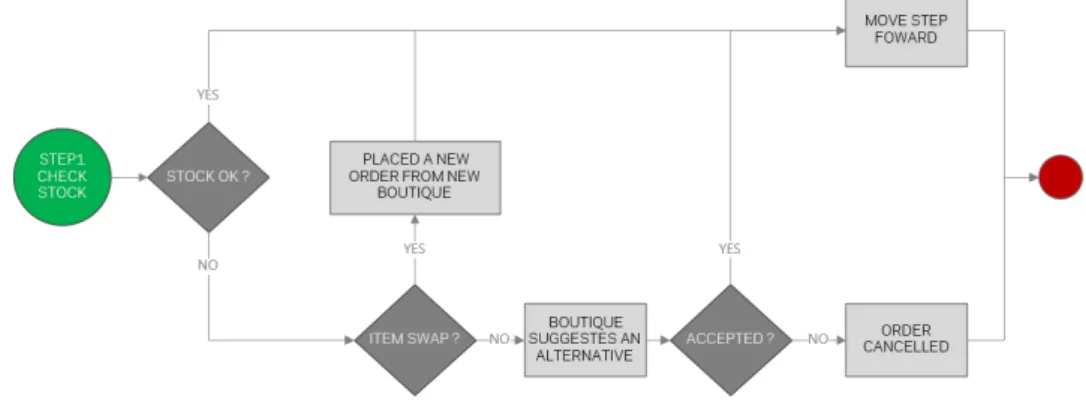
The first step starts when the order is placed on STORM until the item availability is confirmed by the boutique, as shown on figure 3.3. For this reason, it is important to alert the partners to the importance of checking the exact stock to avoid compromising the continuity of the ordering flow. Most of the company’s partners are boutiques that, besides selling their luxury goods online, also sell them physically - in other words, offline. Despite keeping track of the boutique’s stock level, the system synchronization is not done instantaneously. This means that offline shopping can
3.2 Ordering Process 15
happen between the moment that the order is placed on STORM and the moment that the online update of stock is done.
This is called a “no stock“ situation. Intending to solve it, the system will look for the item in another boutique, swapping it without the customer noticing, hence creating a new order and can-celing the previous one. However, Boutiques can also suggest an alternative item to the customer avoiding the “no stock” situation.
Figure 3.3: Step1-Check Stock Step 2 - Approve Payment
Parallel to the first step occurs the second one -Approve Payment-, the responsibility of the Fraud Team, represented on figure 3.4. Moreover, 95 % the orders are approved before Step 1 is completed. According to their behavior regarding the payment system, customers are
distin-Figure 3.4: Step2-Approve Payment
guished generating two lists: Black List and White List. On the one hand, White List Customers are those who have a confirmed, secure and reliable payment source (among other aspects). On the other hand, Black List Customers are those who cause problems with the payment process, usually with a distrustful payment source. This means Farfetch has an updated report of the previ-ous customers and can immediately and automatically reject or accept an order by consulting the previously mentioned lists.
Beyond the orders from Black and White List Customers, that are automatically accepted or rejected by the system, the Fraud Team also needs to deeply analyze the new customer’s order origin, the payment source, and other relevant aspects in order to prevent a potential fraud. As a
result of crossing the data with previous payments to identify standards and possibilities of being fraudulent payments, some payments are directly rejected or accepted. In some cases, it can be necessary to directly contact the customer to request a Proof of Billing by phone.
When the order is not reliable, the fraud analysts cancel the order, reporting the reason for cancellation and adding the suspect to the Black List.
Step 3 - Decide Packaging
In Step 3, boutiques have the responsibility to match the proper packaging to the item ordered, selecting it on STORM, as it shown on figure 3.5. During this step, Boutiques should package the item according to the selected packaging, adding customized details such as a handwritten postcard or a luxury wrapping paper, thus guaranteeing a luxurious customer experience.
Farfetch advises the boutiques about the better packaging for each item, however, boutiques may set a new box if it is required. All boxes are designed by the company, but boutiques are re-sponsible for managing and ordering their own packaging stock since it is provided by an external company.
Figure 3.5: Step3-Decide Packaging Step 4 - Air WayBill (AWB)
The shipping label and the AWB are created in Step 4 and it is automatic unless there is any problem with the shipping information or legal restrictions that have to be handled by the Delivery team. Usually, 95% of the orders take less than 2 hours to pass Step 4.
Step 5 - Send Parcel
As the shipping label is ready, the order is pushed forward to Step 5 to be collected by the courier. When the boutiques have a considerable amount of orders per day, they are assigned a daily pick up service. However, some boutiques do not have enough orders to justify daily pick up, so the system books the pickup automatically, usually for the next day. Once the courier scans the package, the order is moved to Step 6.
Step 6 - Sent
From the moment the courier scans the parcel, until it is received by the final customer, the order is in transit, on Step 6. Once the parcel is scanned, the company sends a confirmation email to the customer, distinguishing the time spent to process the order by the boutique and the estimated time that will be spent by the courier to deliver the order.
3.3 Key Performance Indicator (KPI’s) 17
3.3
Key Performance Indicator (KPI’s)
After understanding all the ordering process’ steps, it is also important to identify the KPI’s that define the partner’s performance. The Speed of Sending (SoS) and No Stock (NS) are the measured performance KPI’s and have, naturally, a direct impact on the customer’s experience. Furthermore, it is likewise to refer Net Promoter Score (NPS), the KPI that measures the cus-tomer’s satisfaction and that is transversal to the whole company. Keeping those KPI’s in mind, internal goals were established monthly and will be further explained below.
3.3.1 Speed of Sending (SoS)
The Speed of Sending (SoS) is a Key Performance Indicators (KPI) that measures the time elapsed since an order is forwarded to the boutique until the courier collects the package. Taking into consideration the ordering process, there are two types of SoS: Speed of Sending Gross and Speed of Sending Net. The Gross SoS represents the total time, counting from the moment an order is placed by the customer, until the time the order is collected by the courier’s company, as equation 3.1 shows. It takes into consideration all the time spent during the first 5 steps of the ordering process, even the ones that are not controlled by boutiques. Moreover, it does not take in consideration weekends and holidays. Considering that boutiques, generally, only work from Monday to Saturday and courier companies just until Friday, this metric becomes an unfair performance indicator.
Gross SoS= Scan Courier Date − Order Creation Date (3.1)
Consequently, the company developed the Net SoS KPI, represented on equation 3.2, that excludes from Gross SoS the time spent on actions that boutiques do not control, i.e payment verification (step 2) , AWB details confirmation (step4), weekends, holidays and occasions where the order may be held by external boutiques factors.
Net SoS= [Time spent on 1 + Time Spent on step3 + Time Spent on step5]
−[Time Spent on Weekends + Time Spent on Holidays + Time Spent on Hold] (3.2)
Therefore, Net SoS KPI is the most accurate way to measure the boutique’s performance. Inter-nally, it is represented as a percentage (%) of the orders shipped in less than two days, constituting the Service Level Agreement Speed of Sending Net (SLA SoS), as seen on next equation 3.3.
SLA SoS=Total Number o f Orders with SoS < 2
Total Number o f Sent Orders (3.3)
advantage against other boutiques. Accounting that the same item may exist in more than one boutique, the company defines rules that prioritize which item will appear first on website.
3.3.2 No Stock
Another metric related to partner’s performance is the No Stock (NS). It represents the per-centage of items canceled by boutiques due to a lack of stock on a total of items sold by the month. This metric has a big negative impact on customer experience, meaning a lot of times a lost sale. For this reason, the company is highly demanding on this KPI.
Like SoS, there are also Gross No Stock and Net No stock. No Stock Gross is calculated based on all items canceled and the alternative suggestions accepted by the customer when the boutique declares no stock and suggests an item. On the other hand, Net No Stock is calculated only on items canceled. For instance, if one boutique sold 100 items, with 3 of them canceled by a no stock reason and 2 alternative suggestions were accepted by the customer: Gross NS=5% and Net NS = 3%. The calculations are shown below on equations 3.4 and 3.5.
Gross NS=Number o f canceled items+ Alternative Suggestions Accepted
Total Number o f Sent Orders =
2 + 3
100 = 5%
(3.4)
Net NS= Number o f canceled items
Total Number o f Sent Orders=
3
100= 3% (3.5)
3.3.3 Net Promoter Score (NPS)
Once the order is delivered, the customer receives a short quiz about the purchased item and the service provided.
This quiz consists of five questions where the customer can evaluate his/her experience. There are three questions directly related to the service provider, classifying the service provided by the boutique, order packaging and the speed of the delivery, each being evaluated up to 5 points.
The remaining questions are related to the customer feedback about the company and the bou-tique that provided the service. In contrast with the previous ones, the customer must classify the answer up to 10 points. The answers are scored in three groups: Detractor (0-6 points), Passive (7-8 points), Promoter (9-10 points), assuming that detractors will not purchase again and promot-ers will recommend Farfetch. NPS measures the difference between the number of promotpromot-ers and detractors, as expressed on equation 3.6.
NPS=Number o f promoters− Number o f Detractors
3.3 Key Performance Indicator (KPI’s) 19
3.3.4 Service 3.0
As competition gets fierce and customers even more demanding, the company needs to ensure that standard services are scalable and maintained.
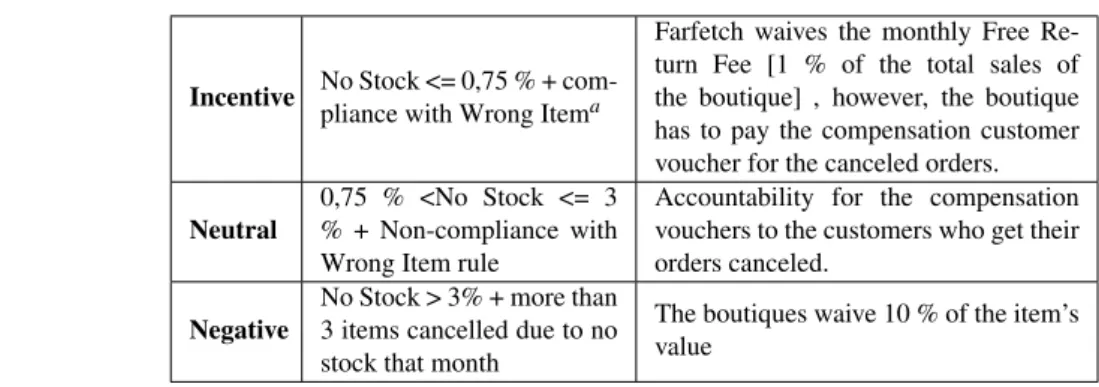
Service 3.0 is an incentives and penalties operational excellence program designed for achiev-ing higher service levels and takachiev-ing customer service to the next level. Besides, it aims to speed up the ordering process, forcing boutiques to improve their performance and processes. As a result, the service considers the SoS, NS, wrong item rule and returns of each boutique, monthly.
Incentives and penalties are managed as a result of the boutique’s KPI’s performances. The ranges of incentive defined by the company, according to the KPI, can be seen in 3.1 and 3.2, respectively.
Table 3.1: Rules of SoS according to Service 3.0
Incentive Net SoS <1 [days] and
Packaging Ratea>= 4,5
Packaging costs are covered by Far-fetch.
Neutral 1<Net SoS < 2 [days] No penalty or incentive.
Negative Net SoS >2 [days]
The boutique is accountable for sup-porting the shipping cost of that order to the customer.
aOn post-purchase survey customer rates the packaging and boutique must achieve the higher classification.(0/5)
Table 3.2: Rules of NS according to Service 3.0
Incentive No Stock <= 0,75 % +
com-pliance with Wrong Itema
Farfetch waives the monthly Free Re-turn Fee [1 % of the total sales of the boutique] , however, the boutique has to pay the compensation customer voucher for the canceled orders. Neutral
0,75 % <No Stock <= 3 % + Non-compliance with Wrong Item rule
Accountability for the compensation vouchers to the customers who get their orders canceled.
Negative
No Stock > 3% + more than 3 items cancelled due to no stock that month
The boutiques waive 10 % of the item’s value
a*Wrong Item Rule –Represents the % of return items due to wrong size, damage or item on total amount of returns
accepted every month. This rule established the % of wrong items that are acceptable to compliance the wrong item rule policy.
To better manage their own service performance, boutiques receive a daily report with the results achieved on the previous day. These reports contain the Net SoS of each order and a list of returns pending and contested. At the end of the month, the company sends a financial report detailing all targets achieved and not achieved, according to the Service 3.0. In opposition to SoS performance, that reflects the transactions of the current month, No Stock and Free Returns Contribution Charge reflect the transactions of the previous month.
3.3.5 Exceptions
Exceptions are a set of options available on STORM that are not only are used for boutiques to report unexpected situations that occur during the ordering process, but also to avoid penalties on the speed of sending. Currently, 3% of the total number of orders have at least one exception. Consequently, operations teams are pressured to work fast to solve them, to minimize the impact on the customer’s experience.
To cover all unexpected situations, there are 13 exceptions distributed for the 3 steps controlled by partners. The description of each exception and respective steps are presented on table 3.3, placed in the end of the present sub-chapter.
The general exceptions’ process flow is represented in figure 3.6.
Figure 3.6: Exceptions Process Flow
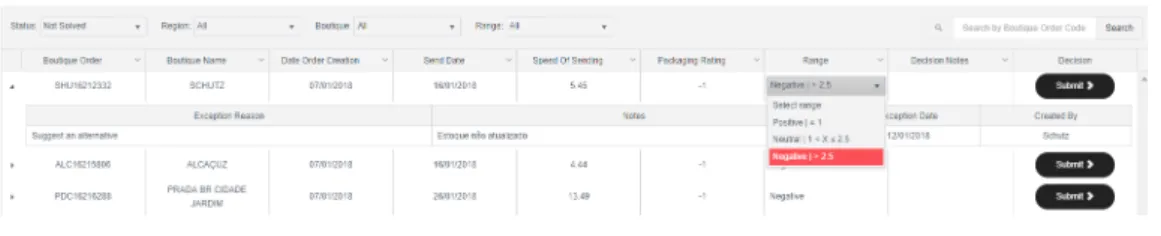
Since the order is placed on STORM and according to each the situation, the boutique must create an exception. This exception represents a doubt or a potential issue that will be later solved by the respective responsible team: Partner Service, Customer Service or Delivery. After this, the order is ready to be pushed one step forward to step 6, where it is collected by the courier company. As the Net SoS KPI does not consider the time spent on problem resolution, the Supply Team must recalculate it, discounting the time spent on solving it, changing the range of the perfor-mance of each order, according to Service 3.0 rules. However, not all cases are meaningful and trustworthy. Therefore, each order must be analyzed by the Supply Team, who has the hard and ambiguous task to validate each created exception and to assign the root cause of the problem to the company or respective boutique. Whenever the fault is held by the company, the time spent on the exception resolution that prevents boutiques to move the order flow forward is calculated by a Supply Chain team member, demanding the SoS recalculation. Aftewards, the right range must be assigned, according to service 3.0 : positive, negative, or neutral, as shown on figure 3.7.
Figure 3.7: SALES Exception Management
3.3 Key Performance Indicator (KPI’s) 21
Table 3.3: Exceptions’ Description
Exception Description Steps
Double Order (DO)
It should be used whenever boutiques receive a new order that contains exactly the same items as a previously placed one, in some minutes time.
Step1 Step3
Suggest an Alternative (SA)
It enables boutiques to suggest an alternative item in case of no stock, thus avoiding the cancellation for no stock. However, the algorithm always looks first for the required item in another boutique before gesting an alternative to the customer. The difference between the sug-gested item and the selected one should be cover by the boutique.
Step1
Wrong Item (WI)
Boutiques should use wrong item exception whenever the photo or de-scription does not match with the item ordered. Consequently, bou-tiques can offer a discount or suggest an alternative to the customer.
Step1 Step3
Wrong price (WP) Boutiques should use this exception whenever the tagged price is not
right or in case of any doubt about the taxes and duties applied.
Step1 Step3
Discount for imperfect item (DII)
Boutiques should create this exception if the ordered item has a small defect, it is missing the tag, there is a small damage on the box or any other possible defect. In this case, it is required a detailed description of the defect and a photo that proves the reliability of the item and the discount to offer.
Step1 Step3
Faulty item (FI)
Boutiques should use this exception whenever the item is not up to lux-ury standards. Consequently, it has to provide an estimated time to ship the new item or suggest an alternative if the customer rejects the ship-ping delay.
Step1 Step3
Size recommendation
(SR)
There are some items that don’t fit the true to tagged size (for example, a specific brand might consider a medium size what the majority of the other brands consider that same size a small). For this reason, boutiques should report the situation alerting and advising the customer to a better matching size.
Step1 Step3
Wrong Size (WS)
Wrong size and size recommendation don’t report the same issue. Wrong size should be used every time the ordered item size scale is different from the one used by the boutique.For example, a 34 size in Europe corresponds to a 6 Size in the UK, although boutiques may not be aware of this conversation scale.
Step1 Step3 Product Packaging issue
(PPI) It must be created every time boutiques ran out of packaging materials. Step3
Impossibility to decide packaging (IDP)
This exception should be used to report STORM problems during the
validation of step 3, preventing the selection of proper packaging. Step3
Impossibility to print
Documents (IPD)
This exception should be used to report STORM problems during Step 5, in cases that boutiques have to wait for paperwork or if invoice infor-mation is eligible.
Step5
Order Already Picked up (OAP)
Boutiques should report this situation when the order was already picked up, but it still appears on STORM. However, they should wait until the next day in case of possible scan delay synchronization on the courier’s side. Otherwise, it should be reported.
Step5
Courier Failed Pick up -DHL/UPS Failed Pick up (CFP)
Boutiques must report whenever the courier does not collect the order on the expected date. For this, boutiques should be aware of their col-lecting system, having two possibilities: manual or daily. The differ-ence between the two is that a daily pick up happens everyday, while a manual pick up must be scheduled for at least one day after the order is received. This means that, in a manual collecting system, the boutique must always be aware of the expected collecting date before reporting the exception.
So, monthly boutique’s SoS KPI will remain the same, even the ranges change. This means that the selected range is only worth it for the service of incentives and penalties and the Net SoS for each boutique is not adjusted to its real performance.
An order has a positive range whenever the order’s Net SoS is less than 1 day, negative if it is higher than 2 days and otherwise considered neutral, as it is possible to consult on table 3.1, in the previous sub-chapter 3.3.4. The incentive program applies to each order, according to the ranges it is inserted in. This means that orders with positive range are accepted without prior analysis, since the interval will no longer change regardless of the impact of the exception. Contrarily, neutral and negatives ranges require a detailed analysis. Once submitted, it will take part of the monthly finance report, where penalties and incentives will be discriminated, according to Service 3.0. Apart from the range and time spent to analyze and submit each exception, it is important to keep in mind that all the submission process is manual, requiring workforce.
After understanding the scope of the exceptions on the ordering process, it is crucial to quantify the real problem by measuring it. First, to understand the real impact of exceptions on the ordering process, it is necessary to know not only the percentage of total orders with exceptions, but also which type of exceptions are more frequently used by the partners.
Considering the Pareto analysis below, in figure 3.8, there is a significant discrepancy attend-ing the type of exception. Pareto Principle supports that 80% of effects come from 20% of the causes. In this specific case, means that 80% of the created exceptions are a consequence of 3 ex-ceptions - Order Already Picked Up,Courier Failed Pickup and Impossibility to print documents -, representing a considerable volume of the total number of orders.
Figure 3.8: Pareto Exceptions’ Chart
Once identified the most created exceptions, it becomes fundamental to understand which boutiques are creating them the most. Segmenting the boutiques according to the number of orders per semester, it ensures that 12 % of the smaller boutiques’ orders have an exception created, against 3% of orders with exceptions from the biggest boutiques. As supported by figure 3.9, the trend is growing from the smaller boutiques to the bigger ones. This can be explained due to the lack of support and information towards smaller boutiques, since they create exceptions, oftentimes, without a valid issue.
3.3 Key Performance Indicator (KPI’s) 23
Proposed Solutions
Understanding the scope of the company’s business and identifying the main processes allows to start a deep analysis of the problem, design its possible solution and implement it. Continuing to follow the stated methodology, this chapter will cover the problem identification, model’s pro-jection and tool development, which concerns “Process Discovery”, “Process Analysis”, “Process Re-design” and “Process Implementation” according to the BPM approach.
4.1
Exceptions Process Mapping
Providing an insight into the process, the process mapping enables an efficient identification of the process weaknesses by guaranteeing an effective visual representation. Thus, highlighting potential improvements to the process.
Since exceptions’ management process was an unexplored area, the lack of information, docu-mented and mapped processes did not allow an immediate evaluation of the current processes. So, to get a clearer grasp of it, all processes were mapped before any evaluation. After designing all the current processes, named AS-IS mapping, the process was redesigned originating the TO-BE mapping.
Regarding the current processes design, since the process was completely manual and per-formed by different people, the information gathered, through interviews with workers, proved to be insufficient to structure the AS-IS process. Consequently, it required two weeks of manual work to perform the processes according to workers’ instructions, to adjust and to collect enough information to build the most accurate process map.
After completing the process flow analysis, the next step was to group the exceptions according to their approach and map the current process. Thus, the exceptions were divided into two groups: Zendesk Exceptions and Delivery Exceptions. Zendesk exceptions are the ones that are previously processed by the PS team namely Double Order, Wrong Item,Wrong Price, Discount for Imperfect Item, Faulty Item, Size Recommendation, Suggest an Alternative, Wrong Size,Product Packaging
4.1 Exceptions Process Mapping 25
Issue, Impossibility to decide packaging and Impossibility to print documents. On the other hand, Delivery Exceptions are related with the exceptions that correspond to courier issues, covering the
Courier Failed Pick Upand Order Already Picked Up.
As a result of an overview of the current process supported by the AS-IS maps, the main weaknesses were reviewed to determine methods to redesign and improve the process, which are:
• The process is completely manual. Despite being manual, which is already a big
limi-tation on the process, there a lot of different interfaces used, decreasing the efficiency and increasing the time spent on it.
• Lack of standardization. There is no mapped process with a clear vision of the procedure, so each team member is analyzing exceptions the way that they think is most efficient. • SLA Net SoS is not accounted in the final monthly report. Although Net SoS also
changes, it is not accounted for on the SALES platform, as the only parameter that is up-dated is the range of incentive. This means that, even though a boutique is not affected financially by the incentives/penalties program, it may cause them to lose exposure on the website (and consequently to reduce its sales) due to the unchanged SoS value.
• Lack of information and visibility. Boutiques are not conscious of how and when to create an exception.
• The process is dependent on the 3PL. Besides not controlling all the information flow, the company’s process success is also dependent on external companies, which turns out to be a great weakness.
• Double check and duplicated work. The lack of standard communication between inter-nal company teams forces the Supply team to double check PS and CS work and to take, sometimes, inaccurate conclusions.
Considering the named weaknesses of the AS-IS process, new standards procedures and rules were redesigned to solve them through process efficiency and agility for a further model develop-ment.
So, gathering all the information in one interface and pointing out the important information for the exceptions analysis was the main concern. Considering this, the number of sources will be reduced to two: Sales Exception Management, where the exception’s range is changed and the exceptions are submitted, and the tool, where it will be placed all the required information for the exception analysis.
Another challenge of the TO-BE process mapping was the development of fair metrics to recalculate the SoS, according to the output situation. Always considering the weekends and holidays between this time. In addition to enabling the Supply Team to recalculate the range with a constant metric, the new mapping will also support the model development.
Summing up, by following the stated rules of process mapping, it is possible to figure out the final output, the root cause of it and recalculate the new SoS. Until the final mapping was
completed, it was required an extended period of testing and investigation with the analysis of thousands of exceptions to detect exceptional cases that were not being considered. It required almost two months of intensive work to map all the exceptions processes and to redesign them. The following sub-chapters will describe in detail the AS-IS and the TO-BE of the Delivery and the Zendesk Exceptions.
4.1.1 Delivery Exceptions
Representing the most frequently used, the Delivery Exceptions should be introduced in the system whenever a boutique faces a courier problem. Therefore, boutiques should create an ex-ception such as Courier Failed Pick Up or Order Already Picked Up, whenever the courier failed the pickup, or when an order is not scanned at the exact moment it is shipped, respectively.
However, it does not mean that these exceptions are always used with the right purpose by bou-tiques. Sometimes, an exception is created due to a lack of information or just because a boutique is trying to avoid penalties in SoS. So, the aim of the Supply Team is to analyze and understand the real scenario and determine if it was a misjudged situation, or if there was an justified issue with the courier. Furthermore, since this part of the process depends on a 3PL company, it is difficult to control their performance and to assure the most accurate information about the parcels’ flow, compromising the effectiveness of the company’s operations and weakening the Supply Team analysis.
Following some pre-defined procedures, it is possible to understand the root cause of the ex-ceptions. By checking several sources and crossing the log dates, it is possible to achieve a solution output that categorized as either No Farfetch’s Fault or Farfetch’s Fault.According to this, the first step is to identify the meaningful information and where to consult it for further analysis.
Recapping the final part of the ordering process, chapter 3, Step 5 is the one that bridges the boutiques and the couriers. Since the order reaches the Step 5, it is ready to be collected by the assigned courier. Once Farfetch’s system is integrated with the courier’s system, as soon as Step 3 changes to Step 5 the pickup will be scheduled instantly. Depending on the courier and on the number of daily orders, can be assigned two distinct pickup services: daily or manual pickup. In case of a large volume of orders, daily pickup service assures that every working day, within the same time range, the courier will come to collect all the processed orders, so the system’s scheduled date and time are the same, by default, as in Step 5. On the other hand, in case of a non-considerable amount of orders, manual pickup service schedules the pickup, usually, for the working day after Step 5’s confirmation. Then, the courier should collects the order by scanning the label inside the store, synchronizing it with the company’s system at the exact time of the parcel collection. Since Step 5, until the synchronization of the scan log, boutiques can create one or more exceptions.
Summing up, the essential information to retrieve about the final part of the ordering process are the assigned courier for the pickup, the type of pickup (daily or manual), the date and time of
4.1 Exceptions Process Mapping 27
Step5, the Step6, the exception and the scheduled pickup. Another additional important informa-tion to retrieve during the courier’s pickup is the pickup point of the order’s collecinforma-tion. A boutique can have several pickup points, from warehouses to other boutiques related with the “mother” boutique.
To gather all this information, the Supply team must rely on different sources. However, in spite of using the same information, the rules and procedures that are considered to analyze each one of the named exceptions are distinct. Therefore, a distinct map was created for each process which will be explained in the following sub-chapters.
4.1.1.1 Courier Failed Pick Up
Current Process Mapping - AS-IS
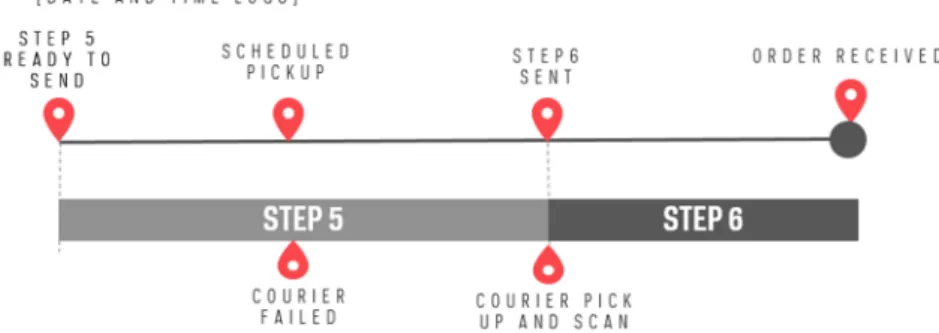
The figure 4.1 represents the only valid reason why boutiques should use this exception, mean-ing that the courier did not collect the order in the scheduled day. Considermean-ing this, the supply team has to check if the created exception has the right purpose, according to the information and the observations retrieved, as it represented in the AS-IS model appendix A.1, figure A.1 .
Figure 4.1: Courier Failed Pick Up
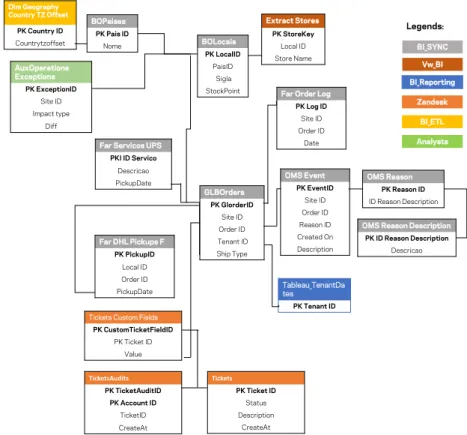
Firstly, since the information is overspread, the Supply team must access 4 different interfaces: Sales Orders Management, Cube, Sales – DHL Pickup and Sales Exceptions Management.
Starting the analysis’ procedure, No Farfetch’s Fault is automatically assigned if the order is shipped before the created exception. If not, the process is divided into two different paths according to the pickup service: daily or manual. In case of a daily pickup, by checking all the orders during that day it is possible to know if the courier collected any order or not and, in case the courier did collect, at what time. Thus, if the courier collects at least one of the boutique’s orders, it will be assigned as No Farfetch’s Fault, as the remaining orders could have been collected, if the boutique had prepared them on time. Orders created after the scheduled pickup time are also included in No Farfetch’s Fault, as they will be picked up the next day. With the manual pickup service the process is similar, however, the Supply team must check the courier’s activity on the respective boutique’s scheduled pickup day, instead of on the Step5 day. Otherwise, if the exception was correctly created, it is assigned as Farfetch’s Fault and the Supply