Carolina Infante da Câmara dos Reis Peixe
[Nome completo do autor]
[Nome completo do autor]
[Nome completo do autor]
[Nome completo do autor]
[Nome completo do autor]
[Nome completo do autor]
[Nome completo do autor]
Licenciada em Conservação-Restauro [Habilitações Académicas] [Habilitações Académicas] [Habilitações Académicas] [Habilitações Académicas] [Habilitações Académicas] [Habilitações Académicas] [Habilitações Académicas] 26 de Novembro, 2019
Orientador: Professora Doutora Inês Alexandra Ramalho Coutinho,
Professora Auxiliar,
Faculdade de Ciências e Tecnologia - Universidade NOVA de Lisboa
Co-orientadores: Professora Doutora Maria da Conceição Casanova,
Professora Auxiliar,
Faculdade de Ciências e Tecnologia - Universidade NOVA de Lisboa Mestre Ana Catarina Teixeira da Silva,
Conservadora-Restauradora,
Museu Nacional de História Natural e da Ciência - Universidade de Lisboa
The Passos Manuel high school glass crystal models:
Condition assessment and analytical characterization
[Título da Tese]1
Dissertação para obtenção do Grau de Mestre em
Conservação e Restauro, especialização em Conservação e Restauro
Dissertação para obtenção do Grau de Mestre em
[Engenharia Informática]
Júri:
Presidente: Professora Doutora Rita Andreia Silva Pinto de Macedo,
Professora Auxiliar,
Faculdade de Ciências e Tecnologia - Universidade NOVA de Lisboa
Arguente: Doutora Marta Cunha Monteiro Manso de Almeida Sampaio,
Investigadora Auxiliar,
Faculdade de Ciências e Tecnologia da Universidade NOVA de Lisboa
Vogal: Professora Doutora Maria da Conceição Casanova,
Professora Auxiliar,
iii
Carolina Infante da Câmara dos Reis Peixe
[Nome completo do autor]
[Nome completo do autor]
[Nome completo do autor]
[Nome completo do autor]
[Nome completo do autor]
[Nome completo do autor]
[Nome completo do autor]
Licenciada em Conservação-Restauro [Habilitações Académicas] [Habilitações Académicas] [Habilitações Académicas] [Habilitações Académicas] [Habilitações Académicas] [Habilitações Académicas] [Habilitações Académicas] 26 de Novembro, 2019
Orientador: Professora Doutora Inês Alexandra Ramalho Coutinho,
Professora Auxiliar,
Faculdade de Ciências e Tecnologia - Universidade NOVA de Lisboa
Co-orientadores: Professora Doutora Maria da Conceição Casanova,
Professora Auxiliar,
Faculdade de Ciências e Tecnologia - Universidade NOVA de Lisboa Mestre Ana Catarina Teixeira da Silva,
Conservadora-Restauradora,
Museu Nacional de História Natural e da Ciência - Universidade de Lisboa
The Passos Manuel high school glass crystal models:
Condition assessment and analytical characterization
[Título da Tese]1
Dissertação para obtenção do Grau de Mestre em
Conservação e Restauro, especialização em Conservação e Restauro
Dissertação para obtenção do Grau de Mestre em
[Engenharia Informática]
Júri:
Presidente: Professora Doutora Rita Andreia Silva Pinto de Macedo,
Professora Auxiliar,
Faculdade de Ciências e Tecnologia - Universidade NOVA de Lisboa
Arguente: Doutora Marta Cunha Monteiro Manso de Almeida Sampaio,
Investigadora Auxiliar,
Faculdade de Ciências e Tecnologia da Universidade NOVA de Lisboa
Vogal: Professora Doutora Maria da Conceição Casanova,
Professora Auxiliar,
ii
The Passos Manuel high school glass crystal models: Condition assessment and analytical characterization Copyright © 2019 Carolina Infante da Câmara dos Reis Peixe, Faculdade de Ciências e Tecnologia, Universidade NOVA de Lisboa.
A Faculdade de Ciências e Tecnologia e a Universidade NOVA de Lisboa têm o direito, perpétuo e sem limites geográficos, de arquivar e publicar esta dissertação através de exemplares impressos reproduzidos em papel ou de forma digital, ou por qualquer outro meio conhecido ou que venha a ser inventado, e de a divulgar através de repositórios científicos e de admitir a sua cópia e distribuição com objetivos educacionais ou de investigação, não comerciais, desde que seja dado crédito ao autor e editor.
iv
vi
AgradecimentosEm primeira instância, quero agradecer às minhas orientadoras. À Professora Doutora Inês Coutinho, primeiramente por ter aceite trabalhar comigo, por todo o apoio e dedicação prestado ao longo do ano de trabalho. Obrigada ainda por todos os ensinamentos transmitidos nas disciplinas de CRBC de Cerâmica e Vidro e Projeto, são aulas com estas que fazem a diferença no fim do percurso académico. À Professora Doutora Maria da Conceição Casanova, por se ter mostrado sempre disponível para esclarecer qualquer dúvida e discutir os resultados de forma a ter as melhores conclusões possíveis. À Mestre Ana Catarina Teixeira, por todo o apoio e total disponibilidade em esclarecer, ajudar e motivar nos momentos mais complicados. Obrigada por todo o conhecimento e boa disposição transmitida, foi sem dúvida uma peça chave para a realização deste trabalho.
Uma palavra de agradecimento à Professora Doutora Joana Lia Ferreira, pela ajuda na aquisição e tratamento de dados do FTIR-ATR, à Doutora Isabel Pombo Cardoso por disponibilizar o microscópio ótico, mesmo quando o pedido era feito em cima da hora. Por fim, aos Professores Luís Cerqueira e Pedro Laranjeiro pela ajuda com o p-XRF, na aquisição e tratamento de dados de um equipamento que não era nada familiar.
Em seguida, expressar o meu agradecimento ao Museu Nacional de História Natural e da Ciência da Universidade de Lisboa por me ter acolhido ao longo do trabalho. Em especial à Doutora Marta Lourenço, subdiretora do museu, por me ter permitido estudar uma coleção de modelos cristalográficos de vidro que se mostrou muito interessante e cheia de História, mas ainda por se ter mostrado sempre disponível a ajudar e esclarecer qualquer questão. Às conservadoras-restauradoras, Laura Moura e Catarina Mateus, pela boa disposição, transmissão de conhecimentos do dia a dia num museu e ainda pela ajuda com todo o processo fotográfico necessário para o trabalho. É ainda importante agradecer a toda a equipa do museu, voluntários, técnicos e curadores, em especial à voluntária Manuela Mineiro, ex-professora da Escola Secundária Passos Manuel, por me poder transmitir em primeira mão como funcionou todo o processo de transição da coleção para o museu, por ter feito a ponte entre mim e a escola e por se ter mostrado sempre pronta a ajudar. Por fim, mas não menos importante, ao Celso, funcionário exemplar, sempre com o seu bom dia, sorriso, boa disposição e disponibilidade para ouvir os desabafos necessários; são pessoas como o Celso que trazem um bocadinho do conforto de casa para o museu.
É necessário agradecer toda a ajuda que foi dada por parte da Escola Secundária Passos Manuel no nome da diretora do conselho executivo, a Professora Helena Simões, por me abrir as portas da escola, à Professora Maria Ribeiro, responsável pelas coleções científicas, que proporcionou uma primeira visita à escola e às suas coleções e, ainda, à D. Lina, responsável pelo arquivo da escola, que despendeu de tempo do seu horário de trabalho para procurar documentação referente aos modelos.
Agradecer ainda à Sra. Ursula Müller-Krantz, representante da empresa Krantz, pela total disponibilidade demostrada em ajudar em qualquer dúvida. E à RETE, comunidade dos Museus da História da Ciência, por todas as respostas fornecidas em relação aos modelos.
A título mais pessoal, quero agradecer às minhas amigas que me acompanham desde o primeiro dia na FCT, à Teresa Fernandes, Bruna Primo e Daniela Antunes. Obrigada por me terem acolhido, por me terem mostrado o que é o mundo e por estarem sempre prontas para apoiar em tudo. Tornaram estes 5 anos mais fáceis, mais divertidos e mais especiais, estaremos cá para tudo! À Ana Franco, um obrigado muito especial, por ser madrinha, colega de casa e, essencialmente, amiga. Foste e serás sempre um grande pilar, uma das mães que a faculdade me deu. Obrigada por cuidares de mim, por me mostrares que somos muito mais fortes e conseguimos alcançar mesmo o que parece impossível. À Joana Fontes, a afilhada que se tornou amiga. Tornaste te um grande apoio dentro desta faculdade, sempre preocupada e pronta para ajudar, obrigada! Às amizades que o mestrado reforçou, Beatriz Rodrigues, Andreia Pereira e Sofia Rocha, obrigada por tudo amigas, foram dois anos muito desafiantes, mas estivemos sempre aqui para superar todos os problemas! Por fim, um especial obrigado à Ana Rita Lourenço. És das melhores
vii
pessoas que conheço, obrigada por me acompanhares neste ano difícil, por me puxares as orelhas quando foi preciso e puxares sempre para dar o meu melhor, foste o meu apoio por muitas vezes! Vamos lá abrir a nossa empresa!
À TunaMaria, um grupo de raparigas que se tornou bem mais que isso, são amigas, confidentes e uma lufada de ar fresco nos momentos difíceis. Obrigada por todas as horas de diversão, são indescritíveis todos os momentos que passamos e todas as histórias que ficam por contar.
Quero ainda agradecer ao meu namorado, Pedro Madeira, por ter acreditado em mim desde o início. Obrigada pela enorme paciência que tens para mim, por nunca me deixares ir abaixo e estar sempre disponível para ajudar. Obrigada por seres o meu porto de abrigo!
Por fim, o agradecimento mais importante, à minha família. Em especial aos meus pais, Wanda e Augusto, e irmão, António, por acreditarem sempre em mim, por aceitarem todas as minhas ausências e ainda por todo o apoio e carinho que me dão e pelo futuro que me ajudam a assegurar todos os dias.
viii
AbstractGlass crystal models are didactic instruments used since the 19th century to support crystallography classes. Their implementation in Portugal occurred during the end of the 19th century with the appearance of the Portuguese Liceus. In these institutions, it was important that classes were not exclusively taught recurring to school textbooks. Following this, high schools, universities, and polytechnics were gradually provided with teaching collections to ensure that students have a tridimensional vision of what was taught in science education. Therefore, this kind of models are an important material evidence of teaching methodologies of mineral and geology science in the 19th and 20th centuries.
The Passos Manuel high school, in Lisbon, owns a significant collection of scientific heritage, part of which is currently on a long-term loan at the National Museum of Natural History and Science from the University of Lisbon, which includes a set of 98 glass crystal models. Apart from glass, these models are composed by paper/textile adhesive tapes, adhesives, cardboard, textile lines and metal nuts and screws. On a first approach, some models seem to have been subjected to repairing processes, presenting different conservation conditions.
This study aims to perform an assessment of the current condition of the Passos Manuel high school glass crystal models collection, as well as its material characterization. To achieve these main objectives, a custom condition scale for glass crystal models was developed and the collection characterization was done based on portable equipment (p-XRF), or by collecting small samples further analyzed using optical microscopy and ATR-FTIR techniques. This study represents an initial approach for the development of a conservation and restoration methodology for glass crystal model collections.
Keywords: glass crystal models; didactic collections; scientific and collections heritage; conservation condition diagnose; material characterization.
x
ResumoModelos cristalográficos de vidro são instrumentos didáticos usados desde o século XIX para dar apoio a aulas de cristalografia. Em Portugal, estes modelos foram implementados no final do século XIX, com o aparecimento dos primeiros liceus portugueses. Nestas instituições havia a preocupação que as aulas não fossem exclusivamente dadas através de manuais escolares. Assim, escolas secundárias, universidades e politécnicos começaram a ser gradualmente equipados com coleções de ensino, de forma a garantir que os alunos tivessem uma visão tridimensional do que era lecionado relativamente a diferentes ciências. Por esta razão, este tipo de modelos são um marco das metodologias de ensino que eram aplicadas na mineralogia e geologia durante os séculos XIX e XX.
A Escola Básica e Secundária Passos Manuel, em Lisboa, tem uma coleção significativa de instrumentos científicos, parte da qual atualmente em depósito no Museu Nacional de História Natural e da Ciência da Universidade de Lisboa, que inclui uma coleção de 98 modelos cristalográficos de vidro. Para além do vidro, estes modelos são compostos por fitas adesivas de papel/têxtil, adesivos, cartão, linhas têxteis e parafusos e porcas de metal. Numa primeira abordagem, alguns modelos aparentam ter sofrido algum tipo de processo de intervenção e a coleção aparenta diferentes estados de conservação.
Este estudo tem como objetivos fazer uma avaliação do estado de conservação da coleção de modelos cristalográficos de vidro da Escola Básica e Secundária Passos Manuel, assim como a sua caracterização material. De forma a alcançar estes objetivos, uma escala de estado de conservação personalizada foi desenvolvida especificamente para modelos cristalográficos de vidro e a caracterização da coleção foi feita com base em equipamentos portáteis (p-XRF), ou através da análise de amostras por microscópio ótico ou FTIR-ATR. Este estudo representa uma abordagem inicial que serve como base para o desenvolvimento de uma metodologia de conservação e restauro para modelos cristalográficos de vidro.
Palavras-chave: modelos cristalográficos de vidro; coleções didáticas; colecções e património científico; diagnóstico de estado de conservação; caracterização material.
xii
Contents1. Introduction ... 1
1.1. Crystallography and glass crystal models ... 2
1.1.1. The origins of crystallography ... 2
1.1.2. Crystal models ... 3
1.1.3. Glass crystal models worldwide ... 4
1.2. Passos Manuel high school: brief historic context and recent developments on the preservation of its scientific heritage ... 5
1.2.1. Glass crystal models case-study – First approach to its characterization ... 7
2. Methodology ... 10
2.1. Collections condition assessment ... 11
2.2. Analytic characterization – Analysis conditions7 ... 13
3. Results ... 15
3.1. Collection condition assessment ... 15
3.2. Analytical characterization results7 ... 17
3.2.1. Paper labels ... 17
3.2.2. Paper/textile adhesive tapes and edges adhesives ... 19
3.2.3. Glass characterization ... 23
3.2.4. Inner paper/cardboard models ... 24
3.2.5. Inner textile lines ... 24
3.3. Discussion7 ... 25 3.3.1. Glass ... 25 3.3.2. Paper ... 25 3.3.3. Adhesives ... 26 4. Conclusion ... 27 5. Bibliography ... 29
Appendix I – “Glass Crystal Models: A First Approah to a Hidden Treasure of Teaching and Scientific Heritage” ... 32
Appendix II – p-XRF glass results... 50
xiv
List of ImagesFigure 1. 3D models: (a) Terracotta prize model from Romé de I’Isles [2]; (b) Wood model from a box (UL-DEP1325) from Passos Manuel high school collection, currently in MUHNAC’s technical storage (Picture: MUHNAC, ®C. Peixe, June 2019). ... 3 Figure 2. Glass crystal model (UL-DEP1270) from Passos Manuel high school collection in the MUHNAC’s technical storage (a), model showing label from Krantz Company; (b) detail of the label from Krantz Company. ... 4 Figure 3. Glass crystal models from Passos Manuel high school packed in bubble warp in MUHNAC’s Technical Storage | Picture: MUHNAC, ®C. Teixeira, September 2018 ... 7 Figure 4. Glass crystal models from Passos Manuel high school collection in the MUHNAC’s technical storage proposed to be from Krantz’s company different generation: (a) Glass crystal model (UL-DEP1321) with inner glass plan; (b) Glass crystal model (UL-DEP1309) with metal nuts and; (c) Glass crystal model (UL-DEP1240) with inner textile lines in red; (d) Glass crystal model (UL-DEP1280) with inner textile lines in red and yellow and blue red and black adhesive tapes. Pictures: MUHNAC, ®C. Peixe, February 2019.. 9 Figure 5. Scheme of the methodology adopted in the present study ... 10 Figure 6. Details from model UL-DEP1308 from Passos Manuel high school collection currently in the MUHNAC. Pictures: MUHNAC, ®C. Peixe, February 2019 ... 13 Figure 7. Examples of condition states from the Passos Manuel collection: (a) model in a good conservation condition, UL-DEP1295; (b) model in a fair conservation condition, UL-DEP1292; (c) model in a poor conservation condition, UL-DEP1323. Pictures: MUHNAC, ®C. Peixe, November 2018 ... 16 Figure 8. Pedro Nunes high school glass crystal models collection: (a) example of the overall collection’s storage conditions; (b) example of the bubble warp conditioning used in the models; (c) example of a poor condition model Picture: Pedro Nunes high school, ®C. Peixe, November 2018 ... 16 Figure 9. Glass crystal models labels: (a) Liceu P. Manuel; (b) Smaller labels with no given correspondence; (c) Register; (d) Krantz Company; (e) Other labels. Pictures: MUHNAC, ®C. Peixe, February 2019 ... 17 Figure 10. ATR-FTIR spectrum of gum Arabic from sample of UL-DEP1308 ... 19 Figure 11. Fibres under optical microscope: (a) cotton sample example from UL-DEP1287 model; (b) flax or hemp sample from UL-DEP1312 model; (c) jute sample from UL-DEP1268 model; (d) softwood sample from UL-DEP1234 model ... 20 Figure 12. ATR-FTIR spectra of (a) protein and cellulose and (b) cellulose samples from UL-DEP1308 model and (c) protein sample from UL-DEP1309 models. ... 21 Figure 13. ATR-FTIR spectrum of (a) PVAc from sample of UL-DEP1287 model; (b) gypsum from sample of UL-DEP1316 model; (b) shellac from sample of UL-DEP1269; (c) kaolin from sample of UL-DEP1316 ... 22 Figure 14. Binary plot of calcium oxide vs. potassium oxide, in weight percent of oxides and measured by p-XRF. ... 23 Figure 15. Fibres under optical microscope: (a) red inner textile line from UL-DEP1316 model (cotton); (b) beige inner textile line from DEP1312 model (cultivated silk); (c) beige inner textile line from UL-DEP1268 model (flax or hemp). ... 24 Figure 16. Process of float glass production ... 51
xvi
List of TablesTable 1. Consistent typologies identified in the Passos Manuel glass crystal models collection (Pictures:
MUHNAC, ®C. Peixe, February 2019). ... 8
Table 2. Proposal for a provenance scheme of the Passos Manuel glass crystal models collection. ... 9
Table 3. Proposed condition scale for the assessment of a glass crystal model ... 12
Table 4. Condition assessment example of the model UL-DEP1308 ... 13
Table 5. Assessment of the Passos Manuel glass crystal model collection overall condition ... 15
Table 6. Phloroglucinol spot test on different paper labels ... 18
Table 7. Aluminon test on different paper labels ... 18
Table 8. Microchemical tests on models with inner paper/cardboard models. ... 24
Table 9.Chemical composition of the glass from glass crystal models, by p-XRF, in weight percent of oxides (% wt.) ... 50
xviii
List of Symbols and Abbreviations3D Tridimensional
Al2O3 Aluminum oxide
ATR-FTIR Fourier-transform Infrared Spectroscopy in Attenuated Total Reflectance
C Carbon
C=O Carbon and oxygen double bond
Ca Calcium
ca. Circa
CAMEO Conservation and Art Materials Encyclopedia
CaO Calcium oxide
C-H Carbon and hydrogen bond
CHx Hydrocarbon groups
CMoG B Corning Museum of Glass standard B CMoG D Corning Museum of Glass standard D
C-O Carbon and oxygen bond
Fe2O3 Iron (III) oxide
H Hydrogen H2SO4 Sulfuric acid HCl Hydrochloric acid K Potassium K2O Potassium oxide Mg Magnesium MT Microchemical test
MUHNAC Museu Nacional de História Natural e da Ciência
N Nitrogen
N-H Nitrogen and hydrogen bond
O Oxygen
OH Hydroxyl group
O-H Oxygen and hydrogen bond
OM Optical microscope
PRISC Portuguese Research Infrastructure of Scientific Collections p-XRF portable X-ray fluorescence spectroscopy
xix
S Sulfur
Si Silicon
SiO Silicon monoxide
Si-O Silica and oxygen bond SiO2 Silicon dioxide
Si-O-Si Silicon and oxygen and silicon bond SO43- Sulphate group
TAPPI Technical Association of the Pulp and Paper Industry
U Uranium
1 1. Introduction
Scientific heritage collections are present in many institutions, such as schools, universities, hospitals, to name a few [1]. The majority of these historical collections and their preservation are responsibility of said institutions and should be performed in their installations. However, not all of them have well documented and established conservative procedures to properly maintain this scientific heritage in situ [1]. Since 2007, the Museu Nacional de História Natural e da Ciência (MUHNAC) started to promote research initiatives into methods to preserve these types of collections, with the main objective of providing the needed preservation guidelines to maintain, in situ, the institutions’ scientific heritage [1]. Unfortunately, in situ preservation of these collections is not always possible due to the absence of proper conditions in said institutions [1]. Only in substantial lack of conditions and urgent need by the institutions to properly preserve their collections, the MUHNAC chooses to accept the collections on a long-term loan, to protect the scientific heritage at risk [1]. This is the case of the Passos Manuel high school glass crystal models collection. Due to a considerable reform in this high school building, the conditions to maintain this collection locally were not met; therefore, MUHNAC accepted the Passos Manuel high school collection on a long-term loan.
Implementing preservation guidelines that can, ultimately, be passed on to the Passos Manuel high school representatives, to ensure that this collection is properly maintained in situ is a complex process that needs to follow several steps.
Firstly, it is necessary to assess the current conservation condition of the collection, to better perceive the starting point and more urgent needs to address. These scientific collections have two main crucial periods in their lifetime that are important to comprehend: the first is the actual time when the models were actually used (or not), which translates in use marks in these objects, originated whether from the daily use of the individual object or possible repairs needed due to this usage; the second is the period after usage that, without proper care, may also have left the models with other consequences that may have contributed to the object’s deterioration [2].
Next, a clear characterization of the models’ materials and components is crucial to understand the materials present. This allows to fully characterize the collection and enables the identification of the main problems associated with the conservation of the materials that constitute the models. Only after these two steps, it is possible to start designing and testing conservation and restoration procedures that serve the needs of glass crystal models collections and their inherent problems. These procedures will, ultimately, result in a consolidated conservation and restoration methodology, providing guidelines and tools to maintain these types of collections, similarly to the objectives of the MUHNAC research initiatives with different institutions.
2
The objectives of the present work are deeply associated with the first two steps of the complex process mentioned previously, applied to the Passos Manuel high school glass crystal model collection.
The first is assessing the current conservation condition of the collection. To do so, it is necessary to understand what is crystallography and the role that these models had in the study of crystallography science. This is crucial to perform an accurate diagnose of the conservation condition of this collection, which will in turn provide knowledge about the two lifetime periods of these objects. Despite the aim of this assessment being the clarification of the collection’s overall condition, this shall be achieved by performing the assessment for each individual model, evidencing the individual needs of each object.
The second is to perform an exhaustive compositional characterization of the glass crystal model of the glass crystal models collection. This will allow to understand the different materials used in glass crystal models and distinguish the original materials from repairs. The results of both approaches coupled together will allow to obtain an accurate assessment of the conservation state of these objects, establishing a baseline for the future work to be developed.
1.1. Crystallography and glass crystal models
Crystallography is the branch of science that studies the structure and properties of crystals, that exists as an individual subject since the diffracted X-rays were discovery. Despite its individual scope, this subject has always been connected with mineralogy and geology studies. To comprehend the evolution of this science and the appearance of the glass crystal models it is necessary to go back to the late 16th century where the principal results of crystals’ studies were mostly presented by books on minerals and mining industries [3].
1.1.1. The origins of crystallography
Minerals were classified and divided by their physical characteristics for the first time in Georgios Agricola’s (1494-1555) work, De Natura Fossilium, in 1546 [3]. His book came to demystify that minerals had superpowers, presenting them with their natural properties and giving relevance to the minerals’ different geometric forms [3]. Agricola’s return 10 years later (1556) with a new publication, De Re Metalica, mainly focused on mining techniques, but also extends the research presented in De Natura Fossilium, by establishing a relation between the minerals’ physical characteristics and the different crystalline mineral forms [3]. But it is only in 1568 that Crystallography takes a huge advance when Wentzel Jamitzer (1508-1586), a master goldsmith and German jeweller, that publishes his work results at Perspectiva Corporum Regularium that consisted on the preparation of 140 models with geometric shapes [3]. After that, in 1621, comes the discovery of light’s refraction law when it crosses a liquid by Willebrord Snel (1580-1626). This would be of great importance to Crystallography science, although it was only published in Issac Vossius’ (1618-1689) De Lucis Natura et Proprietate one year later, in 1622 [3].
3 1.1.2. Crystal models
Despite all the developments during the 16th and 17th centuries, it was only in the 18th century that crystal models were referred in connection with mineralogy [4]. This occurred after 1735, when Carolus Linneaus (1707-1778), a Swedish naturalist, prepared wood crystal models [4]. However, it was not until the 1780s that these models began to be intertwined with crystallography [4].
In 1772, Romé de I’Isle (1736-1790) published his first edition of the famous Essai de Cristallographie, where crystallography and mineralogy were finally defined as a science. Along with it, and with the need to create a way to visualize crystals tridimensional, this book included what the author called developments, an illustration template to cut and construct a tridimensional (3D) crystal shape [4]. With the success of the first edition, a second one was released in 1783, this time with an extended version of 483 illustrations of crystals and minerals from the author’s own private collection. In this second edition, Romé de I’Isle created a prize to send to their subscribers: a 3D terracotta model (Figure 1a), made with the help of two of his students, Claude Lemina and Arnould Carangeot.
(a) (b)
Figure 1. 3D models: (a) Terracotta prize model from Romé de I’Isles [2]; (b) Wood model from a box (UL-DEP1325) from Passos
Manuel high school collection, currently in MUHNAC’s technical storage (Picture: MUHNAC, ®C. Peixe, June 2019).
Arnould Carangeot developed a goniometer1 prototype, which increased the measurement of inter planar angles close to half of a degree and that had been possible due to the use of terracotta models instead of natural crystals [3] [4].
Around 1800, terracotta models were replaced by wooden ones (Figure 1b). These were better, comparing with the terracotta ones, in the sense that these allowed for softer faces, more defined edges and a greater rigour in the creation of angles [4]. Since the introduction of these models by Romé de I'Isle, the quantity of their production increased, being simultaneously required as models of education and minerals’ collection [4].
Throughout the 19th century, the importance of collections in science education led to the emergence of a global industry, with greater preponderance in France, Germany and England [5]. The creation of the
4
Krantz company in Bonn, in 1833, fits the increase in demand and productions of these materials. The company was established by Adam August Krantz, who started the production of crystallographic models in glass (Figure 2) [6].
(a) (b)
Figure 2. Glass crystal model (UL-DEP1270) from Passos Manuel high school collection in the MUHNAC’s technical storage (a),
model showing label from Krantz Company; (b) detail of the label from Krantz Company. Pictures: MUHNAC, ®C. Peixe, June 2019
Nevertheless, it is believed that crystal models, along with other teaching instruments to support classes, had an increasing availability in school’s education in the 20th century [5]. This typology of models was introduced in Portugal from different manufacturers, as Émile Deyrolle, Robert Bendel, Louis Auzoux and Krantz Company, companies from France, England and Germany [5]. In Portugal, in the 1960s, models started to be substituted and acquired from different local distributors and providers of didactic materials, such as Tecnodidática, FOC, Nucleon, Telecol, J. Morais Rocha, Barral, Comundo, amongst others national distributors [5].
According to I. Gomes (2014), between the years of 1966 and 1972, many requisitions of crystal models had been made by schools all over the country through the different national distributors mentioned above [5]. Amongst these crystal models, the most required ones were made from wood and plastic. This was probably due to the fragility that the glass model’s present and, possibly, because models from other materials were easier, and possibly cheaper to acquire [5]. In relation to glass crystal models, these are also found in schools, in sets of 25 to 100 models, namely high schools, polytechnics and universities from north to south of Portugal [5]. Besides the models from the Passos Manuel high school focused in the present work, there are models at Pedro Nunes high school, Colégio Militar, Colégio do Sagrado Coração
de Maria [2] in Lisbon, amongst others, not only in Lisbon but also across the country [5]. These collections
started to lose their interest in the teaching methodologies with the appearance of new technologies, such as film projectors, internet and easy access to information and images, making it cheaper to show these kinds of models through images [5].
1.1.3. Glass crystal models worldwide
Besides Portugal, glass crystal models also exist throughout the world. Through the RETE community of the History of Science Museum2, several queries were submitted in the hopes to obtain more accurate
5
information about the existence of these models. The main questions were: “Are you familiar with any historical or conservation studies about Krantz models, or any crystallography models?” and “Can you direct me to some specific literature, or websites of interest?”. The information that was possible to acquire through the queries submitted to the RETE community is presented next.
The first main point highlighted is that no specific work focused on glass crystal model’s conservation had been made or communicated, as far as it was possible to collect. As far as the existence of other samples of models, in the Nacional Museum of Scotland, the models in storage are from wood, metal, porcelain, plastic and glass. There are 2 from Krantz company and 11 manufactured by Samuel Highley3 (1826-1900) around 1854 [7]. Utrecht University and Leiden University in the Netherlands’ also had glass crystal models, that, presently, are believed to be stored at the Utrecht University Museum [8]. In the Utrecht University, as communicated, there was an occasion that a model was repaired by cutting a new window out of window glass which was fixed with narrow tape over the ribs [8]. This information reinforces the possibility of these models being repaired by teachers, students or other technicians present in these institutions [2]. The Mineralogy Museum of Strasbourg has 2885 wood crystal models, but only 17 are made of glass [9]. These are not from Krantz Company but from F. Thomas company from Siegen, which was older than Krantz company [9]. The technological University of Bergakademie Freiberg in Germany has 20 glass crystal models from Krantz company and, finally, the German Museum in Munich had 8 [9].
Overall, the information obtained suggests that the models from Krantz’s company were the most popular ones, but not the only ones existing; possibly, other companies produced glass crystal models; the last suggestion should be further investigated to obtain a more informed confirmation. Apart from this, it was still possible to identify the variety of materials in which these models were produced; models that contained glass as a constituent material were fewer in numbers.
1.2. Passos Manuel high school: brief historic context and recent developments on the preservation of its scientific heritage
During the 19th century, most exactly during the liberal revolution in 1820 and onwards, Portugal started to reform the public instruction, increasing the science subjects and implementing collections of natural history in high schools. Since there was a concern that classes should not be supported only through school textbooks, but also by the 3D visualization of the taught subjects, crystal models provided a solution for this need: as they represent the organization inside the crystals, allowing the students to
3 Born in 1826, Samuel Highley worked with his father at a shop specialized in Medical books [35]. After his father’s
death, he continues to publish scientific and medical books [35]. Had been the first to sell microscopes, in 1853, and, in 1854, started to focus his shop in microscopy, geology and chemistry sciences and instruments [35].
6
visualize this and to better comprehend it [5]. In 17th November 1836, Manuel da Silva Passos4, known by Passos Manuel, publishes the Plano dos Liceus Nacionais, with the vision of reforming the education in Portugal and changing it into the standards of the European high schools from the 20th century, such as the model of French lycées and Germany gymnasien [5]. Therefore, he founded in the same year the first Liceu in Portugal, the Liceu Nacional de Lisboa, later called the Liceu Passos Manuel [5] [10].
In 1895, through Jaime Moniz’s5 reform, the discipline of natural history was integrated into the curriculum of high school education and, despite some criticisms regarding the lack of materials to do so, it is known that, at that time, more than 70% of the high schools had zoological, botanical, geological and mineralogical collections [5].
2007 marks the beginning of new reforms in schools of Portugal. In 21st of February 2007, the Ministry of Education approves the modernization program destined to high schools by Parque Escolar, E.P.E. [11]. In Passos Manuel high school, the intervention takes place from April 2007 to April 2010, encompassing previous studies, licences, project execution and buildings reconstruction, as well as the need to protect and preserve all the scientific collections of the high school [12]. As mentioned, the MUHNAC has a long tradition in supporting the preservation of scientific heritage, mainly in Lisbon institutions and in its own university [1], and more recently across the country, through the creation of the PRISC6 – Portuguese Research Infrastructure of Scientific Collections in 2013 –, under its management.
Since 2007, the MUHNAC has been providing regular technical conservation support to scientific heritage to several institutions, covering nowadays ca. 30 institutions supported by this initiative, including the Passos Manuel high school [1]. The program promotes the cooperation between the museum and schools, in order to better preserve and safeguard the historical-scientific heritage [1]. It was under this scope and due to the Parque Escolar intervention, that, in 2008, part of the Passos Manuel scientific collections were deposited into the MUHNAC’s storages for a long-term loan. And thus, here is where the collection of 98 glass crystal models, the object of this study, is currently preserved.
4 Born in 1801, Manuel da Silva Passos, graduated in law in the University of Coimbra, where he starts to gain interest
in the political world [12]. He assumes the direction of the September Revolution in 1836, promising to lead in the interests of the country [12]. Simultaneously, he published some legislative works featured in the administrative code from 31st of December 1836, and a large teaching reform, setting Liceus in almost every district capital and
funding the firsts technical teachings, the conservator of arts and crafts of Lisbon [12]. Manuel da Silva Passos would die in 1862 with his name in the history as one of the biggest figures from the 19th century liberalism [12].
5 Born in 1837, Jaime Moniz, graduated in law in the University of Coimbra [34]. He was a Portuguese politic and
intellectual with distinction in the area of education, leading the 1894-1895 high schools reform which had influenced the development of teaching methods up until the 1930 decade [34].
7
1.2.1. Glass crystal models case-study – First approach to its characterization7
To properly characterize the glass crystal models from the Passos Manuel high school collection it was necessary, on a first approach, to categorize the models in respect to their typologies, constituent materials and any characteristics that could help with the identification of the models’ provenance.
The case-study of this collection was already explained in the publication: “Glass Crystal Models: A first Approach to a Hidden Treasure of Teaching and Scientific Heritage” [13] presented in Appendix I. To achieve this, two main steps were followed. First, a macro observation was performed: this consisted in making a first characterization of the 98 models, reviewing all the components that constitute them and their main characteristics, resulting in a separation by typologies. Then, a comparison between the reviewed characteristics and catalogues for this type of models was performed. This step aimed to create a correlation, to the possible extent, the models from the Passos Manuel high school collection with the ones found in these catalogues, to have a more precise identification of the models’ provenance. The main aspects of this first approach are presented next.
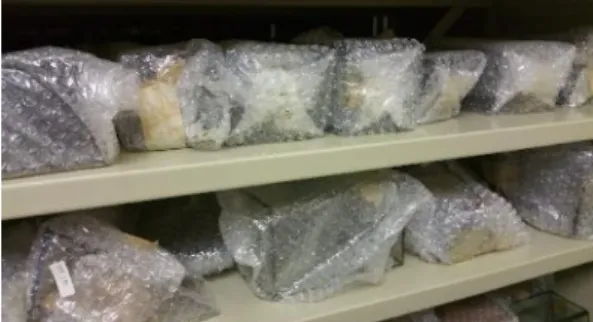
In the beginning of this study, half of the Passos Manuel glass crystal model’s collection was still packed in a bubble wrap (Figure 3) as they came from the school, with a register number label, also from the Passos Manuel, correspondent to the list of models that entered the museum from their collection.
In 13th of October, the glass crystal models collection started to be inventoried by Mrs. Manuela Mineiro, a former physics teacher in Passos Manuel high school and current MUHNAC’s Volunteer, who helped packing and organizing the collections in Passos Manuel high school before moving to the museum.
The glass crystal models collection integrates 98 models composed mostly by glass, but also by other components with different materials such as: paper and cardboard, textile threads, adhesives and
7 This chapter is part of Peixe, C. et al, Glass Crystal Models: A first Approach to a Hidden Treasure of Teaching and
Scientific Heritage, Heritage, Lisbon, Portugal (2019) [13] presented in Appendix I
Figure 3. Glass crystal models from Passos Manuel high school packed in bubble warp in MUHNAC’s
8
paper/textile adhesive tapes and metal nuts and screws, each one with different purposes that gives models different typologies, presented on Table 1.
Table 1. Consistent typologies identified in the Passos Manuel glass crystal models collection (Pictures: MUHNAC, ®C. Peixe,
February 2019).
Typology
Reference Brief Description Qty. Example
A Glass model with textile lines inside, representing
the crystal axes 63
UL
-DE
P1268
B Glass model with interior model of cardboard
representing the crystal axes 24
UL
-DE
P1269
C Glass model with two rotating parts, showing the
ability of the crystal to acquire different forms 8
UL
-DE
P1309
D
Glass models that do not fit any of the
characteristics mentioned above, probably due to previous repairs
3
UL
-DE
P1244
Besides the characteristic materials of the different typologies of models from Table 1, there are other materials present in the models: adhesive to join the edges of the glass faces, paper/textile adhesive tapes to give support to the joining edges, and a few paper labels with printings and/or manuscript ink, all with different correspondences and attached at different moments in time.
Although models may be divided and fit in the four categories as evidenced in Table 1, during their first observation, a label from Krantz company was identified in 4 glass crystal models. So, since the first classification gives no clue to its production provenance and it was possible to buy sets of models with characteristics of types A, B and C, it was necessary to reorganize them and see other differences beyond those mentioned in Table 1. The paper adhesive tapes that join the glass edges are not the same for all the models, neither in colour nor in width and texture; they came in black, blue, red and/or light yellow and some look like a textile, while others appear to be a plastic material. The paper models inside the glass models can be of the same colour (off-white paper colour), or can have two colours, alternated sides, one off-white paper colour and the other black or Bordeaux. The textile lines inside the glass models can also have different colours, ranging from red, orange, yellow, green and blue. From the 98 models it was possible to identify 1 model with a cleavage interior plan made of glass (Figure 4a). For some models, the different features identified – either different coloured paper adhesive tapes, or the presence of gypsum
9
– can probably be related with later interventions made overtime due to usage of the objects. Also, it was noticed that 4 of the 98 models reveal labels from the Krantz company.
Combining and analysing the different characteristics mentioned above and matching the models with Krantz’s Company catalogues 29 and 29b, dated 1925 and 1936 respectively [14], it was possible to suggest a provenance for different types of models within the collection, as presented in Table 2.
Table 2. Proposal for a provenance scheme of the Passos Manuel glass crystal models collection.
Model Reference Provenience Qty.
I Krantz Company Models 85
II Modified Models 12
III School-manufactured Models 1
From the total 98 models, 85 are possibly from Krantz Company with different year of production. Four examples of these models are shown in Figure 4.
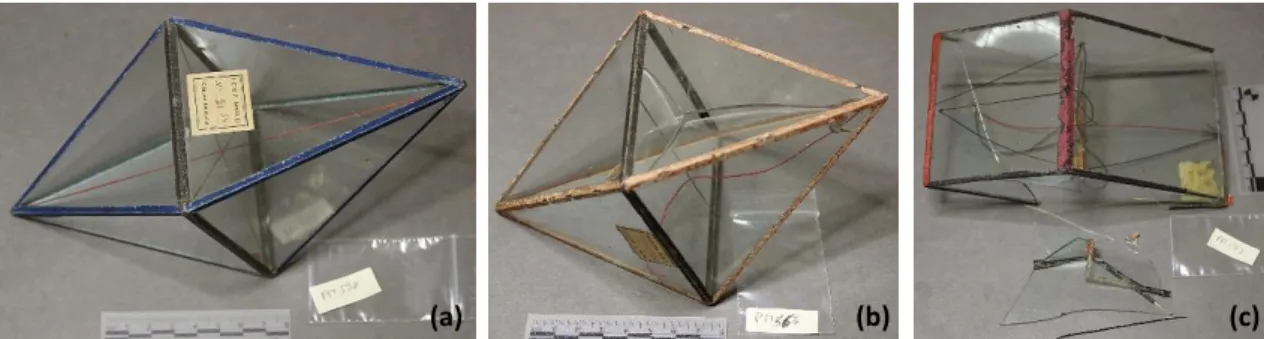
Figure 4. Glass crystal models from Passos Manuel high school collection in the MUHNAC’s technical storage proposed to
be from Krantz’s company different generation: (a) Glass crystal model (UL-DEP1321) with inner glass plan; (b) Glass crystal model (UL-DEP1309) with metal nuts and; (c) Glass crystal model (UL-DEP1240) with inner textile lines in red; (d) Glass crystal
model (UL-DEP1280) with inner textile lines in red and yellow and blue red and black adhesive tapes. Pictures: MUHNAC, ®C. Peixe, February 2019
The first models reveal only black paper/textile adhesive tapes (Figure 4a and 4b), with different textures and integrity (possibly indicating different generations). This contrasts with the coloured paper/textile adhesive tapes (red and blue) from Figure 4d. Referring to inner textile lines, the evolution occurred from one colour (Figure 4c) to several colours (Figure 4d) such as red, green, yellow and orange. So, among these 85 models it is possible to notice the evolution of these characteristics and divide them into four distinct types (Figure 4) that could represent four generations of glass crystal models made by the Krantz Company, possibly acquired in different moments [4] [14].
For the remaining 13 models of Passos Manuel high school collection, it is not possible to visually assume and recognize any characteristic from the original Krantz models, due to the heavy alterations in its conditions. One of these 13 models, UL-DEP1249, is believed to be a school-manufactured model, for several reasons: the paper/textile adhesive tapes are present in two different shades of green (which is never present in any other model, particularly in the Krantz company models); the inner paper/cardboard model is substantially different from the ones present in the other models, portraying two different
10
shades of white; the inner paper/cardboard model is supported by two wooden pieces, similar to toothpicks, possibly included to prevent this component from moving – this supporting technique is not found in none of the other models (particularly in the ones from Krantz company); lastly, the UL-DEP1249 model contains a label with a person’s name, possibly the name its manufacturer.
2. Methodology
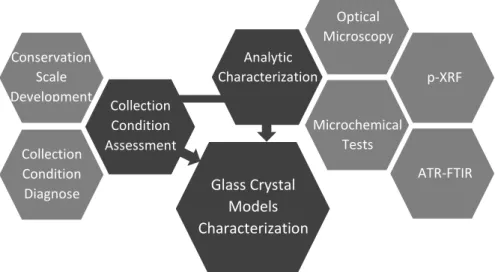
For the development of the proposed study, the methodology presented in Figure 5 was adopted.
To obtain the glass crystal models characterization, two main methods were considered. The collection’s conservation condition needed to be evaluated in greater detail and the analytical characterization of the models needed to be further identified using the different techniques presented in Figure 5. These two steps would culminate in the glass crystal model collection from Passos Manuel high school full characterization by assessing the conservation conditions of the individual models and the global collection, as well as all attempting the general identification of the original materials present in the models.
After the initial analysis presented in Chapter 1, the first step was to properly conduct the collection conservation condition diagnostic. This was divided in two sub-steps: first, a conservation scale was developed (Chapter 2.1) that consisted in comparing the scale used in the MUHNAC with references present in specific literature [15] [16], with the aim of developing a scale more adapted simultaneously not only to the reality of glass crystal models individually, but also that could evidence the conservation condition of the overall collection. Each of the 98 models were evaluated according to the developed scale, to further complement the macro observation already performed in Chapter 1.2.1, emphasizing the current physical and chemical alterations to its conditions. The main results of this assessment are presented in greater detail in Chapter 3.1.
Figure 5. Scheme of the methodology adopted in the present study
Collection Condition Assessment Collection Condition Diagnose Conservation Scale Development Analytic Characterization Optical Microscopy Microchemical Tests p-XRF ATR-FTIR Glass Crystal Models Characterization
11
The analytic characterization was made using four different analytical techniques with results being presented in Chapter 3.2. The first technique used was the optical microscope (OM) with the objective of observing paper and textile fibres from paper/textile adhesive tapes from the model’s edges and from the inner textile lines. Then, the inner cardboard/paper models and labels, suspected to be constituted by industrial paper due to the time of production of the models and its direct connection with the Krantz company production, as presented previously in chapter 1.2.1, were analysed by microchemical tests (MT) to see if specific materials were present in their composition, such as lignin, alumen salts and/or rosin, yielding the quality of the papers used to build the models. To analyse the glass, a portable X-ray fluorescence spectroscopy (p-XRF) equipment was used. And finally, it was necessary to analyse the adhesives used in different parts of the models, such as the edges of glass, paper/adhesive tapes, labels, and repairs. To do so, Fourier-transform infrared spectroscopy in attenuated total reflectance mode (ATR-FTIR) equipment was used to characterize the adhesives present in the models.
2.1. Collections condition assessment
The procedure to perform the collection’s condition assessment of the Passos Manuel high school glass crystal model collection was comprised in several steps. This procedure was applied to each model individually, to obtain a full evaluation of each model’s current condition; reviewing all these evaluations in a consolidated perspective, this procedure allows to, ultimately, assess the global collection’s condition. As mentioned previously, the main results of this assessment are presented in Chapter 3.1.
Firstly, the MUHNAC’s internal condition scale designed to evaluate history of science artefacts, developed in 4 states – good, reasonable, inadequate and poor – was considered. After consulting specific literature [15] [16], the need to create a costume scale for glass crystal models seemed more appropriate. This was due, as mentioned before, particularly to the specificity of this collection materiality, but also, bearing in mind that to larger collections or diverse – which are common in schools – this condition scale could be simpler to be applied, specially by non-conservators. So, an intermediate condition scale with 3 states – good, fair and poor – and 4 parameters to be evaluates using the mentioned states – lacunas, chemical alterations, physical alterations and object interpretation – was created and is presented in Table 3.
12
Table 3. Proposed condition scale for the assessment of a glass crystal model
Lacunas Other Physical
Alterations Chemical Alterations Object Interpretation
Good < 35% 5 / 4 5 / 4 Yes
Fair ≥ 35% and < 65% 4 / 3 / 2 4 / 3 /2 Yes
Poor ≥ 65% 2 / 1 2 / 1 No
Each parameter should be interpreted as follows:
• Lacunas: Represents the material loss in each component of the models, whether being glass, paper or adhesive, and should be evaluated as a percentage – the whole object corresponds to 100%, meaning the percentage of the lacuna represents the portion of the material that is missing. These percentages must be attributed in gaps of 5%, since this evaluation represents an estimation based on macroscopic visualization of the object; a more in-depth evaluation would require an extensive categorization of each lacuna’s size using an image processing software to determine a more exact percentage for this parameter. This parameter directly influences the “Object Interpretation” parameter: the higher the Lacunas percentage of the model is, the less accurate is the interpretation that can be made of the model;
• Other Physical Alterations: Represent the macroscopic alterations that can be visualized in the model, such as glass fissures, paper tearing, adhesive bond strength loss, amongst others. While the “Lacunas” parameter could be incorporated in this analysis, it should be noted that the “Other Physical Alterations” parameter is assessing the stability of these alterations. For example, if an adhesive bond strength is unstable, meaning its condition is deteriorating, this may result in the separation of the paper/textile adhesive tapes from the glass edges, which may impact in the “Lacunas” parameter (in this case, if the adhesive tapes are lost, the “Lacunas” parameter would increase in value). This parameter should be evaluated on a scale of 1 to 5: 1 represents the most unstable conditions and 5 the most stable state;
• Chemical Alterations: Represents the macroscopic alterations that can be visualized in the model, and that one can associate with the commonly observed characteristics that are associated with chemical alterations of the different materials. For example: in glass, checking for the presence of crystals or iridescence; in paper, the existence of acid hydrolysis phenomena, resulting in the yellowing of the paper; in adhesives, the occurrence of cross-linking phenomena, which turns the adhesive yellow, causing it to lose its bond strength. This parameter should be evaluated according to the scale used in the “Other Physical Alterations” parameter. It is important to note that the chemical and physical alterations are always related, influencing each other;
• Object Interpretation: Represents the inference that can be extracted from the object’s current condition, in respect to the model’s original form. This parameter should be evaluated using a Yes/No
13
scale, depending on if it is possible or not to perceive the original form of the object. Yes – If it is possible; No – If it is not possible or if it is severely compromised.
Considering these parameters, each individual component should be evaluated, resulting in the average of all the attributed values, except for the “Lacunas” column where the attributed values should be summed to identify the total “Lacunas” in the model. Table 4 represent the resulting table applied to the example of model UL-DEP1308, presented in detail in Figure 6.
Table 4. Condition assessment example of the model UL-DEP1308
Lacunas Other Physical Alterations Chemical Alterations Object Interpretation Labels 5% 3 2 Yes
Paper Tapes 15% 3 4 Yes
Glass 10% 4 5 Yes
Cardboard Model 5% 3 3 Yes
Inner Lines - - - -
Glass Crystal Model 35% 3 3,5 Yes
Object Condition Fair
2.2. Analytic characterization – Analysis conditions7
The methodology hereby presented was already published by the research team in the article previously mentioned [13] (see Appendix I). Inner textile lines and paper/textile adhesive tapes were analysed by optical microscopy (OM). Different images were obtained with an Axioplan 2ie Zeiss microscope equipped with a transmitted and incident halogen light illuminator (tungsten light source, HAL 100); UV light (mercury light source, HBO 100 illuminator); and a digital Nikon camera DXM1200F,
Figure 6. Details from model UL-DEP1308 from Passos Manuel high school collection currently in the MUHNAC.
14
with Nikon ACT-1 application program software, for microphotographs. Samples were analysed with 10x ocular lenses and 5x/10x/20x/50x objective Epiplan lenses (giving total optical magnification of 50x, 100x, 200x, and 500x). Fibres were observed under OM, identified and categorized by morphologic characteristics [17]. The fibres samples were prepared with distilled water and separated from one another with the help of a needle under a magnifying lens and then mounted on the microscope slide for longitudinal view from lowest to higher magnification, under simple polarized light and cross polarized light. In total 33 samples of fibres were analysed, 6 of inner textile lines from 5 models of type A (Table 1), and 27 of paper/textile adhesive tapes from 15 models, on six different colours.
Microchemical tests were performed in samples of inner cardboard models (type B, Table 1) and to samples of paper labels. The Phloroglucinol Test was applied for lignin detection, using 1g of phloroglucinol dissolved in a mixture of 50ml methanol, 50 ml concentrated HCL and 50ml distilled water, according to TAPPI T401 norm [18]. The Aluminon Test was applied to check the presence of alumen salts, using a solution of 0.1g aluminon in 1l of distilled water [19]. The micro samples were placed on a glass rod and a small drop of each solution placed on different fibre sample where colour change was checked with the help of stereo binocular microscope. In the inner paper/cardboard models samples the Raspail Test was also tried for rosin detection, using an adapted methodology based on the TAPPI T408 norm [20]. First, a drop of saturated sugar solution (35g sucrose/20ml water) was applied into the sample placed on the glass rod, allowed to soak for one minute, and then the excess sugar solution was removed with filter paper. Follows the application of one drop of sulphuric acid (96.6% H2SO4) on sample and its observation with the help low power magnification. The reaction should be immediate, and the colour change may reveal the presence of alum rosin sizing [19].
Portable XRF was performed in situ, using Bruker S1 Titan Model 600, directly to the glass of 15
models, to determine the type of glass used to build the models. Three points were analysed for each
model and the spectra were acquired under the following conditions: the excitation source is a Rh target X-ray tube of 4W, with maximum voltage of 50kV and 100µA, elemental range between Mg and U, and acquired with the integrated acquisition mode calibration GeoExploration, that operates at a 3-phase reading (90s totally): phase 1 at 30kV, 26 µA; phase 2 at 50kV, 26 µA; phase 3 at 15kV, 26 µA (30s each). Quantitative results were obtained with the automatic quantification proprietary software, Bruker Elemental S1. The elements initially not presented in oxides were then converted through oxide factors. To validate the obtained results, the glass standards from the CMoG B and D types were analysed under the same conditions [21].Samples of adhesives on paper/textile adhesive tapes and on adhesives that join the glass surface were analysed by infrared spectroscopy in attenuated total reflectance mode (ATR-FTIR). The spectra
15
were acquired using an Agilent Handheld 4300 FTIR Spectrometer with a DTGS detector, with controlled temperature, and a diamond ATR sample interface; the analyses were performed at the sample surface. All spectra were obtained with a resolution 8 cm−1 and 32 scans. In total, twenty adhesive samples were analysed.
From the categorization (Table 1 and 2), it was possible to select 15 models that may be considered representative of the collection. The first criteria was to select models from each typology presented in Table 1: 6 models from type A, 6 from type B, 1 from type C and, finally, 2 models from type D, ensuring access to all the materials that can be found in the models. The conservation state of the models was also considered: poor and fair condition models were preferred, since it is easier to collect samples and access to the interior materials in models that are less cohesive structurally. The selection comprehends, at least, 9 models attributed to the Krantz company, 5 altered models and 1 model that is proposed to be the only one that corresponds to the possible school-manufactured model (UL-DEP1249). All samples had a maximum size of a few millimetres and were collected from areas where the exterior glass was broken, areas that presented damage, (for example, ripped textile inner lines or detached paper/textile adhesive tapes) or samples where the adhesive was loose and accessible, and so, where the removal would not compromise the integrity of the object.
3. Results
3.1. Collection condition assessment
Through the condition scale presented in Chapter 2.1, it was possible to evaluate the 98 glass crystal models from the Passos Manuel high school, resulting in the collection’s consolidated overall condition. These results are presented in Table 5, with examples of each state presented in Figure 7.
Table 5. Assessment of the Passos Manuel glass crystal model collection overall condition
Collection Condition State Qt. (%) Description Needs Good (Figure 7a) 28%
All components are in place and the models seem complete.
These models are physically and chemically stable; Regular care and monitoring.
Fair
(Figure 7b) 49%
The components are partly fractured, teared, weakened or
discoloured, but the models’ integrity is not in total risk.
These models might need special storage or more frequent monitoring to
better evaluate the materials’ stability;
Poor
(Figure 7c) 23%
Some components or parts may be missing and exists lack of adhesion between materials.
These models need an urgent treatment or special storage to avoid losing: part of a component and its correspondence
to the model; losing any important information; or losing the whole object;
16
Analysing the results presented in Table 5, it is important to emphasize that most of the collection’s models are in a good or fair condition, representing 77% of the overall collection. An overall assessment in which only 23% (less than a quarter) of the models are considered in poor condition can be considered very positive for the collection’s preservation, when considering that glass crystal model collections have, inherently, a very fragile nature due to the materials that constitute these models. Furthermore, when analysing the poor condition models in greater detail, it is also important to understand that the poor condition in the Passos Manuel collection could be substantial worse than the condition observed in the example of Figure 7c. This is evidenced by comparing the poor condition models of this collection with models of other scientific collections of similar contexts, such as the glass crystal model collection from the Pedro Nunes high school, presented in Figure 8.
The overall conditions in which the Pedro Nunes high school collection are stored, as exhibited in Figures 8a and 8b, can be considered deficient when compared to the monitoring and storage conditions that the Passos Manuel collection has available in the MUHNAC technical storage. This causes the models of the Pedro Nunes collection (mainly compose by Krantz company models) to be quite fractured, such as the example presented in Figure 8c. The poor condition of the example model is considerably worse than the poor condition model of the Passos Manuel collection presented in Figure 7c: despite both examples presenting fractured glass, the adhesives present in the model from figure 8c reacted differently to the
Figure 7. Examples of condition states from the Passos Manuel collection: (a) model in a good conservation
condition, UL-DEP1295; (b) model in a fair conservation condition, UL-DEP1292; (c) model in a poor conservation condition, UL-DEP1323. Pictures: MUHNAC, ®C. Peixe, November 2018
(a) (b) (c)
Figure 8. Pedro Nunes high school glass crystal models collection: (a) example of the overall collection’s storage
conditions; (b) example of the bubble warp conditioning used in the models; (c) example of a poor condition model Picture: Pedro Nunes high school, ®C. Peixe, November 2018
17
bubble wrap conditioning, which lead to the adherence of the paper/textile adhesive tapes from the models to this bubble wrap packaging, deteriorating even further the model’s already poor condition.
3.2. Analytical characterization results7
The analytical results obtained are presented by type of component, following the methodology as presented in Appendix I [13]. This allows to analyse all the information related to each component in a consolidated way, so that, all the different technical results performed in each component appear together, in order to better identify all the materials for each individual component. Doing so will enable to clarify, inside a component, which material is degrading the other or vice-versa, and understand if each material, per component, are original or post-fabrication repairs.
The presentation order is from the model’s outside layer to the most inner one, to respect the order from the diagnosis procedure. From the 15 models that constitute the sample of the collection, there are five characteristic components identified and analysed, as follows: first, the paper/textile adhesive tapes and the adhesives form the joining edges analysed by OM and ATR-FTIR; then, the paper labels and the respective adhesives analysed by MT and ATR-FTIR; next, the glass characterization using p-XRF; the inner paper/cardboard models using MT; and finally, the inner textile lines using OM.
3.2.1. Paper labels
The different types of paper labels present in the glass crystal models from the Passos Manuel high school collection are presented in Figure 9.
The labels identified are as follows: the label from Passos Manuel high school (“Liceu P. Manuel”), shown in Figure 9a, which makes the correspondence with a list of the names from the different crystal representations; smaller labels (Figure 9b), whose correspondence is undetermined; current register labels (Figure 9c), a number attributed at Passos Manuel high school to each model from the collection enter the museum. Apart from these three main labels, that appear in most of the models, there are labels from the Krantz company (Figure 9d) present in 4 different models, and a few other different types of labels (Figure 9e) present in 15 models, such as labels with names or numbers, with no matching correspondence determined. From the labels described, the only one that was not considered historic is
(a) (b) (c) (d) (e)
Figure 9. Glass crystal models labels: (a) Liceu P. Manuel; (b) Smaller labels with no given correspondence; (c)
![Figure 1. 3D models: (a) Terracotta prize model from Romé de I’Isles [2]; (b) Wood model from a box (UL-DEP1325) from Passos Manuel high school collection, currently in MUHNAC’s technical storage (Picture: MUHNAC, ®C](https://thumb-eu.123doks.com/thumbv2/123dok_br/15842792.1084539/25.892.216.683.518.703/figure-terracotta-passos-manuel-collection-currently-technical-picture.webp)