Current and Future Chemotherapy
For Chagas Disease
Luís Gaspar
1, 2, Carolina Moraes
3, Lúcio Freitas-Junior
3, Stefania
Ferrari
4, Luca Costantino
4, Maria Paola Costi
4, Ross P. Coron
5,
Terry K. Smith
5, Jair L. Siqueira-Neto
6, James H. McKerrow
6and
Anabela Cordeiro-da-Silva
1, 2, 71
i3S – Instituto de Investigação e Inovação em Saúde, Universidade do Porto, Portugal;
2 IBMC – Instituto de Biologia Molecular e Celular, Universidade do Porto, Portugal; 3
Laboratório Nacional de Biociências, Centro Nacional de Pesquisa em Energia e Materiais - Campinas, Brazil;
4
Dipartimento di Scienze della Vita, Università degli Studi di Modena e Reggio Emilia, Via Campi 183, 41125 Modena, Italy;
5
Biomedical Sciences Research Complex, University of St Andrews, North Haugh, St Andrews, Fife, KY16 9ST, UK;
6
Skaggs School of Pharmacy and Pharmaceutical Sciences, University of California San Diego, La Jolla, California, United States of America;
7
Faculdade de Farmácia da Universidade do Porto, Departamento de Ciências Biológicas, Portugal;
Address correspondence to Anabela Cordeiro-da-Silva, [email protected].
Keywords:
Trypanosoma cruzi, Chagas disease, benznidazole,
nifurtimox, drug discovery, chemotherapy.
Originally published at Current Medicinal Chemistry, 2015, 22(37):4293-312,
doi:10.2174/0929867322666151015120804, Bentham Science. The published manuscript is available
at EurekaSelect via
http://www.eurekaselect.com/openurl/content.php?genre=article&doi=[10.2174/092986732266615 1015120804].
ABSTRACT
Human American trypanosomiasis, commonly called Chagas disease, is one of the most neglected illnesses in the world and remains one of the most prevalent chronic infectious diseases of Latin America with thousands of new cases every year. The only treatments available have been introduced five decades ago. They have serious, undesirable side effects and disputed benefits in the chronic stage of the disease - a characteristic and debilitating cardiomyopathy and/or megavisceras. Several laboratories have therefore focused their efforts in finding better drugs. Although recent years have brought new clinical trials, these are few and lack diversity in terms of drug mechanism of action, thus resulting in a weak drug discovery pipeline. This fragility has been recently exposed by the failure of two candidates; posaconazole and E1224, to sterilely cure patients in phase 2 clinical trials. Such setbacks highlight the need for continuous, novel and high quality drug discovery and development efforts to discover better and safer treatments. In this article we will review past and current findings on drug discovery for Trypanosoma cruzi made by academic research groups, industry and other research organizations over the last half century. We also analyze the current research landscape that is now better placed than ever to deliver alternative treatments for Chagas disease in the near future.
INTRODUCTION
Chagas disease is named after the Brazilian physician Carlos Chagas who first described the disease in 1909 [1]. Chagas disease is caused by the parasite Trypanosoma cruzi and is considered to be the parasitic infirmity with the biggest social and economic burden in Latin America [2]. There is an estimate of 7-8 million people currently infected with T. cruzi, while there are approximately 25 million people at risk of acquiring the disease [3]. Every year, Chagas disease claims 10,000 deaths in endemic countries [4]. The parasite has a complex life cycle, alternating between the mammalian host and the hematophagous triatomine insect vector. The infection begins when the infected bug feeds on the host, which can be a wild or domestic mammal or a human. Infective metacyclic trypomastigote forms of T. cruzi are found in the feces of the bug which are released during the blood meal, and gain access through the lesion to infect dendritic cells [5]. Once inside a cell, the parasite breaks free of its entering organelle, the endosome/lysosome, and differentiates into a replicative amastigote form. The amastigote divides several times and maturates in to bloodstream trypomastigotes that rupture the host cell and are released in to the bloodstream or lymph, free to infect a wide range of cells or be ingested by the transmitting vector, thus closing the cycle. In the triatomine gut, the parasite transforms once again in to a replicative stage called the epimastigote and after clonal divisions it migrates to the final portion of the intestine and differentiates again in to infectious metacyclic trypomastigote.
Although vectorial transmission has been greatly reduced due to vector control campaigns carried out by the World Health Organization (WHO), the Pan-American Health Organization (PAHO) and national health ministries of participating countries, there are still about 41,000 [6] new cases each year due to vectorial transmission. Many thousands of cases can be also attributed to secondary infection routes like transfusion of contaminated whole blood and derivate products, transplant of organs from chronically infected patients, congenital and oral transmissions. Oral transmission is a growing concern, with 138 outbreaks responsible for the appearance of 776 new cases in the period of 2000–2010. Oral infection is usually acquired through ingestion of food, sugar cane and other juices, water or soup contaminated with infected triatomines or their feces [7]. Moreover, human migration in recent years has
increased the incidence of new cases in non-endemic countries, making Chagas disease a public health issue in North America, Europe, Japan and Australia, requiring governments to implement screenings for blood and organs donations, as well as implement infrastructures to treat infected patients [8].
Due to the huge vertebrate reservoir and the variety of triatomine insects, the eradication of this zoonotic parasite is practically impossible [9].
The symptomatology of Chagas disease may vary according to the route of infection: while vectorial transmission is usually asymptomatic or presents non-specific symptoms, oral infection may increase the chance of acute cardiomyopathy because of the higher parasite loads associated. About 20 to 30% of acute cases develop serious chagasic cardiomyopathy with evolving symptoms and the risk of sudden death [10]. Fifteen to 20% develop digestive tract manifestations. The remaining infected individuals are considered to have the indeterminate form of the disease and the majority may not have symptoms or signs of the disease for all their life [10].
To treat new acute cases, indeterminate phase patients or reactivations from chronic patients, the only drugs available were introduced more than four decades ago, with no alternatives. Benznidazole and nifurtimox (Fig. 1A& B) are effective in treating acute infections, but efficacy is thought to decrease with the disease progression, with little to no effect in the chronic phase. Additionally, they must be administrated for long periods of time and display numerous side effects. Some of the most serious side effects require monitoring and ultimately, treatment interruption.
For the above reasons, new drugs to fight this disease are a dire need. New formulations of old drugs, old drugs with new applications as well as innovative drugs are feeding the pipeline for the treatment of Chagas disease [11]. In the following sections we will discuss the therapies available today and their limitations followed by the advances in the drug discovery and the candidates currently in preclinical and clinical studies to treat Chagas disease.
CURRENT THERAPIES
Benznidazole. Benznidazole (Fig. 1A) is a nitroimidazole (N-benzyl-2-(2-nitro-1H-imidazol-1-yl)acetamide) discovered in 1972 at Roche Laboratories, and originally marketed as RochaganTM or RodanilTM. Despite being introduced several decades ago, it is still the frontline treatment for the disease, although it is not approved by FDA [12]. Benznidazole is considered to be effective in reducing symptom severity and to shorten the clinical course and the duration of detectable parasitemia. Clinical cures are thought to be achieved in 60 to 85% of the acute cases and in more than 90% of congenitally infected infants, if treated in their first year of life [13]. Efficacy of benznidazole in chronic Chagas diease is still debatable, with reports varying from 15-35% of cure rates [14, 15]. The benefits of the drug in preventing cardiac and/or megacolon and megaesophagus manifestations were not clear for a long time [16]. To address this uncertainty, a large, multicenter, double-blind, randomized, placebo-controlled clinical trial called BENEFIT (The Benznidazole Evaluation For Interrupting Trypanosomiasis, Clinical Trials.gov, ID: NCT00123916) with 3,000 patients in several endemic countries has recently been concluded and demonstrated that a daily dose during 40 to 80 days of treatment failed in reducing mortality and morbidity in patients with chronic Chagas cardiomyopathy [17]. Problems with precise dosing in young children and the adverse effects observed has led to the development of a new pediatric formulation of benznidazole.
This lower dose, easily dispersible tablet that should improve dosing accuracy, safety, and adherence to treatment is currently in clinical trials (Population Pharmacokinetics Study of Benznidazole in Children With Chagas' Disease -Pop PK Chagas, ClinicalTrials.gov, ID:NCT01549236). A previous clinical trial by the same team already validated the use of a lower dose benznidazole regimen for children aged 2 to 12 years old (Population Pharmacokinetics of Benznidazole in Children With Chagas Disease, ClinicalTrials.gov, ID:NCT00699387) [18]. Recently, a study on the pharmacokinetics of a new formulation of benznidazole (Abarax®, Elea Laboratories) in adults with Chagas disease also suggested that a dose reduction may be feasible [19].
The mechanism of action of benznidazole is thought to require the reduction of its nitro group by a trypanosomal NADH-dependent type I nitroreductase with generation of cytotoxic products that lead to thiol depletion and that can readily form adducts with many biological macromolecules like proteins, lipids and DNA that disrupt normal cell function and metabolism [20]. It is also thought that T. cruzi NADH-fumarate reductase inhibition, phagocytosis improvement and death by INF-γ are additional mechanisms involved in parasite killing by benznidazole [21]. On the other hand, reduction by human liver NADPH, cytochrome P-450 reductase, P450, xanthine oxidase and aldehyde oxidase are thought to be responsible by the adverse side effects in patients [22].
While treatment with benznidazole is usually well tolerated by infants and children [23], adults frequently report adverse effects [24]. The most common side effect is dermatitis from hypersensitivity to the drug, appearing in up to 50% of the patients, usually after 10 days on the treatment, and for this reason, onwards weekly monitoring is recommended [25]. Digestive intolerance, peripheral neuropathy, depression of bone marrow, toxic hepatitis and lymphomas are other occurring side effects. Treatment interruption is most frequently due to dermatitis and digestive intolerance, although studies reveal that low-fat and hypoallergenic diet and daily dose administrations can reduce their incidence [25]. In addition, benznidazole should not be administered to pregnant women nor patients with severe renal or hepatic dysfunction, because of drug metabolization by these organs [26]. Exposure to the drug through breastfeeding is thought to be limited and unlikely to pose a risk [27].
Resistance to benznidazole has been reported under experimental conditions, however it is not yet clear how drug resistance correlates with benznidazole therapeutic failure in chagasic patients. An example is the Colombian strain, with benznidazole only being able to cure up to 16% of the mice infected with different clones [
28]. In vitro results using real-time PCR suggest nitroreductases (NTRs) as the main mechanism of resistance in vitro, probably due to loss of a NTR gene copy [29]. A recent study warns of the relative ease in which benznidazole can develop resistance in vitro by a couple of different mechanisms such as chromosome loss and different point mutations in the NTR gene, all arising from a single population [30].
Nifurtimox. Nifurtimox ((R,S)-3-methyl-N-[(1E)-(5-nitro-2-furyl)methylene]thiomorpholin-4-amine-1,1-dioxide) a 5-nitrofuran derivative (Fig. 1B), constitutes the second and only alternative to benznidazole for the treatment of Chagas disease. Like benznidazole, the FDA has not yet approved chemotherapy of Chagas disease with nifurtimox. Also known as Bayer 2502, the drug, marketed as LampitTM, was originally discovered in that pharmaceutical company in 1965, exactly 50 years ago and provided, for the first time, a treatment for chagasic patients. It is also used in combination therapy with eflornithine to treat second stage
Human African trypanosomiasis caused by the parasite Trypanosoma brucei gambiense [31, 32].
Nifurtimox efficacy is similar to benznidazole, but it has a much higher frequency of adverse effects [13, 26]. There is a frequency of adverse effects in 98% of patients, with only 56% of them completing the 60-day course treatment and 29% not tolerating it for more than 30 days. Digestive symptoms are predominant and neurological alterations the most persistent. An estimated 7% of patients had severe adverse effects like angioedema, myocarditis and grade-3 anaphylactic reactions [grade-3grade-3].
Recently, a study highlighted the possible biochemical mechanisms that may be associated with some of nifurtimox adverse side effects and as well as from other nitro-aromatic derived drugs [34].
Nifurtimox acts through a mechanism of intracellular nitro-reduction with the generation of the nitro radical, followed by redox cycling. In contrast, there is a greater role for oxygen reactive species, like superoxide ion and hydrogen peroxide which are toxic to T. cruzi. This parasite is sensitive to oxidative stress due to weak detoxification mechanisms due to the absence of catalase or peroxidase activity and reduced superoxide dismutase activity [21, 35]. RNA interference studies on Trypanosoma brucei show that besides NTR, other proteins linked to ubiquinone synthesis are also involved in nifurtimox mechanism of action in that species, and it is likely that the same mechanism is also present in T. cruzi [36].
Resistance to nifurtimox is readily obtainable in vitro and it seems parasite nitroreductases play a major role in its resistance, mounting up evidence that cross-resistance with benznidazole can occur as has been reported [37, 38], increasing the pressure to find alternative drugs to treat patients refractive to the only available therapies.
DRUG DISCOVERY AND DEVELOPMENT FOR CHAGAS
DISEASE
Drug Discovery Strategies. Various approaches can be adopted when considering the development of new drugs, and the field of neglected tropical diseases in particular has employed distinct strategies in the search [39]: (i) “De novo synthesis” is a classical way that focuses on the identification of new chemical entities through target discovery and compound screening. Although this is an important strategy to consider in the discovery of novel drugs for neglected diseases, it is a long-term approach. There are constrains like a high attrition rate of candidate compounds and the need for significant human and financial resources. Because of those issues and the perspectives of low market return and profits, the majority of companies do not make neglected tropical diseases a priority [40]. Populations affected by neglected diseases, and Chagas disease in particularly, are economically poor and don’t have the means to pay for expensive medication [41]. (ii) “Piggy-back” discovery is the name given to a process that takes advantage of prior research for an unrelated disease. It uses the data and chemical start points previously generated for a molecular target also present in the organism of interest. An example is the use of kinase inhibitor research data from cancer treatment to provide shortcuts for the development of a kinase inhibitor against a parasitic target. (iii) Label extension or drug repurposing is the approach with the most immediate results, in that it uses already approved drugs for some pathologies, and re-purposes them to be used in neglected diseases, saving considerable time and costs for approval processes after efficacy confirmation. Most of the toxicological data and often clinical tests are already
available. An example of successful application of this strategy is the case of praziquantel for schistosomiasis and ivermectin for filariasis/onchcocersiasis [39, 42]. More recently, auranofin, an approved drug for rheumatoid arthritis, has been identified as an amebacide [43] and a clinical trial is being launched in Bangladesh. So far, no drug has been repurposed for Chagas disease but some studies are devoted to find an extension for existing drugs employing both in vitro and in silico screening strategies [44, 45].
Independent of the strategy used, an essential feature of the drug discovery process that plays a guiding role is the target product profile (TPP). TPPs are a set of criteria to be followed through the development process and describe the needs and characteristic that the new candidate has to meet in order to constitute an improvement over the current available therapies. Drugs for Neglected Diseases initiative (DNDi), a non-profit drug research and development organization founded with the objective to develop therapies for neglected diseases, has recently updated a TPP for Chagas disease [46].
Starting Points: Screening for Hits. Two different approaches can be taken to identify starting points for drug discovery: a molecular target or target-based approach, and a phenotypic approach, also known as untargeted drug discovery. Target-based drug discovery relies on the previous discovery and characterization of a given molecular target and subsequent target validation by chemical or genetic means. Each has advantages anddisadvantages [47]. Ideally, a target should be validated by more than one method. Chemical and biochemical validation is the proof that a molecular target, usually a protein, is able to be inhibited by a small molecule and that the use of such molecule in the parasite and/or in vitro and in vivo models of the disease leads to deficient parasite grow or ability to establish a normal infection. Genetic validation implies the reduction or elimination of the molecular target at the cellular level and the consequent observation of the interference in the parasite fitness/survival. The only reliable way to genetically validate a protein target in T. cruzi is by gene-knockout. Because of the low recombination potential of the parasite and slow growth kinetics, these transgenic techniques are extremely hard and time consuming to perform, with high failure rates and many weeks just to select stable transfected cells [48]. Unfortunately and unlike the related species Trypanosoma brucei, T. cruzi does not have functional RNAi machinery. Apparently some of its components have been lost or mutated during evolution [49, 50]. Most recently, CRISPR-Cas9 technology has been successfully applied to T. cruzi with major breakthroughs like reduction of gene expression of an enzyme gene family consisting of 65 members [51]. Chemical validation of a target requires a very specific and selective inhibitor or probe for a given target. Both genetic and chemical approaches therefore have limitations.
After drug target validation, biochemical assays can be set up to screen for inhibitors. These assays usually make use of proteins, frequently of recombinant origin. In the past, many of the labs working with T. cruzi have screened only a small number of compounds, from either synthetic or natural origin. The scenario changed dramatically with the development of high throughput technology based on assay miniaturization and automation of protocols, from procedure to analysis. This opened the door to large scale screening campaigns for targeting T. cruzi. Among the advantages brought by these innovations are the reduction of time to screen libraries, assay cost reduction and data reproducibility. As an example, one high-throughput screen of 200 000 compounds against cruzipain, yielded 921 hit compounds that were subsequently screened by computational docking analysis to reveal 5 chemical scaffolds of common hits. These scaffolds are good starting points for further optimization and evidentiate the advantages of combining biological and bioinformatics analysis for priorization of molecules after an high-throughput screening campaign has been performed [52]. In
another example of target-based drug discovery, CYP51 from Mycobacterium tuberculosis was screened against a library of 20 000 organic compounds and resulted in two very active compounds [53], of which one (ChemDiv C155-0123) later showed selective inhibitory activity against the T. cruzi orthologous enzyme [54].
The limitations of molecular target approaches are the possibility of poor translation to a therapeutic effect, low druggability of the target, risk of off-target effects and the chance of redundant research by different groups since there are so few targets characterized [55]. To circumvent such limitations, phenotypic approaches have been developed. Instead of a single molecular target, whole cells are tested directly with the compounds and selection is made based on the observance of the required phenotype. This allows the selection of only those compounds that are active against the parasite, despite their mechanism of action. Also, it readily selects those compounds with the minimal pharmacodynamic and pharmacokinetic properties needed: proper intracellular distribution and accumulation, physiological binding and inhibition to target, etc., that are very difficult to predict with target-based strategies. However, this method requires that the target must be elucidated in the discovery process, a task not always easy but achievable [56]. The most recent trend in whole-cell assays has employed the use of high-content screening analyzers – automated microscopes that can image many conditions (compounds) in clear bottom culture microplates. When the technology appeared one assay was developed that made use of mammalian cells expressing GFP and parasites stained with DAPI, and both manual and automated data analysis was performed [57]. Because of limitations of genetically modified parasites/host cells, anotherscreening technology was developed that used unmodified cells and parasites. This assay was validated with a small library of FDA-approved drugs [44]. The development of analysis software further automates the campaigns and allows the additional mining of important data, for example, the toxicity for host cells [58]. The first multi-thousand screening campaign described in the literature has been recently published [59].
Balancing the benefits and disadvantages of both strategies in hit identification for parasitic diseases such as Chagas, phenotypic approaches emerged as the most promising methodologies [39]. Hits are selected for their ability to kill or not the parasite, coupled with cytotoxicity evaluation. When recent first-in-class new drugs, with innovative molecular mechanisms of action are tabulated, many of these were discovered by phenotypic screening (28 versus 17) [60].
From Hit to Lead and Beyond. Once single point hits have been obtained, the most promising are further validated in a dose-response-curve to confirm activity. Most guidelines suggest an EC50 lower than 10 μM as a good starting value, although recommendations can vary if other criteria are met, like a high selectivity index, for instance. The confirmed hits can also be subject to complementary activity assays. These can be of a different configuration, employ a different readout, or even assess activity against other strains. A recent paper shows that a set of compounds in clinical trials have significantly different activity profiles depending on the strain they are tested on [61]. As has been discussed above, it is a requisite of the TPP for Chagas disease that a future drug is active against a large set of different DTUs. Another key unanswered question is whether a compound must clear the infection totally, as the reference compound, benznidazole, does. Does total clearance of infected cells, or parasites in animals or humans correlate with multi-strain activity or, more importantly, with the clinical course of disease in the subsequent 20 years? Compounds that still meet agreed upon pharmacological and biological properties are called lead compounds. Leads are at the end of the screening campaign, but are the starting points of yet another phase in the drug
discovery and development called lead optimization. In this phase, compounds enter a cycle of further testing, commonly with in vivo testing of activity, PK/PD, and toxicity. Leads are optimized by a medicinal chemist to try to improve potency, selectivity, reduce toxicity and enhance pharmacokinetic parameters [40]. The medicinal chemistrynecessary for lead optimization is very costly and constitutes a bottleneck for many drug discovery efforts. Few in academia have the resources or access to the synthetic chemistry capacity necessary to produce the tens to hundreds of compounds usually required for lead optimization. Organizations such as DNDi and recently launched consortia-based projects like the FP7 (Seventh Framework Program supported by the European Commission) KINDReD (Kinetoplastid Drug Development), NMTrypI (New Medicines for Trypanosomatidic Infections), PDE4NPD (Phosphodiesterase Inhibitors for Neglected Parasitic Disease) and A-PARADISE (Anti-Parasitic Drug Discovery in Epigenetics) have attempted to address this issue by coordination or outsourcing.
The optimized lead compound is one which can be called a pre-clinical candidate and enter the pre-clinical phase.
Animal Models. Animal models are used to extract the maximum possible information on drug efficacy and toxicity before testing the drug candidates in humans. Since the translation of data is of the utmost importance, several animal models have been studied to reproduce the physiopathology of Chagas disease. Models including mice, rats, rabbits, dogs and non-human primates have been tried, but none of them completely mimics what happens in the human host [62]. The rat has been used in the past, but early observations concluded that it is somewhat resistant to T. cruzi infection, developing a mild and slow pathology [63]. Rabbits develop some of the chronic alterations such as focal myocarditis with a fibrous component, but do not show more severe forms of chronic myocarditis or the histological lesions in digestive track and skeletal muscles found in typical infections [64]. The Syrian hamster has also been proposed as an animal model for chronic Chagas cardiomyopathy but it was not able to reproduce all the characteristics findings of human cases [65]. Dogs, on the other hand, develop most of the clinical aspects of the disease found in humans. This includes modeling of the indeterminate stage of disease characterized by a latent infection without disease signs or symptoms and with normal electrocardiograms. Just a fraction of these animals develop chronic phase signs and symptoms [66, 67]. Monkeys are the closest phylogenetically related species to be used to study Chagas disease and results are more easily extrapolated to humans [67, 68].
Nevertheless, the mouse has remained the preferred animal model. Mice are easy to handle, house and are cheaper. Additionally, mouse models resemble many immunological, pathological and physiological aspects of human Chagas disease. One of the strains commonly used in experimental chemotherapy is Swiss mice, an outbred strain very sensitive to diverse T. cruzi genotypes [69]. Regarding inbred strains, Balb/C has also been extensively used and is considered one of the most susceptible to parasite infection in general [70]. C3H are a mildly resistant mouse strain commonly used to obtain chronic-like infection in these animals [71]. C57BL/6 are considered to be among the most resistant strains, although susceptibility can vary
Widely depending on the strain of trypanosome used [72]. This genetic background is frequently used to obtain chronically infected mice in attempts to reproduce the pathophysiology of the chronic human disease.
Chronically infected mouse models develop an anti-inflammatory infiltrate and fibrosis in the heart, hallmarks of the disease in humans, but still lack extensive fibrosis, segmental
myocardial abnormalities and macroscopic ventricle dilatation that closely resemble human chronic cases Chagas cardiomyopathy [65]. According to current protocols, four strategies have been employed to try to mimic chronic Chagas disease in mice: (a) a combination of susceptible mice strain, pathogenic T. cruzi DTU, age of animals and inoculation route that guarantees the survival of the animals to the acute phase; (b) infection of mice with a lethal dose of T. cruzi followed by the treatment with a reference drug that assures animal survival, but not parasite clearance; (c) infection of resistant strains of mice with sub lethal inoculum of low pathogenic DTU; (d) infection of animals immunized by attenuated strains with a pathogenic DTU [73].
There are also dozens of different T. cruzi strains that have been used in animal models of the disease. Each research group works with a limited set of biological specimens that may reflect the history of the lab. An illustrative example of this variability is the case of A/J and C3H/HePAS mice infected with the same clone of Sylvio X10/4. Distinct histopathological findings are reported, suggesting a host genetic role in the manifestations and progress of the disease [74]. This variability hinders the extrapolation of results to other animal models and, ultimately, to humans.
Recent guidelines for in vivo testing of compounds in Chagas disease drug discovery have been elaborated. One protocol suggests three independent and consecutive in vivo evaluations of drug candidates: (1) testing for the effect of the compound on parasitemia reduction using Swiss female mice infected with Y strain, three doses of compound with the highest one set at the maximum tolerated dose, orally or intraperitonially, and after five days of infection for a duration of five consecutive days; (2) analysis of parasitological cure during the acute phase using Swiss female mice infected with Y strain, with the dose established in the previous stage; (3) cure the acute phase of parasitemia caused by Colombian strain, which is benznidazole resistant [75]. Parasitemia is analyzed at 5, 8 and 10 days post infection (dpi) for (1) and (2) and at 20, 25 and 30 dpi for (3). Mortality is evaluated for all the three phases at 30 days and PCR, after immunosuppression with cyclophosphamide, to detect “latent” parasites. This technique was employed because it was proved to be more sensitive and time-efficient than haemoculture. All the tests are done against a positive control of 100 mg benznidazole per kilogram of weight per day [75]. The effectiveness in the chronic and indeterminate stage takes place later in the development process, and the lack of it does not invalidate the prospective drug since, if the TPP is followed, it should be already an advance over existing therapies.
Biomarkers. Another obstacle in the drug discovery for Chagas disease has been the lack of reliable biomarkers of cure. Traditionally, the definitive test of cure relies on conventional serology methods that have the limitation that it can take many years for the seroconversion to take place. Also, the majority of currently used methods employ crude antigen preparations from parasite life-cycle stages not present in the mammalian host. Polymerase chain reaction is the standard method of cure in the current clinical trials and although useful, there is no proof of efficacy and it is only an indication of sterile cure for a given therapy [76]. Newer tests using recombinant proteins or peptides may be anim provement, but results are often inconsistent [77]. A recent and promising discovery in the field has been the identification of unusual fragments of human apolipoprotein A1 (APOA1) that are specifically present in chagasic patients and seem to disappear after treatment with nifurtimox [78, 79]. In mouse models, different methodologies to access parasitological cures were used after treatment with benznidazole and found out that even mice considered cured by hematological criteria still showed positive PCR tissues, either indicating a residual infection or presence of remaining parasite DNA [80].
TARGET CANDIDATES IN THE PIPELINE
Ergosterol Biosynthesis Inhibitors. Inhibitors of sterol 14α-demethylase (CYP51) constitute a major fraction of all the drugs in the Chagas disease pipeline [11]. This enzyme is involved in the de novo synthesis of sterols in T. cruzi. While in mammals the major sterol is cholesterol, in plants, fungi and protozoa the major sterol present is ergosterol. The difference consists of a second double bond at the B ring and a fully saturated side chain with a methyl group at C24 in cholesterol [81]. CYP51 catalyzes a critical step of this biosynthetic pathway, removing the C14 methyl group from the sterol intermediate eburicol and originating 14α-demethyl-14dihydroeburicol [82].
Ergosterol biosynthesis inhibitors are among the most common drugs used to treat fungal infections, and after the validation of this pathway in T. cruzi, compounds that were originally developed as antifungals were tested against the parasite. While some of the early generation imidazoles (e.g. miconazole, ketoconazole) and triazole (e.g. itraconazole, fluconazole) sterol biosynthesis inhibitors have some attenuating effect on the infection, they failed in achieving parasitological cures [83]. However, as newer azoles to treat fungi infections are still an ongoing interest for pharmaceutical companies, later generation drugs have also been tested for anti- T. cruzi activity.
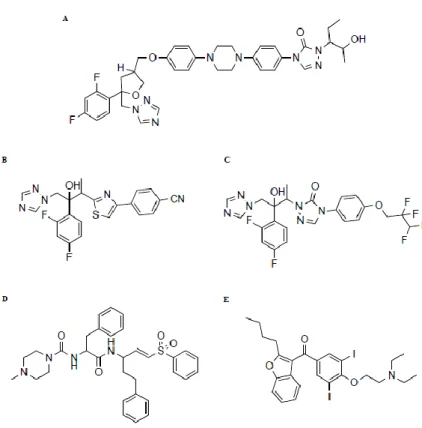
One of the most promising molecules of the past decade was posaconazole (Fig. 2A). This triazole originally marketed as Noxafil by Schering-Plough pharmaceutical and active against Candida spp. and Aspergilus spp. is one example of the previously described drug repurposing strategy. Early assays demonstrated its potent and specific in vitro activity against T. cruzi, especially against the amastigote stage. Moreover, the effect on murine acute and chronic models was curative, rather than suppressive, as some earlier tested antifungal compounds demonstrated [84]. Later, posaconazole also proved to be an efficient trypanocidal against benznidazole and nifurtimox resistant strains, even in immunosuppressed mouse models, where the parasite would have a favorable environment to multiply [85]. A comparative study between posaconazole and benznidazole in a mouse model of Chagas disease showed both drugs led to 100% survival rates, suppression of parasitemia and negative T. cruzi antibodies. Only posaconazole-treated mice had completely negative haemocultures 54 dpi, whilst 50% of the benznidazole-treated had positive results. Also, plasma enzymatic assessment of cardiac lesion was indistinguishable from uninfected control for posaconazole, but significantly higher for benznidazole [86]. These promising results led to two clinical trials: one phase 2 trial sponsored by Hospital Universitari Vall d'Hebron Research Institute (ClinicalTrials.gov, ID: NCT00349271, CHAGASOL) that evaluated posaconazole and benznidazole for the treatment of Chagas disease chronic infection [87] and a phase 2 trial by Schering-Plough (now merged with Merck & Co.) for the treatment of asymptomatic Chagas disease, comparing a posaconazole with a placebo regimen and a combination of posaconazole with benznidazole (ClinicalTrials.gov, ID: NCT01377480, STOPCHAGAS) [88]. When evaluating posaconazole in patients, it is noteworthy that a woman with chronic Chagas disease and systemic lupus erythematous requiring immunosuppression, was treated with posaconazole eliminating T. cruzi completely, whereas benznidazole treatment failed in this patient [89].
Unfortunately, the first clinical trial of posaconazole in humans did not replicate the results reported for the first patient. The treatment, consisting of two doses delivered orally for 60 days, had initial marked antitrypanosomal activity in chronic Chagas disease affected patients, but followup at the end of treatment suggested reactivation of infection, as documented by PCR. All but one patient treated with benznidazole showed negative PCR. The second clinical
trial has finished in January 2015 and the final results should be published soon thereafter. Moreover, two recent studies have demonstrated that benznidazole has a curative activity superior to that of posaconazole in newly developed mice models, suggesting that activity observed for a drug is highly dependent on the model used [90, 91].
Another ergosterol biosynthesis inhibitor in the recent pipeline was E1224 (Fig. 2B) from Eisai Co. E1224 is the monolysine salt of ravuconazole, thus a pro-drug of an antifungal with a short half-life. In this trial, which began in Bolivia in July 2011 as a partnership of DNDi and Eisai, adults with chronic “intermediate” Chagas disease were given placebo, E1124 or benznidazole (ClinicalTrials.gov, ID: NCT01489228). A series of examinations were then carried out in the following months in order to evaluate parasitological cures [92]. According to DNDi, the drug failed to maintain sustained efficacy 1 year after the end of treatment. The advantage of E1224, was that the structure of this compound was simpler and thus synthesis should be less expensive.
A third ergosterol biosynthesis inhibitor in clinical trials is Tak187 (Fig. 2C), a triazole synthetized in the 1990’s and the property of Japanese Takeda Chemical Industries. There was 100% survival in the acute model of Chagas disease in mice treated with Tak-187 as well as a high parasitological cure (80%). In the chronic model, not all mice survived, but in those that did there was 100% parasitological cure even with benznidazole and nifurtimox resistant T. cruzi strains [93]. Subsequent studies confirmed that the drug could produce reductions of parasitemia similar to benznidazole, but at 10 times less dosage. Furthermore, it was superior to benznidazole in reducing inflammatory infiltrates and tissue damage in the heart and skeletal muscle of infected mice. The superior efficacy was attributable to higher intrinsic activity and long terminal half-life [94]. Tak-187 has completed phase I trials [11].
The fungicide fenarimol, another inhibitor of CYP51, has been found to affect T. cruzi growth. After synthesis of analogues, the most promising compounds were tested in vivo in a Swiss mouse model with three dosing regimens. One analogue was effective in the 20 days regimen, reducing parasitemia to negligible levels that only reactivated after three cycles of immunosuppression [95]. While remaining controversial as to long term clinical effects, the failure of repurposed antifungals in Chagas disease clinical trials has focused attention to drug leads targeting the T. cruzi CYP51 (TcCYP51) itself [96, 97]. TcCYP51 is one of the most studied enzymes of T. cruzi as represented by crystallographic data for 18 structures of the protein with 16 different ligands in the protein databank (ww.rcsb.org). Three structural features make this protein particularly interesting for a rational drug design approach: (i) high structure rigidity, particularly in its substrate binding cavity; (ii) a substrate access channel in both ligand-free and bound structures that remains open and well defined; (iii) a substrate binding cavity that extends deeper inside the molecule than in other CYP structures [98]. Fig. (3) depicts the key structural regions of TcCYP51: the active site residues within the BC region (residues 100-120, PDB ID: 3KSW sequence numbering) that close the active site and isolate the substrate from solvent; the substrate tunnel through which substrate and ligands enter the active site; and the deeper substrate regions occupied by smaller ligands such as VNF and LFT (Fig. 4A&B) [97, 99, 100]. Some novel compounds designed to target TcCYP51 possess a nitrogen atom as a warhead, included in an azole or pyridine heterocycle that are able to form a coordination bond with the CYP51 catalytic heme iron and are represented in Fig. (4A-C). These compounds are simple and easy to synthetize and demonstrated strong inhibitory potential of intracellular amastigote growth of T. cruzi [97, 101-103]. VNI, in particular, was able to cure infected mice, has oral bioavailability and low toxicity, making it an excellent drug candidate [101].
Other enzymes of the ergosterol biosynthesis pathway may be targeted as potential drug targets for Chagas disease, including squalene synthase. This enzyme is responsible for the first step of ergosterol biosynthesis and was suggested as target in the parasites Leishmania mexicana and T. cruzi [104]. The effective and potent squalene synthase inhibitor 4-phenoxyphenoxyethyl thiocyanate effective against epimastigote proliferation producing an accumulation of mevalonate pathway intermediates is an example of compound targeting this enzyme [105, 106]. E5700, a drug from the Eisai Co. which is in development as human cholesterol lowering agent, is efficacious against T. cruzi [107]. Amiodarone (Fig. 2E) also inhibits ergosterol biosynthesis and is currently in clinical trials (as well as dronedarone) against the chronic phase of the disease [11]. This antiarrhythmic drug is used in the treatment of cardiac failure in chronic chagasic patients and has been found to act on a synergistic manner with azoles in disrupting T. cruzi biology. Amiodarone interferes with the calcium hemostasis but also inhibits ergosterol biosynthesis, while posaconazole or itraconazole also affects calcium hemostasis, suggesting a viable and advantageous drug combination [108-110]. Allylamine terbinafine, a squalene epoxidase inhibitor, and mevinolin inhibit 3-hydroxy-3-methylglutaryl-coenzyme A reductase, are antiproliferative against T. cruzi and both have been shown to be synergistic with ketoconazole against cultures of the parasite [111], suggesting they could be used in the treatment of human Chagas disease [112]. Cruzipain Inhibitors. K-777, a vinyl sulfone cysteine protease inhibitor was originally synthesized at Khepri Pharmaceuticals as an anti-inflamatory lead (Fig. 2D). It is an irreversible inhibitor of cruzipain, also known as cruzain or gp51/57. Cruzipain is a cathepsin L-like cysteine protease respon sible for the majority of proteolytic activity in all the stages of T. cruzi. It may be essential for metabolism, metacyclogenesis, immune evasion, and invasion of host cells [113-116]. It has been suggested not only as a drug target but also as a vaccine target.
Early experiments with mouse models of Chagas disease showed that cysteine protease inhibitors were able to rescue mice from lethal infection, displaying repetitive negative haemocultures and so indicating parasitological cure [117]. K-777 was able to rescue mice from an acute and lethal T. cruzi infection even with a non-functional immune system, as seen in immunocompromised patients (e.g. HIV/AIDS) or immunosuppressed individuals (e.g. transplantation patients) [118]. K-777 also abrogated myocardial damage in beagle dogs treated orally for seven days [119].
Several other classes of inhibitors of cruzipain have been reported as potential drug leads, including selenosemicarbazones [120], amidines bearing benzofuroxan or benzimidazole [121], and other scaffolds [122, 123]. Effective nitrile inhibitors of cruzipain have also been identified and serve to chemically validate this target [124].
A variety of approaches has been considered to rationally design inhibitors for cruzipain. Most of the compounds synthesized were originally designed to target the catalytic cysteine (Cys) of another member of the same enzyme family. The protein databank reports 24 crystallographic structures of cruzipain in complexes with inhibitors. They show that cruzipain is composed of one polypeptide chain folded into two domains: one mainly α-helix and the other with an extended antiparallel β-sheet. The catalytic triad is Cysteine25, Histidine162 and Asparagine182. Together with the extended substrate-binding site, they are found in the cleft between the two domains [125]. Within the substrate binding site, different regions (S1’, S1, S2 and S3), each devoted to the interaction with and binding of a residues of the peptidic substrate, have been recognized (Fig. 5) [126]. The S2 pocket, which has Glutamic acid 208 at the base is the key determinant for substrate specificity. This region adopts a
substrate-directed conformation if the S2 site is occupied by a basic or uncharged hydrogen bonding residues (such as Arginine and Tyrosine, respectively) whereas it assumes a solvent-directed conformation when an hydrophobic residue (such as Phenylalanine) is bound [127]. Scaffolds designed to inhibit cruzipain include acylhydrazones, thiosemicarbazones and methoxyphenyl ketone derivatives. The discovery of acylhydrazone compounds as antiparasitic Cys protease inhibitors originated from an high throughput screening against brucipain, the related Cys protease of T. brucei [128]. Optimized scaffolds of this class of compounds have since been synthesized and also inhibited cruzipain (Fig. 4D) [129, 130]. Interestingly, acylhydrazones share some similarity with chalchones, in which the unsaturated arylketone subunit can act as a Michael acceptor (Fig. 6). Chalchones possess anti T. cruzi activity, but there was no direct evidence of cruzipain inhibition [131, 132].
A peptide vinyl sulfone (Michael acceptor) cruzipain inhibitor was able to cure parasitic infections in animal models, but with low oral bioavailability. An optimized compound derived from a methoxyphenyl ketone scaffold and with desirable physicochemical properties has been reported (Fig. 4E). Its mechanism of action, supported by the crystal structure of the complex, is depicted in (Fig. 7) [133]. Thiosemicarbazones (Fig. 4F) are another class of covalent inhibitors that originated from a screening of compounds able to inhibit cruzipain. Thiosemicarbazones inhibit Cys proteases through the formation of a reversible tetrahedral adduct of the Cys thiolate with the carbon of the thiocarbonyl group (Fig. 8) [134]. However, several members of this class of compounds were inactive versus the enzyme, yet were lethal to T. cruzi parasites [135-137]. This class of compounds was further modified according to the strategy represented in (Fig. 9) [138]. This led to compounds that targeted the parasite but were not cruzipain inhibitors. Compound G from (Fig. 4) inhibits cruzipain whereas its derivatives, as exemplified by compound in (Fig. 4H), did not. All exhibited strong antiparasitic activity. Because of the promiscuity of binding of thiosemicarbazones, this scaffold has been deprioritized because of concerns of off-target toxicity.
Purine Salvage Inhibitors. Allopurinol is an analogue of hypoxanthine that is used to treat gout, a condition characterized by deposits of uric acid in bone joints. The mechanism of action for this drug involves the inhibition of xanthine oxidase, an enzyme responsible for the consecutive conversion of hypoxanthine to xanthine and xanthine to uric acid. T. cruzi is not able to perform de novo synthesis of purines and needs to acquire them from the host. Since the microorganism does not possess xanthine oxidase, allopurinol is incorrectly sensed as a purine substrate and is directly incorporated in the parasite DNA by hypoxanthine-guanine phosphoribosyltransferase, disrupting DNA-related processes. Previous assays showed the potential of the drug in arresting infection in cultured tissues [139], and a later study with other purine and pyrimidine analogues confirmed this activity [140]. In an animal model, allopurinol was able to reduce parasite blood levels, but with mild cardiac inflammatory infiltrates at the heart. Altogether, the results demonstrated the drug modified the evolution of the infection and prevented the acute phase from evolving into chronic cardiac disease [141]. A comparative study between itraconazole and allopurinol in preventing chronic Chagas disease in Chile showed similar results in preventing cardiomyopathy, but itraconazole was preferred due to the fewer adverse effects [142]. A combination of allopurinol with clomipramine, a trypanothione reductase inhibitor, to treat Chagas disease in an acute mouse model was found to be no better than the use of clomipramine alone [143]. Although there has been an interest in the label extension of this drug, early clinical evidence have discouraged the development of allopurinol as a drug to treat Chagas [144]. There is an interest in exploiting this pathway for Chagas chemotherapy, but to our knowledge no other compounds have been recently tested in vivo [145]. Several 4'-substituted and 3',4'-disubstituted
5-benzyl-2,4-diaminopyrimidines are selective inhibitors of T. cruzi dihydrofolate reductase and showed good in vitro activity against the parasite [146].
Inhibitors of Pyrophosphate Metabolism. Another pathway that has gained attention is the
one responsible for pyrophosphate metabolism. This process does not take place in the cytosol but rather at acidocalcisomes, parasite-specific organelles that are also involved in calcium hemostasis, response to cell stress, osmoregulation, and energy transduction [147]. It has been demonstrated that bisphosphonates, drugs currently used to treat osteoporosis, accumulate in the acidocalcisomes and can inhibit a key enzyme of pyrophosphate metabolism –farnesyl pyrophosphate synthase [148].
The first report of this activity in animal models demonstrated that risedronate could reduce parasitemia with reductions in mortality, but no complete parasitological cures were achieved [149]. In another study, a significant reduction in mortality was observed when CD-1 mice were treated with risedronate, but myocardial pathology and ventricular dilatation was unchanged in comparison with control. On the other hand, Tulahuen strain infected C57BL/6 mice had no improvement in mortality [150].
More recently, metal complexes of the bioactive, bisphosphonates alendronate [151] pamidronate [151] and risendronate [152] were synthetized and showed activity against amastigotes, with no toxicity for the mammalian host cells tested. These complexes are thought to protect phosphonate groups from ionization at physiological pH, increasing bioavailability to target the parasitic farnesyl pyrophosphate synthase [151]. Newly synthesized bisphosphonates also proved to be potent inhibitors of T. cruzi farnesyl pyrophosphate synthase [153].
Trypanothione Biosynthesis Inhibitors. Instead of glutathione and glutathione reductase, trypanosomatids produce trypanothione and trypanothione reductase for thiol-dependent redox metabolism. This is essential in detoxification of free radicals and maintenance of the intracellular reducing environment. As this parasite-specific system does not exist in the humans, it is considered a potential target [154]. Recently, a study validated the trypanothione pathway as drug target by a metabolic modeling approach. All of theconstituent enzymes and transporters present are essential for proper pathway function, but not all of them have therapeutic potential [155]. Many reductase inhibitors have been identified, including poly-amine derivatives, crystal violet, acridine-based tricyclics, phenothiazine, benzoazepine, isoalloxazine and pyridoquinoline [156-159]. In vivo testing of a trypanothione reductase inhibitor, thioridazina, promoted heart protection but failed to completely eradicate the parasite [160].
Lipid Biosynthesis Inhibitors. Alkyllysophospholipids and lysophospholipid analogues, such as miltefosine and edelfosine have been shown to be active against proliferation and differentiation of T. cruzi, in vitro and in vivo with good oral activity and low toxicity [161-166]. Surprisingly little is known about the role of glycosphingolipids in trypanosomatids. Various glycosphingolipids inhibitors have shown antiproliferative activity lysing 79 to 95.5% of parasite in an in vitro assay and cytostatic activity in mouse model [167].
Although T. cruzi glycophosphatidylinositol GPI anchors share the same conserved core as othereukaryotes, many often contain a fourth mannose on which resides a galactofuranosyl (Galf) linked to the O-3 and an obligatory 2-aminoethylphosphonate (2AEP), also known as
ciliatine, linked to O-6 of the glucosamine of all T. cruzi GIPLs and GPI-anchored mucins [168-170].
Enzymes involved in the biosynthesis of the T. cruzi GPI anchors are susceptible to inhibitors in different organisms [171, 172]. A recent study identified the orthologous sequences of all genes involved in the biosynthesis of the T. cruzi GPIs. Three of these sequences complement yeast conditional mutants of these homologues. Unsuccessful attempts to generate T. cruzi knockouts for three of these genes further suggested that the GPI is an essential component of the organism [173].
Although the role of AEP in T. cruzi has not yet been identified, it is a virulence factor in pathogens like Bacteroides fragilis [174]. The absence of the AEP biosynthetic enzymes (phosphoenolpyruvate mutase, phosphoenolpyruvate decarboxylase & 2-aminoethyl-phosphonate transaminase) in humans make the pathway a potential candidate for drug targeting. Recent investigations by Coron and Smith (unpublished) have genetically validated the AEP biosynthetic pathway. They identified compounds with potent in vitro activity against the recombinant enzymes of the AEP pathway as well as against T. cruzi epimastigotes.
CONCLUSION
Since the discovery of Trypanosoma cruzi as the etiological agent of Chagas disease more than 100 years ago, a cure has been pursued. It took 50 years to discover a specific drug, nifurtimox, to treat this neglected disease. However, apart from the discovery and development of benznidazole some years later, no improvements in chemotherapy have been made in safety or effectiveness, despite a half century of intense research. Nevertheless, there are reasons to be optimistic. The global nature of the disease and the information about its pathology, has brought new researchers to the field. Novel basic and applied research is constantly feeding our knowledge of the disease. New partnerships, including with pharmaceutical companies, are accelerating efforts traditionally made solely by academia. Clinical trials for some candidates have been recently completed, some are under way and a few more are planned to begin shortly. But we should not ignore the still long way and challenges to find a better treatment for Chagas: resources and funding are scarce, and there is a critical need to define beneficial intellectual property agreements and improve data sharing for all involved in Chagas disease drug discovery.
CONFLICT OF INTEREST
The author(s) confirm that this article content has no conflicts of interest.
FUNDING INFORMATION
Luís Gaspar is thankful to FCT for funding (scholarship reference: SFRH/BD/81604/2011). The research leading to these results has received funding from the European Community’s Seventh Framework Programme under grant agreement No.602773 (Project KINDRED) and No.603240 (Project NMTrypI)..
[1] Chagas, C. Nova tripanozomiaze humana: estudos sobre a morfolojia e o ciclo evolutivo do Schizotrypanum cruzi n. gen., n. sp., ajente etiolojico de nova entidade morbida do homem. Mem. Inst. Oswaldo Cruz,1909, 1(2), 159-218.
[2] Mathers, C. D.; Ezzati, M.; Lopez, A. D. Measuring the burden of neglected tropical diseases: the global burden of disease frame work. PLoS Negl. Trop. Dis., 2007, 1(2), e114. [3] Lee, B. Y.; Bacon, K. M.; Bottazzi, M. E.; Hotez, P. J. Global economic burden of Chagas disease: a computational simulation model. Lancet Infect. Dis., 2013, 13(4), 342-348.
[4] World Health Organization. Fact Sheet No 340. Available at: http://www.who.int/mediacentre/factsheets/fs340/en/ [Accessed May 22, 2015].
[5] World Health Organization. Reporte sobre la enfermedade de Chagas. Available at: http://whqlibdoc.who.int/hq/2007/TDR_SWG_09_spa.pdf [Accessed May 22, 2015].
[6] Stevens, L.; Dorn, P. L.; Schmidt, J. O.; Klotz, J. H.; Lucero, D.; Klotz, S. A. Kissing Bugs. The Vectors of Chagas. In: Advances in Parasitology; Weiss, L. M.; Tanowitz, H. B.; Kirchhoff, L. V., Eds.; Academic Press: San Diego, 2011; Vol. 75, pp. 169-192.
[7] Shikanai-Yasuda, M. A.; Carvalho, N. B. Oral transmission of Chagas disease. Clin. Infect. Dis., 2012, 54(6), 845-852.
[8] Schmunis, G. A.; Yadon, Z. E. Chagas disease: a Latin American health problem becoming a world health problem. Acta Trop., 2010, 115(1-2), 14-21.
[9] Noireau, F.; Diosque, P.; Jansen, A. M. Trypanosoma cruzi: adaptation to its vectors and its hosts. Vet. Res., 2009, 40(2), 26.
[10] Prata, A. Clinical and epidemiological aspects of Chagas disease. Lancet Infect. Dis., 2001, 1(2), 92-100.
[11] Clayton, J. Chagas disease: pushing through the pipeline. Nature, 2010, 465(7301), S12-S15.
[12] Jannin, J.; Villa, L. An overview of Chagas disease treatment. Mem. Inst. Oswaldo Cruz, 2007, 102(Suppl 1), 95-97.
[13] Bern, C.; Montgomery, S. P.; Herwaldt, B. L.; Rassi, A., Jr.; Marin-Neto, J. A.; Dantas, R. O.; Maguire, J. H.; Acquatella, H.; Morillo, C.; Kirchhoff, L. V.; Gilman, R. H.; Reyes, P. A.; Salvatella, R.; Moore, A. C. Evaluation and treatment of chagas disease in the United States: a systematic review. JAMA, 2007, 298(18), 2171-2181.
[14] Fabbro, D. L.; Streiger, M. L.; Arias, E. D.; Bizai, M. L.; del Barco, M.; Amicone, N. A. Trypanocide treatment among adults with chronic Chagas disease living in Santa Fe city (Argentina), over a mean follow-up of 21 years: parasitological, serological and clinical evolution. Rev. Soc. Bras. Med. Trop., 2007, 40(1), 1-10.
[15] Viotti, R.; Vigliano, C.; Lococo, B.; Bertocchi, G.; Petti, M.; Alvarez, M. G.; Postan, M.; Armenti, A. Long-term cardiac outcomes of treating chronic Chagas disease with
benznidazole versus no treatment: a non-randomized trial. Ann. Intern. Med., 2006, 144(10), 724-734.
[16] Perez-Molina, J. A.; Perez-Ayala, A.; Moreno, S.; Fernandez-Gonzalez, M. C.; Zamora, J.; Lopez-Velez, R. Use of benznidazole to treat chronic Chagas' disease: a systematic review with a meta-analysis. J. Antimicrob. Chemother., 2009, 64(6), 1139-1147.
[17] Morillo, C.A.; Marin-Neto, J. A.; Avezum, A.; Sosa-Estani, S.; Rassi, A., Jr.; Rosas, F.; Villena, E.; Quiroz, R.; Bonilla, R.; Britto, C.; Guhl, F.; Velazquez, E.; Bonilla, L.; Meeks, B.; Rao-Melacini, P.; Pogue, J.; Mattos, A.; Lazdins, J.; Rassi, A.; Connolly, S. J.; Yusuf, S.; Investigators, B. Randomized Trial of Benznidazole for Chronic Chagas' Cardiomyopathy. N. Engl. J. Med., 2015.
[18] Altcheh, J.; Moscatelli, G.; Mastrantonio, G.; Moroni, S.; Giglio, N.; Marson, M. E.; Ballering, G.; Bisio, M.; Koren, G.; Garcia-Bournissen, F. Population pharmacokinetic study of benznidazole in pediatric Chagas disease suggests efficacy despite lower plasma concentrations than in adults. PLoS Negl Trop Dis, 2014, 8(5), e2907.
[19] Soy, D.; Aldasoro, E.; Guerrero, L.; Posada, E.; Serret, N.; Mejia, T.; Urbina, J. A.; Gascon, J. Population pharmacokinetics of benznidazole in adult patients with Chagas disease. Antimicrob Agents Chemother, 2015, 59(6), 3342-3349.
[20] Hall, B. S.; Wilkinson, S. R. Activation of benznidazole by trypanosomal type I nitroreductases results in glyoxal formation. Antimicrob Agents Chemother, 2012, 56(1), 115-123.
[21] Maya, J. D.; Cassels, B. K.; Iturriaga-Vasquez, P.; Ferreira, J.; Faundez, M.; Galanti, N.; Ferreira, A.; Morello, A. Mode of action of natural and synthetic drugs against Trypanosoma cruzi and their interaction with the mammalian host. Comp Biochem Physiol A Mol Integr Physiol, 2007, 146(4), 601-620.
[22] Castro, J. A.; de Mecca, M. M.; Bartel, L. C. Toxic side effects of drugs used to treat Chagas' disease (American trypanosomiasis). Hum. Exp. Toxicol., 2006, 25(8), 471-479. [23] Altcheh, J.; Moscatelli, G.; Moroni, S.; Garcia-Bournissen, F.; Freilij, H. Adverse events after the use of benznidazole in infants and children with Chagas disease. Pediatrics, 2011, 127(1), e212-218.
[24] Bern, C. Chagas' Disease. N Engl J Med, 2015, 373(5), 456-466.
[25] Viotti, R.; Vigliano, C.; Lococo, B.; Alvarez, M. G.; Petti, M.; Bertocchi, G.; Armenti, A. Side effects of benznidazole as treatment in chronic Chagas disease: fears and realities. Expert Rev Anti Infect Ther, 2009, 7(2), 157-163.
[26] Bern, C. Antitrypanosomal therapy for chronic Chagas' disease. N Engl J Med, 2011, 364(26), 2527-2534.
[27] Garcia-Bournissen, F.; Moroni, S.; Marson, M. E.; Moscatelli, G.; Mastrantonio, G.; Bisio, M.; Cornou, L.; Ballering, G.; Altcheh, J. Limited infant exposure to benznidazole through breast milk during maternal treatment for Chagas disease. Arch. Dis. Child, 2015, 100(1), 90-94.
[28] Camandaroba, E. L.; Reis, E. A.; Goncalves, M. S.; Reis, M. G.; Andrade, S. G. Trypanosoma cruzi: susceptibility to chemotherapy with benznidazole of clones isolated from the highly resistant Colombian strain. Rev. Soc. Bras. Med. Trop., 2003, 36(2), 201-209. [29] Mejia-Jaramillo, A. M.; Fernandez, G. J.; Palacio, L.; Triana-Chavez, O. Gene expression studyusing real-time PCR identifies an NTR gene as a major marker of resistance to benznidazole in Trypanosoma cruzi. Parasit. Vectors, 2011, 4(1), 169.
[30] Mejia, A. M.; Hall, B.S.; Taylor, M. C.; Gomez-Palacio, A.; Wilkinson, S. R.; Triana-Chavez, O.; Kelly, J. M. Benznidazole-resistance in Trypanosoma cruzi is a readily acquired trait that can arise independently in a single population. J. Infect. Dis., 2012, 206(2), 220-228. [31] Priotto, G.; Kasparian, S.; Ngouama, D.; Ghorashian, S.; Arnold, U.; Ghabri, S.; Karunakara, U. Nifurtimox-eflornithine combination therapy for second-stage Trypanosoma brucei gambiense sleeping sickness: a randomized clinical trial in Congo. Clin. Infect. Dis., 2007, 45(11), 1435-1442.
[32] Priotto, G.; Kasparian, S.; Mutombo, W.; Ngouama, D.; Ghorashian, S.; Arnold, U.; Ghabri, S.; Baudin, E.; Buard, V.; Kazadi-Kyanza, S.; Ilunga, M.; Mutangala, W.; Pohlig, G.; Schmid, C.; Karunakara, U.; Torreele, E.; Kande, V. Nifurtimox-eflornithine combination therapy for second-stage African Trypanosoma brucei gambiense trypanosomiasis: a multicentre, randomised, phase III, non-inferiority trial. Lancet, 2009, 374(9683), 56-64. [33] Jackson, Y.; Alirol, E.; Getaz, L.; Wolff, H.; Combescure, C.; Chappuis, F. Tolerance and safety of nifurtimox in patients with chronic chagas disease. Clin. Infect. Dis., 2010, 51(10), e69-75.
[34] Zhou, L.; Ishizaki, H.; Spitzer, M.; Taylor, K. L.; Temperley, N. D.; Johnson, S. L.; Brear, P.; Gautier, P.; Zeng, Z.; Mitchell, A.; Narayan, V.; McNeil, E. M.; Melton, D. W.; Smith, T. K.; Tyers, M.; Westwood, N. J.; Patton, E. E. ALDH2 mediates 5-nitrofuran activity in multiple species. Chem. Biol., 2012, 19(7), 883-892.
[35] Cerecetto, H.; Gonzalez, M. Antiparasitic prodrug nifurtimox: revisiting its activation mechanism. Future Microbiol., 2011, 6(8), 847-850.
[36] Alsford, S.; Eckert, S.; Baker, N.; Glover, L.; Sanchez-Flores, A.; Leung, K. F.; Turner, D. J.; Field, M. C.; Berriman, M.; Horn, D. High-throughput decoding of antitrypanosomal drug efficacy and resistance. Nature, 2012, 482(7384), 232-236.
[37] Wilkinson, S. R.; Taylor, M. C.; Horn, D.; Kelly, J. M.; Cheeseman, I. A mechanism for cross-resistance to nifurtimox and benznidazole in trypanosomes. Proc. Natl. Acad. Sci. U S A, 2008, 105(13), 5022-5027.
[38] Filardi, L. S.; Brener, Z. Susceptibility and Natural Resistance of Trypanosoma Cruzi Strains to Drugs Used Clinically in Chagas Disease. Trans. R. Soc. Trop. Med. Hyg., 1987, 81(5), 755-759.
[39] Nwaka, S.; Hudson, A. Innovative lead discovery strategies for tropical diseases. Nat. Rev. Drug Discov., 2006, 5(11), 941-955.
[40] Nwaka, S.; Ridley, R. G. Virtual drug discovery and development for neglected diseases through public-private parnerships. Nat. Rev. Drug Discov., 2003, 2(11), 919-928.
[41] Hotez, P. J.; Dumonteil, E.; Heffernan, M. J.; Bottazzi, M. E. Innovation for the ‘Bottom 100 Million’: Eliminating Neglected Tropical Diseases in the Americas. In: Hot Topics in Infection and Immunity in Children IX; Curtis, N.; Finn, A.; Pollard, A. J., Eds.; Springer New York: 2013; pp. 1-12.
[42] Omura, S.; Crump, A. The life and times of ivermectin – a success story. Nat. Rev. Microbiol., 2004, 2(12), 984-989.
[43] Debnath, A.; Parsonage, D.; Andrade, R. M.; He, C.; Cobo, E. R.; Hirata, K.; Chen, S.; Garcia-Rivera, G.; Orozco, E.; Martinez, M. B.; Gunatilleke, S. S.; Barrios, A. M.; Arkin, M. R.; Poole, L. B.; McKerrow, J. H.; Reed, S. L. A high-throughput drug screen for Entamoeba histolytica identifies a new lead and target. Nat. Med., 2012, 18(6), 956-960.
[44] Engel, J. C.; Ang, K. K.; Chen, S.; Arkin, M. R.; McKerrow, J. H.; Doyle, P. S. Image-based high-throughput drug screening targeting the intracellular stage of Trypanosoma cruzi, the agent of Chagas' disease. Antimicrob. Agents Chemother., 2010, 54(8), 3326-3334. [45] L. Bellera, C.; L. Sbaraglini, M.; E. Balcazar, D.; Fraccaroli, L.; Cristina Vanrell, M.; Florencia Casassa, A.; A. Labriola, C.; S. Romano, P.; Carrillo, C.; Talevi, A. High-throughput Drug Repositioning for the Discovery of New Treatments for Chagas Disease. Mini Rev. Med. Chem., 2015, 15(3), 182-193.
[46] Chatelain, E. Chagas disease drug discovery: toward a new era. J. Biomol. Screen, 2015, 20(1), 22-35.
[47] Wyatt, P. G.; Gilbert, I. H.; Read, K. D.; Fairlamb, A. H. Target validation: linking target and chemical properties to desired product profile. Curr .Top. Med. Chem., 2011, 11(10), 1275-1283.
[48] Taylor, M. C.; Huang, H.; Kelly, J. M. Genetic Techniques in Trypanosoma cruzi. In: Advances in Parasitology; Weiss, L. M.; Tanowitz, H. B.; Kirchhoff, L. V., Eds.; Academic Press: San Diego, 2011; Vol. 75, pp. 231-250.
[49] DaRocha, W. D.; Otsu, K.; Teixeira, S. M.; Donelson, J. E. Tests of cytoplasmic RNA interference (RNAi) and construction of a tetracycline-inducible T7 promoter system in Trypanosoma cruzi. Mol. Biochem. Parasitol., 2004, 133(2), 175-186.
[50] Kolev, N. G.; Tschudi, C.; Ullu, E. RNA interference in protozoan parasites: achievements and challenges. Eukaryot. Cell, 2011, 10(9), 1156-1163.
[51] Peng, D.; Kurup, S. P.; Yao, P. Y.; Minning, T. A.; Tarleton, R. L. CRISPR-Cas9-mediated single-gene and gene family disruption in Trypanosoma cruzi. mBio, 2015, 6(1), e02097-02014.
[52] Ferreira, R. S.; Simeonov, A.; Jadhav, A.; Eidam, O.; Mott, B. T.; Keiser, M. J.; McKerrow, J. H.; Maloney, D. J.; Irwin, J. J.; Shoichet, B. K. Complementarity between a docking and a high-throughput screen in discovering new cruzain inhibitors. J. Med. Chem., 2010, 53(13), 4891-4905.