and
Expression Is Associated
with Lipid and Carbohydrate Oxidation and
Body Composition
Bruno A. P. Oliveira1, Marcela A. S. Pinhel1, Carolina F. Nicoletti1, Cristiana C. Oliveira1, Driele C. G. Quinhoneiro1, Natália Y. Noronha1, Júlio S. Marchini1, Ana J. Marchry1, Wilson S. Junior2, Carla B. Nonino1*
1Department of Internal Medicine, Ribeirão Preto Medical School, University of São Paulo, Ribeirão Preto-SP, Brazil,2Department of Surgery and Anatomy, Ribeirão Preto Medical School, University of São Paulo, Ribeirão Preto-SP, Brazil
Abstract
Background/Objective
Uncoupling proteins (UCPs) are located in the inner membrane of mitochondria. These pro-teins participate in thermogenesis and energy expenditure. This study aimed to evaluate howUCP1andUCP3expression influences substrate oxidation and elicits possible changes in body composition in patients submitted to bariatric surgery.
Subjects/Methods
This is a longitudinal study comprising 13 women with obesity grade III that underwent bar-iatric surgery and 10 healthy weight individuals (control group). Body composition was assessed by bioelectrical impedance. Carbohydrate and fat oxidation was determined by indirect calorimetry. Subcutaneous adipose tissue was collected for gene expression analy-sis. QPCR was used to evaluateUCP1andUCP3expression.
Results
Obese patients and the control group differed significantly in terms of lipid and carbohydrate oxidation. Six months after bariatric surgery, the differences disappeared. Lipid oxidation correlated with the percentage of fat mass in the postoperative period. Multiple linear regression analysis showed that theUCP1andUCP3genes contributed to lipid and carbo-hydrate oxidation. Additionally,UCP3expression was associated with BMI, percentage of lean body mass, and percentage of mass in the postoperative period.
Conclusions
UCP1andUCP3expression is associated with lipid and carbohydrate oxidation in patients submitted to bariatric surgery. In addition,UCP3participates in body composition modula-tion six months postoperatively.
OPEN ACCESS
Citation:Oliveira BAP, Pinhel MAS, Nicoletti CF, Oliveira CC, Quinhoneiro DCG, Noronha NY, et al. (2016)UCP1andUCP3Expression Is Associated with Lipid and Carbohydrate Oxidation and Body Composition. PLoS ONE 11(3): e0150811. doi:10.1371/journal.pone.0150811
Editor:Miguel López, University of Santiago de Compostela School of Medicine - CIMUS, SPAIN
Received:October 8, 2015
Accepted:February 19, 2016
Published:March 9, 2016
Copyright:© 2016 Oliveira et al. This is an open access article distributed under the terms of the
Creative Commons Attribution License, which permits unrestricted use, distribution, and reproduction in any medium, provided the original author and source are credited.
Data Availability Statement:All relevant data are within the paper and its Supporting Information files.
Funding:This work was supported by grant #2013/ 06563-7 and #2013/08916-4 from the São Paulo Research Foundation (FAPESP). The funders had no role in study design, data collection and analysis, decision to publish, or preparation of the manuscript.
Introduction
Obesity is a public health concern in many parts of the world because it has been associated with increased risk of developing hypertension and diabetes[1]. The amount of macronutrients that is consumed and oxidized in the body determines energy storage. Establishing a negative energy balance is extremely important to stimulate weight loss in obese individuals[2].
Changes in lifestyle including diet modification and increased physical activity are strategies that aim at weight loss. However, these changes do not suffice in most cases, especially for indi-viduals with severe obesity[3]. Bariatric surgery has been identified as the most useful tool to achieve weight loss and weight loss maintenance over time[4]. This procedure is recommended for individuals with body mass index (BMI) equal to or higher than 40 kg/m2and with BMI higher than 35 kg/m2when comorbidities exist[5].
Studies have suggested that genetic factors contribute to the development of obesity[6]. Indeed, approximately 40–70% of the variation in susceptibility to obesity can be attributed to genetics[7].
Uncoupling proteins (UCPs) are members of the protein family located in the inner
mem-brane of mitochondria. These proteins participate in energy expenditure, thermogenesis, regu-lation of free fatty acids, and reduction of reactive oxygen species[8].UCP1plays an important
role not only in thermal regulation but also in energy balance and weight control[9]. A recent study conducted on experimental models of bariatric surgery detected the presence of increased body temperature and up-regulated brown adipose tissueUCP1protein expression
levels after surgical intervention [10]. In addition to its action in the adipose tissue,UCP1
con-tributes to the ability of the organism to oxidize substrates, metabolize lipids, and reduce weight, so highUCP1expression should prevent the development of obesity[11].
UCP3is also involved in energy metabolism regulation and weight control. Recent evidence
has suggested thatUCP3plays an important part in modulating the use of lipid and glucose as
energy substrate[12,13]. Gaining better understanding of the roleUCPsplay in controlling
and maintaining energy substrate oxidation could help to manage obesity.
This study aimed to investigate howUCP1andUCP3expression influences substrate
oxida-tion and body composioxida-tion in patients submitted to bariatric surgery.
Materials and Methods
Ethics statement
This investigation was approved by the Research Ethics Committee of the Clinical Hospital of Ribeirão Preto Medical School, University of São Paulo, SP, Brazil (CAAE:
18973913.0.0000.5440). All the patients provided a written informed consent after receiving full explanation about the study.
Study setting and patient selection criteria
This longitudinal study comprised 13 women with obesity grade III (BMI>40 kg/m2)
submit-ted to bariatric surgery by Roux-en-Y gastric bypass (RYGB) (Group 1-Bariatric Surgery) and 10 healthy weight individuals (BMI between 18.5 kg/m2and 24.9 kg/m2) (Group 2-Control). This study did not include patients submitted to a modification of the standard surgical tech-nique, patients who missed follow up with a multidisciplinary team, pregnant women, and patients with thyroid disease, cancer, or psychiatric disorders.
Anthropometric, body composition, and indirect calorimetry data as well as adipose tissue sample were collected during the preoperative period and six months after the surgery. Individ-uals belonging to Group 2 (Control) were evaluated just once.
Anthropometry and body composition
Weight was measured with an electronic platform FilizolaTM scale with precision of 0.1 kg and maximum capacity of 300 kg. A vertical shaft with 0.5-cm graduation was used to measure the height. BMI was calculated based on the weight and height measurements. Abdominal cir-cumference was measured with an inextensible tape at the largest circir-cumference between the last rib and the iliac crest. A monofrequency Quantum BIA 450Q-RJL Systems analyzer was used to evaluate body composition. Resistance and reactance values were placed in particular equations validated for the obese population of this study[14].
Substrate oxidation
Indirect calorimetry on the QUARK-RMR device (COSMED, Rome, Italy) helped to determine oxygen (O2) consumption and carbon dioxide (CO2) production during substrate oxidation. During the evaluation, the women lay awake in the supine position in a quiet room at a temper-ature between 21 and 24°C, under weak lighting. All the measurements were accomplished from 8:00 to 10:00 am. The women were advised to fast for six hours, not to do any physical exercise, and not to drink coffee or black tea 24 h before the assessment. The equipment was automatically calibrated with known gas concentrations before all the assessments, according to the manufacturer’s specifications.
Oxygen consumption (VO2) and carbon dioxide production (VCO2) were measured for 30 min. The measurements obtained in the first ten minutes were discarded, to ensure that the participant reached a steady state[15]. The Frayn equation (1983)[16] was used to calculate the carbohydrate and fat oxidation rates.
Subcutaneous adipose tissue collection
During bariatric surgery, 2 g of abdominal subcutaneous adipose tissue was collected above the participants’upper right umbilical scar for gene expression analysis. In the postoperative period, adipose tissue was collected by biopsy in the same region of the first procedure. For individuals belonging to Group 2, adipose tissue was collected during surgery of an umbilical hernia (incisional or epigastric) or gallstones without acute cholecystitis. The same medical team performed all the procedures.
Gene expression
RNA was extracted from samples of subcutaneous adipose tissue by using the phenol-chloro-form extraction method modified by Chomczynski & Sacchi (1987)[17]. The DNA comple-mentary (cDNA) was synthesized in a 50-mL reaction vessel containing 100 ng of total RNA. A high-Capacity cDNA Reverse Transcription1
kit (Life Technologies) was employed accord-ing to the manufacturer's instructions.
Gene expression was analyzed in triplicate by qPCR conducted on the 7500 Fast Real PCR System (Applied Biosystems). Relative quantification of bothUCP1andUCP3, toward the
Statistical analysis
Descriptive statistics consisted of mean values and standard deviation. Data normality was ver-ified by the Shapiro-Wilk test. Then, analysis of variance (ANOVA) with Tukey post hoc was performed. Pearson correlation between %fat mass and fat oxidation (g/day) was performed. Multiple linear regression was used to determine the contribution of genes to substrate oxida-tion and body composioxida-tion. Statistical significance was set at p<0.05. All the analyses were
performed with the Statistical Package software for Social Sciences (SPSS version 20.0, Inc. Chi-cago. IL).
Results
This study enrolled 13 obese women before and after six months of RYGB with a mean age of 32.7 ± 9.1 years (Group 1); it also included 10 healthy-weight women with a mean age of 34 ± 11 years (Group 2, control). The patients in Group 1 had percentage of excess weight loss equivalent to 22%.Table 1lists the anthropometric and body composition variables and the volumes of oxygen and carbon dioxide. Considering the pre- and postoperative periods, partic-ipants in Group 1 presented significantly different anthropometric, body composition, and respiratory parameters.
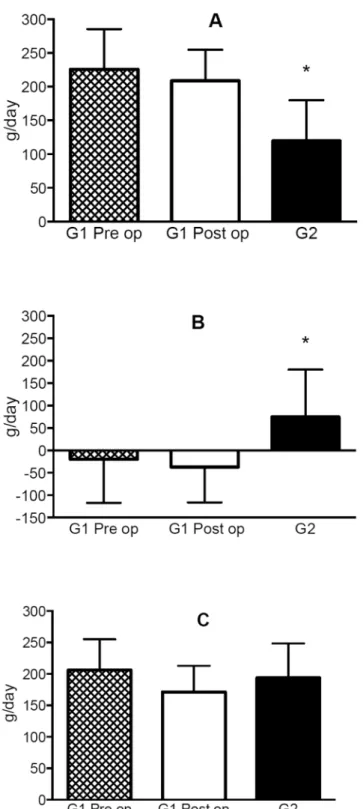
There are significant differences between lipid and carbohydrate oxidation among patients who underwent bariatric surgery and control group. However no differences were observed when compared before and 6 months after bariatric surgery (Fig 1). Furthermore, the lipid + carbohydrate oxidation (lip+cho) presents no difference between the groups.
TheFig 2shows the correlations between lipid oxidation and percentage of fat mass (%FM) in patients submitted to RYGB. This figure evidences a positive relationship between the two variables in the postoperative period (r = 0.67; p = 0.01).
The relativeUCP1andUCP3gene expression was the same before and after bariatric
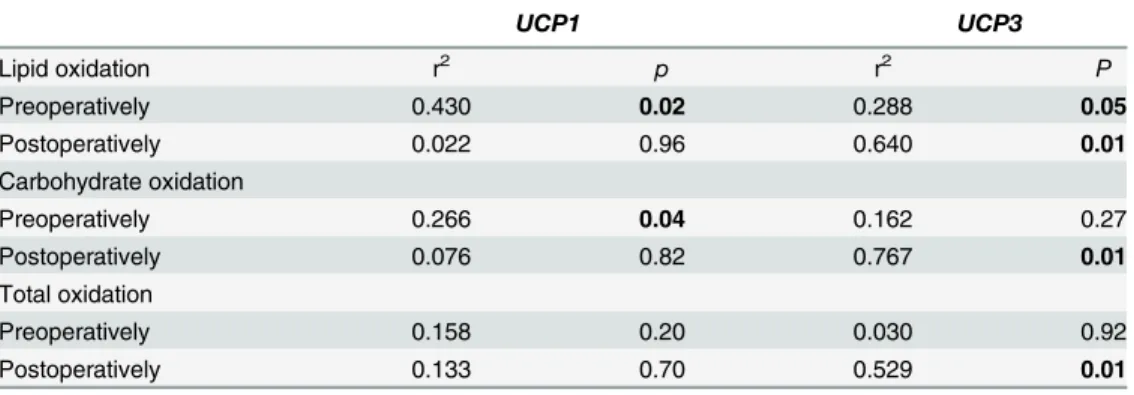
sur-gery (Fig 3). However, multiple linear regression analysis revealed thatUCP1andUCP3
con-tributed to lipid and carbohydrate oxidation (Table 2).
Table 1. Anthropometry, body composition, and respiratory variables in grade III obese patients before and after (six months postoperatively) bariatric surgery (Group 1) and normal-weight individu-als (Group 2).
Group 1 Preoperatively (n = 13) Group 1 Postoperatively (n = 13) Group 2 (n = 10)
Weight (kg) 119.3±15.0 92.5±14.1a 56.7±7.4a,b
Height (cm) 164.0±7.4 161.2±6.8
BMI (kg/m2) 44.5±6.4 34.5±5.7a 21.7±2.1a,b
AC (cm) 125.5±14.3 109.0±14.4a 78.6±8.7a,b
LBM (kg) 54.7±4.3 50.0±4.7a 39.5±6.3a,b
%LBM 46.2±3.3 54.6±4.9a 69.4±3.5a,b
FM (kg) 64.6±11.4 42.5±10.3a 17.4±2.5a,b
%FM 53.8±3.3 45.4±4.9a 30.5±3.5a,b
VO2(L/min) 0.31±0.04 0.27±0.03 0.20±0.04a,b
VCO2(L/min) 0.21±0.02 0.18±0.02a 0.16±0.02a,b
RQ 0.70±0.05 0.69±0.05 0.77±0.09a,b
BMI: body mass index. AC: abdominal circumference. LBM: lean body mass. FM: fat mass. VO2: oxygen
consumption. VCO2: carbon dioxide production. RQ: respiratory quotient. ap<0.05 as compared to Group 1 preoperatively.
bp<0.05 as compared to Group 1 postoperatively.
Fig 1. Substrate oxidation in patients submitted to bariatric surgery before and six months after the surgery and in the control group.A: lipid oxidation, B: carbohydrate oxidation, C: lipid + carbohydrate (lip + cho). Preop: preoperatively, Postop: postoperatively.*p<0.05 Group 2 as compared to Group 1 Preop and Group 1 Postop.
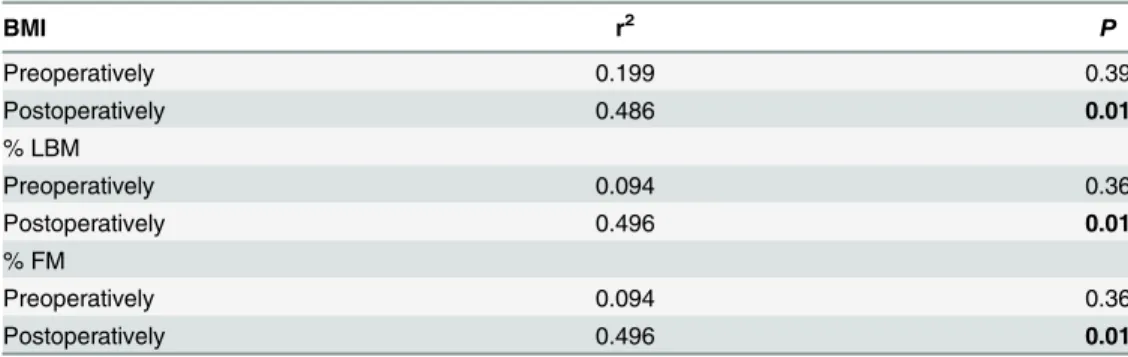
Moreover,UCP3expression was associated with BMI, percentage of lean body mass (%
LBM), and %FM in the postoperative period even after adjustment for age (Table 3).
Discussion
This study showed that patients submitted to bariatric surgery presented different anthropo-metric, body composition, and respiratory variables before and six months after bariatric sur-gery. In contrast, the operated patients did not differ in terms of lipid and carbohydrate oxidation before and after RYGB. However, their preoperative lipid and carbohydrate oxida-tion parameters were different from these parameters in the control group. In addioxida-tion, fat mass and lipid oxidation were positively associated in the postoperative period. Moreover,
UCP3favorably impacted lipid and carbohydrate oxidation, BMI, %LBM, and %FM in the
postoperative period.
Fig 2. Correlation between lipid oxidation and percentage of fat mass.A: Preoperatively, B: Postoperatively.
Fig 3. Relative gene expression in obese women preoperatively and six months after bariatric surgery.A:UCP1, B:UCP3.
doi:10.1371/journal.pone.0150811.g003
Table 2. Contribution ofUCP1andUCP3expression to lipid and carbohydrate oxidation.
UCP1 UCP3
Lipid oxidation r2 p r2 P
Preoperatively 0.430 0.02 0.288 0.05
Postoperatively 0.022 0.96 0.640 0.01
Carbohydrate oxidation
Preoperatively 0.266 0.04 0.162 0.27
Postoperatively 0.076 0.82 0.767 0.01
Total oxidation
Preoperatively 0.158 0.20 0.030 0.92
Postoperatively 0.133 0.70 0.529 0.01
regression adjusted by age.p<0.05.
Patients belonging to group 1 had a mean reduction of 16.5 cm in waist circumference six months after RYGB. Silva et al. (2013)[21] evaluated 98 obese subjects at the same postopera-tive period and found significantly reduced waist circumference (waist circumference
decreased by 23.3 cm), which was similar to the findings reported by Carrasco et al. (2007)[22] in a sample of 31 patients (waist circumference decreased by 28.6 cm.)
RYGB provides an average loss of 35–40% of the baseline weight over a period of 12 to 24 months. The main purpose of this procedure is FM reduction, but LBM loss also takes place [23]. In the present study, LBM and FM decreased by 4.7 kg and 22.1 kg six months after sur-gery, respectively, which agreed with literature results [22–25].
Preoperative Group 1, postoperative Group 1, and Group 2 presented different respiratory variables (VO2and VCO2). The respiratory quotient (RQ), which is the ratio between VO2and VCO2, helped to identify which energy substrate the patient was oxidizing at the time of evalu-ation. RQ determination indicated that fat oxidation prevailed. Other studies have also shown lower RQ due to increased lipid oxidation after bariatric surgery[22,26].
Here, preoperative Group 1 and the control group differed in terms of lipid and carbohy-drate oxidation. These results contrasted with literature data. Labayen et al. (2004)[27] described different lipid oxidation in obese and healthy-weight individuals, whereas Nicoletti et al. (2013)[28] did not find any differences in carbohydrate oxidation. Studies showing the relationship between longitudinal changes in body composition and substrate utilization[29] pointed to a positive correlation between lipid oxidation and fat mass[27], which was similar to the findings of our study.
In the present study,UCP1andUCP3gene expression before and six months after RYGB
was not different. Mingrone et al. (2003)[30] analyzedUCP3expression in the muscle tissue of
11 women before and 24 months after biliary-pancreatic derivation procedure and found reduced expression levels. On the other hand, Bracale et al. (2014)[31] did not verify any changes inUCP3expression in the skeletal muscle of women with severe obesity that were
can-didates for bariatric surgery.
In our study,UCP1andUCP3expression contributed to substrate oxidation. Analysis of the UCPsmade it clear that intracellular energy from the fat cells played a significant role in energy
metabolism, and that such proteins could be possible targets for personalized nutritional inter-ventions and pharmacological approaches aiming at increasing fat oxidation and combating obesity[32,33].
TheUCP3gene associated with all the energy substrates in the postoperative period. Indeed,
Cioff et al. (2009)[34] reported thatUCP3has an important role in fatty acid oxidation and in
Table 3. Contribution ofUCP3to BMI, percentage of lean body mass (%LBM), and percentage of
mass (%FM).
BMI r2 P
Preoperatively 0.199 0.39
Postoperatively 0.486 0.01
% LBM
Preoperatively 0.094 0.36
Postoperatively 0.496 0.01
% FM
Preoperatively 0.094 0.36
Postoperatively 0.496 0.01
Regression adjusted by age.p<0.05.
preventing oxidative damage by mitochondrial reactive oxygen species (ROS). Dulloo and Samec (2001)[35] found thatUCP3and lipid oxidation are markedly correlated. Our data resembled
the results of Dulloo and Samec (2001)[35] and showed that theUCP3gene regulates lipid
oxida-tion[35]. In this same context,UCP1expression in white adipose tissue evidenced that
mitochon-drial uncoupling can affect energy metabolism and glucose homeostasis[11]. Indeed, the present study showed thatUCP1aids carbohydrate oxidation in the preoperative period.
The involvement ofUCP3in protection from ROS-induced oxidative stress and in fatty acid
oxidation rate enhancement suggests a protective role for this protein in obesity[36].UCP3
expression in the skeletal muscle, a tissue that represents 40% of the metabolic active mass and which contributes to energy homeostasis[36], strengthens this suggestion.
UCPsperform an important role not only in thermal regulation but also in the regulation of
energy balance and body weight[9,11]. However, few clinical studies have shown howUCPs
influence body composition. The present study, which showed thatUCP3expression is
associ-ated with BMI, %LBM, %FM in the postoperative period of bariatric surgery, represents an important contribution in this field.
In conclusion,UCP1andUCP3gene expression contributes to lipid and carbohydrate
oxi-dation in patients submitted to bariatric surgery. In addition, theUCP3gene participates in
body composition modulation six months after the surgical intervention.
Supporting Information
S1 Table. Status of anthropometry, body composition, oxidation of substrates, and gene expression.
(XLS)
Acknowledgments
This work was supported by grants #2013/06563-7 and #2013/08916-4 from the São Paulo Research Foundation (FAPESP).
Author Contributions
Conceived and designed the experiments: BAPO MASP CFN CCO DCGQ JSM CBN. Per-formed the experiments: BAPO MASP NYN AJM WSJ. Analyzed the data: BAPO MASP CFN CCO DCGQ NYN CBN. Contributed reagents/materials/analysis tools: BAPO MASP CFN CCO DCGQ NYN CBN. Wrote the paper: BAPO MASP CFN CCO DCGQ NYN JSM CBN.
References
1. Mandal A. Study of prevalence of type 2 diabetes mellitus and hypertension in overweight and obese people. Journal of family medicine and primary care. 2014; 3(1):25–8. doi:10.4103/2249-4863.130265
PMID:24791232
2. Sonko BJ, Fennessey PV, Donnelly JE, Bessesen D, Sharp TA, Jacobsen DJ, et al. Ingested fat oxida-tion contributes 8% of 24-h total energy expenditure in moderately obese subjects. The Journal of nutri-tion. 2005; 135(9):2159–65. PMID:16140892
3. Bal BS, Finelli FC, Shope TR, Koch TR. Nutritional deficiencies after bariatric surgery. Nature reviews. Endocrinology. 2012; 8(9):544–56. doi:10.1038/nrendo.2012.48PMID:22525731
4. Nicoletti CF, de Oliveira BA, de Pinhel MA, Donati B, Marchini JS, Salgado Junior W, et al. Influence of excess weight loss and weight regain on biochemical indicators during a 4-year follow-up after Roux-en-Y gastric bypass. Obesity surgery. 2015; 25(2):279–84. doi:10.1007/s11695-014-1349-0PMID:
24996801
5. Fried M, Yumuk V, Oppert JM, Scopinaro N, Torres A, Weiner R, et al. Interdisciplinary European guidelines on metabolic and bariatric surgery. Obesity surgery. 2014; 24(1):42–55. doi:10.1007/
6. Smith CE, Ordovas JM. Update on perilipin polymorphisms and obesity. Nutrition reviews. 2012; 70 (10):611–21. doi:10.1111/j.1753-4887.2012.00515.xPMID:23035807
7. Loos RJ. Genetic determinants of common obesity and their value in prediction. Best practice & research. Clinical endocrinology & metabolism. 2012; 26(2):211–26.
8. Brondani LA, Assmann TS, de Souza BM, Boucas AP, Canani LH, Crispim D. Meta-analysis reveals the association of common variants in the uncoupling protein (UCP) 1–3 genes with body mass index
variability. PloS one. 2014; 9(5):e96411. doi:10.1371/journal.pone.0096411PMID:24804925 9. Klaus S. Adipose tissue as a regulator of energy balance. Current drug targets. 2004; 5(3):241–50.
PMID:15058310
10. Moncada R, Becerril S, Rodriguez A, Mendez-Gimenez L, Ramirez B, Catalan V, et al. Sleeve Gastrec-tomy Reduces Body Weight and Improves Metabolic Profile also in Obesity-Prone Rats. Obesity sur-gery. 2015.
11. Klaus S, Keipert S, Rossmeisl M, Kopecky J. Augmenting energy expenditure by mitochondrial uncou-pling: a role of AMP-activated protein kinase. Genes & nutrition. 2012; 7(3):369–86.
12. Diano S, Horvath TL. Mitochondrial uncoupling protein 2 (UCP2) in glucose and lipid metabolism. Trends in molecular medicine. 2012; 18(1):52–8. doi:10.1016/j.molmed.2011.08.003PMID:
21917523
13. Toda C, Diano S. Mitochondrial UCP2 in the central regulation of metabolism. Best practice & research. Clinical endocrinology & metabolism. 2014; 28(5):757–64.
14. Jakicic JM, Wing RR, Lang W. Bioelectrical impedance analysis to assess body composition in obese adult women: the effect of ethnicity. International journal of obesity and related metabolic disorders: journal of the International Association for the Study of Obesity. 1998; 22(3):243–9.
15. Weijs PJ, Vansant GA. Validity of predictive equations for resting energy expenditure in Belgian normal weight to morbid obese women. Clinical nutrition. 2010; 29(3):347–51. doi:10.1016/j.clnu.2009.09.009
PMID:19853980
16. Frayn KN. Calculation of substrate oxidation rates in vivo from gaseous exchange. Journal of applied physiology: respiratory, environmental and exercise physiology. 1983; 55(2):628–34.
17. Chomczynski P, Sacchi N. Single-step method of RNA isolation by acid guanidinium thiocyanate-phe-nol-chloroform extraction. Analytical biochemistry. 1987; 162(1):156–9. PMID:2440339
18. Giulietti A, Overbergh L, Valckx D, Decallonne B, Bouillon R, Mathieu C. An overview of real-time quan-titative PCR: applications to quantify cytokine gene expression. Methods. 2001; 25(4):386–401. PMID:
11846608
19. Hosseini A, Sauerwein H, Mielenz M. Putative reference genes for gene expression studies in propio-nate and beta-hydroxybutyrate treated bovine adipose tissue explants. Journal of animal physiology and animal nutrition. 2010; 94(5):e178–84. doi:10.1111/j.1439-0396.2010.01002.xPMID:20579188
20. Bustin SA, Benes V, Garson JA, Hellemans J, Huggett J, Kubista M, et al. The MIQE guidelines: mini-mum information for publication of quantitative real-time PCR experiments. Clinical chemistry. 2009; 55(4):611–22. doi:10.1373/clinchem.2008.112797PMID:19246619
21. Silva MAM, Rivera IR, Barbosa EMW, Crispim MAC, Farias GC, Fontan AJA, et al. Frequência de fatores de risco cardiovascular antes e 6 e 12 meses após gastroplastia. Rev Ass Med Brasil. 2013; 59 (4):381–86.
22. Carrasco F, Papapietro K, Csendes A, Salazar G, Echenique C, Lisboa C, et al. Changes in resting energy expenditure and body composition after weight loss following Roux-en-Y gastric bypass. Obe-sity surgery. 2007; 17(5):608–16. PMID:17658019
23. Hartwig TW, Santos FAI, González MC, Rombaldi AJ. Effects of bariatric surgery on the body composi-tion of adults. Rev Ass Med Brasil. 2013; 15(6):686–94.
24. Faria SL, Faria OP, Buffington C, de Almeida Cardeal M, Rodrigues de Gouvea H. Energy expenditure before and after Roux-en-Y gastric bypass. Obesity surgery. 2012; 22(9):1450–5. doi:10.1007/
s11695-012-0672-6PMID:22592393
25. Carey DG, Pliego GJ, Raymond RL, Skau KB. Body composition and metabolic changes following bar-iatric surgery: effects on fat mass, lean mass and basal metabolic rate. Obesity surgery. 2006; 16 (4):469–77. PMID:16608613
26. de Castro Cesar M, de Lima Montebelo MI, Rasera I Jr, de Oliveira AV Jr, Gomes Gonelli PR, Apare-cida Cardoso G. Effects of Roux-en-Y gastric bypass on resting energy expenditure in women. Obesity surgery. 2008; 18(11):1376–80. doi:10.1007/s11695-008-9460-8PMID:18320289
28. Nicoletti CF, Santos RDS, Suen VMM, Marchini JS, Nonino CB. The bodymass index is not associated with lipid or carbohydrate oxidation in hospitalized patients. Rev Chil Nutr 2013; 40(1):39–42.
29. Hall KD, Bain HL, Chow CC. How adaptations of substrate utilization regulate body composition. Inter-national journal of obesity. 2007; 31(9):1378–83. PMID:17356526
30. Mingrone G, Rosa G, Greco AV, Manco M, Vega N, Hesselink MK, et al. Decreased uncoupling protein expression and intramyocytic triglyceride depletion in formerly obese subjects. Obesity research. 2003; 11(5):632–40. PMID:12740453
31. Bracale R, Petroni ML, Davinelli S, Bracale U, Scapagnini G, Carruba MO, et al. Muscle uncoupling pro-tein 3 expression is unchanged by chronic ephedrine/caffeine treatment: results of a double blind, ran-domised clinical trial in morbidly obese females. PloS one. 2014; 9(6):e98244. doi:10.1371/journal. pone.0098244PMID:24905629
32. Kopecky J, Rossmeisl M, Flachs P, Brauner P, Sponarova J, Matejkova O, et al. Energy metabolism of adipose tissue—physiological aspects and target in obesity treatment. Physiological research /
Acade-mia Scientiarum Bohemoslovaca. 2004; 53 Suppl 1(S225–32. PMID:15119952
33. Depieri TZ, Pinto RR, Catarin JK, de Carli MC, Garcia Junior JR. [UCP-3: regulation of genic expression on skeletal muscle and possible role on body weight control]. Arquivos brasileiros de endocrinologia e metabologia. 2004; 48(3):337–44. PMID:15640895
34. Cioffi F, Senese R, de Lange P, Goglia F, Lanni A, Lombardi A. Uncoupling proteins: a complex journey to function discovery. BioFactors. 2009; 35(5):417–28. doi:10.1002/biof.54PMID:19626697
35. Dulloo AG, Samec S. Uncoupling proteins: their roles in adaptive thermogenesis and substrate metabo-lism reconsidered. The British journal of nutrition. 2001; 86(2):123–39. PMID:11502224