of Violence Tendency in Adolescents
1Raşit AVCI
2& 5ner ÇELİKKALELİ
3ABSTRACT
The primary purpose of the current study is to investigate the relationship between the
violence tendency in adolescents and peer victimization, trait anger and alienation. The
secondary purpose of the study is to look at the relationship between age and gender and
violence tendency. The study group of the current research is comprised of 644 adolescents
(277 female adolescents and 367 male adolescents), selected from two different types of high
school (Anatolian High School and Vocational High School). The ages of the participating
adolescents are in the age group of 14-19 years old and their mean age is 15.81 years. In the
current study, the Violence Tendency Scale, Peer Victimization Scale, State-Trait Anger
Expression Styles and Student Alienation Scale were employed in order to collect data. The
results of the analyses revealed that trait anger, alienation and peer victimization
significantly predict violence tendency. These three variables together explain 45% of the
variance in violence tendency. In a similar manner, it was found that gender and age
significantly predict violence tendency and these two variables together explain 7% of the
variance in violence tendency. The findings obtained from the study were discussed and
interpreted in light of the literature.
Key Words: Violence tendency, Anger, Alienation, Peer victimization
DOI Number: http://dx.doi.org/10.12973/jesr.2016.62.9
1 This study was presented at Third International Eurasian Educatıonal Research Congress (May 31-June 3, 2016), in Muğla Sıtkı
Koçman University.
INTRODUCTION
Violence is a frequently encountered problem among adolescents and it is becoming increasingly prevalent. In Turkey, it is observed that 42% of adolescents are involved in acts of violence at least once a year and 19% of them bully someone else at school Alikasifoğlu, Ercan, Erginöz, Uysal, & Kaymak, 2004). In another study, it was found that 10.3% of adolescents are exposed to violence and 51.4% of adolescent students are bullied by their peers 5zg(r, Yör(koğlu, & Baysan-Arabacı, . In a study conducted by the Turkish Ministry of National Education (Milli Eğitim Bakanlığı [MEB], 2007), it was reported that 28.5% of secondary schools in Turkey, are confronted with an act of violence. When these acts of violence are classified on the basis of the type of violence, it is seen that 34.5% are acts of physical violence and 23.7% are demonstrated in the form of bullying, threatening behavior and teasing. When all the literature on this subject is evaluated, it is seen that adolescents are intensely subjected to acts of violence.
Nearly one fifth of adolescents exhibiting acts of violence have been reported to exhibit this violence towards their teachers. Moreover, in the same study, it was reported that about one third of the adolescents demonstrated an act of violence towards their peers at least once in the last one month (Khoury-Kassabri, Astor, & Benbenishty, 2009). In this regard, it can be argued that adolescents exhibit more violence towards their peers. It is also reported that peer bullying is a problem frequently experienced among students from different levels of schooling and age groups. Stadler, Feifel, Rohrmann, Vermeiren, and Poustka (2010) stated that nearly 20% of adolescents are exposed to peer bullying. In Turkey, the ratio of peer victimization among adolescents aged at 11-16 years old was reported to be 13.9% G(ltekin & Sayıl, . Dölek ; on the other hand, reported that this ratio is 8.2% among 5th, 7th and 9th graders. Kapçı (2004) conducted a study on 4th and 5th graders, a
relatively younger study group and found the ratio of students exposed to different types of peer bullying to be 40%. In another study, it was revealed that 26% of 4th graders are victims
and 23.8% are both victims and perpetrators. According to a study conducted on adolescents, 17.2% are the victims of peer bullying and 9.6% are both victims and perpetrators (Burnukara & Uçanok, . The literature indicates that the problem of peer bullying is quite prevalent and that some children and adolescents subjected to peer bullying can be both victims and perpetrators. Moreover, this might be an indication that exposure of children and adolescents to peer bullying might result in their also displaying acts of bullying. Accordingly, peer victimization can be seen as a problem experienced by both those resorting to act of violence and those being subjected to this violence in many fields.
Shinn, 2011). While Şirvanlı-5zen reported that peer victimization is a significant predictor of problematic behaviors related to introversion, Cooley, Fite, Rubens, and Tunno (2015) revealed that both overt victimization and relational victimization are connected with increasing unruly behaviors. In a study conducted with the participation of students ranging from kindergarten to fifth grade, strong correlations were found between aggressiveness and peer victimization, and between overt victimization and relational victimization (Fite, Cooley, Williford, Frazer, & DiPierro, 2014). Furthermore, Biebl et al. (2011) reported that adolescents subjected to chronic peer bullying exhibit more behavioral disorders when compared to their counterparts not subjected to peer bullying.
Violence tendency observed in adolescents seems to be a complex problem. There are many factors that might lead to the emergence of violent behaviors. When it is investigated from the ecological perspective, some individual, social and environmental variables are thought to be influential on the emergence of violent behaviors. In this regard, the literature revealed that the emotion of anger seen in individuals is closely associated with the externalization problems encompassing aggressiveness and violence G(ndoğdu, Karataş, . Particularly anger is considered to be one of the primary signs of violence (Camodeca & Goossens, 2005). Thomas and Smith (2004) also maintain that adolescents exhibiting acts of violence have more anger directed outwards and their suppressed anger is relatively less. In Turkey, it has been reported that there are medium and high level significant correlations between adolescents trait anger and aggressiveness scores Karataş, 2008). In this regard, according to Berkowitz s (1965) Frustration Aggression Theory, frustration and sense of anger generally might lead to the emergence of aggressive behaviors in individuals. Thus, the sense of anger seems to be an important risk factor in terms of aggressive behaviors and violence tendency.
Another variable pertinent to the act of violence at school is students alienation to school. Students alienation to schools that is, their experiencing the feelings of meaninglessness and weakness can constitute a risk factor for the act of violence. School-directed anger of students who are alienated to school is reported to be increasing; therefore, they are in the at-risk group in terms of displaying acts of violence at school Çivitçi, . Thomas and Smith (2004) stated that the students exhibiting act of violence at school experience alienation and their school commitment is relatively less. Similarly, Çeçen contends that when students anger level increases, they experience a higher level of alienation to school and they are more prone to demonstrate problematic behaviors such as aggression. School alienation holds the potential of affecting the frequency of demonstrating bullying by students. Natvig, Albrektsen, and Qvarnstrøm point out that school alienation increases the likelihood of displaying bullying. As a result, alienated adolescents will come across some negative outcomes in their adulthood as well as in their adolescence (Patterson, 2005). Adolescents becoming alienated to school are more likely to experience some problems with the attendants and personnel of the school.
adolescents. One of the authentic aspects of this study is to aim to reveal the extent to which these three variables together predict violence tendency. Thus, the current study is expected to make some contributions to the literature. In this regard, the primary purpose of the current study is to investigate whether or not trait-anger, peer victimization and alienation to school predict violence tendency in adolescents. In addition to this, the study also aims to reveal whether or not the age and gender of adolescents predict violence tendency.
METHOD
Research Model
The current study employed one of the qualitative research methods known as the relational survey model B(y(közt(rk, Çakmak, Akg(n, Karadeniz, & Demirel, 2008). In the current study, gender, age, peer victimization, trait anger and alienation are the independent variables and violence tendency is the dependent variable.
Study Group
The study group of the current research is comprised of a total of 644 adolescents (277 females (43%) and 367 males (57%) selected from two different types of high school (Anatolian High School and Vocational High School). The students ages range from to years old and their mean age is 15.81 years (S=1.13).
Data Collection Tools
Violence Tendency Scale: The scale developed by Haskan and Yıldırım has 20 items, one of which is inversely worded. The scale items can be responded to by marking one of the options ranging from 1 (Never) to 3 (Always) and the score to be taken from the scale varies between 20 and 60. Higher scores indicate higher violence tendency. In order to test the construct validity of the scale, exploratory factor analysis was run and four factors of the scale (Sense of Violence, Violence by means of Information Technologies, Desire to Give Harms to Others, Inflict Violence on Others) were found to explain 55.45% of the variance in violence tendency. Furthermore, a positive correlation with the aggression scale (.64) and a negative correlation with family support (-.28) were detected. For the total score, internal consistency coefficient of the scale was found to be .87. Test-retest reliability of the scale was calculated to be .83 (Haskan & Yıldırım, . Within the framework of the current study, Cronbach alpha internal consistency coefficient was found to be .89.
Trait Anger-State Anger Expression Style Scale: The original form of the scale was developed by Spielberger, Jacobs, Russel, and Crane (1983) and it intends to measure the sense of anger and its expression style. The scale was adapted to Turkish by 5zer . The scale is a four-point Likert-type scale (1=Never – 4=Completely) comprised of 34 items and four sub-scales Trait Anger , Anger Inside , Anger Outside and Anger Control . Within the context of the current study, the trait-anger subscale was used. The internal consistency coefficient for the trait-anger subscale was found to be .79. Within the context of the criterion-referenced validity, the correlation between the subscale and trait anxiety, depressive adjectives list and anger inventory was investigated and a significant correlation was found. Within the context of the current study, the internal consistency coefficient of the scale was found to be .90.
Student Alienation Scale: The scale was developed by Sanberk (2003) for the purpose of determining students levels of alienation to school. The scale consists of 17 items and is developed in the form of a five-point Likert-type scale. The scale is made up of Weakness, Meaninglessness, Lawlessness and Social Distance subscales. The possible lowest score to be taken from the scale is 17 and the highest possible score is 85. Higher scores mean increasing levels of alienation to school (Sanberk, 2003). The validity studies conducted revealed that the correlations between the subscales of the Student Alienation Scale are .23, .35, .44 and .59, respectively. In criterion-referenced validity studies, correlations between the Student Alienation Scale and the Hopelessness Scale and Life Satisfaction Scale were found in the expected directions. In reliability studies, while the internal consistency of the Student Alienation Scale was found to be .79, test-retest correlation coefficient was found to be r=.77 (Sanberk, 2003). Within the context of the current study, Cronbach alpha internal consistency coefficient of the scale was found to be .76.
Data Analysis
In the current study, correlations between the dependent and independent variables were obtained by using Pearson Product-Moment Correlation Coefficient in SPSS 17.00 program package. The variables were found to be meeting the normality assumptions. Path analyses between the variables were conducted through LISREL 8.70 program. During the analyses, the upper limit of error margin was accepted to be p<.05.
FINDINGS
The correlations between violence tendency, trait-anger, alienation and peer victimization, means and standard deviations are presented in Table 1.
Table 1. Correlations between trait-anger, alienation, peer victimization and violence tendency, means and standard deviations
Variables Ort S 1 2 3 4
1-Violence Tendency 34.91 7.17 1
2-Trait-anger 22.94 7.60 .66* 1
3-Peer Victimization 31.52 8.72 .36* .34* 1
4-Alienation 44.10 9.92 .46* .46* .35* 1
As can be seen in Table 1, there are significant positive correlations between violence tendency and trait-anger (r=.66, p<.01), peer victimization (r=.36, p<.01) and alienation (r=.46, p<.01). In a similar manner, medium level positive correlations were also found between the independent variables.
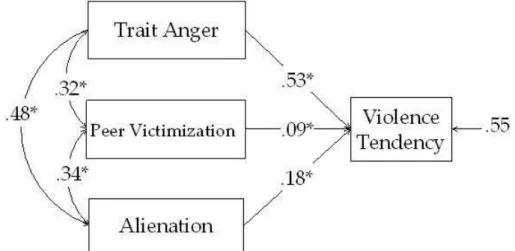
Linear correlations between violence tendency and trait-anger, peer victimization and alienation were tested with path analysis and the results are shown in Figure 1. According to the results of the path analysis, the paths going from trait-anger (β = . , p<. , peer victimization β=. , p<. and alienation β=. , p<. to violence tendency are significant. These three variables together explain 45% of the variance in violence tendency. The correlations between violence tendency in adolescents and trait-anger, peer victimization and alienation are given in Figure 1.
Figure 1. Standardized path coefficients between trait-anger, peer victimization and alienation and violence tendency
In order to determine the extent to which age and gender of the adolescents predicts their violence tendency, path analysis was carried out. Paths going from both gender β=. , p<.01) and age (β=. , p<. were found to be significant. As a result, it was determined that the male adolescents have stronger violence tendency than female adolescents. It was also found that older adolescents have stronger violence tendency than younger adolescents. These two variables explain 7% of the variance in violence tendency.
DISCUSSION AND COMMENTS
In the current study, it was investigated whether trait-anger, peer victimization, alienation to school, age and gender predict violence tendency in adolescents. In this regard, it was revealed that there are significant correlations between trait-anger, peer victimization, alienation and violence tendency. Thus, with increasing levels of anger, peer victimization and alienation, violence tendency among adolescents was found to be increasing. Moreover, at the end of the study, age and gender were also found to be correlated with violence tendency. In this regard, it can be argued that male adolescents when compared to female adolescents, and older adolescents when compared to younger adolescents have stronger violence tendency.
Piquero, & Mazerolle, 2001; G(ndoğdu, Karataş, . Karataş conducted a study on high school students and reported significant medium and high levels of correlations between the high school students trait-anger and aggression scores. In a similar manner, Aydın and Akg(n significant positive correlations between trait-anger and reactive and proactive aggression. G(ndoğdu , in a study conducted with the participation of 9th grade students, found significant correlations between trait-anger and
aggression, physical and verbal aggression. In this connection, according to Berkowitz s (1965) frustration and aggression hypothesis, if a person comes across an obstacle while he/she is trying to accomplish his/her goal, he/she might experience a sense of frustration. Sense of frustration might lead to the emergence of aggression or violence in individuals. This finding of the study seems to be in compliance with this hypothesis.
Another finding of the current study is that student alienation significantly predicts violence. This finding concurs with the literature (e.g.; Natvig et al., 2001; Slater, Henry, Swaim, & Cardador, Y(ksek & Solakoğlu, . Y(ksek and Solakoğlu stated that with increasing level of alienation to school, adolescents tendency to exhibit physical aggression towards others also increases. Natvig et al. (2001) reported that increasing level of alienation to school among adolescents leads to increasing risk of bullying. Reijntjes et al. (2010), in their experimental study, found that when adolescents experience acute peer rejection, those who are more alienated behave more aggressively than the less alienated. Calabrese and Adams (1990) reported that adolescents committing crimes have higher levels of alienation when compared to those not committing crimes. Slater et al. (2004), in their longitudinal study, contended that adolescents alienated from their families and peers are more likely to behave aggressively. In the same study, it was also reported that the effect of media including elements of violence on students feeling alienated to their schools is greater (Slater et al., 2004). In another study, alienation from family and school was reported to assume the role of mediator in aggression and violence-oriented use of the Internet (Slater, 2003). In this respect, indicating separation or distancing from the important values of society and society itself (Calabrese & Adams, 1990), alienation, when experienced by adolescents, can be claimed to be enhancing violence tendency. Adolescents who tended to exhibit more aggressive behaviors might show the symptoms of alienation such as high level of loneliness, isolation and resentment. According to Williams (2001), weak bonds with particularly positive social institutions such as school, family and peers or exclusion from these social institutions pose a serious threat to basic human needs such as belongingness, self-respect, self-control and meaningful existence. Thus, the sense of frustration experienced at school might give rise to a sense of anger and thus increase the likelihood of exhibiting aggressive behaviors (Reijntjes et al., 2010).
Another finding of the current study is that peer victimization predicts violence tendency in adolescents. This finding is parallel to some other findings reported in the literature (e.g.; Gökler, Povedano, Cava, Monreal, Varela, & Musitu, Sullivan, Farrel, & Kliewer, 2006). Povedano et al. (2015) found significant positive correlations between exposure to physical, verbal and relational bullying of peers and overt and relational aggression. In another study conducted with 8th graders, it was also found that
reported in the literature by studies focusing on the determination of the prevalence of bullying experienced by children and adolescents (Gökler, Kutlu, 2005; Pekel, 2004). The ratios of the students in Turkey who are both victims and perpetrators of bullying are reported to be 21% by Gökler , 12% by Kutlu (2005), and 6.4% by Pekel (2004).
Peer victimization might result in adolescents making use of violence as a means of problem solving in social relationships and using violence as a behavioral expression of the sense of anger when they experience anger. In addition, widespread use of violence among adolescents might lead to normalization of this behavior and its frequent use in relationships. Within the framework of social learning theory, it seems to be possible that bullying exhibited by peers can be taken as a model by students and can then be transformed into violence or violence tendency (Bandura, 1986). Then this can be maintained by the reinforcement given by peers. Hence, lack of models to show alternative behavioral patterns to students indicates the importance of the intervention programs to be implemented in this regard.
Another variable investigated within this current study is the effect of gender and age on violence tendency. The findings revealed that male adolescent students exhibited higher violence tendency than female adolescent students. This finding is supported by many studies reporting that male adolescents exhibit more aggression and violence than female adolescents (e.g.; Avcı, Aydın & Akg(n, Balkıs, Duru, & Buluş, Gençoğlu,
Kumcağız, & Ersanlı, G(ndoğdu, Haskan & Yıldırım, 5zg(r et al., ).
Haskan and Yıldırım stated that male students have higher violence tendency than female students. Gençoğlu et al. (2014) also reported that male students violence tendency is higher than that of female students. In another study focusing on aggression, it was found that male adolescents exhibit more overt and relational aggression than do female adolescents Avcı, . Aydın and Akg(n found that gender can significantly explain both reactive and proactive aggression. On the other hand, there are some other studies reporting contradictory findings Yalçın, . In society, male role models are generally seen to be exhibiting acts of violence. Again, within the framework of this theory, it can be taught that acts of violence exhibited by men are reinforced by various sources. Furthermore, stronger violence tendency observed in men does not mean that women do not have violence tendency. During the development period, the superiority of males in terms of aggression is clearly visible (Tremblay et al., 2004). Research also indicates that different types of aggression can be seen in females (Crick & Grotpeter, 1995).
Another finding of the current study is that with increasing age of adolescents, their violence tendency also increases. While this finding concurs with some studies in the literature (e.g.; Avcı, Fung, Raine, & Gao, 2009), it contradicts with others (e.g.; Başaran,
Nair, . Avcı stated that overt and relational aggression is predicted by age
and with increasing age, these two types of aggression also increase. Fung et al. (2009) found a positive correlation between age and reactive aggression. During the adolescent period, parental control of adolescents is gradually replaced by control imposed by their peers, which is believed to be connected with increasing violence tendency in adolescents (Farrington, 2007).
alienation. Furthermore, researchers working in this field can be suggested to test theoretical models including the abovementioned variables to gain a better grasp of violence tendency and aggression. In Turkey, studies aiming to explore violence are generally conducted according to cross-sectional design. In order to gain a more detailed understanding of the concepts of violence and aggression and their relationship with variables such as anger, alienation to school and peer victimization and the evolution of the act of violence, longitudinal studies can be conducted.
REFERENCES
Alikasifoğlu, M., Ercan, O., Erginöz, E., Uysal, 5., & Kaymak D. A. (2004). Violent behavior among Turkish high school students and correlate of physical fighting. European Journal of Public Health, 14(2), 173-177.
Avcı, R. . Validating a measure of forms and functions of aggression in Turkish adolescents. Revista De Cercetare Si Interventie Sociala, 53, 114-131.
Aydın, A., &Akg(n, S. . The relationships between anger, narcissism and reactive and proactive aggression in adolescence. Turkish Journal of Psychology, 29(73), 57-59.
Balkıs, M., Duru, E., & Buluş, M. . Şiddete yönelik tutumların özyeterlilik, medya, şiddete yönelik inanç, arkadaş grubu ve okula bağlılık duygusu ile ilişkisi. Ege Eğitim
Dergisi, 6(2), 81-97.
Bandura, A. (1986). The social learning perspective: Mechanisms of aggression. In H. Toch (Ed.), Psychology of crime and criminal justice (pp. 198-236). Prospect Heights, IL: Waveland Press.
Başaran, C. . Çeşitli tür liselerde öğrenim gören öğrencilerin saldırganlık düzeylerinin
incelenmesi (Unpublished Master s thesis). Sakarya Üniversitesi, Sosyal Bilimler Enstit(s(, Sakarya.
Berkowitz, L. (1965). The concept of aggressive drive. Some additional considerations. In L. Berkowitz (Ed.), Advances in experimental social psychology (Vol. 2, pp. 301-329). New York, NY: Academic Press.
Biebl, S. J., DiLalla, L. F., Davis, E. K., Lynch, K. A., & Shinn, S. O. (2011). Longitudinal associations among peer victimization and physical and mental health problems.
Journal of Pediatric Psychology, 36(8), 868-877.
Brezina, T., Piquero, A. R., & Mazerolle, P. (2001). Student anger and aggressive behavior in school: An initial test of Agnew's macro-level strain theory. Journal of Research in Crime and Delinquency, 38(4), 362-386.
Burnukara, P., & Uçanok, Z. . Bullying in early and middle adolescence: Where does it take place and coping strategies. Turkish Psychological Articles, 15(29), 83-85.
B(y(közt(rk, Ş., Çakmak, E. K., Akg(n, 5. E., Karadeniz, Ş., & Demirel, F. (2008). Bilimsel
araştırma yöntemleri. Ankara: Pegem Akademi.
Calabrese, R. L., & Adams, J. (1990). Alienation: A cause of juvenile delinquency. Adolescence,
25, 435-440.
Camodeca, M., & Goossens, F. A. (2005). Aggression, social cognitions, anger and sadness in bullies and victims. Journal of Child Psychology and Psychiatry, 46(2), 186-197.
Cooley, J. L., Fite, P. J., Rubens, S. L., & Tunno, A. M. (2015). Peer victimization, depressive symptoms, and rule-breaking behavior in adolescence: The moderating role of peer social support. Journal of Psychopathology and Behavioral Assessment, 37(3), 512-522. Crick, N. R., & Grotpeter, J. K. (1995). Relational aggression, gender, and social-psychological
Çeçen, A. R. . School alienation Gender, socio-economic status and anger in high school adolescents. Educational Sciences: Theory & Practice, 6(3), 721-726.
Çivitci, N. . School alienation and perceived social support as predictors of school anger in high school students. Elementary Education Online, 10(3), 861-871.
Dölek, N. . İlk ve ortaöğretim okullarındaki öğrenciler arasında zorbaca davranışların incelenmesi ve zorbalığı önleme tutumu geliştirilmesi programının etkisinin araştırılması (Unpublished doctoral dissertation). Marmara Üniversitesi, İstanbul.
Farrington, D. P. (2007). Origins of violent behavior over the life span. In D. J. Flannery, A. T. Vazsonyi & I. D. Waldman (Eds.), The Cambridge handbook of violent behavior and aggression (pp. 19-48). New York, United State: Cambridge University Press.
Fite, P. J., Cooley, J. L., Williford, A., Frazer, A., & DiPierro, M. (2014). Parental school involvement as a moderator of the association between peer victimization and academic performance. Children and Youth Services Review, 44, 25-32.
Fung, A. L., Raine, A., & Gao, Y. (20 . Cross‐cultural generalizability of the Reactive‐Proactive Aggression Questionnaire RPQ . Journal of Personality Assessment, 91, 473–479.
Gençoğlu, C., Kumcağız, H., &Ersanlı, K. . Ergenlerin şiddet eğilimine etki eden ailevi faktörler.Electronic Turkish Studies, 9(2), 639-652.
Gökler, R. ). İlköğretim öğrencilerinde akran zorbalığının bazı değişkenler açısından
incelenmesi (Unpublished doctoral dissertation). Ankara Üniversitesi, Ankara. Retrieved from https://tez.yok.gov.tr/UlusalTezMerkezi.
G(ltekin, Z., & Sayıl, M. . Akran Zorbalığını Belirleme 5lçeği geliştirme çalışması. Türk Psikoloji Yazıları, 15, 47-61.
G(ndoğdu, R. . sınıf öğrencilerinin çatışma çözme öfke ve saldırganlık d(zeylerinin
bazı değişkenler açısından incelenmesi. Çukurova Üniversitesi Sosyal Bilimler Enstitüsü
Dergisi, 19(3), 257-276.
Haskan, 5., & Yıldırım, İ. . Development of violence tendency scale. Egitim ve Bilim, 37(163), 165-177.
Hymel, S., Closson, L. M., Caravita, S., & Vaillancourt, T. (2011). Social status among peers: From sociometric attraction to peer acceptance to perceived popularity. In P. K. Smith & H. Hart (Eds.), The Wiley-Blackwell handbook of childhood social development (second edition) (pp. 375-392). Malden: Wiley-Blackwell.
Kapçı, E. G. İlköğretim öğrencilerinin zorbalığa maruz kalma t(r(n(n ve sıklığının depresyon, kaygı ve benlik saygısıyla ilişkisi. Ankara Üniversitesi Eğitim Bilimleri Fakültesi Dergisi, 37(1), 1-13.
Karataş, Z. . Lise öğrencilerinde öfke ve saldırganlık. Çukurova Üniversitesi Sosyal
Bilimler Enstitüsü Dergisi, 17(3), 277-294.
Khoury-Kassabri, M., Astor, R. A., & Benbenishty, R. (2009). Middle Eastern adolescents' perpetration of school violence against peers and teachers a cross-cultural and ecological analysis. Journal of interpersonal violence, 24(1), 159-182.
Kutlu, F. (2005). The effect of bullying management training on bullying behaviors of elementary school students (Doctoral dissertation, METU, Ankara). Retrieved from https://tez.yok.gov.tr/UlusalTezMerkezi
Milli Eğitim Bakanlığı . Ortaöğretim okullarında görevli yöneticilerin şiddet konusundaki
bilgi ve becerilerine ilişkin mevcut durum analizi. Ankara Eğitimi Araştırma ve
Mynard, H., & Joseph, S. (2000). Development of the multidimensional peer-victimization scale. Aggressive Behavior, 26, 169-178.
Nair, B. (2014). Ergenlerin saldırganlık davranışlarının bazı değişkenler açısından incelenmesi.
(Master s thesis, Cumhuriyet University, Sivas). Retrieved from
https://tez.yok.gov.tr/UlusalTezMerkezi.
Natvig, G. K., Albrektsen, G., & Qvarnstrøm, U. . School-related stress experience as a risk factor for bullying behavior. Journal of youth and adolescence, 30 (5), 561-575.
5zer, A. K. . S(rekli 5fke SL-5fke ve 5fke İfade Tazı 5fke_Tarz ölçekleri ön çalışması. Türk Psikoloji Dergisi, 31, 26-35.
5zg(r, G., Yör(koğlu, G., & Baysan-Arabacı, L. . Lise öğrencilerinin şiddet algıları, şiddet eğilim d(zeyleri ve etkileyen faktörler.Psikiyatri Hemşireliği Dergisi, 2(2), 53-60. Patterson, R. L. (2005). Adolescent alienation: Examining the relevance of contextual domains and
psychological components (Doctoral dissertation). Retrieved from https://dalspace.library.dal.ca/bitstream/handle/10222/54795/NR16702.PDF?sequence =1&isAllowed=y
Pekel, N. (2004). Akran zorbalığı grupları arasında sosyometrik statü, yalnızlık ve akademik başarı
durumlarının incelenmesi (Master s thesis, Hacettepe University, Ankara). Retrieved
from https://tez.yok.gov.tr/UlusalTezMerkezi.
Povedano, A., Cava, M. J., Monreal, M. C., Varela, R., & Musitu, G. (2015). Victimization, loneliness, overt and relational violence at the school from a gender perspective.
International Journal of Clinical and Health Psychology, 15(1), 44-51.
Reijntjes, A., Thomaes, S., Bushman, B. J., Boelen, P. A., Orobio de Castro, B., & Telch, M. J. (2010). The outcast lash-out effect in youth: Alienation increases aggression following peer rejection. Psychological Science,21, 1394-1398.
Sanberk, İ. . 5ğrenci yabancılaşma ölçeği Bir geçerlik ve g(venirlik çalışması.
(Master s thesis, Çukurova University, Adana). Retrieved from
https://tez.yok.gov.tr/UlusalTezMerkezi.
Santrock, J. W. (2012). Ergenlik (D. M. Siyez, Trans, Ed.). Ankara Nobel Akademik Yayıncılık Eğitim Danışmanlık.
Slater, M. D. (2003). Alienation, aggression, and sensation seeking as predictors of adolescent use of violent film, computer, and website content. Journal of Communication, 53(1), 105-121.
Slater, M. D., Henry, K. L., Swaim, R. C., & Cardador, J. M. (2004). vulnerable teens, vulnerable times how sensation seeking, alienation, and victimization moderate the violent media content–aggressiveness relation. Communication Research, 31(6), 642-668. Spielberger, C. D., Jacobs, G. A., Russel, F. S., & Crane, R. S. (1983). Assessment of anger: The Trait Anger Scale. In. J. N. Butcher & C. D. Spielberger (Eds.), Advances in Personality Assessment (Vol. 2) (pp. 159-187). Hillsdale, N J: Lea.
Stadler, C., Feifel, J., Rohrmann, S., Vermeiren, R., & Poustka, F. (2010). Peer-victimization and mental health problems in adolescents: Are parental and school support protective? Child Psychiatry & Human Development, 41(4), 371-386.
Şirvanlı-5zen D. . The relationship between the adolescent s exposure to peer bullying and their sex, age and internal problem behaviors. Turkish Journal of Child and Adolescent Mental Health, 17(1), 5-12.
Thomas, S., & Smith, H. (2004). School connectedness, anger behaviors, and relationships of violent and nonviolent American youth. Early Education and Development, 10(7), 207-215.
Tremblay, R. E., Nagin, D. S., Seguin, J. R., Zoccolillo, M., Zelaco, P. D., Boivin, M.,…Japel, C. (2004). Physical aggression during early childhood: Trajectories and predictors.
Pediatrics, 114, 43-50.
Williams, K. D. (2001). Ostracism: The power of silence. New York: Guilford Press.
Yalçın, E. . Ortaokul öğrencilerinin saldırganlık düzeyinin ebeveyn kabul red algısı ve
demografik değişkenlere göre incelenmesi (Master s thesis, Gazi University, Ankara).
Retrieved from https://tez.yok.gov.tr/UlusalTezMerkezi.
Ergenlerde Şiddet Eğiliminin Yordayıcıları Olarak Akran
Zorbalığına Maruz Kalma, Sürekli Öfke ve Yabancılaşma
1Raşit AVCI
2& 5ner ÇELİKKALELİ
3Giriş
Şiddet ergenler arasında sıklıkla karşılaşılan bir problemdir ve yaygınlığı giderek artmaktadır. T(rkiye de ergenlerin % sinin bir yıl içinde en az bir kez şiddete karıştıkları ve % unun da okulda zorbalık davranışında bulundukları gör(lmektedir Alikasifoğlu, Ercan, Erginöz, Uysal, & Kaymak, . Bu konuda gerçekleştirilen diğer bir çalışmada da ergenlerin % . n(n şiddete maruz kaldıkları ve bu öğrencilerin % . (n(n de akranları tarafından şiddete yaşantısına maruz bırakıldıkları bildirilmiştir 5zg(r, Yör(koğlu ve Baysan-Arabacı, . Bu konuda yapılan çalışmalar bir arada değerlendirildiğinde ergenlerin şiddet davranışına yoğun bir biçimde maruz kaldıkları gör(lmektedir.
Şiddet davranışı gösteren ergenlerin yaklaşık beşte biri bu davranışı öğretmenlerine karşı gösterdiklerini bildirmişlerdir (Khoury-Kassabri, Astor, & Benbenishty, 2009). Bunun yanında aynı çalışmada, ergenlerin yaklaşık (çte birinin de son bir ay içinde en az bir kez akranlarına yönelik şiddet davranışında bulundukları bildirilmiştir. Bu çerçevede ergenlerin şiddeti kendi aralarında daha fazla gösterdiği ifade edilebilir. Şiddete maruz kalmanın bir t(r( olan akran zorbalığına maruz kalmanın da farklı eğitim kademelerinde ve yaşlarda öğrenciler arasında sık karşılaşılan problemlerden biri olduğu gör(lmektedir. Stadler, Feifel, Rohrmann, Vermeiren ve Poustka ergenlerin yaklaşık % sinin akran zorbalığına maruz kaldıklarını bildirmiştir. T(rkiye de - yaş ergenlerde, akran zorbalığına maruz kalmanın % 13.9 olduğu bildirilmiştir G(ltekin &Sayıl, . Dölek de , ve . sınıf öğrencileri arasında bu oranın % . olduğunu bildirmiştir. Ergenler (zerinde yapılan bir
çalışmaya göre de ergenlerin % . sinin akran zorbalığına kurban olduğu % . sının hem
zorba hem de kurban oldukları gör(lmektedir Burnukara & Uçanok, . Yukarıda söz(
edilen çalışmalar hem problemin yaygınlığını hem de akran zorbalığına maruz kalan çocuk ve ergenlerin bir kısmının hem zorba hem kurban olarak davranışlarda bulunduğu ortaya koymaktadır. Ayrıca bu durum, çocuk ve ergenlerin zorbalığa maruz kalmalarının aynı zamanda kendilerinin de zorbalık ve saldırganlık davranışlarını gösterebileceğini göstermektedir. Dolayısıyla akran zorbalığına maruz kalma hem şiddet davranışına başvuran ergenler hem de şiddete maruz kalan ergenler açısından birçok alanda sıkıntının yaşandığı bir problem olarak değerlendirilebilir.
5te yandan ergenlik dönemiyle birlikte ergenler, aileleriyle geçirdikleri zaman azalırken, akranlarıyla daha fazla zaman geçirmeye başlamaktadırlar. Ergenlerin akranları tarafından genellikle sevilmeye, kabul edilmeye yönelik gereksinimleri bulunmaktadır. Bu gereksinim karşılandığında, bu onlar (zerinde hoş duygular yaratmakta ancak tersi durum yani onlar tarafından dışlandıklarında ya da onlardan baskı görd(kleri zaman, ergenlerde aşırı kaygı ve stres gibi bir takım olumsuz duygulanım ortaya çıkarabilmektedir Santrock,
. Hymel, Closson, Caravita ve Vaillancourt akranlar tarafından reddedilmek ve
1Bu çalışma .Uluslararası Avrasya Eğitim Araştırmaları Kongresi nde ( Mayıs- 3 Haziran 2016) sözl( bildiri olarak
sunulmuştur.
dikkate alınmamanın bazı ergenlerde yalnızlık ve d(şmanlık duygularını ortaya çıkardığını belirtmektedir.
Ergenlerdeki şiddet davranışı karmaşık bir problem olarak karşımıza geçmektedir. Davranışın ortaya çıkmasına neden olabilen pek çok faktörden söz edilebilir. Ekolojik bakış açısıyla incelendiğinde, şiddet davranışının ortaya çıkmasında bireysel, sosyal, çevresel bir takım değişkenlerin önemli olduğu d(ş(n(lebilir. Bu kapsamda literat(rdeki çalışmalar, bireyin öfke duygusunun saldırganlık ve şiddetin de içinde bulunduğu dışsallaştırma
problemleriyle G(ndoğdu, Karataş, yakından ilişkili olduğunu ortaya
koymaktadır.
Okulda şiddet davranışıyla ilişkili olabilecek bir diğer değişken de öğrencilerin okula yabancılaşmasıdır. 5ğrencilerin okula yabancılaşması yani okulda anlamsızlık ve g(çs(zl(k duygularını yaşaması şiddet davranışı için bir risk faktör( oluşturabilir. Okula yabancılaşmış öğrencilerin, okula yönelik öfkelerinin arttığı, bu nedenle de okulda şiddet davranışı göstermesi için risk grubunda oldukları belirtilmektedir Çivitçi, . Thomas ve
Smith okulda şiddet davranışı gösteren öğrencilerin yabancılaşmayı yaşadıklarını ve
okula bağlılıklarının daha az olduğunu belirtmektedir.
Bu çerçevede ergenlerde şiddet eğilimini ortaya çıkaran değişkenlerin daha iyi anlaşılması bu konuyla ilgili daha kapsamlı bir anlayış geliştirilmesi, şiddet davranışının ortaya çıkmasının önlemesi açısından önemlidir. Ayrıca T(rkiye de s(rekli öfke ve saldırganlık arasındaki ilişkiyi inceleyen çalışmalar olmakla birlikte, s(rekli öfke ve şiddet eğilimini inceleyen çalışmaya rastlanmamıştır. Ek olarak akran zorbalığına maruz kalma ve yabancılaşmanın ergenlerdeki şiddet ile ilişkisini inceleyen çalışmaya da rastlanmamıştır. Bu çalışmanın özg(n yönlerinden biri de bu (ç değişkenin aynı zamanda şiddet eğilimini yordamadaki rol(n( ortaya koymasıdır. Dolayısıyla bu çalışmanın, şiddet konusundaki literat(re katkı sağlaması beklenmektedir. Bu amacı s(rekli öfke, akran zorbalığına maruz kalmanın ve öğrencinin okula yabancılaşmasının ergenlerdeki şiddet eğilimini yordayıp yordamadığının incelenmesidir. Ayrıca, ergenlerin yaşlarının ve cinsiyetlerinin şiddet eğilimini yordayıp yordamadığını ortaya koymaktır.
Yöntem
Bu araştırma nicel araştırma yöntemlerinden ilişkisel tarama modelinde
gerçekleştirilmiştir B(y(közt(rk, Çakmak, Akg(n, Karadeniz ve Demirel 08). Bu
çalışmada cinsiyet, yaş, akran zorbalığına maruz kalma, s(rekli öfke ve yabancılaşma bağımsız değişkenler, şiddet eğilimi ise bağımlı değişkendir.Araştırmanın çalışma grubu, iki
farklı lise t(r(nde Anadolu lisesi, meslek lisesi öğrenim gören (% kız, erkek %
erkek toplam ergenden oluşmuştur. 5ğrencilerin yaş aralığı - arasında
değişmektedir ve yaş ortalaması ise . dir S=1.13).
Veri toplama araçları olarak Şiddet Eğilim 5lçeği (Haskan & Yıldırım, , Akran Zorbalığı 5lçeği G(ltekin & Sayıl, , Durumluk-S(rekli 5fke 5lçeği 5zer, ve
5ğrenci Yabancılaşma 5lçeği Sanberk, kullanılmıştır. Araştırmada bağımlı ve
Bulgular
Şiddet eğilimi, s(rekli öfke, yabancılaşma ve akran zorbalığına maruz kalma arasındaki ilişkiler arasındaki ilişkiler incelendiğinde, şiddet eğilimi ile s(rekli öfke arasında (r=. , p<. , akran zorbalığına maruz kalma (r=. , p<. ve yabancılaşma r=.46, p<.01) arasında pozitif yönde anlamlı ilişkiler olduğu bulunmuştur. Benzer şekilde bağımsız değişkenler arasında da olumlu yönde orta d(zeyde ilişkiler elde edilmiştir.
Diğer taraftan, eğilimi ile s(rekli öfke, akran zorbalığı ve yabancılaşma arasındaki doğrusal ilişkiler yol path analizi ile çöz(mlenmiş ve sonuçlar incelediğinde, s(rekli öfkeden β = . , p<. , akran zorbalığından β=. , p<. ve yabancılaşmadan β=. , p<. şiddet eğilimine giden yolların anlamlı olduğu gör(lmektedir. Bu (ç değişken birlikte şiddet eğilimi varyansının % ini açıklamaktadır.
Son olarak, cinsiyet ve yaşın şiddet eğilimini ne d(zeyde yordadığını belirlemek için yol analizi gerçekleştirilmiştir. Hem cinsiyetten β=. , p<. hem de yaştan β=. , p<. giden yolların anlamlı olduğu belirlenmiştir. Bu iki değişken şiddet eğilimi varyansının %
sini açıklamaktadırlar.
Tartışma
Bu çalışmada, öğrencilerin öfkeleri, akran baskısına maruz kalmaları ve yabancılaşma d(zeyleri arttıkça şiddet eğilimlerinin de arttığı belirlenmiştir. Ayrıca çalışma sonucunda cinsiyet ve yaş gibi demografik değişkenlerin de şiddet eğilimiyle ilişkili olduğu belirlenmiştir. Bu kapsamda cinsiyet açısından erkek öğrencilerin kız öğrencilere göre, yaşı b(y(k olan ergenlerin k(ç(k olan ergenlere göre daha fazla şiddet eğilimine sahip oldukları ifade edilebilir. Bu çalışma sonucunda elde edilen öfke ve şiddet eğilimi ya da saldırganlık arasındaki ilişki literat(rde yer alan birçok çalışma ile tutarlık göstermektedir Brezina, Piquero & Mazerolle, 2001; G(ndoğdu, Karataş, . Karataş lise öğrencileri (zerinde gerçekleştirdiği çalışmada lise öğrencilerinin s(rekli öfke ve saldırganlık puanları arasında orta ve y(ksek d(zeyde anlamlı ilişkiler olduğunu bulmuştur.
Bu araştırmada elde edilen bir diğer bulgu da öğrencilerin yabancılaşmasının şiddeti anlamlı bir şekilde yordadığıdır. Bu bulgu literat(r ile tutarlık göstermektedir Natvig vd., Slater, Henry, Swaim & Cardador, Y(ksek & Solakoğlu, . Y(ksek ve Solakoğlu ergenlerin okula yabancılaşma d(zeylerinin arttıkça başkalarına yönelik fiziksel saldırganlık kullanma eğilimlerinin arttığını bulmuştur. Natvig vd., (2001) ergenlerde okulda yabancılaşma d(zeyinin artmasının zorbalık davranışının artması için riski arttırdığını bildirmiştir. Reijntjes vd., gerçekleştirdikleri deneysel çalışmada, ergenlerin akut akran reddini deneyimlediklerinde, yabancılaşan gençlerin diğerlerine göre daha fazla saldırgan davrandığını bulmuşlardır. Calabrese ve Adams , suç işleyen gençlerin suç işlemeyenlere göre daha y(ksek d(zeyde yabancılaşmaya sahip olduklarını bildirmiştir. Slater vd. gerçekleştirdikleri boylamsal çalışmada, akranlardan ve aileden yabancılaşan ergenlerin saldırgan davranmalarının daha olası olduğunu bildirmiştir. Aynı çalışmada saldırganlık (zerinde şiddet içerikli medyanın etkilerinin okuldan yabancılaşma hisseden öğrenciler arasında daha g(çl( olduğunu bildirmişlerdir Slater vd., . Bir başka çalışmada da aileden ve okuldan yabancılaşma saldırganlık ve şiddete yönelik internet
kullanımında kısmi aracılık rol( (stlenmiştir Slater, . Bu kapsamda toplumdan, önemli
şiddet eğiliminin arttığı söylenebilir. Saldırgan davranışları fazla olan ergenler y(ksek d(zeyde yalnızlık, izolasyon ve g(cenme gibi yabancılaşmayla ilgili özellikleri sergileyebilir.
Williams a göre, özellikle okul, aile ve akranlar gibi olumlu sosyal kurumlarla zayıf
bağların olması ya da bu sosyal kurumlardan dışlanma algılanmasının ait olma, benlik saygısı, öz kontrol ve anlamlı var oluş gibi temel insancıl ihtiyaçlar (zerinde ciddi bir tehdit ortaya çıkarmaktadır. Bu durumda okulda ortaya çıkan engellenme durumu öfke duygusunu ortaya çıkararak saldırgan davranış olasılığını arttırabilir Reijntjes vd., .
Bu araştırmanın bir diğer bulgusunda ise, akran zorbalığına maruz kalmanın öğrencilerdeki şiddet eğilimini yordadığı gör(lmektedir. Bu bulgu literat(rdeki çalışmalarla paralellik göstermektedir Gökler, Povedano, Cava, Monreal, Varela, & Musitu, 2015; Sullivan, Farrel, & Kliewer, 2006 . Povedano vd. gerçekleştirdikleri çalışmada akranlar tarafından fiziksel, sözel ve ilişkisel akran zorbalığına maruz kalmanın, açık ve ilişkisel şiddet ile aralarında olumlu yönde anlamlı ilişkiler olduğunu bildirmiştir. Sekizinci sınıf öğrencileri (zerinde gerçekleştirilen bir başka çalışmada fiziksel akran zorbalığına maruz kalmanın fiziksel ve ilişkisel saldırganlık ve suç işleme davranışıyla anlamlı bir şekilde ilişkili olduğu bulunmuştur Sullivan vd., . T(rkiye de doğrudan akran zorbalığına maruz kalmanın ergenlerde şiddeti yordayıp yordamadığına ilişkin çalışmaya rastlanmamış ancak, akran zorbalığına hem maruz kalma hem de zorba olma şeklinde yaygınlığını gösteren çalışmalarla tutarlı bulgulara rastlanmıştır Gökler, ; Kutlu, 2005; Pekel, 2004).
T(rkiye de hem kurban hem de zorbaca davranan öğrencilerin oranı % Gökler , %
12 (Kutlu, 2005) ve % . Pekel, olarak bildirilmiştir.
Bu çalışma kapsamında incelenen bir diğer değişken de cinsiyet ve yaşın şiddet eğilimi ile ilişkisidir. Bulgular erkek öğrencilerin kız öğrencilere göre daha fazla şiddet eğilimi gösterdiklerini ortaya koymaktadır. Bu bulgu literat(rde erkeklerin kızlara göre saldırganlık ve şiddet gösterdiğini ortaya koyan birçok çalışma ile tutarlık göstermektedir (Avcı, Aydın & Akg(n, Balkıs, Duru, & Buluş, Gençoğlu, Kumcağız, &
Ersanlı, G(ndoğdu, Haskan & Yıldırım, 5zg(r vd., 2011). Haskan ve
Yıldırım erkek öğrencilerin kız öğrencilere göre daha fazla şiddet eğilimine sahip olduğunu bildirmiştir.
Bu çalışmada elde edilen bir diğer sonuç da ergenlerin yaşı arttıkça şiddet eğilimlerinin arttığı bulgusudur. Bu sonuç literat(rdeki bazı çalışmalar ile tutarlık gösterirken Avcı, Fung, Raine, & Gao, , bazı çalışmalarla da ters d(şmektedir
Başaran, Nair, . Avcı açık ve ilişkisel saldırganlığın yaş tarafından
yordandığını ve yaş arttıkça bu iki saldırganlık t(r(n(n de arttığını belirtmiştir.
Öneriler
Anahtar Sözcükler: Şiddet eğilimi, 5fke, Yabancılaşma, Akran zorbalığına maruz kalma
Atıf için / Please cite as: