Submitted9 March 2016 Accepted 19 April 2016 Published12 May 2016
Corresponding author Claudia Lange,
Academic editor Irene Newton
Additional Information and Declarations can be found on page 19
DOI10.7717/peerj.2023
Copyright 2016 Lange et al.
Distributed under
Creative Commons CC-BY 4.0
OPEN ACCESS
Genome-scale investigation of
phenotypically distinct but nearly clonal
Trichoderma
strains
Claudia Lange1, Richard J. Weld1,2, Murray P. Cox1,3, Rosie E. Bradshaw1,3,
Kirstin L. McLean1, Alison Stewart4and Johanna M. Steyaert1
1Bio-Protection Research Centre, Lincoln University, Lincoln, New Zealand 2Lincoln Agritech Limited, Lincoln University, Lincoln, New Zealand
3Institute of Fundamental Sciences, Massey University, Palmerston North, New Zealand 4Forest Science, Scion, Rotorua, New Zealand
ABSTRACT
Biological control agents (BCA) are beneficial organisms that are applied to protect plants from pests. Many fungi of the genusTrichodermaare successful BCAs but the underlying mechanisms are not yet fully understood.Trichoderma cf. atroviride strain LU132 is a remarkably effective BCA compared to T. cf. atroviride strain LU140 but these strains were found to be highly similar at the DNA sequence level. This unusual combination of phenotypic variability and high DNA sequence similarity between separately isolated strains prompted us to undertake a genome comparison study in order to identify DNA polymorphisms. We further investigated if the polymorphisms had functional effects on the phenotypes. The two strains were clearly identified as individuals, exhibiting different growth rates, conidiation and metabolism. Superior pathogen control demonstrated by LU132 depended on its faster growth, which is a prerequisite for successful distribution and competition. Genome sequencing identified only one non-synonymous single nucleotide polymorphism (SNP) between the strains. Based on this SNP, we successfully designed and validated an RFLP protocol that can be used to differentiate LU132 from LU140 and otherTrichodermastrains. This SNP changed the amino acid sequence of SERF, encoded by the previously undescribed single copy gene ‘‘small EDRK-rich factor’’ (serf). A deletion ofserf in the two strains did not lead to identical phenotypes, suggesting that, in addition to the single functional SNP between the nearly clonalTrichoderma cf. atroviride strains, other non-genomic factors contribute to their phenotypic variation. This finding is significant as it shows that genomics is an extremely useful but not exhaustive tool for the study of biocontrol complexity and for strain typing.
SubjectsGenetics, Genomics, Microbiology, Molecular Biology, Mycology
Keywords Discordant phenotypes, Biocontrol,Trichoderma cf. atroviride, Single nucleotide polymorphism (SNP), Genomics, Small ERDK-rich factor (serf), Molecular marker
INTRODUCTION
& J Bissett, 2015, unpublished data), are species of economic and ecological importance to horticulture and agriculture for biological control of a variety of plant pathogens. However, there is considerable strain-specific variation in biocontrol characteristics, exemplified by T. cf. atroviride biocontrol strains LU132 (formerly C52) and LU140 (formerly D73). These strains were isolated three years apart from the same New Zealand onion field but extensive trials revealed differences in their biocontrol abilities with pathogenic fungi (Dodd-Wilson, 1996;Harrison & Stewart, 1988;Kay, 1991;Kay, 1994;Kay & Stewart, 1994;Lange, 2015;McLean, 1996;McLean, 2001). The two strains are propagated asexually by mycelial growth and the production of conidia. Both strains were found to be antagonistic towards the onion pathogenSclerotium cepivorum(Harrison & Stewart, 1988;Kay & Stewart, 1994;McLean, 1996). As they consistently grew more rapidly thanS. cepivorumand showed no evidence of antibiotic production or direct antagonism, their chief biocontrol mechanism was suggested to be competition for nutrients and space (Harrison & Stewart, 1988;Kay, 1994). However, LU132 was substantially more efficient than LU140 in inhibitingS. cepivorumon agar plates and in the glasshouse (Kay, 1994; McLean, 1996; McLean, 2001), as well as in proliferation and establishment in soil (McLean, 1996), promoting onion seedling emergence (McLean & Stewart, 2000) and growth promotion of rye grass (Chohan et al., 2010). Due to the excellent biocontrol of S. cepivorumand Botrytis cinereademonstrated by LU132, it was formulated into the commercial biocontrol products TrichopelR Ali 52, SentinelR and TenetR (Agrimm
Technologies Ltd., Lincoln, New Zealand) (Card et al., 2009; McLean et al., 2012; McLean et al., 2005).
In order to release a new biocontrol product on the European market, authorities require a molecular identification method to monitor the development and distribution of the organism in the environment. Attempts were made to develop an LU132-specific molecular marker so its ecology could be monitored within commercial systems. Markers are commonly designed on the basis of individual fingerprinting profiles. However, in the case of LU132, this approach was not sufficient, as the profiles could distinguish LU132 from all tested strains except the less effective strain LU140. Fingerprinting profiles, a SCAR approach (Cordier et al., 2007;Hermosa et al., 2001;Naeimi et al., 2011) and sequencing of a number of marker genes and regions (the translation elongation factor 1α(tef1α) (Shoukouhi & Bissett, 2009), the 42 kDa endochitinase (ech42) (Lieckfeldt et al., 2000), the Internal Transcribed Spacer regions 1 and 2 (ITS1 and ITS2) of rRNA genes (Kuhls et al., 1997;Rehner & Samuels, 1994) and the mitochondrial cytochrome oxidase subunit 1 encoding genecox1(Hamari et al., 2003)) could not identify any DNA sequence differences between LU132 and LU140 (Dodd-Wilson, 1996;McLean, 2001and unpublished data from within our research group). Therefore a genome-wide search for polymorphisms was required.
close relationship promotes plant growth and activates the plant’s resistance to pests. In addition, they parasitise plant pathogens (mycoparasitism) and produce bioactive secondary metabolites and enzymes, which makes them valuable in agriculture as BCA and in industry as sources of hydrolytic enzymes (Harman et al., 2012;Harman et al., 2004; Lorito et al., 2010).
To understand what makes a goodTrichodermaBCA, many studies have focussed on mycoparasitism related genes (e.g., cell wall degrading enzymes) and genes that promote plant growth or induce systemic resistance in the plants (Harman et al., 2012). A recent genome comparison between one hypercellulolytic species (Trichoderma reesei) and two biocontrol species (T. atroviride andT. virens) found that the two biocontrol species contained more mycoparasitism-relevant genes, such as genes coding for chitinolytic enzymes, antibiotics and toxins, than the hypercellulolytic species (Kubicek et al., 2011). However, the complexity of biocontrol interactions between the pathogen, plant and antagonist makes it difficult to link the phenotype of a good BCA to a specific genetic origin. The high genetic similarity, but phenotypic differences, between T. cf. atroviride LU132 and LU140 presented a rare opportunity to compare nearly identical biocontrol fungi in order to study biocontrol-specific gene variants.
The aim of this research was to search for genetic differences (SNPs) between LU132 and LU140 on a whole genome scale to enable a strain-specific DNA-based distinction. We further investigated whether the genetic differences influence the distinct phenotypes. Initially, LU132 and LU140 phenotypes were compared directly to each other to confirm their individuality, to describe and quantify the different characteristics and to predict what target genes might be important. Then, the whole genomes of LU132 and LU140 were sequenced to identify SNPs and an LU132-specific molecular marker was designed. Target genes whose function might be affected by the SNPs were identified and the effects of changes in target genes on the phenotypes of LU132 and LU140 were examined by gene deletion experiments.
MATERIALS AND METHODS
Fungal strainsWe refer to LU132 and LU140 asT. cf. atroviride because a recent five gene phylogeny of Trichoderma spp. from New Zealand (Tef1α,ACLA1,Calm1,LAS1andRPB2) resulted in the definition of this new species, closely related to T. atroviride(M Braithwaite, PR Johnston, KL McLean, F Nourozi, AJ Hay, M Ohkura, C Lange, P Shoukouhi, RA Hill, S Ball, NJ Cummings, D Bienkowski, A Stewart, JM Steyaert & J Bissett, 2015, unpublished data).
Trichoderma atroviride strain IMI206040 was obtained from Alfredo Herrera-Estrella, (Langebio, Mexico) and T. cf. atroviride strains LU132 and LU140 from the Lincoln University Culture Collection (LUCC, New Zealand), where single spore isolations had been stored at −80◦C since the original strain isolations.Trichoderma inocula were
prepared by growing the strains on Potato Dextrose Agar (PDA; Difco) at 25◦C with
layers of Miracloth (CalbiochemR); the conidial suspension was adjusted to 1×10⁹conidia
per mL and aliquots stored in 25% glycerol at−80◦C. Fresh cultures ofBotrytis cinerea
(BC106) andSclerotium cepivorum(LU360) were obtained from the LUCC, sub-cultured onto PDA and incubated at 20◦C with constant light for 14 d. The resulting sclerotia were stored in 25% glycerol at−80◦C. Agar plugs ofPythium ultimumspp. were sub-cultured
onto PDA containing ampicillin, chloramphenicol and streptomycin (50, 100 and 50 µg/mL respectively) and incubated at 20◦C in complete darkness. Agar plugs were stored in 25% glycerol at 4◦C.
Growth rate and conidiation
Radial mycelial growth rates and colony morphologies of LU132 and LU140 were determined on standard 90 mm Petri dishes containing either buffered or un-buffered media in the pH range 2.4–6.0. The media were PDA (Difco); Malt Extract Agar (MEA, 30 g Malt extract (Difco), 5 g Peptone (Difco) 15 g agar per L water); or Minimal Medium agar with 0.2% glucose (MMA, (Carsolio et al., 1994;Steyaert et al., 2004)). Where indicated, the pH was adjusted as described previously (McIlvaine, 1921;Steyaert, Weld & Stewart, 2010) (Table S1). Agar plates were inoculated centrally with 2µL conidial suspensions or with agar plugs containing one colony derived from a single conidium. Plates were incubated at 25◦C in total darkness or with constant light for up to 7 d. Conidial yield was determined for one treatment in Exp. 3 (Holder & Keyhani, 2005). The experimental design is outlined inTable S1.
Dual culture assay with plant pathogens
The plant pathogensSclerotium cepivorum(ascomycete),Botrytis cinerea(ascomycete) and Pythium ultimum(oomycete) were selected to study the antagonistic activity of LU132 and LU140 on dual culture plates using methods described elsewhere (McLean, 1996). Five replicate plates were inoculated with 5 mm mycelial plugs from 3 d old cultures of the pathogens andTrichodermatest strains, 60 mm apart from each other.
Metabolic profiling
Phenotype MicroArraysTM for Filamentous Fungi (Biolog FF, Biolog Inc., Hayward, CA) were used to compare metabolic profiles of LU132 and LU140, utilising 95 single compounds. Assimilation of compounds was reflected by mycelial growth and quantified by measuring the optical density (OD) in the wells at 750 nm, the wavelength at which hyaline mycelium has its maximum absorbance. To quantify catabolism, the wells contain a tetrazolium dye that turns into a purple insoluble precipitate when reduced due to mitochondrial activity. This was measured at the maximum absorbance of the reduced tetrazolium salt of 490 nm (Bochner, Gadzinski & Panomitros, 2001). Conidia of LU132 and LU140 were generated on PDA plates at 25◦C in constant light. The FF plate procedure
was carried out essentially as per manufacturer’s instructions and as described elsewhere (Bochner, Gadzinski & Panomitros, 2001) with modifications. Three replicate plates with separately prepared inocula were incubated at 25◦C under constant light. Cluster analysis
would skew the data. In addition to absorbance measurements, conidiation was assessed using a scoring system from 0 to 5 (Friedl, Kubicek & Druzhinina, 2008).
Genome sequencing
Genomic DNA (gDNA) of LU132 and LU140 were prepared from mycelia using the GentraR PuregeneTMTissue Kit (Qiagen) and further purified using the DNeasyR Plant
Mini Kit (Qiagen) as per manufacturers’ instructions. DNA samples were sequenced with an Illumina GAII (Solexa) machine by the Massey University Genome Service, New Zealand. The data were analysed to identify Single Nucleotide Polymorphisms (SNPs) by mapping LU132 and LU140 reads against the unmasked genome sequence of the closest available reference genome ofT. atroviridestrain IMI206040 (Genome build v. 2.0, May 2010, Joint Genome Institute,http://genome.jgi.doe.gov/Triat2/Triat2.home.html) using the Burrows-Wheeler transform (BWT) algorithm implemented in the program bwa v.0.5.5 (Cox, Peterson & Biggs, 2010;Li & Durbin, 2009). Polymorphisms were identified usingSAMtools(Li et al., 2009) and custom in-house software. At least 8 reads confirming a mutant allele were required to call a SNP at any given position. Unmapped reads were assembledde novousingABySS(version 1.2.0) andPhrap(version 1.090518) and reads of one strain were mapped against the other’s assembled contigs (bwaversion 0.5.8).
SNP confirmation
Regions that encompassed putative SNPs were PCR-amplified from gDNA of IMI206040, LU132 and LU140, then sequenced (primers are shown inTable S2). All PCR amplifications were performed in a Bio-Rad IcyclerTM(Bio-Rad Laboratories) using the Expand long template PCR system (Roche) according to manufacturer’s instructions. SNP-containing genes (target genes) were identified using the reference genome annotation (IMI206040). The SNP-containing sequences were subjected to BLAST analysis on GenBankR to identify
putative gene homologs in other organisms and possible biological functions.
Protein structure predictions
Deduced amino acid sequences that were altered as a consequence of a SNP were analysed to predict protein structures functional motifs using PSIPRED v3.3
(http://bioinf.cs.ucl.ac.uk/psipred/), SignalP 4.1 (http://www.cbs.dtu.dk/services/SignalP/), TargetP 1.1 (http://www.cbs.dtu.dk/services/TargetP/), NetSurfP 1.1 (http://www.cbs.dtu. dk/services/NetSurfP/), Phyre2 (http://www.sbg.bio.ic.ac.uk/servers/phyre2/html/page.cgi? id=index), SAM-T08 (http://compbio.soe.ucsc.edu/SAM_T08/T08-query.html) and ELM (http://elm.eu.org/search/).
Development and validation of a strain-specific molecular marker for LU132
above. The sequences from LU132, LU140 and IMI206040 were subjected toin silico restriction analysis using DNAMAN (v. 4.0a; Lynnon Corporation, Quebec, Canada) to identify SNP-specific restriction sites. The PCR fragments were digested to completion with the identified enzyme according to manufacturer’s instructions. Digested fragments were size fractionated by 2% agarose TAE gel electrophoresis for confirmation of strain-specific banding patterns.
Relative expression
The expression of identified target genes, relative to the expression of the reference gene encoding translation elongation factor 1α (tef1α) (Bustin et al., 2009;Seidl, Druzhinina & Kubicek, 2006), was studied under standard and specific inducing conditions. The standard culturing conditions were as follows: 100 mL PDB (Difco) were inoculated with 5µL of LU132 and LU140 conidial suspensions in 250 mL conical flasks. The cultures were incubated at 25◦C in constant light with shaking at 200 rpm for 3 d. To induce a
mycoparasitic response, the pH of the PDB was adjusted to 4.75 with HCl (Moreno-Mateos et al., 2007) and 4 h before the end of incubation, N-acetyl-D-glucosamine (NAG) (Sigma-Aldrich) was added to the culture to a final concentration of 0.5% (Mach et al., 1999). NAG is known to trigger the expression of target genesnag1 andnag2 and to induce biocontrol mechanisms (Brunner et al., 2003;Mach et al., 1999;Peterbauer et al., 1996;Ramot et al., 2004;Zeilinger et al., 1999). Mycelia from three replicates were harvested by filtration and snap frozen in liquid nitrogen. Total RNA was prepared using the Plant Total RNA Extraction Miniprep System (Viogene BioTek Corp.) and the RNA samples were treated with DNase using Turbo DNA-freeTMKit (Ambion), as per manufacturers’ instructions. Intron-spanning primers were designed to amplify around 100 bp of transcript sequence (Table S2). Reverse Transcription quantitative real-time PCR amplification (RT-qPCR) and cycling conditions were based on the protocol fromHolyoake et al. (2008), except using 10 ng RNA as template. All PCR reactions were done in duplicate and the whole experiment was repeated. The normalised gene expression data were expressed as1Cq=Cq(tg)−Cq (tef1α) (Bustin et al., 2009).
Gene transcript sequencing
The mRNA transcripts of SNP-harbouring target genes, obtained from total RNA prepared as described above, were reverse transcribed into complementary DNA (cDNA) and sequenced using primers described inTable S2. First strand cDNA synthesis was carried out using SuperScriptTM III Reverse Transcriptase (Invitrogen), as per manufacturer’s instructions, using the 3’UTR (or reverse) primers. Subsequent PCR amplifications were performed as above.
Mutational analyses
Primers used for the construct and vector creation are listed inTable S2. Theserf knock-out construct (SKO) contained the hygromycin B phosphotransferase gene (hph) under the control of the pyruvate kinase gene promoter (pki) (Mach, Schindler & Kubicek, 1994), embedded in approximately 1 kb of each of the genomic 5′ and 3′ flanking sequences
the new vector pSKO. The pSKO plasmid was electroporated toA. tumefaciensEHA105 cells using a MicroPulserTMElectroporator (Bio-Rad Laboratories) as per manufacturer’s instructions. Transformation of LU132 and LU140 was based on standard protocols (De Groot et al., 1998;Zwiers & De Waard, 2001) with modifications. pSKO-containing A. tumefacienswere selectively grown in media with 25µg/mL kanamycin and 25µg/ml rifampicin. Co-cultivation of 3 d oldTrichoderma conidia andAgrobacteriumcolonies was carried out on sterile cellophane discs on IMAS agar, without overlay, at 23◦C. The
cellophane disks were cut into three pieces, transferred onto separate PDA plates (Difco), containing 200µg/mL hygromycin B and 300µg/mL timentin (GlaxoSmithKline Plc.), and incubated at 25◦C for up to 4 d in complete darkness. Transformants were transferred to
fresh PDA (Difco) containing antibiotics as above and purified via single-spore isolation. Homologous recombination at the serf locus was confirmed by PCR (Table S2) and Southern hybridisation (Sambrook, Fritsch & Maniatis, 1989). Mutants were characterised for growth, conidiation and metabolic activity as described above.
Statistical analyses
All data were analysed using GenStat (v. 14, VSN International Ltd., Hemel Hempstead, UK). Unless mentioned otherwise, data were analysed using the General Analysis of Variance method. The least significant differences of means (l.s.d.) and multiple comparisons (using Fisher’s Unprotected LSD algorithm) were determined at a significance level of 5% (P<0.05).
RESULTS
Phenotype comparison
Morphological analysis
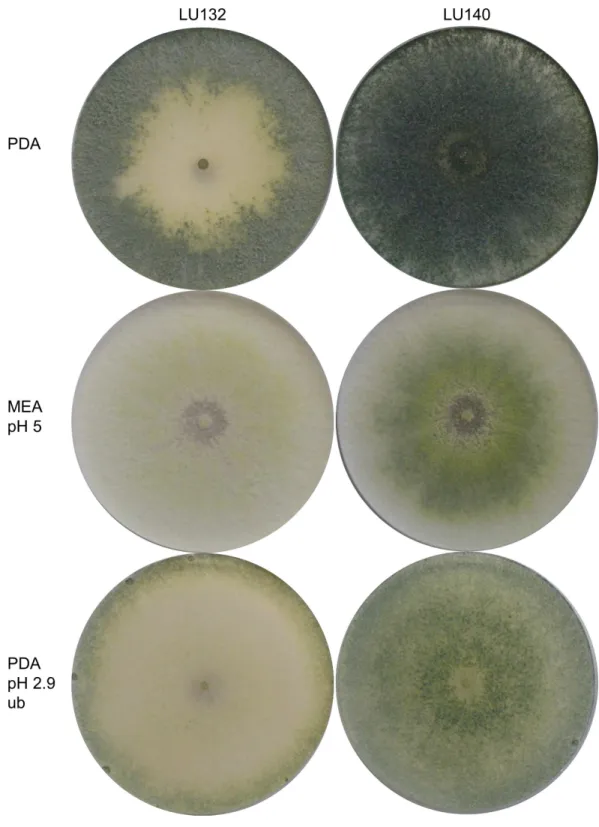
Morphological comparisons were done to assess the extent of phenotypic differences between the T. cf. atroviride strains LU132 and LU140. LU132 grew consistently significantly faster than strain LU140 in all treatments (P<0.05) (Table S3). For example, in experiment 2 (PDA, pH 5, unbuffered, dark) the average growth rates for LU132 and LU140 were 24.8 ±0.45 mm/d and 21.0±0.61 mm/d. The pH range that resulted in the fastest growth was wider for LU132 than for LU140 (Table S3). Colonies incubated with constant light also differed in the distribution and density of conidia (Fig. 1); whereas LU140 produced conidia all over the plate on PDA, LU132 conidia were more concentrated at the edges. This distribution effect was most apparent on unbuffered PDA with the lowest pH (2.9), on which LU140 produced 3.6 times more conidia than LU132 (1.8×10⁹and 0.5×10⁹conidia per plate on average respectively,P<0.05).
Dual culture with plant pathogens
no interaction zones between pathogens and antagonists. On the pathogen-only control plates withS. cepivorumandB. cinerea, sclerotia were observed, whereas no sclerotia were produced on the dual culture plates withT.cf. atroviride.
Metabolic profiling
The phenotype microarray assay (Biolog FF) assessed the growth, metabolism and conidiation of LU132 and LU140 in the presence of 95 single compounds on 96 well plates. A cluster analysis was done to group compounds that were metabolised by each strain at high, medium or low rates; based on absorbance measurements at OD490and
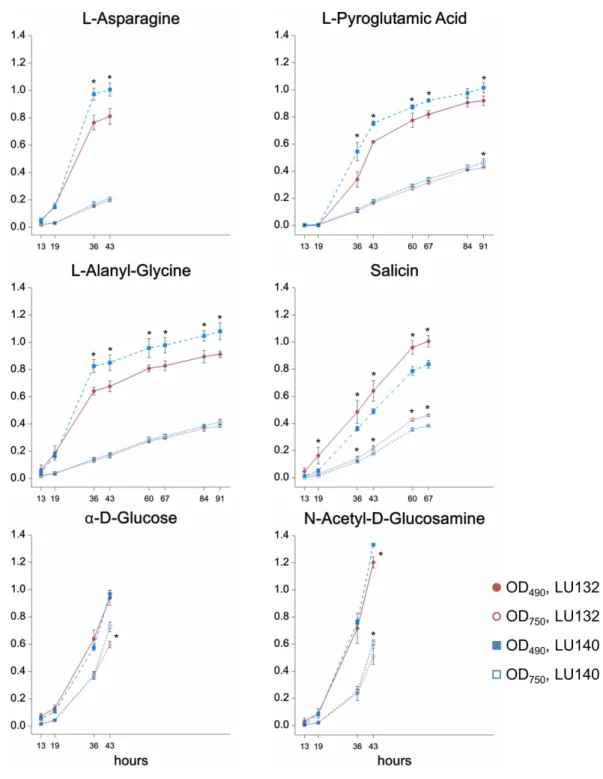
OD750(representing catabolism and mycelial growth respectively). The six compounds for
which the LU132 and LU140 strains differed most in their growth and/or metabolism are shown inFig. 2. The amount of conidia in the wells was scored from 0 to 5 (Friedl, Kubicek & Druzhinina, 2008). The average conidiation score on all 95 compounds was significantly bigger for LU140 than for LU132 at each time point studied (60, 84 and 108 h). LU140 also produced conidia in more wells than LU132 throughout the experiment (Table S5). Apart fromα-D-glucose, the compounds that were differentially metabolised by LU132 and LU140 (Fig. 2) did not result in altered conidiation. Onα-D-glucose LU140 had a conidial mat covering the whole well at 60 h and LU132 at 84 h. The biggest conidiation score difference of 3 was found on D-galactose, D-raffinose,α-methyl-D-galactoside and stachyose at the end of the experiment (108 h).
The metabolism of the glucoside salicin was significantly better in LU132; however, the salicin metabolism could not be associated with a specific pathway. N-acetyl-D-glucosamine (NAG) was the only compound that induced differential metabolism in LU132 and LU140 and that could be associated with pathways implicated in biocontrol (Brunner et al., 2003;Lopez-Mondejar et al., 2009;Seidl, Druzhinina & Kubicek, 2006;Zeilinger et al., 1999).Trichodermaspp. have two genes encoding N-acetyl-β-D-glucosaminidases,nag1 andnag2(Mach et al., 1999;Peterbauer et al., 1996;Ramot et al., 2004), which were selected as target genes for further analyses.
The results clearly identified LU132 and LU140 as two individuals. The strains exhibited distinct growth, conidiation and metabolism. LU132’s better pathogen control could be attributed to its faster growth.
Genome comparison
Whole genome sequences of LU132 and LU140 were mapped to the closest available reference genome of T. atroviride IMI206040 (Genome build v. 2.0, May 2010, Joint Genome Institute,http://genome.jgi.doe.gov/Triat2/Triat2.home.html) to identify single nucleotide polymorphisms (SNPs). The size of the reference genome is 36.1 Mb. It has 29 contigs and 11,863 gene models. Given the coverage threshold (the SNP calling requirement of at least 8 reads per allele) a read coverage of 87% and 73.5% was achieved for LU132 and LU140 respectively, with an average of 35 and 15 reads per nucleotide position for LU132 and LU140 respectively. BothT. cf. atroviride strains were found to have a sequence divergence rate of 2.5% compared to the reference strainT. atrovirideIMI206040.
Figure 2 Compounds that were differentially metabolised by LU132 and LU140.Values with∗are
detected when putative SNPs occurred at the end of a read where the sequencing accuracy was low and deletions or insertions were introduced incorrectly by the mapping program. Some putative SNPs occurred within microsatellites or homopolymers and were therefore unreliable. Sanger sequencing of the SNP-encompassing regions confirmed two SNPs, both transition polymorphisms: SNP1, specific to LU132 (IMI206040 v. 2.0, contig_21:1,174,857, C→T) and SNP2, specific to LU140 (IMI206040 v. 2.0, contig_15:842,707, A→G). The remaining 657 putative SNPs were false positives, and there were no other SNPs in non-coding regions.
De novoassembly of unmapped reads was done to determine whether LU132 and LU140 differed in genome content, such as insertions or deletions that could account for their phenotypic differences. The assembly revealed that both LU132 and LU140 contained DNA sequences that were not present in the reference genome but none were specific for one strain. The contigs containing assembled sequences that mapped to LU132/LU140, but not the reference genome, were small and either matched to theϕX174 genome (which is used as control DNA in the Illumina sequencing process) or had high similarities to human and bacterial genes, suggestive of contamination.
Development and validation of a strain-specific molecular marker for LU132
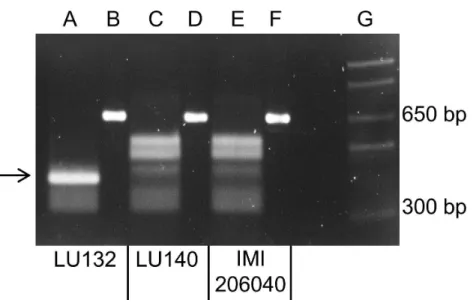
A PCR to amplify a 660 bp region, which encompassed the LU132-specific SNP1, was carried out with LU132, LU140, IMI206040 and 39 otherT. atrovirideandT. cf. atroviride strains from New Zealand, Europe and Asia. Sequence analysis of the PCR products from LU132, LU140 and IMI206040 showed that LU132 contained threeHphI restriction sites while the products of LU140 and IMI206040 contained two. The additionalHphI site in LU132 was conferred by the LU132-specific SNP1 (Table 1).
All PCR products were digested to completion with HphI (New England Biolabs).
Figure 3 shows the banding patterns for LU132, LU140 and IMI206040. The SNP1-containing region could also be amplified from five T. atroviride strains from Europe and Asia and threeT. atroviridestrains from New Zealand but the digest banding pattern resembled that of LU140 and IMI206040. Of 34 testedT. cf. atroviride strains from New Zealand, five could not be amplified and the remaining showed the LU140 and IMI206040 banding pattern (see strain identities and RFLP results inTable S6). These results confirmed the strain-specificity of the developed LU132-specific molecular RFLP marker.
Linking phenotype and genotype
The high genetic similarity in combination with the phenotypical distinctness of LU132 and LU140 led us to investigate functional relationships between the SNPs and phenotypic characteristics.
Target genes directly associated with SNPs
Table 1 LU132-specificHphI restriction site created by SNP1. Sequence (5′
→3′)
IMI204060 TAAAGGCGAAGGTAGAAGCGAAAAT
LU132 TAAAGGTGAAGGTAGAAGCGAAAAT
LU140 TAAAGGCGAAGGTAGAAGCGAAAAT
HphI restriction sequence ....GGTGANNNNNNNN/...
Notes.
SNP1 (underlined) generated a thirdHphI restriction site in the PCR fragment that was only present in LU132 (at 350 bp).
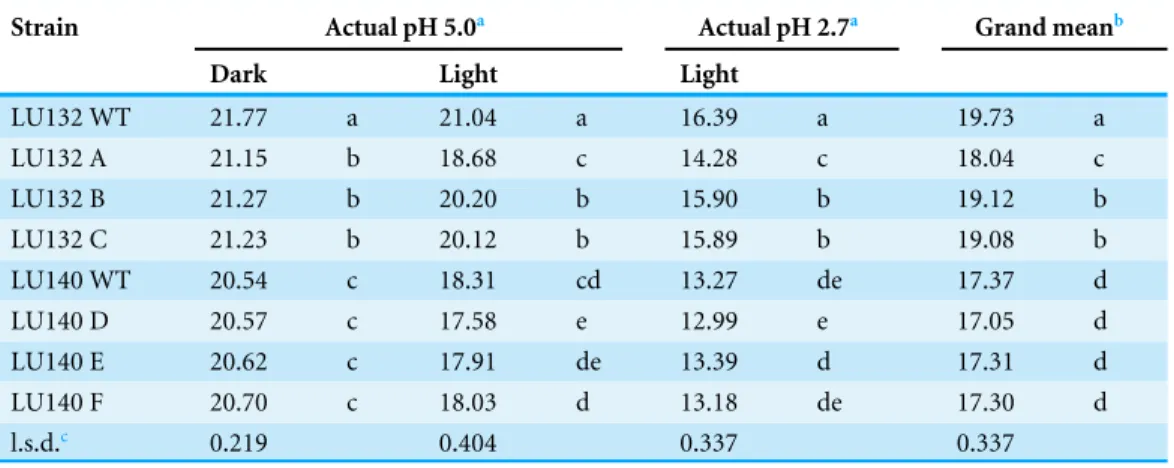
Table 2 Average radial growth rates (mm/d) of WT and1serfmutants.
Strain Actual pH 5.0a Actual pH 2.7a Grand meanb
Dark Light Light
LU132 WT 21.77 a 21.04 a 16.39 a 19.73 a
LU132 A 21.15 b 18.68 c 14.28 c 18.04 c
LU132 B 21.27 b 20.20 b 15.90 b 19.12 b
LU132 C 21.23 b 20.12 b 15.89 b 19.08 b
LU140 WT 20.54 c 18.31 cd 13.27 de 17.37 d
LU140 D 20.57 c 17.58 e 12.99 e 17.05 d
LU140 E 20.62 c 17.91 de 13.39 d 17.31 d
LU140 F 20.70 c 18.03 d 13.18 de 17.30 d
l.s.d.c 0.219 0.404 0.337 0.337
Notes.
Growth rate data for LU132 and LU140 wild types (WT) and1serfmutants (A–F). Values are averages of two experiments with four replicates. Different letters within a column represent significantly different values (P<0.05).
aThe pH was adjusted to 5.0 and 2.4. Before inoculation, the actual pH of the plates was measured. bGrand mean is the average of the three conditions.
cThe grand mean l.s.d. was determined using a split-plot design.
factor (serf) that is conserved in fungi, protozoa and animals. 4F5 protein family members are short proteins with unknown function (Marchler-Bauer et al., 2011). Because SNP1 was a non-synonymous change, it altered the deduced amino acid sequence of the SERF protein from alanine to valine at position 64 in LU132 (Fig. 4A). The amino acid change had the potential to change the protein structure. Phyre2 and SAM-T08 predicted four helices for the LU132 and three helices for the LU140 protein (Fig. S1) (Karplus, 2009;Karplus et al., 2005;Kelley & Sternberg, 2009). ELM identified a mitogen-activated protein kinase docking motif (DOC_MAPK_1) with the amino acid pattern KKRxxKxxxxLxV created by SNP1 in LU132 but absent in LU140 (Dinkel et al., 2013) that could potentially change the function of SERF.
Figure 3 Electrophoretic separation ofHphI digested PCR fragments.Lanes B, D and F represent the undigested 660 bp PCR fragments from LU132, LU140 and IMI204060, respectively. Lanes A, C and E represent theHphI digested PCR fragments for LU132, LU140 and IMI204060, respectively. The arrow in-dicates the 350 bp restriction fragment that was only found in LU132. Size standard was 1 Kb Plus DNA LadderTM(Invitrogen) in lane G.
minima(XP_007918421), but its function in these organisms was not known. SNP2 was located in the 3rd exon ofpcnabut was a synonymous change that did not alter the deduced amino acid sequence for the PCNA protein (Fig. 4B).
The identified two SNP-related target genes (serf andpcna) were selected for further analyses to determine whether their gene expression or functions were likely to be affected by the SNPs.
Relative expression of target genes
The relative expression of the two SNP-related target genes (serf andpcna) and the two metabolism-related target genes (genes encoding N-acetyl-β-D-glucosaminidasesnag1and nag2) was assessed under standard culturing and mycoparasitism-inducing conditions. Gene expression, normalised to the expression of the reference gene (tef1α), were similar in LU132 and LU140 (Table S7). Induction with N-acetyl-D-glucosamine (NAG) resulted in significantly higher relative expression than without NAG ofnag1,nag2andpcnain LU132 and ofnag2andpcnain LU140. The results of this experiment showed that the different phenotypes of LU132 and LU140 were not caused by differential expression of the two SNP-harbouring genes or the two NAGase-encoding genes.
Functional analysis ofserf
Functional analysis of theserf gene was carried out by gene replacement in LU132 and LU140 with the aim of generating identical mutant strains. Three monokaryotic mitotically stable hygromycin B resistant1serf transformants for LU132 (mutants A, B and C) and LU140 (mutants D, E and F) were generated. PCR and Southern analysis confirmed that both LU132 WT and LU140 WT contained a single copy ofserf at the predicted position in the genome and thatserf was replaced by a single copy of the knock-out construct in all mutants (Figs. S2andS3). The average growth rates (grand mean) of the LU1401serf mutants were not significantly different from LU140 WT (P<0.05) (Table 2). The average growth rates of the LU1321serf mutants varied significantly from the LU132 WT in all treatments. Two LU1321serf mutants (B and C) displayed a growth rate reduction of 3% while one mutant (A) had a reduction of 9% compared to the LU132 WT. However, even the slowest growing LU132 mutant (A) grew on average significantly faster than LU140 WT.
The colony appearances of the mutants that were incubated with constant light, are shown inFig. 5. On PDA (pH 5) the conidia of LU140 and its mutants D, E and F and the LU132 mutant A covered the whole plate, while LU132 and its mutants B and C did not produce conidia in the centre. On PDA pH 2.7, LU140 and its mutants D, E, F and the LU132 mutant A all produced yellow-green conidia while LU132 and its mutants B and C produced only immature white/light green conidia.
The phenotype microarray assay (Biolog FF) was used to group the mutants according to their metabolic profiles (Fig. S4). The cluster analysis of the OD750data (mycelial growth)
Figure 5 Colony appearance/conidiation of mutants.LU132 mutants B and C always resembled the LU132 WT, while LU132 mutant A resembled the LU140 WT. The conidiation characteristics of all LU140 mutants were similar to the 140 WT.
data (catabolic activity) were not so clearly grouped. One strain (LU132 mutant C) was an outlier and the remaining strains were separated into two groups at a similarity distance of 0.67. One group contained LU132, its mutant B and the two LU140 mutants E and F, while the second group contained LU140, its mutant D and LU132 mutant A.
functional genomic difference between LU132 and LU140, functional analysis with six independent1serf mutants suggested that this only partially accounted for the phenotypic differences.
DISCUSSION
The main aim of this study was to identify genetic differences between genetically highly similar T. cf. atroviride strains LU132 and LU140 by whole genome comparison. This research allowed the identification of two SNPs that distinguish the strains.
One SNP could be utilised for the successful development and validation of a molecular test for the commercial biocontrol strainT. cf. atroviride LU132. The marker screening technique is straightforward and affordable. The availability of the marker will enable the registration of LU132 biocontrol products internationally, thus opening them to additional markets. The molecular marker for LU132 will also enable more detailed research on this particular strain, as it will now be possible to identify this strain in the environment to study colonisation, competition and mycoparasitism.
The genomes of LU132 and LU140 were found to be nearly identical. Earlier molecular studies with the two strains indicated that there would only be a small number of genomic differences, but the identification of only 1 SNP per strain was very surprising. It has to be noted though that the inability to identify a SNP is not proof of absence and that SNPs in repetitive regions or in regions with missing coverage may have been missed in this exercise. However, Trichoderma atroviride contains only a small number of degenerate transposable elements (0.49% of the genome) and micro- or mini satellite DNA (0.94%) (Kubicek et al., 2011). The analysis ofde novoassembled unmapped reads for LU132 and LU140 minimised the possibility that SNPs might have been missed because they were located in genomic regions with low coverage. In addition to that, the genomes of two other T. cf. atroviride strains from New Zealand were analysed at the same time, using the same methods, and were found to have on the order of 10,000 times more strain-specific SNPs than LU132 and LU140 (data not shown), confirming the appropriateness of the applied methods to identify SNPs. In fact, simple by-chance scrolling through these sequences in IGV enabled the identification of a SNP and a 1 bp insertion in these other strains (Figs. S5andS6).
The metabolism and conidiation profiles of LU132 and LU140 could be distinguished using Phenotype Microarrays. N-acetyl-D-glucosamine (NAG) was one of the compounds that resulted in significantly different growth and catabolic activity of LU132 and LU140. NAG is a monomer of chitin, the main component of fungal cell walls.Trichodermaspp. contain two NAG-cleaving enzymes (N-acetyl-β-D-glucosaminidase 1 and 2) encoded bynag1 andnag2 (Mach et al., 1999;Peterbauer et al., 1996;Ramot et al., 2004). These enzymes are not only involved in chitin degradation of fungal cell walls (Brunner et al., 2003) and in mycoparasitism (Zeilinger et al., 1999) but also in mycelial growth on chitin (Lopez-Mondejar et al., 2009). However, LU132 and LU140 expressed these two genes at similar levels. By comparing NAGases activity to transcript levels of nag1andnag2in T. atroviride P1 on Biolog FF plates,Seidl, Druzhinina & Kubicek (2006)found that both genes are regulated at the transcriptional level. This suggests that the similar expression levels ofnag1andnag2in LU132 and LU140 would lead to similar NAGase activities in both strains and that their different growth rates are not likely to be affected by NAG metabolism. The difference in the biocontrol abilities of the two strains appears therefore to be more complex than originally assumed.
The two identified SNPs did not alter the expression of the associated target genes; however, SNP1 inserf was a non-synonymous change. Bioinformatics analyses predicted protein structure changes due to the amino acid change in SERF from LU132, which could have impacts on the protein function. A single change in the amino acid sequence could therefore potentially have effects on multiple processes (pleiotropy) and might lead to the altered phenotype of LU132, compared to LU140, in multiple complex ways. The more efficient biocontrol activity of LU132, compared to LU140, might therefore be a result of multiple changes caused by SNP1 rather than a result of SNP1 directly. This hypothesis correlates with the finding that a number of metabolic differences were found between LU132 and LU140 but the main biocontrol-related phenotypic difference was found in the growth rates.
To study the involvement of a particular gene in the development of a mutant phenotype, the mutation is usually introduced into the wild type to achieve targeted gene disruption, and the mutated gene then replaced with the wild type gene in the mutant. These processes include the introduction of selection markers that can also have phenotypic effects. For the analysis of a particular gene function this is generally not a problem. In contrast to this, our aim was to create genomically identical strains to see if their phenotypes would be identical. The only current option to achieve this was to remove the SNP-containing gene in both strains and to replace it with an identical knockout cassette, including an identical selection marker.
the involvement ofserf in the development of the observed mutant phenotypes; however, it would not have provided more information about the additional factors responsible for the different wild type phenotypes.
Epigenetic modification could contribute to development of the distinct phenotypes of LU132 and LU140. Interactions between pathogen, plant and the biocontrol agent are very complex and are therefore difficult to associate with a genetic origin. This is attributed to multiple genetic causes but also to epigenetic modifications, such as DNA methylation, histone modifications and RNA interference. It has been shown for instance that the DNA methylation states of three dimorphic fungi (M. rouxii, Y. lipolyticaandU. maydis) differ between their mycelial and yeast stages (Reyna-Lopez, Simpson & Ruiz-Herrera, 1997), that chromatin-remodelling and DNA methylation affect gene expression inNeurospora(Belden et al., 2011), that histone modifications lead to transcriptional activation or repression in many fungi (Aghcheh & Kubicek, 2015) and that non-coding micro-RNA like RNAs (milRNAs) could be potential regulators of cellulase production or fungal growth in T. reesei(Kang et al., 2013). Genome comparisons showed thatTrichoderma atroviride, T. virensandT. reeseicontain genes or homologs to the genes known to be involved in epigenetic regulation of gene expression (Schmoll et al., in press) but the actual functionality of these processes have not yet been studied inTrichoderma.
Another reason for the different phenotypes of LU132 and LU140 could be that one or both strains naturally contained an extra-chromosomal element, such as a mycovirus or a plasmid. Mycoviruses are widespread in fungi (Ghabrial & Suzuki, 2009) where they can affect virulence and cause debilitation (McCabe, Pfeiffer & Van Alfen, 1999;Preisig et al., 2000). Although the function has not yet been studied, single-stranded RNA elements could be identified in one other T. cf. atroviride strain from New Zealand but no extra-chromosomal elements have been found in LU132 and LU140 (Lange, 2015). To our knowledge, only double-stranded RNA (dsRNA) elements have been reported for other Trichodermaspecies so far and their impact on the phenotype is equally unknown (Antal et al., 2005a;Antal et al., 2005b;Jom-in & Akarapisan, 2009). Circular plasmids have been identified in mitochondria ofTrichoderma viride,T. harzianumandT. virens(Antal et al., 2002;Meyer, 1991). The plasmids appeared to have no influence on the strain’s morphology; however, it is known that a plasmid in Neurosporaspecies is responsible for senescence (Griffiths, Kraus & Bertrand, 1986).
CONCLUSION
The main goal to iden tify genetic differences between genetically highly similarT. cf. atroviride strains LU132 and LU140 by whole genome comparison was successful. A strain-specific molecular marker forT. cf. atroviride LU132 was successfully designed and validated. Further analysis of the polymorphic gene, containing the non-synonymous SNP1, highlighted that even apparently genetically identical strains (1serf mutants) can have different phenotypes and that natural strains with different phenotypes (LU132 and LU140) can be genetically extremely similar. Even though whole genome sequencing is an important tool for fundamental and applied research, the definition of an individual is not exclusively defined by its DNA sequence. In the microbiological context, this creates limitations for molecular strain typing to identify efficient biocontrol strains or pathogens and implies that these techniques should not be applied in isolation but should always be combined with phenotypic characterisation.
DATA AVAILABILITY
Strains are available upon request. Gene sequence data are available at GenBank accession numbers:KR812141.1(serf for LU132),KR812142.1(serf for LU140),KR812145.1(pcna for LU132),KR812146.1(pcnafor LU140) andEHK42777.1(tef1α). Illumina raw data for LU132 and LU140 are available at the NCBI sequence read archive, accessionSRP070858.
ACKNOWLEDGEMENTS
Thepki/hphand1blr-2fragments (derived from plasmid pCB1004 (FGSC)) were kindly provided by Artemio Mendoza-Mendoza (Bio-Protection Research Centre, Lincoln University, Lincoln, New Zealand), pYT6 was kindly provided by Barry Scott (Massey University, Palmerston North, New Zealand) and Pythium ultimumspp. was kindly provided by Wadia Kandula (Bio-Protection Research Centre, Lincoln University, Lincoln, New Zealand). We wish to thank Andrew Holyoake for theoretical and technical support as well as Dave Saville for help with statistical analyses.
ADDITIONAL INFORMATION AND DECLARATIONS
Funding
This research was funded by Lincoln University and the Bio-Protection Research Centre, Lincoln, New Zealand. The funders had no role in study design, data collection and analysis, decision to publish, or preparation of the manuscript.
Grant Disclosures
The following grant information was disclosed by the authors: Lincoln University.
Bio-Protection Research Centre, Lincoln, New Zealand.
Competing Interests
Author Contributions
• Claudia Lange conceived and designed the experiments, performed the experiments, analyzed the data, contributed reagents/materials/analysis tools, wrote the paper, prepared figures and/or tables, reviewed drafts of the paper.
• Richard J. Weld, Alison Stewart and Johanna M. Steyaert conceived and designed the experiments, contributed reagents/materials/analysis tools, reviewed drafts of the paper.
• Murray P. Cox and Kirstin L. McLean conceived and designed the experiments, performed the experiments, analyzed the data, contributed reagents/materials/analysis tools, reviewed drafts of the paper.
• Rosie E. Bradshaw conceived and designed the experiments, reviewed drafts of the paper.
DNA Deposition
The following information was supplied regarding the deposition of DNA sequences: GenBank:KR812141.1,KR812142.1,KR812145.1,KR812146.1,EHK42777.1.
Data Availability
The following information was supplied regarding data availability: NCBI SRA:SRP070858.
Supplemental Information
Supplemental information for this article can be found online athttp://dx.doi.org/10.7717/ peerj.2023#supplemental-information.
REFERENCES
Aghcheh RK, Kubicek CP. 2015.Epigenetics as an emerging tool for improvement of fungal strains used in biotechnology.Applied Microbiology and Biotechnology
99:6167–6181DOI 10.1007/s00253-015-6763-2.
Antal Z, Hatvani L, Varga J, Kredics L, Szekeres A, Manczinger L, Vágvölgyi C, Nagy E. 2005a.Double-stranded RNA elements inTrichodermastrains derived from mushroom farms [Abstract].Acta Microbiologica et Immunologica Hungarica52:5.
Antal Z, Manczinger L, Kredics L, Kevei F, Nagy E. 2002.Complete DNA sequence and analysis of a mitochondrial plasmid in the mycoparasiticTrichoderma harzianum strain T95.Plasmid47:148–152DOI 10.1006/plas.2001.1559.
Antal Z, Varga J, Szekeres A, Kredics L, Manczinger L, Hatvani L, Vágvölgyi C, Nagy E. 2005b.Investigation of dsRNA molecules inTrichodermastrains. Poster abstract. Acta Microbiologica et Immunologica Hungarica52:241–242.
Atanasova L, Druzhinina IS, Jaklitsch WM. 2013. Two hundredTrichodermaspecies recognized on the basis of molecular phylogeny. In: Mukherjee PK, Horwitz BA, Singh US, Mukherjee M, Schmoll M, eds.Trichoderma: biology and applications. Wallingford: Centre for Agriculture and Biosciences International, 10–42.
Belden WJ, Lewis ZA, Selker EU, Loros JJ, Dunlap JC. 2011.CHD1 remodels chromatin and influences transient DNA methylation at the clock gene frequency.PLoS Genetics
Bochner BR, Gadzinski P, Panomitros E. 2001.Phenotype MicroArrays for high-throughput phenotypic testing and assay of gene function.Genome Research
11:1246–1255DOI 10.1101/gr.186501.
Brunner K, Peterbauer CK, Mach RL, Lorito M, Zeilinger S, Kubicek CP. 2003.The Nag1 N-acetylglucosaminidase ofTrichoderma atrovirideis essential for chitinase in-duction by chitin and of major relevance to biocontrol.Current Genetics43:289–295
DOI 10.1007/s00294-003-0399-y.
Bustin SA, Benes V, Garson JA, Hellemans J, Huggett J, Kubista M, Mueller R, Nolan T, Pfaffl MW, Shipley GL, Vandesompele J, Wittwer CT. 2009.The MIQE guidelines: minimum information for publication of quantitative real-time PCR experiments. Clinical Chemistry55:611–622DOI 10.1373/clinchem.2008.112797.
Card SD, Walter M, Jaspers MV, Sztejnberg A, Stewart A. 2009.Targeted selection of antagonistic microorganisms for control ofBotrytis cinereaof strawberry in New Zealand.Australasian Plant Pathology38:183–192DOI 10.1071/AP08097.
Carsolio C, Gutierrez A, Jimenez B, Van Montagu M, Herrera-Estrella A. 1994.
Characterization ofech42, aTrichoderma harzianumendochitinase gene expressed during mycoparasitism.Proceedings of the National Academy of Sciences of the United States of America91:10903–10907DOI 10.1073/pnas.91.23.10903.
Chohan P, Kandula D, Stewart A, Hampton J. 2010.Biological control ofRhizoctonia solaniin perennial ryegrass usingTrichoderma atrovirideisolates. In: Stirling G, ed. 6th Australasian Soilborne Diseases Symposium. Sydney: Horticulture Australia, 35.
Cordier C, Edel-Hermann V, Martin-Laurent F, Blal B, Steinberg C, Alabouvette C. 2007.SCAR-based real time PCR to identify a biocontrol strain (T1) ofTrichoderma atrovirideand study its population dynamics in soils.Journal of Microbiological Methods68:60–68DOI 10.1016/j.mimet.2006.06.006.
Cox MP, Peterson D, Biggs P. 2010.SolexaQA: at-a-glance quality assessment of Illumina second-generation sequencing data.BMC Bioinformatics11:485–490
DOI 10.1186/1471-2105-11-485.
De Groot MJA, Bundock P, Hooykaas PJJ, Beijersbergen AGM. 1998.Agrobacterium tumefaciens-mediated transformation of filamentous fungi.Nature Biotechnology
16:839–842DOI 10.1038/nbt0998-839.
Dinkel H, Van Roey K, Michael S, Davey NE, Weatheritt RJ, Born D, Speck T, Krüger D, Grebnev G, Kubań M, Strumillo M, Uyar B, Budd A, Altenberg B, Seiler M, Chemes LB, Glavina J, Sánchez IE, Diella F, Gibson TJ. 2013.The eukaryotic linear motif resource ELM: 10 years and counting.Nucleic Acids Research42:D259–D266
DOI 10.1093/nar/gkt1047.
Dodd-Wilson SL. 1996.Biochemical and molecular characterisation ofTrichoderma species. PhD Thesis, University of Auckland.Available athttp:// hdl.handle.net/ 2292/ 1916.
Friedl MA, Kubicek CP, Druzhinina IS. 2008.Carbon source dependence and pho-tostimulation of conidiation inHypocrea atroviridis.Applied and Environmental Microbiology74:245–250DOI 10.1128/AEM.02068-07.
Ghabrial SA, Suzuki N. 2009.Viruses of plant pathogenic fungi.Annual Review of Phytopathology47:353–384 DOI 10.1146/annurev-phyto-080508-081932.
Griffiths AJF, Kraus S, Bertrand H. 1986.Expression of senescence inNeurospora intermedia.Genome28:459–467 DOI 10.1139/g86-069.
Hamari Z, Tóth B, Beer Z, Gácser A, Kucsera J, Pfeiffer I, Juhász Á, Kevei F. 2003.
Interpretation of intraspecific variability in mtDNAs ofAspergillus nigerstrains and rearrangement of their mtDNAs following mitochondrial transmissions.FEMS Microbiology Letters221:63–71DOI 10.1016/S0378-1097(03)00165-4.
Harman GE, Herrera-Estrella AH, Horwitz BA, Lorito M. 2012.Special issue: Trichoderma—from basic biology to biotechnology.Microbiology158:1–2
DOI 10.1099/mic.0.056424-0.
Harman GE, Howell CR, Viterbo A, Chet I, Lorito M. 2004.Trichodermaspecies— Opportunistic, avirulent plant symbionts.Nature Reviews Microbiology2:43–56
DOI 10.1038/nrmicro797.
Harrison YA, Stewart A. 1988.Selection of fungal antagonists for biological control of onion white rot in New Zealand.New Zealand Journal of Experimental Agriculture
16:249–256DOI 10.1080/03015521.1988.10425647.
Hermosa MR, Grondona I, Diaz-Minguez JM, Iturriaga EA, Monte E. 2001. Develop-ment of a strain-specific SCAR marker for the detection ofTrichoderma atroviride 11, a biological control agent against soilborne fungal plant pathogens.Current Genetics38:343–350DOI 10.1007/s002940000173.
Holder DJ, Keyhani NO. 2005.Adhesion of the entomopathogenic fungus Beauve-ria(Cordyceps)bassianato substrata.Applied and Environmental Microbiology
71:5260–5266DOI 10.1128/AEM.71.9.5260-5266.2005.
Holyoake A, O’Sullivan P, Pollock R, Best T, Watanabe J, Kajita Y, Matsui Y, Ito M, Nishiyama H, Kerr N, Tatley FDS, Cambridge L, Toro T, Ogawa O, Guilford P. 2008.Development of a multiplex RNA urine test for the detection and stratification of transitional cell carcinoma of the bladder.Clinical Cancer Research14:742–749
DOI 10.1158/1078-0432.CCR-07-1672.
Jom-in S, Akarapisan A. 2009.Characterization of double-stranded RNA inTrichoderma spp. isolates in Chiang Mai province.Journal of Agricultural Technology5:261–270.
Kang K, Zhong J, Jiang L, Liu G, Gou CY, Wu Q, Wang Y, Luo J, Gou D. 2013. Identi-fication of microRNA-like RNAs in the filamentous fungusTrichoderma reeseiby solexa sequencing.PLoS ONE8:e76288DOI 10.1371/journal.pone.0076288.
Karplus K. 2009.SAM-T08, HMM-based protein structure prediction.Nucleic Acids Research37:W492–W497DOI 10.1093/nar/gkp403.
Karplus K, Katzman S, Shackleford G, Koeva M, Draper J, Barnes B, Soriano M, Hughey R. 2005.SAM-T04: what is new in protein–structure prediction for CASP6.Proteins: Structure, Function, and Bioinformatics61:135–142
Kay SJ. 1991.Biological control of onion white rot. Master’s Thesis, University of Auckland.
Kay SJ. 1994.The effect of fungicides on fungal antagonists of onion white rot and selection of dicarboximide-resistant biotypes.Plant Pathology43:863–871
DOI 10.1111/j.1365-3059.1994.tb01630.x.
Kay SJ, Stewart A. 1994.Evaluation of fungal antagonists for control of onion white rot in soil box trials.Plant Pathology 43:371–377
DOI 10.1111/j.1365-3059.1994.tb02698.x.
Kelley LA, Sternberg MJ. 2009.Protein structure prediction on the Web: a case study using the Phyre server.Nature Protocols4:363–371DOI 10.1038/nprot.2009.2.
Kubicek CP, Herrera-Estrella A, Seidl-Seiboth V, Martinez DA, Druzhinina IS, Thon M, Zeilinger S, Casas-Flores S, Horwitz BA, Mukherjee PK, Mukherjee M, Kredics L, Alcaraz LD, Aerts A, Antal Z, Atanasova L, Cervantes-Badillo MG, Challacombe J, Chertkov O, McCluskey K, Coulpier F, Deshpande N, Von Doehren H, Ebbole DJ, Esquivel-Naranjo EU, Fekete E, Flipphi M, Glaser F, Gomez-Rodriguez EY, Gruber S, Han C, Henrissat B, Hermosa R, Hernandez-Onate M, Karaffa L, Kosti I, Le Crom S, Lindquist E, Lucas S, Luebeck M, Luebeck PS, Margeot A, Metz B, Misra M, Nevalainen H, Omann M, Packer N, Perrone G, Uresti-Rivera EE, Salamov A, Schmoll M, Seiboth B, Shapiro H, Sukno S, Tamayo-Ramos JA, Tisch D, Wiest A, Wilkinson HH, Zhang M, Coutinho PM, Kenerley CM, Monte E, Baker SE, Grigoriev IV. 2011.Comparative genome sequence analysis underscores mycoparasitism as the ancestral life style ofTrichoderma.Genome Biology12:R40–R54DOI 10.1186/gb-2011-12-4-r40.
Kuhls K, Lieckfeldt E, Samuels GJ, Meyer W, Kubicek CP, Börner T. 1997.Revision of Trichodermasect.Longibrachiatumincluding related teleomorphs based on analysis of ribosomal DNA internal transcribed spacer sequences.Mycologia89:442–460
DOI 10.2307/3761038.
Lange C. 2015.The genome and beyond: Phenotypic determinants of twoTrichoderma cf. atroviridesister strains. PhD Thesis, Lincoln University.Available athttp:// hdl. handle.net/ 10182/ 6675.
Li H, Durbin R. 2009.Fast and accurate short read alignment with Burrows–Wheeler transform.Bioinformatics25:1754–1760DOI 10.1093/bioinformatics/btp324.
Li H, Handsaker B, Wysoker A, Fennell T, Ruan J, Homer N, Marth G, Abecasis G, Durbin R, Subgroup GPDP. 2009.The sequence alignment/map format and SAMtools.Bioinformatics25:2078–2079DOI 10.1093/bioinformatics/btp352.
Lieckfeldt E, Cavignac Y, Fekete C, Borner T. 2000.Endochitinase gene-based phylogenetic analysis ofTrichoderma.Microbiological Research155:7–15
DOI 10.1016/S0944-5013(00)80016-6.
Lorito M, Woo SL, Harman GE, Monte E. 2010.Translational research onTrichoderma: from omics to the field.Annual Review of Phytopathology48:395–417
DOI 10.1146/annurev-phyto-073009-114314.
Mach RL, Peterbauer CK, Payer K, Jaksits S, Woo SL, Zeilinger S, Kullnig CM, Lorito M, Kubicek CP. 1999.Expression of two major chitinase genes ofTrichoderma atroviride(T. harzianumP1) is triggered by different regulatory signals.Applied and Environmental Microbiology65:1858–1863.
Mach RL, Schindler M, Kubicek CP. 1994.Transformation ofTrichoderma reeseibased on hygromycin B resistance using homologous expression signals.Current Genetics
25:567–570DOI 10.1007/BF00351679.
Marchler-Bauer A, Lu S, Anderson JB, Chitsaz F, Derbyshire MK, DeWeese-Scott C, Fong JH, Geer LY, Geer RC, Gonzales NR. 2011.CDD: a Conserved Domain Database for the functional annotation of proteins.Nucleic Acids Research
39:D225–D229DOI 10.1093/nar/gkq1189.
McCabe PM, Pfeiffer P, Van Alfen NK. 1999.The influence of dsRNA viruses on the biology of plant pathogenic fungi.Trends in Microbiology7:377–381
DOI 10.1016/S0966-842X(99)01568-1.
McIlvaine T. 1921.A buffer solution for colorimetric comparison.Journal of Biological Chemistry49:183–186.
McLean K. 1996.Control of onion white rot using beneficial microorganisms and soil solarisation. M.Sc Master’s thesis, Lincoln University.Available athttp:// hdl.handle. net/ 10182/ 3075.
McLean K. 2001.Biological control of onion white rot usingTrichoderma harzianum. PhD Thesis, Lincoln University.Available athttp:// hdl.handle.net/ 10182/ 1494.
McLean K, Braithwaite M, Swaminathan J, Stewart A. 2012.Variability in control of onion white rot byTrichoderma atrovirideunder different disease pressures. Australasian Plant Pathology41:341–346DOI 10.1007/s13313-011-0113-3.
McLean K, Stewart A. 2000.Application strategies for control of onion white rot by fungal antagonists.New Zealand Journal of Crop and Horticultural Science
28:115–122DOI 10.1080/01140671.2000.9514131.
McLean K, Swaminathan J, Frampton CM, Hunt JS, Ridgway HJ, Stewart A. 2005.
Effect of formulation on the rhizosphere competence and biocontrol ability of Trichoderma atrovirideC52.Plant Pathology 54:212–218
DOI 10.1111/j.1365-3059.2005.01158.x.
Meyer RJ. 1991.Mitochondrial DNAs and plasmids as taxonomic characteristics in Trichoderma viride.Applied and Environmental Microbiology 57:2269–2276.
Moreno-Mateos MA, Delgado-Jarana J, Codón AC, Benítez T. 2007.pH and Pac1 control development and antifungal activity inTrichoderma harzianum.Fungal Genetics and Biology44:1355–1367DOI 10.1016/j.fgb.2007.07.012.
Peterbauer CK, Lorito M, Hayes CK, Harman GE, Kubicek CP. 1996.Molecular cloning and expression of thenag1gene (N-acetyl-β-D-glucosaminidase-encoding gene) fromTrichoderma harzianumP1.Current Genetics30:325–331
DOI 10.1007/s002940050140.
Preisig O, Moleleki N, Smit WA, Wingfield BD, Wingfield MJ. 2000.A novel RNA mycovirus in a hypovirulent isolate of the plant pathogenDiaporthe ambigua.Journal of General Virology81:3107–3114DOI 10.1099/0022-1317-81-12-3107.
Ramot O, Viterbo A, Friesem D, Oppenheim A, Chet I. 2004.Regulation of two homodimer hexosaminidases in the mycoparasitic fungusTrichoderma asperellum by glucosamine.Current Genetics45:205–213DOI 10.1007/s00294-003-0478-0.
Rehner SA, Samuels GJ. 1994.Taxonomy and phylogeny ofGliocladiumanalysed from nuclear large subunit ribosomal DNA sequences.Mycological Research98:625–634
DOI 10.1016/S0953-7562(09)80409-7.
Reyna-Lopez G, Simpson J, Ruiz-Herrera J. 1997.Differences in DNA methylation patterns are detectable during the dimorphic transition of fungi by amplification of restriction polymorphisms.Molecular and General Genetics MGG253:703–710
DOI 10.1007/s004380050374.
Sambrook J, Fritsch EF, Maniatis T. 1989.Molecular cloning: a laboratory manual. Cold Spring Harbour: Cold Spring Harbour Laboratory Press.
Schmoll M, Dattenböck C, Carreras-Villaseñor N, Mendoza-Mendoza A, Tisch D, Alemán M, Baker S, Brown C, Cervantes-Badillo M, Cetz J, Cristobal-Mondragon G, Delaye L, Esquivel-Naranjo E, Frischmann A, De Jesus Gallardo-Negrete J, García-Esquivel M, Gomez-Rodriguez E, Greenwood D, Hernández-Oñate M, Kruszewska J, Lawry R, Mora-Montes H, Muñoz-Centeno T, Nieto-Jacobo M, Lopez G, Olmedo-Monfil V, Osorio-Concepcion M, Piłsyk S, Pomraning K, Rodriguez-Iglesias A, Rosales-Saavedra M, Sánchez-Arreguín J, Seidl-Seiboth V, Stewart A, Uresti-Rivera E, Wang C, Wang T, Zeilinger S, Casas-Flores S, Herrera-Estrella A. 2016.The genomes of three uneven siblings: footprints of the lifestyles of threeTrichodermaspecies.Microbiology and Molecular Biology Reviews80In press
DOI 10.1128/MMBR.00040-15.
Seidl V, Druzhinina IS, Kubicek CP. 2006.A screening system for carbon sources enhancing beta-N-acetylglucosaminidase formation inHypocrea atroviridis (Trichoderma atroviride).Microbiology-SGM 152:2003–2012
DOI 10.1099/mic.0.28897-0.
Shoukouhi P, Bissett J. 2009.Preferred primers for sequencing the 5′end of the
translation elongation factor 1-alpha gene (eEF1a1). Methods of molecular identifications and laboratory protocols from the International Subcommission onTrichodermaandHypocreaTaxonomy.Available athttp:// www.isth.info/ isth/ methods/.
Steyaert JM, Weld RJ, Stewart A. 2010.Ambient pH intrinsically influencesTrichoderma conidiation and colony morphology.Fungal Biology114:198–208
DOI 10.1016/j.funbio.2009.12.004.
Van der Klei IJ, Veenhuis M. 2006.Yeast and filamentous fungi as model organisms in microbody research.Biochimica et Biophysica Acta (BBA)-Molecular Cell Research
1763:1364–1373DOI 10.1016/j.bbamcr.2006.09.014.
Zeilinger S, Galhaup C, Payer K, Woo SL, Mach RL, Fekete C, Lorito M, Kubicek CP. 1999.Chitinase gene expression during mycoparasitic interaction ofTrichoderma harzianumwith its host.Fungal Genetics and Biology26:131–140
DOI 10.1006/fgbi.1998.1111.
Zwiers LH, De Waard MA. 2001.EfficientAgrobacterium tumefaciens-mediated gene disruption in the phytopathogenMycosphaerella graminicola.Current Genetics