CARBON SEQUESTRATION BY URBAN
TREES ON ROADSIDES OF
VADODARA CITY
G Sandhya Kiran*
Dept. of Botany, Faculty of Science, The M. S. University of Baroda, Vadodara-390002
Shah Kinnary
Dept. of Botany, Faculty of Science, The M. S. University of Baroda, Vadodara-390002
Abstract
A potential enhancement of the Earth's greenhouse effect is a critical environmental problem. Carbon Dioxide (CO2) is the most significant contributor to the human influence on the greenhouse effect. Because CO2
emissions are directly linked to many economically prosperous activities, it is difficult for the society to quickly accomplish large reductions in its production. As trees grow, they remove CO2 from the atmosphere during the
process of photosynthesis. The CO2 is fixed as organic carbon accumulating in the form of biomass. Our own
findings suggest that 73.59 tones of CO2 is removed by trees planted on road sides of Vadodara city which
represents 22% of the City's estimated total CO2 production. Total CO2 Emission at major roads was found
around 159.47 tones because of more number of automobiles as it is the third most-populated city in the Indian state of Gujarat. Results are restricted to the CO2 that is sequestered by trees planted only on road sides
excluding other carbon sinks. It is therefore evident that tree planting on roadside are an effective method of offsetting CO2 from human sources.
Key Words: Carbon Dioxide (CO2), Carbon Emission, Carbon Sequestration, Biomass.
INTRODUCTION
Carbon is the major component of all cellular life forms; trees utilize carbon as a building material with which to form trunks, roots, stems, branches, and leaves. Trees remove (sequester) carbon from the atmosphere through photosynthesis (Francesco Ferrini et al.,2011), extracting carbon dioxide from the air, separating the carbon atom from the oxygen atoms, and returning oxygen to the atmosphere. In doing so, trees store a tremendous amount of carbon in their structures, and annual growth increases the carbon stored within the structure.
The urban forest therefore is a unique ecosystem experiencing different combinations of stressors than many other ecosystems. It therefore requires site- specific research in addition to special strategies and policies to govern its management and design.
Increasing our understanding of the relation of urban site factors to tree stress and health is critical for urban tree management, tree selection, and success of urban tree planting programs.
The above relevant fact has brought the need of evaluating the assessment of green cover in an urban ecosystem. In this context the present study was undertaken in Vadodara city wherein major roads within the Vadodara Municipal Cooperation (VMC) limit were considered (fig.1). The city lies between 22°18ƍ00ƎN and 73°12ƍ01ƎE. The total road length within the VMC limits is about 1000 km. approximately covering 11.47 sq. km. which is 10.59% of the total city area.
Figure: 1 Map showing study area
MATERIALS AND METHOD
In this study, the aspect of the measurement of the amount of carbon has been carried out and this was based on the amount of standing woody biomass of trees on the road sides of Vadodara City. Initially the trees were sampled by quadrate method. Quadrates of size 20m x 20m were taken at different roadsides and at the same time measurements of GBH (cm) and Basal Area (m2) for different trees were taken (Yadava and Supriya, 2006). Based on these values standing woody biomass (T/ha) (Abraham etal., 2005) and Carbon sequestration rate of trees (T/ha) (Negi et al., 2003) were calculated. These values were then converted into ton/km as per unit conversion and then values were find out for CO2 from C and then the comparison were done of Total Carbon
emitted and sequestered from all the road sites.
Different equation used were
Basal Area (m2) = (GBH/2π)² *π (1)
Standing Woody Biomass (ton/ha) = -1.689+8.32*BA (2)
RESULTS AND DISSCUSSION
There is an increasing tendency among the environmentalists to view holistically the ever decreasing tree cover and subsequent fall in carbon sinks. This decline in carbon sinks has resulted in concomitant increase in carbon emission and a subsequent rise in global temperatures (A. Waran and A. Patwardhan, 2001). Thus increase in CO2 is amongst the most dreaded problems among the urban tree cover because of the vehicular pollution. In the
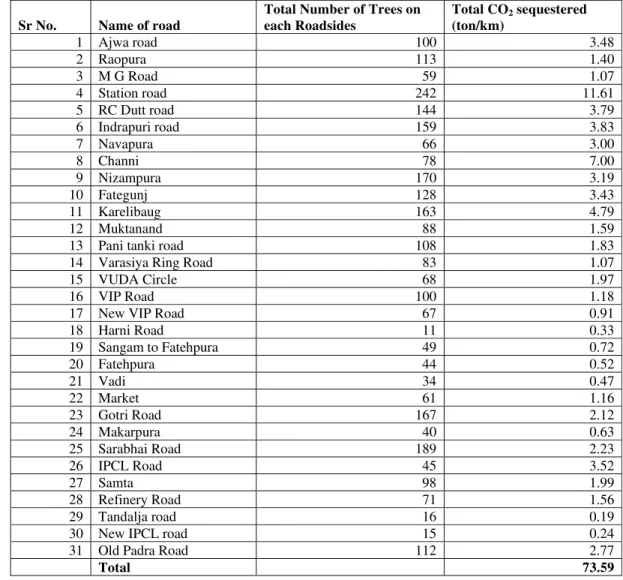
urban areas the roadside trees are in the close proximity to the source of vehicular emissions. They serve as an important component in reducing such emissions. In this city the urban tree cover provides benefits such as carbon storage and sequestration along with the reduction in the air pollutant. Keeping in mind the above relevant facts the need for evaluating and assessing the roadside tree cover in an urban ecosystem becomes imperative. This green cover in the form of urban forest has a significant potential in carbon sequestration (Nowak et.al. 1994). Nowak, 2002 has brought out that Carbon sequestration is not only related to the increased tree cover but also very much related to the increased proportion of large and healthy trees in population. In the present study this point is very clearly brought out as certain roads of Vadodara city with similar number of species exhibited variation in the values of the carbon sequestered (Table 1). The amount of carbon sequestered by these road side trees has amounted to 73.59 tons (Table 1) of carbon dioxide per year. The source of carbon sequestered by these trees can be attributed to the different categories of vehicles passing by these trees.
Table 1: Total CO2 sequestered from all Roadsides of Vadodara City
Sr No. Name of road
Total Number of Trees on each Roadsides
Total CO2 sequestered (ton/km)
1 Ajwa road 100 3.48
2 Raopura 113 1.40
3 M G Road 59 1.07
4 Station road 242 11.61
5 RC Dutt road 144 3.79
6 Indrapuri road 159 3.83
7 Navapura 66 3.00
8 Channi 78 7.00
9 Nizampura 170 3.19
10 Fategunj 128 3.43
11 Karelibaug 163 4.79
12 Muktanand 88 1.59
13 Pani tanki road 108 1.83
14 Varasiya Ring Road 83 1.07
15 VUDA Circle 68 1.97
16 VIP Road 100 1.18
17 New VIP Road 67 0.91
18 Harni Road 11 0.33
19 Sangam to Fatehpura 49 0.72
20 Fatehpura 44 0.52
21 Vadi 34 0.47
22 Market 61 1.16
23 Gotri Road 167 2.12
24 Makarpura 40 0.63
25 Sarabhai Road 189 2.23
26 IPCL Road 45 3.52
27 Samta 98 1.99
28 Refinery Road 71 1.56
29 Tandalja road 16 0.19
30 New IPCL road 15 0.24
31 Old Padra Road 112 2.77
Total 73.59
wheelers and 4 wheelers were observed. Vehicular population showed increasing trend during last ten years. It showed increasing strength of 2 wheelers when compared to 3 or 4 wheelers (figure 2). The contribution of carbon dioxide by each type when taken into consideration, each contributed 75.47, 45.15, 48.85 tones of carbon respectively amounting to 159.47 tones of carbon dioxide
Figure: 2 Numbers of Vehicles increasing during 1998-2008 in Vadodara City
The existing tree population contributes only 22% in reducing carbon pollution which needs to be increased to maintain the carbon cycle balance.This can be achieved by increasing the tree cover by carrying out tree plantation activities in the space available. The selection of tree species in such cases if done precisely i.e specifically looking at their development of girth size and capacity to resist pollution, additional environmental and economic benefits can be accrued.. For the present study area the species recommended to be planted on road side were like Neem (Azadirchta indica), Indian laburnum (Cassia fistula and C. siamea), Gulmohar (Delonix regia), Pipal (Ficus religiosa), Java plum (Syzygium cumini), Jacaranda (Jacaranda mimosifolia), Indian lilac (Lagerstroemia indica), and Temple or Pagoda tree (Plumeria rubra and P. alba) have also been recommended as they have been shown to have a higher carbon sequesteration rates and are more suitable in urban environment (Chakre. 2006).
CONCLUSIONS
Cities are a major source of carbon dioxide emissions. As demonstrated by this research paper urban trees planted on roadsides can help in sequestering CO2 and mitigate the effects of carbon emitted from the
automobiles. It is important to reduce fossil fuel emissions and planting large and healthy trees to maximize the amount of CO2 sequestered by urban trees on roadsides. In Vadodara city there is need to increase roadside
plantation to retrieve the 88% effect of emitted carbon.
REFERENCES:
[1] A. Waran and A. Patwardhan (2001). Urban carbon burden of Pune City: A case study from India. Masters thesis submitted to Univ. of Pune.
[2] Abraham, L., G. Sandhya Kiran. (2005), Role of Planning strategies in success/failure of Joint Forest Management. Current Science. 88(2):288-292.
[3] Beckett, K.P., P. Freer-Smith, and G. Taylor. 2000. Effective tree species for local air-quality management. J. Arboric. 26:12–19. [4] Chakre, O.(2006) Choice of Eco-friendly Trees in Urban Environment to Mitigate Airborne Particulate Pollution. J. Hum. Ecol., 20(2):
135-138.
[5] Francesco Ferrini et al. (2011) Sustainable management techniques for trees in the urban areas. Journal of Biodiversity and Ecological
Sciences JBES. 1 (1):1-20.
[6] INFRASTRUCTURE ASSESSMENT OF VADODARA CITY.
[7] http://www.vadodaracity.com/cdp_report.htm
[8] Negi, J.D.S., Manhas, R.K., Chauhan, P.S. (2003), Carbon allocation in different components of some tree species of India: A New Approach for Carbon Estimation. Current Science. 85 (11):1528-1531.
[9] Nowak, D.J., E.G. McPherson, and R.A. Rowntree. (1994), Executive Summary, pp. iii–vi. In McPherson, E.G., D.J. Nowak, and R.A. Rowntree (Eds). Chicago’s Urban Forest Ecosystem: Results of the Chicago Urban Forest Climate Project, General Technical Report NE-186. USDA Forest Service, Northeastern Forest Experiment Station, Radnor, PA.
[10] Nowak. D., Crane. N. (2002), Carbon storage and sequestration by urban trees in the USA. Environmental Pollution. 116:381–389. [11] Scott, K.I., J.R. Simpson, and E.G. McPherson. 1999. Effects of tree cover on parking lot microclimate and vehicle emissions. J.
[12] Wallace, J., et.al. (2009) Mobile monitoring of air pollution in cities: the case of Hamilton, Ontario,Canada. Journal of Environmental
Monitoring. 11: 998–1003.