SRef-ID: 1680-7359/adgeo/2005-2-181 European Geosciences Union
© 2005 Author(s). This work is licensed under a Creative Commons License.
Geosciences
Stochastic downscaling of LAM predictions: an example in the
Mediterranean area
N. Rebora1, L. Ferraris1,2, J. von Hardenberg1, and A. Provenzale3,1 1CIMA, University of Genoa and University of Basilicata, Savona, Italy 2DIST, University of Genoa, Genoa, Italy
3ISAC-CNR, Turin, Italy
Received: 29 November 2004 – Revised: 31 March 2005 – Accepted: 1 April 2005 – Published: 30 May 2005
Abstract.In the absence of a full deterministic modelling of small-scale rainfall, it is common practice to resort to the use of stochastic downscaling models to generate ensemble rain-fall predictions to be used as inputs to rainrain-fall-runoff models. Here we present an application of a novel spatial-temporal downscaling procedure based on a non-linear transformation of a linearly correlated (gaussian) field. This procedure al-lows for reproducing the scaling properties (if any) of the rainfall pattern and it can be easily linked with meteorolog-ical forecasts produced by limited area meteorologmeteorolog-ical mod-els.
1 Introduction
The knowledge of the precipitation field at scales of a few square kilometers and tens of minutes is a crucial ingredi-ent for forecasting floods in small catchmingredi-ents typical of the mediterranean environment. Due to the short response time of these basins, rainfall events have to be known in advance in order to give early warning to the population1. To tackle this issue it is common practice to resort to the use of limited-area meteorological models (LAMs) that provide precipita-tion forecasts on scales of about 100 km2 and a few hours. For small Mediterranean basins [L∼100 km2] it is however impossible to issue a reliable flood warning based on LAM rainfall predictions (Ferraris et al., 2002). In this case the scale of the meteorological forecasting is considerably larger than the scale of the hydrological process.
One option to fill this scale gap is based on the use of stochastic models for rainfall downscaling. A downscaling procedure consists on a stochastic algorithm that is capa-ble of generating a small-scale rainfall field starting from
Correspondence to:N. Rebora
1The time-scale of the social response is of the order of twelve
hours; this indicates the time it takes for the population to receive the warning message and to react by following the alert procedures
a smoother field predicted on larger scales. This approach should provide precipitation fields that are consistent with the known statistical properties of the small-scale rainfall distri-bution and satisfy the large-scale constraints imposed by the meteorological forecast (e.g., the total rainfall volume).
It is important to notice that a rainfall field produced by a downscaling model is just one possible realization of the small-scale field and cannot be considered as the “true” rain-fall distribution. Therefore it should be clear that the down-scaling procedure is a purely stochastic technique that allows for generating an ensemble of possible realizations of the small-scale rainfall field.
The aim of this work is to show the performance of a downscaling algorithm which has been introduced recently (Rebora et al., 20052), to generate small-scale rain rate fluc-tuations that preserve the spatial-temporal evolution of rain-fall pattern predicted by a LAM.
2 Operational rainfall downscaling
A downscaling model suitable for operational use in a hy-drometeorological forecasting chain should be simple, ro-bust and computationally fast and linked in a clear way to the large-scale prediction.
Many procedures have been proposed for rainfall down-scaling to this date. These algorithms can be grouped in three main families: (1) multifractal cascades (Lovejoy and Mandelbrot, 1985; Schertzer and Lovejoy, 1987; Gupta and Waymire, 1993; Over and Gupta, 1996; Perica and Foufoula-Georgiou, 1996; Menabde et al., 1999b, 1997, 1999a; Venu-gopal et al., 1999; Deidda, 2000), (2) non-linearly trans-formed autoregressive models (Mejia and Rodriguez-Iturbe, 1974; Bell, 1987; Guillot and Lebel, 1999) and (3) pro-cesses based on the superposition of many rainfall cells (clus-ter models) (Waymire et al., 1984; Rodriguez-Iturbe et al., 2Rebora, N., Ferraris, L., von Hardenberg, J., and Provenzale,
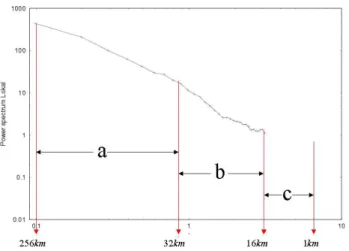
Fig. 1. Example of possible ranges of scales of a power spectrum obtained from the spatial analysis of a LAM prediction:(a)reliable scales,(b)unreliable scales and(c)unresolved scales.
1986; Eagleson et al., 1987; Northrop, 1998; Wheater et al., 2000; Willems, 2001). All these models have been proven to score fairly well in reproducing the small-scale statistical properties observed for precipitation (Ferraris et al., 2003b). However, linking these models with the features of the large scale fields is not that easy. Many downscaling procedures currently available for operational purposes account only for the total precipitation predicted by the LAM, while some other models are based on CAPE predictions (Perica and Foufoula-Georgiou, 1996; Venugopal et al., 1999). Other in-formation provided by the meteorological model is not pre-served. For example, the spatial-temporal structure of the rainfall field is crucial for reliably predicting sudden floods in small mountain catchments and urban areas. Such features become essential in the downscaling of fields predicted in a complex orography environment where flash floods are more likely.
In this work a new downscaling procedure is used. This approach is able to account for the reliable features of the meteorological prediction and its parameters can be directly derived from the large-scale field with no need for calibra-tion.
3 Downscaling with a filtered autoregressive model
Ferraris et al. (2003a,b) have shown that the multifractal properties of radar-measured rainfall fields are compatible with those obtained from a nonlinearly transformed autore-gressive process. Starting from these results a new downscal-ing model has been developed. This procedure is called the RainFARM, Rainfall Filtered AutoRegressive Model, and it was proposed by Rebora et al. (2005)2to which we refer for a complete description and further details. The RainFARM be-longs to the family of algorithms called metagaussian models (see, e.g. Guillot and Lebel 1999) and it is based on a non-linear transformation of a non-linearly correlated process. This approach is closely related to the Turning Bands Method
(Matheron, 1973) and has been used both for satellite-based rainfall measurement validation and for stochastic rainfall modelling (Bell and Kundu, 2003; Bell, 1987; Lanza, 2000). The model is able to generate small-scale rainfall fields that take into account not only the total amount of precipitation predicted by the meteorological model but also its (linear) correlation and the position of the main rainfall patterns. Due to the straightforward link between the model parameters and the large-scale field, this model is suitable for operational downscaling procedures.
The RainFARM uses the spectral information of large-scale meteorological predictions. The basic idea is to pre-serve amplitudes and phases of the original field at the scales at which we are confident in the LAM prediction and to re-construct the Fourier spectrum at smaller scales.
A major concern is to figure out which are the reliable scales. Their definition depends upon the meteorological model we are downscaling and it is related to the predictabil-ity of the meteorological scenario we are considering. It is well known that due to numerical diffusion, a meteorological model is not reliable at scales lower than six to four times its resolution (Patterson and Orszag, 1971). To this end we de-fine three different scale regimes (Fig. 1): (a) reliable scales, (b) unreliable scales, that is the scales resolved by the model but unreliable due to numerical issues and to the lack of as-similation procedures on these scales; (c) unresolved scales, which are the scales not resolved by the model and where we need to know a possible rainfall prediction for hydrological purposes.
The transition from reliable to unreliable scales is some-how subjective and it depends on the model characteristics, the resolution of the network used for data assimilation and the type of meteorological conditions (e.g., convective vs. stratiform).
The RainFARM procedure can be summarized as follows: 1. gaussianization of the LAM spatial-temporal
predic-tion;
2. Fourier transform of the gaussianized field;
3. extrapolation of the Fourier spectrum to higher wavenumbers; random phases are chosen at the unre-liable and unresolved scales;
4. Fourier anti-transform of the resultant spectrum; 5. non-linear transformation of the high-resolution
gaus-sian field.
In the next section we show the performance of the Rain-FARM model applied to the downscaling of an intense rain-fall event predicted by a Limited Area Meteorological Model in the Mediterranean area.
4 Stochastic downscaling in the Mediterranean area
Fig. 2.The downscaling domain over North-Western Italy.
0 10 20 30 40
0 1 2 3 4 5 6 7 8
t [h]
average precipitation [mm/h]
LAM RainFARM
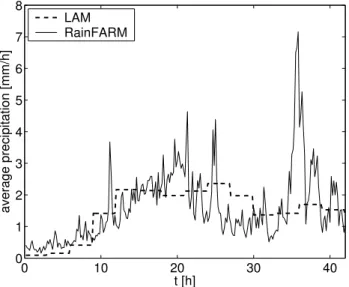
Fig. 3. Temporal evolution of the instantaneous spatial average of the large scale, LAM field (dashed line) and of one realization of the stochastic field (solid line).
This event was predicted on 30 October 2004 starting from 00:00 GMT and has a total duration of 42 h. The downscal-ing domain is a square area of side 448 km that contains the Liguria, Lombardia, Piemonte and Valle d’Aosta regions (Fig. 2).
The predicted LAM field has a spatial resolution of 7 km by 7 km and a time step of 3 h while the downscaled field has a resolution of 1.75 km by 1.75 km in space and 10 min in time.
Our aim is to illustrate the application of the RainFARM procedure to LAM forecasts. We preserve the large scale structure of the precipitation event predicted by the
meteoro-x [km]
y [km]
a)
0 100 200 300 400
50 100 150 200 250 300 350 400
0 5 10 15
x [km]
y [km]
b)
0 100 200 300 400
50 100 150 200 250 300 350 400
0 5 10 15
Fig. 4. Time average of the original, LAM field (panel a) and of one realization of the stochastic field generated by the RainFARM (panel b). The values indicate the average precipitation in mm/h.
logical model and we generate small-scale fields that are con-sistent with the LAM in terms of rainfall volume and spectral properties. The three scale regimes are defined as:
– reliable scales: L>28 km, T>12 h,
– unreliable scales: 7 km<L<28 km, 3 h<T<12 h, – unresolved scales: 1.75 km<L<7 km, 10 min<T<3 h. First we calculate the temporal evolution of the spatial-averaged rainfall intensity of a precipitation fieldp(x, y, t ): p(t )= hp(x, y, t )ixy=
1 NxNy
Nx
X
x=1 Ny
X
y=1
p(x, y, t ). (1) whereNx=Ny=256 grid points for the downscaled field and Nx=Ny=64 grid points for the LAM prediction. Figure 3 reports the resulting time series in both cases.
We then calculate and compare the temporal averages: p(x, y)= hp(x, y, t )it =
1 Nt
Nt
X
t=1
x [km]
y [km]
a)
0 100 200 300 400
100 200 300 400
0 10 20 30 40 50
x [km]
y [km]
b)
0 100 200 300 400
100 200 300 400
0 10 20 30 40 50
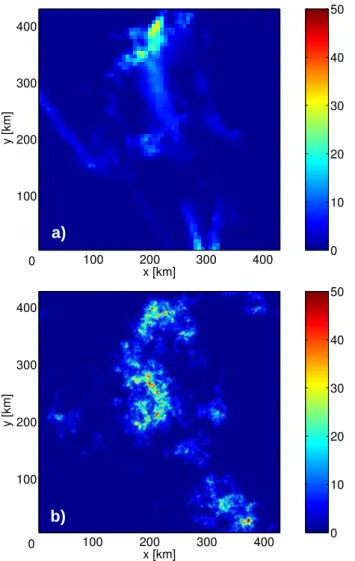
Fig. 5.Example of downscaling. The LAM field (panel a) indicates the rainfall predicted from t=33h to t=36h. The field generated by the RainFARM (panel b) shows the fine-scale precipitation map at t=34h30m with a temporal resolution of 10 minutes. The values indicate the precipitation in mm/h.
whereNt=252 for the RainFARM field andNt=14 for the LAM forecasts. Figure 4 compares the resulting spatial fields. In both cases the graphical comparison shows a very good agreement between the LAM field and that originated by the RainFARM. These figures indicate also that the pro-cedure is able to preserve the position of the rainfall patterns over the Alps and the Apennines since it preserves the large-scale Fourier spectrum.
In Fig. 5 we show one frame of the disaggregated field (panelb) compared to the corresponding large-scale predic-tion (panela). Since the downscaling of the LAM field is both in space and time, Fig. 5b represents one of the eighteen fields derived from the coarse-scale image. The RainFARM stochastically increases the resolution of the LAM predic-tion by creating rainfall fluctuapredic-tions at the scale of hydrolog-ical processes. These stochastic predictions can be used for generating ensemble flood forecasting in small catchments within the downscaling domain.
5 Conclusions
In this work we show an application of the RainFARM, a novel rainfall downscaling method, based on nonlinearly fil-tering a random Gaussian process, which is capable of truly downscaling the large-scale information provided by mete-orological models. This procedure represents a significant improvement over commonly available downscaling models used for operational purposes. It is able to:
1. conserve the total amount of precipitation predicted by the meteorological model;
2. take into account anisotropy between space and time (if any).
3. conserve the correlations of meteorological rainfall fields both in space and in time;
4. conserve the position of large rainfall structures, to take into account the effects of orography.
The features of the model make it suitable for operational applications. In particular they allow for a real time estimate of the parameters by starting directly from the large scale rain field. In this way the model is (self-)consistent and it does not need calibration. The model is clearly dependent on the structure of rainfall fields predicted over the reliable scales (see Fig. 1). Future work will be devoted to investigate the influence of large-scale uncertainty on the spectral estimates.
Acknowledgements. We thank T. Paccagnella and her colleagues from ARPA-SMR for providing us with the Lokal Model precipita-tion data.
Edited by: G. Boni
Reviewed by: anonymous referees
References
Bell, T. and Kundu, P.: Comparing satellite rainfall estimates with rain gauge data: optimal strategies suggested by a spectral model, J. Geophys. Res., 108 D3, 4121–4136, 2003.
Bell, T. L.: A space-time stochastic model of rainfall for satel-lite remote-sensing studies, J. Geophys. Res., 92D, 9631–9643, 1987.
Deidda, R.: Rainfall downscaling in a space-time multifractal framework, Water Resources Res., 36, 1779–1794, 2000. Eagleson, P., Fenessey, N., Quiliang, W., and Rodriguez-Iturbe, I.:
Application of spatial Poisson models to airmass thunderstorm rainfall, J. Geophys. Res., 92(D8), 9961–9978, 1987.
Ferraris, L., Rudari, R., and Siccardi, F.: The uncertainty in the prediction of flash floods in the northern mediterranean environ-ment, J. Hydromet., 3, 714–727, 2002.
Ferraris, L., Gabellani, S., Parodi, U., Rebora, N., von Harden-berg, J., and Provenzale, A.: Revisiting Multifractality in Rain-fall Fields, J. Hydromet., 4, 544–551, 2003a.
Guillot, G. and Lebel, T.: Disaggregation of Sahelian mesoscale convective system rain fields: Further developments and valida-tion, J. Geophys. Res., 104, 31 533–31 551, 1999.
Gupta, V. and Waymire, E.: A statistical analysis of mesoscale rain-fall as a random cascade, J. Applied Met., 32, 251–267, 1993. Lanza, L.: A Conditional Simulation Model of Intermittent Rain
Fields, Hydrol. Earth Sys. Sci., 4, 173–183, 2000,
SRef-ID: 1607-7938/hess/2000-4-173.
Lovejoy, S. and Mandelbrot, B.: Fractal properties of rain and a fractal model, Tellus, 37 A, 209–232, 1985.
Matheron, G.: The intrinsic random functions and their application, Adv. Appl. Probab., 5, 439–468, 1973.
Mejia, J. and Rodriguez-Iturbe, I.: On the synthesis of random fields sampling from the spectrum: An application to the generation of hydrologic spatial processes, Water Resources Res., 10, 705– 711, 1974.
Menabde, M., Seed, A., Harris, G., Austin, G., and Stow, D.: Multi-scaling properties of rainfall and bounded random cascades, Wa-ter Resources Res., 33, 2823–2830, 1997.
Menabde, M., Seed, A., Harris, G., and Austin, G.: Multiaffine random field model of rainfall, Water Resources Res., 35, 509– 514, 1999a.
Menabde, M., Seed, A., Harris, G., and Austin, G.: Self-similar random fields and rainfall simulations, J. Geophys. Res., D 102, 13 509–13 515, 1999b.
Northrop, P.: A clustered spatial-temporal model of rainfall, Proc. Roy. Soc. London, 45 A, 1875–1888, 1998.
Over, T. and Gupta, V.: A space-time theory of mesoscale rainfall using random cascades, J. Geophys. Res., 26, 319–331, 1996. Patterson, G. and Orszag, S.: Spectral calculations of isotropic
tur-bulence: efficient removal of aliasing interaction, Phys. Fluids, 14, 2538–2541, 1971.
Perica, S. and Foufoula-Georgiou, E.: Model for multiscale dis-aggregation of spatial rainfall based on coupling meteorological and scaling descriptions, J. Geophys. Res., 26, 347–361, 1996. Rodriguez-Iturbe, I., Cox, D., and Eagleson, P.: Spatial modelling
of total storm rainfall, Proc R. Soc. London, A403, 27–50, 1986. Schertzer, D. and Lovejoy, S.: Physical modeling and analysis of rain and clouds by anisotropic scaling multiplicative processes, J. Geophys. Res., 92, 9693–9714, 1987.
Venugopal, V., Foufoula-Georgiou, E., and Sapozhnikov, V.: A space-time downscaling model for rainfall, J. Geophys. Res., 104, 19 705–19 721, 1999.
Waymire, E., Gupta, V., and Rodriguez-Iturbe, I.: A spectral theory of rainfall intensity at the meso-beta scale, Water Resources Res., 20, 1483–1465, 1984.
Wheater, H., Isham, V., Cox, D., Chandler, R., Kakou, A., Northrop, P., Oh, L., Onof, C., and Rodriguez-Iturbe, I.: Spatial-temporal rainfall fields: modelling and statistical aspects, Hydrol. Earth Sys. Sci., 4, 581–601, 2000,
SRef-ID: 1607-7938/hess/2000-4-581.