13 http://biology.num.edu.mn
http://mjbs.100zero.org/ Volume 11(1-2), 2013
Mongolian Journal of Biological
Sciences
ISSN 2225-4994 (online edition)
MJBS
Original Ar• cle
Nutrients in Two and Three Cotyledon Seedlings of
Peganum harmala
L. Under Soil Salinity
Narantsetseg Amartuvshin
Institute of Botany, Mongolian Academy of Sciences, Ulaanbaatar 21051, Mongolia, E-mail: [email protected]
Abstract
Key words: Peganum harmala, soil salinity, Fe-defi ciency, three cotyledons.
Article information:
Received: 03 Aug. 2013 Accepted: 27 Mar. 2014 Published: 20 Apr. 2014
Correspondence:
Cite this paper as:
The fi nal seed germination of Peganum harmala L. was signifi cantly decreased at soil salinity of 2.6, 8.6 and 10.8 DS/m, compared with adequate concentration. Fe content in three cotyledon seedlings was signifi cantly correlated with the percentage of fi nal seed germination (rs = 0.94, P= 0.0048), under different concentrations of soil salinity. Normal nutrient order (in two cotyledon seedlings) changed at 10.8 DS/m of soil salinity. Two cotyledon seedlings adapted in the increasing concentrations of soil salinity better than three cotyledon seedlings. Three cotyledons are associated with iron defi ciency and can result of Fe-defi ciency at least during embryogenesis. The results indicate that the variation in cotyledon number of P. harmala L. is related with soil salinity, resulting in at least Fe defi ciency.
Amartuvshin, N., 2013. Nutrients in two and three cotyledon seedlings of Peganum harmala L. under soil salinity. Mong. J. Biol. Sci., 11(1-2): 13-17.
In seed plants, embryogenesis is an important process to produce a new generation. External such as drought, salinity as well as endogenous factors such as phytohormones, proteins, transcription and other substances can affect embryogenesis (Unnikrishnan et al., 1990; Khorolsuren & Jamsran, 2005; Umehara et al., 2007). Previous studies reported that salinity effects on seed germination and early seedling growth (Rahman & Ungar, 1990; Gulzar et al., 2001; Bayuelo-Jimenez et al., 2002; Jamil et al., 2005, 2006; Lombardi & Lupi, 2006; Cordazzo, 2007; Necajeva & Ievenish, 2008; Bybordi & Tabatabaei, 2009; Sivasankaramoorthy et al., 2010; Akbarimoghaddam et al., 2011), and approved that the formation of three cotyledons is related with embryogenesis (Taylor & Mundell, 1999; Al-Hammadi et al., 2003; Conner & Agrawal, 2005).
The purpose of this study was to describe
whether the variation in cotyledon number of Peganum harmala L. is related with soil salinity.
Materials and Methods
Seeds of P. harmala and soil (0-20 cm depth) were sampled in Ekhiin Gol oasis (N43o14’679; E099o00’411; alt. 971 m), on 28 August 2001. P. harmala grows in clay-loam soil with pH=7.57, 10.8 DS/m of electrical conductivity and soluble Ca is 2460 ppm; Mg – 390; Fe – 422; Cu – 13.26 and Mn – 6.21 in soil. Soluble salts in water were extracted and prepared water solutions of different salt concentrations. Seed germination was determined at 25±1oC for 10 days in the seed germinator, without dormancy breaking treatments, using Petri dishes and moist blotter by salt solutions with 2.6, 4.7, 5.7, 6.8, 8.6 and 10.8 DS/m of conductivity. Seedlings for nutrient analysis were sampled in second day
Introduction
after germination and during seed coat attached on seedling, because of endosperm used for seedling growth. Ca, Mg, Fe, Cu and Mn contents in seedlings were determined using atomic absorption spectrophotometer (AAS), in the Institute of Physics and Technology, Mongolian Academy of Sciences. Dried weight of seedlings was 0.011 g.
Rate of seed germination can indicate salinity tolerance during seed germination (Bayuelo-Jimenez et al., 2002). Seeds of P. harmala quickly germinated (for 3 days after put in germinator), and then fi nal seed germination were used to evaluate effect of soil salinity during seed germination. Nutrient content in seedlings and fi nal seed germination were compared by Spearman Rank Correlation. Data of seed germination and nutrient content in seedlings under different concentrations of soil salinity were analyzed by Tukey-HSD test, using statistic software JMP 4.0.
Results
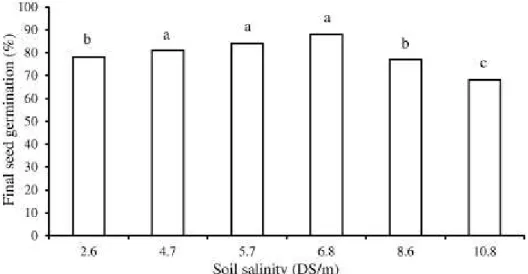
Maximum of fi nal seed germination was 88% at 6.8 DS/m, and this concentration can be adequate for seed germination of P. harmala, while the minimum was 68% at 10.8 DS/m. The fi nal seed germination was signifi cantly decreased at 2.6, 8.6 and 10.8 DS/m, compared with adequate concentration (Fig. 1).
Cu, Mn, Ca and Mg contents in both two and three cotyledon seedlings did not decrease with increasing or decreasing of salinity concentration, but Fe content began to decrease at 8.6 DS/m. At 6.8 and 8.6 DS/m of soil salinity, Fe content in two and three cotyledon seedlings was similar, but at 10.8 DS/m, Fe content in two cotyledon seedlings was larger than in three cotyledon seedlings. Decreasing content of Fe in three cotyledon seedlings was larger than in two cotyledon seedlings with increasing concentration, but it
Fig. 1. Final seed germination of P. harmala under different concentrations of soil salinity (Tukey HSD test, P<0.05).
Table 1.Comparison of mineral contents between two and three cotyledon seedlings under different concentrations of soil salinity
Soil salinity (DS/m)
Cu, ppm Mn Fe Ca Mg
Di* Three** Di Three Di Three Di Three Di Three
2.6 87 95 2.6 5 85 173 95 116 244 254
4.7 95 83 3.8 3.9 245 300 125 134 256 259
5.7 101 89 5 3.8 345 336 178 169 265 244
6.8 89 95 5 6.3 327 345 143 161 265 275
8.6 83 77 6.3 6.3 245 218 196 160 281 228
10.8 77 59 6.5 5 218 158 134 166 254 254
was opposite with decreasing concentration, compared with adequate concentration (Table 1). The highest content of Cu and Fe in two cotyledon seedlings was at 5.7; Ca and Mg at 8.6, and Mn at 10.8 DS/m, whereas that of Ca at 5.7 and other at 6.8 DS/m in three cotyledon seedlings.
Nutrient order at 6.8 DS/m in two cotyledon seedlings was different from at 8.6 to10.8 DS/m, whereas that among at 6.8, 8.6 and 10.8 DS/m in three cotyledon seedlings was different. The nutrient order between two and three cotyledon seedlings was similar at 4.7, 5.7, 6.8 and 8.6 DS/m, but that was different at 2.6 and 10.8 DS/m (Table 2).
Discussion
To evaluate salinity effect on seed germination, previous studies used distilled water supply for control and compared with increasing concentrations of salinity (Rahman & Ungar, 1990; Gulzar et al., 2001; Jamil et al., 2005, 2006; Lombardi & Lupi, 2006; Cordazzo, 2007; Necajeva & Ievenish, 2008; Bybordi & Tabatabaei, 2009; Sivasankaramoorthy et al., 2010; Akbarimoghaddam et al., 2011), but in the present study we used the adequate concentration of soil salinity for control, because plants do not absorb distilled water in nature.
Final seed germination of P. harmala decreases either an increase or decrease of soil salinity concentrations from the adequate concentration, resulting in nutrient absorption difference between two and three cotyledon embryo seeds. Percentage of the fi nal seed germination was the highest when nutrient order in both two and three cotyledon seedlings was similar, like Fe>Mg>Ca>Cu>Mn at 6.8 DS/m, while that was lower or lowest when nutrient order between those was different. Normal nutrient order (in
two cotyledon seedlings) changed at 10.8 DS/m of soil salinity. At this concentration, seeds with three cotyledon embryo are absorbed nutrients during imbibitions phase, weaker than those with two cotyledon embryo, because of maturation of those embryos was different for embryogenesis. In detail, three cotyledon embryos were immature and two cotyledon embryos were mature. Nutrient order in two cotyledon seedlings was dramatically changed with decreasing concentrations of soil salinity, but that in three cotyledon seedlings was with increasing concentrations, during seed coat attached on seedling. The result indicates two cotyledon seedlings could absorb nutrients and adapt in increasing concentration of soil salinity, stronger than three cotyledon seedlings.
Fe content in both two and three cotyledon seedlings was decreased with increasing concentrations of soil salinity. Whereas, that in three cotyledon seedlings was decreased at 10.8 DS/m, stronger than two cotyledon seedlings, because of three cotyledon seedlings absorbed Fe with increasing concentrations of soil salinity, weaker than two cotyledon ones. It means that iron defi ciency occurs in seedlings. Three cotyledons are associated with iron defi ciency, in addition to auxin accumulation (Al-Hammadi et al., 2003).
Fe content in three cotyledon seedlings was signifi cantly correlated with the percentage of fi nal seed germination, under different concentrations of soil salinity (Fig. 2). This correlation suggests that germination of seeds with three cotyledon embryo is depending on Fe absorption. On the other hand, fi nal seed germination directly depends on seed maturity for embryogenesis and three cotyledons can result of Fe-defi ciency at least during embryogenesis. Al-Hammadi et al. (2003) reported that the earliest defects of embryo were observed at the transition from the globular to the heart stage of embryogenesis with the
Table 2. Comparison of nutrient orders between two and three cotyledon seedlings under different concentrations of soil salinity
formation of multiple cotyledons. The expression of several genes encoding late embryogenesis abundant proteins is included in Fe-defi ciency roots and/or leaves (Kobayashi et al., 2009).
Soil salinity in the oasis Ekhiin Gol could affect for embryogenesis, seed germination and seedling nutrient absorption of P. harmala. This species probably will become extinct in this oasis, if soil salinity increases under natural and anthropogenic effects (Pankova et al., 2004). The results indicate the variation in cotyledon number of P. harmala is related with soil salinity, resulting in at least Fe defi ciency.
References
A kbarimoghaddam, H., Galavi, M., Ghanbari, A. & Panjehkeh, N. 2011. Salinity effect on seed germination and seedling growth of Bread Wheat cultivars. Trakia Journal of Sciences, 9(1): 43-50.
Al-Hammadi, A. S. A., Sreelakshmi, Y., Negi, S., Siddiqi, I. & Sharma, R. 2003. The polycotyledon mutant of tomato show enhanced polar auxin transport. Plant Physiology, 133: 113-125.
Bayuelo-Jimenez, J. S., Craig, R. & Lynch, J. P. 2002. Salinity tolerance of Phaseolus species during germination and early seedling growth. Crop Science, 42:1584-1594.
Bybordi, A. & Tabatabaei, J. 2009. Effect of
salinity stress on germination and seedling properties in Canola cultivars (Brassica napus L.). Not. Bot. Hort. Agrobot. Cluj., 37(1): 71-76.
Conner, J. K. & Agrawal, A. A. 2005. Mechanisms of constraints: the contributions of selections and genetic variance to the maintenance of cotyledon number in wild Radish. J. Evol. Biol., 18: 238-242.
Cordazzo, C. V. 2007. Effect of salinity and sand burial on germination and establishment of Blutabaron portulacoides (St.Hil.) Mears (Amaranthaceae) on backshore of southern Brazil. Neotropical Biology and Conservation, 2(2): 94-100.
Gulzar, S., Khan, M. A. & Ungar, I. A. 2001. Effect of salinity and temperature on the germination of Urochondrasetulosa (Trin.) C. E. Hubbard. Seed Sci. & Technol., 29: 21-29.
Jamil, M., Lee, C. C., Rehman, S. U., Lee, D. B., Ashraf, M. & Rha, E. S. 2005. Salinity (NaCl) tolerance of Brassica species at germination and early seedling growth. Electron. J. Environ. Agric. Feed. Chem., 4(4): 970-976. Jamil, M., Lee, D. B., Jung, K. Y., Ashraf, M., Lee,
S. C. & Rha, E. S. 2006. Effect of salt (NaCl) stress on germination and early seedling growth of four vegetables species. Journal of Central European Agriculture, 7(2): 273-282. Khorolsuren, Sh & Jamsran, Ts. 2005.
Cyto-embryological studies of Mongolian plants. Fig.2. Correlation between Fe content in three cotyledon seedlings and percentage of fi nal seed germination
Ecosystems of Mongolia and Frontier Areas of Adjacent Countries, Ulaanbaatar, pp. 110-112. (in Mongolian)
Kobayashi, T., Itai, R. N., Ogo, Y., Kakei, Y., Nakanishi, H., Takahashi, M. & Nishizawa, N. K. 2009. The rice transcription factor IDEF1 is essential for the early response to iron defi ciency and induces vegetative expression of late embryogenesis abundant genes. The Plant Journal, 60: 948-961.
Lombardi, T. & Lupi, B. 2006. Effect of salinity on the germination and growth of Hordeum secalinum Schreber (Poaceae) in relation to the seed after-ripening time. Atti. Soc. Tosc. Sci. Nat. Mem., B113:37-42.
Necajeva, J. & Ievenish, G. 2008. Seed germination of six coastral plant species of the Baltic region: effect of salinity and dormancy-breaking treatments. Seed Science Research, 18: 173-177.
Pankova, Ye. I., Golovanov, D. L. & Mandakhbayar, J. 2004. Monitoring of the soil salinity in Ekhiin-gol oasis within the Gobi-Desert at local. Arid Ecosystems, 10(24-24):
149-161. (in Russian)
Rahman, M. & Ungar, I. A. 1990. The effect of salinity on seed germination and seedling growth of Echinochloa crusgalli. Ohio J. Sci., 90(1): 13-15.
Sivasankaramoorthy, S., Balasubrananian, T., Amuthavalli, P. & Sivaraman, P. 2010. The effect of NaCl salinity on seed germination of Excoecaria agallocha L. Current Botany, 1(1):10-12.
Taylor, N. L. & Mundell, R. E. 1999. Registration of multiple cotyledon Red Clover Genetic marker stock: L38-1485. Crop Science, 39(4): 1259.
Umehara, M., Ikeda, M. & Kamada, H. 2007. Endogenous factors that regulate plant embryogenesis. Japanese Journal of Plant Science, 1(1): 1-6.
Unnikrishnan, S. K., Prakash, L., Josekutty, P. C. & Mehta, A. R. 1990. Effect of NaCl salinity on somatic embryo development in Sapindus trifoliatus L. Journal of Experimental Botany, 42(3): 401-406.