Revista Brasileira de
Engenharia Agrícola e Ambiental
Campina Grande, PB, UAEA/UFCG – http://www.agriambi.com.br
v.20, n.11, p.1002-1007, 2016
Organic solutes in coconut palm seedlings under water and salt stresses
1Alexandre R. A. da Silva
2, Francisco M. L. Bezerra
3, Claudivan F. de Lacerda
3,
Rafael de S. Miranda
4, Elton C. Marques
4& Enéas Gomes-Filho
4DOI: http://dx.doi.org/10.1590/1807-1929/agriambi.v20n11p1002-1007
A B S T R A C T
The objective of this study was to investigate the biochemical mechanisms associated with isolated and/or concurrent actions of drought and soil salinity in seedlings of coconut tree, through the accumulation of organic solutes (soluble carbohydrates, soluble amino N and free proline) in leaves and roots. The experiment, conducted in a protected environment, in Fortaleza, Brazil, in a randomized block design, in a split-plot arrangement, evaluated the effects of different levels of water stress (plots) by imposing distinct percentages of replacement of water losses through crop potential evapotranspiration - ETpc (20, 40, 60, 80 and 100%), associated with subplots consisting of increasing levels of soil salinity in saturation extract (1.72, 6.25, 25.80 and 40.70 dS m-1) provided by the soils collected in the
Irrigated Perimeter of Morada Nova. Salinity did not change the concentration of organic solutes; however, there were increases in leaf and root levels of free proline in response to water stress, which contributes to the osmoregulation and/or osmoprotection of the species under adverse conditions of water supply.
Solutos orgânicos em plantas jovens
de coqueiro sob estresses hídrico e salino
R E S U M O
Objetivou-se, com este trabalho, investigar os mecanismos bioquímicos associados às ações isoladas e/ou simultâneas do déficit hídrico e da salinidade do solo, em plantas jovens de coqueiro através da mensuração do acúmulo de solutos orgânicos (carboidratos solúveis, N - aminossolúveis e prolina livre) em folhas e em raízes. No experimento conduzido em casa de vegetação, em Fortaleza, CE, avaliaram-se, sob delineamento estatístico de blocos casualizados, no arranjo de parcelas subdivididas, os efeitos de diferentes níveis de deficiência hídrica (parcelas) mediante a imposição de distintos percentuais de reposição das perdas de água por evapotranspiração potencial da cultura - ETpc (20; 40; 60; 80 e 100%), associados às subparcelas, constituídas pelos níveis de salinidade do solo no extrato de saturação (1,72; 6,25; 25,80 e 40,70 dS m-1), proporcionados pelos solos coletados no Perímetro
Irrigado Morada Nova. A salinidade não alterou os teores dos solutos orgânicos; todavia, verificaram-se incrementos nos teores foliares e radiculares de prolina livre em resposta à deficiência hídrica. Este fato corrobora com uma possível contribuição à osmorregulação e/ou osmosproteção da espécie em condições adversas de suprimento hídrico.
Key words:
Cocos nucifera L. multiple stresses
biochemical mechanisms
Palavras-chave:
Cocos nucifera L. estresses múltiplos mecanismos bioquímicos
1 Extracted from the Doctoral thesis of the first author’, defended at the Graduate Program in Agricultural Engineering of the Federal University of Ceará 2 Instituto Federal de Educação, Ciência e Tecnologia do Ceará/Departamento de Ensino. Iguatu, CE. E-mail: [email protected] (Corresponding
author)
3 Universidade Federal do Ceará/Centro de Ciências Agrárias/Departamento de Engenharia Agrícola. Fortaleza, CE. E-mail: [email protected]; [email protected] 4 Universidade Federal do Ceará/Centro de Ciências/Departamento de Bioquímica e Biologia Molecular. Fortaleza, CE. E-mail: [email protected];
Introduction
Under natural conditions, plants may be subjected to a simultaneous combination of various types of abiotic stresses, such as the associations between the effects of water deficit and salinity. Recent studies have shown that the biochemical responses exhibited by the plants to the interaction between multiple stress agents are singular and can not be directly fixed based on those that are commonly observed in the individual actions of the stress agents (Ahmed et al., 2015).
Among the important plant species in Northeast Brazil, the coconut palm (Cocos nucifera L.) occupies a prominent position in the regional scene, especially for its socioeconomic importance. In addition, it should be pointed out that this species occurs preferentially in coastal regions, characterized by high contents of salts in the soil (Machado et al., 2014).
Because of its occurrence in areas with problems of salinity and water deficit, the coconut palm is expected to show biochemical characteristics adjusted to these conditions. Such aspects raise the hypothesis that the coconut palm may fit among the relevant species for revegetation of areas with salinized soils. Studies related to the independent effects of water and salt stresses have already been conducted (Marinho et al., 2005; Gomes et al., 2010). However, for coconut palm, there are no studies involving the simultaneous influence of these stress agents, especially those that encompass biochemical responses.
Therefore, this study aimed to investigate the biochemical mechanisms associated with the isolated and/or simultaneous actions of water deficit and soil salinity on seedlings of coconut palm, evaluating the accumulation of organic solutes in leaves and roots.
Material and Methods
The experiment was conducted in a screened greenhouse from October 2013 to February 2014, at the Experimental Area of the Federal University of Ceará, in the municipality of Fortaleza, CE, Brazil (03° 45’ S; 38° 33’ W; 19 m), which has Aw’ climate, rainy tropical, according to Köppen’s classification.
The experiment was conducted in a randomized block design arranged in a split-plot scheme, in which the plots consisted of different water deficit levels, through the imposition of five percentages of replacement of water losses through crop potential evapotranspiration - ETpc (20; 40; 60; 80 and 100% ETpc), while subplots consisted of levels of soil salinity in saturation extract (1.72; 6.25; 25.80 and 40.70 dS m-1), with six
replicates and one plant per pot, totaling 120 experimental units. The treatments allocated in the subplots were provided by soils classified as Fluvic Neosols, collected in different areas of
representative lots of the Irrigated Perimeter of Morada Nova, in the state of Ceará, Brazil. Soil samples from the layer of 0-0.20 m were air-dried and passed through a 4-mm-mesh sieve. During the filling of the pots, composite soil samples were collected for the characterization of the chemical attributes and the results are presented in Table 1.
The seedlings of coconut palm, cultivar “Anão Verde do Brasil de Jiqui”, with 40 days of germination, were transplanted to flexible plastic pots with capacity for 25 L.
A drip irrigation system was used, with pressure compensating emitters, with nominal flow rate of 4 L h-1. The adopted method
of irrigation management was based on the climatic conditions. Crop potential evapotranspiration - ETpc was determined using the methodology proposed by Bernardo et al. (2006). The water deficit treatments were differentiated through the variation of the irrigation time, controlled using independent valves. The total water depths applied, at the end of the treatment, were equal to 62.40, 124.80, 187.20, 249.60 and 312.00 mm for the replacement levels of 20, 40, 60, 80 and 100%, respectively.
At 121 days after transplanting, leaves and roots were collected and lyophilized, macerated in porcelain mortar, in the presence of liquid nitrogen, and stored for subsequent analysis of soluble carbohydrates - SC (Dubois et al., 1956), soluble amino N - AA (Yemm & Cocking, 1955) and free proline - Pro (Bates et al., 1973).
The data were subjected to analysis of variance and, in case of significant effect were analyzed through regression. The mathematical models were selected based on the significance of the regression coefficients using the t-test, on coefficient of determination and on the studied biological phenomenon.
Results and Discussion
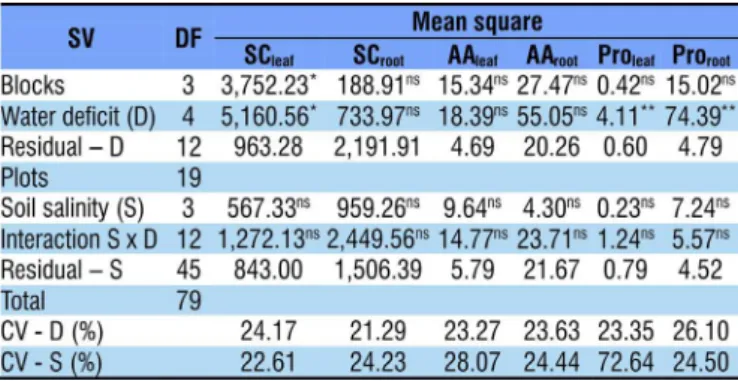
The results of the ANOVA (Table 2) indicated that the contents of soluble carbohydrates (leaves) and free proline (leaves and roots) were significantly influenced by the factor water deficit (p ≤ 0.01 or p ≤ 0.05); however, there was no significant effect of soil salinity (p ≥ 0.05) and of the interaction between salinity and water deficit (p ≥ 0.05) on the contents of the studied organic solutes.
It can be assumed that the salt stress imposed on the plants during the initial development stages (until 121 DAT) was not sufficient to cause significant changes in the contents of organic solutes in the studied plants.
The absence of effects of salinity and interaction are contrary to various reports in the literature, which confirm that the accumulation of compatible solutes is associated with the tolerance to abiotic stresses, during the various phenological
1pH - potential of hydrogen, EC
SE - electrical conductivity of the soil saturation extract; S - sum of bases; T - cation exchange capacity; V - base saturation; ESP - exchangeable sodium percentage;
OC - organic carbon; OM - organic matter; PAssimilable - Assimilable phosphorus
stages, especially regarding salinity, indicating that these solutes play a fundamental role in the osmoprotection (Simpson et al., 2014).
As to the effects of different water deficit levels on the leaf contents of soluble carbohydrates, the values remained between 106.50 and 150.27 µmol g-1 DM, so that the extreme contents
of this variable were obtained at levels of replacement of crop potential evapotranspiration equivalent to 20 and 100% ETpc, respectively (Figure 1).
According to the regression analysis, the leaf contents of soluble carbohydrates followed a linear model of prediction as a function of the evaluated water deficit levels (R² = 0.92), in which the treatment with 100% ETpc was superior in approximately 41%, compared with 20% ETpc. So that it is possible to estimate, through the mathematical model to which the data best fitted, that each unit increase in ETpc resulted in increments of approximately 0.55 µmol g-1 DM (0.57%), as shown in Figure 1.
According to Vitorino et al. (2012), plants usually react osmotically to the reduction in soil water availability through increments in the contents of soluble carbohydrates in their
tissues in order to contribute to the adaptation or simply for the adjustment to the imposed water stress. However, the results observed in the present study demonstrate the contrary, i.e., coconut palm plants actually exhibited an apparent reduction in the content of this solute, under the condition of water scarcity, which may also be related to the lower mobilization of reserves.
According to Akinci & Losel (2009), reductions in the contents of soluble carbohydrates under water deficit conditions indicate the limited osmoregulatory potential of the plants, and this probable reduction in the leaf contents of soluble carbohydrates is related to the consumption of these compounds to guarantee the survival of the species under adverse environmental conditions. In addition, specifically under water deficit, these organic solutes can be altered both quantitatively and qualitatively, while these evident modifications can be interpreted as a relevant metabolic signal, triggered in response to the stress due to water restriction.
According to Pedroso et al. (2014), under environmental conditions adverse to the plants, the soluble carbohydrates synthesized in the leaves are used to maintain the metabolic activities that ensure plant survival, so that the reductions in the leaf concentration of these compounds are frequently reported under severe water deficit conditions.
Given the obtained results, it is supposed that the increasing linear accumulations of soluble carbohydrates recorded with the increments in soil water availability evidence the probable contribution that these solutes had on the supply of part of the metabolic demand of the plants under water deficit conditions, which probably prevented its respective accumulation under water shortage conditions, which leads to the supposition that they do not participate in the probable phenomenon of osmoregulation in the species.
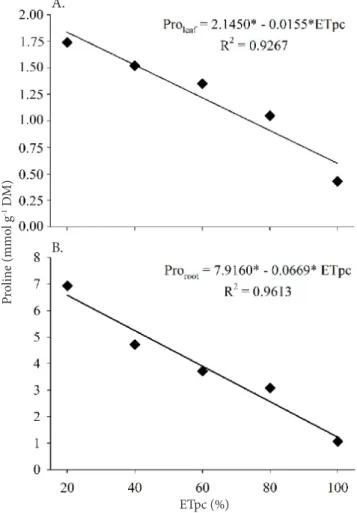
The leaf contents of free proline varied from 0.60 µmol g-1
DM in fully irrigated plants (100% ETpc) to 1.84 µmol g-1 DM
in those cultivated under the most severe level of water stress (20% ETpc), totaling a percent increment of approximately 67%, comparing the extreme values obtained for this solute. These results shows that, in coconut palm plants, the leaf contents of proline increased with the reduction in soil water availability (Figure 2A).
The regression analysis for the leaf contents of free proline as a function of the different levels of water deficit (Figure 2A) indicated that the data best fitted to a decreasing linear model (R² = 0.92), which was able to predict that each unit increase in the percent replacement of water losses led to a reduction of approximately 0.72% in the leaf contents of free proline (0.0155 µmol g-1 DM).
These results are in agreement with the data of Filippou et al. (2014), who reported that, frequently, increments in the leaf contents of free proline have been observed as one of the inherent effects of water stress as way of mitigating the deleterious implications of water shortage on plant species.
According to Alvarenga et al. (2011), proline acts in osmotic adjustment, stabilization of subcellular structures and elimination of free radicals or, also, it can constitute a potential stock of nitrogen and carbon, which can be metabolically used after the period of exposure to the stress.
On this matter, Slabbert & Krüger (2014) claimed that plants can accumulate compatible solutes, such as proline, in response Table 2.Summary of the analysis of variance for the contents
of the organic solutes - soluble carbohydrates (SC), soluble amino N (AA) and free proline (Pro) in leaves (SCleaf, AAleaf and Proleaf) and roots (SCroot,AAroot and Proroot) of seedlings of coconut palm, cv. “Anão Verde”, cultivated under different
water deficit levels, in salt-affected soils, evaluated at the
end of the experimental period (121 DAT)1
1SV: Sources of variation, DF: Degrees of freedom, CV: coefficients of variation, * significant at
0.05 probability level, **: significant at 0.01 probability level, ns: not significant by F test
(*), significant at 0.05 probability level by t-test
Figure 1. Contents of soluble carbohydrates in leaves (SCleaf)
of seedlings of coconut palm as a function of water deficit
levels (% ETpc)
So
lu
ble c
arb
oh
ydra
te
(
m
m
ol
g
-1 DM
)
Gomes et al. (2010) still question the relevance of this strategy for drought tolerance in the species.
Based on the obtained responses, however, it is supposed that these leaf accumulations of free proline, associated with the beneficial implications that are inherent to this osmolyte, clearly contribute to the probable resistance to water stress exhibited by part of the coconut palm seedlings in the present study, through either osmoregulation or osmoprotection, or even through the synergism between these phenomena.
As to the root contents of free proline, coconut plants showed a maximum value of 6.58 µmol g-1 DM, at the water
deficit level equivalent to 20% ETpc, while the treatment in which water requirements were fully met (100% ETpc) led to the lowest value of this variable (1.23 µmol g-1 DM). Hence, the
increment observed in the root contents of proline between the highest and lowest levels of replacement of water losses (ETpc) was approximately 82%, and the amplitude between the extreme values was approximately 5.35 µmol g-1 DM (Figure 2B).
The data best fitted to a decreasing linear equation (R² = 0.96), with a reduction of 0.0669 µmol of free proline g-1 DM,
corresponding to 0.85%, per unit increase in the level of ETpc replacement (Figure 2B).
There is a similarity between leaf and root contents of free proline and these results can be partially explained by taking into consideration the data of Rhein et al. (2011). According to these authors, in plants under water stress, the free proline synthesized in leaf tissues can be easily translocated through the phloem until the roots, where it accumulates to preserve and maintain the turgor of root cells, which are the first organs to detect water scarcity in the soil.
Based on the results, there is the hypothesis that these prominent accumulations of free proline evidenced in the root system and in leaves of coconut palm seedlings possibly result from a series of disorders that occur in the protein metabolism due to water stress, since, under the predominance of these adverse conditions, there may be substantial changes in the proportions of amino acids that, in short, favor the biosynthesis of free proline (Bortolo et al., 2009).
Comparing the mean values of leaf and root contents of free proline, it is inferred that this solute was more accumulated in the roots (3.90 µmol g-1 DM) than in the leaves (1.21 µmol g-1
DM), and the contents of this osmolyte in the root system were about 3.22 times higher than those in the leaves, regardless of the considered level of water deficit.
Such observations suggest that the root system, besides communicating with the shoots, plays an important function in the osmoregulatory mechanisms shown by coconut palm seedlings under water stress conditions, based on the confirmed accumulation of substances of low molecular weight, especially the organic solute proline.
This accumulation of free proline in the roots, compared with that in the leaves, can be explained through the data reported by Signorelli et al. (2013), who suggested that proline is synthesized in the shoots and then translocated to the roots, where its metabolism is necessary to promote survival and/or plant growth under conditions of low water potentials in the soil. Although the accumulation of free proline during water stress is well documented in the literature for the most plant species
* significant at 0.05 probability level by t-test
Figure 2. Contents of free proline in leaves - Proleaf (A) and roots - Proroot (B) of seedlings of coconut palm as a function
of different water deficit levels (% ETpc)
A.
B.
P
ro
lin
e (mm
ol g
-1 DM
)
ETpc (%)
to stresses, to facilitate water absorption and protect the cells against the excessive accumulation of reactive oxygen species. According to these authors, the accumulation of proline was correlated with a variety of edaphoclimatic conditions adverse to plants and this osmolyte is apparently an important antioxidant agent of non-enzymatic nature.
According to Silva et al. (2012), in plants subjected to water deficit, the increments in proline contents may be associated with the increase in the activity of proteolytic enzymes, which, under the predominance of these conditions adverse to plants, start to promote a greater availability of this free amino acid.
Results similar to the present study were obtained by Gomes et al. (2010), who also reported an expressive accumulation of proline in the leaves of coconut palm seedlings in response to water deficit. Based on the results, these authors inferred that, apparently, this accentuated accumulation of free proline was better correlated with the functions of protection, instead of osmoregulation.
While many studies indicate high correlation between proline accumulation and the increase in drought tolerance, others suggest that the accumulation is simply an effect of the stress (Ribeiro et al., 2014).
Thus, despite the reports in the literature that point out the role of proline followed by its participation in osmotic adjustment as an important mechanism capable of providing tolerance to water deficit in various coconut palm genotypes,
(Campos et al., 2011), in the present study, it is inferred that the alterations in root and leaf contents of proline, through the increased syntheses and/or the decreased metabolic uses, were not sufficient to precisely predict whether the actual role of these compounds in the response of coconut palm plants to water deficit of either osmoregulation or osmoprotection.
In the specific case of free proline and based on the propositions of Lacerda et al. (2004), the fact that the leaf and root contents remained always very low can mainly indicate the small effective contribution that this solute may have had on the mechanisms that, in association, promote tolerance to water deficiency in coconut palm seedlings, despite the observed increments due to the reduction in water availability.
Thus, it can be inferred that, as observed by Gomes et al. (2010), leaf and root accumulations of free proline under water deficit possibly caused more relevant effect of osmoprotection, in detriment of osmoregulation itself.
Conclusions
1. Salinity, isolated or associated with water deficiency, does not alter leaf or root contents of soluble carbohydrates, soluble amino N and free proline of coconut palm seedlings.
2. The leaf and root contents of free proline increased in response to water deficit in coconut palm seedlings.
3. Under adverse conditions of water supply, the accumulation of free proline is associated with osmoregulation and/or osmoprotection in coconut palm seedlings.
Acknowledgments
To Coordination for the Improvement of Higher Education Personnel (CAPES), National Council of Technological and Scientific Development (CNPq) and the National Institute of Science and Salinity Technology (INCTSal) for the financial support.
Literature Cited
Ahmed, I. M.; Nadira, U. A.; Bibi, N.; Cao, F.; He, X.; Zhang, G.; Wu, F. Secondary metabolism and antioxidants are involved in the tolerance to drought and salinity, separately and combined, in Tibetan wild barley. Environmental and Experimental Botany, v.111, p.1-12, 2015. http://dx.doi.org/10.1016/j.envexpbot.2014.10.003 Akinci, S.; Losel, D. M. The soluble sugars determination in
Curcubitaceae species under water stress and recovery periods. Advances in Enviromental Biology, v.32, p.175-183, 2009. Alvarenga, I. C. A.; Queiroz, G. A.; Honório, I. C. G.; Valadares, R.
V.; Martins, E. R. Prolina livre em alecrim-pimenta sob estresse hídrico antes da colheita. Revista Brasileira de Plantas Medicinais, v.13, p.539-541, 2011.
Bates, L. S.; Waldren, R. P.; Teare, I. D. Rapid determination of free proline for water-stress studies. Plant and Soil, v.39, p.205-207, 1973. http://dx.doi.org/10.1007/BF00018060
Bernardo, S.; Soares, A. A.; Mantovani, E. C. Manual de irrigação. 8.ed. Viçosa: UFV, 2006. 625p.
Bortolo, D. P. G.; Marques, P. A. A.; Pacheco, A. C. Teor e rendimento
de flavonóides em calêndula (Calendula officinalis L.) cultivada
com diferentes lâminas de irrigação. Revista Brasileira de Plantas Medicinais, v.11, p.435-441, 2009. http://dx.doi.org/10.1590/ S1516-05722009000400012
Campos, M. K. F. de; Carvalho, K. de; Souza, F. S. de; Marura, C. J.; Pereira, L. F. P.; Bespalhok Filho, J. C.; Vieira, L. G. E. Drought tolerance and antioxidant enzymatic activity in transgenic ‘Swingle’ citrumelo plants over-accumulating proline. Environmental and Experimental Botany, v.72, p.242-250, 2011. http://dx.doi.org/10.1016/j.envexpbot.2011.03.009
Dubois, M.; Gilles, K. A.; Hamilton, J. K.; Rebers, P. A.; Smith, F. Colorimetric method for determination of sugars and related substances. Analytical Chemistry, v.28, p.350-356, 1956. http:// dx.doi.org/10.1021/ac60111a017
Filippou, P.; Bouchagier, P.; Skotti, E.; Fotopoulos, V. Proline and reactive oxygen/nitrogen species metabolism is involved in the
tolerant response of the invasive plant species Ailanthus altissima
to drought and salinity. Environmental and Experimental Botany, v.97, p.1-10, 2014. http://dx.doi.org/10.1016/j. envexpbot.2013.09.010
Gomes, F. P.; Oliva, M. A.; Mielke, M. S.; Almeida, A. A. F.; Aquino, L. A. Osmotic adjustment, proline accumulation and cell membrane
stability in leaves of Cocos nucifera submitted to drought stress.
Scientia Horticulturae, v.126, p.379-384, 2010. http://dx.doi. org/10.1016/j.scienta.2010.07.036
Lacerda, C. F. de; Cambraia, J.; Oliva, M. A.; Ruiz, H. A. Influência do cálcio sobre o crescimento e solutos em plântulas de sorgo estressadas com cloreto de sódio. Revista Brasileira de Ciências do Solo, v.28, p.289-295, 2004. http://dx.doi.org/10.1590/S0100-06832004000200007
Machado, C. de A.; Moura, C. R. F.; Lemos, E. E. P. de; Ramos, S. R. R.; Ribeiro, F. E.; Lédo, A. da S. Pollen grain viability of coconut accessions at low temperatures. Acta Scientiarum Agronomy, v.36, p.227-232, 2014. http://dx.doi.org/10.4025/actasciagron. v36i2.17346
Marinho, F. J. L.; Ferreira Neto, M.; Gheyi, H. R.; Fernandes, P. D.; Viana, S. B. A. Uso de água salina na irrigação do coqueiro (Cocus nucifera L.). Revista Brasileira de Engenharia Agrícola e Ambiental, Suplemento, p.359-364, 2005.
Pedroso, F. K. J. V.; Prudente, D. A.; Bueno, A. C. R.; Machado, E. C.; Ribeiro, R. V. Drought tolerance in citrus trees is enhanced by rootstock dependent changes in root growth and carbohydrate availability. Environmental and Experimental Botany, v.101, p.26-35, 2014. http://dx.doi.org/10.1016/j.envexpbot.2013.12.024 Rhein, A. F. de L.; Santos, D. M. M. dos; Carlin, S. D. Atividade da
enzima redutase do nitrato e teores de prolina livre em raízes de cana-de açúcar sob os estresses hídrico e ácido no solo. Semina: Ciências Agrárias, v.32, p.1345-1360, 2011. http://dx.doi. org/10.5433/1679-0359.2011v32n4p1345
Ribeiro, R. C.; Matias, J. R.; Pelacani, C. R.; Dantas, B. F. Activity
of antioxidant enzymes and proline accumulation in Erythrina
velutina Willd. seeds subjected to abiotic stresses during germination. Journal of Seed Science, v.36, p.231-239, 2014. http:// dx.doi.org/10.1590/2317-1545v32n2956
Signorelli, S.; Corpas, F. J.; Borsani, O.; Barroso, J. B.; Monza, J. Water stress induces a differential and spatially distributed
nitro-oxidative stress response in roots and leaves of Lotus
Silva, R. T. L. da; Oliveira Neto, C. F. de; Barbosa, R. R. do N.; Costa, R. C. L. da; Conceição, H. E. O. da. Resposta fisiológica de plantas de mamoeiro submetidas ao déficit hídrico. Nucleus, v.9, p.113-120, 2012. http://dx.doi.org/10.3738/1982.2278.779
Simpson, C. R.; Nelson, S. D.; Melgar, J. C.; Jifon, J.; King, S. R.; Schuster, G.; Volder, A. Growth response of grafted and ungrafted citrus trees to saline irrigation. Scientia Hor tic ulturae, v.169, p.199-205, 2014. http://dx.doi. org/10.1016/j.scienta.2014.02.020
Slabbert, M. M.; Krüger, G. H. J. Antioxidant enzyme activity, proline accumulation, leaf área and cell membrane stability in water stressed amaranthus leaves. South African Journal of Botany, v.95, p.123-128, 2014. http://dx.doi.org/10.1016/j.sajb.2014.08.008 Vitorino, H. dos S.; Martins, D.; Marques, R. P.; Garbiate, M. V. Efeito
do déficit hídrico na eficiência de herbicidas e nas características bioquímicas de picão-preto. Bioscience Journal, v.28, p.692-698, 2012. Yemm, E. W.; Cocking, E. C. The determination of amino-acids