AFTER REBRANDING
Associate professor PhD Cătălin Mihail BARBU
University of Craiova Email: [email protected]Abstract:
The brand identity and brand image are two concepts used extensively in positioning. Many brands underwent a rebranding process attempting to improve their positioning. The rebranding process can bring minor changes or substantial changes. Following the substantial changes, there can appear a mismatch between the desired identity and brand image. Brand image is persistent and it takes time to change it. This paper explores the challenges involved by the calibration of the identity and of the image in the process of rebranding. The alignment process is a dynamic one, an interactive and not a normative one. The results of this study highlight the elements that support the brand identity and image alignment: marketing communication, product characteristics and internal brand strength. On the other side, the efforts to align the brand identity and brand image are negatively affected by the attitudes of the consumers and their past experience with the brand.
Keywords: brand identity, brand image, rebranding, brand management
1. Introduction
The discussion about identity within the positioning approach is important because the identity and its elements represent the source of positioning. Marketers should position the brand using sustainable elements of identity. The effort to disclose the identity is rewarded by the brand's image among the public. Ideally, the brand image should be as close as possible to the one desired by the organization.
The organizations implement the rebranding processes for a variety of reasons: to increase sales, to improve brand equity, to generate further associations, to increase the loyalty of consumers (Aaker, 2005). For example, the Romanians companies engaged in rebranding in order to revitalize the old brands from communism.
Rebranding it is not an easy process since it requires changes in the desired image of the organization. Attempts to impose the new identity is often received with resistance. Marketing specialists try to reduce the factors that confront the rebranding and to enhance the elements that favour the rebranding. This paper is organized as follows: the concepts of brand identity, brand image and rebranding are presented, then I discuss a proposed model to analyse the brand identity-brand image congruence after rebranding.
2. The brand identity and the
brand image
(2008) considers the identity as the core of the brand. Identity means the reporting to itself, to the values that define an organization, that make it different from other organizations. Although we speak of an identity referring to the graphic elements that characterize a brand, the design identity for a line of cars, this is not the brand identity, its true essence. Knowing the identity means the success of the profound, immaterial elements on the form.
Brand identity originate from the company strategy over the long-run and from corporate communication, the objective being to ensure consistency over time and not to puzzle the consumers (Aaker, 1996).
The identity is the central, distinctive and enduring element of a product or organization. The identity is relevant only in relation to what distinguishes it from other identities. The brand becomes the medium that allows us to relate with customers and defines who we are by reference to other brands. Brands are identities in action that allow the company to act on both the short and long term. The brand provides the conceptual framework for theorizing
and talk about identity. The brand is the tool used to manage the identity (Kornberger 2010).
The brand makes an effort to disclose their identity to the public for the well-known purposes of: 1) selling more and 2) having a more desirable image. The companies want to have a favourable image among consumers, even if they do not purchase the product that particular moment, because they don't want to or cannot afford to buy it. How many of us can afford a Ferrari right now? Is there anyone who does not like this brand?
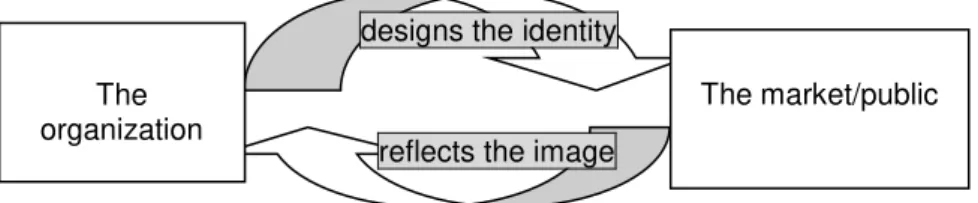
The brand image is the consumer's perception about the associations, evocations and meanings of the brand. The manufacturer designs and project an identity to the public. Public's perception about the brand is the brand image. The identity is what we believe about ourselves, while the image is what others think about us. Brand image is the identity reflection in the mirror of the market (Figure 1). In order to last in time, it is important for the brand to design a sustainable identity, a durable one, to avoid episodic images, affected by fashion.
designs the identity
reflects the image
Figure 1. Brand identity – brand image relationship Source: Adaptation after Kapferer 2008, p. 174
The identity helps positioning as it allows brands to define themselves by reference to other brands. Positioning is a competitive endeavour which mainly has to answer to the question "what
differentiates us from the competition?" Consumers often make comparative assessments of different products or brands. Positioning facilitates this process.
The organization
Identity sources come from product features, brand personality and the culture that brand creates. Brand image is represented by the public considerations about the brand, self-image and the relationships established between consumers and brands (Kapferer 2008)
The product is the most important element of brand identity, the one that maintains the brand awareness. Product features are those that provide its identity. German cars are known for being well-made precisely because they are well-made. In this case the image is the result desired by the organizations and the image is pursuant to the identity. Brand personality represents the human characteristics or features that consumers may give to a brand. We can measure them in different ways. Perhaps the most straightforward way is to ask for answers to direct questions such as: If the brand were a person, who would that be? What should he do? Where would he live? What would he be dressed like? Who would he speak to, if he went to a party and what would he talk about (Keller 2008)? Culture refers either to the dominant values of the organization or the values of the country of origin transferred to the brand and the product. For example, iPhone is an innovative and intelligent product, as well as the producing company. Volkswagen is a reliable car, hard-working, well-done car, which you can rely on as well as the cultural features of its country of origin.
The public's considerations on the brand are represented by the associations of the brand. Brand relationships are connections between consumers and brands that facilitate the purchase and the way consumers relate to brands. Self-image refers to how consumers perceive themselves when they consume a certain brand. There is
an inner satisfaction when you drive a Mercedes or you are an iPhone owner.
Identity is intended to be stable but it is into a permanent evolution. Identity is built during the interaction with the stakeholders of the organization, by constantly adapting to their interests (Da Silveira et al, 2013).
3. The rebranding
Rebranding represents the process by which the brand is upgraded to meet the demands of today's consumers. Most of the time the rebranding is necessary for brands that enjoy a good recognition on the market, but commercialize obsolete and out-dated products. This was the case for the majority of the brands of the former communist countries of Central and Eastern Europe in the early 90s.
Rebranding can be a complex process affecting both the product and brand elements, or an easier process, adapting only the brand elements, which rejuvenate the brand's visual identity, keeping the product mainly unchanged. Complex rebranding is necessary especially on products with high added value, affected by increasingly shorter life cycles. The sectors which require complex rebranding include vehicles, cosmetics, electronics. The rebranding of the elements of the brand is suitable for sectors where the dynamic of the modernization of products is lower: food and beverage, place destinations.
Usually, the rebranding mix includes four elements: reposition, redesign, re-launch and in some cases even renaming (Muzellec et al, 2003).
Of a critical importance in rebranding is repositioning by trying to update the brand image and product characteristics. However the market response to rebranding varies.
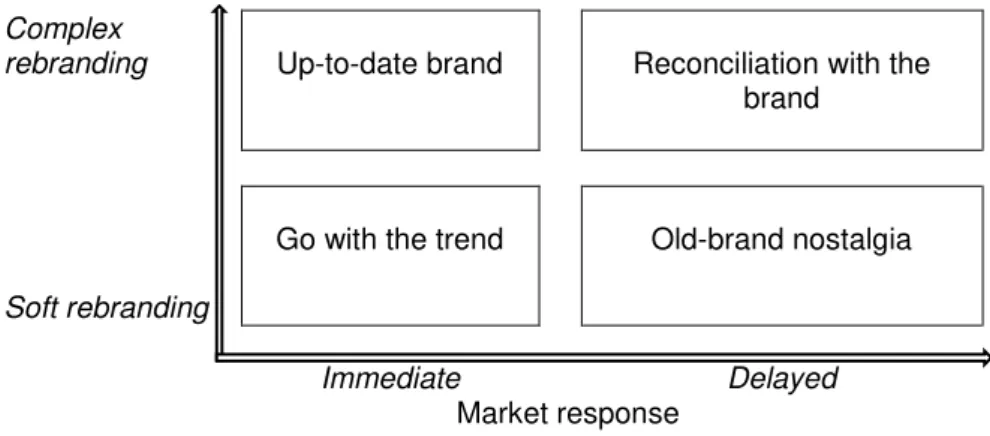
The rebranding is intended to reposition a brand by creating a new identity in conformity with the brand’s ambitions. The market response can confirm immediately or later the success of rebranding (figure 2). We can identify four cases depending on the rebranding complexity and market response.
Complex
rebranding Up-to-date brand Reconciliation with the brand
Soft rebranding
Go with the trend Old-brand nostalgia
Immediate Delayed
Market response
Figure 2. Combining rebranding complexity and market response
Un up-to-date brand is the result of a complex rebranding (including products and brand elements) that is well and immediate received by the market. The market was actually requesting or at least expecting the rebranding.
In the category go with the trend are included the brands that experienced a soft rebranding (only the brand elements) and the market response was immediate. The rebranding was necessary to align with the markets trend (for example in the design of packages).
If the market response is delayed and the rebranding complex, the public needs time to accommodate the new brand. The new positioning of the brand is opposed to strong public attitudes.
In the case of a soft rebranding and delayed market response we can talk about old-brand nostalgia. The original brand was accepted and recognized on the market. The public regret the older brand. The companies should find ways to overthrow this nostalgia.
4. Brand identity
–
brand
image congruence
attitudes and their consuming experience (figure 3).
(+)
(+)
(+)
Figure 3. Forces that impact upon the brand identity – brand image congruence
Analysing the model above, I introduce the following propositions.
P1. Marketing communication positively affects the brand identity – brand image congruence
In practice, the rebranding is accompanied by actions to communicate and to present the new brand identity. It is necessary to coordinate the communication activities. This is done under the auspices of integrated marketing communication, which aims to harmonize instruments, media and messages, in order to provide a single consistent message every time the consumer comes into contact with the brand. Integrated marketing communication is part of integrated corporate communication. The concept of integrated corporate communication refers to "align symbols, messages, procedures and behaviours" (Christensen et al., 2008), which allow the organization to communicate inside and outside the formal borders of the
organization, constantly and with continuity.
P2. Product characteristics positively affects the brand identity – brand image congruence
Rebranding is expected to be accompanied by qualitative changes in the product or service. When the product functions have been upgraded, when the product received an upgrade, the consumers will appreciate this. Rebranding without substantial improvements, even minor ones, cannot fully achieve its objectives. The new brand identity should be based on something tangible, perceptible by the consumer. In addition to substantive amendments, the packaging and the design come to support the new brand image. The design addresses the senses and appeal to consumers' emotion knowing that the act of purchase is rational and emotional at the same time.
Marketing communication
Brand identity – brand image
congruence
Past consumers’ experience
Attitudes Product
characteristics
Internal brand management
P3. Internal brand management positively influences the brand identity – brand image congruence
The internal brand management refers to the extent to which the brand is recognized, accepted, internalized and implemented by the employees. Internal brand management must start from the new brand identity including the vision, values, organizational capabilities and the brand heritage (Burmann et al., 2009b). If executed carefully, the internal brand management provides the prerequisites for the rebranding to be successful. Employees are the ones offering the brand experience. In order to transmit in a more credible way this experience, the employees must believe in the brand. They must internalize the brand values and to identify themselves with these values (O'Reilly and Chatman, 1986). The employee commitment to the brand is manifested by enthusiasm, desire for self-development and helping behaviour towards other employees and consumers (Burmann and Zeplin, 2005). In order to intensify the employees commitment it is necessary for the organization management to implement brand-centred human resource activities (Burmann et al., 2009a). Organizations need to develop organizational cultures that allow employees to embrace the brand values, without any coercive influence (of Chernatony, 2002).
P4. Past consumers’ experience negatively influences the brand identity –brand image congruence
The clientele' negative consumer experience leaves deep scars and causes changes in the consumer's behaviour towards the brand. Rebranding process cannot alter this behaviour immediately. Consumers are reticent to the promises of the "new" brand. Organizations should strive to
understand the consumers, to identify the brakes stopping the consumption and to remove them. According to Arnould et al. (2002), the total consumer experience consists of: the pre-purchase experience, the experience of purchasing, the actual consumer experience and the consumption reminder experience. Also, the consumer experience must be reported to the context in which the consumption was achieved. For example, Romanians consumers in the years after the fall of the communism sought zealously foreign brands and avoided Romanian brands, which they felt "fed up" with. Obviously they were not physically "fed up" with them, but those were the only ones available on the market and therefore, of questionable quality. The first rebranding efforts were viewed with mistrust. Then, the rebranding of Romanian brands revealed some consumption nostalgia, seeking to highlight the emotion associated with the memory of communism.
The companies must consider the overall consumer experience for rebranding process and not just the buying experience (Caru and Cova, 2003). A possible strategy would be to target the rebranding towards younger consumers who do not have a vast consumer experience.
P5. Attitudes of the consumers negatively affects the brand identity – brand image congruence
thinking (Meghişan and Nistorescu, 2006). Therefore, successful rebranding should not seek to undermine the system of attitudes but try to fold on them, capitalizing on positive attitudes. But what happens if the brand before the rebranding "enjoys" only negative attitudes? The changing of attitudes becomes a necessity.
A first step consists of accepting the product and accepting the fact that the product was improved. Consumers do not have to like the product but to recognize and acknowledge the effort of the brand to change. It is very important for the brand that the customers move from a negative attitude ("I won't buy it, I don't like it, it's not a good product") to a neutral position (I won't buy it, I might like it or not, but is an OK product). This way a positive word-of-mouth is generated that can influence consumers whose attitudes are not yet fully formed. Then, the consumers should be encouraged to try out the product (Solomon et al., 2013) and organizations should stimulate trying, for instance by sampling. Changing attitudes is a long process and organizations should give the rebranding process the necessary time required to fully show its effects.
5. Conclusions
The success of rebranding can be obtained if proper actions are taken such as communicating efficiently the new positioning, improving product experience and strengthening internal brand management. The communication should address the target group also in relationship with the new product characteristics. Employees’ attitudes and commitment are a driving force for the accomplishment of rebranding.
Past consumers’ experiences and consumers attitudes have a negative impact on the brand identity-brand image compliance. The rebranding process should address these aspects such as to minimize their effect. Links with the nostalgic consumption must be created in order to determine a first try of the newly rebranded product, based on some emotional consumption. In this respect, consumers can be attracted to the new characteristics of the product.
The limitation of the present study consists in its mainly theoretical approach. Further developments are needed in order to test the proposed model and to validate the described influences.
REFERENCES
Aaker, David (2005), Managementul capitalului unui brand, Editura Brandbuilders, Bucureşti.
Aaker, David (1996), Building strong brands, Simon & Schuster, Free Press, London.
Arnould, Eric, Price, Linda, Zinkhan, George (2002), Consumers. New York, McGraw-Hill.
Burmann, Christoph, Zeplin, Sabrina, Riley, Nicola (2009a), Key determinants of internal brand management: An exploratory empirical analysis, Journal of Brand Management 16 (4), pp. 264 – 285.
Burmann, Christoph, Zeplin, Sabrina (2005), Building brand commitment: a behavioral approach to internal brand management, Journal of Brand Management, 12 (April), pp. 279–300.
Carù Antonella, Cova, Bernard (2003), Revisiting Consumption Experience: A More Humble but Complete View of the Concept, Marketing Theory, Vol. 3, No. 2, pp. 259-278.
Christensen, Lars Thøger, Firat, Fuat, Torp, Simon (2008), The organization of integrated communications: toward flexible integration, European Journal of Marketing 42(3/4), pp. 423 – 452.
da Silveira, Catherine, Lages, Carmen, Simões, Cláudia (2013), Reconceptualizing brand identity in a dynamic environment, Journal of Business Research, 66, pp. 28-36.
de Chernatony, Leslie (2002), Would a brand smell any sweeter by a corporate name?, Corporate Reputation Review, 5(2/3), pp. 114–32.
Kapferer, Jean-Noel (2008), The New Strategic Brand Management: Creating and Sustaining Brand Equity Long Term, Kogan Page, London.
Keller, Kevin (2008), Strategic brand management, Prentice Hall.
Kornberger, Martin (2010), Brand Society: How Brands Transform Management and Lifestyle, Cambridge University Press.
Meghişan, Gheorghe, Nistorescu, Tudor (2006), Bazele marketingului, Editura Sitech, Craiova.
Muzellec, Laurent, Doogan, Manus, Lambkin, Mary (2003), Corporate rebranding – an exploratory review, Irish Marketing Review, Volume 16 Number 2 , pp. 33-40.
O'Reilly Charles, Chatman, Jennifer (1986), Organizational commitment and psychological attachment: the effects of compliance, identification, and internalization on prosocial behavior, Journal of Applied Psychology, 71(3), pp. 492–499.