www.nat-hazards-earth-syst-sci.net/11/1949/2011/ doi:10.5194/nhess-11-1949-2011
© Author(s) 2011. CC Attribution 3.0 License.
and Earth
System Sciences
Fluoride in ash leachates: environmental implications at
Popocat´epetl volcano, central Mexico
M. A. Armienta1, S. De la Cruz-Reyna1, O. Cruz1, N. Ceniceros1, A. Aguayo1, and M. Marin2 1Universidad Nacional Aut´onoma de M´exico, Instituto de Geof´ısica, M´exico D.F., M´exico
2Universidad Nacional Aut´onoma de M´exico, FES Zaragoza, M´exico
Received: 31 July 2010 – Revised: 2 January 2011 – Accepted: 13 June 2011 – Published: 12 July 2011
Abstract. Ash emitted by volcanic eruptions, even of mod-erate magnitude, may affect the environment and the health of humans and animals through different mechanisms at dis-tances significantly larger than those indicated in the volcanic hazard maps. One such mechanism is the high capacity of ash to transport toxic volatiles like fluoride, as soluble con-densates on the particles’ surface. The mobilization and haz-ards related to volcanic fluoride are discussed based on the data obtained during the recent activity of Popocat´epetl vol-cano in Central Mexico.
1 Introduction
Environmental and health effects of potentially toxic ele-ments released from natural sources have gained much atten-tion due to the high concentraatten-tions these elements may reach in air, soil and water. Active volcanoes are one of the impor-tant sources of such elements, not always imposing a con-sidered hazard to near and remote settlements, as volcanic clouds may cover extended areas. In addition to the solid components, the gaseous eruptive column is typically com-posed of H2O, CO2, SO2, HCl, HF, H2S and volatile metal and metalloid compounds. Most of these gases may pose environmental and human health hazards. About 1700 were killed by CO2 emission from lake Nyos in 1986, and more than 30 deaths were also attributed to CO2exposure at lake Monoun, Cameroon in 1984 (Kling et al., 1987; Baxter et al., 1989). Sulfur dioxide emissions from Kilauea volcano
Correspondence to:
S. De la Cruz-Reyna
produced some increase in asthma cases in Hilo, Hawaii (Michaud et al., 2004). Exposure to hydrogen sulfide re-leased from volcanoes and geothermal systems has also been linked to adverse health effects like nervous system and res-piratory problems (Bates et al., 2002; Hansell and Oppen-heimer, 2004).
The ash released by eruptions may also affect health, through different mechanisms. The respiratory system and the eyes comprise of the most vulnerable tissues to ash (Hor-well et al., 2003; Hor(Hor-well and Baxter, 2006). In addition, part of the erupted gases and volatiles are adsorbed on the ash particles and dispersed by them over extensive areas. El-ements scavenged by ashes may then be mobilized to the en-vironment posing a hazard to flora, fauna and human health beyond regions marked in the hazards maps (Fulignati et al., 2006; Kockum et al., 2006).
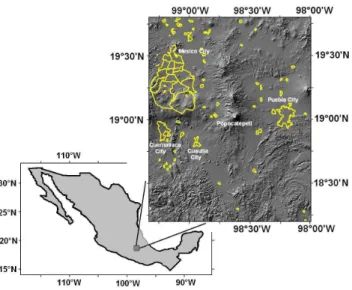
Fig. 1. Locations of Popocat´epetl volcano and major cities and towns. About 20 million people could be potentially affected by tephra fallout produced by a major eruption.
al., 1998, 2002). This requires a careful assessment, for the actual environmental hazard of toxic elements depends not only on their concentrations and toxicity, but also on their chemical form and prevailing physico-chemical conditions. In this work, the potential environmental effects of fluoride carried by ashes emitted by Popocat´epetl volcano are evalu-ated based on its concentrations in aqueous leachates, consid-ering that environmentally available F in the tephras was pri-marily estimated by extraction in water (Cronin et al., 2003).
2 The impact of volcanic fluoride
Volcanic fluoride may cause detrimental impacts on the en-vironment due to its toxicity, and to the large amounts that may be released by eruptions, the main natural atmospheric source of fluoride (Bellomo et al., 2007). Fluorine as flu-orapatite is a constituent of teeth and bones and it is, thus, required for their health. However, an excess of fluoride causes diverse negative health effects such as dental or skele-tal fluorosis, with mottled and harder teeth and bone cal-cification (Edmunds and Smedley, 1996). Crippling skele-tal fluorosis is a significant cause of morbidity in a num-ber of regions of the World. Chronic effects are reported to have been caused by the ingestion of groundwater con-taminated by water-rock interaction processes (Fawell et al., 2006). The World Health Organization established a guide-line of 1.5 mg l−1of fluoride in drinking water (WHO, 2004), a value that has been adopted in Mexico as the potable water standard (DOF, 2000).
Effects of large fluoride concentrations on livestock are comparable to those on humans (Weinstein and Davison, 2004). Fluoride excess caused by volcanic activity has also
affected animals by direct ingestion of volcanic ash, or inges-tion of contaminated water and crops (Bellomo et al., 2007). Iceland has been repeatedly affected by eruptions of fluoride-bearing ash. In 1693, the first fluorine intoxication of animals due to a volcanic eruption was reported from emissions of Hekla volcano (Thorarinsson, 1979). In 1783, ashfall and gases of Lakagigar volcano caused the death of tens of thou-sands of sheep, cattle and horses (Cronin et al., 2003). Flu-oride concentrations from 350 to 4300 µg g−1on forage cov-ered by ash, and ashes containing up to 2000 ppm water sol-uble fluorine emitted by Hekla in 1970, resulted in the death of about 1500 ewes and 6000 lambs (CSLP, 1971; Thorarins-son, 1979), and ash from the 1973 eruption of Eldfell, on the island of Heimaey caused vegetation damage.
High concentrations of fluoride released by other volca-noes have also produced serious environmental damage. In 1988, about 10 000 farm animals were affected by fluoride-bearing ashes from the Lonquimay volcano eruption in Chile (SEAN, 1989a), killing more than 4000 heads (goats, sheep, cattle and horses). Furthermore, dental fluorosis (incisors at-trition and brown or black spotted discolouration) was ob-served in cattle near Lonquimay two years after the erup-tion (SEAN, 1989b, c; Araya et al., 1993). Similarly, ashfall from Ruapehu volcano eruptions caused the death of thou-sands of sheep in 1995–1996 probably by fluorosis. Enamel and dentine fluoride enriched bands were observed in imma-ture surviving animals. In this case, ashes were enriched with fluorine not only by adsorption processes within the eruptive column, but also from the hydrothermal activity present in the volcano before the eruption (Cronin et al., 2003).
Fluoride doses about 100 mg kg−1 of body weight are acutely lethal in most mammals (Weinstein and Davison, 2004). Concentrations above 250 mg kg−1 dry weight in grass can kill sheep in 2 to 3 days (Thorarinsson, 1979). About 40 ppm dry weight has been considered as the max-imum acceptable fluoride concentration for beef or dairy cat-tle to avoid chronic fluorosis (Araya et al., 1993; Weinstein and Davison, 2004).
Ingestion of fluoride may also pose a significant risk to wildlife. Deer affected by osteofluorosis were observed near aluminium smelters and other industrial facilities like ther-mal power plants in various countries (Kierdorf et al., 1999; Kierdorf and Kierdorf, 2003; Zemek et al., 2006). Other wild animals like field voles (Microtus agrestis), wood-mice (Apodemus sylvaticus), moles (talpa europaea), shrews (Sorex araneus) and cotton rats (Sigmodon hispidus), were also affected by fluoride emission from an aluminium smelter in Wales (Boulton et al., 1994; Weinstein and Davison, 2004). Bison and mule deer showed osteofluorosis around hot springs of Yellowstone National Park, USA, and India (Dwivedi et al., 1997; Patra et al., 2000; Weinstein and Davi-son, 2004).
affect plants either from gaseous emissions of HF or from absorption by roots from fluoride-enriched soils. However, the phytotoxicity of fluoride absorbed from soils by roots is much less significant than that from airborne fluoride as HF (Kabata-Pendias and Pendias, 2001; Weinstein and Davison, 2004). The effect of the continuous degassing of Mount Etna volcano in Italy on vegetation growing on the volcano flanks was studied by D’Alessandro et al. (2008). Surprisingly, the impact of this emission (considered as the main natural source of fluorine to the troposphere) on vegetation was only visible in pine needles. The authors ascribed this fact to the morphology and height of the volcano and the neutralizing action of Ca deposits derived from limestone dusts, as well as the possible development of plant resistance to volcanic gas exposure.
3 Environmental setting at Popocat´epetl
Popocat´epetl (5452 m a.s.l.) is located in central M´exico (19.02◦N, 98.62◦W) in the eastern-central portion of the
Mexican Volcanic Belt. It is the second highest volcano in M´exico and the youngest within the Sierra Nevada, a volcanic range which extends in a roughly N-S direc-tion. This range also includes a large complex of overlap-ping cones called Iztacc´ıhuatl volcano (19.18◦
N, 98.64◦
W, 5286 m a.s.l.).
Both, Popocat´epetl and Iztacc´ıhuatl volcanoes have a pro-nounced altitudinal gradient with climates ranging from temperate to cold depending on height. Rapidly decay-ing glaciers partially cover the summit areas of both vol-canoes. In 1947, the zone comprising Popocat´epetl and Iztacc´ıhuatl volcanoes was officially declared “Natural Na-tional Protected Area” considering its unique flora and fauna, and is currently known as the Izta-Popo National Park. The Popocat´epetl’s height favours a flora and fauna diversity that changes with altitude. A temperate coniferous forest is dom-inated by oak (Quercus rugosa), cypress (Cupressus lusitan-ica), Oyamel or sacred fir (Abies religiosa) and pine (Pinus hartwegii), in the altitude range of 2850 to 3900 m. Grass-lands (Hilaria cenchroides,festuca amplissima), oak, fir and pine are also found between 2300 and 2700 m, and alpine grassland predominates at the highest altitude (ca. 4000 m) whereHagrostis tolucensis, Calamagrostis intermedia, and
Arenaria bryoides, among other species have been identi-fied (Beaman, 1962, Rzedowski, 1979; Almeida et al., 1994; Velasquez et al., 2001; S´anchez-Gonz´alez and L´opez-Mata, 2003; Hern´andez-Garc´ıa and Granados-S´anchez, 2006).
Fauna is also diverse at Popocat´epetl, and jointly with Iz-tacc´ıhuatl accounts for over 10 % of the total Mexican mam-malian species. A total of 52 mammal species within 37 gen-era and 16 families inhabit the study area. Rodents domi-nate, represented by 5 families and 21 species, followed by carnivores, bats and insectivores. Fir forests are very im-portant for squirrels (Sciurus andSpermophylus), racoons
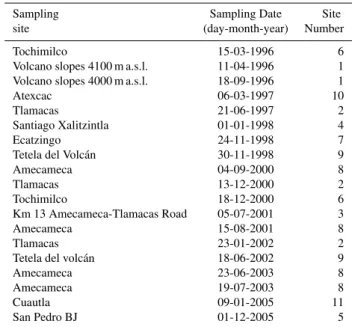
Table 1.Sampling site locations and dates.
Sampling Sampling Date Site
site (day-month-year) Number
Tochimilco 15-03-1996 6
Volcano slopes 4100 m a.s.l. 11-04-1996 1 Volcano slopes 4000 m a.s.l. 18-09-1996 1
Atexcac 06-03-1997 10
Tlamacas 21-06-1997 2
Santiago Xalitzintla 01-01-1998 4
Ecatzingo 24-11-1998 7
Tetela del Volc´an 30-11-1998 9
Amecameca 04-09-2000 8
Tlamacas 13-12-2000 2
Tochimilco 18-12-2000 6
Km 13 Amecameca-Tlamacas Road 05-07-2001 3
Amecameca 15-08-2001 8
Tlamacas 23-01-2002 2
Tetela del volc´an 18-06-2002 9
Amecameca 23-06-2003 8
Amecameca 19-07-2003 8
Cuautla 09-01-2005 11
San Pedro BJ 01-12-2005 5
(Procyon), and skunks (Conepatus and Mephitis), among others. Tropicalpine grasslands are a restricted habitat for the volcano mouse (Neotomodon), and preferential habitat for all ground-specialised genera (e.g.,Microtus, Sorex,Mustela). About one fifth of the species are endemic, such as the mouse (Neotomodon alstoni and Reithodontomys chrysop-sis) as well as other 24 subspecies. Five of the species are endangered like “Teporingo” or volcano’s rabbit ( Romerula-gus diaza) (Vel´azquez, 1988; Vel´azquez et al., 2001).
Forestry (especially wood production), agriculture and cattle raising are the main economic activities in the area. Livestock includes cattle, pigs, sheep, chicken, goats and horses. Agriculture is limited to the low-lands. Main crops are maize, barley, oat, bean, wheat, forage, fruit trees, sugar cane and some vegetables (Hern´andez-Garc´ıa and Granados-S´anchez, 2006; Romero et al., 1999).
4 Analytical methods
Fig. 2. Location of ash-sampling sites: 1 (4100 m a.s.l., on the volcano slope); 2 (Tlamacas); 3 (km 13 Tlamacas-Amecameca road); 4 (Santiago Xalizintla); 5 (San Pedro BJ); 6 (Tochimilco); 7 (Ecatzingo); 8 (Amecameca); 9 (Tetela del Volc´an); 10 (Atexcac); 11 (Cuautla).
pH was measured in the slurry with a conductimeter PC18 calibrating with pH 4, 7 and 9 buffers at room tempera-ture (20◦C). This methodology was developed based on the
capabilities of our laboratory and the compositional range of leachates. It has been tested against the Taylor and Stoiber (1973) and Varekamp et al. (1984) methods as re-ported in Armienta et al. (1998), and fulfils all recommen-dations given by the International Volcanic Health Hazard Network IVHHN (http://www.ivhhn.org/index.php?option= com content&view=article&id=100). In all cases, duplicate samples were analysed and results accepted when differences were less than 10 %. Calibration solutions were prepared with reagent grade salts dried overnight, deionized water, and class A volumetric material.
5 Results and discussion
Soluble concentrations of fluoride in ash samples of var-ious eruptions are shown in Fig. 3. Concentrations ranged over a two-orders of magnitude, from 5 mg kg−1 to 513 mg kg−1. The highest contents in leachates were de-tected on 24 November 1998 (513 mg kg−1) at Ecatzingo; 20 December 2000 (338 mg kg−1) at Tochimilco, 15 Au-gust 2001 (306 mg kg−1) at Amecameca; and 11 May 1997 (275 mg kg−1) at Santiago Xalizintla. These ash samples corresponded to episodes of new dome emplacement or to increased rates of dome growth as indicated by the monitoring data of the Mexican National Center for Dis-aster Prevention (CENAPRED). Such data include aerial
Fig. 3. Fluoride concentrations in leachates (mg kg−1) of various eruption dates.
photographs, seismic signals (VT events, tremors) and in-creased incandescence inside the crater, detected by the vol-cano video monitors (http://www.cenapred.unam.mx/popo/ UltimaImagenVolcanI.html).
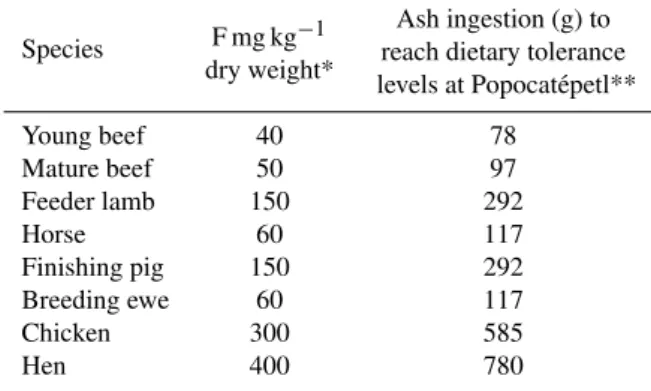
Table 2.Dietary tolerance to fluoride.
Species F mg kg−1
Ash ingestion (g) to
dry weight* reach dietary tolerance levels at Popocat´epetl**
Young beef 40 78
Mature beef 50 97
Feeder lamb 150 292
Horse 60 117
Finishing pig 150 292
Breeding ewe 60 117
Chicken 300 585
Hen 400 780
* National Research Council (1974); Weinstein and Davison (2004) ** considering the maximum fluoride concentration
and 17 October 1998 where the highest fluoride concen-trations (41 mg kg−1and 124.2 mg kg−1, respectively) were measured at the farthest sampling locations (55.8 and 29 km respectively; Armienta et al., 2002). Both of these eruptions emitted ash clouds that produced light ashfalls on Mexico City, nearly 70 km NNW of the volcano. Moreover, a thin ash layer does not hinder grazing and sticks easily to vege-tation, leading to a fluorosis hazard to humans and animals at even further distances (Thorarinsson, 1979; Armienta et al., 2002). Whether these amounts of fluoride in ash repre-sent a serious fluorosis hazard to fauna is a question that may not be unequivocally answered from the available informa-tion. It may be argued that rain will rapidly wash the fluoride away and remove fine layers of ash so exposure would be very limited over time. As an example, we may estimate the exposure to ash fluoride during the initial stage of the cur-rent Popocat´epetl activity. Martin del Pozzo et al. (2008) calculate that 1.181×10⁶m3 of ash was emitted between 21 December 1994 to 12 March 1995, with F concentrations ranging between 20 and 100 mg kg−1(Fig. 3). Those months correspond to the lowest rain precipitation, averaging about 6 mm per month. The resolution of the published isopachs (Martin del Pozzo et al., 2008) do not allow for the estimation at what distance from the emission centre such rainfall will wash the fluoride before it produces significant health dam-age to fauna, but the order of magnitude estimates suggest that it probably may not involve a very large area. However, between 1997 and 2003 (particularly on 30 June 1997) simi-lar volumes (up to 1.1×10⁶m3)of ash were emitted in a day (Martin del Pozzo et al., 2008), i.e., an emission rate about two orders of magnitude greater than in 1994. Although sum-mer rain fall may exceed winter precipitation by a factor of about 20, it is very difficult with the available data to estimate the extent at which hazardous exposure of fauna to fluoride may occur. Furthermore, during December 2000, the vol-cano registered even higher magma eruption rates, forming the largest lava dome and producing frequent ash columns
Fig. 4.pH values measured in leachates of the ash samples listed in Table 1.
Fig. 5.Fluoride concentrations (mg kg−1) in leachates of the sam-ples listed in Table 1.
Fluoride-enriched ashes settled on soils may also affect the vegetation around Popocat´epetl. However, the total fluoride contents in ash-contaminated soils may not be available for plant uptake, since fluoride absorption depends on various other factors, such as soil type, pH, organic matter, and Ca and Al contents. Concentrations of fluoride in the plant roots are proportional to the soil solution concentration (Weinstein and Davison, 2004). In addition, fluoride is most readily ab-sorbed by plants at low pH values, at which it is more soluble. Fluoride solubility in soils of Austria showed a minimum at pH 6.0–6.5 and increased at a pH less than 6.0, and higher than 6.5 (Wenzel and Blum, 1992). It has also been found that aluminium-fluoride complexes increase plant uptake. On the other hand, fluoride adsorption on aluminium minerals decreases its lability (Longanathan et al., 2001). Formation of Al-F complexes thus explain the high solubility at low pH, and desorption from soil the solubility raise at high pH (Wen-zel and Blum, 1992; Longanathan et al., 2001).
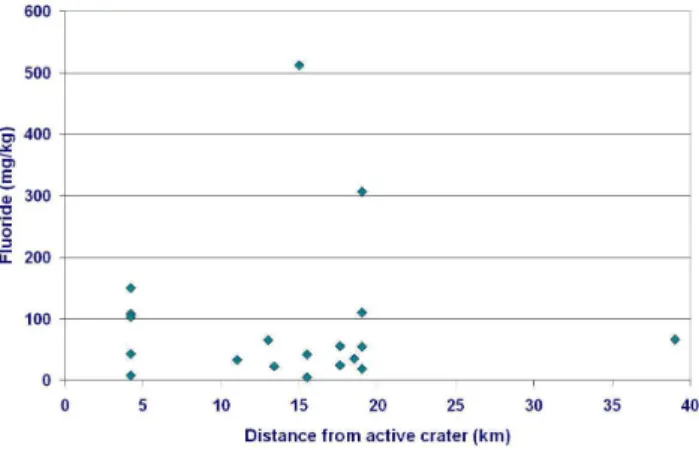
Samples from the Popocat´epetl area show near neutral to slightly basic pH values, except in those collected near the vent (Fig. 4). Concentrations of fluoride in leachates in the same sites are shown in Fig. 5. On the other hand, vegetation may assimilate F in its soluble form. Hence, a close relation-ship between the concentration of soluble F in the soil and in the plants should be expected (Egli et al., 2004). Experimen-tal studies with artificial soil solutions, jointly with geochem-ical modelling, showed that fluorine is mostly as fluoride in the soil solution (Stevens et al., 2000). Concentrations in ash-leachates may, thus, provide a good proxy to fluoride levels available to vegetation uptake from volcanic ashes.
Histological and structural effects resulting from fluorine exposure have been studied for some of the most represen-tative plants present at Popocat´epetl or for similar species. Shrinkage of chloroplasts in subnecrotic zones and fewer chloroplasts lamellae in maize were reported by Lhoste and Garrec (1975). Inhibition of H+ pumping and ATPase ac-tivity in maize roots vesicles by LiF and AlF3was reported
by Fac¸anha and de Meis (1995). Pinus effects identified by various studies include changes in phloem and occlusion of resin canals, dilatation of thylakoids, cell vacuolization and increase in endoplasmic reticulum (Weinstein and Davison, 2004).
Aluminium and calcium are known to be strong binders for F in soil (Rai et al., 2000). Manoharan et al. (2007), demonstrated that fluoride in soils decreased the growth of roots of barley in slightly acid soil pH values (4.25 to 5.48). This effect was due to the increase in the concentration of Al-F complex formation in the soil and was more pronounced at the lowest pH. Around Popocat´epetl, slightly acid values were measured in ash samples with a pH range from 4.3 to 6.4 and highly soluble fluoride contents from 43 mg kg−1at a pH of 4.4 to 512.5 mg kg−1 at a pH of 6.3 (Figs. 4 and 5). Barley crops raised in agricultural fields within that range may, thus, be affected by ash-fallout. More acid values of the ash were measured nearer to the active crater, but no agricul-tural activity is developed there.
6 Conclusions
Although there is no evidence that fluoride transported by volcanic ash has so far posed an acute problem to organisms exposed to the ashfall, it is clear that Popocat´epetl volcano has the potential to produce larger, fluoride-rich eruptions. Therefore, soluble fluoride concentrations in ash emitted by some eruptions may pose a risk to humans, animals and veg-etation around that volcano. Evaluation of such hazard is essential to design appropriate mitigation measures. Young cows would be the grazing animals most affected by fluoride-enriched ashes. Small wild mammals would also be at risk. This is particularly relevant for the volcano rabbit ( Romeru-lagus diaza) and other endangered species at Popocat´epetl. Effects of fluoride rich ashfall on vegetation are controlled by additional factors such as soil pH, as well as Ca and Al content.
Acknowledgements. The authors are grateful to Peter Baxter and to an anonymous reviewer for their valuable comments and suggestions that greatly helped to improve this paper. We thank the Instituto de Geof´ısica, Universidad Nacional Aut´onoma de M´exico (UNAM), and DGAPA-PAPIIT (Grant IN114808-3) for funding the present work. We are indebted to Esteban Ramos, Angel G´omez and the late Marcos Galicia for their great help in the field work.
Edited by: J. Marti
Reviewed by: P. Baxter and another anonymous referee
References
Almeida, L., Cleef, A. M., Herrera, A., Vel´asquez, A., and Luna, I.: El zacatonal alpino del volc´an Popocat´epetl, M´exico, y su posici´on en las monta˜nas tropicales de Am´erica, Phytocoenolo-gia, 22, 391–436, 1994.
Araya, O., Wittwer, F., and Villa, A.: Evolution of fluoride con-centrations in cattle and grass following a volcanic eruption, Vet. Hum. Toxicol., 35, 437–440, 1993.
Armienta, M. A., Martin, A. L., Espinasa, R., Cruz, O., Ceniceros, N., Aguayo, A., and Butron, M. A.: Geochemistry of Ash Leachates During the 1994–1996 Activity of Popocatepetl Vol-cano, Appl. Geochem., 13, 1–10, 1998.
Armienta, M. A., De la Cruz-Reyna, S., Morton, O. Cruz, O., and Ceniceros, N.: Chemical Variations of Tephra Deposit Leachates for Three Eruptions from Popocat´epetl Volcano, J. Volcanol. Geoth. Res., 113(1–2), 61–80, 2002.
Bates, M. N., Garrett, N., and Shoemak, P.: Investigation of health effects of hydrogen sulfide from a geothermal source, Arch. En-viron. Health, 57, 405–411, 2002.
Baxter, P. J., Kapila, M., and Mfonfu, D.: Lake Nyos disaster, Cameroon, 1986: the medical effects of large scale emission of carbon dioxide?, Brit. Med. J., 298, 1437–1441, 1989.
Beaman, J. H.: The timberlines of Iztaccihuatl and Popocatepetl, Mexico, Ecology, 43, 377–385, 1962.
Bellomo, S., Aiuppa, A., D’Alessandro, W., and Parello, F.: Envi-ronmental impact of magmatic fluorine emission in the Mt. Etna Area, J. Volcanol. Geoth. Res., 165, 87–101, 2007.
Boulton, I. C., Cooke, J. A., and Johnson, M. S.: Fluoride accu-mulation and toxicity in wild small mammals, Environ. Poll., 85, 161–167, 1994.
CSLP: Hekla, Review of May–July 1970 eruption, Center for Short-Lived Phenomena Event Report, Smithsonian Institution, Card 1093–1094 (19 January 1971), CSLP, 43–70, 1971.
Cronin, S. J., Neall, V. E., Lecointre, J. A., Hedley M. J., and Lo-ganathan, P.: Environmental hazards of fluoride in volcanic ash: a case study from Ruapehu volcano, New Zealand, J. Volcanol. Geoth. Res., 121, 271–291, 2003.
D’Alessandro, W., Bellomo, S., and Parello, F.: Fluorine speciation in topsoils of three active volcanoes of Sicily (Italy), Environ. Geol., 56, 413–423, 2008.
De la Cruz-Reyna, S. and Siebe, C.: The giant Popocat´epetl stirs, Nature, 388(6639), p. 227, 1997.
De la Cruz-Reyna, S. and Tilling, R. I.: Scientific and public re-sponses to the ongoing volcanic crisis at Popocat´epetl Volcano, Mexico: Importance of an effective hazards-warning system, J. Volcanol. Geoth. Res., 170, 111–120, 2008.
DOF: MODIFICACION a la Norma Oficial Mexicana NOM-127-SSA1-1994, Salud ambiental, Agua para uso y consumo hu-mano, L´ımites permisibles de calidad y tratamientos a que debe someterse el agua para su potabilizaci´on, Diario oficial de la Fed-eraci´on, M´exico, D.F., 20 octubre, 2000.
Dwivedi, S. K., Dey, S., and Swarup D.: Hydrofluorosis in water buffalo (Bubalus bubalis) in India, Sci. Total Environ., 207, 105– 109, 1997.
Edmunds, W. M. and Smedley, P. L.: Groundwater geochemistry and health: an overview, in: Environmental Geochemistry and Health, edited by: Appleton, J. D., Fuge, R., and McCall, G. J. H., Geological Society Special Publication, London, 113, 91– 105, 1996.
Egli, M, D¨urrenberger, S., and Fitze, P.: Spacio-temporal behaviour and mass balance of fluorine in forest soils near an aluminium smelting plant: short and long term aspects, Environ. Pollut., 129, 195–207, 2004.
Fac¸anha, A. R. and de Meis, L.: Inhibition of maize root H+ -ATPase by fluoride and fluoraluminate complexes, Plant Phys-iol., 108, 241–246, 1995.
Fawell, J., Bailey, K., Chilton, J., Dahi, E., Fewtrell, L., and Mag-ara, Y.: Fluoride in Drinking Water, World Health Organization, London, 134 pp., 2006.
Fulignati, P., Sbrana, A., Clocchiatti, R., and Luperini, W.: En-vironmental impact of the acid fumarolic plume of a passively degassing volcano (Vulcano Island, Italy), Environ. Geol., 49, 1139–1155, 2006.
Hansell, A. and Oppenhemier, C.: Health hazards from Volcanic Gases: A systematic literature review, Arch. Environ. Health, 59, 628–639, 2004.
Hern´andez-Garc´ıa, M. A. and Granados-S´anchez, D.: El par-que nacional Iztacc´ıhuatl-Popocat´epetl-Zoquiapan y el impacto ecol´ogico-social de su deterioro, Revista Chapingo Serie Cien-cias Forestales y del Ambiente, 12, 101–109, 2006.
Horwell, C. J. and Baxter, P.: The respiratory health hazards of vol-canic ash: a review for volvol-canic risk mitigation, Bull. Volcanol., 69, 1–24, 2006.
Horwell, C. J., Sparks, R. S. J., Brewer, T. S., Llewellin, E. W., and Williamson, B. J.: Characterization of respirable volcanic ash from the Soufriere Hills volcano, Montserrat, with implications for human health hazards, Bull. Volcanol., 65, 346–362, 2003. Kabata-Pendias, A. and Pendias H.: Trace elements in soils and
plants, CRC Press, Boca Raton USA, 432 pp., 2001.
Kierdorf ,Y. and Kierdorf, H.: Temporal variation of fluoride con-centration in antlers of roe deer (Capreolus capreolus) living in an area exposed to emissions from iron and steel industry, 1948– 2000, Chemosphere, 52, 1677–1681, 2003.
Kierdorf, H., Kierdorf, U., and Sedlacek, F.: Monitoring regional fluoride pollution in the Saxonian ore mountains (Germany) us-ing the biomarker dental fluorosis in roe deer (Capreolus capre-olusL.), Sci. Total Environ., 232, 159–168, 1999.
Kling, G. W., Clark, M. A., Wagner, G. N., Compton, H. R., Humphrey, A. M., Devine, J. D., Evans, W. C., Lockwood, J. P., Tuttle, M. L., and Koenigsberg, E. J.: The 1986 Lake Nyos Gas Disaster in Cameroon, West Africa, Science, 236(4798), 169– 175, 1987.
Lhoste, A. M. and Garrec, J. P.: Fluorine Effects on Chloroplast Ultrastructure of Zea-Mays Biometrical Study, Journal de Mi-croscopie et de Biologie Cellulaire, 24, 351–364, 1975. Loganathan, P., Hedley, M. J., Wallace, G. C., and Roberts, A. H.
C.: Fluoride accumulation in pasture forages and soils following long-term applications of phosphorous fertilizers, Environ. Pol-lut., 115, 275–282, 2001.
Manoharan, V., Loganathan, P., Tillman, R. W., and Parfitt, R. L.: Interactive effects of soil acidity and fluoride on soil solution alu-minium chemistry and barley (Hordeum vulgareL.) root growth, Environ. Pollut., 145, 778–786, 2007.
Martin-Del Pozzo, A. L., Gonz´alez-Mor´an, T., Espinasa-Pere˜na, R., Butr´on, M. A., and Reyes, M.: Characterization of the re-cent ash emissions at Popocatepetl Volcano, Mexico, J. Volcanol. Geotherm. Res., 170, 61–75, 2008.
Michaud, J. P., Grove, J. S., and Krupitsky, D.: Emergency depart-ment visits and “vog” related air quality in Hilo, Hawai’i, Envi-ron. Res., 95, 11–19, 2004.
National Research Council: Effects of fluorides in ani-mals/Subcommittee on Fluorosis, Committee on Animal Nutri-tion, Board of Agriculture and Renewable Resources, National Research Council, National Academy of Sciences, Washington, USA, 1974.
Patra, R. C., Dwivedi, S. K., Bhardwaj, B., and Swarup, D.: In-dustrial fluorosis in cattle and buffalo around Udaipur, India, Sci. Total Environ., 253, 145–150, 2000.
Rai, K., Agarwal, M., Dass S., Shrivastaqv, R.: Fluoride: Diffusive mobility in soil and some remedial measures to control its plant uptake, Current Science, 79, 1370–1373, 2000.
Romero, F. J., Rangel-Cordero, H., Est´evez-Ram´ırez, A., Es-camilla, M., and Cabrera-Garc´ıa, L.: Aspectos sociode-mogr´aficos y actividades productivas rurales del sur de la Cuenca de M´exico, in: Bodiversidad de la Regi´on de Monta˜na del Sur de la Cuenca de M´exico, Universidad Aut´onoma Metropolitana, M´exico D.F., 229–262, 1999.
Rzedowski, J.: Principales comunidades vegetales, in: Flora fanerog´amica del Valle de M´exico, edited by: Rzedowski, J. and Rzedowski, G. C., CECSA, M´exico, D.F., 47–54, 1979. SEAN: Lonquimay, Continued tephra emission; cattle sickened by
ash, Scientific Event Alert Network Bull., Smithsonian Institu-tion, 14(4), 2–3, 1989a.
SEAN: Lonquimay, Continued tephra emission and lava flow; fluo-rine data, Scientific Event Alert Network Bull., Smithsonian In-stitution, 14(9), 3–4, 1989b.
SEAN: Lonquimay, Strong fluorine emission; one person and many animals killed, Scientific Event Alert Network Bull., Smithso-nian Institution, 14(6), 11–13, 1989c.
S´anchez-Gonz´alez, A. and L´opez-Mata, L.: Clasificaci´on y orde-naci´on de la vegetaci´on del norte de la Sierra Nevada, a lo largo de un gradiente altitudinal, Anales del Instituto de Biolog´ıa, Uni-versidad Nacional Aut´onoma de M´exico, Serie Bot´anica, 74, 47– 71, 2003.
Schroder, J. L., Basta, N. T., Payton, M., Wilson, J. A., Carlson, R. E., Janz, D. M., and Lochmiller, L.: Ecotoxicological risks associated with land treatment of petrochemical wastes, I. Resid-ual soil contamination and bioaccumulation by cotton rats ( Sig-modon hispidus), J. Toxicol. Environ. Health A, 66, 305–325, 2003.
Stevens, D. P., McLaughlin, M. J., Randall, P. J., and Keerthisinghe, G.,: Effect of fluoride supply on fluoride concentrations in five pasture species: Levels required to reach phytotoxic or poten-tially zootoxic concentrations in plant tissue, Plant Soil, 227, 223–233, 2000.
Taylor, P. S. and Stoiber, R. E.: Soluble material on ash from active central American volcanoes, Geol. Soc. Am. Bull., 84, 1031– 1042, 1973.
Thorarinsson, S.: On the damage caused by volcanic eruptions with special reference to tephra and gases, in: Volcanic Actitivy and Human Ecology, edited by: Sheets, P. D. and Grayson, D. K., Academic Press, NY, 125–159, 1979.
Varekamp, J. C., Luhr, J. F., and Prestegaard, K. L.: The 1982 erup-tions of El Chich´on volcano (Chiapas, M´exico): Character of the eruptions, ash-fall deposits and gasphase, J. Volcanol. Geotherm. Res., 23, 39–68, 1984.
Vel´azquez, M. A.: Especies y habitats en peligro de extinci´on. El caso del conejo de los volcanes, ICYT, Informaci´on Cient´ıfica y tecnol´ogica, 10, 45–49, 1988.
Vel´azquez, A., Romero, F. J., Rangel-Cordero, H., and Heil, G. W.: Effects of landscape changes on mammalian assemblages at Izta-Popo volcanoes Mexico, Biodivers. Conserv., 10, 1059– 1075, 2001.
Weinstein, L. H. and Davison, A.: Fluorides in the Environment, CABI Publishing, Wallingford, 287 pp., 2004.
Wenzel, W. W. and Blum, W. E. H.: Fluorine speciation and mobil-ity in F-contaminated soils, Soil Sci., 153, 357–364, 1992. WHO, World Health Organization: Fluoride in drinking-water,
Background document for development of WHO Guidelines for Drinking-water Quality, WHO, 9 pp., 2004.