Annotations for Disulfide Connectivity Pattern Prediction
Julien Becker1, Francis Maes2,3, Louis Wehenkel2*
1Bioinformatics and Modeling, GIGA-Research, University of Liege, Liege, Belgium,2Department of Electrical Engineering and Computer Science, Montefiore Institute, University of Liege, Liege, Belgium,3DTAI, Departement Computerwetenschappen, University of Leuven, Leuven, Belgium
Abstract
Disulfide bridges strongly constrain the native structure of many proteins and predicting their formation is therefore a key sub-problem of protein structure and function inference. Most recently proposed approaches for this prediction problem adopt the following pipeline: first they enrich the primary sequence with structural annotations, second they apply a binary classifier to each candidate pair of cysteines to predict disulfide bonding probabilities and finally, they use a maximum weight graph matching algorithm to derive the predicted disulfide connectivity pattern of a protein. In this paper, we adopt this three step pipeline and propose an extensive study of the relevance of various structural annotations and feature encodings. In particular, we consider five kinds of structural annotations, among which three are novel in the context of disulfide bridge prediction. So as to be usable by machine learning algorithms, these annotations must be encoded into features. For this purpose, we propose four different feature encodings based on local windows and on different kinds of histograms. The combination of structural annotations with these possible encodings leads to a large number of possible feature functions. In order to identify a minimal subset of relevant feature functions among those, we propose an efficient and interpretable feature function selection scheme, designed so as to avoid any form of overfitting. We apply this scheme on top of three supervised learning algorithms: k-nearest neighbors, support vector machines and extremely randomized trees. Our results indicate that the use of only the PSSM (position-specific scoring matrix) together with the CSP (cysteine separation profile) are sufficient to construct a high performance disulfide pattern predictor and that extremely randomized trees reach a disulfide pattern prediction accuracy of58:2%on the benchmark dataset SPXz, which corresponds toz3:2% improvement over the state of the art. A web-application is available at http://m24.giga.ulg.ac.be:81/x3CysBridges.
Citation:Becker J, Maes F, Wehenkel L (2013) On the Relevance of Sophisticated Structural Annotations for Disulfide Connectivity Pattern Prediction. PLoS ONE 8(2): e56621. doi:10.1371/journal.pone.0056621
Editor:Narcis Fernandez-Fuentes, Aberystwyth University, United Kingdom
ReceivedSeptember 17, 2012;AcceptedJanuary 14, 2013;PublishedFebruary 15, 2013
Copyright:ß2013 Becker et al. This is an open-access article distributed under the terms of the Creative Commons Attribution License, which permits unrestricted use, distribution, and reproduction in any medium, provided the original author and source are credited.
Funding:Julien Becker is recipient of a FRIA fellowship from the FRS-FNRS (http://www.frs-fnrs.be/). The funders had no role in study design, data collection and analysis, decision to publish, or preparation of the manuscript.
Competing Interests:The authors have declared that no competing interests exist.
* E-mail: [email protected]
Introduction
A disulfide bridge is a covalent link resulting from an oxidation-reduction process of the thiol group of two cysteine residues. Both experimental studies in protein engineering [1–3] and theoretical studies [4,5] showed that disulfide bridges play a key role in protein folding and in tertiary structure stabilization. The knowledge of the location of these bridges adds strong structural constraints to the protein, which enable to drastically reduce the conformational search space in the context of protein structure prediction. Due to the technical difficulties and the expensive cost of experimental procedures for determining protein structures (by x-ray crystallography, NMR or mass spectrometry), machine learning approaches have been developed to predict the formation of disulfide bridges in an automatic way.
Given an input primary structure, the disulfide pattern prediction problem consists in predicting the set of disulfide bridges appearing in the tertiary structure of the corresponding protein. This problem can be formalized as an edge prediction problem in a graph whose nodes are cysteine residues, under the constraint that a given cysteine is linked to at most to a single other one. Most recent successful methods to solve this problem are pipelines composed of three steps which are illustrated in Figure 1.
First, they enrich the primary structure using evolutionary information and sometimes structural-related predictions. Second, they apply a binary classifier to each pair of cysteines to estimate disulfide bonding probabilities. Finally, they use a maximum weight graph matching algorithm to extract a valid disulfide pattern maximizing the sum of these probabilities.
The main contribution of this paper is an extensive study which aims at establishing the relevance of various structural-related annotations and of various feature encodings in the context of a disulfide pattern predictor such as the one presented in Figure 1. We consider various structural annotations, some which were already studied in the context of disulfide pattern prediction – position-specific scoring matrix, secondary structure and solvent accessibility – and some others which are more original in this context: 8-class secondary structure, disordered regions and structural alphabet. For each such annotation, we consider four different procedures in order to encode it as a feature vector. The combination of annotations with feature encodings leads to a large set of possible feature functions. In order to identify a minimal subset of feature functions that are relevant to disulfide pattern prediction, we introduce a tractable and interpretable feature selection methodology, based on forward selection of feature functions. We adopt a computational protocol that avoids any risk of overfitting and apply our approach in combination with two usual classifiers: k-nearest neighbors (kNN) and support vector machines (SVM), as well as with one classifier, which was not yet considered for disulfide pattern prediction: extremely randomized trees (ET) [9].
As a result of this study, we show that only a very limited number of feature functions are sufficient to construct a high performance disulfide pattern predictor and that, when using these features, extremely randomized trees reach a disulfide pattern accuracy of 58:2% on the benchmark dataset SPXz, which corresponds to z3:2% improvement over the state of the art. However, since SPXz only contains proteins with at least one intrachain disulfide bridge, we further consider the more heterogeneous and less redundant benchmark dataset SPX{ which also contains a significant number of proteins without any intrachain bridge. We then investigate the behavior of our disulfide pattern predictor on both datasets by coupling it with filters predicting the presence of intrachain bridges and the bonding states of individual cysteines. We consider both the case where bonding states are known a priori and the case where bonding states are estimated thanks to another predictor. We show that predicting the bonding states significantly improves our disulfide pattern predictor on SPX{, but slightly degrades it on SPXz. When the bonding states are known a priori, we reach very high accuracies:89:9%on SPX{and75:8%on SPXz.
The following two sections give an overall view of related work by first discussing multiple sub-problems of disulfide pattern prediction and then presenting the kinds of features that have been proposed to describe cysteines and cysteine pairs in supervised
learning approaches. We refer the reader to [10] for an extensive recent overview of the field.
Disulfide bridge related prediction problems
While the ultimate goal of disulfide bridge prediction is to infer correctly the whole connectivity pattern of any protein from its primary sequence, several researchers have focused on interme-diate simpler sub-problems, which are detailed below.
Chain classification. This sub-problem aims at predicting for a given protein, whether (a) none of its cysteines participate to a disulfide bridge, (b) some of its cysteines are involved in disulfide bridges or (c) all of its cysteines are involved in disulfide bridges. Frasconiet al.[11] proposed a support vector machine classifier to solve this task. Fiseret al.[12] have exploited the key fact that free cysteines (not involved in any bond) and oxidized cysteines (involved in a bond but not necessarily an intra-chain disulfide bridge) rarely co-occur and shown that theirs sequential environ-ments are different. From those observations, subsequent studies have reduced this sub-problem to a binary classification task: (a) or (c).
Cysteine bonding state prediction. This second commonly studied sub-problem consists in classifying cysteines into those that are involved in a disulfide bridge and those that are not. To solve this binary classification problem, several machine-learning algorithms were proposed such as multi-layer neural networks [13], two-stage support vector machines that exploit chain classification predictions [11] and hidden neural networks [14].
Disulfide bonding prediction. While chain classification works at the protein level and cysteine bonding state prediction works at the cysteine level, disulfide bonding prediction works at the level of cysteine pairs and aims at predicting the probability that a specific pair of cysteines will form a disulfide bridge during protein folding. Depending on the studies, some authors assume to have an a priori knowledge on the bonding state of isolated cysteines. This prior knowledge can be the actual state [15–17] or a prediction made by a cysteine bonding state predictor [18].
Disulfide pattern prediction. Once one or several of the previous tasks have been solved, the most challenging step is to predict the disulfide connectivity pattern. Fariselliet al.[19] were the first to relate the problem of predicting the disulfide pattern to a maximal weight graph matching problem. Several authors have since adopted this approach and proposed disulfide pattern predictors that fit into the three step pipeline of Figure 1. Baldi et al.[6,20] have used two-dimensional recursive neural networks to predict bonding probabilities, which are exploited by a weighted graph matching algorithm. Linet al.[7,21] used the same graph
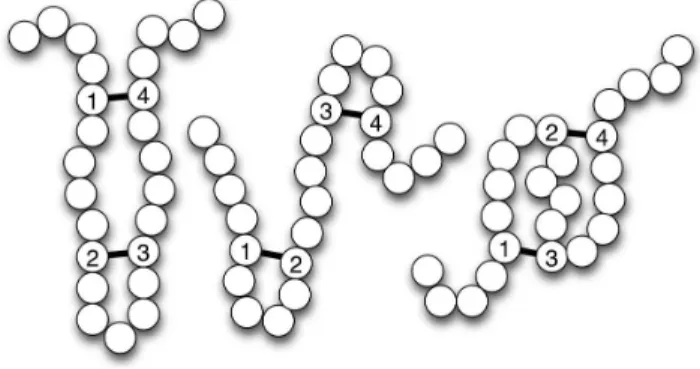
Figure 1. Three-step approach for disulfide pattern prediction.(A) an input primary structure, which contains four cysteine residues. (B) The sequence is first enriched using evolutionary information and sometimes structural-related predictions such as the secondary structure. (C) A bridge classifier, then, predicts disulfide bonding probabilities for each cysteine pair and finally (D) a graph matching algorithm extracts the disulfide pattern with maximal weight.
matching approach while predicting bonding probabilities with support vector machines.
Features for cysteines and cysteine pairs
Machine learning algorithms are rarely able to process complex objects such as cysteine pairs directly, hence it is necessary to define a mapping from these objects to vectors of features. A large body of research on disulfide bridge prediction has been devoted to the analysis of such encodings into feature vectors.
In 2004, Vulloet al.[15] suggested to incorporate evolutionary information into features describing cysteines. For each primary sequence, they generate a position-specific scoring matrix (PSSM) from a multiple alignment against a huge non-redundant database of amino-acid sequences. This evolutionary information was shown to significantly improve the quality of the predicted disulfide bridges, which led the large majority of authors to use it in their subsequent studies. Generally, the PSI-BLAST program [22] is used to perform multiple alignments against the SWISS-PROT non-redundant database [23].
Zhaoet al.[24] introduced cysteine separation profiles (CSPs) of proteins. Based on the assumption that similar disulfide bonding patterns lead to similar protein structures regardless of sequence identity, CSPs encode sequence separation distances among bonded cysteine residues. The CSP of a test protein is then compared with all CSPs of a reference dataset and the prediction is performed by returning the pattern of the protein with highest CSP similarity. This approach assumes to have an a priori knowledge on the bonding state of cysteines. In this paper, we introduce a slightly different definition of CSPs based on separation distances among all cysteine residues (see Candidate feature functions).
From the earlier observation that there is a bias in the secondary structure preference of bonded cysteines and non-bonded cyste-ines, Ferre` et al. [8] have developed a neural network using predicted secondary structure in addition to evolutionary infor-mation. Chenget al.[6] proposed to also include predictions about the solvent accessibility of residues. The predictions of secondary structure and/or solvent accessibility used in their experiments were however not accurate enough to obtain significant perfor-mance improvements. Nevertheless, they observed that using the true valuesof secondary structure and solvent accessibility can lead to a small improvement of 1%. More recently, Lin et al. [7] proposed an approach based on support vector machines with radial basis kernels combined with an advanced feature selection strategy. They observed a weak positive influence by using predicted secondary structure descriptors, but their experimental methodology could suffer from overfitting so that this result should be taken with a grain of salt. Indeed, in this study, the same data is used both for selecting features and for evaluating the prediction pipeline. As detailed in [25], proceeding in this way often lead to an overfitting effect and hence to over-optimistic scores. Notice that the three studies [6–8] were all based on the secondary structure predicted by the PSIPRED predictor [26].
More recently, Savojardoet al.[27] reported an improvement of their predictive performance by taking into consideration the relevance of protein subcellular localization since the formation of disulfide bonds depends on the ambient redox potential.
Materials and Methods
Notations and problem statement
This section introduces notations and formalizes the disulfide pattern prediction problem. Let P be the space of all proteins described by their primary structure and P[P one particular
protein. We denote C(P)~(C1(P),. . .,Cn
C(P)) the sequence of
nC~DC(P)Dcysteine residues belonging to proteinP, arranged in the same order as they appear in the primary sequence. A disulfide bonding connectivity pattern (or disulfide pattern) is an undirected graphG~(C(P),B) whose nodes C(P) are cysteines and whose edgesBare the pairs of cysteines(f(Ci,Cj)gthat form a disulfide bridge.
Since a given cysteine can physically be bonded to at most one other cysteine, valid disulfide patterns are those that respect the constraint degree(Ci)ƒ1,Vi[½1,nC. This constraint enables to trivially derive an upper bound on the number b of disulfide bridges given the number of cysteines:bƒtnc
2s, wheret
:sis the
floor function. If we know in advance the numberb§1of disulfide bridges, we can derive the number of valid disulfide patterns using the following closed form formula [28]:
C2bnC P
iƒb
i~1(2i
{1), ð1Þ
where C2b nC~
nC! (2b)!(nC{2b)!
denotes the number of possible
subsets of size 2bof the set of nC cysteines. As an example, a protein withnC~6 cysteines and b~3 bridges has 15 possible disulfide patterns and a protein withnC~11 cysteines andb~5 bridges has11|945~10 395possible patterns. Figure 2 illustrates the three possible disulfide connectivity patterns of a protein with four cysteines and two disulfide bridges.
When the number of bridges is unknown, the number of possible disulfide connectivity patterns for a protein P with nC cysteines becomes
X
tnC=2s
b~1
CnC2biƒbP
i~1ð2i{1Þz1: ð2Þ
Note that the term z1 represents the case where no cysteine residue is bonded. As an example, a protein withnC~10cysteines has 45|1z210|3z210|15z45|105z1|945z1~9 496 possible valid disulfide patterns.
We adopt a supervised-learning formulation of the problem, where we assume to have access to a dataset of proteins (represented by their primary structure) with associated disulfide patterns. We denote this dataset D~f(P(i),B(i))g
i[½1,N, where P(i)[P is the i-th protein andB(i) is the set of disulfide bridges associated to that protein. We also denote n(i)C~DC(P(i))D the
number of cysteines belonging to the protein P(i). Given the datasetD, the aim is to learn a disulfide pattern predictorf(:): a function that maps proteins P[P to sets of predicted bridges ^
B
B~f(P). Given such a predicted set, we can define the predicted connectivity pattern as following:GG^~(C(P),BB^).
We consider two performance measures to evaluate the quality of predicted disulfide patterns:Qpand Q2.Qp is a protein-level performance measure that corresponds to the proportion of entirely correctly predicted patterns:
Qp~ 1
N XN
i~1
B(i)~BB^(i)
, ð3Þ
where f gPr is the indicator function whose value is1ifPris true or0otherwise.Q2 is a cysteine-pair level performance measure that corresponds to the proportion of cysteine pairs that were correctly labeled asbondedornon-bonded:
Q2~
1
PN
i~1
n(i)C(n(i)C{1)=2
XN
i~1
X
n(i)C
j~1
X
n(i)C
k~jz1
(fCj,Ckg[B(i))~(fCj,Ckg[BB^(i))
: ð4Þ
Note that bothQpandQ2belong to the interval½0,1and are equal to1in case of perfectly predicted disulfide patterns. While the ultimate goal of disulfide pattern prediction is to maximizeQp, we will also often refer to Q2 since, in the pipeline depicted in Figure 1,Q2is directly related to the quality of the cysteine pair classifier.
Disulfide pattern prediction pipeline
This section first presents the datasets and the five kinds of structural-related predictions we consider. It then details the different steps of our prediction pipeline: the dataset annotation, the pre-processing step that enriches the primary structure with evolutionary information and structural-related annotations, the classification step of cysteine pairs that predicts bridge bonding probabilities and the post-processing step that constructs a disulfide pattern from these probabilities using maximum weight graph matching.
Dataset and annotations. In order to assess our methods, we use two datasets that have been built by Chenget al.[6] and extracted from the Protein Data Bank [29]. The first one, SPXz, is a collection of1 018proteins that contain at least 12 amino acids and at least one intrachain disulfide bridge. We use this dataset for the problem of pattern prediction. However, since it does not contain any protein without disulfide bridges it is not adapted to address chain classification and cysteine bonding state prediction. For these tasks, we use the other dataset, SPX{, which is made of 1 650proteins that contain no disulfide bridge and897proteins that contain at least one bridge. In order to reduce the over-representation of particular protein families, both datasets were filtered by UniqueProt [30], a protein redundancy reduction tool based on the HSSP distance [31]. In SPX{, Chenget al.used a HSSP cut-off distance of 0for proteins without disulfide bridge and a cut-off distance of5for proteins with disulfide bridges. In SPXz, the cut-off distance was set to10. To properly compare our experiments with those of Chenget al., we use the same train/
test splits as they used in their paper. Statistics of the two datasets are given in Table 1.
We enrich the primary structure (denoted asAA) by using two kinds of annotations: evolutionary information in the form of a position-specific scoring matrix (PSSM) and structural-related predictions, such as predicted secondary structure or predicted solvent accessibility. We computed the PSSMs by running three iterations of the PSI-BLAST program [22] on the non-redundant NCBI database. To produce structural-related predictions, we use the iterative multi-task sequence labeling method developed by Maeset al.[32]. This method enables to predict any number of structural-related properties in a unified and joint way, which was shown to raise state of the art results. We consider here five kinds of predicted annotations: secondary structure (SS3, 3 labels), DSSP secondary structure (SS8, 8 labels), solvent accessibility (SA, 2 labels), disordered regions (DR, 2 labels) and a structural alphabet (StAl, 27 labels, see [33]). The two versions of secondary structure give two different levels of granularity. The structural alphabet is a discretization of the protein backbone conformation as a series of overlapping fragments of four residues length. This representation, as a prediction problem, is not common in the literature. Here, it is used as a third level of granularity for local 3D structures. To our best knowledge, predicted DSSP secondary structure, predicted disordered regions and structural alphabet annotations have never been investigated in the context of disulfide pattern prediction.
In order to train the system of Maeset al., we rely on supervision information computed as follows: secondary structures and solvent accessibility are computed using the DSSP program [34], disordered regions and structural alphabet are computed by directly processing the protein tertiary structure. Since the disorder classes are not uniquely defined, we use the definition of the CASP competition [35]: segments longer than three residues but lacking atomic coordinates in the crystal structure were labelled as disorderedwhereas all other residues were labelled asordered.
Note that it is often the case that supervised learning algorithms behave differently on training data than on testing data. For example, the 1-nearest neighbor algorithm always has a training accuracy of 100%, while its testing accuracy may be arbitrarily low. In order to assess the relevance of predicted annotations, we expect our input enrichment step to provide ‘‘true’’ predictions, i.e., representative of predictions corresponding to examples that were not part of training data.
We therefore use the cross-validation methodology proposed in [36] that works as follows. First, we randomly split the dataset into ten folds. Then, in order to generate ‘‘true’’ predictions for one fold, we train the system of Maes et al. on all data except this fold. This procedure is repeated for all ten folds and all predictions are concatenated so as to cover to whole dataset.
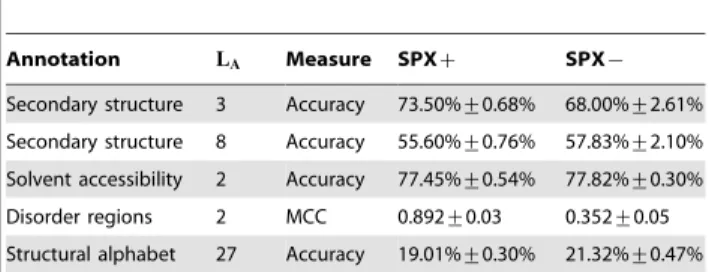
Table 2 reports the cross-validation accuracies that we obtained with this procedure. The default scoring measure is label accuracy, i.e., the percentage of correctly predicted labels on the test set. Since disordered regions labeling is a strongly unbalanced problem, label accuracy is not appropriate for this task. Instead, we used a classical evaluation measure for disordered regions prediction: the Matthews correlation coefficient [37].
Candidate feature functions. The feature generation step aims at describing cysteine pairs in an appropriate form for classification algorithms. This encoding is performed through cysteine-pair feature functionsw:P|C|C?Rd that, given a protein Pand two of its cysteines(Ci,Cj), computes a vector of d real-valued features. In our experiments, we extracted cysteine-pairs (Ci,Cj)in such a way that1ƒivjƒnC, wherenCis the number
cysteine-pairs from P. The purpose of the feature selection methodology described in the next section is to identify a subset of relevantwfunctions among a large panel of candidate ones that we describe now.
Our set of candidate feature functions is composed of primary-structure related functions and annotation related functions. The former are directly computed from the primary structure alone and are the following ones:
N
Number of residues: computes one feature which is the number ofresidues in the primary structure.
N
Number of cysteines: computes one feature which is the number ofcysteine residues in the primary structure.
N
Parity of the number of cysteines: computes one feature whichindicates whether the number of cysteines is odd or even.
N
Relative position of cysteines: computes two features which are theresidue indices of cysteines Ci and Cj, denoted pos(Ci) and
pos(Cj), divided by the protein length.
N
Normalized position difference: returns one feature whichcorre-sponds to the number of residues separatingCifromCjin the
primary structure,i.e.,pos(Cj){pos(Ci), divided by the protein
length. Note that asjwiand thereforepos(Cj)wpos(Ci), this
difference is always greater than zero.
N
Relative indices of cysteines: computes two features which are thecysteine indicesiandjdivided by the number of cysteines.
N
Normalized index difference: computes one feature whichcorre-sponds to the number of cysteines separating Ci from Cj
divided by the number of cysteines.
N
Cysteine separation profile window: computes one feature per cysteineCk[fCi,Cjgand per relative positiond[½{
W
2 ,
W
2,d=0whose value is the position differencepos(Ckzd){pos(Ck)divided by
the protein length, where Ww0 is called the window size parameter.
Annotation-related feature functions are defined for each type of annotation A[fAA,PSSM,SS3,SS8,SA,DR,StAlg of the residues of the protein P. We denote by LA the set of labels corresponding to annotationAand by LA~DLADthe size of this set. For our annotations, we have: LAA~20, LPSSM~21 (the twenty amino acids and the gap), LSS3~3, LSS8~8, LSA~2,
LDR~2andLStAl~27. For a given primary structure of length
DPD, an annotation A is represented as a set of probabilities aA
p,l[½0,1wherep[½1,DPDdenotes the residue index andl[LAis a label.
Note that in the general case, aA
p,l probabilities may take any value in range½0,1to reflect uncertainty about predictions. Since the primary structure (AA) is always known perfectly, we have:
aAAp,l~ 1 iflis the residue at positionp
0 otherwise:
For each annotationA, we have four different feature functions:
N
Labels global histogram: returns one feature per labell[LA, equalto 1 DPD
XDPD
p~1a
A
p,l.
N
Labels interval histogram: returns one feature per labell[LAequalto
Ppos(Cj)
p~pos(Ci)a A
p,l
pos(Cj){pos(Ci)z1
.
N
Labels local histogram: returns one feature per labell[LAand percysteine Ck[fCi,Cjg, equal to
1
W
Xpos(Ck)zW=2
p~pos(Ck){W=2a A
p,l and
one special feature equal to the percentage of out-of-bounds positions,i.e., positionspsuch thatp=[½1,DPD.
N
Labels local window: returns one feature per label l[LA, percysteineCk[fCi,Cjgand per relative position d[½{
W
2 ,
W
2, equal toapos(Ck)zd,l. When the position is out-of-bounds,i.e.,
pos Cð Þk zd=[½1,DPD, the feature is set to 0.
Our candidate feature functions are summarized in Table 3. Note that three of them are parameterized by window size parameters. Figure 3 shows an illustration of the three kinds of histograms. We will see how to tune window sizes and how to select a minimal subset of feature functions in the next section.
Cysteine pair classifiers. Let fw1,. . .,wmgbe a subset of the candidate feature functions described above and letdidenote the dimensionality of thei-th function of this set. A cysteine pair classifier processes feature vectors of dimensionPm
i~1di, in order to predict disulfide bonding probabilities. In this study, we consider three such binary classifiers:
Table 1.Dataset statistics.
Proteins Cysteines Bonds perprotein
All None Mix Total Positive Negative Total
SPX{ 757 1 650 140 2 547 4 942 7 844 12 786 0.97+1.78
SPXz 718 0 300 1 018 5 082 901 5 983 2.50+2.14
All: proteins in which all cysteines are bonded.None: proteins with no disulfide bridges.Mix: proteins with both bonded cysteines and non-bonded cysteines.Positive: number of bonded cysteines.Negative: number of non-bonded cysteines.
doi:10.1371/journal.pone.0056621.t001
Table 2.Cross-validated accuracies of annotations.
Annotation LA Measure SPXz SPX{
Secondary structure 3 Accuracy 73.50%+0.68% 68.00%+2.61%
Secondary structure 8 Accuracy 55.60%+0.76% 57.83%+2.10%
Solvent accessibility 2 Accuracy 77.45%+0.54% 77.82%+0.30%
Disorder regions 2 MCC 0.892+0.03 0.352+0.05
Structural alphabet 27 Accuracy 19.01%+0.30% 21.32%+0.47%
The scoring measure is label accuracy,i.e., the percentage of correctly predicted labels on the test set except for disordered regions that use the Matthews correlation coefficient (MCC).
N
K-nearest neighbors(kNN) is a simple and well-known method for classification. In order to determine the disulfide bonding probability of a new example, the algorithm first search for thek nearest training samples and then returns the frequency of bonded cysteines among these neighbors. The distance between two feature vectors A and B is computed using a normalized version of the l2-norm, which is defined as follows:
dist(A,B)~
ffiffiffiffiffiffiffiffiffiffiffiffiffiffiffiffiffiffiffiffiffiffiffiffiffiffiffiffiffiffiffiffiffiffiffiffiffiffiffiffiffiffiffi Xm
i~1 1
di
Xdi
j~1
Aji{Bji
sji !2 v
u u
t ,
whereAjiandB j
idenote thej-th components of thei-th feature
generator wi, and where sji denotes the empirical standard deviation of this component, computed on the training data. Since we are concataining feature functions with very different dimensionalities (dvaries from1toO(103)), the effect of the traditional l2-norm would be largely dominated by
high-dimensional feature functions. The term 1
di
enables to avoid
this problem. Dividing by the standard deviations sji is a classical strategy to be less dependent on the domain of the different features.
N
Support vector machines(SVM) is also a well-established methodthat constructs a hyperplane that maximizes the distance to the nearest training samples of any class in a high-dimensional space. The method has one hyper parameter that is a regularization constantC. Among the common functions used to cope with non-linear feature interactions, called kernel
functions, we use the Gaussian radial basis function
exp({c:dist(A,B)2), where cw0 is a bandwidth hyper-parameter and wheredist(:,:)is the same norm as previously. Note that previous studies on disulfide pattern prediction [7,38] also relied on the Gaussian radial basis function. In our experiments, we used the well-known LibSVM implementa-tion [39]. In order to convert SVM predicimplementa-tions into probabilities, we use the default probability estimation method of LibSVM, which was proposed by Platt [40] and Wuet al.
[41].
N
Extremely randomized trees (ETs). This tree-based ensemblemethod, proposed by Geurtset al.[9], is similar to the popular Random Forests approach [42]. The main differences with the latter are that ETs does not rely on bootstrap replicates (unlike the Random Forests method, each tree is built using all learning samples), and that cut-points are selected in a random fashion, which was shown to lead to better generalization performances. The method has three hyper-parameters:K, the number of random splits tested per node creation, T, the
Figure 3. Example of local, interval and global histograms.C2andC3are the two cysteines of interest. In red, we show the labels local histograms of size11of the secondary structurehlocal(SS3,11). In yellow, we show the labels interval histogram of the solvent accessibility annotation
hinterval(SA). In green, we show the global histogram of the disordered regions sequencehglobal(DR).
doi:10.1371/journal.pone.0056621.g003
Table 3.Feature functions used in our experiments to encode cysteine pairs.
Symbol Parameter d Description
DPD - 1 Number of residues
nC - 1 Number of cysteines
nCmod 2 - 1 Parity of the number of cysteines
pos(Ci)=DPD,pos(Cj)=DPD - 2 Relative position of cysteines
(pos(Cj){pos(Ci))=DPD - 1 Position difference
i=nC,j=nC - 2 Indices of cysteines
(i{j)=nC - 1 Index difference
csp(W) window size 2(W{1) Cysteine separation profile window
hglobal(A) - LAz1 Labels global histogram
hinterval(A) - L
A Labels interval histogram
hlocal(A,W) window size 2L
Az2 Labels local histogram
w(A,W) window size 2WLA Labels local window
Symbols, parameters, number of features (d) and description of our candidate feature functions. Top: feature functions that are directly computed from the primary structure. Bottom: feature functions defined for every kind of annotationA[fAA,PSSM,SS3,SS8,SA,DR,StAlg.
number of trees composing the ensemble, and Nmin, the minimum number of samples required to allow for splitting a node. We use the probabilistic version of ETs, in which each leaf is associated to a bonding probability, which is the empirical proportion of bonded cysteine pairs among the training samples associated to that leaf. In order to make one prediction, we traverse each of the T trees and return the average of the bonding probabilities associated to the corresponding T leaves. To our best knowledge, tree-based ensemble methods, and in particular ETs, were not yet applied to disulfide connectivity pattern prediction, despite the fact that several studies have shown that these methods very often outperform other methods such as support vector machines or neural network [43].
Maximum weight graph matching. Given bonding prob-abilities for every cysteine pair of a protein, the aim of this last step of the disulfide pattern prediction pipeline is to select a subset of disulfide bridges so as to respect the constraint degree(Ci(P))ƒ1,Vi[½1,nC. As proposed previously, this problem is formalized as a maximum weight graph matching problem: the weight of a disulfide pattern is defined as the sum of probabilities attached to its edges and the aim is to find the valid pattern with maximal weight.
A naive solution to solve the maximum weight graph matching problem is to perform an exhaustive search over all valid disulfide patterns. The complexity of this procedure is however exponential in the number of cysteines, which is problematic for large proteins. This issue is often solved using the maximum weight matching algorithm of Gabow [44] whose time complexity is cubic w.r.t. the number of cysteinesnCand whose space complexity is linear w.r.t.
nC. In our experiments, we used Blossom V, which is a more recent and optimized implementation proposed by Kolmogorov [45].
Notice that, because this algorithm searches for a full matching, i.e., where each cysteine is associated to another one, it cannot be directly applied on proteins that have an odd number nC of cysteines. To deal with such proteins, we run the matching algorithm on each one of thenC subsets ofnC{1cysteines and select the solution with maximal weight.
Forward feature function selection
This section describes our forward feature function selection algorithm, which aims at determining a subset of relevant feature functions among those described above. Feature selection is an old topic in machine learning and a common tool in bioinformatics [46]. Our feature selection problem departs from traditional feature selection w.r.t. three unique aspects:
N
Feature function selection: we want to select feature functionsrather than individual features. Given that feature functions can be parameterized by window sizes, our algorithm has to perform two tasks simultaneously: determining a subset of feature functions and determining the best setting for associated window sizes.
N
Insertion in a pipeline: we want to optimize the performanceQpofthe whole pipeline rather than the accuracyQ2of the classifier for which we perform feature selection. Preliminary studies have shown that these two performance measures are not perfectly correlated: a binary classifier with higher accuracy can lead to worse disulfide pattern predictions when combined with the graph matching algorithm, and conversely.
N
Interpretability: our approach not only aims at constructing apipeline maximizing Qp, but also at drawing more general
scientific conclusions on the relevance of various annotations of the primary structure. We thus require the result of the feature selection process to be interpretable.
In order to fulfill these requirements, we adopt a wrapper approach that repeatedly evaluates feature function subsets by cross-validating the whole pipeline and that is directly driven by the cross-validated Qp scores. In order to obtain interpretable results, we rely on a rather simple scheme, which consists in constructing the feature function set greedily in a forward way: starting from an empty set and adding one element to this set at each iteration.
In order to treat feature functions with parameters and those without parameters in an unified way, we express the feature functions as a set of parameterized feature functions W~fW(1),. . .,W(M)gwhere eachW(i)contains a set of alternative feature functions W(i)~fw(i)1,. . .,w(i)a
ig. In the case where the
feature function has no parameters (e.g., number of residues or labels global histogram), this set is a singletonW~fwg. Otherwise, when the feature function is parameterized by a window size, there is one alternative per possible window size, e.g., WcspW~fcsp(1),csp(3),. . .,csp(19)g.
Our forward feature function selection approach is depicted in Algorithm. We denote by S(:,:,:)[R the objective function that evaluates the Qp score associated to a given set of feature functions, based on a cysteine pair classifierC and a dataset of proteinsD. In our experiments, this objective function is computed by performing a 10-fold cross-validation of the whole prediction pipeline and by returning the testQpscores averaged over the ten folds.
Algrithm 1. Forward feature function selection algorithm.
Given a set of parameterized feature functions
W~fW(1),. . .,W(M)g
Givenan objective functionS(:,:,:)[R Givena cysteine pair classifierC Givena datasetD
1:U/60 4initial empty feature function set 2:repeat
3: (i,j)/argmax i,j
S(U|fw(i)j g,C,D) 4evaluate candidate w(i)j functions
4:U/U|fw(ij)g 4add the best feature function
5: W/W\w(i) 4remove the best parameterized feature function
6:untilsome stopping criterion is fulfilled 7:returnU 4return feature function set
The feature function is first initialized to an empty set60(line 1). Each iteration then consists in inserting a candidate feature functionsw(i)j taken in the setWintoU. For this, we try to add each
candidatew(i)j to the current feature function set and select the best feature function w.r.t. the obtained cross-validationQpscores (line 3). This feature function is then inserted intoU (line 4) and the corresponding set of alternativesW(i)is removed fromW. After a given stopping criterion is fulfilled, the constructed function setU is returned (line 7). In our experiments, this stopping criterion is simply a fixed number of iterations. An alternative consists in stopping the algorithm when no additional feature functions enable to improve theSscore.
smaller than in the case of individual feature selection). We show in the next section that this algorithm is a tractable feature function selection approach that provides interpretable results, from which we can draw some general conclusions about the relevance of primary structure annotations.
Results: Disulfide Pattern Prediction
This section describes our experimental study on disulfide pattern prediction using the SPXz benchmark dataset. We first make an overall comparison of the three binary classification algorithms described previously and show that extremely random-ized trees lead to significantly better results than the two other algorithms. We then apply our forward feature function selection approach using this algorithm and show that only a few feature functions are sufficient to construct a high performance disulfide pattern predictor. We finally compare this predictor with the state of the art and propose an analysis of the sensitivity of extremely randomized trees w.r.t. their hyper-parameters. Note that, for the moment, our prediction pipeline always tries to construct fully connected disulfide patterns and that it does not enable predicting partially connected disulfide patterns. We address this issue in the next section, by coupling our predictor with filters based on the bonding state of individual cysteines.
Comparison of the cysteine pair classifiers
Comparing cysteine pair classifiers in our context is not trivial for two reasons. First, we are primarily interested in theQpscore of the whole prediction pipeline rather than in the classification accuracy. Second, we do not have a fixed feature representation and different classification algorithms may require different feature function sets to work optimally. To circumvent these difficulties, we compare cross-validated Qp scores obtained with the three classifiers on a large number of randomly sampled feature function sets. To sample a feature function set of sizem[½1,18, we proceed as follows. First, we draw a subsetfW(1),. . .,W(m)gfromW. Then, for each memberW(i) of this subset, we select a feature function w(i)j , using the following rules: (i) local window sizes are sampled according to the Gaussian distribution N(15,152), (ii) local histogram sizes are sampled according to N(51,502) and (iii) CSP window sizes are sampled fromN(7,112). These values were chosen according to preliminary studies using the three classifiers.
We set the hyper-parameters in the following way:
N
kNN. By studying the effect ofk, we found out that large values of k drastically decrease the performance of kNN and low values do not enable to distinguish patterns well since the set of possible predicted probabilities is limited tokz1values. In the following, we use the default valuek~5, which we found to be a generally good compromise.N
SVM. It turns out that the best setting forcand Cis highly dependent on the chosen feature function set. For each tested set of feature functions, we thus tuned these two parameters by testing all combinations of c[f2{14,2{7,20,27,214g andC[f20,25,210,215g and by selecting the values of (c,C) that led to the bestQpscores.
N
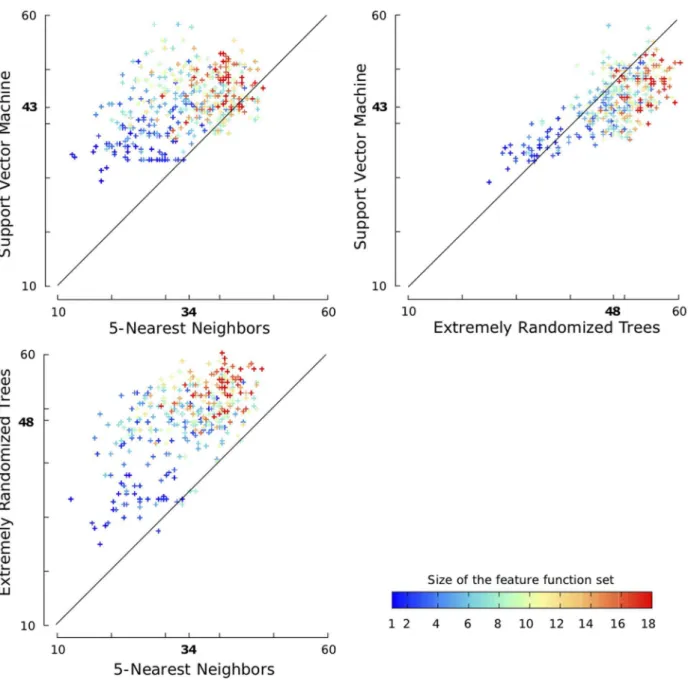
ETs. We use a default setting that corresponds to an ensemble of 1 000 fully developed trees (T~1 000,Nmin~2) andKis set to the square root of the total number of features pffiffiffid, as proposed by Geurtset al[9].The results of our comparison on SPXzare given in Figure 4. As a first remark, note the large range in which theQpscores lie:
from^15%to ^60%. This shows that all three classifiers are highly sensitive to the choice of the features used to describe cysteine pairs, which is a major motivation for our work on feature function selection. The experiments are color-encoded w.r.t the sizemof their feature function set. This color-encoding enables us to notice that, in general, larger feature function sets lead to better classifiers.
The mean and standard deviations of these results are 34:23%+7:45% for kNN classifiers, 43:96%+5:31% for SVM classifiers and47:85%+7:17%for ETs classifiers. In 73.25% of the experiments, the best pattern accuracy is given by ETs and in 20.35% of them by SVMs. In the remaining 6.40% experiments, exactly the same number of disulfide patterns were correctly predicted by ETs and SVM.kNN was always outperformed by the other two classifiers. We have used the pairedt-test to assess the significance of the out-performance of ETs. Thep-value against kNN is O(10{128) and the p-value against SVM is O(10{38), which make it clear that ETs significantly outperformkNN and SVM. Moreover, ETs work well with a default setting contrarily to SVM that required advanced, highly time-consuming, hyper-parameters tuning.
Given those observations, we proceed in the remainder of this study by restricting to the ETs method.
Feature functions selection
We now apply our feature function selection approach on top of extremely randomized trees. We rely on the set of parameterized feature functions W described in Table 3 and consider the following window size values:
N
Cysteine separation profile window: 1, 3, 5, 7, 9, 11, 13, 15, 17, 19.N
Local histograms: 10, 20, 30, 40, 50, 60, 70, 80, 90.N
Local windows: 1, 5, 9, 11, 15, 19, 21, 25.This setting leads to a total of150candidate features functions. As cysteine pair classifier, we use ETs with the same default setting as previously (T~1 000,K~pffiffiffid,Nmin~2).
The simplest way to apply our algorithm would be to apply it once on the whole SPXzdataset. By proceeding in this way, the same data would be used for both selecting the set of feature functions and assessing the quality of this selected set. It has been shown that this approach is biased due to using the same data for selecting and for evaluating and that it could lead to highly over-estimated performance scores [25].
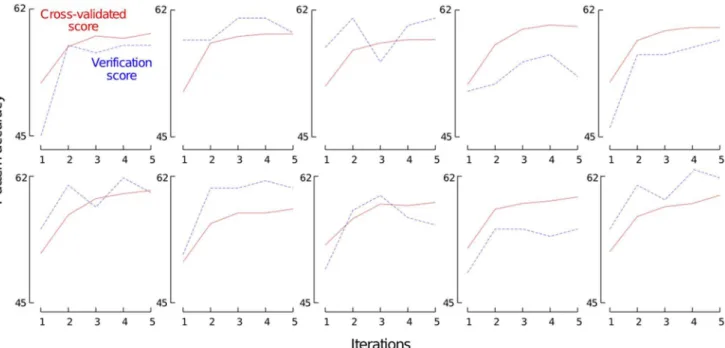
To avoid this risk of overfitting, we adopted a more evolved approach, which consists in running the feature selection algorithm once for each of our 10 different train/test splits. In this setting, the whole feature selection algorithm is executed on a training dataset composed of 90% of the data and the generalization performance of the selected feature functions is evaluated using the remainder10%of data. There are thus two different objective functions. We callcross-validated scorethe value returned byS(:,:,:),i.e., the 10 cross-validatedQpscore using90% of the data, and we callverification scoretheQpscore computed over the remainder10%of the data.
Table 4 reports the selected feature functions for each of the 10 runs. We observe that the first selected feature function is always w(PSSM,:) with a window size varying in f9,11,15,19g. This means that, taken alone, the best individual feature function is always a window over the position-specific scoring matrix. The fact that this results was observed during each run is very strong, since the selection algorithm has to select between 150different functions. Similarly, the second selected feature function is always csp(:)with a window size varying inf9,13,17,19g.
After the two first iterations, the selected feature functions become more disparate and only lead to tiny improvements. This probably indicates that the system starts to overfit, by selecting feature functions that are specifically tailored to a specific subset of the training proteins. In iterations 3–4, we note thathlocal(SS8,:) occurs slightly more often than the other feature functions (6 times
over 20). From the two last rows, which give the averaged cross-validated scores and the averaged verification scores, we observe that while the cross-validated score systematically increases, the verification score becomes unstable after the two first iterations. These observations reinforce the fact that the selected feature functions become more and more specific to training samples. From these results, it is clear that the feature functionsw(PSSM,:) andcsp(:)bring the major part of the predictive power that can be obtained by our feature functions.
According to these results, we focus in the following on the feature functionsw(PSSM,15),csp(17)andhlocal(SS8,77), where we chose windows sizes by taking the average sizes reported in Table 4. Note that, contrarily to the observation of Figure 4 that suggested large feature function sets, our method carefully selected
Figure 4. Qp scores for three binary classification algorithms and randomly sampled feature function sets. The experiments are
performed on the SPXzdataset. In bold, the means of the classifiers. The diagonal lines indicate situations where both classifiers have the same score. The experiments are color-encoded w.r.t. the size of their feature function set.
a very small number of relevant feature functions that led to a more simpler and still very accurate classifier.
Evaluation of the constructed prediction pipeline We now compare our constructed prediction pipeline with the state of the art. We consider three baselines that were evaluated using the same experimental protocol as ours (10 cross-validated Qp). The first baseline is the recursive neural network approach proposed by Chenget al.[6]. These authors, who introduced the SPXzdataset, reached a pattern accuracy of51%using the true secondary structure and solvent accessibility information. Linet al. [7] proposed to predict the bonding state probabilities using a fine tuned support vector machine. They obtained a pattern accuracy of 54:5% by using the same data for feature selection and for evaluation, making this results probably over-estimated. Vincentet al. [47] proposed a simple approach based on a multiclass one-nearest neighbor algorithm that relies on the fact that two proteins tend to have the same disulfide connectivity pattern if they share a similar cysteine environment. This method reaches a pattern accuracy of55%.
Table 5 reports the performance obtained by ETs with feature functions w(PSSM,15), csp(17)and hlocal(SS8,77). We observe that using onlyw(PSSM,15)already leads to a pattern accuracy of51:6%, which is better than the baseline of Chenget al.[6]. A significant improvement of z6:6% is achieved by adding the feature functioncsp(17), which leads to a model that significantly outperforms the state of the art. The feature function hlocal(SS8,77) leads to small further improvement of the Q
p score, but due to the large variance, this improvement cannot be shown to be significant.
From these results, we conclude that only the following two feature functions are sufficient for high-quality disulfide pattern prediction in combination with ETs: local PSSM windows and CSP windows. Note that it might be the case that, by using larger datasets, feature functions such as medium-size histograms on
predicted DSSP secondary structure could slightly improve the quality of the system.
Table 6 reports the pattern accuracy as a function of the true number of disulfide bridges. By comparing the results with the three baselines, we observe that our method outperforms the baselines, except for proteins with 4 potential disulfide bonds where the approach proposed by Vincent et al. [47] obtains a better pattern accuracy.
Sensitivity of extremely randomized trees to its hyper-parameters
This series of experiments aims at studying the impact of the hyper-parameters (T, K and Nmin) when using the feature functions fw(PSSM,15),csp(17)g. With these two feature func-tions, the number of features is d~662. The default setting is T~1 000,K~pffiffiffid,Nmin~2and we study the parameters one by one, by varying their values in rangesT[½10,104
, K[½1,d and Nmin[½2,100.
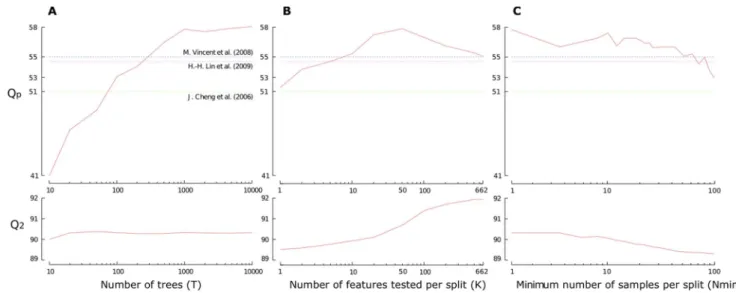
Figure 6 reports theQpandQ2scores in function of the three hyper-parameters. As a matter of comparison, we also reported the Qp scores of the three baseline described previously. We observe that theQpscore grows (roughly) following a logarithmic law w.r.t. T. The value of T~1 000 occurs to be very good tradeoff between performance and model complexity. Concerning K, we observe that the value maximizingQpisK^50, which is a bit larger than the default settingK~pffiffiffid. Note that the protein-level performance measure Qp and the cysteine-pair level performance measure Q2 do not correlate well in terms of the effect of parameter K, which confirms the interest of directly optimizingQp in our feature function selection algorithm. Nmin controls the complexity of built trees and, hence, the bias-variance tradeoff by averaging output noise. It is usually expected that a small value of Nmin improves performance. In our case, we observe that increasing Nmin never improves the performance measures and thatQphas a large variance.
Figure 5. Forward feature function selection with 10 train/test splits of the SPXzdataset.Each figure reports the results of five iterations of our forward feature function selection algorithm on one of ten train/test splits. Solid red lines are the cross-validated scores and dashed blue lines are the verification scores.
Results: Chain Classification and Cysteine Bonding State Prediction
Until now, our pipeline relies on a perfect graph matching algorithm that always attempts to predict patterns involving all cysteines. Due to this, our approach is, for the moment, unable to deal with partially connected disulfide patterns (except for proteins with an odd number of cysteines having a single non-bonded cysteine). This can be harmful, especially on datasets containing many non-bonded cysteines. For example, if we apply our pipeline to the SPX{dataset, the pattern accuracyQpis only22%, since most proteins of this dataset do not contain any disulfide bridges. We now focus on this issue by coupling our predictor with filters based on the output of a chain classifier and on the output of a cysteine bonding state predictor. We first construct a chain classifier and a cysteine bonding state predictor by applying our feature function selection approach. We then study combinations of these predictors with our disulfide pattern predictor.
Chain classification
We consider the binary chain classification problem, which consists in classifying proteins into those that have at least one disulfide bridge and those that have no disulfide bridge. In order to construct a chain classifier, we apply the same methodology as before: we perform feature function selection on top of extremely randomized trees. Since chain classification works at the level of proteins, the set of candidate feature functions is restricted to labels global histograms. We also include as candidates the simple feature functions returning the number of residues, the number of cysteines and the parity of the number of cysteines. We use the following default setting for ETs:T~1 000,K~d and Nmin~2. According to preliminary experiments, we found outK~dto be a good default setting for this task. This is probably due to the fact that we have far less features than we had before.
We performed ten runs of the feature function selection algorithm on the SPX{ dataset, which contains both proteins without disulfide bridge and proteins with disulfide bridges. The performance measure is the accuracy, i.e., the percentage of proteins that are correctly classified. In every feature function selection run, the first selected feature function washglobal(PSSM) and the second one was hglobal(AA). Starting from the third Table 4.Forward feature functions selection with 10 train/test splits of the SPXzdataset.
Fold Iteration 1 Iteration 2 Iteration 3 Iteration 4 Iteration 5
1 w(PSSM,15) csp(17) hinteval(AA) hlocal(SS8,90) w(SS3,25)
2 w(PSSM,15) csp(19) hlocal(SS8,80) w(AA,1) hlocal(SA,80)
3 w(PSSM,19) csp(19) hglobal(SA) hlocal(SS8,60) hlocal(AA,30)
4 w(PSSM,11) csp(9) hlocal(SA,90) hlocal(DR,60) pos(Ck)
5 w(PSSM,9) csp(13) hlocal(DR,90) w(SA,19) hlocal(PSSM,20)
6 w(PSSM,9) csp(19) hlocal(SS8,90) hlocal(SS3,30) w(SA,21)
7 w(PSSM,11) csp(13) hlocal(SS8,50) w(SS3,5) hlocal(PSSM,50)
8 w(PSSM,19) csp(17) hlocal(AA,80) hlocal(DR,50) w(SA,21)
9 w(PSSM,15) csp(19) hlocal(SS3,90)
hlocal(SS8,90) pos(Ck)
10 w(PSSM,19) csp(17) hlocal(AA,50) hlocal(SS3,40) hlocal(SS8,70)
Mean
Cross-validated 51.8%+0.64% 56.9%+0.63% 58.3%+0.67% 58.6%+0.84% 58.9%+0.75%
Verification 51.6%+4.19% 57.8%+2.83% 57.4%+2.22% 58.7%+2.83% 58.0%+2.72%
In bold, the most frequent feature function (without consideration of the window size parameters) of each iteration.Mean: averages over the ten cross-validated scores and the ten verification scores.
doi:10.1371/journal.pone.0056621.t004
Table 5.Evaluation of the proposed prediction pipeline.
Features Qp
fw(PSSM,15)g 51.6%+3.58%
fw(PSSM,15),csp(17)g 58.2%+2.74%
fw(PSSM,15),csp(17),hlocal(SS8,77)g 58.3%+3.04%
Baseline
Vincentet al.[47] 55.0%
Linet al.[7] 54.5%
Chenget al.[6] 51.0%
We report the mean and standard deviation of theQpscores obtained using
10-fold cross-validation on the SPXzdataset. doi:10.1371/journal.pone.0056621.t005
Table 6.Comparison ofQpscores on SPXz.
Number of
bridges Chenget al. Vincentet al. Linet al. Beckeret al.
(2006) (2008) (2009) (2013)
1 59% 59% 60.6% 61.8%
2 59% 63% 65.9% 66.6%
3 55% 64% 59.8% 67.6%
4 34% 48% 36.4% 41.8%
all 51% 55% 54.5% 58.3%
Qpscores obtained using 10-fold cross-validation.
iteration, the results are more diverse and the system starts to overfit. By keeping the two first feature functions, we reach a 10 fold cross-validation accuracy of79:5%on SPX{, which is not very far from the82%accuracy obtained by [47].
Cysteine bonding state prediction
Cysteine bonding state prediction consists in classifying cysteines into those that are involved in a disulfide bridge and those that are not. To address this task, we apply our feature function selection approach on top of extremely randomized trees (T~1 000,K~pffiffiffid and Nmin~2). The set of candidate feature functions is composed of those depending only on the protein (number of residues, number of cysteines, parity of the number of cysteines, labels global histograms) and those depending on the protein and on a single cysteine (labels local histograms, labels local windows, cysteine separation profile window). We consider the same window size values as in previous section. The evaluation measure is binary accuracy, i.e., the percentage of cysteines that are correctly classified.
We ran the feature selection algorithm once for each of the ten different train/test splits of SPX{. We observed that the selected feature functions set fw(PSSM,11),hglobal(PSSM),n
Cgled to a binary accuracy of87:4%, which outperforms the result of87% obtained by Vincentet al. [47]. On SPXz, we obtain a similar accuracy of87:8%.
Note that once we have a cysteine bonding state predictor, we can use it to also solve the chain classification task as follows. In order to predict whether a protein contains disulfide bridges or not, we run the cysteine bonding state predictor on each cysteine, and see if at least one cysteine is predicted as being bonded. By applying this strategy to SPX{, we obtain a chain classification accuracy of81:4%, which is comparable to the score of [47].
Table 7 summarizes the feature functions that were selected for the three tasks that we consider in this paper.
Impact on pattern prediction
Now that we have constructed a chain classifier and a disulfide bonding state predictor, we focus on the question of how to exploit the corresponding predictions in order to improve disulfide pattern
prediction. Note that, in some cases, the user may have prior knowledge of either the chain class (whether the proteins contains any disulfide bridges or not) or of the cysteine bonding states (which are the cysteines that participate to disulfide bridges). To take the different possible scenarios into account, we study the following four settings:
N
Chain class known: in this setting, we assume that the chainclasses are known a priori and simply filter out all proteins that are known to not contain any disulfide bridge. For the proteins that contain disulfide bridges, we run our disulfide pattern predictor as in previous section.
N
Chain class predicted:in this setting, we replace the knowledge ofthe chain class by a prediction. We therefore rely on the chain classifier derived from the cysteine bonding state predictor, which obtained a chain classification accuracy of81:4%.
N
Cysteine states known:we here assume that the bonding states ofcysteines is known a priori. We modify the disulfide pattern predictor by setting a probability of zero to any cysteine pair containing at least one non-bonded cysteine.
N
Cysteine states predicted:in this setting, we first run our cysteinestate predictor and then perform disulfide pattern prediction by only considering cysteine pairs in which both cysteines where predicted as bonded.
Figure 6. Sensitivity of ETs w.r.t. hyper-parameters.The experiments are performed on the SPXzdataset. We used the two feature functions
w(PSSM,15)andcsp(17). (A) Impact of the number of treesT(from10to10 000) withK~pffiffiffid andNmin~1, whered~662is the number of
features. (B) Impact ofK(from1tod) withT~1 000andNmin~1. (C) Impact ofNmin(from2to101).
doi:10.1371/journal.pone.0056621.g006
Table 7.Selected feature functions of the three tasks.
Task Features
Chain classification fhglobal(PSSM),hglobal(AA)g
Cysteine bonding state prediction fw(PSSM,11),hglobal(PSSM),n Cg
Disulfide pattern prediction fw(PSSM,15),csp(17)g
The feature functions were determined by the application of our selection algorithm on top of extremely randomized trees, using the SPX{dataset for chain classification and cysteine bonding state prediction and the SPXz
Note that, since the SPXz dataset is entirely composed of proteins with at least one bridge, our two first settings based on chain classification are irrelevant for this dataset. In these experiments, we learnt models using a 10-fold cross-validation of ETs (T~1 000,Nmin~2and
ffiffiffi d
p ).
Table 8 summarizes the results of our experiments on chain classification, cysteine bonding state prediction and disulfide pattern prediction with our four different settings. When the chain classes are known, we observe a significant improvement of theQpscore: from22%to82:5%on SPX{. When replacing the true chain classes with predicted chain classes, we still have a relatively highQpscore:70:9%. This result is detailed in Table 9 as a function of the true number of disulfide bridges. We observe that our method clearly outperforms the method of Vincentet al. [47] on proteins containing one or two disulfide bonds and performs slightly worst on proteins with three disulfide bonds. Given that a majority of proteins in SPX{contain less than two bonds, these results leads to an overall score that is significantly better than that of Vincentet al.When the cysteine bonding states are known, we obtain impressive disulfide pattern accuracies: more than 75%on SPXz and almost 90%on SPX{. When using predicted cysteine bonding states, we still observe an impressive improvement on SPX{: from 22% to 71:4%. However, on SPXz, the score slightly degrades ({1:4%). This is probably related to the fact that, as soon as one cysteine is falsely predicted as being non-bonded, it becomes impossible to recover the correct disulfide pattern.
Discussion
Disulfide connectivity pattern prediction is a problem of major importance in bioinformatics. Recent state of the art disulfide pattern predictors rely on a three step pipeline, in which the central component is a binary classifier that predicts bridge bonding probabilities given cysteine pair representations. Howev-er, the comparison of the conclusions of these works is difficult because it is often the case that these different studies rely on different kinds of binary classifiers and slightly differ in their experimental protocol. Therefore, the relevance of some features is still a subject under heavy debate. This paper has proposed an
extensive study on the best way to represent cysteine pairs in the form of features. We considered three classification algorithms: k-nearest neighbors, support vector machines and extremely randomized trees, and we proposed a forward feature function selection algorithm that we applied on the standard benchmark dataset SPXz.
Our experiments have shown that extremely randomized trees (ETs) are highly promising in terms of predicted disulfide pattern accuracy Qp. ETs are easy to tune and thanks to their use of decision trees, they benefit from good scaling properties, making them applicable to large sets of training proteins and large sets of features. The result of our feature selection experiments with ETs is that the primary structure related features functions w(PSSM,15) (a local window of size 15 on the evolutionary information) and csp(17) (a window of size 17 on the cysteine separation profile) are sufficient to reach a very high performing disulfide pattern predictor: ETs with these two kinds of features predict correct disulfide connectivity patterns in58:2%of proteins, which outperforms the state of the art [47] with a z3:2% improvement. Furthermore, we showed that appending any other feature function does not lead to significant subsequent improve-ments or even decreases the accuracy.
We also investigated the question of how to exploit our disulfide pattern predictor with filters based on the output of either a chain classifier or of a cysteine bonding state predictor. Among the four scenarios that we considered, we observed an important potential for improvement when the cysteine bonding states are known, with scores reaching 75% on SPXzand almost 90% on SPX{. When using predicted cysteine bonding states, we still observe an impressive improvement on SPX{(from22%to71:4%) but the score slightly degrades ({1:4%) on SPXz. This degradation is probably due to the fact that, as soon as one cysteine is falsely predicted as being non-bonded, it becomes impossible to construct the correct disulfide pattern. Therefore, one direction of future research is to develop more sophisticated methods to couple the cysteine bonding state prediction task with the pattern prediction task. One direction for such a better coupling is to apply the ideas developed in [32] on multi-stage and multi-task prediction,e.g., by iteratively re-estimating the disulfide bond probabilities.
Note that despite the fact that several studies have shown that tree-based ensemble methods often reach state of the art results in supervised learning (see e.g. [43]), these methods were surprisingly few applied to structural bioinformatics problems yet. We believe that ETs in combination with feature function selection provide a general methodology that can be applied to a wide range of protein related prediction problems and more generally to any kind of classification problems involving many different possible representations.
Table 8.Evaluation of the three tasks.
Filter SPX{ SPXz
Chain classification
– 79.5%+2.40% –
Cysteine states predicted 81.4%+2.66% –
Cysteine bonding state prediction
– 87.4%+1.14% 87.8%+2.20%
Disulfide pattern prediction (Qp)
– 22.0%+2.00% 58.2%+2.74%
Chain class known 82.5%+2.24% –
Chain class predicted 70.9%+3.10% –
Cysteine states known 89.9%+1.57% 75.8%+2.09%
Cysteine states predicted 71.4%+2.76% 56.8%+2.52%
We report the mean and standard deviation of the binary accuracy for chain classification and cysteine bonding state prediction while theQpscore is used
for disulfide pattern prediction. The symbol – indicates that all cysteines are used in the experiment.
doi:10.1371/journal.pone.0056621.t008
Table 9.Comparison ofQpscores on SPX{when chain classes are predicted.
Number of bridges Vincentet al. Beckeret al.
(2008) (2013)
1 30% 77.1%
2 49% 63.5%
3 61% 60.4%
4 37% 44.2%
all 39% 70.9%
Qpscores obtained using 10-fold cross-validation.