Original
article
Effect
of
acetyl
resin
retentive
arms
on
the
retentive
force
of
circumferential
clasps:
An
in
vitro
study
E´rica
Miranda
de
Torres
DDS,
PhD
a,
Iane
Inarde
de
Siqueira
Damasceno
DDS
b,
Bruna
Aguiar
do
Amaral
DDS,
MSc
b,
Renata
Cristina
Silveira
Rodrigues
DDS,
PhD
c,
Adriana
da
Fonte
Porto
Carreiro
DDS,
PhD
b,
Ricardo
Faria
Ribeiro
DDS,
PhD
c,*
aDepartmentofStomatologicalSciences,SchoolofDentistry,FederalUniversityofGoia´s,Goiaˆnia,GO,BrazilbDepartmentofDentistry,SchoolofDentistry,FederalUniversityofRioGrandedoNorte,Natal,RN,Brazil
cDepartmentofDentalMaterialsandProsthodontics,DentalSchoolofRibeira˜oPreto,UniversityofSa˜oPaulo,Ribeira˜oPreto,SP,Brazil
Received26January2011;receivedinrevisedform2September2011;accepted21September2011 Availableonline21November2011
Abstract
Purpose: Tocompareandtoevaluatethestabilityoftheretentiveforceofcobalt–chromium(Co–Cr)circumferentialclasps(control)tothosewith anacetylresinretentivearm.
Methods: SixteenspecimenswithacoupleofcircumferentialclaspsweremadeusingCo–Croverametalmodelproviding0.25mmundercuts. Eightspecimenswerefabricatedwithouttheanteriorretentivearm,whichwasmadelaterusingacetylresin(DentalD).Insertionandremoval simulationtestwasperformedthrough7250cycles.TheretentiveforcewasrecordedinNewtons(N)forperiodscorrespondingto0,1,2,3,4,and5 years.ThedataweresubjectedtoANOVAandTukeytesttocompareperiodsandtoStudent’sttesttocomparegroups(a=0.05).
Results: Mean(SD)ispresentedforCo–Crandresingroups,respectively:8.09(3.05)and2.79(1.57)inperiod0;10.48(4.25)and3.32(1.92)in1 year;10.09(4.15)and3.47(1.81)in2years;9.87(4.30)and3.46(1.87)in3years;9.46(3.93)and3.27(1.59)in4years;9.63(3.79)and3.41(1.59)in 5years.ThereweresignificantdifferencesforCo–Crbetweenperiodsof0and1(p<0.001),0and2(p<0.01)and0and3(p<0.05).Inthe resingroup,nosignificantdifferenceswerefoundbetweenperiods(p>0.05).Comparisonsbetweenthegroupsshowedstatisticaldifferencesfor alltestedperiods:0(p=0.0012),1(p=0.0013),2(p=0.0019),3(p=0.0031),4(p=0.0027)and5years(p=0.0014).
Conclusions: Acetylresinretentivearms,evenifonlyintheanteriorclasps,cansignificantlyreducetheretentiveforce,butthisforceremained stableafter5yearsofsimulateduse.
#2011JapanProsthodonticSociety.PublishedbyElsevierIreland.Allrightsreserved.
Keywords:Dentalclasps;Acetylresin;Removablepartialdenture;Aesthetics;Fatigue
1. Introduction
Duetotheincreasingemphasisonaesthetics,dentistshave been concerned about providing aesthetics and functional removable partial dentures (RPDs) to their patients. Some strategiescanbe used to optimizeaestheticresults in RPDs, suchasattachmentsystems[1],RPDwitharotationalpathof insertion [1,2], aesthetic clasp designs [3], and aesthetic materialsformakingclasps[4–8].
Metalcomponentsthatarevisiblewhenthepatientsmilesor speaksare amajorproblem associatedwiththe conventional clasp-type partial denture [3]. A visible clasp may cause patientstobe dissatisfiedwithboththeirappearanceandthe RPD. Appearance would be vastly improved if metal direct retainerswereeliminatedorminimized[5].
Intracoronal and extracoronal precision attachments can provide good aesthetics; however, they present some dis-advantages, such as cost, time-consumption, extensive abut-ment tooth preparation, and technique-sensitive clinical and laboratoryprocedures[1,5].
Rotational pathRPD replaces certainclasp arms by rigid retentive components. If used in combination with specially designedrests,thesecomponentsmakeitpossibletoeliminate some unaesthetic clasp arms without impairing mechanical
www.elsevier.com/locate/jpor
JournalofProsthodonticResearch56(2012)216–221
*Correspondingauthorat:DepartmentofDentalMaterialsand Prosthodon-tics,DentalSchoolofRibeira˜oPreto,UniversityofSa˜oPaulo,Av.doCafe´,s/n, MonteAlegre,CEP:14040-904,Ribeira˜oPreto,SP,Brazil.
Tel.:+551636024046/3983;fax:+551636330999.
E-mailaddress:[email protected](R.F.Ribeiro).
requirements of support, retention, andstability. Thisdesign decreases tooth and tissue coverage by partial denture framework components, minimizing plaque accumulation and adverse periodontal response [2]. One disadvantage of rotationalpathRPDsisthatKennedyClassIandClassIIwith anteriormodificationspacesordinarilydonotlendthemselves toarotational pathof placement,because the rigid retainers willusuallytorquetheabutmentsduringrotationalmovements infunction[9].
Inordertominimizethistorqueeffect,Belles[3]described the Twin-Flex technique. It is an alternative for anterior retentionthatmaintains excellentaesthetics andconsistsof a wire clasp soldered into a channel that is cast in the major connector. It uses areas of mesial and distal retention. In general, the only flexible part of the retentive clasp is its extremity.However,theproposedwireclaspintheTwin-Flexis entirelyflexible.Therefore,itdoesnotgenerateasmuchtorque whenthedistalextensionisdepressedinKennedyClassIand ClassII.Disadvantagesofthistechniqueincludegreaterspace betweentheretentivecomponentandartificialtoothtoallowa horizontalmovementofthewire,extrathicknessofthemajor connectoroverthewireclasp,theextralaboratorystepswith impliedincreasedcosts,anddifficultyinrepairingtheclaspif breakageoccurs[3,10].
Technopolymers,alsoknownasacetylresins,are injection-moldedthermoplasticsthathavebeenproposedasanaesthetic alternative to metals when fabricating RPD clasps [4–8]. Manufacturers have recommended acetyl resins due to their flexibility, strength, and retentive properties similar to traditionalones,madeincobalt–chromium(Co–Cr)alloys[6]. Acetylresinclaspscanbeproducedbywaxingthedesired shapeonamastercast,investingthepattern,usingthelostwax techniquetocreateamold,andinjectingtheheated,softened acetylresinintothemoldusinganappropriate machine.One cannot assume that the design principles that apply to alloy clasps are appropriate for acetyl resin clasps, due to fundamental differences in the physical properties of these materials.Onewouldexpectthatacetylresinclaspsrequire a differentdesigntoachieveadequateretention[4].
Thehighflexibilityofacetylresinclaspsallowstheretentive clasparmtobeplacedindeeperundercutsonabutments[8].It could result in better fatigue strength compared to Co–Cr clasps; however it could reduce RPD retentive force. None-theless,thefewstudiesthatdeterminetheseaestheticmaterials’ propertiesandsuitabilityarenotenoughtosupporttheirusefor RPDclasps.
The objective of this study was to compare the retentive forceof Co–Cralloycircumferentialclasps(control)tothose withanacetylresinretentivearmandtoevaluatethestabilityof thisforce throughout periods of 0, 1, 2, 3, 4 and5 years of simulatedclinical use.
2. Materialsandmethods
Toperformthesimulationtest,ametalmodelrepresentinga partially edentulous mandibular right hemi-arch segment (secondpremolar and second molar abutmentteeth andfirst
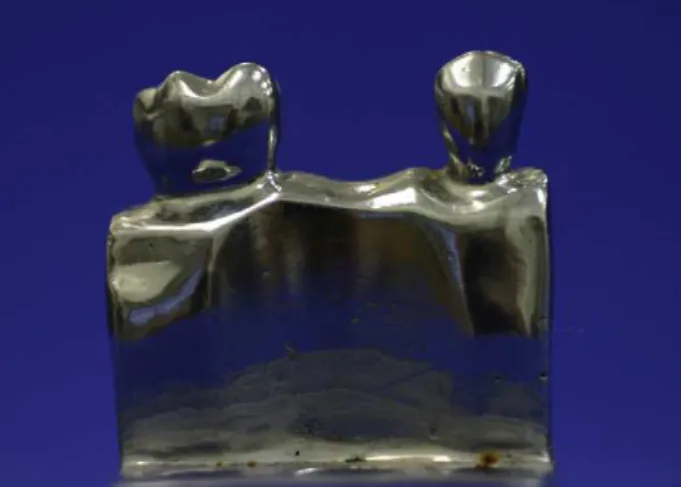
molar missing tooth) was made in Co–Cr alloy (Remanium GM380, Dentaurum, Pforzheim, Germany). This model provided 0.25mm undercuts in the testpositions established forcircumferentialclasps.A2mmdeepocclusalrestseatwas preparedonthemesialocclusalsurfaceofthemolartoothand onthedistalocclusalsurfaceofthepremolartooth.Inaddition, mesial and lingualguide planes were prepared on the molar toothanddistalandlingualguideplanesonthepremolartooth (twothirdsthecrownlength)tostandardizethepathofinsertion andremoval(Fig.1).Acommerciallaboratoryfabricatedthe testspecimens,asdescribedbelow,basedonthemetalmodel providedbythe researchers.
Themetalmodelwaspositionedinasurveyor,relievedfor the correct waxing of the specimens and duplicated using silicon (Elite Double, Zhermack, Rovigo, Italy). The silicon moldwaspouredwithinvestment (Cromo-o-Cast,Polidental, Sa˜o Paulo,SP,Brazil)toconstruct16refractorycasts.
Each refractory cast was positioned in the surveyor according to the guide planes to ensure identical waxing outcomes. Standard wax patterns of preformed semicircular clasps (GEO molar ande premolar clasps, self-adhesive; Renfert GmbH, Hilzingen, Germany), for retentive and reciprocal arms,andretention mesh(Rewax,Renfert, Hilzin-gen,Germany)wereused.Thedimensionsoftheretentivearms were 12mm inlength and1.2mmindiameterfor the molar clasps and 8mm in length and 1.2mm in diameter for the premolarones.Theretentivearmofeachclasp,fromtheclasp tiptotheminorconnectorwasadaptedtotherefractorycasts, withtheterminalendoftheclaspintheretentiveundercutarea (0.25mm undercut).
Eightspecimenswerewaxedwithoutaretentivearmonthe buccalaspectofpremolartooth.Thesemissingarmsweremade later, using acetylresin (Dental D, Quatrotti, Rovello Porro, Italy). A mechanical retention was waxed in the specimens withoutaretentivearminordertoconnecttheacetylresinarm later.
Apin,5mmwideand60mmlong,waspositioned onthe retention mesh parallel tothe path of insertionandremoval. This pin acted as a sprue for casting, and maintained the specimeninthefatiguetestingapparatuslater.
Theassemblies(refractorycastsandwaxedspecimens)were invested(Cromo-o-Cast)andcastwithCo–Cralloy(FITFlex, Talladium do Brasil, Curitiba, PR, Brazil), following the manufacturer’srecommendations.
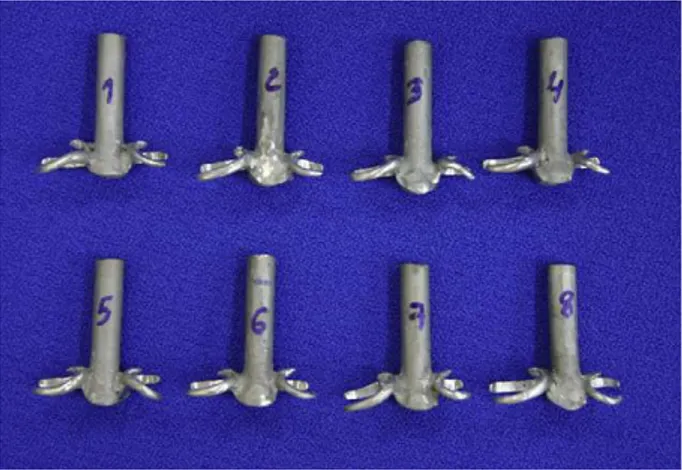
Aftercasting,thespecimenswereremovedfromthecastand sandblastedwithaluminumoxide(80psi=5.62kgf/cm2).No polishing procedures were performed to ensure uniformity. Onlynoduleswerecarefullyremovedwithtungstenbursunder magnificationwhen necessary(Fig.2).
For making the acetyl resin arms, the metal model was duplicated(EliteDouble) again. The new siliconemold was poured with type IV dental stone (Durone IV, Dentsply, Petro´polis,RJ,Brazil)tomake8refractorystonemodels.
The Co–Crspecimenswithout retentive arms inpremolar toothwerepositionedonthestonemodels.Thesamestandard circumferentialclaspwaxpatterns(Rewax)wereadaptedtothe modelsasdescribedabove.Thewaxclaspswerespruedandthe assemblies(stonemodelsandwaxedspecimens)wereinvested in plaster (Herodent, Vigodent, Rio de Janeiro, RJ, Brazil) withininjectionflasks.Thewaxwasboiledoutfor30minand theflaskwassteamcleaned.
The flasks were attached singly to the thermo-injection apparatus(MG-NEWPRESS,Quattroti,RovelloPorro,Italy). TwobarsofDentalDwereplacedintotheinjectioncartridgein the oven, which had been heated to 2208C. The resin was injectedinto theflaskatapressureof7/8atm.
Theflaskswereallowedtobenchcool,andspecimenswere then deflasked. Only sprues were carefully removed with tungsten burs. No polishing procedures were performed to ensureuniformity(Fig.3).
Beforethe retentionstestall claspswere checked,usinga blacksilicone indicator paste (FitChecker, GC Corporation, Tokyo,Japan)forthecorrectadaptationtotheplannedposition on abutmentteeth, assuring the use of 0.25mm undercut as planned.
Theretentiontestwasperformedusinganinsertion-removal apparatusespeciallydesignedattheRibeira˜oPretoSchoolof Dentistry,University of Sa˜o Paulo. This apparatus has been used in others studies [11,12]. Some technical details anda brief description of the testing conditions are described as follows.
The apparatus allowed inserting the specimen in its predetermined terminal position, and its subsequent removal fromthemetalmodel,thussimulatingthepathofinsertionand removaloftheRPD.Theapparatusisconnectedtoacomputer tomeasure retentive force inNewtons (N)using appropriate software(LabVIEW 8.0,National Instruments, USA)during removalofthespecimenfromthemetalmodel.Theloadused toinsertthespecimenswasnecessarytoovercomethefrictional retention andtoadaptrests andclaspstothemodel.
Eachspecimenwasattachedtothetestingapparatus,andthe metalmodelwasfixedtoacontainerfilledwithdistilledwater at378C,inordertosimulateclinical conditions(Fig.4).
Atotal of 7205 insertion/removalcycles were performed, simulating 5 years of specimen insertion and removal, estimating4completecyclesperday.Thetestwasperformed with41cyclesperminuteataconstantspeedof35.79mm/s. Retentive force mean and standard deviationvalues were recordedforperiodscorrespondingto0,1,2,3,4,and5years of simulated clinical use of the specimens. The value established for each period corresponded to the arithmetic averageof 10consecutivecycles.
Thedataweresubjectedtorepeated-measuresANOVAand Tukeyposthoctesttocompareretentiveforcebetweenperiods foreachgroup(Co–CrandResin).TheStudent’sttestwasused tocomparegroupsinthesameperiod.pvalues>0.05werenot
considered significant differences. All statistical tests were
Fig.2. ViewofspecimensentirelymadeinCo–Cr. Fig.3. Viewofspecimenswithanteriorretentivearmmadeinacetylresin.
performedusingGraphPadInStat3(GraphPadSoftwareInc., SanDiego,California,USA).
3. Results
Table 1 represents the mean and standard deviation(SD) values of the groups’retentive force at the different studied periods.IntheCo–Crgroup,thereweresignificantdifferences between retentive force values related to periods 0 and 1 (p<0.001),0and2(p<0.01),and0and3years(p<0.05);
period0showed thelowestvalues.Nosignificant differences wereobservedbetweenperiods1,2,3,4,and5(p>0.05).For
the resin group, no statistically significant differences were foundamongall testperiods(p>0.05).
Comparisons between the groups revealed significant differences in each tested period; 0 (p=0.0012), 1 (p=0.0013),2(p=0.0019),3 (p=0.0031),4 (p=0.0027), and 5 years (p=0.0014). Co–Cr group showed the highest retentionforcevalues.ThiscanbeobservedinFig.5.
4. Discussion
Veryspecific equipments arenecessary tofabricateacetyl resinclasps.FewlaboratoriesinBrazilhavetheseapparatuses. Thismaybeconsideredadisadvantageforaestheticmaterials compared to conventional alloy for RPD frameworks. As describedinthematerialsandmethodssession,acommercial laboratorywasrequiredtofabricatethetestedspecimens.Itis veryimportanttohighlightthattheauthorsoversawthewhole process.
Toensureuniformity, standardwaxpatternsof circumfer-ential clasps were used, and no polishing procedures were performed.Besides,asingletechnicianwaxedandfabricated allspecimens.Evenso,somedifferences intheprofile ofthe specimenswere observed. The authors assume thatthis was inherenttotheseveralstepsinvolvedinthefabricationofRPD
frameworks.Itisamanualprocess.Therefore,thesedifferences are expectedtooccurclinically.
RPD clasp retentive arms must be flexible to engage undercuts returning to their original position in order to adequatelyretaintheprostheses[13].Manystudiesshowedthat Co–Cr alloys can be satisfactorily used to fabricate RPD frameworksemploying 0.25mmundercutdepth[11,14–16].
Ontheotherhand,acetylresinclaspshavehigherflexibility, comparedtoCo–Crones,whichcanallowtheretentiveclasp arm to be placed in deeper undercuts on abutments [4,6,8]. Also, thisgreatestdeflection of acetylresin could be agood propertytoindicateitsuseonperiodontallycompromisedteeth
[6,17]or whereretentiverequirementsare low[17].
Besides engaging deeper undercuts to have adequate retention, acetyl resin clasps should have a shorter length and agreatercross-sectional area than standardmetal clasps
[4,18].AccordingtoTurneretal.[4],toobtainstiffnesssimilar tothatof acastCo–Crclaspmeasuring15mminlengthand 1mmindiameter,asuitableacetylresinclaspmustbeshorter (approximately 5mm) and have a larger cross-sectional diameter(approximately1.4mm).
Ithasbeenshownthatclaspsentirelymadeinacetylresin require thicker retentive arms. This larger cross-sectional diameter would be considered as a disadvantage, becauseit would bedetrimentaltooralhealthbycontributingtoplaque accumulation[4,8,18].It hasbeensuggestedthatacetylresin wouldbeabetterchoiceofmaterialsinceithelpstoovercome thepooraestheticsofanteriorclasping,besidesdemonstrating greaterflexibility,whichwouldresultinreduced loadsonthe abutment teeth. This assumption may not be completely satisfactory,or,yet,maynotbesufficienttoimplychangesin choosingthematerial.Thelowerretentionprovidedbyacetyl resinclaspsshouldbeconsideredinclinicaluse[8].
In the present study, acetyl resin was used only in the retentive armsofanteriorclasps,whichinclinicalconditions would optimize aesthetics without needing larger cross-sectional diameter aesthetic arms. Although there is some evidence that acetyl resin clasps should be placed in deeper undercutsonabutments[4,6,8],0.25mmundercutswereused inthis study for bothCo–Crand resingroup. Allspecimens werefabricatedusingstandardwaxpatternsofcircumferential clasps tostandardize the groups. Therefore, acetyl resin and Co–Crclaspshadthesamethickness.Thiswasdonebecausea greaterretentionforcewouldbeexpectedforacetylresinclasps intheproposedmodelsincereciprocalarmsweremadeinCo– Cralloy.ItwouldbeanewwaytouseacetylresintomakeRPD clasps.
Ahmadet al.[14] foundthata4.77Nretention forcewas requiredtodislodgeaCo–Crclaspfroma0.25mmundercut.
Table1
Mean(SD)retentiveforce(N)ofgroupsatdifferenttestperiods. Period(simulatedyears)
0 1 2 3 4 5
Resin 2.79(1.57) 3.32(1.92) 3.47(1.81) 3.46(1.87) 3.27(1.59) 3.41(1.59) Co–Cr 8.09(3.05) 10.48(4.25) 10.09(4.15) 9.87(4.30) 9.46(3.93) 9.63(3.79)
This is in agreement with the findings of the present study, becausea retentive force of approximately 9.6N was found over the test periods for specimens with two Co–Cr circumferentialclasps.
Theretentiveforcevaluesofspecimenswithacetylresin anterior retentivearms (approximately 3.28N over the test periods)werehigherthanresultsobtainedbySykesetal.[6]
(1.75N) and Arda and Arikan [8] (1.2mm thick clasps, 1.08N,and2.0mm,1.74N,respectively).Thiswasexpected because, inthe presentstudy, theacetyl resinretentivearm wasassembledtoreciprocal Co–Crarmandcircumferential claspentirelymade inCo–Cralloy,whileinthose studiesa singleclaspwasentirelymade inacetylresin.However,the present results showed that retentive arms made in acetyl resin, even only in the anterior RPD clasps, significantly reducedtheretentiveforce comparedtothoseentirelymade inCo–Cr.
Ithasbeenshownthattheretentiveforceneededtodislodge claspsissignificantlylowerformolarthanpremolarteethdue totheshorterlengthofthepremolarclasparm[8].Thiscould explainwhy,inthepresentstudy,theretentiveforceoftheresin group was reduced more than half compared to the Co–Cr group.Premolarsmightberesponsibleforthemajorpartofthe retentiveforceinthisexperimentalmodel.Hence,itisexpected thatthiswouldalsohappen inclinical use.
Wuetal.[7]compareddeformationofacetylresinandmetal alloyRPDdirectretainersafterrepeateddislodgmentsovera testdieforasimulated3-yearperiod.Theytookocclusaland facial digital images before and after cycling and found significantlygreaterdeformationsforacetylresincomparedto metalalloyintheocclusalview.Therefore,theyinferredthat acetylresin direct retainers maylose someof theirretentive characteristics.
Ontheotherhand,ArdaandArikan[8]indicatedthatacetyl resinclaspswith1.2mmthicknessandwith2.0mmthickness wereresistanttodeformation.Theretentiveforcesofbothtypes ofacetylresinclaspsdidnotdecreaseoverthe3-yearcycling period.Thepresentstudyconfirmsthesefindings,becausethe retentiveforceofspecimenswithacetylresinclaspsremained stableafter5 yearsof simulated use.During thefatiguetest, therewas noclaspfracture,andthe resultsobtainedforresin and Co–Cr groups indicated no permanent deformation. However, it is important to highlight that the experimental conditions were different from clinical ones, because a periodontal ligament was not present and the insertion path was strictly defined by the testing apparatus and the guide planesofabutmentteeth.Therefore,clinicalresultscoulddiffer interms ofdeformation.
Contrarytotheresultsofotherstudies[8,15],therewasan increaseinretentiveforceofspecimensentirelymadeinCo–Cr alloyduringthefirst3yearsofsimulatedclinicalusecompared toperiod0.However,thisforceremainedstableduringperiods of1,2,3,4,and5years.Asimilarsituationwasobservedby Rodriguesetal.[11]andaccordingtothem,thiswasprobably causedbytheclasps’prolongedcoldworkingbecausethepath of insertion was strictly rigid, as reproduced in the present study.
According toLassila andVallitu [19],water andartificial saliva can reduce the fatigue strength of Co–Cr alloy by corrosionof the alloyinthe wetenvironment.The insertion/ removal test in the present study was carried out in wet conditions,inanattempttosimulatetheclinicalenvironment, asdoneinotherreports[8,19].However,itshouldbenoticed thatthetestswereperformedinarigidsystem,whichmayhave increasedtheforcevaluesnecessaryforinsertingandremoving thespecimensbecauseof greaterfrictionalresistance[11].
Further clinical studies are needed toconfirm the present resultsandtodeterminewhethertheseaestheticmaterialsare suitablealternativesfor RPDclasps. Besides, thisstudy used only 0.25mm deep undercuts. This was necessary in this preliminarystudybecausethecircumferentialclaspsshouldbe compared undersimilarexperimental conditions. The unique difference between the specimens was the material of a retentive arm. It could happen that0.25mm deep undercuts were enough to provide adequate retentive force for the proposedclaspmodel.Furtherresearchusingdeeperundercuts, thicker retentive clasp arms and different clasp designs is recommendedtoprovideadditionalinformationforacetylresin RPDclasps.
5. Conclusions
Within the limitations of the methodology used inthis in vitrostudy,andbasedontheresultsobtaineditispossibleto concludethat:
(1)Aretentivearmmadeinacetylresinsignificantlyreduced theretentiveforceusingcircumferentialclaspsin0.25mm undercuts.
(2)The retentive forceof specimens withacetylresin clasps remainedstableaftercontinuousfatiguetestingcycles. (3)There was an increase in retentive force of specimens
entirely made in Co–Cr alloy during the first 3 years of simulatedclinicalusecomparedtoperiod0.However,this forceremainedstablealongperiodsof1,2,3,4and5years.
Conflictofinterest
Theauthorsof thisstudyhavenoconflictsofinterest.
Acknowledgement
TheauthorsaregratefultoAnaPaulaMacedo (engineer– Department of Dental Materials and Prosthodontics, Dental School of Ribeira˜o Preto, University of Sa˜o Paulo, Ribeira˜o Preto,SP,Brazil)forher assistanceinthe simulationtest.
References
[1] DonovanTE,ChoGC.Estheticconsiderationswith removablepartial dentures.JCalifDentAssoc2003;31:551–7.
[2] JacobsonTE.Satisfyingestheticdemandswith rotationalpathpartial dentures.JAmDentAssoc1982;105:460–5.
[4] TurnerJW, Radford DR,Sherriff M. Flexuralproperties and surface finishingofacetalresindentureclasps.JProsthodont1999;8:188–95. [5] ChuCH,ChowTW.Estheticdesignsofremovablepartialdentures.Gen
Dent2003;51:322–4.
[6] SykesLM,DullabhHD,ChandlerHD,BunnB,EssopARM.Flexibility oftechnopolymerclaspscomparedwithcobalt–chromiumandtitanium clasps.SADJ2002;57:166–71.
[7] WuJC, Latta JrGH, Wicks RA,Swords RL, Scarbecz M.In vitro deformationofacetylresinand metalalloyremovable partialdenture directretainers.JProsthetDent2003;90:586–90.
[8] ArdaT,ArikanA.Aninvitrocomparisonofretentiveforceand defor-mation of acetal resin and cobalt–chromium clasps. J Prosthet Dent 2005;94:267–74.
[9] KrolAJ,FinzenFC.Rotationalpathremovablepartialdentures.Part2. Replacementofanteriorteeth.IntJProsthodont1988;1:135–42. [10] DeRossiA,AbuquerqueJrRF,BezzonOL.Estheticoptions forthe
fabricationofremovablepartialdentures:aclinicalreport.JProsthetDent 2001;86:465–7.
[11] RodriguesRCS,RibeiroRF,MattosMGC,BezzonOL.Comparative studyofcircumferentialclaspretentionforcefortitaniumandcobalt– chromium removable partial dentures. J Prosthet Dent 2002;88: 290–6.
[12] Rodrigues RCS, MacedoAP, Torres EM, Mattos MGC, Ribeiro RF. RetentionforceofT-barclaspsfortitaniumandcobalt–chromium remov-ablepartialdentures.BrazDentJ2008;19:209–13.
[13] Carr AB, McGivneyGP, Brown DT. McCracken’s removable partial prosthodontics, 11thed.,StLouis:Elsevier;2004.p.79–117. [14] AhmadI,SherriffM,WatersNE.Theeffectofreducingthenumberof
clasps on removable partial dentures retention. J Prosthet Dent 1992;68:928–33.
[15] Kim D,ParkC,Yi Y,Cho L.Comparison ofcastTi–Ni alloyclasp retentionwithconventionalremovablepartialdentureclasps.JProsthet Dent2004;91:374–82.
[16] TseET,ChengLY,LukHW,ChuFC,ChaiJ,ChowTW.Comparisonof theretentivecharacteristicsofcobalt–chromiumandcommerciallypure titaniumclaspsusinganovelmethod.IntJProsthodont2006;19:371–2. [17] VandenBrinkJP,WolfaardtJF,FaulknerMG.Acomparisonofvarious removablepartialdentureclaspmaterialsandfabricationproceduresfor placingclasponcanineandpremolarteeth.JProsthetDent1993;70:180–8. [18] FittonJS,DaviesEH,HowlettJA,PearsonGJ.Thephysicalpropertiesofa
polyacetyldentureresin.ClinMater1994;17:125–9.