FARLEY WILLIAM SOUZA SILVA
PLASTICIDADE FENOTÍPICA E SUSCEPTIBILIDADE A PATÓGENOS EM Anticarsia gemmatalis (LEPIDOPTERA: NOCTUIDAE)
Dissertação apresentada à Universidade Federal de Viçosa, como parte das exigências do Programa de Pós-Graduação em Entomologia, para obtenção do título de Magister Scientiae.
VIÇOSA
FARLEY WILLIAM SOUZA SILVA
PLASTICIDADE FENOTÍPICA E SUSCEPTIBILIDADE A PATÓGENOS EM Anticarsia gemmatalis (LEPIDOPTERA: NOCTUIDAE)
Dissertação apresentada à Universidade Federal de Viçosa, como parte das exigências do Programa de Pós-Graduação em Entomologia, para obtenção do título de Magister Scientiae.
APROVADA: 17 de julho de 2010
___________________________ ____________________________ Prof. Dr. Eraldo Rodrigues de Lima Dr. Fernando Hercos Valicente
Co-orientador Co-orientador
_________________________ _________________________ Prof. Dr. Eliseu José Guedes Pereira Prof. Dr. José Eduardo Serrão
________________________ Prof. Dr. Simon Luke Elliot
"A ciência não pode prever o que vai acontecer. Só pode prever a probabilidade de algo acontecer." (César Lattes)
AGRADECIMENTOS
À Universidade Federal de Viçosa/Programa de Pós-Graduação em Entomologia pela qualidade científica e de ensino.
Ao Conselho Nacional de Desenvolvimento Científico e Tecnológico (CNPq) pela concessão da bolsa.
Ao Professor Simon Luke Elliot pela confiança e dedicação, além de todo o conhecimento científico passado durante o curso.
Ao Professor Eraldo Rodrigues de Lima pelo apoio logístico e intelectual na execução desse trabalho.
Ao Fernando Hercos Valicente pela receptividade durante o estágio na EMBRAPA e por todas as sugestões no projeto.
A todos os amigos do Laboratório de Interações Inseto-Microrganismo pelo companheirismo, acolhimento e pelas discussões científicas. Em especial, a Sirlene e Daniel pela ajuda desde a criação dos insetos até a montagem dos experimentos.
Aos laboratórios de Acarologia, Ecotoxicologia, Enzimologia e Semioquímicos pelo apoio nas fases experimentais desse projeto.
À EMBRAPA por ter fornecido o material (BaculovirusAAE®) utilizado nos experimentos.
Ao Gilberto Santos Andrade pela ajuda indispensável à execução dos experimentos.
A todos os professores da Entomologia pelos ensinamentos.
A Luci pelo exemplo de serenidade, respeito e inteligência. É umas das maiores incentivadoras dos meus sonhos, me apoiando e me fortalecendo nos momentos em que estes não são realizados com êxito. Agradeço-te por me fazer a cada dia uma pessoa melhor, com todo o companheirismo, carinho e amor...
À minha família por serem o alicerce da minha caminhada. É na distância que vejo o quão essenciais vocês são para a minha vida. Claretinha, você é meu EXEMPLO de garra, perseverança e amor... É em você que me espelho quando tenho que enfrentar as atribulações da vida. Obrigado! Aos meus irmãos por estarem sempre na minha torcida... Obrigado por vocês me mostrarem, que mesmo na distância, o carinho e amor fraternal estão acima de tudo. A meu pai, que mesmo longe, torce por minhas vitórias... Amo vocês!
A meus amigos-irmãos de Montes Claros, vocês farão sempre parte da minha vida. Obrigado por todos os momentos felizes que me proporcionaram. Às vezes tiveram alguns nem tão felizes, mas que de alguma forma me ajudaram a ser quem sou. Valeu os boy!
ÍNDICE
RESUMO ...vi
ABSTRACT...vii
1. LITERATURE REVIEW ...1
1.1. Pathogen transmission...1
1.2. Hypothesis of density-dependent prophylaxis ...2
1.3. Density-dependent phase polyphenism...3
1.4. Mechanisms of insect defense against parasites ...4
1.5. Anticarsia gemmatalis: biological aspects, importance and control methods ...5
2. INTRODUCTION...10
3. MATERIALS AND METHODS...13
3.1. Anticarsia gemmatalis density treatments ...13
3.2. Frequency distribution of phenotypes...13
3.3. Encapsulation responses ...14
3.4. Hemocyte counts...14
3.5. Susceptibility to Baculovirus anticarsia (AgMNPV) ...15
3.6. Susceptibility to Bacillus thuringiensis subsp. kurstaki (Bt) ...16
3.7. Statistical procedures ...16
4. RESULTS ...17
4.1. Frequency distribution of phenotypes...17
4.2. Encapsulation response ...19
4.3. Hemocyte counts...23
4.4. Susceptibility to Baculovirus anticarsia (AgMNPV) ...24
4.5. Susceptibility to Bacillus thuringiensis...26
5. DISCUSSION ...27
RESUMO
SILVA, Farley William Souza. M.Sc., Universidade Federal de Viçosa, julho de 2010. Plasticidade fenotípica e susceptibilidade a patógenos em Anticarsia gemmatalis (Lepidoptera: Noctuidae). Orientador: Simon Luke Elliot. Co-orientadores: Eraldo Rodrigues de Lima e Fernando Hercos Valicente.
ABSTRACT
SILVA, Farley William Souza. M.Sc., Universidade Federal de Viçosa, July, 2010. Phenotypic plasticity and susceptibility to pathogens in Anticarsia gemmatalis (Lepidoptera: Noctuidae). Advisor: Simon Luke Elliot. Co-Advisors: Eraldo Rodrigues de Lima and Fernando Hercos Valicente.
1. LITERATURE REVIEW
1.1. Pathogen transmission
All animals and plants interact with parasites (including pathogens). As a consequence, microrganisms represent an important selective force to their hosts (Wilson & Cotter 2009), with the ecology of these interactions being very diverse (Bonsall 2004), affecting direct and indirectly not only the individual host but also the host population. In nature, disease seems to be a density-dependent factor, with epizootics (i.e., generalized infection within a population) occuring with greater intensity in moments of high host densities (Steinhaus 1958).
The assumption in most parasite-host models is that transmission risk is density-dependent, or increases linearly with the population density (Anderson & May 1981; Wilson & Reeson 1998). Ryder et al. (2007) argue that if this transmission is direct, the model will be valid if contact among the hosts increases according with the population density. Thus, the infection rate is given as:
vmNS(I/N)
where v is probability of transmission by contact, m is a constant of the total population density (N) for a encounter rate density-dependent (mN), and S and I are the densities of susceptible and infected individuals, respectively.
On the other hand, alternative models have shown that pathogen transmission in insects sometimes does not correlate linearly with host density (White & Wilson 1999; D'Amico et al. 2005; Boots & Mealor 2007). This may be observed in some lepidopteran species such as Orgyia pseudotsugata and Lymantria dispar (Lepidoptera: Lymantriidae), in which the increase of larval density resulted in a decrease in pathogen transmission, indicating that the transmission rate is not directly proportional to the host density (Dwyer 1991; D'Amico et al. 1996). This happens because if the infection risk for individuals increases with the host density, they are expected to evolve mechanisms of resistance through natural selection, following the "density-dependent prophylaxis" (DDP) (Wilson & Reeson 1998).
1.2. Hypothesis of density-dependent prophylaxis
resistance to the virus decreased with an increase of density, and similarly, the time to death was faster in high densities than in low densities.
DDP seems to occur in a wide range of animals, mainly in those that presents variable densities through generations, such as insects (Wilson & Reeson 1998; Wilson et al. 2002). When the phenotype of an individual is changed in response to perceived
variation in the local density of conspecifics, is known as "density-dependent phase polyphenism" (Whitman & Agrawal 2009; Wilson & Cotter 2009).
1.3. Density-dependent phase polyphenism
For Reeson et al. (1998), the observation that in some species, the population in high densities triggers the cuticular melanization, suggests that a higher phenoloxidase (PO) level may increase the resistance, and the cuticular melanization will relate directly with the activity of phenoloxidase in hemolymph. As this prophylactic investment in resistance mechanisms to parasites (immunological, behavioral, chemical or physical) may involves a cost to be maintained, it is expected that organisms under stronger selective pressure will use them only when required (Reeson et al. 1998; White & Wilson 1999).
morphology, physiology and behavior (Leonard 1968; Wilson et al. 2001; Elliot et al. 2003; Lee et al. 2004). When they involve process of sclerotization and pigmentation of insect tegument, the morphological and chromatic transitions respond more slowly to changes in population density than behavioral transitions (Applebaum & Heifetz 1999).
1.4. Mechanisms of insect defense against parasites
Prophylactic investment in immune defense can vary with the population density experienced by the previous generations, with the prior experience of individuals to infection and/or during the early development of insect (Moret & Siva-Jothy 2003; Wilson & Cotter 2009; Elliot & Hart 2010). In lepidopterans, the amount of tactile stimuli received during the larval period define what kind of phenotype the individual will adopt (Reeson et al. 1998), although the phenotypic changes are not always visible (Wilson & Cotter 2009).
The system of the PO enzyme plays a important role in insects, especially in the encapsulation response (Robb et al. 2003). This occurs in the hemolymph in response to invasion for a wide range of microrganisms (Wilson et al. 2002; Moret & Siva-Jothy 2003). The melanization process involves the enzyme phenoloxidase that oxidizes tyrosine derivatives which subsequently produce melanin (Wilson et al. 2001; Cotter & Wilson 2002). PO has been isolated from the cuticule and hemolymph of some insects (Cotter & Wilson 2002; Moret & Schmid-Hempel 2009), and has also been linked to melanization in the midgut, in response to parasites that enter the host orally (Wilson et al. 2001).
1.5. Anticarsia gemmatalis: biological aspects, importance and control methods
Anticarsia gemmatalis Hübner (Lepidoptera: Noctuidae), known as the velvetbean caterpillar, is the key pest of soybean (Glycine max) in Brazil. As a holometabolous species, it goes through four development stages. The larval period may last around 26 days, with up to six instars (Andrade et al. 2004). Larvae present variable colors, depending on rearing density, varying from green to black and reaching up to 48 mm in length (Anazonwu & Johnson 1986; Fescemyer & Hammond 1986). Pupae coloration varies from green to brown and they measure about 18 mm in length and four mm in width. In this stage, the insects are found underground for a seven day period, until they emerge as adult moths. Adults live about 15 days and present, on average, a 35 mm wingspan, with the color varying from gray to brown, with no apparent sexual dimorphism (Andrade et al. 2004). Their reproductive process, including mating and oviposition, occurs at night (Hoffmann-Campo et al. 2000).
defoliation to the complete destruction of the plant (Hoffmann-Campo et al. 2000; Praça et al. 2006). Much effort is invested in controlling this pest. Soybean is economically the most important crop in Brazil, responsible for significant expansion to new areas in the central and northern regions of the country (Piubelli et al. 2006). Some countries have invested in technologies and strategies that improve soybean productivity, such as the utilization of insect-resistant cultivars. These cultivars produce chemicals (secondary metabolites) which can have behavioral (antixenosis, i.e. occurring before feeding, with adverse plant effects on insect behavior) and/or physiological (antibiosis, i.e. occurring after feeding, with negative plant effects on insect growth and development) effects on insects (Piubelli et al. 2005).
Some of these chemical compounds act directly on the digestive system of the velvetbean caterpillar, inhibiting proteases (the main enzyme classes involved in the insect’s digestion). However, the velvetbean caterpillar is able to bypass the effects caused not only by natural inhibitors found in soybean plants, but also by synthetic inhibitors (Visotto et al. 2009). For this reason, the choice of soybean cultivars resistant to this pest is so important.
engineering, e.g. transgenic soybean expressing genes that produce toxins against A. gemmatalis larvae).
The first example of an entomopathogen is Bacillus thuringiensis (Bt) which is a common soil bacterium that produces crystalline proteins (i.e. endotoxins encoded by cry genes) which are used to control certain insect pests, mainly Lepidoptera (Beron &
Salerno 2006; Valicente et al. 2010). Control of the velvetbean caterpillar with Bt products may be a viable alternative (Bobrowski et al. 2002), but the main interest in this bacteria is because of its endotoxin production. Bt delta-endotoxins are specifically toxic to insect larvae (Saadaoui et al. 2009) and are activated under alkaline conditions of the lepidopteran midgut, resulting in the formation of cation channels that lead to osmotic imbalance, cell lysis and death of the insect (Hernandez-Martinez et al. 2009; McPherson & MacRae 2009). Thus, soybean encoding delta-endotoxins may be very useful to control A. gemmatalis (Homrich et al. 2008ab) with little or no negative effect on predatory arthropods (McPherson & MacRae 2009). Soybean cultivars expressing Bt toxins have not yet been commercialized, although experimental lines have been developed (Homrich et al. 2008a).
recommended that monitoring be undertaken of the progress of the disease in velvetbean caterpillar populations, to avoid unnecessary applications of chemical products (Hoffmann-Campo et al. 2000).
Within the natural control of velvetbean caterpillar with entomopathogens, special attention has to be given to the A. gemmatalis multicapsid nucleopolyhedrovirus (AgMNPV), also known as Baculovirus anticarsia. This virus occurs naturally in velvetbean caterpillar populations in Brazil (Moscardi 1999) and from 1977, it was investigated in tests, indicating it as a potential control agent in soybean integrated pest management programs (Moscardi 1989). Currently, velvetbean control by AgMNPV is the largest program in the world using a virus against pest insects, being employed in an area of approximately 1,750,000 ha/year in Brazil (1999 value) (Moscardi 1999).
This virus belongs to the family Baculoviridae, which is subdivided in two subfamilies (Eubaculovirinae, including both occluded nuclear polyhedrosis viruses, NPV, and granulosis viruse, GV, and Nudibaculovirinae, comprised of nonoccluded baculoviruses). Eubaculovirinae is divided into two genera (Nucleopolyhedrovirus and Granulovirus). Virions of NPV and GV are occluded in polyhedral or capsular proteinaceous occlusion bodies (OB), respectively (Moscardi 1999).
leaves contaminated by frass or cadavers of other larvae. Following applications, such infected larvae may serve as inoculum for secondary virus transmissions, which may be affected by abiotic factors (e.g. rain and wind) or the movement of natural enemies (e.g. predators and parasitoids) (Moscardi 1999).
2. INTRODUCTION
Parasites represent an important selective force to their hosts (Wilson & Cotter 2009). The costs of this interaction may be expressed in different ways, such as a reduction in reproductive fitness, reduced survival or inhibition of metamorphosis (see Hu et al. 2008; Dawes et al. 2009; Pruijssers et al. 2009). Both empirical and theoretical studies have discussed the higher risk of pathogen transmission for insects experiencing high conspecific densities (Steinhaus 1958; Anderson & May 1981; Reeson et al. 1998; Wilson et al. 2002; Ruiz-Gonzalez et al. 2009). If the infection risk for individuals increases with host density, it is expected that host subject to high densities evolve mechanisms of resistance, as proposed by "density-dependent prophylaxis" hypothesis (Wilson & Reeson 1998). In the case of insects that undergo plastic phenotypic changes when at high densities (i.e., density-dependent phase polyphenism), they may invest more in prophylactic mechanisms according to a predictable infection threat at crowded moments (Wilson & Cotter 2009). As an example, Barnes & Siva-Jothy (2000) found that Tenebrio molitor beetles reared at high larval densities had higher degrees of cuticular melanization and lower mortality when exposed to an entomopathogenic fungus.
2001; Cotter & Wilson 2002). PO has been isolated from cuticule and hemolymph of some insects (Cotter & Wilson 2002; Moret & Schmid-Hempel 2009), being also linked to melanization in the midgut of polyphenic insects, in response to parasites that enter the host orally (Wilson et al. 2001).
Phase polyphenism is a widespread phenomenon in insects, have been recorded in Lepidoptera, Orthoptera, Coleoptera and Hemiptera (Reeson et al. 1998; Barnes & Siva-Jothy 2000; Wilson et al. 2002; Wilson & Cotter 2009), with the "phase" which individuals live in crowding, known as "gregaria", being caracterized by individuals with darker or melanized cuticula than individuals of "solitary" phase (Cotter et al. 2004a). The polyphenism may result in changes not only in color, but also in morphology, physiology and behavior of insects (e.g. Leonard 1968; Wilson et al. 2001; Elliot et al. 2003; Lee et al. 2004). In the desert locust Schistocerca gregaria, the amount of tactile stimuli received during the nymphal period will define what phenotype the individual will adopt (Simpson et al. 2001). These authors identified by repeatedly touching with aid of paintbrush on outer face of nymphs' hind femur, where the mechanical stimulation elicited of gregarious phase behavior in solitarious phase. Phase polyphenism is a phenomenon commonly found in species that live gregariously, although it can also occur in those that live in isolation.
development and wet and dry weights and lipid and protein contents in adults (Fescemyer & Hammond 1986, 1988). This species, popularly known as the velvetbean caterpillar, is one the most important pests in soybean agrosystems (Zavala et al. 2001; Bobrowski et al. 2002; Piubelli et al. 2006), being widely distributed and causing yield losses in all areas where soybean is cultivated (Sosa-Gomez 2004). A. gemmatalis is mainly controlled by chemical insecticides, although it is also widely controlled by two entomopathogens: multicapsid nucleopolyhedrovirus (AgMNPV) (a species-specific pathogen) and Bacillus thuringiensis (specific to Lepidoptera) (Moscardi 1999; Bobrowski et al. 2002; Beron & Salerno 2006).
3. MATERIALS AND METHODS
3.1. Anticarsia gemmatalis density treatments
A stock rearing of Anticarsia gemmatalis was maintained on artificial diet according to Hoffman-Campo et al. (1985), at 25±5 °C, 70±5 % relative humidity and 12h photophase. For the experiments, adults were allowed to oviposit on sheets of sulphite paper and eggs were separated. Hatching occurred within 24h of oviposition, and larvae were held in 100ml opaque plastic pots, lidded and with airholes, at four densities: 1, 2, 4 or 8 larvae/pot. They were kept in a climate-controlled chamber (25±1 °C, 60±3 % relative humidity and 12h photophase) until further use. This procedure was adopted in four separate assays (below), and insects were used at 10 days post-eclosion, approximately 4th instar. Throughout, only one insect, randomly chosen, was ever used from a given pot, to reduce pseudoreplication.
3.2. Frequency distribution of phenotypes
Anticarsia gemmatalis larvae expressed different color phenotypes - black, intermediate
3.3. Encapsulation responses
When subjected to invasion by a parasite, one of the immune defenses of insects is a triggering of the encapsulation response (Cerenius et al. 2008). To determine if the density of conspecifics affects this, larvae were submitted to a challenge that simulates the presence of a parasite. Before the experiment, larvae were weighted to ensure that the corporal conditions were homogeny and the immune parameter were just a function of treatments. Thus, a piece of sterile nylon filament (2 mm length and 0,12mm Ø) was inserted through the first thoracic segment (dorsal region) of 30 larvae/density (two larvae died before the experiment, so n=118). After 24h, the larvae were dissected and the nylon filaments were mounted on slides. The slides were photographed (camera Power Shot A640 coupled to light microscope Zeiss Axioskop 40) and two variables were analyzed: capsule area formed around the nylon and capsule melanization, with the aid of IMAGEJ 1.42q software. Capsule area was assessed by selecting (polygon command) in pictures of the cells layer formed. To melanization measure, the pictures are converted to grayscale ranging from 0 to 255, allowing quantification as the mean value of this grayscale for each image (methodology adapted from Dubovskii et al. 2010).
3.4. Hemocyte counts
Giemsa stain. Two aliquots of 8 µl of hemolymph suspension were added in each side of a Neubauer improved chamber (Bright-Line, Precicolor (HBG), Germany) and hemocytes were counted under a microscope. The final value was the mean of the two aliquots, providing the cell numbers per microliter (adapted from Ibrahim & Kim 2006).
3.5. Susceptibility to Baculovirus anticarsia (AgMNPV)
3.6. Susceptibility to Bacillus thuringiensis subsp. kurstaki (Bt)
The bacterium used in this assay, Bacillus thuringiensis subsp. kurstaki, is widely used as the principal ingredient of a lepidopteran bioinsecticide (Dipel® - registred product to A. gemmatalis). This experiment was conducted according to the same methodology as
that used for AgMNPV (above). Small soybean leaf pieces were inoculated with 20 µl of Bt suspension (3 x 10⁴ spores/larvae) obtained from the formulated product, and offered to the larvae to feed for a 24h period. This bacterial concentration was chosen after preliminary tests.
3.7. Statistical procedures
4. RESULTS
4.1. Frequency distribution of phenotypes
Anticarsia gemmatalis larvae expressed different color phenotypes - black, intermediate or green, according to rearing density – 1, 2, 4 or 8 per pot (see Figure 1). In all experiments, the frequency of the black phenotype increased with rearing density, while the frequency of the green phenotype decreased with rearing density. The frequency of the intermediate phenotype also decreased with density in all experiments, except in the last (i.e., Bt resistance), where it remained almost constant. Tests of independence show the frequency of larval color to be associated with rearing density in all four experiments (Values of G for: encapsulation response, hemocyte numbers, virus resistance and Bt resistance experiments are 77.60, 104.51, 78.66 and 79.77, respectively, all greater than χ20.001[6]=22.46 for p<0.001). Furthermore, when density 1
4.2. Encapsulation response
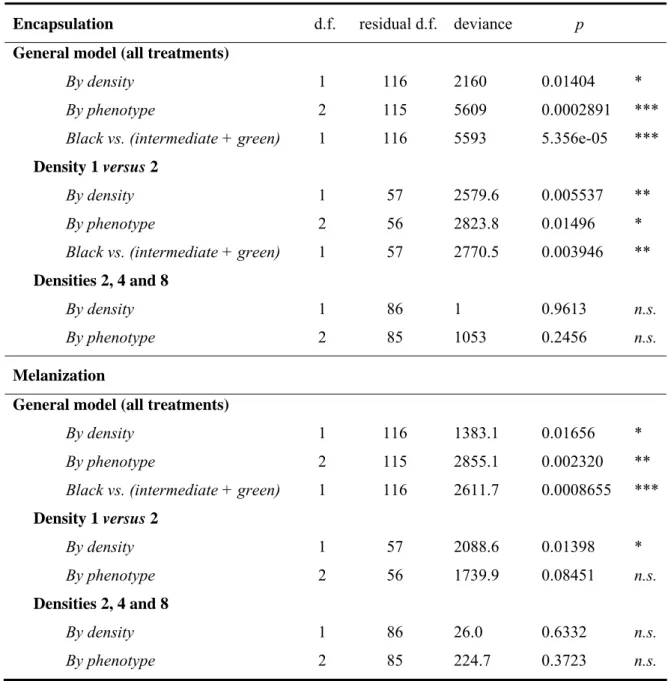
The degree of encapsulation of the nylon filament increased with larval density (Table 1; Figure 2-A). Note that larval weight did not vary with treatment (F[1,116]=0.0026, p=0.9595), then, we did not include it in the models. To verify if the
overall response was principally a function of density per se, or the presence or absence of conspecifics, we analyzed the densities separately. The response was observed when we compared the two lowest densities, 1 versus 2 larvae/pot but not when we excluded density 1 from the overall analysis (Table 1; Fig. 2-B). Besides density, we analyzed the encapsulation response associated with larval phenotype (i.e. phenotype as the independent variable). Both the complete model (all phenotypes) and the simplified model (black versus intermediate + green phenotype) showed that there is a higher encapsulation response in the black phenotype than the intermediate and green phenotypes, whether we included all densities (Table 1; Fig. 2-C) or densities 1 versus 2 larvae/pot in the analysis (Table 2; Fig. 2-D).
Table 1. Effect of rearing density (1, 2, 4 or 8 larvae/pot) and resultant phenotype (black, intermediate or green) on immune parameters in Anticarsia gemmatalis larvae. Data were analyzed according to density or phenotype. To verify if the overall immunological response was a function of density per se, or contact among larvae, we analyzed the data comparing all densities (1, 2, 4 or 8 larvae/pot), densities with density 1 removed, and density 1 versus 2. Variables were amalgamated when the mean values were not significantly different. (*p<0.05, **p<0.01,***p<0.001, n.s.= not significant).
Encapsulation d.f. residual d.f. deviance p
General model (all treatments)
By density 1 116 2160 0.01404 *
By phenotype 2 115 5609 0.0002891 ***
Black vs. (intermediate + green) 1 116 5593 5.356e-05 ***
Density 1 versus 2
By density 1 57 2579.6 0.005537 **
By phenotype 2 56 2823.8 0.01496 *
Black vs. (intermediate + green) 1 57 2770.5 0.003946 **
Densities 2, 4 and 8
By density 1 86 1 0.9613 n.s.
By phenotype 2 85 1053 0.2456 n.s.
Melanization
General model (all treatments)
By density 1 116 1383.1 0.01656 *
By phenotype 2 115 2855.1 0.002320 **
Black vs. (intermediate + green) 1 116 2611.7 0.0008655 ***
Density 1 versus 2
By density 1 57 2088.6 0.01398 *
By phenotype 2 56 1739.9 0.08451 n.s.
Densities 2, 4 and 8
By density 1 86 26.0 0.6332 n.s.
4.3. Hemocyte counts
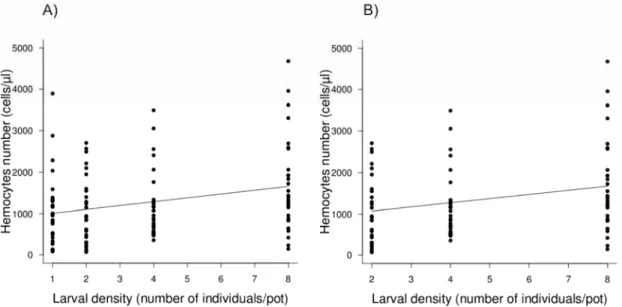
Larvae reared in contact with conspecifics had higher hemocyte numbers than those reared alone (Table 2; Fig. 4-A). In contrast with the previous assays, this was a result of the rearing density: firstly, there was no difference between densities 1 and 2; secondly, when analyzed with no density 1 the increase in hemocyte counts persisted (Table 2; Fig. 4-B). Finally, hemocyte numbers did not vary according to larval phenotype (Table 2). The larval weight did vary with treatments (F[1,118]=11.361,
p<0.05); however this term was not included in the model, because it did not affect hemocyte numbers (F[1,118] =0.9045, p=0.3435).
Table 2. Effect of rearing density (1, 2, 4 or 8 larvae/pot) and resultant phenotype (black, intermediate or green) on hemocyte numbers in Anticarsia gemmatalis larvae. Data were analyzed according to density or phenotype. To verify if the overall immunological response was a function of density per se, or contact among larvae, we analyzed the data comparing all densities (1, 2, 4 or 8 larvae/pot), densities with density 1 removed, and density 1 versus 2. (*p<0.05, **p<0.01, n.s.= not significant).
Hemocyte numbers d.f. residual d.f. deviance p
General model (all treatments)
By density 1 118 7355043 0.006951 **
By phenotype 2 117 1804220 0.4193 n.s.
Density 1 versus 2
By density 1 58 2667 0.9502 n.s.
By phenotype 2 57 642924 0.6254 n.s.
Densities 2, 4 and 8
By density 1 88 5601333 0.02431 *
Figure 4. Hemocyte numbers of Anticarsia gemmatalis larvae according to rearing density. Larvae were reared at four densities – 1, 2, 4 or 8 per cup. To count the cell numbers, a hemolymph aliquot was extracted from each larva (30 larvae/density), placed in a Neubauer improved chamber, and counted under a microscope. (A & B) General model (all treatments) or Densities 2, 4 and 8: Hemocyte number increase with density; shown is curve of best model fit, whether all densities are considered (A) or only densities 2, 4 and 8 (B). (See table 2 for analyses.)
4.4. Susceptibility to Baculovirus anticarsia (AgMNPV)
density 1 with 2, log-rank Z=5.40, p=0.0202; 1 with 4, Z=5.29, p=0.0214; and 1 with 8 larvae/pot, Z=12.89, p=0.0003). Meanwhile, there were no statistically significant differences between the remaining density treatments (comparing density 2 with 4, Z=0.01, p=0.9035; 2 with 8, Z=2.75, p=0.0970; and 4 with 8 larvae/pot, Z=3.67, p=0.0553).
When we analyzed survival of inoculated insects by phenotype, larvae that presented the green phenotype (most of the larvae reared alone) survived for less time (a mean of 199 ± 11 hours) than the black phenotype (means of 218 ± 8 and 221 ± 5 hours respectively; log-rank Z=3.99, p=0.0458), while neither differed significantly from the intermediate phenotype (comparing intermediate with black phenotype, Z=0.42, p=0.5145; intermediate with green phenotype, Z=1.50, p=0.2206).
4.5. Susceptibility to Bacillus thuringiensis
Throughout, comparisons between control and infection treatments were highly significant (p<0.0001). Survival curves of inoculated and uninoculated A. gematalis larvae are shown in Fig. 6. The survival among larvae in different treatments was not equally and linearly distributed, i.e., larval survival did not vary with the rearing density (p>0.05). Pairwise comparisons among pathogen treatments also revealed no differences (p>0.05). Survival was also not different among the larval phenotypes (comparing black with intermediate phenotype, log-rank Z=0.19, p=0.6604; black with green phenotype, Z=0.13, p=0.7149; intermediate with green phenotype, Z=0.52, p=0.4724).
5. DISCUSSION
The relation between pathogen risk and resistance varying with host density has been investigated in previous work (Steinhaus 1958; Wilson & Reeson 1998; Barnes & Siva-Jothy 2000). This has mainly been done with gregarious insects: Spodoptera exempta and S. littoralis (Reeson et al. 1998; Wilson et al. 2001), and Schistocerca gregaria (Wilson et al. 2002); and eusocial insects: Zootermopsis angusticollis (Pie et al. 2005) and Bombus terrestris (Ruiz-Gonzalez et al. 2009). However, none of these
have shown these relations in solitary species living in crowded conditions. Hence the importance of this study with A. gemmatalis, since the insect lives solitarily, but presents features of a gregarious insect that exhibits density-dependent phase polyphenism. In species that present this polyphenism, the individuals change not only the color phase, but also morphology, physiology and behavior (e.g. Leonard 1968; Fescemyer & Hammond 1986; Wilson et al. 2001; Sword 2002; Elliot et al. 2003; Lee et al. 2004; Gray et al. 2009; Whitman & Agrawal 2009). To date, it is not known what
occurs with species that exhibit an intermediate pattern between density-dependent phase polyphenism (gregarious) and a completely solitary existence without such phenotypic changes. It seems that this plastic phenotypic adjustment is more common than previously thought.
to be associated with rearing density. This observation corroborates that of Fescemeyer & Hammond (1986), where the proportion of black A. gemmatalis larvae increased with density, both in laboratory and field experiments. They argue, however, that this phenotypic change does not occur until larvae have molted to the last instar. This would not fit very well with the "density-dependent prophylaxis" (DDP) hypothesis (Wilson & Reeson 1998), since such changes would be related to evolution of defense mechanisms in individuals faced with higher infection risk during crowded periods. This risk would not be expected to affect the last instar of A. gemmatalis larvae, since they stop feeding (Hoffmann-Campo et al. 1985), so are not vulnerable to pathogens that infect orally. Thus, phenotypic changes and prophylactic investment in this species should occur in the stage of higher infection risk by viruses, i.e., in the first three instars (Moscardi 1999). In contrast to Fescemeyer & Hammond (1986), we observed (data not shown) that A. gemmatalis larvae start to change their phenotype around the fifth day after eclosion, approximately the 3rd instar.
Furthermore, we showed (in the tests of independence of frequency of larval color) for the first time that this change depends, more specifically, upon the presence or absence of conspecifics. This highlights, at least in part, that is necessary for only one conspecific to trigger the phenotypic and prophylactic responses in this lepidopteran species, giving a new context to DDP hypothesis. It predicts that prophylaxis would be a density-dependent factor, but it does not explicitly treat the relation with pathogen resistance being contact-dependent.
A. gemmatalis, the stimulus that triggers the phenotypic change appears to be more sensitive, since the contact with only one conspecific is able to trigger the reactions on individual. Apparently, this change is only of phase, but there is a possibility to be affecting the behavior of larvae as well, since as noted (personal observation), after the phenotypic changes, A. gemmatalis larvae move to different locations of the rearing recipient.
In partial support of the DDP hypothesis, we found that larvae reared at higher densities (or simply in contact with conspecifics – 2 larvae per pot) and expressing black phenotypes presented elevated prophylactic immune defenses. Both encapsulation and hemocyte numbers increased with larval density and with this darker coloration. Hemocytes are cells responsible for immune responses in insects, including encapsulation and melanization, which act in defense against pathogens invading the hemolymph (Marmaras & Lampropoulou 2009). Encapsulation in A. gemmatalis increased even when we analyzed the two lowest densities (1 vs. 2 larvae/pot), but not when we excluded density 1 from the overall analysis. This encapsulation was also a function of the larval phenotype, with the higher encapsulation occurring in the black phenotype.
It is expected that there are trade-offs in immune defenses, since these requires a investment to be maintained. For example, Povey et al. (2009) showed that some immune functions, and consequently, survival of infected S. exempta larvae (related specie of A. gemmatalis), are directly associated with the intake of protein-rich diets, suggesting a cost to defense. In a multivariate approach, Cotter et al. (2004) showed that some immune functions are greater in crowded and black larvae, while others are not. For instance, solitary-reared S. littoralis larvae presented higher melanization than crowded larvae. In the present study, the melanization of A. gemmatalis larvae also responded in the opposite direction to that found in other insects’ prophylactics mechanisms, in that it decreased according to larval crowding. It is worth pointing out that the trigger for the change appears to be the same: higher melanization occurred in solitary larvae and intermediate and green phenotypes. Melanization is a process mediated by hemocytes and fat body (Wang et al. 2010), and only occurs after the formation of a capsule around the invader (in this study, the nylon filament inserted in larvae) by hemocytes (Marmaras & Lampropoulou 2009). Negreiro et al. (2009) suggest that the defense of A. gemmatalis larvae to AgMNPV may be attributed to higher hemocyte numbers in hemolymph. Thus, it is likely that solitary-reared larvae have low hemocyte numbers, yet begin the melanization process faster than larvae in high densities.
to the present study, where Mamestra brassicae larvae reared in 2, 4 and 10 individuals per recipient and infected with MbNPV presented greater survival than those reared at a density of one individual per recipient.
This same response may not occur for A. gemmatalis larvae when faced with another kind of pathogen, such as Bacillus thuringiensis (Bt). The increase in population density did not trigger prophylactic responses against this bacterium: larvae reared at all densities were equally susceptible. It is probable that immune responses of these larvae are linked to selective pressure that each pathogen has been exercising on its population. AgMNPV occurs naturally in A. gemmatalis populations (Moscardi 1999), and due to its specificity (Castrol et al. 1999), it likely had presented a selective pressure driving the evolution of plastic prophylactic mechanisms in this lepidopteran species. According to Wilson & Reeson (1998), DDP is a phenomenon that occurs in a specifically coevolved system, such as AgMNPV-Anticarsia gemmatalis larvae. However, Barnes & Siva-Jothy (2000) tested the DDP in a non-coevolved insect-pathogen system, and found that it occurs even in a host from a population not previously exposed to that pathogen. In the present study there was not this plastic prophylactic adjustment in larvae inoculated with Bt (a non-specific bacterium that infects a wide range of lepidopteran hosts) (Liu et al. 2010; Valicente et al. 2010). Bt is a pathogen not found infecting insects in the field; thus, epizootics do not occur, and there is no reason to be a density-dependent increase in infection risk. The mechanism for Bt infection is very specific, so it is unlikely that selection pressure from another pathogen (including bacteria) would affect susceptibility to it.
mean its failure as a control agent. Secondly, AgMNPV production is done through inoculation in vivo, and density effects may disturb the large-scale virus production. It is also possible that the passage of AgMNPV through the A. gemmatalis larvae (i.e., horizontal transmission) living at high densities leads to negative effects on the virus, such as the production and/or release of viral particles (Gomi et al. 1997), and deletion of genes essential for its infectivity (Pan et al. 2007), whereas in higher larval densities there will be more barriers to viral replication, such as increased hemocyte numbers.
6. REFERENCES
Anazonwu D.L. & Johnson S.J. (1986). Effects of host and density on larval color, size, and development of the velvetbean caterpillar, Anticarsia gemmatalis (Lepidoptera: Noctuidae). Environmental Entomology, 15, 779-783.
Anderson R.M. & May R.M. (1981). The population-dynamics of micro-parasites and their invertebrate hosts. Philosophical Transactions of the Royal Society of London Series B-Biological Sciences, 291, 451-524.
Andrade F.G., Negreiro M.C.C. & Falleiros A.M.F. (2004). Aspectos dos mecanismo de defesa da lagarta da soja Anticarsia gemmatalis (Hübner, 1818) relacionados ao controle biológico por Baculovirus anticarsia (AgMNPV). Arquivos do Instituto Biológico, 71, 391-398.
Applebaum S.W. & Heifetz Y. (1999). Density-dependent physiological phase in insects. Annual Review of Entomology, 44, 317-341.
Barnes A.I. & Siva-Jothy M.T. (2000). Density-dependent prophylaxis in the mealworm beetle Tenebrio molitor L. (Coleoptera: Tenebrionidae): cuticular melanization is an indicator of investment in immunity. Proceedings of the Royal Society of London Series B-Biological Sciences, 267, 177-182.
Beron C.M. & Salerno G.L. (2006). Characterization of Bacillus thuringiensis isolates from Argentina that are potentially useful in insect pest control. Biocontrol, 51, 779-794.
Bobrowski V.L., Pasquali G., Bodanese-Zanettini M.H., Pinto L.M.N. & Fiuza L.M. (2002). Characterization of two Bacillus thuringiensis isolates from South Brazil and their toxicity against Anticarsia gemmatalis (Lepidoptera : Noctuidae). Biological Control, 25, 129-135.
Bonsall M.B. (2004). The impact of diseases and pathogens on insect population dynamics. Physiological Entomology, 29, 223-236.
Boots M. & Mealor M. (2007). Local interactions select for lower pathogen infectivity. Science, 315, 1284-1286.
Castrol M.E.B., Souza M.L. & Bilimoria S.L. (1999). Host-specific transcription of nucleopolyhedrovirus gene homologues in productive and abortive Anticarsia gemmatalis MNPV infections. Archives of Virology, 144, 1111-1121.
Cerenius L., Lee B.L. & Soderhall K. (2008). The proPO-system: pros and cons for its role in invertebrate immunity. Trends in Immunology, 29, 263-271.
Cotter S.C., Hails R.S., Cory J.S. & Wilson K. (2004a). Density-dependent prophylaxis and condition-dependent immune function in Lepidopteran larvae: a multivariate approach. Journal of Animal Ecology, 73, 283-293.
Cotter S.C., Kruuk L.E.B. & Wilson K. (2004b). Costs of resistance: genetic correlations and potential trade-offs in an insect immune system. Journal of Evolutionary Biology, 17, 421-429.
Cotter S.C. & Wilson K. (2002). Heritability of immune function in the caterpillar Spodoptera littoralis. Heredity 88, 229-234.
Crawley M.J. (2007). The R Book. 8 edn. John Wiley & Sons Ltd, Chichester.
D'Amico V., Elkinton J.S., Dwyer G., Burand J.P. & Buonaccorsi J.P. (1996). Virus transmission in gypsy moths is not a simple mass action process Ecology, 77, 201-206.
D'Amico V., Elkinton J.S., Podgwaite J.D., Buonaccorsi J.P. & Dwyer G. (2005). Pathogen clumping: an explanation for non-linear transmission of an insect virus. Ecological Entomology, 30, 383-390.
Dawes E.J., Churcher T.S., Zhuang S., Sinden R.E. & Basanez M.G. (2009). Anopheles mortality is both age- and Plasmodium-density dependent: implications for malaria transmission. Malaria Journal, 8.
Dubovskii I.M., Grizanova E.V., Chertkova E.A., Slepneva I.A., Komarov D.A., Vorontsova Y.L. & Glupov V.V. (2010). Generation of reactive oxygen species and activity of antioxidants in hemolymph of the moth larvae Galleria mellonella (L.) (Lepidoptera: Piralidae) at development of the process of encapsulation. Journal of Evolutionary Biochemistry and Physiology, 46, 35-43. Dwyer G. (1991). The roles of density, stage, and patchiness in the transmission of an
insect virus. Ecology, 72, 559-574.
Elliot S.L. & Hart A.G. (2010). Density-dependent prophylactic immunity reconsidered in the light of host group living and social behavior. Ecology, 91, 65-72.
Fescemyer H.W. & Erlandson C.M. (1993). Influence of diet on the density-dependent phase polymorphism of velvetbean caterpillars (Lepidoptera: Noctuidae). Environmental Entomology, 22, 933-941.
Fescemyer H.W. & Hammond A.M. (1986). Effect of density and plant age on color phase variation and development of larval velvetbean caterpillar, Anticarsia gemmatalis Hübner (Lepidoptera: Noctuidae). Environmental Entomology, 15, 784-789.
Fescemyer H.W. & Hammond A.M. (1988). Effect of larval density and plant age on size and biochemical composition of adult migrant moths, Anticarsia gemmatalis Hübner (Lepidoptera: Noctuidae). Environmental Entomology, 17, 213-219.
Gomi S., Zhou C.E., Yih W.Y., Majima K. & Maeda S. (1997). Deletion analysis of four of eighteen late gene expression factor gene homologues of the baculovirus, BmNPV. Virology, 230, 35-47.
Goulson D. & Cory J.S. (1995). Responses of Mamestra brassicae (Lepidoptera, Noctuidae) to crowding - interactions with disease resistance, color phase and growth. Oecologia, 104, 416-423.
Gray L.J., Sword G.A., Anstey M.L., Clissold F.J. & Simpson S.J. (2009). Behavioural phase polyphenism in the Australian plague locust (Chortoicetes terminifera). Biology Letters, 5, 306-309.
Hernandez-Martinez P., Ferre J. & Escriche B. (2009). Broad-spectrum cross-resistance in Spodoptera exigua from selection with a marginally toxic Cry protein. Pest Management Science, 65, 645-650.
Hochberg M.E. (1991). Nonlinear transmission rates and the dynamics of infectious-disease. Journal of Theoretical Biology, 153, 301-321.
Hoffmann-Campo C.B., Moscardi F., Corrêa-Ferreira B.S., Oliveira L.J., Sosa-Gómez D.R., Panizzi A.R., Corso I.C., Gazzoni D.L. & Oliveira E.B. (2000). Pragas da soja no Brasil e seu manejo integrado. In. Embrapa Soja Londrina, p. 70.
Homrich M.S., Passaglia L.M.P., Pereira J.F., Bertagnolli P.F., Pasquali G., Zaidi M.A., Altosaar I. & Bodanese-Zanettini M.H. (2008a). Resistance to Anticarsia gemmatalis Hubner (Lepidoptera, Noctuidae) in transgenic soybean (Glycine max (L.) Merrill Fabales, Fabaceae) cultivar IAS5 expressing a modified Cry1Ac endotoxin. Genetics and Molecular Biology, 31, 522-531.
Homrich M.S., Passaglia L.M.P., Pereira J.F., Bertagnolli P.F., Salvadori J.R., Nicolau M., Kaltchuk-Santos E., Alves L.B. & Bodanese-Zanettini M.H. (2008b). Agronomic performance, chromosomal stability and resistance to velvetbean caterpillar of transgenic soybean expressing Cry1Ac gene. Pesquisa Agropecuária Brasileira, 43, 801-807.
Hu C.Y., Rio R.V.M., Medlock J., Haines L.R., Nayduch D., Savage A.F., Guz N., Attardo G.M., Pearson T.W., Galvani A.P. & Aksoy S. (2008). Infections with immunogenic Trypanosomes reduce Tsetse reproductive fitness: potential impact of different parasite strains on vector population structure. Plos Neglected Tropical Diseases, 2.
Ibrahim A.M.A. & Kim Y. (2006). Parasitism by Cotesia plutellae alters the hemocyte population and immunological function of the diamondback moth, Plutella xylostella. Journal of Insect Physiology, 52, 943-950.
Knell R.J., Begon M. & Thompson D.J. (1996). Transmission dynamics of Bacillus thuringiensis infecting Plodia interpunctella: A test of the mass action assumption with an insect pathogen. Proceedings of the Royal Society of London Series B-Biological Sciences, 263, 75-81.
Kurtz J. & Armitage S.A.O. (2006). Alternative adaptive immunity in invertebrates. Trends in Immunology, 27, 493-496.
Lee K.P., Simpson S.J. & Raubenheimer D. (2004). A comparison of nutrient regulation between solitarious and gregarious phases of the specialist caterpillar, Spodoptera exempta (Walker). Journal of Insect Physiology, 50, 1171-1180. Leonard D.E. (1968). Effects of density of larvae on biology of gypsy moth Porthetria
dispar. Entomologia Experimentalis et Applicata, 11, 291-304.
Levy S.M., Moscardi F., Falleiros A.M.F., Silva R.J. & Gregorio E.A. (2009). A morphometric study of the midgut in resistant and non-resistant Anticarsia gemmatalis (Hubner) (Lepidoptera: Noctuidae) larvae to its nucleopolyhedrovirus (AgMNPV). Journal of Invertebrate Pathology, 101, 17-22.
Little T.J., Hultmark D. & Read A.F. (2005). Invertebrate immunity and the limits of mechanistic immunology. Nature Immunology, 6, 651-654.
Liu J.J., Yan G.X., Shu C.L., Zhao C., Liu C.Q., Song F.P., Zhou L., Ma J.L., Zhang J. & Huang D.F. (2010). Construction of a Bacillus thuringiensis engineered strain with high toxicity and broad pesticidal spectrum against coleopteran insects. Applied Microbiology and Biotechnology, 87, 243-249.
Marmaras V.J. & Lampropoulou M. (2009). Regulators and signalling in insect haemocyte immunity. Cellular Signalling, 21, 186-195.
McCallum H., Barlow N. & Hone J. (2001). How should pathogen transmission be modelled? Trends in Ecology & Evolution, 16, 295-300.
McPherson R.M. & MacRae T.C. (2009). Evaluation of Transgenic Soybean Exhibiting High Expression of a Synthetic Bacillus thuringiensis cry1A Transgene for Suppressing Lepidopteran Population Densities and Crop Injury. Journal of Economic Entomology, 102, 1640-1648.
Moret Y. & Schmid-Hempel P. (2009). Immune responses of bumblebee workers as a function of individual and colony age: senescence versus plastic adjustment of the immune function. Oikos, 118, 371-378.
Moret Y. & Siva-Jothy M.T. (2003). Adaptive innate immunity? Responsive-mode prophylaxis in the mealworm beetle, Tenebrio molitor. Proceedings of the Royal Society B-Biological Sciences 270, 2475-2480.
Moscardi F. (1989). Use of viruses for pest control in Brazil - the case of the nuclear polyhedrosis-virus of the soybean caterpillar, Anticarsia gemmatalis. Memórias do Instituto Oswaldo Cruz, 84, 51-56.
Moscardi F. (1999). Assessment of the application of baculoviruses for control of Lepidoptera. Annual Review of Entomology, 44, 257-289.
Pan X.Y., Long G., Wang R.R., Hou S.W., Wang H.Y., Zheng Y.T., Sun X.L., Westenberg M., Deng F., Wang H.L., Vlak J.M. & Hu Z.H. (2007). Deletion of a Helicoverpa armigera nucleopolyhedrovirus gene encoding a virion structural protein (ORF 107) increases the budded virion titre and reduces in vivo infectivity. Journal of General Virology, 88, 3307-3316.
Pie M.R., Rosengaus R.B., Calleri D.V. & Traniello J.F.A. (2005). Density and disease resistance in group-living insects: do eusocial species exhibit density-dependent prophylaxis? Ethology Ecology & Evolution, 17, 41-50.
Piubelli G.C., Hoffmann-Campo C.B., Moscardi F., Miyakubo S.H. & de Oliveira M.C.N. (2005). Are chemical compounds important for soybean resistance to Anticarsia gemmatalis? Journal of Chemical Ecology, 31, 1509-1525.
Piubelli G.C., Hoffmann-Campo C.B., Moscardi F., Miyakubo S.H. & de Oliveira M.C.N. (2006). Baculovirus-resistant Anticarsia gemmatalis responds differently to dietary rutin. Entomologia Experimentalis et Applicata, 119, 53-60.
Povey S., Cotter S.C., Simpson S.J., Lee K.P. & Wilson K. (2009). Can the protein costs of bacterial resistance be offset by altered feeding behaviour? Journal of Animal Ecology, 78, 437-446.
Praça L.B., Silva-Neto S.P. & Monnerat R.G. (2006). Anticarsia gemmatalis Hübner, 1818 (Lepidoptera: Noctuidae): Biologia, amostragem e métodos de controle. In. Embrapa Brasília, p. 18.
Pruijssers A.J., Falabella P., Eum J.H., Pennacchio F., Brown M.R. & Strand M.R. (2009). Infection by a symbiotic polydnavirus induces wasting and inhibits metamorphosis of the moth Pseudoplusia includens. Journal of Experimental Biology, 212, 2998-3006.
R Development Core Team (2008). R: A Language and Environment for Statistical Computing. In: Viena, Austria.
Reeson A.F., Wilson K., Cory J.S., Hankard P., Weeks J.M., Goulson D. & Hails R.S. (2000). Effects of phenotypic plasticity on pathogen transmission in the field in a Lepidoptera-NPV system. Oecologia, 124, 373-380.
Reilly J.R. & Hajek A.E. (2008). Density-dependent resistance of the gypsy moth Lymantria dispar to its nucleopolyhedrovirus, and the consequences for population dynamics. Oecologia, 154, 691-701.
Robb T., Forbes M.R. & Jamieson I.G. (2003). Greater cuticular melanism is not associated with greater immunogenic response in adults of the polymorphic mountain stone weta, Hemideina maori. Ecological Entomology, 28, 738-746. Ruiz-Gonzalez M.X., Moret Y. & Brown M.J.F. (2009). Rapid induction of immune
density-dependent prophylaxis in adult social insects. Biology Letters, 5, 781-783.
Ryder J.J., Miller M.R., White A., Knell R.J. & Boots M. (2007). Host-parasite population dynamics under combined frequency- and density-dependent transmission. Oikos, 116, 2017-2026.
Saadaoui I., Rouis S. & Jaoua S. (2009). A new Tunisian strain of Bacillus thuringiensis kurstaki having high insecticidal activity and delta-endotoxin yield. Archives of Microbiology, 191, 341-348.
Savio G.M. & Pinotti E.B. (2008). Controle biológico da lagarta-da-soja (Anticarsia gemmatalis) por Baculovirus anticarsia. Revista Científica Eletrônica de Agronomia, 7.
Simpson S.J., Despland E., Hagele B.F. & Dodgson T. (2001). Gregarious behavior in desert locusts is evoked by touching their back legs. Proceedings of the National Academy of Sciences of the United States of America, 98, 3895-3897.
Sokal R.R. & Rohlf F.J. (1995). Biometry: the principles and practice of statistics in biological research. 3 edn, New York.
Sosa-Gomez D.R. (2004). Intraspecific variation and population structure of the velvetbean caterpillar, Anticarsia gemmatalis Hübner, 1818 (Insecta : Lepidoptera : Noctuidae). Genetics and Molecular Biology, 27, 378-384.
Steinhaus E.A. (1958). Crowding as a possible stress factor in insect disease. Ecology, 39, 503-514.
Strand M.R. (2008). Insect hemocytes and their role in immunity. In: Insect Immunology (ed. Beckage NE). Academic Press/Elsevier San Diego, pp. 25-47. Sujii E.R., Tigano M.S. & Sosa-Gomes D. (2002). Simulation of the impact of the
Sword G.A. (2002). A role for phenotypic plasticity in the evolution of aposematism. Proceedings of the Royal Society of London B 269, 1639-1644.
Valicente F.H., Picoli E.A.D., de Vasconcelos M.J.V., Carneiro N.P., Carneiro A.A., Guimaraes C.T. & Lana U.G. (2010). Molecular characterization and distribution of Bacillus thuringiensis cry1 genes from Brazilian strains effective against the fall armyworm, Spodoptera frugiperda. Biological Control, 53, 360-366.
Visotto L.E., Oliveira M.G.A., Guedes R.N.C., Ribon A.O.B. & Good-God P.I.V. (2009). Contribution of gut bacteria to digestion and development of the velvetbean caterpillar, Anticarsia gemmatalis. Journal of Insect Physiology, 55, 185-191.
Wang Q., Liu Y., He H.J., Zhao X.F. & Wang J.X. (2010). Immune responses of Helicoverpa armigera to different kinds of pathogens. Bmc Immunology, 11. White K.A.J. & Wilson K. (1999). Modelling density-dependent resistance in
insect-pathogen interactions. Theoretical Population Biology, 56, 163-181.
Whitman D.W. & Agrawal A.A. (2009). What is phenotypic plasticity and why is it important? In: Phenotypic plasticity of insects: mechanisms and consequences (eds. Whitman DW & Ananthakrishnan TN). Science Publishers Inc., pp. 1-63. Wilson K. & Cotter S.C. (2009). Density-dependent prophylaxis in insects. In:
Phenotypic plasticity of insects: mechanisms and consequences (eds. Whitman DW & Ananthakrishnan TN). Science Publishers Inc., pp. 137-176.
Wilson K., Cotter S.C., Reeson A.F. & Pell J.K. (2001). Melanism and disease resistance in insects. Ecology Letters, 4, 637-649.
Wilson K. & Reeson A.F. (1998). Density-dependent prophylaxis: evidence from Lepidoptera-baculovirus interactions? Ecological Entomology, 23, 100-101. Wilson K., Thomas M.B., Blanford S., Doggett M., Simpson S.J. & Moore S.L. (2002).
Coping with crowds: Density-dependent disease resistance in desert locusts. Proceedings of the National Academy of Science, 99, 5471-5475.