Volume VIII Number 3, 2016
Analysis of Open Data Availability in Czech Republic Agrarian Sector
J. Jarolímek, R. Martinec
Faculty of Economics and Management, Czech University of Life Sciences Prague, Czech Republic
Abstract
In the agrarian sector several tens of billions Czech crowns of state and European aid is redistributed annually. The openness of related data and any other that can support economic stability and competitiveness of Czech
agrarian sector is a challenge not only for oficials but also for research and non-proit sector.
In order to determine the current state of availability of open data in agrarian sector 10 departmental institutions have been selected, which are the main producers of agricultural data in the Czech Republic, along
with the CZSO (Czech Statistical Ofice) which is another signiicant source of agricultural data. The evaluation took place in the irst quarter of 2016. The result is a statement that data in formats that
allow further processing is published only by two out of ten surveyed departmental organizations. A similar situation prevails in the National Catalog of Open Data where there is no data coming from regarding the agricultural sector.
It is proven that making the data open can bring beneits to both farmers themselves, end consumers and other
commercial entities. On the other hand, it is necessary to ensure the safety of data providers, data creators and in turn, the national security.
Keywords
Open data, agrarian sector, Ministry of Agriculture, standardization, agriculture, food industry.
Jarolímek J., and Martinec, R. (2016) “Analysis of Open Data Availability in Czech Republic
Agrarian Sector", AGRIS on-line Papers in Economics and Informatics, Vol. 8, No. 3, pp. 57 - 67.
ISSN 1804-1930, DOI 10.7160/aol.2016.080306.
Introduction
Open data may be, in addition to the most
frequently mentioned beneits such as transparency
of public administration, public awareness,
etc. also very beneicial for the economy
of the sector and the entire country. It opens up new economic opportunities and possibilities for further development of job offers and new services. It is important for discovering new connections and knowledge in the sector (Atenas
et al., 2015). It can be used in virtually all sectors
of the national economy, including agricultural
enterprises (Vanek et al., 2010), (Stočes et al., 2015).
Data are holding role of an unlimited and reusable "raw material" for further processing, creating
applications that generate added value, proit and new jobs. (Ministry of Interior, 2015).
The main economic beneits are as follows (Janssen et al., 2012):
• stimulating economic growth
and competitiveness
• innovation stimulation
• methods of improving processes, products and services
• development of new products and services
• harnessing the collective wisdom
• creation of new industries
• the availability of information for investors and companies
Another beneit of data openness is also
the improvement of data infrastructure in the public administration. Individual institutions will have
more “order” in their data, the possibilities for data
analysis will increase, and data will be cataloged. Its publication also allows better organizing and optimizing of the institutions’s own internal
improve as well. It will bring a higher level of communication and cooperation between public administration institutions. Opening up data helps to replace unnecessarily complex data exchange between different institutions (Ministry of Interior,
2015).
Open data is the path to open government. It is the next step from bureaucratic governance towards greater involvement of citizens in the management of the country. Open government should increase
the overall operating eficiency of the state
administration and introduce a noticeable reduction in bureaucracy, which is considered as the future of all democratic countries. One of the tools of open government are currently open data (Zuiderwijk
et al., 2015). To accomplish this goal, it is necessary
for all areas of government to be involved in the project. This greatly concerns the agrarian sector. It is proven that open data can bring certain
beneits to farmers themselves, end consumers
and also other commercial entities (Bellon-Maurel
et al., 2015). On the other hand, it is necessary
to further ensure the safety of both data providers, data creators and last but not least, national security. Therefore, it is necessary to follow the laws and regulations which regulate this and related issues. It is more than obvious that open data, and in turn open government has its place in the future in most areas of the national economy.
Situation in the Czech Republic
In 2014, in the rating the openness of data conducted by the nonproit organization Open Knowledge,
the Czech Republic took 13th place with a score
of 66%. The organization assesses the openness of data based on the following criteria:
• publishing under an open license
• machine-readability
• data cost
• bulk processability
• data freshness
• online availability
• level of digitization
• public access to data
• unavailability of similar data elsewhere. All these criteria are met in the Czech Republic in only two areas, which are area maps and national election results. National budgets and statistics also score almost 100 percent with minor exceptions. Data being outdated and not readily available is a common problem at departmental organizations
and local (municipal, city) datasets don not
have inalized license agreements. Worst of all
the reviews were data on government expenditure, indicating a low level of transparency in this
area (Open Knowledge, 2014). The situation
in the availability of agricultural data in the European
Union is described by (Holster et al., 2011).
In the agrarian sector several tens of billions crowns of state and European aid is annually redistributed. The openness of these data and any other that can support economic stability and competitiveness of Czech agrarian sector are a challenge not only
for oficials but also for researchers and non-proit sector (Hossain et al., 2016).
Legislative framework
When publishing data from state institutions it is necessary to deal with it irst in terms of legislation
of the State. In the world there are different approaches concerning the open data in terms of legislation. Czech Republic, like other countries of the European Union, is bound to follow the regulations and directives of the European Commission. Czech government is then obliged to integrate these regulations into Czech legislation. But the access to information by citizens is however already engraved in the Charter of Fundamental Rights and Freedoms.
The most important law on the subject in the Czech
Republic is the Act no. 106/1999 Coll., on free
access to information. It regulates the conditions of access to public sector information and
processes directives 2003/98/ES and 2013/37/EU
on the reuse of public sector information. The law obliges government institutions to publish
information on their own or upon a request (Czech Republic, 1999) (European Parliament and Council, 2013).
The law was supplemented by references
to the Act no. 365/2000 Coll. and the statute
of obligation to provide information without
requests (§4b "Provision of information disclosure")
in accordance with the technical and legal standards
for open data (Ministry of Interior, 2015).
Other modiications are done by the Decree
of the Ministry of Interior about open data
and National Open Data Catalog. It adresses: • the signiicance of the data sets and their
criteria
• standards for publishing open data
This decree is complemented by the technical manual of open data, which was also issued by the Ministry of Interior. This manual includes
the following (Ministry of Interior, 2015):
• detailed speciication of individual degrees
of openness introduced by the decree
• technical standards for data sets published on degrees of openness 3 and 5
• recommended procedure for opening data up and cataloging
• attributes of a catalog record in the National Catalog of Open Data
• technical standards for recommended data sets
• technical standards for local catalog interfaces.
Area of spatially oriented data is speciically
addressed at European level by INSPIRE Directive.
The directive came into force in 2007. Its part is
also the basis for coordination mechanisms needed for the infrastructure at European level (Thorp
and Bronson, 2013) (Kubatova and Faugnerova, n.d.). Into Czech legislation it was transported in 2009 via an amendment to Act no. 380/2009 Coll.
Materials and methods
Evaluation of data openness in agricultural
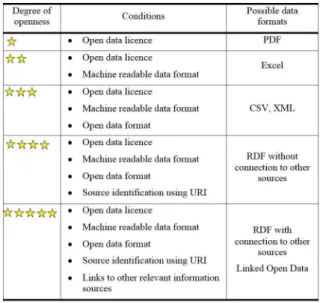
sector was based on a ive-star schema compiled by Tim Berners-Lee (Table 1) and the suitability of the formats used (Table 2).
Source: Hausenblas (2012)
Table 1: Data openness level.
From the table 2 it is clear that the most preferred
format for publication is RDF. It should however be noted that the path towards this format is still very
long. A professional qualiication and experience in the ield as well as overall knowledge of data
connectivity are necessary for its use (Gymrek
and Farjoun, 2016). During the irst publication
of any open data the XML format which excels in simple construction, good clarity and great openness would therefore be a good choice. On its basis it is possible to build a variety
of different applications. Within the geographic
data GeoJSON format is often used, which is based
Source: Chlapek et al. (2012)
Table 2: Suitability of data format for publishing.
Format Application
Independence Structured
Structure Description
Data Semantics
Creation by linking
Suit-ability 1 = best
PDF No No No No No 5
DOC(X), RTF No No No No No 5
TXT Yes No No No No 5
HTML Yes Partial No No No 4
XLS(X) No Partial No No No 4
CSV Yes Yes Partial No No 3
JSON Yes Yes Partial No No 3
XML Yes Yes Yes No No 2
OData Yes Yes Yes Partial Partial 2
on the format for classical JSON data. However, the most widespread format still remains
the XLS(X), which is due to the global widespread of Microsoft products, including Windows operating system and ofice suite MS Ofice.
To determine the current state of availability of open data in agrarian sector 11 institutions that are major producers of agricultural data in the Czech Republic were selected. The evaluation
took place in the irst quarter of 2016. Analyzed departmental organization:
• Ministry of Agriculture (MA)
• State Agricultural Intervention Fund (SAIF) • State Land Ofice (SLO)
• Czech Agriculture and Food Inspection
Authority (CZAFIA)
• Institute of Agricultural Economics
and Information (IAEI)
• Central Institute for Supervising and Testing
in Agriculture (CISTA)
• State Veterinary Administration (SVA) • Czech Forests, state enterprise (CZF) • Czech Agrarian Chamber (CZACH)
• Federation of the Food and Drink Industries
of the Czech Republic (FFDICZ) • Czech Statistical Ofice (CZSO).
An example of the evaluation process
Method of description and assessment of the data availability from individual organizations is shown on example of the State Agricultural Intervention
Fund:
SAIF is an entity that is involved in supporting the management of Czech farmers. It is an accredited paying agency, which is responsible for mediating
inancial support from the EU and national sources (State Agricultural Intervention Fund).
SAIF is responsible for the following payments
(State Agricultural Intervention Fund): • Direct payments (DP)
• Rural Development Programme (RDP) 2007-2013 / 2014-2020
• The Common Market Organisation (CMO) ◦ vegetal commodities
◦ animal commodities
◦ foreign trade
• Operative Programme Fisheries (OPF) 2007-2013 / 2014-2020
• National subsidies
• Quality food brands KLASA and Regional
Food.
SAIF collects data from farmers mainly through
LPIS (Land Parcel Identiication System). A larger
portion of data that SAIF analyzes and controls through LPIS has sensitive and personal nature. It is mainly data on the applications for grants
of speciic individuals, which also contain sensitive
personal data. Information on subsidies that are tied to a particular plot is not in the public part of LPIS. It is accessible only after login and only for that plots’ owner.
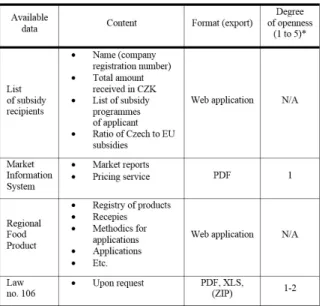
Data published by SAIF:
Source: State Agricultural Intervention Fund, List of subsidy recei -vers, Regional food product
Table 3: Data published by SAIF.
SAIF portal publishes a list of subsidy recipients including the amount paid from the preceding year
(Figure 1).
Names of individual recipients refer to a different table, in which the year, fund or support type - purpose of subsidy, resources given by Czech Republic, by EU and a total subsidy amount
in CZK are displayed.
A list of subsidy recipients is published
in accordance to the Act no. 106/1999 Coll.
Source: List of subsidy recipients
Figure 1: List of subsidy recipients shown on SAIF portal.
and allowed them to be further processed, its value would increase tremendously. The result would be the option to create a variety of applications above the data, which could bring insight into the management of the fund to the general public and facilitate the data visualization.
On the basis of law no. 106 SAIF provides other
data as well. Some of them are in a format that
allows further processing or other use (XLS).
The problem lies in the fact that this data must be
formally requested, which is a signiicant obstacle
to its immediate use. So again, we can call this
an open data. This data can be requested from SAIF by mail, electronically (email) via data box or in person at the ofice registry. Anyone can ask
for any data that does not collide with the Law on Protection of Personal Data. However, as far
as state and EU inances are concerned there is
only small amount of data that would be protected by this law, because a rule of transparency applies in this situation.
Among other information the fund discloses are information from a market information system. This system delivers current news from the market for agricultural products. The fund regularly publishes monthly newsletters reporting on agricultural commodity markets in the Czech Republic, European Union and other countries.
The portal publishes market reports on these commodities, products or programs (Market
Information System):
• Potatoes
• Poultry
• Beef and pork
• Grains and oilseeds
• Fruits
• Rural Development Programs
• Wine and grapes • Vegetables.
Another part of the market information system is a pricing service. There are regularly published pricing reports for individual agricultural commodities and products, which Czech Republic
is required to watch according to the European
legislation and send the reports to the European Commission.
The pricing service gives reports for these
commodities (Market Information System): • Bananas
• Dairy products
• Cereals
• Fruits and vegetables
• Pigs and piglets
• Cattle
• Eggs and poultry
• Wine.
information about the commodity, including lots of tabular data, charts, comparisons, comments and analyses results. Published reports have really
high informational value and are surely inding frequent application. That is why they are issued with such regularity and quality. The only downside
is the fact that all published documents are in PDF format, so the machine readability is very low. This unfortunately devaluates all published data
signiicantly. If the fund began to publish these
as open data, it would mean a lot of opportunities for their further use. Given that these data can be used in both commercial and personal sectors in wide range of applications, the public would certainly welcome opening up this data.
Results and discussion
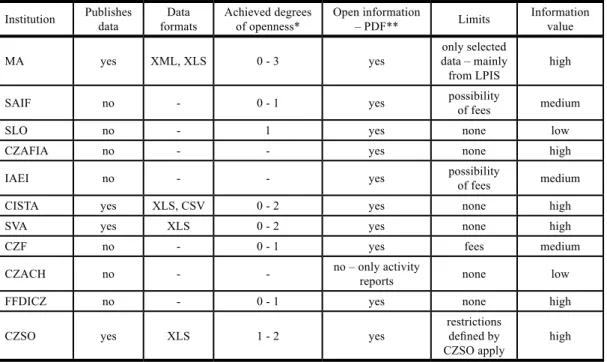
The following table provides a clear representation of the results of the analysis of availability of open data and information in the agrarian sector.
Table 4 shows that the development regarding open data in the agrarian sector is not at very high level and is considerably worse than in other sectors. Most institutions do not publish open data at all,
and if so, it is not an open data with a suficient
degree of openness.
Data which is publicly accessible on the institution portals has generally no restrictions on its
subsequent use, so it is possible to consider such
data to be at least partially open.
MA has undertaken the biggest step towards open data at the end of last year when it published a substantial GIS part of the LPIS portal that was not publicly available before. Here it is necessary to particularly highlight the fact that the data from the LPIS portal can be exported into open XML format. MA was followed by other institutions such as the SVA or CISTA. Here it should be noted that many other data remain internal.
Among them one could ind a lot of other data
that could be potentially made open. Most of the already published data has great potential in their
subsequent use. There are options for potential
developers and for the general public. Developers will mainly appreciate access to data in "raw" format. The biggest area opened for specialized farming applications – pest occurrence registers, advisor registers, catalogs of public commissions, etc. On the other hand, the Ministry of Agriculture and other institutions took patronage over of these applications themselves. These applications, which transform the "raw data" to other forms
of information, ind their use mostly with the general public (Charvat et al., 2014).
However, a problem occurs with institutions that have chosen to disclose only the fully ready information, not "raw data". Many of these
Note: * Based on the ive-star rating, individually requested data not included **Law no. 106/1999 Coll., and other documents not further processed Source: own processing
Table 4: Overview of published data and information.
Institution Publishes data
Data formats
Achieved degrees
of openness* Open information – PDF** Limits Information value
MA yes XML, XLS 0 - 3 yes
only selected data – mainly from LPIS
high
SAIF no - 0 - 1 yes possibility
of fees medium
SLO no - 1 yes none low
CZAFIA no - - yes none high
IAEI no - - yes possibility
of fees medium
CISTA yes XLS, CSV 0 - 2 yes none high
SVA yes XLS 0 - 2 yes none high
CZF no - 0 - 1 yes fees medium
CZACH no - - no – only activity
reports none low
FFDICZ no - 0 - 1 yes none high
CZSO yes XLS 1 - 2 yes
restrictions
deined by
CZSO apply
"national" applications are indeed good, but lack a space for developers who could bring new ideas through their own applications, and possibly
further enrich such data (Jarolimek et al., 2014) (Reznik et al., 2015). But it can not be said that a state institution always equals the best solution.
The above-mentioned applications will surely have their use in the future. For example, the web application "Food at the stake", which was formed under the leadership CZAFIA and already won numerous evaluations. Another application with great future potential is "Find your own producer" by FFDICZ, but it is still in the early stages of development and integration. Another
high-quality concept is a SAIF portal "Regional food," which offers consumers high quality
and comprehensive information regarding this brand and how it is being awarded.
Regarding the situation with open data in the agrarian sector, CZSO can be considered as the largest distributor of "raw data". Data published CZSO are clear, electronically readable, properly described and should be an example for all other institutions. It is possible to say that its potential for further use in the agrarian sector is
really more than suficient. But it is also necessary
to mention that when using open data it is still
a requirement to refer to the original source.
The openness of data lies in the possibility of unlimited use anywhere, by anyone and for any purpose. All data published by CZSO is in machine-readable formats have a high degree of standardization.
Final evaluation is as follows: data is published
only by 3 out of 11 surveyed institutions, one
of which (CZSO) does not directly belong
to the agrarian sector. These results can be assessed
as slightly less than average. Highest quality
data is published by the Ministry of Agriculture itself, since valuable exports from the portal LPIS are available in an open XML format that
allows unlimited other usage, which is conirmed
by the authorization of the free disposal of available data directly on eAGRI portal. Quality of other published data falls into the category of two
stars, where its subsequent use is predetermined by owning specialized (often commercial)
applications. Regarding the data publishing itself, the situation has somewhat improved. Information
released thanks to the Act no. 106/1999 Coll. is
provided by almost all institutions with the exception of CZF. The problem may be the possibility of charging for this service, which of course raises numerous discussions regarding the freedom
of access to information. Some institutions also publish other free information on their own portals, usually about their activities. This information is in most cases available in PDF. This format does not allow further processing of information, which can greatly reduce the information value of the data. An example of good practice is the Market Information System portal by SAIF, which provides a very carefully crafted data that
could be used and processed in other ields such
as econometrics and forecasting.
Data standardization
One of the functions of open data should be the possibility of linking with other datasets. This feature can greatly increase the informational value
of the inal dataset (Sieber and Johnson, 2015).
However, none of the examined data supports this. Although most of the formats are readable and usable for a wide range of users, it is still mainly XLS formats. To fully utilize the data in this format, one must have a commercial software MS Excel. These facts unfortunately do not correspond with open data policies in the true sense of the word, but at least some effort has been made towards openness.
A bigger problem occurs with the standardization of thes datasets. According to the results of analysis in the Czech agrarian sector we can not talk about any standardization whatsoever. Data is diverse, often unsorted and in various formats. The problem may also be in the use of graphic elements, for example coloring of cells, usage of variety of fonts etc. This problem stems from the fact that the datasets are compiled by different people from different institutions or external companies. The greatest degree of standardization dataset exists within the CZSO, but without additional export to other formats this still does not allow for linking to other datasets
(therefore a ive-star rating is currently infeasable).
The data published is also lacking consistency
(Figure 2). As an example, a list of subsidy recipients
from the SAIF portal was compared to register of subsidy recipients from eAGRI portal. This should be an absolutely identical lists of individuals and legal entities. Both institutions are also interconnected. Their connection is (in terms
of subsidy administration) of the utmost importance
with respect to other institutions under the Ministry of Agriculture. Both lists are, however, upon closer
inspection quite different. They evaluate exactly the same subsidy programs, but the inal values
Source: List of subsidy recipients, Czech Ministry of Agriculture
Figure 2: Example of data inconsistencies between SAIF and MA.
due to absence of many records at eAGRI portal. The list compiled by SAIF can be therefore considered as more credible source of information.
With such a large degree of mutual integration
of both institutions this situation cannot be described as anything but very irregular.
Problems of this kind are not only between institutions, but also within a single institution, for example, the Ministry of Agriculture. The problem is especially noticeable when you export data from different applications, where
the resulting structure of the exported ile often
differs. This example shows that the level of data standardization of this institution is very low.
Conclusion
The overall amount of content in the National Catalog is still very low. Data in further processable format are only published by MA and SVA on their portals. Ministry of Agriculture contributed towards the disclosure of data in December
last year by publishing of signiicant portion
of the geographic LPIS portal from which it is possible to export data to XML. XML format is multiplatform and therefore offers the possibility of further processing. There are also various data available from different registers, which is predominantly in XLS format. The portal, where data are available usually imposes no limitations for working with such data. Hence we can consider this essentially as open data, although not published as such. Another institution that contributes
to a signiicant degree of disclosure of data
in the agrarian sector is CZSO. Although this
ofice is not an organization directly from agrarian sector, it publishes high-quality statistical data
from the agriculture, food industry and forestry, all
of which are signiicant branches of the agrarian
sector. Use of such data is limited by the terms
of the statistical ofice and therefore it is not open
data per say. Data from CZSO are very clear, well structured and above all has a high degree of standardization.
That is the biggest problem of all previously released data across institutions in this sector. Standardization is not only an inter-institutional problem but also within the institutions themselves,
see also (Juell-Skielse et al., 2014). An example
of incorrect standardization is MA itself, where they use different data formats or even different structure. Even before the individual institutions decide to open up the data in RDF format, it is necessary to deal with standardization. The most appropriate format for the initial publication is XML. Until all the data is published in open XML formats with a clear structure it is not possible to even contemplate publication of linked data in RDF format. It offers the possibility to link with other databases, whether on a national or a world scale. The result is enriched data with a high degree of standardization and increased value of information that can be used for further processing or for developing a variety of applications.
Information in various forms is provided by all of the analyzed institutions. They most commonly publish information in PDF format. This format
is also frequently associated with the responces to requests for free access to information. Additional
information is provided to end consumers through
a special web portals or other available documents. The data provided has different levels of information value. In particular, portals dedicated to food, which provide very useful information about food
to inal consumers, exhibit the highest levels of data quality and information value. However, usefulness
of some of this data for further processing is lowered by used data format. This in particular applies to the Market Information System by SAIF,
where the monthly reports with high quality data
are only available in PDF.
Because the data is published by small number of institutions it is necessary to focus on the correct procedure for its eventual publication. It includes
the following steps:
1. Selection of appropriate data
2. Standardization
3. Selection of the place and manner of publication
4. Evaluation of the potential beneit of publications.
The most important step is to standardize, which brings some order to all data published in the agrarian sector. Standardization nowadays
also does not impose excessive inancial and technical dificulty. When selecting
the appropriate data, the farming data sensitivity must be taken into account. The third step depends on the arrangement between individual institutions, whether they prefer a centralized or decentralized manner of publishing and what form of visualization they decide upon - maps, web applications,
spreadsheets, etc. (Kubicek et al., 2013; Ojha et al., 2015).
Acknowledgements
The results and knowledge included herein have been obtained owing to support from the Internal grant agency of the Faculty of Economics and Management, Czech University of Life Sciences
in Prague, grant no. 20161028, “Assessment of quality, usability and accessibility of electronic
services from the perspective of small and middle
Corresponding author: Ing. Jan Jarolímek, Ph.D.
Department of Information Technologies, Faculty of Economics and Management Czech University of Life Sciences Prague, Kamýcká 129, Prague 6 - Suchdol, 165 21, Czech Republic
Phone: +420 22438 2293, E-mail: [email protected]
References
[1] Atenas, J., Havemann, L. and Priego, E. (2015) „Open Data as Open Educational Resources:
Towards transversal skills and global citizenship”, Open praxis, Vol. 7, No. 4, pp. 377-389.
ISSN 2304-070X. DOI 10.5944/openpraxis.7.4.233.
[2] Bellon-Maurel, V., Peters, G. M., Clermidy, S., Frizarin, G., Sinfort, C., Ojede, H., Roux, P.
and Short, M. D. (2015) „Streamlining life cycle inventory data generation in agriculture using traceability data and information and communication technologies-part II: application to viticulture”, Journal of cleaner production, Vol. 87, pp. 119-129. ISSN 0959-6526.
[3] Czech Republic (1999) Law no. 106/1999 Coll. dated May 11th 1999 on free access to information.
Czech Republic legislation, 1999. ISSN 1211-1244.
[4] European Parliament and Council (2013) European Parliament and Council Directive 2013/37/EU,
June 26th 2013.
[5] Gymrek, M. and Farjoun, Y. (2016) „Recommendations for open data science”, Gigascience. Vol. 5.
ISSN 2047-217X. DOI 10.1186/s13742-016-0127-4.
[6] Hausenblas, M. (2012) 5-star Open Data. 22 Jan. 2012. [Online]. Available: http://5stardata.info/en/. [Accessed: 10 Oct. 2015].
[7] Holster, H., Fusai, B., Giannerini, G., Horakova, S., Martini, D., Teye, F., and Ipema, B. (2011)
„Current situation on data exchange in agriculture in the EU27 & Switzerland”, EFITA/WCCA ’11.
pp. 367-381. ISBN 978-80-904830-0-2.
[8] Hossain, M. A., Dwivedi, Y. K. and Rana, N. P. (2016) „State-of-the-art in open data research: Insights
from existing literature and a research agenda”, Journal of organizational computing and electronic commerce, Vol. 26, No. 4, pp. 14-40. ISSN 1091-9392. DOI 10.1080/10919392.2015.1124007.
[9] Charvat, K., Esbri, M., Mayer, W., Campos, A., Palma, R. and Krivanek, Z. (2014) „FOODIE - Open
data for agriculture“. 2014 IST-Africa Conference Proceedings. [Online]. Available: https://scholar. google.czscholar?q=FOODIE+%E2%80%94+Open+data+for+agriculture&btnG=&hl=cs&as_ sdt=0%2C5. [Accessed: 13 Aug. 2016]. ISBN 978-1-905824-44-1. DOI 10.1109/ISTAFRICA.2014.6880647.
[10] Chlapek, D., Kucera, J. and Necasky, M. (2012) „Metodika publikace otevřených dat veřejné správy
ČR.“ (In Czech). [Online]. Available: http://www.korupce.cz/assets/dokumenty/aktuality/Metodika-publikace-otevrenych-dat.pdf. [Accessed: 20 Nov. 2015].
[11] Janssen, M., Charalabidis, Y. and Zuiderwijk, A. (2012) „Beneits, Adoption Barriers and Myths
of Open Data and Open Government“, Information systems management, Vol. 29, No. 4,
pp. 258-268. ISSN 1058-0530. DOI 10.1080/10580530.2012.716740.
[12] Jarolimek, J., Vanek, J., Jezek, M., Masner, J. and Stoces, M. (2014) „The telemetric tracking of wild boar as a tool for ield crops damage limitation“, Plant, Soil and Environment, Vol. 60,
No. 4, pp. 418-425. ISSN 1214-9368.
[13] Juell-Skielse, G., Hjalmarsson, A., Johannesson, P. and Rudmark, D. (2014) „Is the Public
Motivated to Engage in Open Data Innovation?”, Electronic government (EGOV 2014), Vol. 8653,
pp. 277-288. ISSN 0302-9743. DOI 10.1007/978-3-662-44426-9_23.
[14] Kubatova, E. and Faugnerova (2015) INSPIRE. Infrasructure for Spatial Information in Europe.
[15] Kubicek, P., Kozel, J., Stampach and R., Lukas, V. (2013) „Prototyping the visualization
of geographic and sensor data for agriculture”, Computers and electronics in agriculture, Vol. 97,
pp. 83-91. ISSN 0168-1699.
[16] Lassinantti, J., Bergvall-Kareborn, B. and Stahlbrost, A. (2014) „Shaping Local Open Data Initiatives: Politics and Implications”, Journal of theoretical and applied electronic commerce research, Vol. 9,
No. 2, pp. 17-33. ISSN 0718-1876. DOI 10.4067/S0718-18762014000200003.
[17] Ministry of Interior (2015) „Školení otevřených dat VS ČR“. [Online]. Available: http://opendata.
gov.cz/_media/edu:skoleni_open_data_web.pdf. [Accessed: 10 Oct. 2015].
[18] Czech Ministry of Agriculture (2016) „Registry of subsidy recipients“. [Online]. Available:
http://eagri.cz/public/app/SZR/SubsidyReports#ilter--Subjid=&Ico=&SzifId=&LpisId=&Rci=&D atNaroz=&ObchJm=&Jmeno=&Prijmeni=&ObecNaz=&ObecKod=&Ulice=&Okres=&searched= Reload. [Accessed: 20 Feb. 2016].
[19] Ojha, S. R., Jovanovic, M. and Giunchiglia, F. (2015) „Entity-Centric Visualization of Open Data”, Human-Computer interaction – Interact 2015, PT III, Vol. 9298, pp. 149-166. ISSN 0302-9743.
DOI 10.1007/978-3-319-22698-9_11.
[20] Open Knowledge (2015) „Global Open Data Index“. [Online]. Available: http://index.okfn.org/ place/czech-republic/2014/. [Accessed: 29 Nov 2015].
[21] Reznik, T., Charvat, K. Jr., Charvat, K., Horakova, S., Lukas, V. and Kepka, M. (2015) „Open Data Model for (Precision) Agriculture Applications and Agricultural Pollution Monitoring”,
Proceeding of envroinfo and ict for sustainability 2015, Vol. 22, pp. 97-107. ISSN 2352-538X.
DOI 10.2991/ict4s-env-15.2015.12.
[22] Sieber, R. E., Johnson, P. A. (2015) „Civic open data at a crossroads: Dominant models and current challenges”, Government information quarterly, Vol. 32, No. 3, pp. 308-315. ISSN 0740-624X.
[23] State Agricultural Intervention Fund (2015) „O nás“. [Online]. Available: https://www.szif.cz/cs/o-nas. [Accessed: 20 Dec. 2015].
[24] List of subsidy recipients (2016). [Online] Available: https://www.szif.cz/cs/seznam-prijemcu-dotaci. [Accessed: 10 Feb. 2016].
[25] Regionální potravina. [Online]. Available: http://www.regionalnipotravina.cz/. [Accessed: 10 Feb. 2016].
[26] Stočes, M., Benda, P. and Ulman, M. (2015) „Open data and rural development. In: Agrarian Perspectives XXIV. – Global Agribusiness and Rural Economy, 16.09.2015, Prague. Czech
University of Life Sciences Prague, pp. 399-406. ISBN 978-80-213-2581-4, E-ISSN 2464-4781, ISSN 1213-7960.
[27] Market Information System (2016). [Online]. Available: https://www.szif.cz/cs/trzni-informacni-system. [Accessed: 24 Feb. 2016].
[28] Thorp, K. R., Bronson, K. F. (2013) „A model-independent open-source geospatial tool for managing point-based environmental model simulations at multiple spatial locations”, Environmental modelling & software, Vol. 50, pp. 25-36. ISSN 1364-8152.
[29] Vanek, J., Kanska, E., Jarolimek, J. and Simek, P. (2010) „State and evaluation of information and communication technologies development in agricultural enterprises in Czech Republic“, Plant, Soil and Environment, Vol. 56, No. 3, pp. 144-147. ISSN 1214-1178.
[30] Zuiderwijk, A., Janssen, M. and Dwivedi, Y. K. (2015) „Acceptance and use predictors