Tephritidae) and Its Evolution in Insects
Marı´a Fernanda Ruiz1., Andreina Milano2., Marco Salvemini2, Jose´ Marı´a Eirı´n-Lo´pez4, Andre´ L. P. Perondini5, Denise Selivon5, Catello Polito2,3, Giuseppe Saccone2, Lucas Sa´nchez1
*
1Centro de Investigaciones Biolo´gicas (CSIC), Madrid, Spain,2Dipartimento delle Scienze Biologiche–Sezione di Genetica e Biologia Molecolare, Universita` degli Studi di Napoli ‘‘Federico II’’, Napoli, Italy,3Instituto di Genetica e Biofisica2Adriano Buzzati2Traverso (ABT), Consiglio Nazionale delle Ricerche (CNR), Napoli, Italy,4Departamento de Biologı´a Celular y Molecular, Universidade da Corun˜a, Corun˜a, Spain,5Departamento de Gene´tica e Biologia Evolutiva, Instituto de Biocieˆncias, Universidade de Sa˜o Paulo, Sao Paulo, Brazil
In the tephritids Ceratitis capitata and Bactrocera oleae, the gene transformer acts as the memory device for sex determination, via an auto-regulatory function; and functional Tra protein is produced only in females. This paper investigates the evolution of the genetra, which was characterised in twelve tephritid species belonging to the less extensively analysed genusAnastrepha. Our study provided the following major conclusions. Firstly, the memory device mechanism used by this gene in sex determination in tephritids likely existed in the common ancestor of theCeratitis,Bactrocera and Anastrepha phylogenetic lineages. This mechanism would represent the ancestral state with respect to the extant cascade seen in the more evolvedDrosophila lineage. Secondly, Transformer2-specific binding intronic splicing silencer sites were found in the splicing regulatory region of transformer but not in doublesexpre-mRNAs in these tephritids. Thus, these sites probably provide the discriminating feature for the putative dual splicing activity of the Tra-Tra2 complex in tephritids. It acts as a splicing activator indsxpre-mRNA splicing (its binding to the female-specific exon promotes the inclusion of this exon into the mature mRNA), and as a splicing inhibitor intrapre-mRNA splicing (its binding to the male-specific exons prevents the inclusion of these exons into the mature mRNA). Further, a highly conserved region was found in the specific amino-terminal region of the tephritid Tra protein that might be involved in Tra auto-regulatory function and hence in its repressive splicing behaviour. Finally, the Tra proteins conserved the SR dipeptides, which are essential for Tra functionality.
Citation: Ruiz MF, Milano A, Salvemini M, Eirı´n-Lo´pez JM, Perondini ALP, et al (2007) The GeneTransformer ofAnastrephaFruit Flies (Diptera, Tephritidae) and Its Evolution in Insects. PLoS ONE 2(11): e1239. doi:10.1371/journal.pone.0001239
INTRODUCTION
Perpetuation by sexual reproduction is the rule within the animal Kingdom. A plethora of sex determination mechanisms exist which commit the embryo to following either the male or female developmental pathway. The mechanism underlying this process has been thoroughly analysed in Drosophila melanogaster. In this species, sex determination is under the control of the geneSex lethal (Sxl). The epistatic relationships between Sxl and the other sex determination genestransformer (tra),transformer-2 (tra-2)anddoublesex (dsx)have revealed a hierarchical interaction to exist among them. Their characterisation has shown that the sex-specific splicing of their primary transcripts controls their expression during develop-ment, the product of one gene controlling the sex-specific splicing of the pre-mRNA of the downstream gene in the sex determination cascade (reviewed in [1]).
The geneSxl, which is at the top of this cascade, acts as the memory device for female sexual development via its auto-regulatory function: the Sxl protein participates in the female-specific splicing of its own pre-mRNA [2,3]. The downstream target ofSxlis the gene transformer (tra). A transcript found in both males and females encodes a non-functional truncated Tra protein, and a female-specific transcript encodes the functional Tra protein [4,5,6,7,8]. The Tra product and the product of the constitutive genetransformer-2 (tra-2) [9,10] control the sex-specific splicing of the pre-mRNA of the gene doublesex (dsx), the last gene in the genetic cascade, and which is transcribed in both sexes [11,12,13,14,15,16]. In females, the Tra-Tra2 complex directs the splicing of thedsxpre-mRNA according to the female mode, giving rise to the female DsxF protein that promotes female sexual development. In males, where no functional Tra protein is available, thedsxpre-mRNA follows the default, male mode of splicing, which produces male DsxM protein. This promotes male sexual development.
Sex determination mechanisms have long been of major interest from both developmental and evolutionary points of view. The search in different insects for genes homologous to the sex determination genes ofD. melanogasteris underway. The aim is to determine how much of the sex determination genetic cascade has been modified between the more ancient dipteran phylogenetic lineages and the drosophilid lineage. The gene tra of Drosophila simulans, D. erecta, D. hydeiandD. virilishas been characterised [17] and an unusually high degree of divergence found with that ofD.
Academic Editor:Jean-Nicolas Volff, Ecole Normale Supe´rieure de Lyon, France
ReceivedSeptember 11, 2007;AcceptedOctober 26, 2007;PublishedNovember 28, 2007
Copyright:ß2007 Ruiz et al. This is an open-access article distributed under the terms of the Creative Commons Attribution License, which permits unrestricted use, distribution, and reproduction in any medium, provided the original author and source are credited.
Funding: This work was financed by grants BFU2005-03000 awarded to L. Sa´nchez by the D.G.I.C.Y.T., by grant PRIN 2004 to C. Polito, by the Insect Biotechnology PhD Programme for A. Milano; by grants from a Joint Programme of the CSIC (20004BR0005 to L. Sa´nchez, Spain) and CNPq (690088/02-7 to ALP Perondini, Brazil), and a grant to D. Selivon (FAPESP, 03/02698-3, Brazil), and grant from a Joint Programme of the CSIC (20004IT0017) to L. Sa´nchez (Spain) and C.Polito (Italy). The work was partially supported by Fondo PRIN 2006 (Ministero dell’Istruzione, dell’Universita` e della Ricerca) to C. Polito. M.F. Ruiz was recipient
of a Short-term EMBO fellowship (ASTF Nu168-05). J.M. Eirı´n-Lo´pez was awarded
a Postdoctoral Marie Curie International Fellowship within the 6th European Community Framework Programme.
Competing Interests:The authors have declared that no competing interests exist.
* To whom correspondence should be addressed.E-mail: [email protected]
melanogaster. Even so,D. melanogaster tramutants can all be rescued by thetraof these species [17].
Outside the genusDrosophila,trawas first characterised inCeratitis capitata[18] and recently inBactrocera oleae[19]. As inDrosophila, in Ceratitis and Bactrocera alternative splicing also regulates the expression oftraso that only females contain the full-length protein. TheCeratitis capitata (Cctra)andBactrocera oleae (Botra) tragenes have male-specific exons, which contain translation stop codons; their inclusion in the mature mRNA produces truncated and most probably non-functional Tra protein. In females, these exons are spliced out, and a mature mRNA is made that produces a functional Tra protein. Surprisingly, putative Tra-Tra2 binding sites have been found in the male-specific exons ofCctra[18] andBotra[19]. The injection of the respectivetra-dsRNA inCeratitis[20] and inBactrocera [19] results in the destruction of endogenoustra function in both species and the subsequent male-specific splicing of the endogenous trapre-mRNA, ensuing in the complete transformation of females into fertile XX pseudomales.
The early results inCeratitisled to Pane et al. [18] to propose a novel auto-regulatory function for theCctragene with respect to itsDrosophilahomologue. InC. capitata, the genetrawould play the key regulatory role, acting as the memory device for sex determination through its auto-regulatory function. The Tra protein would act as a splicing inhibitor of its own pre-mRNA splicing. This was based on the idea that the Tra-Tra2 complex binds to the Tra-Tra2 binding sites in thetrapre-mRNA2because of the sequence conservation of these sites2inhibiting the incorporation of the male-specific exons into the mature tra mRNA. This would also apply to the genetraofB. oleae[19].
To better analyse the evolution oftragene, in the present work its characterisation was undertaken in tephritid species belonging to the less extensively analysed genusAnastrepha. We chose those species which, according to morphological [21] and molecular data [22], belong to distinct intrageneric taxonomic groups. The present analysis therefore includedAnastrepha obliqua, A. ludens, A. amitaandA. sororcula, plus the four closely related species of the so-called Anastrepha fraterculuscomplex2A.sp.1aff. fraterculus, A.sp.2 aff.fraterculus, A.sp.3aff.fraterculusandA.sp.4aff.fraterculus[23,24], all of which belong to the fraterculus group [21]–along with A. serpentina, A. striataandA. bistrigata(of theserpentinagroup, see 25]) andA. grandis(of thegrandisgroup).
The genetrain the reference speciesA. obliquawas first isolated and its molecular organisation, expression pattern and encoded product studied. ThetraORFs in the otherAnastrephaspecies were then identified, and a comparative analysis of all the known insect Tra proteins undertaken. In this way, a comparison of the Tra protein at different phylogenetic levels was made. Within-genus comparisons of the members of Drosophila and Anastrepha; distinct genera of the same family, such asCeratitis, BactroceraandAnastrepha (Tephritidae); and two different families of the same order (Diptera), such as Drosophilidae and Tephritidae. Next, the genomictraregion that controls the sex-specific splicing of its primary transcript was characterised and compared in C. capitata,B. oleae and the above Anastrepha species. This should indicate whether the molecular organisation of genetrainCeratitisand inBactroceraarose before or after the splitting off of the frugivorous Tephritidae lineage. Finally, the phylogeny of genetrain these different insects was investigated.
RESULTS
The molecular organisation of
tra
in
Anastrepha
obliqua
, and its product
The strategy followed to determine the molecular organisation of Anastrepha obliqua tragene(Aotra)is described in Materials and Methods.
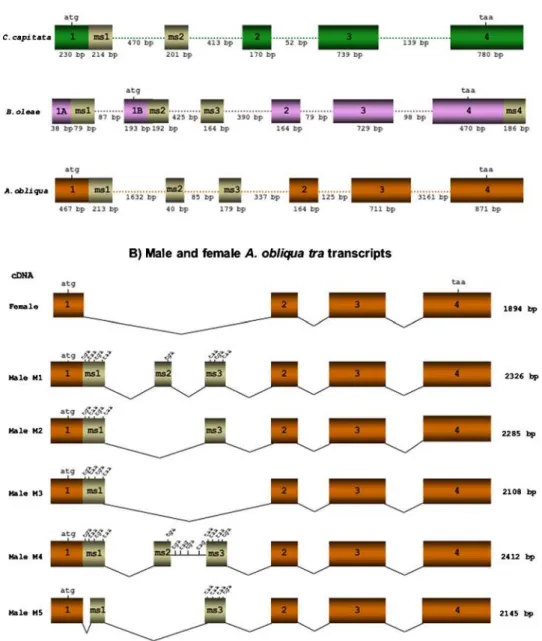
Figures 1A and B shows the molecular organisation of theAotra gene. The transcription unit is made up of 7665 bp, and the transcription start site located at –197 bp from the initial ATG of the ORF. It is composed of 4 exons (1–4) common to both sexes, and three male-specific exons, ms1, ms2 and ms3, located between exons 1 and 2. TheAotragene produces three mRNAs in females formed by exons 1–4. These differ in the length of their 39UTR, yet they encode the same female Tra protein. In males, 5 distinct mRNAs (M1–M5) are produced depending on the male-specific exons included (see Fig. 1B). These latter exons contain translation stop codons. The comparison of male and femaleAotra mRNAs indicates that they arise by sex-specific splicing of the tra pre-mRNA, with the male-specific exons being skipped in the female mRNA.
Figure 1A compares the molecular organisation ofAotra, Cctra andBotra. In all three cases the female mRNA contains 4 exons. Exons 2–4 are homologous across all three species, their sizes differing only slightly. Exon 1 ofAotra corresponds to exon 1 of Cctraand to exons 1A and 1B ofBotra. InCctraandAotra, exons 1 and ms1 are contiguous. However, inBotra, exon 1 is split and exon 1A precedes and is contiguous with ms1. Both are separated by an intron from the downstream exon 1B with which exon ms2 is contiguous. This latter exon is flanked by introns inAotra and Cctra. BothBotraandAotrahave an additional male-specific exon, ms3.
The conceptual translation of the femaleAotramRNA shows it to encode a polypeptide of 417 amino acids. MaleAotramRNA, however, encodes a truncated, presumably non-functional poly-peptide of either 55 or 67 amino acids depending on the male-specific splicing pathway followed (see Fig. 1B). The female Tra protein contains the SR dipeptides that characterise the family of SR proteins.
InD. melanogaster[26]], in other drosophilids [17], inC. capitata [18] and inB. oleae[19], the genetrais closely linked to the well-conserved genel(3)73Ah. In the three named species, these two genes are transcribed in opposite directions, and inD. melanogaster andC. capitatathe genestraandl(3)73Ahoverlap at their 39-UTR regions. InB. oleaesuch overlapping seems not to be present and the stop codons of both genes are 830 bp from each other. InA. obliquathe genestraand l(3)73Ahdo not overlap either, and are separated by about 3.5 kb (data not shown).
The expression of
tra
in
A. obliqua
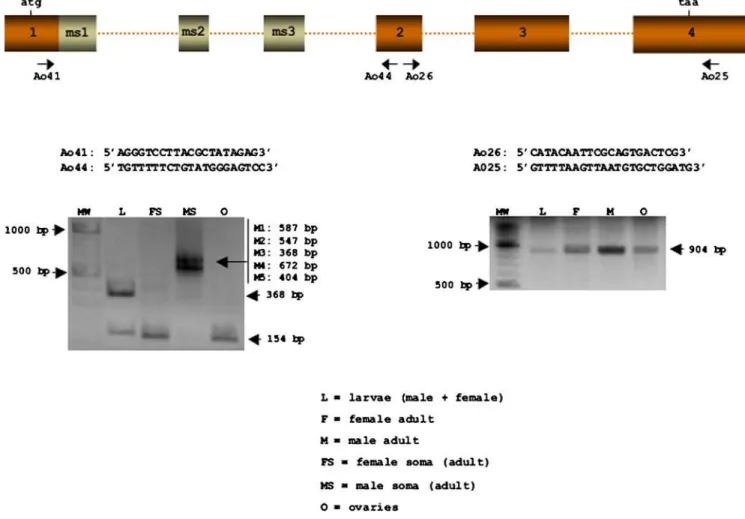
The expression ofAotrawas studied by performing RT-PCR on total RNA from adult males and females, on RNA from the heads plus thoraces of male and femaleA. obliquaadults (separately), on that from a mixture of male plus female larvae at different developmental stages, and that from adult ovaries. Figure 2 shows the primers used. All the amplified fragments were cloned and sequenced. The primer pair Ao26 plus Ao25 amplified a fragment of 904 bp common to both sexes, while Ao41 plus Ao44 amplified a single fragment of 154 bp in adult female soma and ovaries, as well as two fragments of 154 and 368 bp in the larvae (corresponding to female and male mRNAs respectively). Different fragments were amplified in adult male soma depending on the male-specific exons they included (these latter fragments could not be resolved in gels).
indicates that, as inC. capitataandB. oleae, the mother provides the zygote with femaletramRNA and/or female Tra protein.
The Tra protein of other
Anastrepha
species
The strategy followed to identify the tra ORFs in the other Anastrepha species is explained in Materials and Methods. The putative Tra proteins from the 12Anastrephaspecies and the Tra protein fromC. capitata,B. oleaeandA. obliqua(used as reference for the genusAnastrepha) were then compared.
The Tra protein of the 12Anastrephaspecies is composed of 417 amino acids, except that ofA. grandis, which contains 416 amino acids (Fig. S1 in Supporting material). Their degree of similarity (i.e., identical plus conservative amino acids) ranges from 88 to 99% (upper half of Table 1). The Tra protein of the tephritids is larger than that of the drosophilids due to its bigger amino
terminal end. This is composed of about 103 amino acids in the Anastrephaspecies and of 105 amino acids inCeratitisandBactrocera. The comparison of the specific amino-terminal region in all Anastrepha species revealed an extraordinary high degree of similarity (between 89–100%) (lower half of Table 1).
Figure 2. Expression ofA. obliqua tra.RT-PCR analyses of total RNA from male plus female larvae (L), female adult (F), male adult (M), female soma (head plus thorax), male soma (head plus thorax), and ovaries (O). The sequence of the primers used and their locations are shown.
doi:10.1371/journal.pone.0001239.g002
Table 1.Percentage of similarity among theAnastrephaTra proteins.
. . . .
species obl sp1 sp2 sp3 sp4 grd ser sor str bis ami lud
obl 96 97 98 96 90 89 99 97 95 96 97
sp1 97 96 95 95 89 88 96 98 94 96 96
sp2 98 97 96 96 90 89 97 97 95 96 98
sp3 100 97 98 95 89 88 97 96 94 95 96
sp4 95 96 95 95 88 87 95 96 94 95 96
grd 90 91 90 90 89 89 90 90 91 90 89
ser 92 93 92 92 91 91 89 89 90 88 89
sor 100 97 98 100 95 90 92 97 95 96 97
str 98 99 98 98 97 92 94 98 95 97 97
bis 96 96 95 96 94 91 93 96 97 94 95
ami 96 97 96 96 95 94 94 96 98 97 96
lud 99 98 99 99 96 91 93 99 99 96 97
The upper half of the table shows the similarity values (in bold) for the entire Tra proteins; the bottom half shows the similarity values (in italic) for the specific amino
terminal regions (the first 103 amino acids).Anastrephaspecies: obl,A. obliqua;sp1,A.sp.1aff.fraterculus; sp2,A.sp.2aff.fraterculus; sp3,A.sp.3aff.fraterculus; sp4,A.
sp.4aff.fraterculus; grd,A. grandis; ser,A. serpentina; sor,A. sororcula; str,A. striata; bis,A. bistrigata; amiA. amita; lud,A. ludens. doi:10.1371/journal.pone.0001239.t001
...
...
...
....
...
...
....
...
...
....
...
...
....
...
...
....
...
...
....
...
dipeptides like the Tra proteins of the drosophilids, a feature that shows the SR proteins to be involved in splicing regulation. These SR dipeptides are also found in the specific amino terminal region of the three tephritids.
Molecular organisation of the sex-specific splicing
regulatory region of
tra
The Tra protein acts as a splicing activator in the female-specific splicing ofdsxpre-mRNA inC. capitata[18] andB. oleae[19]. In these species, the sex-specific splicing of dsx pre-mRNA is organised as in Drosophila: the male-splicing pathway represents the default mode, and the presence of functional Tra protein in females seems to cause the formation of the Tra-Tra2 complex, which binds to its targets in the female-specific exon, thus promoting the inclusion of the latter in the mature mRNA [11,12,13,14,15,16]. The RBP1 being also needed [27]. The
presence of Tra-Tra2 binding sites in the female-specific exon of dsx pre-mRNA of the Anastrepha species suggests that, in these species, Tra probably also controls the sex-specific splicing ofdsx pre-mRNA [28,29].
The auto-regulation model proposed by Pane et al. [18] forC. capitata traconsider that the Tra protein acts as a splicing inhibitor of its own pre-mRNA splicing (see Introduction). A similar model seems to be applicable to the other tephritidsBactrocera[19] and Anastrepha[this work]tragenes, since the molecular organisation of trapre-mRNA of these tephritids were similar to that ofCeratitis. Nothing is presently known about the mechanism through which the tephritid Tra protein controls the splicing of its own transcript. We undertook a comparison of the tragenomic region (encom-passing the male-specific exons and their flanking introns, where the regulation of sex-specific splicing occurs) of the twelve Anastrephaspecies studied here, ofC. capitata, and ofB. oleae. Given the possible involvement of Tra2 in the auto-regulation oftra, we also looked for the presence and location of putative Tra-Tra2 and RBP1 binding sites, as well as Tra2-ISS binding sites [30], in this tragenomic region. Thetragenomic region corresponding to the Anastrepha species was amplified by PCR processing of genomic DNA using the primer pair TRA39 and TRA41 (see Materials and Methods and Table S1 in Supporting material).
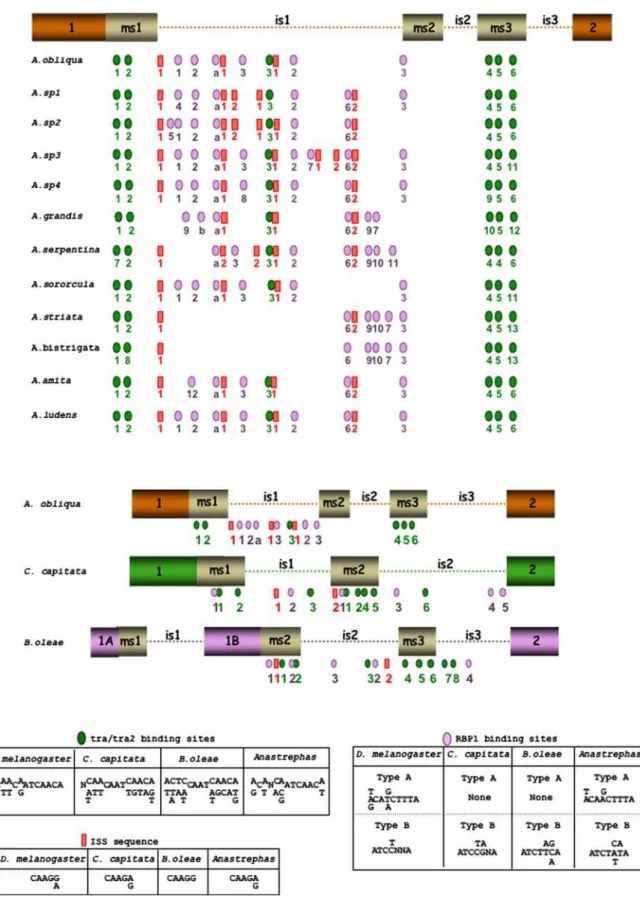
In theAnastrepha species, the size of intron is1 varied between 1024 and 3296 bp, and that of is2 between 337 and 472 bp. Intron is3 was composed of 85 bp in all twelve species (Fig. S2 in Supporting Material). Six putative Tra-Tra2 binding sites were found in all the Anastrepha species except for A. striata and A. bistrigata, which had five sites (Fig. 4). These elements were located at similar positions: two sites in exon ms1, one site in intron is1 (missing inA. striataandA. bistrigata), and three sites in exon ms3.
Figure 3. Comparison of the predicted Tra polypeptides ofC. capitata[18],B. oleae[19]andA. obliqua(taken as the reference for the twelve Anastrephaspecies here studied).The shadowed regions correspond to the domains that show 100% similarity among the three species (similarity refers to identical plus conservative amino acids)
doi:10.1371/journal.pone.0001239.g003
Table 2.Percentage of similarity among the tephritid Tra proteins.
. . . .
Tephritid C. capitata B. oleae A. obliqua
C. capitata 56 54
B. oleae 61 54
A. obliqua 64 59
The upper half of the table shows the similarity values (in bold) corresponding to the entire Tra proteins of the Tephritids; the bottom half shows the values (in
italic) for the specific amino terminal regions (the first 105 amino acids inC.
capitataandB. oleae, and the first 103 amino acids inA. obliqua, the reference
for the genusAnastrepha).
doi:10.1371/journal.pone.0001239.t002
....
...
...
....
...
...
....
...
...
....
...
...
Figure 4. Comparison of the molecular organisation of thetragenomic region (encompassing the male-specific exons and their flanking introns) involved in sex-specific splicing regulation of the trapre-mRNA, in the twelveAnastrepha species, in C. capitata(unpublished sequence) and inB. oleae(accession number AJ715414). Boxes represent exons, lines represent introns (not drawn to scale).InB. oleae, exon 1 is split into exons 1A and exon 1B [19]. The male-specific exons are denoted by ms1, ms2 and ms3, and the introns corresponding to the comparedtra genomic region by is1, is2 and is3. The locations of the Tra-Tra2, RBP1 and Tra2-ISS binding sites are shown, along with their consensus sequences, together with those found inD. melanogaster(bottom of the Figure). The numbers and the letters (a) and (b) underneath the small rectangle and ellipsoids representing these binding sequences refer to the exact same sequences described in the Supporting Material.
Between 5 and 8 putative RBP1 binding sites were found, all located in intron is1. All the RBP1 binding sites were of type B but for two of type A (a and b in Fig. 4). Between one and six Tra2-ISS binding sites were found in intron is1 in all species (Fig. 5). The two CAAGG and CAAGA Tra2-ISS binding sequences reported in theDrosophila tra-2gene [30] were also found.
In C. capitata, eight repeats of Tra-Tra2 binding sites have previously been described [18]. In the present work, five type B RBP1 binding sites were recorded: one in exon ms1 and in exon ms2, one in intron is1, and three in intron is2 (Fig. 4). Finally, two types of Tra2-ISS binding sites were located, one in intron is1, and one in exon ms2 (Fig. 4).
In B. oleae, eight repeats of Tra-Tra2 binding sites have previously been reported [19]. Five type B RBP1 binding sites were seen in this work: two in exon ms2, another two in intron is2, and one in intron is3 (Fig. 4). Finally, two Tra2-ISS binding sites (both CAAGG-type) were identified; one in exon ms2 and the other in intron is2 (Fig. 4).
The comparison of the respective consensus sequences for all these binding sites in theAnastrephaspecies,C. capitataandB. oleae, revealed a high degree of similarity among the tephritids and Drosophila(Fig. 5). The complete sequences of all these binding sites are given in the Supporting Material (Fig. S3). Another shared feature is the mixing and grouping of these binding sites.
Phylogeny and molecular evolution of gene
tra
As in former studies of the Sxl [31] and Dsx [29] proteins, the topology of the phylogenetic relationship for Tra proteins from different tephritid and drosophilid species were in very good agreement with these species’ taxonomic relationships. The different groups defined by the tree were very well supported by statistical tests (CP and BS). The tephritids and drosophilids grouped into distinct clades, and among the tephritids,B. oleaeand C. capitata, which belong to the subfamily Dacinae, grouped together in a branch distinct from that encompassing the twelve species of Anastrepha (a genus that belongs to the subfamilyFigure 5. (A)Phylogenetic tree reconstructed from 22 protein TRA sequences belonging to different insect species (taxonomic groups indicated on the right hand side of the tree). The tree was built using the neighbour-joining method. The confidence levels for the groups are indicated in the corresponding nodes as bootstrap (BP, normal type) and interior branch test results (CP, bold type) based on 1000 replications. Values are shown only when either the BP or CP values are higher than 50%.(B)Proportion of nucleotide sites at which two sequences being compared are different (p, nucleotide substitutions per site) and ratio between the numbers of non-synonymous (pN) and synonymous (pS) substitutions per site across the coding regions oftrain the tephritids. These values were calculated using a sliding-window approach with a window length of 40 bp and a step size of 10 bp. The relative positions of the RS and SR dipeptides acrosstraare represented in the white boxes below the graph.
Trypetinae). In theAnastrephabranch, species of the more ancient intrageneric taxonomic groups, such asA. serpentina, A. grandisand A. bistrigata (but not A. striata), lie in sub-branches distinct from those grouping the eight species belonging to the fraterculus taxonomic group.
Table 3 provides information showing the variation of thetra gene. Within the pool of three tephritid genera (Anastrepha, Ceratitis and Bactrocera species), the degree of amino acid variation is significantly smaller than that seen within the genus Drosophila. When variation of the Tra protein within the genusAnastrephawas evaluated, a still more reduced degree of Tra protein variation was found. The observed levels of protein variation agreed well with those observed at the nucleotide level, finding high levels of silent variation.
The Tra protein belongs to the family of SR-proteins. These are characterised by having serine-arginine (SR) dipeptides, which are involved in protein–protein interactions (reviewed in [32]). The percentage of SR dipeptides in the different species was determined, and means of 7.072% for theAnastrephaspecies and 5.644% for the other tephritid speciesC. capitataandB. oleaerecorded. These values are low compared to the estimated 16.5% inDrosophilaspecies [17]. Figure 5B shows the proportion of nucleotide sites at which two sequences being compared are different (p) against the ratio between the numbers of non-synonymous and synonymous nucleotide substitutions per site (pN/pS). The results show a high degree of coincidence between peaks ofpand those ofpN/pS, matching the gene regions encoding the SR domains, indicating a higher degree of nucleotide diversity in these particular areas.
DISCUSSION
Sex determination in tephritid flies: the role of the
tra
gene
The present work shows that the genetraof theAnastrephaspecies has a molecular organisation and expression pattern similar to those ofCeratitis[18] andBactrocera[19]. The hypothesis of Pane et al. [18] regarding the role played by tra in Ceratitis sex determination2namely that of the memory device for sex determination through its auto-regulatory function–therefore applies not only toBactrocera[19] but also to theAnastrephaspecies (this work), in which females are XX and males are XY. This hypothesis states that the Tra protein, together with the Tra2 protein, participate in the female-specific splicing of its own primary transcript. The maternal expression oftrawould supplytra mRNA (or its protein) to the oocyte, thus making it available to the embryo. This would impose female-specific splicing on the initial zygotictrapre-mRNA, which would give rise to the initial zygotic functional Tra protein and consequently the establishment oftra auto-regulation. Thus, XX embryos follow the female develop-mental route. However, XY embryos are able to follow the male
route. For example, in male embryos ofC. capitatait is known that the Y chromosome contains a male-determining factor (M factor) [33] that would prevent the instigation of tra auto-regulation. Consequently, these embryos would not produce functional Tra protein, leading to male development. InBactroceraandAnastrephait is still not known whether the Y chromosome is male-determining. However, the similar molecular organisation and expression pattern oftra inCeratitis[18], Bactrocera [19] andAnastrepha (this work) suggest that thetramemory device mechanism, as well as the M factor mechanism for preventing the establishment oftra auto-regulation, might be present in all three of these extant genera, and that they may have been present in the common ancestor of the frugivorous Tephritidae lineages.
These results support the model of Wilkins [34], who proposed that the evolution of sex-determining cascades was bottom up, with the genes at the bottom being more conserved than those further upstream genes (for a theoretical analysis of this model see [35]). Indeed, the tra/tra2.dsx elements at the bottom of the cascade, and their relationships, have been found conserved in all the dipterans analysed so far. This suggests that they represent the ancestral state (which still exists in the Tephritidae and Muscidae lineages) with respect to the extant cascade found in the more evolved Drosophilidae lineage (in which tra is just another component of the sex determination gene cascade regulated by Sxl). Thus, in the phylogenetic lineage that gave rise to the drosophilids, evolution co-opted for theSxlgene, modified it, and converted it into the key gene controlling sex determination, thus substituting for the loss oftraauto-regulation.
The gene
tra
controls sex determination in the
tephritid insects through a dual mechanism
The Tra protein in the tephritidsCeratitis, BactroceraandAnastrepha appears to show a dual splicing role. On one hand it behaves as a splicing activator ofdsxpre-mRNA2the binding of Tra to the female-specific exon promotes the inclusion of this exon into the mature mRNA. On the other hand, Tra acts as a splicing inhibitor of its own pre-mRNA2the binding of Tra to the male-specific exons prevents the inclusion of these exons into the mature mRNA. These observations raise the question of how Tra can perform this dual function. In this respect, the results obtained by other authors [30] with respect to Drosophila Tra2 and RBP1 function are pertinent here. The Drosophila Tra2 protein shows a dual splicing role. It behaves as a splicing activator ofdsx pre-mRNA in the soma ofDrosophilafemales, but also acts as a splicing inhibitor of the M1 intron intra-2pre-mRNA in the germ line of Drosophilamales. This inhibition is exerted through the binding of Tra2 to specific ISS sites. However, thein vitrointeraction between Tra2 and its ISS targets is not sufficient to cause M1 splicing inhibition; the presence of nuclear extracts is also required,
Table 3.Average number of amino acid and nucleotide differences per site amongtragenes in different species, plus standard errors, calculated using the bootstrap method (1000 replicates).
. . . .
pAA (1) pNT (2) pS (3) pN (4) R (5) Z-test P-value
Anastrepha 0.05660.006 0.03460.002 0.04960.005 0.02860.003 1.5 3.68 0.000**
Drosophila 0.41560.021 0.3760.011 0.48660.019 0.32860.017 0.6 6.093 0.000**
Tephritidae 0.15960.008 0.11960.004 0.18560.007 0.09860.005 1.0 10.457 0.000**
Overall 0.45260.012 0.37960.006 0.48860.011 0.34560.01 0.6 9.361 0.000**
(1) Numbers of amino acid differences per site (p-distance). (2) Number of nucleotide differences per site (p-distance). (3) Number of synonymous differences per site. (4) Number of non-synonymous differences per site. (5) Transition/transversion ratio.
suggesting the existence of a yet unknown factor involved in the Tra2-ISS interaction [30]. This factor cannot be the Tra protein because this is not produced inDrosophilamales (see Introduction). The RBP1 protein is also required for splicing inhibition of intron M1[30] in addition to being required for promoting the splicing of the female-specific exon ofdsx pre-mRNA [27]. Thus, the dual role of Tra protein in the tephritids appears to parallel that of Tra2 and RBP1.
This prompted us to look for Tra2 ISS and RBP1 binding sites in thetragenomic region, which controls the sex-specific splicing of its primary transcript inC. capitata,B. oleaeand theAnastrephaspecies. In addition to the previously described putative Tra-Tra2 binding sequences, putative Tra2-ISS and RBP1binding sites were found–an important discovery. These sequences are highly conserved in the tephritids and in Drosophila. Moreover, RBP12but not Tra2-ISS2binding sites was found in the region of Anastrepha, Ceratitis and Bactrocera dsx pre-mRNA involved in sex-specific splicing regulation (data not shown). It is suggested here that the Tra2-ISS binding sites provide a discriminative feature for thetraanddsx pre-mRNAs regions involved in sex-specific splicing regulation.
Questions naturally arise regarding the molecular basis un-derlying the putative dual splicing role of the tephritid Tra protein. The presence and molecular organisation of Tra-Tra2 and RBP1 binding sites in thedsxgene of tephritid flies2which is similar to that seen inDrosophila2suggests that Tra, Tra2 and RBP1 bind co-operatively to form a splicing activator complex at the female-specific exon ofdsxpre-mRNA. This would allow the exon to be incorporated into the mature mRNA. The tephritidtrapre-mRNA also contains Tra2 and RBP1 binding sites so that the
Tra-Tra2-RBP1 complex can bind the male-specific exons2but in this case it would prevent the incorporation of these exons into the maturetramRNA. It is proposed here that this is so because the presence of Tra2-ISS binding sites in the tra pre-mRNA determines the additional binding of Tra2 to these sequences, and that this overrides the activator effect of the Tra-Tra2-RBP1 complex.
As mentioned above, the interaction of Tra2 with the ISS sites inDrosophila tra-2pre-mRNA requires an as yet unknown factor. Thus, it is possible that such a factor is also required for the interaction of Tra-2 at the ISS sites in tephritidtrapre-mRNA, and that the complex formed by Tra2 and the proposed factor blocks, either by itself or by recruiting another SR protein, the splicing activation effect of the Tra-Tra2-RBP1 complex. While in Drosophilathe Tra protein cannot be this unknown factor, it cannot be ruled out that this is not the case in the tephritids. The tephritid Tra protein has an amino terminal region not found in the Drosophila Tra protein. This region is very strongly conserved among the tephritidCeratitis, Bactrocera and Anastrepha species. In addition it contains SR-dipeptides involved in protein-protein interactions. Thus, the possibility exists that the tephritid Tra protein has a double interaction with the Tra2 protein2one mediated through the region of the protein homologous in the tephritids and drosophilids, and a second through the specific amino terminal region associated with the binding of Tra2 to ISS sites. This second interaction would convert the Tra-Tra2-RBP1 splicing activator complex into a Tra2-Tra-Tra2-RBP1 splicing inhibitor complex. Alternatively, the double interaction of Tra and Tra2 may recruit an SR protein, which would inhibit splicing. In
Figure 6. Proposed explanation of the dual role-played by the tephritid Tra protein in sex determination.For the sake of simplification, thetra pre-mRNA is shown as containing a single male-specific exon (yellow box); the white boxes represent common exons. Thedsxpre-mRNA shows only the one common exon (white box), a female-specific exon (grey box) and a male-specific exon (yellow box). The lines represent introns. AAA stands for polyadenylation. The black, yellow and red rectangles represent the Tra-Tra2, the RBP1 and the Tra2-ISS binding sites respectively. The X-SR factor refers to the unknown factor mentioned in the text. The green part of the Tra protein corresponds to the amino terminal region of the tephritid Tra protein, which is not present in the Tra protein of the drosophilids. The complex made up by Tra, Tra2, RBP1 and X-SR inhibits splicing, whereas the complex formed by Tra, Tra2 and RBP1 promotes splicing. For details see text.
this scenario, the amino terminal region of the tephritid Tra protein would be essential for this protein to exert its auto-regulation. Although both traanddsx are transcribed within the same cell, and therefore their primary transcripts are exposed to the same splicing machinery, the splicing inhibitor complex (howsoever composed) would only be formed at tra pre-mRNA since only this contains Tra2-ISS sites (see a simplified diagram in Fig. 6).
Under this scenario, it is hypothesised here that in the phylogenetic lineage that gave rise to the drosophilids, the tra gene lost the Tra2-ISS binding sites and the Tra protein lost the amino terminal region that characterises the tephritid Tra protein; hence, its female-specific auto-regulatory function disappeared. This protein was, however, still feasible in the drosophilids because the tra gene gained Sxl-binding sequences so that the female-specific splicing regulation of thetrapre-mRNA came under the control ofSxl, which is only present in females.
The molecular evolution of Tra
The phylogeny oftrareconstructed in the present work agrees well with the phylogenetic relationships among the tephritids and the drosophilids. The level of variation at both the nucleotide and amino acid level differs between the drosophilids and the tephritids. This might be due to the protein’s auto-regulatory function in the latter.
Particularly interesting is the comparison of tra variation between the Drosophila and Anastrepha species. McAllister and McVean [36] reported high rates of neutral evolution when comparingD. americanaandD. virilis(separated 60 Myr ago), while Kulathinal et al. [37] reported a high level of divergence among the sibling species of the Melanogaster complexD. melanogaster, D. simulans, D. mauritianaand D. sechellia(separated 2.5 Myr ago). In this work, the tra gene of the twelve Anastrepha species showed extraordinarily reduced variation, and no insertions were detected, unlike in someDrosophilaspecies. Indeed, silent variation appears to be significantly more common than non-silent variation when considering the complete coding region oftra, suggesting that this gene is subject to strong purifying selection in order to preserve the mechanism of action of Tra proteins.
Although the SR dipeptide content of the tephritids and the drosophilids is also different, the distribution of these regions over the Tra protein is very much conserved within both groups. This supports the proposal that during the evolution the Tra proteins these maintained enough SR dipeptides regions to bestow functionality on these proteins [32]. The Tra proteins seem to lack an RNA binding domain so that its role in splicing regulation is exerted at the level of its interaction (through their SR domains) with other proteins carrying RNA-binding domains, such as Transformer-2 (reviewed in [32]).
MATERIALS AND METHODS
Species
The species of Anastrepha studied, their host fruits, and the sites where they were collected are described in Ruiz et al. [29]. Anastrepha ludens was provided by Pablo Montoya (Programa Moscamed, Direccion General de Sanidad Vegetal, SAGAR, Apartado Postal 368, 30700 Tapachula, Chiapas, Mexico).
Extraction of DNA and RNA
Total genomic DNA was isolated from flies according to Maniatis et al. [38] Total RNA extracts from frozen adult males and females were prepared using the Ultraspec-II RNA isolation kit (Biotecx) following the manufacturer’s instructions. The
Genome-Walker genomic library ofA. obliquawas synthesised using the BD GenomeWalker Universal kit (BD Biosciences), following the manufacturer’s instructions
PCR and RT-PCR analyses
Five hundred nanograms of genomic DNA from each adult insect were used in PCR analyses. Five micrograms of total RNA from each were reverse transcribed with Superscript (Invitrogen) following the manufacturer’s instructions. Ten percent of the synthesized cDNA was amplified by PCR. PCR and RT-PCR products were analysed by electrophoresis in agarose gels and the amplified fragments sub-cloned using the TOPO TA-cloning kit (Invitrogen) following the manufacturer’s instructions. These subclones were then sequenced using universal forward and reverse primers. Figure 1 shows the sequences and location of the primers. Reverse transcription reactions were performed with the oligo-dT primer. Thetragenomic region that is involved in sex-specific splicing regulation in allAnastrephaspecies was amplified using the pair of primers TRA39 and TRA41, which are common to allAnastrephaspecies. The sequences of all primers used in this work are shown in Table S1 in Supporting material.
Isolation of gene
tra
of
A. obliqua
The first step in the isolation of theA. obliqua tragene (Aotra)was to perform RT-PCR on total RNA from female adults. Reverse transcription was performed using the primer oligo-dT, while PCR was performed with three designed primers: DOMA2+and CcCATs-, specific for the beginning of exon 2 and close to the end of exon 4 of theC. capitata tra (Cctra)gene respectively, and PyA-, a degenerate primer designed after comparison of theCctraandB. oleae tra (Botra) sequences. The two amplified fragments were cloned and sequenced. The conceptual amino acid sequences of these fragments showed a high degree of similarity with the region of the CcTra protein encoded by exons 2–4, indicating that a fragment of the putative AoTra protein had been isolated.
To determine the molecular organisation ofAotrathe following strategy was followed. Firstly, 39- and 59-RACE analyses were performed. To this end, specific primers from the amplified sequenced were synthesised: AZ1+ and AZ2+for 39-RACE, and B41- and B42- for 59-RACE. These primers were used in nested PCR reactions, the products of which were cloned and sequenced. The 59-RACE generated three overlapping fragments of about 300, 450 and 500 bp. The largest one contained the start ATG codon of the tra ORF. Thus, exon 1 and the 59UTR were identified. The 39-RACE, which produced three overlapping fragments of about 243, 288 and 528 bp, allowed the identification of the end of exon 4 and the 39UTR region containing the three poly-A(+) signals corresponding to the three amplified fragments. Consequently, the gene Aotra encodes three female mRNAs of 1894, 1654 and 1603 bp that differ in the length of the 39-UTR depending on the poly-A(+) signal used. Next, RACE overlapping PCR was performed on cDNA synthesised from total RNA of adult males. The amplified fragments were cloned and their sequences compared to that of the female cDNA. Five different isoforms of male mRNA of 2326 (M1), 2285 (M2), 2108 (M3), 2412 (M4), and 2145 (M5) bp were found, depending on the male-specific exons included (see Fig. 1B).
For identification of the Tra protein of other Anastrepha species, RT-PCR analyses of total RNA from female adults were performed. Reverse transcription was performed with the oligo-dT primer. PCR amplification of the cDNA was undertaken using the pair of primers TRA23 (Table S1) plus Ao25 (Fig. 2) correspond-ing to sequences of the Aotra gene. The first primer represents part of the exon 1 sequence, while the second represents part of the exon 4 sequence – respectively before and after the start and stop codons of the ORF. Thus, the amplicon expands the whole ORF. All amplicons were cloned in the TOPO-TA vector and subsequently sequenced.
DNA sequencing
Sequencing was performed using an automated 377 DNA sequencer (Applied Biosystems). The following list shows the accession numbers for the tra gene of the Anastrepha species studied: A. obliqua (EU024498);A. sp.1 aff. fraterculus(EU024499);A.sp2 aff fraterculus (EU024500); A. sp3 aff fraterculus(EU024501); A. sp4 aff fraterculus (EU024502); A. grandis (EU024503); A. serpentina (EU024504); A. sororcula(EU024505);A striata(EU024506);A. bistrigata(EU024507);A amita(EU024508); andA. ludens(EU024509).
Comparison of DNA and protein sequences
All comparisons were made using Fasta v.3.0t82 [39] and ClustalW1.83 software [40].
Molecular evolutionary analyses
For comparison of DNA and protein sequences, and for phylogenetic analyses of genetra, the methodology used for the analysis of genes Sex-lethal[31] anddsx[29] was followed. The analysis of nucleotide variation across coding regions was performed using a sliding-window approach, estimating the proportion (p) of nucleotide sites at which two sequences being compared are different, and the ratio between the numbers of non-synonymous (pN) and synonymous (pS) substitu-tions per site, with a window length of 40 bp and a step size of 10 bp.
Estimates of the dipeptide compositions of TRA proteins from different dipteran species were made using the services of the COPid Server (http://www.imtech.res.in/raghava/COPid/index.html).
SUPPORTING INFORMATION
Table S1
Found at: doi:10.1371/journal.pone.0001239.s001 (0.47 MB DOC)
Figure S1 Comparison of the predicted Tra polypeptides of the Anastrephaspecies. Points stand for the same amino acid. obl,A. obliqua; sp1, A. sp.1aff. fraterculus; sp.2, A. sp.2 aff. fraterculus; sp.3, A. sp.3aff. fraterculus; sp.4, A. sp.4aff. fraterculus; grd,A. grandis; ser, A. serpentina; sor,A. sororcula; str,A. striata; bis,A. bistrigata; ami,A. amitaand lud,A. ludens.
Found at: doi:10.1371/journal.pone.0001239.s002 (0.15 MB TIF)
Figure S2 The genomic tra region of the Anastrepha species involved in sex-specific splicing regulation. The number of base pairs in the exons and introns is indicated. For the rest of the symbols see legend to Figure 1.
Found at: doi:10.1371/journal.pone.0001239.s003 (0.14 MB TIF)
Figure S3 Sequence of the different putative Tra-Tra2, RBP1 and Tra2-ISS binding sites. The numbers in front of each sequence correspond to the numbers for these binding sites in Figure 5.
Found at: doi:10.1371/journal.pone.0001239.s004 (0.12 MB TIF)
ACKNOWLEDGMENTS
Author Contributions
Conceived and designed the experiments: LS MR AM MS GS. Performed the experiments: MR AM MS. Analyzed the data: LS MR AM MS JE GS. Contributed reagents/materials/analysis tools: AP DS. Wrote the paper: LS MR AM MS JE AP DS CP GS.
REFERENCES
1. Sa´nchez L, Gorfinkiel N, Guerrero I (2005) Sex determination and the development of the genital disc. In Gilbert LI, Iatrou K, Gill SS, eds.Comprehensive Molecular Insect Science,Vol. 1. Oxford, UK: Elsevier Pergamon. pp 1–38. 2. Cline TW (1984) Autoregulatory functioning of aDrosophilagene product that
establishes and maintains the sexually determined state. Genetics 107: 231–277. 3. Bell LR, Horabin JI, Schedl P, Cline TW (1991) Positive autoregulation of Sex-lethalby alternative splicing maintains the female determined state inDrosophila. Cell 65: 229–239.
4. Boggs RT, Gregor P, Idriss S, Belote JM, McKeown M (1987) Regulation of sexual differntiation inDrosophila melanogastervia alternative splicing of RNA from the transformer gene. Cell 50: 739–747.
5. McKeown M, Belote JM, Baker BS (1987) A molecular analysis oftransformer, a gene inDrosophila melanogasterthat controls female sexual differentiation. Cell 48: 489–499.
6. Nagoshi RN, McKeown M, Burtis KC, Belote JM, Baker BS (1988) The control of alternative splicing at genes regulating sexual differentiation inD. mealnogaster. Cell 53: 229–236.
7. Belote JM, McKeown M, Boggs RT, Ohkawa R, Sosnowski BA (1989) The molecular genetics of transformer, a genetic switch-controlling sexual differen-tiation inDrosophila. Devel Genet 10: 143–154.
8. Inoue K, Hoshijima K, Sakamoto H, Shimura Y (1990) Binding of theDrosophila Sex-lethal gene product to the alternative splice site of transformer primary transcript. Nature 344: 461–463.
9. Goralski TJ, Edstro¨m JE, Baker BS (1989) The sex determination locus transformer-2ofDrosophilaencodes a polypeptide with similarity to RNA binding proteins. Cell 56: 1011–1018.
10. Amrein H, Maniatis T, No¨thiger R (1990) Alternatively spliced transcripts of the sex determining genetra-2ofDrosophilaencode functional proteins of different size. EMBO J 9: 3619–3629.
11. Burtis KC, Baker BS (1989)Drosophila doublesexgene controls somatic sexual differentiation by producing alternatively spliced mRNAs encoding related sex-specific polypeptides. Cell 56: 997–1010.
12. Hoshijima K, Inoue K, Higuchi I, Sakamoto H, Shimura Y (1991) Control of doublesexalternative splicing bytransformerandtransformer-2inDrosophila. Science 252: 833–836.
13. Hedley M, Maniatis T (1991) Sex-specific splicing and polyadenylation ofdsx pre-mRNA requires a sequence that binds specifically to tra-2 protein in vitro. Cell 65: 579–586.
14. Ryner LC, Baker BS (1991) Regulation ofdoublesexpremRNA processing occurs by 39-splice site activation. Genes Dev 5: 2071–2085.
15. Tian M, Maniatis T (1993) A splicing enhancer complex controls alternative splicing ofdoublesexpre-mRNA. Cell 74: 105–114.
16. Hertel KJ, Lynch KW, Hsiao EC, Liu EHT, Maniatis T (1996) Structural and functional conserevation of the Drosophila doublesex splicing enhancer repeat elements. RNA 2: 969–981.
17. O’Neil MT, Belote JM (1992) Interspecific comparison oftransformergene of Drosophilareveals an unusually high degree of evolutionary divergence. Genetics 131: 113–128.
18. Pane A, Salvemini M, Bovi PD, Polito C, Saccone G (2002) Thetransformergene inCeratitis capitataprovides a genetic basis for selecting and remembering the sexual fate. Development 129: 3715–3725.
19. Lagos D, Koukidou M, Savakis C, Komitopoulou K (2007) Thetransformergene inBactrocera oleae: the genetic switch that determines its sex fate. Insect Mol Biol 16: 221–230.
20. Pane A, de Simone A, Saccone G, Polito C (2005) Evolutionary conservation of Ceratitis capitata transformergene function. Genetics 171: 615–624.
21. Norrbom AL, Zucchi RA, Herna´ndez-Ortiz V (1999) Phylogeny of the genera AnastrephaandToxotrypana(Trypetinae: Toxotrypanini) based on morphology. In Aluja M, Norrbom AL, eds. Fruit Flies (Tephritidae): phylogeny and evolution of behaviour. Boca Rato´n: CRC Press. pp 299–342.
22. Barr NB, Cui L, McPheron BA (2005) Molecular systematics of nuclear gene periodin genusAnastrepha(Tephritidae). Ann Entomol Soc Am 98: 173–180. 23. Selivon D, Vretos C, Fontes L, Perondini ALP (2004) New variant forms in the
Intern. Symp. Fruit Flies Economic Importance, edited by BN Barnes, Isteg Scientific Pub, Irene, South Africa.
24. Selivon D, Perondini ALP, Morgante JS (2005) A genetic-morphological characterization of two cryptic species ofAnastrepha fraterculuscomplex (Dipetra, Tephritidae). Ann Entomol Soc Amer 98: 365–381.
25. Norrbom AL (2002) A revision of theAnastrepha serpentinaspecies group (Diptera: Tephritidae). Proc Entomol Soc Was 104: 390–436.
26. Irminger-Finger I, No¨thiger R (1995) The Drosophila melanogaster gene letha(3)73Ah encodes a ring finger protein homologous to the oncoproteins MEL-18 and BMI-1. Gene 163: 203–208.
27. Heinrichs V, Baker BS (1995) TheDrosophilaSR protein RBP1 contributes to the regulation ofdoublesexalternative splicing by recognizing RBP1 RNA target sequences. EMBO J 14: 3987–4000.
28. Ruiz MF, Stefani RN, Mascarenhas RO, Perondini ALP, Selivon D, Sa´nchez L (2005) The genedoublesexof the fruit flyAnastrepha obliqua(Diptera, Tephritidae). Genetics 171: 849–854.
29. Ruiz MF, Eirı´n-Lo´pez JM, Stefani RN, Perondini ALP, Selivon D, Sa´nchez L (2007) The genedoublesexofAnastrephafruit flies (Diptera, Tephritidae) and its evolution in insects. Dev Genes Evol 217: 725–731.
30. Qi J, Su S, Mattox W (2007) Thedoublesexsplicing enhancer components Tra and RBP1 also repress splicing through an intronic silencer. Mol Cell Biol 27: 699–708.
31. Serna E, Gorab E, Ruiz MF, Goday C, Eirı´n-Lo´pez JM, Sa´nchez L (2004) The geneSex-lethalof the Sciaridae family (Order Diptera, Suborder Nematocera) and its phylogeny in dipteran insects. Genetics 168: 907–921.
32. Black DL (2003) Mechanisms of alternative pre-messenger RNA splicing. Annu Rev Biochem 72: 291–336.
33. Willhoeft U, Franz G (1996) Identification of the se-determining region of the Ceratitis capitataY chromosome by deletion mapping. Genetics 144: 737–745. 34. Wilkins A (1995) Moving up the hierarchy: a hypothesis on the evolution of
a genetic sex determination pathway. BioEssays 17: 71–77.
35. Pomiankowski A, No¨thiger R, Wilkmins A (2004) The evolution of theDrosophila sex determination pathway. Genetics 166: 1761–1773.
36. McAllister BF, McVean GAT (2000) Neutral evolution of the sex-determining genetransformerinDrosophila. Genetics 154: 1711–1720.
37. Kulathinal R J, Skwarek L, Morton RA, Singh RS (2003) Rapid evolution of the sex-determining gene, transformer: Structural diversity and rate heterogeneity among sibling species of Drosophila. Mol Biol Evol 20: 441–452.
38. Maniatis T, Fritsch F, Sambrook J (1982) Molecular cloning. Cold Spring Harbor, New York: Cold Spring Harbor Laboratory.
39. Pearson WR, Lipman DJ (1988) Improved tools for biological sequence comparison. Proc Natl Acad Sci USA 85: 2444–2448.