www.foss-rec.net/18/119/2015/ doi:10.5194/fr-18-119-2015
© Author(s) 2015. CC Attribution 3.0 License.
The first
Stylogaster
Macquart, 1835 (Diptera: Conopidae) fossil,
from Oligo-Miocene Dominican amber, and some phylogenetic
and biogeographic considerations
L. S. G. Rocha1,2,*, T. O. Burt3,4, C. A. de Mello-Patiu5,6, and J. H. Skevington3,4
1Graduate Program in Biological Sciences – Zoology, Museu Nacional, Universidade Federal do Rio de Janeiro, Rio de Janeiro, RJ, Brazil
2Instituto Federal de Educação, Ciência e Tecnologia do Rio de Janeiro, Campus Nilópolis, Nilópolis, RJ, Brazil 3Canadian National Collection of Insects, Arachnids and Nematodes, Agriculture and Agri-Food Canada, Ottawa, ON, Canada
4Department of Biology, Carleton University, Ottawa, ON, Canada
5Department of Entomology, Museu Nacional, Universidade Federal do Rio de Janeiro, Rio de Janeiro, RJ, Brazil 6Research fellow of Conselho Nacional de Desenvolvimento Científico e Tecnológico (CNPq), Brazil
*now at: Department of Entomology, Museu Nacional, Universidade Federal do Rio de Janeiro, Rio de Janeiro, RJ, Brazil
Correspondence to:L. S. G. Rocha ([email protected])
Received: 5 April 2015 – Revised: 14 May 2015 – Accepted: 18 May 2015 – Published: 29 June 2015
Abstract.StylogasterMacquart, 1835 has been unknown in the fossil record until now, the only fossil conopid genus being PalaeomyopaMeulnier, 1912. TwoStylogaster spec-imens in amber from the American Museum of Natural His-tory collection were studied and are described here. Both specimens, male and female, belong to a new species, S. grimaldiisp. nov., that is probably basal to at least the New World species with a short ocellar triangle. Photos and draw-ings of the new species are provided. The relationship with otherStylogasterspecies and ancient distributional patterns are briefly discussed.
1 Introduction
Conopidae, or thick-headed flies, are an interesting and un-derstudied group of flies with a nearly worldwide distribu-tion. They are only absent from Antarctica and the islands of Pacific. The adults are nectarivorous and the larvae are oblig-atory parasitoids of other insects. About 800 extant species of conopids in 58 genera are known, and one fossil genus with two species has been recorded from Baltic amber (Stuke, 2005; Gibson and Skevington, 2013).
StylogasterMacquart, 1835 is a peculiar genus of Conop-idae, with 118 valid species described so far, distributed amongst all biogeographic regions except for the Palaearctic (Papavero, 1971; Camras and Parrillo, 1985; Smith and Pe-terson, 1987; Yang, 1995; Camras and Parrillo, 1996; Stuke, 2006; Rocha and Mello-Patiu, 2009; Schneider, 2010; Rocha and Mello-Patiu, 2012; Stuke, 2012; Pape and Thompson, 2013, Burt et al., 2014). The genus (thus the subfamily) can be diagnosed by the following characters: a pronounced facial keel, elongated prementum and labella, medial om-matidia larger than all other conopid genera, females with an elongated tube-like terminalia, formed by the segments VI, VII and VIII and dart-like eggs with a hard and scaled chorion and barb-shaped spines (Kotrba, 1997).Stylogaster
attack-120 L. S. G. Rocha et al.: The firstStylogasterMacquart, 1835 (Diptera: Conopidae) fossil
ing in the insects that run from the swarms, but not the ants themselves (Lopes, 1937; Smith and Peterson, 1987; Skev-ington et al., 2010).
Recent phylogenetic analyses give many alternative phylo-genetic hypotheses forStylogaster: one as the sister group of all other conopids, or as sister of the Lauxaniidae, depend-ing on the method of analysis (Gibson et al., 2012; Gibson and Skevington, 2013) or even a paraphyletic Conopidae, in-side the Sciomyzoidea, withStylogasterseparated from the other conopids (Wiegmann et al., 2011). The age of Stylo-gasterhas not been proposed before, as the only known fossil conopid genus,PalaeomyopaMeulnier, 1912 is not closely related toStylogaster (Hennig, 1966; Gibson and Skeving-ton, 2013). The short mouthparts with palps and widely open cellR4+5are putative plesiomorphic characters of
Palaeomy-opa, while the presence of facial foveae and pad-like exten-sions of sternite 5 of the female are shared with the non-stylogastrine conopids. Evolutionary studies of Conopidae are important because this family is hypothesized to be the sister taxon to all other schizophoran Diptera (Gibson et al., 2010), thus providing insights into the evolution of diet and parasitoidism amongst the enormous radiation of higher flies. The morphology of the mouthparts and female terminalia suggests that ancestral conopids were nectarivorous and par-asitoids (Hennig, 1966), and must have evolved after the ap-pearance of the flowering plants. It remains unclear which hosts are plesiomorphic: orthopteroids or hymenopterans, or another group entirely, unknown to date. The estimated divergence from molecular data between schizophoran and non-schizophoran Diptera is Upper Cretaceous (Santonian age), ca. 84.5 Mya (Bertone and Wiegmann, 2009), although there were no conopids in their analysis. A posterior analysis (Wiegmann et al., 2011), including conopids, found that the Schizophora date from the K–T boundary, ca. 66 Mya. The oldest schizophoran fossil is a Cretaceous (ca. 70 Mya, Maas-trichtian age) puparium from Alberta, Canada,Cretophormia fowleri McAlpine, 1970, and its family relationships are uncertain. Except for this, all other fossil Schizophora are Cenozoic (ca. 66 Mya) and very common in Baltic amber, although occurring in younger amber (Grimaldi and Cum-ming, 1999; Grimaldi and Engel, 2005).
The early–middle Miocene amber-bearing sediments in the Dominican Republic are associated with lignitic material and were formed in a great variety of depositional environ-ments, from coastal to deep marine. The age of the amber-bearing sediments is estimated to be from Oligo-Miocene boundary (23 Mya) to middle Miocene (14 Mya) (Iturralde-Vinent, 2001). The exact formation of origin for the fossil is not provided on the specimen label, but its age corre-sponds to the amber-bearing sediments cited by Iturralde-Vinent (2001). This author suggests that those sediments were likely formed from debris produced from active uplift of a highland terrestrial or near-shore area.
This paper aims to describe the first known Stylogaster
fossils, compare them with the other conopid fossils, and
dis-cuss the systematic and biogeographic relevance of this new species.
2 Material and methods
The examined specimens are from the American Museum of Natural History (AMNH) collection.
They were observed with a Leica M80 stereomicroscope and then described. Photographs were taken using a Canon EOS 50D camera with a Canon MP-E 65 mm f/2.8 1–5x Macro Lens and a Canon Speedlite 430EX II flash. The cam-era was attached to a StackShot (Cognisys Inc.) computer-ized rail, which was used to take a series of images of the specimen. These images were then montaged with Zerene Stacker version 1.04 (Zerene Systems LLC) to produce one image. The montaged images were edited with Adobe Photo-shop. The dorsum was illustrated by tilting the specimen un-der various lighting conditions to assess, capture and clearly display all the characters necessary for diagnosis. The ter-minology used here follows McAlpine (1981) and Cumming and Wood (2009), except when contradicted by Gibson et al. (2012), who are then followed.
3 Results
Stylogaster grimaldii sp. nov. (Figures 1–6)
Holotype: Dominican Republic amber, Oligo-Miocene, AMNH specimen no. DR-15-411, 1 male; Paratype: Do-minican Republic amber, Oligo-Miocene, AMNH specimen (No DR no. given), 1.5 females.
Type locality: Dominican Republic. Type stratum: Unknown.
Etymology: Named after Dr. David Grimaldi, who has built an impressive collection of amber for study at the American Museum of Natural History. He obtained the specimens and brought them to our attention.
4 Male
Diagnosis: Pedicel and postpedicel subequal in size; ocellar triangle short and pointed; mid basitarsus more than twice as long as the remaining tarsomeres; hind trochanter and femur with long black setae ventrally; tergite 1 with white setae laterally; tergite 5 longer than the others; sternite 5 sclerotized.
ca-Figure 1. (a)Photo of maleStylogaster grimaldiisp. n., dorsal view. OT, ocellar triangle.(b)Photo of maleStylogaster grimaldiisp. n., frontal view. Scale bar=1 mm.
rina yellow, seeming to be covered by microtomentum; prementum black at the middle and yellow at tips, basal sheath of prementum clearly visible; ocellar triangle brown and rounded, not reaching middle of the frons, ocellar tubercle prominent (Figs. 1a, 2a); antennae entirely yellow, some setulae dorsally on anterior margin of scape; pedicel and postpedicel subequal in size; arista brown, its third segment enlarged at the base; head setae, per side, are 2 frontal, 6 orbital, 1 ocellar, 1 vertical and 2 occipital, all black (Fig. 2b); occiput and gena covered by white setulae; ommatidia on medial side of the compound eyes slightly enlarged (Fig. 1b).
Thorax: Postpronotal lobe yellow, scutum light brown, supraalar and posterior regions lighter; katepimeron and katepisternum of the same colour as scutum, other pleural sclerites yellow; notopleuron with strongly demarked suture, scutellum pointing upwards; proepisternal setae white, all other black; setae on each side are 1 proepisternal, 1 postpronotal, 2 notopleural, 2 anepimeral, 2 supraalar, 2 dorsocentral, 2 postalar and 1 scutellar (Fig. 2a–b); fore and mid legs yellow; fore and mid coxae with long white setae apically, mid femur with a row of sparse black setae ventrally; fore and mid tibiae coated with white setulae, which are longer apically; fore basitarsus coated with white
Figure 2. (a)Photo of maleStylogaster grimaldiisp. n., left lateral view.(b)Photo of maleStylogaster grimaldiisp. n., right lateral view. MbT, mesobasitarsus. Scale bar=1 mm.
setulae; mid basitarsus more than 2-fold longer than the other tarsomeres (Fig. 5); hind coxae light brown, with long black setae apically, seeming to be covered with microto-mentum; hind trochanters with black setulae ventrally; hind femur light brown in the tips and yellow in the middle, with moderately long black setae ventrally at the base (Fig. 5); hind tibiae brown with white preapical markings, and dense setulae at the apex; halter rounded, with the lateral half of the knob brown and the medial yellow; wing with one basal seta, costal setulae small; basal radial cell curved apically, M1+2 vein slightly curved, forming a petiole with R4+5 (Fig. 2b).
122 L. S. G. Rocha et al.: The firstStylogasterMacquart, 1835 (Diptera: Conopidae) fossil
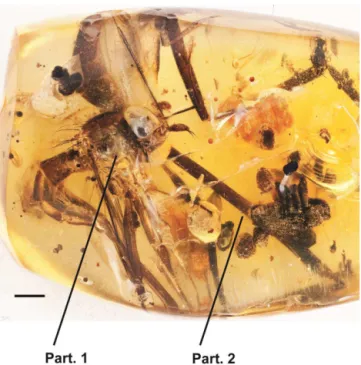
Figure 3.Photo of 1.5 femaleStylogaster grimaldiisp. n. right lat-eral view. Partial specimen 1 is intact except for the tip of terminalia, while all that remains of Partial specimen 2 is the abdomen with the terminalia intact. Part. 1, 2. Partial specimen 1, 2. Scale bar=1 mm.
but with visible limits.
Terminalia: Mainly yellow; sternite 5 sclerotized, with 2 transversal sets of black setulae; syntergosternite 7+8 nearly the same size of the epandrium; cerci smaller than posterior surstyli and apparently without hooked apex; cerci and posterior surstyli with black and white setae (Fig. 2b).
5 Female
Description: Same as male, except for modified abdomen and terminalia.
Abdomen: Abdomen twice as long as thorax and head combined. Abdominal tergites brownish-yellow, without clear maculation or markings (Figs. 3, 4); tergites 2, 3 and 4 about equal in size, while tergite 5 slightly larger and longer than others; tergite 6 somewhat constricted posteriorly and shorter than 5, and appearing fused with tergite 7 (Figs. 3, 4, 6a); tergite 1 with only white setae on the sides, tergite 2 with a transversal series of 4 long black setae; white setulae absent from the anterior ventral margin of tergites 3, 4 and 6; moderately long (shorter than in male) black setae present in the ventral margins of all tergites except tergite 1; sternites 1–6 totally membranous, but with visible limits.
Terminalia:Mainly dark brown; tergite 7 greatly elongated, cylindrical, slender, tube-like; tergite 8 virtually indistin-guishable, but appears fused to 7; tergite 9 indistinguishable but also appears fused; tergites 7–8 with short, regular black setae dorsally, ventrally and laterally; sternites appear
Figure 4.Photo of 1.5 femaleStylogaster grimaldiisp. n. left lateral view. Partial specimen 1 is intact except for the tip of terminalia, while all the remains of Partial specimen 2 is the abdomen with the terminalia intact. Part. 1, 2. Partial specimen 1, 2. Scale bar=1 mm.
fused; lateral lobes appear to protrude from tergite 8, are short with rounded tips, cercus short with long bushy black setae; hypoproct long (about 10 times as long as length of cercus), and slightly rounded at tip, but arrow-shaped overall, covered in long black setae, bushy (Fig. 6a–b). Comments: The other two known fossils of Conopidae have been discussed by Hennig (1966), Camras (1994), Stuke (2005) and Gibson and Skevington (2013); both are from Baltic amber. They are not associated directly with extant taxa, but resemble the non-stylogastrine conopids in having mobile female terminalia, pad-like appendices on the sternites and no facial carina protruding. Stylogaster grimaldiiis clearly aStylogaster, having all the characters of the group.
Discussion: The Stylogaster fauna was known only from extant species until now. The discovery of a fossil species from Oligo-Miocene sheds light regarding some questions about the evolutionary history and biogeography of this group.
Recent works on the phylogeny of Conopidae (Gibson et al., 2012; Gibson and Skevington, 2013) placeStylogaster
suggest-Figure 5.Illustration of male Stylogaster grimaldiisp. n., dorsal view. Scale bar=1 mm.
ing that the separation betweenStylogasterand the Conopi-daesensuHennig (1966) has this minimum age.Stylogaster grimaldiiprobably dates from the Oligo-Miocene boundary, ca. 23.03 Mya (International Commission on Stratigraphy, 2013; Iturralde-Vinent, 2001).
Stylogaster grimaldii was included in an all-species phy-logeny of Stylogaster, which divides the genus into two monophyletic groups, one New World clade and one Old World clade (Rocha et al., unpublished data). The New World group has a short ocellar triangle clade and a long ocellar triangle clade. S. grimaldii morphologically resembles the species with a short ocellar triangle, sharing with them many other characters, such as the subequal-sized pedicel and post-pedicel and the absence of thick bristles on the epandrium. The hypothesized position of other Stylogaster in this un-published work is congruent with the molecular and mor-phological cladogram of Gibson et al. (2012). The hypoth-esized position of the fossil species, as the sister of all other species with a short ocellar triangle, indicates that the sep-aration between Old/New World and long/short ocellar tri-angle New World clades is probably older than the Neogene (23.03 Mya). The position of S. grimaldii adds little to re-solve the conflict concerning the placement of Conopidae within Schizophora (Gibson et al., 2010). Different analytical methods used by Gibson et al. (2010) produced different hy-potheses, with Parsimony suggesting that conopids are sister to Schizophora and Bayesian suggesting that Conopidae are sister to Lauxaniidae Macquart. Fossil Lauxaniidae are rare (Evenhuis, 1994) but have been found in Baltic amber (Even-huis, 1994; Poinar Jr., 1992) and in the Fushun amber of
Figure 6. (a)Amalgamated illustration of female abdomen and terminalia ofStylogaster grimaldiisp. n., right lateral view. Scale bar =1 mm. (b) Illustration of female terminalia of Stylogaster grimaldiisp. n., Partial specimen 2, right lateral, slightly oblique view. Scale bar=0.5 mm.
China (Szwedo et al., 2013; Hong, 1981). The Fushun amber deposit has been dated to the Paleogene, specifically the Pa-leocene and early Eocene epochs (50–53 Mya) (Wang et al., 2014). Finding an older conopid fossil (in the 70 Mya range) would add considerable support to the conopid–Schizophora sister hypothesis. Given that the minimum age of conopids (47.9 Mya based onPalaeomyopa) is similar to that of the oldest lauxaniid, both hypotheses remain viable.
124 L. S. G. Rocha et al.: The firstStylogasterMacquart, 1835 (Diptera: Conopidae) fossil
least two lineages are represented by these taxa suggests that the West Indies was an important corridor and has lost much of its fauna through extinction events (Rocha et al., unpub-lished data). The insights coming from this fossil species il-lustrate the contribution that fossil taxa can make with re-spect to conopid phylogenetics.
Author contributions. L. S. G. Rocha analysed the specimens and wrote the descriptions and the main text; T. O. Burt revised the text, especially the conclusions, and made the drawings of the speci-mens; C. A. de Mello-Patiu and J. H. Skevington revised the text and made major corrections to the primary manuscript.
Acknowledgements. Funding for L. S. G. Rocha came from the Sandwich fellowship programme of CAPES (Coordenação de Aperfeiçoamento de Pessoal de Nível Superior, Brazil, proc. no. 10454-12-8) and FAPERJ – Fundação Carlos Chagas Filho de Amparo à Pesquisa do Estado do Rio de Janeiro, Brazil (proc. no. E-26/110.409/2012). Agriculture and Agri-Food Canada supported L. S. G. Rocha during his work in Ottawa and provide operational funds to J. H. Skevington. We thank David Grimaldi for providing the specimen to us, Jens-Hermann Stuke and Jeff Cumming for guidance and Michelle Locke for taking the stere-omicroscopic images of the male specimen. This work is part of the PhD thesis of L. S. G. Rocha.
Edited by: D. Korn
Reviewed by: J.-H. Stuke and S. Marshall
References
Bertone, M. A. and Wiegmann, B. M.: True flies (Diptera), in: The Timetree of Life, edited by: Hedges, S. B. and Kumar, S. (Eds.), Oxford University Press, Oxford, United Kingdom, 270–277, 2009.
Burt, T. O., Skevington, J. H., and Rocha, L. S. G.: Revision of NearcticStylogasterMacquart (Diptera: Conopidae), Can. Ento-mol., 146, 1–23, 2014.
Camras, S.: A new subfamily for the fossil conopid fly, Palaeomy-opa tertiaria(Diptera: Conopidae), Entomol. News, 105, 175– 177, 1994.
Camras, S. and Parrillo, P. P.: Review of the New WorldStylogaster (Diptera Conopidae), Ann. Entomol. Soc. Am., 78, 111–126, 1985.
Camras, S. and Parrillo, P. P.: NewStylogasterand ranges of Conop-idae (Diptera) from the Brazilian and Bolivian Amazonia, Acta Amaz., 25, 221–234, 1996.
Couri, M. S. and Barros, G. P. S.: Diptera hosts ofStylogaster Mac-quart (Diptera, Conopidae) from Madagascar and South Africa, Rev. Bras. Entomol., 54, 361–366, 2010.
Couri, M. S. and Pont, A. C.: Eggs of Stylogaster Macquart (Diptera: Conopidae) on Madagascan muscids (Diptera: Musci-dae), Proc. Calif. Acad. Sci., 57, 473–478, 2006.
Couri, M. S., Pont, A. C., and Kirk-Spriggs, A. H.: New Musci-dae (Diptera) hosts ofStylogaster Macquart (Diptera:
Conopi-dae) from the Afrotropical Region, Afr. Invertebr., 54, 401–408, 2013.
Cumming, J. M. and Wood, D. M.: Adult morphology and termi-nology, in: Manual of Central American Diptera, Vol. 1, edited by: Brown, B. V., Borkent, A., Cumming, J. M., Wood, D. M., Woodley, N. E., and Zumbado, M., NRC Research Press, Ottawa, Canada, 9–50, 2009.
Evenhuis, N. L.: Catalogue of the Fossil Flies of the World (IN-SECTA: DIPTERA), Backhuys Publishers, Leiden, Netherlands, 600 pp., 1994.
Gibson, J. F. and Skevington, J. H.: Phylogeny and taxonomic revi-sion of all genera of Conopidae (Diptera) based on morphologi-cal data, Zool. J. Linn. Soc.-Lond., 167, 43–81, 2013.
Gibson, J. F., Skevington, J. H., and Kelso, S.: Placement of Conop-idae (Diptera) within Schizophora based on mtDNA and nrDNA gene regions, Mol. Phylogenet. Evol., 56, 91–103, 2010. Gibson, J. F., Skevington, J. H., and Kelso, S.: A phylogenetic
anal-ysis of relationships among genera of Conopidae (Diptera) based on molecular and morphological data, Cladistics, 1, 1–34, 2012. Grimaldi, D. and Cumming, J. M.: Brachyceran Diptera in Creta-ceous ambers and Mesozoic diversification of the Eremoneura, B. Am. Mus. Nat. Hist., 239, 1–124, 1999.
Grimaldi, D. and Engel, M. S.: Evolution of the Insects, Cambridge University Press, New York, United States, xv+755 pp., 2005. Hennig, W.: Conopidae im Baltischen Bernstein (Diptera;
Cyclor-rapha), Stuttg. Beitr. Naturkd., 154, 1–24, 1966.
Hong, Y.: Eocene fossil Diptera Insecta in amber of Fushun coal-field, Geological Publishing House, Beijing, China, 166 pp., 1981.
International Comission on Stratigraphy: International Chronos-tratigraphic Chart v. 2013/01, http://www.stratigraphy.org/ ICSchart/ChronostratChart2013-01.pdf, last access: 19 June 2013.
Iturralde-Vinent, M. A.: Geology of the Amber-Bearing Deposits of the Greater Antilles, J. Caribb. Sci., 37, 141–167, 2001. Kotrba, M.: Shoot or stab? Morphological evidence on the
unre-solved oviposition technique in Stylogaster Macquart (Diptera? Conopidae), including discussion of behavioral observations, Proc. Entomol. Soc. Wash., 99, 614–622, 1997.
Lopes, H. S.: Contribuição ao conhecimento do gênero “ Stylo-gaster” Macquart, 1835 (Dipt.: Conopidae), Arch. Inst. Biol. Veg., 3, 257–293, 1937.
McAlpine, J. F.: Morphology and terminology – adults, in: Manual of Nearctic Diptera. v.1., edited by: McAlpine, J. F., Peterson, B. V., Shewell, G. E., Teskey, H. J., Vockeroth, J. R., and Wood, D. M., Research Branch Agriculture Canada, Ottawa, Canada, 9–63, 1981.
Papavero, N.: Family Conopidae, in: A Catalogue of the Diptera of the Americas South of the United States, edited by: Papavero, N., Museu de Zoologia, Universidade de São Paulo, São Paulo, Brazil, 1–47, 1971.
Pape, T. and Thompson, F. C. (Eds.): Systema Dipterorum, Version 1.5, http://www.diptera.org/, last access: 16 June 2013.
Poinar Jr., G. O.: Life in amber, Stanford University Press, Califor-nia, United States, 357 pp., 1992.
Rocha, L. S. G. and Mello-Patiu, C. A.: Revisão das espécies de StylogasterMacquart do grupostylatacom descrição de uma es-pécie nova do Brasil (Diptera, Conopidae, Stylogasterinae), Rev. Bras. Entomol., 53, 549–564, 2009.
Rocha, L. S. G. and Mello-Patiu, C. A.:StylogasterMacquart, 1835 (Diptera: Conopidae) from Northeastern Brazil: New records and two new species, Zootaxa, 3590, 23–36, 2012.
Schneider, M. A.: A taxonomic revision of Australian Conopidae (Insecta: Diptera), Zootaxa, 2581, 1–246, 2010.
Skevington, J. H., Thompson, F. C., and Camras, S.: Conopidae (Thick-Headed Flies), in: Manual of Central American Diptera v.2, edited by: Brown, B. V., Borkent, A., Cumming, J. M., Wood, D. M., Woodley, N. E., and Zumbado, M., NRC Research Press, Ottawa, Canada, 847–855, 2010.
Smith, K. G. V. and Peterson, B. V.: Conopidae, in: Manual of Nearctic Diptera, v.2, McAlpine, J. F., Peterson, B. V., Shewell, G. E., Teskey, H. J., Vockeroth, J. R., and Wood, D. M. (Eds.): Research Branch Agriculture Canada, Ottawa, Canada, 749–756, 1987.
Stuke, J.-H.: Eine neue Gattung der Conopidae aus dem Baltischen Bernstein (Diptera: Conopidae), Beitr. Entomol., 55, 313–318, 2005.
Stuke, J.-H.: Eine neue Art der GattungStylogasterMacquart, 1835 aus der Orientalis (Diptera: Conopidae), Entomol. Z., 116, 40– 42, 2006.
Stuke, J.-H.: A revision of Afrotropical species ofStylogaster Mac-quart (Diptera: Conopidae), with descriptions of twenty-one new species and an identification key, Afr. Invertebr., 53, 267–354, 2012.
Szwedo, J., Wang, B., and Zhang, H.: The Eocene Fushun amber – known and unknown (Lecture). The International Amber re-searcher Symposium: Amber. Deposits-Collections-The Market, Gda´nsk International Fair Co, Amberif, 2013, 33–37, 2013. Wang, B., Rust, J., Engel, M. S., Szwedo, J., Dutta, S., Nei, A., Fan,
Y., Meng, F., Shi, G., Jarembowski, E. A., Wrappler, T., Stebner, F., Fang, T., Mao, L., Zheng, D., and Zhang, H.: A diverse Pale-obiota in early Eocene Fushn amber from China, Curr. Biol., 24, 1606–1610, 2014.
Wiegmann, B. M., Trautwein, M. D., Winkler, I. S., Barr, N. B., Kim, J-W., Lambkin, C., Bertone, M. A., Cassel, B. K., Bayless, K. M., Heimberg, A. M., Wheeler, B. M., Peterson, K. J., Pape, T., Sinclair, B. J., Skevington, J. H., Blagoderov, V., Caravas, J., Kutty, S. N., Schmidt-Ott, U., Kampmeier, G. E., Thomp-son, F. C., Grimaldi, D. A., Beckenbach, A. T., Courtney, G. W., Friederich, M., Meier, R., and Yeates, D. K.: Episodic radiations in the fly tree of life, P. Natl. Acad. Sci. USA, 108, 5690–5695, doi:10.1073/pnas.1012675108, 2011.
Wolfe, A. P., Tappert, R., Muehlenbachs, K., Boudreau, M., McKel-lar, R. C., Basinger, J. F., and Garrett, A.: A new proposal con-cerning the botanical origin of Baltic amber, P. Roy. Soc. B-Biol. Sci., 276, 3403–3412, 2009.