SAGE Open April-June 2015: 1 –11 © The Author(s) 2015 DOI: 10.1177/2158244015593117 sgo.sagepub.com
Creative Commons CC BY: This article is distributed under the terms of the Creative Commons Attribution 3.0 License
(http://www.creativecommons.org/licenses/by/3.0/) which permits any use, reproduction and distribution of the work without further permission provided the original work is attributed as specified on the SAGE and Open Access page (http://www.uk.sagepub.com/aboutus/openaccess.htm). Article
Introduction
Universally, the trajectory of health and dying has changed dramatically (Swerissen & Duckett, 2014). Like most devel-oped countries, Australia is facing a rapidly growing aging population with the number of centenarians increasing by 235% in the past two decades (Australian Bureau of Statistics, 2011). The population aged above 65 years is projected to increase from 3.2 million in 2012 (14% of population) to 5.7-5.8 million in 2031 (18.3%-19.4%) and to 9.0-11.1 million in 2061 (22.4%-24.5% of population; Australian Bureau of Statistics, 2013b).
The end-of-life ideal of “dying peacefully at home” eludes most individuals with the majority of people of any age con-tinuing to die in institutions (Broad et al., 2013; Pockett, Walker, & Dave, 2010). Studies on peoples preferred place of death predominantly report a preference to die at home, yet Broad et al. (2013) recently found that more than half (54%) of all 16 million reported deaths across 45 populations occurred in hospital. In addition, the number of hospital and institutional deaths doubled for people aged 85 years and above (Broad et al., 2013). Similarly, about two-thirds of Australians die between 75 and 95 years of age, and about 70% of deaths are expected (Australian Bureau of Statistics, 2013a; Swerissen & Duckett, 2014). Between 60% and 70%
of people want to die at home or a home-like environment (hospitals and residential care are the least preferred options), but only approximately 14% die at home (Broad et al., 2013; Foreman, Hunt, Luke, & Roder, 2006; Higginson, Sarmento, Calanzani, Benalia, & Gomes, 2013). The main reasons peo-ple are unable to die at home are due to a lack of support services or a lack of discussion about dying and planning for it (Swerissen & Duckett, 2014).
Determining how to provide quality and affordable health care to older people, particularly end-of-life care, has driven investment in advance care planning (ACP) (Alano et al., 2010; Bravo, Dubois, & Wagneur, 2008; Morrison & Meier, 2004). ACP provides assurance for quality of life, individual autonomy, provision of people’s rights and wishes to be maintained even if they have lost the capacity to communi-cate, and peace of mind for family members (O’Malley,
1
Menzies Health Institute Queensland, Griffith University, Brisbane, Australia
2
Mater Children’s Hospital, Brisbane, Australia 3
University of Auckland, New Zealand
Corresponding Author:
Amanda Wheeler, Griffith University, Logan Campus, University Drive, Brisbane 4131, Australia.
Email: [email protected]
Advance Care Planning for Older
Australians Living in the Community:
The Impact of a Group Education Session
Liz Crowe
1,2, Val Quinn
1, Lesley Chenoweth
1,
Sanjeewa Kularatna
1, Jenny Boddy
1, and Amanda J. Wheeler
1,3Abstract
To evaluate the impact of advance care planning (ACP) education with people aged ≥60 years living in the community. The interactive workshop explored all aspects of ACP—legal, emotional, physical, spiritual, role of significant others—and allowed reflection time, questions, and group discussion. Evaluation of knowledge and attitudes toward ACP were completed pre- and post-training. Readiness-to-change and feedback about the workshop quality were collected post-training. Eleven workshops were delivered in Queensland (132 matched pre- and post-questionnaires compared for analysis). Participant’s ACP knowledge and confidence increased significantly (12/13 statements, p<0.05) alongside some shift in attitudes (4/12 statements, p<0.05) after training. Participants were engaged and rated the workshop positively. Single ACP workshops are an effective intervention for healthy older people in the community. Training should focus on demystifying legislation and documentation, the importance of planning and communicating wishes while still healthy, and the need to regularly review and update plans. Follow-up is required to assess translation of education into ACP action.
Keywords
Caudry, & Grabowski, 2011; Simon, Murray, & Raffin, 2008). ACP is the process where people reflect on their per-sonal values, beliefs, and goals for the future, and then typi-cally in consultation with family, friends, religious leaders, and health professionals, they formulate (either formally or informally) a health plan stipulating their wishes should they ever lose capacity to participate in or communicate their future health care (Detering, Hancock, Reade, & Silvester, 2010; Swerissen & Duckett, 2014). Despite acknowledg-ment that older people want to participate in their future health care plans, and governments investing in ACP initia-tives, completion and engagement rates consistently remain low across the western world with estimates believed to be less than 20% (Collins, Parks, & Winter, 2006; Pautex, Herrmann, & Zulian, 2008; Ramsaroop, Reid, & Adelman, 2007; Scott, Mitchell, Reymond, & Daly, 2013). Two Australian studies reported rates of 5% in residential aged care facilities (Bezzina, 2009) and 8% of emergency patients (Taylor, Ugoni, Cameron, & McNeil, 2003).
There is strong evidence that the most opportune time to engage consumers and their families in discussion about ACP is when they are well and living independently in the community (Malcomson & Bisbee, 2009; Mezey, Leitman, Mitty, Botterell, & Ramsey, 2000; Patel, Sinuff, & Cook, 2004; Perkins, 2000; Ramsaroop et al., 2007). Yet frequently, ACP is raised without foresight or planning when people are hospitalized or diagnosed with a terminal illness (Mezey et al., 2000). Perkins and colleagues (2002) found that rais-ing the issue of ACP durrais-ing a hospital admission is often not appropriate or successful due to people’s vulnerabilities. The systematic review of interventions to promote advance health directive (AHD) completion in older adults by Bravo et al. (2008) showed greater success rates among non-clinical pop-ulations and nursing home residents than among medical patients. Therefore, a paradigm shift in relation to ACP engagement and education with a focus on trajectory of dis-ease and frailty and incrdis-eased communication and partner-ship will be paramount to the success of ACP completion in the future (Baughman et al., 2012). Community education on ACP will also be vital if these rates are to change and the needs of older people are met in end-of-life care (Burge et al., 2013; Cohen, McCannon, Edgman-Levitan, & Kormos, 2010; Detering et al., 2010; Ramsaroop et al., 2007). There is a lack of literature on community-based ACP education for non-clinical populations of older adults. We located only three published studies of group ACP education for medical outpatients (Burge et al., 2013; Dipko, Xavier, & Kohlwes, 2004; Landry, Kroenke, Lucas, & Reeder, 1997) and one study that included both medical outpatients and residential housing participants (High, 1993). The studies used a range of educational interventions, that is, single session and mul-tiple sessions, oral and written information.
In light of this, we developed and delivered a series of eleven 2.5-hr workshops in Queensland, Australia for people aged 60 years and above who lived independently in the
community. Led by a senior health practitioner experienced in palliation, end-of-life discussions, and grief and loss coun-seling, the ACP workshop is based on adult learning princi-ples that acknowledge that adults learn best when taught through a variety of mediums, and seeks to explore life expe-riences and motivation as key themes to learning about ACP (Knowles, 1977). The workshop promotes ACP not just as something to explore in end-of-life care but as an important component of broader life planning allowing the consumer ongoing autonomy should he or she lose capacity to com-municate their wishes in the future. The workshop looked extensively at the emotions and practicalities of engaging in ACP with a particular focus on Queensland legislation1 relat-ing to the Endurrelat-ing Power of Attorney (EPA) for finances, health and personal issues, and the AHD. The workshop explores important issues such as engaging significant oth-ers, choosing the right person as a substitute decision maker and the barriers and emotions involved in decision making. Two vignettes of people aged ≥60 were shown to demon-strate polar ideological positions regarding ACP decisions about their care. The workshop is highly interactive and allows considerable time for questions, reflection, and small group discussions.
In this article, we report the results of the evaluation con-ducted prior to and at the completion of the workshops with respect to the impact of the education on consumers’ knowl-edge, attitudes in relation to ACP, and feedback related to the quality of the education.
Method
Study Design and Setting
This pre–post design study was conducted with two groups of consumers aged ≥60 years. Consumers were recruited from a range of community-based sporting, recreational, educational, and social clubs, community service organiza-tions, health groups, hospital volunteers and a retirement complex via email, newspaper advertisement, expression of interest postcards, posters, and public information sessions. Despite multiple strategies, there was little interest or engage-ment from chronic health organizations and populations, which is consistent with previous research (Patel et al., 2004; Perkins, 2000). In contrast, the response from independent consumers expressing interest was high and participant num-bers had to be capped because demand exceeded the limited number of workshops offered and resources available.
(T1) to ascertain their current knowledge, attitudes, and experiences in relation to ACP. At the end of the workshop, they completed a second survey (T2) to evaluate whether the workshop had improved their knowledge, attitudes, and future behavior with the ACP process.
Ethics approval was granted by the University Human Research Ethics Committee (HSV/31/11/HREC) and by the local Health Human Research Ethics Committee (HREC/12/ QGC/4/AM01).
Data Collection
All workshop participants in both groups were invited to complete a paper-based questionnaire immediately prior to training (T1) and immediately after completing the training (T2). Group 2 participants (delayed training comparison group) were invited to complete the pre-training question-naire on two occasions: (i) online in October 2012 (T1a) and (ii) immediately prior to training (T1b) to ensure that any changes observed were due to the impact of the training. The self-report questionnaire used for assessing consumer knowl-edge, attitudes, and experiences of ACP was developed from published survey instruments identified in a literature review (Alano et al., 2010; Jackson, Rolnick, Asche, & Heinrich, 2009; Mezey et al., 2000) and other training evaluations (Christie, Black, Dunbar, Pulford, & Wheeler, 2013; Walters, Raymont, Galea, & Wheeler, 2012; Wheeler, Fowler, & Hattingh, 2013). Amendments were made to wording of the published instruments so that it was more familiar to Queensland consumers, for example, physician was changed to doctor and advance directive was changed to advance health directive. The modified questionnaire was piloted with health care consumers aged ≥60 years (n = 8), health care practitioners (n = 4), and academic staff of two universi-ties (n = 5) and amended accordingly to promote clarity.
The final version of the pre-training questionnaire col-lected demographic information and prior experience of ACP, including any previous training. Participants were asked to rate statements regarding their attitudes using a 7-point Likert-type scale (1 = strongly agree and 7 = strongly disagree) and knowledge about ACP by selecting a “true,” “false,” or “unsure” option at both time points. Participant ratings of their satisfaction and quality of the workshop were collected immediately after training (T2). Comments on areas of the training they found valuable or that they thought should be removed from the program were also sought with free-text comments.
Data Analysis
The primary analysis to evaluate the impact of training was between participant responses before training (T1) and immediately after training (T2).
The two groups of training participants (Group 1 [T1; immediate training group] and Group 2 [T1a; delayed training
comparison group]) were compared at baseline (participant demographics and pre-training attitude and knowledge responses; T1 vs. T1a) and within Group 2 (comparison group; T1a and T1b). This analysis involved Pearson’s chi-square test for demographics, McNemar’s test for comparing knowledge responses, and Wilcoxon signed rank test for attitude comparisons.
Descriptive statistics were used to describe demographic characteristics of the participants, prior ACP experience, and the workshop evaluation. To compare knowledge and atti-tude change between pre- and post-training (T1 and T2), non-parametric analysis for matched pairs was conducted using McNemar’s chi-square tests for categorical data and Wilcoxon signed rank test for Likert scale data. The analysis was carried out using SPSS21 software, and p values lesser than 0.05 were indicative of statistical significance.
Study group (i.e., Group 1 = immediate training or Group 2 = delayed training) was included in a random-effects linear models analysis (Norman, 2010) to test a null hypothesis of no difference in responses between study groups (sensitivity analysis). The sensitivity analysis was conducted using Stata 13 software.
Responses to the open-ended questions were coded using constant comparative checking and comments placed into themes.
Results
A total of 11 workshops were delivered between October 2012 and April 2013 with 207 participants. The pre-training questionnaire was completed by 137 workshop participants; Group 1 = 81 and Group 2 = 56. Training evaluation data were missing/incomplete for 70 participants either because one of the questionnaires was not completed or both had not been completed due to age-related problems such as frailty, eyesight problems, or loss of fine motor skills. Nobody was excluded from participating in the workshop. Matched pre- and post-training questionnaires were completed by 132 workshop participants.
Group 1 and Group 2 (p=0.22; sensitivity analysis not pre-sented in tables). The number of differences was considered to be minor, and therefore, Group 1 and Group 2 data were combined to evaluate the impact of the workshop.
The demographic characteristics of the 137 participants are provided in Table 1; the majority were female (70.0%), in a relationship (63.8%), and the mean age was 69.5 years (SD = 6.2; range = 60-87 years). As described above, there were no significant differences between participants in the two study groups (Table 1).
Prior to training, the majority of the participants had some awareness of ACP. Around two-thirds (68.5%) stated that they had heard of an AHD, and almost all were aware of an EPA (96.8%). About half of the participants (51.6%) were aware of Not for Resuscitation Orders, and only 21.0% were aware of Statutory Health Attorneys and 15.3% of Acute Resuscitation Plans.2
The participant’s previous experience of ACP prior to the workshop is presented in Table 2. More than half (57.8%) had read information about ACP, but only 6.0% had been to any courses or education sessions about ACP. Few partici-pants had any prior experience of completing an AHD for themselves (27.6%) or others (12.6%). However, more than two-thirds had previously completed an EPA for themselves (67.5%). Significantly, only 16.5% of participants reported
that a general practitioner (GP) or another health care pro-vider had raised the issue of ACP with them. Participants stated that their major motivation to attend this workshop was to learn more about ACP (94.7%).
Impact of Training on Knowledge of ACP
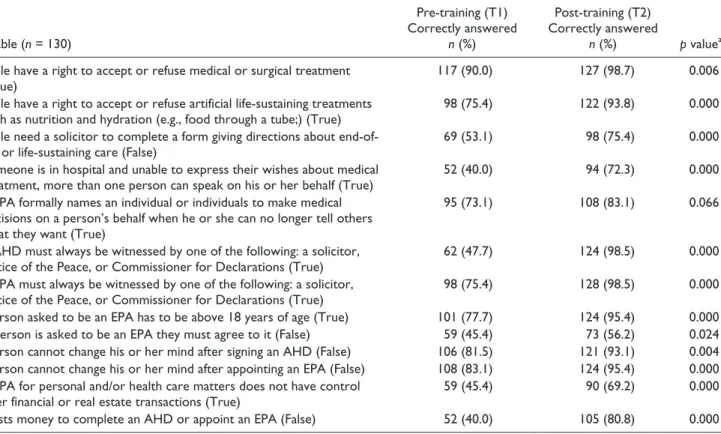
The study sought to assess change in participant’s knowl-edge about ACP after completing the workshop. Participants were asked to indicate whether 13 knowledge-based state-ments about ACP were true, false, or they were unsure before and after training (Table 3). After the training, the proportion of people who answered these questions about ACP correctly increased significantly for 12 of the 13 statements. This reflected an improved understanding of participants’ rights to be involved in decision making now and in the future and to change their mind about their wishes.
Impact of Training on Attitudes to ACP
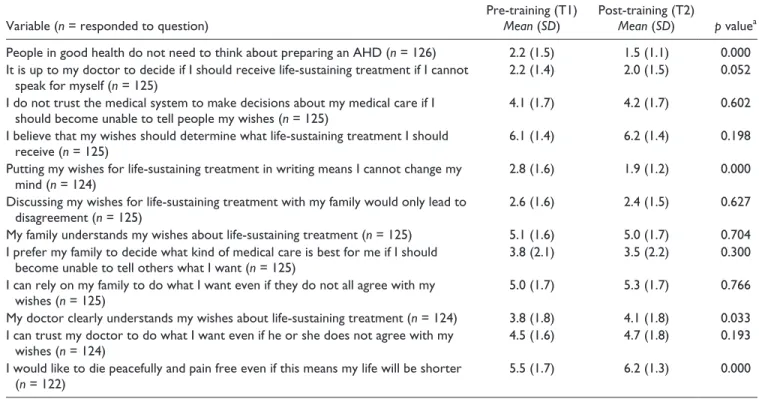
The participants were requested to indicate their level of agreement with 12 statements on a 7-point Likert-type scale (1 = strongly disagree and 7 = strongly agree) before and after the training. Overall, four of the attitudinal statements changed significantly after training (Table 4). There was an Table 1. Demographic Characteristics of Workshop Participants.
Variable
Total
n = 137
n (%)
Group 1
n = 81
n (%)
Group 2
n = 56
n (%) p valuea
Gender 0.513
Female 89 (70.1) 57 (72.2) 32 (66.7)
Male 38 (29.9) 22 (27.8) 16 (33.3)
Age (years) 0.694
60-66 39 (31.0) 23 (29.5) 16 (33.3)
67-73 57 (45.2) 37 (47.4) 20 (41.7)
74-80 22 (17.5) 12 (15.4) 10 (20.8)
81-87 8 (6.3) 6 (7.7) 2 (4.2)
Country of birth 0.051
Australia/New Zealand 100 (73.0) 65 (80.2) 35 (62.5)
United Kingdom 18 (13.1) 9 (11.1) 9 (16.1)
Others 19 (13.9) 7 (8.6) 12 (21.4)
Marital status 0.364
In a relationship 81 (63.8) 48 (60.8) 33 (68.8)
Not in a relationship 46 (36.2) 31 (39.2) 15 (31.2)
Employment status 0.819
In employment 17 (13.4) 11 (13.9) 6 (12.5)
No employment 110 (86.6) 68 (86.1) 42 (87.5)
Religion 0.978
Catholic 20 (16.1) 13 (16.7) 7 (15.2)
Anglican 40 (32.3) 25 (32.1) 15 (32.6)
Other 64 (51.6) 40 (51.2) 24 (52.2)
Note. Australians and New Zealanders were considered together. aχ2
increase in those who disagreed that people in good health did not need an AHD, an increase in those who disagreed that if they put their wishes in writing they could not change their mind, an increase in those who agreed they would like to die peacefully and pain free even if their life would be shorter, and an increase in those who agreed their doctor should understand their wishes about life-sustaining treatment. At both time points, 50% to 60% of consumers agreed that (a)
their family would understand and (b) abide by their wishes, and approximately 40% of consumers agreed that they could trust their doctor to abide by their wishes.
Rating the Training
In the post-training questionnaire, participants were asked to rate the training on a scale of 1 (very poor) to 7 (excellent). Table 2. Prior Experience With Advance Care Planning (n = 137).
Yes
n (%)
No
n (%)
Unsure
n (%)
Variable
Have you ever completed an AHD for yourself? 35 (27.6) 87 (68.5) 5 (3.9)
Have you ever completed an EPA for yourself? 85 (67.5) 38 (30.2) 3 (2.4)
Have any of your family members completed an AHD? 26 (20.6) 79 (62.7) 21 (16.7) Have any of your family members completed an EPA? 68 (54.4) 40 (32.0) 17 (13.6) Have you ever assisted someone else to complete an AHD? 16 (12.6) 108 (85.0) 3 (2.4) Have you ever assisted someone else to complete an EPA? 35 (28.0) 89 (71.2) 1 (0.8)
Have you ever cared for someone with an AHD? 19 (15.0) 105 (82.7) 3 (2.4)
Have you ever cared for someone with an EPA? 44 (34.6) 82 (64.6) 1 (0.8)
Have you ever been a patient in an intensive care unit? 23 (18.4) 99 (79.2) 3 (2.4) Have you ever had a family member as a patient in an intensive care unit? 61 (48.0) 61 (48.0) 5 (3.9) Has your GP or any other health care provider ever raised the issue of an AHD or EPA with you? 21 (16.5) 105 (82.7) 1 (0.8)
Note. AHD = Advance Health Directive; EPA = Enduring Power of Attorney; GP = general practitioner.
Table 3. Comparison of Knowledge About Advance Care Planning Pre- and Post-Training.
Variable (n = 130)
Pre-training (T1) Correctly answered
n (%)
Post-training (T2) Correctly answered
n (%) p valuea
People have a right to accept or refuse medical or surgical treatment (True)
117 (90.0) 127 (98.7) 0.006
People have a right to accept or refuse artificial life-sustaining treatments such as nutrition and hydration (e.g., food through a tube;) (True)
98 (75.4) 122 (93.8) 0.000
People need a solicitor to complete a form giving directions about end-of-life or end-of-life-sustaining care (False)
69 (53.1) 98 (75.4) 0.000
If someone is in hospital and unable to express their wishes about medical treatment, more than one person can speak on his or her behalf (True)
52 (40.0) 94 (72.3) 0.000
An EPA formally names an individual or individuals to make medical decisions on a person’s behalf when he or she can no longer tell others what they want (True)
95 (73.1) 108 (83.1) 0.066
An AHD must always be witnessed by one of the following: a solicitor, Justice of the Peace, or Commissioner for Declarations (True)
62 (47.7) 124 (98.5) 0.000
An EPA must always be witnessed by one of the following: a solicitor, Justice of the Peace, or Commissioner for Declarations (True)
98 (75.4) 128 (98.5) 0.000
A person asked to be an EPA has to be above 18 years of age (True) 101 (77.7) 124 (95.4) 0.000 If a person is asked to be an EPA they must agree to it (False) 59 (45.4) 73 (56.2) 0.024 A person cannot change his or her mind after signing an AHD (False) 106 (81.5) 121 (93.1) 0.004 A person cannot change his or her mind after appointing an EPA (False) 108 (83.1) 124 (95.4) 0.000 An EPA for personal and/or health care matters does not have control
over financial or real estate transactions (True)
59 (45.4) 90 (69.2) 0.000
It costs money to complete an AHD or appoint an EPA (False) 52 (40.0) 105 (80.8) 0.000
Note. EPA = Enduring Power of Attorney; AHD = Advance Health Directive. a
Table 4. Comparison of Attitudes About Advance Care Planning Pre- and Post-Training.
Variable (n = responded to question)
Pre-training (T1)
Mean (SD)
Post-training (T2)
Mean (SD) p valuea
People in good health do not need to think about preparing an AHD (n = 126) 2.2 (1.5) 1.5 (1.1) 0.000 It is up to my doctor to decide if I should receive life-sustaining treatment if I cannot
speak for myself (n = 125)
2.2 (1.4) 2.0 (1.5) 0.052
I do not trust the medical system to make decisions about my medical care if I should become unable to tell people my wishes (n = 125)
4.1 (1.7) 4.2 (1.7) 0.602
I believe that my wishes should determine what life-sustaining treatment I should receive (n = 125)
6.1 (1.4) 6.2 (1.4) 0.198
Putting my wishes for life-sustaining treatment in writing means I cannot change my mind (n = 124)
2.8 (1.6) 1.9 (1.2) 0.000
Discussing my wishes for life-sustaining treatment with my family would only lead to disagreement (n = 125)
2.6 (1.6) 2.4 (1.5) 0.627
My family understands my wishes about life-sustaining treatment (n = 125) 5.1 (1.6) 5.0 (1.7) 0.704 I prefer my family to decide what kind of medical care is best for me if I should
become unable to tell others what I want (n = 125)
3.8 (2.1) 3.5 (2.2) 0.300
I can rely on my family to do what I want even if they do not all agree with my wishes (n = 125)
5.0 (1.7) 5.3 (1.7) 0.766
My doctor clearly understands my wishes about life-sustaining treatment (n = 124) 3.8 (1.8) 4.1 (1.8) 0.033 I can trust my doctor to do what I want even if he or she does not agree with my
wishes (n = 124)
4.5 (1.6) 4.7 (1.8) 0.193
I would like to die peacefully and pain free even if this means my life will be shorter (n = 122)
5.5 (1.7) 6.2 (1.3) 0.000
Note. Lower scores indicate disagreement with statement and higher scores indicate agreement. AHD = advance health directive; EPA = Enduring Power of Attorney. SD=standard deviation.
a
Wilcoxon signed rank test. p<0.05 indicates statistical significance.
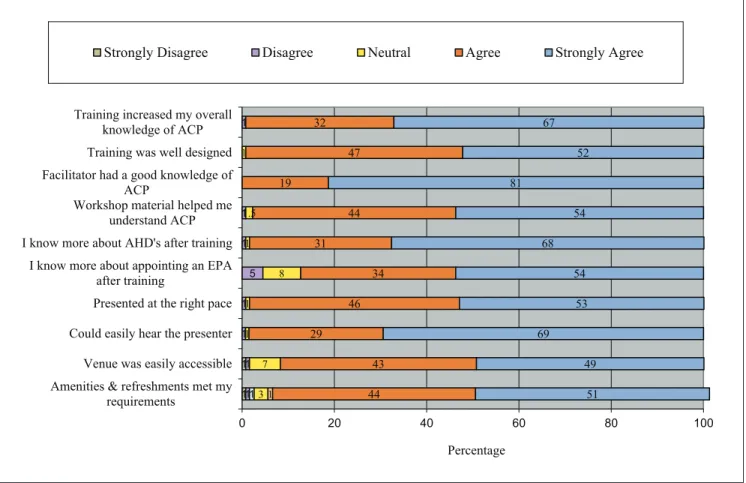
Overall, the majority of participants rated the training as “excellent” (61.2%); 35.8% gave an overall rating of “very good,” 2.2% rated “good,” and one person rated “very poor.” All but one participant (n = 130/131) recommended that the training be made available to their family and friends. Participants were asked to rate various aspects of the train-ing. Figure 1 shows the distribution of ratings. In all cases, the majority of participants agreed/strongly agreed with the statements regarding knowledge acquired, workshop presen-tation style, and level and accessibility of training informa-tion and venue.
The training areas that were identified as particularly good were the presentation style (particularly the use of humor)—“It was clear and humorous and neither conde-scending (older people are frequently talked down to) nor over our heads”—and the opportunity to reflect and ask questions. Overall, the responses were overwhelmingly posi-tive about the content, format, and mode of presentation: “The quality of the presentation, the enthusiasm and knowl-edge of presenter and preparation that had gone into this presentation.” Many participants stated that the training gave them the information they needed to start the ACP pro-cess and/or review their current documentation: “Very well presented, no boring bits! Gave me more incentive to get my ACP underway.”
Participants identified that the most valuable aspects of the training were understanding the relationship between
AHDs and EPAs, the legislation and documentation required, the importance of planning for the future while still well, and the need to regularly review and update an ACP: “Need to complete forms whilst you are fit and well enough to do it correctly.” They identified that discussions needed to occur before a health crisis with clear communication and full and open discussions with family members, friends, and even neighbors: “Importance of thinking ahead so as to relieve burden from family at time of grief.”
Participants were asked to identify areas of the training that could be improved or changed and most responded “nothing.” A few participants wanted the workshop to be shorter or longer, and several people commented that they had reached “absorption point!” by the end. A small number of participants requested that a summary be available to take away for further reflection or to share with others.
Discussion
does not guarantee a consumer will complete an AHD, nor if they do does this guarantee that they will receive care as they directed.
Changes in participant’s knowledge and confidence in the ACP process after the workshop were overwhelmingly posi-tive. The only area that did not change significantly was in relation to appointing an EPA, as participants had a better working knowledge of this process prior to attending the training.
Beliefs and attitudes are an important component to peo-ple engaging and participating in the ACP process. Attitudinal change toward ACP at an individual and societal level is important for ACP to gain momentum. While there were less significant changes in these statements at the completion of the workshop, most importantly, there was a positive shift toward recognizing the need for preparing an AHD while in good health and that ACP is a flexible and dynamic process that can be altered throughout life’s journey. We also found that most consumers agreed that their family and to a lesser extent their doctor would carry out their wishes. This finding is consistent with work by Alano et al. (2010) with partici-pants stating that they were confident in family, nurses, and physicians abiding by their wishes. However, research by Sonnenblick, Friedlander, and Steinbert (1993) and Zweibel
and Cassel (1989) suggests that this confidence is unfounded with discrepancies of up to 50% between patient decisions and their health care proxy. In another study, surrogate deci-sion making about a patient’s end-of-life care was often inac-curate and biased by the surrogates own preferred treatment choices (Fagerlin, Ditto, Danks, Houts, & Smuker, 2001). The workshops did not specifically address this issue but did focus on the importance of choosing the right family member or significant other to be the legal guardian of health and finances. The workshop also highlighted that in Queensland the AHD is a legal document that by law has to be followed by both family members and health professionals.
Workshop participants were enthusiastic about ACP and motivated to remain independent. Acknowledging individual values and beliefs in relation to making decisions about health issues is a very personal and sensitive issue (Lambert et al., 2005), and recognizing participants lives and values was a constructive way to initiate discussions about ACP in the workshop (Lambert et al., 2005; Patel et al., 2004; Tulsky, Fischer, Rose, & Arnold, 1998). Working through these end-of-life issues with people who are independent and moti-vated to participate and who identify as having good health is recommended (Burge et al., 2013; Maxfield, Pohl, & Colling, 2003; Perkins, 2000; Swerissen & Duckett, 2014).
1 1
1 1 1 1 5 1 1 1
13 7 1 1
8 1 1.5 1
1 44
43 29
46 34 31
44 19
47 32
51 49 69
53 54 68
54 81
52 67
0 20 40 60 80 100
Amenities & refreshments met my requirements
Venue was easily accessible Could easily hear the presenter Presented at the right pace I know more about appointing an EPA
after training
I know more about AHD's after training Workshop material helped me
understand ACP Facilitator had a good knowledge of
ACP
Training was well designed Training increased my overall
knowledge of ACP
Percentage
Strongly Disagree Disagree Neutral Agree Strongly Agree
Figure 1. Agreement Rating with Statements about ACP Training.
The most valued aspects of the training were demystify-ing the legislation and documentation required in the pro-cess, the importance of undertaking the planning and communicating wishes while still identifying as being healthy and well, and the need to regularly review and update an ACP. There were no major suggestions from participants about improving the workshop though several people requested a written summary of the training.
The documents that are associated with ACP continue to be reported as a barrier to engagement (Porensky & Carpenter, 2008). Difficulties accessing, understanding, and completing the forms due to wide ranges in levels of literacy in our community have been a continuing theme reported in ACP research and our experience was no different (Cohen et al., 2010; Green & Levi, 2009; Perkins, 2000; Schickedanz et al., 2009; Sudore et al., 2008). A number of participants reported previously going to see a health professional to complete their ACP and being told “there was no time,” which is consistent with previous studies (Schickedanz et al., 2009; Scott et al., 2013). In an attempt to address this, each workshop participant was provided with the relevant ACP paperwork, was able to ask questions, and was guided to complete these forms during the workshop.
We found that older people were ready to discuss and engage in ACP education. Older people today are active information seekers and are reported to be more interested in autonomy than previous generations (Manafo & Wong, 2012). In addition, research has found that there is no corre-lation between being diagnosed with a life-limiting condition or being hospitalized and likelihood of completing an ACP (Alano et al., 2010; Perkins, 2000; Samsi & Manthorpe, 2011). Similarly in our study, while we did not look at ACP completion rates, we were overwhelmed with the number of independent consumers wanting to participate in the work-shop, and despite extensive marketing and direct engage-ment with consumer health services and organizations, we did not receive any expressions of interest from these areas. The community need for this type of education is supported by the continuing requests for workshops still being made to the researchers 18 months after completion of this part of the project.
Our findings provide strong support for the value and effectiveness of providing single education sessions on ACP for large numbers of people living in the community with respect to engaging older people in conversations about ACP and increasing knowledge about the ACP process (Burge et al., 2013). While this provides information about readiness to change, it does not tell us about behavior change in terms of rates of ACP completion. This is the focus of a subsequent study. Older consumers have communicated their prefer-ences for education to be delivered face to face (Bravo et al., 2011; Brown et al., 2005), in a group setting (Burge et al., 2013; Cohen et al., 2010), and with a respected health profes-sional (Morrison & Meier, 2004). In contrast, simply provid-ing written information about ACP to this population has
been shown to be relatively ineffective in terms of ACP com-pletion rates (Brown et al., 2005; Ramsaroop et al., 2007). In addition, while researchers have proposed that having mul-tiple ACP conversations with a health care professional is the most effective intervention to guarantee ACP completion (Alano et al., 2010; Bravo et al., 2008; Patel et al., 2004), multiple sessions are often difficult in terms of time and cost for both the health professional and older people and their families. In a comparison of three education strategies with a Veterans Affairs outpatient population (a group session, one individual session, or multiple individual sessions), Dipko et al. (2004) found that group education was twice as tive on AHD completion as a single session and just as effec-tive as multiple sessions but less time-consuming. The authors concluded that group education was an effective and time- and cost-efficient tool for facilitating AHD completion among older people.
Due to the age of the participants and previous research indicating that older people prefer a relationship with educa-tors involved in ACP (Alano et al., 2010; Bravo et al., 2008; Malcomson & Bisbee, 2009), recruitment, retention, and engagement of interested participants in our study had a tar-geted approach. Participants were phoned after submitting an expression of interest form by email, fax, or post. These fol-low-up calls were useful to establish a relationship and trust with participants (Hamel, Guse, Hawranik, & Bond, 2002). A direct number and email contact were also given to all par-ticipants should they have further questions about the proj-ect, the workshop, catering, or parking. A research assistant was available to speak with the participants in relation to the study and broader issues and was present at the training as a familiar person to welcome participants. Venues were appro-priate for all levels of mobility, located close to public trans-port and provided ample car parking. These strategies were employed to ensure that participants remained engaged in the education and research, and it also led to enrollment of more participants in future workshops.
backgrounds (Cohen et al., 2010), and this requires further work as these people may have specific health literacy needs. In addition, there is a need for health professionals to receive further information on ACP, end-of-life care, and training on engaging and working with health consumers (Kahana & Kahana, 2003), and consequently, we are piloting workshops for health professionals.
Acknowledging these limitations, this study has important implications for the future of ACP education for consumers above the age of 60 years who want to incorporate health planning into broader retirement planning and planning for frailty. There has been limited research on the knowledge and behavior of older people who have no imminent health or care decisions in relation to ACP. This study has successfully demonstrated that delivery of a 2.5-hr workshop is effective in improving knowledge, confidence, and beliefs about ACP, with little associated costs or resources required. Adult learn-ing principles, together with facilitator authenticity, empathy, and respect for participant’s understanding and desire for knowledge, are important elements for successfully engaging older people in ACP education. Older people are empowered and motivated to remain autonomous about their health and well-being into the future and identify ACP as an appropriate intervention. The reluctance of people with acute health issues or receiving palliative care to engage in ACP is univer-sal, and a paradigm shift in ACP education and target audi-ence is required to ensure engagement.
Acknowledgments
The research team would like to thank all of the consumer partici-pants who gave so generously of their time and participated so enthusiastically in the training and research.
Declaration of Conflicting Interests
The author(s) declared no potential conflicts of interest with respect to the research, authorship, and/or publication of this article.
Funding
The author(s) disclosed receipt of the following financial support for the research and/or authorship of this article: The study was made possible by a grant from the JO and JR Wicking Trust.
Notes
1. All Australian jurisdictions have advance care planning (ACP)
regulatory and legislative frameworks in place; however, there is no national standard for ACP (Swerissen & Duckett, 2014). 2. Acute Resuscitation Plans replace the Not for Resuscitation
Orders in Queensland, Australia.
References
Alano, G. J., Lesser, M., Wolf-Klein, G. P., Pekmezaris, R., Tai, J. Y., Hussain, M. J., . . . Reddy, R. (2010). Factors
influenc-ing older adults to complete advance directives. Palliative &
Supportive Care, 8, 267-275. doi:10.1017/s1478951510000064
Australian Bureau of Statistics. (2011). Population by age and sex,
Australian states and territories. Retrieved from http://www. abs.gov.au/ausstats/[email protected]/0/AE3CAF747F4751CDCA257 9CF000F9ABC?OpenDocument
Australian Bureau of Statistics. (2013a). Deaths Australia
(33020DO019). Canberra: Author.
Australian Bureau of Statistics. (2013b). Population projections,
Australia, 2012 (base) to 2101. Retrieved from http://www. abs.gov.au/ausstats/[email protected]/Lookup/3222.0main+featu res52012 (base) to 2101
Baughman, K. R., Ludwick, R. E., Merolla, D. M., Palmisano, B. R., Hazelett, S., Winchell, J., & Hewit, M. (2012). Professional judgments about advance care planning with
community-dwell-ing consumers. Journal of Pain and Symptom Management,
43, 10-19. doi:10.1016/j.jpainsymman.2011.03.023
Bezzina, A. J. (2009). Prevalence of advanced care directives in
aged care facilities of the Northern Illawarra. Emergency
Medicine Australasia, 21, 379-385.
Bravo, G., Dubois, M.-F., Cohen, C., Wildeman, S., Graham, J., Painter, K., & Bellemare, S. (2011). Are Canadians providing advance directives about health care and research
participa-tion in the event of decisional incapacity? Canadian Journal of
Psychiatry, 56, 209-218.
Bravo, G., Dubois, M.-F., & Wagneur, B. (2008). Assessing the effectiveness of interventions to promote advance directives among older adults: A systematic review and multi-level
analy-sis. Social Science & Medicine, 67, 1122-1132.
Broad, J. B., Gott, M., Kim, H., Boyd, M., Chen, H., & Connolly, M. J. (2013). Where do people die? An international compari-son of the percentage of deaths occurring in hospital and resi-dential aged care settings in 45 populations, using published
and available statistics. International Journal of Public Health,
58, 257-267. doi:10.1007/s00038-012-0394-5
Brown, M., Grbich, C., Maddocks, I., Parker, D., Roe, P., & Willis, E. (2005). Documenting end-of-life decisions in residential
aged care facilities in South Australia. Australian and New
Zealand Journal of Public Health, 29, 85-90.
Burge, A. T., Lee, A., Nicholes, M., Purcell, S., Miller, B., Norris, N., . . . Holland, A. E. (2013). Advance care planning educa-tion in pulmonary rehabilitaeduca-tion: A qualitative study
explor-ing participant perspectives. Palliative Medicine, 27, 508-515.
doi:10.1177/0269216313478448
Christie, G., Black, S., Dunbar, L., Pulford, J., & Wheeler, A. (2013). Attitudes, skills and knowledge change in child and adolescent mental health workers following screening and brief
intervention training in New Zealand. International Journal
of Mental Health and Addiction, 11, 232-246. doi:10.1007/ s11469-012-9414-1
Cohen, M. J., McCannon, J. B., Edgman-Levitan, S., & Kormos, W. A. (2010). Exploring attitudes toward advance care
direc-tives in two diverse settings. Journal of Palliative Medicine,
13, 1427-1432. doi:10.1089/jpm.2010.0200
Collins, L. G., Parks, S. M., & Winter, L. (2006). The state of
advance care planning: One decade after SUPPORT. American
Journal of Hospice & Palliative Medicine, 23, 378-384. Detering, K. M., Hancock, A. D., Reade, M. C., & Silvester, W.
(2010). The impact of advance care planning on end of life
care in elderly patients: Randomised controlled trial. British
Dipko, L. R., Xavier, K., & Kohlwes, R. J. (2004). Advance
direc-tive group education in a VA outpatient clinic. Social Work in
Health Care, 38, 93-106.
Fagerlin, A., Ditto, P. H., Danks, J., Houts, R., & Smuker, W. (2001). Projection in surrogate decisions about life-sustaining
medical treatments. Health Psychology, 20, 166-175.
Foreman, L., Hunt, R., Luke, C., & Roder, D. (2006). Factors pre-dictive of preferred places of deathin the general population of
South Australia. Palliative Medicine, 2006, 447-453.
Green, M. J., & Levi, B. H. (2009). Development of an
interac-tive computer program for advance care planning. Health
Expectations: An International Journal of Public Participation in Health Care and Health Policy, 12, 60-69. doi:10.1111/ j.1369-7625.2008.00517.x
Hamel, C. F., Guse, L. W., Hawranik, P. G., & Bond, J. J. B. (2002). Advance directives and community-dwelling older adults.
Western Journal of Nursing Research, 24, 143-158.
Higginson, I., Sarmento, V., Calanzani, I., Benalia, H., & Gomes, B. (2013). Dying at home—Is it better? A narrative appraisal
of the state of the science. Palliative Medicine, 27, 918-924.
High, D. M. (1993). Advance directives and the elderly: A study
of intervention strategies to increase use. The Gerontologist,
33, 342-349.
Jackson, J. M., Rolnick, S. J., Asche, S. E., & Heinrich, R. L. (2009). Knowledge, attitudes and preferences regarding advance care directives among patients of a managed care organisation.
American Journal of Managed Care, 15, 177-186.
Kahana, E., & Kahana, B. (2003). Patient proactivity enhancing doctor-patient-family communication in cancer prevention and
care among the aged. Patient Education and Counseling, 50,
67-73. doi:10.1016/S0738-3991(03)00083-1
Knowles, M. (1977). Adult learning processes: Pedagogy and
andragogy. Religious Education, 72, 202-211.
Lambert, H. C., McColl, M. A., Gilbert, J., Wong, J., Murray, G., & Shortt, S. E. (2005). Factors affecting long-term care residents’ decision-making processes as they formulate advance
direc-tives. The Gerontologist, 45, 626-633.
Landry, F. J., Kroenke, K., Lucas, C., & Reeder, J. (1997). Increasing the use of advance directives in medical outpatients.
Journal of General Internal Medicine, 12, 412-415.
Malcomson, H., & Bisbee, S. (2009). Perspectives of healthy elders
on advance care planning. Journal of the American Academy
of Nurse Practitioners, 21, 18-23. doi:10.1111/j.1745-7599.2008.00369.x
Manafo, E., & Wong, S. (2012). Health literacy programs for
older adults: A systematic literature review. Health Education
Research, 27, 947-960.
Maxfield, C. L., Pohl, J. M., & Colling, K. (2003). Advance
direc-tives: A guide for patient discussions. Nurse Practitioner, 28,
38-47.
Mezey, M. D., Leitman, R., Mitty, E. L., Botterell, M. M., & Ramsey, G. C. (2000). Why hospital patients do and do not
execute an advance directive. Nursing Outlook, 48, 165-171.
Morrison, R. S., & Meier, D. E. (2004). High rates of advance care planning in New York City’s elderly population.
Archives of Internal Medicine, 164, 2421-2426. doi:10.1001/ archinte.164.22.2421
Norman, G. (2010). Likert scales, levels of measurement and the
“laws” of statistics. Advances in Health Sciences Education
Theory Practice, 15, 625-632.
O’Malley, A. J., Caudry, D. J., & Grabowski, D. C. (2011). Predictors to nursing home residents’ time to hospitalization.
Health Services Research, 46, 82-104. doi:10.1111/j.1475-6773.2010.01170.x
Patel, R. V., Sinuff, T., & Cook, D. J. (2004). Influencing advance directive completion rates in non-terminally ill patients: A
sys-tematic review. Journal of Critical Care, 19, 1-9.
Pautex, S., Herrmann, F., & Zulian, G. (2008). Role of advance directives in palliative care units: A prospective study.
Palliative Medicine, 22, 835-841.
Perkins, H. S. (2000). Time to move advance care planning beyond
advance directives. Chest, 117, 1228-1231.
Perkins, H. S., Geppert, C. M. A., Gonzales, A., Cortez, J. D., & Hazuda, H. P. (2002). Cross-cultural similarities and
differ-ences in attitudes about advance care planning. Journal of
General Internal Medicine, 17, 48-57.
Pockett, R., Walker, E., & Dave, K. (2010). “Last orders”: Dying in
a hospital setting. Australian Social Work, 63, 250-265. doi:10.
1080/0312407X.2010.497928
Porensky, E. K., & Carpenter, B. D. (2008). Knowledge and
percep-tions in advance care planning. Journal of Aging and Health,
20, 89-106. doi:10.1177/0898264307309963
Ramsaroop, S. D., Reid, M. C., & Adelman, R. D. (2007). Completing an advance directive in the primary care
set-ting: What do we need for success? Journal of the American
Geriatrics Society, 55, 277-283. doi:10.1111/j.1532-5415. 2007.01065.x
Samsi, K., & Manthorpe, J. (2011). “I live for today”: A qualitative study investigating older people’s attitudes to advance
plan-ning. Health and Social Care in the Community, 19, 52-59.
doi:10.1111/j.1365-2524.2010.00948.x
Schickedanz, A., Schillinger, D., Landefeld, S., Knight, S., Williams, B. A., & Sudore, R. L. (2009). A clinical frame-work for improving the advance care planning process: Start
with patients’ self-identified barriers. Journal of the American
Geriatric Society, 57, 31-39.
Scott, I. A., Mitchell, G. K., Reymond, E. J., & Daly, M. P. (2013). Difficult but necessary conversations—The case for advance
care planning. Medical Journal of Australia, 199, 662-666.
Simon, J., Murray, A., & Raffin, S. (2008). Facilitated advance care
planning: What is the patient experience? Journal of Palliative
Care, 24, 256-287.
Sonnenblick, M., Friedlander, Y., & Steinbert, A. (1993). Dissociation between the wishes of terminally ill parents and
decisions by their offspring. Journal of the American Geriatric
Society, 41, 599-604.
Sudore, R. L., Schickedanz, A. D., Landefeld, C. S., Williams, B. A., Lindquist, K., Pantilat, S. Z., & Schillinger, D. (2008). Engagement in multiple steps of the advance care planning
process: A descriptive study of diverse older adults. Journal of
the American Geriatrics Society, 56, 1006-1013. doi:10.1111/ j.1532-5415.2008.01701.x
Swerissen, H., & Duckett, S. (2014, September). Dying well (Grattan
Institute Report No. 2014-10). Grattan Institute. Retrieved
from http://grattan.edu.au/wp-content/uploads/2014/09/815-dying-well.pdf
Taylor, D., Ugoni, A. M., Cameron, P. A., & McNeil, J. J. (2003). Advance directives and emergency department patients:
Ownership rates and perceptions of use. Internal Medicine, 33,
Tulsky, J. A., Fischer, G. S., Rose, M. R., & Arnold, R. M. (1998). Opening the black box: How do physicians communicate about
advance directives? Annals of Internal Medicine, 129, 441-449.
Walters, C., Raymont, A., Galea, S., & Wheeler, A. (2012). Evaluation of online training for the provision of opioid sub-stitution treatment by community pharmacists in New Zealand.
Drug and Alcohol Review, 31, 903-910. doi:10.1111/j.1465-3362.2012.00459.x
Wheeler, A. J., Fowler, J., & Hattingh, L. (2013). Intervention map-ping framework to develop an online mental health continuing
education program for pharmacy staff. Journal of Continuing
Education in the Health Professions, 33, 258-266.
Zweibel, N. R., & Cassel, C. K. (1989). Treatment choices at the end of life: A comparison of decisions by older patients
and their physician-selected proxies. The Gerontologist, 29,
615-621.
Author Biographies
Liz Crowe is an advanced clinician social worker at the Lady Cilento Children’s Hospital Brisbane, Australia, PhD Candidate School of Medicine University of Queensland, was the programme facilitator for the Advanced Care Planning Research Project Griffith University.
Val Quinn has an M.A.(hons) in Psychology and for many years was a registered psychologist working in the Juvenile Justice
system in Queensland. Her area of special interest and expertise was in the assessment and prevention of self-harm and suicide among young people in Youth Detention.
Lesley Chenoweth AO is professor of Social Work and head of the Logan Campus at Griffith University. Her research is primarily in the field of disability policy and service delivery. Her other interests include consumer engagement, child protection and the delivery of health and human services to rural communities.
Sanjeewa Kularatna is a research fellow attached to the Centre for Applied Health Economics, Griffith University. Recently, he com-pleted a PhD in health economics. He has wide experience in statis-tical analysis and economic evaluation in health care.
Jennifer Boddy is a senior lecturer in the School of Human Services and Social Work at Griffith University. Her research has focused on health and human services particularly in women’s health and wellbeing, working with children and families and advance healthcare planning. Her most recent work is in the area of environmental social work practice.