EDUCATIONAL
PLANNING
IN HEALTH
CARE1
Armando
Cordera*
and Manuel
Bobenrieth3
To yield anything like the maximum possible benefits, programs for educating health manpower in the Americas need to include effective educational plan- ning. The purpose of the article that follows is to describe the basic educational planning processes involved.
The Problem
The great health care needs of the people of the Americas, the inadequacy of health care systems, and the fundamental importance of the primary care level all draw attention to the importance of preparing human resources to provide health care. If such education is carried out under the actual conditions pre- vailing in a country on a critical and construc- tive basis, it can bring about major changes that in turn can lead to a transformation of health services.
We frequently hear about educational pro- grams in health care institutions that neither fulfill the students’ expectations, satisfy the teachers, nor meet the institutions’ needs (1). In searching for the causes of this dissatisfac- tion by analyzing many such courses in Latin American countries, we find there has usually been no educational planning; rather, the pro- grams start with a list of subjects and a roster of teachers.
Among the commonest reasons given by the organizers of such programs for undertaking educational activities are the following:
l The desire of teachers to transmit knowledge
and information to other physicians and profes- sionals interested in the subject. Only rarely can a purpose directly related to acquiring abilities or skills be identified.
‘Also appearing in Spanish in the B&tin de la Oficina &nitaria Panamicana 91(6), 1981.
bter-American Center of Social Security Studies, Mexico City, Mexico.
3Pan American Health Organization, Washington. D.C., U.S.A.
l The wish of hospital directors and heads of
medical care or teaching units to encourage partici- pation by professional staff members in some course that will promote the institution’s interests or will enhance the working group’s prestige.
l The interest of professional and technical per-
sonnel in obtaining course credits paving the way for promotion.
Despite the positive effects these aims can have, it seems reasonable to ask if what the teacher wishes to teach is what the students need to learn. Today education, especially medical education, is seen not as an end in itself but rather as a tool for achieving objec- tives of specific services. Therefore, specific education should be provided for a specified group at a specified time.
To avoid the aforementioned pitfalls, as well as to procure the maximum benefit from an effort at once well-intentioned, intense, and costly, proper educational planning is needed. Two experts in educational sociology, Alvarez Manilla (2) and Htctor Apezechea (3), have pointed out that a common charac- teristic of the Latin American countries is not so much their lack of resources (including hu- man resources) as it is the poor distribution and use of those resources. In this vein, it is worth noting that Latin American health care personnel do not generally perform functions that match their skills or their education.
Today there are many approaches to educa- tional planning. Since some of the differences involved arise largely from problems of defini- tion, it is essential that the meaning of the basic terminology used be spelled out. For purposes of this presentation, we accept the
378 PAHO BULLETIN l vol. 15, no. 4, 1981
definition proposed by Steiner (4) that de- scribes “planning” as a continuing process of current decision-making that involves system- atic risks but that tries to take advantage of op- portunities by means of a doctrine and set of techniques whose purpose is to facilitate the transition from an existing to a desired situa- tion. Likewise, we consider “education” to be a social process composed of multiple elements organized so as to promote behavioral changes advancing the comprehensive development of individuals and groups toward intellectual, af- fective, and psychomotor goals determined by their culture. Within this context, the term “culture” is defined anthropologically-as a set of human values, habits, memories, be- liefs, expectations, and traditions that pro- vides a framework within which social pro- cesses take place (5). Therefore, educational planning seeks to ascertain the existing situa- tion in a defined social setting in order to develop educational programs consistent with general development efforts that will permit students to acquire behavior patterns con- ducive to obtaining a desired change.
The Conceptual Framework
Our first step in discussing educational planning will be to define a theoretical concep- tual framework dependent upon accomplish- ment of the pertinent social research needed to define the prevailing situation-including both synchronous phenomena (that occur at the same time) and chronological phenomena (that occur progressively over time). In this vein, perhaps the most important things to determine are what the community conceives of as health, disease, and medical care and also how the health sector executives making strategic and technical decisions define these concepts, since health and medical services are shaped by these executives’ operating defini- tions. Accordingly, the social and individual values of health authorities, the population at large, and the educational planning workers must be determined, as well as the cultural, social, and environmental setting within
which the work is carried out. This implies a need to identify policies, standards, functions, hierarchies, chains of command, individual and institutional motivations, formal and in- formal organization of the institution in- volved, material resources, patterns of leader- ship, and prevailing philosophies.
This provides a basis for deciding whether the social environment is characterized by openness, flexibility, and a positive attitude toward the change in question-a change that is not always in accord with institutional ob- jectives, philosophies, or governing policies, nor with cultural conditions, beliefs, values, and social expectations. However, within this conceptual framework we must also define which theories of learning will be used to enable the student to acquire the knowledge, abilities, skills, and attitudes necessary for his development.
Education specialists at the Latin American Center for Educational Technology for Health (CLATES) (6) recommend the following general learning and motivation principles:
l Meaningfulness: A student will be motivated
to learn something if it is meaningful for him and if he can relate it to his experiences, interests, and values.
l Requirements: It is felt that by mastering prior
social behavior patterns the student will very prob- ably learn something new, a matter that can be ascertained by performing a task analysis.
l Modeling: A student will acquire new
behavior patterns if presented with an operating model he can observe and imitate-i.e., if the teacher demonstrates the behavior involved and emphasizes its positive aspects.
l Open communication: The teacher should be
willing to freely discuss the students’ concerns, to communicate objectives clearly, to provide guidance, to help students utilize various channels of information, and to encourage their participation in confirming that they understand.
l Freshness: The facts and theories taught
should be fresh, so as to arouse the students’ in- terest in unfamiliar material. (New educational techniques can be used to achieve this same pur- pose.)
l Active practice: People learn better if they ac-
tively participate in the practical work involved in the learning process.
CoTdera and Bobenrieth l EDUCATIONAL PLANNING 379
useful to have short scheduled practice sessions spread out over time in order to promote learning without prompting fatigue.
l Phasing out assistance: The greatest amount of
assistance should be provided at the start of the learning process, and the degree of assistance pro- vided should diminish as the student acquires knowledge, abilities, and skills so that the student does not become dependent on it. The timing of assistance is also important, because if assistance is proffered too quickly it may cause the student to commit excessive errors and become frustrated.
l Agreeable conditions and their effects:
Because such conditions are important, an initial step should be to eliminate negative conditions so as to subsequently emphasize positive ones. For this purpose, achievement of the desired objectives should be made a challenge, but one that is always within reach of the student; and the student should be informed of the results. Compensations-includ- ing social recognition and acknowledgment of suc- cess-should be provided for the efforts made and should be geared to the values of each student. A reward need not be given whenever desired behavior is demonstrated; rather, rewards should be given intermittently in a manner calculated to sustain the desired behavior.
Teachers face not only the challenge of teaching-understood as a process by which the teacher and students create a shared climate (including shared sets of values, beliefs, and agreements about what is impor- tant) that in turn enhances the students’ view of reality; they also face the challenge of moti- vating the students and enabling them to con- tinue their own education throughout their lives.
Overall, the greatest challenge in education is undoubtedly to promote and strengthen cer- tain transcendental human values in the face of other values of a temporary nature.
Purpose and Objectives
Once the conceptual framework has been defined and the situation analysis completed, the purpose of the proposed educational activ- ities should be established. For it is awareness of this purpose that enables us to define a positive student behavior pattern that is con- sistent with the changes planned for operation of the health system as a whole. The purpose
specified may be to create either a “product” (relating to a pattern of acquired student behavior) or an “impact” (defined as the social result of such behavior).
A product-oriented purpose may be achieved during (a) regular course-work or(b) continuing education, the latter being defined as activities (either formal or informal and for either individuals or groups) carried out after the course is completed. Such continuing education is often required by health institu- tions or medical care facilities as a result of studies on specific problems.
An impact-oriented purpose seeks to pro- mote action that will be (a) efficient and (b) ef- fective. An efficient action is one that achieves its objectives while using the minimum amounts of time and of material, economic, and human resources. An effective action is one that brings about an optimum organiza- tional relationship between four determinants: production, satisfaction, adaptation, and development (7).
Every course should also have subpur- poses-that in some cases can be as important as the principal purposes.
l 0 l
380 PAHO BULLETIN
l
’ vol. 15, no. 4, 1981Specifying the educational objectives in- volved will bring out the purpose of this edu- cation. However, in the course of specifying these educational objectives, it is first neces- sary to define the desired psychological and technical profile of workers filling the position for which the students are being prepared. This position can be defined in terms of the abilities, skills, efforts, and responsibilities re- quired of the holder under various specified conditions. Such post description is generally accomplished by means of a job analysis and description or by listing and explaining the professional functions involved (‘8).
Spelling out problems can also clarify edu- cational objectives. Problems can be defined, in psychological terms, as a state of dissatisfac- tion among individuals or groups confronting actual present or future conditions that do not permit a desired change (2). Problems are per- ceived by managerial groups as a result of complaints, failure to attain goals, personal or group confrontations, statistical shortcom- ings, and critical incidents.
If we acknowledge that a problem exists, then an investigation must be made in order to spell out the dependent and independent variables relating to that problem as well as the variables that can be favorably changed through the educational process. (A suitable definition of dependent and independent variables (9) describes an independent vari- able as a characteristic, property, feature, or attribute of the person, thing, or situation in- volved that causes or influences some result but that is not affected by that result. Similar- ly, a dependent variable is defined as one that is “dependent” upon independent variables; it is the effect, the result that presumably depends upon the values assumed by the in- dependent variables.)
We shall not deal in depth with the process of specifying educational objectives, since it is a subject that has been exhaustively discussed by many education experts. In this vein, Guilbert (10) proposes six appropriate charac- teristics or qualities for a specific educational objective, asserting that such an objective
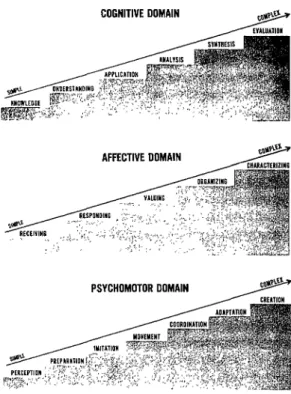
should be relevant, logical, unambiguous, feasible, observable, and measurable. It has also been proposed that the cognitive, affec- tive, and psychomotor “domains” of the ob- jectives should be defined. According to Bloom (II), Krathwohl (12J and Harrow
(13), the cognitive domain includes acquisi- tion of knowledge, comprehension, applica- tion, analysis, synthesis, and evaluation; the affective domain includes the processes of receiving, responding, valuing, organizing, and characterizing by a value or group of values; and the psychomotor domain (which provides a model for classifying the motor behavior of children in accordance with theories of child growth and development) in- cludes the processes of perception, prepara- tion, imitation and/or repetition, movement, coordination, adaptation, and creation of new motor actions (24). Figure 1 shows these elements of the cognitive, affective, and
Figure 1. Classification of elements in the cognitive, affective, and psychomotor domains in steps leading from simple to complex actions.
COGNITIVE DOMAIN v ?LO
AFFECTIVE DOMAIN
Cordera and Bobenrieth l EDUCATIONAL PLANNING 381
psychomotor domains in steps leading from simple to complex actions.
An ability or skill may require attainment of different objectives in each of the three do- mains, and since awareness of this commonly leads to lack of control or insecurity, it is often more effective to point out observable actions that clearly include the desired cognitive, af- fective, and psychomotor behaviors (2).
Program Content
Another way of conceptualizing the pur- poses and objectives involved is to refer to the curricular process (see Figure 2). In this con- text the term “curriculum” means the plan- ned learning experiences offered to the student for inculcating acceptable behavior patterns (knowledge, skills, and attitudes) and for in- hibiting unacceptable behavior patterns (1.5). In essence, the curricular process includes the following five stages:
1) selection of the purpose and objectives; 2) organization of learning experiences to help achieve the purpose and objectives;
3) selection of the program content (material) to be offered;
4) selection of teaching methods and teaching ac- tivities;
5) evaluation of the effectiveness of stages 2, 3, and 4 in helping to achieve the purpose and objec- tives specified in stage 1.
INT
SELECTION OFiEACHlNC MEfHODS AND ACTIVITIES
Clearly, the curriculum includes the ra- tional and systematic structures under which the learning processes of the students are orga- nized. These structures establish the priorities and sequences according to which the students experience different elements of the learning process. In a broad sense, the curriculum is therefore a tool for rationally ordering human thought so as to permit transmission of knowl- edge to other human beings.
The program content that emerges during the curricular process points to elements of knowledge, skills, and attitudes that are first selected and organized and then presented through learning experiences. That is, the content is what is to be taught, and the under- standing and acquisition of that content subse- quently enables the student to act in accord with what is described in the objectives of the course or program.
A central question in curricular theory in- volves the relationship between fields of knowledge and the types of curricular organi- zation conceived and proposed. The principal methods of curricular organization go hand in hand with different concepts about how knowledge should be selected and ordered for educational purposes, and those concepts pro- vide a way of categorizing the different forms of organization.
Emphasizing how fields of knowledge are arranged within different types of curricular organization may also help to bring a degree of order out of the confusion frequently asso- ciated with traditional labels such as “central curriculum, ” “ activity curriculum,” “expe- rience curriculum,” “social functions cur- riculum,” “subject curriculum,” “broad field curriculum, ” “fused curriculum,” “cor- related or correlative curriculum,” and so forth that have been applied to various forms of curricular organization.
382 PAHO BULLETIN l vol. 15, no. 4, 1981
curricula concerned primarily with organized knowledge.
The “organized knowledge” curriculum concentrates primarily on the logical order in- herent in knowledge itself, the structure of the concepts and principles of investigation that characterize the various disciplines such as history, economics, biochemistry, mathemat- ics, etc. These disciplines deserve to be known because of their intrinsic value, and they are recognized as vital intellectual resources that can provide great help to students in dealing with the problems of human life. From this point of view, such disciplines are important not only for specialists in the various fields in- volved but also for nonspecialists. The “organized knowledge” curriculum thus at- tempts to narrow the gap between what is known and practiced at the highest level of learning and what is taught and learned in the school or course. In general terms, great value is attached to the disciplines involved-not so much because they are depositories of infor- mation but because they provide conceptual systems for creating order based on ex- perience.
Nevertheless, the tremendous recent expan- sion of knowledge in all fields of learning makes it impossible to teach the complete ordering of organized disciplines by means of courses. Therefore, educators committed to this discipline-centered approach must decide
which fields of knowledge will be included in the curriculum. In most cases the curriculum is structured around the four basic areas of knowledge that many scholars believe to en- compass the basic intellectual resources of our culture; the natural and physical sciences, the mathematical sciences, the social sciences, and the humanities (IS).
In contrast, the “directly functional” cur- riculum emphasizes the practical ordering of knowledge around individual or social needs and problems-including needs relating to family life, vocation, and citizenship. Curricu- la organized to deal with such crucial social problems as poverty, overpopulation, igno-
rance, disease, and human rights are “direct- ly functional. ”
The basic concept behind the “directly functional” curriculum is that fields of knowl- edge are resources for dealing with problems, pursuing basic interests, or becoming more proficient at certain activities. In this context, the fields of knowledge themselves are consid- ered important only insofar as they contribute to an understanding or solution of the prob- lem at hand. As a group, “directly func- tional” forms of curricular organization may be defined primarily in terms of the instru- mental criteria applied to the knowledge or subject concerned; i.e., that knowledge or subject is conceived primarily as an instru- ment with which an individual or group can conduct some search or solve some problem. In this vein W. H. Kilpatrick, one of the leaders of the “directly functional” school, asserts that he regards a “topic” or subject primarily as a means to an end, rather than an end in itself (I 7).
This approach has given rise to important educational methods, including those known as the problem-solving method and the case- study method. (Various forms of the problem- solving method differ from one author to another, but all these techniques involve some ordered sequence of steps that includes identi- fication and definition of the problem, identi- fication of alternative solutions, decision- making, implementation of the solution, and evaluation.) However, whether the “directly functional” approach to curricular organiza- tion is more apt to produce student self-direc- tion and enthusiasm than is pursuit of the logical topics and remote abstractions that characterize the “organized knowledge” ap- proach is still a matter of debate.
Cordera and Bobenrieth l EDUCATIONAL PLANNING 383
dents, undiagnosed conditions, etc. And, on the other, “directly functional” matters such as evaluation of health care quality are in- cluded that require knowledge of various disciplines such as statistics, medical record- keeping, medical diagnosis, nursing, etc. The result of such mixed criteria is that the rela- tionship between the two approaches can be suitably represented by a matrix. Future edu- cational research and studies, based on valid experiences, may shed further light on the best curricular approach.
Regardless of the approach used, however, once the program content has been selected and put in order, it should be separated into teaching units. For this purpose, the material must be gradually distributed and divided into small units so that each principle involved has a clear application. Also, there must be feed- back from practice to the principles, concepts, and theories involved in order to complete the learning cycle. In addition, the topics chosen must be ordered and presented in sequence so that each unit is built on the preceding unit.
Great care should be taken to avoid either of two extremes: overteaching-that is over- loading too many concepts, theories, and related practical exercises onto subjects irrele- vant to the purpose and objectives of the course; and, underteaching-that is, in-
cluding so few concepts, theories, and related practical exercises that the purpose and objec- tives of the course are not achieved.
Organization of Learning Experiences
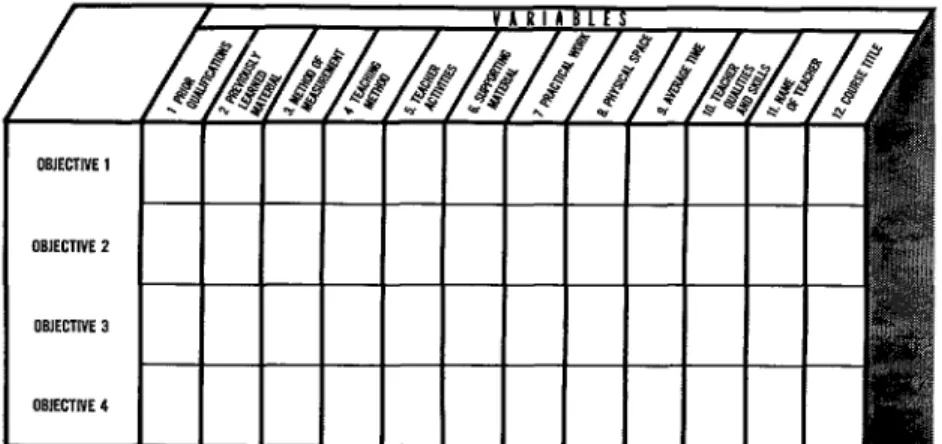
To prepare a study plan consistent with the course objectives, those objectives must be broken down until they can be described in terms of required variables so that a matrix of objectives and decision variables can be con- structed. An example of such a matrix is pro- vided in Figure 3, where each row represents an objective and each column represents a variable considered relevant to planning the learning experiences involved. This particular matrix presents the following 12 variables:
(1) prior qualifications that the student should have in order to achieve the proposed objective;
(2) study subjects that the student should have learned previously;
(3) the way achievement of the objective is going to be measured and evaluated;
(4) the teaching method or technique that will be used;
(5) the activities performed by the teacher during the instructional process;
(6) the support material needed; (7) the type of practical work required; (8) the physical space needed;
(9) the average time (in minutes) required for a session of instruction;
384 PAHO BULLETIN l vol. 15, no. 4, 1981
(10) the psychological qualities and technical skills the teacher needs in order to achieve the ob- jective;
(11) the teacher’s name; and
(12) the course title (name of the subject taught).
This list of variables, which is not exhaustive, may be shortened or lengthened as seems ap- propriate in any particular case.
The immediate translation of concepts and theories into practice improves learning and retention. However, the learning time in- volved also depends on the material to be taught and the quality of the students, each student learning at his own pace in accordance with his character and personality. Many of the numerous learning methods and tech- niques available today have varying degrees of
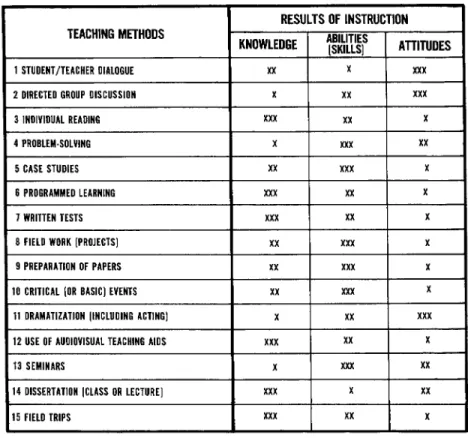
impact on the results of learning-these results being increased knowledge (in the cognitive area); increased ability or skill (in the psychomotor area); and changed attitudes (in the affective area). Figure 4 shows the rela- tionship between 15 common teaching methods and techniques and their impacts on knowledge, abilities and skills, and attitudes. As may be seen (a) different methods have dif- ferent kinds of impacts; (b) no method has a maximum impact on all three areas; (c) the combined use of some methods may promote a specific desired result; and (d) more methods appear to have a maximum impact on knowl- edge or skills and abilities than on attitudes.
The importance of the initial diagnostic evaluation of the student-which makes it
Figure 4. A rough assessment of 1.5 teaching methods’ impacts on students’ knowledge, abilities (skills), and attitudes.
TEACHING METHODS
9 PREPARATION OF PAPERS
Cordera and Bobenrieth l EDUCATIONAL PLANNING ’ 385
possible to find out whether he needs to im- prove his knowledge, abilities and skills, or at- titudes -should be emphasized, For it is this initial evaluation (which may be individual or collective) that makes it possible to select an appropriate course material as well as appro- priate learning methods and techniques.
Personnel and Supporting Material
The next step is to recruit teaching person- nel in accordance with the previously specified qualities and skills desired. Efforts should be made to keep the number of teachers small in order to facilitate coordination of the various subjects; otherwise the best experts may orient the students toward subjects that are very specific but only marginally related to the overall program.
Once the teaching personnel have been re- cruited, they should be invited to participate in a training meeting (seminar, workshop, etc.) that will enable them (a) to understand the purpose and objectives of the course; (b) to explain succinctly the central ideas they will be presenting, so that the entire educational pro- gram will be coherent; and (c) to acquire or update the skills needed in order for their edu- cational activities to obtain optimum results.
As the course proceeds, the students should gradually be freed of dependence on the teacher. This independence should be pro- moted intentionally in order to encourage self- education and self-confidence.
Overall, the teacher’s charisma is as impor- tant as his pedagogic skill. This charisma is a special gift, power, skill, quality, or aura of personal “magnetism” that enables teachers possessing it to influence and guide students. A professor with charisma is indeed a leader- and as such is able to understand, to inspire, and to act.
During this recruitment and orientation period a start should be made on program- ming and developing the educational material to be used in support of the planned instruc- tional activities. By way of determining the
necessary support material, a list should be made of the teaching aids required and of the human resources needed to prepare such teaching aids.
The course schedule should then be pre- pared on the basis of the matrix of program objectives and decision-making variables (Figure 4), taking feasibility into account. This course schedule should spell out teacher and student activities, the types of practical work involved, the times for preparing evalua- tions of student behavior, the times to be used for individual study and group activities, and all the formal and informal activities that will lead to achievement of the desired objectives. In addition, all the prevailing cultural circum- stances of the country or region that may fa- vorably or adversely affect the conduct and success of the course should be considered.
Administrative and Budgetary Considerations
Another important step is defining the type of administration required. Normally some- one is made responsible for maintaining com- munication between the course administrators and those seeking admission, for preparing letters of invitation to teachers, for maintain- ing pertinent student and teacher records, for purchasing expendable material and supply- ing it as needed, for controlling resources, and for performing the many other activities essen- tial to harmonious progress of the educational program.
Preparation of the budget is also critically important. The methods used vary from country to country and institution to institu- tion, depending on the funds assigned by the authorities; but the budgetary process is ob- viously vital, since without proper financing a program of acceptable quality cannot be con- ducted.
386 PAHO BULLETIN l vol. 15, no. 4, 1981
tices that must be consistent with the objec- tives sought.
Course Announcement
The next step is to prepare an announce- ment inviting qualified candidates to take the course. This announcement should clearly set forth the justification for the course, its pur- poses and objectives, its content, and the en- trance requirements (which are largely de- rived from the prior requirements noted in column 2 of the matrix of decision variables). The announcement should also describe the course and specify its place and duration, the work schedule, the names of the principal teachers, and the name of the person who will act as the director or academic coordinator. Other data that should be listed include holi- days (if any), registration and tuition fees, diagnostic evaluations (both formative and final), the type of credentials to be awarded, and other pertinent information. Within the context of evaluation and certification, grades are important as a symbol of achievement; and credentials (degrees, diplomas, certili- cates, etc.) are important as an indication of competence.
course organizers then determine what results indicate an acceptable profile.
Prior assessment of knowledge, abilities, and skills is considered essential, since this makes it possible to ascertain the point the student is at before the course begins. It also paves the way for a similar assessment at the end of the course and provides a way of deter- mining what the student acquired through his participation.
We have taken part in some educational planning where the initial selection process assessment indicated that the student already had the abilities and skills that were the objec- tive of the course. In such cases the educator- planner has a tendency to raise the level of the objectives; but this is an error, since the objec- tives were not selected at random but rather as a consequence of desired professional and technical functions. If we were to raise the level of the objectives, and subsequently the individual were only to exercise the abilities and skills he already possessed before enter- ing the course, we would be causing great frustration.
Evaluation
Selection of Students
The wide variety of selection strategies followed range from acceptance of documents (as demonstrating fulfillment of requirements) to specialized examinations. Ideally, a student should be required to pass a psychological, technical, and skills examination before being admitted to the course.
The psychological and technical examina- tion, the content of which is determined joint- ly with general or industrial psychologists, usually includes tests for measuring the student’s intellectual ability, capacity for work, motivation, ability to relate to people, executive ability, leadership, psychomotor skills, maturity, and so forth. The social
Once the objectives, content, methods of in- struction, and related activities of the course have been decided, it is necessary to make a decision about evaluation. Evaluation is the process of determining how successfully a predetermined objective has been achieved. This process includes at least the following steps: formulation of objectives, identification of appropriate standards and criteria to be used in the assessment, selection of evaluation strategies, selection and design of measuring instruments, determination of the amount of success achieved, explanation of the degrees of success attained, and recommendations for future program activities.
Cordera and Bobanrieth l EDUCATIONAL PLANNING 387
and “explanation of the degree of success at- tained.” In other words, the process of assign- ing value to some objeGtive and then of determining the degree of success in achieving that “valued obj,,- tive” (26) is inherent in evaluation.
Two key terms at this stage are formative evaluation and final evaluation (17). Indeed, the ability to distinguish between these two types of evaluation is important in developing an evaluative design.
Formative evaluation is assessment of the quality of the instructional process and its se- quence with a view to improving that se- quence. In formative evaluation, the evaluator collects evidence during the instructional phase of the program. Later, when inter- preting the information, he looks for deficien- cies in the instructional process.
Formative evaluation makes it possible to intervene in the sequence of instruction in order to correct deficiencies while the students are still participating in the program. There- fore, formative evaluation may be considered an integral element contributing to the achievement of mastery by the student. (Naturally, this presupposes good communi-
cation and a constant flow of information be- tween the student and the teacher.) Such pro- grammed periodic reinforcement is basic to the cumulative synthesis obtained from the learning process.
Final evaluation is an assessment of effective- ness at the end of a program or course. The goal of final evaluation is to determine the total effect of the instructional sequence. Degrees, grades, certificates, and other docu- ments of competence are in practice the result of final evaluation. Unlike formative evalua- tion, final evaluation does not shed light directly upon the educational process involved but instead indicates the final result; in other words, final evaluation shows whether the student achieved the final objectives of the course.
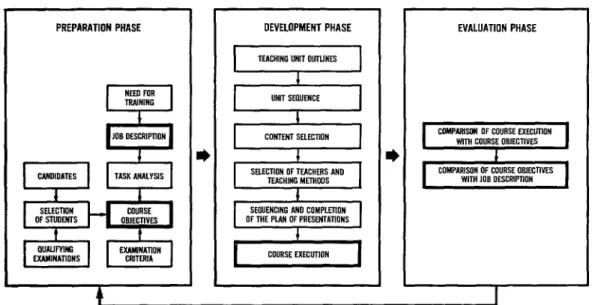
Specifically, the evaluation phase seeks to answer two important questions. The first is Were the objectives of the course accom- plished? To answer this question, the execu- tion of the course (in the development phase) must be compared with the course objectives set forth in the preparation phase. The second question is Are the objectives of the course
Figure 5. Schematic outline of a course showing elements of the preparation, development, and evaluation phases.
PREPARATION PHASE
I
J0BOESCRlPllONDEVELOPMENT PHASE
1 CONTENT: 1
I
COURSE EXECUTIONEVALUATION PHASE
I
388 PAHO BULLETIN l vol. 15, no. 4, 1981
relevant to the training need? To answer this a course, including the evaluation phase, is essential question, the course objectives must presented in Figure 5. As may be seen, the be compared with the job description devel- evaluation phase is followed by modifications oped during the preparation phase. and adjustments directed at course improve-
A schematic outline of the various phases of ment .
SUMMARY
Latin America’s enormous health care needs underscore the importance of health manpower education. It is unlikely, however, that such educa- tion will achieve anything like the maximum poten- tial benefits unless it is supported by appropriate educational planning. The present article defines the basic planning processes involved.
In starting to plan a program, it is important to define relevant social and individual values of edu- cational planners, health authorities, and the general population, and to spell out important sociocultural features of the setting where the pro- gram will be conducted. Once this has been done and the overall situation has been assessed, the specific purpose of the proposed program (in terms of preparing certain personnel or having a particu- lar social impact) should be established. In addi- tion, educational objectives should be set forth- on the basis of personnel problems perceived by managerial groups and the qualities required of someone filling the post for which the students will b e prepared.
Another essential step is to carefully define the content of a given course-in terms of the learning experiences needed to confer the desired knowl- edge, skills, and attitudes to the students. Broadly speaking, this course content can be defined in terms of existing disciplines (the “organized knowl- edge” approach) or in terms of the practical
knowledge needed to deal with individual or social needs and problems (the “directly functional” ap- proach). These two approaches can also be applied to other steps in the planning process-including selection of the course purpose and objectives, selection of teaching methods and activities, and evaluation of course effectiveness.
It is also important to decide how the various learning experiences involved should be provided, how much attention should be devoted to each one, and how these experiences should be organized within the course framework. Here special em- phasis should be given to initial evaluation of the students, for it is this evaluation that permits selec- tion of appropriate course material and teaching methods.
Decisions must also be made about two kinds of subsequent evaluation designed to assess (a) the quality of the instructional process and (b) student achievement. The first, known as “formative eval- uation,” depends on data collected during the course; these data can often be used to correct deli- ciencies while the course is still underway. The sec- ond, known as “final evaluation,” comes at the end of the course; its purpose is to show whether the students achieved the course objectives. Assuming appropriate follow-up, both types of evaluation should typically lead to modifications and adjust- ments directed at course improvement.
REFERENCES
(I) UNESCO Solar. Educacidn y desarrollo en Am&z’ca Latina. Hachette, Buenos Aires, 1966.
(2) Alvarez M., J. M. Personal communication, 1978.
(3) Apezechea, H. Personal communication, 1979.
(4) Steiner, G. A. Top Management Planning. MacMillan, New York, 1969.
(5) Benis, W. G. Desarrollo organizational: Su
naturaleza, sus onkenes y perspectivas. Fondo Educative Interamericano, Mexico City, 1973.
(6) Centro Latinoamericano de Tecnologia Educational para la Salud (CLATES). Taller de diseiio y conduccidn de talleres educacionales. CLATES document TADICTE/75/14. Mexico City, 1975.
Cordera and Bobenrieth l EDUCATIONAL PLANNING 389
(8) Peiro, S. I. Andlisis y descripcidn de puestos. Instituto TecnoMgico de Monterrey (ITECM), Monterrey, Mexico, 1972.
(9) Isaac, S., and W. Michael. Handbook in Re- search and Evaluation. Knapp, San Diego, 1974.
(10) Guilbert, J. J. Educational Handbook for Health Personnel. WHO Offset Publication No. 35. World Health Organization, Geneva, 1977.
(11) Bloom, B. S. (ed.). Taxonomy of Educational Objectives: Handbook I, Cognitive Domain. McKay, New York, 1956.
(1.2) Krathwohl, D. R., B. S. Bloom, and B. B. Masia. Taxonomy of Educational Objectives: Handbook II, Affective Domain. McKay, New York, 1964.
(13) Harrow, A. J. A Taxonomy of the Psychomotor Domain. McKay, New York, 1972.
(14) Simpson, E. J. The Classification of Educa- tional Objectives in the Psychomotor Domain. In The Psychomotor Domain. Gryphon House, Washing- ton, D.C., 1972.
(1.5) Bobenrieth, M., J. Ortiz, and J. Peiia. Estudio de Cuarenta y Cuatro Programas Regula- res de Educacidn en Administracibn de Atencion de Salud. Division de Recursos Humanos e Investiga- c&-r, Pan American Health Organization, Wash- ington, D.C., 1977.
(16) Knowles, A. S. The International Encyclopedia of Higher Education (Vol. 3). Jossey-Bass, San Fran- cisco, 1978, pp. 1184-1197.
(17) Piattelli-Palmarini, M. Language and Learn- ing: The Debate between Jean Piaget and Noam Chonisky. Harvard University Press, Cambridge, 1980.
(18) American Public Health Association. Glossary of administrative terms in public health. Am J Public Health 50~225-226, 1960.
(19) Striven, M. The Methodology of Evalua- tion. In P. A. Taylor and D. M. Cowley (eds.). Readings in Curriculum Evaluation. William C. Brown, Dubuque, 1972.
DENGUE FEVER SURVEILLANCE IN THE AMERICAS
As of 7 September 1981 the outbreak of dengue fever on Cuba was con- tinuing to wane, and in the week preceding that date only 66 cases were reported. Overall, between 7 September and the last previous report (dated 20 August) a total of 6,764 cases and seven deaths were reported. These figures bring the reported totals for the outbreak to 343,924 cases and 156 deaths.
Elsewhere, beginning in the last week of May 1981 some 641 cases of a mild dengue-like disease were reported from the Mexican town of Pinotepa National (population 22,000) in the state of Oaxaca. Serologic tests are being carried out. Vector control activities and surveillance have been in- creased in Oaxaca and neighboring states.