Volume 6, Issue 3, 2013 Society University
ISSN 2074-6857 (Print) / ISSN 2307-2202 (Online) © Lomonosov Moscow State University, 2013 © Russian Psychological Society, 2013 doi: 10.11621/pir.2013.0305 http://psychologyinrussia.com
an investigation of 3D images of the
simultaneous-lightness-contrast illusion using a virtual-reality technique
Galina Ya. Menshikova
Lomonosov Moscow State University, Moscow, Russia
his article investigates the problem of lightness perception. To clarify the role of depth in lightness perception two current models—the albedo hypothesis and the coplanar-ratio hypothesis—are discussed. To compare them the strength of the simultaneous-lightness-contrast (SLC) illusion was investigated as a function of three-dimensional (3D) con-igurations of the test and background squares. In accordance with both hypotheses the changes in the depth arrangements of the test and background squares should result in changes in the illusory efect. However, the reasons for and the directions of these chang-es should be diferent. Five diferent typchang-es of 3D conigurations were created in which the test squares were tilted at diferent angles to the background squares. A virtual-reality technique was used to present stereo pairs of diferent 3D conigurations. hirty-seven observers took part in the experiment. he method of constant stimuli was used to obtain psychometric functions. The displacements of these functions for 3D conigurations in comparison with the 2D coniguration allowed the estimation of illusion strength. he analysis of individual values of illusion strength revealed two groups of subjects. For the irst group (38% of all participants) the strength changed insigniicantly depending on the 3D conigurations. For the second group (62% of all participants) signiicant difer-ences were obtained for those conigurations in which the test and background squares were perceived as diferently illuminated. he changes in the SLC illusion strength for the second group were consistent with predictions made by the albedo hypothesis. hus, it seems that the perceived illumination of a surface should be considered the main param-eter for lightness estimations in 3D scenes.
Keywords:perception, visual illusions, lightness, perceived illumination, albedo hypoth-esis, coplanar-ratio hypothhypoth-esis, virtual-reality technology
he illusion of simultaneous lightness contrast (SLC) has been actively investigated for 180 years. In the illusion (Figure 1) two identical gray squares located on light-gray and dark-light-gray backgrounds are perceived as dark-light-gray and light-light-gray respec-tively.
figure 1. he SLC illusion
Let us preliminarily introduce some terms that will be used in this article. All surfaces absorb a certain amount of light and relect the rest. he intensity of light falling on a surface is called the illumination. Luminance refers to the intensity of light relected by a surface and projected onto the retina. he percentage of light relected by a surface is called relectance. For example, white surfaces relect about 90% of light, while black surfaces relect about 3% of it. So the ratio of the intensi-ties of light relected from white and black surfaces is 30:1. All surfaces are tilted relative to the subject and to the light source. Surfaces that are located in the same plane or in parallel planes are called coplanar. he perceived relectance is referred to as lightness. he intensity of light perceived by the subject is called the perceived illumination.
Luminance is considered the proximal stimulus for lightness estimations. he problem of lightness perception lies in the fact that luminance depends not only on the surface’s relectance but also on other parameters of the external environ-ment: the illumination of a surface and its slant. he surfaces around us are illu-minated diferently (some are shadowed, others are strongly illuillu-minated) and are tilted diferently in space. In special cases the light intensity coming from shaded white surfaces is less than the light intensity relected from illuminated black sur-faces. So a question arises about the mechanisms that the visual system uses for lightness estimations.
ac-companied by a decrease in lightness at a constant value of surface luminance. A third hypothesis emphasizes the role of local contrasts for lightness estimation. he idea was proposed by E. Hering (Hering , 1964) and has now been developed in a number of contemporary studies (Blakeslee & McCourt, 1999; Blakeslee, Pasieka, & McCourt, 2005; Grossberg & Howe, 2003). A fourth approach for lightness per-ception considers the role of contour junctions–that is, the places where several surfaces having diferent degrees of luminance are contiguous to each other (An-derson, 1997; Ross & Pessoa, 2000; Todorovic, 1997).
Let us consider the irst two hypotheses in detail as they are the most discussed in the modern literature. he irst one assumes that surface lightness can be evalu-ated through the ratio of its luminance to the luminance of other surfaces in the scene (Land & McCann, 1971; Wallach, 1963). his procedure allows the relative relectance of all surfaces to be computed. To estimate the absolute relectance the anchoring rule is applied in the visual system. his means that one of the relative relectance values anchors to some absolute value: for example, the most luminous object is assumed to be white (Gilchrist et al., 1999; Land & McCann, 1971; Wal-lach, 1976). hus, the lightness of each object can be determined. However, the described model of lightness estimations works when all surfaces are equally il-luminated and there is only one light source in the scene. Otherwise, when there are diferently illuminated surfaces, the luminance ratios depend on the intensity relationships of the strongly illuminated and the shadowed surfaces. It is assumed that the lightness estimation in complex scenes is accomplished in two stages: irst the groups of coplanar surfaces are picked out, and then lightness is estimated in accordance with the anchoring rule for each group. he anchoring rules “work” in the range of local and global frameworks simultaneously. Local frameworks are used to estimate the luminance ratio of the test patch and adjacent background patches of a surface. Global frameworks are used for estimating the luminance ratio of the test patch and distant patches of a surface. A general lightness estimation is calculated as average lightness through local and global frameworks. his hypoth-esis was called the coplanar-ratio hypothhypoth-esis (Gilchrist, 1977), and the visual cues of grouping were called the coplanarity cues. he important role of these cues in lightness perception was shown in a number of studies (Taya, Ehrenstein, & Cavo-nius, 1995; Wishart, Frisby, & Buckley, 1997).
the inluence of the perceived illumination on lightness perception (Knill & Ker-sten, 1991; Logvinenko & Menshikova, 1994; Menshikova & Lunyakova, 1994; Menshikova & Nechaeva, 2011; Williams, McCoy, & Purves, 1998).
In a number of studies the inluence of depth on lightness perception was investigated to test two of the theoretical hypotheses mentioned above. he main idea behind these studies was to change the coplanarity cues by manipulations of 3D positions of the test surfaces relative to the background surfaces. In ac-cordance with the coplanar-ratio hypothesis these manipulations would result in a change in lightness perception. Some works studying the inluence of depth on lightness estimations (Kardos, 1934; Wolf, 1933) conirmed these predictions. In one of them (Wolf, 1933) two test surfaces with the same relectance were ar-ranged against dark and light backgrounds. When test surfaces were coplanar to their backgrounds, the SLC illusion appeared, and the two tests looked diferent. However, when the test surfaces were moved away from the backgrounds (that is, they were not coplanar), the strength of the SLC illusion decreased. hese results showed that the relationship between the test surfaces and the background surfaces occurred only when they were coplanar. Later works also tested the coplanar-ratio hypothesis. he inluence of depth cues on lightness perception was investigated using stereo images (Coren, 1969). he observer saw a black cross hanging over a white background. he test gray square was arranged next to the cross and was perceived as being located, in one case, in the plane of the cross, and, in another, in the plane of the background. he observer was asked to estimate the lightness of the test square. Results showed that the test square, perceived in the plane of the black cross, was estimated to be 7% lighter. However, that efect was rather weak. To test the inluence of depth cues on lightness perception the study was carried out using the Gelb efect (Gogel & Mershon, 1969). A large, black, strongly illumi-nated disk hanging over the black unlit background was perceived as white or light gray (the Gelb efect). When a small white disk was attached to the black disk, the Gelb efect decreased–the black disk was perceived as black. However, when the white disk was moved away from the black one (that is, when it was not coplanar), the Gelb efect increased again. Conditions of monocular/binocular viewing were used to investigate the inluence of depth cues in lightness perception (Gilchrist, 1977). When the display was viewed monocularly, the test disk was perceived as being coplanar to a dark-gray surface, whereas when the display was viewed bin-ocularly, the test disk seemed coplanar to a light-gray surface. As a result, the shit in lightness estimations in the two conditions was 4.5 Munsell units. he above-mentioned studies were in good agreement with the coplanar-ratio hypothesis. Other studies investigating the role of depth cues did not reveal or determine the very weak inluence of coplanar ratios on lightness estimations (Dalby, Saillant, & Wooten, 1995; Epstein, 1961; Flock & Freedberg, 1970; Julesz, 1971; Zaidi, Spehar, & Shy, 1997).
to the background surface, the coplanar-ratio hypothesis was not available, and as a result lightness estimations became worse (Gilchrist, 1980). hird, the coplanar ratio hypothesis “works” only when the luminance ratios are more than 30:1. his limitation made it possible to explain why the inluence of depth cues on lightness was not revealed in many studies.
hese studies provided contradictory results for the role of depth cues on light-ness perception. herefore, the question of choosing one of the alternative hypoth-eses remained unanswered. One of the problems of choosing an appropriate theo-retical approach was connected with the fact that in many studies the experimental conditions were set up in such a way that changes in luminance ratios were ac-companied by changes in perceived illumination. An attempt was made to test the two hypotheses under conditions of separate, independent changes in luminance ratios and perceived illumination (Howe, 2006). he results were in better agree-ment with the albedo hypothesis.
Method
Participants
hirty seven observers (12 males and 25 females; age range 17–30) with normal or corrected-to-normal vision were tested. All the observers were unaware of the purpose of the experiment.
Apparatus
Virtual-reality technology was used to present 2D-3D conigurations of the SLC illusion. Advantages of and perspectives on this technology in experimental psy-chology, cognitive psypsy-chology, and psychophysiology have been thoroughly de-scribed and analyzed in the Russian and international literature (Riva, 2005; Yee, 2007; Zinchenko, Menshikova, Bayakovsky, Chernorizov, & Voiskounsky, 2010; Zinchenko, Menshikova, Chernorizov, & Voiskounsky, 2011). Participants ob-served 2D-3D images of SLC illusions using the head-mounted-display (HMD) technique eMagin Z800 3D Visor.* he HMD displays were arranged at a distance of 2.5 cm from observers’ eyes. he angular sizes of the test and background squares were 2° × 2° and 6° × 6° respectively. Maximum luminance was equal to 333 cd/m2. he luminance ratio was 52:1.
Stimuli
he articulated variant of the SLC illusion (Figure 2) was used as the basic pattern because its illusory efect was stronger than that of the original (Adelson, 2000; Gilchrist et al., 1999; Soranzo, Lugrin, & Cavazza, 2011).
figure 2. Articulated variant of the SLC illusion
Diferent 3D conigurations of the SLC illusion were formed by the creation of stereo pairs with the use of Photoshop CS2 9.0. he value of disparity was constant and equal to 10 pxl for all stereo pairs.
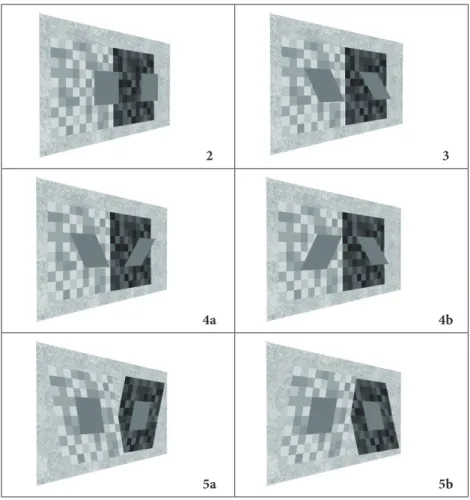
Five diferent types of 2D-3D conigurations of the test and background squares were created. hey were arranged against the frontal random-point surface. he types were as follows: type 1–2D articulated variant of the SLC illusion (Figure 2);
type 2–the central squares were moved out of the background squares and were parallel to them (Figure 3.2); type 3–the central squares were tilted at the same angles to their backgrounds (Figure 3.3); type 4a and 4b–the central squares were tilted at diferent angles to their backgrounds: the let one was tilted toward the hypothetical overhead light source, and the right one was tilted downward from it (Figure 3.4a), and vice versa (Figure 3.4b); type 5a and 5b–the background squares were tilted at diferent angles to the frontal random-point surface in a similar way as for types 4a, 4b.
2 3
4a 4b
5a 5b
figure 3. Types of 3D conigurations of the SLC illusion
Procedure and Plan
he stimuli sequence was created in MediaLab v2008. 1.33. Each of the 42 stereo pairs was repeated 10 times. he sequence of stimuli presentation was completely randomized. he participant’s ability to see 3D conigurations was tested at the begin ning of the experiment. hen 420 stereo pairs were presented. he time for pre sentation of each stimulus was 5 s. he screen with possible answers appeared ater each presentation. In every trial the participant was asked to choose the light-er of the two central squares.
Results and Discussion
Psychometric functions for 2D and six diferent 3D conigurations were obtai-ned and were used to evaluate the strength of the SLC illusion for each parti-cipant and each 3D coniguration. he illusion strength (IS) was calculated as IS = (Р3D / 2D – 1) × 100%, where Р3D andР2D – 50% probability of answers “ligh ter” for 3D and 2D conigurations respectively. Analysis of individual values of the SLC illusion strength revealed two groups of subjects. he values of the illu sion strength were averaged for each group separately. he results are shown in Figure 4.
he s
tr
en
g
th o
f the
s
lc i
ll
us
io
n (%)
types of conigurations
50 40 30 20 10 0
2D 3D-2 3D-3 3D-4a 3D-4b 3D-5a 3D-5b
Group 1 Group 2
figure 4. he strength of the SLC illusion as a function of 2D-3D conigurations
For the irst group (38% of all the participants) the strength changed insig-niicantly depending on 2D-3D conigurations; signiicant diference t (72) = 1.86, p = 0.05. For the second group (62% of all the participants) signiicant diferenc-es were revealed for typdiferenc-es 4a-4b (t (72) = 2.77, p □ 0.01), and also for types 5a-5b (t (72) = 2.82, p □ 0.01) of 3D conigurations. he results showed an increase of the illusion efect for types 3D-4a and 3D-5a and, on the contrary, a decrease for types 3D-4b and 3D-5b.
of ISat all. For the second group the decreases of the illusion efect were found for types 3D-4b and 3D-5b, but they were not consistent with the coplanar-ratio hypothesis. According to the albedo hypothesis, changes in IS should occur only for those 3D conigurations in which the test and background squares seemed dif-ferently illuminated. In the absence of cast and attached shadows the visual system should make “an unconscious inference” about the overhead light source. For con-igurations 2D, 3D-2, and 3D-3 the test squares were tilted equally relative to the overhead light source, so IS did not change. For the coniguration 3D-4а the test square lying on the light-gray background was tilted toward the hypothetical light source, so it appeared darker in contrast to the test square lying on the dark-gray background, which was tilted downward from the hypothetical light source and so appeared lighter. his coniguration resulted in an increase of IS values. Using the same inferences it is possible to explain the decrease of ISvalues for the 3D-4b coniguration. he changes of illusion strength for 3D-5a and 3D-5b may be inter-preted similarly.
conclusion
Two current models of lightness perception–the albedo hypothesis and the copla-nar-ratio hypothesis–were tested to explain the results of the study. he changes in the SLC illusion strength for diferent 2D-3D conigurations were consistent with predictions made by the albedo hypothesis. It seems that in 3D scenes the per-ceived illumination of a surface should be considered as the main parameter for lightness estimations.
acknowledgments
his research was supported by the grant “Development of innovative methods for scientiic, educational, and practical activities of psychologists with the application of virtual-reality technologies” within the framework of the federal program “Sci-entiic and sci“Sci-entiic-pedagogical personnel of innovative Russia” for 2009–2013 (State contract no. 8011).
References
Adelson, E. H. (2000). Lightness perception and lightness illusions. In M. S. Gazzaniga (Ed.), he new cognitive neurosciences (2nd ed., pp. 339–351).Cambridge, MA: MIT Press.
Anderson, B. L. (1997). A theory of illusory lightness and transparency in monocular and bin-ocular images. Perception, 26, 419–453. PMid:9404492 doi: 10.1068/p260419
Bergstrom, S. S. (1977). Common and relative components of relected light as information about the illumination, colour, and three-dimensional form of objects. Scandinavian Jour-nal of Psychology,18, 180–186. PMid:897594 doi: 10.1111/j.1467-9450.1977.tb00275.x Blakeslee B., & McCourt, M. E. (1999). A multiscale spatial iltering account of the White efect,
simultaneous brightness contrast and grating induction. Vision Research, 39, 4361–4377. doi: 10.1016/S0042-6989(99)00119-4
of stimuli including White, Howe and simultaneous brightness contrast. Vision Research, 45(5), 607–615. PMid:15621178 doi: 10.1016/j.visres.2004.09.027
Anderson, B. L. (1997). A theory of illusory lightness and transparency in monocular and bin-ocular images. Perception, 26, 419–453. doi: 10.1068/p260419
Bergstrom, S. S. (1977). Common and relative components of relected light as information about the illumination, colour, and threedimensional form of objects. Scandinavian Journal of Psychology, 18, 180-186. doi: 10.1111/j.1467-9450.1977.tb00275.x
Blakeslee, B., & McCourt, M. E. (1999). A multiscale spatial iltering account of the White efect, simultaneous brightness contrast and grating induction. Vision Research, 39, 4361–4377. doi: 10.1016/S0042-6989(99)00119-4
Blakeslee, B., Pasieka, W., & McCourt, M. E. (2005). Oriented multiscale spatial iltering and contrast normalization: A parsimonious model of brightness induction in a continuum of stimuli including White, Howe and simultaneous brightness contrast. Vision Research, 45(5), 607–615.doi: 10.1016/j.visres.2004.09.027
Coren, S. (1969). Brightness contrast as a function of igure-ground relations. Journal of Experi-mental Psychology,80, 517–524. doi: 10.1037/h0027435
Dalby, T. A., Saillant, M. L., & Wooten, B. R. (1995). he relation of lightness and stereosco-pic depth in a simple viewing situation. Perception & Psychophysics, 57(3), 318–332. doi: 10.3758/BF03213057
Epstein, W. (1961). Phenomenal orientation and perceived achromatic color. Journal of Psychol-ogy, 52, 51–53.doi: 10.1080/00223980.1961.9916503
Flock, H. R., & Freedberg, E. (1970). Perceived angle of incidence and achromatic surface color.
Perception & Psychophysics, 8, 251–256. doi: 10.3758/BF03210216
Gilchrist, A. L. (1977). Perceived lightness depends on perceived spatial arrangement. Science,
195(4274), 185–187.doi: 10.1126/science.831266
Gilchrist, A. L. (1980). When does perceived lightness depend on perceived spatial arrange-ment? Perception & Psychophysics, 28(6), 526–538. doi: 10.3758/BF03198821
Gilchrist, A. L., Kossyidis, C., Bonato, F., Agostini, T., Cataliotti, J., Li, X., Spehar, B., & An-nan, V. (1999). An anchoring theory of lightness perception. Psychological Review, 106(4), 795–834. doi: 10.1037/0033-295X.106.4.795
Grossberg, S., & Howe, P. D. (2003). A laminar cortical model of stereopsis and three- dimension-al surface perception. Vision Research, 43, 801–829. doi: 10.1016/S0042-6989(03)00011-7 Grossberg, S., & Todorovic, D. (1988). Neural dynamics of 1-D and 2-D brightness perception: a
uniied model of classical and recent phenomena. Perception & Psychophysics, 43, 241–277. doi: 10.3758/BF03207869
Gogel, W. C., & Mershon, D. H. (1969). Depth adjacency and simultaneous contrast. Perception & Psychophysics, 5, 13–17. doi: 10.3758/BF03210471
Helmholtz, H. von. (1867). Handbuch der physiologischen optik [Handbook of physiological op-tics]. Leipzig: Voss.
Hering, E. (1964). Outlines of a theory of the light sense (L. Hurvich & D. Jameson, Trans.). Cam-bridge, MA: Harvard University Press. (Original work published 1874)
Howe, P. D. (2006). Testing the coplanar ratio hypothesis of lightness perception. Perception,
35(3), 291–301. doi: 10.1068/p5461
Julesz, B. (1971). Foundations of Cyclopean perception. Chicago: Chicago University Press. Kardos, L. (1934). Ding und Schatten. Eine experimentelle Untersuchung über die Grundlagen
des Farbensehens [Object and shadow. An experimental investigation of the fundamentals of color vision]. Zeitschrit fur Psychologie Erganzungsband, 23, 1–184.
Kozaki, A., & Noguchi, K. (1976). he relationship between perceived surface-lightness and perceived illumination. Psychological Research, 39, 1–16.doi: 10.1007/BF00308942 Land, E. H., & McCann, J. J. (1971). Lightness and retinex theory. Journal of the Optical Society
of America, 61, 1–11 doi: 10.1364/JOSA.61.000001
Logvinenko, A., & Menshikova, G. (1994). Trade-of between achromatic colour and perceived illumination as revealed by the use of pseudoscopic inversion of apparent depth. Perception,
23, 1007–1023. doi: 10.1068/p231007
Menshikova, G., & Lunyakova, E. (1994). Relationship between achromatic color of a surface and its perceived illumination in the “wallpaper” illusion. Perception, 23, 17.
Menshikova, G., & Nechaeva, A. (2011). Does the strength of simultaneous lightness contrast depend on the disparity cue? Perception, 40, 104.
Riva, G. (2005). Virtual reality in psychotherapy: Review. CyberPsychology & Behavior: he Im-pact of the Internet, Multimedia and Virtual Reality on Behavior and Society, 8, 220–230. doi: 10.1089/cpb.2005.8.220
Ross, W., & Pessoa, L. (2000). Lightness from contrast: A selective integration model. Perception & Psychophysics, 62, 1160–1181.doi: 10.3758/BF03212120
Soranzo, A., Lugrin, J-L., & Cavazza M. (2011). Photometric relationships afect the simultane-ous lightness contrast phenomenon in virtual reality. Perception, 40, 76.
Taya, R., Ehrenstein, W. H., & Cavonius, C. R. (1995). Varying the strength of the Munker-White efect by stereoscopic viewing. Perception, 24(6), 685–694. doi: 10.1068/p240685
Todorovic, D. (1997). Lightness and junctions. Perception,26, 379–394.doi: 10.1068/p260379 Wallach, H. (1963). he perception of neutral colours. Scientiic American, 208, 107–116. doi:
10.1038/scientiicamerican0163-107
Wallach, H. (1976). On perception. New York: Quadrangle/New York Times Book Co.
Williams, S. M., McCoy, A. N., & Purves, D. (1998). he inluence of depicted illumination on brightness. Proceedings of the National Academy of Sciences of the USA, 95, 13296–13300. doi: 10.1073/pnas.95.22.13296
Wishart, K. A., Frisby, J. P., & Buckley, D. (1997). he role of 3-D surface slope in a lightness/ brightness efect. Vision Research,37(4), 467–473. doi: 10.1016/S0042-6989(96)00104-6 Wolf, W. (1933). Uë ber die kontrasterregende Wirkung der transformierten Farben
[Concern-ing the contrast-caus[Concern-ing efect of transformed colors]. Psychologische Forschung, 18(1), 90– 97.doi: 10.1007/BF02409628
Yee, N. (2007). Psychological research in virtual worlds. Retrieved from http://bps-researchdigest. blogspot.com/2007/06/psychological-research-in-virtual.html
Zaidi, Q., Spehar, B., & Shy, M. (1997). Induced efects of backgrounds and foregrounds in three-dimensional conigurations: he role of T-junctions. Perception, 26, 395–408.doi: 10.1068/ p260395
Zinchenko, Yu. P., Men’shikova, G. Ya., Bayakovsky, Yu. M., Chernorizov, A. M., & Voiskounsky, A. E. (2010). Technologies of virtual reality in the context of world-wide and Russian psy-chology: Methodology, comparison with traditional methods, achievements and perspec-tives. Psychology in Russia: State of the Art, 3, 12–45. doi: 10.11621/pir.2010.0001
Zinchenko, Yu. P., Menshikova, G. Ya., Chernorizov, A. M., & Voiskounsky, A. E. (2011). Tech-nologies of virtual reality in psychology of sports of great advance: heory, practice and perspectives. Psychology in Russia: State of the Art, 4, 129–154. doi: 10.11621/pir.2011.0008