VII Congresso Brasileiro de Biometeorologia,
Ambiência, Comportamento e Bem-Estar Animal
“Responsabilidade Ambiental e Inovação”
VII Brazilian Congress of Biometeorology, Ambience,
Behaviour and Animal Welfare
“Environmental Responsibility and Innovation”
Heat loss efficiency and thermoregulation responses of Nellore cows
Henrique Barbosa Hooper¹, Fábio Luís Henrique², Lina Fernanda Pulido Rodríguez³, Alfredo Manuel Franco Pereira², Cristiane Gonçalves Titto ³, Evaldo Antonio Lencioni Titto 4.
¹Phd Student, Laboratory of Animal Physiology, Faculty of Animal Science and Food Engineering, University of São Paulo, Duque de Caxias Norte Avenue, 225, CEP 13635-900, Pirassununga, SP. E-mail: [email protected]
²Phd Student, Laboratory of Biometeorology and Ethology, Faculty of Animal Science and Food Engineering, University of São Paulo, Duque de Caxias Norte Avenue, 225, CEP 13635-900, Pirassununga, SP. E-mail: [email protected]
³Phd Student, Laboratory of Biometeorology and Ethology, Faculty of Animal Science and Food Engineering, University of São Paulo, Duque de Caxias Norte Avenue, 225, CEP 13635-900, Pirassununga, SP. E-mail: [email protected]
4Auxiliar Professor, Biometeorology and Animal Welfare Laboratory, Institute of Mediterranean Agricultural and Environmental Sciences, University of Évora, Apartado 94 7006-554 Évora, Portugal. E-mail:[email protected]
5Associate Professor, Laboratory of Biometeorology and Ethology, Faculty of Animal Science and Food Engineering, University of São Paulo, Duque de Caxias Norte Avenue, 225, CEP 13635-900, Pirassununga, SP. E-mail: [email protected]
6Full Professor, Laboratory of Biometeorology and Ethology, Faculty of Animal Science and Food Engineering, University of São Paulo, Duque de Caxias Norte Avenue, 225, CEP 13635-900, Pirassununga, SP. E-mail: [email protected]
Abstract: Nellore cattle is well adapted to tropical environmental conditions with good thermoregulatory
characteristics. However, knowledge related to body temperature regulation and acclimatization mechanisms are still scarce. This investigation aimed to understand the heat loss efficiency and thermoregulation responses of Nellore cows in tropical climate conditions. In this study was used 16 healthy purebred Nellore cows classified by heat loss in efficient and non-efficient using the vaginal temperature continuously monitored by data-loggers. The rectal, tail and ocular temperatures, sweating rate and respiratory frequency were also measured to understand the thermoregulatory responses and correlate to previous classification. In our findings, were noticed that according to heat loss classification the non-efficient cows showed greater amplitude of temperature variation. The body temperature increased from 12:00 PM to 19:00 PM with gradual decreased from 19:00 PM to 07:00 AM, reaching the peak in both groups at around 16:00 PM. In addition, the efficient cows presented higher sweating rate than non-efficient that presented higher rectal temperature, therefore the reduction of body temperature by improving evaporative mechanisms is a good trait of acclimatization to heat. No statistical difference was observed for the other physiological variables between groups. In conclusion, the methodology to classify the cows by heat loss using vaginal data loggers allowed us to distinguish Nellore cows according to their body temperature regulation, being feasible and reproducible. Furthermore, the efficiency to heat loss of this bred was mainly associated with sweating capacity.
Keywords: bos taurus indicus, ocular area thermography, vaginal temperature
Os autores deste trabalho são os únicos responsáveis por seu conteúdo e são os detentores dos direitos autorais e de reprodução. Este trabalho não reflete necessariamente o posicionamento oficial da Sociedade Brasileira de Biometeorologia (SBBiomet).
The authors of this paper are solely responsible for its content and are the owners of its copyright. This paper does not necessarily reflect the official position of the Brazilian Society of Biometeorology (SBBiomet).
Introduction
Humanity has been living climate changes that affects agriculture and livestock production threatening survival. For this reason, it is important to set priorities regarding mitigation and adaptation related to food and water consumption. In livestock will be necessary to seek balance within production, environment and genetic aspects, including adaptability. Consequently, will be essential to understand the dynamics between animals-environment and which are the important characteristics to overcome adverse situations.
In Brazil, 80% of the beef cattle herds are compound by Nellore cattle and their crosses, because of its productivity, heat tolerance and disease resistance. In a long adaptive process in tropical climates, Bos taurus indicus were able to better regulate the rectal temperature in response to heat stress than Bos taurus taurus. This capacity is related to low metabolic heat production and high heat flow capability, arteriovenous anastomoses in the skin , thick, dense, smooth and shiny hair coat (Hutchinson and Brown 1969; Finch et al. 1984)and a high sweat glands density.
The acclimatization, part of adaptation, is the body ability to perform work in heat stress by improving dissipation due to moderate and repeated elevation of temperature. The comprehension of physiological mechanisms related to thermoregulation will contribute to better understand the thermolytic responses of a breed very popular in tropical climate conditions. Therefore, with this knowledge will be possible to select more adapted animals and improve productive and reproductive performance in the face of heat stress. Hence, the aim of this study is to understand a methodology to analyze the heat loss efficiency and thermoregulation responses of Nellore cows (Bos taurus indicus) in tropical climate conditions.
Material and Methods
The experiment was conducted during spring season in Biometeorology and Ethology Laboratory, Faculty of Animal Science and Food Engineering (FZEA), University of São Paulo, Pirassununga (21°80’ latitude South and 47°25’42’’ longitude West). The local climate is classified as a subtropical humid according to Köeppen-Geiger classification. The animals used were randomly selected from the beef cattle herd from FZEA. The Institutional Ethics Committee of Animal Use approved all animal care, handling and procedures in this project with the protocol number nº13.1.2186.74.2. The environmental variables: air temperature (Ta), black globe temperature (Tbg) and relative humidity (RH) were continuously measured during six days of experiment by data loggers. The animals were kept in pastures with mineral supplementation and water ad libitum.
The 16 health purebred Nellore cows used were classified in efficient (E) and non-efficient (NE) using the vaginal temperature (Tvag) continuously monitored during six days by data-loggers. The vaginal data-loggers (HOBO Water Temperature Pro v2) used were adapted with a blank progesterone implant to better allocation in the reproductive tract, with the dimensions of 11.5cm x 3.0cm x 43g (LxCxW). From the six days of vaginal temperature measurement were chosen two days with similar and stressful climatic conditions. On these two days, the vaginal temperature was separated in heat gain period, from 12:00 PM to 19:00 PM, and the heat loss period, from 19:00 PM to 07:00 AM. To heat gain and heat loss were calculated two regression equations, this methodology was created taking into consideration the works of Fisher et al. (2008) and Hillman et al. (2009) . The angular coefficients were determined to each animal for the heat gain (β positive - ascending slope) and heat loss (β negative – downward slope) periods. At first criteria to separate the animals was used the downward slope. The most efficient cows were the ones with higher downward slope, that quickly dissipates heat (Table 1). The methodology used in this research
Other physiological variables: rectal (Tr), tail (Tt) and ocular area temperatures (Toc), sweating rate (SR) and respiratory frequency (RF) were collected at 07:00 AM and 15:00 PM on the last four days of continuously vaginal temperature monitoring to understand the thermoregulatory responses and to compare with the heat loss classification. The Tr and Tt were measured using a clinical and contact thermometers. The Toc was obtained by infrared thermography using the Testo® 875-2i camera (emissivity coefficient of 0,98). The SR was measured by Schleger and Turner (1965) method. The RF was measured by counting the breath movements per minute (bpm).
The environmental data were analyzed by the F test and Student’s t test. The Ta, Tbg and RH were analyzed as dependent variables and day as independent variables, with GLM procedure of SAS 9.2 software (SAS Inst., Inc., Cary, NC). To classify animals by heat management were made logistic regressions using Tvag. The physiological variables were analyzed as repeated measures in time using the animal as a random effect and the date as a block. The means were compared by the F test and Student's t-test. In the multiple comparisons procedure was used PDIFF of MIXED procedure of SAS 9.2 software (SAS Inst., Inc., Cary, NC). Were made Pearson correlations between environmental and physiological variables, with strong correlation when r values were above 0.7, moderate between 0.3 and 0.7 and weak when r values were under 0.3. It is relevant to emphasize that there are other methods to group animals such as principal component analysis, however we decide to group cows according to the mean of vaginal temperature as a new method to classify cows in relation to their heat loss and gain, and were not our intention to establish a standard coefficient value to be applied in other projects.
Results and Discussion
In this study, the environmental conditions, on the days 5 and 6 (chosen for Tvag evaluation), were within the thermal comfort zone for cattle, although in certain hours of the day the cows were exposed to stress conditions (Table 2). Titto et al. (1999) considered to Marchigiana, Nelore and Simental breeds the comfort zone from 22°C and 25°C and stress from 28°C to 35°C.
Table 1 Classification of Nellore cows by higher angular coefficients of heat loss (β2) and lower angular coefficients for heat gain (β1), maximum and minimum vaginal temperatures (Tvag), on days 5 (12:00 PM to 19:00 PM) and days 5 and 6 (19:00 PM to 7:00 AM).
Day 5 (12:00 PM – 19:00 PM) Days 5 and 6 (19:00 PM – 7:00 AM)
Animal Tvag Min Tvag Max
Heat gain
coefficient Tvag Max Tvag Min
Heat loss coefficient Classification* A 38.34 39.2 0.06 38.78 37.7 0.08 E B 38.25 39.4 0.09 38.84 37.92 0.07 E C 38.09 39.6 0.09 38.7 37.56 0.06 E D 38.31 39.2 0.06 38.78 37.84 0.06 E E 38.12 39.06 0.11 38.78 37.98 0.05 E F 38.06 39.03 0.10 38.67 37.78 0.04 E G 38.2 39.37 0.10 38.81 38.12 0.04 E H 38.34 38.98 0.08 38.95 38.36 0.04 E I 37.95 39.32 0.07 38.64 37.97 0.03 NE J 38.03 38.92 0.10 38.78 38.23 0.03 NE K 38.45 39.26 0.06 38.76 38.14 0.03 NE L 38.42 38.89 0.04 38.81 38.28 0.03 NE M 38.17 39.12 0.08 38.76 38.14 0.03 NE N 38.2 39.38 0.13 39.72 38.14 0.02 NE O 38.23 39.49 0.08 38.64 38.03 0.02 NE P 38.31 39.23 0.07 39.12 38.14 0.01 NE
*E – Efficient cows, NE – Non-efficient cows.
Table 2 Mean, maximum and minimum values of air temperature, black globe temperature and relative humidity during six days.
*Different lowercase letters in the columns statistically differ by Student T test (P<0.05).
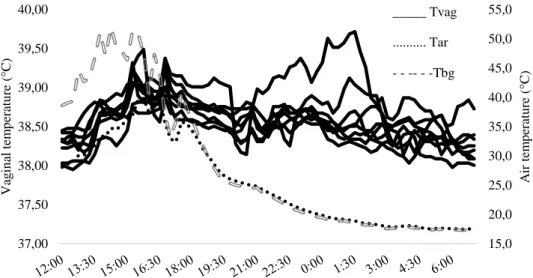
It was noticed that body temperature increased from 12:00 PM to 19:00 PM and gradually decreased from 19:00 PM to 07:00 PM, reaching the peak in both groups at around 16:00 PM (Figures 1 and 2). The analysis of body temperature can be performed in different ways, the most common methods used are the measurement of the tympanic, rectal, vaginal, intraruminal. In our observations, the Tvag had a significant and positive relation (r=0.62) and was above 1.14°C when compared to Tr at the morning and 0.51°C at the afternoon. The methodology used allowed us to distinguish cows according to their heat loss capacity, being feasible and reproducible. It was also noted that according heat loss classification, the variation profile for heat gain between the two groups was similar with a greater amplitude for non-efficient cows. Complementarily, the efficient cows presented higher SR than non-efficient cows that presented higher Tr. Therefore, the vaginal temperature was enough to classify cows by heat loss and heat gain.
Cheung and McLellan (1998) argue that common characteristics for heat acclimatization are the reduction of body temperature by improving evaporative mechanisms. Although in our study were not found differences on Tt and
Air temperature (°C) Black Globe Temperature (°C) Relative Humidity (%)
Day Mean Max. Min. SEM Mean Max. Min. SEM Mean Max. Min. SEM 1 27.42a 41.61 19.31 1.16 29.98a 49.24 18.65 0.25 58.45d 86.34 21.51 0.25 2 25.89b 36.47 18.53 0.13 27,13b 45.49 17.91 0.2 64.71a 92.75 34.06 0.2 3 22.26e 34.20 15.7 0.15 24.59c 42.50 15.24 0.24 61.01c 86.73 29.38 0.24 4 22.68e 35.93 13.28 0.19 25.42c 50.92 12.89 0.3 61.59bc 87.12 29.32 0.3 5 24.14d 39.8 15.50 0.18 26.81b 51.88 15.10 0.28 63.48ab 86.95 30.55 0.28 6 25.05c 39.17 17.46 0.17 27.42b 52.13 17.15 0.26 61.84bc 79.86 32.41 0.26
Toc between efficient and non-efficient cows, is suggested that animals with lower skin surface temperature are more potentially efficient to dissipate heat to environment (Montanholi et al. 2008; Montanholi et al. 2009). In both groups, respiratory rate was within the normal range from 24 to 55 bpm (Mcmanus et al. 2014). Hence, these physiological profiles pointed out hereditary and selection traits in the breed for thermoregulation characteristics, such as efficiency in sweating rate and low resistance to heat loss, and would be a good strategy for genetic improvement in tropical regions (Finch 1985).
Figure 1 Vaginal temperature of efficient (E) cows on days 5 and 6 considering the air temperature (Ta) and black globe temperature (Tbg) variations.
Figure 2 Vaginal temperature of non-efficient (NE) cows on days 5 and 6 considering the air temperature (Ta) and black globe temperature (Tbg) variations.
The Tr, Tt, Toc, RF and SR were lower in the morning than in the afternoon due to the heat increment inherent to the period (Table 3). The Tr was in the physiological normality proposed by Kolb et al. (1987), 38.5°C to 39.3°C. The Tvag mean was slightly above that observed for Tr, nonetheless in the physiological normality.
The influence exerted by environment on the physiological responses should be evaluated considering changes in daytime heating and nighttime cooling. In our findings, the cows presented and increase on body temperature on daytime heating, with low influence at the morning and higher at the afternoon. The efficient cows presented higher SR than non-efficient cows reflecting better body temperature maintenance. Although both groups presented higher SR when compared to other studies (McManus et al. 2009; Barbosa et al. 2014).
15,0 20,0 25,0 30,0 35,0 40,0 45,0 50,0 55,0 37,00 37,50 38,00 38,50 39,00 39,50 40,00 A ir tem p era tu re ( °C) V ag in al tem p era tu re ( °C) 15,0 20,0 25,0 30,0 35,0 40,0 45,0 50,0 55,0 37,00 37,50 38,00 38,50 39,00 39,50 40,00 A ir tem p era tu re ( °C) V ag in al tem p era tu re ( °C) _____ Tvag ... Tar - - -- - -Tbg _____ Tvag ... Tar - - -- - -Tbg
Table 3 Mean followed by standard error of Nellore cows’ physiological variables by period, classification and interaction.
Period Classification Interaction Morning Afternoon P-valor Efficient
Non-efficient P-valor SEM P-valor Tr ¹ 37.28 38.32 <0.0001 37.65 37.95 0.0013 0.12 0.1818 Tvag ² 38,42 38.83 <0.0001 38.58 38.67 0.0827 0.06 0.2086 Tt ³ 29.53 34.59 <0.0001 31.78 32.35 0.1269 0.46 0.7298 Toc 4 30.91 34.1 <0.0001 32.56 32.45 0.5030 0.18 0.3391 RF 5 29.51 37.57 <0.0001 33.76 33.32 0.7225 1.05 0.8790 SR 6 441.47 567.35 <0.0001 528.73 480.08 0.0554 30.53 0.3937
¹Rectal temperature (°C), ² Vaginal Temperature (°C), ³Tail temperature (°C), 4Ocular temperature (°C), 5Respiratory frequency (bpm), 6Schleger & Turner (g. m-². h-¹). *Difference were analysed by Student T test (P<0.05).
Conclusions
In conclusion, the methodology used allowed us to distinguish Nellore cows according to their heat loss capacity, being feasible and reproducible, furthermore, in this breed the efficiency of heat loss was mainly associated with sweating capacity. The pathway to understand the responses involved in thermoregulation is still long, however, these information may contribute as future keys to select more adapted animals.
Acknowledgements
This research was supported by São Paulo Research Foundation, n°2011/09282-3. We would also like to show our gratitude to Ana Carina Alves Pereira de Mira Geraldo (PhD), Ana Luisa Silva Longo (MSc.), Thays Mayra da Cunha Leme dos Santos (PhD), Ed Hoffman Madureira (Professor) and Júlio Cesar de Carvalho Balieiro (Professor), all from University of São Paulo, who provided insight and expertise that greatly assisted the research.
References
Andersson, B.E., Jonasson, H. (1993). Temperature regulation and environmental physiology, in: Swenson, M.J. and Reece, W.O. (Eds.), Dukes' physiology of domestic animals, Cornell University Press, New York, p.805-813.
Barbosa BRP, Santos SA, Abreu UGP de, et al (2014) Tolerância ao calor em bovinos das raças Nelore branco, Nelore vermelho e Pantaneira. Rev Bras Saúde e Produção Anim 15:854–865. doi: 10.1590/S1519-99402014000400010
Cheung SS, McLellan TM (1998) Heat acclimation, aerobic fitness, and hydration effects on tolerance during uncompensable heat stress. J Appl Physiol 84:1731–1739.
Finch V. A. (1985) Body Temperature in Beef Cattle: Its Control and Relevance to Production in the Tropics. J Anim Sci 62:531–542. doi: 10.2134/jas1986.622531x
Finch VA, Bennett IL, Holmes CR (1984) Coat colour in cattle: effect on thermal balance, behaviour and growth, and relationship with coat type. J Agric Sci 102:141. doi: 10.1017/S0021859600041575
Fisher AD, Morton R, Dempsey JMA, et al (2008) Evaluation of a new approach for the estimation of the time of the LH surge in dairy cows using vaginal temperature and electrodeless conductivity measurements. Theriogenology 70:1065–1074. doi: 10.1016/j.theriogenology.2008.06.023 Hillman PE, Gebremedhin KG, Willard ST, et al (2009) Continuous measurements of vaginal temperature of female cattle using a data logger encased
in a plastic anchor. Appl Eng Agric 25:291–296.
Hutchinson JC, Brown GD (1969) Penetrance of cattle coats by radiation. J Appl Physiol 26:454–464.
McManus C, Prescott E, Paludo GR, et al (2009) Heat tolerance in naturalized Brazilian cattle breeds. Livest Sci 120:256–264. doi: 10.1016/j.livsci.2008.07.014
Mcmanus CM, Louvandini H, Paim TP, et al (2014) Factors affecting heat tolerance in crossbred cattle in central Brazil. Ciência Anim Bras 15:152– 158. doi: 10.1590/1809-6891v15i28726
Montanholi YR, Odongo NE, Swanson KC, et al (2008) Application of infrared thermography as an indicator of heat and methane production and its use in the study of skin temperature in response to physiological events in dairy cattle (Bos taurus). J Therm Biol 33:468–475. doi: 10.1016/j.jtherbio.2008.09.001
Montanholi YR, Swanson KC, Schenkel FS, et al (2009) On the determination of residual feed intake and associations of infrared thermography with efficiency and ultrasound traits in beef bulls. Livest Sci 125:22–30. doi: 10.1016/j.livsci.2009.02.022
Schleger A, Turner H (1965) Sweating rates of cattle in the field and their reaction to diurnal and seasonal changes. Aust J Agric Res 16:92. doi: 10.1071/AR9650092