American Journal of Engineering Research (AJER)
e-ISSN: 2320-0847 p-ISSN : 2320-0936
Volume-5, Issue-10, pp-53-58
www.ajer.org
Research Paper Open Access
w w w . a j e r . o r g
Page 53
Development of an Innovative Medical Cupping Device
Feng-Chyi Duh
(Department of Mechanical Engineering, Minghsin University of Science and Technology, Hsinchu, Taiwan)
ABSTRACT:
Temperature increases to influence the organs are often used in Chinese medicine therapy. A heat therapy cup was developed in this study with temperature control, timer, and heat therapy functions. The concept behind these therapeutic aids is traditional Chinese medicine combined with modern technology and the designs include timers and temperature control. The completed prototypes were used for cupping therapy. After testing, it was found that the standard deviation was greater at a lower temperature setting (To) while at ahigher To the standard deviation was lower. At To of 30, 40, 50, and 60°C, the relative changes in standard
deviations were 5.27%, 2.50%, 2.66%, and 0.88%, respectively. The results indicated that the timer and temperature control functioned properly. Therefore, the designed medical aid, which is an important tool in Chinese medicine, can be provided to people of all ages to maintain health, help with rehabilitation, or to boost energy.
Keywords:
Constant Temperature, Cupping, Heat Therapy, Medical Instrument, Temperature ControlI.
INTRODUCTION
There is a common saying regarding the meridian system in traditional Chinese medicine (TCM): “If there is free flow, there is no pain; if there is pain, there is no free flow.” Cupping therapy is widely used in traditional medicine to promote circulation, particularly, in case of mild failure in local blood microcirculation. In healthy people, meridian therapy fosters local metabolism and health recovery.
Cupping involves applying heat stimulation to body acupoints to promote unobstructed meridians and qi and blood coordination, thereby ridding the body of disease and recovering health. The earliest common method of cupping was fire cupping, in which heat was used to stimulate adsorption of cups placed over acupoints or meridians on the skin for localized hyperemia or congestion. This could lead to capillary rupture, resulting in destruction of red blood cells and hemolysis and providing chronic stimulation and health protection of the body.
TCM maintains that cupping therapy promotes blood circulation and removes blood stasis. The advantages of this form of therapy include non-invasiveness and easiness in operation. Therefore, it has long been a physical therapy method used in health care. Cupping is classified as an alternative remedy. It has extensive and profound implications and has been steadily applied for a thousand years. In fact, cupping may be considered as a valuable heritage of human civilization development. Technology and science can be integrated into cupping therapy to support and maintain its value.
Cupping is an external therapy in TCM that is mainly based on heat. However, during treatment, its duration and temperature cannot be effectively controlled, which can cause skin burns. Inconveniences and risks of traditional cupping therapy have resulted in its reduced application. This aspect of traditional medicine is at risk of being lost to future generations, which has become a large concern. Cupping is a type of thermal stimulation, in which a certain degree of heat must be achieved and negligence is not permitted as the treatment will not be effective in the case of exterior heat and interior cold.
II.
LITERATURE
REVIEW
w w w . a j e r . o r g
Page 54
on heat transfer in cupping have been successful in developing medical cupping equipment [14-16]. During treatment, the amount of heat used to best meet the patient's needs is mainly determined by the physician's experience. This study developed a heat cupping therapeutic device capable of time and temperature control, which is an innovative device in terms of product type and basic functions.
III.
MATERIALS
AND
METHODS
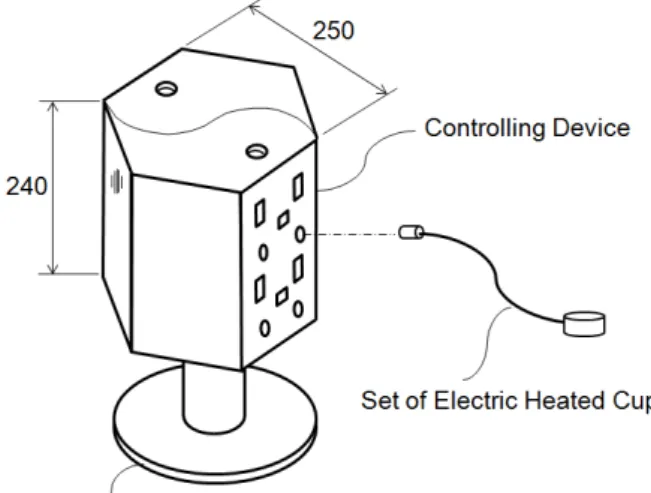
The exterior design of the controlling device is illustrated in Figure 1. The appearance is solid and refined; modern technology is used inside combined with the Bagua and Taiji designs used on the outer casing. In Taoism, Bagua and Taiji have many implications and are believed to suppress evil and give the patient piece of mind while expelling any evil during medical treatment. A temperature controller and other elements were integrated into the controlling device. With regard to design, the main consideration was given to the efficiency of the electronic components and dissipation of accumulated heat.
The dimensions of the controlling device are 250mm250mm240mm. A ϕ60mm120mm circular stand was installed underneath with a ϕ270mm base at the bottom (Figure 1). The controlling device was equipped with a heat sink that discharged accumulated heat from the device using natural convection.
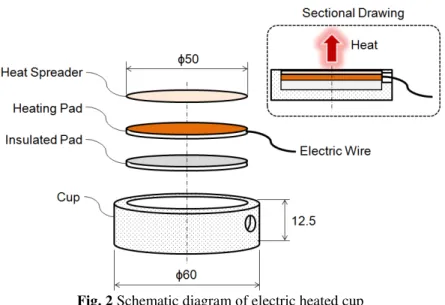
Electrically heated cups (Figure 2) comprised four elements: cup, insulated pad, heating pad, and heat spreader. The cups were produced using safe acrylic materials. Acrylic is easily processed and has low thermal conductivity (0.2 W/m-K), which is lower than the thermal conductivity of human skin (0.37W/m-K). Acrylic has good thermal insulation and is semipermeable, which allows monitoring of the body's reaction to the heat. The cups had an internal diameter of 50 mm, height of 12.5 mm, and wall thickness of 5 mm. The appearance was a cup.
Flexible, circular silicon thermofoil was used as the heating source in the electric heated cups. Heating at a fixed temperature (To=constant) was made possible by a thermocouple and temperature controller. The cups
are very safe to use in actual practice. Silicon thermofoil is a heating element that provided the electrical cups with stable heat. It is safe, has low power consumption, and meets water-proof and moisture-proof requirements. The highest temperature that can be set with the silicon thermofoil was 80°C that can be controlled within the range of 80±5°C. The dimensions of the customized circular silicon thermofoil used in the developed device were ϕ50mm (diameter)2mm (thickness).
w w w . a j e r . o r g
Page 55
Fig. 2 Schematic diagram of electric heated cup
The constant temperature control system of the developed device is shown in Figure 3. A temperature sensor system was used for feedback temperature control. Based on the difference between input constant temperature values and feedback temperature values, the controller initiated the heating system to achieve the set constant temperature in the constant temperature control system. The constant temperature control system used a 100VAC power source. The heating device was powered on/off using a button switch. When the switch is on, a proportional–integral–derivative (PID) circuit output 12VDC electrical energy to the solid-state relay (SSR), allowing the PID to determine the ON/OFF moment and values and, using 12VDC electrical energy, initiate the SSR to turn ON/OFF. As a result, the service life of the PID circuit can be extended, reducing the cost for replacement parts. When the switch is on and before electric energy is delivered to the heating device, a transformer reduces the voltage from 110VAC to 12VAC and temperature measurements are returned to the PID circuit. Then, it is determined whether the temperature set by the PID circuit needs to be increased and SSR is used to control heating of the heating device.
Fig. 3 The constant temperature control system of medical cupping device
IV.
RESULTS
AND
DISCUSSION
The controlling device for heating cups developed in this study was efficient in terms of regularity and maintaining a constant temperature (To). When the temperature inside cups is below the lower temperature
threshold, the temperature controller automatically increases the temperature. When the temperature is above the upper temperature threshold, the temperature controller automatically decreases the temperature. When the lower and upper thresholds are close to each other, the cup temperature can be set to a certain range.
w w w . a j e r . o r g
Page 56
The developed controlling device can easily set the heating duration and temperature values. When the temperature is above or below the set temperature, feedback signals from the temperature sensor device allow the temperature controlling device to make adjustments at any time. In the following experiment, To was
controlled using four heaters (heating pads) TC1, TC2, TC3, and TC4 and set at 30, 40, 50, and 60°C. TC1 and
TC3 were equipped with heating sensors and controlled temperature in TC2 and TC4 in addition to their own
temperature. Thus, TC1 and TC2 conducted temperature control as one temperature control device, and TC3 and
TC4 were a second temperature control device.
According to sensor results, values recorded after temperature measurements using thermocouple thermometer were sent to the computer. The process is demonstrated in Figures 5-8. Each temperature measurement took 720 seconds. As seen from the distribution curves in the figures, despite temperature fluctuations, stability was achieved in temperature control. With regard to quantitative description of temperature accuracy in each case, Table 1 shows the maximum (Tmax), minimum (Tmin), and average (Tave)
temperature values and standard deviations. The standard deviation was the square root of the variance and mainly represents dispersion of temperature values within groups. The ratio of standard deviation and expected values is represented by the coefficient of variance. The data provided in the table shows that at a To of 30, 40,
50, and 60°C, the average coefficients of variance were 3.13%, 1.85%, 1.61%, and 2.26%, respectively.
Fig. 5 Temperature measurements of electric heated cup (To=30°C)
w w w . a j e r . o r g
Page 57
Fig. 7 Temperature measurements of electric heated cup (To=50°C)
Fig. 8 Temperature measurements of electric heated cup (To=60°C)
Table 1. Experimental data of electric heated cup
TC To(°C) Tmax (°C) Tmin (°C) Tave (°C) SD (°C)
1 30 39.5 29.4 31.3 1.58
2 40.6 33.3 35.2 1.15
3 29.7 28.0 29.1 0.46
4 31.6 28.9 30.6 0.57
1 40 44.1 38.3 39.4 1.00
2 50.6 44.3 46.1 1.11
3 38.9 37.3 38.3 0.41
4 41.6 40.0 41.0 0.44
1 50 57.2 47.6 49.4 0.83
2 63.6 55.1 57.5 1.08
3 49.0 47.4 48.3 0.40
4 53.0 50.9 52.2 0.40
1 60 59.5 57.7 58.8 0.53
2 68.1 55.0 63.7 3.32
3 58.9 57.6 58.4 0.37
4 64.1 58.4 61.8 1.21
The heating pads were installed in electrical heating cups and balsa heat insulating pads and heat spreaders were produced. Temperature control at a To of 30, 40, 50, and 60°C is shown in Table 1. Each
temperature measurement took 720 seconds. As shown in the table, the lower temperature setting was associated with more evident deviations of average temperature values. Error calculations based on Table 1 showed that at a To of 30, 40, 50, and 60°C, the errors were 8.48%, 3.40%, 2.36%, and 1.30%, respectively. After testing the
temperature setting accuracy based on standard deviations, it was found that the standard deviation was greater at a lower temperature setting (To). As shown in Table 1, the standard deviations were 0.53, 0.83, 1.00, and
1.58°C. At a To of 30, 40, 50, and 60°C, the relative coefficients of variance were 5.27%, 2.50%, 1.66%, and
w w w . a j e r . o r g
Page 58
cupping has mostly moved away from heat and has opted to use vacuum cups, such that the quality of cupping therapy has changed. Although technologies using heat in medical treatment are already relatively advanced, recent studies on heat transfer in cupping have been successful in developing medical cupping equipment. During treatment, the amount of heat used to best meet the patient's needs is mainly determined by the physician's experience.
The innovation proposed in this study integrated electrical machinery, electronics, control, and heat transfer technologies. The developed device provides traditional medical therapies that use heat with a safe heating method that can improve treatment quality. The empirical results showed that despite temperature fluctuations, stability was achieved in temperature control. The temperatures measured in each test reached stability within 60-120 seconds, meaning that the average temperature values (Tave) were close to the
temperature setting (To).
ACKNOWLEDGEMENTS
This study was supported by the Ministry of Science and Technology of Taiwan through the Project NO. MOST 104-2622-E-159-009-CC3.
REFERENCES
[1]. J. O’Conner, and D. Bensky, Acupuncture: A comprehensive text, Eastland press, Seattle, WA, 1981.
[2]. R.F. Zhang, X.F. Wu, and N.S. Wang, Illustrated dictionary of Chinese acupuncture, Sheep’s Publications, Hong Kong, 1986. [3]. X.N. Cheng, Chinese acupuncture and moxibustion, Foreign Languages Press, Beijing, 1987.
[4]. J. Cui and G.Q. Zhang, A survey of thirty years’ clinical application of cupping, Journal of Traditional Chinese Medicine, 9(3),
1989, 151-154.
[5]. H.D. Ju, 30 Cases of frozen shoulder treated by needling and cupping, International Journal of Clinical Acupuncture, 9(3), 1989, 327-328.
[6]. J.S. Wu, Observation of analgesic effect of acupuncturing Dazhui point, Journal of Traditional Chinese Medicine, 9(4), 1989, 240-242.
[7]. X.C. Xu, English-Chinese encyclopedia of practical traditional Chinese medicine, Higher Education Press, Beijing, 1989. [8]. M.Q. Zhu, A handbook for treatment of acute acupuncture syndromes using acupuncture and moxibustion, Eight Dragons
Publishing, Hong Kong, 1992.
[9]. D.C. Chen, N.W. Jiang, and X. Cong, 47 Cases of acne treated by prick-bloodletting plus cupping, Journal of Traditional
Chinese Medicine, 13(3), 1993, 185-186.
[10]. J. Li, A miraculous spinal pinching therapy, Journal of Traditional Chinese Medicine, 16(3), 1996, 228-229.
[11]. Y. Yin, Blood-letting at a single point for treatment of acute diseases, Journal of Traditional Chinese Medicine, 17(3), 1997, 214-216.
[12]. S.C. Jiang, N. Ma, H.J. Li, and X.X. Zhang, Effects of thermal properties and geometrical dimensions on skin burn injuries,
Burns, 28, 2002, 713-717.
[13]. J.S. Huang, D.A. Gervais, and P.R. Muellerm, Radiofrequency ablation: Review of mechanism, indications, technique, and results, Chinese journal of Radiology, 26, 2001, 119-134.
[14]. F.C. Duh and Y.T. Tsai, Analysis of heat transfer in electromoxibustion cup, Journal of Technology, 23(2), 2008, 107-116. (in Chinese)
[15]. F.C. Duh and T.H. Li, Heat transfer study on electomoxibustion cup for therapy of traditional Chinese medicine, Journal of
Science and Engineering Technology, 5(2), 2009, 73-81. (in Chinese)
[16]. F.C. Duh, T.H. Li, and Y.H. Chiu, An investigation of heat transfer study on warm-moxibustion cup for zhenjiuology,Journal of