ii
Abstract
Title: Consumer drivers of private label purchase intent and the mediating role of perceived purchase risk - An analysis on Beauty and Personal Care categories
Author: Madalena Pinto Basto Alves Barata
The retail landscape has changed considerably in the last decade. This dramatic change is partially due to the global growth of private labels, which are now a must game for any strong retailer. Private label brands provide several advantages to retailers such as competing against strong brand leaders while yielding bargaining power and offering high profitability.
Hence, retailers continue to broaden their private label offerings into new product categories whilst constantly investing in quality.
However, it has been a challenge to strike through in certain categories, especially the ones where product differentiation and involvement are high, and consumers identify a potential risk associated with making a wrong purchase. A particular example is Hair Care, where name brands still outperform private labels on a large scale.
This entire study consists on an investigation of what drives consumers’ private label purchase intent in the Beauty and Personal Care industry, namely the categories of Hair Care and Body Care, giving a special attention to the role of perceived purchase risk.
The methodology used for this investigation includes both primary and secondary data, encompassing two surveys and one interview to Sonae MC’s private label manager of Beauty and Personal Care products.
Results obtained with this study suggest that Private label purchase intent is explained by different consumer traits as well as by the purchase risk associated with the product or category. In addition, perceived purchase risk plays a key role in mediating some of these relationships.
Resumo
Título: Fatores influenciadores da intenção de compra de marcas próprias e o papel mediador do risco associado à compra - Uma análise a categorias de Beleza e Cuidados Pessoais
Autor: Madalena Pinto Basto Alves Barata
A industria do retalho tem sofrido grandes transformações na ultima década, em parte devido ao crescimento global das marcas próprias.
Estas são, atualmente, um dado poderoso para qualquer retalhista, pois trazem várias vantagens, desde competirem com grandes marcas de fornecedor e assim dando poder negocial ao retalhista, até produzirem uma alta rentabilidade e serem bastante lucrativas. Consequentemente, grande parte dos retalhistas continua a expandir a sua gama de produtos de marca própria, investindo paralelamente na constante melhoria da qualidade dos mesmos. No entanto, tem sido um grande desafio suceder em certas categorias, particularmente nas quais a diferenciação entre produtos é alta e onde os consumidores identificam um risco potencial elevado associado à compra.
Um exemplo de uma categoria assim é Produtos para Cabelo, onde as grandes marcas ainda superam extraordinariamente as marcas próprias.
O seguinte estudo consiste numa investigação sobre o que leva os consumidores a comprarem produtos de marca própria nas categorias de Produtos para Cabelo e de Cuidados do Corpo dando uma atençao especial ao papel do risco nesse processo.
Os métodos utilizados para esta investigação incluem dados primários e dados secundários, consistindo em dois quesitonários e uma entrevista à gestora de marca propria de produtos de Higiene e Beleza.
Os resultados obtidos sugerem que a intenção de compra de produtos de marca propria é explicada por diferentes caracteristicas do consumidor e pelo risco associado à compra do produto em questão. O risco associado à compra, inclusivamente, desempenha um efeito mediador em algumas dessas relações.
iv
Acknowledgements
First and foremost, my gratitude goes to my amazing family. They have provided me with the best opportunities and the finest education and have always taught me to be passionate and ambitious, whatever I chose to do in life. Their optimism and boundless encouragement were far-reaching and decisive to complete this Dissertation, the final stage of my Master degree. A special praise to my Dad, who has not only been an admirable father, but also a role model and the person who most motivates me to be better and be successful both in my personal life and in my career. I would like to express my earnest gratitude to my thesis supervisor, Professor Paulo Romeiro, for his guidance and feedback, but most of all for his patience, flexibility and encouragement which were crucial for completing this Thesis, considering the simultaneous professional and academic life I was experiencing.
I am also very grateful to Duarte Fragoso, my Business Unit Director at Sonae MC, and my co-workers, who have demonstrated enormous support and constant availability for sharing their valuable knowledge with me.
Last but not least. I am very grateful to my wonderful friends, who support me unconditionally and inspire me to set my goals high and don’t settle for anything less than what I am capable of.
List of Abbreviations and Acronyms
CI Confidence IntervalDV Dependent Variable IV Independent Variable PL Private Label
vi
Table of Contents
Abstract ... II Resumo ... III Acknowledgements ... IV List of Abbreviations and Acronyms ... V
1 INTRODUCTION ... 9
1.1 PROBLEM STATEMENT ... 9
1.2 RESEARCH QUESTIONS ... 10
1.3 METHODOLOGY ... 10
1.4 ACADEMIC AND MANAGERIAL RELEVANCE OF RESEARCH ... 11
1.5 CHAPTER OUTLINE ... 11
2 LITERATURE REVIEW ... 13
2.1 GENERIC NO MORE:PRIVATE LABELS’ NEW APPEAL ... 13
2.2 THE BATTLE: PRIVATE LABELS VERSUS NAME BRANDS ... 14
2.3 PURCHASE INTENT FOR PRIVATE LABEL PRODUCTS ... 16
2.4 CONSUMER CHARACTERISTICS INFLUENCING ATTITUDE TOWARDS PRIVATE LABELS ... 16
2.4.1 Consumer’s Price Consciousness ... 16
2.4.2 Consumer’s Value Consciousness ... 17
2.4.3 Consumer’s Price-Quality Association ... 17
2.4.4 Consumer’s Smart Shopper Perception ... 18
2.4.5 Consumers’ Brand loyalty ... 18
2.5 PERCEIVED PURCHASE RISK ... 19
2.5.1 Quality Variance ... 19
2.5.2 Consequences of Purchase mistake ... 20
3 METHODOLOGY ... 23
3.1 REVIEW OF CONCEPTUAL MODEL AND RESEARCH APPROACH ... 23
3.2 PRIMARY DATA ... 24
3.2.1 Sonae MC Challenge ... 24
3.2.2 Online Pre- Survey ... 24
3.2.3 Online Survey ... 25
3.4 DATA ANALYSIS ... 27
4 RESULTS AND DISCUSSION ... 29
4.1 SONAE MC: THE RETAILER’S VIEW ... 29
4.1.1 Private label Sales ... 29
4.1.2 An Interview with Private Label Category Manager ... 30
4.2 ONLINE PRE-SURVEY ... 32
4.3 ONLINE SURVEY ... 33
4.3.1 Sample Characterization ... 33
4.3.2 Measures Reliability ... 34
4.4 HYPOTHESIS TESTING ... 35
The effects of consumer perceptual variables over Private Label purchase intent ... 35
4.4.1 Consumer drivers of Private Label Purchase Intent: Results for entire sample ... 36
4.4.2 Consumer drivers of Private Label Purchase Intent: Results for Shampoo ... 38
4.4.3 Consumer drivers of Private Label Purchase Intent: Results for shower gel ... 40
The mediating effect of risk on Private Label purchase intent ... 42
4.4.4 Perceived risk as a mediator of PL purchase intent ... 43
4.4.5 Testing for Moderation effects ... 47
5 CONCLUSIONS AND LIMITATIONS ... 48
5.1 MAIN FINDINGS AND CONCLUSIONS ... 48
5.1.1 Consumer drivers of private label purchase intent ... 48
5.1.2 The mediating role of perceived purchase risk ... 51
5.2 ACADEMIC RELEVANCE ... 52
5.3 MANAGERIAL IMPLICATIONS ... 53
5.4 LIMITATIONS AND FURTHER RESEARCH ... 54
6 REFERENCES ... 56
7 APPENDIX ... 60
7.1 APPENDIX I: ONLINE PRE-SURVEY GUIDELINE ... 60
7.2 APPENDIX II: ONLINE SURVEY GUIDELINE ... 61
7.3 APPENDIX III: INTERVIEW GUIDELINE ... 65
7.4 APPENDIX IV: SPSS OUTPUT - PRE-SURVEY ... 66
viii
7.8 APPENDIX VIII:SPSSOUTPUT –REGRESSION (ENTIRE SAMPLE) ... 70
7.9 APPENDIX IX: SPSS OUTPUT – MEDIATION (IV: PRICE-QUALITY ASSOCIATION) ... 71
7.10 APPENDIX X: SPSS OUTPUT – MEDIATION (IV: SMART-SHOPPER PERCEPTION) ... 72
7.11 APPENDIX XI: SPSS OUTPUT – MEDIATION (IV: BRAND LOYALTY) ... 74
7.12 APPENDIX XII:SPSSOUTPUT –MODERATION (IV:PRICE CONSCIOUSNESS) ... 76
7.13 APPENDIX XIII: SPSS OUTPUT – MODERATION (IV: VALUE CONSCIOUSNESS) ... 76
7.14 APPENDIX XIV: SPSS OUTPUT – MODERATION (IV: PRICE-QUALITY ASSOCIATION) . 77 7.15 APPENDIX XV: SPSS OUTPUT – MODERATION (IV: SMART-SHOPPER PERCEPTION) .. 77
1 I
NTRODUCTION 1.1 Problem StatementThe dynamics of grocery retail and what retailers offer to consumers are mainly motivated by consumer demands. Throughout the years, the retail industry has adapted to customer’s evolving needs and expectations.
In the last decade, Portuguese consumption patterns have changed dramatically, mainly due to the economic downturn that considerably diminished consumers’ purchasing power. While consumers’ budgets became tighter, private labels emerged as a huge success. Simultaneously, retailers increase promotions to secure their position and market share, allowing the customers to purchase at lower prices.
Private Labels are advantageous for retailers in many ways as they generate higher margins, provide retailers with negotiating power over shelf-space and distribution, but also help increase customer’s store loyalty due to their exclusiveness (Ailawadi, Pauwels, and Steenkamp 2008).
Private labels’ success has been strongest in commodity driven- categories such as milk or canned products, where the perceived product differentiation is low and purchase frequency is high. Nevertheless, retailers continue to expand their private label offerings into new, riskier, product categories where product differentiation is higher.
Most Portuguese grocery retailers have been developing and selling their own products almost across all product categories, though some categories are demonstrating greater Private Label success than others.
On a major perspective, consumers’ acceptability is positive and private label purchases are attaining good outcomes. Although in certain categories, it has been a challenge to conquer consumers to purchase private label products.
The Literature suggests that category risk plays a key role in Private label penetration. For instance, most consumers prefer to purchase higher priced brands as a way of avoiding the risk of making a purchase mistake (Burton et al. 1998).
This dissertation holds two main goals: the first is to investigate which consumer traits predict private label purchase intent; the second is to analyze if the perceived risk associated with the
10 the relationships between consumer characteristics and purchase intent for private label products.
This study will focus on Beauty and Personal Care product categories and will compare two categories with distinct levels of perceived risk: Hair Care and Body Care.
1.2 Research Questions
§ RQ1: How have Private Labels evolved in the last years?
§ RQ2: What are the main advantages of Private Labels for retailers?
§ RQ3: Which consumers’ characteristics drive private label purchase intent? § RQ4: Does perceived purchase risk impact Private label purchase intent?
§ RQ5: Does perceived purchase risk mediate the relationship between consumers’ shopping characteristics and private label purchase intent?
§ RQ6: How do these effects vary between categories with different levels of perceived risk?
1.3 Methodology
Primary and Secondary Data were collected in order to answer the proposed research questions.
First of all, a detailed literature review was performed to find out existing research that could help sustaining the research questions. This literature review was fully built upon academic papers from several journals and disciplines, newspapers and books. It is mainly focused on Retail and Consumer Behavior concepts such as private label evolution, consumer drivers of private label purchase intent and the effect of perceived purchase risk on private label purchase intent.
In what concerns Primary Data, two surveys and one interview were conducted.
The interviewee was the manager of private label products on the Beauty and Personal Care categories. The purpose of the interview was to unveil the retailer’s perspective on the topic. Then, a short pre-survey was distributed online to the target audience in order to verify if certain assumptions were true and determine the consecutive most appropriate research design.
Lastly, a final questionnaire was designed and distributed online to quantitatively assess the causal relationships between the variables.
This questionnaire was targeted to Portuguese female consumers’ who buy Beauty and Personal Care products at the supermarket.
All the survey’s responses were analyzed using IBM’s SPSS statistical software.
The main statistical analysis performed were Mediation models in order to assess the role of Perceived Purchase risk as a mediator of the relationship between consumer perceptual characteristics and private label purchase intent. In addition, frequencies analysis and multiple regressions were also administered.
1.4 Academic and Managerial Relevance of Research
The topic of this dissertation came up while working at Sonae MC, the Portuguese market leader in food retail. Although Private Label growth within the company has been ascending in the last years, some categories still face big challenges, such as the case of Hair Care products.
This, this study aims at investigating what causes the low private label penetrarion in the Hair Care category at Sonae MC, by understanding the main consumer drivers of private label purchase intent in the Beauty and Personal care market. This information is valuable for Sonae MC management particularly because their private label strategy for Beauty and Personal Care products is currently going through a full strategic remake – from packaging to positioning.
This topic is academically relevant since it constitutes a further investigation of what has been studied in literature. Among other authors, Ailawadi (2001) has administered research to find the demographic and psychographic traits that influence the usage of Private Label products. This topic has been widely studied in previous research, however studies focused on specific product categories are scarce. Most studies analyzed consumer drivers of Private Label on a broad level, rather than focusing on particular product categories.
The primary goal of this study is to not only to examine these constructs and respective relationships on two particular categories with considerably different levels of risk, but also to evaluate how the category Risk mediates these relationships for both cases.
12 The next chapter contains the Literature Review. It provides a profound, synthetized investigation of the relevant topics for this dissertation, along with several hypotheses that are this study proposes to answer. The third chapter comprises the Methodology used for testing the proposed Hypothesis. All the methods used for data collection and analyses are presented in detail.
The fourth chapter includes a comprehensive analysis of the results obtained from the collected data.
Finally, the last chapter focuses on the principal conclusions of the study. This chapter outlines the main findings and recommendations for future research and provides academical suggestions as well as managerial clues that might be useful for Sonae MC in redesigning repositioning its Private Label products.
2
L
ITERATURE REVIEWThe purpose of this chapter is to provide a comprehensive analysis of previous academic findings and concepts that are necessary to sustain the development of the research Hypothesis and establishing a context for the questions to be answered. Thus it begins by covering the evolution of private labels, followed by a smaller section about the tension between national brands and private labels. After that it summarizes the general consumer characteristics that have been demonstrated to influence consumer’s attitude towards private label and ultimately their purchase intent.
2.1 Generic no more: Private Labels’ new appeal
Retailers are increasingly selling their own brands. Some authors call them “Store brands” (Ailawadi, Neslin, and Gedenk 2001; Dhar and Hoch 1997) while others call them “Private Labels” (Ailawadi et al. 2008; Burton et al. 1998; Hoch and Banerji 1993).
For this dissertation’s purpose, the chosen term is Private Label.
Private Labels share similarities with any other brands, like a demand curve with a downward slope with respect to price, and an upward slope with respect to quality (Dhar and Hoch 1997). Yet, what distinguishes them from the other brands is that their success is under full responsibility of the retailer: The retailer is in charge of procurement, development, warehousing and merchandising.
Retailers’ own brands have appeared in North America in the early 1900’s, when food products were not branded and commodities were sold in bulk.
It all began when the largest food grocery retailer in the United States back then, Atlantic & Pacific Tea Company begun a strategy of procuring and selling food products under their name. Years later, In Europe, retailers like Aldi and Tesco also started growing their businesses by developing their own brands. 1
Private Labels started simply as generic, low-cost alternatives to name brand products. Then, some retailers introduced product ranges with different levels of price/quality combinations and some created sub-brands accounting for each level in the hierarchy.
14 On top of this progression, some retailers extended these sub brands for particular customer preferences like “organic ranges”.2
A few decades ago there still was a large disparity on the quality levels between store brands and national brands’ products. Nowadays, that gap has significantly diminished, as quality levels of private labels have increased substantially (Bronnenberg and Wathieu 1996).
There are several advantages of Private Labels for retailers. Besides producing higher margins and granting retailers more bargaining power over shelf-space and distribution, they also increase store traffic and ultimately store loyalty due to their exclusiveness (Ailawadi et al. 2008; Jin and Suh 2005; Richardson, Jain, and Dick 1996).
According to Corstjens and Lal (2000), in order to maximize the advantages of private labels, retailers must provide not only low prices but also invest in the quality of their own brand’s products. Hoch et al. (2001) state that perceived quality is the main driver of private label share.
To better respond to consumers quality demands and adapt to the evolving retail marketplace retailers are increasingly offering “comparable quality at a significantly lower cost” (Accenture 2012).
In fact, 71% of global online consumers say store brand quality has improved (Nielsen 2014). In addition to the greater quality levels, retailers keep on broadening their private label offerings into new product categories and consumer segments (Delvecchio 2001).
Traditionally present in commodity driven- categories such as milk or canned products, Private labels have expanded into categories such as soft drinks, cereals, hair care, beer, clothing and many others (Marcel Corstjens and Rajiv Lal 2000).
Notwithstanding, Private label’s success is particularly remarkable in categories where perceived differences among products are low and the purchase frequency is high (Nielsen 2014).
2.2 The battle: Private Labels versus Name Brands
The quality improvements combined with the broader product assortment, has attracted many consumers to choose a (low price) private label instead of a (costly) name brand (Quelch and
2http://www.centromarca.pt/folder/conteudo/632_Oxera%20report%20on%20retailer%20own%20bran
Harding 1996). Some studies state that private labels are now “competing head-to-head with national brands” (Accenture 2012).
Private labels success depends in part on what’s available on the shelves. This means that the broader private label offers there are, the more sales private labels will achieve. However, retailers must be careful, since replacing brands of high penetration and high purchase frequency with private labels can steer customers to the competitors’ stores (Nielsen 2014). Hoch and Banerji (1993) describe private labels as “An important source of profits for retailers and a formidable source of competition for national brand manufacturers”.
Private labels expansion is pressuring manufacturers to “raise their game” and engage in massive price promotions to be able to take some shelf space and fight the consumer migration that feeds the growth of private labels (Garretson, Fisher, and Burton 2002).
Recent research on how price changes affect brand competition has concluded that “when higher-price, higher-quality brands price deal, they steal unit sales away from other brands in their own price tier and from brands in the tier below, as the moderate and private label brands” (Blattberg and Wisniewski 1989).
In other words, this means that promotions on national brands are likely to have customers switching from private label to the promoted brands. This represents a challenge for retailers. On one hand, retailers strive to grow their own brands for three major reasons which were mentioned above: they provide higher margins; yield negotiating power with national brand manufacturers and lastly it increases consumer loyalty to their store. On the other hand, retailers cannot bear to discard national brands too much.
Popular national brands are powerful traffic builders, as well as store switchers, meaning that consumers may switch stores if they don’t find the desired products (Martenson 2007).
It is necessary for retailers to optimize their shelves with right assortment. It should be rigorously designed, in order not to discard too many of their consumers’ preferred brands and allowing for enough private label assortment (which conveys higher margins).
The private labels’ expansion and their growing shelf occupation also carry severe challenges for some manufacturers. Even though category leaders remain safe, the second and third market ranked national brands experience a high risk. Take as an example the UK: “40% of sales come from the category leader, 41% from private label and 19% from all other brands” (Nielsen 2014).
16 2.3 Purchase intent for Private Label products
Purchase intent can be defined as the likelihood that consumers will purchase a certain product or service in the future (Wu, Yeh, and Hsiao 2011). It depends on the extent to which consumers believe that product will satisfy their needs (Kupiec and Revell 2001).
Purchase intentions have been extensively applied in the literature for predicting actual purchase. This construct is often regarded as a valuable indicator of subsequent purchase, as it is formed “under the assumption of a pending transaction” (Chang and Wildt 1994).
Several authors who have studied Private Labels have used the Purchase Intent construct (Jin and Suh 2005; Wu et al. 2011).
Consequently, purchase intent should be an adequate measure regarding consumer’s purchase of Private Label products.
2.4 Consumer characteristics influencing attitude towards Private Labels
Literature suggests that consumers attitude towards Private Labels can be explained by several consumer factors, which can be classified according to three types: personality, perceptual and socioeconomic, with the perceptual characteristics being the most linked to Private Label purchase (Jin and Suh 2005).
The perceptual variables most mentioned in previous research, which have been demonstrated to influence Private Label attitude and purchase intention, include price consciousness, value consciousness, price-quality association, smart shopper perception, brand loyalty and perceived risk (Burton et al., 1998; Garretson et al., 2002; Ailawadi et al., 2001).
2.4.1 Consumer’s Price Consciousness
One of many possible ways to define price consciousness is “the degree to which the consumer focuses exclusively on paying low prices” (Donald R. Lichtenstein, Nancy M. Ridgway 1993).
Price conscious consumers are sensitive to price and generally seek price savings (Ailawadi et al. 2001).
Under the circumstances, they may find private label products as an opportunity to save money by paying lower prices. As such, the hypothesis concerning price consciousness is the following:
Hypothesis 1: Consumers’ Price consciousness has a positive effect on Private Label purchase intent.
2.4.2 Consumer’s Value Consciousness
Lichtenstein et al. (1993) define value consciousness as “a concern for price paid relative to quality received”.
According to Zeithaml (1988) value refers the tradeoff between what one gives and what one gets in a transaction, in other words, the quality one gets for the price he gives.
Accordingly, the main goal of these types of shoppers when they make a purchase is to maximize the quality-price ratio.
Research on the reasons why private labels succeed, has found that private label quality weights more than price in determining PL category share, implying that success of private labels depends not only on price but also on the product quality (Hoch and Banerji 1993). Additionally, the quality gap between private labels and name brands has been decreasing, reflected by an increasing market share or private labels (Bronnenberg & Wathieu,1996). Past research has found that the higher the perceived value of a product, the higher its purchase intent (Grewal et al. 1998).
Therefore, in categories where Private label brands keep following a low-cost strategy, combined with quality improvements, they are likely to attract a larger share of value conscious consumers. In hypothetical terms:
Hypothesis 2: Consumers’ value consciousness has a positive effect on private label purchase intent.
2.4.3 Consumer’s Price-Quality Association
The price-quality association construct reflects consumer’ general belief that the level of price positively influences the level of product quality (Erickson and Johansson 1985).
18 Following Dickson and Sawyer (1990) attribution theory, certain private label products’ low price might lead consumers to attribute it to some dubious product feature, thus perceived them as quality inferior.
Moreover, Wolinsky (1987) defends that inferences drawn from price as well as brand names influence consumers perception of product quality.
Based on the above theories, the following Hypothesis is presented:
Hypothesis 3: Consumers’ price-quality association has a negative effect on private label purchase intent.
2.4.4 Consumer’s Smart Shopper Perception
The smart shopper self-perception construct is an-ego related variable associated with consumer’s feelings when making a good purchase decision.
A sense of accomplishment, a boost in self-esteem and pride in shopping savoir Fare are examples of feelings these thoughtful shoppers (Garretson et al. 2002).
Consumers who view themselves, as “smart” shoppers believe they know the best available opportunities in the market, therefore tend to make rational choices among brands (Burton et al. 1998).
Schindler (1989) argues that these smart shopper feelings may influence consumer s decision process in the way they affect the evaluation of different alternatives.
Moreover, according to Holbrook (1984) consumers feel smart and proud when they pay a low price for a particular item.
On the basis of this rationale, the following Hypothesis is built:
Hypothesis 4: Consumers’ smart-shopper perception has a negative effect on private label purchase intent.
2.4.5 Consumers’ Brand loyalty
Brand loyal consumers are characterized by their tendency to buy the same brands overtime. Consumers Brand loyalty can vary according to the product category. However, research suggests there is a general propensity to be brand loyal across all categories (Burton et al.
1998). Contrarily to variety seekers, brand loyal shoppers are unlikely to try or switch to new and unfamiliar brands (Garretson et al. 2002).
As private label brands are not promoted with large national campaigns, they are less likely to become familiar and establish favorable associations in consumer’s minds.
Consequently, brand loyalty should be negatively correlated with private label purchase. In hypothetical words:
Hypothesis 5: Consumers’ brand loyalty has a negative effect on private label purchase intent.
2.5 Perceived Purchase risk
As declared by Richardson et al. (1996) “The perceived risks associated with using store brands are an important determinant of consumers’ propensity to favorably evaluate and purchase these products.”
Many empirical studies suggest the degree of perceived risk on a category-level is contingent on the perceived quality variance within brands within the category and the consequences of a purchase mistake or. Some researchers name the latter construct as “product category involvement” (Laurent and Kapferer 1985).
2.5.1 Quality Variance
The perceived quality variance within a category indicates the degree to which consumers view significant quality differences among different brands of products within the same category (Bettman 1974).
Findings suggest that the degree of perceived quality variation across brands in a category is strongly associated with the degree of perceived risk (Batra and Sinha 2000; Narasimhan and Wilcox 1998).
As there is a general perception that private labels are of inferior quality compared with name-brands (Richardson et al. 1996) , if the quality variance within a category is high, it may lead to a larger perceived gap between private label and name brand’s quality levels.
Moreover, Researchers found that Private label share is lower in categories with higher quality variance among brands (Hoch and Banerji 1993).
20 As well as that when quality varies considerably within a product category consumers tend to purchase Name brands instead of private labels In an attempt of reducing financial risk (Semeijn, Van Riel, and Ambrosini 2004).
2.5.2 Consequences of Purchase mistake
Regarding the perceived consequences of a wrong purchase , Batra and Sinha (2000) suggest that purchases of products of certain categories may seem riskier than others due to the severity of the consequences, such as baby foods.
The same authors also argue that this type of risk should be higher for purchases that may put the consumer subject to social ridicule situations, by their peers or reference groups, and this can happen with low priced-goods.
Moreover, evidence from their study suggests that as the severity of the consequences increases, the purchase of private label products declines.
Other authors agree that in low-risk categories, where the risk of buying the wrong brand is lower, consumers are more likely to buy Private Labels, as it minimizes the opportunity costs (Gomez and Benito, 2008).
Finally, findings in the literature declare that “risk-averse consumers are more likely to purchase higher-priced brands within a product category as a means of reducing the risk of purchasing a brand of inferior quality” (Burton et al. 1998).
Taking risk as the combination of perceived quality variance and the consequences of a purchase mistake, it is hypothesized that as perceived purchase risk increases, private label purchase intent decreases.
Hypothesis 6: Perceived purchase risk has a negative effect on Private Label purchase intent.
Furthermore, Richardson et al. (1996) discovered that the perceived quality variation among brands in the category, which several authors regard as category risk, negatively influences the perceived value for money of Private Labels.
Plus, certain unfamiliar brands might be perceived as riskier, and studies have found that brand loyalty is a strategy consumers utilize to reduce the risk associated with certain products and services (Sheth and Parvatiyar 1995).
Other studies also show that risk aversion is positively associated with the greatest degree of brand loyalty (Gounaris and Stathakopoulos 2004).
Based on the all the above findings about the important role of perceived risk on deteriorating consumers’ evaluation and purchase intent for private label products, it is expected that perceived risk mediates the (negative) relationships between consumers’ perceptual traits and private label purchase intent. Therefore, the following Hypothesis are proposed:
Hypothesis 7a: Perceived purchase risk mediates the relationship between consumers’ price-quality association and Private Label purchase intent.
Hypothesis 7b: Perceived purchase risk mediates the relationship between consumers’ smart-shopper perception and Private Label purchase intent.
Hypothesis 7c: Perceived purchase risk mediates the relationship between consumers’ brand loyalty and Private Label purchase intent.
In Figure 1 is presented the conceptual framework of this research. It clearly shows the variables of the study and the hypothesized relationships that will be tested through statistical analysis.
The model depicts the effects of consumers’ price consciousness, value consciousness, price-quality association, smart-shopper perception and brand loyalty within a product category on consumers’ private label purchase intent.
The mediating effects of perceived purchase risk are also investigated.
All the constructs presented in the model have been studied previously, as well as certain proposed relationships. However, little is known about these relationships under specific product categories, as the majority of the studies that have analyzed consumer drivers of PL purchase intent have done it mainly on a wide, market level.
This study will not only examine and compare these relationships across two product categories with considerably different levels of perceived risk, but also analyze how perceived purchase risk mediates some of these relationships.
3
M
ETHODOLOGYThis chapter aims at presenting in detail the methodological approach of this study. It concerns the design of the conceptual model, data collection and analysis. That will allow testing the research Hypothesis previously proposed.
3.1 Review of Conceptual Model and Research Approach
As mentioned in the first chapter, the Conceptual framework of this Dissertation is based upon the effect of six consumer perceptual variables on consumer’s Private Label purchase intent on that category.
These consumer variables are Price consciousness, Value consciousness, Price-quality association, Smart shopper perception and brand loyalty within a product category as well as the Perceived Risk associated with the category.
The last variable, Perceived Category Risk is predicted to have a mediating effect on the relationships between the other Independent variables on the dependent one: Private Label purchase intent.
There are three methods mostly used for research purposes: Exploratory, Descriptive and Explanatory.
Fort this study, both exploratory and explanatory research approaches was followed in order to answer the research questions proposed in the second chapter.
Exploratory research, as the name says, consists on reviewing the Literature on the topic, interviewing people who are knowledge about it, or conducting focus groups.
The goal is to help better understanding a problem and not to provide conclusive evidence. Secondly, Explanatory research, also known as Causal research, aims at explain the observed situation and identify the nature of cause-and-effect relationships between the variables (Saunders, Lewis, and Thornhill 2009).
The secondary data collected for the purpose of this study was mainly used for the Literature Review, and was primarily collected from top journals and academic articles. It covered topics such as the evolution of private labels in retail industry, the tension between private labels and national brands and finally the consumer characteristics that drive purchase of
24 Secondary data was also obtained from Sonae MC’s sales files, specifically concerning the share of private label sales across Beauty and Personal Care categories.
3.2 Primary Data
3.2.1 Sonae MC Challenge
Although this dissertation is not about any retailers private Label in particular, the topic has emerged after a conversation with some category leaders at Sonae MC, while having a coffee in-between meetings. The theme was Sonae MC’s private label innovation and successful penetration across several categories.
Ultimately, one of the leaders referred to a few cases where the retailer’s brand is having more difficulty in competing with the well-established name brands. One concern that was mentioned in particular was the low private label share within Hair care products.
Albeit the greatest part of this investigation was done on a consumer’s point of view, by asking directly the target market, it is also important to take the retailers’ view was into account.
Therefore, an interview was conducted with the Beauty and Personal Care Private Label manager, Liliana Lage, to unveil the market leader’s standpoint on their private label status, challenges, forthcoming steps and main goals. Most of the insights collected from this interview are presented in Chapter 4.
3.2.2 Online Pre- Survey
As mentioned in the first chapter, one important factor in determining consumers’ propensity to purchase private label products is the perceived risk associated with the purchase.
Therefore, an online questionnaire was administered to assess the perceived risk of seven sub-categories of the Beauty and Personal Care product segment: Shampoo, Conditioner, Body cream, Face Cream, Shower Gel, Deodorants and Oral Hygiene.
The questionnaire consisted of two screening questions and one formal question. This formal question was replicated for several product categories, depending on the answers to the second screening question, where respondents were asked about which categories they purchase at the supermarket. The survey was available online to the general public between April 30th and May 15th. Although the survey was launched in Portuguese, an English version
can be found in Appendix I.
The goal of this questionnaire was to prove that there is a high variability in perceived purchase risk among different Beauty and Personal Care categories, and that Hair Care products fall among the riskiest.
3.2.3 Online Survey
A second survey was administered to gather quantitative data for this research.
The primary goal of this questionnaire was to evaluate the consumer traits that drive private label purchase intent as well as the role of risk on the categories of Hair Care and Body Care, following the conceptual model proposed in Chapter 1.
The inquiry was composed by 13 questions, and aimed at Portuguese Women who buy personal care and hygiene products at the supermarket. It was distributed via e-mail and social media between May 25th and June 10th 2017.
In the questionnaire, it was applied a between subjects’ design, as participants were randomly assigned to one of two scenarios, one comprising a set of questions on Shampoo, symbolizing the Hair Care category, and other containing the same set of questions regarding Shower gel, symbolizing the Body Care category.
Both scenarios were evenly distributed among participants, such that each one of them was responded a close number of people.
Throughout the questionnaire, the respondents were asked to indicate to which degree they agreed with several questions, which translated into the constructs of the conceptual model. It started with questions on their price consciousness, value consciousness, price-quality association, smart-shopper perception and brand loyalty.
Then there were questions for evaluating the perceived purchase risk within that particular category.
Finally, participants were asked about their purchase intent for the private label product correspondent to their scenario: Shampoo or Shower Gel.
3.4 Data Analysis
All data collected from the Surveys was analyzed using SPSS.
The first survey simply required using Descriptive Statistics and Frequencies, in order to assess average risk for each category.
The second survey was analyzed using both multiple linear regressions and Mediation analysis using the bootstrapping method with bias-corrected confidence estimates. All statistical tests were carried out considering a significance level of 5%.
The analysis of the results started with the execution of two multiple Linear Regressions to evaluate the effect of the consumer attributes as well their perceived purchase risk for the two product categories of Shampoo and Shower Gel. A linear regression is the appropriate analysis for predicting a variable’s value based on the value of another variable, by applying a linear equation to the data. Better than a simple linear regression that only considers one dependent variable, is a multiple linear regression, which models the relationship between two or more explanatory variables and a response variable.
Secondly, simple mediation analyses were performed. A Mediation model is typically used to estimate the indirect effect of one variable (X) on another variable (Y) through an intermediary, mediator variable (M). Thus, the mediator variable helps explain the relationship between the independent and dependent variables.
The intent of this study’s model is to estimate the indirect effect of three consumer perceptual variables on Private label purchase intent, through the intermediary (mediator) variable, which in this case is perceived risk.
Therefore, three mediation models were performed in separate, one for each consumer characteristic, or independent variable.
The selected model for the analysis was a “classis mediation” model (Hayes, 2013) and its displayed in Figure 3. X represents the consumer characteristics, M stands for the Mediator - perceived purchase risk- and Y means the purchase intent for private label.
Paths a and b compose the indirect effects of X on Y, through M, being path the effect of X over M and path b the effect of M over Y.
Path c’ shows the direct effect of X on Y.
Beauty and Personal Care industry, the magnitude of promotions on name brands and their enormous capacity of R&D make it difficult for private labels to thrive.
The Personal Care categories are the ones where Sonae MC’s private labels are able to attain a considerable share of sales, like Body Care Baby Products.
Contrarily, where private labels are less prosperous are the Beauty categories like Skincare and Hair Care. The man reason for this hardship is the lack of product offering and a price-quality positioning that is far from the market requirements.
Within the Beauty and Personal Care industry there are categories where the penetration of name brands is very high and there is still a lot of work needed in order to defeat these brands. A good example of this reality is Hair Care, for instance, where suppliers like P&G own brands like Pantene that not only have a large range of products, but also invest highly in promotions that make the final price of the Shampoos almost as low as the private labels’. Therefore, Liliana believes that what really prevents the success of private labels is not the perceived quality but, instead, the low-price gap originated by deep promotions and the higher brand recognition and brand loyalty that these brands have among consumers.
Another example that Liliana mentioned where it is quite difficult to gain consumers trust is Skincare. However, Lidl – the german grocer- has already been able to “democratise” the Beauty market, by offering facial creams that have gained outstanding recognition and several quality awards, at very low prices. Consumers have been reacting to this new landscape and she believes Sonae MC will soon follow this path.
However, as reported by Liliana, the most critical category in what concerns Private labels at the moment is Hair Care.
The Beauty and Personal care team at Sonae MC is currently redesigning their private label strategy, which they entitle a 360º strategy. They are working on a new product range, price positioning and quality improvements in order to fulfill the market requirements.
In addition, a new, consistent brand image is being developed. Soon, Continente’s private label will offer a complete Hair Care range of products with excellent quality at a competitive price, as declares the manager.
32 4.2 Online Pre-Survey
The goal of the Pre-Survey was to prove both that the product categories of Hair Care and Body Care had different perceptions of risk by consumers, and that the same happens for the sub-categories of Shampoo and Shower Gel, which will be the focus of this study. Therefore, this questionnaire evaluated, on a scale from 1 to 7, the perceived risk of seven sub-categories of Beauty and Personal Care products: Shampoo, Conditioner, Body cream, Face Cream, Shower Gel, Deodorants and Oral Hygiene.
The scale used to evaluate risk was taken from Batra & Sinha (2000), and comprised two measures of risk, Perceived Quality Variation and Consequences of Purchase Mistake, which were merged into one construct named “Perceived Purchase Risk” for analysis simplification purposes.
The collected data was analyzed with SPSS statistical software. First, the Cronbach’s Alpha was calculated to checked the reliability of the construct of “Perceived Risk” for each category. Most of the values obtained were above 0.7, which is the minimum of the most desirable, thus demonstrating a high degree of internal consistency between the items.
On a scale from 1 to 7, Results indicate that Shower Gel is the sub-category with lower risk, with an average perceived purchase risk of 3.59 and Shampoo is the sub-category with the second highest risk, with an average perceived risk of 5.52. The riskiest sub category according to the target is (Appendix IV).The average risk among the seven studied categories were 4.95.
In order to evaluate if this sub-category risk divergences also applied on a category level, the risk of the categories of Hair Care and Body Care were computed. Beginning with Hair Care, the perceived purchase risk of this cateogory was estimated by the average of Shampoo and Conditioner, resulting in a perceived risk of 5.46. Likewise, the perceived risk of Body Care was estimated by the mean of Shower Gel and Body Cream, resulting in a perceived risk of 3.98
The above results prove this dissertation primary assumption that there is a high disparity of perceived risk on a sub-category level, between the Shampoo and Shower Gel, as well as on a Category level, between the categories of Hair Care and Body Care.
4.3 Online Survey
4.3.1 Sample Characterization
In total, 318 respondents answered the questionnaire, but only 246 were considered valid. As already explained in the previous chapter – Methodology – the survey contained a between subject’s design, therefore participants were randomly assigned to one of two scenarios each consisting of questions about consumers’ purchasing habits for one of two product sub-categories: Shampoo (Hair Care) or Shower Gel (Body Care).
Since the scenarios were evenly distributed among respondents, each of them got approximately the same number of participants. The “Shampoo” scenario had 122 answers while the “Shower Gel” scenario had 124.
Considering the age of the respondents, the majority (29%) was aged between 45 and 54 years old followed by the younger age group, with less than 25 years old, comprising 24% of the sample population.
Overall, it appears to be a considerably educated sample, as most participants have completed either bachelor degree (46%) or a Master’s degree (30%). As concerns the sample’s occupation, about half of the respondents (48%) have a job working for someone else and 25% express to have a job on their own. From the remaining participants, 16% are students and the remaining are either retired or unemployed. Monthly individual incomes between 10000 and 1999 euros are the most prominent, comprising 41% of the sample. Immediately below with a share of 23% respondents, is the income level between 500€ and 999€ per month.
Concerning respondent’s store choice for buying Beauty and Personal Care products, nearly half has declared to go to Continente (49%), followed by Pingo Doce (22%) and thirdly Jumbo or Pão de Açucar stores (21%), as shown in Figure 6.
4.4 Hypothesis Testing
Advancing to the subsequent steps of the analysis, multiple linear regressions as well as a mediation analysis were conducted for testing the Hypothesis proposed in Chapter 2.
In particular, the goal was not only to evaluate the effect of five consumer perceptual characteristics plus the perceived purchase risk on consumer’s purchase intent private label products, namely Shampoo and shower gel which belong to the categories of Hair Care and Body Care, but also to test the mediating role of purchase perceived risk on the relationships between the consumer traits and private label purchase intent.
The effects of consumer perceptual variables over Private Label purchase intent
To begin, a multiple linear regression was conducted to predict respondents purchase intent for a private label product based upon their price consciousness, value consciousness, price-quality association, brand loyalty and smart-shopper perception. This first analysis comprised only the consumer perceptual variables, excluding perceived risk from the equation.
A preliminary analysis was performed to ensure there was no violation of the assumption of normality, linearity and multicollinearity, assuring data validity of the models. A significant regression model was found for all three scenarios: for the entire sample, for the sample which questions were regarding Shampoo, and for the sample about shower gel. The resulting models’ R2 were 31%, 25% and 40%
Following the same procedure, a second multiple regression was conducted incorporating all the consumer variables and risk together to predict Private Label purchase intent. The goal was adding to the equation the effect of the category perceived risk on the purchase intent for an either a private label Shampoo or shower gel. The analysis was firstly done for the entire sample. The outcome model again, was significant for the three scenarios.
To begin with the analysis on the entire sample, the linear regression model (F (6,242)=24.38, p<. 001) presented an R2 of 38%, meanwhile for Shampoo (F(6,115)=8.53, p<.001 ) it exhibited
an R2 of 31% and for Shower gel (F(6,120)=15.338, p<.001 ) an R2 of 43%.
Results show that crosswise, the R2 values on the second regression are the most favorable, which demonstrates that the variable risk definitely improves the explainability of the
36 regression models. Accordingly, along this dissertation these will be the considered coefficients for the analysis.
Recalling the Hypotheses evaluating the direct effects of consumer perceptual variables over Private Label purchase intent as well as the effect of perceived risk:
H1: Consumers’ price consciousness has a positive effect on private label purchase intent H2: Consumers’ value consciousness has a positive effect on private label purchase intent. H3: Consumers’ price-quality association has a negative effect on private label purchase intent.
H4: Consumers’ smart-shopper perception has a negative effect on private label purchase intent.
H5: Consumers’ brand loyalty has a negative effect on private label purchase intent. H6: Perceived purchase risk has a negative effect on private label purchase intent.
4.4.1 Consumer drivers of Private Label Purchase Intent: Results for the entire sample
According to the results from the regression comprising the entire sample it is observable that four variables have significant coefficients.
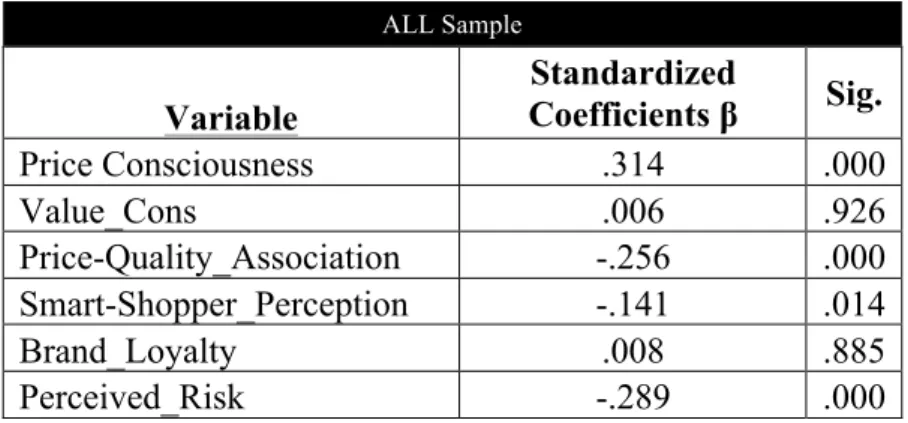
The variables include Price consciousness, price-quality association, smart-shopper perception and perceived purchase risk. These variables are shown to have a significant effect on private label purchase intent. In Figure 8.1 are displayed the standardized regression coefficients for the linear regression model comprising the entire sample population.
ALL Sample Variable Standardized Coefficients β Sig. Price Consciousness .314 .000 Value_Cons .006 .926 Price-Quality_Association -.256 .000 Smart-Shopper_Perception -.141 .014 Brand_Loyalty .008 .885 Perceived_Risk -.289 .000
Dependent Variable: PI_PLall
Looking at the variable Price Consciousness, the coefficient exhibits that for every unit increase in Price consciousness, the purchase intent for private label products (Shampoo and shower gel) will grow roughly 31%, all other variables remaining constant. Consequently, Hypothesis 1 is approved: Consumers’ price consciousness has a positive effect on Private Label purchase intent.
Price quality association, on the other hand, turns out to have a contrary effect over private label purchase intent. If a consumer’s price quality association increases by one unit, their purchase intent for private label decreases by 26%. Thus, Hypothesis 3 is confirmed: Consumers’ price-quality association has a negative effect on private label purchase intent. Similarly, Smart shopper perception manifests a negative association with private label purchase intent. As consumer’s self-perception of a smart shopper grows one unit, their willingness to purchase a private label product decreases by 14%. This result validates Hypothesis 4: Consumers’ smart-shopper perception has a negative effect on private label purchase intent.
Finally, the variable purchase risk appears to significantly predict private label purchase intent. In numerical terms, for one unit increase in consumer’s perceived risk, purchase intent for private label Shampoos will decrease by nearly 30%. Hypothesis 6 is, therefore, certified: Perceived purchase risk has a negative effect on Private Label purchase intent.
According to the described results, considering the entire sample population, most Hypotheses from the literature review are validated.
Hypothesis 1, Hypothesis 3, Hypothesis 4 and Hypothesis 6 are confirmed.
Nonetheless, Hypothesis 2 and Hypothesis 5 could not be validated, as the coefficients resulting from the performed regression model were not statistically significant.
Figure 8.2 displays a diagram with the Hypothesis tests’ results comprising the entire sample population.
label Shampoos will increase by approximate 22%, holding all other variables constant. This result validates Hypothesis 1: Consumers’ price consciousness has a positive effect on Private Label Shampoo purchase intent.
Price quality association conveys a significant negative coefficient, which means that as consumers association that higher priced Shampoos insinuate better quality increases, it is predicted that the purchase intent for private label Shampoos will decrease. Based on the standardized coefficient, for one unit increase in price-quality association regarding Shampoos, purchase intent for private label decreases by about 39%.
This result confirms Hypothesis 3: Consumer’s price-quality association has a negative effect on private label Shampoo purchase intent.
Concerning purchase risk, this variable has demonstrated to significantly predict private label purchase intent. There is a significant and negative relationship between consumers perceived risk of buying the wrong Shampoo, and the purchase intent for private label Shampoos. Quantitatively, for one unit increase in consumer’s perceived risk, purchase intent for private label Shampoos will decrease by 40%.
Based on the above result, there is evidence to uphold Hypothesis 6: Perceived purchase risk has a negative effect on Private Label Shampoo purchase intent.
The collected data does not provide statistical evidence to support the Hypothesis H2, H4 and H5, since the resulting coefficients for the consumer variables value consciousness, brand loyalty and smart-shopper perception were not significant on the performed regression models, considering a 95% CI.
product increases nearly 50%. Accordingly, Hypothesis 1 is verified: Consumers’ Price consciousness has a positive effect on Private Label Shower gel purchase intent.
Contrarily, Price quality association shows an inverse relationship with private label purchase intent. As consumers price quality association within shower gel products increases by one unit, their purchase intent for private label decreases by 19%. This result upholds Hypothesis 3: Consumers’ price-quality association has a negative effect on private label Shower gel purchase intent.
Moreover, Smart shopper perception also demonstrates a negative relationship with private label shower gel purchase intent. The more consumers perceived themselves as Shopping “experts” when it comes to Shower Gel, the less they are willing to purchase a private label product, in numerical terms, a decrease of 20%. Therefore, there is evidence to agree with Hypothesis 4: Consumers’ smart shopper perception has a negative effect on Private Label Shower gel purchase intent.
Perceived risk conveys a negative coefficient, which implies the purchase intent for private label Shower Gel decreases as the perceived risk associated with the purchase increases, thus confirming Hypothesis 6: Perceived purchase risk has a negative effect on Private Label Shower gel purchase intent.
As is evident from the above results, several Hypotheses from the literature review chapter are validated. Alike the results for Hair Care, hypothesis H1, H3 and H6 are supported. In addition, Hypothesis 4 is also confirmed.
The prevailing Hypothesis concerning the relationship between brand loyalty and PL purchase intent (H5) cannot be upheld based on the obtained results due to the fact that the regression coefficient for brand loyalty was not significant considering a 95% CI.
4.4.4 Perceived risk as a mediator of PL purchase intent
Following the regression analysis that unveiled the effects of each consumer characteristic and Perceived purchase risk on the Purchase Intent for a Private Label Shampoo, a Mediation analysis was performed to investigate whether perceived purchase risk mediates the (negative) relationship between consumers’ shopping characteristics – Price-Quality Association, Brand Loyalty and Smart-Shopper perception -and the purchase intent for private label. The analysis comprised the entire sample, including both responses for Shampoo and shower gel related questions, as the goal is access the mediating role of risk, which happens to be the main difference between the two product categories.
The idea behind Mediation analysis is that the direct effect of the independent variable (IV), on the dependent variable should decrease after a mediator (M) is added to the model.
The mediation analysis, therefore, compares the total effect of the IV on the DV without mediator, denominated c-path, with the “new” effect of the IV on the DV after controlling for the mediator, known as c’path.
The goal is to disclose whether the difference between these two effects (c-path – c’ path), generally known as the indirect effect, is statistically significant.
As mentioned above, in order to advocate mediation, c’-path should be smaller than c-path. However, there are two types of mediation: if c’ is non-significant there is full mediation; if both paths are significant there is only partial mediation.
An alternative to estimate the indirect effect and its significant is the Sobel test (Sobel. 1982). It consists of a Z-test on whether the difference between c path and c’path is statistically significant and different from zero.
Sobel tests were ultimately performed for each analysis to confirm the results.
Finally, to calculate the effect sizes the measure used was the Percent mediation (PM), interpreted as the percentage of the total effect that is accounted for by the indirect effect. The subsequent analysis considers consumer traits ad the independent variables, perceived risk as the mediator and private label purchase intent as the outcome variable, or dependent variable.
quality association and Private Label purchase intent.
Hypothesis 7b: Perceived purchase risk mediates the negative relationship between consumers’ smart-shopper perception and Private Label purchase intent.
Hypothesis 7c: Perceived purchase risk mediates the negative relationship between consumers’ brand loyalty and private label purchase intent.
4.4.5 Testing for Moderation effects
Ultimately, a moderation analysis was performed to assess if risk, bedises a mediator, is also a moderator of the above relationships. The model used for the analysis was Hayes's PROCESS Model 1: Moderation with a continuous moderator.
A moderator variable is one that changes the strength of the relationship between a dependent and independent variable. Statistically, a variable is called moderator if there is an interaction between the independent variable(s) and the moderator variable such that affects the
dependent variable. Thus, in order to exist Moderation the must be interaction.
Given that each model should contain only one independent variable, five analysis were conducted, one for each consumer characteristic: Price consciousness, Value consciousness, Price-quality association, Smart-shopper perception and Brand loyalty.
The moderator variable here is perceived risk and the dependent variable is private label purchase intent.
Results show that the interaction effect between the independtent variables and the moderator is not significant for any case (p>0.05), revealing that there is no signifcicant moderation effect between the variables, which means there is not enugh evidence conclude that there is moderating effect in the population. (Appendices XI → XV)
48
5 C
ONCLUSIONS AND LIMITATIONS5.1 Main Findings and Conclusions
This research had two main objectives. First, it aimed at studying whether and how consumer perceptual traits and perceived purchase risk influence private label purchase intent and how these relationships vary depending on the category’s level of risk. To investigate these effects, this study focused on the Beauty and Personal Care industry and analyzed two particular product categories with different levels of perceived risk, namely Hair Care and Body Care, which were rated by consumers as high-risk and low-risk respectively.
The second fundamental purpose of this study was to assess whether perceived purchase risk could explain the nature of the relationships between consumer characteristics and purchase intent for private label products on the studied product categories. These effects were measured using SPSS statistical software.
5.1.1 Consumer drivers of private label purchase intent
First and foremost, multiple linear regressions were performed to access the effects of
consumers’ price consciousness, value consciousness, price-quality association, brand loyalty, smart-shopper perception and perceived risk on private label purchase intent, contextualized in accordance with each product category. As already explained through the methodology, the survey’s participants were randomly assigned to one of two scenarios where they were asked questions about their consumer behavior towards bying Shampoo or Shower gel.
A first regression was performed for the entire sample followed by two more detailed analyses, one for each category’s sample.
The main goal of these analyses was to compare the results for both categories, considering that they have different levels of perceived risk as confirmed by the pre-survey’s collected data.
To begin with the analysis of entire sample it was demonstrated that consumers’ price consciousness, price-quality association, smart-shopper perception and perceived purchase risk have a significant effect in predicting private label purchase intent.
While consumers’ price consciousness seems to positively influence purchase intent for private label, which is predictable since these brands are usually the lowest priced, their price-quality association, smart-shopper self-perception and perceived purchase risk exert the contrary effect.
However, the focus of this research is to understand the different drivers between both categories, Hair Care and Body Care, in order to explain the high variability in private label penetration.
Thus, moving on to the results on a category-level, the particular examples of Shampoo and shower gel were chosen to represent the Hair Care and the Body Care categories through the data collection process and analysis.
Results obtained from the analysis on consumer’s shopping behavior towards Shampoos, support that within this product category (Hair Care), consumers’ price consciousness positively influences their PL purchase intent while their price-quality association and perceived purchase risk negatively influence their purchase intent for private label.
The remaining consumer traits such as value consciousness, brand loyalty and smart-shopper perception appear not to directly predict private label purchase intent for this product category, contrarily to what was expected from the literature review.
In respect of consumer’s shopping behavior towards shower gel, the results defended that within this category, consumers’ price consciousness, price-quality association, smart shopper perception and perceived purchase risk had a direct effect over their purchase intent for private label. While consumers price consciousness appears to positively predict purchase intent for private label shower gel, the remaining four variables had demonstrated to have the opposite effect.
Consumers’ value consciousness and brand loyalty are believed not to have a direct effect over private label purchase intent for this product category, which does not support the corresponding Hypothesis based on the literature review.
On the table below (Figure 13) are displayed the conclusions from the Hypotheses proposed in the Literature Review, related to the consumer traits that drive private label purchase intent.