Technological
Developments in
Industry 4.0 for Business
Applications
Luis Ferreira
Polytechnic Institute of Cávado and Ave, Portugal
Nuno Lopes
Polytechnic Institute of Cávado and Ave, Portugal
Joaquim Silva
Polytechnic Institute of Cávado and Ave, Portugal
Goran D Putnik
University of Minho, Portugal
Maria Manuela Cruz-Cunha
Polytechnic Institute of Cávado and Ave, Portugal
Paulo Silva Ávila
Polytechnic of Porto, Portugal
A volume in the Advances in Logistics,
Operations, and Management Science (ALOMS) Book Series
Published in the United States of America by IGI Global
Business Science Reference (an imprint of IGI Global) 701 E. Chocolate Avenue
Hershey PA, USA 17033 Tel: 717-533-8845 Fax: 717-533-8661 E-mail: [email protected] Web site: http://www.igi-global.com
Copyright © 2019 by IGI Global. All rights reserved. No part of this publication may be reproduced, stored or distributed in any form or by any means, electronic or mechanical, including photocopying, without written permission from the publisher. Product or company names used in this set are for identification purposes only. Inclusion of the names of the products or companies does not indicate a claim of ownership by IGI Global of the trademark or registered trademark.
Library of Congress Cataloging-in-Publication Data
British Cataloguing in Publication Data
A Cataloguing in Publication record for this book is available from the British Library.
All work contributed to this book is new, previously-unpublished material. The views expressed in this book are those of the authors, but not necessarily of the publisher.
For electronic access to this publication, please contact: [email protected]. Names: Ferreira, Luis, 1967 December 28- editor. | Lopes, Nuno, 1977- editor. | Silva, Joaquim, editor.
Title: Handbook of research on emerging developments in industry 4.0 / Luis Ferreira, Nuno Lopes, Joaquim Silva, Goran D. Putnik, Maria Manuela, Cruz-Cunha, and Paulo Silva Avila, editors.
Description: Hershey : Business Science Reference, [2018]
Identifiers: LCCN 2017032933| ISBN 9781522549369 (hardcover) | ISBN 9781522549376 (ebook)
Subjects: LCSH: Technological innovations--Management. | Information technology--Management.
Classification: LCC HD45 .H2937 2018 | DDC 658.5/14--dc23 LC record available at https://lccn.loc.gov/2017032933 This book is published in the IGI Global book series Advances in Logistics, Operations, and Management Science (ALOMS) (ISSN: 2327-350X; eISSN: 2327-3518)
26
Chapter 2
DOI: 10.4018/978-1-5225-4936-9.ch002
ABSTRACT
Information Systems are the core of every business and cut across almost all aspects of organizational life. The adoption of technology enablers, by itself, does not guarantee such an organizational trans-formation. The new technology enablers allow the production, sharing and management of information and knowledge within the organization between peers and other stakeholders, and they also allow the improvement of organizational processes, requiring the updating of the supporting IS. Taking advantage of these technologies for organizations within the context of digital transformation requires a compre-hension exercise in how to demonstrate their usefulness with regard to the creation, access and sharing of contents and IS improvements in a safe way. To this end, this chapter provides a comprehensive view of a new context of labour faced by the DT of organizations, which we term Enterprise 4.0 and which we propose to be implemented through the m_CSDIT framework, so as to improve the organizational well-being considering the collective intelligence and agility dimensions.
Digital Transformation Towards
a New Context of Labour:
Enterprise 4.0
Maria João Ferreira
Portucalense University, Portugal & University of Minho, Portugal
Fernando Moreira
Portucalense University, Portugal & University of Aveiro, Portugal
Isabel Seruca
Digital Transformation Towards a New Context of Labour
INTRODUCTION
It is widely acknowledged that organizations have suffered a large evolution at the social, economic and technological levels where the traditional barriers of transferring information and knowledge have been progressively eliminated. This evolution allowed the elimination of silos, the breaking down of hierar-chies, the connection of internal and external stakeholders and the empowering of employees (Berkman, 2014). Furthermore, the use of technology enablers such as Big Data and associated analytics, Cloud Computing, Mobile Connectivity, and Social, the four pillars of digital transformation (DT), within business practice can enable significant organizational competitive advantage (Uhl, & Gollenia, 2016).
According to Earley Information Science (2016) digital transformation (DT) is today a top priority for executives, being that (1) 125000 enterprises expect revenue from their digital initiatives to increase by 80% by 2020; (2) DT initiatives will more than double by 2020, from 22% to almost 50% and, (3) only 27% of businesses have a coherent digital strategy for creating customer value in place.
From the organizations’ point of view, DT can be seen as a deep and accelerating transformation with regard to processes, activities, competencies and models, in order to take advantage of the changes and opportunities offered by the inclusion of digital technologies into an organization. However, this advantage is only possible if the information systems of the organizations are also aligned with these new technologies. The main purpose of digital transformation is to redesign the organizational business through the introduction of digital technologies, achieving benefits such as productivity improvements, cost reductions and innovation (Hess et al., 2016). Nevertheless, as stated in Miller (2016), for these results to be achieved, a total organizational commitment is required. To this extent, Hinchcliffe (2016) points out that “…because digital itself is so intangible…. It’s often even harder to understand the di-verse needs, perspectives, and skill gaps of the people that have to change along with the technology”. Hence, it may be assumed that continuous education/training is an imperative in this transformation organizational context.
In parallel with digital transformation and often referred as a major opportunity for promoting digital transformation in manufacturing, the paradigm of industry 4.0 has also arisen, whose goal is to achieve a higher level of operational efficiency and productivity, as well as a higher level of automatization (Thames & Schaefe, 2016). Industry 4.0 facilitates inter-connection and computerization into the tradi-tional industry (Lu, 2017). Following this line of reasoning, in our research contribution we propose a framework to drive organizational digital transformation, where the former concept applied within the context of manufacturing is applied to any type of organization – Enterprise 4.0.
On the other hand, Information Systems (IS) are the core of every business and cut across almost all aspects of organizational life. They are used to support and improve all aspects of organizational func-tions and activities. In particular, under this context, the perception of increased product and services customization as a competitive advantage is universally shared (Kadiri et al., 2016).
Thus, it can be claimed that in order for DT to be successful in an organization, IS needs to be adapted/ updated as well. IS must accommodate DT and must be aligned with the business in order to create value for the organization/business.
In this chapter, we provide a comprehensive view of the prevalent issues of a new context of labour faced by organizations on a digital transformation process: Enterprise 4.0 supported by mobile IST – m_CSDIT. Furthermore, we argue that this context will improve the well-being of these organizations through the collective intelligence and agility dimensions. The m_CSDT framework was formerly
pro-Digital Transformation Towards a New Context of Labour
or systematize social business in organizations. We now propose an update of the m_CSDT framework to accommodate digital transformation and leading to Enterprise 4.0.
NEW TRENDS FOR ORGANIZATIONS
As already referred IS are nowadays central on any organization (Romero & Vernadat, 2016) regardless of its type, size, purpose or means, any organisation has an IS to support its internal operations and its interactions with the external environment. IS can be defined as “software systems for business manage-ment, encompassing modules supporting organizational functional areas such as planning, manufacturing, sales, marketing, distribution, accounting, financial, human resources management, project management, inventory management, service and maintenance, transportation and e-business” (Rashid et al., 2002) supported by computers, software, people, processes and data.
Organizations face daily pressures to demonstrate their ability to adapt quickly to unpredictable changes in their dynamics in terms of technology, social, legislative, competitiveness and globalization. Thus, to ensure their place in this difficult context, organizations must always be agile and must ensure their sustainability through continuous improvement of their IS (Imache et al., 2015). Therefore, organizational agility should be considered today as one of the main objectives of any organization (Imache et al., 2015).
According to Xu (2011) ISs have emerged in the last decades as a hopeful tool used for integrating and extending business processes across boundaries of business functions of an organization, at both intra and inter-organizational levels, in a worldwide economy with increasing global and competitive business operations. Moreover, the development of ICT including Industrial Informatics and the tech-nological advances in ISs have provided a solution to the growing needs of information integration in businesses, supporting the operations of global supply networks. As stated in Imache et al. (2015), ISs have progressed in a constant interaction between a permanent and random change. In this context of organizational and ICT evolution, the emerging trends for organizations are presented during the next sub-sections.
Digital Transformation
The definition of digital transformation (DT) is not consensual among the stakeholders involved in this issue, particularly in organizations, leading to several perspectives of what it really means. These perspec-tives range from a focus on technology, to digital customer engagement, to new digital business models and so on. The lack of clarity often results in piecemeal initiatives, missed opportunities and false starts in the organization digitalization. According to Solis (2017) DT may be defined as “the realignment of, or new investment in, technology, business models, and processes to drive new value for customers and employees and more effectively compete in an ever-changing digital economy”
Following this line of reasoning, from the organizations’ point of view, DT can be seen as a deep and accelerating transformation with regard to processes, activities, competences and models, in order to take advantage of the changes and opportunities offered by the inclusion of digital technologies into an organization.
On the other hand, Uhl and Gollenia (2016) enrich the DT concept, arguing that the adoption of technology-based change is focused on four technology enablers: (1) cloud, (2) mobile, (3) social, and (4) big data – analytics. Hence, DT draws on these four pillars to place a business context over the
Digital Transformation Towards a New Context of Labour
technologies, while taking advantage of them to support innovation. These technology enablers will be briefly described in the following sub-sections.
Big Data and Associated Analytics
As discussed in Chen et al. (2014), on the one hand Big data is considered an abstract concept and, on the other hand, the academic and industrial communities have different views on the definition (Team, 2011; Laney, 2001). However, some definitions have appeared over time, namely by Apache Hadoop, IBM, McKinsey & Company and IDC. The first definition was though introduced by Doug Laney in 2001, where he presents the 3Vs model (Volume – great volume, Velocity – rapid generation, and Variety – various modalities) (Gantz & Reinsel, 2011). This definition has undergone changes, and in 2011, IDC defined big data as “big data technologies describe a new generation of technologies and architectures, designed to economically extract value from very large volumes of a wide variety of data, by enabling the high-velocity capture, discovery, and/or analysis” (Labrinidis & Jagadish, 2012). This definition implied a change from the 3Vs model to a 4Vs model with the inclusion of Value (huge value but very low density).
Despite the added value that Big Data presents in responding to new requests, some of the existing challenges need to be addressed. In Agrawal, et al. (2012) eight challenges are presented. Within our contribution, we place special emphasis on the challenge identified by these authors as “Analytical mechanism”.
Cloud Computing
The basic definition of cloud computing can be found in Armbrust, et al. (2010) and is given as “Cloud computing refers to both the applications delivered as services over the Internet and the hardware and systems software in the data centers that provide those services. The services themselves have long been referred to as Software as a Service (SaaS). Some vendors use terms such as IaaS (Infrastructure as a Service) and PaaS (Platform as a Service) to describe their products.” While realizing that the definition may vary, Ochian et al. (2014) describe cloud computing “as a mechanism for generating ubiquitous access to a pool of convenient, on demand computing resources (compute, storage, platform, application and services) through a web interface with low administration overhead and the least intervention from a cloud service provider.”
This new paradigm is supported by a set of vendors such as Amazon, Google, and Microsoft. Mi-crosoft offers SaaS, PaaS and IaaS cloud packages to end users (Amato et al., 2013; Furht & Escalante, 2010). Some of the significant benefits (Furht & Escalante, 2010) of cloud computing include device and location independence, 24x7 support, lower total cost of ownership (TCO), reliability, scalability, sustainability, agile deployment, lower capital expenditure and a single infrastructure to fulfil all com-puting, networking and storage needs for various applications.
Regarding the advantages of the implementation of the cloud computing paradigm, Uhl and Gollenia (2016) put forward the following enhancers for organizations: “(i) Increase user mobility by a ubiquitous approval of information on any device; (ii) Flexibility and cost savings by eliminating the need for heavy local installations of end-user applications and high-powered client computers; (iii) Boosts of your busi-ness by the shift from fixed to variable costs.”
Digital Transformation Towards a New Context of Labour
Mobile Connectivity
Mobile devices and connections grew in 2013 to 7 billion, and will grow to 50 billion by 2020 (Reddi & Zhu, 2017). Not only the devices are targeted by this growth, but also the volume of mobile Web traffic, which often exceeds the “traditional” Web traffic.
This massive use of mobility devices through the vast amount of applications and services is based on Mobile computing. Mobile computing is defined in Bucki (2016) as “a generic term used to refer to a variety of devices that allow people to access data and information from where ever they are.” Some-times referred to as “human-computer interaction,” mobile computing transports data, voice and video over a network via a mobile device.”
The growth of the mobile computing market allows access to a wide range of technologies, and the integration of a variety of environments, such as cloud computing (Hsieh et al., 2013), social networks (Bellavista et al., 2013), big data computing and big data analytics (Hsieh et al., 2013).
Mobile connectivity summarizes the trend around mobile devices (smartphones, tablets, etc.) and com-munication technologies (NFC, Wi-Fi, etc.). The combination of devices and comcom-munication technologies will allow new forms of work and business, following the principle, any place, any time, and anywhere.
Regarding this technology enabler, Uhl and Gollenia (2016) identify the following enhancers for organizations: “(i) Direct connection and communication to stakeholders; (ii) Additional information about customers behavior; (iii) Customers-oriented offers; (iv) Mobile payment and ordering systems,”
Social Business and Social Media
According to Bharadwaj et al. (2013), digital technologies are transforming the relations of the digital structure, regarding the spaces of action of customers and companies, due to social media and social networks. The social business concept encompasses two directions, the resolution of social problems and, in a broader perspective, allowing a transformation of organizations so as to turn them more agile and more resilient.
Hence, Social Business may be regarded as a popular tendency that is revolutionizing organizational work and generating value for all of its elements, i.e. employees, customers, partners and suppliers. It means that all departments in an organization integrate their social capabilities into traditional business processes (Dorn et al., 2007) to change the way of working in order to create value. This view is reinforced by (Bharadwaj et al., 2013) as they state that “digital business strategy is simply that of organizational strategy formulated and executed by leveraging digital resources to create differential value.” These authors also defined three indicators to assess this added value: “(1) going beyond the traditional view; (2) going beyond systems and technologies (Conner & Prahalad, 1996); and (3) explicitly linking digital business strategy to creating differential business value”.
According to Kaplan and Haenlein (2010) Social Media “is a group of Internet-based application that build on the ideological and technological foundations of Web 2.0, and that allow the creation and exchange of user generated content.” In this context, products, services and businesses are increasingly visible in the most used social networks (Facebook, YouTube, Twitter, Instagram, etc.), both by pro-ducers and consumers. While propro-ducers produce “information” in such a way that its dissemination is as positive as possible, aiming to promote a product or service, customers, business partners, and other stakeholders may also produce information about a product or service in the form of evaluation (positive or negative). This possibility allows, in principle, new levels of transparency in the supplier-customers
Digital Transformation Towards a New Context of Labour
relationship, as can be seen from the examples discussed in Ferreira, Moreira, and Seruca, (2015). Thus, social media forces organizations to rethink their traditional business models in order to engage the stakeholders in a more focused way.
In summary, Uhl and Gollenia (2016) present the following enhancers for organizations: “(i) Faster information sharing by direct and proactive communication with various stakeholders; (ii) Early brand and consumers feedback; (iii) Cost saving with the reduction of product lifecycles; and (iv) Transpar-ency of organization processes.”
Industry 4.0
Assuming that Industry 4.0 can be considered the 4th Industrial Revolution, it is worthwhile to note,
briefly, its predecessors and the evolution of manufacturing and the industrial sector in general. The 1st
Industrial Revolution occurred in England in the late eighteenth and early nineteenth centuries. This revolution was characterized by two important inventions that proposed a reorganization of the produc-tive and transport sectors, with the appearance of the steam engine. The 2nd Industrial Revolution is
characterized by the use of electric power, the use of the motor of explosion, and the invention of the telegraph, among others, provided the emergence of new markets and the acceleration of the industrial rhythm. The 3rd Industrial Revolution, also known as the Technical-Scientific Information Revolution,
is characterized by advances in telecommunications and transportation systems, by the emergence and rapid expansion of information technology and automation, as well as robotics. Finally, as a reflection of the widespread adoption of information technology in all sectors of society, industry is currently witnessing the 4th Industrial or Technological Revolution, also known as “Industry 4.0”.
The term “Industry 4.0” (Industry 4.0 Working Group, 2013) was adopted in 2011. The reference to “.0” stems from an analogy to the way software versions are usually called, meaning that the evolution of industry itself is also subjected to the rules of technological evolution of the information technology world.
According to the Industry 4.0 Working Group (2013), the current convergence between the physical (kinetic) world and the digital or virtual world (also called “cyberspace”) makes it possible to create industrial ecosystems in which industrial processes arise from the networked interaction of objects, information and people. Thus, by using integrated digital systems for design, project, prototyping, com-ponent manufacturing, assembly and packaging, products can be planned and executed with minimal human intervention. This allows offering to the market, without cost increase, a wide range of products adapted to each individual customer. The flow of real-time and networked data between machines, robots and logistics systems will allow to anticipate failures, adapt production to new scenarios and integrate variables into the production process (with information from clients) that would otherwise be impossible.
Therefore, under Industry 4.0, there is the creation of cyber-physical systems that interrupt machines, warehouses and production lines, in a context in which all these manufacturing entities are endowed with (artificial) intelligence. The permanent connection to Internet of Things and the services of these cyber-physical systems allows production, logistics and marketing to be permanently at the service of the specific supply needs, regardless of the customer or the existing partner in the global market. For example, according to Uhl and Gollenia (2016), the automotive industry benefits greatly from the In-dustry 4.0 paradigm. Customers can change their orders (for example, car color) more easily, even when the production process has already been initialized.
Digital Transformation Towards a New Context of Labour
Uhl and Gollenia (2016) show that Industry 4.0 can empower organizations in three positive aspects: “(i) Ad hoc reaction to customer changes (painting, delivery address, etc.) and changes in the supply chain (absent delivery can be replaced promptly); (ii) Optimization of the tasks of the staff members (reprogram-ming of machines); (iii) Find irregularities in the production process and correct them automatically.”
DIGITAL TRANSFORMATION IN ORGANIZATIONS
There is a growing number of reports of DT in organizations. There are also different levels of maturity in the effort of DT by organizations. In this section, we provide a selection of examples that are focused on the evolution of companies’ digital transformation efforts.
Social Media Tools and Social Business: Early DT Efforts
Starbucks is a multinational company with more than 20,000 stores worldwide, headquartered in Seattle, USA. The company created its name inspired by the Starbuck character of Moby Dick, and its logo is a sixteenth-century Scandinavian cut of a two-tailed mermaid.
In 2009, Starbucks, after a poor performance and share price value, which was cut in half, focused its digital strategy to re-establish the connection with its customers (Fitzgerald et al., 2013). One of the first measures introduced was to offer free Wi-Fi in all Starbucks stores, in addition to free access to The Economist’s magazine contents.
Furthermore, an important step in the undergone digital transformation was to restructure teams to collaborate from the start of projects. By that time, the company was able to reduce 10 seconds in the processing of each card transaction, reducing the total service time by 900,000 hours, considering 3 million mobile payments per week.
The use of social media tools, in addition to other technologies, changed customer relationships, op-erations, and the business model, leading to increased customer relationships; as a result, the Starbucks company shares value increased from $8 in 2009, to nearly $73 in July 2013.
Internal communication also benefited from this strategy of use of social media tools; to that extent, the company’s CIO remarked that “social business tools and processes had transformed the company’s innovation culture, helping it develop products and understand risks as rapidly as new markets emerged.” (Fitzgerald et al., 2013).
Hummel is a company founded in 1923 in Hamburg, Germany, by a young shoemaker, and has one of the oldest sportswear brands in the world. The company has suffered management changes and, in the late 1990s, was bought by a Danish lawyer. Since then, Hummel has maintained a growth of ap-proximately 20% per year.
Hansen and Sia (2015) presented a case study on the digital transformation of the Hummel Company. This transformation began with the consolidation of the 22 local sites into only one global platform, which took local needs into account. In addition, the presence on the social network Facebook, where the company had about 25 different pages, with inconsistent brand expressions, went to a global Facebook page. The strategy was not only to use Facebook, but to be present on all relevant social media platforms, in order to maintain the most appropriate relationship with customers according to the profile of use in each of the various platforms (Instagram, etc.).
Digital Transformation Towards a New Context of Labour
Besides its relationship with the outside world through social media platforms, the company devel-oped a Digital Handbook so as to further align the online brand image, describing the set of norms and guidelines needed to be followed within online channels brand usage. This guide also provides guid-ance on how partners should sell products on channels such as their own sites, as well as policies for AdWords, etc. To cope with the evolution of communication channels and the emergence of new means of relationship with customers, the company regularly updates the manual every six months.
LEGO was founded in 1932 by Ole Kirk Kristiansen, a carpenter who made wooden toys; its head-quarters are in Billund, Denmark, but the company has offices spread all over the world (U.S., U.K., China, etc.). It has more than 17,000 employees, with revenues of over $5 billion in 2015.
The company decided to make a digital transformation in its form of leadership and in all sectors of the organization’s activities. Sawy et al., (2016) describe that the efforts made by the company were in the direction of using various digital channels, such as social media tools. For example, the company began to tell interactive stories within the “trailers” of online games to engage children with the new characters. Complementarily, the company has created a catalog of augmented reality products to meet the new technologies, and to not lose the market.
The increase of connectivity with customers through various communication channels (company web-site, social media tools, etc.) has put, however, new demands on the reorganization of the company’s IT department, so as to adapt to this new reality, digital interaction with the consumer. Hence, the company learned the importance of social media tools in business and their value in discovering the concerns and needs of customers, and therefore allowing to create value.
Innovation Accelerators: New DT Directions
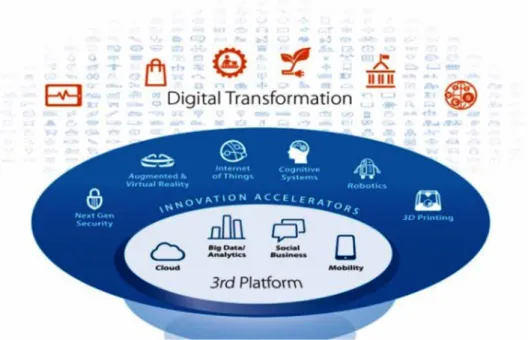
The results of introducing, among others, social media tools in business were very positive and resulted in the revitalization of many businesses and reference companies in their areas of intervention. These outcomes were presented and discussed in the previous section regarding Starbucks, Hummel and LEGO organizations. However, the rapid evolution of technology has led to the emergence of new solutions (cloud computing, increased use of mobile devices, etc.) that led to the emergence of the so called 3rd technology platform (early 2010), which is based, as previously described in four technology enablers or pillars (mobile devices, cloud computing, social networking and Big Data and associated analytics). This platform is the result of the evolution of the 1st platform (late 1950s), based on mainframes, and the 2nd platform (mid-1980s) based on the client-server model.
The more significant use of the pillars of digital transformation has been driven by innovation ac-celerators, which include, among other solutions, IoT, Robotics, 3D Printing, Artificial Intelligence, Augmented and Virtual Reality, Cognitive Systems and Next Generation (NextGen) Security as shown in Figure 1. To this extent, IDC expects that in, 2019, 3rd platform technologies and services will ac-count for about 75% of IT spending (IDC, 2016).
The consideration of the 3rd platform and the innovation accelerators within Digital Transforma-tion efforts will allow a large number of combinaTransforma-tions that will result in diverse business models and implementations, as discussed in the next section. This evolution will leave many organizations with new challenges to meet the challenges they already had. Furthermore, digital transformation will entail a significant shift with which CIOs will have to confront and adapt. For example, systems will have to be addressed as services, IT agility will shift to business agility, and information will have to be
trans-Digital Transformation Towards a New Context of Labour
Thus, for companies to stay competitive in the market, ensuring more agility, efficiency and pro-ductivity in business, it is no longer enough to just invest in IT. It is necessary to recognize the strategic value of the innovation accelerators and to plan the IT infrastructure to support digital transformation.
One of the main advantages of digital transformation is the possibility of expanding physical to digital business. For example, one of the innovation accelerators, virtual reality technology, can be applied to the real estate market to conduct visits to fully digital properties, whereas in the medical field, the same resource can be applied to offer virtual training of surgeries and study of organisms.
The Rise of the DT Economy and the New Tech Industry
In the last years, we have witnessed the establishment and evolution of the four pillars of Digital Trans-formation as well as the maturation and mash-up of the so-called innovation accelerators (IDC, 2017). These two trends allowed the support of an expanding Digital Transformation economy and the first wave of players, services and solutions in all the industries.
Innovation plays a major role in the process and is considered one key domain of Digital Transforma-tion (Rogers, 2016). Today’s start-ups have shown us that digital technologies can enable a very different approach to innovation, one based on continuous learning through rapid experimentation.
As digital technologies make it easier and faster than ever to test ideas, market feedback can be gained from the very beginning of the innovation process, all the way through to launch and even afterwards. This new approach to innovation is focused on careful experiments and on minimum viable prototypes that maximize learning while minimizing costs. Assumptions are repeatedly tested, and design decisions are made based on validation by real customers. Products and services are developed iteratively through a process that saves time, reduces the cost of failures and improves organization learning.
Digital Transformation Towards a New Context of Labour
The two case studies provided in this section describe real stories of business innovation through digital transformation, applied in start-up companies. Both cases target the use of intelligent systems in the conduction of the companies’ operations and the benefits achieved, thus providing a new context of labour, which we term Enterprise 4.0.
The AddVolt Case
Founded in 2014 and incubated at the Science and Technology Park of the University of Porto (UPTEC), the Portuguese Start-Up company AddVolt (AddVolt, 2017) designs and develops electric controllers which manage intelligently and autonomously distinct sources of electric energy.
The company has created WeTruck, a product and technology designed to produce energy in trucks, targeted to transport and logistic companies operating in the temperature sensitive product supply chain, which have fleet equipped with refrigeration units that are powered by diesel engines with high level of fuel consumption, maintenance, noise and CO2 emissions.
The WeTruck system produces energy through photovoltaic panels installed on top of the truck and recovers energy during the vehicle braking and decelerations. It uses the energy generated to supply the refrigeration unit in electric mode.
The WeTruck System
WeTruck is a fresh and non-invasive solution for transport and logistic companies operating in the temperature sensitive product supply chain: it uses the solar and the kinetic energy of the vehicle to pro-duce enough electricity to power the cooling system of refrigerated trucks. Through a portable electric equipment (capable of producing, recovering and storing electrical energy on board of the vehicle) and a controller, it has even become possible to recover energy during braking, without the need of structural modifications on the vehicles (Figure 2). The outcome is quite impressive: a reduction in fuel consump-tion, maintenance costs and noise, and less 87% of CO2 emissions per year.
“There are 4.8 million refrigerated lorries and trucks circulating across the globe, a number that is expected to double by 2025. In Europe, there are approximately 1.1 million of these vehicles, where WeTruck can make a difference. AddVolt aims to improve fleet integration with the electrical network and with cities, thus contributing to more sustainable and effective transport, on a path towards 0% fuel consumption in the cooling of goods and foodstuffs”, says Bruno Azevedo, Chief Executive Officer of
Digital Transformation Towards a New Context of Labour
the company, which was one of the 66 start-ups selected to represent Portugal at Web Summit 2016 (AddVolt, 2017).
Intelligent Use of the Regenerative Braking Functionality Through Data Mining Techniques
In parallel with the WeTruck system, AddVolt is also developing a data driven optimization procedure to save energy and reduce costs while travelling. The data mining project uses both supervised and unsupervised machine learning techniques and aims to optimize the energy recovery process, using historical traffic data.
As already described, heavy vehicles that transport temperature-sensitive goods, generally use a fuel-needy dedicated diesel engine. The WeTruck system is an Energy Management System (EMS) capable of producing energy on-board of the vehicle. This recovery is possible due to the Regenerative Braking (RB) functionality, which consists in converting kinetic energy to electrical energy during a slowdown. The recovered energy is then stored in a set of batteries that supplies the refrigeration system when needed, allowing it to run in electrical mode.
Using data retrieved from the vehicle’s operation and this management system, an opportunity towards the intelligent use of the regenerative braking functionality emerges. By introducing an intelligence layer on the energy management system, a decision on applying the RB functionality can be made based on the trip’s energetic potential. This decision will optimize the battery usage and reduce the load and wear on the EMS components.
In order to calculate the energetic potential of a certain route, an estimation of the road is needed. In the modeling approach developed and implemented by AddVolt, a route is divided in several spatial segments and each segment is categorized among three pre-defined classes. A classification model is used to predict traffic using historical data as input. By using this modeling approach based on travel times, information on traffic flow and intersection queues are incorporated and by calculating the most likely sequence of states, a estimation of the road ahead is made.
Using the information of the modeled path, when the RB systems detects a situation where the functionality can be applied, a decision will be made by weighting the energetic potential of the path ahead and the energy need. When the algorithm sees fit, a higher torque may be applied to the genera-tor, which will result in a larger quantity of energy recovered. Since this causes stress to the system, this functionality needs a robust intelligence layer.
Results and Internationalization Roadmap
Luis Simões has become the first company to implement the WeTruck technology, responding to the commitment of the company for R&D and environmental care (Portugal Startups, 2016). With almost 50 years of experience and more than 1800 employees, Luis Simões is one of the biggest logistic and transportation companies in Portugal.
This partnership has brought immediate effects in reducing gas refrigeration units generated in Luis Simões’ trucks and trailers, allowing a reduction of up to 87% of carbon dioxide emissions during the transport of products subjected to temperature control.
After two years of research and more than 70,000 km of testing and trials in real operations, Luis Simões and AddVolt have shown that the technology contributes significantly in emissions, achieving a reduction of 844 kg per vehicle per month. The improvement also has an effect on a reduction of more than 30% of noise (about 30 dB) and increases the cooling efficiency of the products during transport.
Digital Transformation Towards a New Context of Labour
This collaboration shows the potential of having big companies working with universities and startups to bring innovation to their activity.
In which concerns internationalization, AddVolt managed to attract funds from four investors who are now shareholders of the company, and aims to enter the German and Spanish markets (Portugal Ventures, 2017). The new investors will help AddVolt get its technology circulating on European streets and in cities where CO2 emissions and noise restrictions have driven the electrification of transport.
In Germany, a market where the biggest components and systems manufacturers for the transport sector are located, AddVolt already has strategic partnerships in place as well as the support of distribu-tors to launch WeTruck. Entry into the Spanish market is also in the pipeline.
The Neomatix Case
Neomatix, an Israeli Start-Up company based in Tel Aviv, has invented a simple, seamless and cost-effective solution for automatically inspecting cars and trucks based on Computer Vision, Deep Learning and Big Data Analytics. In October 2016, Neomatix was selected as the winner in Shell’s Bright Energy Ideas Challenge, out of 219 Smart Mobility start-ups from 36 countries (Neomatix, 2017).
The company offers an automated tire monitoring and asset management system which allows commercial vehicle fleets to save on operational expenses while increasing safety and reducing carbon emissions. This is achieved without any installation on the vehicles. The electro-optic tire sensor system monitors tire pressure and wear & tear remotely, based on advanced image processing, computer vision and machine learning algorithms. The solution greatly contributes to reduced CO2 emissions, improved fuel efficiency and road safety by timely warning drivers of a low-pressure or torn tire.
Neomatix started with tire monitoring, devising a smart sensor for monitoring the status of tires and estimating tire pressure and tire wear using visual data from multiple cameras, and is now inspecting cars and trucks at fleet parking lots and logistic centers. The system enables seamless and cost effec-tive prediceffec-tive maintenance, bringing down the total cost of ownership, reducing carbon emissions, and making the roads safer for all.
The Neomatix TRAX Visual Intelligence Solution
Neomatix develops electro-optic tire monitors for automated fleet-level tire management (Figure 3). The Neomatic TRAX is an electro-optic tire monitoring and management solution, designed to work as a Tire Resource Automation Expert (TRAX).
The company’s proprietary solutions are based on advanced computer vision and image processing algorithms, as well as on actionable business intelligence derived from big data analysis and machine learning.
The key benefits of automated external inspection provided by Neomatic TRAX are to allow vehicle fleet operators to get their tires effectively under control, increase fleet safety and up-time, reduce fuel waste and carbon emissions, and most importantly to significantly reduce their cost per kilometer. Thus, the solution helps vehicle fleet operators to save on operational expenses while increasing safety and reducing carbon emissions by automated tire monitoring and asset management.
Digital Transformation Towards a New Context of Labour
Intelligent Use of the Solution Through Data Mining Techniques
Visual Intelligence empowers organizations with instant business intelligence into areas that were previ-ously out of reach. The Neoamtix TRAX system estimates tire pressure and tire wear using visual data from multiple cameras and uses a set of data mining techniques for classification, regression, localization and segmentation problems. The solution also uses 3D reconstruction from a stereo vision system and includes a real time wheel detection system.
Results and Internationalization Roadmap
Regardless of mobility solutions trending towards more shared, electric or autonomous driving, vehicle tires remain a constant factor in mobility. Innovations related to tires can substantially contribute to cleaner, safer and cheaper transportation.
Enabling V2V external inspections in the age of autonomous vehicles, Neomatix’s patented technol-ogy, which uses computer vision and deep learning algorithms, is disrupting the way tires are managed in trucking fleets. According to Geert van de Wouw, managing director of Shell Technology Ventures (Business Wire, 2017), the winning startup was selected thanks to its potential effect on sustainability and road safety, both now and in the foreseeable future.
Kfir Wittmann, Founder and CEO of Neomatix, explains: “Fleets waste billions of dollars every year due to tire negligence, which affects roads safety as well as environmental issues. Despite the highly competitive landscape, no solution showed a high acceptance rate yet” (Business Wire, 2017).
Urubatan Helou Jr., fleet director at Braspress Transportes Urgentes (BTU), one of Brazil’s leading parcel delivery companies that operates thousands of trucks throughout the country, and the first customer of Neomatix says “The beauty about Neomatix is that it is easy to adopt and implement, regardless of fleet size, and also very simple to maintain and use in the daily process of a fleet like ours”. He also adds “We have tried every tire monitoring solution before adopting the Neomatix system. The information provided by the system is straightforward, actionable and very focused. We already see the effect on our bottom line. This is exactly the management solution we were looking for.”
Digital Transformation Towards a New Context of Labour
The company has already raised $3M from the Tel Aviv Angel Group and the Brazilian fleet manage-ment company SmartDrive and is an alumni of the Coca-Cola company’s commercialization program “The Bridge”, addressing the supply chain challenges of the popular beverage company.
ENTERPRISE 4.0 SUPORTED BY DIGITAL TRANSFORMATION
Digital transformation in organizations is already a reality that needs to be implemented and even, in some cases improved, as already discussed. Acknowledging this context, the m_CSDT framework was formerly proposed in Ferreira et al. (2015); at that stage, the framework was used to introduce and/or systematizes social business in organizations. We now propose an extension of the framework to ac-commodate digital transformation leading to the Enterprise 4.0. The main aim is to contribute to the improvement of business processes, relationships with stakeholders (business partners, customers) and continuous training of employees within organizations.
The following subsections present the updated approach, renamed as mobile Create, Share, Document, Improve and Training (m_CSDIT) and the rationale for its use, under a context of DT by an organization.
Mobile_Create, Share, Document, Improve and Training: m_CSDIT
The relevance of conducting Digital Transformation supported by the four enablers - Big Data and as-sociated analytics, Cloud Computing, Mobile Connectivity, and Social tools is widely acknowledged and recognized by the scientific community and organizations, as discussed throughout the previous sections. However, there is a lack of approaches that allow the systematization and that guide its implementation within an organization, while improving IS and organizational processes.
To address this end, we propose the m_CSDIT approach as a three-layer framework with the fol-lowing objectives:
1. Creation, sharing documentation of information and knowledge in and out of an organization, im-provement of organizational processes and relationships with stakeholders, based on information and knowledge;
2. Training of organizational workers – ToOW model (Ferreira et al., 2017); and 3. Promotion of ad-hoc discussion.
As shown in Figure 4, a context for an Enterprise 4.0 implementation can be settled through the use of the four pillars of digital transformation, so as to achieve the well-being of the organization consider-ing the agility and collective intelligence dimensions. Thus, emphasis is given in the production of value for the organizational ecosystem.
Creating value often occurs in different social contexts. This approach includes individual and organi-zational contextual factors. It identifies the crucial role that an organization plays in promoting a culture of lifelong learning, collaboration and innovation in order to achieve the organization’s strategic objec-tives. The model identifies and presents the relationships and interactions namely between employees, technology and tools, the business strategy and business processes.
orga-Digital Transformation Towards a New Context of Labour
networks. Figure 4 illustrates the nature of the proposed collaboration in the workplace, where mobile devices are used, IS and underlying processes are largely organized and conducted by the organization, and which is based on the social context.
The approach may be briefly described as the collaboration in the workplace based on the four pillars of digital transformation. This means that the organization learns through the participation and involve-ment of its stakeholders, namely employees, through a network, connecting, interacting and collaborating to obtain or share information and / or knowledge in order to improve its organizational processes/IS. We propose that the collaboration in the workplace is achieved through the integration of suitable social media tools to the needs of organizational development and learning. To that end, we suggest a mixed form of peer tutoring with an instructor who acts as observer / facilitator. To achieve the potential benefits of collaboration, we recommend that the organization supports rather than restricts the adequate use of tools in the workplace. Thus, organizations have to define the best long-term strategies and implement action plans to take advantage of collaboration based on the DT pillars.
The Rationale for the Framework Proposal
As discussed throughout this chapter, the need for digital transformation of organizations, and conse-quently the need to introduce changes in the conduction of business and process improvement, are now recognized within the scientific community and by organizations. However, new approaches to address this paradigm are needed, so that guidance may be provided for its implementation within an organization.
Hence, a new contribution is hereby presented, originating from the work reported in Ferreira et al. (2015). The former approach was focused only on the changes introduced by social business, supported by social media tools. However, digital transformation, as discussed earlier, is based on four pillars: social, mobile, cloud and big data and associated analytics.
Thus, to address this objective – taking into account these four pillars and not just one – the former approach was extended; it consists of a three-tier framework (m_CSDIT), covering: (i) the creation, shar-ing, documentation of information and knowledge in and out of an organization in order to improving
Digital Transformation Towards a New Context of Labour
the business processes (that must be aligned to the organization strategy); (ii) training of organizational workers, and (iii) promotion of ad-hoc discussion.
As shown in Figure 4, it is possible to consider a generic approach for the implementation of digital transformation and IS improvements, based on the four DT pillars as well as in the Agility and Collec-tive Intelligence dimensions.
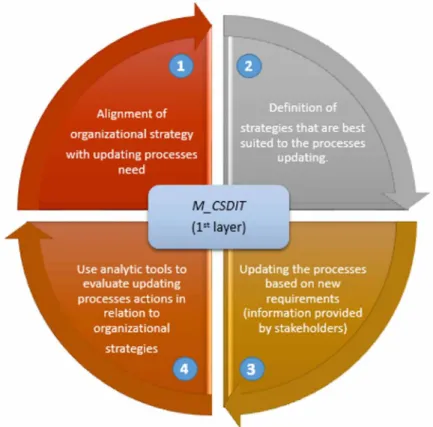
The first layer of the m_CSDIT framework is presented in Figure 5 as a cyclic sequence of stages, aiming to use the four DT pillars in the definition of the creation, sharing, documentation of information and knowledge in and out of an organization and improving the business processes, in alignment with the organizational strategy.
As depicted in Figure 5, the m_CSDIT framework is designed to improve organizational processes based on information and knowledge provided in and out of organization (3). The processes updating strategies of the organization (2) are aligned with the organizational strategy (1) and analytical tools are used to evaluate the updating of processes, on the basis of their performance, according to the defined organizational strategy (4).
In order to enable a more flexible updating scheme, the model also considers updating actions pro-posed by employees; however, updating will always be compulsory according to the defined updating processes strategies (3). The definition/adjustment of the updating processes strategies (2) should be made in a periodical basis, so as to pace with the evolution / needs of the organization.
Regarding the use of DT enablers, the model considers a complete set of tools to be used within the updating processes activities, which can be made inside and outside the organization, that is, in
Digital Transformation Towards a New Context of Labour
ent transformation (update) contexts. The model is designed in such a way as to enable the updating, at distance or in workplace context, in a formal or informal way. In the case of an informal context there will always be, as shown in Figure 2, an Observer / Facilitator, who will have a role of moderator on the ongoing activities.
As cloud is one of the pillars of digital transformation and social is one of the others, the use of social media tools located in the cloud, will allow to consider the CSDIT approach under collaborative work, as it enables internal transformation (Figure 2 – Employees) as well as external transformation (Figure 2 – Nomadic employees), enabling the interaction and collaboration among the participants, stakehold-ers, and, thus, the sharing of information and/or knowledge.
All the updates carried out will have to be evaluated so that it can be understood if the investment made meets the needs of the organization and the impact it may have on organizational processes’ im-provement. Hence, analytics tools – one of the pillars of digital transformation – will be used to monitor and compare updating results with the defined metrics goals to improve organizational processes.
The absence of a collaborative culture embedded in the organization’s ecosystem may lead to the failure of strategies set for the organization in general. In order to avoid this failure scenario, the model hereby proposed aims to promote the development of a culture of lifelong training, adding value to organizational development and being central to achieve the objectives defined in the alignment of the organizational strategy with the organization needs.
FUTURE RESEARCH DIRECTIONS
Despite the successes and progress made to date, many important topics remain open for investigation with respect to providing appropriate approaches to undertake DT in organizations supported by the use of the Big Data and associated analytics, Cloud Computing, Mobile Connectivity, and Social tools.
Many of the results achieved so far in DT of organizations have come from joint work between researchers and organizations. Awareness, education and systematization remain three of the biggest issues to develop for those working in DT. Researchers need to have practical experience as well as a sound theoretical foundation. Practitioners need to be equipped with a variety of approaches to use where appropriate depending on what is best suited to a given situation. Customers need to understand the importance of the process, believe in it, and support the efforts involved in doing it right. It is therefore under this context that our approach is proposed. The m_CSDIT approach here proposed – a three layer framework – needs to be conceptualized, implemented and validated in an organizational context.
The conceptualization of the model, in particular the first layer, will go through a preliminary study supported by a maturity model for the use/identification of indicators of measurement. The indicators will be used to determine an activity pattern so as to select the best tools either producing organization’s information “out” and in their input, i.e. what type and how the information should be made available to one or more stakeholders, and also how the feedback given by this/these stakeholder(s) should be analyzed in order to make the organization more competitive and improve its business processes. As far as out information is concerned, the indicators should guide the selection of tools to use against the ob-jectives, the “drawing” of the content and the form of dissemination. Meanwhile, indicators for analysis of information indicate how to handle this same information in order to draw conclusions on the basis of the proposed objectives e.g. sentiment analysis within one or more social networks. In defining the indicators, qualitative and quantitative methods will be used.
Digital Transformation Towards a New Context of Labour
For the 1st layer, as shown in Figure 6, the final/main goal is to instantiate the conceptual model in each organization according to its business domain and its objectives introducing whenever necessary the innovation accelerators (see section Innovation accelerators: New DT directions).
Regarding the conceptualization of the second layer of the framework, it is currently under develop-ment, i.e. studies (Ferreira et al., 2017) have been performed and a model has been outlined.
Finally, the third layer will not be conceptualized, because as it can be inferred by the name itself, it is intended that the promotion of ad- hoc discussion is unrestricted and not planned. However, the analysis of the results obtained will be performed through the in indicators set for the first layer.
CONCLUSION
DT is currently one of the major challenges faced by organizations and involves a set of highly complex activities. Within these activities, business improvement plays a fundamental role and requires particular attention. These activities are supported by information systems, which need to be aligned with orga-nizations strategies.
Taking advantage of the DT technology enablers (Big Data and associated analytics, Cloud Comput-ing, Mobile Connectivity, and Social) and realizing the need for updated approaches to address namely business processes improvement and organizational workers’ training, we extended the m_CSDT frame-work to accommodate digital transformation leading to a new enterprise environment, that we termed Enterprise 4.0.
This chapter aimed to give an overview of the state of-the art issues underlying DT efforts undertaken by organizations. It then proposes the extended m_CSDIT approach consisting in a three-layer framework that covers the systematization of (i) the creation, sharing and documentation of information and knowl-edge in and out of an organization and improvement of organizational processes based on information and knowledge, (ii) the education and training of organizational workers and (iii) ad-hoc discussion.
Digital Transformation Towards a New Context of Labour
Even though the m_CSDIT approach seems to be a valuable contribution to offer a new context to the traditional way of performing business – the DT context, in order to achieve organizational well-being through the agility and collective intelligence dimensions, the approach needs a greater degree of formalization. A distinguishing feature of a traditional organization with and without DT is the involve-ment of customers, business partners and employees in the life of an organization. Both visions present benefits and drawbacks. We envisage that the m_CSDIT approach will allow the implementation of a new context of labour, which we term Enterprise 4.0. The approach is focused on the production of value for all the organizational stakeholders. Therefore, the involvement of the organization ecosystem is of paramount importance to achieve this goal. On the contrary, traditional approaches allow the conduction of business within an organization in a closed way.
REFERENCES
AddVolt. (2017). AddVolt company institutional web site. Retrieved from http://www.addvolt.com/en/ Bertino, E., Bernstein, P., Agrawal, D., Davidson, S., Dayal, U., Franklin, M., ... & Jadadish, H. V. (2011). Challenges and Opportunities with Big Data.
Amato, F., Mazzeo, A., Moscato, V., & Picariello, A. (2013). A Framework for Semantic Interoperability over the Cloud. In 27th IEEE International Conference on Advanced Information Networking and
Ap-plications Workshop (pp. 1259–1264). 10.1109/WAINA.2013.218
Armbrust, M., Fox, A., Griffith, R., Joseph, A., Katz, R., Konwinski, A., ... Zaharia, M. (2010). A View of Cloud Computing. Communications of the ACM, 4(53), 50–58. doi:10.1145/1721654.1721672 Bellavista, P., Montanari, R., & Das, S. K. (2013). Mobile social networking middleware: A survey.
Pervasive and Mobile Computing, 4(9), 437–453. doi:10.1016/j.pmcj.2013.03.001
Berkman, R. (2014). The social enterprise: Where does the information professional fit? Online Searcher,
6, 45–48.
Bharadwaj, A., & Omar, A. (2013). Digital Business Strategy: Toward a next generation of insights.
Management Information Systems Quarterly, 37(2), 471–482. doi:10.25300/MISQ/2013/37:2.3
Bucki, J. (2016). Definition and Explanation of Mobile Computing. The Balance. Retrieved from https:// www.thebalance.com/definition-of-mobile-computing-2533640
Business Wire. (2017). Stealth Tire Monitoring Startup Neomatix to Take 1st Place in Shell’s Competition
for Sustainable Mobility. Retrieved from http://www.businesswire.com/news/home/20161027006866/en/ Chen, M., Mao, S., & Liu, Y. (2014). Big Data: A Survey. Mobile Network, 19(2), 171–209. doi:10.100711036-013-0489-0
Conner, K., & Prahalad, C. (1996). A Resource-Based Theory of the Firm: Know ledge Versus Oppor-tunism. Organization Science, 5(7), 477–501. doi:10.1287/orsc.7.5.477
Digital Transformation Towards a New Context of Labour
Crăciun, D., & Bunoiu, M. (2015). Training Teachers for the Knowledge Society: Social Media in Sci-ence Education. Broad Research in Artificial IntelligSci-ence and NeurosciSci-ence., 6(3-4), 82–88.
DeNisco, A. (2017). Report: 56% of CEOs say digital transformation has increased profits. Tech Republic. Retrieved from http://www.techrepublic.com/article/report-56-of-ceos-say-digital-transformation-has-increased-profits/
Dorn, J., Grün, C., Werthner, H., & Zapletal, M. (2007). A survey of B2B methodologies and technolo-gies: From business models towards deployment artifacts. In 40th Hawaii International Conference on
Systems Science, Waikoloa, Hawaii, January3-6. 10.1109/HICSS.2007.37
Earley Information Science. (2016) Building a Successful Digital Transformation Roadmap. Retrieved from https://cdn2.hubspot.net/hubfs/109038/EIS_Assets/EIS-Whitepaper-Building-a-Successful-Digital-Transformation-Roadmap.pdf
Ferreira, M. J., Moreira, F., & Seruca, I. (2014). A traditional organization towards a new dimension of
labour – social business. In Information systems and Technology for Organizational Agility, Intelligence, and Resilience (Ch. 9, pp. 180–204). Hershey, PA: IGI Global. doi:10.4018/978-1-4666-5970-4.ch009
Ferreira, M. J., Moreira, F., & Seruca, I. (2015). Social Business: A way to promote organizational trans-formation. International Journal of Information System Modeling and Design, 6(4), 57–81. doi:10.4018/ IJISMD.2015100104
Ferreira, M. J., Moreira, F., & Seruca, I. (2017). Organizational training within digital transformation: The ToOW model. In 19th International Conference on Enterprise Information Systems (ICEIS), Porto, Portugal, April 26-29. 10.5220/0006366105260532
Fitzgerald, M., Kruschwitz, N., Bonnet, D., & Welch, M. (2013). Embracing Digital Technology: A New Strategic Imperative. MIT Sloan Management Review, 55(2), 1–12.
Furht, B., & Escalante, A. (2010). A Handbook of Cloud Computing. New York: Springer. Gantz, J., Reinsel, D. 2011. Extracting value from chaos. IDC iView, 1142(2011), 1-12.
Hansen, R., & Sia, S. K. (2015). Hummel’s Digital Transformation Toward Omnichannel Retailing: Key Lessons Learned. MIS Quarterly Executive, 14(2), 51–66.
Hinchcliffe, D. (2016). Using online community for digital transformation. Retrieved from https:// dionhinchcliffe.com/
Hess, T., Matt, C., Benlian, A., & Wiesböck, F. (2016). Options for formulating a digital transformation strategy. MIS Quarterly Executive, 15(2), 123–139.
Hsieh, J. C., Li, A. H., & Yang, C. C. (2013). Mobile, cloud, and big data computing: Contributions, challenges, and new directions in telecardiology. International Journal of Environmental Research and
Public Health, 11(10), 6131–6153. doi:10.3390/ijerph10116131 PMID:24232290
IDC. (2016). Third platform. Retrieved from http://www.idc.com/promo/thirdplatform
https://www.idc.com/promo/thirdplatform/digital-Digital Transformation Towards a New Context of Labour
Imache, R., Izza, S., & Ahmed-Nacer, M. (2015). Clustering-based urbanisation to improve enterprise information systems agility. Enterprise Information Systems, 8(9), 861–877. doi:10.1080/17517575.2 013.879210
Industry Week. (2016). IDC transformation [image]. Retrieved from http://www.industryweek.com/sites/ industryweek.com/files/styles/article_featured_standard/public/uploads/2016/01/idc-transformation. jpg?itok=D1dkzVxX
Kadiri, E. S., Grabot, B., Thoben, K., Hribernik, K., Emmanouilidis, C., von Cieminski, G., & Kiritsis, D. (2016). Current trends on ICT technologies for enterprise information systems. Computers in Industry,
79, 14–33. doi:10.1016/j.compind.2015.06.008
Lu, Y. (2017). Industry 4.0: A survey on technologies, applications and open research issues. Journal
Of Industrial Information Integration, 6, 1–10. doi:10.1016/j.jii.2017.04.005
Labrinidis, A., & Jagadish, H. V. (2012). Challenges and opportunities with big data. Proc VLDB
En-dowment, 5(12), 2032–2033. 10.14778/2367502.2367572
Laney, D. (2001). 3-d data management: controlling data volume, velocity and variety. META Group
Research Note.
Mamaqi, X. (2015). The efficiency of different ways of informal learning on firm performance: A comparison between, classroom, web 2 and workplace training. Computers in Human Behavior, 51, 812–820. doi:10.1016/j.chb.2014.11.080
Manca, S., & Ranieri, M. (2016). “Yes for sharing, no for teaching!”: Social Media in academic practices.
Internet and Higher Education, 29, 63–74. doi:10.1016/j.iheduc.2015.12.004
Miler, R. 2016. Digital transformation requires total organizational commitment. Retrieved from https:// techcrunch.com/2016/01/31/digital-transformation-requires-total-organizational-commitment/
Neomatix (2007) Neomatix company institutional web site. Retrieved from http://www.neomatix.com Neomatix. (n.d.). [Image]. Retrieved from http://neomatix.com/wp-content/uploads/2017/05/optimus-brmp.jpg
Nookhong, J., & Wannapiroon, P. (2014). Development of collaborative learning using case-based learn-ing via cloud technology and social media for enhanclearn-ing problem-solvlearn-ing skills and ICT literacy within undergraduate students. Procedia: Social and Behavioral Sciences, 174, 2096–2210. doi:10.1016/j. sbspro.2015.02.007
Ochian, A., Suciu, G., Fratu, O., Voicu, C., & Suciu, V. 2014. An overview of cloud middleware services for interconnection of healthcare platforms, In 10th IEEE International Conference on Communications
(COMM) (pp. 1-4). 10.1109/ICComm.2014.6866753
Petrucci, A., Kaneva, P., Lebedeva, E., Feldman, L., Fried, G., & Vassiliou, M. (2015). You Have a Message! Social Networking as a Motivator for FLS Training. Journal of Surgical Education, 7(32), 542–548. doi:10.1016/j.jsurg.2014.10.007 PMID:25496795
Digital Transformation Towards a New Context of Labour
Portugal Startups. (2016) AddVolt makes Luis Simões the first company combining solar and kinetic energy in refrigerated trucks. Retrieved from http://portugalstartups.com/2016/09/addvolt-makes-luis-simoes-first-company-combining-solar-kinetic-energy-refrigerated-trucks/
Portugal Ventures. (2017) AddVolt prepares internationalisation with funds from three investors. Retrieved from http://www.portugalventures.pt/en/article/addvolt-prepares-internationalisation-funds-three-investors
Rashid, M. A., Hossain, L., & Patrick, J. D. (2002). The Evolution of ERP Systems: A Historical Perspec-tive. In Enterprise Resource Planning: Global Opportunities and Challenges. Hershey, PA: IGI Global. Reddi, V., & Zhu, Y. (2017). The Red Future of Mobile Web Computing. Communications of the ACM,
60(1), 52–53.
Rogers, D. (2016). The Digital Transformation Playbook: Rethink Your Business for the Digital Age. New York: Columbia Business School Publishing. doi:10.7312/roge17544
Romero, D., & Vernadat, F. (2016). Enterprise information systems state of the art: Past, present and future trends. Computers in Industry, 79, 3–13. doi:10.1016/j.compind.2016.03.001
Salminen, L., Gustafsson, M.-L., Vilén, L., Fuster, P., Istomina, N., & Papastavrou, E. (2016). Nurse teacher candidates learned to use social media during the international teacher training course. Nurse
Education Today, 36, 354–359. doi:10.1016/j.nedt.2015.08.026 PMID:26358632
Solis, D. (2017). Digital Transformation – The six stages of digital transformation. Retrieved from http:// www.briansolis.com/2017/01/definition-of-digital-transformation/
Sawy, O. A., Kræmmergaard, P., Amsinck, H., & Vinther, A. L. (2016). How LEGO Built the Founda-tions and Enterprise Capabilities for Digital Leadership. MIS Quarterly Executive, 15(2), 141–166. Thames, L., & Schaefe, D. (2016). Software-defined cloud manufacturing for Industry 4.0. Procedia
CIRP, 52, 12–17. doi:10.1016/j.procir.2016.07.041
Team, O. R. (2011). Big data now: current perspectives. OReilly Media.
Uhl, A., & Gollenia, L. (2016). Digital Enterprise Transformation: A Business-Driven Approach to
Leveraging Innovative IT. USA: Routledge.
Xu, L. D. (2011). Enterprise Systems: State-of-the-Art and Future Trends. IEEE Transactions on
Indus-trial Informatics, 4(7), 630–640. doi:10.1109/TII.2011.2167156
ADDITIONAL READING
Balina, S., Baumgarte, D., & Salna, E. (2017). Cloud Based Cross-system Integration for Small and Medium-sized Enterprises. Procedia Computer Science, 104, 127–132. doi:10.1016/j.procs.2017.01.084
Digital Transformation Towards a New Context of Labour
Bauer, W., Hämmerle, M., Schlund, S., & Vocke, C. (2015). Transforming to a Hyper-connected So-ciety and Economy–Towards an “Industry 4.0”. Procedia Manufacturing, 3, 417–424. doi:10.1016/j. promfg.2015.07.200
Chen, Y. Y. K., Jaw, Y. L., & Wu, B. L. (2016). Effect of digital transformation on organisational perfor-mance of SMEs: Evidence from the Taiwanese textile industry’s web portal. Internet Research, 26(1), 186–212. doi:10.1108/IntR-12-2013-0265
Del Rowe, S. (2016). Digital Transformation Requires a Cultural Change. CRM Magazine., 20(7), 15–15. Dumitrica, D., & Wyatt, S. (2015). Digital technologies and social transformations: What role for critical theory? Canadian Journal of Communication, 40(4). doi:10.22230/cjc.2015v40n4a3044
Funtenberger, V. (2017). German Music Libraries in the Age of Digital Transformation—Challenges and Perspectives. Fontes Artis Musicae, 64(1), 86–91.
Hinchcliffe, D., & Kim, P. (2012). Social business by design: Transformative social media strategies for the connected company. John Wiley & Sons.
Hess, T., Matt, C., Benlian, A., & Wiesböck, F. (2016). Options for Formulating a Digital Transforma-tion Strategy. MIS Quarterly Executive, 15(2).
Jäger, J., Schöllhammer, O., Lickefett, M., & Bauernhansl, T. (2016). Advanced Complexity Manage-ment Strategic Recommendations of Handling the “Industrie 4.0” Complexity for Small and Medium Enterprises. Procedia CIRP, 57, 116–121. doi:10.1016/j.procir.2016.11.021
Kaivo-oja, J., Roth, S., & Westerlund, L. (2017). Futures of robotics. Human work in digital transforma-tion. International Journal of Technology Management, 73(4), 176–205. doi:10.1504/IJTM.2017.083074 Kane, G. C., Palmer, D., Phillips, A. N., Kiron, D., & Buckley, N. (2015). Strategy, not technology, drives digital transformation. MIT Sloan Management Review and Deloitte University Press.
Kans, M., & Ingwald, A. (2016). Business Model Development towards Service Management 4.0.
Pro-cedia CIRP, 47, 489–494. doi:10.1016/j.procir.2016.03.228
Majchrzak, A., Markus, M. L., & Wareham, J. (2016). Designing for digital transformation: Lessons for information systems research from the study of ICT and societal challenges. Management Information
Systems Quarterly, 40(2), 267–277. doi:10.25300/MISQ/2016/40:2.03
Marcum, D. (2014). The digital transformation of information, education, and scholarship. International
Journal of Humanities and Arts Computing, 8(Suppl.), 1–11. doi:10.3366/ijhac.2014.0095
Ozcaglayan, M., & Çelik, R. (2014). Self Expression, Exposition and Surveillance in Social Media (A Qualitative Study on the Transformation of Surveillance through The Digital Information). Journal of
Media Critiques, 1(3).
Romero, D., & Vernadat, F. (2016). Enterprise information systems state of the art: Past, present and future trends. Computers in Industry, 79, 3–13. doi:10.1016/j.compind.2016.03.001