CERN-PH-EP/2013-215 2014/01/27
CMS-B2G-12-015
Inclusive search for a vector-like T quark with charge
23in
pp collisions at
√
s
=
8 TeV
The CMS Collaboration
∗Abstract
A search is performed for a massive new vector-like quark T, with charge 23, that is pair produced together with its antiparticle in proton-proton collisions. The data were collected by the CMS experiment at the Large Hadron Collider in 2012 at√s= 8 TeV and correspond to an integrated luminosity of 19.5 fb−1. The T quark is assumed to decay into three different final states, bW, tZ, and tH. The search is carried out using events with at least one isolated lepton. No deviations from standard model expectations are observed, and lower limits are set on the T quark mass at 95% con-fidence level. The lower limit lies between 687 and 782 GeV for all possible values of the branching fractions into the three different final states assuming strong produc-tion. These limits are the most stringent constraints to date on the existence of such a quark.
Published in Physics Letters B as doi:10.1016/j.physletb.2014.01.006.
c
2014 CERN for the benefit of the CMS Collaboration. CC-BY-3.0 license
∗See Appendix A for the list of collaboration members
1
Introduction
The discovery of a Higgs boson with a mass close to 125 GeV, with properties consistent with those of a standard model (SM) Higgs particle [1–3], suggests the need for a mechanism to stabilize the mass of this particle. Loop corrections to the mass of a scalar particle diverge quadratically with the cutoff scale of the calculation. The dominant contributions arise from loops that involve top quarks, W bosons, and Higgs bosons. If the SM applies to energies sig-nificantly above the electroweak scale, there must be other new particles that give rise to loop corrections that cancel these contributions. Little Higgs models [4, 5], for example, predict a quark “T”, a partner to the top quark, which would cancel the contributions of the top-quark loops to the Higgs-boson mass. This T quark must have a mass at the TeV scale if it is to effec-tively fulfill this role. Here we assume that the T quark is vector-like, i.e. that it has only vector couplings with the W and Z bosons, thereby evading the many constraints placed by preci-sion electroweak measurements [6] on extenpreci-sions to the SM that propose a fourth generation of quarks and leptons.
We assume that the T quark is produced together with its antiquark in proton-proton (pp) col-lisions through the strong interaction. Thus its production cross section can be calculated using perturbative quantum chromodynamics. We use the approximate next-to-next-to-leading or-der (NNLO) calculation implemented inHATHOR[7], which gives results varying from 570 fb to 0.05 fb for T-quark masses between 500 GeV and 1500 GeV. A recent exact NNLO calculation [8] gives consistent results. The T quark can decay into three different final states: bW, tZ, or tH. At low T-quark masses, the tZ and tH modes are kinematically suppressed. If the T quark is assumed to be an electroweak singlet, the branching fractions should be approximately 50% into bW and 25% each into tZ and tH when using the Goldstone Equivalence assumption [9]. We will call these the nominal branching fractions.
We search for a T-quark signal without making any specific assumptions on the branching fractions. This is the first search that considers all three final states. Previous searches have considered a single final state or two final states. The Compact Muon Solenoid (CMS) collabo-ration excluded T quarks that decay 100% into tZ for masses below 625 GeV [10]. T quarks that decay 100% into bW were excluded for masses below 570 GeV [11, 12] and for masses below 656 GeV [13] by the CMS and ATLAS collaborations, respectively.
All three decay channels produce final states with b quarks and W bosons. Here, we consider final states in which at least one W boson decays leptonically.
2
The CMS detector
The characteristic feature of the CMS detector is a superconducting solenoid, 6 m in diameter and 13 m in length, which provides an axial magnetic field of 3.8 T. CMS uses a right-handed cartesian coordinate system with its origin at the center of the detector. The z axis coincides with the axis of symmetry of the detector, and is oriented in the counterclockwise proton beam direction. The x axis points towards the center of the Large Hadron Collider (LHC) ring. The polar angle θ is defined with respect to the positive z axis and φ is the corresponding azimuthal angle. Pseudorapidity is defined as η = −ln[tan(θ/2)].
Several particle detection systems are located within the bore of the solenoid. A multi-layered silicon pixel and strip tracker covering the pseudorapidity region|η| < 2.5 measures the
tra-jectories of charged particles. An electromagnetic calorimeter (ECAL) covering|η| <3.0 made
2 3 Event samples
measures electrons and photons. A hadron calorimeter made of brass and scintillators covering
|η| <3.0 measures jets. Muons are measured with gas-ionization detectors covering|η| <2.4
embedded in the steel flux return yoke of the solenoid, and with the pixel and strip trackers. The CMS detector is nearly hermetic, enabling momentum imbalance measurements in the plane transverse to the beam directions. A two-level trigger system selects the most interest-ing pp collision events for use in physics analyses. The Level-1 system uses custom hardware processors to select events in less than 4 µs, using information from the calorimeters and muon detectors. The high-level trigger processor farm further reduces the event rate to a few hundred Hz. A detailed description of the CMS detector can be found in Ref. [14].
3
Event samples
The analysis is based on data recorded by the CMS experiment in pp collisions at√s = 8 TeV during the 2012 LHC run and corresponding to an integrated luminosity of 19.5 fb−1. The inclusive muon sample is defined by the requirement to have an isolated muon candidate in the event with the transverse momentum pT > 24 GeV, as identified online by the trigger system.
In the inclusive electron sample, an isolated electron candidate in the event with pT >27 GeV
is required at the trigger level. The multilepton sample consists of events with two or more isolated electron and/or muon candidates. At the trigger level, one lepton candidate must have pT > 17 GeV and the other pT > 8 GeV. The data are filtered to remove spurious events
from noise or beam backgrounds by requiring a primary interaction vertex, and to remove data collected at times when the detector was not operating optimally.
The signal efficiencies and background contributions are estimated using simulated event sam-ples. The pp → TT process is simulated using version 5.1.1 of the MADGRAPH [15] event generator with up to two additional hard partons. For every T-quark mass between 500 and 1500 GeV, in 100 GeV increments, six different samples each with one of the possible final states (bWbW, bWtH, bWtZ, tHtH, tHtZ, and tZtZ) are generated. All possible combina-tions of branching fraccombina-tions can be simulated by combining these samples with the appropriate weights. The Higgs boson decays are simulated assuming SM branching fractions for a mass of 125 GeV.
Events from SM processes that give rise to backgrounds are generated using MADGRAPH (W+jets, Z+jets, ttW, and ttZ production), POWHEG version 1 [16–18] (tt and t production), andPYTHIAversion 6.424 [19] (WW, WZ, ZZ, and ttH production). For W+jets and Z+jets pro-duction, MADGRAPH generates samples with up to four partons. These samples are merged using the MLM scheme with kT jets [20, 21]. For POWHEG the CTEQ6M parton distribution
functions (PDFs) are used and for all other generators the CTEQ6L1 [22] PDFs are used. Had-ronization and parton showering are simulated using PYTHIA for all samples, and the CMS detector response is simulated using GEANT4 [23]. Minimum bias interactions, generated us-ing PYTHIA, are superimposed on the simulated events to model the effect of additional pp collisions within a single bunch crossing (pileup). The simulated interaction multiplicities are made to match the data, given the observed luminosity profile. The average number of si-multaneous collisions per bunch crossing in the data sample is 21. The normalization of the W+jets sample is determined directly from the data, and all other samples are normalized to the next-to-leading-order prediction of their cross sections as computed withMCFM[24].
4
Event reconstruction
The event vertex of the hard scatter, “primary vertex”, is identified as the reconstructed vertex with the largest∑ p2Tof its associated tracks. Data and simulated samples are reconstructed by a particle-flow algorithm [25], which reconstructs all visible particles in the event originating from the primary interaction. Charged particles identified as coming from pileup interactions are not considered.
Muon candidates [26] are reconstructed from track segments detected in the muon chambers combined with matching hits in the silicon tracker. Electron candidates [27, 28] are recon-structed as clusters of energy deposits in the ECAL that are consistent with a track in the silicon tracker. Electron candidates consistent with arising from a photon conversion are re-jected. An isolation variable is defined as the ratio of the sum of pT of all additional
parti-cles reconstructed in an isolation cone to the pT of the lepton candidate. The cone radius is
∆R = √
(∆φ)2+ (∆η)2 = 0.4 around muon candidates and ∆R = 0.3 around electron can-didates. The sum of pT in the isolation cone is corrected, on an event-by-event basis, for the
remaining contributions from other interactions in the same beam crossing. A muon is consid-ered isolated if the isolation variable is below 0.12. For electrons the corresponding requirement is 0.10.
All reconstructed particles except isolated leptons are clustered into jets using the anti-kT jet
clustering algorithm [29] with a distance parameter of 0.5, as implemented inFASTJET3.0 [30]. Energy response, trigger and reconstruction efficiencies for simulated event samples are cor-rected using scale factors determined from data to reproduce the performance of the CMS detector [31]. Efficiency corrections are of order a few percent. Jet energy corrections vary between 1% and 10%, depending on η and pT.
The missing transverse energy, EmissT , is defined as the magnitude of the vector sum of the transverse momenta of all reconstructed particles. We define HTas the scalar sum of the
trans-verse momentum of all jets, and STas the sum of HT, ETmiss, and the transverse momenta of all
leptons.
Jets originating from the hadronization of a b quark are identified by the combined secondary vertex algorithm [32], which combines information about impact parameter significance, secondary-vertex reconstruction, and jet kinematic properties. Jets identified by the algorithm are said to be b-tagged. For jet kinematics typical of top-quark decays, the algorithm has a 66.1±0.3% probability of tagging jets from b quarks and a 1.3±0.2% probability of tagging jets from light quarks and gluons [33].
For large values of the T-quark mass, its decay products have large pT values and their
sec-ondary decay products may get merged into a single jet. In order to identify highly boosted W-boson and top-quark jets from the decay of massive particles, we perform an additional jet reconstruction using the Cambridge–Aachen algorithm [34] with a distance parameter of 0.8. Jets with pT > 200 GeV and a mass between 60 and 130 GeV are classified as W jets [35–37].
This signature is most important for T decays to bW because in this decay the W boson tends to have the largest pT. It can also occur in T decays to tZ or tH but here the decay products of
the bosons merge less often because in these decays the boson is accompanied by the massive top quark and therefore has smaller pT. The decay products of a hadronic top decay may merge
into a single jet. To identify top-quark jets, we follow the method of Ref. [38]. Jets are classified as top jets if they have pT > 200 GeV, a mass between 140 and 250 GeV, at least three subjets,
and the minimum pairwise mass larger than 50 GeV. The efficiency for identifying W and top jets is adjusted for differences in the range of 5-7% between data and simulation. The W and
4 5 Single-lepton channel
top jet reconstruction is independent of the standard jet reconstruction, and the collection of jets reconstructed by the latter is not modified by the W and top jet identified.
5
Single-lepton channel
Single-muon events are selected in the inclusive muon sample requiring an isolated muon can-didate with pT > 32 GeV and |η| < 2.1. Single-electron events are selected in the inclusive
electron sample requiring an isolated electron candidate with pT > 32 GeV and|η| < 1.44 or
1.57 < |η| < 2.5. In each case, the candidate lepton must be consistent with originating from
the primary vertex. Events that have a second muon or electron candidate are removed from the sample. All events must have at least three jets with pT > 120, 90, and 50 GeV
respec-tively. In addition, at least one W jet has to be identified or there has to be a fourth jet with pT > 35 GeV. Each of the jets must have|η| <2.4 and be separated by∆R> 0.4 from the
iso-lated muon and by∆R> 0.3 from the isolated electron. Requiring several high-pT jets greatly
reduces the contributions from SM background processes, which are all dominantly produced with fewer and softer jets. All events must also have EmissT > 20 GeV. Combined with the re-quirements above, this last requirement effectively suppresses contributions from background multijet events.
To avoid large uncertainties from modeling W-boson production in association with multiple energetic jets, the W-boson background is normalized directly to a control data sample consist-ing of events selected in exactly the same way as in the signal selection but with the requirement that the events have at most three jets with pT >35 GeV and no W jet. This sample is dominated
by W-boson and top-quark production, and would have a negligible signal contribution. We determine two scale factors such that the total number of simulated events and the number of simulated events with at least one b-tagged jet agree with the corresponding counts observed in the control data sample. One scale factor is used to multiply the number of events with a W boson and heavy-flavor (b- or c-quark) jets; the other scale factor is used to multiply the num-ber of events with a W boson without heavy-flavor jets. In addition, we scale events containing b- and c-quark jets with two different scale factors. The ratio of these two scale factors is set to the value determined in the semileptonic tt sample at√s = 7 TeV from [39]. The scale factors are 0.8 for events that have at least one b quark, 1.1 for events without b quarks but at least one c quark, and 1.0 for events with only light quarks and gluons. These factors are applied after the samples are normalized to the inclusive W-boson production cross section predicted at NNLO [40]. The same scale factors are applied to events with electrons and to events with muons.
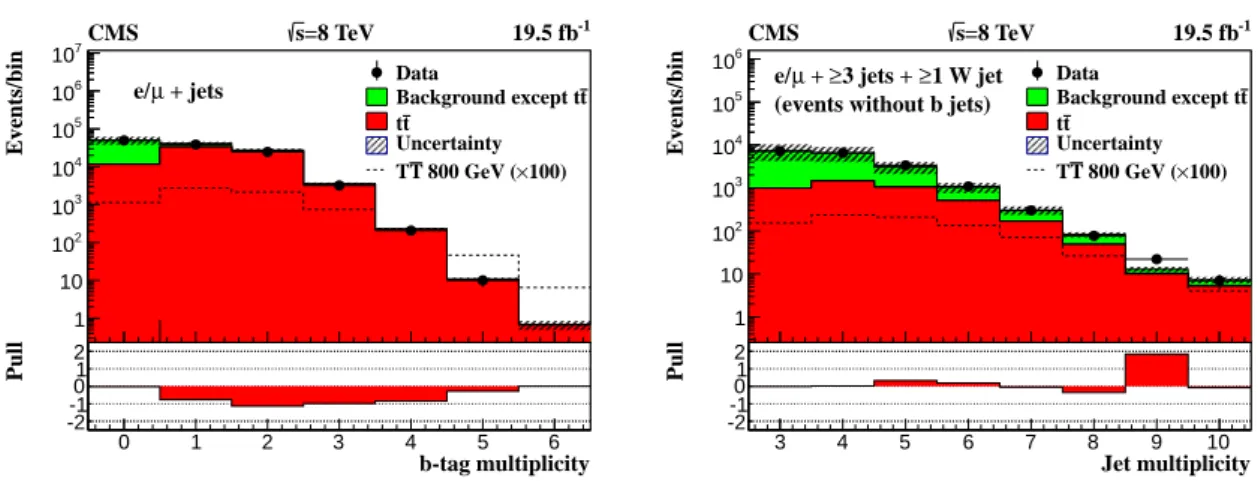
Figure 1 shows that the overall jet multiplicity distribution and the multiplicity of b-tagged jets are both well modeled by the simulation following the scaling procedure. The left plot in Fig. 1 shows the agreement between data and simulation for the multiplicity of b-tagged jets. As an additional cross-check of the simulation of the background we have looked at the overall jet multiplicity, in a subset of the event sample without b-tagged jets. This distribution is shown as the right plot in Fig. 1.
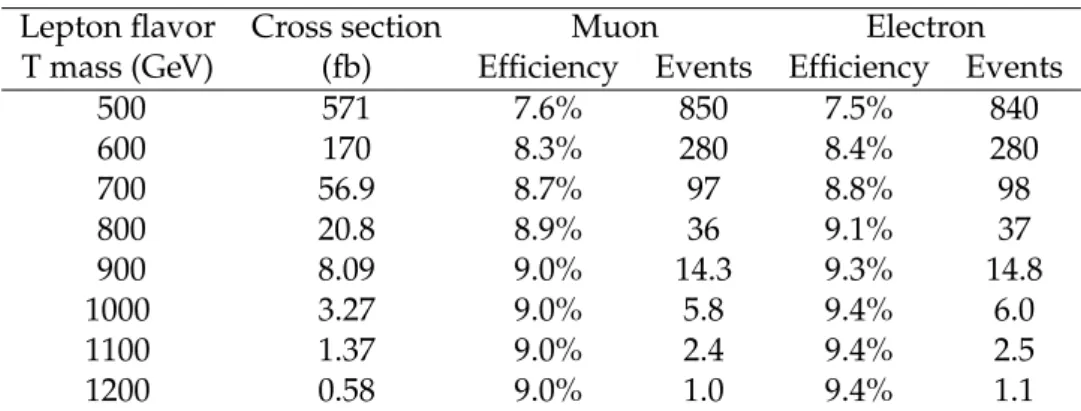
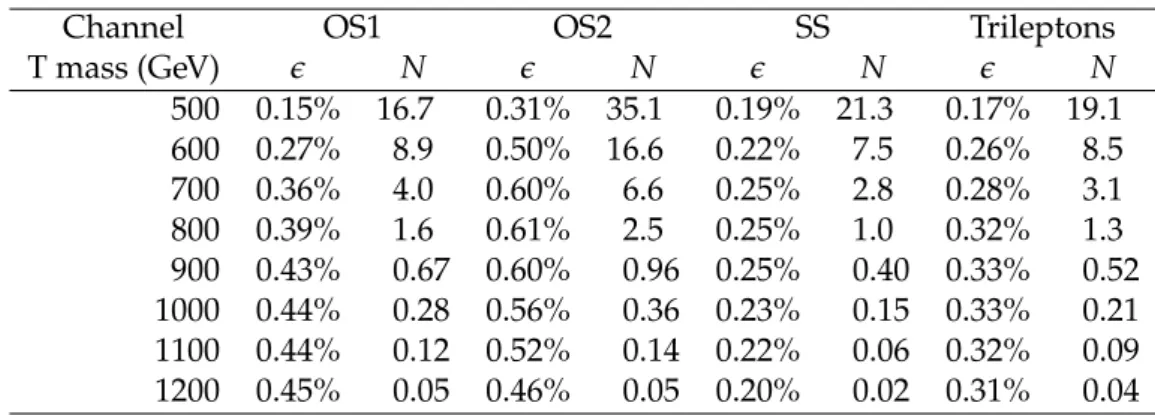
The numbers of events expected and observed are given in Table 1. The selection efficiencies and expected numbers of events for the T-quark signal, assuming nominal branching fractions, are summarized in Table 2.
We use boosted decision trees (BDT) [41] to further separate the T-quark signal from the SM background, more than 96% of which arises from tt, W- and Z-boson production. In the train-ing of the BDT, we include the signal sample with the composition defined by the nominal
b-Tag Multiplicity 0 1 2 3 4 5 6 Events/bin 1 10 2 10 3 10 4 10 5 10 6 10 7 10 Data t Background except t t t Uncertainty 100) × 800 GeV ( T T | CMS s=8 TeV 19.5 fb-1 + jets µ e/ b-tag multiplicity 0 1 2 3 4 5 6 Pull -2-1 01 2 b-Tag Multiplicity 3 4 5 6 7 8 9 10 Events/bin 1 10 2 10 3 10 4 10 5 10 6 10 Data t Background except t t t Uncertainty 100) × 800 GeV ( T T | CMS s=8 TeV 19.5 fb-1
(events without b jets) 1 W jet ≥ 3 jets + ≥ + µ e/ Jet multiplicity 3 4 5 6 7 8 9 10 Pull -2-1 01 2
Figure 1: Observed multiplicity of b-tagged jets in the single-lepton sample compared with a simulation using the W-boson background normalization determined from the data (left) and observed multiplicity of jets with pT > 30 GeV for events with one isolated lepton, at least
three jets, at least one W jet and no b-tagged jets (right). The bin-by-bin pulls shown in this and other figures are the values of the difference between observed number and expected number of events divided by the sum in quadrature of the systematic and statistical uncertainties. The uncertainties are correlated bin-to-bin, and include those in the luminosity, the cross sections and the correction factors, as described in Section 7.
branching fractions. We have tried training separate BDTs using T quark samples decaying 100% to one of the three final states bW, tZ, or tH. This procedure did not lead to a signif-icant improvement in sensitivity and therefore we use the same BDT for all combinations of branching fractions. Only tt, W- and Z-boson production contributions enter the BDT training. We train separate BDTs for events with at least one W jet and for events without any W jet, at every value of the T-quark mass. The BDT distributions for the T-quark signal move towards slightly higher values and get a little wider with increasing mass. Although our sample in-cludes all SM decays of the Higgs boson, we are mostly sensitive to decays to b-quark pairs and vector bosons with hadronic decays. We split the signal and background samples into two subsamples and use one of the subsamples to train the BDT and the other to model the BDT discriminant distribution to be compared with the data. The input variables for the BDT are jet multiplicity, b-tagged jet multiplicity, HT, EmissT , lepton pT, pT of the third jet, and pT of the
fourth jet. For events with a W jet, the number and pT of W jets and the number of top jets
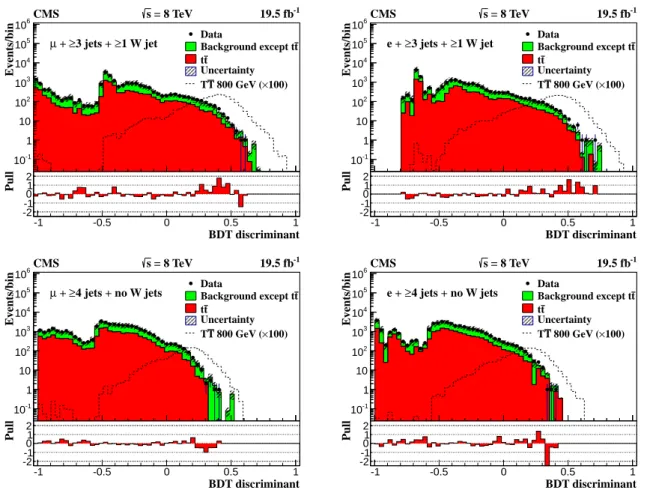
are included as additional parameters. These variables are chosen based on their importance calculated by the BDT algorithm and the desire to avoid strong correlations between the input variables. We have verified that the distributions of these variables agree well with expecta-tions. The distributions of the BDT discriminant are shown in Fig. 2. These demonstrate the discrimination between the T-quark signal and the SM background.
As an auxiliary check, we show that the simulation models the data well by comparing the dis-tributions of the BDT discriminant in the subset of the sample without b-tagged jets as shown in Fig. 3. In this sample the signal is suppressed by a factor 5 relative to the default selection with W jets and by a factor 8 for the sample without W jets.
6
Multilepton channel
The multilepton sample is divided into the four mutually exclusive subsamples described below. Dilepton events are required to have exactly two leptons with pT > 20 GeV. These
6 6 Multilepton channel
Table 1: Number of events predicted for background processes and observed in the single-lepton sample. The uncertainty in the total background expectation is computed including the correlations between the systematic uncertainties of the individual contributions. The uncer-tainties include those in the luminosity, the cross sections and the correction factors, as detailed in Section 7.
Lepton flavor Muon Electron
tt 36700±5500 35900±5400
Single top quark 2200±1100 2100±1000
W 19700±9900 18600±9400 Z 2200±1100 2000±1000 Multijets <60 1680±620 ttW 144±72 137±68 ttZ 109±54 108±54 ttH 570±290 570±290 WW/WZ/ZZ 410±200 400±200 Total background 61900±13900 61500±13700 Data 58478 57743
Table 2: Production cross section, efficiency, and number of events predicted by the single-lepton analysis, for the T-quark signal processes, assuming the nominal branching fractions into bW, tH, tZ of 50%, 25%, 25%, respectively.
Lepton flavor Cross section Muon Electron T mass (GeV) (fb) Efficiency Events Efficiency Events
500 571 7.6% 850 7.5% 840 600 170 8.3% 280 8.4% 280 700 56.9 8.7% 97 8.8% 98 800 20.8 8.9% 36 9.1% 37 900 8.09 9.0% 14.3 9.3% 14.8 1000 3.27 9.0% 5.8 9.4% 6.0 1100 1.37 9.0% 2.4 9.4% 2.5 1200 0.58 9.0% 1.0 9.4% 1.1
are divided into opposite- and same-sign dilepton events according to their charges, and the opposite-sign sample is further divided in two samples according to the number of jets in the event. Trilepton events must have at least three leptons with pT > 20 GeV. To reject
heavy-flavor resonances and low-mass Drell–Yan (DY) production, we require at least one dilep-ton pair with a mass above 20 GeV and ETmiss > 30 GeV in these samples. Jets must have pT > 30 GeV and |η| < 2.4 and be separated by ∆R > 0.3 from the selected leptons. We
also require that at least one jet must be identified as a b jet.
The first opposite-sign dilepton sample (referred to as the OS1 sample) mostly accepts events in which both the T and the T quarks decay to bW, resulting in a bWbW final state [12]. The main irreducible backgrounds in this sample are tt and DY production. To minimize these backgrounds, we impose the following requirements. The mass of the dilepton pair, M``, must
not be consistent with the Z-boson mass, i.e. we eliminate events in which 76< M``<106 GeV.
We require that the smallest invariant mass of lepton and b-jet combinations, M`b, is larger
than 170 GeV. Since, in a top-quark decay, M`bmust be smaller than the top-quark mass, this
-1 -0.5 0 0.5 1 Events/bin -1 10 1 10 2 10 3 10 4 10 5 10 6 10 Data t Background except t t t Uncertainty 100) × 800 GeV ( T T CMS s = 8 TeV 19.5 fb-1 1 W jet ≥ 3 jets + ≥ + µ BDT discriminant -1 -0.5 0 0.5 1 Pull -2-1 01 2 -1 -0.5 0 0.5 1 Events/bin -1 10 1 10 2 10 3 10 4 10 5 10 6 10 Data t Background except t t t Uncertainty 100) × 800 GeV ( T T CMS s = 8 TeV 19.5 fb-1 1 W jet ≥ 3 jets + ≥ e + BDT discriminant -1 -0.5 0 0.5 1 Pull -2-1 01 2 -1 -0.5 0 0.5 1 Events/bin -1 10 1 10 2 10 3 10 4 10 5 10 6 10 Data t Background except t t t Uncertainty 100) × 800 GeV ( T T CMS s = 8 TeV 19.5 fb-1 4 jets + no W jets ≥ + µ BDT discriminant -1 -0.5 0 0.5 1 Pull -2-1 01 2 -1 -0.5 0 0.5 1 Events/bin -1 10 1 10 2 10 3 10 4 10 5 10 6 10 Data t Background except t t t Uncertainty 100) × 800 GeV ( T T CMS s = 8 TeV 19.5 fb-1 4 jets + no W jets ≥ e + BDT discriminant -1 -0.5 0 0.5 1 Pull -2-1 01 2
Figure 2: Observed and expected distributions of the BDT discriminant. The distribution for a T quark with a mass of 800 GeV is also shown. The top panel is for events with at least one W jet, the bottom panel for events without W jets. The left column is for events with a muon and the right column for events with an electron.
either two or three jets, HT > 300 GeV, and ST > 900 GeV. The final selection requirements are
optimized by computing expected limits on the T-quark mass.
The DY background is not modeled adequately at low invariant mass and in the presence of missing transverse energy. We therefore use data to measure the residual background in events with two muons or two electrons. The observed event count in the Z-boson mass peak is rescaled by the ratio of DY events outside and inside the mass window as measured in a control data sample consisting of events with no b-tagged jets, ETmiss < 10 GeV, ST < 700 GeV,
and HT > 300 GeV. Since contamination from non-DY backgrounds can still be present in the
Z-boson mass window, this contribution is subtracted using the eµ channel scaled according to the event yields in the µµ and ee channels.
Events in the second opposite-sign dilepton sample (referred to as the OS2 sample) must have at least five jets, of which two must be b-tagged, HT > 500 GeV, and ST > 1000 GeV. This
sample accepts final states in which both leptons come from the decay of a Z boson but is not sensitive to the bWbW final state. The dominant background in this channel is tt production. The same-sign dilepton sample (the SS sample) accepts events in which at least one T quark decays to tZ or tH. The bWbW final state does not contribute to this channel. We further filter these events by requiring at least three jets, HT >500 GeV, and ST >700 GeV. The distribution
8 6 Multilepton channel -1 -0.5 0 0.5 1 Events/bin -1 10 1 10 2 10 3 10 4 10 5 10 6 10 Data t Background except t t t Uncertainty 100) × 800 GeV ( T T CMS s = 8 TeV 19.5 fb-1
(events without b jets) 1 W jet ≥ 3 jets + ≥ + µ BDT discriminant -1 -0.5 0 0.5 1 Pull -2-1 01 2 -1 -0.5 0 0.5 1 Events/bin -1 10 1 10 2 10 3 10 4 10 5 10 6 10 Data t Background except t t t Uncertainty 100) × 800 GeV ( T T CMS s = 8 TeV 19.5 fb-1
(events without b jets) 1 W jet ≥ 3 jets + ≥ e + BDT discriminant -1 -0.5 0 0.5 1 Pull -2-1 01 2 -1 -0.5 0 0.5 1 Events/bin -1 10 1 10 2 10 3 10 4 10 5 10 6 10 Data t Background except t t t Uncertainty 100) × 800 GeV ( T T CMS s = 8 TeV 19.5 fb-1
(events without b jets) 4 jets + no W jets ≥ + µ BDT discriminant -1 -0.5 0 0.5 1 Pull -2-1 01 2 -1 -0.5 0 0.5 1 Events/bin -1 10 1 10 2 10 3 10 4 10 5 10 6 10 Data t Background except t t t Uncertainty 100) × 800 GeV ( T T CMS s = 8 TeV 19.5 fb-1
(events without b jets) 4 jets + no W jets ≥ e + BDT discriminant -1 -0.5 0 0.5 1 Pull -2-1 01 2
Figure 3: Observed and expected distributions of the BDT discriminant for the subset of events in the subsample without b-tagged jets. The distribution for a T quark with a mass of 800 GeV is also shown. The top panel is for events with at least one W jet, the bottom panel for events without W jets. The left column is for events with a muon and the right column for events with an electron.
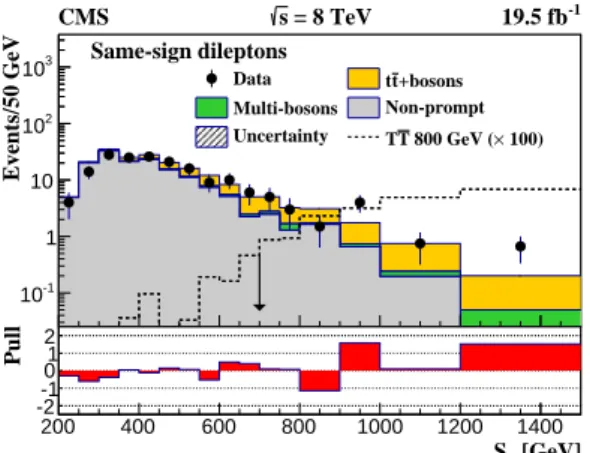
of ST is shown in Fig. 5. The backgrounds associated with this channel fall into three main
categories. Standard model processes leading to prompt, same-sign dilepton signatures have very small cross sections and are determined from simulation. Events with two prompt leptons of opposite charge can be selected if one lepton is misreconstructed with the wrong charge sign. The probability to misreconstruct the charge sign of a muon in the pTrange considered here is
negligible. We determine the probability to misreconstruct the charge sign of an electron from a sample of Z decays where events with oppositely charged leptons are selected with the same criteria as in the signal selection except for the charge requirement. We then weight the events by the charge misreconstruction probability to determine the number of expected background events. The charge misidentification contribution to the background is dominated by events from tt production. We also determine instrumental backgrounds, where jet misidentification is the source of one or both lepton candidates, using control data samples.
The trilepton sample also accepts events in which at least one T quark decays to tZ or tH. The bWbW final state does not contribute to this channel. We further filter trilepton events requiring at least three jets, HT > 500 GeV, and ST > 700 GeV. The backgrounds in this
chan-nel originate from SM processes with three or more leptons in the final state, such as diboson and triboson production, which are modeled by simulation. There are also non-prompt
back-) [GeV] lb min(m Events/25 GeV 1 10 2 10 3 10 4 10 Data Drell-Yan Single top quark
t t Uncertainty 100) × 800 GeV ( T T CMS s = 8 TeV 19.5 fb-1 Opposite-sign dileptons ) [GeV] lb min(M 0 100 200 300 400 500 600 Pull -2-1 01 2
Figure 4: Observed and expected distributions of the smallest M`bfor the opposite-sign
dilep-ton sample. The distribution for a T quark with a mass of 800 GeV is also shown. It is dominated by the bWbW final state. The arrow indicates the chosen requirement.
[GeV] T S Events/50 GeV -1 10 1 10 2 10 3 10 Data tt+bosons Multi-bosons Non-prompt Uncertainty TT 800 GeV (× 100) CMS s = 8 TeV 19.5 fb-1 Same-sign dileptons [GeV] T S 200 400 600 800 1000 1200 1400 Pull -2-1 01 2
Figure 5: Observed and expected distributions of ST for the same-sign dilepton sample. The
arrow indicates the chosen requirement.
grounds from tt production and other processes, characterized by one or more misidentified leptons. These are determined from data as for the dilepton samples.
The numbers of events expected and observed in the multilepton samples are given in Table 3. The selection efficiencies and expected numbers of events for the T-quark signal, assuming nominal branching fractions, are summarized in Table 4. The selection efficiencies decrease for large values of the T-quark mass, above 1100 GeV, because an increasing fraction of the decay products of W and Z bosons are reconstructed as single jets. For the multilepton samples, the numbers of events expected from background and the T-quark signal are of similar order of magnitude and therefore we use the event count in the different multilepton samples, distin-guished by lepton flavor, for the limit computation. We separate the dilepton samples into µµ, eµ, and ee subsamples and the trilepton sample into a µµµ subsample, an eee subsample, and a subsample containing all events with mixed lepton flavors.
10 7 Limit computation and systematic uncertainties
Table 3: Number of events predicted for background processes and observed in the opposite-sign dilepton samples with two or three jets (OS1) and with at least 5 jets (OS2), the same-opposite-sign dilepton sample (SS), and the trilepton sample. An entry ”–” means that the background source is not applicable to the channel.
Channel OS1 OS2 SS Trileptons
tt 5.2±1.9 80±12 – –
Single top quark 2.5±1.3 2.0±1.0 – –
Z 9.7±2.9 2.5±1.9 – – ttW – – 5.8±1.9 0.25±0.11 ttZ – – 1.83±0.93 1.84±0.94 WW – – 0.53±0.29 – WZ – – 0.34±0.08 0.40±0.21 ZZ – – 0.03±0.00 0.07±0.01 WWW/WWZ/ZZZ/WZZ – – 0.13±0.07 0.08±0.04 ttWW – – – 0.05±0.03 Charge misidentification – – 0.01±0.00 – Non-prompt – – 7.9±4.3 0.99±0.90 Total background 17.4±3.7 84±12 16.5±4.8 3.7±1.3 Data 20 86 18 2
Table 4: Efficiencies e and number of events N for the T-quark signal with the nominal branch-ing fractions into bW, tH, tZ of 50%, 25%, 25%, respectively, in the opposite-sign dilepton sam-ples with two or three jets (OS1) and with at least 5 jets (OS2), the same-sign dilepton sample (SS), and the trilepton sample.
Channel OS1 OS2 SS Trileptons
T mass (GeV) e N e N e N e N 500 0.15% 16.7 0.31% 35.1 0.19% 21.3 0.17% 19.1 600 0.27% 8.9 0.50% 16.6 0.22% 7.5 0.26% 8.5 700 0.36% 4.0 0.60% 6.6 0.25% 2.8 0.28% 3.1 800 0.39% 1.6 0.61% 2.5 0.25% 1.0 0.32% 1.3 900 0.43% 0.67 0.60% 0.96 0.25% 0.40 0.33% 0.52 1000 0.44% 0.28 0.56% 0.36 0.23% 0.15 0.33% 0.21 1100 0.44% 0.12 0.52% 0.14 0.22% 0.06 0.32% 0.09 1200 0.45% 0.05 0.46% 0.05 0.20% 0.02 0.31% 0.04
7
Limit computation and systematic uncertainties
We observe no evidence for a signal in the data. This section discusses upper limits on the pro-duction cross section of T-quark pairs. We use Bayesian statistics to compute 95% confidence level (CL) upper limits for the production cross section for values of the T-quark mass between 500 and 1500 GeV in 100 GeV steps. For the single-lepton channels we compute the posterior probability density as a function of the TT production cross section using the BDT discriminant distribution observed for data at each mass value and the combination of the BDT discriminant distributions for signal and background processes. For the multilepton channels we use the ob-served and predicted numbers of events in the twelve subsamples to compute the likelihood. We integrate the posterior probability density function over the nuisance parameters assigned to the sources of systematic uncertainties that affect both the normalization and the distribution of the discriminating observables.
Uncertainties in the normalization of the signal and background samples arise from the 2.6% uncertainty in the integrated luminosity for the√s =8 TeV data collected by CMS in 2012 [42], and the uncertainties in the cross sections and in the efficiency corrections. We assign a system-atic uncertainty of 50% for each of the diboson backgrounds, for the single-top-quark produc-tion, and for the W- and Z-boson backgrounds. This accounts for the uncertainties related to the definition of the renormalization and factorization scales used in the simulation, which is the largest with a systematic uncertainty of 40%, and for the uncertainties in the determination of the W+jets and Drell–Yan backgrounds from data. For the normalization of the tt background we use the NNLO cross section of 245.8 pb [8] with an 8% uncertainty to cover the difference between alternative calculations [43, 44]. We correct the lepton trigger and identification effi-ciencies in the simulation to agree with the performance observed in the data. The uncertainties in the correction factors give rise to uncertainties of 3% in the normalization of the signal and background samples. We further account for the effect of uncertainties in the jet energy and resolution, the b-tagging efficiency, the renormalization and factorization scales, the jet-parton matching scale, and the top-quark-pT distribution on the number of events expected and the
distribution of the BDT discriminant. The uncertainties related to the PDFs used to model the hard scattering of the proton-proton collisions are determined to be negligible.
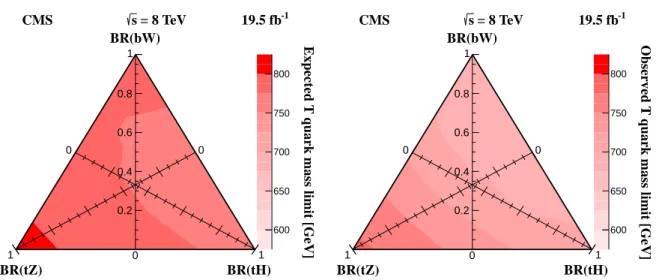
The observed and expected limits for the nominal branching fractions are shown in Figure 6. The observed limit is slightly higher than expected because there are slightly more events ob-served than expected in the high tail of the BDT distribution from single-lepton events with at least one W jet and in the multilepton channels. We set a lower limit at the mass of the T quark where the observed cross section limit and the predicted T-quark production cross sec-tion intersect. To model the BDT discriminant distribusec-tion expected for different values of the T-quark branching fractions we weight the contributions from the six signal samples according to the branching fractions. The lower limits for the T-quark mass measured for the different sets of branching fractions are listed in Table 5 and represented graphically in Fig. 7.
[GeV] T M 600 800 1000 1200 1400 [pb] σ -3 10 -2 10 -1 10 1 Observed 95% CL Expected 95% CL expected σ 1 ± expected σ 2 ± theory σ CMS s = 8 TeV 19.5 fb-1
Figure 6: Observed and expected 95% confidence level upper limits for the T-quark production cross section for the nominal branching fractions into bW, tH, tZ of 50%, 25%, 25%, respectively.
8
Summary
We have searched for the associated production of a heavy vector-like T quark with charge 23 and its antiparticle, based on events with at least one isolated lepton. No evidence for a signal in the data is seen. Assuming that the T quark decays exclusively into bW, tZ, and tH, we set lower limits for its mass between 687 and 782 GeV for all possible branching fractions into these three final states assuming strong production. This is the first search that considers all
12 8 Summary
Table 5: Lower limits for the T quark mass, at 95% CL, for different combinations of T quark branching fractions.
Branching fractions Expected Observed T→bW T→tH T→tZ limit (GeV) limit (GeV)
0.5 0.25 0.25 773 696 0.0 0.0 1.0 813 782 0.0 0.2 0.8 798 766 0.0 0.4 0.6 790 747 0.0 0.6 0.4 783 731 0.0 0.8 0.2 773 715 0.0 1.0 0.0 770 706 0.2 0.0 0.8 794 758 0.2 0.2 0.6 786 739 0.2 0.4 0.4 777 717 0.2 0.6 0.2 767 698 0.2 0.8 0.0 766 694 0.4 0.0 0.6 786 734 0.4 0.2 0.4 776 705 0.4 0.4 0.2 766 693 0.4 0.6 0.0 762 690 0.6 0.0 0.4 779 703 0.6 0.2 0.2 771 693 0.6 0.4 0.0 769 687 0.8 0.0 0.2 779 695 0.8 0.2 0.0 777 689 1.0 0.0 0.0 785 700
three final states, and these limits are the most stringent constraints to date on the existence of such a quark.
Acknowledgements
We congratulate our colleagues in the CERN accelerator departments for the excellent perfor-mance of the LHC and thank the technical and administrative staffs at CERN and at other CMS institutes for their contributions to the success of the CMS effort. In addition, we gratefully acknowledge the computing centres and personnel of the Worldwide LHC Computing Grid for delivering so effectively the computing infrastructure essential to our analyses. Finally, we acknowledge the enduring support for the construction and operation of the LHC and the CMS detector provided by the following funding agencies: BMWF and FWF (Austria); FNRS and FWO (Belgium); CNPq, CAPES, FAPERJ, and FAPESP (Brazil); MES (Bulgaria); CERN; CAS, MoST, and NSFC (China); COLCIENCIAS (Colombia); MSES (Croatia); RPF (Cyprus); MoER, SF0690030s09 and ERDF (Estonia); Academy of Finland, MEC, and HIP (Finland); CEA and CNRS/IN2P3 (France); BMBF, DFG, and HGF (Germany); GSRT (Greece); OTKA and NKTH (Hungary); DAE and DST (India); IPM (Iran); SFI (Ireland); INFN (Italy); NRF and WCU (Republic of Korea); LAS (Lithuania); CINVESTAV, CONACYT, SEP, and UASLP-FAI (Mexico); MBIE (New Zealand); PAEC (Pakistan); MSHE and NSC (Poland); FCT (Portugal); JINR (Dubna); MON, RosAtom, RAS and RFBR (Russia); MESTD (Serbia); SEIDI and CPAN (Spain); Swiss Funding Agencies (Switzerland); NSC (Taipei); ThEPCenter, IPST, STAR and
600 650 700 750 800 BR(bW) BR(tZ) BR(tH) 0 1 0 1 0 0.2 0.4 0.6 0.8 1 CMS s = 8 TeV 19.5 fb-1 E x p ec te d T q u a rk m a ss li m it [ G eV ] 600 650 700 750 800 BR(bW) BR(tZ) BR(tH) 0 1 0 1 0 0.2 0.4 0.6 0.8 1 CMS s = 8 TeV 19.5 fb-1 O b se rv ed T q u a rk m a ss li m it [ G eV ]
Figure 7: Branching-fraction triangle with expected (left) and observed 95% CL limits (right) on the T-quark mass. Every point in the triangle corresponds to a specific set of branching-fraction values subject to the constraint that all three add up to 1. The branching fraction for each mode decreases from 1 at the corner labeled with the decay mode to 0 at the opposite side of the triangle.
NSTDA (Thailand); TUBITAK and TAEK (Turkey); NASU (Ukraine); STFC (United Kingdom); DOE and NSF (USA). Individuals have received support from the Marie-Curie programme and the European Research Council and EPLANET (European Union); the Leventis Founda-tion; the A. P. Sloan FoundaFounda-tion; the Alexander von Humboldt FoundaFounda-tion; the Belgian Fed-eral Science Policy Office; the Fonds pour la Formation `a la Recherche dans l’Industrie et dans l’Agriculture (FRIA-Belgium); the Agentschap voor Innovatie door Wetenschap en Technolo-gie (IWT-Belgium); the Ministry of Education, Youth and Sports (MEYS) of Czech Republic; the Council of Science and Industrial Research, India; the Compagnia di San Paolo (Torino); the HOMING PLUS programme of Foundation for Polish Science, cofinanced by EU, Regional Development Fund; and the Thalis and Aristeia programmes cofinanced by EU-ESF and the Greek NSRF.
References
[1] ATLAS Collaboration, “Observation of a new particle in the search for the Standard Model Higgs boson with the ATLAS detector at the LHC”, Phys. Lett. B 716 (2012) 1, doi:10.1016/j.physletb.2012.08.020, arXiv:1207.7214.
[2] CMS Collaboration, “Observation of a new boson at a mass of 125 GeV with the CMS experiment at the LHC”, Phys. Lett. B 716 (2012) 30,
doi:10.1016/j.physletb.2012.08.021, arXiv:1207.7235.
[3] CMS Collaboration, “Observation of a new boson with mass near 125 GeV in pp collisions at√s = 7 and 8 TeV”, JHEP 06 (2013) 081,
doi:10.1007/JHEP06(2013)081, arXiv:1303.4571.
[4] N. Arkani-Hamed, A. G. Cohen, and H. Georgi, “Electroweak symmetry breaking from dimensional deconstruction”, Phys. Lett. B 513 (2001) 232,
14 References
[5] M. Schmaltz and D. Tucker-Smith, “Little Higgs review”, Ann. Rev. Nucl. Part. Sci. 55 (2005) 229, doi:10.1146/annurev.nucl.55.090704.151502,
arXiv:hep-ph/0502182.
[6] The ALEPH, DELPHI, L3, OPAL Collaborations, the LEP Electroweak Working Group, “Electroweak Measurements in Electron-Positron Collisions at W-Boson-Pair Energies at LEP”, (2013). arXiv:1302.3415.
[7] M. Aliev et al., “HATHOR: HAdronic Top and Heavy quarks crOss section calculatoR”, Comput. Phys. Commun. 182 (2011) 1034, doi:10.1016/j.cpc.2010.12.040, arXiv:1007.1327.
[8] M. Czakon, P. Fiedler, and A. Mitov, “The total top quark pair production cross-section at hadron colliders through O(α4S)”, Phys. Rev. Lett. 110 (2013) 252004,
doi:10.1103/PhysRevLett.110.252004, arXiv:1303.6254.
[9] F. del Aguila, L. Ametller, G. L. Kane, and J. Vidal, “Vector like fermion and standard Higgs production at hadron colliders”, Nucl. Phys. B 334 (1990) 1,
doi:10.1016/0550-3213(90)90655-W.
[10] CMS Collaboration, “Search for a Vector-like Quark with Charge 2/3 in t + Z Events from pp Collisions at√s=7 TeV”, Phys. Rev. Lett. 107 (2011) 271802,
doi:10.1103/PhysRevLett.107.271802, arXiv:1109.4985.
[11] CMS Collaboration, “Search for pair produced fourth-generation up-type quarks in pp collisions at√s=7 TeV with a lepton in the final state”, Phys. Lett. B 718 (2012) 307, doi:10.1016/j.physletb.2012.10.038, arXiv:1209.0471.
[12] CMS Collaboration, “Search for heavy, top-like quark pair production in the dilepton final state in pp collisions at√s=7 TeV”, Phys. Lett. B 716 (2012) 103,
doi:10.1016/j.physletb.2012.07.059, arXiv:1203.5410.
[13] ATLAS Collaboration, “Search for pair production of heavy top-like quarks decaying to a high-pT W boson and a b quark in the lepton plus jets final state at√s =7 TeV with the ATLAS detector”, Phys. Lett. B 718 (2013) 1284,
doi:10.1016/j.physletb.2012.11.071, arXiv:1210.5468.
[14] CMS Collaboration, “The CMS experiment at the CERN LHC”, JINST 3 (2008) S08004, doi:10.1088/1748-0221/3/08/S08004.
[15] J. Alwall et al., “MadGraph 5: going beyond”, JHEP 06 (2011) 128, doi:10.1007/JHEP06(2011)128, arXiv:1106.0522.
[16] P. Nason, “A new method for combining NLO QCD with shower Monte Carlo algorithms”, JHEP 11 (2004) 040, doi:10.1088/1126-6708/2004/11/040, arXiv:hep-ph/0409146.
[17] S. Frixione, P. Nason, and C. Oleari, “Matching NLO QCD computations with parton shower simulations: the POWHEG method”, JHEP 11 (2007) 070,
doi:10.1088/1126-6708/2007/11/070, arXiv:0709.2092.
[18] S. Alioli, P. Nason, C. Oleari, and E. Re, “A general framework for implementing NLO calculations in shower Monte Carlo programs: the POWHEG BOX”, JHEP 06 (2010) 043, doi:10.1007/JHEP06(2010)043, arXiv:1002.2581.
[19] T. Sj ¨ostrand, S. Mrenna, and P. Skands, “PYTHIA 6.4 physics and manual”, JHEP 05 (2006) 026, doi:10.1088/1126-6708/2006/05/026, arXiv:hep-ph/0603175. [20] J. Alwall et al., “Comparative study of various algorithms for the merging of parton
showers and matrix elements in hadronic collisions”, Eur. Phys. J. C 53 (2008) 473, doi:10.1140/epjc/s10052-007-0490-5, arXiv:0706.2569.
[21] J. Alwall, S. de Visscher, and F. Maltoni, “QCD radiation in the production of heavy colored particles at the LHC”, JHEP 0902 (2009) 017,
doi:10.1088/1126-6708/2009/02/017, arXiv:0810.5350.
[22] J. Pumplin et al., “New generation of parton distributions with uncertainties from global QCD analysis”, JHEP 07 (2002) 012, doi:10.1088/1126-6708/2002/07/012, arXiv:hep-ph/0201195.
[23] GEANT4 Collaboration, “GEANT4—a simulation toolkit”, Nucl. Instrum. Meth. A 506 (2003) 250, doi:10.1016/S0168-9002(03)01368-8.
[24] J. M. Campbell and R. K. Ellis, “Next-to-leading order corrections to W+2 jet and Z+2 jet production at hadron colliders”, Phys. Rev. D 65 (2002) 113007,
doi:10.1103/PhysRevD.65.113007, arXiv:hep-ph/0202176. [25] CMS Collaboration, “Commissioning of the Particle-Flow Reconstruction in
Minimum-Bias and Jet Events from pp Collisions at 7 TeV”, CMS Physics Analysis Summary CMS-PAS-PFT-10-002, (2010).
[26] CMS Collaboration, “Performance of CMS muon reconstruction in pp collision events at√ s =7 TeV”, JINST 7 (2012) P10002, doi:10.1088/1748-0221/7/10/P10002, arXiv:1206.4071.
[27] CMS Collaboration, “Electron Reconstruction and Identification at√s=7 TeV”, CMS Physics Analysis Summary CMS-PAS-EGM-10-004, (2010).
[28] CMS Collaboration, “Energy calibration and resolution of the CMS electromagnetic calorimeter in pp collisions at√s=7 TeV”, JINST 8 (2013) P09009,
doi:10.1088/1748-0221/8/09/P09009, arXiv:1306.2016.
[29] M. Cacciari, G. P. Salam, and G. Soyez, “The anti-ktjet clustering algorithm”, JHEP 04
(2008) 063, doi:10.1088/1126-6708/2008/04/063, arXiv:0802.1189.
[30] M. Cacciari, G. P. Salam, and G. Soyez, “FastJet User Manual”, Eur. Phys. J. C 72 (2012) 1896, doi:10.1140/epjc/s10052-012-1896-2, arXiv:1111.6097.
[31] CMS Collaboration, “Determination of Jet Energy Calibration and Transverse Momentum Resolution in CMS”, JINST 6 (2011) P11002,
doi:10.1088/1748-0221/6/11/P11002, arXiv:1107.4277.
[32] CMS Collaboration, “Identification of b-quark jets with the CMS experiment”, JINST 8 (2013) P04013, doi:10.1088/1748-0221/8/04/P04013, arXiv:1211.4462. [33] CMS Collaboration, “Performance of b tagging at√s=8 TeV in multijet, tt and boosted
topology events”, CMS Physics Analysis Summary CMS-PAS-BTV-13-001, (2013). [34] Y. L. Dokshitzer, G. D. Leder, S. Moretti, and B. R. Webber, “Better jet clustering
algorithms”, JHEP 08 (1997) 001, doi:10.1088/1126-6708/1997/08/001, arXiv:hep-ph/9707323.
16 References
[35] J. M. Butterworth, A. R. Davison, M. Rubin, and G. P. Salam, “Jet substructure as a new Higgs search channel at the LHC”, Phys. Rev. Lett. 100 (2008) 242001,
doi:10.1103/PhysRevLett.100.242001, arXiv:0802.2470.
[36] S. D. Ellis, C. K. Vermilion, and J. R. Walsh, “Techniques for improved heavy particle searches with jet substructure”, Phys. Rev. D 80 (2009) 051501,
doi:10.1103/PhysRevD.80.051501, arXiv:0903.5081.
[37] S. D. Ellis, C. K. Vermilion, and J. R. Walsh, “Recombination Algorithms and Jet Substructure: Pruning as a Tool for Heavy Particle Searches”, Phys. Rev. D 81 (2010) 094023, doi:10.1103/PhysRevD.81.094023, arXiv:0912.0033.
[38] CMS Collaboration, “Search for anomalous t t-bar production in the highly-boosted all-hadronic final state”, JHEP 09 (2012) 029, doi:10.1007/JHEP09(2012)029, arXiv:1204.2488.
[39] CMS Collaboration, “Measurement of the t¯t production cross section in pp collisions at√ s =7 TeV with lepton + jets final states”, Phys. Lett. B 720 (2013) 83,
doi:10.1016/j.physletb.2013.02.021, arXiv:1212.6682.
[40] K. Melnikov and F. Petriello, “Electroweak gauge boson production at hadron colliders through O(α2s)”, Phys. Rev. D 74 (2006) 114017, doi:10.1103/PhysRevD.74.114017,
arXiv:hep-ph/0609070.
[41] H. Voss, A. H ¨ocker, J. Stelzer, and F. Tegenfeldt, “TMVA: Toolkit for Multivariate Data Analysis with ROOT”, in XIth International Workshop on Advanced Computing and Analysis Techniques in Physics Research (ACAT), p. 040. 2007. arXiv:physics/0703039.
[42] CMS Collaboration, “CMS Luminosity Based on Pixel Cluster Counting - Summer 2013 Update”, CMS Physics Analysis Summary CMS-PAS-LUM-13-001, (2013).
[43] N. Kidonakis, “Differential and total cross sections for top pair and single top
production”, in XX International Workshop on Deep-Inelastic Scattering and Related Subjects, p. 831. Bonn, 2012. arXiv:1205.3453. doi:10.3204/DESY-PROC-2012-02/251. [44] M. Cacciari et al., “Top-pair production at hadron colliders with next-to-next-to-leading
logarithmic soft-gluon resummation”, Phys. Lett. B 710 (2012) 612, doi:10.1016/j.physletb.2012.03.013, arXiv:1111.5869.
A
The CMS Collaboration
Yerevan Physics Institute, Yerevan, Armenia
S. Chatrchyan, V. Khachatryan, A.M. Sirunyan, A. Tumasyan
Institut f ¨ur Hochenergiephysik der OeAW, Wien, Austria
W. Adam, T. Bergauer, M. Dragicevic, J. Er ¨o, C. Fabjan1, M. Friedl, R. Fr ¨uhwirth1, V.M. Ghete, C. Hartl, N. H ¨ormann, J. Hrubec, M. Jeitler1, W. Kiesenhofer, V. Kn ¨unz, M. Krammer1, I. Kr¨atschmer, D. Liko, I. Mikulec, D. Rabady2, B. Rahbaran, H. Rohringer, R. Sch ¨ofbeck,
J. Strauss, A. Taurok, W. Treberer-Treberspurg, W. Waltenberger, C.-E. Wulz1
National Centre for Particle and High Energy Physics, Minsk, Belarus
V. Mossolov, N. Shumeiko, J. Suarez Gonzalez
Universiteit Antwerpen, Antwerpen, Belgium
S. Alderweireldt, M. Bansal, S. Bansal, T. Cornelis, E.A. De Wolf, X. Janssen, A. Knutsson, S. Luyckx, L. Mucibello, S. Ochesanu, B. Roland, R. Rougny, H. Van Haevermaet, P. Van Mechelen, N. Van Remortel, A. Van Spilbeeck
Vrije Universiteit Brussel, Brussel, Belgium
F. Blekman, S. Blyweert, J. D’Hondt, N. Heracleous, A. Kalogeropoulos, J. Keaveney, T.J. Kim, S. Lowette, M. Maes, A. Olbrechts, D. Strom, S. Tavernier, W. Van Doninck, P. Van Mulders, G.P. Van Onsem, I. Villella
Universit´e Libre de Bruxelles, Bruxelles, Belgium
C. Caillol, B. Clerbaux, G. De Lentdecker, L. Favart, A.P.R. Gay, T. Hreus, A. L´eonard, P.E. Marage, A. Mohammadi, L. Perni`e, T. Reis, T. Seva, L. Thomas, C. Vander Velde, P. Vanlaer, J. Wang
Ghent University, Ghent, Belgium
V. Adler, K. Beernaert, L. Benucci, A. Cimmino, S. Costantini, S. Dildick, G. Garcia, B. Klein, J. Lellouch, J. Mccartin, A.A. Ocampo Rios, D. Ryckbosch, S. Salva Diblen, M. Sigamani, N. Strobbe, F. Thyssen, M. Tytgat, S. Walsh, E. Yazgan, N. Zaganidis
Universit´e Catholique de Louvain, Louvain-la-Neuve, Belgium
S. Basegmez, C. Beluffi3, G. Bruno, R. Castello, A. Caudron, L. Ceard, G.G. Da Silveira, C. Delaere, T. du Pree, D. Favart, L. Forthomme, A. Giammanco4, J. Hollar, P. Jez, M. Komm, V. Lemaitre, J. Liao, O. Militaru, C. Nuttens, D. Pagano, A. Pin, K. Piotrzkowski, A. Popov5, L. Quertenmont, M. Selvaggi, M. Vidal Marono, J.M. Vizan Garcia
Universit´e de Mons, Mons, Belgium
N. Beliy, T. Caebergs, E. Daubie, G.H. Hammad
Centro Brasileiro de Pesquisas Fisicas, Rio de Janeiro, Brazil
G.A. Alves, M. Correa Martins Junior, T. Martins, M.E. Pol, M.H.G. Souza
Universidade do Estado do Rio de Janeiro, Rio de Janeiro, Brazil
W.L. Ald´a J ´unior, W. Carvalho, J. Chinellato6, A. Cust ´odio, E.M. Da Costa, D. De Jesus Damiao,
C. De Oliveira Martins, S. Fonseca De Souza, H. Malbouisson, M. Malek, D. Matos Figueiredo, L. Mundim, H. Nogima, W.L. Prado Da Silva, J. Santaolalla, A. Santoro, A. Sznajder, E.J. Tonelli Manganote6, A. Vilela Pereira
Universidade Estadual Paulistaa, Universidade Federal do ABCb, S˜ao Paulo, Brazil
C.A. Bernardesb, F.A. Diasa,7, T.R. Fernandez Perez Tomeia, E.M. Gregoresb, C. Laganaa, P.G. Mercadanteb, S.F. Novaesa, Sandra S. Padulaa
18 A The CMS Collaboration
Institute for Nuclear Research and Nuclear Energy, Sofia, Bulgaria
V. Genchev2, P. Iaydjiev2, A. Marinov, S. Piperov, M. Rodozov, G. Sultanov, M. Vutova
University of Sofia, Sofia, Bulgaria
A. Dimitrov, I. Glushkov, R. Hadjiiska, V. Kozhuharov, L. Litov, B. Pavlov, P. Petkov
Institute of High Energy Physics, Beijing, China
J.G. Bian, G.M. Chen, H.S. Chen, M. Chen, R. Du, C.H. Jiang, D. Liang, S. Liang, X. Meng, R. Plestina8, J. Tao, X. Wang, Z. Wang
State Key Laboratory of Nuclear Physics and Technology, Peking University, Beijing, China
C. Asawatangtrakuldee, Y. Ban, Y. Guo, Q. Li, W. Li, S. Liu, Y. Mao, S.J. Qian, D. Wang, L. Zhang, W. Zou
Universidad de Los Andes, Bogota, Colombia
C. Avila, C.A. Carrillo Montoya, L.F. Chaparro Sierra, C. Florez, J.P. Gomez, B. Gomez Moreno, J.C. Sanabria
Technical University of Split, Split, Croatia
N. Godinovic, D. Lelas, D. Polic, I. Puljak
University of Split, Split, Croatia
Z. Antunovic, M. Kovac
Institute Rudjer Boskovic, Zagreb, Croatia
V. Brigljevic, K. Kadija, J. Luetic, D. Mekterovic, S. Morovic, L. Tikvica
University of Cyprus, Nicosia, Cyprus
A. Attikis, G. Mavromanolakis, J. Mousa, C. Nicolaou, F. Ptochos, P.A. Razis
Charles University, Prague, Czech Republic
M. Finger, M. Finger Jr.
Academy of Scientific Research and Technology of the Arab Republic of Egypt, Egyptian Network of High Energy Physics, Cairo, Egypt
A.A. Abdelalim9, Y. Assran10, S. Elgammal9, A. Ellithi Kamel11, M.A. Mahmoud12, A. Radi13,14
National Institute of Chemical Physics and Biophysics, Tallinn, Estonia
M. Kadastik, M. M ¨untel, M. Murumaa, M. Raidal, L. Rebane, A. Tiko
Department of Physics, University of Helsinki, Helsinki, Finland
P. Eerola, G. Fedi, M. Voutilainen
Helsinki Institute of Physics, Helsinki, Finland
J. H¨ark ¨onen, V. Karim¨aki, R. Kinnunen, M.J. Kortelainen, T. Lamp´en, K. Lassila-Perini, S. Lehti, T. Lind´en, P. Luukka, T. M¨aenp¨a¨a, T. Peltola, E. Tuominen, J. Tuominiemi, E. Tuovinen, L. Wendland
Lappeenranta University of Technology, Lappeenranta, Finland
T. Tuuva
DSM/IRFU, CEA/Saclay, Gif-sur-Yvette, France
M. Besancon, F. Couderc, M. Dejardin, D. Denegri, B. Fabbro, J.L. Faure, F. Ferri, S. Ganjour, A. Givernaud, P. Gras, G. Hamel de Monchenault, P. Jarry, E. Locci, J. Malcles, A. Nayak, J. Rander, A. Rosowsky, M. Titov
Laboratoire Leprince-Ringuet, Ecole Polytechnique, IN2P3-CNRS, Palaiseau, France
S. Baffioni, F. Beaudette, P. Busson, C. Charlot, N. Daci, T. Dahms, M. Dalchenko, L. Dobrzynski, A. Florent, R. Granier de Cassagnac, M. Haguenauer, P. Min´e, C. Mironov, I.N. Naranjo, M. Nguyen, C. Ochando, P. Paganini, D. Sabes, R. Salerno, Y. Sirois, C. Veelken, Y. Yilmaz, A. Zabi
Institut Pluridisciplinaire Hubert Curien, Universit´e de Strasbourg, Universit´e de Haute Alsace Mulhouse, CNRS/IN2P3, Strasbourg, France
J.-L. Agram15, J. Andrea, D. Bloch, J.-M. Brom, E.C. Chabert, C. Collard, E. Conte15, F. Drouhin15, J.-C. Fontaine15, D. Gel´e, U. Goerlach, C. Goetzmann, P. Juillot, A.-C. Le Bihan, P. Van Hove
Centre de Calcul de l’Institut National de Physique Nucleaire et de Physique des Particules, CNRS/IN2P3, Villeurbanne, France
S. Gadrat
Universit´e de Lyon, Universit´e Claude Bernard Lyon 1, CNRS-IN2P3, Institut de Physique Nucl´eaire de Lyon, Villeurbanne, France
S. Beauceron, N. Beaupere, G. Boudoul, S. Brochet, J. Chasserat, R. Chierici, D. Contardo, P. Depasse, H. El Mamouni, J. Fan, J. Fay, S. Gascon, M. Gouzevitch, B. Ille, T. Kurca, M. Lethuillier, L. Mirabito, S. Perries, J.D. Ruiz Alvarez16, L. Sgandurra, V. Sordini, M. Vander Donckt, P. Verdier, S. Viret, H. Xiao
Institute of High Energy Physics and Informatization, Tbilisi State University, Tbilisi, Georgia
Z. Tsamalaidze17
RWTH Aachen University, I. Physikalisches Institut, Aachen, Germany
C. Autermann, S. Beranek, M. Bontenackels, B. Calpas, M. Edelhoff, L. Feld, O. Hindrichs, K. Klein, A. Ostapchuk, A. Perieanu, F. Raupach, J. Sammet, S. Schael, D. Sprenger, H. Weber, B. Wittmer, V. Zhukov5
RWTH Aachen University, III. Physikalisches Institut A, Aachen, Germany
M. Ata, J. Caudron, E. Dietz-Laursonn, D. Duchardt, M. Erdmann, R. Fischer, A. G ¨uth, T. Hebbeker, C. Heidemann, K. Hoepfner, D. Klingebiel, S. Knutzen, P. Kreuzer, M. Merschmeyer, A. Meyer, M. Olschewski, K. Padeken, P. Papacz, H. Reithler, S.A. Schmitz, L. Sonnenschein, D. Teyssier, S. Th ¨uer, M. Weber
RWTH Aachen University, III. Physikalisches Institut B, Aachen, Germany
V. Cherepanov, Y. Erdogan, G. Fl ¨ugge, H. Geenen, M. Geisler, W. Haj Ahmad, F. Hoehle, B. Kargoll, T. Kress, Y. Kuessel, J. Lingemann2, A. Nowack, I.M. Nugent, L. Perchalla, O. Pooth, A. Stahl
Deutsches Elektronen-Synchrotron, Hamburg, Germany
I. Asin, N. Bartosik, J. Behr, W. Behrenhoff, U. Behrens, A.J. Bell, M. Bergholz18, A. Bethani, K. Borras, A. Burgmeier, A. Cakir, L. Calligaris, A. Campbell, S. Choudhury, F. Costanza, C. Diez Pardos, S. Dooling, T. Dorland, G. Eckerlin, D. Eckstein, T. Eichhorn, G. Flucke, A. Geiser, A. Grebenyuk, P. Gunnellini, S. Habib, J. Hauk, G. Hellwig, M. Hempel, D. Horton, H. Jung, M. Kasemann, P. Katsas, C. Kleinwort, M. Kr¨amer, D. Kr ¨ucker, W. Lange, J. Leonard, K. Lipka, W. Lohmann18, B. Lutz, R. Mankel, I. Marfin, I.-A. Melzer-Pellmann, A.B. Meyer, J. Mnich, A. Mussgiller, S. Naumann-Emme, O. Novgorodova, F. Nowak, H. Perrey, A. Petrukhin, D. Pitzl, R. Placakyte, A. Raspereza, P.M. Ribeiro Cipriano, C. Riedl, E. Ron,
20 A The CMS Collaboration
M. ¨O. Sahin, J. Salfeld-Nebgen, R. Schmidt18, T. Schoerner-Sadenius, M. Schr ¨oder, M. Stein, A.D.R. Vargas Trevino, R. Walsh, C. Wissing
University of Hamburg, Hamburg, Germany
M. Aldaya Martin, V. Blobel, H. Enderle, J. Erfle, E. Garutti, M. G ¨orner, M. Gosselink, J. Haller, K. Heine, R.S. H ¨oing, H. Kirschenmann, R. Klanner, R. Kogler, J. Lange, I. Marchesini, J. Ott, T. Peiffer, N. Pietsch, D. Rathjens, C. Sander, H. Schettler, P. Schleper, E. Schlieckau, A. Schmidt, M. Seidel, J. Sibille19, V. Sola, H. Stadie, G. Steinbr ¨uck, D. Troendle, E. Usai, L. Vanelderen
Institut f ¨ur Experimentelle Kernphysik, Karlsruhe, Germany
C. Barth, C. Baus, J. Berger, C. B ¨oser, E. Butz, T. Chwalek, W. De Boer, A. Descroix, A. Dierlamm, M. Feindt, M. Guthoff2, F. Hartmann2, T. Hauth2, H. Held, K.H. Hoffmann, U. Husemann,
I. Katkov5, A. Kornmayer2, E. Kuznetsova, P. Lobelle Pardo, D. Martschei, M.U. Mozer, Th. M ¨uller, M. Niegel, A. N ¨urnberg, O. Oberst, G. Quast, K. Rabbertz, F. Ratnikov, S. R ¨ocker, F.-P. Schilling, G. Schott, H.J. Simonis, F.M. Stober, R. Ulrich, J. Wagner-Kuhr, S. Wayand, T. Weiler, R. Wolf, M. Zeise
Institute of Nuclear and Particle Physics (INPP), NCSR Demokritos, Aghia Paraskevi, Greece
G. Anagnostou, G. Daskalakis, T. Geralis, S. Kesisoglou, A. Kyriakis, D. Loukas, A. Markou, C. Markou, E. Ntomari, I. Topsis-giotis
University of Athens, Athens, Greece
L. Gouskos, A. Panagiotou, N. Saoulidou, E. Stiliaris
University of Io´annina, Io´annina, Greece
X. Aslanoglou, I. Evangelou, G. Flouris, C. Foudas, P. Kokkas, N. Manthos, I. Papadopoulos, E. Paradas
Wigner Research Centre for Physics, Budapest, Hungary
G. Bencze, C. Hajdu, P. Hidas, D. Horvath20, F. Sikler, V. Veszpremi, G. Vesztergombi21, A.J. Zsigmond
Institute of Nuclear Research ATOMKI, Debrecen, Hungary
N. Beni, S. Czellar, J. Molnar, J. Palinkas, Z. Szillasi
University of Debrecen, Debrecen, Hungary
J. Karancsi, P. Raics, Z.L. Trocsanyi, B. Ujvari
National Institute of Science Education and Research, Bhubaneswar, India
S.K. Swain
Panjab University, Chandigarh, India
S.B. Beri, V. Bhatnagar, N. Dhingra, R. Gupta, M. Kaur, M.Z. Mehta, M. Mittal, N. Nishu, A. Sharma, J.B. Singh
University of Delhi, Delhi, India
Ashok Kumar, Arun Kumar, S. Ahuja, A. Bhardwaj, B.C. Choudhary, A. Kumar, S. Malhotra, M. Naimuddin, K. Ranjan, P. Saxena, V. Sharma, R.K. Shivpuri
Saha Institute of Nuclear Physics, Kolkata, India
S. Banerjee, S. Bhattacharya, K. Chatterjee, S. Dutta, B. Gomber, Sa. Jain, Sh. Jain, R. Khurana, A. Modak, S. Mukherjee, D. Roy, S. Sarkar, M. Sharan, A.P. Singh
Bhabha Atomic Research Centre, Mumbai, India
Tata Institute of Fundamental Research - EHEP, Mumbai, India
T. Aziz, R.M. Chatterjee, S. Ganguly, S. Ghosh, M. Guchait22, A. Gurtu23, G. Kole, S. Kumar, M. Maity24, G. Majumder, K. Mazumdar, G.B. Mohanty, B. Parida, K. Sudhakar, N. Wickramage25
Tata Institute of Fundamental Research - HECR, Mumbai, India
S. Banerjee, S. Dugad
Institute for Research in Fundamental Sciences (IPM), Tehran, Iran
H. Arfaei, H. Bakhshiansohi, H. Behnamian, S.M. Etesami26, A. Fahim27, A. Jafari, M. Khakzad, M. Mohammadi Najafabadi, M. Naseri, S. Paktinat Mehdiabadi, B. Safarzadeh28, M. Zeinali
University College Dublin, Dublin, Ireland
M. Grunewald
INFN Sezione di Baria, Universit`a di Barib, Politecnico di Baric, Bari, Italy
M. Abbresciaa,b, L. Barbonea,b, C. Calabriaa,b, S.S. Chhibraa,b, A. Colaleoa, D. Creanzaa,c, N. De Filippisa,c, M. De Palmaa,b, L. Fiorea, G. Iasellia,c, G. Maggia,c, M. Maggia, B. Marangellia,b, S. Mya,c, S. Nuzzoa,b, N. Pacificoa, A. Pompilia,b, G. Pugliesea,c, R. Radognaa,b, G. Selvaggia,b, L. Silvestrisa, G. Singha,b, R. Vendittia,b, P. Verwilligena, G. Zitoa
INFN Sezione di Bolognaa, Universit`a di Bolognab, Bologna, Italy
G. Abbiendia, A.C. Benvenutia, D. Bonacorsia,b, S. Braibant-Giacomellia,b, L. Brigliadoria,b, R. Campaninia,b, P. Capiluppia,b, A. Castroa,b, F.R. Cavalloa, G. Codispotia,b, M. Cuffiania,b, G.M. Dallavallea, F. Fabbria, A. Fanfania,b, D. Fasanellaa,b, P. Giacomellia, C. Grandia, L. Guiduccia,b, S. Marcellinia, G. Masettia, M. Meneghellia,b, A. Montanaria, F.L. Navarriaa,b, F. Odoricia, A. Perrottaa, F. Primaveraa,b, A.M. Rossia,b, T. Rovellia,b, G.P. Sirolia,b, N. Tosia,b,
R. Travaglinia,b
INFN Sezione di Cataniaa, Universit`a di Cataniab, CSFNSMc, Catania, Italy
S. Albergoa,b, G. Cappelloa, M. Chiorbolia,b, S. Costaa,b, F. Giordanoa,2, R. Potenzaa,b, A. Tricomia,b, C. Tuvea,b
INFN Sezione di Firenzea, Universit`a di Firenzeb, Firenze, Italy
G. Barbaglia, V. Ciullia,b, C. Civininia, R. D’Alessandroa,b, E. Focardia,b, E. Galloa, S. Gonzia,b,
V. Goria,b, P. Lenzia,b, M. Meschinia, S. Paolettia, G. Sguazzonia, A. Tropianoa,b
INFN Laboratori Nazionali di Frascati, Frascati, Italy
L. Benussi, S. Bianco, F. Fabbri, D. Piccolo
INFN Sezione di Genovaa, Universit`a di Genovab, Genova, Italy
P. Fabbricatorea, R. Ferrettia,b, F. Ferroa, M. Lo Veterea,b, R. Musenicha, E. Robuttia, S. Tosia,b
INFN Sezione di Milano-Bicoccaa, Universit`a di Milano-Bicoccab, Milano, Italy
A. Benagliaa, M.E. Dinardoa,b, S. Fiorendia,b,2, S. Gennaia, A. Ghezzia,b, P. Govonia,b, M.T. Lucchinia,b,2, S. Malvezzia, R.A. Manzonia,b,2, A. Martellia,b,2, D. Menascea, L. Moronia, M. Paganonia,b, D. Pedrinia, S. Ragazzia,b, N. Redaellia, T. Tabarelli de Fatisa,b
INFN Sezione di Napoli a, Universit`a di Napoli ’Federico II’ b, Universit`a della
Basilicata (Potenza)c, Universit`a G. Marconi (Roma)d, Napoli, Italy
S. Buontempoa, N. Cavalloa,c, F. Fabozzia,c, A.O.M. Iorioa,b, L. Listaa, S. Meolaa,d,2, M. Merolaa, P. Paoluccia,2
22 A The CMS Collaboration
INFN Sezione di Padovaa, Universit`a di Padovab, Universit`a di Trento (Trento)c, Padova,
Italy
P. Azzia, N. Bacchettaa, M. Bellatoa, D. Biselloa,b, A. Brancaa,b, R. Carlina,b, P. Checchiaa, T. Dorigoa, M. Galantia,b,2, F. Gasparinia,b, U. Gasparinia,b, P. Giubilatoa,b, A. Gozzelinoa,
K. Kanishcheva,c, S. Lacapraraa, I. Lazzizzeraa,c, M. Margonia,b, A.T. Meneguzzoa,b, J. Pazzinia,b, N. Pozzobona,b, P. Ronchesea,b, F. Simonettoa,b, E. Torassaa, M. Tosia,b, A. Triossia, S. Vaninia,b, S. Venturaa, P. Zottoa,b, A. Zucchettaa,b, G. Zumerlea,b
INFN Sezione di Paviaa, Universit`a di Paviab, Pavia, Italy
M. Gabusia,b, S.P. Rattia,b, C. Riccardia,b, P. Vituloa,b
INFN Sezione di Perugiaa, Universit`a di Perugiab, Perugia, Italy
M. Biasinia,b, G.M. Bileia, L. Fan `oa,b, P. Laricciaa,b, G. Mantovania,b, M. Menichellia, A. Nappia,b†, F. Romeoa,b, A. Sahaa, A. Santocchiaa,b, A. Spieziaa,b
INFN Sezione di Pisaa, Universit`a di Pisab, Scuola Normale Superiore di Pisac, Pisa, Italy
K. Androsova,29, P. Azzurria, G. Bagliesia, J. Bernardinia, T. Boccalia, G. Broccoloa,c, R. Castaldia, M.A. Cioccia,29, R. Dell’Orsoa, F. Fioria,c, L. Fo`aa,c, A. Giassia, M.T. Grippoa,29, A. Kraana, F. Ligabuea,c, T. Lomtadzea, L. Martinia,b, A. Messineoa,b, C.S. Moona,30, F. Pallaa, A. Rizzia,b, A. Savoy-Navarroa,31, A.T. Serbana, P. Spagnoloa, P. Squillaciotia,29, R. Tenchinia, G. Tonellia,b,
A. Venturia, P.G. Verdinia, C. Vernieria,c
INFN Sezione di Romaa, Universit`a di Romab, Roma, Italy
L. Baronea,b, F. Cavallaria, D. Del Rea,b, M. Diemoza, M. Grassia,b, C. Jordaa, E. Longoa,b, F. Margarolia,b, P. Meridiania, F. Michelia,b, S. Nourbakhsha,b, G. Organtinia,b, R. Paramattia, S. Rahatloua,b, C. Rovellia, L. Soffia,b, P. Traczyka,b
INFN Sezione di Torino a, Universit`a di Torino b, Universit`a del Piemonte Orientale
(No-vara)c, Torino, Italy
N. Amapanea,b, R. Arcidiaconoa,c, S. Argiroa,b, M. Arneodoa,c, R. Bellana,b, C. Biinoa, N. Cartigliaa, S. Casassoa,b, M. Costaa,b, A. Deganoa,b, N. Demariaa, C. Mariottia, S. Masellia, E. Migliorea,b, V. Monacoa,b, M. Musicha, M.M. Obertinoa,c, G. Ortonaa,b, L. Pachera,b, N. Pastronea, M. Pelliccionia,2, A. Potenzaa,b, A. Romeroa,b, M. Ruspaa,c, R. Sacchia,b, A. Solanoa,b, A. Staianoa, U. Tamponia
INFN Sezione di Triestea, Universit`a di Triesteb, Trieste, Italy
S. Belfortea, V. Candelisea,b, M. Casarsaa, F. Cossuttia,2, G. Della Riccaa,b, B. Gobboa, C. La Licataa,b, M. Maronea,b, D. Montaninoa,b, A. Penzoa, A. Schizzia,b, T. Umera,b, A. Zanettia
Kangwon National University, Chunchon, Korea
S. Chang, T.Y. Kim, S.K. Nam
Kyungpook National University, Daegu, Korea
D.H. Kim, G.N. Kim, J.E. Kim, D.J. Kong, S. Lee, Y.D. Oh, H. Park, D.C. Son
Chonnam National University, Institute for Universe and Elementary Particles, Kwangju, Korea
J.Y. Kim, Zero J. Kim, S. Song
Korea University, Seoul, Korea
S. Choi, D. Gyun, B. Hong, M. Jo, H. Kim, Y. Kim, K.S. Lee, S.K. Park, Y. Roh
University of Seoul, Seoul, Korea
Sungkyunkwan University, Suwon, Korea
Y. Choi, Y.K. Choi, J. Goh, M.S. Kim, E. Kwon, B. Lee, J. Lee, S. Lee, H. Seo, I. Yu
Vilnius University, Vilnius, Lithuania
A. Juodagalvis
Centro de Investigacion y de Estudios Avanzados del IPN, Mexico City, Mexico
H. Castilla-Valdez, E. De La Cruz-Burelo, I. Heredia-de La Cruz32, R. Lopez-Fernandez, J. Mart´ınez-Ortega, A. Sanchez-Hernandez, L.M. Villasenor-Cendejas
Universidad Iberoamericana, Mexico City, Mexico
S. Carrillo Moreno, F. Vazquez Valencia
Benemerita Universidad Autonoma de Puebla, Puebla, Mexico
H.A. Salazar Ibarguen
Universidad Aut ´onoma de San Luis Potos´ı, San Luis Potos´ı, Mexico
E. Casimiro Linares, A. Morelos Pineda
University of Auckland, Auckland, New Zealand
D. Krofcheck
University of Canterbury, Christchurch, New Zealand
P.H. Butler, R. Doesburg, S. Reucroft, H. Silverwood
National Centre for Physics, Quaid-I-Azam University, Islamabad, Pakistan
M. Ahmad, M.I. Asghar, J. Butt, H.R. Hoorani, S. Khalid, W.A. Khan, T. Khurshid, S. Qazi, M.A. Shah, M. Shoaib
National Centre for Nuclear Research, Swierk, Poland
H. Bialkowska, M. Bluj33, B. Boimska, T. Frueboes, M. G ´orski, M. Kazana, K. Nawrocki, K. Romanowska-Rybinska, M. Szleper, G. Wrochna, P. Zalewski
Institute of Experimental Physics, Faculty of Physics, University of Warsaw, Warsaw, Poland
G. Brona, K. Bunkowski, M. Cwiok, W. Dominik, K. Doroba, A. Kalinowski, M. Konecki, J. Krolikowski, M. Misiura, W. Wolszczak
Laborat ´orio de Instrumenta¸c˜ao e F´ısica Experimental de Part´ıculas, Lisboa, Portugal
P. Bargassa, C. Beir˜ao Da Cruz E Silva, P. Faccioli, P.G. Ferreira Parracho, M. Gallinaro, F. Nguyen, J. Rodrigues Antunes, J. Seixas2, J. Varela, P. Vischia
Joint Institute for Nuclear Research, Dubna, Russia
P. Bunin, I. Golutvin, I. Gorbunov, A. Kamenev, V. Karjavin, V. Konoplyanikov, G. Kozlov, A. Lanev, A. Malakhov, V. Matveev34, P. Moisenz, V. Palichik, V. Perelygin, M. Savina, S. Shmatov, N. Skatchkov, V. Smirnov, A. Zarubin
Petersburg Nuclear Physics Institute, Gatchina (St. Petersburg), Russia
V. Golovtsov, Y. Ivanov, V. Kim, P. Levchenko, V. Murzin, V. Oreshkin, I. Smirnov, V. Sulimov, L. Uvarov, S. Vavilov, A. Vorobyev, An. Vorobyev
Institute for Nuclear Research, Moscow, Russia
Yu. Andreev, A. Dermenev, S. Gninenko, N. Golubev, M. Kirsanov, N. Krasnikov, A. Pashenkov, D. Tlisov, A. Toropin
Institute for Theoretical and Experimental Physics, Moscow, Russia
V. Epshteyn, V. Gavrilov, N. Lychkovskaya, V. Popov, G. Safronov, S. Semenov, A. Spiridonov, V. Stolin, E. Vlasov, A. Zhokin