A Work Project, presented as part of the requirements for the Award of a Master Degree in Management from the NOVA – School of Business and Economics.
ICELANDIC BANKING CRISIS: WOULD BASEL III HAVE MADE A DIFFERENCE?
ANA TERESA FORTES MARQUES DA SILVA | 2565
A Project carried out on the Master in Management Program, under the supervision of:
Professor Gonçalo Rocha
2 Abstract
Icelandic banking crisis: Would Basel III have made a difference?
The purpose of this research is to understand whether the Icelandic banking crisis would have been prevented or downsized, had Basel III regulation been in place at the time. Iceland saw three of its major banks collapse in 2008. Landsbanki, one of the three biggest banks, was analyzed and its problems identified, followed by the application of Basel III regulation to its 2007’ financial statements. After applying Basel III reforms, verification of ratios compliance was performed. This research provides valuable insights on the soundness of Basel III, raising awareness for its limitations, by exposing the results of its implementation before the crisis. Key words:
Basel III | Iceland | Capital | Liquidity 1. Introduction
Iceland was one of the first countries to face economic distress during the 2008 financial crisis. In just a few days, in the autumn of 2008, around 85% of the Icelandic banking sector collapsed. Around the same time the Icelandic krona depreciated, numerous non-financial firms declared bankruptcy, unemployment increased substantially and inflation skyrocketed.
The three major banks in the country, Glitnir, Landsbanki, and Kaupthing, all needed state intervention between September and October 2008. Icelandic banks had recently been through privatization and extensive deregulation in recent years, which motivated its rapid growth in European markets and banks became too big to rescue, ten times bigger than the country’s GDP.
The crisis was aggravated by the Icesave dispute. A dispute between Iceland and two other countries, The United Kingdom and The Netherlands, about which central bank should be responsible for guarantying the deposits British and Dutch people had in Landsbanki.
The question this paper aims to answer is, “Would Icelandic Banks, Landsbanki in particular, be cleared by supervisors without raising red flags, had Basel III been in place?”
3 Even though bank regulation and supervision failed to prevent the Banking sector collapse, they are not the only culprits of the crisis.
This paper starts with an explanation of what lead to the Icelandic’ banking crisis and how responsibility for its occurrence is shared between the setbacks from a global financial crisis, the country’s government and banks. A summary of Basel III international regulation and main changes from Basel II to Basel III follows.
To provide an understanding of what would have happened to Icelandic banks, had Basel III been in effect at the time, Landsbanki’s financial statements will be analyzed and the bank’s major problems identified. The next step will be to compute Basel III ratios, by applying Basel III reforms to Landsbanki’s 2007 financial statements. Finally, a conclusion will be presented on whether Basel III would have aided in the prevention of the problems previously identified. 2. Icelandic financial crisis
The 2008 Icelandic crisis was caused by a combination of the world’s 2008 financial crisis, bad government policies and careless bank management and supervision.
2.1. World financial crisis
In 2007-08 a Credit crunch hit the world, loans where no longer easily obtainable due to the uncertainty in financial markets and Iceland suffered from this event almost instantly. Icelandic banks were heavily relying on short term loans obtained in the international market to finance its daily operations which, after the burst of the bubble, became almost impossible to get.
The world’s financial crisis was just the trigger for the Icelandic’ crisis. The conflicting measures implemented by the government and the unstable grounds where Icelandic banks were standing, would have led Iceland to a crisis on its own, even if of smaller proportions. 2.2. Government’s role in the crisis
The Icelandic government was, and still is responsible for providing student and housing loans to the population. The Icelandic Housing Fund - institution through which the government
4 provides loans – could finance up to 80% an house’s market value. The remaining 20% had to be paid in the form of equity or recurring to other types of financing, such as bank loans. In 2003, the government increased the limit on government loans to 90% of market value.
This measure affected banks’ revenue, at a time when banks were being privatized - between 1998 and 2003 – and understandably trying to increase market share. Banks reacted aggressively, as expected, by offering unequivocally better conditions on loans to attract borrowers, which generated an enormous increase in the demand for loans.
The visible credit expansion, combined with the reduction of taxes generated a big incentive on investment, which caused inflation. The problem was that the country, more specifically the central bank, had established an inflation goal in 2001, so in order to contradict those effects the Icelandic central bank had to increase the discount rate.
After this measure, the Icelandic interest rate was one of the highest offered in the world, which naturally attracted foreign investment to the country. Demand for Icelandic bonds increased, as well as the demand for Icelandic krónas, leading to its appreciation. These conditions combined with cheap foreign loans and currency, made foreign investment attractive. Icelandic banks and the private sector started investing abroad, acquiring both foreign assets and debt. Exposure to the international markets and overall international economy increased drastically from 2004 to the beginning of 2008.
It is therefore reasonable to conclude that the Icelandic government had a determinant role in the country’s financial crisis, policymakers will to achieve too much at the same time led things out of control.
The institutions responsible for bank supervision, currency value control and overall financial activity, are also to blame. Especially because, those institutions received warnings from foreign countries, mainly Denmark and Scotland, on the risks of the Icelandic bank activity as it was, and did not reacted accordingly.
5 2.3. Banks’ role in the crisis
The three largest Iceland based banks, with international presence, collapsed after the world’s 2008 financial crisis. The Banking crisis was partially caused by suboptimal bank management decisions, decisions which will be explained in the next paragraphs.
As previously mentioned, banks started to offer cheaper loans to the Icelandic population as a way to increase their market share, after having been recently privatized.
To get the necessary liquidity to comply with the new found demand for loans, banks started raising funds in the short-term financial market. Those short-term funds were cheap and easily obtainable until the Geyser crisis hit Iceland in 2006. This so called mini-crisis was caused by a combination of the country’s massive increase in foreign debt and concerns of the international community on Icelandic banks being too dependent on wholesale funding in the international market. Inevitably, access to the wholesale market for loans became restricted.
The alternative found by banks was to offer high-interest internet based retail deposit schemes in foreign countries. Kaupthing and Landsbanki adopted this new strategy.
Kaupthing opened a deposit scheme, called Kaupthing edge, through its subsidiary, Kaupthing Singer & Friedlander in the United Kingdom. Being a subsidiary, the deposits had to be kept in the country of origin, the UK, and became under British banking surveillance.
Landsbanki, on the other hand, forgot its subsidiary, the Heritable Bank, and offered its deposits’ scheme through the opening of a new branch in the UK. The branch was opened in October 2006 and named Icesave. Contrary to subsidiaries, a branch surveillance is a responsibility of the home country of the parent bank. By having a branch, Landsbanki was allowed to move deposits between countries, which Kaupthing was not legally allowed to do.
A few noticed the difference between both schemes until the 2008 world crisis, when the variance which seemed insignificant at the time, became a critical factor in distinguish how both banks would be impacted by the crisis.
6 Icesave deposit scheme was considered a good investment and grew rapidly, attracting more savers than the Icelandic population, 300.000 habitants, in a short amount of time. This fast growth made Landsbanki size increase tremendously. In the spring of 2008 the bank opened a branch in The Netherlands, just a few months before the crash.
In 2008, as the international community watched Iceland go into economic collapse, depositors, namely British depositors feared for their savings. When in September 2008, the news of Glitnir planned nationalization got out, depositors rushed to withdraw their money. 2.3.1. Icesave dispute
The Central bank turned to international help to guarantee the necessary amount of foreign currency in its saves to go through the financial crisis. However, they found most countries to be unwilling to help, with the exception of Nordic countries at an initial stage. At a time when the ECB and the bank of England were injecting liquidity in European banks, similar funds and a bailout where denied to Iceland (Iceland is not a member of the E.U.).
Iceland’s small size was a disadvantage, since most considered the country not too big to fail, i.e. its fall would not significantly impact the international economy.
Icelandic banking system was now missing liquidity to finance daily operations, to secure national and foreign deposits. Once both Icelandic banks and government were denied access to the international market, the only option left was to apply to the IMF emergency program. However, the IMF initial response was to deny help until the Icesave dispute was resolved.
The Icesave dispute was a legal battle over who was responsible for guarantying the Icesave deposits. The United Kingdom and The Netherlands claimed that the Icelandic government was responsible for guarantying deposits, according to EU regulations on Depositors Guarantee. The Icelandic government refused the claim and even if it had accepted, the Central bank had nothing close to the refund amount, £3,39 billion in its safes.
7 In the meantime, when the dispute over the Icesave deposit accounts was in a still period, the IMF agreed to intervene and help Iceland to overcome the crisis, this was in November 2008.
The long time legal dispute only came to an end in January 2013, when the EFTA (European free trade association) court ruled on Iceland’s favor, and refused the UK and Holland’s claim.
3. Basel
The initial and basic intent of the Basel committee was to get supervision, amongst international banks, evened out so that no bank could escape supervision or benefit from special advantages due to differences in regulation. Closing the gap between capital requirements became one of the main focuses of the committee.
In 1992 Basel I came into effect, and for the first time a weighted approach on risk management was set in order to reach capital adequacy. A minimum ratio was established at 4% for Tier 1 capital to risk weighted assets (RWA) and at 8% for Tier 1 and Tier 2 capital. For RWA assets, the focus of Basel I was the quantity of credit risk.
The “Market Risk Amendment” was introduced, to include market risk when finding the appropriate capital requirements. This amendment introduced two alternative approaches to measure market risk, a standardize method and an internal risk models (IRM) approach.
Lose definitions on risk weighted assets, resulted in regulatory arbitrage. Banks could control capital requirements by shifting between on balance sheet assets with different weights and securitize assets in order to shift them into the trading book, under which, with the market risk amendment, banks could control risk weights. Hybrid debt instruments were included in Tier 1 capital and deferred tax assets were not deducted form capital instruments - see annex 1. In 2004 Basel II, was announced. This new revised three pillars framework, improved “minimum capital requirements”, “supervisory review of an institution’s capital adequacy and
8 internal assessment process” and an “effective use of disclosure as a lever to strengthen market discipline and encourage sounding banking practices”. Basel II, introduced operational risk in RWA and banks’ own models could now be used to compute credit and counterparty credit risk, which before had only been possible for market risk.
Basel II was still in the process of being fully implemented when the crisis broke. Even for banks in the process of implementing Basel II, the Market Risk Amendment was already in effect, and with it the concept of IRM, which incentivized regulatory arbitrage.
No considerable changes were introduced by Basel II on required quantity or quality of capital. Pillar 2 allowed supervisors to set additional specific capital requirements, which would serve as cushion to mal practice in pillar 1. However, more often than not additional capital was computed as a percentage of Pillar 1, missing the point of serving as contingency to pillar 1.
Basel I and II failed to successfully contain risk taking and guarantee adequate capital. Basel III was the result of a much-needed response to the 2007-08 world’s financial crisis, which got the worldwide banking system at risk.
In 2010 Basel III was released, with new capital and liquidity standards, which were the result of the revised and strength pillars from Basel II, plus some innovations, such as the Capital conservation buffer, when breached, restricts payouts of earnings to help protect the minimum common equity; Countercyclical capital buffer (CCyB), restricts participation by banks in system-wide credit booms to reduce losses during crisis; Leverage ratio (LR), minimum capital requirement relative to all bank’s assets and off balance sheet exposures without accounting for risk; The liquidity coverage ratio (LCR), intendeds to provide enough cash to cover funding needs over a 30-day stress period; and the Net stable funding ratio (NSFR), to address maturity mistakes over the entire balance sheet.
Not only minimum capital standards were increased, but also preventive measures on macroeconomic events were included. Stress tests gained a new emphasis.
9 A new supervisory measure was adopted in 2012, and now the Basel committee itself will supervise the consistency and completeness in the adoption of new standards.
Basel III is to be implemented during an acceptable time frame. Basel II implementation urgency lead to banks finding suboptimal ways to imposed standards.
4. Methodology
As to answer the question “Icelandic Banking Crisis and Icesave: Would Basel III have made a difference?” Landsbanki, one of the three biggest Icelandic banks, will be analyzed. The conclusions reached from this analyzes can be extended to the other two banks, Glitnir and Kaupthing Bank, which all collapsed around the same time.
Even though all three banks were experiencing similar problems, Landsbanki sparked international tension with the ICESAVE dispute, which brought attention to the bank. The international character of this problem makes Landsbanki an interesting case of study.
First step was to identify the bank’s problems. By looking at Landsbanki’s financial statements of the last five years before the collapse (2003 - 2007) and based on my own judgment and further research, a set of problems was brought to light.
Basel III came into effect after the 2007-08’ financial crisis in order to address the problems behind it. The end goal of this new regulation was to strength the already existent capital requirements and buffers, introduce liquidity rules and create a more resilient banking sector. Hence, the second step taken was to relate each of Landsbanki’s problems, previously identified, to Basel III reforms.
Thirdly, Basel III reforms will be applied to Landsbanki’s 2007 financial statements. This exercise was only executed for 2007, year the bank started to follow Basel II’ Standardized Approach (SA) and the last year before the collapse. After computing Basel III new ratios, verification of compliance will follow, i.e. ratios results will be compared to required minimums. If, with the new rules and limits, bank’s ratios still meet standards, this indicates
10 Basel III would not have made a difference in the Icelandic banking crisis. On the other hand, if ratios are not in compliance, it is assumed Basel III would have made a difference, since the quantity and quality of both capital and liquidity would have to be raised. Consequently, the ability for the bank to absorb shocks would be superior.
Basel III reforms were applied to Landsbanki’s financial statements as presented in the two following points.
4.1. Capital ratios, limits, minima and criteria (1) CET1 ratio = Common Equity Tier 1
Risk weighted assets ≥ 4,5% + 2,5% conservation buffer
(2) Tier 1 ratio = Tier 1 capital
Risk weighted assets≥ 6% + 2,5% conservation buffer
(3) Capital ratio = Total capital (Tier 1+ Tier 2)
Risk weighted assets ≥ 8% + 2,5% conservation buffer
Where,
i. Common equity Tier 1 is equal to Common shares issued by the bank; Stock surplus (Share premium) resulting from instruments included in common shares; Retained earnings; Accumulated other comprehensive income and other disclosed reserves; Minority interests by consolidated subsidiaries and Regulatory adjustments.
ii. Tier 1 capital is equal to CET1 plus Additional Tier 1 capital (subordinated equity-like debt instruments with no maturity, for which dividend payments are discretionary).
iii. Total capital is equal to Tier 1 plus Tier 2 capital, which must be subordinated to depositors, have a five-year minimum maturity and no incentives to redeem.
iv. Risk Weighted Assets (RWA) amount, includes counterparty credit risk, market risk and operational risk. (4) RWA = ∑ 𝑤𝑤𝑖𝑖× 𝐴𝐴𝐴𝐴𝐴𝐴𝐴𝐴𝐴𝐴𝐴𝐴𝑖𝑖, where to each group of assets i, a specific weight, w, is given according with its level of risk. The riskier the asset the higher the weight (0% to 100%).
11 v. The Capital conservation buffer is equal to 2,5%. When a bank complies with the CET1
minimum of 4,5%, but misses the 7% reached by adding the capital conservation buffer, regulators impose restrictions on the distribution of discretionary earnings. This restrictions increase proportionally with how close the CET1 ratio is to the 4,5% minimum. The same applies for Tier 1 and Capital ratios – see annex 2 for minimum capital conservation standards.
Countercyclical buffer
The countercyclical buffer is only applied when authorities conclude credit growth is resulting in an unacceptable accumulation of systematic risk and intents to account for the macro-financial environment surrounding the banks’ operations.
The reasoning for the implementation of this buffer is similar to the conservation buffer. When the buffers aren’t met, regulators will impose restrictions on the distribution of discretionary earnings. The buffer is imposed within a range of 0 – 2,5%, defined by the regulator, on top of the conservation buffer – see annex 3 for minimum capital conservation.
Maximum countercyclical capital buffer (CCyB) will be assumed, since systematic risk was high at a time when a world’s financial crisis was on the hedge (2007) and the 2006’ Geyser crisis had just happened. The imposition of this buffer demands an increase in capital.
Assumptions
Most of the ratios’ components require complex calculations and need to comply with a vast number of requisites to be considered within capital and RWA.
Since the information available in Landsbanki’ 2007 financial report is not detailed enough to compute the ratios under the new Basel III requirements, proxies had to be used to reach an approximate result. Based on the Basel Committee on Banking Supervision (BCBS)’ report from 2010 “Results of the comprehensive quantitative impact study”, the average impact of implementing all changes from Basel III, assuming full implementation (referred as “% average
12 impact” from now onwards), was applied to each of Landsbanki’s 2007 ratios - impacts can be found in annex 3. This proxies were computed based on the 2009’ financial statements, when Basel III was yet to be implemented, from banks in the 23 Basel committee member countries.
In the BCBS, 2010’ report results are different for Group 1 and Group 2 banks, where Group 1 banks have Tier 1 capital above 3 billion € and Group 2 banks have Tier capital bellow. In 2007 Lansbanki Tier 1 capital was 233.595 million ISK, given that the currency exchange rate at the time was of 0,011 €/ISK, Tier 1 capital was equal to (5) 0,011 × 233.595 million = 2,5 billion €. Since Tier 1 capital was below 3 billion €, Group 2 average impacts (BCBS, 2010), will be applied to Landsbanki’s 2007 capital ratio as follows: (6) CET1 ratio = (CET1 end 2007 × % average impact on CET1) / RWA × % average impact on RWA); (7) Tier 1 ratio = (Tier 1 capital end 2007 × % average impact on Tier 1) / (RWA × % average impact on RWA); (8) Capital ratio = (Total capital end 2007 × % average impact on Total capital) / (RWA × % average impact on RWA).
(9) Leverage ratio = Tier 1 capital
Exposure measure≥ 3 %
Leverage ratio’ numerator is Tier 1 capital, already computed above. The denominator is equal to bank’s level of exposure and accounting principles should be followed to measure it, meaning all balance sheet assets must be included in the exposure measure. However, assets already deducted from Tier 1 capital, as it is the case of Goodwill, should be excluded. Other deductions set by Basel III requirements might have occurred, not possible to identify, since Tier 1 ratio was computed using a proxy due to lack of data. Consequently, they cannot be excluded from the exposure measure. Exposure measure will be computed as follows:
(10) Exposure measure = Total balance sheet assets – Derivatives – Securities Financing Transactions (SFTs) – Goodwill) + Derivative exposures + SFTs + Off-balance sheet assets.
13 Where,
i. (11) Derivative exposures = Replacement cost (fair value + variation margin) + add-on for Potential Future Exposure (PFE), where: The replacement cost is the amount that would be payed if the asset was replaced at present time. Since information on the variation margin in not available, replacement cost will be assumed to be equal to fair value; (12) Add-on = add-on factor based add-on residual maturity and type of derivatives (annex 4) × notional principal amount of the derivative.
ii. SFTs: Landsbanki anual report doesn’t provide enough information to compute the value of SFTs, so this item will not be removed from “Total balance sheet assets” in the first place. 4.2. Liquidity ratios, limits, minima and criteria
(13) Liquidity coverage ratio (LCR) = High Quality Liquid Assets
30 Day Net cash Outflows ≥ 100 %
(14) Net stable funding ratio (NSFR) = Available stable funding
Required Stable Funding≥ 100 %
As information to compute these liquidity ratios is not available in the 2007 annual report, a proxy value will be assumed, corresponding average ratios of Group 2 banks (BCBS, 2010). Since the results from the study demonstrated a high variation, this value will be adjusted to Landsbanki reality. The adjustment is done by comparing the real LCR from Landsbanki’ 2013 Annual reports, first time disclosure, with the weighted average for Group 2 banks for 2013 (BCBS, 2014). The difference between the two will be applied to the 2009 average result as follows: (15) LCR = 2009 LCR (BCBS, 2010) + (2013Landsbanki LCR – 2013 LCR weighted average (BSCR, 2014).
The same reasoning will be applied to the NSFR, but with 2014 values instead (BCBS, 2015), first year the ratio was disclosed in Landsbanki’s Annual report.
By following these steps, a conclusion on whether each of Landsbanki’s problems would have been solved or lessened under Basel III will be reached.
14 When ratios’ approximate results are under compliance, Basel III would have made a difference and when they are in compliance, no difference would have occurred.
5. Presentation of Results and Discussion 5.1. Landsbanki from 2003 to 2007
When looking at Landsbanki from an outsider perspective, it was doing great, in 2007 Landsbanki was operating in 14 countries, providing all kinds of services, from retail and corporate to investment banking, had around 2640 employees and was growing more than ever.
The bank was established in 1886, in Iceland, and remained state-owned until 1998 when the government of Iceland decided to privatize the Bank through public offering. Landsbanki remained private until 2007.
5.2. Landsbanki’s main problems 1. Rapid growth of its balance sheet
Credit growth resulting in unstained accumulation of systematic risk, turning it into a bank too big to safe. In just 5 years (2003-2007), Loans and advances to customers had grown around 520% - see annex 5 for reasons behind this growth.
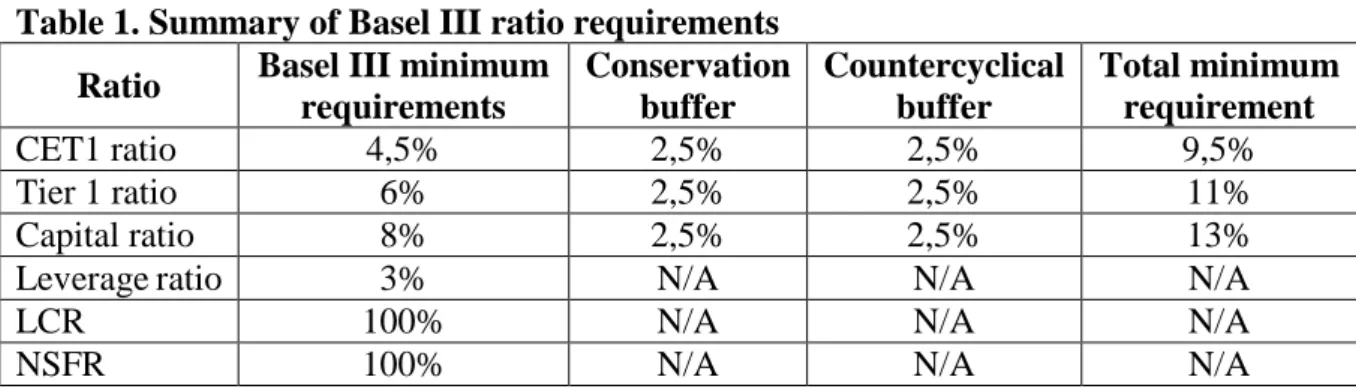
Basel III possible solution: Countercyclical buffer is precisely imposed when authorities believe that credit growth is resulting in unstained accumulation of systematic risk. Leverage ratio, will impose a limit on asset growth by not attributing risk weights to assets and based on Tier 1 capital, it will straight forwardly contain system wide increase of leverage.
Table 1. Summary of Basel III ratio requirements
Ratio Basel III minimum
requirements Conservation buffer Countercyclical buffer Total minimum requirement CET1 ratio 4,5% 2,5% 2,5% 9,5% Tier 1 ratio 6% 2,5% 2,5% 11% Capital ratio 8% 2,5% 2,5% 13%
Leverage ratio 3% N/A N/A N/A
LCR 100% N/A N/A N/A
15 2. Increase in deposit base to foreign parties - ICESAVE
The bank became more dependent on short term financing (total liabilities with up to 3month maturity represented 72% of total Liabilities in 2007, from which 59% were attributed to Deposits from customer) and consequently more sensitive to market conditions – see annex 6 for deposits to customer and liabilities maturities and currency denomination. With this rapid growth, Icelandic Banks’ foreign deposits base became higher than total Central bank of Iceland foreign exchange reserves, making it harder to fulfill its role as lender of last resort.
As soon as foreign depositors (mostly in the UK) heard rumors of trouble in Landsbanki there was a run to the bank (bank withdraw of their money) and shortly after the bank did not have enough liquidity to cover it.
Basel III possible solution: Net Stable Funding ratio, preventing the exponential increase in deposits and consequent increase in short term maturity, since it is a long term structural ratio that intends to decrease liquidity mismatches. Liquidity coverage ratio, will require the bank to have enough quality liquid assets to sustain a 30 day’ stress test, which would allow to the bank to comply with its obligations for a while longer, which would by it time to solve its problems.
3. Landsbanki’s equity in Icelandic kronas and most assets in foreign currency
Landsbanki’s equity was in Icelandic kronas, while most assets were denominated in foreign currency (69% of total assets) – see annex 7 for total asset composition by currency, which increased currency risk and was aggravated by the devaluation of the Icelandic krona at the time of the crisis.
Basel III possible solution: Liquidity coverage ratio, will require the bank to have enough high-quality liquid assets to sustain a 30-day stress test and has to be reported and met in a single currency. To be compliant with this ratio, banks are expected to be able to cover liquidity needs in every currency. However, this requirement is not a standard tool, so it has no imposed limit, and is posed as suggestion. The LCR is therefore expected to be monitored and reported
16 to supervisors to identify any potential currency related issues, by considering its ability to convert currencies and access foreign exchange markets under stressed conditions.
4. Large exposures to single clients or group of related clients
Iceland adopted rules on large exposures in accordance with directives from the European Union. Landsbanki, was not permitted to incur exposure in relation to one customer or group of customers that are related in a certain way, in excess of 20% of their equity base. The 2007 Landsbanki annual report provides information on large exposures, which are the parties with total obligations exceeding 10% of the bank’s equity. The bank had nine clients rated has having large exposures, totaling 150% of the bank’s total equity, which was under the 800% limit set by the FME. Even though the financial report states no client or group of related clients was above the 20% exposure limit. However, there were cases where parties where related, but considered as separate exposures. The relation between Actavis Group hf. and Björgólfur Thor Björgólfsson, where the second party held 38,84% share in Actavis Group hf, but both were still accounted as separate exposures (Hreinsson, Gunnarsson, Benediktsdóttir, 2010). The FME did warn the bank about this situation, however no measures were taken towards a solution. This example shows how regulation can be useless if supervisor enforcement fails.
Basel III possible solution: a large exposures framework’ was issued in 2014, by the Basel committee as a complement to Basel III capital requirements (implementation is expected at end 2019). Minimum capital requirements, from Pillar 1 implicitly assume granularity of portfolios, since capital requirements are only dependent on loan specific risk and not on the portfolio in which it’s integrated. This means risk concentration is not considered under Pillar 1. With large exposures framework banks sum of all exposures to a single or a group of related counterparties must not be higher than 25% of the bank’s available Tier 1 capital.
17 5. Main owners among its biggest borrowers
Individuals in decision-making positions within the bank, were also working in companies with loans at Landsbanki. Samson Holding Company held 40.7% of Landsbanki’s share capital in 2007. Mr. Björgólfur Guðmundsson (chairmain of Landsbanki’s board) and Mr. Björgólfur Thor Björgólfsson, father and son owned Samson. In Landsbanki 2007 annual report the following statement could be read “No direct business relationships, such as provision of credit, exist between Landsbanki and Samson.” However, Mr. Björgólfur had loans in the bank, in fact his and related parties’ total debt amounted to close to 1 billion euros in end 2008 (Hreinsson, Gunnarsson, Benediktsdóttir, 2010).
Basel III possible solution: This problem is related to the previous one, meaning large exposures standards would also apply. However, it would not be enough and responsible authorities must actively supervise owners’ use of power for their own benefit. The biggest borrowers of the bank had strong influence in the bank’s decision making, raising a conflict of interests. Basel III regulation does not specifically address this problem.
6. Cross financing among national banks was increasing
Banks had money in other banks, becoming dependent of one another’s success. Compounded annual growth rate (CAGR) of deposits and loans from/to financial institutions was of around 50% and 34% respectively from 2003 to 2007, see annex 8 for evolution balance sheet items w/ financial institutions.
Basel III possible solution: The capital framework demands higher requirements for inter-financial sector exposures.
7. Capital ratios stayed comfortably above required minimums
Even though Landsbanki capital ratio was above required minimums (annex 9), time proved those ratios did not reflect the bank’s real strength. Capital amount ended up being less than enough to withstand the crisis setbacks.
18 Basel III possible solution: Greater focus on common equity, with higher minimum capital requirements to increase the quantity and quality of capital.
5.3. Basel III reforms applied to Landsbanki’s Finacial Statements Capital Ratios under Basel II
In 2007, Landsbanki’s capital ratios were above the minimum 8% of RWA established in Basel II, this is true for total capital ratio, but also for Tier 1 ratio.
Tier 1 capital was equal to (16) Share capital + Share premium + Reserves + Retained earnings + 66% of Subordinated Loans – Goodwill + Minority interest = 233.595 million ISK, while Tier 2 capital equal to (17) 34% of Subordinated Loans - Deduction in accord with Articles 28 and 85 of Act No 161/2002 = 37.086 million ISK. Risk weighted assets amounted to 2.317.362 million ISK. Tier 1 ratio was equal to (18) 233.595/2.317.362 = 10,1% and capital ratio (19) (233.595 + 37.086) /2.317.362 = 10,1%.
Landsbanki’s CET1 capital was equal to (20) share capital + share premium + reserves + retained earnings + minority interests = 184.004 million ISK before deductions and CET1 ratio was equal to (21) 184.004 / 2.317.362.
Capital Ratios under Basel III
The tightening of charges against counterparty credit risk and trading book exposures set by Basel III will cause an increase of the Risk weighed assets base. By applying an average increase of 4% (BCBS, 2010), to RWA in the 2007’ financial statements, Landsbanki’s RWA under Basel III regulations would be equal to (22) 4% × 2.317.362 = 2.410.056 million ISK.
CET1 capital ratio: By applying the average decline in CET1 capital after Basel III regulation is applied, Landsbanki CET1 capital would be (23) -24,7% × 184.004 = 138.555 million ISK after deductions. With the decrease of CET1 capital and increase of RWA the CET1 ratio would be (24) 138.555/2.410.056 = 5,75%.
19 Tier 1 capital ratio: By applying the average decline in Tier 1 capital after Basel III regulation is applied, Landsbanki Tier 1 capital would be (25) -14,1% × 233.594 = 200.657 million ISK. With the decrease of Tier 1 capital and increase of RWA the Tier 1 ratio would be (26) 200.657/2.410.056 = 8,33%.
Capital ratio: By applying the average decline in Total Capital after Basel III regulation is applied, Landsbanki Total Capital would be (27) -16,6% × 270.679 = 225.746 million ISK. With the decrease of Total capital and increase of RWA the Capital ratio would be (28) 225.746/ 2.410.056 = 9,37%.
Leverage ratio: Leverage ratio numerator is Tier 1 capital (200.657 million ISK) and the denominator is exposure measure. Exposure measure will be equal to (29) 3.057.546 (total on-balance sheet assets) – 24.190 (Goodwill) – 58.917 (Derivatives) + 58.917 (Derivatives fair value) + 26.526 (Add-on) + 244.359 (Off-balance sheet items) = 3.304.241 million ISK. The approximate Leverage ratio amount would be (30) 200.657/3.304.241 = 6,07%.
Liquidity Ratios under Basel III
Liquidity ratios were introduced with Basel III, meaning there are no comparable ratios. Liquidity coverage ratio: The LCR 2009 average is 98% (BCBS, 2010). Landsbanki’s actual LCR in 2013 was of 102%, while the weighted average LCR in the same year was of 119% (BCBS, 2014). It will therefore be assumed that in 2007 the LCR of Landsbanki would be close to (31) 98% + (102% – 119%) = 81%
Net stable Funding ratio: The NSFR 2009 average was 103% (BCBS, 2010). Landsbanki’s actual NSFR in 2014 was of 134%, while the weighted average NSFR in the same year was 114% (BCBS, 2015). In 2007, LCR of Landsbanki would be approximately (32) 103% + (134% – 114%) = 123%.
20 5.4. Discussion of results
The first three Landsbanki’ 2007 capital ratios (CET1, Tier and Total capital), adapted to Basel III reforms, would not be in compliance with Basel III minimum requirements, with conservation buffer. However, if we remove the conservation buffer from the imposed minimums, all three ratios become compliant with Basel III minimum capital requirements. Basel III would have made a difference in the sense that Landsbanki would have to raise its capital through imposing limits in the distribution of earnings for the next period. However, it would not have to increase its core capital since it would still be in compliance with Basel III minimum requirements (excluding buffer).
For the countercyclical capital buffer, results are straight forward. If capital ratios are not in compliance when conservation buffer is considered, they will also not be in compliance when the CCyB is required (minimum ads up to conservation buffer).
Leverage ratio is the only capital ratio in compliance under Basel III reforms (6,07% > 3%). Even though this result is an estimative, with the possibility of being overestimated, it is not unwise to assume that this ratio would be above the 3% minimum requirement, the difference between this ratio and the Tier 1 ratio is in the denominator, which is equal to total assets on and off balance sheet. The leverage ratio will therefore be lower than Tier 1 ratio, since the denominator will be higher than total RWA. However, the Tier 1 ratio is high 8,38%, so for the LR to be below 3%, measured exposure would have to be more than 4.278.511 million ISK higher than RWA, which is unlikely since bank’s total on balance sheet assets amounted to
Table 2. Summary of Landsbanki’s ratios under Basel III Ratio Value under
Basel III
Basel III minimum requirements
Basel III limits (w/ conservation buffer) Ratio above requirements CET1 ratio 5,75% 4,5% 7% No Tier 1 ratio 8,38% 6% 8,5% No Capital ratio 9,18% 8% 10,5% No
Leverage ratio 6,07% 3% N/A Yes
LCR 81% 100% N/A No
21 3.057.546 and off-balance sheet assets amounted to 244.359 million ISK (stated in the annual report), performing a total of 3.301.905 million ISK, well below the 6.688.567 million ISK required for LR to be 3%. Therefore, the implementation of this ratio would not have made a difference in Landsbanki, since no measures would to be taken to comply with the ratio.
In respect to Liquidity ratios, estimates indicate LCR would not be compliance with required minimum, while NSFR would be well above.
The LCR, not being in compliance with the required minimums was expected since this is a short-term liability ratio, requiring banks to have enough highly liquid assets to cover a 30 days stress test. Well, Landsbanki ended up being under a stress period, and was not able to sustain a bank run with its assets. With this ratio, Basel III would had have made a difference, since high-quality liquid assets would have to be raised to comply with regulation.
The NSFR would be complying. This ratio’s goal is to avoid a liability and asset mismatch, and insure funding for a 1 year horizon. The available stable funding (numerator) is composed by the bank’s funding carrying amounts, to which weights are given according with its agreed maturity (beneficing higher maturity) and the propensity for withdrawals (beneficing lower propensity). Regulatory capital, is given a 100% weight, and as we have seen already it is considerably high (above minimum capital requirements) and high weights are given to lower than 1 year maturity liabilities, which amounted to 78% of total liabilities in 2007.
On the other, the required stable funding (denominator) is composed by the bank’s exposures (off and on balance sheet) to which a weight is given according with their maturity (higher maturity, greater weight) and liquidity value (higher liquidity, lower weight). Given that a 100% weight is given to all assets that are encumbered for a period of one year or more, and that Landsbanki’s assets with over 1 year maturity only represent 20% of total assets, it is understandable why the ratio stayed above required minimum. NSFR, so it would have not made a difference.
22 Recalling Landsbanki’s seven main problems identified above, problems 1 (Rapid growth of its balance sheet), 6 (Cross financing among national banks was increasing) and 7 (Capital ratios stayed comfortably above required minimums), are related to the capital ratios. The first three capital ratios would be bellow required minimums, which means the bank would have to raise its capital or decrease its exposures amounts and comply with regulation, meaning Basel III would have made a difference. However, the Leverage ratio, which is also a capital measure would have complied, indicating that at least for the first problem, Basel III would be only partially effective and even though the bank would have to decrease its riskier assets amount, it would still have the chance to increase its asset base.
Problems 2 (Increase in deposit base to foreign parties – ICESAVE) and 3 (Landsbanki’s equity in Icelandic kronas and most assets in foreign currency) are related to the Liquidity ratio. The LCR, would not have been in compliance which means the bank would have had to increase its high quality asset base or decrease the short run funding amount and would have been better prepared for the liquidity run that occurred. However, the same cannot be said about the NSFR which was above the required minimum so it wouldn’t have made a difference, even though most of the bank’s deposits had high propensity to be withdrawn (Icesave deposits, belonged to foreign depositors, with lower levels of trust on Icelandic banks), this ratio would not have made a difference. Even though for problem 3, the LCR is considered to be the closest solution, and in fact red flags would have been raised had the bank monitored its currency mismatch, doing this monitoring is not a mandatory requirement. No predefined limit is imposed, and it’s posed as just suggestion, making this Basel III requirement dependent on specific country regulators impositions, missing the point of a homogeneous regulatory framework.
Finally, problems 4 (Large exposures to single clients or group of related clients) and 5 (Main owners among its biggest borrowers) do not have a direct relation with the ratios presented above and are likely to have occurred, even if Basel III was in vigor. A large
23 exposures framework was purposed by the Basel committee, in which a single or a group of related counterparties cannot represent more than 25% of the bank’s available Tier 1 capital. However, a similar imposition was already imposed in Iceland at the time, and the problem still occurred.
6. Conclusion
In a world where different countries financial markets are ever more connected, and the Banking sector has proven to be a fuel for the economy (provider of credit for consumption and investment), international banking regulation has become crucial to guarantee consistency and avoid misconduct.
This is true today, after the world as gone through the 2007-08 financial crisis, but was already true before. Basel III emerged as a response to the crisis with the purpose of preventing a reoccurrence. However, Basel II in effect at the time of the crisis, was also created to prevent a Banking crisis, and failed. Which raises the question: If Basel III was in effect at the time, would the crisis have been prevented?
This paper provided an overlook to one of the world’s most affected countries by the financial crisis, having seen its three biggest banks collapse in late 2008 “Iceland’s banking collapse is the biggest, relative to the size of an economy, that any country has ever suffered.” – The Economist, 2008.
The large collapse of the Icelandic banks, Landsbanki in particular, associated with their numerous problems, turned it into a good base case to study whether “Basel III would have made a difference”.
Basel III had a “response” for almost all problems Landsbanki presented right before the crisis. However, in this paper we saw that even if in theory the new reforms would have prevented the bank from collapse, when applying Basel III regulations to the 2007 bank’s financial statements, some of the purposed ratios remained in compliance. However, it is
24 important to refer that the computation of this ratios was performed using proxies, and acknowledge that true data might had led to different results.
By using proxies, the Leverage ratio and NSFR were in compliance. Also, and even though regulatory capital ratios were not in compliance, that would not have been the case had the conservation buffer been left out. As we have seen before, being compliant with the buffer only requires the bank to impose limits in the distribution of earnings for the next period, and does not demand a structural increase on the bank’s core capital. The only ratio not fully compliant was the LCR.
Given the results obtained, it is visible that most Basel III reforms would have not required the bank to take measures towards significant improvements. Even the LCR, which would have demanded changes, showed limitations regarding the foreign currency mismatch between equity and assets, since it did not impose clear and mandatory requirements on the topic.
Some of the bank’s major problems have no Basel III related reforms, as it is the case for the “Main owners among its biggest borrowers” problem and “Large exposures to single clients or group of related clients”. The last problem can be related to the large exposures framework, however, it is disregarded by the fact that a similar framework was in vigor in Iceland before the crisis.
Under Basel III, the bank would likely still have collapsed, as problems would have not been completely solved. However, Basel III reforms would have demanded banks to strength liquidity, which could have allowed Landsbanki to sustain the bank run.
Basel III would have made a difference in the Icelandic banking crisis, by decreasing the magnitude of its impact, but would have not fully prevented it.
References
(1) Jannari, Kaarlo. 2009. Report on Banking Regulation and Supervision in Iceland: past, present and future. Reykjavík.
25 (2) Andrew Bailey. 2014. The capital adequacy of banks: today’s issues and what we have
learned from the past. London: At Bloomberg.
(3) Felton, Andrew and Reinhart, Carmen M.. 2009. The First Global Financial Crisis of the 21st Century, Part II: June- December, 2008. London: Centre for Economic Policy Research.
(4) Čihák, Martin and Demirgüç-Kunt, Aslı and Martínez Pería, María Soledad and Mohseni-Cheraghlou, Amin. 2012. Bank Regulation and Supervision around the World, A Crisis Update. Washington DC: World bank.
(5) Bergmann, Eirikur. 2014. The Icesave dispute: case study into\ crisis of diplomacy during the Credit Cruch. Glasgow: At ECPR, University of Glasgow.
(6) Jochem, Torsten. 2003. Geographic Diversication and Bank Stability: Evidence from the 2008-2011 U.S. Banking Crisis. Amsterdam: University of Amsterdam.
(7) Hreinsson, Páll and Gunnarsson, Tryggvi and Benediktsdóttir, Sigríður. 2010. Report of the Special Investigation Commission (SIC) to investigate and analyze the processes leading to the collapse of the three main banks in Iceland. Þingvellir: Alþingi
(8) Matthiasoon, Thorolfur. 2008. Spinning out of control, Iceland in Crisis. Nordic Journal of Political Economy. 34:3-20.
(9) Blundell-Wignall, Adrian and Atkinson, Paul. 2010. Thinking Beyond Basel III: Necessary solutions for capital and liquidity. OECD Journal: Financial Market Trends. 2010(1). (10) Landsbanki Financial reports from 2005 to 2008
(11) Basel Committee on Banking Supervision (2015), Basel III: The Net Stable Funding Ratio, January.
(12) Basel Committee on Banking Supervision (2010), Results of the comprehensive quantitative impact study, December.
(13) Basel Committee on Banking Supervision (2010), Basel III: A global regulatory framework for more resilient banks and banking systems, revised June 2011
(14) Basel Committee on Banking Supervision (2014), Basel III leverage ratio framework and disclosure requirements, January
(15) Basel Committee on Banking Supervision (2013), Basel III: The Liquidity Coverage Ratio and liquidity risk monitoring tools, January
(16) Basel Committee on Banking Supervision (2014), Standards: Supervisory framework for measuring and controlling large exposures, April
(17) Basel Committee on Banking Supervision (2014), Basel III monitoring report, September (18) Basel Committee on Banking Supervision (2015), Basel III monitoring report, September
26
Annex
Annex 1 – Basel I Tier 1 problems
1. Hybrid debt instruments were included in Tier 1 capital, even though they had no principal loss absorbency, i.e. they only absorbed losses after reserves were gone or the bank was in insolvency. It is important to note that insolvency is often not a possibility, banks are too important to the economy to fail, meaning those hybrid instruments were fair from being put into use as a buffer on losses. Another problem was that some of the capital instruments had incentives to redeem even though theoretical they were not allowed to.
2. Deferred tax assets were not deducted form capital instruments, even though they depend on future profitability, which is not a certain thing
3. Minority interests were recognized in full, even though in case of distress they would not be completely transferable to absorb group’ losses.
27 Annex 2 – Conservation and Countercyclical requirements minimum capital, Basel III Conservation buffer capital requirements
Common Equity Tier 1 Ratio Minimum Capital Conservation Ratios
(expressed as a percentage of earnings)
4.5% - 5,125% 100%
>5.125% - 5.75% 80%
>5.75% - 6.375% 60%
>6.375% - 7.0% 40%
> 7.0% 0%
Capital requirements for a countercyclical buffer of 2,5% Common Equity Tier 1 Ratio
(including other fully loss absorbing capital)
Minimum Capital Conservation Ratios (expressed as a percentage of earnings)
4.5%- 5.75% 100%
>5.75% - 7.0% 80%
>7.0% - 8.25% 60%
>8.25% - 9.5% 40%
28 Annex 3 – BCRS average impact ratios
The estimates presented assume full implementation of final Basel III reforms, based on data as of year-end 2009. No assumptions were made about banks' profitability or behavioural responses, such as changes in bank capital or balance sheet composition, since then or in the future.
Impact of Basel III requirements based on data from 2009 financial statements Source: BCRS
Ratios Real Average in 2009 Average w/ Basel III
requirements Average % Change CET1 ratio 10,70% 7,80% -2,90% Tier 1 ratio 9,80% 8,10% -1,70% Capital ratio 12,80% 10,30% -2,50% CET1 capital -24,70% Leverage ratio 3,80%
Liquidity Coverage ratio 98%
Net Stable funding ratio 103%
29 Annex 4 – Leverage ratio
Add-on factors for determining potential future exposure
Residual maturity Interest
rates FX and gold Equities Precious metals except gold Other commodities
One year or less 0,0% 1,0% 6,0% 7,0% 10,0%
Over one year to five years 0,5% 5,0% 8,0% 7,0% 12,0%
30 Annex 5 - Reasons behind Loans growth
In just 5 years (2003-2007), Loans and advances to customers had grown around 520%. This growth can be partially explained by the intense competition existent between the Icelandic government and domestic banks, in the market for Housing loans, motivated by a combination of two circumstances. First, the government demanded for housing loans to be more than 80% provided by the government loan agency and only the rest by a credit institution. Secondly, the privatization of the major national banks between 1998 and 2003, urged banks to grow and take on a more aggressive approach to increase their loan portfolio.
In addition to domestic expansion, penetration into international markets was also a major contributor for loan growth. Foreign net revenues represented just 13% of total net interest revenues in 2004, while in 2007, 47% were originated in Foreign countries.
Source: Landsbanki Annual Reports
Net interest revenue by geographic location (%) 2007 2006 2005 2004
Iceland 56% 59% 76% 87%
UK & Ireland 25% 23% 17% 5%
Other European Countries 10% 8% 7% 8%
Other 8% 10% 0% 0%
Total 100% 100% 100% 100%
Absolute total values 54.052 41.491 22.996 14.734
A shift in the nature of Landsbanki’s activities also motivated this growth. Investment and Corporate Banking gained importance in the past years, representing 37% and 35% of total Net Operating Income in 2007, respectively.
Source: Landsbanki Annual Reports
Income per Business Segment (%) 2007 2006 2005 2004
Retail banking 19% 20% 22% 29%
Corporate Banking 35% 29% 24% 24%
Investment Banking 37% 43% 47% 40%
Asset management and private banking 9% 7% 7% 7%
Total 100% 100% 100% 100%
Absolute total values (million ISK) 109.392 87.727 60.978 33.467
31 Annex 6
Source: Landsbanki Annual Reports
Up to 3 months 3-12months
1-5years Over 5 years Non interest bearing
0% 10% 20% 30% 40% 50% 60% 70% 80% 90% 100%
Up to 3 months 3-12months 1-5years Over 5 years Non interestbearing
Deposits from customers 1.211.370 134.809 63.947 11.284 0
Total liabilities and equity 2.058.394 186.741 314.217 183.256 314.937
Deposits from customers, by maturity
Deposits from customers Total liabilities and equity
21%
14% 1% 63%
0% 1%
Deposits from customers, per currency
32 Annex 7
Source: Landsbanki Annual Reports
31% 27% 10% 15% 7% 10%
Total assets by denomination currency
33 Annex 8
Source: Landsbanki Annual Reports
0 50.000 100.000 150.000 200.000 250.000 300.000 350.000 400.000 2003 2004 2005 2006 2007 m ill io n I SK
Deposits from financial institutions
0 50.000 100.000 150.000 200.000 250.000 2003 2004 2005 2006 2007 m ill io n I SK
34 Annex 9
Source: Landsbanki Annual Reports
Capital Ratio 2007 2006 2005 Risk-weighted assets 2.317.362 1.523.143 1.065.074 Tier 1 capital 233.594 197.468 126.635 Equity 180.008 144.282 110.059 Tier 2 capital 37.086 28.603 13.074 Equity ratio 7,8% 9,5% 10,3% Tier 1 ratio 10,1% 13,0% 11,9% Capital ratio 11,7% 14,8% 13,1%