Multilem: how to stand up to a
crisis?
Filipa Ferreira de Lima
Dissertation written under the supervision of Nuno Magalhães Guedes
Dissertation submitted in partial fulfilment of requirements for the MSc in
Business, at the Universidade Católica Portuguesa,
1
Abstract
Dissertation title: Multilem: how to stand up to a crisis? Author: Filipa Ferreira de Lima
Multilem is a Portuguese company, founded in 1986, operating in the fairs industry, responsible for the manufacture of stands and for managing the performance of its clients in industry fairs. In 2008, after many successful years, the international economic crisis sent Multilem into hard times. Customers started to decrease the number of orders and to commit lower budgets to their presence in fairs. Multilem had to outline a strategy to maintain the business.
Multilem’s case study addresses this crisis situation, providing information about the story of the company, the economic crisis and the industry in which Multilem operates. Information on key aspects shaping the behavior of clients is also provided. Additionally, in the Literature Review section, subjects that provide a broad perspective of the problem are addressed. The Teaching Notes section offers an analysis of the case including possible future alternatives and recommendations to Multilem’s management.
The aim of this dissertation is to help to develop a strategy that will help Multilem facing this crisis, in order to keep operating in its traditional market niche.
2
Resumo
Título da dissertação: Multilem: how to stand up to a crisis? Autor: Filipa Ferreira de Lima
Multilem é uma empresa portuguesa, fundada em 1986, que opera na indústria de ferias, responsável pela construção de stand e pela gestão da performance dos seus clientes em feiras da indústria.
Em 2008, após vários anos de sucesso, a crise económica internacional enviou a Multilem para maus momentos. Os clientes começaram a diminuir o número de pedidos e a disponibilizar orçamentos mais baixos para a sua presença nas feiras. Multilem teve de delinear uma estratégia para manter o negócio.
O caso de estudo da Multilem aborda esta situação de crise, providenciando informação sobre a história da empresa, sobre a crise económica e a indústria onde a Multilem opera. É também disponibilizada informação sobre os aspetos chave que moldam o comportamento dos clientes. Adicionalmente, na Revisão de Literatura, são abordados temas que fornecem uma perspetiva mais ampla do problema. Na secção de Notas de Ensino é oferecida uma análise do caso, incluindo futuras alternativas, bem como recomendações para os gerentes da Multilem.
A finalidade desta dissertação é ajudar a desenvolver uma estratégia que ajudará a Multilem a enfrentar a crise, a fim de continuar a operar no seu nicho de mercado tradicional.
3
Acknowledgements
Firstly, I would like to express my gratitude to Pedro Castro for his availability and kindness to help me during the whole process. Also, I would like to extend my appreciation to Sandra and Luisa for their help during Pedro’s vacations.
Thank-you also to my academic advisor Professor Nuno Magalhães Guedes for all the support and care throughout these months. Without his support it would have been much harder or even impossible to accomplish my objectives.
A special word for my parents. Without their support and trust I would not have done this Master after my studies in a different area. Thank you for always supporting and encouraging me. Additionally, I would like to express my gratitude to António, for all his motivation during this period.
Finally, I would like to say thank you to my colleagues Teresa and Constança for all the friendship and support during this Master’s degree.
4
Table of contents
I. Introduction ... 5
II. Case Study ... 6
Multilem ... 6
The Industry ... 11
The Crisis ... 12
The Future ... 13
Exhibits ... 15
III. Literature Review ... 22
1.The role of fairs as a tool to promote companies ... 22
2.The impact of Quality Services and Consumer Loyalty in a business ... 25
3.Value Chain and Differentiation... 27
4.The impact of an Economic Crisis in a business ... 29
5.The role of Internationalization for competitiveness between companies ... 30
IV. Teaching Notes ... 32
1.Learning Objectives ... 32
2.Class Plan ... 32
3.Analysis ... 32
A)What were the reasons for Multilem’s success until 2008? ... 32
B)Evaluate the strategy that Multilem has followed. ... 33
C)Analyze the structure of the industry in which Multilem operates ... 35
D)What do Multilem’s customers value? ... 38
E)Evaluate the role of Multilem in its customers’ Value Chain. ... 39
F)Assess Multilem’s strengths and weaknesses. ... 39
G)What are Multilem’s main problems?... 41
H)What are the potential alternatives established by Multilem? ... 42
I)What would be your recommendations for Multilem’s managers? ... 42
V. Conclusion ... 45
VI. References ... 46
5
I. Introduction
Multilem was a company founded in 1986, with the aim of exploring the fairs and exhibitions’ industry, through the construction of stands. Managed by two brothers, the growing company quickly developed into more than stands’ construction, starting to manage all the needs of its clients in fairs, while entering the events and refurbishment market as well. The business was going well, and the company made a profit every year, until 2008, when the American bank Lehman Brothers declared bankruptcy, originating a severe economic crisis. The Portuguese economy started to retract and consequently, customers decreased their orders. With less demand, Multilem had to figure out what to do in order to get back on track.
The present dissertation includes three parts. Firstly, a Case study about Multilem, where the company’s profile, its history, the type of industry, the economic crises and the company’s main problems are reflected. Secondly, a Literature Review, where topics such as fairs and exhibitions, quality services, customer loyalty, economic crisis, value chain and internationalization are addressed. It also provides valuable insights to help finding out alternatives to Multilem’s problem. Lastly, in the Teaching Notes an extensive analysis of Multilem’s business can be found, while providing alternatives and recommendations for the company, in order to address its strategic problem and to leverage Multilem’s success.
6
II. Case Study
It was mid-June 2009, the sun was going down in Azambuja, Portugal, and José Castro, the chairman of Multilem, was in his office eagerly waiting for his brother Pedro, the CEO of the company, in order to discuss the next steps of the business.
Multilem operated in the industry of trade fairs and exhibition stands. It was founded in 1986 by José Castro and a few years later Pedro Castro joined the business.
The company used to be growing year by year, the business model had been modified whenever the partners felt that an adjustment was required to respond to customer’s needs. Both José and Pedro felt they were shaping a modern company, completely ready for the future challenges of the market.
However, the 2008 storm took them by surprise. The USA and Europe entered a severe financial crisis which affected almost every business sector. Customers slowed down their orders, the market started to retract, some competitors started to fail.
The market was decreasing, falling by 50% in volume. Multilem customers were cutting their budget by almost 65% and the Castro brothers felt as balancing in the peak of a mountain. Multilem’s 2008 revenues were still around €7 million, although almost 40% below golden times. The future was not bright for the company and it was urgent to rethink Multilem strategy in order to survive and not to fail as many competitors did.
Would more than twenty years of experience be enough to overcome this moment of economic crisis? Or would Multilem go down the same road as other companies, with its successful path soon coming to an end? The time had come to expand the market. Would José and Pedro be able to find the right strategy?
Multilem
In 1986, the Princes of Wales were coming to Portugal to celebrate 600 years of the Anglo-Portuguese alliance. The English Government decided to organize a fair with Anglo-Portuguese companies that exported to England, and English companies that exported to Portugal. For that purpose, there was a publication in several newspapers looking for a company to be in charge of the stands. José Castro was a partner of Incormat, a civil construction company. Its business and know how had nothing to do with stands and fairs. However, the partners decided to present a proposal and they won the tender. Working with a novel system, named LemSystème that
7
enabled 45º aluminum profiles, something little seen before and completely different from what the market was used to. This new material allowed new possibilities to create completely different stands. In order to leverage the capabilities of this novel system, a separate company called Multilem was created.
Quickly, the company understood that aluminum was not a good bet, since the margin was not good enough, the material was little customizable and did not allow for much creativity. In order to differentiate from competitors and overcome all the factors that LemSystème did not allow for, in the early 90’s Multilem started to work with wood. By 1992 it was the only material used by the company.
Differentiation was always a key word to describe Multilem, a pioneer working with wood and also in the methods it used. The fair’s industry was a market with many players into it, and with so many competitors, the company had to innovate and start doing something different. So, due to special orders by its clients, the company left behind modular stands1 and started to do
tailormade stands2. [Exhibit 1 and 2]
Hearing about Multilem novelties, clients started to place more and bigger orders and Multilem had to hire more employees. Yet, the growth of the company brought with it a huge problem. The market of fairs was a seasonal business. Companies were used to organize exhibitions from May to October, and the rest of the year this business was asleep. Fulltime employees implied a full year of wages, regardless of having work or not.
So, in face of this situation, Multilem decided to apply for different projects and began to get involved in the organization of some events, such as weddings, conferences, parties or exhibitions. In 1994 it made the setting of an European TV show called “Games without borders”, and in 1998 got into its first event, building an entire hall in Expo’98 in Lisbon. Thereby, Multilem started to prepare not just individual stands but multiple stands for different companies, as well as entire exhibitions. By the end of the 90’s, this kind of market started to grow, many competitors entered the market and so the return started to decline. Nevertheless, Multilem kept growing and it was considered as a top-level company, its clients started to place bigger orders, involving stands of up to 500.000€.
1 Stands designed with standard dimensions, in order to allow flexibility in use and assembly 2 Stands designed custom and usually with architecture and carpentry
8
With the growing volume of orders, space in Lisbon was lacking and, in 2003, the company had to move its headquarters to Azambuja, a village 50Km away from Lisbon, where it could have a wider structure capable of supporting its own carpentry and a rented warehouse.
Multilem was all the time searching for new projects and different challenges, so in the beginning of the 21st century the company entered the interior refurbishment area. In 2007 one
of its big projects was the new offices of Mckinsey in Lisbon. By 2008 the company was operating in three main business sectors: Stands (representing 58,1% of Multilem’s revenues), refurbishment of commercial spaces (15,3%) and events organization (7,6%).
Building stands always had been Multilem’s core business. However, due to big refurbishment orders in some years, both areas were almost even in terms of revenues, such as in 2006 and 2007. [Exhibit 3]
Multilem's main activity was to create and develop exhibition stands, organize events and interior spaces for a wide range of clients. It always aimed to be positioned as a company that delivered high-quality services, able to attract big clients.
Multilem’s target were large companies, with high budgets. Companies that searched for big results on their presence in fairs, wishing to have no concerns during the creativity process. Companies that really trusted Multilem to let it create and surprise at the end. Companies that had very high expectations both in artistic and workmanship terms.
From those big projects, Multilem usually could generate margins between 30% and 40%. One of the first customers of Multilem was Revigres, a Portuguese company and a world reference in ceramics, specialized in the production of wall and floor tiles. The French automotive company Renaut was another company that from the 90’s was loyal and always believed and trusted Multilem.
Over the years, well-known companies from different business sectors, such as Banco Espírito Santo, Turismo de Portugal, TV Cabo Portugal or Automóvel Clube de Portugal, became clients of Multilem. However, a strong customer’s portfolio was never a guarantee for future success. All customer groups that Multilem was after were marked by sporadic events, so if a client ordered a service one year it did not mean that it would order another the following year. It was not related with loyalty, but with customer needs. A loyal customer could need Multilem’s services just from time to time. So, every year, about 65% of its clients were new clients [Exhibit 4], and just a small percentage were customers from the previous year.
9
In a competitive market, Multilem had to work on its differentiation to attract and retain its customers. Almost from the beginning, the first detail that it worked on were its high-quality finishes. However, Multilem did not want to have just one different feature. In contrast to other companies, Multilem always worked with the purpose of completing its project a day before the fair’s opening. It believed that this last day was for relaxing, to convey confidence and peace of mind to its clients. As the CEO said “The last day and night are not to work and solve the last details. It is to relax and eat shrimps.”
In the business, it was usual for companies to bring the components to the fair and start developing the stand on site. Multilem learned that there was a better way to manage time and resources. Its stands were all developed inside its workshop and, on the installation days, they were assembled as a puzzle. This way of working reflected professionalism and confidence for its clients, two main factors for Multilem’s reputation.
A key differentiation factor from other competitors was Multilem’s 360º work. This meant that Multilem did not offer just the design, woods and labor, but all the intervention that was involved with the performance of its clients on fairs. Multilem believed that it was more efficient to buy, for example, chairs, and use them over and over in multiple stands, instead of renting them each time that a client demanded some. This way clients trusted that Multilem always had everything they needed.
Besides the design, which Multilem considered as a differentiating factor, its way of presenting projects leveraged a lot its recognition. Multilem was a pioneer in 3D modelling. The company had always been proud for being innovative and for using the most advanced presentation technologies.
For Multilem, more important than creativity and the stand’s final result, it was key to preserve the relationship between the company and its clients. Multilem always worked in order to make its customers feel unique and special. For Multilem, all projects were built on a story basis, since the company believed that each brand had a unique story to tell.
Creativity, quality, innovation and rigor in meeting deadlines had been main factors for differentiation from the competition and had allowed Multilem to win and retain clients. [Exhibit 5]
Furthermore, Multilem was the only company that operated in all three business segments: fairs, events and interior refurbishment.
10
Mergers between advertisement agencies and companies responsible for stands and exhibitions were usual to see. While a builder like Multilem had the know-how and techniques to take care of everything on site, the advertisement agencies had the marketing directors of potential clients in their contact list. Merging into a single company, or becoming partners, was the solution that a lot of competitors found in order to expand their range of clients.
Multilem never had a communication strategy implemented or even defined. And the company’s managers were aware of this weakness. Many competitors worked a lot on this in order to gain clients. Even so, Multilem preferred to put its effort in other features that gave recognition and differentiation to the company and let its work speak for itself. Multilem believed that its works was the best way of showing its value and quality. As its clients went to fairs to exhibit their products and do their marketing, so did Multilem through the work provided to them.
By 2008, Multilem had 49 employees, including four managers, seven people in the technical department and one person responsible for purchases. Around half of the staff worked on operations, mainly carpentry, and the remaining headcount had administrative and support functions. Finally, three interns were allocated to specific projects.
Multilem did not have a design department, subcontracting an agency or a freelancer for each project. After the request from the client, Multilem brought the customer’s briefing to the agency and let them develop their creativity, and afterwards presented the proposal to the client. After the client’s approval, Multilem’s technical department began to work on the project in order to be able to start the construction of the stand or the refurbishment. The process could also initiate by agencies asking Multilem to work on design already defined and approved by their client. These procedures could take about four days. The construction of a stand would depend on its size and complexity. A stand of 9𝑚2 would normally need between four and ten
days inside the carpentry workshop and two more for its implementation on site. For bigger stands, for example of 405𝑚2 done in 2007 [Exhibit 6], it took six weeks for the project and
technical drawing, four weeks for production and six days for its implementation on site. The materials most used by Multilem in its stands were derivatives of wood, such as plywood, MDF3, wood cluster and veneer wood. Also acrylics, polycarbonates and PVCs4. For
3 MDF – Medium Density Fiberboard 4 PVC - Polyvinyl chloride
11
ornamenting graphic elements such as clipping vinyl, fingerprint images on canvas, vinyl or fabric, carpets and other fabrics were used.
The Industry
In the 90’s and early 21st century, the fairs industry was a big market. Oporto and Lisbon were
the two main hubs of this business and almost every week, one of the cities, or even both, had an important fair. Each fair could be opened for visitors from two days to a week.
During the 90’s, Guimarães and Coimbra, in the North of Portugal, were also important cities for fairs. In the beginning of the 21st century, the business also expanded towards the center
region of Portugal.
Some of the bigger fairs in Portugal were Expolíder, Concreta, Expotelecom, Bolsa de Turismo de Lisboa5. The biggest fair centers were Exponor and Expo Salão in Oporto and FIL6 in Lisbon.
Many companies from multiple sectors, such as automotive, telecommunications, travel or civil construction, were big investors in the trade fairs industry. In these events, companies were there to launch new products, show the novelties and see what kind of innovations competitors were bringing too. Companies could test products directly with customers and develop their loyalty through a customized service.
When a company was present in a fair with a stand, this represented the materialization of the company’s image, thus, fairs were a marketing and communication tool, with the aim of getting the attention of its target and sometimes there were a place to sell as well. Customers were there not just to see, but sometimes to buy, to catch better deals than could be available in stores later on.
For example, Salão do Automóvel, an automotive fair, was offered in Oporto every year and in Lisbon every two years. Companies such as Renaut, Peugeot or Volkswagen were used to invest hard in fairs because people were there to compare models and prices. Customers looked for the best opportunity and sometimes ended up buying new cars.
The fair’s market was an industry with space for almost every player that wanted to enter, from the big events company to the little carpentry. Demand was very high and diverse, since many
5 Contruction, Telecomunications and Turism fairs 6 FIL – Feira Internacional de Lisboa
12
companies were used to invest in this market. Each company that provided stands or managed the presence of clients in fairs were considered as Multilem’s competitors.
Multilem identified three competitors who worked for the same target of big clients. Certame, Palexpo and Construtora da Ferraria, which became Insycro in 2008 when acquired by Explorer, a private equity firm. All were companies with similar dimensions, working to deliver high quality services and premium design at comparable prices.
The Crisis
In 2008, a combination of excessive borrowing, risky investments and little transparency led to a severe economic crisis in the USA and the global financial system. A crisis that quickly developed and involved most European countries, including Portugal.
At the end of 2008 Portuguese GDP was increasing by 0.2%. However, the scenario would be better if on September 15th the American bank Lehman Brothers had not declared bankruptcy.
This impacted not just the USA, but all Europe as well. In the last quarter of the year, Portuguese GDP decreased by 0,9%, and it was just the beginning. [Exhibit 7]
Soon, the crisis felt in the financial sector, spread to all sectors.
By the end of 2008, 60% of European companies that operated in the exhibitions industry experienced a decrease in business, believing it was attributable to the economic downturn. Also, more than 60% were anticipating a 10% decrease, or greater, in gross turnover in the first half of 2009, compared with the first half of 2008. In response, by February 2009, 70% of companies made meaningful cost reductions in their company operations to compensate for any actual or anticipated decrease in gross turnover.
For shows occurring between October 2008 and March 2009, around 7 companies out of 10 experienced a decrease in space sales (68% for B2B7 shows and 71% for B2C8 shows). The
situation regarding visitors/attendees experienced a similar decrease.
Participating in a fair had always been a good way to promote a company’s products. Fairs were possibly the oldest marketing strategy of companies. Groups of people from the same industry gathered to show and present their products. With the evolution of business, of the ways of presenting, fairs were also growing, and companies started to invest more in this type of marketing. Companies were investing in events that attracted a wide variety of potential
7 B2B: Business to business 8 B2C: Business to customer
13
customers from a specific sector and enabled them to have a personalized and attractive B2C contact.
The business had always been a winning bet and for many years even the entrance of new players was not a problem, since there was space for everyone, with different companies focused on different targets. However, by 2008, the big crisis was felt in most industries based in Portugal, and the business started to decline and became a saturated market.
In business downturns, marketing and advertisement were usually among the first cuts to be considered. Companies reduced their investment in fairs and companies like Multilem started to feel the pain. Even though Multilem’s revenues in 2008 were in line with previous years [Exhibit 8], the number of clients increased 71%, with the customer’s budget decreasing by 65% compared with 2007 [Exhibit 9]. By March 2009, the scenario was improving a little [Exhibit 10], although the forecast for the remaining months was not favorable and did not allow for growth.
The Castro brothers were concerned about the situation. Fixed costs and the time that a team needed to build a stand or prepare an event were pretty much the same as before. However, the number of orders were higher and the budget for them was smaller. Multilem was running out of capacity but revenues were not enough to enlarge the team in response to orders.
The Future
The economic crisis had just started, and José and Pedro were aware of it. If the partners did not do something, the number of orders could reduce as well as customers budgets and Multilem could have to close its doors. However, that was an option that the company did not want to consider.
The market was starting to shrink, falling by 50% in volume. Customers within Multilem’s target were disappearing one by one, on reducing their budgets. It was urgent to expand the market.
For the Castro brothers, to do a downgrade on Multilem’s projects and its quality, in order to extend the market and reach smaller budgets, was the first option. This way, it could reach more smaller size customers. Fixed costs would be the same, but the company could play with variable costs to reach the same margin and reduce the budget through raw materials and work techniques. However, this move would lead the company to a new path, completely against all
14
the effort that was done through those years in building an image of high-quality services and finishes, the most important feature for Multilem.
The brothers thought that the lack of salespeople or a good marketing department and the outsourcing of its projects design were two main weaknesses. Many competitors were developing partnerships with design and communication agencies, in order to have all these departments within their structure. José and Pedro Castro felt that it could be another option. However, even if Multilem had better features, the market would still be the same and with this partnership Multilem would be limited to a given agency’s customers. The success of its clients and their ability to pay for Multilem’ services were not dependent on Multilem’s capabilities. In contrast, agencies used to hold 30% of the project return, what would be almost all the earnings that Multilem kept from each project. Customers were trying to reduce cost, but agencies still wanted to gain the same. All the effort and work were from Multilem and in the end the return could be lower than before.
Over 2008 and the beginning of 2009, Multilem worked on several projects to represent Portuguese companies in fairs abroad. The partners started to understand that, for some reason, Portuguese companies were choosing to make themselves known in the international market rather than investing in their own country. Although the severe economic crisis affected most of the world, not all countries were in the same situation. Thus, exploring the market abroad could be a third option.
Multilem had some of its big clients operating in Angola and asking for its projects there. In the beginning of 2009, Multilem went to Angola representing one of its big clients in a local fair. The fair’s producer was impressed with the output and invited the company to go to Angola and start operating there. Angola was a growing country, with an active fair business, with higher budgets and lacking on creativity, which could be a window to Multilem. Portuguese was the primary language, which allowed all Multilem’s employees to work there with no speaking barriers. One of Multilem’s bigger clients was already operating there and was encouraging the company to go to Angola.
Pedro entered the room and sat in front of his brother. The Castro brothers had to decide what to do in order to save their company. But what? Would the downgrade of quality be adequate to leverage the company without damaging its image? Would the merger with an agency be enough to navigate the market through that time of crisis? Or should the company invest and internationalize its business to Angola?
15
Exhibits
Exhibit 1 – Modular Stand
16
Exhibit 3 – Multilem revenues by business area (%)
*In other can be: furniture, maintenance or civil construction.
Exhibit 4 – Multilem customers – first time vs repeat
31,8% 0,8% 9,9% 7,6% 50,3% 44,4% 37,1% 59,1% 14,5% 43,0% 36,9% 15,3% 3,4% 11,8% 16,1% 18,0% 2005 2006 2007 2008
Events and Exhibitions Stands Refurbishment Other
70% 52% 76% 30% 48% 24% 2006 2007 2008
17
Exhibit 5 – Number of customers per year
*Customers only from January until May
Exhibit 6 – A 405𝒎𝟐 stand produced by Multilem in 2007
3D project image 49 69 69 118 71 0 20 40 60 80 100 120 140 2005 2006 2007 2008 2009*
18
3D project image
19
3D project image
Picture of the stand on site
20
Exhibit 7 – Portuguese GDP quarterly growth (%)
Exhibit 8 – Mulitlem’s annual revenues
€7 125 370,20 €6 690 435,55 €10 846 162,44 €6 704 969,99 €-€2 000 000,00 €4 000 000,00 €6 000 000,00 €8 000 000,00 €10 000 000,00 €12 000 000,00 2005 2006 2007 2008
21
Exhibit 9 – Multilem’s average budget per customer
Exhibit 10 – Multilem’s average quarterly budget per customer
€145 415,72 €96 962,83 €157 190,76 €56 821,78 €-€20 000,00 €40 000,00 €60 000,00 €80 000,00 €100 000,00 €120 000,00 €140 000,00 €160 000,00 €180 000,00 2005 2006 2007 2008 €-€500 000,00 €1 000 000,00 €1 500 000,00 €2 000 000,00 €2 500 000,00 €3 000 000,00 €3 500 000,00 Q1 2005 Q2 2005 Q3 2005 Q4 2005 Q1 2006 Q2 2006 Q3 2006 Q4 2006 Q1 2007 Q2 2007 Q3 2007 Q4 2007 Q1 2008 Q2 2008 Q3 2008 Q4 2008 Q1 2009
22
III. Literature Review
1. The role of fairs as a tool to promote companies
The world is constantly moving, new discoveries are published every day, and the technologic processes are the focus of our society. The face-to-face contact is getting undervalue. However, in the business world, this personal interaction available on fairs will always be a leverage factor for sales.
Trade fairs are probably the oldest way of marketing known by the Human being. Palumbo & Herbig (2002) state that “international trade fairs have been a primary vehicle for reaching potential buyers and introducing products since the16th century”. According to Situma (2012) trade shows and exhibitions, are a place for companies to display and demonstrate their products to potential customers, who had a special interest in buying those products. Morrow (2002) agrees, defending that a fair consists in a periodical meeting of people or companies in order to sell or demonstrate their goods or services in some place, date and hour previously defined. Additionally, Rafael (2018) quoting Sarmento, Farhangmehr and Simões (2013) states a fair as an enabler marketing event that occurs periodically at intervals, whose main purpose is to disseminate information and display the assets and services of competitors and complementary sellers whose audience is a selected concentration of customers, potential buyers, influencers of decisions. In this sense, Silva (2012) asserted that fairs and exhibitions are very efficient communication platforms by allowing direct connection with potential customers.
The definition of trade fairs is not consensual for every author or institution, however UFI (2010/2011) distinguish fairs from exhibitions and expositions. Defending that a fair is a gathering of people held at regular intervals for the exchange or sale of goods, is the one from which the present day definition is taken, i.e. a periodic gathering for sale of goods, often with shows or entertainment, at a place and time fixed by custom. UFI also established exhibitions as not just collections of interesting objects brought together at a certain place and time. They are human activities and enterprises, undertaken for set reasons, in order to achieve certain specified results. They are a form of human exchange, whereby the promoters and exhibitors communicate with the visitors, however their results can only be told in terms of further human thought and activity. At last, UFI suggests that expositions were held purpose-built in facilities. They were organized by either government departments or groups of entrepreneurs with government assistance for the strict purpose of promoting trade. Companies are invited to show their goods.
23
Figure 1 – Different types of shows by UFI (2010/2011)
Many authors plead that the participation in trade fairs is a good strategy for a company in order to leverage sales and get to know what competitors can offer. Palumbo & Herbig (2002) suggest that fairs are one of the best ways to get into a market or find it. Englon (2014) also preserves this definition arguing that trade fairs have a significant role in the firms’ marketing mix. Additionally, Seringhaus & Rosson (2001) suggest that “trade fairs play a key marketing role in most industries and many firms allocate a significant portion of their marketing budgets to participate at these events.”
A company participation in a fair can be the reflection of many reasons. Situma (2012) defended that multiple factors such as “changing consumer preferences, increased industrialization, technology, innovation and inventions, intense competition and widened markets call for marketers to constantly keep abreast with the happenings around their businesses and to adopt strategies that enable their companies to remain afloat”. According to a study led by Blythe (2000), companies invest in fairs and exhibitions with the aim of achieving at least one of the following objectives: 1.Launching new products; 2. Getting information about competitors; 3. Getting an edge on non-exhibitors; 4. Keeping up with the competition; 5. Meeting existing distributors; 6. General market research; 7. Making sales; 8. Meeting new distributors.
Smaller size organizations usually have less budget allocated to marketing costs. Rafael (2018) defends that this kind of companies invest less in advertisement, promotion, market research and other marketing techniques. However, most of them participate in fairs as visitants or exhibitors. For some authors, the cost of a participation in a fair is an investment more valuable than other traditional ways of selling. Tanner & Chonko (1995) suggest that “trade shows have
24
long been recognized for presenting an opportunity to sell in-person at a cost per contact far below that of an industrial sales call”. Additionally, Bento (2010) states the fairs activity as a big opportunity to leverage a business and encourage the process of buying and selling in the same place. In this sense, the participation in fairs can be a better deal for companies than to sell in stores.
According to Sebrae (2014), companies invest in fairs and exhibitions in order to present their products and services, aiming to sell, attract new customers and get their loyalty. Garcia (2001) defends that fairs are most efficient in order to introduce a new product in the market, to collect new customers, to promote the company’s image, to get into new markets and to support a company’ supply chain. Fairs are the perfect tool to present new products and complex equipment, in a unique space to a big, specific and high-quality target, enabling them to manipulate such products or equipments, know their functionalities and compare with competition while dealing with all doubts in a prompt way. (Castilho & Dias, 2008 in Rafael, 2018)
The presence of social media in fairs is another benefit for companies. According to García (2001) companies should take advantage from promotion of their image through social media, since fairs privilege forums of discussion, promotion and innovation that involve sectorial associations, investigation institutions, technologic centers and specific and generic press. Indeed, the presence in a fair is a sui generis moment to establish strict contact with media and to get covered due to the cluster and quality of visitors.
Fairs and exhibitions are also a valuable platform for a company’s internationalization, since these events gather sellers and buyers on the same place; provide reference contacts for future exhibitions; have the role of achieving alternative markets and new commercialization sources and allows for a much more cost-effective cross product comparison. (O’hara, 1993; Dekimpe, 1997 in Bento, 2010)
Participation in fairs is certainly a beneficial communication strategy for a company. Depending on a company’s operational sector, the return for a company could vary. If for some the recognition is the goal, for others increasing the number of sales is the purpose to be there. However, it cannot be denied that to be in the same place with direct competitors presenting to the same target is always an added value for a company.
25
2. The impact of Quality Services and Consumer Loyalty in a business
A quality service is an intangible concept that is not easy to evaluate. Many authors define this concept as a comparison between customers’ expectation about a service or product and their perception of its performance (Parasuraman et al, 1985; Lewis and Booms, 1983; Gronroos, 1982; Smith and Houston, 1982). In this way, a quality service is achieved when customer expectations are satisfied or exceeded (Grubor, Salai, & Lekovic, 2009)
Lehtinen and Lehtinen (1991) give a three-dimensional view of quality service: interactive quality, which derives from the interaction between seller and buyer as well as between customers; physical quality, which includes the physical aspects of the service; and corporate
quality, which involves the company’s image.From the customers’ perspective, they see quality
service as a two dimensional: output and process. Thus, “the perceived quality of a given service will be the outcome of an evaluation process, where the consumer compares his expectations with the service he perceives he has received”. (Gronroos, 1984)
Gronroos (1984) distinguished two quality dimensions, which are quite different in nature: technical quality and functional quality. Technical quality refers to the service or product that is delivered to the customer, answering the question of what the customer gets. Functional quality refers to the way customers receive the product or service, answering the question of how he gets it. This second dimension concerns both psychological and behavioral aspects which means that the evaluation will not depend only on the service or product delivered, but on many exterior variables that will influence the moment of consumption.
Parasuraman, Zeithaml and Berry (1985) developed a model in order to operationalize the assessment of quality service. According to Caruana (2002) and Grubor et all (2009) this 22-item SERVQUAL instrument, represents one of the most widely used models for operationalization of service quality. SERVQUAL expressed that clients judge quality service by using the same general criteria, irrespective of the type of service investigated (Waldmann, 2003), consisting of 5 dimensions: tangibility, responsiveness, reliability, assurance and empathy. Researchers conclude that gaps can be easily identified once the difference between expectation and perception is figured out (Wang, Lo & Yang, 2004).
26
Figure 2 - Quality Service Model by Parasuraman et all (1985)
Grubor et all (2009) state that quality service is a significant source of sustainable competitive advantage, as it affects the constant improvement of service performance by increasing market share and profit growth. Adding further that a strategic approach to quality service enables companies to achieve sustainable competitive advantage, to build and improve service provider image, to create affirmation of relation marketing, to build consumer loyalty, to achieve optimum combination of service marketing mix instruments and to enhance service value. Parasuraman, Zeithaml and Berry (1987) add on that “excellent service is a profit strategy because it results in more new customers. More business with existing customers, fewer lost customers, more insulation from price competition, and fewer mistakes requiring the reperformance of services”.
Caruana (2002) believes that the interest in delivering a quality service has a beneficial effect on bottom-line performance for companies. Arguing further that “the practice of excellent quality service has been proven that customer satisfaction will significantly lead to customer loyalty”.
Almomani (2019) states that customer loyalty is an important objective for a company strategy and represents a crucial basis for developing a sustainable competitive advantage. Reichheld (2003) proposes that true loyalty affects a company’s profitability.
27
For Huang (2017) there are two types of customer loyalty: attitudinal and behavior loyalty. The first one includes price tolerance and degree of self-recognized loyalty. The second includes repurchase intention, cross-buying intentions, and willingness to recommend the service or company. Furthermore, Reichheld (2003) argued that the loyal customer is not just the one who looks for the same company services repeatedly, but also the one who recommends its services. For the author, recommendation intention is the best metric to predict customers’ loyalty. Additionally, Reichheld & Sasser (1990) defend that loyalty customers can maximize a company’s profit since loyal customers are willing to ask for company services more frequently, spend money on trying new services, recommend the company to others and give companies truthful suggestions.
Many authors argue that customer satisfaction is a key element that is in the middle of quality services and customer loyalty (Caruana, 2002; Gil, 2016; Huang, 2017 and Lee, 2018). For these authors, customers will only become loyal to a company if they are satisfied with its services. On the other hand, customers will be satisfied only if they enjoy a quality service. Quality services, customer satisfaction and service loyalty are three elements that together are crucial for a company’s growth. “Customers form expectations about the value and satisfaction that various market offerings will delivery and buy accordingly. Satisfied customers buy again and tell others about their good experiences. Dissatisfied customers often switch to competitors and disparage the product to others” (Kotler and Armstrong, 2014).
The cost of developing a new customer is five times that of maintaining an existing customer in a competitive environment, highlighting the importance of improving or sustaining the loyalty of existing customers (Kotler, 2003 in Huang, 2017).
3. Value Chain and Differentiation
Every company works with the aim of being the best seller of its products or services. Most business sectors are fulfilled with companies that offer the same products and services, which means that in order to be successful, each company must differentiate itself to be special and offer an added value to customers. Porter (1985) structured a concept called Value Chain, the creation of value through all the production process from the basic raw material sources to the ultimate end-use product or service delivered to the final consumer. (Shank & College, 1989) Porter & Miller (1985) propose that the value created by a company is measured by the amount customers are willing to pay for their products or services. For the authors, a business is
28
profitable only if created value exceeds the activity costs. Accordingly, in order to gain competitive advantage, a company has two options, either perform its activities at a lower cost, or perform them in a way that leads to differentiation and a premium price.
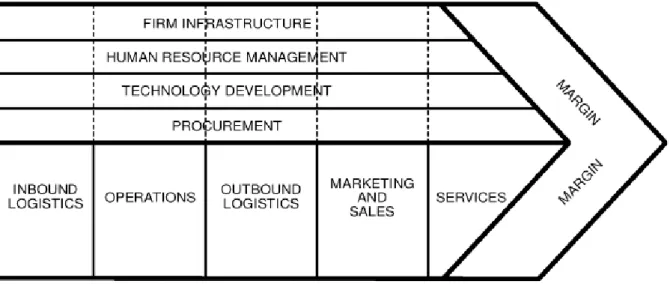
Porter (1985) defends that a company can create value through two type of activities, which are primary and support activities: Primary activities are those involved from the transformation of inputs until the transfer of the product or service to the customer, which includes its marketing and delivery to buyers and its support and servicing after sale; Support activities are those that provide the inputs and infrastructure allowing the primary activities to take place. (Porter & Miller, 1985)
Figure 3 - The Value Chain of a Firm by Porter (1985)
According to Porter (1985) this analysis “provides a way to identify a firm's sources of differentiation, and the fundamental factors that drive it.” For Grant (2016) and Banker, Mashruwala & Tripathy (2014) a company has a differentiation advantage when it is able to obtain, due to its differentiation, a premium price that exceeds the cost of providing the differentiation.
“A firm can differentiate itself by offering high quality and innovative products with superior design or brand image, technology or customer service, a strategy typically implemented by making investments in costly activities such as extensive research, product design, and marketing.” (Banker et all, 2006)
Companies that focus on differentiation, most of the time, offer customized products and services which, in turn, evolve depending on close relationships developed with those customers. These close relationships over time build the image of the firm, a strong tool to
29
sustain a company’s competitive advantage (Banker et all, 2014). Porter & Miller (1985) agree, adding that one key determinant factor of differentiation is the role of a company and its products in the buyer’s value chain.
“Firms focusing on differentiation, in many cases emphasize the level of service and support. While a basic level of service and support may be easy to imitate, increasing these levels beyond the basic level involve substantial amounts of training. Also, this reflects in the attitude of employees toward customers which becomes entrenched in the organization culture and can be hard to duplicate” (Banker et all, 2014). In this sense, a company can work in its differentiation in innovative products and services, but also in the way that presents them and on the relationship that establishes with the customers.
4. The impact of an Economic Crisis in a business
From the beginning of History, the world has faced many economic crises that due to some reason affected the economy of many countries around the world. Pearson & Clair (1998) defined economic crisis as a situation represented by "a low probability, high impact situation that is perceived by critical stakeholders to threaten the viability of the organization". For Grewal & Tansuhaj (2001) the impact of crises may be manifested in the firm's demise, which makes it critical for managers to understand and effectively control the situation. The authors also complement that “crises are characterized by the co-movement of many macroeconomic indicators, including decreases in real output (measured by real Gross Domestic Product [GDP]), high levels of inflation and unemployment, and an unstable currency”.
Different crises can create a different impact on business. For Trasca (2015) an economic crisis can be reflected on the decrease of public consumption, on a slowdown of foreign direct investments, on the foreign trade, by reducing exportation and importation, and on the decrease of purchasing power of the population and national wealth. According to Grewal & Tansuhaj (2001) an economic crisis leads to a decrease of consumers' buying power and changing the basic demand pattern it makes market orientation even more critical, since consumers become more price sensitive. This way, more price sensitive customers lead for a decrease in demand, which reflects on the decline of companies’ profit.
Naudé (2009) states that an economic crisis can affect three channels: banking failures and reductions in domestic lending, reductions in export earnings, and reductions in financial flows to developing countries. However, depending on the size of the company and the industry in which it operates, the consequences can vary.
30
The big challenge is to understand how to survive an economic crisis and be successful at it. “Firms that have the flexibility to respond to new competitive behaviors are at a definite advantage; they can easily redeploy critical resources and use the diversity of strategic options available to them to compete effectively” (Grewal & Tansuhaj, 2001)
5. The role of Internationalization for competitiveness between companies
In a world in constant change, with the progressive opening of global trade, the international expansion has been the answer for companies faced with the growth of competitors and threats. (Dias, 2007) In response to this situation, Pereira, Fernandes and Diz (2009) propose that the internationalization of a company is a fundamental key to improve its competitiveness.
There are many factors that encourage companies to explore international markets. Silva (2012) states that internationalization is considered by many entrepreneurs and economists as the only escape for an economic crisis. However, internationalization cannot be misunderstood with globalization. According to Dias (2007) globalization is the idea that differences between markets in different countries have been disappearing throughout the years and companies must adjust their strategies into a single strategy since it is a single market.
Therefore, many authors define internationalization in different ways. For Meyer (1996) internationalization is the process in which a company adds value to its activities out of its country. Freire (1997) states that internationalization is the extension of company strategy and vertical integration in other countries, having as effect a total replication of the company’s operational chain. Additionally, Silva (2012) proposed that internationalization is the action of a company in different nations, conducting product factor movements such as capital transfer, developing projects in collaboration with foreign partners or simply the commercialization of their products or services in another country.
For Zahra, Ireland & Hitt (2000) internationalization is an essential factor for SME9 which has
as goals to grow sales and profit. However, each company has its own motivation to internationalize its business. Brito & Lorga (1999) in Silva (2012) suggest that a company either internationalize the business due to an action or reaction motivation, although some companies do it for both reasons. As an action motivation the authors consider companies that want to grow and have the opportunity to grow in a new market. As reaction motivation the Brito & Lorga (1999) classify companies that in order to follow the entrance of their clients in an
31
international market, they also drag themselves into that market either. It can also be, companies that due to inherent characteristics of the business are almost required to operate in an international market. Within the action and reaction motivation, companies can be incentived to internationalize by geographic, cultural or linguistic reasons; risk reduction; cost reduction and economies of scale advantages; government support or country’s image advantage.
“Internationalization occurs through two mechanisms: trade and direct investment. Both are the result of the strategic decisions of individual businesses to exploit either market opportunities outside their national boundaries or resources and capabilities located in other countries.” (Grant, 2016)
Pereira et all (2009) stated that internationalization can occur by multiple ways: direct exporting; indirect exporting; through intermediaries or agents; agreements with foreign companies; establishment of factories or trough commercial subsidiaries. However, one of the first factors to have in mind when thinking about to expand the business for another country is to choose the new location. According to Atthirawong & MacCarthy (2000) there are twelve factors that affect the location’s decision: working environment; transportation costs; proximity with customers and market; proximity with resources; geographic situation; the local competitors; the weather; political factors; social factors; economic factors.
Considering that competitiveness is increasingly globalized, an effective connection with the international market is essential for the business economy to grow sustainably (Silva, 2012).
32
IV. Teaching Notes
1. Learning Objectives
This case study provides an opportunity for readers to develop their management capacities when challenged by a situation of crisis.
The main learning objectives of the case are:
• To understand the impact that a quality service has on customers’ loyalty;
• To understand the importance of exhibitions and trade fairs for specific industries; • To develop critical thinking in ways to manage a company after an economic crisis. 2. Class Plan
A) What were the reasons for Multilem’s success until 2008? B) Evaluate the strategy that Multilem has followed.
C) Analyze the structure of the industry in which Multilem operates. D) What do Multilem’s customers value?
E) Evaluate the role of Multilem in its customers’ Value Chain. F) Assess Multilem’s strengths and weaknesses.
G) What are Multilem’s main problems?
H) What are the potential alternatives established by Multilem? I) What would be your recommendations for Multilem’s managers? 3. Analysis
A) What were the reasons for Multilem’s success until 2008?
Multilem was a company that, since the beginning of its business, worked with the aim of corresponding to customer expectations. Multilem worked to exceed customers’ expectations, always presenting new technologies and materials, corresponding or beating the customers’ needs. As mentioned in the Literature Review, when the result of a service exceeds the customer expectation, the customer will feel satisfaction and may become loyal to the company. Loyal customers talk about the services, recommend them to their contacts and probably will come again to order another service. This cycle of satisfaction will generate profit for the company.
33
As a service provider, Multilem focused in two main objectives: providing quality services and developing differentiation, learning with each project in order to always improve from project to project.
Differentiation can be reached by delivering services or products that are difficult to imitate. However, a company can differentiate through all the environment around the service. Multilem differentiates itself by the quality of its stands, but also due to the full environment and confidence it provides to its clients.
Multilem’s success was due to its managers capacity to always react in face of challenges. Firstly, understanding what kind of materials were better and adequate for providing a good service. Changing from modular to personalized stands was a response to the customers’ needs. Multilem was capable to always do different projects and to correspond to every customer’s requirements. Later, when seasonality was an issue, Multilem assessed all employees’ skills, and redirected the company for new sectors, such as events and refurbishments, where its human resources could be developed.
Multilem always was a company focused on the customers and worked to provide the best premium services it could, different from competitors. Throughout the years, Multilem understood that customers had a lot of tasks to do in order to guarantee their performance on fairs and the stands were just a part of it. So, Multilem took the opportunity and started to provide a 360º service, in addition to the stand, providing all the inherent services, such as catering, brand activation, furniture, among others.
B) Evaluate the strategy that Multilem has followed.
Multilem strategy, until the financial crisis, was to assure the loyalty of its customers while acquiring new ones, always within its market niche.
Operations
In the beginning of the 21st century, Multilem understood that it was more efficient to have its
own carpentry and carpenters than to outsource this service. So, in its headquarter in Azambuja was accommodated the carpentry. This way, the stands’ manufacture – labor, machinery and physical space - became a fixed cost for the company. Additionally, the process of construction could be followed by project managers and could be updated or adapted at any time, according to the customer’s needs. The machinery and techniques could also be improved and modernized to react to the market.
34
Multilem understood that delivering the project in advance of the established deadline conveyed peace of mind to the clients. So, the company always finished the projects a day before planned. Also, the stands were pre-built in Azambuja and then assembled on fairs like a puzzle, while competitors had carpenters on site building stands until the last minute.
Over the years and with Multilem’s experience, the company also understood that it was less costly to buy all the ornaments used in stands and events, instead of renting them every time they were needed. This way, Multilem amortized the cost through events and at some point, the items were already paid and were converted into profit for the company.
Design was the only part of the process that sometimes was outsourced, using freelancers or agencies. However, in the moment of presenting projects, Multilem was always up to date with the more recent programs of 3D modeling presentation, in order to provide customers the best experience possible.
Customers
The main focus of Multilem always was the satisfaction of its customers. As mentioned in the Literature Review, satisfied customers lead to loyalty and generate profit for the company. The loyalty of its customers required the quality and unique service that Multilem was so committed to deliver.
Multilem designed a customized service for each client, with the aim of making its customers feel unique and special. From the beginning of the project, until the end of the fairs or event, Multilem works in order to reflect the story of its customer on the final product, which made that all customers felt this personalized service and that they were not a client like all others. Marketing and Communication
Multilem did not had a developed Marketing and Communication department, believing that its work was powerful enough to speak for itself. As mentioned in the Literature Review, fairs activity is a big opportunity to leverage a business, so Multilem believes that its work presented on fairs to other brands that participate at fairs as well, was the most economical strategy that could be implemented.
Instead of investing in people and structures to communicate in social media, Multilem decided to invest in other components of the business, for example in the quality of raw materials, in order to present better finishes and quality services.
35
Price
Multilem’s pricing strategy was not a driver for its competitive advantage. Its prices were high, alongside the level of quality of its services. With this pricing strategy, Multilem not only reflected the value of its work, but it also protected itself from bargaining situations with customers from unusual target groups. Since customers were aware of the level of Multilem’s prices, should they be willing to pay for the service, they would get creativity and quality, both important feature for Multilem’s image. On the other hand, high prices allowed Multilem to generate higher margins while granting for better creativity than competitors.
For those reasons, Multilem was considered as positioned in a top-level market niche. C) Analyze the structure of the industry in which Multilem operates
Multilem was a company operating in three different industries: fairs, events and refurbishments. However, I will analyze the fairs’ industry, since it is Multilem’s core business and specialization.
5 Forces Porter’s Analysis Threats of substitution of services
The threats of services’ substitution can be classified as high. When a company desires to be present on a fair, there are a lot of details that need to be aligned. In this situation, companies have two alternatives, either to hire the services of a company like Multilem, which takes care of every detail without any concern, or to go directly to each supplier and have someone inside the company responsible for managing all of them.
Thus, we can consider as substitute services, designers and design agencies, in charge of the stand’s idea; carpenters who can be responsible for the stand’s manufactory; decoration and furniture stores, where the client can buy the necessary to decorate its stand.
The propensity of buyers to substitute services will depend on their profile, if they are price sensitive and if they are concerned about the quality of their performance on fairs. Big companies that have a lot in hand and want to delegate to be free of any concerns will be less price sensitive and more interested in the final quality. Small companies, with smaller budgets, will be more price sensitive, taking time to search, to bargain and to try to grab better deals.
36
Threats of entry of new competitors
The industry of fairs and exhibitions is a complex market in the way that a lot of components to complete the presence of a company in a fair are needed. In this sense, to be a Multilem competitor one does not need a relevant investment to enter. A person or company can enter the market by outsourcing all elements needed for its services. A design to create the project, a carpenter to manufacture it can be outsourced and all the ornaments for the stand can be bought or rented. The only investment needed is time and contacts to acquire customers. Therefore, if the business gets established it can start to invest in something bigger.
Economies of scale are a barrier to new entries in this sector. Since a new company can have little volume of work, suppliers will not be able to offer as good deals as to other big clients, leaving the new players at a cost disadvantage.
The loyalty of customers in this industry is another barrier to new entries. A presence in fairs is an important moment for the customers, so when they find a company that meets or exceeds their expectation, as mentioned in the Literature Review, customers become loyal to that company and, unless something bad happens, it is difficult to switch to another competitor. Overall, the threats of entry of new competitors in the market is considered as medium. Bargaining Power of Buyers
The customers bargaining power is unquestionable when talking about services. Physical products usually have established prices, but when analyzing services, the same is not true. In terms of price sensitiveness, in this particular industry we can describe two types of customers. The ones who just go to one fair a year and the ones who are present in many fairs during a year.
In the first scenario customers are less price sensitive. They do care about the money they are spending in the service, but because this is the unique moment of the year where they will be in the same place with competitors, presenting its products or services to their target, it is important to be creative, to have an outstanding stand, in order to be in the customers mind and to be reminded every time the customers want that type of product or service. These clients do not mind spending large budgets, although the suppliers need to explain where they are spending that amount and why it is so important to have that material or detail.
37
The second type of customers, because they are present in many fairs per year, need to distribute their budget throughout these events. Thus, these customers are more price sensitive, bargaining with the suppliers, comparing prices and offers in order to do the best deal.
On the other hand, deadlines are extremely important on this industry. Fairs have dates to be met, and if a stand is not ready on time, the customer loses its opportunity. Hence, confidence and loyalty are two key words for customers. They look for companies that meet deadlines and give peace of mind to its clients. Loyal customers are also less price sensitive, although they want to spend well their budget.
Moreover, conscious customers trust Multilem but oversee all the process. To conclude, the bargaining power of Multilem’s customers is medium.
Bargaining Power of Suppliers
Multilem had twenty-two years of experience by 2008. Through all those years, the company had time to learn and shape its strategy according to the circumstances. By that time, most of their operations were inside the company and just a minority were outsourced. Even so, the company still was dependent on some suppliers. Woods, painting, carpets and other components were essential for the manufactory of a stand. This way, in the beginning of each year Multilem negotiated with all suppliers, made large orders to keep supplies for the whole year in order to bargain with suppliers. Multilem was loyal to most of its suppliers in order to grab better deals, but also to maintain proximity and to count on them if something wrong happened and the company needed something urgently.
Regarding outsource services, Multilem always hired freelancers or design agencies, depending on the project. Freelancers usually are in the beginning of their career and have less knowhow, so their prices vary from agencies that have more expertise. In this sense, freelancers had less bargaining power than agencies. However, the market was full of suppliers which did not allow agencies to have a strong bargaining power.
Even so, the market had plenty of suppliers, and it was easy to find another one and look for different prices. In this way, the bargaining power of suppliers was considered as low.
Industry Rivalry
Multilem identified three competitors operating with a similar business model. Certame, Palexpo and Construtora da Ferraria, which became Insycro in 2008 when acquired by Explorer, a private equity firm. In 2008 the three companies were in the same stage of maturity.
38
All companies were responsible for the entire performance of a client in a fair, from the stand itself to its decoration and some dynamic moments that could add value to the client. The four companies competed between them to gain new clients and to not lose them for others, since all of them used similar strategy and prices.
There was a high level of rivalry in the sense that all companies were always aware of what was done, techniques that were used, innovations and creativity. But relative positions between competitors were quite stable.
In summary, the industry of fairs and exhibition had low attractiveness for new competitors. Barriers to enter were not high, but to establish a good relationship with customers and suppliers was not so easy. In this way, companies such as Multilem that already have a strong loyal customer portfolio and a good relationship with suppliers, need to constantly refresh their strategy in order to keep in the business and not to lose that loyalty.
D) What do Multilem’s customers value?
Multilem’s was a company that always worked to attract top clients. Its customers were only the ones with big budgets to spend in great projects. However, no company would spend a lot of money in a project if it did not believe it was worth it.
The feature most valuable for Multilem’s clients was the quality of its finishes. Multilem always worked with quality materials and made the effort to present golden appearances. In addition to delivering an excellent work, Multilem worked to complete its projects a day before the fair’s opening, in order to give confidence and peace of mind to its customers.
Companies with a high volume of work and income do not want to bother with details and multiple suppliers. Thus, Multilem had a 360º offer where customers did not have to think about catering, lounge areas or other details of their performance on fairs. Multilem’s customers value the organization of the company as well. Its stands were all developed inside its workshop and, on the installation’s day, they were assembled as a puzzle on site. This way of working reflected professionalism and confidence for its clients, two main factors for Multilem’s reputation. As mentioned in the Literature Review, quality services will lead to customer satisfaction and consequently, customer loyalty. When experience exceeds consumers’ expectations, they become satisfied customers. Satisfied customers buy again and tell others about their good experiences.