1 A Work Project, presented as part of the requirements for the Award of a Master Degree
in Management from the NOVA - School of Business and Economics.
FL – TOURISM MANAGEMENT
Opening Pousada da Serra da Estrela in Covilhã: A Two-Way Impact –
Studying the Value Chain
INÊS MARCHANA DA SILVA | 1258
A Project carried out on the Management Course, under the supervision of:
Professor Sonia Dahab
2
Index
Abstract ... 3
Introduction ... 3
Literature Review on Value Chain Analysis ... 5
Methodology ... 6
Competition in Serra da Estrela ... 7
Competitive advantages of Pousada da Serra da Estrela ... 9
Attractiveness of the Hotel Industry in Covilhã: The Five Forces Model of Porter... 10
Implementation ... 12
a. Site Development and Construction ... 13
b. Marketing and Sales ... 13
c. Service Monitoring ... 19
e. Human Resources Management ... 20
f. Maintenance ... 24
Conclusion ... 24
3 Abstract
“Opening Pousada da Serra da Estrela in Covilhã: A Two-Way Impact –Studying the Value Chain” aims at analyzing how the hotel’s value chain can be improved with local resources and mutual beneficial relationships in Covilhã. Research on hospitality management and value chain was done and two meetings were held with Grupo Pestana Pousadas and many others local agents. Important relationships need to be established, especially for marketing, procurement, HR and maintenance, through resources sharing. All stakeholders must cooperate to create a better touristic product and make the hotel a region’s point of interest, attracting customers to the destination. Keywords: Covilhã, Hospitality, Value Chain, Cooperation
Introduction
The tourism sector plays a preponderant role on the Portuguese economy. It generates revenues and job opportunities, attracts foreign investment and increases international recognition. At issue is a vast coastline, the country with more sun hours per year in Europe, a rich history, diverse landscapes and tourism offers, welcoming and hospitable people, a healthy and excellent gastronomy appreciated worldwide, safety and a favorable location in terms of accessibilities (by sea and air).
During crisis times, this sector can lead to a leverage effect on the economy. In 2012, it was registered about €40 millions of overnights1. In the first semester of 2013, Portugal registered an increase of 8% of incoming tourists2, illustrating the positive and crescent moment that Portugal is experiencing in the sector. Figures3 also show that, this sector accounted for 5,7% of the GDP (direct contribution) in 2012 and it is expected to grow 0,2% in 2013 and 2% until 2023. Furthermore, tourism directly contributed with 7% to
4 the employment in 2012 and it is expected to grow 0,2% in 2013 and 1,5% until 2023. Thus, the tourism sector seems to present a huge potential in Portugal, namely on stimulating the economy and it should be considered a sector to invest in the future. One of the biggest agents of this industry in Portugal is precisely Grupo Pestana. It was founded in 1972 and its strategy is based on three pillars: horizontal integration, achieved by developing its core business – the hotels, firstly at a national level and later on internationally (present in 15 countries); vertical integration, through the development of other tourism’s subsectors such as golf or casinos; and finally, on the adaptation of the businesses to each region.4 Since 2003, the group is managing Pousadas de Portugal, property of ENATUR (Empresa Nacional do Turismo). Pousadas de Portugal is a group of 37 accommodation units in Portugal, intended to offer to its clients the opportunity of enjoying the variety of traditions in each region5. Pousadas are located in historic relevant places, such as monuments and/or privileged natural spaces and vary between charm, historic, historic design and nature. Once the State is a shareholder of ENATUR, it makes sense that they aim to maintain and restore buildings with historic and cultural relevance. In this context, GPP (Grupo Pestana Pousadas) is constantly investing in remodeling processes of the hotels’ physical structure. Recently, it was developed a project for a new hotel, Pousada da Serra da Estrela, in Covilhã.
Given the importance of tourism in Portugal, the relevance of such a big group in the sector, the brand’s visibility of Pousadas de Portugal and the fact that already exists Pousada de Manteigas, near Covilhã (it may mean that GPP believes in the region’s potential), the following research question arises: How the new Pousada can benefit and take advantage of the potential of Covilhã, in its value chain, through mutual beneficial
5 relationships with local agents? For that, analysis on the industry’s attractiveness and competition and on the new hotel’s competitive advantages will be developed. Consequently, an implementation plan for the value chain will be suggested.
Literature Review on Value Chain Analysis
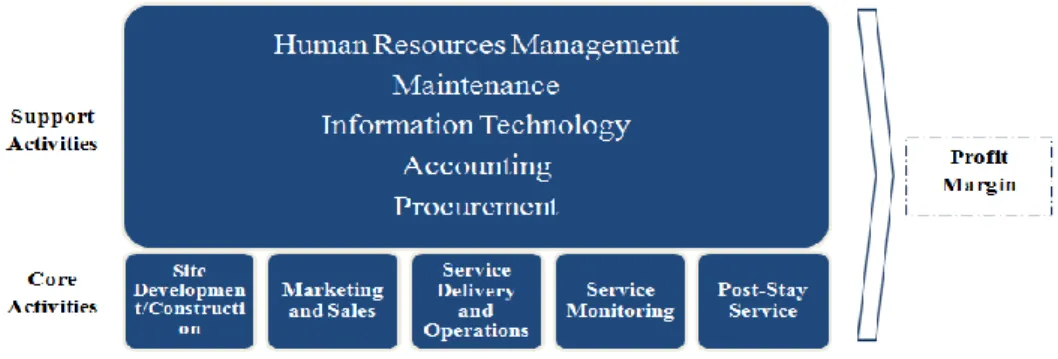
With the aim to compete globally in a dynamic industry as the tourism one, firms need to develop sustainable competitive advantages, indispensable to satisfy customers’ needs and even to create on them new ones. In fact, to deliver superior value to customers, firms need to be able to create a favorable set of benefits capable of overcoming the costs (Walters and Lancaster, 2000). In this context, a value chain is a powerful instrument that can be used to evaluate the core and support activities, which can be sources of competitive advantages (Enz, 2010), due to resources and capabilities on developing such activities in a better or more efficient way than competitors. In particular, a hotel’s value chain is comprised of the following core/primary and support activities (Enz, 2008), presented in Figure 1, which together create and add value:
Figure 1: Hotel’s Value Chain
The hotel’s profit margin will result from how efficiently those activities are performed. Furthermore, it should be noted that not only end customer’s satisfaction should be achieved but also stakeholders’ objectives should be met (Walters and Lancaster, 2000). A coordinated strategic process between the different agents and suppliers is required,
6 involving communication, information sharing, joined control and focus on customer, throughout the whole chain.
Methodology
In order to develop my analysis, first I did research on tourism destination and hospitality management and on the value chain model. After, I gathered data about the Grupo Pestana’s strategy and I had two meetings with people responsible for GPP. However, there were some limitations because the data provided was secondary. Thus, much information was estimated based on data of the industry or on other hotel units of GPP. Consequently, some assumptions were made and some activities could not be so deeply analyzed. I also went to Covilhã to have meetings with some agents (such as Tourism Delegation, private associations, Municipality or museums) and to know the region and the hotel. Finally, I had contacts with some private companies of the sector.
The new hotel unit: Pousada da Serra da Estrela
Pousada da Serra da Estrela is located at 1200 meters of altitude, in the heart of Serra da Estrela, 5 km from Covilhã. It results from the rehabilitation of an old sanatorium, built in the twentieth century that had been abandoned for decades. This investment required about €19,6 millions, 70% funded by Programa Operacional Temático de Valorização do Território and it is expected to create 40 jobs, most with local people6. It will be a four star hotel that integrates a new concept of larger units of GPP since it will have 92 bedrooms (two of them are spa bedrooms), and it offers jacuzzi, gym, interior and exterior swimming pools, games rooms, bar and structures for MICE (Meetings, Incentives, Conferencing, Exhibitions). The access to the building will be
7 made through the back, so that customers can enjoy the space and landscape, without being disturbed by people and cars coming.
Regarding its target market, the hotel targets a middle-up scale clients’ segment, with relatively high purchasing power, Portuguese or foreign tourists, with interest in nature, sport and health tourism. They also target business people and beginners of ski and families with kids looking forward to experience the snow and the ski.
The Region of Covilhã
Location is a crucial aspect of attractiveness and represents a success factor in this industry. Thus, it is imperative to understand why is GPP investing in one more unit near Covilhã. Covilhã, the“Cidade Fábrica”7, is known for its long history on the textile industry (it had a crucial role on its economy), namely on the wool production, and for its fruits and wines. The textile industry has experienced a period of crisis, with factories’ closure, leaving workers unemployed. However, the strategic location near Serra da Estrela, national reference for tourism that attracts a lot of visitors, the typical dynamism of a university town (UBI-University of Beira Interior), the effort that has been made in order to attract investment (e.g. implementation of PT Data Center, with an investment of €90 millions8
) seem to be some interesting ingredients to be explored by GPP. However, regional coordination between agents and deep knowledge about the region are imperatives to guarantee the region’s development and integration’s success. Competition in Serra da Estrela
Turistrela – Hotels & Experiences is a Portuguese group operating in Serra da Estrela9. It has the exclusive right to carry out the tourism activities above 800 meters of Serra da Estrela’s altitude, except the new Pousada. The group owns Serra da Estrela’s Hotel, Carqueijais’ Hotel and the Dharma SPA. Besides that, it is also owner of a mountain
8 village with 63 chalets and of the ski resort. Although they are well established in the region and hold almost a monopoly of the tourism activities and operations in Serra da Estrela, GPP believes that they target a different segment of clients who is not so concerned about quality. In fact, the quality of service and infrastructures cannot be compared. Some other hotels across the city, which do not strategically operate by differentiation, are also not considered direct competition by GPP but instead, indirect competition. The direct competition comes from the following hotel units:
Casa das Penhas Douradas, Design Hotel and Spa10 is a charm hotel of tourism of nature in Serra da Estrela. It is in line with the concept of Parque Natural da Serra da Estrela because it is inspired in the local architectural style and uses local material resources (cork and birch wood). Regarding its offers, there is a spa available with swimming pool, sauna and massages. It also offers a multimedia meeting room for the MICE segment. Finally, it was created the project Penhas Douradas Food and Factory, in order to revitalize the local resources and two brands were created: PDF (gourmet food) and BUREL (textile area), currently with a store in Chiado.
H2otel11 belongs to the IMB Group, which owns several hotels, with a strong focus on health tourism once they have the concession of the Termas de Unhais da Serra. H2otel, located in Unhais da Serra, offers 90 rooms, gym, library, outdoor activities integrated with spa activities (access to the Aquadome SPA) and hairdresser, restaurant, meeting rooms, games rooms and a gourmet store Espaço H2O.
Indeed, in these type of hotels, clients look for more than standard services. Service quality, diversification, familiar and a comfortable environment, in harmony with the environment, are quite appreciated.
9 Competitive advantages of Pousada da Serra da Estrela
In order to establish a competitive advantage over the competition, unique resources or capabilities, which help to create unforgettable experiences, should be identified. Particularly, Pousada da Serra da Estrela results from an architectural project of a recovered sanatorium, the first in the region of the Pritzker Prize winner (international architectural award), architect Souto Moura12. Thus, the building is a physical resource in a privileged location, with a unique architectural value and interest in the region. Such is the importance for the locals that the architect strived to maintain the identity of the former sanatorium in terms of structure and decoration.
Moreover, the hotel is under the well-known brand Pousadas de Portugal and “brands are viewed as a key value-creating resource, because they are firm specific and difficult to imitate” (Enz, 2010). In fact, GPP believes that the brand is appealing and capable of attracting tourists. They also believe that another competitive advantage is their superior value and quality service. But how is this measurable? Is it inimitable?
In fact, in order to guarantee a sustainable competitive advantage, the VRIO model proposes four questions that should be positively answered (Rothaermel, 2013): Firstly, the resource needs to be valuable, which is true for the two resources and capability mentioned above. A building with strong architectural and historical values, recovered by a project of a prestigious architect, a well-known brand and a superior quality service are valued in the hotel industry. Secondly, both the building and the brand are unique. However, the superior quality service delivered is not unique, since direct competitors are known for its quality. Therefore, the quality service is not a sustainable competitive advantage but just a competitive parity. Thirdly, the building and the brand are inimitable because the brand has its own identity and the building has its unique value.
10 Finally, the firm has the necessary structure and it is organized in order to benefit from its brand because it already has a good reputation, and management control systems, internal policies and culture associated are already defined. Regarding the building, all the details are being taken into account and efforts have been made to stay faithful to the original building (architect, structure) with the aim to take advantage of this resource. Thus, these two resources can be considered sustainable competitive advantages.
Attractiveness of the Hotel Industry in Covilhã: The Five Forces Model of Porter By analyzing the factors affecting the industry’s profitability as well as the power of some stakeholders, a firm is able to better position itself on the market (Enz, 2010). In this context, it was conducted an analysis of the hotel industry in Covilhã. According to Porter (1980), the attractiveness of an industry is defined by five dimensions:
Bargaining power of buyers: Although travel agencies (for foreign tourists) represent a part of the clients, through the use of internet the major buyers are individuals (direct sales), which means that a possible loss of this type of customer would not have such a big impact. Regarding switching costs, they can be relevant depending on the period of the year. During high season, they may be not able to find alternative hotels of the same type. Additionally, buyers cannot easily integrate backward and supply themselves. However, due to the different types of substitutes, buyers have power to choose between alternatives.Thus, it can be concluded that the power of buyers is low.
Power of suppliers: Several suppliers can be enumerated in this industry such as food and beverage area, human resources training companies, furnishing companies, IT manufacturers, marketing companies, among others. In fact, the relative power of each one individually is not high and hotels have the possibility of choosing the best offers according to their needs (price, quality, etc). Regarding labour force, hotels can also
11 have their own training system, which give less power to suppliers. Besides that, suppliers cannot usually easily integrate forward, so they cannot compete with their clients. However, suppliers usually do not depend on a single customer which gives them some power (even though hotels can be important clients). In addition, switch some suppliers, such as IT services and trained labor force may be costly because of the investment. Thus, the suppliers’ power in the hotel industry is medium/low.
Rivalry among existing firms: There are many hotels in Covilhã, but above the 800 meters of altitude of Serra da Estrela, Turistrela has a “monopoly” of the touristic activities. Thus, this group has a dominant position compared to other hotels. Moreover, the fixed costs in the industry are very high because they are associated to large hotel properties and huge investments, which requires higher level of sales to cover the costs and it results in pressures on prices and margins. Additionally, high exit barriers because of high fixed costs discourage firms to exit the industry. Therefore, it is clear the intense competition and rivalry between hotels in Covilhã.
Threat of Substitutes: If we look to the industry in Covilhã in general, hotels can be substituted by houses for rent, camping, friends’ house, caravan and manor houses. The switching costs for a low segment of moving from camping to a hotel for instance, can be high but, for middle-up segment may be not so high. Additionally, if we analyze more specifically the different hotels’ types, there are simple and common hotels near Covilhã’s center and there are also, closer to Serra da Estrela, few hotels more oriented to the nature, health and spa tourism that can substitute each other, though not being direct substitutes. Overall the threat of substitutes in Covilhã can be considered high.
12 Threat of New Entrants: To enter this industry huge investments are required and new entrants may face the competition from hotels of big chains (Meliá, Grupo IMB, Turistrela) that benefit from economies of scale, have access to distribution channels and benefit from a learning curve. In addition, hotels as H2otel or Casa das Penhas Douradas, contrast with the others through their strategy of differentiation, making difficult to enter and compete with them. However, new entrants may benefit from governmental support in terms of community funds in order to encourage the investment and development of the region. Overall the threat of new entrants in the Covilhã’s hotel industry is low.
It can be concluded that the attractiveness of the hotel industry in Covilhã is medium, since especially the threat of substitutes and the intense rivalry pose several challenges. However, a sixth force should be analyzed, complementary products/services. In this industry, they can be represented by services of touristic animation companies, museums, ski resorts, travel agencies, airlines or restaurants. In Covilhã, touristic entertainment companies are decreasing, high quality restaurants are almost inexistent and so far, GPP does not have cooperation relationships with local agents and with the owner of the ski resort. It can be inferred that GPP will have to define who and where they want to be in the region. For that, it is crucial the establishment of key relationships and a customer centric approach in order to better serve customers, to differentiate from competitors and to face the adversities of the industry.
Implementation
Taking into account the hotel’s strategy and local resources’ availability, suggestions for the hotel’s value chain will be provided. Although it cannot be compared to the
13 value chain of the majority of the GPP’s hotels in some aspects (due to the dimension), the suggestions should benefit not only the new hotel but, the whole group. Whenever possible, resources (human resources, supplier contracts, marketing activities) should be shared. The corporate image and some practices are part of the brand’s essence and must be respected in order to maintain a consistent image.
a. Site Development and Construction
As already mentioned, the building was carefully remodeled and decorated to remain faithful to the original. Although not constituting a source of differentiation, it would be interesting to provide a library to guests. This hotel targets a middle-up segment of clients, who are usually interested in diverse areas like culture or even history. Others are also interested in relaxing away from the hustle, to appreciate the amazing view, and a book, about the region or building for instance, could be a good friend.
b. Marketing and Sales
As one of the core activities, it is responsible for customer and brand management, market research, promotion and sales. Regarding promotion, the strategy to attract customers and to increase international recognition is the Storytelling. It aims to satisfy customers through the history/essence of the product or brand13. The concept is about knowing how to tell a history to the right target by understanding its needs, knowing the history of the brand and creating experiences to satisfy them.
Because GPP considers online promotion faster and cheaper, the agency Performance Sales is responsible for the promotion of Pousadas de Portugal through digital means. The campaigns target not only Portuguese tourists but also from UK, Germany, Netherlands, France and Russia. The company uses online advertising tools (e.g.
14 Google AdWords) and try to have strong presence on desktop, smartphones and tablets (with banners, e-mails and text-based ads). According to this company, the idea is not to promote Pousadas just as luxury hotel’s rooms, but as unforgettable experiences. Thus, references about the importance of such an emblematic building for locals, with a recognized architect, in an excellent location and the guarantee of a service of quality should be highlighted. Besides, GPP should promote itself as an entity that cares about the local community and that will exert efforts to contribute to the region by establishing cooperation relationships and increasing the employment in the region.
In terms of product development, the question of what are the client’s expectations is raised. Since they expect unforgettable experiences throughout the year, some packages could be created. This involves other products and services that complement the guests’ stay. Indeed, companies will only be able to attract and satisfy customers by promising a worthwhile destination, involving private and public agents (Grängsjö,2003), in order to offer an attractive service. The key issue is the capacity of each agent to recognize the dependency between them to deliver an interesting touristic product. Thus, GPP should exert efforts to establish partnerships with companies of touristic animation such as IZIFUN, Animactiva14 and Adriventura15 that organize activities in the region (paintball, pedestrian trail, mountaineering, gastronomic among others), local museums and companies such as Europcar and Avis that assure the transport of guests, to guarantee the success of the packages. To promote and sell the packages, partnerships should be defined with travel agencies, such as Abreu and TUI Viagens, that establish a link between suppliers and customers. Some packages (including transport, breakfast and local products tasting) based on offers that Abreu promotes16, to diversify the offer and to combat the seasonality, are presented:
15 Romantic Weekend in Serra da Estrela - One night for two in a spa room, with hydro massage tub and jacuzzi; Access to the gym, indoor and outdoor pools, bar and games room; Champagne bottle and a romantic dinner served in the hotel room.
Family in Serra a Estrela - Two nights for two in a double room; Dinner in the hotel’s restaurant; Access to the gym, indoor and outdoor pools, bar and games room; Three activities of the following: paintball, BTT ride -Parque Natural da Serra da Estrela, treasure hunt, target shooting, canoeing, rappel or mountaineering.
Gastronomy and Wines in Serra da Estrela - Two nights in a double room; Dinner with typical food in the Pousada’s restaurant; Visit to the Queijo’s Museum and wine tasting activities or visit to Quinta dos Termos’ vineyards; Access to the gym, indoor and outdoor pools, bar and games room.
Cultural Weekend in Serra da Estrela - Two nights in a double room; Dinner at the Pousada’s Restaurant; Visit to the historical center of Covilhã and a museum route by: Museu do Queijo, Arte Sacra, Arte e Cultura and Lanifícios.
Route for Pousadas in Covilhã, Guarda and Viseu - One night for two in each or in the chosen of the following: Pousada de Viseu, Pousada de Manteigas, Pousada de Belmonte, Pousada de Vila Pouca da Beira and the new hotel, with discount;
It should be noted that some of those packages could also be promoted to associations and clubs related to hiking, mountaineering, bicycling, ski lovers, wines or culture.
Moreover, to enrich the offer during in the low season, there is the option to become a Bikotel. A bike friendly hotel is a “lodging that offers specific amenities to answer the needs of those who consider cycling the best thing in life (road or mountain biking)”17
. To be a member of the network, the hotel needs to follow some practices and have infrastructures such as bike parking and garage.
16 Additionally, the tourism activity in the region is well known by its winter tourism because of the snow. Therefore, this is an important part of the hotel’s touristic product. However, as already mentioned, the ski resort is owned by Turistrela and if we look to the major alliances agreements, half of them are between rival companies (Enz, 2010). In this sense, co-opetition is considered for competitors the relationship with more advantages (Grängsjö, 2003). This type of relationship assumes relations of competition and cooperation simultaneously, where the interactions established benefit both companies. Thus, GPP could establish a partnership with Turistrela for the use of the ski resort and the competition side would stay naturally on the hospitality business. GPP would promote and include programs of the ski resort in its packages and attract customers to the ski resort. At the same time, the new hotel would be able to make its product more attractive, providing to its customers an easier way to access the ski resort. If they would buy large quantities of “tickets” from Turistrela, maybe they could benefit from a discount. Assuming that a partnership will be established and once an important part of the target are beginners of ski and families with kids looking forward to have an experience in the snow, it is essential to create a package on that: Snow Experience in Serra da Estrela – Two nights for two (double room); Material and initiation course, with transport; Access to the gym, pools, games room and bar.
Finally, the cooperation with the different agents mentioned should be extended to the promotion activities of the region, because it will affect the destination. For that, cooperation with UBI and Turismo do Centro are also necessary. The initiative should also come from GPP once they are a new agent in the region. As a matter of fact, some studies have shown positive influence to tourism destinations when several agents are involved in the development and marketing of the product (Grängsjö, 2003).
17 To determine the price per room, several factors should be taken into account such as the identification of fixed and variable costs of a room (the access was not possible). Initially, the concern would be to increase the occupancy rate. After paying some of the fixed costs, it would not be so risky to increase prices to increase the revenue per room. Another factor is GPP’s pricing strategy, that could be similar to hotels as Pousada do Porto and Pousada de Faro. The first one because, even though it does not suffer from seasonality (its attractions do not depend on the period of the year), offers the same type of service and it has 87 rooms (similar dimensions), and the second one because it has the same typology and suffers from seasonality. Table 1 presents the prices, for a double standard room for a Saturday (for comparison objectives it is the most appropriate day):
1 Nov-27 Dec 2013, 1 Jan-31 Mar 2014 1-16 Apr 2014 20 Apr-31 Jul 2014 15 Sep-31 Oct 2014 28-31 Dec 2013 17-19 Apr 2014 1 Aug-14 Sep 2014 Pousada de Faro 150€ 150€ 215€ Pousada do Porto 150€ 200€ 215€ Source: http://www.pousadasofportugal.com/?gclid=CLT53cH2kbsCFdOWtAoddHwAng Table 1 - Prices of other Pousadas of GPP
However, not only the behavior of the prices of these hotels are important, but also answer the question of how much are clients willing to pay for the hotel’s location and offers, taking into account the competition’s offers and prices. The prices of a double room, for a Saturday, charged by the competition are presented in Tables 2 and 3:
New Year, Carnival, Easter
and Christmas Rest of the year
Casa das Penhas Douradas 135 – 155€ 125 – 145€
Source: http://www.casadaspenhasdouradas.pt/precario.aspx?pid=10&cid=32 Table 2 - Prices charged by Casa das Penhas Douradas
December January February Rest of the year
H2otel 200-220€ 220€ 200-210€ 170€
Source: https://reservasonline.imb-hotels.com/domhotel/default.aspx Table 3 - Prices charged by H2otel
18 The prices of H2otel are the highest ones, which can be explained by the Aqualudic. It is a SPA structure, which the access is included in any guest’s stay. It comprises indoor and outdoor pools, gym, jacuzzi, sauna, sauna with cromotherapy, Hamman baths, Turkish bath and hydromassage. However, the new Pousada does not offer a spa for all clients, only indoor and outdoor pools, gym and/or the possibility of booking one of the two spa rooms with some of the other possibilities. Therefore, this should reflect a difference in the prices charged around 10-15%. Regarding Casa das Penhas Douradas, the stay includes sauna and hydromassage, library’s access, bicycles, material for the snow, buffet with tee and local fruit and wine tasting. Both offer different thematic packages. Concerning the new hotel, it offers bar, games room, indoor and outdoor pools and gym. Additionally, as suggested, if the new Pousada would offer local products (fruit, wines and cheeses) to guests, create a library and become a Bikotel, as suggested, and knowing that the new hotel is closer to the ski resort (an important attraction in the Winter) than competitors and benefits from the well known brand Pousadas de Portugal, the price interval could be between the competition’ prices. Taking all of this into consideration, assuming that the price during low season will be less 15% than the price charged by H2otel, the price during the low season could be around 145€ (=170*0,85%). However, by analyzing the prices of Pousadas do Porto and Faro in Table 1, and assuming that the 150€ charged in the low season are the basic price for those hotels that at least covers the costs, the price for the new hotel should increase from 145€ to 150€ at least (because of the dimensions), in order to cover the costs. Regarding the high season, the difference in prices between seasons that Casa das Penhas Douradas charges is 10€. However, GPP’s strategy for this hotel is to set higher prices during the high season to benefit from higher occupancy rates and to compensate
19 lower values during low season. From Table 1, it is possible to understand that, in some cases, GPP increases the prices of other units around 30 - 40% from the low to the high season. Even not assuming such high values in the beginning, and to charge prices not so close to the prices of H2otel, an increase of 20% will be the strategy assumed. Thus, the price interval (double standard room for a Saturday) could be the following:
Rest of the year December, January, and February
Pousada Serra da Estrela 150 150*1,2= 180€
Table 4 - Possible price interval for the new Pousada
c. Service Monitoring
“A recent study of 130 service companies found that the linking of quality management practices to strategic planning was the best predictor of increased productivity and competitive advantage (Terziovski and Dean 1998)” (Worsfold, 1999). In industries of services, quality plays a preponderant role since there is constant direct contact with clients. In fact, the perception of the service’s quality may dictate the stay’s success and consequently, the hotel’s overall performance. Thus, quality management should be involved in all areas of the value chain. According to Parasuraman et al. (1988), the service quality is determined by five factors: tangibles, service reliability, responsiveness, assurance and empathy. (Briggs, Sutherland, and Drummond, 2007) In fact, physical evidence, in terms of equipments, the use of local products in the decoration and staff may reflect the quality of the hotel. The hotel’s decoration was carefully chosen and employees have the same work clothes in all GPP’s hotels, showing uniformity. Then, the promoted service should be guaranteed. Finally, human resources are crucial because they should be ready to serve or help in any situation and have the required knowledge and delicateness to serve (Foster, 2010
)
. They also should show empathy and provide personalized service whenever possible. In fact,20 performance indicators should be established for each process, such as number of customers lost, no. of repeated customers, delays in the supply and delivery processes, no. of nonconformities at the reception (Popescu and Dascălu, 2011), waiting times or turnover rate. The aim is to identify deviations and apply corrective measures to increase performance and added value.
d. Post-Stay Service
The post-stay service affects the customer’s perception because a continuous contact with the client, where CRM is based, will show that they care about customers and exert efforts to keep them. In this sense, and to encourage customers to come back, the existing promotions regarding the GPP hotel units, should be highlighted and communicated to clients according their preferences (based on their previous choices), via e-mail for instance. Furthermore, asking for feedback to clients is crucial to understand satisfaction levels and prevent future errors/failures. In this context, the group hired an American company responsible for the treatment of satisfaction surveys. GPP monitors the data on a monthly basis, reviews internal practices and improves the service, to keep and acquire clients. Although not using local resources, this strategy should be extended to the new hotel.
e. Human Resources Management
HRM constitutes an essential support activity of hotels and it should be aligned with the business strategy. An imperative need of GPP is to attract and hire employees with the right competencies and to train them according their culture, once the employees’ behaviors will influence the link customer-hotel. HRM practices help to build employees’ well being and commitment towards the organization, which may lead them
21 to provide a better service. This will ultimately result in a better performance if customers percept that and appreciate it. (Worsfold, 1999)
Knowing that the group owns luxury hotels such as Pestana Palace and Pousada de Cascais, they could transfer knowledge on recruiting/training processes to apply to the new hotel, which will target a middle-up segment. By having employees from others Pousadas (at least initially), who know the culture, it would be possible to teach new employees according to the brand’s philosophy. Hiring someone from the region with proper qualifications could be interesting because of the identification with the region and its history and the transmission of that to the clients. Consequently, the guests’ experience could become more unique. In this sense, near Covilhã there are schools of tourism, where GPP can hire employees. Additionally, similar to a practice of Ritz-Carlton Hotels (Sucher and Mcmanus, 2005), known for its human resources practices, it could be implemented a system that allow each employee to help to solve a guest problem and to report problems or errors observed. They would be trained and encouraged to solve and describe the problem, possible sources, how did they solve it and provide recommendations on how address the problem. Then, those reports would be analyzed and discussed between teams. This will give employees empowerment, which makes their work more meaningful and enrich it, and show that they are part of the project. This may result in positive feelings towards the group, such as commitment and trust, which will be reflected in the service provided to the guests.
f)
ProcurementSupply chain management is responsible for managing the relationships between suppliers, important stakeholders. Its effective management may facilitate competitive advantages if successful relationships are established. To encourage cooperation,
22 companies should establish contracts that benefit both parties, reflecting that both are walking in the same direction. In fact, partnerships involve constant information sharing and communication between firms, joined effort on quality control, coordination and risk sharing (Enz, 2010). Furthermore, when delivering high quality services, suppliers’ evaluation is crucial, to guarantee that products/services are delivered on time, budget and according quality criteria defined.
Once there are no relationships established with the local community and the majority of economic agents of Covilhã so far, GPP should take a proactive role on the region’s development. This also benefits the brand because it may be good for the image and may encourage positive word-of-mouth. In this sense, the investment of the group in partnerships with local producers of economic activities such as wool industry, fruits (apples, peaches and cherries) or wines (all of them with a long tradition), to buy their products to use and/or offer them in the hotel, may have several benefits to the region: increase the employment, result in higher production capacity for producers and strengthen the region’s economic base. The hotel would also benefit because it would be well accepted by the local community, an important stakeholder. Besides that, it should be noted that GPP is a big group and it follows a strategy of general procurement for the whole group. Consequently, it has some bargaining power to negotiate with its suppliers and find the best offers. Therefore, GPP will only benefit from those relationships with competitive products in terms of price and quality for the whole chain. Only in this way they will be willing to change to suppliers of the region. Besides that, one important decision factor for GPP could be if those producers and suppliers would be able to supply personalized and exclusive products for GPP (with the logo for instance), that could be designed between both parties, and that would give
23 the hotels’ identity to the products. In fact, it only makes sense to find suppliers to the whole chain of GPP because of the synergies, “activities that create synergy include combining similar processes, coordinating business units that share common resources” (Enz, 2010). Knowing that for that strategic fit between the different hotel units is required, it allows GPP to combine activities and reduce procurement costs, to benefit from quantity discounts and consequently, increase the profit margin.
More specifically, GPP could be supplied by companies such as: Burel’s Atlier - Cool Natura or ECOLÃ. Cool Natura18 is a well-known brand in Covilhã, of the designer Miguel Gigante. They produce clothing, accessories and home decoration articles with Burel, a traditional wool material. For decoration they offer “wall sculptures, carpets, blankets, pillows, ottomans19”. ECOLÃ 20, a familiar craft company located in Manteigas, uses the wool as raw material for products like blankets, clothes, carpets, bedspreads, curtains, bathrobes, slippers, towels and pillows.
Finally, regarding the restaurant, there is evidence that several hotels make outsourcing of the restaurant because if something goes wrong the subcontractor will bear the risk and responsibility (Lamminmaki, 2005). Indeed, it may reduce costs and help to focus on its core business. However, it also means that there is a loss of control over the quality of the restaurant. Once GPP has a big concern for adapting the business to each region, namely with gastronomy, the restaurant can be faced as a bridge for that. In fact, there are no high quality restaurants in Covilhã that are not part of other hotels, and this should be an opportunity for GPP to show the local gastronomy to its guests with the quality that meets guests’ expectations. Thus, it seems that exploring the restaurant by themselves, instead of make outsourcing, is the best choice for now.
24 f. Maintenance
This activity is related to housekeeping, gardening and maintenance. It is part of the group’s strategy, for all units, to outsource these services, once it is not its core business. Therefore, local companies, such as Darkcode, Lda21or Fibravaclean, Lda22, could be hired to develop those tasks in order to increase employment in the region and to decrease costs of production for the hotel.
Conclusion
The tourism industry has been growing in Portugal. However, particularly in Covilhã, the hotel industry has become very competitive, which poses several changes to GPP. Knowing that location is a success factor, the question of “How the new Pousada can benefit and take advantage of the potential of Covilhã, in its value chain, through mutual beneficial relationships with the local agents?” needed to be answered.
Throughout the project it was clear that the new hotel presents factors essential to its positioning and success and needs to develop others. The location was not randomly chosen, though the region somehow lacks regional coordination. The physical space is in harmony with the environment and the architecture/design try to remain faithful to the original. This can be improved through the use of wool products of local producers in the decoration. Additionally, unique experiences should be created, which involves all stages of the value chain. Knowing that so far there are no relationships with the local agents and community, this gap needs to be filled in order to offer better services and to facilitate the integration in the region. This requires a proactive approach of GPP and deep knowledge on the region. It allows them to take advantage of the local resources’ potential such as people, raw-materials, knowledge or relationships on areas such as HR and procurement for the whole chain of hotels and marketing or
25 maintenance. Marketing plays here a preponderant role once the product development, in cooperation with tourism operators, touristic animation companies and the owner of the ski resort, will help to create attractive products and face the competition. It would be also interesting to analyze municipalities as Belmonte, Fundão or Manteigas that complement Covilhã and together improve the region’s offer in terms of suppliers, gastronomy and attractions. Promotion is also essential because those services must be part of a storytelling communicated to the right target and because of the cooperation activities with local agents, such as UBI or Turismo do Centro, to promote the region, in order to attract customers. This facilitates the establishment of relationships with the local community, strengthened through unique relationships with suppliers and employment increase. Thus, promotion can become a competitive advantage.
Furthermore, regarding human resources, essential to provide a more personalized service and to create a familiar environment, among other strategies is the suggestion that some local people with qualifications could be part of the guests experience. After GPP’s training programs, they could share with guests its passion for the region and to show the best of what the region has to give, which would add value to the guests’ stay. Although some limitations in terms of information’s access, it seems clear that both the new hotel and Covilhã can benefit from each other, if GPP exert efforts to unify and satisfy the different stakeholders involved. In fact, all of them will benefit from a better tourism destination management. The aim is that the new Pousada become a point of interest of the region, a reason to go to Covilhã, with historical value, to relax, to do business or sports or to simply enjoy, attracting customers for the destination.
26 References
- Websites and Databases
1 Turismo de Portugal. 2013. http://www.turismodeportugal.pt/PORTUGU%C3%8AS/PROTURISMO/Pages/ProTur ismo.aspx 2 Expresso.2013. http://expresso.sapo.pt/bruxelas-destaca-importancia-do-turismo-para-paises-como-portugal=f832648 3
World Travel and Tourism Council.2013.
http://www.wttc.org/site_media/uploads/downloads/portugal2013_2.pdf 4
Pestana.2013. http://www.pestana.com/pt/institucional/pages/grupo.aspx 5
Pousadas de Portugal.2013. http://www.pousadas.pt/historic-hotels-portugal/pt/corporate/pages/welcome.aspx
6
LocalVisão Tv.2013. http://videos.sapo.pt/Zj06SNt3weLwmH9zqAJ3 7
Gabinete de Organização e Porjectos.2013. http://www.gop.pt/projecto-detalhe.php?projecto=374&catProj=9&ordem=1
8
Sapo Notícias.2013. http://noticias.sapo.pt/tec_ciencia/artigo/data-center-da-pt-na-covilha-gar_5704.html
9
Turistrela.2013.https://www.turistrela.pt/en/ 10
Casa das Penhas Douradas.2013. http://www.casadaspenhasdouradas.pt/ 11
H2otel.2013.http://www.h2otel.com.pt/ 12
Pritzker Architecture Prize.2011. http://www.pritzkerprize.com/laureates/2011 13
Administradores.com.2008.
http://www.administradores.com.br/noticias/administracao-e-negocios/storytelling- novo-conceito-de-marketing-busca-encantar-o-consumidor-pela-historia-da-marca-ou-do-produto/14661/
27 14
Animactiva.2013. http://animactiva.pt/ 15
Turismo da Serra da Estrela.2013.
http://www.turismoserradaestrela.pt/index.php/pt/animacao?start=8 16 Abreu.2013. http://www.abreu.pt/Resultados_Pesquisa-389.aspx 17 Bikotel.2013. http://www.bikotels.com/ 18
Portugal Confidential.2013. http://portugalconfidential.com/2013/04/miguel-gigante-atelier-de-burel-in-covilha/
19
Portugal Confidential.2013. http://portugalconfidential.com/2013/04/miguel-gigante-atelier-de-burel-in-covilha/ 20 Ecolã.2013. http://www.ecolaportugal.com/ 21 Directório de Empresas.2013. http://www.infoempresas.com.pt/N812_ACTIVIDADES-LIMPEZA/Concelho_COVILHA.html 22 Páginas Amarelas.2013.http://www.pai.pt/limpeza-conservacao/covilha/ - Articles and Case Studies
Briggs, S., J. Sutherland and S. Drummond. 2007. "Are hotels serving quality? An exploratory study of service quality in the Scottish hotel sector." Tourism Management, 28(4), 1006–1019.
Grängsjö, Y. V. F. 2003." Destination networking: Co-opetition in peripheral
surroundings." International Journal of Physical Distribution & Logistics Management, 33(5), 427–448.
Lamminmaki, D. 2005. "Why do hotels outsource? An investigation using asset specificity." International Journal of Contemporary Hospitality Management, 17(6), 516–528.
Popescu, M. and A. Dascălu. 2011. “Value chain analysis in quality management context.” Bulletin of the Transilvania University of Brasov, 4(2).
Sucher, S. and S. Mcmanus. 2005. The Ritz-Carlton Hotel Company. HBS No. 9-601-163. Boston, MA: Harvard Business School.
28 Walters, D. and G. Lancaster. 2000. "Implementing value strategy through the value chain". Management Decision 38(3): 160–178.
Worsfold, P. 1999. "HRM, performance, commitment and service quality in the hotel industry." International Journal of Contemporary Hospitality Management, 11(7), 340– 348.
- Books
Enz, C. 2010. Hospitality Strategic Management: Concepts and Cases. 2nd Edition. New Jersey: Wiley.
Foster, S. Thomas. 2010. Managing Quality – Integrating The Supply Chain. 4th Edition. Pearson
Rothaermel, F. 2013. Strategic Management – Concepts. International edition. McGraw-Hill.