INSTITUTO POLITÉCNICO DE LISBOA
Instituto Superior de Engenharia de Lisboa
Escola Superior de Tecnologia da Saúde de Lisboa
Bioburden in Aquafeeds designed for Echinoderms
production in Portugal
LILIANA SOFIA FERREIRA ESTEVES
Licenciada em Biologia Marinha e Biotecnologia
Trabalho Final de Mestrado para obtenção do grau de Mestre em Análise e Controlo de Riscos Ambientais para a Saúde
Orientadores:
Doutora Carla Sofia Costa Viegas
Doutora Ana Margarida Paulino Violante Pombo
Júri:
Presidente: Doutor Nelson Alberto Frade Da Silva Vogais:
Doutora Liliana Aranha Caetano Doutora Carla Sofia Costa Viegas
INSTITUTO POLITÉCNICO DE LISBOA
Instituto Superior de Engenharia de Lisboa
Escola Superior de Tecnologia da Saúde de Lisboa
Bioburden in Aquafeeds designed for Echinoderms
production in Portugal
LILIANA SOFIA FERREIRA ESTEVES
Licenciada em Biologia Marinha e Biotecnologia
Trabalho Final de Mestrado para obtenção do grau de Mestre em Análise e Controlo de Riscos Ambientais para a Saúde
Orientadores:
Doutora Carla Sofia Costa Viegas
Doutora Ana Margarida Paulino Violante Pombo
Júri:
Presidente: Doutor Nelson Alberto Frade Da Silva Vogais:
Doutora Liliana Aranha Caetano Doutora Carla Sofia Costa Viegas
A
CKNOWLEDGEMENTS
The author is grateful to the Instituto Politécnico de Lisboa (IPL), in Lisbon, Portugal, for funding the Project “Bioburden and mycotoxigenic burden from feed
applied in aquaculture – Risk assessment and control – AquaInvest”
(IPL/2018/AquaInvest_ESTeSL); to the MARE – Marine and Environmental Sciences Centre of the Instituto Politécnico de Leiria (MARE-IPLeiria), in Peniche, Portugal, which provide the samples; to the Health and Technology Research Centre (H&TRC), Lisbon, Portugal, which carried out the culture-based methods and the molecular methods; and also to the Department of Physiology and Toxicology of the Kazimierz Wielki University, in Bydgoszcz, Poland, which carried out the mycotoxin analysis.
In addition, the author would like to thank each person who contributed, in a more personal way, to the development of this study. Thus, I would like to thank to my advisor Carla Viegas, for having embraced this work with me, for believing in me, and for her excellent guidance. I also would like to thank to my co-advisor Ana Pombo, who was a precious and special support for me, who gave me an extra confidence and guided me in an exemplary way. Thanks to the teacher Marina Silva, who always helped me and without her this thesis would not exist. Thanks to the teacher Susana Viegas, who was always also very motivational and optimistic with me. Thanks to my dearest friend Francisco, who has always been my greatest inspiration. And, finally, an especial thanks to my family, for all support, motivation, patience, and for always believing in me.
A
BSTRACT
The aquafeeds can be a route of contamination for animals produced in aquaculture and, consequently, for humans. For this reason, it is imperative to identify the bioburden present in aquafeeds, in order to know the threat that may represent for human health. Extruded and jellified pellets and frozen microalgae were specifically designed for the potential production, in Recirculating Aquaculture Systems, of two species of echinoderms, the sea cucumber Holothuria tubulosa and the sea urchin
Paracentrotus lividus. Thus, diet samples were collected to characterise their bioburden.
Furthermore, water samples and sponge filter samples were also collected to identify their proliferation to water and the efficiency of filtration process used, respectively. All samples were collected 90 days after the start of the experiment. Culture-based methods were used for the characterisation of bioburden, in which mesophilic bacteria and total coliforms were enumerating for bacterial evaluation, while filamentous and xerophilic fungi were counting and identifying through micro and macroscopic characteristics for fungal assessment. Aspergillus sections were investigated through molecular method Real-Time Polymerase Chain Reaction. Mycotoxin analysis was carried out utilising Liquid Chromatography-Mass Spectrometry system. For mesophilic bacteria, the results reveal some spoilage activity. The results for total coliforms were actually minimal.
Fusarium verticillioides was identified in one jellified pellet and in one frozen
microalgae and F. culmorum was identified in the same frozen microalgae. Aspergillus sections were not detected in any sample. Mycotoxins were detected in the extruded pellets and in one jellified pellet, but the quantification only was possible in the extruded pellets. However, the most part of the findings of this study were below to the limits defined as harmless. So the diets used in the production systems evaluated seem to be safe to be used for feeding the studied echinoderms.
Keywords: Recirculating Aquaculture System; Aquafeed; Bacterial burden; Fungal
R
ESUMO
As dietas utilizadas em aquacultura podem ser uma fonte de contaminação para as espécies produzidas e, sendo estas, na maioria das vezes, destinadas ao consumo humano, poderão efetivamente representar uma ameaça para a saúde humana. Portugal tem uma costa muito extensa, o que propicia que os hábitos alimentares da população Portuguesa sejam, em grande parte, sustentados pela atividade pesqueira, sendo, portanto, um dos países com maior consumo de pescado em todo o mundo. Os peixes e o marisco apresentam uma elevada qualidade nutricional, tanto ao nível do conteúdo proteico como lipídico, o que também suscita a sua procura como parte integrante de uma alimentação saudável. Assim, para que esses hábitos alimentares saudáveis sejam mantidos, de uma forma sustentável para o meio ambiente, e com o intuito de combater o declínio que se tem verificado nos stocks naturais decorrentes das pescas, surge a aquacultura, que visa garantir a produção das espécies aquáticas, sobretudo para o consumo humano. A produção de novas espécies, como os ouriços-do-mar e os pepinos-do-mar, também tem sido investigada, tanto em relação à manutenção da sua qualidade nutricional, através de dietas especificamente formuladas, como relativamente à sua aceitação em termos de aspeto visual e palatabilidade para consumo. Esta parece ser também uma excelente alternativa a determinadas espécies-alvo, cuja abundância se encontra ameaçada, sendo necessário continuar a investigar a sua aceitação perante a população. Uma alimentação ideal para as espécies produzidas em aquacultura seria, de facto, o mais semelhante possível ao que se encontra disponível nos ecossistemas aquáticos, garantindo as suas necessidades nutricionais e a sua qualidade. No entanto, o grande aumento do esforço pesqueiro que se tem verificado nos últimos anos sugere a procura de outros ingredientes, igualmente nutritivos, que possam substituir a farinha e o óleo de peixe, até então utilizados de forma mais abundante. Deste modo, tem-se recorrido à utilização de cereais, produzidos na agricultura, por serem uma excelente fonte de proteína com potencial para a resolução deste recente problema. Para além disso, é também uma mais-valia na produção de ração, uma vez que permite uma melhor coesão dos ingredientes e, ainda, reduz o seu teor de humidade. Isto possibilita uma menor desagregação da ração quando esta é empregue no meio aquático, minimizando a difusão de matéria orgânica no sistema de produção e, portanto, preservando a qualidade da água. Contudo, os cereais são uma fonte preocupante de
microrganismos, pois, durante o seu crescimento nas culturas, estão expostos a danos provocados por insetos, ou por ação mecânica de máquinas, e a variações climáticas que promovem temperaturas e teores de humidade propícios ao desenvolvimento de bactérias e de fungos. As bactérias desenvolvem-se muito rapidamente, quando em condições ideais e podem produzir toxinas, podendo originar várias doenças. Porém, a sua presença em dietas formuladas para alimentar espécies produzidas em aquacultura não tem sido alvo de investigação, o que incitou o interesse e a curiosidade relativamente à abordagem da contaminação bacteriana neste estudo. Os fungos, por sua vez, produzem micotoxinas, que são muito prejudiciais para a saúde animal e humana. Estas acarretam uma grande preocupação, devido ao facto de apresentarem muita estabilidade perante o calor, não sendo, portanto, eliminadas em processos de extrusão de alimento utilizados para produzir as rações. A acrescentar, ainda, a sua capacidade de persistir nas diferentes matrizes, mesmo após o desaparecimento dos fungos que as produzem, uma vez que estes apresentam uma maior sensibilidade ao processamento de alimentos. Adequadamente, as micotoxinas têm sido alvo de vários estudos em alimentação formulada especificamente para animais produzidos em cativeiro, mas ainda existem poucos estudos direcionados para a investigação da sua presença em dietas destinadas à alimentação utilizada em aquacultura. Tendo tudo isto em consideração, revela-se ser de extrema importância a identificação da contaminação biológica presente nas mais variadas dietas utilizadas em sistemas de produção de aquacultura, cuja atividade encontra-se em progressiva expansão. Assim, este estudo foi desenvolvido como forma de contribuir para um maior conhecimento científico, relativamente ao potencial risco de contaminação biológica a que as espécies produzidas em aquacultura podem, eventualmente, estar a ser expostas, através da utilização das formulações de dietas ricas em variedade de cereais. Este estudo focou-se, portanto, na caracterização da contaminação biológica presente em diferentes formulações de dietas, de modo a verificar a sua qualidade microbiológica. Para tal, foi realizada a amostragem de dietas secas, semi-húmidas e microalgas congeladas, que foram especificamente projetadas para a potencial produção de pepinos-do-mar Holothuria tubulosa e de ouriços-do-mar Paracentrotus lividus, em aquacultura com sistemas de recirculação. Além de serem recolhidas amostras de dietas, também foram recolhidas amostras de água dos tanques de produção, para uma melhor compreensão sobre a proliferação da contaminação nas diferentes matrizes, uma vez que a água é um excelente meio de ligação entre os microrganismos e as espécies de cultura. E, ainda, foram recolhidas
amostras de filtros de esponja, de modo a validar a eficiência da sua utilização nestes sistemas de produção. A amostragem de dietas, águas e filtros de esponja ocorreu 90 dias após o início dos ensaios de produção dos referidos equinodermes. A contaminação bacteriana foi investigada através da enumeração de bactérias mesófilas, que permitem estimar o nível de deterioração presente nas dietas, e de coliformes totais, cuja presença revela a falta de cuidados de higiene durante o processamento das dietas. Para o crescimento de bactérias mesófilas, utilizou-se o meio de cultura Agar Triptona de Soja com o antifúngico Nistatina, a 30 °C, e, para os coliformes totais, foi utilizado o meio de cultura Agar Bílis Vermelho Violeta, a 35 °C, que foram submetidos às condições referidas durante 7 dias. Em relação à micobiota, esta foi avaliada através da enumeração e identificação de fungos e da análise de micotoxinas. Para o crescimento de fungos filamentosos, utilizou-se o meio de cultura Agar Extrato de Malte com o antibiótico Cloranfenicol e, para os fungos xerófilos, foi utilizado o meio de cultura Agar Dicloran-Glicerol, ambos foram armazenados a 27 °C, durante 7 dias. Após o período de crescimento, as espécies fúngicas foram contadas e identificadas através das suas características micro e macroscópicas. Para a deteção das secções de Aspergillus foi utilizado o método molecular Reação em Cadeia da Polimerase em Tempo Real. A análise de micotoxinas foi realizada através de Cromatografia Líquida acoplada à Espetrometria de Massa. Relativamente à contaminação por bactérias mesófilas, foram detetadas na maioria das amostras analisadas, sugerindo que, de um modo geral, o seu conteúdo em grãos cereais e o teor de humidade nas dietas tenham sido fatores decisivos, assim como as possíveis flutuações de temperatura durante o transporte das dietas. Os resultados para os coliformes totais foram efetivamente mínimos, apenas uma dieta seca estava contaminada, o que se pressupõe ser proveniente dos grãos de cereais utilizados na sua formulação; e também foram detetados numa dieta congelada, presumindo-se que esta contaminação tenha ocorrido durante a amostragem ou o processamento de amostras. Fusarium verticillioides foi identificado numa dieta semi-húmida, que continha milho na sua composição, e numa dieta congelada e F. culmorum foi identificado na mesma dieta congelada. As secções de Aspergillus não foram detetadas em nenhuma amostra. As micotoxinas foram detetadas nas dietas secas analisadas, que continham maior teor de cereais na sua composição, e numa dieta semi-húmida, mas apenas foi possível a sua quantificação nas dietas secas. Os resultados obtidos neste estudo, na sua maioria, encontravam-se abaixo dos limites estabelecidos. Deste modo, as dietas utilizadas nos sistemas de produção avaliados parecem ser
seguras como parte integrante da alimentação dos equinodermes dos respetivos ensaios, sugerindo que não são prejudiciais para a saúde dessas espécies nem colocam em risco a Saúde Pública.
Palavras-Chave: Aquacultura com Sistema de Recirculação; Alimentação em
P
REAMBLE
The Instituto Politécnico de Lisboa (IPL) funded the Project “Bioburden and mycotoxigenic burden from feed applied in aquaculture – Risk assessment and control – AquaInvest” (IPL/2018/AquaInvest_ESTeSL), which allowed the development of this study. With respect to this Project, the theme “Fungal and mycotoxigenic burden from feed applied in Portuguese aquaculture” was presented with an oral communication in the 40th Mycotoxin Workshop 2018, 10th-13th June 2018, in Munich, Germany; which can be found in the Conference abstracts (page 44). Furthermore, the article about this Project is under revision.
The MARE – Marine and Environmental Sciences Centre of the Escola Superior de Turismo e Tecnologia do Mar (ESTM) of the Instituto Politécnico de Leiria (IPLeiria) is a research and development unit in the areas of Marine Biotechnology, Marine Biology and Sustainability, and Marine Food Resources. The MARE-IPLeiria is associated with innovation and empowerment of knowledge transfer to companies. Its mission is to raise awareness of the sustainability and communication of science and knowledge in the field of marine environments and resources, and to create the bridges of the sea for society. All these research activities in marine resources and their sustainability of the MARE-IPLeiria take place in the scientific and technological infrastructures built by the IPLeiria, recognised by the building of CETEMARES – Centre for research and development, training and dissemination of maritime knowledge. The building of CETEMARES is located in the port of Peniche (Portugal), allowing greater interaction with the sea and industry. It has around 2,000 m2 of laboratories equipped with the most modern equipment in the field of biology, fisheries, aquaculture, biotechnology, chemistry, microbiology, and food technology, as well as several spaces dedicated to the formation and transfer of knowledge, making this the unique infrastructure of the West of Portugal dedicated exclusively to Science and Technology of the Sea.
The Health and Technology Research Centre (H&TRC) is a structural resource unit of the Escola Superior de Tecnologia da Saúde de Lisboa (ESTeSL) of the IPL, in Lisbon, Portugal, endowed with specific scientific and administrative autonomy under the law. Its purpose is to contribute to the development of scientific research in the field of health sciences in a multidisciplinary perspective, promoting innovation and the
dissemination of knowledge. The H&TRC is organised in an articulated way in research groups, which develop their research and development activities within their strategic lines of research. It guarantees the freedom of research of its researchers and is guided by the norms and ethical and deontological principles underlying the processes of scientific investigation, as well as by the statutory principles of the ESTeSL-IPL. Its objectives are: to promote and coordinate the execution of scientific research projects within the strategic research lines defined by its Scientific Committee; streamline innovative projects with social impact; promote cooperation, partnerships and scientific exchange with other national and international institutions, networks and researchers; to create networks of scientific and cultural extension and of intervention in the community; disseminate and promote the discussion of scientific knowledge; dynamics of student involvement in the H&TRC activities. The research team of the H&TRC is characterised by multidisciplinary expertise in genetics, biochemistry, biostatistics, chemistry, nutrition, biomedical sciences, physiotherapy, pharmacy, environmental health, endocrinology, pathology, orthoptics, radiation and medical imaging.
The Faculty of Natural Sciences of the Kazimierz Wielki University, in Bydgoszcz, Poland, cooperate with many International Scientific Centres, mostly in Europe, which has given rise to publications. The Institute of Experimental Biology collaborates, according to the formal agreements, with German and French Scientific Centres in the fields of Toxicology and Genetics. As part of the 6th Framework Programme, the European Union has created the European Network of Excellence, EVOLTREE, and the Domestic Scientific Network, DENDROGEN. The academics of this Faculty are members of many National and International Scientific Organisations and Committees, conducting several Scientific Conferences and Seminars, even the International ones; and some are regular, as the case of the International Mycotoxins Conference, since 2003.
I
NDEX
ACKNOWLEDGEMENTS ... I ABSTRACT ... III RESUMO ... V PREAMBLE ... IX INDEX ... XI INDEX OF TABLES AND FIGURES ... XIII LIST OF ABBREVIATIONS ... XV1. Background ... 1
1.1. Aquaculture ... 1
1.1.1. Aquaculture Activity ... 1
1.1.2. Production Systems ... 1
1.1.2.1. Extensive, Semi-intensive, and Intensive Systems ... 1
1.1.2.2. Open, Semi-closed, and Closed Systems... 2
1.1.3. Production Units ... 3 1.1.4. Sector Development... 6 1.2. Importance in Portugal ... 6 1.2.1. Seafood/Fish Consumption ... 6 1.2.2. Aquaculture Establishments ... 7 1.2.3. Aquaculture Production ... 7 1.2.4. Production by Species... 8 1.3. Types of Feeding ... 9
1.3.1. Moisture Content in Aquafeed... 9
1.3.2. Feed Ingredients... 10
1.4. Production of New Species ... 11
1.4.1. Echinoderms ... 11 1.4.1.1. Sea Cucumber ... 11 1.4.1.2. Sea Urchin ... 12 2. State of Art ... 15 2.1. Bacteriota ... 15 2.2. Mycobiota ... 18 3. Objective ... 23
4. Materials and Methods ... 25
4.1. Description of Production Systems ... 25
4.2. Sampling ... 26
4.3. Characterisation of Bioburden ... 27
4.4. Molecular Detection of Specific Aspergillus Sections ... 29
4.5. Mycotoxin Analysis ... 30 4.6. Data Analysis ... 33 5. Results ... 35 5.1. Bacterial Contamination... 35 5.2. Fungal Contamination ... 37 5.3. Mycotoxin Contamination ... 38 6. Discussion ... 41 7. Conclusion ... 65 8. Bibliographic References ... 67 ATTACHMENTS ... 87
I
NDEX OF
T
ABLES AND
F
IGURES
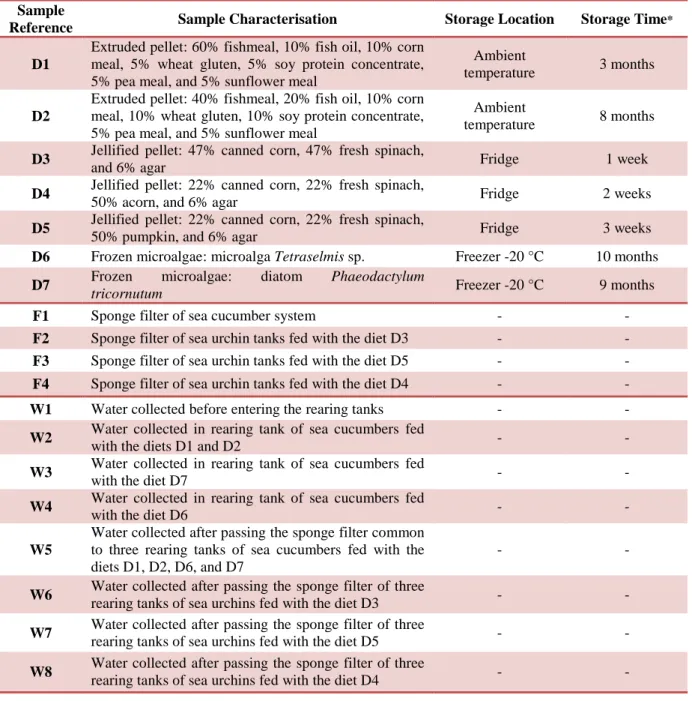
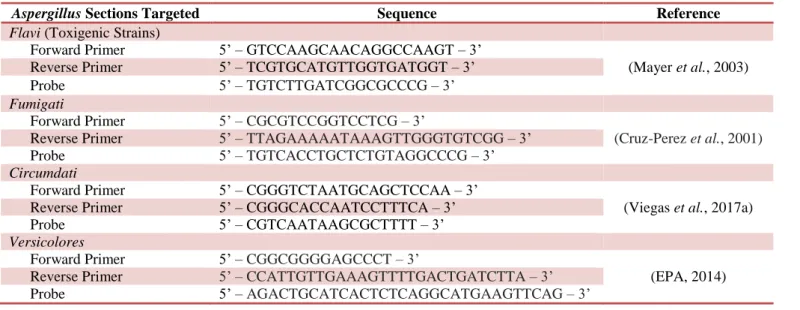
Table 1 – Sample reference with respective characterisation; and storage location and storage time of diet samples ... 27 Table 2 – Sequence of primers and TaqManTM probes used for Real-Time PCR ... 30 Table 3 – Limits of Detection (LOD), Limits of Quantification (LOQ), and Matrix
Effects (ME) for mycotoxins and their metabolites in blank feed matrix ... 32 Table 4 – Bacterial densities present in samples of diets (CFU.g-1), sponge filters
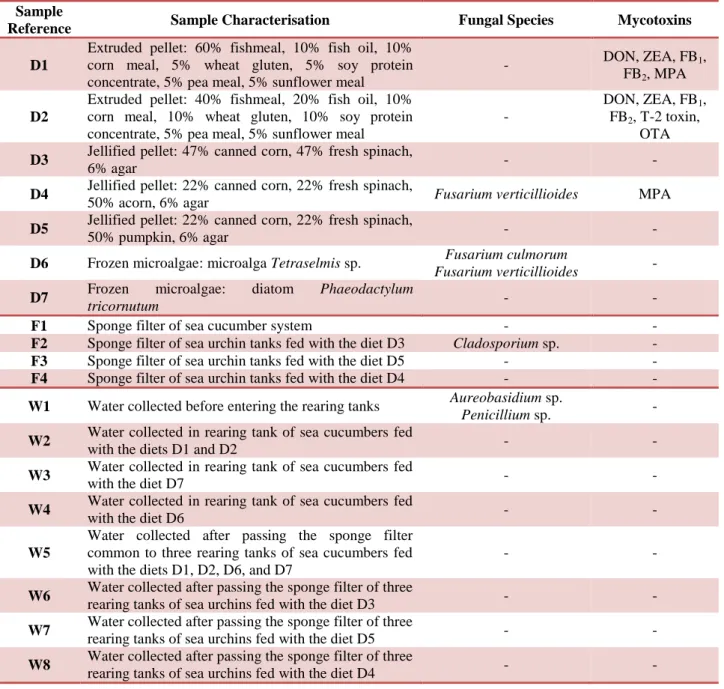
(CFU.m-2), and waters (CFU.mL-1) ... 36 Table 5 – Fungal burden present in samples of diets, sponge filters, and waters... 38 Table 6 – Distribution of fungal species and mycotoxin contamination in samples of
diets, sponge filters, and waters ... 40 Figure 1 – Percentage of mesophilic bacteria present in samples of diets, sponge filters,
and waters inoculated on TSA medium ... 35 Figure 2 – Percentage of total coliforms present in samples of diets, sponge filters, and
waters inoculated on VRBA medium ... 36 Figure 3 – Concentrations of mycotoxins present in the extruded pellet D2, with the
following units: μg.Kg-1
L
IST OF
A
BBREVIATIONS
< – Symbol that refers to “less than” > – Symbol that refers to “greater than” % – Percentage α – Alpha α-ZOL – α-Zearalenol β – Beta β-ZOL – β-Zearalenol 1st – First 101 – A dozen (10) 102 – A hundred (100) 103 – A thousand (1,000) 104 – Ten thousand (10,000) 106 – A million (1,000,000) 108 – A hundred million (100,000,000) 15-AcDON – 15-Acetyldeoxynivalenol μg – Microgram µL – Microlitre μm – Micrometre ACN – Acetonitrile AcOH – Acetic Acid AF – Aflatoxin AFB1 – Aflatoxin B1
AFB2 – Aflatoxin B2
AFG1 – Aflatoxin G1
AFG2 – Aflatoxin G2
API – Atmospheric Pressure Ionisation °C – Degrees Celsius
CETEMARES – Centre for research and development of maritime knowledge CFU – Colony-forming Units
cm – Centimetre
DAS – Diacetoxyscirpenol
DCPA – Dichloran Chloramphenicol Peptone Agar medium DG-18 – Dichloran 18% Glycerol Agar medium
DNA – Deoxyribonucleic Acid DOM-1 – Deepoxy-deoxynivalenol DON – Deoxynivalenol or Vomitoxin
DRBCA – Dichloran Rose Bengal Chlortetracycline Agar medium EC – European Commission
EFSA – European Food Safety Authority
ELISA – Enzyme-Linked Immunosorbent Assay
et al. – Abbreviation of “and others” in Latin
EU – European Union
FAO – Food and Agricultural Organization of the United Nations FB – Fumonisin
FB1 – Fumonisin B1
FB2 – Fumonisin B2
FIFO – Fish-In Fish-Out Ratio g – Gram
× g – G-force h – Hour H2O – Water
ha – Hectare
HPLC – High-Performance Liquid Chromatography HPLC-DAD – HPLC with Diode-Array Detection HPLC-FD – HPLC with Fluorescence Detection H&TRC – Health and Technology Research Centre
i.e. – Abbreviation of “id est” (equivalent to expressions like: that is, meaning, namely) INSA – Instituto Nacional de Saúde Doutor Ricardo Jorge
IPL – Instituto Politécnico de Lisboa IPLeiria – Instituto Politécnico de Leiria ITRA – Itraconazole
Kg – Kilogram Km – Kilometre
L – Litre
LC-MS/MS – Liquid Chromatography-Tandem Mass Spectrometry system LOD – Limits of Detection
log10 – Base Ten Logarithm or Common Logarithm
LOQ – Limits of Quantification m2 – Square Metre
MARE – Marine and Environmental Sciences Centre MBR – Membrane Biological Reactor
ME – Matrix Effects
MEA – Malt Extract Agar medium mg – Milligram
min – Minute mL – Millilitre mm – Millimetre mM – Millimolar
MPA – Mycophenolic Acid
MS/MS – Tandem Mass Spectrometry n – Number of times that the event occurred NaCl – Sodium Chloride
NIV – Nivalenol nm – Nanometre nM – Nanomolar No. – Number
NUTS II – Nomenclature of Territorial Units for Statistics level II OT – Ochratoxin
OTA – Ochratoxin A
PCR – Polymerase Chain Reaction PDA – Potato Dextrose Agar medium POSA – Posaconazole
qPCR – Real-Time PCR
RAS – Recirculating Aquaculture System rpm – Revolutions Per Minute
s – Second (unit of time)
S/N – Signal-to-noise Ratio
SOFIA – The State of World Fisheries and Aquaculture sp. – Species
spp. – Subspecies
STEC – Shiga Toxin-producing Escherichia coli Infection t – Tonnes
TCT – Trichothecene
TSA – Tryptic Soy Agar medium
UHPLC – Ultra-High Performance Liquid Chromatography UV – Ultraviolet Irradiation
VORI – Voriconazole
VRBA – Violet Red Bile Agar medium v/v – Volumetric Fraction
1. B
ACKGROUND
1.1. Aquaculture
1.1.1. Aquaculture Activity
Aquaculture is defined as an activity that allows the cultivation or rearing of aquatic organisms (DGRM, 2016; DRAPN, 2012; Justino et al., 2016; Snow et al., 2012), with the application of methods that allow the progressive increase of productivity (DGRM, 2016; DRAPN, 2012; Justino et al., 2016). Thus, the biogenetic cultures are characterised by the growing, reproduction, or maintenance of aquatic species in freshwater, marine or brackish waters (DR, 2007) and these activities are referred in Law No. 58/2005 of December 29th (DGRM, 2016; DR, 2005; DRAPN, 2012) and Decree-Law No. 226-A/2007 of May 31st (DGRM, 2016; DR, 2007; DRAPN, 2012). Some human intervention is necessary in the breeding process, whether through stocking, feeding, or simply protection against predators (Boison & Turnipseed, 2015; Myers, 2010).
The groups of organisms reared in freshwater, marine, and brackish environments include the finfish, molluscs, and crustaceans (Boison & Turnipseed, 2015; DGRM, 2016; Myers, 2010; Snow et al., 2012). But many others aquatic animals are also reared, as the example of sea squirts and jellyfish (Boison & Turnipseed, 2015); or even aquatic plants (Boison & Turnipseed, 2015; Myers, 2010), microalgae, and seaweeds (Snow et al., 2012).
The main purpose of aquaculture activity is the production of organisms with high nutritional value, in order to integrate the human diet in a sustainable way (Justino
et al., 2016; Liu et al., 2017), given that this is one of the preferred protein sources of a
great part of population (Chanpiwat et al., 2016).
1.1.2. Production Systems
1.1.2.1. Extensive, Semi-intensive, and Intensive Systems
Aquaculture facilities can be distinguished in three different regimes, the extensive, semi-intensive, and intensive systems (Erzini, 2016; Ismail et al., 2017; Justino et al., 2016; Lekang, 2007; Parisi et al., 2014), depending on the feeding,
technology, and productivity that are used in the exploitation regime selected (Ismail et
al., 2017; Justino et al., 2016; Lekang, 2007).
In extensive regime, the density of reared species is maintained at low levels (EC, 2012; Justino et al., 2016; Lekang, 2007), as well as technology and investment (Lekang, 2007), and the input of artificial substances (Ismail et al., 2017; Lekang, 2007). Thereby, the feeding used is exclusively natural (Erzini, 2016; Justino et al., 2016). This system consists in maintaining natural or artificial ponds, through cleaning and fertilising the ponds or lagoons, in order to intensify the existence of microorganisms, small crustaceans and molluscs, worms and larvae that comprise the aquatic food pyramid. This allows the development of marketable organisms with higher yield comparing with natural ecosystem (EC, 2012).
In contrast, intensive regime represents a system with a really upper productivity level per unit volume (Gabriel et al., 2015; Justino et al., 2016; Lekang, 2007), implying the utilisation of more technology (Ismail et al., 2017; Lekang, 2007) and artificial inputs, which leads to the requirement of much higher investments per unit volume (Lekang, 2007). The commercial feeds are utilised to supply the specific nutritional needs of each species (Justino et al., 2016). In this way, the feeds are competently administered and their consumption and conversion are effectively monitored (Tidwell, 2012) to obtained an optimal growth conditions. The risk of diseases arising is greater, because animals are constantly under stress in order to reach their maximum performance. For that, there is a need to avoid such injury through the utilisation of disease control methods (Lekang, 2007).
However, it is possible to associate both exploitation regimes mentioned above, creating a new system called semi-intensive regime (Lekang, 2007). In this system, the production is greater than in extensive aquaculture and for that is added supplementary feed, as extruded pellets, to complement the natural feed that is available in pond (EC, 2012). In this way, the feeding consists of a mixture of natural and commercial feeds (Erzini, 2016; Ismail et al., 2017; Justino et al., 2016).
1.1.2.2. Open, Semi-closed, and Closed Systems
The classification of production systems may also be made according to the intervention of the producer in the control of appropriate levels of basic functions, in
terms of oxygen, temperature, and waste removal. Thereby, the systems can be categorised as open, semi-closed, or closed (Tidwell, 2012).
Open production systems use natural ecological processes to perform the basic functions mentioned above. Usually, the commercial aquaculture production utilises natural bodies of water and has a low environmental impact. The natural processes offer the sufficient oxygen supply for biomass to be supported, being provided through photosynthesis performance by natural algal communities, through diffusion, or both. The waste products are removed according to natural processes rates within the system and the water temperature is defined by the ambient temperature (Tidwell, 2012).
In semi-closed production systems, the flow of water to the production units is promoted by pumping or gravity-flowed and the water may be used once and then be discharged or be continuously cleaned and re-oxygenated through natural processes. There is a major control over water quality and management of water replenishment. It occurs the monitoring of temperature and the detection of diseases. The levels of dissolved oxygen are easily monitored and mechanical aeration can be included. The elimination of predation and control of poaching are more efficient than in extensive regime (Tidwell, 2012).
In closed production systems, human intervention acts on all basic processes and the operator is responsible for the control of all environmental variables in the production system. It is possible to keep the water temperature very near to the optimal growth temperature of rearing species, which can have a huge positive impact on growth rate and production efficiency. The water can be reused and the constant disinfection of water with ozone or ultraviolet lights reduces pathogenic organisms in a manmade culture system. The poachers and predators can be totally eliminated from the system (Tidwell, 2012).
1.1.3. Production Units
The production units used in aquaculture may be described as natural settings, like ponds and lagoons (EC, 2012; Tucker & Hargreaves, 2012); or as man-made settings, like cages and net pens (EC, 2012; Masser, 2012), longlines, rafts (EC, 2012; López et al., 2017), and tanks (flow-through and recirculating systems) (Ebeling & Timmons, 2002; EC, 2012).
Ponds are considered a semi-closed system (Tidwell, 2012) and are the most common aquaculture worldwide. The production in ponds can be defined as confined bodies of standing water with small size in which are produced aquatic animals. Almost all groups of aquatic animals may be cultured in ponds, so such as crustaceans and fish, but those that adapt better to larger ranges of environmental conditions variations are best suited, mainly in relation to the water temperature. Aquatic plants can also be produced, particularly single-cell algae, as Spirulina sp. (Tucker & Hargreaves, 2012).
Cage culture is a production method in open sea, which consists in a “fencing-off” of a part of natural aquatic habitat. In marine environments, larger cages are used (Tidwell, 2012) and these structures may be suspended in the water column or on-bottom (Justino et al., 2016). While in shallow freshwater ponds usually are used small floating cages (Tidwell, 2012). These settings are distinguished by their well-defined and rigid structures or by having a frame that supports and secures the mesh or netting. The difference between cages and net pens is the fact that net pens are made of flexible mesh or netting without whole or encasing frames (Masser, 2012).
Longline cultures are floating systems that use extensive and simple structures with ropes, culture units, and floats, and are applied in protected areas. They involve reduced investments and are easily operated (López et al., 2017).
The tanks used in a flow-through system are usually made of concrete troughs and are called raceways, being considered a semi-closed system (Tidwell, 2012). A production system representative of this type of culture is compound by tanks in series, generally with rectangular form and with water flow along the extensive axis. In smaller aquacultures, habitually, the tanks are arranged in pairs for easy access and in larger farms multiple raceways are arranged in parallel series (Fornshell et al., 2012). The water can be reused many times along multiple raceways in series, according to the water flow (Tidwell, 2012).
The tanks that are used in recirculating systems are constructed with moulded polyethylene, fiberglass (Ebeling & Timmons, 2002), or concrete (EC, 2012). These systems are designated by Recirculating Aquaculture Systems (RAS) and emerged as a way to solve the pollution produced by the use of conventional methods of aquaculture (Zhu et al., 2016). Thereby, these are considered the production systems with major sustainability (Priyaja et al., 2017), given that the water is maintaining in a closed system and is recycled (EC, 2012). RAS allows an intensive production with high population densities, which promotes the accumulation of waste products in water
(Gonçalves & Gagnon, 2011). The solid wastes produced by aquatic organisms are removed by mechanical filters (Tidwell, 2012) and the dissolved and particulate organic matter are removed through biofilter-based systems (EC, 2012; Gonçalves & Gagnon, 2011). Biofilters used in RAS carry large microorganism populations that metabolise nitrogen compounds (Summerfelt et al., 2004). The use of biofilters allows the recycling of aquaculture wastewater, reducing the use of water supply. During this recombination process, nitrification occurs, in which, in a first step, ammonia is used as an energy source by ammonia-oxidizing bacteria which convert it into nitrites and, in a second step, the nitrites are used as energy source by nitrite-oxidizing bacteria and converted into nitrates. Thus, the stable and viable nitrification biofilm (population of microorganisms) guarantees the good quality of RAS (Zhu et al., 2016).
Nevertheless, it is possibly to utilise the combination of advanced water treatments like Membrane Biological Reactor (MBR) (Holan et al., 2014; Sharrer et al., 2007; Wold et al., 2014) and disinfection treatments (Aruety et al., 2016; Gonçalves & Gagnon, 2011; Sharrer & Summerfelt, 2007; Summerfelt et al., 2004). The MBR is a system of membrane filtration with low porosity that guarantees the retaining of high microorganism concentrations (Sharrer et al., 2007). The pore size of microfiltration membranes is of 0.1 to 10 μm and the pore size of ultrafiltration membranes is of 1 to 100 nm, which distinguished by their efficiency and, therefore, the ultrafiltration membranes are preferred in aquaculture to produce the better water quality for the production system (Wold et al., 2014).
Furthermore, the combination of filtration system with disinfection treatments, like Ozonation and Ultraviolet (UV) Irradiation, reduces significantly the microbiota counts (Aruety et al., 2016; Martins et al., 2010; Sharrer & Summerfelt, 2007), inactivating the remaining (Martins et al., 2010; Summerfelt et al., 2004). The Ozonation uses the ozone as an oxidizing agent that inactivates pathogens by direct contact (Summerfelt, 2003; Summerfelt et al., 2004), and also degrades organic compounds to smaller compounds that are more amenable to biodegradation (Summerfelt et al., 2004). The UV Irradiation destructs the residual ozone that is toxic to aquatic organisms, being converted to oxygen. This treatment produces the denaturation of microorganisms DNA, or mortality (Summerfelt, 2003; Summerfelt et
al., 2004), and it does not present any risk to aquatic organisms, since there is no
Accordingly, after undergoing these specific treatments (Martins et al., 2010), it is added air or oxygen into the water (Tidwell, 2012), enabling its reuse and return to the closed system through piping systems. The organic wastes should be treated before being discarded in nature (EC, 2012).
1.1.4. Sector Development
During the year 2012, about 200 countries reported that high-value species (flatfish, prawns, shrimp, salmon, seabass, seabream, tuna) were highly traded, as well as low-value species (small pelagic), having the main purpose of exporting to developing countries, where there were low-income consumers (Ismail et al., 2017).
Aquaculture is an extremely important activity, which allows to ensure the cover of the food needs of the constantly expanding world population (Gonçalves & Gagnon, 2011; Palm et al., 2015), given that the fish are the most commercialised food in the World. In addition, it is important to emphasize its relevance in reducing pressure on wild fish stocks (Ismail et al., 2017).
The Food and Agricultural Organization of the United Nations (FAO) made a document entitled by “The State of World Fisheries and Aquaculture (SOFIA)”, mentioning that aquaculture is expanding (Crab et al., 2007; FAO, 2018; Justino et al., 2016; Pietsch et al., 2011; Snow et al., 2012) and highlighting the increase in production and quality improvements of the product produced (FAO, 2018; Justino et
al., 2016).
1.2. Importance in Portugal
1.2.1. Seafood/Fish Consumption
Portugal area is around 92,000 Km2 and its coast covers 942 Km. Maybe because of this, the feeding of Portuguese population comprises many food related to the sea (Maciel et al., 2016; Viegas et al., 2018a submitted), having been declared that mostly of the population consumes seafood/fish more than once a week. The consumption of seafood/fish in Portugal has an average annual of approximately 54 Kg per capita (FAO, 2016), which represents a seafood/fish daily average of about 160 g (Cardoso et al., 2015; Viegas et al., 2018a submitted). Thereby, Portugal has the highest consumes of seafood/fish per capita worldwide, belonging to the third country in the
ranking (Almeida, 2014; Fernandes, 2017; Maciel et al., 2016), afterwards Japan and Iceland (Almeida, 2014; Maciel et al., 2016).
Aquaculture ensures the availability of seafood/fish protein for human consumption (Gabriel et al., 2015; Ismail et al., 2017; Liu et al., 2017), since fishing is an activity that exploits the natural resources, which are increasingly at risk (Moreira, 2015; Viegas et al., 2018a submitted). Thus, aquaculture guarantees a higher productivity and is economically more reachable for population (Boison & Turnipseed, 2015).
1.2.2. Aquaculture Establishments
In Portugal, aquaculture is represented habitually by small-scale establishments, namely the bivalve productions that are commonly found in the estuarine zones, corresponding mostly to family-based productive units (DGRM, 2016).
In 2015, the numbers of total establishments that are licensed were 1,504, but only 1,433 were active with production in this year. Whereas in 2016 was occurred an increase, there being 1,518 licensed establishments, in which 1,466 were active with production. The total area of aquaculture in 2016 (4,881 hectares), which means about 3.22 hectares per establishment, was decreased its average size at 2.0%, given that in 2015 (4,928 hectares) was of around 3.28 hectares per establishment (Annexe I) (INE, 2018).
With respect to production units, in 2016, 87.9% of the total licensed establishments (i.e. 1,335 establishments) corresponded to on-bottom production of bivalve molluscs (INE, 2018), most of which were located in Ria Formosa (DGRM, 2016; INE, 2018); 9.4% (i.e. 143 establishments) were the rearing tanks that are used for fish production; and 2.1% of the facilities (i.e. 32 establishments) corresponded to floating structures that are often used for bivalve molluscs (Annexe II) (INE, 2018).
1.2.3. Aquaculture Production
Regarding to freshwater aquaculture, in the year 2015, only 30 establishments were licensed, increasing to 34 licensed establishments and all with active production, in 2016. In both years, the production remained exclusively intensive (Annexe III) (INE, 2018).
While, in relation to marine and brackish waters, at the end of 2015, there were 1,474 licensed establishments and, in 2016, were 1,484. This reveals that the main types of water that are selected to produce aquatic organisms are marine and brackish waters. Thus, the intensive exploitation regime represented 28.4% of this production, which was ensured by 15 establishments, having decreased 5.6% comparatively to 2015; the semi-intensive exploitation regime accounted 11.3% of production, having been ensured by 76 establishments, being the volume of production similar to the previous year (11.1%); and the extensive exploitation regime counted 60.2% of production, having been ensured by 1,393 establishments, mainly by bivalve production, and the production, in 2015, was of 54.9% (Annexe III) (INE, 2018).
The total aquaculture production in Portugal, in the year 2015, was of 9,561 tonnes, with revenue of 54.1 millions of Euros, which increased to 11,259 tonnes in 2016, representing 75.2 millions of Euros (Annexe IV). These data reflect a rise of around 17.8% in volume with relation to the previous year, representing an increase of about 38.9% in monetary value, given that in 2015 were produced 9,561 tonnes that generated 54.1 millions of Euros (Annexe V) (INE, 2018).
Regarding to the major production volumes of the country, Algarve Region produced 5,967 tonnes that were exclusively from marine and brackish waters, followed by Centre Region with 3,255 tonnes, in which only 1 tonne was from freshwaters. And freshwater aquaculture was produced merely in Centre Region and in North Region with 674 tonnes (Annexe IV) (INE, 2018).
1.2.4. Production by Species
Aquaculture in marine and brackish waters remained the most relevant in 2016, signifying approximately 94.0% of total produced, in which fish production represented 37.6%, of which 84.7% were ensured by production of turbot and gilthead seabream. The largest volume of marine fish production (more 8.7% from 2015 to 2016) was mainly due to increased production of main species. In 2016, turbot production was of 2,388 tonnes, gilthead seabream was of 1,196 tonnes, and seabass was of 427 tonnes, having increased 3.8%, 8.8%, and 43.7%, respectively, relative to the preceding year (Annexe VI) (INE, 2018).
The bivalve molluscs and crustaceans represented 56.4% of production in marine and brackish waters, having increased around 32.9% from 2015 to 2016. In
2016, clams remained as the most important species, accounting 3,716 tonnes with an increase of 61.6%; followed by mussels that added 1,474 tonnes, exhibiting an increase of 12.1%. The oyster production represented 1,014 tonnes in 2016, having declined about 2.0% in relation to the previous year (Annexe VI) (INE, 2018).
The aquaculture production in freshwater decreased 24.1% in 2016, accounting 675 tonnes, representing 6.0% of total aquaculture production, in Portugal, that were exclusively ensured by trout production (Annexe VI) (INE, 2018).
1.3. Types of Feeding
1.3.1. Moisture Content in Aquafeed
The water content in aquafeeds affects their quality during storage time and their stability in water of culture. Thus, diets can be categorised depending on its humidity percentage, being designated by moist, pasty, or dry feeds (Barnabé, 1994).
Moist diets contain between 45 and 80% of water and usually are made of low market value fish and fresh plant material. These diets can be used in crude state or freezing and mincing. Habitually, fish that are used directly in diets have a great water level of about 80%. Some fish species have insufficient fat level, between 2 to 3%, requiring to mixture with fish with lipid content between 8 to 20% (Barnabé, 1994).
Semi-moist diets are composed by the same ingredients, but are added several dry products, usually meals, so such as fishmeal, yeast, and wheat millings, in order to water content is between 18 to 45%. The feed ingredients are processed through crushing and mixing, originating a paste that pass through a mincer and gets a pellet form, originating a jellified pellet that is ready to feed the fish (Barnabé, 1994).
Dry diets have a natural humidity of 7 to 13% and their lipid levels can reach 17%. Generally, are made from meals or powders that are mixed and are prepared by presses. It is further incorporated 1 to 2% of binder in the mixture that allows the cohesion of the granules (Barnabé, 1994). Thereby, is ensured a major stability of extruded pellets in water, maintaining the water quality and allowing their efficient consumption by aquatic organisms (Parker, 2012), avoiding the suspension of residual feed particles that may cause irritation of fish gills (Barnabé, 1994).
1.3.2. Feed Ingredients
All ingredients provide a particular nutrient or lend a physical property that is suitable for the diet formulation. The variety of foodstuffs utilised allows obtaining a diet nutritionally balanced, palatable, and stable in water (Ali, 2006).
Fish oil and fishmeal are the two most relevant ingredients present in the formulations of aquafeeds, because they are considered complete food and also have great digestibility, being also economical feed ingredients. However, it is not sustainable in long term to recourse to fishery activities to support the progressive growth of aquaculture production, since it would lead to the collapse of natural stocks. Thereby, the need arose to use terrestrial resources to replace part of the aquafeed formulation (Shepherd et al., 2017).
Since July 1st 2013, the inclusion of non-ruminant land animal meals in aquafeeds has been allowed in Europe, as well as their by-products that gain commercial value and are more sustainable from an economic point of view (Campos et
al., 2017).
The hydrolysed feather meal is a rich source of protein and polyunsaturated fatty acids, being included in aquafeeds as a substitute of fishmeal. Nevertheless, rates of substitution very high can decrease the palatability and digestibility of diets, decreasing their intake (Campos et al., 2017).
The feed ingredients selected for the aquaculture species diets should also take into account their sustainability, their impact on the environment, the Fish-In Fish-Out (FIFO) Ratio (Tacon et al., 2011), and the acceptance of diet that may vary according to its physical appearance (Ali, 2006).
In diets for fish, may be used diatoms (genera Phaeodactylum and
Skeletonema), flagellated microalgae (genera Tetraselmis and Isochrysis) (Pintado et al.,
2014), seaweeds (genera Gracilaria, Porphyra, Sargassum, and Ulva), peas, lupines, canola (Pereira et al., 2012), cottonseed meal, soybean meal, corn meal (Marinho et al., 2013; Parker, 2012), peanut meal, wheat, barley (Parker, 2012), linseed oil, rapeseed oil, soybean oil (Reis et al., 2014), fish oil (Diógenes et al., 2018; Enes et al., 2011; Ribeiro
et al., 2015; Ribeiro et al., 2017; Valente et al., 2006), fishmeal, poultry by-products,
In diets for crustaceans, can be used plants, diatoms, sweet potato, peanut meal, oil cake, corn meal, wheat flour, broken rice, rice bran, cottonseed, hay (Parker, 2012), soybean meal, liver from fish (Barnabé, 1994), shrimp, and small fish (Parker, 2012).
In diets for molluscs, may be used microalgae, seaweeds (Barnabé, 1994), sunflower seeds, wheat flour, soybean meal (Parker, 2012), fish, and crustaceans (Barnabé, 1994).
1.4. Production of New Species
1.4.1. Echinoderms
1.4.1.1. Sea Cucumber
The sea cucumbers, also known as holothurians, are soft-bodied echinoderms (Santos et al., 2015) and belong to marine benthic communities. They have low fat and high protein content (Santos et al., 2015; Santos et al., 2017), containing trace elements and amino acids essentials for human health. These marine invertebrates present several distinctive properties, as antioxidant, anti-inflammatory, antitumor (Santos et al., 2015), and their suture characteristics, purported antiseptic, and wound healing properties are also valued (Brown & Eddy, 2015).
In Western cuisine, the suggestion of consume sea cucumber induces several reactions among Western consumers, alternating between curiosity and disgust (Brown & Eddy, 2015). Nevertheless, the sea cucumbers are considered a luxury food in Asian seafood markets (González-Wangüemert et al., 2016; Purcell et al., 2012; Rakaj et al., 2018), conducing to an overfishing of natural stocks (Santos et al., 2015). To ensure the Asian market demand, has been developed mainly the aquaculture of Japanese sea cucumber, Apostichopus japonicus (Rakaj et al., 2018), as well as Holothuria scabra, which has also been greatly produced (Domínguez-Godino & González-Wangüemert, 2018).
In the Mediterranean and North-eastern Atlantic, the aquaculture production of sea cucumber has high potential, due to the great diversity of species that exists there with high commercial value (Domínguez-Godino & González-Wangüemert, 2018). The new target species, such as Holothuria mammata, H. tubulosa, H. polii (Rakaj et al., 2018), H. arguinensis, H. sanctori, and Parastichopus regalis (or Stichopus regalis) (Santos et al., 2017), are considered a good nutrient sources and also suitable for human
consumption (Rakaj et al., 2018). The exploitation of H. forskali, an European species, also presents an increase interest (Brown & Eddy, 2015).
Holothuria mammata can be found in Northern Spain, Canary Islands, Azores,
and Madeira (González-Wangüemert et al., 2016). H. tubulosa is a species actively harvested in Spain, Italy, Greece, Turkey, and other countries (Rakaj et al., 2018).
Holothuria arguinensis was well-successful in reproduction
(Domínguez-Godino & González-Wangüemert, 2018; Rakaj et al., 2018) and in juveniles rearing (Domínguez-Godino & González-Wangüemert, 2018); and can be found in Azores, centre of Portugal, and Canary Islands (González-Wangüemert et al., 2016).
1.4.1.2. Sea Urchin
Sea urchins represent a prised delicacy in the Mediterranean, Asia, Chile, Polynesia (Castilla-Gavilán et al., 2018), and Barbados. Their gonads, an edible portion typically restricted to testis and ovary, are often termed as roe in culinary (Brown & Eddy, 2015). They are rich in β-carotene and polyunsaturated fatty acids (Rahman et al., 2013) and have high commercial value (Cirino et al., 2017), being used raw in sushi and sashimi (Brown & Eddy, 2015; Castilla-Gavilán et al., 2018). Thereby, the Japanese market absorbs 80% of their production and France is the second country with major consumes in the World (Castilla-Gavilán et al., 2018).
Aquaculture methods are utilised to produce the juveniles, enhancement of the gonads, or to improve natural stocks. The challenging is essentially the roe appearance and taste, but the product value may be raise improving the roe quality with feeding kelp in controlled setting (Brown & Eddy, 2015).
Some sea urchins as Holopneustes purpurascens and Heliocidaris tuberculata are poor candidates for commercialisation, given that their aquaculture production is unpredictable and they have frequently poor gonad quality. Psammechinus miliaris is easy to culture and its gonads have acceptable taste and colour, but its relatively small size did not allow its commercial development due to the lack of market acceptance (Brown & Eddy, 2015).
Despite the good gonadal and somatic growth of the large and globular Echinus
Strongylocentrotus nudus, S. intermedius, and Pseudocentrotus depressus are
appropriate species for complete aquaculture, with rapid growth and high commercial value, being possible to breed from eggs to harvest size (Brown & Eddy, 2015).
Paracentrotus lividus, as known as purple sea urchin (Brown & Eddy, 2015), is
quite large and is traditionally consumed on the Mediterranean coast. Its harvesting occurs essentially in Portugal, Croatia, and Ireland for export (Lawrence, 2007). This species is becoming a relevant choice in Europe for emerging aquaculture industry (Ghisaura et al., 2016), being its cultivation well-known, mainly in Scotland (Brown & Eddy, 2015).
2. S
TATE OF
A
RT
2.1. Bacteriota
The aquafeeds are an input in aquaculture production and can lead to exposure of aquatic organisms to biological agents that are a human health issue (Sapkota et al., 2008). The intensive aquaculture is more susceptible to be affect by microbial diseases (Priyaja et al., 2017). Wherefore, studies about bacterial contamination present in aquafeeds and their feed ingredients are of major importance, but there are no studies from Portugal neither from European countries with this specific objective.
The dry feeds used for aquaculture can be compared with poultry feeding, given that the raw materials used can be the same, mainly with regard to cereals.
The animal feed has been frequently associated to contamination by foodborne bacterial pathogens (Crump et al., 2002). Bacterial infections in birds have been related to feeds with contaminated feed ingredients, being a concern to affect the productivity and conduct to economic losses (Udhayavel et al., 2017).
The poultry feed and other animal feeds were reported with Salmonella
enterica, namely animal protein-based feeds and vegetable protein-based feeds, but the
distinction is not always made between isolated serotypes (Crump et al., 2002). This bacterium is often isolated from cereals and their whole grains, being wheat the raw material most affected. Davies & Wales (2013) investigated Salmonella Typhimurium contamination in cereal ingredients, having obtained only 2 positive results for 581 samples of wheat and no positive results for 96 samples of barley. The heat treatments in feed processing can kill a large part of bacteria, but the recontamination of feeds by
Salmonella genus may also occur during storage or cooling. This is a concern to Public
Health and has been described the link between the contamination of animal feeds and livestock species (Davies & Wales, 2013).
The soil may be considered an initial contamination source of spore-forming bacteria in silages and can be distinguished as strictly anaerobic (Clostridium genus) or aerobic (Bacillus and other related genera). They reduce the shelf-life and the food spoilage that originate changes in texture or even the development of off-flavours. In a study in which samples of soil were collected in dairy farms from Canada revealed that contained 5.2 log CFU.g-1 of Clostridium genus. Another study from Pittsburgh reveal
that the presence of C. perfringens in soil samples ranged from 0 to 103 CFU.g-1 (Heyndrickx, 2011). Udhayavel et al. (2017) studied the contamination of C.
perfringens in poultry feed ingredients. Samples of meat and bone meal had 39 positive
results out of 91 samples; bone meal had 13 positive results out of 29 samples; fishmeal had 21 positive results out of 38 samples; dry fish had 5 positive results out of 13 samples; and all results were negative for samples of soybean meal, rapeseed meal, and maize (Udhayavel et al., 2017).
Clostridium botulinum of proteolytic group I and non-proteolytic group II
cause human botulism and both groups can origin outbreaks from foods. C. botulinum of non-proteolytic group II grows at low temperatures and produces spores, being a concern in chilled food storage. The contaminations with its spores are associated to seafood/fish products, meat, and potato peels, being this last one a reflection of their presence in soil (Heyndrickx, 2011).
Bacillus cereus is found in cereals, rice, fish, meat products, vegetables, but
also in sediments, soil, and dust. The raw plant materials may be utilised for animal feed. B. cereus spores, as well as all bacterial spores, are resistant to desiccation and heat and can survive to food-processing steps, but its vegetative cells are reduced or eliminated. The soil has been greatly contaminated with its spores, revealing ranges from 4 to 6 log10.g-1 (Heyndrickx, 2011).
The harvesting methods, human settlements, nutritional quality, amount of food supply, and temperature variation influence the development of opportunistic bacteria in crops (Huicab-Pech et al., 2017). Their inoculation in feed materials can occur during growing, dispersal, harvesting, processing, and storage of feeds. Their development is influenced mainly by moisture content of feed formulations (Maciorowski et al., 2007).
Overall, opportunistic pathogens can cause many effects in fish species, namely haemorrhagic septicaemia, circling or erratic swimming, decreased appetite or anorexia, uncoordinated movements, corneal opacity, abdominal inflammation, softening of liver and brain, epithelial hyperplasia in gills, and necrosis in organs (liver, kidney, heart, brain, spleen, and musculature) (Huicab-Pech et al., 2017).
Bacteria use the water as precursor vehicle in aquaculture systems, which allow fish-to-fish outbreaks through direct contact. Fish have bacteria in their normal digestive flora. However, the stress induced by additional organic matter and consequent poor water quality and also the interaction between fish, aquatic
environment, and pathogens increase the incidence of diseases (Huicab-Pech et al., 2017). The opportunistic bacteria can become pathogenic originating diseases and they can cause mortality, mainly in RAS (Wold et al., 2014). The pathogenicity degree depends on resistance of farmed species and also environmental conditions (Huicab-Pech et al., 2017). Feeds are great contributors to the organic load in tank water and the appearance of bacteria in marine hatchery tanks can be promoted by aquafeed and intake of water (Wold et al., 2014).
Streptococcus iniae, S. parauberis, and Aeromonas salmonicida may
contaminate fish by-products and low-value fish (Kim et al., 2013). S. iniae is associated to morbidity and mortality of wild and farmed fish, infecting very cultured fish species (Aruety et al., 2016).
The genera Aeromonas, Pseudomonas, and Staphylococcus are potential bacterial pathogens that can induce epidemic outbreaks and A. hydrophila is considered the most important pathogen in aquaculture, being able to originate weakness and anorexia, haemorrhages in skin and gills, vision loss (Huicab-Pech et al., 2017). Vibrio genus is also a frequent cause of bacterial disease in finfish and shellfish of aquaculture (Priyaja et al., 2017). Vibrio anguillarum, V. harveyi, Flavobacterium columnare, and
Edwardsiella tarda are some pathogenic bacteria that normally cause mortality in fish. Edwardsiella genus provokes septicaemia, opaque eyes, and abdominal inflammation.
The Gram-negative bacteria are considered the main source of bacterial disease (Huicab-Pech et al., 2017).
The high choice for fish as a protein primary source of large population conduct to a concern about bacterial pathogens present in fish (Chanpiwat et al., 2016). Bacteria can infect human by their invasion in edible tissues of target-animals that are destined to human consumption (Crump et al., 2002). Fish products have been associated to outbreaks of foodborne illness, with infections caused mainly by pathogenic bacteria Escherichia coli and Listeria monocytogenes. E. coli is a classic indicator of faecal contamination and has been associated to contaminated meat and seafood/fish products, but not all E. coli strains are pathogens for human. Listeria spp. has been also detected in food for human consumption, including fish products (Chanpiwat et al., 2016).
In a study developed by Chanpiwat et al. (2016), the fish samples were contaminated with a mean of 1.57 log CFU.g-1 Escherichia coli and 1.36 log CFU.g-1 Listeria. Regarding to the fish samples that they obtained from market (open air and
supermarket), they detected a mean of 2.06 log CFU.g-1 E. coli and 1.93 log CFU.g-1
Listeria, whereas the fish samples that they collected at aquaculture operations
presented a mean of 1.12 log CFU.g-1 E. coli and 0.83 log CFU.g-1 Listeria. Comparing fish samples from open air markets and supermarket, they verified that the differences between them were not significative. From open air markets, they found a mean of 2.26 log CFU.g-1 E. coli and 1.77 log CFU.g-1 Listeria and from supermarkets the mean were of 1.96 log CFU.g-1 E. coli and 2.02 log CFU.g-1 Listeria. The undercooked or improperly prepared fish revealed to be a risk for Public Health (Chanpiwat et al., 2016).
The genera Micrococcus and Staphylococcus can also be found in fish, given that they are related to the lack of hygiene during the fish management, due to they are commonly detected in human skin. Besides this, they can cause alimentary intoxications in humans (Huicab-Pech et al., 2017).
Other bacterial species that may be found in fish and can also be a concern for Public Health are Aeromonas hydrophila, Vibrio cholerae, V. parahaemolyticus, V.
vulnificus, Pseudomonas spp., Streptococcus iniae, Flexibacter sp., Edwardsiella sp.,
and Flavobacterium sp. (Huicab-Pech et al., 2017).
2.2. Mycobiota
There are few studies around the World about the fungi, moulds, and mycotoxins present in aquafeeds and only one of these studies was performed in Portugal.
Almeida et al. (2011) analysed the natural mycobiota and the Aflatoxin (AF) contamination in plant-based aquafeed distributed in Portugal that is used for production of seabass. For mycological examination, they enumerated the fungi growth on media Dichloran Rose Bengal Chlortetracycline Agar (DRBCA) and Sabouraud Agar (SAB) with Chloramphenicol and their identification was realised by macro and microscopic morphology characterisation and with taxonomic keys. For AF detection and quantification, they use the standard method and the determination of Aflatoxins B1
(AFB1), B2 (AFB2), G1 (AFG1), and G2 (AFG2) was executed by isocratic
reversed-phase High-Performance Liquid Chromatography (HPLC). They found moulds in less than half of samples, in which Aspergillus flavus was in 35 out of 87 (40.2%) fish feed samples with an average of 2.7 log10 CFU.g-1, followed by A. niger (39.1%) with an
average of 2.2 log10 CFU.g-1, A. glaucus (29.9%) with an average of 1.9 log10 CFU.g-1,
Penicillium spp. (28.7%) with an average of 2.0 log10 CFU.g-1, Cladosporium spp.
(28.7%) with an average of 1.9 log10 CFU.g-1, and Fusarium spp. (25.3%) with an
average of 1.8 log10 CFU.g-1. No sample contained AFs (Almeida et al., 2011).
Pietsch et al. (2013) examined the concentrations of Deoxynivalenol (DON) and Zearalenone (ZEA) in commercial feed and the possible impact in health of aquatic organisms. The fish feed was from Central Europe and was designed for carp feeding. For mycotoxins analysis, DON and its metabolite Deepoxy-deoxynivalenol (DOM-1) were analysed using the HPLC with Diode-Array Detection (HPLC-DAD) and ZEA was determined utilising the HPLC with Fluorescence Detection (HPLC-FD). DON levels in fish feed ranging from 0 to 825 µg.Kg-1 and, wherefore, were below to the values of guidance for complete feedings. DOM-1 was not detected in samples. ZEA was detected in all samples; its concentrations ranging from 3 to 511 µg.Kg-1 ZEA and, therefore, did not exceed the recommended values by the European Commission (EC) (Pietsch et al., 2013).
Greco et al. (2015) investigated the toxicogenic mycobiota, namely mould genera and species, and quantified the six most relevant mycotoxins in commercial aquafeed for rainbow trout in Argentina. For mycobiota analysis, they used the DRBCA medium to count total cultivable fungi, the Dichloran 18% Glycerol Agar (DG-18) medium to count xerophilic fungi, and the Dichloran Chloramphenicol Peptone Agar (DCPA) medium for selective isolation of species of Fusarium and Alternaria. For mycotoxins analysis, they utilised the Enzyme-Linked Immunosorbent Assay (ELISA) analytical test kits for the quantitative analysis of AF, Ochratoxin A (OTA), T-2 toxin, Fumonisin (FB), DON, and ZEA. They found fungi at moderate levels in 26 out of 28 feed samples and the mycotoxigenic that predominated were Eurotium repens, E.
rubrum, and Penicillium genus. Mycotoxins were discovered in all samples and 93% of
feed samples had the co-occurrence of 2 out of 6 mycotoxins; 7% of samples had the co-occurrence of six mycotoxins (Greco et al., 2015).
Nácher-Mestre et al. (2015) quantified 18 mycotoxins in aquafeeds for two fish species based on processed animal proteins from non-ruminants (produced in Central Europe) and plant-proteins (produced in United Kingdom). For mycotoxins analysis, they used Ultra-High Performance Liquid Chromatography (UHPLC) linked to a Tandem Mass Spectrometry (MS/MS). FB levels in corn ranged from 0.011 to 4.9 mg.Kg-1. DON levels in corn and wheat ranged from 139 to 814 µg.Kg-1 and from 17 to