Article
J. Braz. Chem. Soc., Vol. 22, No. 2, 197-203, 2011. Printed in Brazil - ©2011 Sociedade Brasileira de Química
0103 - 5053 $6.00+0.00
A
*e-mail: [email protected]
Determination of Inorganic Species of Sb and Te in Cereals by Hydride Generation
Atomic Fluorescence Spectrometry
Mariela N. M. Reyes, Maria L. Cervera* and Miguel de la Guardia
Department of Analytical Chemistry, University of Valencia, 50 Dr. Moliner Street, 46100 Burjassot, Valencia, Spain
Neste trabalho foi desenvolvido um sistema não cromatográico rápido, sensível e simples para a determinação de Sb(III), Sb(V), Te(IV) e Te(VI) em amostras de cereais. O procedimento baseia-se na extração assistida por ultra-som e na determinação por espectrometria de luorescência atômica acoplada com geração de hidretos (HG AFS). Foram realizados estudos preliminares com o intuito
de avaliar a eiciência da extração usando 1 mol L-1 ácido fosfórico, 1 mol L-1 ácido nítrico,
água regia, 1 mol L-1 ácido sulfúrico e 6 mol L-1 ácido clorídrico. A extração com água
régia apresentou uma evidente interconversão das espécies durante o processo. No entanto, o H2SO4 apresentou-se como o melhor agente de extração com eiciências maiores do que 90% em relação ao conteúdo total de Sb e Te (ambos os elementos foram previamente quantiicados), não apresentando interconversão nenhuma. Estudos de recuperação para diferentes níveis de adição das espécies comprovaram a não interconversão das espécies. O método forneceu limites de detecção na faixa de 0,1 a 1,0 ng g-1 com desvios padrão
relativos de 5,4-9,2% para 10 análises independentes de amostras que continham baixas concentrações de espécies de Sb e Te.
A non-chromatographic fast, sensitive and easy method has been developed for the determination of Sb(III), Sb(V), Te(IV) and Te(VI) in cereal samples. The procedure is based on ultrasound assisted extraction and determination by hydride generation atomic luorescence spectrometry (HG AFS). Preliminary studies were made in order to get the best extraction eficiency using 1 mol L-1 phosphoric acid, 1 mol L-1 nitric acid, aqua
regia, 1 mol L-1 sulfuric acid and 6 mol L-1 hydrochloric acid. The extraction with aqua
regia showed a clear interconversion of the species during the process, being H2SO4 the best extractant with eficiencies greater than 90% from the total content of Sb and Te quantiied previously and without species interconversion. This point was checked by recovery experiments at different spiked levels. The method provided limits of detection values from 0.1 to 0.5 ng g-1 with relative standard deviation values from 5.4 to 9.2% of
10 independent analysis of samples containing few ng g-1 of Sb and Te species.
Keywords: antimony, tellurium, cereals, speciation, hydride generation atomic luorescence spectrometry
Introduction
Natural concentrations of Sb and Te in the environment are low. Their abundance in the earth’s crust is of the order of 0.2-0.3 mg kg-1.1 In its metallic form, the major
use of Sb is as hardener for Pb, e.g., in lead-acid batteries, cable sheathings, ammunition, and as a component in
semiconductors. Important anthropogenic sources of Sb in the environment are emissions from vehicles (where it is used as a ire-retardant in brake linings), waste disposal and incineration, fuel combustion, metal smelters, and shooting activities.2,3 Antimony has no known essential
and animals in areas with contaminated soils is through food and feed plants.4
On the other hand, pentavalent antimonials, such as, meglumine antimoniate and sodium stibogluconate are used for the treatment of leishmaniasis caused by protozoa.5 In
addition, some Sb compounds show antitumor activity.6
Tellurium is a non-essential toxic element widely spread in nature, usually at low concentration levels which can affect various organs.7 Some studies indicated that tellurium’s
toxicity, bioavailability, and environmental transport mechanism highly depend on its chemical form and oxidation state; being tellurite 10 times more toxic than tellurate.8
The Food and Nutrition Board of the U. S. National Research Council recommends for a Sb intake of 50-200 µg day-1, 10-40 µg day-1 for infants and 20-120 µg day-1
for children under the age of 6.9 The daily intake of tellurium
for the average adult is judged to be around 0.6 mg and it is part of our diet.10
In comparison with extensive speciation studies carried out of other elements such as As and Se, only few works have dealt with the speciation of Sb and Te. Table 1 shows the data reported in the literature on the speciation analysis of Sb and Te in food samples. As it can be seen, some of the analysis has been carried out on certiied reference materials. Major contributions on the Sb and Te speciation have been given by the authors in food samples such as garlic, mushrooms and milk.
Antimony(III) has been determined in meals and certiied materials by voltammetry,11-13 and by high performance
liquid chromatography (HPLC) in environmental samples.14
In previous works, non-chromatographic determination of Sb(III) and Sb(V) was made in garlic, mushroom and milk samples by using hydride-generation-atomic-luorescence spectrometry (HG AFS).15-17 The simultaneous speciation of
As and Sb by (HPLC ICP MS) in ish sample was studied by Morita and co-workers.18
The methods proposed for Te speciation are complex and involve several sequential steps, thus making their use very dificult in routine analysis. In general these methods are based on chromatographic separations with element-specific detectors. A method for the determination of tellurite [Te(IV)] and tellurate [Te(VI)] by ion chromatography with inductively coupled plasma mass spectrometric detection (ICP MS) was developed by Kuo and Jiang,19 the analysis being carried out using
dynamic reaction cell. A procedure for the fractionation and determination of Te(IV) and Te(VI) using a tungsten furnace was described by Narukawa.20 The speciation analysis of
tellurium by ICP MS using solid-phase extraction in the presence of ammonium pyrrolidine dithiocarbamate in water samples was studied by Yu and co-workers.21 A highly
sensitive non-chromatographic procedure for the speciation of Te in milk samples by HG AFS was developed by Cava Montesinos and co-workers.22 It was used aqua regia as
Table 1. Contents of Sb and Te inorganic species in food samples
Specie Sample Technique Concentration Reference
Sb(III)
BCR-CRM 189 NIST-SRM 1567a NIST-SRM 1568a
Voltammetry
6.6 ± 0.4 µg g-1 6.5 ± 0.6 µg g-1 7.3 ± 0.5 µg g-1
11
Sb(III) BCR-CRM 189
NIST-SRM 1567a Voltammetry
7.2 ± 0.4 µg g-1
6.6 ± 0.4 µg g-1 12
Sb(III)
Whole meal Wheat meal Maize meal
Voltammetry
0.94 ± 0.06 µg g-1 0.41 ± 0.04 µg g-1 0.171 ± 0.008 µg g-1
13
Sb(III)
Sb(V) Garlic HG AFS
7.2-17.1 ng g-1
4.7-5.8 ng g-1 15
Sb(III)
Sb(V) Mushrooms HG AFS
4.6-11.4 ng g-1
14.7-21.2 ng g-1 16
Te(IV)
Te(VI) Garlic HG AFS
5.4-9.4 ng g-1
0.6-1.0 ng g-1 15
Sb(III)
Sb(V) Milk HG AFS
1.3-2.4 ng g-1
2.3-8.3 ng g-1 17
Sb(III) Fish HPLC ICP MS 0.010 ± 0.004 mg kg-1 18
Te(IV)
Te(VI) Milk HG AFS
0.7-6.3 ng g-1
extractant with and without pre-reduction with potassium bromide at 75 ± 5 °C during 30 min inside a water bath.
Nowadays there is special attention in foods such as cereals, vegetables and pulses (dry bean seeds), because they are an important base of the diet around the world. On the other hand, from the methodological point of view it is clear that non-chromatographic methods of elemental speciation may offer cheaper, simpler, faster and more sensitive procedures than chromatographic ones,23 and thus,
they can offer a valuable alternative for routine speciation analysis. So, the aim of this work has been the development and application of a simple analytical procedure for the quantiication of inorganic species of Sb and Te in cereal samples by HG AFS.
Experimental
Reagents, solutions and samples
All reagents used were of analytical grade and all solutions were prepared in ultrapure water with a minimum resistivity of 18 MΩ cm obtained from a Milli-Q Millipore system (Billerica, MA, USA). The 1000 mg L-1 Sb(III) stock
solution was from Scharlau Chemie (Barcelona, Spain) and Sb(V) stock standard was prepared by dissolving in water the adequate amount of H6KO6Sb from Fluka (Buchs, Switzerland). The stock solution of Te(IV) was prepared by dissolving in ultrapure water an appropriate amount of Na2TeO3 Sigma Aldrich (Steinheim, Germany) and Te(VI) standards were prepared by dissolving H6O6Te from Fluka. For sample preparation 37% v/v HCl from Merck and 65% v/v HNO3 from J. T. Baker (Deventer, Holland) were used. A solution of 50% m/v KI Merck with 10% m/v ascorbic acid from Scharlau Chemie was employed to reduce Sb(V) to Sb(III), while KBr from Scharlau Chemie was employed to reduce Te(VI) to Te(IV). The ashing agent used for dry ashing of samples before the determination of the total trace element content was a mixture of 20% m/v Mg(NO3)·6H2O and 2% m/v MgO, both from Scharlau Chemie. Sodium tetrahydroborate from Fluka, dissolved in 0.1 mol L-1
NaOH from Scharlau Chemie was used to generate the corresponding hydrides before the AFS determination of Sb and Te, this solution was prepared daily and iltered before use. For the extraction of inorganic species a 1 mol L-1 H
2SO4 from Scharlau Chemie and 0.1% m/v
solution of the disodium salt of ethylenediaminotetraacetic acid from Panreac (Barcelona, Spain) were used. Argon C-45 with purity higher than 99.995% was employed as carrier gas and synthetic air was used in the Perma Pure drier system. Both gases were supplied by Carburos Metálicos (Barcelona, Spain).
Instrumental
A continuous low HG AFS model PSA Millenium Excalibur 10055 from PS Analytical (Kent, UK) was used for the analytical determinations. Boosted discharge hollow cathode lamps for Sb and Te, both from Photron (Victoria, Australia), were employed as excitation source. The instrumental parameters were adjusted according to the manufacturer recommendations, except the concentrations of HCl and sodium borohydride (NaBH4), sample introduction system and the sample volume, which were implemented in previous studies.15,17,22 So, HCl
concentration was ixed at 3.5 and 4 mol L-1 for Sb and Te
respectively, being the NaBH4 concentration 0.7% m/v for Sb and 0.8% m/v for Te. In all experiments NaBH4 and HCl low rates employed were 4.5 and 9 mL min-1 respectively.
An ultrasound water bath from Branson (Danbury, CT, USA) for 10 tubes placed vertically inside it, 2.8 L of volume and operated at 130 W and 40 Hz was used for sample extraction. Other equipment included a sand bath Selecta (Model 600709, Abrera, Spain), and a Lenton ECF 12/45A mufle furnace equipped with a Eurotherm 2416 controller from Biometa (Lanera, Spain).
Certiied reference materials and samples
Two certiied reference materials were used, NIST 1573a (Tomato leaves) from the National Institute of Standards and Technology (NIST, Gaithersburg, MD, USA) and IAEA 140-TM (Fucus sp.) from International Atomic Energy Agency (IAEA, Viena, Austria). Samples of different cereals were purchased at the local market in Valencia (Spain). Rice, rice semolina, wheat semolina, wheat bran and rye lakes were ground in a domestic mill Taurus (Leida, Spain) and the powdered samples were stored in polyethylene bottles inside a dessicator until analysis together with wheat semolina and wheat corn that were stored directly.
Dry ashing mineralization for total element determination
Approximately 1 g of sample was accurately weighed and mixed with 2.5 mL of an ashing aid suspension containing 20% m/v Mg(NO3)2·6H2O plus 2% m/v MgO, and 5 mL of 50% v/v HNO3. The mixture was evaporated to dryness in a sand bath and mineralized in a mufle furnace at 450 ºC with a gradual increase in temperature.24 The
of the 50% m/v KI plus 10% m/v ascorbic acid reducing solution. The inal volume was made up to 30 mL with ultrapure water. For Te determination, 5 mL of the ashed sample solution were transferred to a 50 mL polyethylene tube, as well as 16.7 mL of concentrated HCl and 0.5 g of KBr. Then, this solution was diluted to 50 mL with ultrapure water. The inal solution was warmed during 30 min at 75 ± 5 ºC. Recovery studies previously made evidenced that for a spiked concentration of Sb and Te at 100 ng g-1 level, the aforementioned elements were
recovered at 91 and 98% respectively from vegetable, cereal and pulses samples.24
Ultrasound-assisted extraction for inorganic trace element determination
Approximately 1 g of sample was accurately weighed inside a 50 mL polyethylene tube, and a volume of 10 mL of 1 mol L-1 H
2SO4 was added to the tube. The
slurry was sonicated for 10 min, and the sulphuric extract separated by centrifugation at 3500 rpm for 10 min. The solid residue was washed with 10 mL of 0.1% m/v ethylenediaminetetraacetic acid (EDTA); this suspension was centrifuged for additional 10 min, and the supernatant was mixed with the previous extract. Two aliquots were taken from the inal extract, for Sb(III) and Sb(V) determination. One of the aliquots was prepared in a medium containing 1% m/v KI and 0.2% m/v ascorbic acid and was left to react for 30 min for Sb(V) reduction; the another one was analyzed directly by HG AFS without pre-reduction; the inal HCl medium in both cases, was adjusted to 3.5 mol L-1.
For Te speciation, two aliquots were taken also from the sonicated solutions. One aliquot was prepared in a medium containing 4 mol L-1 HCl plus 1% m/v KBr
and the solution was warmed for 30 min at 75 ± 5 ºC before HG AFS determination of Te(IV) and Te(VI). The other one was analyzed directly after acidiication for the determination of Te(IV).
Results and Discussion
Selection of the extraction conditions for inorganic antimony and tellurium determination
The selection of the extracting agents was based on previous works made for the determination of trace elements in garlic,15 and the speciation of As in cereals,25
thus, the following extractants were investigated: 1 mol L-1
HNO3, 1 mol L-1 H
3PO4, 1 mol L -1 H
2SO4, 6 mol L -1 HCl
and aqua regia. Extractions carried out with 6 mol L-1 HCl,
1 mol L-1 HNO
3 and 1 mol L -1 H
3PO4 led to erroneous
results of inorganic antimony [Sb(III) + Sb(V)] and tellurium [Te(IV) + Te(VI)] because the levels obtained were higher than the total concentration of these elements in the considered samples. These results may be explained by interference effects in the hydride generation process. Therefore, the aforementioned extractants were not taken into account for further studies. Sulphuric acid (1 mol L-1)
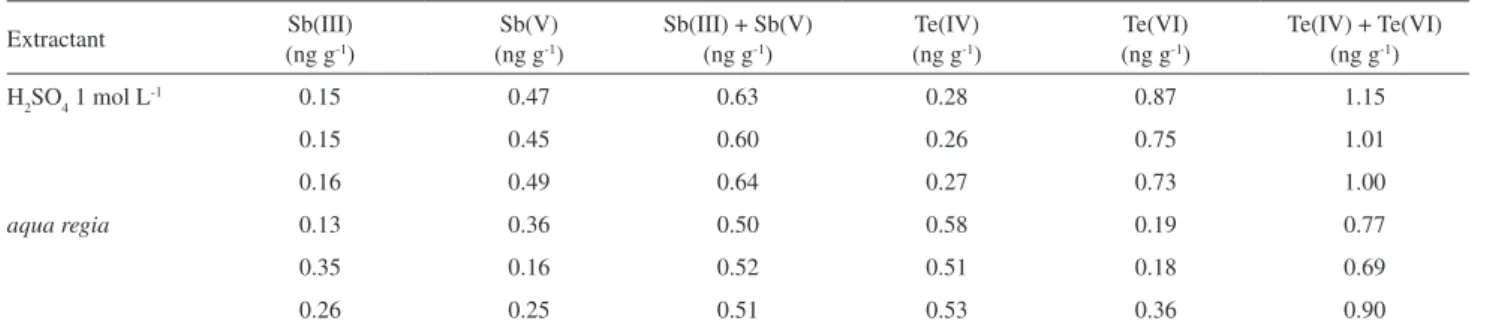
and aqua regia resulted the most eficient extractants of Te and Sb from cereals. However, for Sb, a separate extraction was carried out with aqua regia for the same sample of rice, giving different concentrations of Sb(III) and Sb(V), despite that the total content of inorganic Sb was quite reproducible. Additionally, the total content of Te species extracted was around 85% for the total content of Te, and data found for Te(IV) were quite higher than those expected (see Table 2). Consequently, 1 mol L-1 H
2SO4 was
selected as the best extracting agent for speciation of Sb and Te in cereals. Results show a reproducible distribution of Sb and Te species in the studied sample, being Sb(V) and Te(VI) the main chemical forms in this sample.
Strategy for the speciation analysis of Sb(III), Sb(V), Te(IV) and Te(VI)
The speciation strategy was based on previous experience in non-chromatographic speciation by HG AFS which evidenced that Sb(V) reacts with NaBH4 forming
Table 2. Selection of the best extractant for the Sb and Te determination in a rice sample
Extractant Sb(III)
(ng g-1)
Sb(V) (ng g-1)
Sb(III) + Sb(V) (ng g-1)
Te(IV) (ng g-1)
Te(VI) (ng g-1)
Te(IV) + Te(VI) (ng g-1)
H2SO4 1 mol L-1 0.15 0.47 0.63 0.28 0.87 1.15
0.15 0.45 0.60 0.26 0.75 1.01
0.16 0.49 0.64 0.27 0.73 1.00
aqua regia 0.13 0.36 0.50 0.58 0.19 0.77
0.35 0.16 0.52 0.51 0.18 0.69
0.26 0.25 0.51 0.53 0.36 0.90
stibine with a reaction kinetics slower than that of Sb(III).23
So, the AFS signals produced by the pentavalent species of Sb depend on hydride generation conditions. In order to determine the total Sb content a pre-reduction is thus required to reduce quantitatively Sb(V) to Sb(III). Based on the different AFS sensitivity obtained from Sb(V) with and without pre-reduction, it could be possible to determine Sb(III) and Sb(V) concentrations on the same sample based on two independent measurements, one without a previous reduction and another after a quantitative transformation of Sb to Sb(III), and to establish a system of two equations with two unknowns related to the oxidation states of Sb.15 On the
other hand, Te(VI) does not react with NaBH4 to form the corresponding hydrides, being necessary to reduce it to the (IV) oxidation state with KBr or boiling using 2-6 mol L-1
HCl before HG AFS measurements.26 Therefore, speciation
of Te(IV), Te(VI) can be easily carried out by HG AFS using a two step analysis. Samples must be analysed without pre-reduction, in order to determine Te(IV) concentrations; then, the sample must be treated with KBr in acidic medium at 75 ± 5 ºC for 30 min in order to achieve a quantitative reduction of Te(VI) to Te(IV) present in the sample. The analysis of this last solution gives the total concentration of Te(IV) and Te(VI), and can be calculated by the difference between the two analysis performed.22
Analytical igures of merit
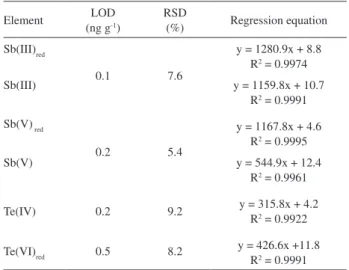
The main analytical parameters of the developed procedure, such as sensitivity, limit of detection (LOD) and precision are summarized in Table 3, together with the slope of typical regression equations obtained before and after KI or KBr reduction. The LOD values were calculated by dividing three times the standard deviation of the luorescence signal of 10 reagent blanks by the slope of the calibration curve, in the best experimental conditions, for each Sb and Te species. The LOD was also established for dried samples, taking into account the sample mass and dilution factor involved in the proposed method. The precision expressed as relative standard deviation (RSD%) for 10 replicate analysis of a sample is also reported. As it can be seen, concentrations from 0.1 to 0.5 ng g-1 of Sb
and Te species can be detected and concentrations of few ng g-1 can be determined with relative standard deviations
from 5.4 to 9.2%.
Accuracy studies
To evaluate the accuracy of the inorganic species determination in cereal samples, a series of recovery studies on a rice sample spiked with different concentrations of
Sb(III), Sb(V), Te(IV) and Te(VI) were made to verify the lack of interconversion of original species during the extraction and measurement steps. The sample was spiked with 10, 20 and 40 ng g-1 of each specie before the extraction
process. The recovery values were always higher than 95% for all the species considered at the spiked levels (see Table 4). These good recovery values evidence the stability of each species during the extraction process. In relation to organic species of Sb and Te, it was not possible to evaluate the possible presence of organic species because organic standards are not commercially available. However, the good correlation between the sum of inorganic species and the total concentration values seems to indicate the absence of organic species of the aforementioned elements in cereal samples.
It was also determined the concentration of Sb(III), Sb(V), Te(IV) and Te(VI) in two certified reference materials, NIST 1573a (tomato leaves) and IAEA 140-TM (Fucus sp). Results obtained (see Table 5) evidence that the sum of the analyzed species agree well with the total Sb certiied value and in the case of Te, there is not available certiied sample.
Analysis of commercial cereal samples
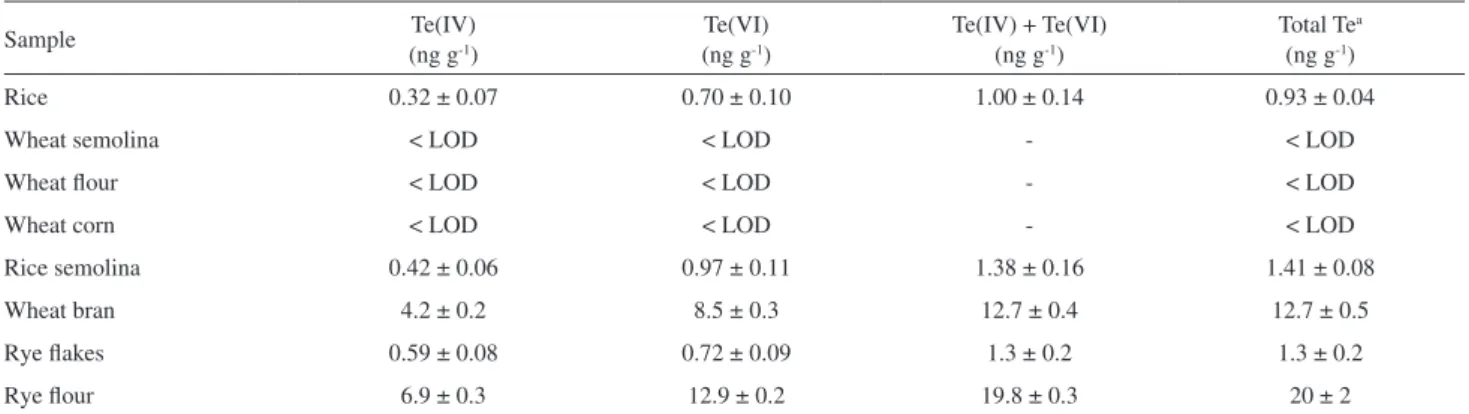
Samples of cereals, obtained from the local market of Valencia were analyzed by the proposed procedure and results found for Sb and Te species are summarized in Tables 6 and 7, together with data found for total Sb and Te determination based on dry-ashing mineralization and HG AFS. The t-test demonstrated that there are no signiicant differences between the results found for total Sb and total Te and those obtained from the sum of the species determined by the proposed method (−0.49 < tcritical = 2.57).
Table 3. Analytical igures of merit obtained for non-chromatographic speciation of inorganic Sb and Te in cereal samples through HG AFS
Element LOD
(ng g-1)
RSD
(%) Regression equation
Sb(III)red
0.1 7.6
y = 1280.9x + 8.8 R2 = 0.9974
Sb(III) y = 1159.8x + 10.7
R2 = 0.9991
Sb(V) red
0.2 5.4
y = 1167.8x + 4.6 R2 = 0.9995
Sb(V) y = 544.9x + 12.4
R2 = 0.9961
Te(IV) 0.2 9.2 y = 315.8x + 4.2
R2 = 0.9922
Te(VI)red 0.5 8.2 y = 426.6x +11.8
Table 4. Recovery percentages of inorganic Sb and Te species in cereal samples by HG AFS in three different addition levels, all results were the average and standard deviation of n = 3 determinations
Sb(III) (ng g-1)
Recovery (%)
Sb(V) (ng g-1)
Recovery (%)
Te(IV) (ng g-1)
Recovery (%)
Te(VI) (ng g-1)
Recovery (%)
10 99.4 ± 1.5 10 95.4 ± 1.4 10 99 ± 3 10 98.4 ± 0.9
20 97 ± 2 20 99 ± 3 20 94.6 ± 1.4 20 98 ± 2
40 101 ± 4 40 100.0 ± 0.7 40 98.9 ± 1.1 40 100.0 ± 0.8
Table 5. Antimony and Te species found in NIST 1573a (tomato leaves) and IAEA 140-TM (Fucus sp)
CRM Sb(III)
(ng g-1)
Sb(V) (ng g-1)
Sb(III) + Sb(V) (ng g-1)
Te(IV) (ng g-1)
Te(VI) (ng g-1)
Te(IV) + Te(VI) (ng g-1)
NIST 1573 14.4 ± 1.1 50.8 ± 1.7 64.8 ± 1.9 31 ± 2 11 ± 2 41 ± 3
IAEA 140-TM 50.0 ± 0.3 52.8 ± 0.4 103.5 ± 0.8 45.0 ± 0.15 20 ± 3 65 ± 3
Total certiied value for NIST 1573a: Sb = 0.063 ± 0.006 µg g-1; Recommended value for IAEA 140-TM: Sb = 0.103 µg g-1.
Table 6. Determination of Sb(III) and Sb(V) in cereal samples by HG AFS, expressed as mean ± standard deviation for n = 3
Sample Sb(III)
(ng g-1)
Sb(V) (ng g-1)
Sb(III) + Sb(V) (ng g-1)
Total Sba (ng g-1)
Rice 0.15 ± 0.01 0.47 ± 0.02 0.6 ± 0.2 0.65 ± 0.03
Wheat semolina < LOD < LOD - < LOD
Wheat lour 0.19 ± 0.03 0.22 ± 0.09 0.39 ± 0.03 0.34 ± 0.05
Corn lour 0.19 ± 0.07 0.33 ± 0.10 0.52 ± 0.09 0.5 ± 0.1
Rice semolina 0.17 ± 0.11 0.30 ± 0.09 0.38 ± 0.08 0.42 ± 0.06
Wheat bran 1.6 ± 0.4 1.2 ± 0.3 2.9 ± 0.5 2.9 ± 0.3
Rye lakes 1.5 ± 0.3 1.4 ± 0.3 2.9 ± 0.5 2.9 ± 0.1
Rye lour < LOD < LOD - < LOD
aLOD for total Sb: 0.2 ng g-1.
Table 7. Determination of Te(IV) and Te(VI) in cereal samples by HG AFS, expressed as mean ± standard deviation for n = 3
Sample Te(IV)
(ng g-1)
Te(VI) (ng g-1)
Te(IV) + Te(VI) (ng g-1)
Total Tea (ng g-1)
Rice 0.32 ± 0.07 0.70 ± 0.10 1.00 ± 0.14 0.93 ± 0.04
Wheat semolina < LOD < LOD - < LOD
Wheat lour < LOD < LOD - < LOD
Wheat corn < LOD < LOD - < LOD
Rice semolina 0.42 ± 0.06 0.97 ± 0.11 1.38 ± 0.16 1.41 ± 0.08
Wheat bran 4.2 ± 0.2 8.5 ± 0.3 12.7 ± 0.4 12.7 ± 0.5
Rye lakes 0.59 ± 0.08 0.72 ± 0.09 1.3 ± 0.2 1.3 ± 0.2
Rye lour 6.9 ± 0.3 12.9 ± 0.2 19.8 ± 0.3 20 ± 2
aLOD for total Te: 0.8 ng g-1.
From the different type of samples analyzed it can be concluded that Te(VI) is the main specie of Te in raw cereals and cereal based products. On considering Sb species it seems that Sb(V) is predominant in raw cereals
Conclusions
The non-chromatographic strategy developed for Sb(III), Sb(V), Te(IV) and Te(VI) determination in cereals and cereal based products by HG AFS offers a simple and sensitive alternative to hyphenated techniques for speciation analysis. The speciation analysis of Sb and Te in cereal samples based on the sonication of samples for 10 min with 1 mol L-1 H
2SO4 at room temperature, followed by a
washing step with EDTA provides quantitative recoveries of both considered elements and does not modify the original Sb and Te species present in cereals. The levels of Sb(III), Sb(V), Te(IV) and Te(VI) found, evidenced that the developed procedure is suitable to obtain quantitative data for cereal samples and that is a guarantee of the absence of risks in the consumption of the considered samples.
Acknowledgments
The authors gratefully acknowledge to the Ministerio de Educación y Ciencia Project AGL2007-64567 for the inancial support.
References
1. Fowler, B. A.; Goering, P. L. In Metals and their Compounds in the Environment: Occurrence, Analysis and Biological
Relevance; Merian, E., ed.; VCH Verlagsgesellschaft: Weinhein,
1991, ch. 2.
2. Cal-Prieto, M. J.; Carlosena, A.; Andrade, J. M.; Martínez, M. L.; Muniategui, S.; López-Mahía, P.; Prada, D.; Water, Air, Soil Pollut. 2001, 129, 333.
3. Amereih, S.; Meisel, T.; Scholger, R.; Wegscheider, W.; J. Environ. Monit.2005, 7, 1200.
4. Hammel, W.; Debus, R.; Steubing, L.; Chemosphere2000, 41, 1791.
5. Frézard, F.; Demicheli, C.; Ribeiro, R. R.; Molecules 2009, 14, 2317.
6. Sharma, P.; Perez, D.; Cabrera, A.; Rosasi, N.; Arias, J. L.; Acta Pharmacol. Sin.2008, 29, 881.
7. Sadeh, T. In The Chemistry of Organic Selenium and Tellurium Compounds; Patai, S., ed.; Wiley: New York, 1987, ch. 11, p.
367.
8. Karlson, U.; Frankenberger, W. T.; Metal Ions in Biological Systems, Marcel Dekker: New York, 1993.
9. Centre for Food Safety, Hong Kong, China, http://www.cfs.gov. hk, accessed in December 2009.
10. Emsley, J.; The Elements of Murder, Oxford University Press: Oxford, UK, 2005.
11. Locatelli, C.; Torsi, G.; Microchem. J. 2003, 75, 233. 12. Locatelli, C; Anal. Bioanal. Chem.2005, 381, 1073. 13. Locatelli, C.; J. Sci. Food Agric.2007, 87, 305.
14. Miravet, R.; Hernandez-Nataren, E.; Sahuquillo, A.; Rubio, R.; López-Sánchez, J. F.; TrAC, Trends Anal. Chem.2010, 29, 28. 15. Matos-Reyes, M. N.; Cervera, M. L.; De la Guardia, M.; Anal.
Bioanal. Chem.2009, 394, 1557.
16. Sousa-Ferreira, H.; Costa-Ferreira, S. L.; Cervera, M. L.; De la Guardia, M.; Spectrochim. Acta, Part B2009, 64, 597. 17. Cava-Montesinos, P.; De la Guardia, A.; Teutsch, C.; Cervera,
M. L.; De la Guardia, M.; Anal. Chim. Acta2003, 493, 195. 18. Morita, Y.; Kobayashi, T.; Kuroiwa, T; Narukawa, T.; Talanta
2007, 73, 81.
19. Kuo, C. Y.; Jiang, S. J.; J. Chromatogr., A2008, 1181, 60. 20. Narukawa, T.; J. Anal. At. Spectrom. 1999, 14, 75.
21. Yu, C.; Cai, Q. T.; Guo, Z. X.; Yang, Z.; Khoo, S. B.; Anal. Bioanal. Chem.2003, 376, 236.
22. Cava-Montesinos, P.; De la Guardia, A.; Teustch, C.; Cervera, M. L.; De la Guardia, M.; J. Anal. At. Spectrom.2004, 19, 696. 23. Gonzalvez, A.; Armenta, S.; Cervera, M. L.; De la Guardia, M.;
TrAC, Trends Anal. Chem. 2010, 29, 260.
24. Matos-Reyes, M. N.; Cervera, M. L.; Campos, R. C.; De la Guardia, M.; Food Chem.2010, 122, 188.
25. Matos-Reyes, M. N.; Cervera, M. L.; Campos, R. C.; De la Guardia, M.; Talanta 2008, 75, 811.
26. Nakahara, T.; Bunseki Kagaku 1997, 46, 513.
Submitted: May 21, 2010