of open geodata in cities
Dissertation submitted by Manuel Fernando Benitez Paez to apply for the joint doctorate degree from the Universitat Jaume I, Universida de Nova de Lisboa and
Universität Münster.
European Joint Doctorate Marie Sklodowska-Curie in
Geoinformatics
Doctoral School from Universitat Jaume I
Manuel Fernando Benitez Paez
Supervisors:
Dr. Joaquin Huerta Dr. Roberto Henriques Dr. Christian Kray (Universitat Jaume I) (Universidade Nova de Lisboa) (Universität Münster)
Every word in this dissertation is dedicated to my mom, Flor Paez, my aunt Cenaida Paez, my patient and lovely, Carolina Jimenez, and finally to my little brother Linton Paez who from heaven is guiding all my steps. All of this is for each of you.
Acknowledgments
There are many people who contributed in certain ways to achieve the results presented in this research. First, to all, I would like to thank my main supervisor Joaquin Huerta, to the guide and all support along this research also to introducing me to the European geospatial community and its challenges, projects, communit-ies and overall to help me to start an academic carrier in the European research community. Special thanks to Michael Gould who always provided me with new insights and different ways to tackle different open data issues. Special thanks to professor Christian Kray for his support, new ideas, comments and always helping to get better results in my publications and the GeoC outcomes. I am very grateful to Sergi Trilles for his support in all my research, and pushing me to move forward and reach always better results. Special thanks to professor Auriol Degbelo of the Institute of geoinformatics of the University of Münster for his patience, guidance, support and especially to helping me to understand how the scientific contributions should be and the right method to follow. Special thanks also to my co-supervisor Roberto Henriques for helping me in my external semester in Lisbon finding the way to reach the initial publication presented in this research. I am very grateful to professor Alexis Comber from the school of the geography of the University of Leeds for the guide in my second publication presented in this research.
Besides my advisors, I would like to thank the two international experts Dr. Rolf de By and Dr. Çetin Cömert for their comments, suggestions, and questions that make of this thesis a better contribution. To my colleagues and friends in the GeoTec research group and the GeoC project, their interesting comments, and help with the activities that this research carried out. I want to express my acknowledgement to the four data authorities who allow me to perform the participatory workshops and always be interested in the topic presented in this investigation. To Pamela Mayorga in IDECA Bogotá, Julio Muñoz in IDECS
-Cali, Jose Ignacio and Iris Alonso (Valencia City Hall), Diego Alvarez (Professor in UPV), and Ana Melchor (Las Naves) in Valencia city, and Marcela Perez in Medellin City Hall. But special thanks to all data users communities that were part of our activities, their suggestions, comments, barriers and especially their commitment to making a better and useful local open geodata were the keystones where this research is developed.
Resumen
Open Data cuenta hoy en día con un profundo impacto en un ambiente donde la información es creada y compartida en todos los niveles. En los gobiernos locales, las iniciativas de datos abiertos han resultado en altos niveles de transparencia. Un importante nivel de empoderamiento entre los tomadores de decisiones y los ciudadanos ha cambiado la forma en que los datos, su reuso y como son usados por gobiernos locales. Sin embargo, el actual reto de las iniciativas de datos abiertos de las ciudades va mucho más allá de la accesibilidad, y el desarrollo de marcos de trabajo que permitan evaluar el impacto de los actuales proyectos de datos abiertos se ha convertido en un elemento destacado en cualquier estrategia, desde amplios catálogos de datos hasta incrementables niveles de reuso. No obstante, a pesar de contar cada día con más catálogos de datos liberados, solo algunos estudios se han centrado en el problema de la reusabilidad, cuáles son las barreras que evitan que los datos geográficos abiertos se usen efectivamente, tomando en cuenta principalmente el punto de vista de los usuarios de datos. Aunque algunos "frameworks" ilustran el nivel de madurez de las iniciativas de datos abiertos a nivel nacional, parece que se requieren marcos de trabajo a nivel local, los cuales ciertamente no se toman en cuenta de forma adecuada en la literatura. Se necesita un marco de trabajo que guie a las autoridades de datos locales a incluir o enganchar a los actuales usuarios además de permitirles mover hacia una estrategia ascendente.
Esta investigación contribuye con tres elementos en este sentido. El primero es un estado actual del nivel del reuso de los datos geográficos abiertos en las ciudades. Segundo por la delimitación de una taxonomía de barreras que los usuarios de datos en Colombia y en España deben enfrentar. Y finalmente la tercera contribución es un conjunto de elementos que forman una estrategia centrada en los usuarios enmarcados en un marco de trabajo o “Framework” qué
ayuda a las autoridades de datos a mejorar el nivel de reuso de los datos en geográficos publicados en las actuales iniciativas locales de datos abiertos. La taxonomía propuesta y framework están basados en la revisión literaria, encuesta online y un conjunto de talleres participativos conducidos en cuatro ciudades (Bogotá, Medellín, Cali en Colombia y Valencia en España), con autoridades de datos y comunidades de usuarios de diferentes perfiles y experiencia en datos abiertos.
La taxonomía presentada en esta investigación destaca variedad de obstáculos que evitan que los usuarios puedan hacer un uso efectivo de los datos geográficos disponibles, mencionado algunas de estas barreras, encontramos que los datos desactualizados, baja integración de los productores de datos, y un acceso complejo a los datos publicados, son las barreras más mencionadas y que más preocupan a las comunidades de usuarios.
Una vez las barreras se han identificado y validado con las comunidades de usuarios de datos a través de las ciudades seleccionadas esta investigación definió los elementos que deberán ser incluidos en un marco conceptual de trabajo que permita a las autoridades de datos usar como guía, para mejorar el nivel del reuso de sus actuales iniciativas de datos abiertos. El framework presentado cuenta con partes esenciales en la correcta implementación de los elementos presentados. Inicialmente el framework requiere de una base definida por tres elementos denominados “Impact Enablers” o habilitadores de impacto. Estos habilitadores se han considerado relevantes por ser identificados en la literatura validada como elementos que permiten un reuso sostenibles en otras iniciativas de datos abiertos. Los habilitadores de impacto son: A) Comunidades de usuarios, pero en especial sus requerimientos en datos abiertos. B) Iniciativas de datos abiertos a nivel local o ciudad como una forma mas efectiva de promover con usuarios el proyecto de open data. Finalmente, C) Un enfoque geográfico, como un potencializado de reuso de datos en los usuarios, gracias a ser el tipo de datos que mas se consulta y se solicita por parte de esta comunidad.
La segunda parte del marco centrado en el usuario es compuesta por cuatro recursos/elementos que se proponen deben estar conectados. 1) Una completa y constante identificación de las comunidades de usuarios de datos y su demanda de datos. 2) La comunidad del reuso. Un conjunto de herramientas para promover la reusabilidad de los datos geográficos publicados. 3) Metadatos centrados en el usuario y 4) términos de reuso centrados igualmente en el usuario. Estos
elementos mencionados fueron agrupados e incluidos por su relevancia para las comunidades de usuarios en los cuatro casos de éxito de esta investigación. El “framework” propuesto en esta investigación provee una clara hoja de ruta para autoridades de datos locales que buscan reformar su actual iniciativa de datos abiertos hacu un enfoque ascendente que incluya los usuarios de datos como un elemento primordial. Esta investigación finaliza con una discusión y conclusiones además de las posibles limitaciones que los resultados de nuestras contribuciones puedan llegar tener lugar.
Introducción
El número de iniciativas, colaboraciones y proyectos relacionados con datos abiertos aumenta cada día, y la mayoría de los gobiernos nacionales y locales actualmente se esfuerzan por avanzar con implementaciones de datos abiertos. Para estas administraciones, los problemas críticos en el éxito de los portales de datos abiertos han sido la accesibilidad y los datos que contienen. Para crear portales web más útiles y fáciles de usar, se han desarrollado soluciones tecnoló-gicas para respaldar los requisitos de accesibilidad de los organismos públicos nacionales y locales. Estas soluciones han sido impulsadas por regulaciones locales y nacionales para garantizar procesos de publicación de datos abiertos dentro de los organismos públicos (Zuiderwijk and Janssen, 2014). Sin embargo, aún quedan algunos problemas críticos y nuevos desafíos que el movimiento de datos abiertos tiene que abordar. Esta tesis abarca el desafío de la reutil-ización con el que muchas autoridades de datos están luchando después de la implementación de sus portales de datos abiertos. De manera similar, después de varios años de implementación, la comunicación y la colaboración entre los usuarios de datos y las autoridades no ha progresado tan bien como se esperaba. Por un lado, los usuarios aún solicitan datos más útiles o han perdido confianza en los nuevos portales, y su percepción es que los datos proporcionados no son adecuados para sus necesidades. Por otro lado, las autoridades de datos están continuamente tratando de capacitar a sus usuarios y aumentar los niveles de reutilización de datos.
Motivación
Nuestro trabajo está motivado por un entorno de datos abiertos donde el enfoque descendente (desde los productores de datos hasta los usuarios) se ha estudiado y aplicado en muchos contextos durante varios años. Sin embargo, después de 15 años de implementaciones de datos abiertos, parece que este enfoque no es suficiente para alcanzar los beneficios que se recomendaron. Se necesita un enfoque ascendente (desde los usuarios hasta los productores de datos) como una forma eficaz de desarrollar una iniciativa de datos abiertos sostenible y eficiente que funcione en tres direcciones. El primero es el papel aislado de las comunidades de usuarios de datos en proyectos de datos abiertos en curso. El segundo involucra la creciente atención de las ciudades y su potencial para desarrollar estrategias efectivas entre las necesidades de los ciudadanos y las autoridades locales. Finalmente, el tercero es la posibilidad de incluir datos geográficos como combustible para impulsar iniciativas efectivas. En la siguiente sección, se define el problema abordado en esta investigación y se abordan las preguntas de la investigación.
Problema
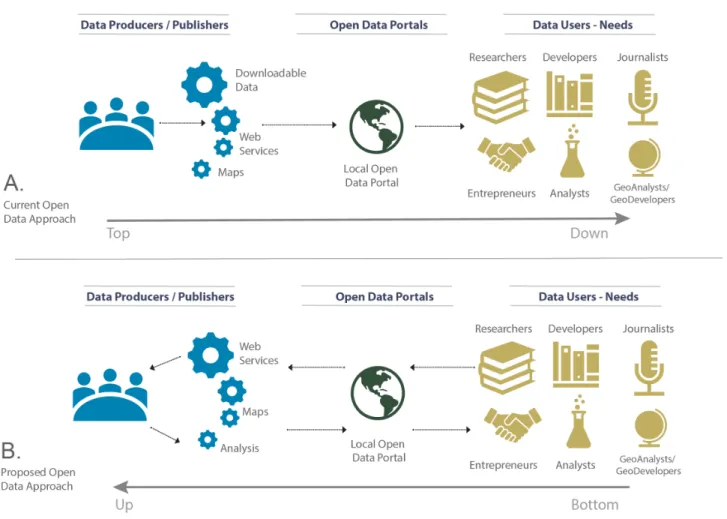
En un entorno de datos abiertos descendente, la demanda de datos de los usuarios se considera solo brevemente (The European Data Portal, 2016) y el productor de datos es el que establece qué recursos, herramientas o métodos de retroalimentación deben incluirse. Este escenario unidireccional considera los portales de datos abiertos como el puente que permite a los usuarios de diferentes orígenes acceder a los datos publicados (consulte la parte A de la Figura 1.2). Sin embargo, las autoridades de datos buscan activamente mejorar la reutilización de los datos abiertos disponibles, a fin de permitir que las comunidades de usuarios de datos formen parte de un escenario mejorado, es decir, el enfoque de ascendente. Esta investigación abarca el desafío de la reutilización con el que muchas autoridades de datos están luchando en la implementación de sus portales de datos abiertos. Del mismo modo, la comunicación y la colaboración entre los usuarios de datos y las autoridades no han progresado bien. Por un lado, los usuarios aún requieren datos más útiles o han perdido confianza en los portales nuevos o ya implementados, y perciben que los datos proporcionados no son adecuados para sus necesidades. Por otro lado, las autoridades de datos intentan continuamente capacitar a sus usuarios y aumentar los niveles de reutilización de datos.
Nuestro objetivo es definir un enfoque ascendente que considere que los portales de datos abiertos están más conectados con las necesidades de los usuarios y que no tiene una comunicación unidireccional del productor de datos únicamente. El enfoque sugerido es circular, donde el rol y las contribuciones de las comunidades de usuarios de datos definen los pasos posteriores que se deben tomar en las iniciativas de datos abiertos en curso (consulte la parte B de la Figura ref fig: Problema). Estos pasos son: (a) Metadatos centrados en el usuario que están concebidos para proporcionar información que ayuda a los usuarios a evaluar la utilidad de un conjunto de datos con respecto a su problema; (b) Términos legales centrados en el usuario que ayudan a los usuarios a com-prender el nivel de reutilización, en lugar de tener que leer términos de licencia complicados; (c) Desarrollar y fomentar una comunidad de reutilización en la que los usuarios con diferentes perfiles y necesidades puedan ver fácilmente otros ejemplos, casos de uso, comentarios o sugerencias de otros sobre la reutilización de datos abiertos; finalmente, (d) una identificación completa de los usuarios de datos y su demanda de datos para tener una mejor idea de los servicios más solicitados, problemas o requisitos de calidad de los datos, y crear eventos, metodologías y herramientas centradas en el usuario que sean relevantes para el Iniciativa local de datos abiertos.
En resumen, la siguiente lista establece las preguntas de investigación definidas en esta tesis y mencionadas anteriormente.
• RQ1: ¿Cuál es el estado actual de la reutilización de datos abiertos a nivel
local (ciudades)?
• RQ2: ¿Qué barreras impiden la reutilización de datos geográficos abiertos
por parte de los usuarios de datos locales?
• RQ3: ¿Qué estrategia se necesita para mejorar el nivel de reutilización de
Contribuciones
• Estado de reutilización actual de datos abiertos en iniciativas locales
Conocer el estado actual del nivel de reutilización de datos abiertos es el principal requisito para poder contribuir luego a mejorarlo. La literatura con-tiene mucho trabajo sobre el impacto, las implicaciones y el valor agregado, pero aún falta una definición precisa de lo que significa la reutilización.
• Taxonomía de las barreras de los usuarios de datos: Una vez que se
definió claramente el estado actual, nuestro segundo objetivo fue determinar las barreras o fricciones desde la perspectiva del usuario a nivel local que impiden el uso adecuado y la reutilización de los datos publicados. Esta ruta nos llevó a investigar el estado actual de los portales de datos abiertos en las ciudades mediante la recopilación de barreras antiguas, los formatos de datos requeridos, los tipos de datos más utilizados y las recomendaciones de usuarios de diferentes orígenes para establecer una taxonomía de las barreras de los usuarios de datos (Benitez-Paez et al., 2017).
• Un marco conceptual para mejorar la reutilización de los datos
geo-gráficos abiertos en las ciudades: La tercera contribución es un marco
centrado en el usuario para ayudar a las autoridades locales de datos a reformular su estrategia de datos abiertos en curso hacia una estrategia centrada en el usuario. Validado con usuarios de datos en la ciudad de Valen-cia (España), este marco se basa en un conjunto de recomendaciones de usuarios de datos en cuatro ciudades (Bogotá, Cali y Medellín en Colombia y Valencia en España) (Benitez-Paez et al., 2018).
Marco Teórico
El número y la variedad de iniciativas de datos abiertos han aumentado a nivel mundial. Varios estudios se han centrado en las barreras, las características clave, los desafíos de implementación, el uso y los casos de impacto. Peled (2013) analizó los problemas actuales de la primera versión de datos abiertos en los EE. UU. después del lanzamiento del programa de Gobierno Abierto de la administración de Obama. Propusieron una nueva etiqueta Open Data 2.0 para incluir estrategias de datos liberadas. Señalan el potencial temporal de la política de transparencia, es decir, situaciones en las que las políticas solo se
implementan durante cortos períodos de tiempo. Sieber and Johnson (2015) analizó el rol cambiante del gobierno en la "cultura" de datos abiertos y presentó cuatro modelos en los que los ciudadanos, el sector privado y las autoridades realizan cambios para determinar la efectividad de las futuras estrategias de datos abiertos.
El potencial de los datos abiertos se relaciona no solo con el gobierno o la autoridad local, sino también con partes interesadas con diferentes roles, intereses y contribuciones. Una consideración crítica es cómo el valor agregado se crea a través de la cadena de datos y análisis Carrara et al. (2017a). Kassen (2013) exploró el potencial empoderador de los datos abiertos a nivel local como una plataforma para la participación ciudadana, basada en un caso de uso en Chicago. Kassen señaló que los esquemas de descendentes a nivel local pueden proporcionar una plataforma efectiva para recopilar y comprender los requisitos de los ciudadanos. El papel del gobierno local en el movimiento de datos abiertos también es cada vez más reconocido. Por ejemplo, la comision euroepa señaló que datos abiertos tiene el potencial de convertirse en el activo mas valioso para los ciudadanos, las empresas y las autoridades públicas (The European Data Portal, 2016).
En general, hay una gran cantidad de trabajos publicados sobre la reutilización de datos abiertos debido a que es uno de los desafíos para las iniciativas actuales. Barry and Bannister (2014) seleccionó las ocurrencias de algunos temas relacion-ados con datos abiertos, mencionando que el intercambio y la reutilización de datos son dos temas con un gran número de ocurrencias, lo que demuestra un enfoque en aprovechar al máximo el recurso de información del sector público. La literatura ha analizado los angulos economicos Johnson et al. (2017); Jetzek et al. (2012); Ahmadi Zeleti et al. (2016), técnicos, institucionales Yang et al. (2015); Cranefield et al. (2014), factores políticos y regulador Nug (2015); Jetzek et al. (2013) que influyen en la cadena de valor de los datos abiertos, lo que sugiere que los beneficios teóricos no se ha visto como se esperaba en las ciudades Carrara et al. (2017b); Janssen et al. (2012); Conradie and Choenni (2014); Barry and Bannister (2014); Attard et al. (2015); Cranefield et al. (2014).
Con respecto a la intersección de iniciativas entre esfuerzos nacionales y loc-ales, ambos trabajando para mejorar los esfuerzos de su iniciativa de Gobierno Abierto, en muchos casos, los conjuntos de datos se ofrecen en varios sitios web Yang et al. (2015) de forma fragmentada, que es difícil de encontrar. También se
necesitan metadatos adecuados para mejorar la reutilización de datos Janssen et al. (2012). La cooperación entre los departamentos municipales para promover y gestionar el proceso de intercambio de datos es un desafío diario relevante para muchos organismos públicos. Crear un marco para la colaboración podría ser una de las formas en que una IDE local puede contribuir a proyectos locales de datos abiertos, debido a su experiencia en el desarrollo de acuerdos legales, técnicos e institucionales. No obstante, las IDE locales también tienen muchas barreras que superar con respecto al intercambio de datos. Carrara et al. (2017a) identi-ficó las características de los datos geográficos como barreras técnicas para la reutilización de las iniciativas de datos abiertos. Las diferencias entre estándares, formatos, tamaño de archivos, estándares de calidad de datos, derivadas de Directivas como INSPIRE1.
Para resumir, el trabajo realizado por otros autores (mediante entrevistas, en-cuestas y/o talleres) ha identificado un conjunto de barreras principalmente desde el punto de vista del productor de datos, donde las autoridades nacionales desem-peñan el papel principal de las iniciativas de datos abiertos. En cuanto a la reutilización de datos abiertos, no hay mucho trabajo realizado; encontramos solo cuatro referencias relacionadas, ninguna de ellas ha considerado el posible po-tencial de los datos geográficos o el papel que pueden desempeñar las ciudades. El número de artículos que examinan los obstáculos de reutilización desde la perspectiva de un usuario de datos también es limitado.
Metodologia
Durante este capitulo 5, se describen las etapas consideradas en esta invest-igación. La figura 3.8 muestra inicialmente que la revisión de la literatura incluía la validación del estado actual del estado de los datos abiertos a nivel local. Esta revisión de la literatura se realizó para validar cómo otros autores han considerado el tema de la reutilización, analizando otros casos de uso, las implicaciones y las barreras encontradas que impiden la reutilización efectiva de los datos abiertos.
Una vez que la revisión de la literatura revela algunas barreras y consideraciones tales como la importancia del nivel local, la brecha entre las actividades de los productores de datos y los requisitos de los usuarios de datos y, finalmente, el tipo de datos que podría alentar a las comunidades de usuarios de datos a reutilizar más activamente los datos de publicación. La encuesta en línea fue
diseñada para preguntar directamente a las personas en las ciudades acerca de su percepción sobre la reutilización de datos abiertos. La encuesta en línea compartida públicamente permite a esta investigación definir qué ciudades eran más participativas, teniendo a Bogotá, Medellín, Cali en Colombia y València en España como ciudades con más participantivas, por lo tanto, fueron las ciudades seleccionadas para la siguiente etapa.
Con más de 113 usuarios de datos en las cuatro ciudades, lideramos una discusión y un conjunto de actividades adecuadamente descritas en el capitulo 3 donde la reutilización, el impacto de los datos abiertos y los requisitos de los usuarios de datos fueron los temas clave que recopilamos para validar las barreras identificadas en La encuesta mencionada. Dos talleres participativos adicionales fueron conducidos a obtener la retroalimentación requerida sobre el resultado preliminar y los supuestos presentados en esta investigación. La conferencia AGILE 2017 fue la manera de discutir los resultados de la encuesta en línea y algunas de las recomendaciones de los usuarios de datos recopilados en los talleres anteriores.
Los resultados de estas actividades iniciales se describieron correctamente en el artículo de investigación Benitez-Paez et al. (2017), en el que definimos una taxonomía de las barreras de los usuarios de datos para ayudar a las autorid-ades de datos a identificar fácilmente dónde están teniendo más problemas sus comunidades de usuarios de datos.
Sin embargo, la definición de una taxonomía de barreras parece no ser su-ficiente, se requiere un tipo de guía para ayudar a las autoridades de datos a reformular sus estrategias actuales considerando un enfoque ascendente e incluir las recomendaciones hechas por usuarios de datos en los talleres participativos. Incluyendo el conjunto de recomendaciones de los talleres participativos an-teriores, la revisión de la literatura y las preocupaciones más mencionadas en la taxonomía, se diseña y valida un marco conceptual en un taller participativo adicional con usuarios de datos de la ciudad de València. La descripción completa de los elementos de este marco de trabajo se describe adecuadamente en el capitulo 5
Barreras que evitan la reutilización de datos geográficos en las ciudades, desde la perspectiva de los usuarios de datos
A través de tres actividades principales, nuestro trabajo se dedicó a analizar en toda la literatura el estado actual de la reutilización de datos geográficos abiertos. En segundo lugar, mediante una encuesta en línea exhaustiva, preguntamos a los usuarios de datos, especialmente en las ciudades, sobre sus impresiones, desafíos, barreras, recomendaciones y su opinion general sobre el nivel de reutilización de los geodatos abiertos en sus ciudades. Esta encuesta nos permite tener una mejor imagen de los problemas potenciales que los usuarios locales enfrentan actualmente en relación con la reutilización. A pesar de la cantidad de respuestas válidas (195 respuestas válidas, consulte el Capítulo anterior 3), la validación y la discusión cara a cara fueron necesarias para corroborar lo que las personas dicen y lo que las personas hacen.
Teniendo en cuenta solo las ciudades más participativas, hemos seleccionado cuatro ciudades para organizar un conjunto de talleres participativos. Durante esos talleres participativos, nos reunimos con autoridades de datos locales, comunid-ades de usuarios de datos con diferentes antecedentes y experiencia en datos abiertos, en torno al concepto de reutilización. Recolectando barreras y recomen-daciones, esta discusión fue la manera de validar las barreras identificadas. El resultado de esas actividades es la taxonomía de las barreras de los usuarios de datos y el estado actual del nivel de reutilización de geodatos abiertos que describe el capitulo 4.
Marco para mejorar el nivel de reutilización de datos geográficos abiertos en las ciudades
A través de la taxonomía de las barreras, describimos los problemas más comúnmente mencionados que enfrentan los usuarios de datos en las iniciativas en curso de datos abiertos. Las categorías y las barreras descritas en el Capítulo 4 se basaron en el documento de investigación de Benitez-Paez et al. (2017). Actualmente, autoridades como IDECA en Bogotá o Valencia lideran la campaña de datos abiertos en sus respectivas ciudades. Sin embargo, buscan activamente incluir más usuarios en sus iniciativas de datos abiertos, dado que el enfoque descendente no ha tenido éxito en los últimos años.
Aunque la descripción de las barreras que enfrentan los usuarios de datos es una herramienta útil para los autoridades locales de datos abiertos, esta
investigación propone una forma centrada en el usuario para superar los prob-lemas identificados y ayudar con acciones específicas también sugeridas por sus usuarios de datos. El capítulo 5 está dedicado a explicar el marco centrado en el usuario y sus elementos. Este marco tiene dos partes: la primera parte se define como ’Habilitadores de impacto’, que son tres recursos que las autoridades locales de datos abiertos pueden usar para mejorar el impacto esperado de la implementación de datos abiertos.
Cuatro acciones concretas y conectadas sugeridas por los usuarios de datos en las cuatro ciudades para mejorar la reutilización de los datos geográficos abiertos se presentan como la segunda parte de este marco. Se describen en la Sección 5.2, de la siguiente manera: 1) Metadatos enfocados en el usuario, 2) Comunidad de reutilización, 3) Identificación de los usuarios de datos y su demanda de datos abiertos y, por último, 4) Términos legales enfocados en la reutilización. Las cuatro acciones incluidas en este marco centrado en el usuario se validaron con usuarios de datos y expertos en datos abiertos en dos eventos, con diferentes enfoques. Este capítulo se basa en el reciente trabajo de investigación publicado en la revista Transactions in GIS Benitez-Paez et al. (2018).
Discusión
Estudios anteriores han abordado las iniciativas de datos abiertos a nivel nacional como la escala con la que se pueden configurar los posibles benefi-cios y los obstáculos que dificultan la implementación de datos abiertos cuando se reutilizan. La mayoría de ellos ha considerado el proceso de publicación de datos y la opinión del productor de datos como el núcleo de cualquier sistema de datos abiertos.
Esta investigación presenta otra perspectiva al tomar las necesidades del usuario de los datos como el foco para mejorar la reutilización de datos geográficos abiertos a nivel local. El estudio incluye tres elementos para una mejor perspectiva de datos abiertos. Estos tres elementos son (1) datos geográficos, como el tipo de datos más comúnmente solicitados por los usuarios de datos; (2) utilizar el nivel local o el nivel de la ciudad como una forma de mejorar la comunicación entre los usuarios de datos y los editores; y (3) la parte más relevante de esta investigación ha sido el papel que las comunidades de usuarios de datos pueden desempeñar en las estrategias actuales de datos abiertos, lo que implica identificar sus necesidades para definir acciones, funcionalidades y conjuntos de datos adicionales. La sección 6.1 presenta algunas observaciones sobre el estado
actual del nivel de reutilización en los cuatro casos de uso, y analiza nuestros hallazgos al respecto. La sección 6.2 resume las barreras mencionadas por los usuarios de datos de cuatro ciudades con iniciativas abiertas basadas en diferentes enfoques. La sección 6.3 ofrece una serie de comentarios sobre el papel de las comunidades locales de usuarios de datos y cómo las autoridades de datos enfrentan problemas similares relacionados con las licencias, el proceso de identificación de usuarios de datos, sus necesidades y las estrategias actuales para mejorar el compromiso de los usuarios.
Palabras clave: Datos Geograficos abiertos, Reusabilidad, Requerimientos de
Abstract
Open data has a profound effect in working environments in which information is created and shared at all levels. At the local government level, open-data initiatives have resulted in higher levels of transparency as regards policies. Greater engage-ment between decision-makers and citizens has changed the way data analysis and evidence are used to support local governance. Initiatives on open data are currently playing an essential role in local governments. However, the current challenge of local open data that authorities are facing has gradually changed from accessibility issues to measures of the impact of the ongoing open-data projects, from more data catalogs to sustainable and increasing levels of reuse of released data, and better reusability of open data. Despite an increasing amount of data being made open, few studies have looked into its level of reusability, and the bar-riers that hamper the reuse of open geodata from a data consumer’s perspective are an issue that most communities of data users are currently faced with. Some frameworks are showing how the level of maturity in national open-data initiatives is either increasing or decreasing, but there is still a need for a specific framework to guide local data authorities to engage their current users and also help them to move toward a bottom-up approach.
This research contributes with three elements in this regard. The first is the current status of the level of reuse of open geodata in cities. This is followed by a taxonomy of the barriers faced by data users in Colombia and Spain, and the third is a set of elements that shape a user-centric framework to help data authorities improve the level of reuse of published open geodata in their ongoing local initi-atives. The proposed taxonomy and framework are based on a literature review, an online survey, and a set of participatory workshops conducted in four selected cities (Bogotá, Medellín, Cali in Colombia and Valencia in Spain), with local data authorities and user communities from different backgrounds and with experience
in the field of open data. The taxonomy presented in this research highlights a number of issues such as outdated data, low integration of data producers, and difficulty to access data, the most relevant from the data consumer’s point of view being misinterpretation and misuse of released data and their terms of use. Once the barriers had been identified and validated with data users across the selected cities, this research defined the elements included in a conceptual framework that local authorities could use as a guideline to improve the level of reuse in their ongoing open data initiatives. The core elements of this framework are what are defined as ’Impact Enablers’, which consist of three aspects considered by the literature reviewed as relevant to improve the positive impact of current initiatives. These three factors are: A) the requirements of data-user communities; B) open data at city level as a way to promote and engage users; and finally, C) a geo-graphic approach to improving the level of reusability of released data due to its potential to engage more users. The second part of the proposed framework is made up of four connected elements: 1) The complete identification of data-user communities and their needs; 2) The community of reuse as a set of technological tools to promote the reusability of released data; 3) User-focused metadata; and 4) Reuse-focused legal terms. The elements mentioned earlier were compiled and included due to their relevance for data-user communities in the four use cases included in this research. This framework provides a clear path for local data authorities to reshape their current open data strategies so as to include data-user requirements and move toward a bottom-up approach. The research ends with a discussion and some concluding points, in addition to several limitations in the application of our findings. At the end of this dissertation, a roadmap for future research and implementations are presented, taking into account some reflections on the framework.
Index
Resumen v Abstract xvii Acronyms xxvii 1 Introduction 1 1.1 Motivation . . . 3 1.2 Problem . . . 8 1.3 Contributions . . . 16 1.4 Related Projects . . . 18 1.5 Thesis Structure . . . 23 2 Background 25 2.1 Open Data . . . 25 2.2 Open Government Data . . . 30 2.3 Reuse of OGD . . . 35 2.4 Added Value, Impact, and Reusability of Open Data . . . 37 2.5 Geographic Approach . . . 42 2.6 Barriers and the Importance of Data Users’ Perspective . . . 44 2.7 Summary . . . 463 Methodology 49
3.1 Overview . . . 49 3.2 Literature Review . . . 54
3.3 Online Survey: Current status of open geodata reuse . . . 58 3.4 Selecting the use cases (Cities and Users communities) . . . 63 3.5 Summary . . . 71
4 Roadblocks hindering the reuse of open geodata in cities 73
4.1 Overview . . . 74 4.2 Identified Barriers in Literature . . . 76 4.3 Identified Barriers in On-line Survey . . . 80 4.4 Identified Barriers in Participatory Workshops . . . 87 4.5 Defining the data users’ taxonomy barriers . . . 90 4.6 Recommendations . . . 95 4.7 Summary . . . 97
5 Framework to improve the reusability of open geodata 99
5.1 Overview . . . 100 5.2 Impact Enablers . . . 103 5.2.1 Local Level . . . 104 5.2.2 Data-User Communities . . . 106 5.2.3 Geographic Approach . . . 109 5.3 Framework Elements . . . 112 5.3.1 User-Focused Metadata . . . 118 5.3.2 Community of Reuse . . . 120 5.3.3 Data Users Identification and Demand . . . 120 5.3.4 Reuse-focused Legal Terms . . . 121 5.4 Validation . . . 122 5.5 Summary . . . 125
6 Discussions, Conclusions and Future work 129
6.1 Level of reuse in the use cases . . . 130 6.2 Summary of Barriers . . . 131 6.3 The Role of Cities and Their Data-User Communities . . . 133 6.4 Toward improving the level of reusability . . . 135 6.5 Conclusions . . . 136
6.6 Future Work . . . 143
Bibliography 145
A Appendix 155
A.1 Publications, Congresses and External Semester . . . 155 A.2 Online Survey Questions . . . 157 A.3 List of data user suggestions in use cases . . . 161
Index of tables
3.1 Literature about barriers to release data under data producer’s perspective . . . 56 3.2 Literature about barriers to release and reuse open data under data
users’ perspective . . . 56 3.3 Improvements proposed by the literature to improve the reuse level
of open data . . . 57 3.4 General aspects of selected cities data authorities. . . 67
4.1 Data users’ barriers mentioned in the literature . . . 79 4.2 Top five of barriers mentioned by data users . . . 81 4.3 Occurrences of the mentioned barriers by data users . . . 86 4.4 Summary of most mentioned barriers by data users . . . 86 4.5 Barriers by data users in selected cities . . . 88
5.1 References used to select the impact enablers . . . 106 5.2 Concerns mentioned by respondents about using geographic data 108 5.3 List of recommendations from data users perspective . . . 114 5.4 Votes by data users during the last participatory workshop . . . 115 5.5 Proposed color-schema for licences . . . 122
Index of figures
1.1 Boundaries of Open Data and Public Sector Information . . . 4 1.2 Top-Down and Bottom-Up Open-Data Approach . . . 15 1.3 The three principles of the Open Data Barometer . . . 20 1.4 5-star deployment scheme for Open Data . . . 21
2.1 The Data Spectrum by ODI . . . 27 2.2 Open Data Economic Value across seven sectors . . . 28 2.3 Open Government Framework . . . 32 2.4 Open Data Value Chain by EDP . . . 38 2.5 Open Data Value Chain by Open Data Watch . . . 39 2.6 Taxonomy of Open Data Impact . . . 41
3.1 Methodology Applied . . . 52 3.2 Countries and Cities Participants . . . 59 3.3 Employment role of respondents . . . 60 3.4 Industry where participants are involved . . . 61 3.6 Experience in the industry by respondents . . . 62 3.7 Overview to workshop participant roles . . . 65 3.8 Applied Method Overview . . . 72
4.1 Barriers mentioned by respondents . . . 83 4.2 Formats or services mentioned by participants . . . 84 4.3 Data Users’ Taxonomy Barriers . . . 94
Acronyms
GIS Geographic information systems
SDI Spatial Data Infrastructure
OGD Open Government Data
IDECA Infraestructura de Datos Espaciales para el Distrito Capital IDESC Infraestructura de Datos Espaciales de Santiago de Cali EDP European Data Portal
API Application Programming Interface
RSS Really Simple Syndication
INSPIRE Infrastructure for Spatial Information in Europe ODB Open Data Barometer
1
|
Introduction
Data should be able to flow freely between locations, across borders, and within a single data space.
Andrus Ansip
Open data holds the promise of “dramatically reduc[ing] the time and money citizens need to invest to understand what government is doing and to hold it to account” (The World Wide Web Foundation, 2015). The word “open” can be interpreted in many ways (for a recent review, see Pomerantz and Peek (2016)), but in this work it is used in line with the Open Definition: “Open means anyone can freely access, use, modify, and share for any purpose”1. Providing datasets freely for access and reuse has received an increasing amount of attention from public bodies and society, which see it as a means to improve governance and stimulate knowledge-driven economic growth (Ubaldi, 2013). The concept of open data is now entering the mainstream, with 51 countries (i.e., about 25% of all the countries in the world) having an Open Government Data (OGD) initiative according to The World Wide Web Foundation (2015). OpenDataSoft2 has listed more than 2,600 open-data portals around the world, which include national, regional and local implementations. The European Data Portal3, which acts as a gateway to access open data from public administrations in Europe, has listed +860,000 metadata sets to date. Furthermore, the number of countries that
1 The Open Definition, available online: http://opendefinition.org/, accessed on 22 June 2018. 2 OpenDataSoft, available online: https://www.opendatasoft.com/, accessed on 22 June 2018. 3 European Data Portal, available online:https://www.europeandataportal.eu/, accessed on 22
endorsed the Open Government Partnership (OGP)4 is increasing with more than 70 members pursuing the same goal, that is, to make their governments more open and accountable.
The number of initiatives, collaborations, and projects related to Open data is increasing daily, and most national and local governments are currently striving to advance with open-data implementations. For these administrations, the critical issues in the success of open-data portals have been accessibility and the data they contain. To create more useful and user-friendly web portals, technological solutions have been developed to support the national and local public bodies’ accessibility requirements. These solutions have been driven by local and na-tional regulations to guarantee open-data release processes within public bodies (Zuiderwijk and Janssen, 2014). However, there remain some critical issues and new challenges the open-data movement has to tackle. This thesis embraces the reusability challenge that many data authorities are struggling with after the implementation of their open-data portals. Similarly, after several years of imple-mentation, communication and collaboration between data users and authorities have not progressed as well as expected. On the one hand, users still call for more useful data or have lost confidence in the new portals, their perception being that the data provided is not suitable for their needs. On the other hand, data authorities are continually trying to empower their users and increase the levels of data reuse.
The sections that follow cover the motivation underlying the work that has been carried out in this thesis, a description of the problem to be dealt with, the research questions addressed, the contributions made throughout this research, an outline of the context of our work in order to highlight where our contributions are located in the current state-of-the-art, and close with an outline of the structure of this dissertation.
4 Open Government Partnership, available online:https://www.opengovpartnership.org/, accessed
1.1
|
Motivation
Without a doubt, the open-data movement is currently holding the attention of the most influential stakeholders at the national and local levels. Since the Public-Sector Information (PSI) Directive in 2003 in Europe,5 Obama’s executive order about open data in 2009,6 the creation of the OGP initiative,7 in 2011, the Open Data Charter defined by the G8 in 2013,8 and the guidelines on recommended standard licenses by the European Commission in 2014,9 the world has been witness to a remarkable amount of progress regarding open-data principles. Many countries have currently implemented their national policies to follow the trendsetter countries and to gain some of the expected benefits of allowing public access to data that was previously kept private or less accessible by public bodies.
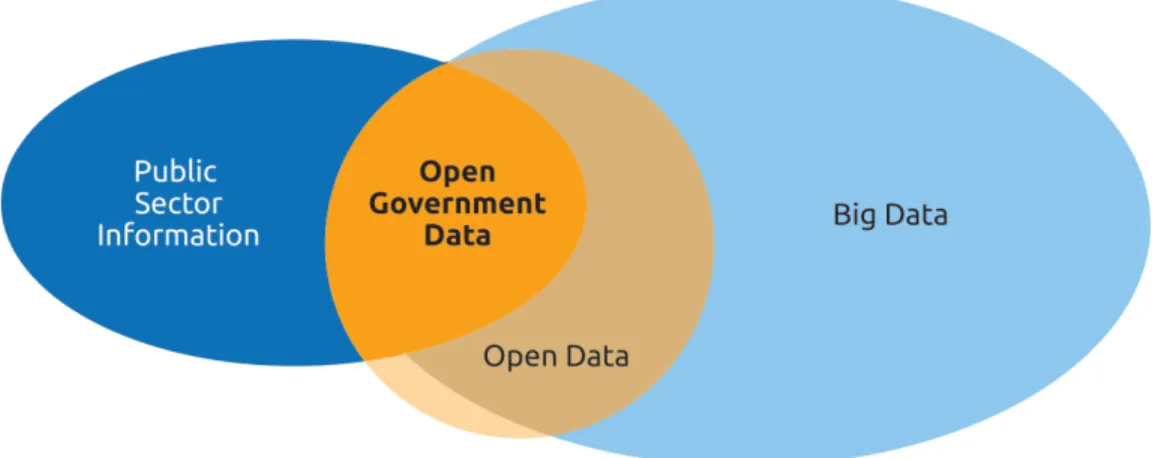
Despite open data being a broad concept that might be applied in several contexts, the spotlight has been focused on the intersection between the concept of open data and public information (Ubaldi, 2013). However, the concept of open data is often confused with the OGD definition. These are different concepts and how we address the definition could be the way to improve the expected outcomes. On the one hand, in the article by Ubaldi (2013), government data is defined as “any data and information produced or commissioned by public bodies”. On the other hand, the Open Knowledge Foundation (OKF) established that "Open data is data that can be freely used, reused and redistributed by anyone - subject only, at most, to the requirement to attribute and share-alike". In a study on the impact of reuse of public data prepared by Capgemini Consulting as part of the European Data Portal, the boundaries of open data and Public Sector Information are defined by an intersection of "big data", Public Sector Information (PSI), and open data (see Figure 1.1). This picture offers a general perspective of the amount
5 Public-Sector Information (PSI) Directive, available online:
https://ec.europa.eu/digital-single-market/en/european-legislation-reuse-public-sector-information, accessed on 22 July 2018.
6 Obama’s executive order, available online: https://obamawhitehouse.archives.gov/open,
ac-cessed on 22 July 2018.
7 Open Government Partnership, available online: https://www.opengovpartnership.org/, accessed
on 22 July 2018.
8 The international Open Data Charter, available online: https://opendatacharter.net/, accessed
on 22 July 2018.
9 European Commission’s guidelines on recommended standard licenses, available online:
https://eur-lex.europa.eu/legal-content/EN/TXT/?uri=CELEX:52014XC0724(01), accessed on 22 July 2018.
of data currently released. Open data could refer to data created by public bodies associated with the PSI directive or that published by private companies or directly by empowered citizens.
Figure 1.1: Boundaries of Open Data and Public Sector Information. Source: Carrara et al. (2015)
Overall, the concept of Open Data attracts the most attention when comes to OGD initiatives, as mentioned above (Ubaldi, 2013; Attard et al., 2015). The expected results are mostly related to more transparent and efficient governments (Huijboom and den Broek, 2011), getting to grips with growing corruption (Attard et al., 2015; Karolis.Granickas, 2013), improving citizens’ participation (Jetzek et al., 2013, 2012), attempting to solve social challenges (Kassen, 2013; Gurstein, 2011; Young and Verhulst, 2016), increasing the economic value and empowering entrepreneurship (Carrara et al., 2017b; Young and Verhulst, 2016; Janssen and Zuiderwijk, 2014), and fostering innovation, efficiency, and effectiveness in government services (Ubaldi, 2013; Carrasco and Sobrepere, 2015; Williamson and Eisen, 2016). With more social and also economic evidence from national and local governments around the globe, it is difficult for any national or local authority to remain isolated from the OGD initiatives. However, Worthy (2015) argued that the impact of open data and especially the release and use of open government data is more complex, more unpredictable, and more political than its advocates claim.
Nowadays, after almost 15 years of open data implementations, most OGD initiatives, data authorities, public bodies, and users’ communities are starting to consider what the next steps in open data projects should be. Janssen et al. (2012)
listed five myths about open data and open government, sketching a clear picture of the possible expectations that OGD initiatives may not accomplish. Just the implementation of open data is not enough to reach most of the expected benefits; the role of reuse needs to be clear, and only when the released data is being used can stakeholders obtain the expected value.
In more recent work, Ubaldi (2013) established a value chain of OGD and delimited the stages of data generation and use required to have a positive impact on the changing role of governments, expand the role of private actors, and empower citizens and contribute to civil societies. Attard et al. (2015) presented the OGD life-cycle, in which the pre-processing, exploitation and maintenance steps are defined. Moreover, the impact is also considered in terms of motivations to use open data and a set of challenges in OGD initiatives. Welle Donker and van Loenen (2017) defined a conceptual framework to assess the success of open-data ecosystems. Peled (2013) presented lessons learned from the initial open-data implementations, and proposed a new approach for further open-data initiatives defining what the second version of open data should be like.
Most of what has been written or studied regarding open data has focused on benefits, adoption or implementation barriers, isolated use cases, or positive impact. Little is known about its use, reuse or impact whether negative or positive. According to Andrus Ansip, Vice-President of the Digital Single Market of the European Commission, “Data should be able to flow freely between locations, across borders, and within a single data space. In Europe, data flow and data access are often upheld by localization rules or other technical and legal barriers. If we want our data economy to produce growth and jobs, data needs to be used. However, to be used, it also needs to be available and analyzed ” (European Commission, 2017). A poor understanding of the impact and the circumstances in which the open-data implementations have been most effective could be a relevant risk to mismatch the current data supply and demand requirements. It is essential to gain better a understanding of how open data, its demand, level of reuse, and the possible impacts through several levels. Young and Verhulst (2016) proposed a methodological attempt to define a framework that establishes a taxonomy of impact for open-data initiatives through 19 use cases from around the world. In another recent example in Spain, reusability is considered a relevant milestone in ongoing open-data initiatives. Thus, Abella et al. (2014) suggested a metric to assess the reuse of open data, considering the relationship between a "smart city"
and open data as the fuel enabling services to be provided directly to citizens. The latest edition of the Open Data Barometer10, developed by the World Wide Web Foundation11includes four findings after studying the current status of open data for more than 113 countries. This report claimed that Governments are not publishing the data needed to restore citizens’ trust, an aspect considered increasingly more frequently in the literature, where data-user requirements were not part of the initial studies or reviews. Gurstein (2011) criticized the possible effect on marginalized citizens, who have more restricted access to technological resources, highlighting the reduced social impact of open data and open data for everyone, both of which are definitions that many initiatives want to establish. Moving in the same direction, Kassen (2013) noted that the inclusion of data users is one of the critical aspects that needs to be considered in open-data projects, and stressed the role of local communities and their knowledge in becoming efficient and productive in open-data projects.
But data users and their demands are not the only relevant aspects that have been considered in recent studies. The level of implementation could have a specific impact on subsequent results or on the sustainability of the open-data project. Although most of the literature addresses the national level, there are a few studies that include the local level as the core of the initiative and, therefore, examine what role could be played by cities in an open-data environment. The fourth analytic report of the European Data Portal (EDP) (The European Data Portal, 2016) established the vital role cities can play in a national open-data strategy. After investigating eight medium-sized European cities, the report found a strong relationship between the local open-data initiatives and smart city initiatives, which allow cities and the reuse of their open data to tackle the current urban challenges and consequently citizens’ most important concerns. Kassen (2013) mentioned that the intersection between citizens, but especially citizens’ needs, and local level authorities could be more useful than the traditional means of communication, where the outcomes of the strategy, such as an open-data portal, have already been built, thus reinforcing the need to collect data users’ needs as primary input of any open-data strategy.
10 Open Data Barometer, available online:
https://opendatabarometer.org/doc/4thEdition/ODB-4thEdition-GlobalReport.pdf, accessed on 21 June 2018
11 World Web Wide Foundation, available online:https://webfoundation.org, accessed on 21 June
To sum up, our work is motivated by an open-data environment where the top-down approach has been studied and applied in many contexts for several years. However, after 15 years of open-data implementations, it seems that this approach is not enough to reach the benefits that were advocated. A bottom-up approach is needed as an effective way to develop a sustainable and efficient open-data initiative that works in three directions. The first is the isolated role of data-user communities in ongoing open-data projects. The second involves the growing attention of cities and their potential to develop effective strategies between citizens’ needs and local authorities. Finally, the third is the possibility of including geographic data as fuel to drive effective initiatives. In the next section, the problem addressed in this research is defined, and the research questions are addressed.
1.2
|
Problem
Two widely recognized and very frequently mentioned concepts in recent years are, on the one hand, open data, where the overlap with government data has been the most studied approach (Attard et al., 2015). On the other, there is the concept of a smart city, which is still emerging and has been interpreted by different stakeholders in a variety of ways. Sometimes the concept of smart city is judged regarding technological and sensor-connected solutions throughout cities, while others associate it with an effective integration among citizens’ needs, local administrations, industry, and academia (Degbelo et al., 2016b).
In Degbelo et al. (2016b), the authors outlined the trends in technologies, archi-tectures, and infrastructures for smart cities, suggesting that cities are the current focus for many disciplines from social and technological angles. Moreover, Degbelo et al. (2016b) claimed that regardless of the focus of the smart-city implementation, there is a common request, along with some recent experiences, concerning the sharing and use of available data. Although the open-data movement is a key factor in the smart-city concept, the integration with citizens’ requirements is also considered another success factor in current use cases12.
The initial idea to make public data available to promote the transparency and accountability of citizens was essentially a promising idea initially promoted by two well-known administrations (the United States and the United Kingdom). Nowadays, this idea is being criticized due to the lack of impact as well as the amount of effort required to carry out those projects in legal, technical, and political terms. Peled (2013) discussed the idea of having a second and improved version of open data, where politicians must understand that implementing an effective open-data program requires time, patience, and mid- or long-terms goals. The question that arises from this is: Do current or coming administrations have enough patience and commitment to keep supporting open-data initiatives? Is there any strategy that can help today’s open-data authorities to demonstrate the effectiveness of those open-data projects?
12 Smart cities: technologies challenges, available online:
The sustainability of open-data initiatives has depended mostly on national administrations. Because they have a strong commitment and political support, national authorities have led a national coordinated effort to develop many open-data portals and later populate them with the open-data that needs to be published. However, the national efforts invested in the open-data strategies do not seem to be enough to reach the desired impact of open data and its portals (The European Data Portal, 2016; Carrara et al., 2017b). One way that some governments have found to achieve a more profound and more tangible result has been through local administrations (i.e., at city level), which see open-data initiatives as an excellent opportunity to move toward the open government approach and gain some of the expected benefits for their local administrations. Moreover, most of the ongoing local open-data initiatives have been implemented and designed by a politician leadership without coordination with the national open-data authorities. The number of national open-data strategies that include local administrations and how cities need to be integrated into the whole ecosystem is significantly low. (The European Data Portal, 2016) listed a set of European cities (local level) that have implemented open-data strategies and included the lessons learned from national implementations. Some of the cities listed have had, or are having, remarkable results in terms of open-data portals, events, and accessibility (i.e., New York, Madrid, London, Puebla). However, other cities have had to tread a more problematic path and invest a significant amount of effort in order to accomplish the results, due to the required coordination between the national and local administrations.
From National Open Data to Local Open Data: Several national governments
(i.e., Canada, Australia, Argentina, Uruguay) have robust open-data portals and mature strategies with some lessons learned from previous or initial implementa-tions of open-data initiatives. Cities, especially those with open-data initiatives at a local level (i.e., city level), are attracting more attention due to the potential to reach data-user communities and the increasing amount of work they are doing on well-known topics like smart cities, mobility, air pollution, green living and, above all, on urban challenges (Ubaldi, 2013; The European Data Portal, 2016). However, the transition from national open-data initiatives to local open data is not always the only way that authorities have found to establish a city-level open-data strategy. The European Data Portal (2016) illustrated the link between open-data
strategies and broader digital or smart-city strategies. In the emerging "wave" of smart-city initiatives and their close relationship with open-data projects, several politicians and mayors have seen open data as a new way to promote their results among their voters (Peled, 2013). Regardless of the way that local level open-data strategies have been defined, the aim is changing and nowadays the reusability and impact that the published data could have seems to be one of the priorities. A better understanding of the level of reuse of open data is required. To address this emerging challenge, this dissertation includes the following question What is the current status of open-data reuse on a local level (cities)?
Better and early integration of data users’ demands and requirements in the local open-data strategy: As mentioned above, the current top-down
approach of many open-data initiatives around the world does not seem to be enough to reach the expected benefits, especially regarding effective reuse, added value, and impact in data-user communities.
Although several national and local governments have adopted open-data pro-jects, there is an increasingly strong call from data users, who see current initiatives as a gap between the published data and the real data demand. Although, in the literature, some frameworks include data users as part of the open-data eco-system, most of them only consider users’ communities to evaluate and test the final results and obtain the feedback required to enhance the process. However, many elements cannot be built upon or modified once the open-data initiatives are released, even when data users provide extensive feedback.
Early integration of data users’ requirements should be considered in the con-ceptualization process of any open-data strategy. Even though accessibility is still an important aspect that needs to be part of the priorities, it should not be the principal purpose in current open-data strategies. This dissertation claims that reusability needs to be the primary goal of the open-data strategies and early integration of data users’ needs might have a positive effect on future open-data initiatives. Therefore, identifying the current frictions that prevent data users from taking full advantage of published data is the initial step to later suggest what ways could be used to improve the reuse level in local open-data initiatives.
Validation of current barriers considering only the data-user perspective and which of them are related to geographic data leads us to the second research question included in this dissertation: What barriers prevent the reuse of open geographic data by local data users?
The potential of geographic data: Welle Donker and van Loenen (2017)
pro-posed an assessment framework to evaluate the success of open-data ecosystems and determined that open geographic data could provide useful tips for other OGD initiatives. (Welle Donker and van Loenen, 2017) compared different kinds of datasets in the Netherlands and found that national geodata was rated significantly higher in all the indicators evaluated, such as being usable, findable, and recogniz-able, together with reliability, in which data users rated geodata significantly better than non-geodata, or even than open data. In the same direction, in a study on companies transforming open data into economic benefits, (Carrara et al., 2017b) reported that geospatial and statistical data were consulted and reused the most by their respondents. The European Data portal published another analytic report (The European Data Portal, 2016), in which it establishes that geodata is one of the most consulted by data users, especially those from the business sector. This kind of data was grouped in the description of technical barriers mentioned that are due to specificities of the geographic data. Some of these particularities include size, standards, and web services, which are possible sources of friction hampering the reuse of this kind of data in open-data communities that are not familiar with the geographic formats. Being aware of the importance of and the growing attention to geographic data at the local and national levels, the European Commission (2017) outlined an improved set of guidelines on recommended standard licenses, data-sets, and charging for reuse across European countries. This guideline defines five categories to prioritize the release and inclusion of geospatial data as the initial datasets that need to be published, due to the high demand for it from reusers across the EU.
Despite the fact that geographic data attracts growing interest from data users, and also the scholars reviewed show that it is valuable to users and therefore should be more open, data authorities nevertheless continue to ignore the potential of geographic initiatives. In a recent study, Reynard (2018) revealed that despite the relevant and significant contributions of a Public Participatory Geographic Information System (PPGIS) developed to work in mobility issues throughout Edmonton (Canada), the city hall ignored its results and took a top-down approach
without considering the data generated by citizens and the empirical results that showed where the city infrastructure could be improved.
Countries have been working on developing National Spatial Data Infrastructures (NSDIs) since 1994, with the goal of establishing metadata standards, developing clearing houses, and enhancing availability among national departments that collect, manage, and analyze geospatial data (Esri, 2010). Although the concept of SDI has been established in many countries, full implementation and its success are still limited (Harvey and Tulloch, 2006). These NSDIs have been transferred to the city level through local Spatial Data Infrastructures (local SDI), in which accessibility, standardization, and high data quality are the primary goals. By developing complicated legal and technical frameworks, local SDI authorities want to be the end-point of all geographic data across the city, thus making it easier for citizens and experts looking for spatial data about the city. However, the integration and standardization of all geographic data from several city departments is often a mid-term task, due not only to the legal barriers but also the high degree of data quality control that most of those authorities need to accomplish as an official data provider. Many of those local SDI have trodden a long, tough path to accomplish, in most cases, a geo-portal and a metadata catalog with geographic data related to many topics. Particularly the process and experience of many of those local SDI might be an adequate aid for open-data initiatives in cities. At the same time, this process faced by those authorities is entirely related to the process that most of the open-data authorities need to lead, especially in cities. Therefore, lessons learned from local SDIs could be transferred to ongoing open-data initiatives at the city level (Welle Donker and van Loenen, 2017).
It is not a case of having to reinvent the wheel, but of listening to other local data authorities, especially those that have previously spent years on formulating the legal and technical framework to guarantee a certain level of standardization and integration. However, as mentioned above, this does not mean that local SDIs do not have any particular reusability issues. In fact, those authorities are facing similar challenges, and the reuse of geographic data is limited for the time being. Notwithstanding the combination of experiences, lessons learned, and data users’ requirements, the potential to reuse geographic data should be added for joint development that allows the creation of user-focused open-data initiatives.
Regarding the limited reuse of geographic data, it is important to bear in mind the important role of cities in the implementation of open-data initiatives, and the
increasing need to include data-user communities as part of the whole system, adding their needs to the conceptualization of any open-data strategy. The re-search question to be put forward in this respect is the following: What strategy is needed to improve the level of reusability of open geographic data at a local (city) level?
In a top-down open-data environment, the data demand from users is considered only briefly (The European Data Portal, 2016) and the data producer is the one who establishes what resources, tools or feedback methods should be included. This one-way scenario considers open-data portals as the bridge that allows users from different backgrounds to access the published data (see part A of Figure 1.2). However, data authorities are actively looking to improve the reusability of available open data, so as to allow data-user communities to be part of an improved scenario, that is, the bottom-up approach. This research embraces the reusability challenge that many data authorities are struggling with in the implementation of their open-data portals. Similarly, communication and collaboration between open-data users and authorities have not progressed well. On the one hand, users still require more useful data or have lost confidence in the new or already-implemented portals, perceiving that the data provided is not suitable for their needs. On the other hand, data authorities are continually trying to empower their users and to increase levels of data reuse.
Our goal is to define a bottom-up approach that considers open-data portals as being more connected to users’ needs, and that does not have a one-way communication from the data producer only. The suggested approach is more circular, where the role and contributions from the data-user communities define the subsequent steps to be taken in the ongoing open-data initiatives (see part B of Figure 1.2). These steps are: (a) User-focused metadata that is conceived to provide information that helps users to assess the usefulness of a dataset with respect to their problem; (b) User-focused legal terms that help reusers to understand the level of reuse, instead of their having to read complicated license terms; (c) Developing and fostering a reuse community in which users with different backgrounds and needs could easily see other examples, use cases, comments or suggestions from others about open-data reuse; finally, (d) a full identification of data users and their data demands helps to gain a better idea of the most requested services, data quality issues or requirements, and to create user-focused events, methodologies, and tools that are relevant to the local open-data initiative.
To sum up, the following list establishes the research questions defined in this dissertation and mentioned above.
• RQ1: What is the current status of open-data reuse on a local level (cities)?
• RQ2: What barriers prevent the reuse of open geographic data by local data
users?
• RQ3: What strategy is needed to improve the level of reusability of open
1.3
|
Contributions
After holding discussions, congresses, and forums about open data, and a series of participatory workshops with data authorities, user communities, and private companies that work in the data-releasing process, we have identified a recurring comment that refers to improving the level of reuse of current open-data initiatives.
Nevertheless, if the community of data users comes from Europe or South America, there is a similar concern: the existing open-data portals and strategies do not follow our needs, and the reuse of published data is limited to just short periods or events where the initiatives are promoted. The literature has studied and validated obstacles and suggestions, mostly from the heads of open-data projects or open government initiatives, who shared their experience and lessons learned about how open data should be addressed. However, a set of barriers together with some recommendations considering only the data-user perspective and providing a better understanding of how data users expect to reuse the published data in cities is a rather limited amount of information. There are some isolated use cases where datasets published are included in projects or external applications with particular relevance, for instance, how the public budget was spent, bus and bike station distributions, or air quality measurements. However, the amount of published data is significantly higher than the number of use cases that are expected to be created.
Although some data authorities are aware of this challenge that their open-data initiatives are facing, there is still a lack of knowledge about how the reusability challenge should be tackled. A user-focused strategy is needed to help current open-data leaders to reshape their activities and guide them over the most relevant concerns from data users, and mainly the elements or modifications required to in-tegrate the data-user requirements within the whole open-data system. Therefore, this dissertation presents a set of contributions in this regard.
• Current reusability status Knowing the current status of the level of reuse
of open data is the principal requirement to be able to later contribute to improving it. The literature contains a great deal of work on the impact, implications, and added value but a precise definition of what reusability means is still lacking.