CO75 – PatIEnt GlObal assEssmEnt In RhEUmatOId aRthRItIs COnvEys a vaRIablE blEnd OF dIsEasE aCtIvIty and dIsEasE ImPaCt: a CROss-sECtIOnal stUdy wIth 311 PatIEnts
Ferreira R1,2, Duarte C1,3, Silva C3, Eugénio G1, Ndosi M4, Gossec L5, da Silva JAP1,3
1. Rheumatology Department, Centro Hospitalar e Univer-sitário de Coimbra, Coimbra, Portugal.
2. Health Sciences Research Unit: Nursing (UICiSA:E), Coim-bra, Portugal.
3. Faculdade de Medicina da Universidade de Coimbra, Coimbra, Portugal.
4. School of Healthcare, University of Leeds, Leeds, UK 5. Paris 06 University, Paris, France
Background: Patient global assessment (PGA) is a key outcome measure in rheumatoid arthritis (RA) and the sole patient-reported outcome included in measures currently used to guide treat-to-target (T2T) strategies. However, it is still not clear which concepts it conveys and how appropriate they are to guide therapy. Objectives: to explore the meaning of PGA in RA pa-tients, namely the influence of disease activity, disease impact, comorbidities, and psychological aspects.
Comunicações orais
ACTA REUMATOL PORT. 2016:41:31-52 (SUP)
Methods: This was an observational, cross-sectional study including consecutive RA patients (ACR/EULAR 2010 or ACR 1987 criteria) followed in a tertiary rheumatology outpatient department. Data collection included PGA (100mm VAS), pain and fatigue (0–10 NRS), Health Assessment Questionnaire (HAQ), Func-tional Assessment of Chronic Illness Therapy (FACIT), Hospital Anxiety and Depression Scale (HADS), Hap-piness Subjective Scale (HSS), and Ten Item Personal-ity Inventory (TIPI). Demographic data, comorbidities, and disease activity [tender joint (TJC28) and swollen joint counts (SJC28), erythrocyte sedimentation rate (ESR) and C-reactive protein (CRP)] were also collect-ed. Disease activity categories were defined as: 1) re-mission (ACR/EULAR 2011 boolean-based definition), 2) near-misses (only PGA>1), and 3) non-remission. Univariate (Pearson correlation, student’s ttest and One Way ANOVA) and multivariable analyses (linear re-gression, with stepwise methods and assessment of multicolinearity) were performed to explain PGA. Results: 311 patients were included (82% females, 60±12 years, 11±9 years of disease duration, 8±5 years of formal education and a mean DAS(28)CRP4v= 2.9±1.2). All comorbidities assessed were associated with statistically (p<.05) higher PGA than RA alone
*p<.05Yes
FibromyalgiaDepressionLow Back PainOsteoporosisOsteoarthritis n=150n=5055,545,8*58,343,9*n=225n=5956,144,0*n=213n=6752,839,1*n=112n=172
100,090,0
PGA (mm)
80,070,060,050,040,030,020,010,00,055,564,342,8**n=170n=51 n=25
NoYes (with fracture)
*p<.05 Yes
Fibromyalgia Depression Low Back Pain Osteoporosis Osteoarthritis
n=150 n=50 55,5 45,8 * 58,3 43,9 * n=225 n=59 56,1 44,0 * n=213 n=67 52,8 39,1 * n=112n=172 100,0 90,0 PG A ( m m ) 80,0 70,0 60,0 50,0 40,0 30,0 20,0 10,0 0,0 55,5 64,3 42,8 * * n=170 n=51 n=25 No
Yes (with fracture)
(Figure 1).
PGA was statistically correlated with all predictor variables, except for the personality domain “agreeable -ness”. In multivariable analysis, PGA was explained (R2adj.=.6258) by pain (b=.2933), fatigue (b=.1723), function (b=.3021), anxiety (b=.183), and SJC28 (b=.1009). The predictors of PGA were different be-tween disease activity categories (Table 1).
Conclusions: PGA does not only convey the inflam-matory activity of the disease but also pain (of whatev-er musculoskeletal origin), fatigue, functional capacity, and psychological variables. These predictors present different relative impacts in different disease activity cat-egories. In near-misses, the group where PGA is decisive for T2T, PGA is determined by fatigue, pain, function and anxietyTJC28 and negatively associated with CRP. Including PGA in composite indices drifts these measures away from strict disease activity representa-tion. This may negatively affect the adequacy of targetdriven decisions regarding immunosuppressive thera -py, inherently designed to control inflammation.
CO131 – tRIPlE POsItIvIty Is a RIsk FaCtOR FOR RECURREnt thROmbOsIs In yOUnG PatIEnts wIth PRImaRy antIPhOsPhOlIPId syndROmE
Marília Rodrigues1, Cecilia Nalli2, Laura Andreoli2, Emanuela Balestreri2, Alessandra Zanola2,
Flavio Allegri2, Antonio Pedrini2, Angela Tincani2
1. Rheumatology Department, Centro Hospitalar Universitário de Coimbra, Coimbra, Portugal
2. Rheumatology and Clinical Immunology, Spedali Civili and University of Brescia, Brescia, Brescia, Italy
Background: Recurrence of thrombosis during the fol-low-up of patients with Primary Antiphospholipid Syn-drome (PAPS) is a major event yielding to poor prog-nosis. The identification of risk factors for recurrence is crucial to improve treatment strategies for seconda-ry prophylaxis1.
Objectives: To determine the risk factors for rethrom-bosis in patients with PAPS by investigating clinical fea-tures, traditional cardiovascular risk factors, the profi-le of antiphospholipid antibodies (aPL) and treatment options.
Methods: Retrospective analysis of a monocentric co-hort of patients with thrombotic PAPS defined accor-ding to the updated Sapporo Criteria. aPL were deter-mined by Lupus Anticoagulant (LA), anti-cardiolipin (aCL) IgG/IgM and anti-ß2glycoprotein I (anti-ß2GPI) IgG/IgM. A positive result by all 3 assays was defined as triple positivity. Patients were grouped by the num-ber of events (single-S or recurrent–R). Comparisons between groups were performed using chi square test for categorical variables and Mann-Whitney test to con-tinuous variables. Multivariate logistic regression ana-lysis was used to identify independent determinants of R events. Variables identified as having p-value < 0.1 in univariate analysis were included. P-values < 0.05 were considered statistically significant. Data was analyzed using SPSS® version 21 for windows.
Results: The study included 162 PAPS patients (118
fe-tablE I. mUltIvaRIablE lInEaR REGREssIOn mOdEls (stEPwIsE-baCkwaRd mEthOd) tO ExPlaIn PGa In Ra PatIEnts
Patients
All Remission Near-misses Non-remission
(n=284) (n=28) (n=107) (n=149) Variable b adjusted* Pain 0.29 0.62 0.25 0.34 Fatigue 0.17 0.27 HAQ 0.30 0.21 0.36 HADS-Anxiety 0.18 0.19 0.27 SJC28 0.10 0.15 TJC28 0.33 CRP R2 adjusted: 0.62 0.49 0.48 0.63 *all with p<.05
male, median age 48 years, venous thrombosis, VT in 103, arterial thrombosis, AT in 59). During the follow--up (median 93 months) 70 recurrences were observed in 53 patients (VT in 36, AT in 34). Clinical and labora-tory characteristics of patients are summarized in the ta-ble. Anticoagulation withdrawal or poor control of anti-coagulation intensity was identified in 28% of the pa-tients that experienced a recurrence. Papa-tients with reth-rombosis more frequently had cardiac disease (hypertensive cardiopathy, valvular dysfunction, patent foramen ovale) (43% vs 21% p=0.007) and arterial hy-pertension (53% vs 33% p=0.01). Recurrent events were significantly associated with triple positivity (64% vs 44% p=0.01), LA (83% vs 62% p=0.008) and IgM antiß2GPI (77% vs 60% p=0.03). Patients with rethrom -bosis less frequently received hydroxychloroquine (11%
vs 41% p<0.0001), oral anticoagulation (19% vs 46% p=0.009) and anti-platelet treatment (37% vs 59% p=0.0009). The logistic regression analysis showed that the variables that remained significant were triple positi-vity (OR 3.57 95% CI 1.32-9.65), cardiac dysfunction (OR 3.51 95% CI 1.35-9.15), hydroxychloroquine use (OR 0.22 95% CI 0.08-0.64), oral anticoagulation (OR 0.06 95% CI 0.02-0.24) and anti-platelet treatment (OR 0.01 95% CI 0.03-0.34). Triple aPL positivity was also significantly more frequent in younger patients (under 50 years, n=118) who had recurrent events (71% vs 51% p=0.05), while no differences were found in terms of tra-ditional cardiovascular risk factors.
Conclusions: Patients with PAPS developed recurren-ce of thrombosis despite treatment in one third of ca-ses. Triple positivity conferred a more severe risk of
tablE I. ClInICal and labORatORy ChaRaCtERIstICs OF PatIEnts wIth PaPs
Single (n=109) Recurrent (n=53) p
Demography 47,8 (37,6-56,9) 54,5 (42,7-65,7) NS Age at last visit, median (25th, 75th percentile) years 34,0 (24,0-45,5) 42,0 (31,0-53,0) NS Age at last first event, median (25th, 75th percentile) years 79 (73%) 39 (73%) NS Sex, no. female 89,9 (42,2-169,9) 108,5 (35,3-174,3) NS Disease duration, median (25th, 75th percentile) months
Clinical features
Thrombosis (first event)
Arterial 39 (36%) 20 (38%) NS
Venous 70 (64%) 33 (62%) NS
Thrombotic risk factors
Cardiac disease 23 (21%) 23 (43%) 0,007 Arterial hypertension 23 (21%) 22 (42%) 0,016 Untreated hypertension 32 (29%) 22 (42%) NS Diabetes mellitus 3 (3%) 4 (7%) NS Obesity Smoking 23 (21%) 13 (24%) NS Smoking 37 (34%) 13 (25%) NS Hypercholesterolomia 34 (31%) 17 (32%) NS Hypertriglyceridemia 10 (9%) 6 (11%) NS Hyperhomocysteinemia 26 (24%) 12 (23%) NS Inherited thrombophilia 36 (33%) 16 (30%) NS Laboratory profile LA 68 (62%) 44 (83%) 0,008 Isolated LA 6 (5%) 4 (7%) NS aCL IgG 72 (66%) 36 (68%) NS aCL IgM 82 (75%) 38 (71%) NS b2GPI IgG 82 (75%) 38 (72%) NS b2GPI IgM 66 (61%) 41 (77%) 0,034 Single positivity 24 (22%) 8 (15%) NS Double positivity 36 (33%) 11 (21%) NS Triple positivity 48 (44%) 34 (64%) 0,016
rethrombosis in PAPS patients irrespective of traditio-nal risk factors.
REFEREnCEs
1. Nalli C, Andreoli L, Casu C, Tincani A. Management of recur-rent thrombosis in antiphospholipid syndrome. Curr Rheuma-tol Rep. 2014 Mar;16(3):405
CO187 – IntERstItIal lUnG dIsEasE In sClEROdERma PORtUGUEsE PatIEnts
Sandra Sousa1, Ana Catarina Duarte1, Inês Cordeiro1, Lídia Teixeira1, José António Canas da Silva1, Ana Cordeiro1, Maria José Santos1, 2
1. Rheumatology Department, Hospital Garcia de Orta,
Almada, Portugal
2. Rheumatology Research Unit, Instituto de Medicina Molecular, Lisboa, Portugal
Background: Systemic sclerosis (SSc) is a rheumatic di-sorder characterized by inflammation and fibrosis invol-ving the skin as well as internal organs, including the lung. Objectives: This study was conducted to characterize SSc patients with ILD and determine predictor featu-res for the pfeatu-resence of ILD.
Methods: A retrospective evaluation of SSc patients from our Rheumatology department was undertaken. ILD was defined according to imaging findings in high--resolution CT (HRCT) combined with functional pa-rameters. Demographic features, auto-antibodies, spi-rometry, diffusion capacity for carbon monoxide (DLCO) measurement, echocardiography and 6-mi-nute walk test were compared between groups with and without ILD using parametric tests and
non-para-metric tests. Predictor factors were established by lo-gistic regression analyses.
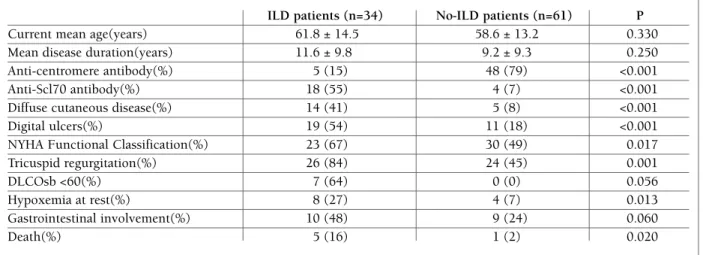
Results: One hundred and three SSc patients with cur-rent mean age of 60.2±14.1y and mean disease dura-tion of 10.0±9.6y were evaluated. Thirty-four (35.8%) patients were diagnosed with ILD, of whom 13 had li-mited cutaneous SSc, 14 had diffuse cutaneous SSc, 2 sine sclerodema and 5 overlap syndroms. ANA was po-sitive in 100% cases, anti-Scl70 was found in 55% and anti-centromere antibody positivity was found in 15% of patients. HRCT revealed diffuse parenchymal lung disease involvement > 20% in 18(53%) cases, with the majority showing a predominant honeycombing pat-tern. Spirometry showed a restrictive pattern in 8 pa-tients and 1 had obstruction. The DLCOsb was abnor-mal in 7 patients. Three patients had pulmonary hy-pertension confirmed by right heart catheterization, 2 patients classified as group 1 and 3 and 1 patient of group 5. About 63% of ILD patients were ever treated with corticosteroids and 27% with cyclophosphami-de, which were the most common drugs used. Two pa-tients were also treated with rituximab. In this ILD--group, 5 deaths were recorded, 2 due to cancer, 1 ab-dominal sepsis, 1 pulmonary hypertension and 1 of unknown cause. Comparison of these ILD patients with non-ILD patients revealed some significantly dif-ferences (Table 1).
Multivariate analysis showed that digital ulcers (OR=31.6, 95% CI 3.09 to 321.91), Anti-Scl70 anti-body positivity (OR=10.1, 95% CI 1.19 to 85.74) and anti-centromere antibody negativity (OR=0.08, 95% CI 0.01 to 0.83) were independently associated with
tablE I. statIstICally sIGnIFICant dIstInCtIOns bEtwEEn PatIEnts wIth and wIthOUt Ild
ILD patients (n=34) No-ILD patients (n=61) P
Current mean age(years) 61.8 ± 14.5 58.6 ± 13.2 0.330 Mean disease duration(years) 11.6 ± 9.8 9.2 ± 9.3 0.250 Anti-centromere antibody(%) 5 (15) 48 (79) <0.001 Anti-Scl70 antibody(%) 18 (55) 4 (7) <0.001 Diffuse cutaneous disease(%) 14 (41) 5 (8) <0.001 Digital ulcers(%) 19 (54) 11 (18) <0.001 NYHA Functional Classification(%) 23 (67) 30 (49) 0.017 Tricuspid regurgitation(%) 26 (84) 24 (45) 0.001 DLCOsb <60(%) 7 (64) 0 (0) 0.056 Hypoxemia at rest(%) 8 (27) 4 (7) 0.013 Gastrointestinal involvement(%) 10 (48) 9 (24) 0.060
the presence of ILD.
Conclusions: This study is one of the first studies car-ried out in Portugal regarding lung involvement in SSc. About one third of the patients had ILD, whose main characteristics are in accordance with other European cohorts. We confirmed that anti-SCL70 positivity, presence of digital ulcers as well as the abpresence of anticen -tromere antibody is independently associated with ILD.
CO6 – EFFECt OF COmEdICatIOn wIth COnvEntIOnal synthEtIC dmaRds On REtEntIOn OF tnF InhIbItORs In PatIEnts wIth sPOndylOaRthRItIs: a PROsPECtIvE COhORt
Alexandre Sepriano1, 2, Sofia Ramiro1, 2, Désirée van der Heijde2, Pedro Ribeiro3, Rita Fonseca4, Joana Borges5, Lídia Teixeira6, Pedro David Carvalho7, Marcos Cerqueira8, Joana Sousa Neves8, Tiago Meirinhos9, Anabela Barcelos9, Graça Sequeira10, Maria João Salvador7, José António Canas da Silva6, Helena Santos5, Miguel Bernardes4, Elsa Vieira-Sousa3, 11, Helena Canhão3, 11, Jaime C. Branco1, 12,
Fernando Pimentel-Santos1, 12, Robert Landewé13
1. CEDOC, NOVA Medical School, Nova University, Lisboa, Portugal
2. Rheumatology, Leiden University Medical Center, Leiden, Netherlands
3. Rheumatology Department, Hospital de Santa Maria, Lisbon Medical and Academic Centre, Lisboa, Portugal 4. Rheumatology Department, Centro Hospitalar São João,
Porto, Portugal
5. Rheumatology Department, Instituto Português de Reumatologia, Lisboa, Portugal
6. Rheumatology Department, Hospital Garcia de Orta, Almada, Portugal
7. Rheumatology Department, Centro Hospitalar Universitário de Coimbra, Coimbra, Portugal 8. Rheumatology Department, Hospital Conde de Bertiandos (ULSAM), Ponte de Lima, Portugal
9. Rheumatology Department, Hospital Infante D. Pedro (CHBV), Aveiro, Portugal
10. Rheumatology Department, Hospital de Faro, Faro, Portugal 11. Rheumatology Research Unit, Instituto de Medicina Molecular, Faculdade de Medicina da Universidade de Lisboa, Lisboa, Portugal
12. Rheumatology Department, Hospital Egas Moniz (CHLO), Lisboa, Portugal
13. Clinical Immunology & Rheumatology, Academic Medical Center, University of Amsterdam, Amsterdam (official), Netherlands
Background: The effects of comedication with con-ventional synthetic disease modifying antirheumatic drugs (csDMARDs) on TNF inhibitors (TNFi)-retention in spondyloarthritis (SpA), are inconclusive. Results from previous observational studies may have easily led to spurious conclusions, since confounding, especially ‘confounding by indication’, was not fully addressed. Objective: To evaluate if comedication with csDMARD influences TNFi-retention in patients with SpA, while performing a comprehensive set of adjustments to best
Probability of maintaing therapyyearsNumber at riskNo csDMARDAny csDMARD 389 289 220180 131 96 67 42 32 26 19 12 42565 417 318 248 182 128 90 69 58 41 27 14 53 Effect of csDMARD, adjusted formultivariable baseline model without PSA001 2 3 4 5 6 7 8 9 10 11 12 131.75.5.25No csDMARDadjHR (95% CI): 0,83 (0,56; 1,16)Any csDMARDProbability of maintaing therapy
yearsNumber at riskNo csDMARDAny csDMARD 389 289 220180 131 96 67 42 32 26 19 12 4 2565 417 318 248 182 128 90 69 58 41 27 14 5 3
Effect of csDMARD, adjusted formultivariable baseline model with PSB00 1 2 3 4 5 6 7 8 9 10 11 12 131.75.5.25No csDMARDadjHR (95% CI): 0,83 (0,56; 1,25)Any csDMARD
P ro b ab ili ty o f m ai n ta in g th e ra py years Number at risk No csDMARD Any csDMARD 389 289 220 180 131 96 67 42 32 26 19 12 42 565 417 318 248 182 128 90 69 58 41 27 14 53 Effect of csDMARD, adjusted for multivariable baseline model without PS A 0 01 2 3 4 5 6 7 8 9 10 11 12 13 1 .75 .5 .25 No csDMARD adjHR (95% CI): 0,83 (0,56; 1,16) Any csDMARD P ro b ab ili ty o f m ai n ta in g th e ra py years Number at risk No csDMARD Any csDMARD 389 289 220 180 131 96 67 42 32 26 19 12 4 2 565 417 318 248 182 128 90 69 58 41 27 14 5 3 Effect of csDMARD, adjusted for multivariable baseline model with PS B 0 0 1 2 3 4 5 6 7 8 9 10 11 12 13 1 .75 .5 .25 No csDMARD adjHR (95% CI): 0,83 (0,56; 1,25) Any csDMARD FIGURE.
handle confounding.
Methods: Patients with SpA (according to their treating rheumatologists) from the Rheumatic Diseases Portu-guese Register (Reuma.pt), with first TNFi started bet-ween 2001 and 2014 were included in this prospecti-ve, multicenter, cohort study. Our main outcome was time to first TNFi discontinuation. Cox-regression was used to estimate the effect of csDMARD comedication on TNFi-retention in two types of models, one inclu-ding baseline (time-fixed) variables and the other with time-varying variables, including socio-demographic features, measures of disease activity, physical function and co-treatment with other drugs (NSAIDs and oral steroids). To control for possible ‘confounding by in-dication’, the effect of csDMARD comedication on TNFi--retention was also tested after propensity score (PS)-adjustment.
Results: In total, 954 patients (mean (SD) age 41.5 (12.0) years; 59.6% males; 13.7 (10.4) years of disea-se duration) were included and 289 (30.3%) disconti-nued their first TNFi after a median follow-up time of 2.5 years (range: 0.08-13 years). A large proportion of patients were treated with csDMARDs at baseline (389; 41%). Inefficacy was the most common reason for TNFi discontinuation (55.7%), followed by adverse events (31.1%). In the multivariable analysis comedi-cation with csDMARDs had no effect on TNFi-reten-tion, nei ther in the baseline model (HR: 0.83; 95% CI: 0.59; 1.16) (figure A) nor during follow-up adjusting
for time-varying covariates (HR: 1.13; 95% CI: 0.71; 1.80). The effect of csDMARDs remained not statisti-cally significant after PS-adjustment (figure B). Conclusion: Comedication with csDMARDs does not prolong TNFi-retention in SpA patients in clinical prac-tice suggesting no benefit in the concomitant use of these drugs.
CO12 – PERFORmanCE OF thE asas ClassIFICatIOn CRItERIa FOR axIal and PERIPhERal sPOndylOaRthRItIs – a systEmatIC lItERatURE REvIEw and mEta-analysIs
Alexandre Sepriano1, 2, Roxana Rubio2, Sofia Ramiro2, Robert Landewé3, Désirée van der Heijde2
1. CEDOC, NOVA Medical School, Nova University, Lisboa, Portugal
2. Rheumatology, Leiden University Medical Center, Leiden, Netherlands
3. Clinical Immunology & Rheumatology, Academic Medical Center, University of Amsterdam, Amsterdam (official), Netherlands
Background: The Assessment of SpondyloArthritis In-ternational Society (ASAS) has developed and valida-ted classification criteria for axial spondyloarthritis (axSpA) and peripheral SpA (pSpA). Following their release, the ASAS criteria have been ‘challenged’ in dif-ferent cohorts, thus warranting a review of the so-far
ac-tablE I. REsUlts OF mEta-analysIs
Number Number LR + LR – Sensitivity Specificity
of studies of patients (95%CI) (95%CI) (95%CI) (95%CI)
ASAS SpA criteria 2 1,750 6.3 0.31 0.73 0.88 (3.2;12.4) (0.13;0.70) (0.47;0.89) (0.81;0.93) ASAS pSpA criteria 3 749 4.7 0.43 0.62 0.87
(3.5;6.3) (0.30;0.62) (0.47;0.76) (0.81;0.91) ASAS exSpA criteria 6 4,293 6.9 0.19 0.82 0.88
(3.8;12.4) (0.15;0.27) (0.76;0.87) (0.79;0.94) axSpA criteria 5 3,426 13.6 0.45 0.57 0.96 imaging arm +/- clinical arm (4.8;38.7) (0.37;0.56) (0.47;0.66) (0.88;0.99) axSpA criteria 5 3,426 6.0 0.56 0.49 0.92 clinical arm +/- imaging arm (2.9;12.4) (0.43;0.72) (0.34;0.64) (0.82;0.96) axSpA criteria 5 3,426 9.6 0.72 0.26 0.97 (imaging arm only) (4.4;20.7) (0.59;0.88) (0.16;0.40) (0.94;0.99) axSpA criteria 5 3,426 4.5 0.81 0.23 0.94 (clinical arm only) (2.3;8.8) (0.72;0.91) (0.17;0.29) (0.89;0.96)
cumulated evidence on the criteria validity and appli-cability.
Objective: To summarize the evidence on the perfor-mance of the ASAS classification criteria for axSpA (also imaging and clinical arm separately), pSpA and the en-tire set of SpA, when tested against the Rheumatologist’s diagnosis (‘reference standard’).
Methods: A systematic literature review was perfor-med to identify eligible studies. Only studies with full-text available were included and, thereafter, raw data was obtained from the authors of the selected publica-tions. A meta-analysis was performed to obtain pooled estimates for sensitivity, specificity, positive (LR+) and negative (LR-) likelihood ratios, by fitting random ef-fects models. With a series of sensitivity analyses we assessed the possible effects of: i) target population (ori-ginal validation study inclusion criteria vs different in-clusion criteria); iii) setting (hospital vs community); and iii) disease duration (< 2 years vs = 2 years). Results: Of the 1,647 retrieved articles, 8 fulfilled the inclusion criteria (N=5,042 patients). The entire set of the ASAS SpA criteria yielded a high pooled sensitivi-ty (73%) and specificisensitivi-ty (88%), but with limited avai-lable data (Table). Similarly good results were found for the axSpA criteria (sensitivity: 82%; specificity: 88%) in a larger number of studies. Splitting the axSpA criteria in ‘imaging arm only’ and ‘clinical arm only’ re-sulted in much lower sensitivity (30% and 23% res-pectively) but retaining very high specificity (97% and 94% respectively). The ‘imaging arm only’ compared to the ‘clinical arm only’ had a much higher LR+ (9.6 vs 4.5, respectively). The pSpA criteria were less tested than the axSpA and have shown a similarly high pool -ed specificity (87%) but lower sensitivity (63%). Sen-sitivity analyses yielded consistently good results for the axSpA criteria (sensitivity (range): 78%-86%; spe-cificity (range): 86%-93%). For pSpA there were few studies therefore hampering sensitivity analyses. Conclusions: Accumulated evidence from more than 5,000 patients confirms the good performance of the various ASAS SpA criteria as tested against the Rheu-matologist’s diagnosis. The clinical and imaging arm have high specificity but lack sensitivity if applied se-parately, indicating that the full set of axSpA criteria is the preferred set.
CO18 – PREdICtORs OF REsPOnsE tO tnF-a blOCkERs In PatIEnts wIth POlyaRtICUlaR PsORIatIC aRthRItIs
Pedro David Carvalho1, Cátia Duarte1, 2,
Elsa Vieira-Sousa3, Luís Cunha-Miranda4, Pedro Machado5, JA Pereira da Silva1, 2
1. Rheumatology Department, Centro Hospitalar Universitário de Coimbra, Coimbra, Portugal 2. Faculdade de Medicina, Universidade de Coimbra, Coimbra, Portugal
3. Rheumatology Department, Hospital de Santa Maria, Lisbon Medical and Academic Centre, Lisboa, Portugal 4. Rheumatology Department, Instituto Português de Reumatologia, Lisboa, Portugal
5. Centre for Rheumatology Research & MRC Centre for Neuromuscular Diseases, University College London, London, United Kingdom
Introduction: Psoriatic arthritis (PsA) is a chronic in-flammatory rheumatic disease affecting both the skin and the joints. TNF-a blockers (adalimumab, etaner-cept, golimumab and infliximab) were a breakthrough development in the treatment of PsA. Identifying pre-dictors of response to TNF-a blockers in patients with PsA is of utmost importance, especially in view of the costs and potential side effects of these agents. Objectives: The aim of the present study was to deter -mine baseline predictive factors of response to TNF-a blockers at 3 and 6 months, in PsA patients with polyar-ticular involvement (with or without axial involvement). Methods: Data were collected from the Rheumatic Di-seases Portuguese Registry (Reuma.pt). Eligible PsA pa-tients were TNF-a blockers naive at baseline and had at least 3 months of follow up, after the beginning of TNF-a blockers therapy. Patients with oligoarticular or mutilant forms of PsA were excluded. Only patients with information on at least one of the response mea-sures (EULAR good clinical response, EULAR good/moderate response, DAS28-3V-ESR remission and HAQ response) at 3 or 6 months of follow-up were included in the analysis.
Univariable logistic regression analyses of potential baseline predictors of EULAR good clinical response, EULAR good/moderate response, DAS28-3V-ESR remis sion and HAQ response (achievement of a HAQ =0.5 and/or a decrease in the HAQ =0.22) were per-formed. Variables with a p-value<0.05 were re-tested in multivariable models. Forward selection was perfor-med until the best-fit model was obtained, taking con-founding effects into account.
Results: A total of 180 patients were eligible for the study (mean age 52 years, 54% women). At 3 months, females were less likely to attain a good EULAR res-ponse and this type of resres-ponse was also positively
as-sociated with disease duration until the first biologic. Achieving moderate/good EULAR and HAQ responses as well as a DAS28-3V-ESR remission was also less pro-bable in females and the later was negatively associa-ted with higher ESR at baseline.
At 6 months, a good EULAR response was inverse-ly associated with both female gender and higher ten-der joint count at baseline. DAS28-3V-ESR remission was less probable in females and it was negatively as-sociated with higher DAS28-3V-ESR at baseline. A mo-derate/good EULAR response was only positively as-sociated with methotrexate intake. HAQ response was also less probable in females. The results of the multi-variable analysis are reported in Table I.
Conclusion: In this study we found that gender was the most consistent predictor of response of anti-TNFa therapy in patients with polyarticular PsA, with males having a higher probability of response compared to females. These findings suggest that gender-associated biochemical, hormonal and psychological factors could
play an important role on the response to anti-TNFa therapy in PsA.
CO254 – assOCIatIOn bEtwEEn EnthEsItIs ChanGEs and
CaRdIOvasCUlaR RIsk In PsORIatIC aRthRItIs PatIEnts
Marcos Cerqueira1, Montserrat Robustillo Villarino2, Cristina Vergara Dangond2, Àngels Martínez Ferrer2, Desamparados Ybañez García2, Èlia Valls Pascual2, Glòria Albert Espí2, Elvira Vicens Bernabeu2, Juan José Alegre Sancho2
1. Rheumatology Department, Hospital Conde de Bertiandos (ULSAM), Ponte de Lima, Portugal
2. Reumatologia, Hospital Universitario Dr. Peset, Valencia, Spain
Background: Psoriatic arthritis (PsA) patients are at in-creased risk of cardiovascular (CV) events compared to general population1,2. Enthesitis is a hallmark of PsA,
tablE I. REsUlts OF thE mUltIvaRIablE analysEs FOR all OUtCOmEs at 3 and 6 mOnths
3 months
Good EULAR DAS28-3V-ESR Moderate or good HAQ
response remission EULAR response response
Female gender, OR (CI), p-value 0.082 0.083 0.091 0.074 (0.024,0.278), (0.017, 0.416), (0.011, 0.091), (0.009, 0.608),
p<0.001 p=0.002 p=0.024 p=0.015 DDFB, OR (CI), p-value 1.091
(1.026, 1.159), p=0.005
Higher ESR at baseline, OR (CI), 0.935 p-value (0.891, 0.982),
p=0.007
6 months
Female gender, OR (CI), p-value 0.060 0.060 0.138 (0.011, 0.325), (0.012, 0.297), (0.029, 0.654),
p=0.001 p=0.001 p=0.013 Higher TJC at baseline, OR (CI), 0.892
p-value (0.801, 0.992), p=0.036
Higher DAS28-3V-ESR at 0.344 baseline, OR (CI) , p-value (0.133, 0.893),
p=0.028
MTX intake, OR (CI), p-value 4.667 (1.320, 16.497),
and it can be evaluated by ultrasound (US) with higher sensibility and specificity than clinical evaluation. Structural and inflammatory changes feasible to be eva-luated by US are described by OMERACT consensus3, and can be quantified by scores such as MASEI4. Objectives: To study the association between enthesi-tis changes, measured by MASEI, and cardiovascular risk in PsA patients.
Methods: PsA patients with peripheral joint involve-ment followed at a tertiary Hospital and consecutively observed in the outpatient clinic were included. De-mographic and clinical data (age, gender, CV risk fac-tors) were registered. Patients enthesic involvement was assessed by US using the MASEI score, and struc-tural (strMASEI) and inflammatory (infMASEI) scores were stratified. The atherogenic index (AI) was calcu-lated (AI=total cholesterol/HDL); CV risk was then es-timated using the SCORE stratification table for low risk countries such as Spain (CVrSCORE). The vascu-lar evaluation was performed in the extra cranial caro-tid artery, following the Mannheim consensus (5), with an Esaote MyLab xv70 ultrasound equipped with a 7--12 mHz linear transducer; an automated program as-sessed the intima-media thickness through radiofre-quency (Quality intima media thickness in real time [QIMT]). Statistical analysis was performed using SPSS 17.0 software.
Results: Sixty-six patients were included, 41 (62.1%) women, with a mean age of 56.8 ± 11.9 years and a mean disease duration of 108.1 ± 102.5 months; 22 (33.3%) were smokers or past smokers; 19 (28.8%) were obese (average BMI of 27.8 ± 4.7 kg/m2); 56 (84.8%) were treated with methotrexate and 22 (33.3%) were on biological therapy. The mean MASEI score was 13 ± 9.7 (0-43); mean strMASEI and infMA-SEI scores were 9.3 ± 5.9 (0-27) and 3.7 ± 4.5 (0-22), respectively. The MASEI and the strMASEI scores cor-related positively with age (r=0.31, p<0.05 and r=0.42, p<0.01, respectively).
CVrSCORE correlated positively with MASEI and strMASEI scores (p<0.05); however, after adjusting for age, this correlation didn’t prevail. Greater MASEI and strMASEI scores were associated with the presence of atheroma plaque, after adjusting for confounding va-riables (age, genre and smoking status) (p<0.05); the QIMT correlated positively only with the infMASEI score, after adjusting for the same confounding varia-bles (p<0.05).
Conclusions: Extensive enthesitis changes, which may represent accumulated damage in PsA patients, are
as-sociated with atherosclerotic vascular changes, both evaluated by US. It has been previously demonstrated in Rheumatoid Arthritis patients that CVrSCORE may underestimate the CV risk, when compared to US ca-rotid changes (6); although no similar data exists for PsA patients, this could explain why in this study no significant association between enthesitis changes and the clinical CV risk estimation score was found.
REFEREnCEs
1. Gonzalez-juanatey C, et al. Arthritis Care & Research 2007. 57(6): p. 1074-1080.
2. Ogdie A, et al. Annals of the Rheumatic Diseases 2015. 74(2): p. 326-332.
3. Terslev L, et al. Arthritis Care Res 2014;66(5): p. 741-748. 4. de Miguel E, et al. Annals of the Rheumatic Diseases 2009.
68(2): p. 169-174.
5. Touboul PJ et al. Cerebrovascular diseases 2012. 34(4): p. 290--296.
6. Corrales A, et al. Ann Rheum Dis 2014;73(4):722-727.
CO159 – yEaRs OF wORkInG lIFE lOst CaUsEd by RhEUmatIC dIsEasEs In PORtUGal – analysIs FROm thE EPIREUmaPt stUdy
Pedro A Laires1,2, Miguel Gouveia3, Helena Canhão1, 4, Rodrigues AM1, 4, 5, Gouveia N1, 5, Mónica Eusébio1, Jaime C Branco1, 5, 6
1. Sociedade Portuguesa de Reumatologia, Lisboa, Portugal 2. Centro Académico de Medicina de Lisboa, Lisboa, Portugal
3. Catolica Lisbon School of Business, Lisboa, Portugal 4. Rheumatology Department, Hospital de Santa Maria (CHLN), Lisbon Medical and Academic Centre, Lisboa, Portugal
5. CEDOC, NOVA Medical School, Nova University, Lisboa, Portugal
6. Rheumatology Department, Hospital Egas Moniz (CHLO), Lisboa, Portugal
Objectives: The aim of this study was to calculate the years of working life lost (YWLL) caused by rheumatic diseases (RD).
Methods: We used data from the cross-sectional, population-based EpiReumaPt study (Sep2011--Dec2013). 10,661 inhabitants were randomly sur-veyed to capture all cases of RD within a representati-ve sample of the Portuguese population. We analyzed participants aged between 50 and 65 years old (yo), near the official retirement age. YWLL were determined for cases with premature retirement caused by RD (self--reported) estimated as the difference between each
pregnancy outcome (APO) in patients with thrombo-tic PAPS by investigating clinical features, traditional cardiovascular risk factors, the profile of aPL and treat-ment options.
Methods: From a cohort of 162 thrombotic PAPS we selected two groups:1) women with first treated preg-nancies that were prospectively followed in our cen-ter(n=34) 2)women with anamnestic untreated preg-nancies(n=38).Group 2 was also selected upon a posi-tive anti-b2glycoprotein I result obtained with our rou-tine test. Patients were classified according to updated Sapporo Criteria.aPL were determined as Lupus Anticoa gulant(LA),IgG/IgM anti-cardiolipin dies(aCL) and IgG/IgM anti-b2glycoprotein I antibo-dies(anti-b2GPI).A positive result by all 3 assays was defined as triple positivity. The detection of IgG antibo -dies against the domain I of b2GPI(anti-DI) was per-formed using the chemiluminescence immunoassay in BIOFLASH®system (INOVA Diagnostics,San Die-go,CA,USA;cut-off 20CU). Patients with were grouped upon the presence or absence of APO. APO was defi-ned as at least one of the followings: miscarriage (be-fore 10thweek), foetal death (beyond 10thweek), se-vere preterm delivery (before 34thweek) and HELLP syndrome. Comparisons between groups were perfor-med using chi square, Fisher’s and Mann-Whitney test. The predictive value of anti-DI titres was performed using ROC analysis. P-values <0.05 were considered statistically significant.Data was analyzed using SPSS® version 21 for windows.
Results: Thirty four women with thrombotic PAPS were prospectively followed during pregnancy (median age 26 years, median follow-up 16 months, venous thrombosis VT-28, arterial thrombosis AT-6). Most of the patients (62%)were triple positive. Clinical, labo-ratory characteristics and treatment of the patients are summarized in the table. Nine women(26%) suffered from obstetric morbidity despite treatment.aPL profile was similar among the groups. Patients with APOs more frequently had hypercholesterolemia(56% vs 16% p=0,03), hypertriglyceridemia(33% vs 4% p=0,05) and hyperhomocysteinemia (56% vs 0% p<0,01).In group 2 (median age 22 years, VT-29, AT-9, 68% triple positive), 87% of women had history of APO. APOs were significantly associated with triple po-sitivity (81% vs 27%p<0,01), LA (85%vs36% p<0,01), IgG aCL (77% vs 60%p=0.03), IgM aCL (18% vs 59%p=0,02) and anti-DI positivity (85% vs 18%p<0,001).History of fetal death was associated with anti-DI positivity (100% vs 55%p<0,001). Titres participant’s age and the respective retirement age
(“ob-served stock”), while the potential YWLL (PYWLL: YWLL+“expected stock” of YWLL still to occur if the-re is no the-return-to-work) was the diffethe-rence between of-ficial and actual retirement ages. We also calculated the percentage of time in inactivity (inactivity ratio = YWLL/Active age-range [15-65yo]). All results were ba-sed on weighted data.
Results: 3.9% (n=66,953/N=1,706,750) of the Portu-guese population (50-64 yo) had premature retirement caused by RD. The mean age of early retirement cau-sed by RD was 54.8 yo, which led to a total stock of 389,939 YWLL (228 per 1000 inhabitants). Women account for 85% of these YWLL. If all forms of exit from work are included this figure rises to 617,764 YWLL (disability: 121,323; unemployment: 106,502). A to-tal number of 684,960 PYWLL were estimated (401/1000) if early retirement is considered and 1,186,679 PYWLL (695/1000) for all forms of exit from work. The mean YWLL and PYWLL inactivity ratios were 13% and 25%, respectively.
Conclusions: We observed a high stock of accumulated YWLL caused by RD in Portugal. Moreover, if no -thing is done otherwise the amount of working life still to be lost from the current early retirees due to RD will almost equal those already gone, meaning that health policies should target not only job retention measures but also return-to-work ones.
CO219 – aUtOantIbOdIEs aGaInst DI OF b2GlyCOPROtEIn I aRE a RIsk FaCtOR FOR FEtal dEath In PRImaRy antIPhOsPhOlIPId syndROmE
PREGnanCIEs
Marília Rodrigues1, Laura Andreoli2, Cecilia Nalli2, Emanuela Balestreri2, Alessandra Zanola2,
Flavio Allegri 2, Antonio Pedrini2, Gary Norman3, Michael Mahler3, Angela Tincani2
1. Rheumatology Department, Centro Hospitalar Universitário de Coimbra, Coimbra, Portugal
2. Rheumatology and Clinical Immunology, Spedali Civili and University of Brescia, Brescia, Brescia, Italy
3. Inova Diagnostics, CA20673, San Diego, United States
Introduction: History of thrombosis is an independent risk factor for adverse pregnancy outcomes (APO).The-refore, in patients with thrombotic Primary Antiphos-pholipid Syndrome(PAPS) obstetric risk stratification is particularly relevant.
of anti-DI were significantly higher in patients with his-tory of fetal death (median 3867 vs 225,p<0.0001). The ROC analysis indicated a cut-off value of 1347 CU with 70 % sensitivity and 71 % specificity (AUC = 0.797 p <0,001) for fetal death prediction. In reverse, patients without APO presented lower anti-DI titres (46 vs 3489 p<0.0001).
Conclusions: Women with thrombotic PAPS are at risk of pregnancy complications. When treated, pregnancy was successful in two-thirds of the cases. The aPL pro-file (including anti-DI) can help to identify women at higher risk, but also traditional vascular risk factors
must be included into risk stratification in order to identify women who deserve a more aggressive treat-ment.
CO25 – PERFORmanCE OF thE EUlaR/aCR 2013 ClassIFICatIOn CRItERIa In a PORtUGUEsE systEmIC sClEROsIs POPUlatIOn
Rita Fonseca1, Diana Rosa-Gonçalves1, Francisca Aguiar1, Tiago Meirinhos2, Teresa Martins-Rocha1, Eva Mariz1, Miguel Bernardes1, Lúcia Costa1
tablE I. ClInICal, labORatORy ChaRaCtERIstICs and tREatmEnt OF PatIEnts wIth PROsPECtIvEly FOllOwEd PREGnanCIEs
Pregnancies with APO Pregnancies without APO
(n=9) (n=25) p
Demography
Age at last visit, median
(25th, 75th percentile) years 27,5 (23,0-30,6) 25,3 (22,5-34,3) NS Disease duration, median
(25th, 75th percentile) months 14,5 (8,4-27,5) 17,1 (14,4-29,2) NS Clinical features
Thrombosis (first event)
Arterial 2 (22%) 4 (16%) NS
Venous 7 (78%) 21 (84%) NS
Thrombotic Risk Factors
Arterial hypertension 2 (22%) 0 (6%) NS Diabetes mellitus 0 (0%) 0 (0%) NS Obesity 1 (11%) 7 (28%) NS Smoking 3 (33%) 4 (16%) NS Hypercholesterolemia 5 (56%) 4 (16%) 0,03 Hypertriglyceridemia 3 (33%) 1 (4%) 0,05 Hyperhomocysteinemia 5 (56%) 0 (0%) 0,001 Inherited thrombophilia 5 (56%) 7 (28%) NS History of obstetrical complications 8 (85%) 14 (56%) NS Laboratory Profile LA 8 (89%) 20 (80%) NS aCL IgG 7 (77%) 18 (72%) NS aCL IgM 6 (66%) 8 (32%) NS b2GPI IgG 9 (100%) 21 (84%) NS b2GPI IgM 7 (78%) 18 (72%) NS Single positivity 0 (0%) 2 (8%) NS Double positivity 3 (33%) 8 (32%) NS Triple positivity 6 (67%) 15 (60%) NS Treatment during Pregnancy
LDA + LMWH 9 (100%) 20 (80%) NS
1. Serviço de Reumatologia, Centro Hospitalar de São João, Porto, Portugal
2. Rheumatology Department, Hospital Infante D. Pedro (CHBV), Aveiro, Portugal
Background: The 1980’s ACR classification criteria for systemic sclerosis (SSc) show low sensitivity, especial-ly in earespecial-ly or mild forms. A new set of classification cri-teria has been developed by ACR/EULAR in 2013. Ap-plicability of the new criteria in clinical practice remains to be shown.
Objectives: To evaluate the performance of both set of classification criteria for SSc in a Portuguese SSc po-pulation.
Methods: Cross-sectional study including consecutive patients with clinical diagnose of SSc (based on expert opinion) followed in our rheumatology department. Clinical and demographic characteristics were colle -cted by consulting the clinical files and national data base – Reuma.pt. The two sets of criteria were applied to all patients, sensitivity was calculated and Kappa coefficient was used to evaluate the agreement between them. Patients not fulfilling the old but fulfilling the new criteria were compared with those that fulfilled ACR criteria using Mann-Whitney, qui-square and fishe r test (SPSS 23.0). Significance level was set as <0.05.
Results: 108 patients were included, 96 (88.9%) were female with mean age of 58.21 (±12.8) years and a me-dian disease duration of 6 years (0-38). 96 (88.9%) had localized and 12 (11.1%) had diffuse disease form. The most prevalent criteria items were: Raynaud’s pheno-menon (93.5%), sclerodactyly of the fingers (85.2%) and antinuclear antibodies (94.4%).
For overall cohort, 53 patients (49.1%) fulfilled the old ACR criteria. These 53 patients and more 44 pa-tients (97) fulfilled the new ACR/EULAR criteria, sho-wing a sensitivity of 89.9% compared to 49.1% of the old ones. Kappa coefficient was 0.197 (p=0.01).
In patients with localized forms, the sensitive of ACR/EULAR criteria was 88.5% compared with 43.8% of ACR 1980 criteria and Kappa coefficient was 0.183 (p=0.02).
In diffuse forms, all 12 patients fulfilled both crite-ria set, showing an almost perfect agreement.
Patients not fulfilling the old but fulfilling the new criteria presented more frequently with capillaroscopic abnormalities (p=0.04) and anticentromere antibo -d y (p=0.01), but low inci-dence of anti-Scl70 antibo-dies (p<0.001) and interstitial lung disease (p<0.001).
Conclusions: Our study confirmed a greater sensibi-lity of the new ACR/EULAR 2013 criteria compared with ACR 1980 criteria, especially in mild and locali-zed SSc disease forms. In our patients with SSc not ful-filling the old criteria, the presence of capillaroscopic abnormalities and anticentromere antibodies among the new set of classification criteria were of the utmost importance in their reclassification as SSc patients. The application of the new criteria in clinical scenario al-lows an early classification and timely management of more SSc patients, ensuring a better prognosis.
CO53 – EsClEROsE sIstÉmICa dE lOnGa dURaÇÃO – PRECIsamOs dE Uma
REClassIFICaÇÃO dOs PadRÕEs CaPIlaROsCÓPICOs. Um EstUdO mUltICÊntRICO
Paulo Clemente Coelho1, Alexandra Cardoso2, Alice Castro3, Catarina Resende3,
Maria João Salvador4, Georgina Terroso5,
Lúcia Costa5, Inês Silva6, Filipe Araújo6, Ana Raposo7, Maria José Santos8
1. Rheumatology Department, Instituto Português de Reumatologia, Lisboa, Portugal
2. Nutrition Department, Instituto Português de Reumatologia, Lisboa, Portugal
3. Rheumatology Department, Hospital de Santa Maria, Lisbon Medical and Academic Centre, Lisboa, Portugal 4. Rheumatology Department, Centro Hospitalar Universitário de Coimbra, Coimbra, Portugal 5. Serviço de Reumatologia, Centro Hospitalar de São João, Porto, Portugal
6. Rheumatology Department, Hospital Egas Moniz (CHLO), Lisboa, Portugal
7. Rheumatology Department, Hospital Conde de Bertiandos (ULSAM), Ponte de Lima, Portugal 8. GEDRESIS, Sociedade Portuguesa de Reumatologia, Lisboa, Portugal
Introdução: A Esclerose Sistémica (ES) é uma doença em que o envolvimento microvascular desempenha um papel crucial na sua fisiopatologia. Como processo di-nâmico, a expressão microvascular desta vasculopatia pode ser classificada na capilaroscopia periungueal (CAP) em padrões que são típicos da ES: 1) “padrão precoce”; 2) “padrão ativo” e 3) “padrão tardio”. Os re-sultados de alguns estudos sugerem que um grupo de doentes com ES de longa duração não progride para um “padrão de tardio”, mas parece estabilizar num pa-drão menos evoluído.
Objetivos: Avaliar o padrão capilaroscópico em doen-tes com ES de longa evolução e as suas associações com as características da doença.
Métodos: Estudo multicêntrico, retrospectivo, envol-vendo doentes com o diagnóstico de ES (critérios de classificação ACR / EULAR 2013), com pelo menos uma das seguintes condições: duração = 20 anos de fe-nómeno de Raynaud (FR) ou = 15 anos de uma mani-festação de ES (não FR). Os dados de capilaroscopia foram recolhidos por um microscópio estereoscópico (ampliação 10-100 x) e / ou por videocapilaroscopia (ampliação 200 x). Correlação do padrão de CAP com o envolvimento de órgãos (pele, hipertensão pulmo-nar (HP), doença pulmopulmo-nar intersticial (DPI)) e com o perfil de auto-anticorpos. A análise estatística foi reali-zada usando SPSS versão 17.0, aplicando o teste do qui-quadrado, t de Student e Wilcoxon, para signifi-cância estatística de <5%.
Resultados: No total, 95 doentes foram incluídos, com idade média de 63,7 ± 11,3 anos, 94% eram do sexo fe-minino. A duração da doença foi de 18,3 ± 7,0 anos (primeira manifestação não FR) e 26,1 ± 8,2 anos (FR). As alterações na última CAP, realizada em média 24,7 ± 7,3 anos após o início do FR, foram: 51,6% (hemor-ragias), 83,2% (dilatação capilar), 89,5% (megacapila-res), 52,6% (áreas avasculares) e 46,3 % (neovascula-rização). Observou-se que 47,4% dos doentes apre-sentavam um “padrão estável” (não evoluindo para o “padrão tardio”). Os doentes que preenchiam os crité-rios ACR 1980 apresentaram mais frequentemente um “padrão tardio” (76% vs. 44,4%, p = 0,003). Compa-rando com o “padrão estável”, o “padrão tardio” rela-cionou-se de forma estatisticamente significativa com a presença de Scl70 (32% vs. 11,1%, p = 0,024), Sco-re de Rodnan modificado> 10 (62% vs. 11,1%, p <0,0001), DPI (62% vs. 35,6%, p = 0,014), redução na DLCO (52% vs. 13,3%, p <0,0001) e com o uso de terapia imunossupressora (60% vs. 20%, p <0,0001). Não houve diferenças significativas entre os grupos quanto à idade, duração do FR, duração da primeira manifestação não FR, tempo de capilaroscopia e pre-sença de HP.
Conclusão: Uma proporção significativa de doentes com longa duração de ES não evolui no sentido de um “padrão tardio” na capilaroscopia. Este grupo parece ter um prognóstico melhor, com menos envolvimento de órgão. Na avaliação dos padrões capilaroscó picos de ES será útil introduzir o conceito de “padrão está-vel” para refletir esta realidade de interesse prognós-tico.
CO114 – systEmIC sClEROsIs Is
assOCIatEd wIth POOR slEEP QUalIty and dECREasEd QUalIty OF lIFE
Vasco C Romão1, 2, Maria João Gonçalves1, 2, Alice Castro1, 2, Cristina Ponte1, 2, Helena Canhão1, 2, Catarina Resende2, Pereira da Silva JA2
1. Rheumatology Research Unit, Instituto de Medicina Molecular, Faculdade de Medicina da Universidade de Lisboa, Lisboa, Portugal
2. Rheumatology Department, Hospital de Santa Maria (CHLN), Lisbon Medical and Academic Centre, Lisboa, Portugal
Introduction: Sleep dysfunction is highly prevalent in diseases with an important inflammatory component. Recent studies have demonstrated that sleep distur-bance and circadian rhythm disruption result in an up-regulation of inflammatory cytokines, perhaps leading to a vicious circle.
Systemic sclerosis (SSc) has been associated with poor sleep quality, and some clinical features seem to predict worse sleep quality, such as gastrointestinal symptoms, pain and pruritus. Sleep quality is also as-sociated with quality of life, which in turn is thought to be decreased in SSc patients.
Objectives: We aimed to assess sleep quality and qua-lity of life in SSc patients and describe possible asso-ciations with demographic and clinical variables. Methods: Patients with SSc were consecutively recrui-ted and asked to answer three questionnaires: the Pitts-burgh sleep quality index (PSQI), the European quality of life questionnaire (EQ5D) and the Hopkins telepho-ne diagnostic interview for restless leg syndrome (RLS). Age- and sex-matched healthy controls (HC) were re-cruited from the Hospital and University staff and from healthy blood donors to the IMM Biobank. Workers with night shifts, sleep apnea, fibromyalgia or an inflamma-tory rheumatic disease were excluded. We compared continuous and categorical variables across groups using Student’s T-test or Chi-square test, respectively. We con-ducted univariate and multivariate linear regression ana-lysis to determine predictors of PSQI scores.
Results: 62 SSc patients were enrolled, 90.2% were women, the mean age and disease duration was 56.6±16.1years and 11.1±6.6 years, respectively. Li-mited SSc was more frequent than the diffuse subtype (63% vs. 37%). The most frequent clinical manifesta-tions were digital ulcers (66%), gastrointestinal invol-vement (48%) and interstitial lung disease (45%).
Anti-depressants use was similar in both groups (20.4% SSc
vs. 13.6% HC, p=0.33), but SSc patients used
hypno-tics more frequently (46.6% vs. 18.6%, p=0.001). The mean PSQI value was higher in SSc patients (7.7±0.5 vs. 6.0±0.5, p=0.025), translating worse sleep quality. Quality of life as per EQ5D was greatly decrea-sed in SSc patients compared to HC (0.54±0.03 vs. 0.81±0.03, p<0.001; mean [range] for general Portu-guese population 0.76 [-0.5 to 1.0]). Both indexes were negatively correlated (Spearman r=-0.433, p<0.001). In the patient population, univariate analysis revea-led that PSQI was associated with age (p=0.009), antide pressants use (p=0.015) and EQ5D scores (p<0.001). Disease variables associated with higher PSQI included telangiectasia (p=0.037), arthritis (p=0.02) and calcinosis (p=0.004). Multivariate analysis identified age (p=0.033), EQ5D score (p<0.001), arthri -tis (p=0.003) and calcinosis (p=0.004) as the variables independently associated with poor sleep quality. Conclusions: SSc patients have increased sleep dis-turbances and this is negatively correlated with quali-ty of life. Older age and history of arthritis or calcino-sis were also independently associated with a worse sleep score.
CO63 – REal-lIFE EFFECtIvEnEss OF GOlImUmab In bIOlOGIC-naÏvE
RhEUmatOId aRthRItIs PatIEnts – data FROm REUma.Pt, a PORtUGUEsE REGIstRy
Ana Filipa Mourão1, Célia Ribeiro2, Joana Borges3, Maria João Gonçalves4, Miguel Bernardes5, Susana Fernandes3, Raquel Dezerto6, Pedro Almeida Laires6, Patricia Machado6,
Mónica Eusébio7, Maria José Santos8, Helena Canhão4
1. Rheumatology Department, Hospital Egas Moniz (CHLO), Lisboa, Portugal
2. Rheumatology Department, Hospital de Faro, Faro, Portugal
3. Rheumatology Department, Instituto Português de Reumatologia, Lisboa, Portugal
4. Rheumatology Department, Hospital de Santa Maria (CHLN), Lisbon Medical and Academic Centre, Lisboa, Portugal
5. Rheumatology Department, Centro Hospitalar São João, Porto, Portugal
6. Merck Sharp and Dohme, Lisboa, Portugal 7. Sociedade Portuguesa de Reumatologia, Lisboa, Portugal
8. Rheumatology Department, Hospital Garcia de Orta, Almada, Portugal
Background: Registries are becoming an increasingly important source of data, providing additional infor-mation on the use of biologics in clinical practice. The real-world clinical data currently available regarding the use of SC anti-TNFs is still limited. Therefore, it is of utmost importance to increase the knowledge of Go-limumab (GLM) effectiveness in the clinical practice. Objectives: This study was designed to access the ef-fectiveness of SC GLM 50 mg/monthly + MTX through 52 weeks of treatment in biologic-naïve RA patients. The primary objective was to investigate the proportion of patients achieving clinical remission (DAS28ESR <2.6). The secondary objectives were the evaluation of: the treatment persistence rates; the proportion of pa-tients achieving functional response (deltaHAQ>0.22); and the effect of treatment on DAS28 individual com-ponents.
Methods: This was a retrospective non-interventional study based on the Rheumatic Diseases Portuguese Re-gister (Reuma.pt). It was conducted in a cohort of pa-tients aged >18 years with active RA despite previous treatment with conventional DMARDs, biologic-naïve, who started SC GLM+MTX, from March 2011 to Au-gust 2015. The cumulative incidence of achieving cli-nical remission, treatment persistence and functional response/remission were estimated using survival ana-lysis. Cox regression was used to calculate the hazard ratios.
Results: A total of 109 patients (86.3% female, mean age 55.5±13.2 years; mean age of diagnosis 45.5±13.5 years, rheumatoid factor 78% positive) met the study criteria. Ninety-three had a follow-up of at least 52 weeks (i.e. all patients who started treatment before August 2014). At week 52, 38.3% of patients were on
Analysis time in weeks Survival estimate for Golimumab treatmentpersistence through 52 weeks 0.0001020304050
1.000.750.500.25
Analysis time in weeks Survival estimate for Golimumab treatment
persistence through 52 weeks
0.00 0 10 20 30 40 50 1.00 0.75 0.50 0.25 FIGURE 1.
clinical remission, 91.9% achieved functional respon-se and 35.2% were on functional remission (HAQ<0.5). The treatment persistence rate was 75.3% for the individuals who were in the study for = 52 weeks (Figure 1). For functional remission, high CRP levels at baseline seem to be a determining factor (HR=0.54, p=0.026).
Conclusions: This is the first Golimumab data analy-sis generated from the Portuguese registry Reuma.pt. Our results are in agreement with data from other na-tional registries and demonstrate the long-term effec-tiveness and the high treatment persistence rates of GLM through 52 weeks.
CO130 – hIGh C-REaCtIvE
PROtEIn at basElInE Is assOCIatEd wIth lOnG-tERm tREatmEnt PERsIstEnCE In PatIEnts wIth RhEUmatOId aRthRItIs tREatEd wIth RItUxImab
MJ Gonçalves 1, 2, Cambridge G3, Leandro MJ3
1. Rheumatology Research Unit, Instituto de Medicina Molecular, Faculdade de Medicina da Universidade de Lisboa, Lisboa, Portugal
2. Rheumatology Department, Hospital de Santa Maria (CHLN), Lisbon Medical and Academic Centre, Lisboa, Portugal
3. Rheumatology Department, Centre for Rheumatology and Bloomsbury Rheumatology Unit, University College London, London, United Kingdom
Background: B cell depletion with rituximab (RTX) is an established treatment for rheumatoid arthritis (RA). It was first introduced at UCL in 1998 and at this cen-tre patients are followed up in a dedicated weekly cli-nic. Initial treatment protocols included combination with cyclophosphamide, but since 2001 patients are treated with cycles of 2x1g RTX. Initial retreatment stra-tegies based on retreatment at flare evolved in the last 6 years patients to retreatment to avoid flare, based on the duration of response to initial cycles. We aim to characterize RTX drug survival in our cohort and de-termine 5 years drug retention predictors.
Methods: We conducted a retrospective cohort stu-dy of RA patients treated with RTX at UCL between 1998 and 2015. Medical records of 248 RA patients were reviewed; demographic and clinical data was collected. All patients fulfilled 1987 ACR classification criteria. Drug survival data was analysed using Ka-plan-Meier estimates. Predictors for 5-years drug tention were determined by a multivariate logistic
re-gression model.
Results: Of the 248 patients included, 81% were fe-male, 80.9% Caucasians. Mean age (SD) was 60.75± 15.4yrs and mean age at diagnosis was 39.25±16.2yrs. RF and ACPA were positive in 89% and 84.6% of pa-tients, respectively. History of smoking was present in 59.43%. Mean follow up duration after RTX initiation was 1737±1206 days (maximum 6055 days). At 2 and 5 years, 78% and 61% patients remained on rituximab. Baseline DAS28 was on average 5.93±1.25, CRP 2.2±2.9mg/L. Majority of patients received concomi-tant therapy with other DMARDs/steroids, more fre-quently MTX 46%, SSZ 21.4% and low-dose predni-solone 28.6%. Main reasons for RTX discontinuation were: inefficacy 49 patients (44 primary failures, 6 secondary failures), adverse events 18 patients, pre -gnancy 1 patient and death 5 patients.
In univariate analysis, current age, disease duration, RF seropositivity, CRP at baseline, number of previous biologics and concomitant use of prednisolone were associated with long-term RTX retention (>5 years). In multivariate analysis, only CRP at baseline kept statis-tical significance (p=0.014).
Conclusions: Overall, high drug retention rates were observed, independent of concomitant use of cDMARDs. In multivariate analysis, higher baseline CRP was associated with long-term drug survival. We found that secondary failures were rare (8% of drop outs) with the current retreatment strategy based on the prevention of flare.
CO201 – b-CEll maRkERs ExPREssIOn Is aFFECtEd by tnF-InhIbItORs and tOCIlIZUmab tREatmEnt In RhEUmatOId aRthRItIs
Rita A. Moura1, Cláudia Quaresma1, Ana R. Vieira1, Maria João Gonçalves1, 2, Joaquim Polido Pereira1, 2, Vasco C Romão1, 2, Nádia Martins2, Helena Canhão1, 2, JE Fonseca1, 2
1. Rheumatology Research Unit, Instituto de Medicina Molecular, Faculdade de Medicina da Universidade de Lisboa, Lisboa, Portugal
2. Rheumatology Department, Hospital de Santa Maria (CHLN), Lisbon Medical and Academic Centre, Lisboa, Portugal *C.Quaresma and A.R.Vieira equally contributed for this work
Introduction: The use of TNF-inhibitors and/or the IL-6 receptor antagonist, tocilizumab, in rheumatoid arthritis (RA) have pleiotropic effects that also involve circulating B-cells. The main goal of this study was to
assess the effect of TNF-inhibitors and tocilizumab on B-cell phenotype and gene expression in RA.
Methods: Blood samples were collected from untrea-ted early RA (ERA) patients (< 1 year of disease dura-tion), established RA patients under methotrexate (MTX) treatment, established RA patients before and af-ter treatment with TNF-inhibitors and tocilizumab, and healthy donors. B-cell subpopulations were characte-rized by flow cytometry and B-cell gene expression was analyzed by real-time PCR on isolated B-cells. Serum levels of BAFF, CXCL13 and sCD23 were determined by ELISA.
Results: The frequency of total CD19+ B cells in cir-culation was similar between controls and all RA groups, irrespective of treatment. However, established RA patients under MTX treatment had significantly in-creased frequencies of double negative (IgD-CD27-) B cells in comparison with controls. Treatment with TNF--inhibitors and tocilizumab did not affect the circula-ting levels of B-cell subpopulations. CD86 and CD95 had, respectively, a significantly lower and higher ex-pression on B-cells after anti-TNF treatment. HLA-DR MFI values were also significantly increased in RA pa-tients after treatment with TNF antagonists and tocili-zumab. BAFF-R, TACI, BCMA, CD69, CXCR5, TLR9, IgM and CD5 expression on B cells were not signifi-cantly affected by TNF-inhibitors and tocilizumab. In addition, alterations in B cell gene expression of BAFF-R, TACI, TLR9, Fc RIIB, BCL-2, BLIMP-1 and b2M were found in ERA and established RA patients under MTX treatment when compared to controls, but no significant differences were observed after anti-TNF and tocilizumab treatments when comparing baseline and follow-ups. Moreover, CXCL13 and sCD23, but not BAFF serum levels were significantly increased sin-ce early RA, but no effect of TNF-inhibitors and tocili-zumab treatment was observed.
Conclusions: In RA patients, the use of TNF-inhibitors and/or tocilizumab treatment affects B-cell phenotype in circulation, but not B-cell frequencies or B-cell gene expression. Our results suggest that TNF-inhibitors and tocilizumab help to reduce B-cell infiltration in in-flammatory sites, allowing these activated B-cells to re-circulate through blood and lymphatic systems.
CO243 – OstEOPOROsIs tREatmEnt and OUtCOmEs OF PROxImal FEmUR FRaCtUREs - stIll mIssInG thE OPPORtUnIty?
Sandra Sousa1, Inês Cordeiro1, Pedro Gonçalves1,
Viviana Tavares1, Carolina Escalda2, José António Canas da Silva1
1. Rheumatology Department, Hospital Garcia de Orta, Almada, Portugal, 2Orthopedic and Traumatologic Depart-ment, Hospital Garcia de Orta, Almada, Portugal
Introduction: Hip fractures are the most serious out-come of osteoporosis (OP) due to the associated in-crease in morbidity and mortality, loss of independen-ce and social costs. Although identification and treat-ment of these high risk patients is crucial and recom-mended, several studies showed that it is frequently forgotten.
Objective: To characterize patients with fractures of the proximal femur admitted at our hospital over a 1-year period, and assess whether OP treatment in-fluences the outcomes of these patients.
Methods: Retrospective analysis of patients admitted between 1st of January and 31st of December 2015 with fractures of the proximal femur using clinical re-cords to assess demographic data, fracture site, co-mor-bidities, history of previous fracture or OP treatment, intra-hospital mortality rate and OP treatment institu-ted at discharge. Patients with fractures resulting from high-energy trauma or transferred to other institutions were excluded. Mortality predictor factors were deter-mined by a multivariate logistical regression model. Results: In total, 348 patients were included. The ma-jority (73.6%) were women with an average age of 82±9years. Only 44(13%) patients reported having OP, the same number of patients had a history of one or more fragility fractures and only 22 of these patients had a record of previous OP treatment. Two or more co-morbidities were present in 67% of patients, hyper-tension being the most frequent. The type of fracture most commonly encountered was intertrochanteric, in 212 cases. Twenty three patients did not undergo ope-rations; 113 underwent joint replacement; and 212 un-derwent osteosynthesis. The mean length of hospital stay was 12±10 days. At discharge, only 52(16%) pa-tients were prescribed antireabsortive treatment, all with bisphosphonates. Fifty nine patients were also treated with calcium and vitamin D. Until 31st of De-cember, 62(17.8%) had died, 20 of them during hos-pitalization for the fracture. Factors associated with mortality were older age, male gender, lack of diagno-sis of osteoporodiagno-sis prior to the fracture, absence of prior treatment of OP and nonsurgical treatment of fractures (Table 1).
+61.6; p0.03), male gender (LR +10.4; p0.01), and pre-vious lack of diagnosis of OP (LR +11.7; p0.01) were independent predictors of mortality in patients with proximal femur fracture.
Conclusions: Patients with proximal femur fracture constitute a high risk population, where treatment in-tervention is essential and recommended by national and international guidelines. International registered treatment ratios remain low (20-30%) but in Portugal, the problem seems to be even more serious, with treat-ment rates ranging from 4.5% and 14.4%. Concerning mortality, it is estimated that within one year after fe-mur facture, 10 to 20% of the patients die. Previous Portuguese studies showed mortality rates ranging bet-ween 10.2% and 21.7%. Our study is in line with this negative tendency, with low osteoporosis diagnosis, low treatment rate, and high mortality in this increasingly high risk elderly group of patients. These results are of great concern as they seem to show no improvement of care in the last 10 years and that it is urgent to imple-ment measures that can reverse this situation.
CO238 – aRthRItIs IndUCEs EaRly bOnE stRUCtURal dEGRadatIOn and
mEChanICal wEaknEss
Vidal B1, 2, Rita Cascão1, Finnila M3, 4, Lopes IP1, Saarakkala S3, 5, 6, Helena Canhão1, 7, JE Fonseca1, 7
1. Rheumatology Research Unit, Instituto de Medicina Molecular, Faculdade de Medicina da Universidade de Lisboa, Lisboa, Portugal
2. Centro Académico de Medicina de Lisboa, Lisboa, Portugal
3. Research Unit of Medical Imaging, Physics and Technology, Faculty of Medicine, University of Oulu, Oulu, Finland, Oulu, Finland
4. Department of Applied Physics, University of Eastern Finland, Kuopio, Finland, Oulu, Finland
5. Medical Research Center, University of Oulu, Oulu,
Finland, Oulu, Finland
6. Oulu University Hospital, Oulu, Finland, Oulu, Finland 7. Rheumatology Department, Hospital Santa Maria, CHLN, Lisbon Academic Medical Center, Lisboa, Portugal
Background: We have previously found in the chronic SKG mouse model of arthritis that long standing (5 and 8 months) inflammation directly leads to high colla-gen bone turnover, disorganization of the collacolla-gen net-work, disturbed bone microstructure and ultimately declining of bone biomechanical properties1.
Objectives: Our main goal was to study the effects of the inflammatory process on the microarchitecture and mechanical properties of bone in the early stages of arthritis development.
Methods: Fifty Wistar adjuvant-induced arthritis (AIA) rats were monitored throughout arthritis development and sacrificed after 4, 11 and 22 days of disease in-duction. Thirty healthy non-arthritic rats, age and sex-matched, were sacrificed at the end of the experiment and used as controls for comparison. The inflammato-ry score, ankle perimeter and body weight were mea-sured over the experimental period. At the time of sa-crifice, bone and serum samples were collected for mi-cro-CT and 3-point bending analysis as well as bone turnover markers (CTX-I and P1NP), respectively. All experiments were approved by the Animal User and Ethical Committees at the Instituto de Medicina Mole-cular (Lisbon University), according to the Portuguese law and the European recommendations.
Results: We have observed that bone turnover mar-kers, CTX-I and P1NP, increased soon after arthritis on-set (p<0.0001 and p=0.0034, respectively, when com-pared to healthy controls). Moreover, micro-CT analy-ses showed both in trabecular and cortical parameters, that the effects of inflammation on bone microstructu-re wemicrostructu-re evident since the 4th day of arthritis develop-ment. Of particular interest, trabecular bone volume
tablE I. statIstICally sIGnIFICant vaRIablEs that InFlUEnCE thE mORtalIty OF PatIEnts wIth FRaCtURE OF thE PROxImal FEmUR
Alive patients (n=286) Deceased patients (n=62) P
Age (years) 81.6 ± 9.3 84.8 ± 8.6 0.012 Women, n(%) 219 (85.5) 37 (14.5) 0.006 Previous osteoporosis diagnosis, n (%) 43 (97.7) 1 (2.3) 0.004 Without previous treatment, n (%) 223 (81.1) 52 (18.9) 0.007 Nonsurgical fracture treatment, n (%) 1 (6.3) 15 (93.8) <0.001