ScienceDirect
Available online at www.sciencedirect.com
Procedia Computer Science 138 (2018) 221–227
1877-0509 © 2018 The Authors. Published by Elsevier Ltd.
This is an open access article under the CC BY-NC-ND license (https://creativecommons.org/licenses/by-nc-nd/4.0/)
Selection and peer-review under responsibility of the scientific committee of the CENTERIS - International Conference on ENTERprise Information Systems / ProjMAN - International Conference on Project MANagement / HCist - International Conference on Health and Social Care Information Systems and Technologies.
10.1016/j.procs.2018.10.032
10.1016/j.procs.2018.10.032
© 2018 The Authors. Published by Elsevier Ltd.
This is an open access article under the CC BY-NC-ND license (https://creativecommons.org/licenses/by-nc-nd/4.0/)
Selection and peer-review under responsibility of the scientific committee of the CENTERIS - International Conference on ENTERprise Information Systems / ProjMAN - International Conference on Project MANagement / HCist - International Conference on Health and Social Care Information Systems and Technologies.
1877-0509
ScienceDirect
Procedia Computer Science 00 (2018) 000–000
www.elsevier.com/locate/procedia
1877-0509 © 2018 The Authors. Published by Elsevier Ltd.
This is an open access article under the CC BY-NC-ND license (https://creativecommons.org/licenses/by-nc-nd/4.0/)
Selection and peer-review under responsibility of the scientific committee of the CENTERIS - International Conference on ENTERprise Information Systems / ProjMAN - International Conference on Project MANagement / HCist - International Conference on Health and Social Care Information Systems and Technologies.
CENTERIS - International Conference on ENTERprise Information Systems /
ProjMAN - International Conference on Project MANagement / HCist - International
Conference on Health and Social Care Information Systems and Technologies,
CENTERIS/ProjMAN/HCist 2018
Help2CARE - Towards a digital platform to help to care for
dependent persons and caregivers
Nuno Gomes
a,*, João Caroço
a, Ricardo Martinho
a,b, Rui Rijo
a,b,c,d, Ana Querido
b, e, f,
Maria dos Anjos Dixe
e,faSchool of Technology and Management, Polytechnic Institute of Leiria, Leiria, Portugal
bCentre for Research in Health Technologies and Information Systems (CINTESIS), University of Porto, Porto, Portugal cInstitute for Systems Engineering and Computers at Coimbra (INESC Coimbra), University of Coimbra, Coimbra, Portugal
dHealth Intelligence Laboratory, Faculty of Medicine of the University of São Paulo, Ribeirão Preto/São Paulo, Brazil eSchool of Health Sciences, Polytechnic Institute of Leiria, Leiria, Portugal
fCenter for Innovative Care and Health Technology (ciTechCare), Leiria, Portugal
Abstract
Nowadays, the training of caregivers and patients in self-care is performed in a health professional-to-patient/caregiver oral communication during consultation or discharge from the hospital, which leads to a limited knowledge retention rate either by caregivers and patients in self-care. The Help2CARE project aims to reduce the high rate of readmissions of patients in hospitals due to the lack of training of their informal caregivers. Therefore, we propose to train these caregivers/self-care patients through the provision of training materials that can increase the level of care provided.
For this purpose, we present in this paper the Help2CARE digital platform, consisting of a web application and a mobile application that communicate with each other, which enables training materials to be available to caregivers (according to their patients’ needs of care) in a mobile application. With the web application, it is possible for a health professional to manage caregivers and materials to be made available to them, in order to enable those caregivers to access them through the mobile application, among other features, which enables health professionals to accomplish a closer monitoring of the caregivers under their guidance.
© 2018 The Authors. Published by Elsevier Ltd.
This is an open access article under the CC BY-NC-ND license (https://creativecommons.org/licenses/by-nc-nd/4.0/)
Selection and peer-review under responsibility of the scientific committee of the CENTERIS - International Conference on ENTERprise Information Systems / ProjMAN - International Conference on Project MANagement / HCist - International Conference on Health and Social Care Information Systems and Technologies.
Keywords: health professional; caregiver; learning; digital platform; mobile health; e-health;
* Corresponding author.
E-mail address: [email protected]
ScienceDirect
Procedia Computer Science 00 (2018) 000–000
www.elsevier.com/locate/procedia
1877-0509 © 2018 The Authors. Published by Elsevier Ltd.
This is an open access article under the CC BY-NC-ND license (https://creativecommons.org/licenses/by-nc-nd/4.0/)
Selection and peer-review under responsibility of the scientific committee of the CENTERIS - International Conference on ENTERprise Information Systems / ProjMAN - International Conference on Project MANagement / HCist - International Conference on Health and Social Care Information Systems and Technologies.
CENTERIS - International Conference on ENTERprise Information Systems /
ProjMAN - International Conference on Project MANagement / HCist - International
Conference on Health and Social Care Information Systems and Technologies,
CENTERIS/ProjMAN/HCist 2018
Help2CARE - Towards a digital platform to help to care for
dependent persons and caregivers
Nuno Gomes
a,*, João Caroço
a, Ricardo Martinho
a,b, Rui Rijo
a,b,c,d, Ana Querido
b, e, f,
Maria dos Anjos Dixe
e,faSchool of Technology and Management, Polytechnic Institute of Leiria, Leiria, Portugal
bCentre for Research in Health Technologies and Information Systems (CINTESIS), University of Porto, Porto, Portugal cInstitute for Systems Engineering and Computers at Coimbra (INESC Coimbra), University of Coimbra, Coimbra, Portugal
dHealth Intelligence Laboratory, Faculty of Medicine of the University of São Paulo, Ribeirão Preto/São Paulo, Brazil eSchool of Health Sciences, Polytechnic Institute of Leiria, Leiria, Portugal
fCenter for Innovative Care and Health Technology (ciTechCare), Leiria, Portugal
Abstract
Nowadays, the training of caregivers and patients in self-care is performed in a health professional-to-patient/caregiver oral communication during consultation or discharge from the hospital, which leads to a limited knowledge retention rate either by caregivers and patients in self-care. The Help2CARE project aims to reduce the high rate of readmissions of patients in hospitals due to the lack of training of their informal caregivers. Therefore, we propose to train these caregivers/self-care patients through the provision of training materials that can increase the level of care provided.
For this purpose, we present in this paper the Help2CARE digital platform, consisting of a web application and a mobile application that communicate with each other, which enables training materials to be available to caregivers (according to their patients’ needs of care) in a mobile application. With the web application, it is possible for a health professional to manage caregivers and materials to be made available to them, in order to enable those caregivers to access them through the mobile application, among other features, which enables health professionals to accomplish a closer monitoring of the caregivers under their guidance.
© 2018 The Authors. Published by Elsevier Ltd.
This is an open access article under the CC BY-NC-ND license (https://creativecommons.org/licenses/by-nc-nd/4.0/)
Selection and peer-review under responsibility of the scientific committee of the CENTERIS - International Conference on ENTERprise Information Systems / ProjMAN - International Conference on Project MANagement / HCist - International Conference on Health and Social Care Information Systems and Technologies.
Keywords: health professional; caregiver; learning; digital platform; mobile health; e-health;
* Corresponding author.
1. Introduction
Population ageing has now become a serious concern of increasing importance to developed and developing countries alike. In fact, it is projected that by 2020, a quarter of the world's population will be over 65 years old and the age group 85 years or older is the one that will present the highest growth. In addition, most of these people have difficulties to perform their activities of daily living (ADL), since they live alone or with other elderly people [5].
Moreover, the increase in the average life expectancy is accompanied by an increase in individuals suffering from postoperative, chronic conditions, neurological disorders, among others, which, in turn, reveal the need for continuous care outside a health organization. Currently, informal caregivers are recognized in the National Health Plan, however, public support services for the elderly and for dependent people are insufficient to meet the needs of this population [3].
According to the latest report of the National Network of Continuing Integrated Care (NNCIC), 84% of the 238,050 people present in the population of this network are over 65 years old. In addition, the grounds for referral are, dependence on ADL and support in the treatment of wounds and pressure ulcers [3].
It is crucial to emphasize that informal caregivers are not health professionals therefore they need training and/or information to carry out their function correctly. This information is only transmitted to them on the day of discharge of the patient, which is not sufficient to take due care, thus requiring continuous access to information and support from the health professional.
Nowadays, with the advances of technologies, it is possible that patients and caregivers have permanent access to the specific and updated procedures/support materials needed for each condition and for the individual characteristics of each patient. These materials can be made available by health professionals, so that the caregivers can provide better care by functioning as an extension of the Health National System and thus avoiding many readmissions in health institutions, obtaining from this an improvement in their life quality and a significant reduction in costs ahead.
For this purpose, we present the Help2CARE digital platform which can provide the appropriate training materials, to access caregiver knowledge about these materials and to get feedback about its use, so that these materials can be revisited when necessary, offering a greater capacity for learning. The Help2CARE digital platform also work as an interface of caregiving in different settings (hospital, home-care, community).
The digital platform proposed in this paper is composed by a web application and a mobile application. The web application allows the management of users (administrators, health professionals and caregivers), patient needs and training materials. In addition, it is possible to manage questionnaires that can be used to verify the suitability of a caregiver or self-care patient to perform a certain task or to use a specific material, among other features. The mobile application allows the caregiver to have access to the training materials provided by the health professional according to their patient’s needs. In addition, the caregiver will be able to communicate with the health professional in case of doubts about their tasks.
Therefore, the main goal of the effective use of this digital platform is, through caregiver training, to reduce the rate of readmissions of dependent and on self-care patients in health institutions. Consequently, this will reduce the costs associated with these readmissions, improving the quality of care provided and the quality of life of patients and caregivers.
The next section details the problem that led to the implementation of this project. The third section presents related work and the following section will expose the architecture defined for both applications that compose the digital platform. The fifth section presents the main features that are already developed for both applications. Finally, the sixth section summarizes the conclusions and the next steps to be taken in the development of this project.
2. Problem Description
Once a patient is diagnosed as dependent in self-care by a health professional, the patient and her/his informal caregiver are designed to receive education, training and guidance to perform the care tasks outside the health organization, in a home healthcare environment. This guidance usually happens in a short and brief moment of contact, where the care information is verbally transmitted and/or in a written format with no concern of the caregiver’s capacity and/or level of instruction. Informal caregivers, especially family members or people close to the patients, are those who live in or move to their patients’ homes who need help in their ADL. Caregivers do not usually carry
with them appropriate information on care procedures, in case they need clarification about any procedure. Therefore, there are numerous cases of readmissions of patients in health institutions dependent or on self-care, which reveal an improper care in homecare scenarios [4, 8].
According to existing research and reported by the health institutions themselves, these numerous readmission cases are associated with problems related to insufficient preparation for self-care of the patient and the caregiver before leaving the health institution [4, 6]. These problems occur in several health areas, such as hygiene and comfort, mobility and balance, obstruction of probes, malnutrition and dehydration, communication, symptom management and medication.
In addition, this number of cases may be related to stress factors felt by caregivers, such as lack of knowledge or information to perform care, difficulties in adapting care requirements to available resources and work overload, which can lead to fatigue and exhaustion, leading to institutionalization of the people they are caring for. In fact, such limitations have many implications on the lives of both patients and caregivers, since the caregiver must reorganize her/his entire life to answer to the needs of individuals with difficulties to perform their self-care tasks. We found all these motives enough to develop a digital platform to train caregivers, providing them access to all the necessary and complete information to perform caring tasks using a smartphone. Not only they can access it anytime, anywhere, but also can communicate (through messaging) with a health professional, and quickly get assistance on a certain care procedure/training material. Also, the digital platform can also serve to provide questionnaires and evaluations allowing the health professional to follow caregivers and patients continuously.
3. Related Work
Existing research and industry works that fit to the concept of the relation and support of the caregiver – patient include the “First Aid – American Red Cross”, an application for smartphones, which provides information about emergency procedures to take on various hazards and sudden illness situations [9]. Another mobile application is “Protege”, which aims to bridge some communication gaps that can easily occur within the elder-caregiver paradigm [11]. “Alzheimer's Caregiver Buddy” is a mobile application that includes features like daily care tips for tasks related to hygiene and meal times, and fun activities that will stimulate the body and mind of someone living with dementia. The key difference between those applications and the present research project is that the Help2CARE mobile app developed provides specific information for a caregiver according to her/his specific patients’ needs, which is monitored and prepared by a health professional. All the information presented to the caregiver is validated by a professional so that the caregiver does not have to search for herself/himself and get wrong information. Another important difference is that we intend to, in future work, scientifically study the impact of the effectiveness of the platform among the patients and caregivers, mainly through the analysis of patient readmissions to hospitals/care centers due to improper care.
4. Help2CARE digital platform architecture
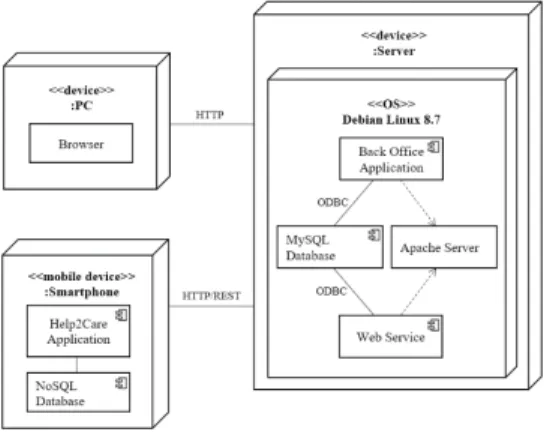
Given that this project consists of a web application and a mobile application, these will access a server computer through the Hypertext Transfer Protocol (HTTP) and a web service in Representational State Transfer (REST), respectively. In such a way, the architectural deployment diagram of this project is illustrated in Fig. 1.
Looking at the figure above, the server is on a machine with the Debian Linux 8.7 operating system, which hosts the web service and the backoffice web application. This application will use an Apache server to support HTTP requests and a MySQL database to store all data entered by administrators and health professionals. In order to access the backoffice application, users (administrators and health professionals) will make HTTP requests to it through the browser on their computer. In addition, caregivers will access training materials through a mobile application, that in turn will consume the web service provided on the server. These training materials will also be stored in a NoSQL database on the mobile device, to make it accessible offline.
Regarding the architectural pattern of the developed digital platform, the Model-View-Controller (MVC) standard was used in both applications, being a very popular pattern nowadays, with an increasing presence both in web and mobile applications that use frameworks based on web views, such as the Ionic framework used in the development of this mobile application, and the Laravel framework used in the development of the backoffice application and the web service [1, 2].
5. Help2CARE main features
Regarding the backoffice web application, it will be available for users playing two different roles: administrator and health professional. Administrators can manage users of both applications, patient needs, training materials and questionnaires. More specifically, this type of user will be able to perform create, edit, read, and lock/unlock operations for users, patient needs, training materials and questionnaires.
On the other hand, users with the health professional role can perform a varied set of features, such as: Manage users with the role of caregiver (users of the mobile application), patients;
Associate/disassociate patients to/from users with the role of caregiver; Associate/disassociate needs to/from patients;
Associate/disassociate materials to/from patient needs and users with the role of caregiver;
Provide questionnaires for the caregiver to answer in the mobile application. These questionnaires can include questions about herself/himself, her/his patients or any of the training materials available;
Overall statistics on the use of the mobile application and statistics on the use of each caregiver associated with it; Answer to requests for help from the caregiver regarding a given training material;
Notifications on new materials, questionnaires to answer and messages from/to the health professional.
In Fig. 2 it is possible to observe a screenshot where the user can create a training material of List Item type, after performing authentication on the backoffice web application.
Therefore, the backoffice web application will be used to develop the complete structure of the users with the role of caregiver, so that they can use the mobile application with their correct information.
Regarding the mobile application, it will only be available to users with the caregiver role. Therefore, these users will be able to perform the following features:
See all available information regarding each of their patients (personal information and patient needs); See all the training materials associated with them to learn how to treat their patients;
Indicate that they have used a specific training material;
Indicate a level of difficulty in using/learning a specific training material; Answer to a questionnaire that has been requested by their health professionals; Send help requests about a specific training material;
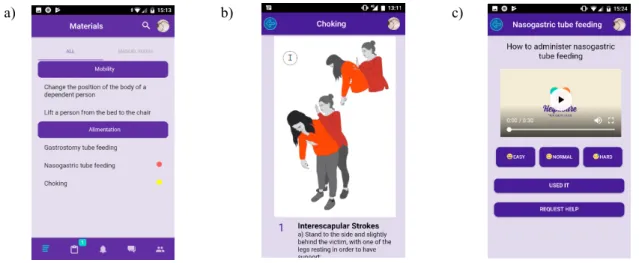
Verify notifications about new materials, questionnaires to answer and/or messages from the health professional. Fig. 3 shows the initial screen of the user with the role caregiver, after her/his authentication on the mobile application (a) and the details of training materials that can be previously selected by the user (b and c).
a) b) c)
Fig. 2. Screen where the user can create a training material of List Item type
Fig. 3. a) Initial screen of the user with the role caregiver on the mobile application; b) selected material's details page (training material consisting of steps and images); c) selected material's details page (training material consisting of a video)
6. Discussion
The smartphone is the most common device in everyone's lives, even in the elderly, and as such is one of the easiest ways for passing information. However, it is necessary to use techniques to convey this information. For the caregiver to be successful in informing herself/himself, it is necessary to have a short and simple text, containing the necessary information for the act of caring [10]. Otherwise, if large texts are transmitted, the caregiver will eventually give up and will continue to care without the information provided through the smartphone [10].
To tackle this risk of non-information, we have developed a controlled set of training materials together with real caregivers and a professional design and video-editing team. The use of real caregivers will allow others to immediately relate with the videos, images and texts presented in these materials.
Additionally, we have already tested the usability of both applications with a set of beta testers (health professionals and caregivers). For health professionals, we have presented the backoffice web application to a group of 15 health professionals and trained them to use the platform. As for the mobile app, we have installed it on the devices of 4 caregivers. Both types of users have been reporting improvements to the apps (backoffice web and mobile), but the overall impression feedback we could collect till now is very positive.
Within these preliminary tests, we could observe the need to add a distinct role: the one of a content manager (also a health professional), which can separately manage training materials, questionnaires and needs. This will allow the other health professionals (usually nurses) to be focused on the effective use of these training materials by their caregivers.
Beta-testing performed with the mobile app have also identified some technical issues related with the mobile devices minimum requirements for the app (mainly storage space, operating system version, device’s security settings and network connectivity). Nevertheless, these caregiver beta-users could already benefit from a mobile app with their patient’s information and the adequate training materials for better care.
7. Conclusions and future work
We have presented in this paper a digital platform comprised of a web application (backoffice) and a mobile application that aims to provide all the training materials that caregivers need to learn to treat their patients, focusing on what the caregivers need to learn in the moment.
As such, this platform can have a huge impact on people's lives as well as on healthcare institutions, since by effectively transmitting information through smartphones, caregivers can improve the way they perform the task of caring for their patients. As a result, healthcare institutions will be less burdened with patient readmissions due to problems in their self-care.
Given that the development of a first version of the digital platform (web application and mobile application) is near the end and beta testing is being carried out, future work will be to improve issues identified during these tests to perform field tests with real end users of the developed platform.
Acknowledgements
This work was supported by Fundação para a Ciência e Tecnologia FCT - Portugal, under the scope of the Help2CARE project: Help2care – Apoiar no autocuidado de utentes e cuidadores (POCI-01-0145-FEDER-23762).
References
[1] “Installation - Laravel - The PHP Framework For Web Artisans,” [Online]. Available: https://laravel.com/docs/5.6. [Acedido em 15 April 2018].
[2] “Ionic Documentation,” [Online]. Available: https://ionicframework.com/docs/. [Acedido em 15 April 2018].
[3] Administração Central do Sistema de Saúde, “Monitorização da Rede Nacional de Cuidados Continuados Integrados (RNCCI) 2015,” March 2016. [Online]. Available: http://www.acss.min-saude.pt/category/cuidados-de-saude/continuados/. [Acedido em 20 April 2018]. [4] E. Alper, T. A. O’Malley e J. Greenwald, “Hospital discharge and readmission,” [Online]. Available:
https://www.uptodate.com/contents/hospital-discharge-and-readmission. [Acedido em 11 May 2018].
[5] C. R. Oliveira, A. Mota-Pinto, V. Rodrigues e C. Alves, “Fatores Relevantes na Avaliação Cognitiva da População Portuguesa,” Acta Médica Portuguesa, vol. 30, nº 4, pp. 293-301, 2017.
[6] M. E. Weiss, K. Bobay, S. J. Bahr, L. L. Costa e R. G. Hughes, “A Model for Hospital Discharge Preparation: From Case Management to Care Transition,” Journal of Nursing Administration, vol. 45, nº 12, pp. 606-614, 2015.
[7] A. Tinker e C. McCreadie, “The acceptability of assistive technology to older people,” Ageing & Society, vol. 25, nº 1, pp. 91-110, 2005. [8] E. Manias, T. Bucknall, A. Hutchinson, M. Botti e J. Allen, Improving documentation at transitions of care for complex patients, Sydney:
Australian Commission on Safety and Quality in Health Care, 2017.
[9] The American Nacional Red Cross, First Aid/CPR/AED Participant's Manual, 4ª ed., StayWell Health & Safety Solutions, 2014. [10] L. Chittaro, “Visualizing information on mobile devices,” Computer, vol. 39, nº 3, pp. 40-45, 2006.
[11] F. Ferreira, F. Dias, J. Braz, R. Santos, R. Nascimento, C. Ferreira e R. Martinho, “Protege: A Mobile Health Application for the Elder-caregiver Monitoring Paradigm,” Procedia Technology, vol. 9, pp. 1361-1371, 2013.