(Annals of the Brazilian Academy of Sciences)
Printed version ISSN 0001-3765 / Online version ISSN 1678-2690 www.scielo.br/aabc
Morphological deformities in the osseous structure in spotted sorubim
Pseudoplatystoma coruscans
(agassiz & spix, 1829) with vitamin c deficiency
RODRIGO Y. FUJIMOTO1, RUDÃ F.B. SANTOS2 and DALTON J. CARNEIRO3 1Embrapa Tabuleiros Costeiros, Avenida Beira Mar, 3250, Bairro Jardins, 49025-040 Aracaju, SE, Brasil
2Laboratório de Ictioparasitologia e Piscicultura, Universidade Federal do Pará, Alameda Leandro Ribeiro, s/n, Bairro Aldeia, 68600-000 Bragança, PA, Brasil 3
Departamento de Zootecnia da Faculdade de Ciências Agrárias e Veterinárias, UNESP,
Campus de Jaboticabal, Prof. Paulo Donato Castellane, s/n, Bairro Zona Rural, 14884-900 Jaboticabal, SP, Brasil
Manuscript received on June 26, 2011; accepted for publication on April 24, 2012
ABSTRACT
Vitamin C is essential for fish diets because many species cannot syntethize it. This vitamin is needed for bone and cartilage formation. Moreover, it acts as antioxidant and improve the immunological system. The present work investigated the effects of vitamin C diet supplementation to spotted sorubim (Pseudoplatystoma coruscans) fingerlings by frequency of bone and cartilage deformation. Ascorbyl poliphosphate (AP) was used as source of vitamin C in the diets for spotted sorubim fingerlings during three months. Six diets were formulated: one diet control (0 mg/kg of vitamin C) and 500, 1,000, 1,500, 2,000 and 2,500 mg AP/kg diets. Fishes fed without vitamin C supplementation presented bone deformation in head and jaws, and fin fragilities. Thus, 500 mg AP/kg diet was enough to prevent deformation and the lack of vitamin C supplementation worsening the development of fingerlings.
Key words: scurvy, bone formation, siluriformes, ascorbic acid.
Correspondence to: Rodrigo Yudi Fujimoto E-mail: [email protected]
INTRODUCTION
The barred sorubim (Pseudoplatystoma fasciatum)
and spotted pintado (Pseudoplatystoma corruscans),
named surubins, are important fishes in the
Brazilian aquaculture due to their characteristics as
high growth and carcass yield (> 50%), absence of
intramuscular spines, high commercial values and
consumers (Smerman et al. 2002, Santos and Oba,
2009). But this species presents problems in larval
and fingerlings culture, because the high mortality
caused by cannibalism and stress susceptibility in
the alimentary training to inert feed.
The vitamin C is a promoter of many
biochemical and phisiological processes in animals
and plants (Baraúna et al. 2009), act as cofactor
of reactions to maintain the normal growth like
prolin hydroxylation in the collagen synthesis,
tryptophan hydroxylation to 5- hidroxitriptofan
and in reaction of 3,4-dihidroxyphenylpiruvate
to noraepinephrine (Baker 1967, Dabrowski
2001, Barros et al. 2002). The use of vitamin C in
supplemented diet for fish also increases the growth
and resistance to stress and anti-inflammatory
effects in larvae and fingerling (Gaspasin et al.
1998, Chagas and Val. 2003, Martins et al. 2008).
due to the lack of enzyme gulono lactona oxidase,
therefore the inclusion of this vitamin in diet is
essential (O’keefe 2001).
The lack of this vitamin provokes the scurvy,
as observed by Wilson and Poe (1973) and Li
and Robinson (2001). Halver (1972) observed
classical symptoms of scurvy in fish as scoliosis,
low collagen formation and distortion of cartilage
support. Gaspasin et al. (1998) observed low bone
deformities index in larvae of “milkfish” (Chanos
chanos) when they were fed with artemia and
rotifers enriched with 1,750 mg vitamin C/ kg
dry weight of live foods (rotifer and artemia). The
authors also reported higher growth and survival
index in fish fed vitamin C.
The objective of this work was to evaluate
the morphological deformities in bone and
cartilage structure of spotted sorubim fingerlings
fed with diets supplemented or not with ascorbyl
polyphosphate as source of vitamin C.
MATERIALS AND METHODS
The experiment was conducted at the Laboratory of
Aquatic Organisms Nutrition Aquaculture Center,
UNESP - College of Agriculture and Veterinary
Sciences, Jaboticabal Campus, Brazil.
The spotted sorubim fingerlings were obtained
from the National Center for the Study of Tropical
Fish - CEPTA (Pirassununga-SP), with one month
old. Fish were first placed in tanks of 500 L, for
two weeks to acclimation to the artificial diet and
to reduce the stress.
After this period, 126 juveniles were anesthetized
(0.4 g benzocaine/15 L of water) to realize the
biometry and then distributed in experimental
aquaria in three weight classes: small, medium
and large (average 1, 3 and 6 g, respectively). This
procedure was taken to prevent cannibalism by the
high degree of heterogeneity of growth, found in this
species. Monthly, the fingerlings of three replicates
of each treatment were redistributed again in three
weight classes. Each month was considered an
experimental period (P). At the end of each period,
were made the biometry, measuring the weight, total
length (TL), and the body was observed for possible
deformities. Handling procedures were made in fish
anesthetized with 0.4 g benzocaine/15 L.
Were used a total of 18 tanks with 100 L
capacity, continuously supplied with water from an
artesian well, with a total water change of about 20
times a day. The temperature was monitored daily,
and dissolved oxygen weekly.
The water parameters were monitored
throughout the experiment and the results remained
within the standards for fish culture, mean of Oxygen
dissolved 5.5. ±1.35 mg O
2/ L and temperature of
29 ±1.5°C.
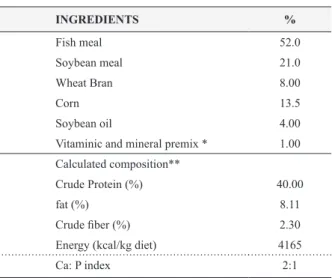
A basal diet formulation was used to contain the
optimal levels of nutrients for this experiment (Table
I). This diet corresponded to the diet free of vitamin C
treatment (0 mg of AP / kg diet). For supplementation,
the levels of ascorbyl polyphosphate (Stay C
Rovimix, Roche) (500, 1,000, 1,500, 2,000 and 2,500
mg / kg) were added at the basal diet.
The source of vitamin C was incorporated into
experimental diets, becoming a pre-mix and swirl
up and mixed up with the rest of each match. By
difficulties in acceptance of the dry diet, six
semi-moist diets were processed by grinding machine by
adding 40% water for pelletizing.
After pelleting process of, the diets were
packed and stored in a freezer at -18ºC conservation
to minimize losses. Food was offered twice a day
at 8:00 am and 19:00 pm. For fish conditioning,
the water was briefly closed and the tanks aerated.
Diets were fed ad libitum, and small quantities
were taken to prevent losses, but until the fish did
not seek more food.
During the three experimental periods, the
occurrence of deformities such as spine deviation,
retraction of the jaw, fin deformation (fragmentation
Statistical analyses and contrast analyses
were realized to compare the occurrence of
morphological deformities between fishes fed
without supplementation and the group of fishes
fed with supplementation of vitamin C.
RESULTS AND DISCUSSION
For this species, were not observed benefits of
vitamin C supplementation in growth (Fujimoto
and Carneiro 2001), but several authors cited
improvements in immune parameters or prevention
of deformities in other species, asserting that
vitamin C is an essential nutrient in fish nutrition
(Chagas and Val 2006, Pezzato et al. 2004). In
the present study at the end of the experiment, the
occurrence of morphological deformities in control
animals (0 mg AP/kg) were observed compared to
those fed 500 and 1,000 mg vit. C/kg (Table II).
The deformities in spotted sorubim fingerlings
were found after the second month of experiment.
In contrast, Blom et al. (2000) did not observe any
deformities in Pterophyllum scalare fingerling fed
0, 30, 120, 360, 720, 1,440 mg vitamin C/ kg diet,
after fourteen weeks of experiment.
INGREDIENTS %
Fish meal 52.0
Soybean meal 21.0
Wheat Bran 8.00
Corn 13.5
Soybean oil 4.00
Vitaminic and mineral premix * 1.00
Calculated composition**
Crude Protein (%) 40.00
fat (%) 8.11
Crude fiber (%) 2.30
Energy (kcal/kg diet) 4165
Ca: P index 2:1
Statistics Df(%)
F for blocks 1.55 ns
F for treatments 11.71 ** F contrast:
Group with vitamin C X Group without vitamin C 54.29 **
Linear effect 3.89 ns Quadratic effect 0.12 ns Cubic effect 0.00 ns
Variation coefficient (%) 28.49
Means:
0 mg AP/ kg 82.00
500 mg AP/ kg 0.00
1,000 mg AP/ kg 0.00
1,500 mg AP/ kg 6.66
2,000 mg AP/ kg 8.33
2,500 mg AP/ kg 15.00
TABLE I
Basic composition of experimental diet.
TABLE II
F values, coefficient of variation and means of the deformities occurrences (Df) of pintados.
* Composition of vitaminic and mineral premix: Iron 15,000mg, Cupper 5,000 mg, Iodine 500 mg, Manganese 17,000 mg, Zinc 12,000 mg, 70 mg Selenium, vehicle 1,000g, 12,000 IU Vitamin A, Vitamin D3 1500 IU Vitamin E 50 mg, 4 mg Vitamin K, Vitamin B12 7 mg, 7 mg vitamin B2, acid 60 mg Pantothenic Ac. Nicotinic 120 mg, 600 mg choline chloride, methionine 700 mg, 500 mg antioxidant, vehicle 1,000 g. ** Calculated composition based on the results of testing of ingredients in accordance with AOAC (1975).
Fish with high specific growth rates, tend to have
more symptoms of scurvy due to rapid growth,
indi-cating higher requirements of vitamin C for the whole
development (Thompson et al. 1993), which may
have been occurring to spoted sorubim fingerlings in
this study. Other explanation for these differences in
vitamin C requirement is related to different species
and its level of development (Leonardo et al. 2001).
Deformities as head convexity (26.31%),
displa-cement of jaw line (31.57%), distortion and fragility
of fins (31.57%), deviation of the spine (10.52%)
were also observed. Deformities of spine occur less
frequently, as observed in trout (12.5%) fed diets
free of vitamin C (Madsen and Dalagaard 1999).
The occurrence of deformities increased as the
vitamim C supplementation (2,000 and 2,500 mg
AP / kg diet), although not significantly, indicating
hyper-vitaminosis but not significantly harm to
the body, for the fry fed these higher levels did not
showed weakness of the fins.
Figure 2 shows the radiographs from spotted
sorubim fingerling with deformities on the head
and mouth, which occurred more frequently in the
group fed the diet without vitamin C, demonstrating
its importance bone formation.
Deformities as scoliosis and lordosis were
reported in the studies of Lim and Lovell (1978),
reaching 60.9% of the channel catfish fingerlings
(Ictalurus punctatus) in vitamin C deficiency,
that were similar to our findings. However in the
present study a lower value (10.52%) was related.
Mazik et al. (1987) founded higher deformity
(79%) than this study in vitamin-deficiency fish.
Chavez de Martines (1990) reported deformities of
jaw in Cichlasoma urophthalmus, observed at 45
days vitamin restriction. This abnormality was also
observed in 31.57% of spotted sorubim fingerlings
at 60 days of restriction.
One type of deformity was not reported in the
literature, but frequently observed in unsuplement
spotted sorubim (26.31%) was the convexity of
the head, clearly observed in Figures 1B and 2C.
These deformities could provoke a decrease in the
commercial value due to strange morphological
aspect of fish.
Figure 1 -A: fish head without convexity; B: head deformity in pintados fingerlings not supplemented with vitamin. Arrows and lines in indicate deformities: lines, convex head, arrow indicates weakness and distortion of the fins. Scale bar = 1cm.
The vitamin C is essential for collagen fibers
formation that participates in the formation of the
pro-collagen structure. This disability and injuries
prejudice the heal and bone formation as supported by
Wang et al. (2003), Moraes et al. (2003), Junqueira and
Carneiro (1999). Thus, a deficiency in the formation
of this tissue may be responsible for deformities and
fragility of the fins, since the tissue is important for
the body, performing duties of defense, transportation,
storage, and regeneration (Gartner and Hiatt 1993).
RESUMO
A vitamina C é essencial para dietas de peixe porque muitas espécies não conseguem sintetizá-la. Esta vitamina é necessária par a formação de cartilagem e matriz óssea. Além disso, age como antioxidante e melhora as resposta do sistema imunológico. O presente trabalho investigou os
efeitos da suplementação de vitamina C em dietas para alevinos de pintado (Pseudoplatystoma corruscans) pela incidência de deformidades na estrutura óssea e cartilaginosa. O ascorbil polifosfato (AP) foi utilizado como fonte de vitamina C em dietas para alevinos de pintado durante o período de três meses. Seis dietas foram formuladas: uma dieta controle (0 mg de vitamina C / kg) e cinco dietas 500, 1.000, 1.500, 2.000 e 2.500 mg de AP / kg. Os peixes alimentados sem suplementação de vitamina C apresentaram deformidades óssea na cabeça e mandíbula e fragilidade de nadadeiras. Assim, a dieta de 500 mg de AP/kg foi suficiente para prevenir a ocorrência de deformidades, e a ausência desta vitamina prejudica o desenvolvimento ósseo de juvenis de pintados.
REFERENCES
AOAC - OFFICIAL METHODS OF ASSOCIATION OF OFFICIAL AGRICULTURAL CHEMISTS. 1975. 3rd ed., Washinghton AOAC, 975 p.
BAKER EM. 1967. Vitamin C requirements in stress. The Am J Clin Nutr 20: 583-590.
BARAÚNA LCRI, COSTA DSP, CARVALHO JV, LIRA AD, ALMEIDA TR, GARCEZ NETO AF, LABORDAL SS, ALBINATI RCB, OLIVEIRA EMD AND SILVA MCA. 2009. Utilização de duas diferentes megadoses de vitamina C na ração de alevinos de tilapia do Nilo (oreochromis niloticus) submetidos a infecção experimental por Edwardsiella tarda. Arq do Inst de Biol 76: 561-567.
BARROS MM, PEZZATO L AND KLEEMANN GK. 2002. Níveis de vitamina C e ferro para tilápia do Nilo (Oreochromis niloticus). Rev Bras Zoot 31: 2149-2159.
BLOM JH, DABROWSKI K AND EBELING J. 2000. Vitamin C
requirements of the Angelfish Pterophylum scalare. J
World Aquac Soc 31: 115-118.
CHAGAS EC AND VAL AL. 2003. Efeito da vitamina C no ganho de peso e em parâmetros hematológicos de tambaqui. Pesqui Agro Bras 3: 397-402.
CHAGAS EC AND VAL AL. 2006. Ascorbic acid reduces the
effects of hypoxia on the Amazon fish tambaqui. J Fish
Biol 69: 608-612.
CHAVEZ DE MARTINES MC. 1990. Vitamin C requeriment of the mexican native cichlid Cichlasoma urophthalmus (Gunther). Aquaculture 86: 409-416.
DABROWSKI K. 2001. Ascorbic Acid in Aquatic Organisms -Status and perspectives. CRC Press, Boca Raton, FL, USA. FUJIMOTO RY AND CARNEIRO DJ. 2001. Adição de ascorbil poli-fosfato, como fonte de vitamina C, em dietas para alevinos de pintado, Pseudoplatystoma corruscans (Agassiz, 1829). Acta Sci Maringá 23: 855-861.
GARTNER LP AND HIATT JL. 1993. Atlas de histologia. Rio de Janeiro, editora Guanabara Koogan SA, 322 p.
GASPASIN RSJ, BOMBEO R, LAVENS P, SORGELOOS P AND NELIS H. 1998. Enrichment of live food with essential
fatty acids and vitamin C: effects on milkfish (Chanos
chanos) larval performance. Aquaculture 162: 269-286. HALVER JE. 1972. The role of ascorbic acid in fish disease and
tissue repair. Bull Jap Soc Fish Oceanogr 38: 79-92. JUNQUEIRA LC AND CARNEIRO J. 1999. Tecido ósseo. In:
Histologia básica. 9a ed., Rio de Janeiro: Guanabara-Koogan, cap. 8, p. 111-128.
LEONARDO JMLO, VARGAS L, RIBEIRO RP, MOREIRA HLM, NATALI MRM, VOSKI T AND CAVICHIOLO F. 2001. Histo-logia das brânquias de larvas da tilápia do Nilo, Oreochromis niloticus (L.), de origem tailandesa, submetidas a diferentes níveis de vitamina C. Acta Sci 23: 863-870.
LI MH AND ROBINSON EH. 2001. Dietary ascorbic acid
require-ment for growth and health in fish. In: LIM C AND WEBSTER CD. Nutrition and fish health. Haworth Press,
New York, p. 163-175.
LIM C AND LOVELL RT. 1978. Pathology of the vitamin C
deficiency syndrome in Channel Catfish (Ictalurus
punctatus). J Nutr 108: 1137-1146.
MADSEN L AND DALAGAARD I. 1999. Vertebral common defor-mities in farmed rainbow trout (O. mikiss). Aquaculture 171: 41-48.
MARTINS ML, MIYAZAKI DMY, MORAES FR DE, GHIRALDELLI L, ADAMANTE DE B AND MOURIÑO JLP. 2008. Ração
suple-mentada com vitaminas C e E influência a resposta
infla-matória aguda em tilápia do Nilo. Cienc Rural: 38: 213-218. MAZIK PM, BRANDT TM AND TOMASSO JR. 1987. Effects of
dietary vitamin C on growth, caudal fin development,
and tolerance of aquaculture-related stressors in Channel
catfish. Prog Fish-Cult 49: 6-13.
MORAES JRE, FREITAS JB DE, BOZZO FR, MORAES FR DE AND MARTINS ML. 2003. A suplementação alimentar com vitamina C acelera a evolução do processo cicatrial em Piaractus mesopotamicus (HOLMBERG, 1887). Bol Inst Pesca 29: 57-67.
O’KEEFE T. 2001. Ascorbic acid and stable ascorbate esters as sources of vitamin C in aquaculture feeds. Singapore: American Soybean Association (ASA) – United Soybean Board. 8 p. (ASA Technical Bulletin, AQ48-2001). Disponível em: <http://www.asasea.com/aq48_2001.html>. Acesso em: 12 dez. 2005.
PEZZATO LE, BARROS MM, FRACALOSSI DM AND CYRINO JEP. 2004. Nutrição de peixes. In: CYRINO JEP, URBINATTI EC, FRACALOSSI DM and CASTAGNOLLI N (Eds), Tópicos especiais em piscicultura de água doce tropical intensiva. São Paulo: TecArt, p. 75-169.
SANTOS LBS DOS AND OBA ET. 2009. Dieta: ferramenta importante para o manejo dos peixes no cultivo. In: TAVARES – DIAS M (Ed), Manejo e sanidade de peixes em cultivo. Macapá: Embrapá Amapá, p. 89-105. SMERMAN W, CASTRO JGO, TOLEDO JJ DE, ROSA CAS DA
AND GODOI DS DE. 2002. Larvicultura de pintado
(Pseudoplatystoma sp.) em alta floresta – Mato Grosso.
Rev Biol Ciênc Terra 2: 1-7.
THOMPSON I, WHITE A, FLETCHER TC, HOULIHAN DF AND SECOMBES CJ. 1993. The effect of stress on the imune response of Atlantic Salmon (Salmo salar L.) fed diets containing differents amounts of vitamin C. Aquaculture 114: 1-18.
WANG X, KIM K, BAI SC, HUH M AND CHO B. 2003. Effects of the different levels of dietary vitamin C on growth and
tissue ascorbic acid changes in parrot fish (Oplegnathus
fasciatus). Aquaculture 215: 203-211.
WILSON RP AND POE WE. 1973. Impaired collagen formation