Biodegradation of Poly (3-hydroxybutyrate) /Eggshellsystems
Marcel Leiner de Sáa, Érica Melo de Carvalhob, Julienne Calvacantea, Luis Miguel Araquea, José
Francisco Reis Sobrinhoc, Renata Barbosaa,d , Tatianny Soares Alvesa,d*
Received: September 04, 2017; Revised: February 08, 2018; Accepted: March 29, 2018
In this work, biocomposites of poly (3-hydroxybutyrate) (PHB) / calcium carbonate from
Rhea Americana eggshells were prepared and the effects of the addition of the inorganic filler in
the polymeric matrix were assessed. The residue (powder) of the eggshell calcined at 400 ºC or in natura was inserted into a PHB solution for preparation of films via casting. Powder samples were
characterized by X-Ray Fluorescence (XRF), X-Ray diffraction (XRD) and Thermogravimetry (TG/ DTG) and films were characterized by X-Ray diffraction (XRD), Scanning Electron Microscopy (SEM) and biodegradation tests according to the ASTM G 160-03 norm: the results were reported as weight loss and visual inspection by optical microscopy (OM). From the results of the XDR, it was perceived that the peaks in the diffractograms of the powder obtained by milling the Rhea Americana eggshells corresponded to the diffraction patterns of the Calcite crystals, which is a
calcium carbonate polyform, and that the calcination preserved the crystalline structure, maintaining the calcium carbonate in the samples. For the biocomposites, a peak characteristic to the calcium carbonate in 29.57º was detected, indicating the insertion of the filler to the polymer matrix. Through SEM the presence of small agglomerates, probably due to polymer particles that were not dissolved, was observed for the pure PHB film. With the addition of the filler in natura a greater porosity was formed in the surface of the biocomposite films, and with the calcined filler, homogeneous films with reduced porosity were obtained. From the weight loss and OM results, it was observed that the filler inserted into the polymeric matrix catalyzes the biodegradation process up to 60 days evaluation in different ways, depending on the type of sample used.
Keywords: biodegradation, poly (3-hydroxybutyrate), eggshell.
*e-mail:[email protected]
1. Introduction
Nowadays, synthetic polymers are being used in various applications. This is due to the low cost, lightweight, high strength and ease of product manufacturing. The main drawback is the disposal causing serious environmental risks when improperly discarded in nature1-4. A way
to reduce these environmental risks would be using biodegradable polymers obtained from renewable sources. An important family of biodegradable polymers is the poly (hydroxyalkanoates) - PHAs, which has attracted great attention because they are biocompatible thermoplastics. The PHB - Poly (3-hydroxybutyrate) is the most known among them, which is produced by bacterial fermentation, with mechanical and physical properties similar to the polypropylene. Besides, the PHB can be degraded by microorganisms in a short period of time and in different environments, such as soils, rivers, lakes and even in wastewater, generating water and carbon dioxide3-10.
The search for viable alternatives for the use of polymeric materials has been gradually increasing with research aiming at the exhaustion of the main source for the production of synthetic polymers. Since the oil crisis in the 60s and 70s, the cost of polymeric materials reached higher values and, from then on, the formation of composites with the incorporation of fillers obtained from natural sources became a tangible and ecologically viable alternative11.One of the most used fillers in polymeric
materials processing is calcium carbonate (CaCO3), a natural, cheap, and abundant resource, which offers some advantages such as cost reduction, being widely used as non-reinforcing filler in the preparation of polymeric composites12,13.
The CaCO3 is found in different sources, such as eggshells, oysters, and mussels, and is commercially extracted from quarries. According to Rivera, Araiza, Brostow, Castano, Dıaz-Estrada, Hernández, et al.14, the eggshells of chicken
and ostrich have, respectively, 94% and 97% of calcium carbonate in their compositions. The largest source of CaCO3 is the shell of greater rhea eggs, which has approximately 98.5% of this component in its composition15.
a Programa de Pós-Graduação em Ciência de Materiais, Centro de Tecnologia, Universidade Federal do Piauí, Teresina, PI, Brasil
bUniversity of Strathclyde, Glasgow, United Kingdom
In the literature, studies with various applications to the eggshells were found: catalysts for biodiesel production16,17, use of residue of eggshell as coating pigments for printing paper18, eggshells as heavy metal absorbent19-21. Other examples
that can be mentioned are the use of calcium carbonate as filler for polymeric materials - polypropylene composites with the eggshell of chicken22, the use of eggshell with a
SEBS (styrene ethylene / butylene-styrene) matrix as bio-filler23and composites of green polyethylene biopolymer
with eggshell24. However, there are no reports of the use
of the eggshells of greater rhea with a PHB polymeric matrix, making this study an unprecedented research. The development of this work favored an unprecedented study capable of promoting the obtainment of low-cost biodegradable materials, and the reuse of a large volume of residues, such as eggshells, being a source of important inorganic material for the industry of polymeric composites. This study aimed to prepare and characterize biocomposites based on a PHB matrix and calcium carbonate (CaCO3) from eggshells of greater rhea (Rhea Americana) in natura and calcined forms and verify the impacts of the addition of the filler in the structure, morphology, and biodegradation of films prepared by casting.
2. Materials and Methods
2. 1 Materials
As polymer matrix was used Poly (3-hydroxybutyrate) provided by PHB Industrial SP, Brazil. The eggshell of
Rhea America was obtained at Federal University of Piauí, Teresina Campus. The films were prepared by solution
using chloroform as the solvent, provided by Synth. The soil used for the biodegradation tests was of the POLE GARDEN brand, whose composition is reported in Table 1.
eliminating organic matter and preserving the calcium carbonate. The samples were calcined at 400 ºC for 2 hours in a JUNG model J-200 muffle. The non-calcined samples were referred as in natura and the calcined samples, calcined at 400ºC.
The calcium carbonate obtained from eggshells was selected to propose a new alternative that reuses this kind of large-scale residues, thus, this work can contribute to a new research route.
2.3 Preparation of the films (by casting)
For the preparation of the films, PHB was added to the chloroform and the solution (ratio 1:10) remained under stirring for 3 hours at room temperature (23 ºC). The solution then remained static under the same temperature for 24 hours in order to facilitate the dissolution of the PHB grains (a process called swelling) and, in the last step, the solution was subjected to constant stirring and heating at a temperature of 80 ºC for 3 hours. After homogenization, the solution was poured onto a marble plate and films were formed by the evaporation of the solvent at room temperature (23 ºC). The films formed had an average thickness of 42 µm.
For the preparation of the films with percentages of 1 or 3% of the filler (mass) was incorporated to the solvent. Subsequently, the solution contending the filler was stirred and heated at 80 ºC for 2 hours, poured onto a marble plate after this time and, after 30 minutes, films were obtained. These biocomposites were denominated as PHB + 1 % in natura (1% CaCO3 non-calcined)and PHB + 3 % in natura(3% CaCO3 non-calcined) or PHB + 1 % at 400ºC (1% CaCO3 calcined at 400ºC) and PHB + 3% at 400ºC(3% CaCO3 calcined at 400ºC).
2.4 Ray fluorescence (XRF)
A semi-quantitative chemical analysis was carried out by X-Ray Fluorescence spectroscopy with the spectrometer PANalyticalAxios Max was applied to filler. The samples were dried at 60 ºC for 48 hours.
2.5 Ray diffraction (XRD)
The filler samples in natura and calcined at 400 ºC were characterized by XDR with Kα cooper radiation and sweeping 2θ from 2 to 60º. The neat PHB and biocomposites films were characterized by XRD with Kα cooper radiation and sweeping 2θ from 2 to 30º, the analyses were performed in a PANalytical equipment, model Xpert Pro MPD.
2.6 Thermogravimetry (TG)
As an additional technique to characterize the filler after the heat treatment, a thermogravimetric analysis was carried out under a nitrogen atmosphere with a heating range from room temperature up to 1000 ºC, the heating rate of 10 ºC.min-1 and drag flow 100 mL.min-1in an aluminum pan.
Analyses were carried out in TA Instruments equipment.
Table 1. Chemical Composition of the Commercial Soil.
Total Nitrogen 1%
Humidity 50%
Organic Carbon 15%
pH 6.0
C/N 18/1 g/L
CTC 80 mmolc/Dm3
C/N:Carbon / nitrogen balance
CTC: cation exchange capacity
2.2 Preparation of the eggshells
The eggshells were cleaned with tap water and then dried at room temperature, milled to obtain a powder, which was sifted in a mesh # 200 (74µm).
2.7 Scanning electron microscopy (SEM)
The degree of dispersion of the fillers in the PHB matrix was evaluated by electron microscopy with a Shimadzu Model SSX-550 microscope with an accelerating voltage of electron beam at 15kV.
2.8 Biodegradation test
In order to assess the biodegradation of the PHB and biocomposites films in the soil, parameters defined by the ASTM G160-03 norm were used with samples with dimensions of 50 mm x 50 mm. Samples were weighed and selected in triplicate according to weight and thickness, in order to avoid distortions that could interfere with the degradation process. Films were placed vertically in a plastic container with the prepared soil.
Throughout the biodegradation evaluation period, humidity and temperature were controlled by means of water spray at regular intervals. Samples collected at intervals of 20, 30, 40, 50 and 60 days were carefully cleaned with water and dried at 40 ºC/24 hours. Along the biodegradation tests, the films were weighted and evaluated through optical microscopy and weight loss.
2.9 Optical microscopy
Films collected after the biodegradation tests were analyzed by optical microscopy with LEICA device in reflection mode with a 40X magnification.
3. Results
X-Ray Fluorescence ofin natura and calcined powder
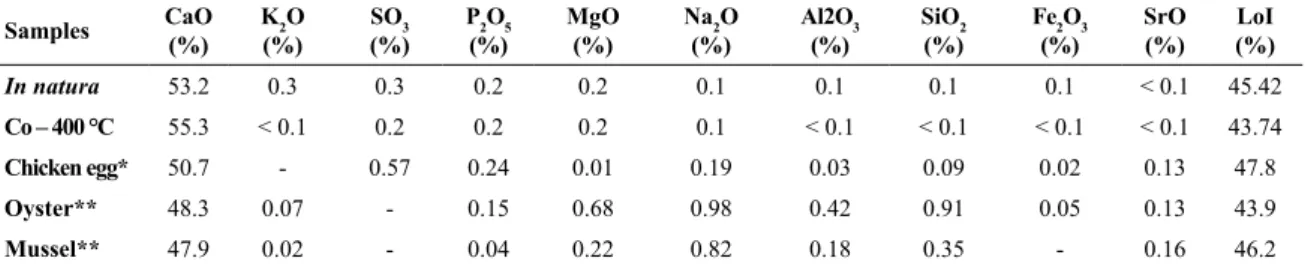
Results of the X-Ray Fluorescence analysis for the eggshells of Rhea Americana both in natura and calcined at 400 ºC are presented at Table 2, such as the values found in the literature for similar fillers from different sources as reference.
Based on results obtained in Table 2, it was observed that the percentages of the most relevant component,
calcium oxide, were higher than 50% for both in natura
and calcined at 400ºC samples, slightly increased by calcination. The other elements are present in lower than 0.3% percentages and few of them were altered by calcination. The loss on ignition was greater forin natura
samples, corresponding to the loss of organic matter and dehydration of the sample, as expected.
Regarding the shells of different origins (chicken, oyster and mussel), it can be observed that the calcium oxide contained on them is lower than in the samples obtained for this study. Results confirm the literature, indicating eggshells of Rhea Americana as an interesting source of this type of oxide. The greatest natural source of CaCO3 is the Rhea Americana eggshells, which have approximately 98.5 % of this composite into its composition15.
3.1 X-Ray Diffraction of in natura and calcined
powder
The XRD curves for the eggshells of Rhea Americana
both in natura and calcined at 400 ºC are shown in Figure 1.
Table 2. X-Ray Fluorescence Analysis for in natura and calcined at 400°C eggshell samples assessed in this study and some literature references.
Samples CaO (%)
K2O (%)
SO3 (%)
P2O5 (%)
MgO (%)
Na2O (%)
Al2O3 (%)
SiO2 (%)
Fe2O3 (%)
SrO (%)
LoI (%)
In natura 53.2 0.3 0.3 0.2 0.2 0.1 0.1 0.1 0.1 < 0.1 45.42
Co – 400 °C 55.3 < 0.1 0.2 0.2 0.2 0.1 < 0.1 < 0.1 < 0.1 < 0.1 43.74
Chicken egg* 50.7 - 0.57 0.24 0.01 0.19 0.03 0.09 0.02 0.13 47.8
Oyster** 48.3 0.07 - 0.15 0.68 0.98 0.42 0.91 0.05 0.13 43.9
Mussel** 47.9 0.02 - 0.04 0.22 0.82 0.18 0.35 - 0.16 46.2
• LoI = Loss on ignition and results normalized to 100 %.
* Source: Freire&Holanda, 2006.
** Source: Silva, 2007.
According to the diffractograms, the powder obtained from the milling of the Rhea Americana eggshell has a diffraction pattern corresponding to calcite crystals, a polymorph of the calcium carbonate (CaCO3) (ICDD, 86-2334), with well-defined crystalline phases, confirming the presence of this component as majority in birds eggshells, as reported by Wei, Xu, Li17and Kumar, Dev and Gupta25.
The X-Ray diffraction patterns of the eggshell powder are similar to the diffraction pattern of the industrial calcium carbonate, as reported by Bootklad, Kaewtatip26 and Murakami, Rodrigues, Campos27 In these studies,
the authors compared the pattern of calcium carbonate with chicken eggshells.
The characterization by XRD of in natura and calcined samples indicated that the heat treatment preserved the crystal structure while maintaining calcium carbonate in the samples, being efficient in the removal of water and organic matter, and allowing the use of the eggshell residues as a source of calcium carbonate.
3.2 Thermogravimetry of in natura and calcined
powder
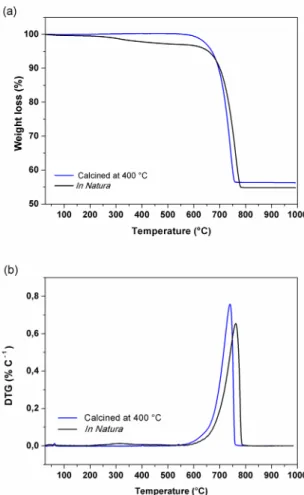
Figure 2 shows TG and DTG curves of the powder obtained by milling the eggshells.
According to the TG curves, the in natura eggshell decomposition occurs in two distinct stages of weight loss: (i) the removal of water molecules (H2O) and decomposition of organic matter with a weigh loss of 3.3 % in the temperature range between 50 ºC and 570 ºC; (ii) the second stage involves the release of CO2 from the decomposition of CaCO3 (calcium carbonate) in the temperature range of 570 ºC to 780 ºC, with a weight loss of approximately 46%. At 800 ºC, the in natura eggshell had 50.7 % of residue, which corresponds to ashes and inorganic materials, mainly calcium oxide from the decomposition of CaCO3.
The purpose of the calcination was the removal of water and any organic matter present in the eggshells, in order to reduce possible variation on the aspects of the films due to contamination of the filler, since systems would be prepared with the biodegradable polymer, sensitive to the presence of impurities.
Samples calcined at 400 ºC did not have the weight loss initial stage detected in in natura samples. This result was expected because of the temperature range used in the heat treatment, confirming the efficiency of the heat treatment in the removal of organic matter and water. For these samples, only a single weight loss step of approximately 45% was observed between 560 and 770 ºC, associated to the previous reaction.
These results were also observed by Pereira, Okumura, Ramos, Cavalheiro, Nóbrega28 and Caliman29, when they
used chicken and ostrich eggshells with hydroxyapatite, respectively.
According to the obtained results for X-ray fluorescence, X-ray diffraction, and thermogravimetry the conditions of the thermal treatment selected for the calcination were efficient since the structure of the calcium carbonate was not altered and the impurities were removed. Besides, the thermal stability of the filler was highlighted, confirming the viability of the method for the preparation of polymeric composites at high temperatures.
3.3 X-Ray Diffraction of biocomposites with
powder in natura
The XRD curves for samples of neat PHB and PHB containing 1 or 3% of powder in natura are shown in Figures 3 and 4.
According to the diffractogram, films prepared with neat PHB showed more defined basal reflections at 2θ values 13.56º, 16.34º, 20.16º, 21.47ºe 25.43º. These reflections were also observed by Abdelwahab, Flynn, Chiou, Imam, Orts, Chiellini30.
For samples containing powder in natura, an important basal reflection can be detected at 2θ value 29.57º, corresponding to the presence of CaCO3, indicating the incorporation of the filler to the polymer, and confirming the diffractogram previously discussed for the fillers. Similar behavior was reported by Kang, Pal, Park, Bang, and Kim23, who used the
Figure 3. XRD curves for neat PHB and PHB with 1 or 3% of powder in natura
Figure 4. XRD curves for neat PHB and PHB with 1 or 3% of powder calcined at 400 ºC
chicken eggshell as bio-fillingin an SEBS (styrene-ethylene/ butylene-styrene) matrix. The authors noted the presence of this characteristic peak on composites, confirming the presence of the reinforcing element calcium carbonate.
It can be observed that, with the filler, films possibly had their crystallinity increased, a fact observed due to the higher order and intensity of the diffraction peaks.
With the increase of calcined filler, it occurred an increase in the intensity of the peak at 2θ value 29.57º. Most significant differences are observed in the optical microscopy and scanning electron microscopy analysis and evaluation of the biodegradation.
3.4 Scanning Electron Microscopy of
biocomposites and neat PHB
Figure 5 shows the micrographs of neat PHB and biocomposites with both in natura and calcined fillers.
It was observed that samples containing neat PHB have a homogeneous and continuous surface, as reported by Santos, Oliveira, Paoli, Freitas, Rosa4. SEM images showed
the presence of small clusters on the surface, possibly due to some undissolved polymer particles in the solvent, which may be associated with the preparation conditions.
For 1% of filler, the solvent evaporation rate may have been altered, leading to the formation of a structure with a large number of pores of varying sizes. The increase in filler percentage promoted the formation of clusters, indicating poor dispersal by the method adopted. There was also porosity, but with smaller pores. The reduction of porosity may have been caused by the slower evaporation of the solvent due to the presence of fillers agglomerates. Similar aspect was observed by Kang, Pal, Park, Bang, Kim23, by using a styrene-ethylene/
butylene-styrene matrix with chicken eggshell, with large clusters with low adhesion to the polymer matrix.
The surface of the biocomposites with calcined filler was more homogeneous with small pores dispersed throughout its length and with a significant reduction of the presence of fillers agglomerates, possibly due to the elimination on humidity and organic matter in the sample, which allowed better dispersion and homogenization of the systems.
3.5 Biodegradation test
Figures 6 and 7 show the mean values for visual inspection and weight loss, respectively, in each of the films after the biodegradation periods.
Based on data presented in Figures 6 and 7, the increase of biodegradation can be observed for all systems over time, but with variations in the intensity of degradation depending on the type of composition.
Films based on neat PHB showed a low mass loss until the fiftieth day of testing, then, an acceleration of the biodegradation occurred around 60 days of evaluation. With the addition of the in natura filler, the biodegradation process
Figure 5. Scanning Electron Microscopy of films containing neat PHB (a); PHB with filler in natura: 1% (b) and 3% (c); PHB with 1%
(d) and 3% (e) of calcined filler. Magnification 1000x
third collection with 1% of filler. By increasing the content of in natura filler, films got more susceptible to microbial
attack, leading to almost 80% degradation index with 20 days of evaluation and total loss from the 3rd collection. This
behavior can be associated to the presence of porous regions on the surface of the films, which facilitates the penetration of microorganisms in the structure, promoting a more intense biodegradation in less time of exposure to soil, as previously observed by scanning electron microscopy.
The images of the optical microscopy of the collected samples are illustrated in Figure 8.
Figure 6. Visual inspection of the neat PHB; PHB with in natura filler: 1% and 3%; PHB with calcined filler with 1% and 3% along the biodegradation period
A smooth surface can be an obstacle for the contact of water and lipase molecules with polymer chains, as illustrated in Figure 9. Studies carried out by Molitoris, Moss, De Koning, Jendrossek32 confirm the dependence of the rate
of PHA hydrolysis to the surface area.
For films with calcined filler, was possible to observe a considerable reduction in the biodegradation rate of the samples, which can be explained by the removal of water and organic matter present in the sample, even in small proportions. The increase in calcined filler percentages slightly accelerated the biodegradation of
the films, with the formation of a smaller number of voids and less pronounced erosion of the surface.
Another possibility to different levels of degradation according to the type of filler adopted may be associated with a change in crystallinity of the samples: biodegradation occurs initially in the amorphous region34.
Bootklad, Kaewtatip26 developed thermoplastic starch and hen eggshells composites, and concluded that the organic components in the eggshells facilitated the microorganism's attack.
Figure 7. Weight loss of the neat PHB; PHB with in natura filler: 1% and 3%; PHB with calcined filler with 1% and 3% along the biodegradation period
Figure 8. Optical Microscopy of biocomposites
Figure 9. Scheme of attack of bacteria on various surfaces. (Adapted
by Wang, Mo, Yao, Wu, Chen, Chen33)
condition such as temperature, humidity, pH, the presence of nutrients for microorganisms and intrinsic characteristics of the material, such as crystallinity, additives, surface area and type of monomers34.
4. Conclusions
According to the RXF, RXD, TG/DTG results, it was concluded that the heat treatment of the eggshells resulted in the elimination of organic matter and humidity without
affecting the crystal structure, preserving calcium oxide as a major component. For biocomposites the X-ray diffractograms presented peaks characteristics to the calcium carbonate and different intensities and small shifts in the diffraction planes with the variation of the calcium carbonate. In the Scanning Electron Microscopy - SEM - images, it was observed films with most of the surface regular and with the small filler of polymer agglomerations. Plenty of pores with different sizes were observed in the surface of the biocomposite films with the in natura filler. A more homogenous surface was observed
lower amount of pores with smaller sizes and the formation of fewer agglomerates were observed. Biodegradation was intense for all systems, being influenced by the type of filler adopted. The neat PHB films presented a small weight loss until the 50th day of the test, and the biodegradation process was
accelerated after the 60th day of the test. With the addition of
1 % of the in natura filler, the biodegradation process reaches
out over 90 % in the third withdrawal. With the increase of the in natura filler the films were more susceptible to the
microorganisms attack, displaying a degradation index of approximately 80 % at the 20th day of the test and a total
degradation at the third withdrawal. For the films with the calcined filler, the biodegradation rate of the samples was decreased, as observed in the weight loss values, and the increase of the filler content did not influence the films' degradation. The used of the Rhea Americana eggshells shows a great potential as the filler for developing polymeric biocomposites.
5. Acknowledgements
The authors are grateful to PHB Industrials for the polymer donation, to UFPI's breeding for the donation of eggshells and to UFCG for the optical microscopy analysis.
The authors thank the Graduate Program in Materials Science (UFPI), Laboratory of Polymer and Conjugated Materials - LAPCON/UFPI to the physical structure, and CNPq for financial support (Process: 446655/2014-7, 306312/2015-8 and 446530/2014-0).
6. References
1. Roa JP, Mano V, Faustino PB, Felix EB, Silva MESR, Souza Filho JD. Synthesis and characterization of the copolymer
poly (3-poly(3-hydroxybutyrate) -co-e-caprolactone) from poly(3-hydroxybutyrate) and poly(e-caprolactone). Polímeros.
2010;20(3):221-226.
2. Abou-Zeid DM, Müller RJ, Deckwer WD. Degradation of
natural and synthetic polyesters under anaerobic conditions.
Journal of Biotechnology. 2001;86(2):113-126.
3. Reis KC, Pereira J, Smith AC, Carvalho CWP, Wellner N, Yakimets I. Characterization of polyhydroxybutyrate-hydroxyvalerate (PHB-HV)/maize starch blend films. Journal of Food Engineering. 2008;89(4):361-369.
4. Santos PA, Oliveira MN, Paoli MAD, Freitas VG, Rosa DS. Evaluation of the effect of pro-degrading additives in PP,
Blended with PHB. Polímeros. 2013;23(3):432-439.
5. Rosa DS, Filho RP, Chui QSH, Calil MR, Guedes CGF.
The biodegradation of (hydroxybutyrate),
poly-ß-(hydroxybutyrate-co-ß-valerate) and poly (ε-caprolactone) in
compost derived from municipal solid waste. European Polymer Journal. 2003;39(2):233-237.
6. Bucci DZ, Tavares LBB, Sell I. Biodegradation and physical
evaluation of PHB packaging. Polymer Testing. 2007;26(7):908-915.
7. Rosa DS, Lotto NT, Lopes DR, Guedes CGF. The use of roughness
for evaluating the biodegradation of poly-ß-(hydroxybutyrate) and poly-ß-(hydroxybutyrate-co-ß-valerate). Polymer Testing. 2004;23(1):3-8.
8. Savenkova L, Gercberga Z, Nikolaeva V, Dzene A, Bibers I, Kalnin
M. Mechanical properties and biodegradation characteristics of
PHB-based films. Process Biochemistry. 2000;35(6):573-579.
9. Franchetti SMM, Marconato JC. Biodegradable polymers - a partial way for decreasing the amount of plastic waste. Química Nova. 2006;29(4):811-816.
10. Thiré RMSM, Ribeiro TAA, Andrade CT. Effect of starch addition
on compression-molded poly(3-hydroxybutyrate)/starch blends.
Journal of Applied Polymer Science. 2006;100(6):4338-4347. 11. Rodolfo Jr A, Nunes LR, Ormanji W. Tecnologia do PVC. 2a
ed. São Paulo: Proeditores/Braskem; 2006.
12. Rabello MS. Aditivação de Polímeros. São Paulo: Artliber; 2000.
13. Yao ZT, Chen T, Li HY, Xia MS, Ye Y, Zheng H. Mechanical and thermal properties of polypropylene (PP) composites filled with modified shell waste. Journal of Hazardous Materials.
2013;262:212-217.
14. Rivera EM, Araiza M, Brostow W, Castaño VM, Díaz-Estrada JR, Hernández R, et al. Synthesis of hydroxyapatite from
eggshells. Materials Letters. 1999;41(3):128-134.
15. Souza-Soares LA, Siewerdt F. Aves e ovos. Pelotas: Editora da
Universidade UFPEL; 2005.
16. Cho YB, Seo G. High activity of acid-treated quail eggshell catalysts in the transesterification of palm oil with methanol. Bioresource Technology. 2010;101(22):8515-8519.
17. Wei Z, Xu C, Li B. Application of waste eggshell as low-cost
solid catalyst for biodiesel production. Bioresource Technology. 2009;100(11):2883-2885.
18. Yoo S, Hsieh JS, Zou P, Kokoszka J. Utilization of calcium
carbonate particles from eggshell waste as coating pigments for ink-jet printing paper. Bioresource Technology.
2009;100(24):6416-6421.
19. Chojnacka K. Biosorption of Cr (III) ions by eggshells. Journal of Hazardous Materials. 2005;121(1):167-173.
20. Park HJ, Jeong SW, Yang JK, Kim BG, Lee SM. Removal of
heavy metals using waste eggshell. Journal of Environmental Sciences. 2007;19(12):1436-1441.
21. Vijayaraghavan K, Jegan J, Palanivelu K, Velan M. Removal
and recovery of copper from aqueous solution by eggshell in a packed column. Minerals Engineering. 2005;18(5):545-547.
22. Toro P, Quijada R, Yazdani-Pedram M, Arias JL. Eggshell, a new bio-filler for polypropylene composites. Materials Letters.
2007;61(22):4347-4350.
23. Kang DJ, Pal K, Park SJ, Bang DS, Kim JK. Effect of eggshell and silk fibroin on styrene-ethylene/butylene-styrene as bio-filler. Materials & Design. 2010;31(4):2216-2219.
24. Boronat T, Fombuena V, Garcia-Sanoguera D, Sanchez-Nacher L, Balart R. Development of a biocomposite based on green
polyethylene biopolymer and eggshell. Materials & Design.
25. Kumar V, Dev A, Gupta AP. Studies of poly (lactic acid)
based calcium carbonate nanocomposites. Composites Part B: Engineering. 2014;56:184-188.
26. Bootklad M, Kaewtatip K. Biodegradation of thermoplastic
starch/eggshell powder composites. Carbohydrate Polymers. 2013;97(2):315-320.
27. Murakami FS, Rodrigues PO, Campos CMT, Silva MAS. Physicochemical study of CaCO3 from egg shells. Food Science and Technology. 2007;27(3):658-662.
28. Pereira JG, Okumura F, Ramos LA, Cavalheiro ETG, Nóbrega JA. Termogravimetria: um novo enfoque para a clássica determinação de cálcio em cascas de ovos. Química Nova. 2009;32(6):1661-1666.
29. Caliman LB. Síntese e caracterização de hidroxiapatita obtida a partir da casca de ovo de avestruz. [Dissertation]. Vitória: Federal Institute of Espírito Santo; 2011.
30. Abdelwahab MA, Flynn A, Chiou BS, Imam S, Orts W, Chiellini E. Thermal, mechanical and morphological characterization
of plasticized PLA-PHB blends. Polymer Degradation and
Stability. 2012;97(9):1822-1828.
31. Corrêa MCS, Rezende ML, Rosa DS, Agnelli JAM, Nascente
PAP. Surface composition and morphology of poly(3-hydroxybutyrate) exposed to biodegradation. Polymer Testing. 2008;27(4):447-452.
32. Molitoris HP, Moss ST, de Koning GJM, Jendrossek D. Scanning
electron microscopy of polyhydroxyalkanoate degradation by bacteria. Applied Microbiology and Biotechnology.
1996;46(5-6):570-579.
33. Wang YW, Mo W, Yao H, Wu Q, Chen J, Chen GQ.
Biodegradation studies of poly(3-hydroxybutyrate-co-3-hydroxyhexanoate). Polymer Degradation and Stability. 2004;85:815-821.
34. Abe H, Doi Y. Molecular and Material Design of Biodegradable
Polyhydroxyalkanoates (PHAs). In: Biopolymers Online.