BIOGEOGRAPHY OF AZOREAN PLANT lNY ADERS
L. SILVA, J. TAVARES & C. W. SMITH
SILVA, L., J. TAVARES & C. W. SMITH 2000. Biogeography of Azorean plant invaders. Arquipelago. Life and Marine Sciences. Supplement 2(Part A): 19-27. Ponta Delgada. ISSN 0873-4704.
Alien plants are a major component of the Azorean vascular !lora. We present a general biogeographic analysis of the taxa considered as introduced in the Archipelago. This work results from the construction of a data-base of Azorean plnnt invaders. Of the 996 taxn recorded for the Azores, 6,6% are considered endemic. 10,2% nntive. 72.6% nlien. and 10,5% to be of uncertain stntus. The percentage of alien taxa is lowest in the Pteridophyta (26,O%) and highest in the Dicotyledoneae (7S,9%). Significant differences were found between islnnds for the proportion of invnders. The highest percentages were found in Sao Miguel, Terceira nnd Faial, and the lowest in Flores and Corvo. A quadratic model fitted a regression between percentage of invaders and human popUlation density, and might reflect the existence of n higher propagule pressure in some of the islands. Many of the invaders are also found in mainland Portugal and in other Macnronesian islands. The invaders are largely Palearctic in origin or Subcosmopolitan, with a wide geographic distribution. and have also been introduced in other regions of the world.
Luis Silva (e-mail: [email protected]) & loclo Tavares, Departamento de Biologia. Uiliversidade dos A~ore5, PT - 9500 POllta Delgada, Portllgal. - Clifford W. Smith. Botany Department, Uiliversity of Hawaii. 3190 Maile Way, HOIlOIIlIII, HJ96822, USA.
INTRODUCTION
The study of plant invaders is Important not only in academic terms, but also because some of the invaders might become noxious WEEDS (CRONK & FULLER 1995: PYSEK et 011. 1995). The origin of the pl:.lIlts invading a certain region hns been ex.tensively covered elsewhere (DRAKE et 011. 1989; GROVES & DI CASTRI 1991). Today. the success of an invnder in a given ecosystem is an important indicator of whether a species might become a successful invader elsewhere (WILLIAMSON 1996).
Alien plants are a major component of the Azorean vascular tlora. According to PALHINHA (1949) three quarters of the Azorean vascular plant species are ex.otic. Although a considerable research effort was developed regarding the native vegetation (see DIAS 1996). few papers deal with plant invaders. Exceptions are those of PALHINHA (1949, 1953). REGO (196-+). SJOGREN. (1973a. 1973b) and HANSEN (1987. 1992). Since
1992, work has been carried out on the ecology and control of plant invaders, both those originating in the Azores islands (SILVA 1994, SILVA & TAVARES 199501. SILVA & TAVARES 1995b, SILVA et al. 1995, SILVA & TAVARES 1997, SMITH et al. 1995) and those invading the archipelago from elsewhere (SILVA et al. 1996, SILVA et al. 1997). One of the aims of this study is the development of a data-base regarding the Azorean vascular tlora. including an in-depth characterisation of the introduced taxa. The Azores archipelago. located in the North Atlantic Ocean. comprises nine islands diviued by three island groups (Table I): the eastern group (Santa Maria and SJo Miguel), the central group (Taceira. Graciosa. SJo Jorge, Pico and Faial). and the western groU[) (Flores and Corvo). The islands 3re ()~. volcanic origin aml the climate is lemperate oceanic_ with a mean annuill temperature of 12°C <.It 550 m altitude and 17°C at 70 m. and a mean r:lin-fall of ~lbout 2300 and
1020 mm/year, respectively (INMG 1991). In this p:lper we present ,1 gener:ll
biogeographic analysis of the vascular plant t. xa considered as introduced in the Azorean islanus. We test the hypothesis that the majority of the plant invaders in the Azores have a wide biogeographic d istri but ion.
MATERIALS AND METHODS
A data-base of the Azorean vascular flora was compiled using FileMaker Pro 2 (Claris Corporation). and based On the checklist of Macaronesian vascular plants from HANSEN & SUNDING (1993). The data-base was complemented with information regarding the included taxa. namely. from the following sources: DROUET (1866). TRELEASE (1897). PALHINHA (1966). SJOGREN (1973b). Flora Europaea volumes 1-5 (TUTIN et a!. 1964. 1968. 1972. 1976. 1980). FRANCO (1971. 1984), FRANCO & AFONSO (1994). PRESS & SHORT (1994). ANONYMOUS (1976).
Only the species stated to have been recorded as spontaneous (native or endemic - indigenous) or naturalised (introduced accidentally or intentionally by Man, but maintaining self-sustained populations) in the Azores have been included.
Searches of the data-base were carried out to ascertain how many taxa were assigned to the following categories: endemic, native, introduced, and of uncertain status. The latter category was used for taxa where it was not possible to decide if they were native or introduced. Although the reason for considering a species as· introduced was largely based on records by previous authors, the following criteria, in different combinations, supported the decision to consider a species as introduced: i) first record during the last 100 years; ii) distribution limited to a reduced number of islands; iii) record of a recent extension (noted during the last 100 years) of the distribution in the Azores; i v) absence from other Macaronesian islands; v) disjunct distribution; vi) largely anthropochoric species - weeds. ornamental plants, medicinal plants. These criteria were applied after the exclusion of endemic species. The percentage of invaders was calculated for the Pteridophyta, Gymnospermae,
Monocotyledo-neo .md Dicotyledoneae. For each of these taxa. the biogeographic distribution of the invaders was analysed. The biogeographic regions of the world used in this work are those suggested by PIELOU (1992), namely: Antarctic, Australasian. Ethiopian. Nearctic. Neotropical, Oceanian. Oriental and Palearctic. Holarctic in this text refers to the Nearctic and Palearctic regions together. Species with a wide geographic distribution, present in more than two regions were considered as Subcosmopolitan.
Percentage of invasive taxa were calculated by island. These percentages were compared using a X2 test (ZAR 1996). followed by a multiple comparison test. For the latter analysis, percentages were transformed in degrees using arcsine after a square root transformation.
Relationships were searched for between the number of endemic, native, indigenous and exotic taxa, and the area, maximum altitude, and human population of each Azorean island. For that purpose data were log transformed. and the statistical package SPSS for Macintosh 6.1.1. was used. Linear, logarithmic and quadratic regression models were calculated, but only those indicated as significant by ANOV A were considered.
RESULTS
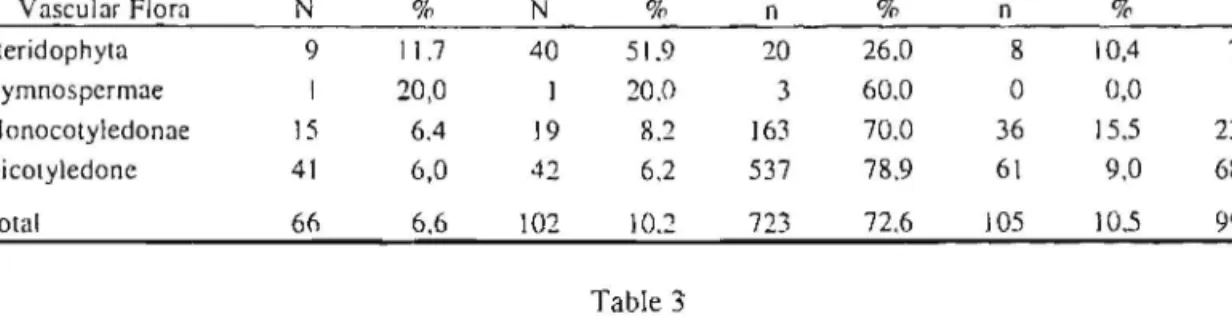
For the 996 taxa considered, the percentage of plant invaders in the archipelago was found to be 72,6%. The group with the lowest percentage of invaders is the Pteridophyta, while the Dicotyledoneae present the highest proportion (Table 2). About 10% of the taxa are still of uncertain status.
For every Azorean island the percentage of introduced taxa is above 50%, with a lowest proportion of exotic taxa in the western group of islands (Corvo and Flores), and the highest proportion in Sao Miguel, Terceira and Faial (Table 3). A relatively high proportion of native species was thus found for the western group. Species of uncertain status accounted for between 10 and 15% of the taxa.
Significant differences were found between islands for the proportion of introduced taxa (X2 = 56,94; d.f.= 8; p<0,000 I). Using' a multiple
Table I
Physical dcscription 01" thc Archipclago of thc Azorcs,
Azorean Area Maximum Age Distancc to Human
islands (km') Altitude (m) (1'I1Y) mainland (km) population
Santa Mari<l lJ7 587 !U20 1588 6500
S50 Miguel 757 1103 4,()IO 1584 131908 Terceira 402 1023 2,000 1764 53570 Graciosa 62 402 2.500 1844 5377 S50 Jorge 246 105~ 0.550 1832 10361 Pico 433 2351 0.300 1860 15483 Faial 172 1043 0.730 1908 15489 Flores 142 915 2,900 2152 4352 Corvo 17 718 ~ 2148 370
(Adapted from BORGES 1997)
Table 2 Density (inh.l km') 66.8 176.6 133.2 87.9 42.2 34.6 89,5 30.7 21.6
Number and perccntage of taxa from the Azorean vascular nora. divided into four categories: endemic. native. introduced, and of uncertain status.
DISTRIBUTION OF TAXA
Azorean Endemic Native Introduced Uncertain Total
Vascular Flora N % N % n % n % Pteridophyta 9 11.7 40 51.9 20 26.0 8 10,4 77 Gymnospermae 20,0 I 20.0 3 60.0 0 0,0 5 Monocotyledonae 15 6.4 19 8.2 163 70.0 36 15.5 233 Dicotyledone 41 6,0 42 6.2 537 78.9 61 9,0 681 Total 66 6,6 102 10.2 723 72.6 105 10.5 996 Table 3'
Distribution of the four categories of-vascular plant taxa within the Azores. V ASCULAR PLANT TAXA
Total Introduced Native Endemic Uncertain
Islands n % n % n % n % Santa Maria 435 289 66,4 66 15.2 26 6,0 54 12,4 S50 Miguel 730 503 68,9 91 12.5 50 6,8 86
.
1 1,8 Terceira 634 427 67,4 89 14,0 48 7,6 70 11,0 Graciosa 335 218 65.1 53 15.8 13 3.9 51 15,2 S50 Jorge 464 276 59.5 77 16.6 49 10.6 62 13.4 Pico 545 329 60.4 91 16.7 54 9,9 71 13,0 Faial 599 403 67.3 87 14.5 47 7,8 62 10,4 Flores 405 228 56,3 81 20,0 42 10,4 54 13.3 Corvo 305 156 51.1 68 223 38 12,5 43 14,1'"
1.90'"
'"
•
~ '.; I.H,'i ~•
-g
-
1.80 1S
~J 1.7:1 L I.~ I ... 1.6 c.11Log(Human p()pul~lion dellsity)
Fig.l. RelationShip oetween human popul:nion densilY ~nu percentagc
or
introuuceu vascular plants In the Azorean islands. A quadratic modcl CR'=O.98. F=69.2. ~md p=O.OOOI) with the following equaLion: log('J{ Introduced taxa) '" -0.18Iog(DcnsiIY)' + 0.75Iog(Dcnsily) + 1.09 .U/)
•
1.50 I ~JJ.s
1.40 1 . ,[)j
---<'-
~----~----~----~~--1.2 1.4 1.6 1,8 2,0 2,'2 2.4Log(l-lliman population density)
Fig. 2. Relationship between human population density and percentage of indigenous vascular plants in the Azorean islands. A linear model (R '::0.88. F=S 1,6 and p=0.0002) with the following equation: log(% Indigenous taxa):= -0.28 log(Density) + 1,94.
comparison test significant differences were fQund between Sao Miguel and the islands of the western group (Table 4). No significant differences were found between Corvo, Flores, Sao Jorge and Pico, but all the remaining islands presented a proportion of invaders significantly different from that of Corvo.
A quadratic relationship was found between human population density and the percentage of introduced species (Fig. I). A linear model was adjusted to the relationship bet~veen human population density and the percentage of indigenous species (Fig. 2).
A considerable proportion of the introduced plants found in the Azores was also present in
mainland Portugal and in other Macaronesian islands (Table 5). The Pteridophyta were an exception, with only a quarter of the introduced taxa found in mainland Portugal.
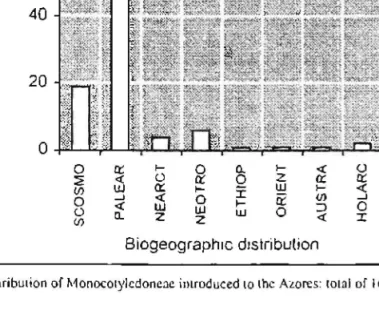
A large proportion of the introduced Pteridophyta have a Subcosmopolitan or a Pa1earctic distribution or are present in more than one biogeographic region (Fig. 3). The Gymnospermae has only three naturalised species: one taxa from America, one from the Mediterranean. and a third from Asia. The Monocotyledoneae also present a large proportion of Palearctic and Subcosmopolitan taxa (Fig. 4). The same was found for the Dicotyledoneae, although this group also presents a considerable
T:Jble 4
Pcn:cnt:.Jge of introduced v:lscular plants in the Azorcs mquipclago. Thc percentages were
re-c.1Icul~ted afIer excluding species of uncerwin sWtus.
Comparison hetween isl;.IOds ()~~ tcstJollowcd by a multiple comp:uison Icst).
Azorc:ln Pcrcenlage of Comparison Island., plant in\'ader~ 0:=0.05
Corvo 595 a Florcs 65.0 a b Sao Jorge 611.7 a b Pico 69A Q h Fainl 75.0 b Terceiru 75.7 b S;.IOI<lI\1;1ria 75.9 b Gracios:! 76.8 b Sao Micuel 78.1
•
(Different IClters = ,ignilicant differences.)
c c c c c c e
proportion of introduced taxa occurring in two biogeographic regions, and some exclusively Macaronesian taxa (Fig. 5).
DISCUSSION
The percentage of invaders found in the Azores is higher than that found in other places of the world (REJMANEK et. al. 1991, MONTENEGRO et al.
1991, WELLS, 1991), even when compared with
islands presenting a very much modified
vegetation such as Hawaii and New Zealand, with 17.5-19% and 47% of introduced species,
respectively (HEYWOOD 1989). Some authors
suggest that isolated oceanic islands are
predisposed to certain types of human-related
invasions (LOOPE & MUELLER-DoMBOIS 1989),
others (WILLIAMSON 1996) consider that this has yet to be proved. The Azores are considerably remote islands, and are relatively
young when compared with the other
Macaronesian archipelagos. They have been intensively cultivated since the XV century. Many species have been introd uced for food and fibre or as accompanying weeds, and also as
ornamental and hedging plants. A large
proportion of the l:Jndscape was directly changed by human activities, allowing the easy entrance of exotic species, and increasing the propagule
pressure, the amount and frequency of
introduction of dispersal units from an alien
species.
The islands of the western group, together with Sao Jorge and Pico, are those presenting a
lower proportion of invaders. We might thus
suggest that they were under a relatively lower propagule pressure. A lower human popUlation
density allowed a lower input of alien species.
Sao Miguel, Terceira and Faial are more heavily populated islands and also present the higher proportions of alien taxa. Furthermore, these islands have been considered as an important source of propagules from alien taxa for the other
islands, during the last one hundred years
(SJOGREN 1973a). Graciosa and Santa Maria are
small islands with a relatively low maximum altitude where the landscape was largely altered by human action. This might have lead to a relatively high input of alien taxa, what might explain the relatively high proportion of invaders recorded for these islands.
Differences between islands for the proportion of introduced taxa, might thus be associated with different levels of human pressure on the
60
40
20 o :2 (f) o u (f) a::«
w ...J«
1Lo
a::f-o
wz
~1L
f-Q ( f ) I::>f-«w
~f-1Lz
Qw
I -f-a::w
O Biogeographic distributionFig. 3. Biogeographic distribution of Pteridophyta
60
40
200
0 0:: I- 0 0- I- <i () ~ « () 0::Q
z
0::: 0:: (f) UJa::
I- w I- <i 0 ...J <i 0 I ~ (J) ...J <i UJ l- =>a
() 0... Z UJ wa
« :r If>z
Biogeographic distributionFig. 4. Biogeographk dislribution of Monocolylcdoneae introduced to the: Azores: IOInI of 163 InXl.
60
40 20 0 0 0:: ( j (30 I-a
00:: a.. -0:: I- -0:: ~o:: 0 ~ <C 0:: 0::0:: ( j 0:: 0 0..« Z 1-« ~ :) 0:: 0::« Qw w Zw 0::« (/) w:56
l - I I-W~
L5
0 I-W I...J ii. !!!..J ( j0 0 O...J I- 0::« Ci)...J
(j 0.. r
ow
Z w w« w 1-« wo..a
00.. =:1« «(/) I Z Z zo... «0... :2:
Biogeographic distribution
Fig. 5. Biogeographic distribution of OiCotyJedone~ introduced to tlie Azores: 10lal or 537 considered laxa. environment. implying different levels of
propagule pressure. The models derived from our a.nalyses positively relating the human population density to the percentage of introduced species further support this hypothesis. WILLIAMSON (1996) reports stud ies where si III i I ar results were found when rel;}ting numbers of plant invaders and numbers of human visitors into nature
reserves. higher numbers of visitors were associated with a higher propot1ion of invaders. Quarantine measures should be implemented to to avoid further introductions in the less affected islands.
A considerable proportion of Azore;}n plant invaders is also present in mainland Portugal or in other Macaronesian islands, what might suggest a.
Table 5
Percentage of illlrmluccd taxa from the Azore~n vascular l10w which also occur in three regions oUlside Awrcs: mainlalld Portugal. Madeira island and the Macaronesin excluding the Azores. (n==number of
introduced trlxn)
INTRODUCED
V !\SCU I_A II. I'Lt\NTS 11 POflue:!I
I'It:ridnpl1yl:l 2() 25.()
GYIll!Hl.'r~l"Illac 66.7 fo,,1olHJwlykdollac I (J: 70.6
Di cOli Icdollae 5~7 77.~
direct intl'llduclion of plants frolll the mainland, but also that many of those species are successful invaders ehewhere, Success as an in\'ader in other ecosystems should be used in the future to reject a potential introduction. and also to stimulate the control of species that were already introduced but still with a limited distribution.
Many of the invaders have a Subcosmopolitan distribution. are present in two bio~eographic regtons or have a Palearctic distribution. i.e. always a wide distribution. This further emphasises the suggestion that success as an invader in other regions is a good indicator of the potential for similar success in the Azores. Thus, we might conclude thaL as a general rule, the potentially most successful invaders in the Azores are those species with a wide biogeographic distribution which are already invaders elsewhere. Some of the invaders present a very narrow biogeographic distribution. for example Clethra
arlJorco Aiton (Clethraceae, endemic to Madeira but an invader in Sao Miguel). ~tnd do not followthe general scheme.
A Iso. some of the invaders are considered as weeds in agriculture.
forestry and in nature reserves. for example Rllillex spp. (Polygonaceae) and Menlha
sltal'co/cIlS Ehrh. (Lamiaceae) on pastureland, Hcdrchilf!11 gardneriallllll1 Ker-Gawl (Zingiberaceae) in forestry and in nature reserves. and Piu()sjJorulII lIlldLi/alulIl Vent. (Pil\osporaceae) from sea level up to 600 m. Both groups deserve further study regarding their ecology and control.
0; OF TAXA Ma<icira Mac:lcarom:sia 55.0 6(1.0 ~3.3 3~.3 6.1.2 71.2 67.2 75.2 ACKNOWLEDGEMENTS
We would like to thank Dr. Eduardo Dias and his team at Departamento de Ciencias Agrarias. Universidade dos Ar;ores for bibliographic support. The manuscript was improved by comments and corrections from two anonymous reviewers.
REFERENCES
ANONYMOUS 1976. Honus Third. A concise diCiiollary of ClIllil'Oled planls in lite Vniled Siales and Canada. Bailey HOi"1orium. Cornell University. Macmillan Publishing Comp;my. New York. 1290 Pfl·
BORGES. p, 1997. Pasture arlltropod community
SIrlICIU/'(' in A;:orl'lIl1 islands of different geological
age, Phd, Thesis. University of London. r mperial College of Science. Technology and Medicine, Depnrtmcnl of Biology. Silwood Park. London, 245 flP.
CRONK, C. B. & J. L. FULLER 1995. Plam illl'Oders.Chapman & Hall, London. 241 pp. DtAS. E, 1996. Veliela~iio n(llllral dos A~ores.
Universidndc do~ Al;ores. Angra do Herofsrno. 302 pp,
DRAKE. J.A .. H. A. MOONEY. F. DI CASTRI, R. H.
GROVES, F. J. KRUGER, M. Rf:JMANEK & M.
WILLIAMSON 1989. Biological im'asions - A global
perspeclive. SCOPE 37. Jonh Wiley & Sons, Chichester. 525 pp.
DROUET, H. 1866. Calalogue de La flore des lies
A~'ores precede d(' I'itilll!raiare d'ull voyage dalls cel archipel. Paris. 153 pp.
SJOGIWN. E. 1\)73h. Reccnt changcs in thc \'ascul:lr
ilora and vcgctation of the A7.0l'cS islands.
M!'IH!jrias do SO!'l('{ladl' nmt"rilillO ~2: 1-453.
S~IITH, C. ~.' .. C. LU1Zow-Fu.L1NG &. D. E. GARDNER
19'Xi. M\Tico fa\'{{: onc l11illl's mcal is another man's POiSllll. nole/illl do /I,tIlSt'li MlillieifUll do FUllc/i{f1
Suplemc/l!o4: ()lil)·7()().
TKELb\SE. W. 1 Xli7. i30lanical OhSCf\'ulions on th~ Al.orcs. Eighl /111/111,,1 NCI'orl, Mis.lOllri no/wlic{{1
Corden, pp. 77-~~O.
'fLTIN. T. G .. v. H. HEYWOUD. N. A. BURGES. D. H.
VALEi':TINE. S. M. W,ILTEKS &. D. /\. WEI.IU 1%4.
Fiom EUrlJl)lJN/. Volumc J. Cllmbridge UnivcrsilY Prcss. Camhridge. 464 pp.
Tl'TIN. T. G .. V. H. HEY\I'OOD. 1\. A. BURGES. D. ~1. MOORL. D. H .. D. H. VALENTINE. S. ~1. WALTERS
&. D. A. WEIJB 1\)68. Flora F';uml'{/('{/. Volume 2.
C;lmhriugc Univcrsity Prcss. Camhridge. 455 pp.
TLTI!'. T. G .. v. H. HEYWOOD. N. A. BURGES. D, M.
1\'1001{[, D. H .. D, H. VALENTINE. S. M. \V,ILTEHS
&: D. A. Wnw 1972. F/W(I EIII'DIJac!/. Volume 3.
Cambridgc Univcrsity Prcss. Cambridge. 385 rr TUTIN. T G .. v. H. HEYWOOD. N. A. BURGES. D. M.
MOORE. D. H .. D. H. VALENTINE. S. M. WALTERS 8:. D. A. WEBB J 976. FloI'({ £/fTOlwa/. Volumc 4.
Cambridgc Univcrsity Press. Cambridge. 505 pp. TliTIN. 1'. G .. V. H. HEYWOOD. K A. BCRGES. D. M.
MOORE. D. H .. D. 1-1. VALE:-ITINE. S. VI. W,\LTERS
&. D. A. WUl!l J 9KO. Flom [urol)!lell. V olumc 5.
Camhridgc Univcrsity Prcss. Cambriuge. 452 rp. WELLS. M. J. 1!)91. Introduced plants of thc I'ynho,
biome of South l\fric~. Pro 115-12li in: GnovES. R.
H. 8.:. F. DI C,,-STRI (Eds). i3iog!'Ufimphv of
Medi/erral/l'{/n 11I1'asialls. Cambridgc Uni I'crsily
Press. C;Jmbridgc. 485 pp.
\VILLlA~tSO;-<. (\1. 1996. Ihalofiicol III\'Gsio"s. Chapman
8.:. H;JII. London 244 pp.
ZAI{. J. H. 1996. lJios/lI/istical Allal.nis. Third Edition.
Prentice H;JII Internalional. London. 662 pp.