Maio de 2006
Tese de Mestrado
Mestrado em Informática
Trabalho efectuado sob a orientação do
Professor Doutor José Nuno Oliveira Fonseca
Doutor Joost Visser
Tiago Miguel Laureano Alves
VooDooM: Support for understanding and
re-engineering of VDM-SL specifications
Escola de Engenharia
´
E AUTORIZADA A REPRODUC¸ ˜AO INTEGRAL DESTA TESE APENAS
PARA EFEITOS DE INVESTIGAC¸ ˜AO, MEDIANTE DECLARAC¸ ˜AO
Preface
It is often the case that small decisions end up causing a big impact into one’s life. It is funny look behind and see how everything started, all the path that I have been through, and all the people that accompanied me.
It all started in the 5th year Formal Methods course taught by Professor Jos´e Nuno Oliveira. My partner and friend Paulo Silva and I were challenged to create a simple prototype tool for database calculation from formal specifi-cations (VooDooM). Although both of us were a bit sceptic at first, the project was successfully accomplished. A key factor for the project’s success was the valuable help from Joost Visser, who introduced us to advanced software technologies such as “strategic term-rewriting” and “grammar engineering”. Meanwhile, in other 5th year project supervised by Joost Visser, Paulo, Bruno Herdeiro and I were asked to implement software analysis techniques for some mainstream programming languages in a bilateral project with the Dutch company Software Improvement Group (SIG). I still remember the first meeting, where all of us were sitting together discussing whether we were going to accept that work or not. I am glad we did, since this was one of the projects that changed me the most. It was the first time that I was faced with a completely different point of view to look at software: the program understanding point of view.
This project allowed us to caught a glimpse of the real-world software, by performing quantitative analysis of real-world systems in different languages. It was a tough challenge, but once more we succeeded. The involvement with SIG was profitable in other ways since they provided Paulo and me a PL/SQL
grammar that we used in the VooDooM project, thus saving a lot of work. Both these works were not only professionally stimulating, but they have also captivated me with the charms of software science.
After finishing the first semester of the 5th year, I was faced with the choice of doing an internship at some company or doing it in the University. Influenced by professor Jos´e Nuno, and Dr. Lu´ıs Neves, I decided to embrace a new challenge, a University of Minho research project called IKF. The IKF project created all the conditions for starting a MSc, and once more professor Jos´e Nuno had a great impact in my decision by persuading me to accept. Once more I am glad that I followed his advice.
Many other persons had relevance to my work. One of them was professor Lu´ıs Barbosa who gently bought the ISO VDM Standard which allow me to build the tool front-end. Thank you for your trust.
With a hint from professor Jos´e Carlos Ramalho, after the IKF project I became teacher at University of Minho. This not only helped me to financially support myself, but also granted me some time to finish this thesis. Thus, I have to thank professors Pedro Henriques, Jo˜ao Saraiva and Jos´e Jo˜ao Almeida for all their support.
A special thanks to my supervisors, for all their patience and all the time and trust they invested in me.
Finally, I would like to thank all my friends for their support during all periods of this work, and for always remembering me what is important.
Thanks to Andreia for all the love and care, and for gently bringing me back down to earth every time my mind was somewhere else.
Thanks to my sisters and parents. Thanks mom, for all the hard work for me to have the best conditions to work and thanks dad, for the incentive by starting or ending all those long phone calls by asking “when are you going to finish you MSc?” or saying “You really have to finish your MSc!”.
VooDooM: Support for understanding and
re-engineering of VDM-SL specifications
Abstract
The main purpose of this work is to define steady ground for supporting the understanding and re-engineering of VDM-SL specifications.
Understanding and re-engineering are justified by Lehman’s laws of soft-ware evolution which state, for instance, that systems must be continually adapted and as a program evolves its complexity increases unless specific work is done to reduce it.
This thesis reports the implementation of understanding and re-enginering techniques in a tool called VooDooM, which was built in three well defined steps. First, development of the language front-end to recognize the VDM-SL language, using a grammar-centered approach, supported by the SDF formalism, in which a wide variety of components are automatically generated from a single grammar; Second, development of understanding support, in which graphs are extracted and derived and subsequently used as input to strongly-connected components, formal concept analysis and metrication. Last, development of re-engineering support, through the development of a relational calculator that transforms a formal specification into an equivalent model which can be translated to SQL.
In all steps of the work we thoroughly document the path from theory to practice and we conclude by reporting successful results obtained in two test cases.
VooDooM: Support for understanding and
re-engineering of VDM-SL specifications
Resumo
O objectivo principal deste trabalho ´e a defini¸c˜ao de uma infra-estrutura para suportar compreens˜ao e re-engenharia de especifica¸c˜oes escritas em VDM-SL.
compreens˜ao e re-engenharia justificam-se pelas leis de evolu¸c˜ao do soft-ware. Estas leis, formuladas por Lehman, definem, por exemplo, que um qualquer sistema deve ser continuamente adaptado e `a medida que os progra-mas evoluem a sua complexidade tende sempre a aumentar.
Esta tese descreve o estudo de t´ecnicas de compreens˜ao e re-engenharia que foram implementadas numa ferramenta chamada VooDooM. Esta imple-menta¸c˜ao foi efectuada em trˆes etapas bem definidas.
Primeiro, foi desenvolvido um parser (front-end ) para reconhecer a lingua-gem VDM-SL. Para tal, foi utilizada uma abordalingua-gem centrada na gram´atica, suportada no formalismo SDF, que est´a equipado com ferramentas de gera¸c˜ao autom´atica de diversos componentes.
Segundo, para o suporte de compreens˜ao, foram desenvolvidas funcionali-dades para extrair e derivar grafos que s˜ao utilizados em t´ecnicas de an´alise como componentes fortemente relacionados, an´alise de conceitos (formal concept analysis) e m´etricas.
Por ´ultimo, para o suporte de re-engenharia, foi prototipada uma calcu-ladora relacional que transforma um modelo, definido numa especifica¸c˜ao formal, no seu equivalente relacional que pode ser traduzido para SQL.
Em todas as etapas realizadas h a preocupa¸c˜ao de documentar o percurso entre teoria para a pr´atica. A an´alise de resultados obtida no estudo de caso revela o sucesso da abordagem e as suas potencialidades para desenvolvimentos futuros.
Contents
1 Introduction 1 1.1 Motivation . . . 2 1.2 Program understanding . . . 4 1.3 Program re-engineering . . . 5 1.4 Objectives . . . 6 1.5 General approach . . . 71.6 Origins of the chapters . . . 9
2 Technology 11 2.1 Grammar-centered tool development . . . 11
2.2 SDF by example . . . 14
2.3 Strategic term rewriting . . . 16
3 A front-end for VDM-SL 21 3.1 Grammar Engineering . . . 22 3.1.1 Grammar evolution . . . 22 3.1.2 Grammar metrics . . . 23 3.1.3 Grammar testing . . . 28 3.1.4 Coverage metrics . . . 29
3.2 Development of the VDM grammar . . . 29
3.2.1 Scope, priorities, and planned deliverables . . . 30
3.2.2 Grammar creation and evolution . . . 31
3.2.3 Grammar metrics . . . 34
3.2.4 Observations . . . 39 ix
3.2.5 Test suites . . . 41
3.3 Summary . . . 43
4 Support for understanding 45 4.1 Primary graphs extraction . . . 47
4.1.1 Graphs representation . . . 47
4.1.2 Procedure call graph extraction . . . 48
4.1.3 Type dependency graph extraction . . . 51
4.1.4 Procedure-type flow graph extraction . . . 53
4.2 Secondary graph derivation . . . 56
4.2.1 Procedure-type dependency derivation . . . 56
4.2.2 Full dependency graph derivation . . . 58
4.2.3 Transitive closure derivation . . . 59
4.2.4 Strongly connected components derivation . . . 60
4.2.5 Formal Concept Analysis derivation . . . 62
4.3 Metrics . . . 66
4.3.1 Metrics Definition . . . 67
4.3.2 Data Collection . . . 70
4.4 Summary . . . 72
5 Support for re-engineering 75 5.1 Database design by calculation . . . 76
5.1.1 Abstraction and representation . . . 76
5.1.2 Preorder . . . 77
5.1.3 Conversion laws . . . 78
5.1.4 Normal form . . . 80
5.2 Design and Implementation . . . 81
5.2.1 Transformation . . . 83
5.2.2 SQL Translation . . . 86
6 Conclusions and future work 91
6.1 Development Method . . . 91
6.2 Related Work . . . 93
6.2.1 Front-end for VDM-SL . . . 93
6.2.2 Support for understanding . . . 94
6.2.3 Support for re-engineering . . . 94
6.3 Contributions . . . 96
6.3.1 Front-end for VDM-SL . . . 96
6.3.2 Support for understanding . . . 96
6.3.3 Support for re-engineering . . . 97
6.4 Concluding remarks and future work . . . 98
6.4.1 Front-end for VDM-SL . . . 98
6.4.2 Support for understanding . . . 99
6.4.3 Support for re-engineering . . . 100
6.5 Availability . . . 101
A SAFER specification 115 A.1 SAFER module . . . 115
A.2 AUX module - Auxiliary defintions . . . 116
A.3 HCM module - Hand controller module . . . 118
A.4 TS module - Thruster selection logic . . . 119
Chapter 1
Introduction
The main purpose of this research is to define steady ground for supporting understanding and re-engineering of VDM-SL specifications.
Understanding will be accomplished through the extraction and deriva-tion of different kinds of graphs which can be both visualized or subject of metrication. Re-engineering, on the other hand, will by achieved with the prototyping of a relational calculator which is able to convert a specification to its relational equivalent and hence, subsequently generate SQL.
The global contribution of this work is the VooDooM tool which supports understanding and re-engineering of VDM-SL specifications. Besides the general contribution, we specifically contribute with the following:
• A VDM-SL grammar which serves both as documentation and for generation of tool support,
• Powerful program understanding techniques that can be applied during development or to guide understanding,
• A database calculator which intends to promote database design through formal specification.
Our main motivation is the belief that formal methods and in particular VDM-SL lack proper tool support. Emphasis is put on development and
validation but understanding and re-engineering is left to second plan. In this work we specifically intend to address those.
1.1
Motivation
Investigation about the evolution of OS/360 software led Lehman to formulate eight laws of Software Evolution [67].
Briefly, the first law, continuous change, states that a program that is used must be continually adapted else it becomes progressively less satisfactory; and the sixth law, continuing growth, states that functional content of a program must be continually increased to maintain user satisfaction over its lifetime.
Moreover, Lehman states, that as a program evolves, its complexity increases unless work is done to maintain or reduce it (second law - increasing complexity); and programs will be perceived as of declining quality unless rigorously maintained and adapted to a changing operational environment (seventh law - declining quality).
Formal specifications are normally used as a contract in which the most relevant system details are specified before they are implemented. When new requirements arise, they first are formally specified and after implemented. This describes an “one-way” only process, from specifications to the system’s implementation.
Nevertheless, the contrary is also possible since it is feasible to do automatic re-engineering of parts of existing systems to formal specifications.
When formal specifications have such important role, they can be re-garded as any other software artifact, being under “jurisdiction” of the same Lehman laws, and hence suffering the same evolution problems and requiring complexity and quality control.
The Vienna Development Method (VDM) [53, 32] is a collection of tech-niques for the formal specification and development of computing systems. VDM consists of a specification language, called VDM-SL, and an associated
proof theory. Specifications written in VDM-SL describe mathematical models in terms of data structures and data operations that may change the model’s state.
VDM-SL is quite a rich language in the sense that its syntax provides notation for a wide range of basic types, type constructors, and mathematical operators. VDM’s origins lie in the research on formal semantics of program-ming languages at IBM’s Vienna Laboratory in the 1960s and 70s, in particular of the semantics of PL/I. In 1996, VDM achieved ISO standardization [50].
A successful comercial tool supporting VDM-SL was developed by the Danish company IFAD. IFAD introduced extensions to the ISO VDM-SL [40] to allow executable specifications in order to make it a more appealing formal methods language. IFAD further extended the language with object oriented concepts calling it VDM++ [39]. VDM++ was supported by its own version of the VDMTools which additionally supported automatic code generation for C++ and Java, and re-engineering from VDM++ to Java [49].
ISO VDM-SL offers a clear notation and well-defined semantics. It is based on a mathematical model built from simple datatypes like sets, lists and mappings. Specifications can have state which is explicitly defined and manipulated by operations.
In this project we chosen to use ISO VDM-SL as model/specification language in program understanding and re-engineering, rather than using a set of ad-hoc or mathematically less rigorous notations. The motivation for this choice is that it allows us to develop techniques with a more solid theoretical foundation, and it brings into reach more sophisticated reasoning and calculation approaches to re-engineering and program understanding. Additionally, and in contrast with IFAD VDM-SL and VDM++, full semantics of the ISO VDM-SL1 is available from [50].
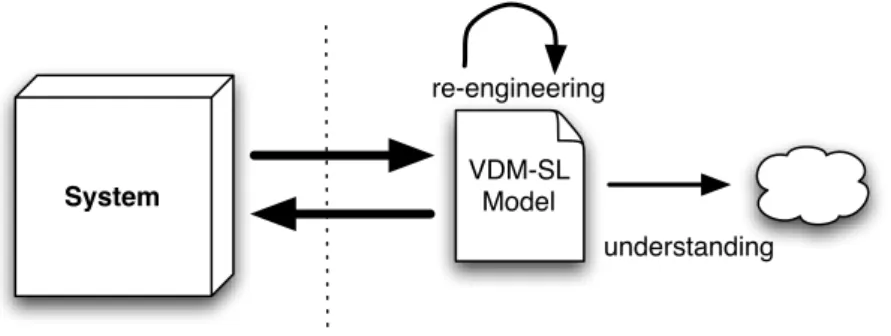
Figure 1.1 provides an overview about how we interpret software re-engineering and understanding based on VDM-SL specifications.
1Whenever we mention VDM-SL or VDM, we will refer to ISO VDM-SL and not to
System VDM-SL Model
re-engineering
understanding
Figure 1.1: Re-engineering and understanding overview.
Our focus is the right side of the dashed lines, re-engineering and under-standing of VDM-SL specifications, which can be obtained from a previous re-engineering project.
1.2
Program understanding
Associated with the system growth and complexity increase, Lehman’s sixth and second law, respectively, there is also the problem of losing knowledge.
As a rule, lack of understanding is due not only to outdated documentation or unavailability of key personnel, but also to the sheer size and complexity to which systems grow over time. When this happens, design decisions, system’s architecture and, sometimes, program semantics become entangled in the extensive details of the source code.
Program understanding [85] is the process of acquiring knowledge about
programs and provides valuable help in solving this problem. Program
understanding can achieve this by using reverse engineering techniques based on source code analysis.
Many program understanding techniques used today were borrowed from other areas. Data and control flow analysis were first used in optimizing compilers [3]. Data flow analysis is used for finding dependencies between different data items manipulated by a program and it can be used to discover
relationships in data, verify properties in concurrent programs, and others. Control flow analysis [77] allows for execution of a given program to be discovered, and to identify dependencies in the execution of code. These two, combined with slicing [90, 77], for isolating specific parts of the program code, are powerful techniques [77] used for automatic debugging, property checking and validation, and aiding program understanding.
Architecture recovery has been subject of research in order to assist migration of legacy systems but also to validate systems design. Techniques such as cluster and concept analysis have been developed and applied with some success [93].
Quantitative analysis, or software metrics, is used to assign numeric values to particular aspects of software. Halstead, McCabe and Allbrecht in the late seventies are credited for defining the most well-known metrics today. The Halstead metrics [41] were developed to measure program module complexity from the operators and operands they use. McCabe defined cyclomatic complexity [71] as the number of linearly-independent paths through a program module. Allbrecht defined function point analysis [4] as a means of measuring software size and productivity using functional, logical entities such as inputs and outputs. After almost two decades, in a effort to measure and track maintainability, the Maintainability Index [104] was proposed, combining Halstead, McCabe and other simple metrics.
1.3
Program re-engineering
Program re-engineering can be defined as “examination and alteration of a system to rebuild it in a new form and subsequent implementation of the new form” [20].
Different software engineering processes fit in this category, namely soft-ware maintenance and softsoft-ware renovation.
Forward engineering [21], also called reification or refinement in formal methods, is the process of deriving a lower level model, specification, or
program from a higher-level one. Thus, to reify (or refine) is to make it into ‘a more concrete thing’.
Refinement can also be divided into two categories, data and operation refinement. Converting from an abstract data model type such as a product type, into its implementable data structure such as a C struct or a Java class, are examples of data refinement. Examples of operation refinement are, for instance, the conversion of a specification of an operation into an implementable program such as a C procedure or Java method.
Because formal specification languages have a strong mathematical basis, these transformations can be methodically derived and mathematical proofs can be done to prove their correctness.
In VDMTools, the refinement process is implemented targeting C++ or Java.
In [26], the author investigated the refinement process between the two dialects of VDM, by converting functional specifications written in VDM-SL to VDM++. In this work, we are interested in exploring the possibility of targeting other models, specifically the SQL model [34].
1.4
Objectives
The general objective of the work is to provide basic support for understanding and re-engineering. This requires development of a language front-end, or parser, for VDM-SL and development of understanding and re-engineering functionalities.
For each of these items mode detailled objectives will be given next: VDM-SL front-end Develop an SDF grammar using strong software
en-gineering practices applied to grammar development such as grammar versioning, metrication, visualization, and testing.
Program understanding Implement a few static analysis techniques like type dependency, function call and function and type dependency graphs.
The results of these analysis will be fed to both visualization and quantitative analysis. The novelty that will be introduced here, is the derivation of metrics (quantification analysis) which we expect to provide us insights over the complexity or structure of systems formal specifications.
Program re-engineering Introduce a novel approach for database design through its specification using a VDM-SL model. The more abstract model specified in VDM-SL will be refined to an SQL database schema. We will provide not only a detailed overview over the method that can support database specification, but also about the transformation process.
Throughout this work, we show how these techniques can be elegantly and concisely implemented in the Haskell [54, 89] programming language using strategic term rewriting provided by the Strafunski [66] bundle.
As proof of concept, a tool called VooDooM has been developed.
1.5
General approach
In order to achieve the objectives just stated, a roadmap was set up (Figure 1.2) which reflects both the architecture of the intended, and the thesis structure. This is as follows:
First of all, background about the technology adopted to accomplish the whole work will be presented in Chapter 2.
The first step of the work was the implementation of a language recognition component: a parser for the VDM language (represented at the bottom of Figure 1.2). The development of this component is of great importance since all of the work relies on this component. This requires strong grammar engineering techniques in order to achieve the required high-quality. Both the engineering techniques and the development method will be fully described in Chapter 3.
Graphs Rep. VDM-SL SQL Metrics Report VDM-SL VDM-SL VDM-SL VDM-SL Parser Understanding Reengineering VoooDooM Facts Extraction Quantification Transformation Conversion VDM PP DOT Metri cs SQL PP
Figure 1.2: Overall architecture of the VooDooM tool.
For program understanding, represented on the left hand side of Figure 1.2, two main components, “Facts extraction” and “Quantification”, have been developed. The “Facts extraction” module is responsible for extracting information such as procedure calls, type dependencies and procedure-type flow. The results of this module can be output using the “DOT” module,
for visualization purposes, or fed to the “Quantification” module. The
“Quantification” module is responsible for metrics calculation and its result is output as a metrics report.
All the work done for program understanding is detailed in Chapter 4. The program re-engineering part, represented on the right hand side of Figure 1.2, supports database calculation in two steps, represented by the “Transfor-mation” and “Conversion” components. The “Transfor“Transfor-mation” component implements the refinement process by transforming the input model into an equivalent VDM model. The result can be both output to the “VDM-SL PP” component, that prints it as a VDM specification (through “VDM-SL PP”
component) and to the “Conversion” component that converts it to SQL and prints it (through the “SQL PP” component). Chapter 4 documents both the method and the implementation of database calculation.
Finally, the conclusions and future work are presented in Chapter 6.
1.6
Origins of the chapters
Sections 2.1, 3, 6.2.1, 6.3.1, and 6.4.1 were based on the work co-authored by Joost Visser, submitted for publication:
T. Alves and J. Visser. Grammar engineering applied for develop-ment of a VDM grammar. [7]
Sections 2.3, 5, 6.2.3, 6.3.3, and 6.4.3 were based on the work co-authored by Paulo Silva, Joost Visser and Jos´e Nuno Oliveira, published earlier as:
T.L. Alves, P.F. Silva, J. Visser, and J.N. Oliveira. Strategic term rewriting and its application to a VDM-SL to SQL conversion. In Proceedings of FM 2005: 13th International Symposium on Formal Methods, In Lecture Notes in Computer Science 3582, pages 399-414. Springer, 2005. [6]
Chapter 2
Technology
The aim of this chapter is to introduce basic notions about the technology adopted, as follows:
Section 2.1 introduces grammar-centered tool development, which advo-cates the generation of several components from a single grammar. These components, as we will explain, are the foundation of the language front-end.
Section 2.2 introduces SDF, the formalism in which grammars are specified. We will also provide a brief overview of the available tools.
Finally, Section 2.3 introduces a library of combinators which add support for generic traversal in Haskell [54, 89]. This library, called StrategyLib avail-able in the Strafunski [66] bundle developed by Ralf L¨ammel and Joost Visser, is extensively used in the implementation of both analysis and transformation rules.
2.1
Grammar-centered tool development
One of the first challenges for language tool support is the development of a language front-end (parser). In traditional approaches, the grammar of the language is encoded in a parser specification. Commonly used parser generators include Yacc/Bison [51], Antlr [82], and JavaCC [58]. However, the parser specifications read by such tools are not general context-free grammars.
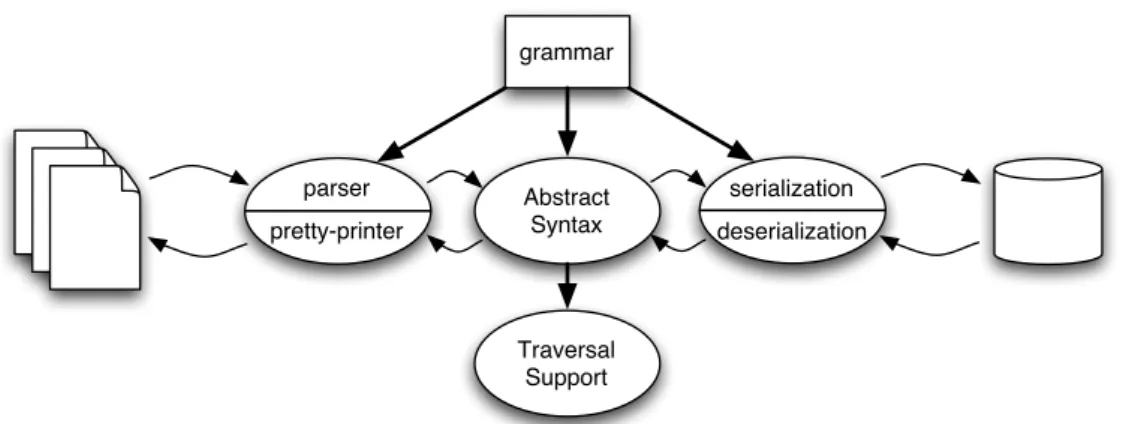
grammar parser pretty-printer Abstract Syntax serialization deserialization Traversal Support
Figure 2.1: Grammar-centered approach to language tool development.
Rather, they are grammars within a proper subset of the class of context-free grammars, such as LL(1), or LALR [3]. Entangled into the syntax definitions are semantic actions in a particular target programming language, such as
C, C++ or Java. As a consequence, the grammar can serve only a single
purpose: to generate a parser in a single programming language, with a single type of associated semantic functionality (e.g. compilation, tree building, metrics computation). For a more in-depth discussion of the disadvantages of traditional approaches to language tool development see [92].
For language tool support we will use a grammar-centered approach [28]. In such an approach, the grammar of a given language takes a central role in the development of a wide variety of tools or tool components for that language. For instance, the grammar can serve as input for generating parsing components to be used in combination with several different programming languages. In addition, the grammar serves as basis for the generation of support for representation of abstract syntax, serialization and de-serialization in various formats, customizable pretty-printers, and support for syntax tree traversal. This approach is illustrated by the diagram in Figure 2.1.
For the description of grammars that play such central roles, it is essential to employ a grammar description language that meets certain criteria: it must be neutral with respect to target implementation language, it must not impose restrictions on the set of context-free languages that can be described,
SyntaxPP Grammar Syntax Parser Eq Show Term ATerm DrIFT sdf2table Sdf2Haskell
Figure 2.2: Grammar-centric approach diagram.
and it should leave the specification of semantics to a specific layer, but be concerned with syntax only. Since grammar changes potentially lead to changes in many related tools, grammars must reach a high level of maturity before tool development starts. We contend that for the development of grammars with such characteristics the use of advanced grammar engineering techniques such as grammar metrics, grammar unit testing, and coverage analysis are essential.
Possible candidates are BNF or EBNF, or our grammar description of choice: SDF [43, 94]. The reason for this choice is that SDF is the only formalism that has tool support and it offers an excellent integration with Haskell. SDF will be introduced in Section 2.2.
The grammar centered approach is supported in the Haskell programming language via tools such as eg. sdf2table, Sdf2Haskell and DrIFT as illustrated in Figure 2.2.
Parse tables are automatically generated by the sdf2table tool from the SDF software bundle, which corresponds to the Parser ellipses of Figure 2.2.
The AST Haskell datatype definition and the pretty-printer are generated with the Sdf2Haskell tool from Strafunski [66]. They correspond to the Syntax and SyntaxPP ellipsis in the picture.
From the abstract syntax, further components are generated in the form of Haskell class instances, using the DrIFT tool. The ATerm instances support serialization to the ATerm format, which is used as interchange
context-free syntax
"mk_" Name "(" ExpressionList? ")" -> Expression { cons("RecordConstructor") } "let" { LocalDefinition "," }+ "in" Expression -> Expression { cons("LetExpr") }
Figure 2.3: Excerpt of the Expressions module of the VDM-SL grammar. format between the generated parser and other components. The Term instances support generic traversal and strategic term rewriting over ASTs. The last two (Eq and Show ), are not mandatory: they add comparison and printing functions to the Haskell datatypes.
2.2
SDF by example
The syntax definition formalism [94], or SDF for short is a simple notation to define grammars. Figure 2.3 presents an example of SDF notation (an excerpt of the VDM-SL grammar [50]).
One of the most noticeable differences between (E)BNF and SDF is that SDF rules are written in reverse order. Moreover, SDF allows for the specification of even more regular expression-style constructs to BNF than EBNF does, such as separated lists, for instance.
In the example of Figure 2.3, non-terminal Expression is defined with two rules. The first rule specifies Expression as being a terminal “mk ”, followed by a Name, and an optional ExpressionList between brackets. The second rule specifies Expression as being a terminal “let”, a list with one or more elements of LocalDefinition separated by a comma, a terminal “in”, and an Expression.
Alternatives can either be specified as (E)BNF with the | operator (as in Yacc [51] or BNF) or just by adding a new rule defining the same non-terminal (as shown in the example).
Yacc or its sucessor Bison allows grammar rules1 to have semantic actions 1Actually semantic actions can be specified just after any symbol in a rule and are
module VDM-Syntax
imports Characters Layout
exports sorts SymbolicLiteral Identifier QuoteLiteral context-free syntax
"true" -> BooleanLiteral { cons("TRUE") } "false" -> BooleanLiteral { cons("FALSE") } ...
lexical syntax
Numeral ( "." Digit+)? Exponent? -> NumericLiteral Digit+ -> Numeral
"E" ("+" | "-")? Numeral -> Exponent
Figure 2.4: An excerpt of module VDM-Syntax.
made up of statements in the C [56] programming language.
Although this enables doing some processing during parsing, this implies that the grammar can be only used for creating a parser generator in a single programming language (in this particular case, C). SDF overcomes this by being purely declarative, i.e., not allowing for semantic actions. However, SDF allows for the specification of rule attributes such as, for instance, disambiguity and abstract syntax tree constructs. In the example of Figure 2.3 the latter kind is shown.
Additionally, in contrast to (E)BNF, SDF has the important advantage of allowing one to specify both context-free and lexical syntax and it offers a flexible modularization mechanism. The module mechanism accepts mutually dependent modules, and distribution of alternatives of the same non-terminal across multiple modules.
In Figure 2.4 an excerpt of the module VDM-Syntax is shown in which the module import and export mechanisms, the context-free section and the lexical syntax are used. Besides, SDF also allows the user to specify restrictions and priorities sections which provide a mechanism for disambiguation.
SDF is supported by several tools such as a well-formedness checker, a GLR
parser generator, generators of abstract syntax support for various program-ming languages (among which Java [9], Haskell [54, 89], and Stratego [95]), and customizable pretty-printer generators [16, 95, 66, 59, 55].
2.3
Strategic term rewriting
Traditional term rewriting distinguishes the rewriting equations of a particular term rewriting system (TRS) from the strategy that is used to apply these equations to an input term. Most commonly, term rewriting environments has a fixed rewriting strategy, such as the leftmost-innermost strategy. In some rewriting environments, for instance those where the equations may be governed by conditions and may be stratified into default and regular equations, more sophisticated strategies may be employed. In any case, however, these strategies are fixed, i.e. hard-wired into the environment.
By contrast, strategic term rewriting generalizes the traditional term rewriting paradigm by making rewriting strategies programmable, just as the equations are. Stratego [95] and the Rewriting Calculus [22] are among the first rewriting environments to offer such programmable rewriting strategies. Such environments offer a small set of basic strategy combinators, which can be combined with each other and with rewriting equations to construct term rewriting systems with arbitrarily complex strategies.
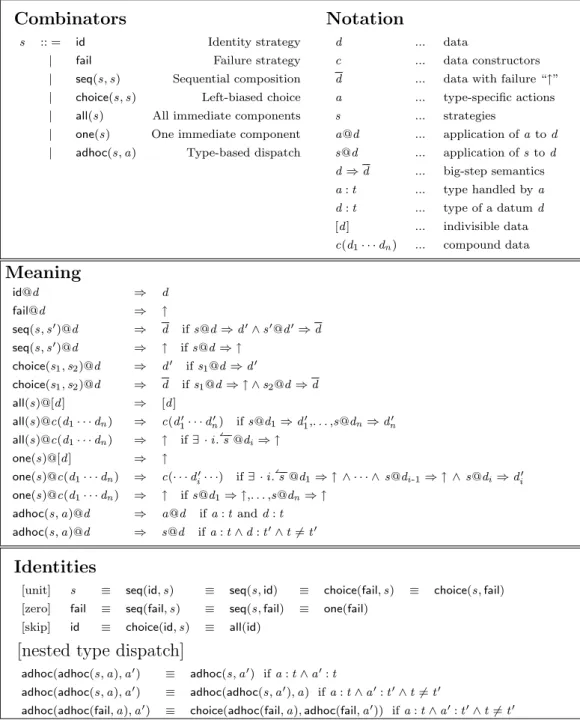
Figure 2.5 shows a set of such basic strategy combinators, along with their operational semantics, from which more elaborate ones can easily be constructed. Consider for instance the following definitions:
try(s) = choice(s, id)
repeat (s) = try(seq(s, repeat (s)))
full topdown(s) = seq(s, all(full topdown(s)))
innermost (s) = seq(all(innermost (s)), try(seq(s, innermost (s)))) The try combinator takes a potentially failing strategy as argument, and attempts to apply it. Should failure occur, the identity strategy id is used to recover. The repeat combinator repeatedly applies its argument strategy, until
Combinators
s :: = id Identity strategy | fail Failure strategy | seq(s, s) Sequential composition | choice(s, s) Left-biased choice | all(s) All immediate components | one(s) One immediate component | adhoc(s, a) Type-based dispatch
Notation
d ... data
c ... data constructors d ... data with failure “↑” a ... type-specific actions s ... strategies a@d ... application of a to d s@d ... application of s to d d ⇒ d ... big-step semantics a : t ... type handled by a d : t ... type of a datum d [d ] ... indivisible data c(d1· · · dn) ... compound data Meaning id@d ⇒ d fail@d ⇒ ↑ seq(s, s0)@d ⇒ d if s@d ⇒ d0∧ s0@d0⇒ d seq(s, s0)@d ⇒ ↑ if s@d ⇒ ↑ choice(s1, s2)@d ⇒ d0 if s1@d ⇒ d0 choice(s1, s2)@d ⇒ d if s1@d ⇒ ↑ ∧ s2@d ⇒ d all(s)@[d ] ⇒ [d ] all(s)@c(d1· · · dn) ⇒ c(d10· · · dn0) if s@d1⇒ d10,. . . ,s@dn⇒ dn0 all(s)@c(d1· · · dn) ⇒ ↑ if ∃ · i .(s @d− i⇒ ↑ one(s)@[d ] ⇒ ↑ one(s)@c(d1· · · dn) ⇒ c(· · · di0· · ·) if ∃ · i .(−s @d1⇒ ↑ ∧ · · · ∧ s@di-1⇒ ↑ ∧ s@di ⇒ di0 one(s)@c(d1· · · dn) ⇒ ↑ if s@d1⇒ ↑,. . . ,s@dn⇒ ↑
adhoc(s, a)@d ⇒ a@d if a : t and d : t adhoc(s, a)@d ⇒ s@d if a : t ∧ d : t0∧ t 6= t0
Identities
[unit] s ≡ seq(id, s) ≡ seq(s, id) ≡ choice(fail, s) ≡ choice(s, fail) [zero] fail ≡ seq(fail, s) ≡ seq(s, fail) ≡ one(fail)
[skip] id ≡ choice(id, s) ≡ all(id)
[nested type dispatch]
adhoc(adhoc(s, a), a0) ≡ adhoc(s, a0) if a : t ∧ a0: t
adhoc(adhoc(s, a), a0) ≡ adhoc(adhoc(s, a0), a) if a : t ∧ a0: t0∧ t 6= t0
adhoc(adhoc(fail, a), a0) ≡ choice(adhoc(fail, a), adhoc(fail, a0)) if a : t ∧ a0: t0∧ t 6= t0
it fails. The full topdown combinator applies its argument once to every node in a term, in pre-order. Finally, the innermost strategy applies its argument in left-most innermost fashion to a term, until it is not applicable anywhere anymore, i.e. until a fixpoint is reached.
For a more in-depth explanation of these combinators we refer the reader to [96, 65].
The challenge of combining strategic term rewriting with strong typing was first met by the Haskell-based Strafunski bundle [66], which we will use in this thesis, and the Java-based JJTraveler framework [96, 59]. A formal semantics of typed strategic programming is defined in [61]. Further generalizations were provided in the Haskell context [65, 63].
Strategic term rewriting has several benefits over traditional term rewrit-ing. The most important benefits derive from the fact that many applications require rewrite equations that together do not form a confluent and terminat-ing TRS. A program refactorterminat-ing system, for instance, may require equations both for “extract method” and for “inline method”. A document processing system may include equations that change mark-up only inside the context of certain document tags. In a traditional term rewriting environment, the only option to obtain sufficient control over when and where equations are applied, is to switch to so-called ‘functional style’. This means that every rewrite rule t 7→ . . . s . . . is reformulated to include function symbols to control rewriting: f (t ) 7→ . . . g(s) . . .. In this way, the rewriting strategy becomes explicit in the additional function symbols, but is thoroughly entangled with the rewrite equations. In strategic programming, the rewrite equations can stay as they are, the strategy is specified separately, and both equations and strategies can be used and reused in different combinations to obtain different TRSs. So, apart from full control over when and where equations are applied, strategic rewriting enhances separation of concerns, reusability, and understandability.
In this work, we will rely on strategic term rewriting to cleanly separate the individual rules from the strategy of applying them to the abstract syntax terms. The Strafunski bundle is our choice of strategic term rewriting
environment, in which we will implement a understanding and re-engineering tool called VooDooM.
Chapter 3
A front-end for VDM-SL
In this chapter, we provide details about the grammar engineering part of this project, in which a full grammar of the VDM-SL [50] language is obtained from its ISO standard language reference. We do so with two complementary objectives.
Firstly, we intend to convey our experiments with the application of a mix of grammar engineering techniques, thus contributing to the body of knowledge about best grammar engineering practises. Our approach can be characterised as a tool-based methodology for iterative grammar development embedded into the larger context of grammar-centered language tool development.
Secondly, we aim to document the delivered grammar of VDM-SL, as well as the steps that led to its creation and account for its quality. A well-engineered grammar can significantly reduce the risks and effort involved in subsequent language tool development, and developers of VDM processing tools need to be convinced of the quality of the grammar on which their product hinges.
These two objectives are mutually complementary, in the sense that the application of the techniques validate their practical value and scalability, and that the quality of the grammar is strongly dependent on the techniques used for its development. In accordance with this two-fold aim, this chapter is structured as follows.
Section 3.1 describes our tool-based methodology for grammar engineering, independent of any specific grammar development project. We address key issues such as grammar versioning, metrication, visualization, and testing, and we embed our grammar engineering approach into the larger context of grammar-centered language tool development. Section 3.2 describes the application of these general techniques in the specific case of our VDM grammar development project. We describe the development process along with its intermediate and final deliverables.
3.1
Grammar Engineering
Grammar engineering is an emerging field of software engineering that aims to apply solid software engineering techniques to grammars, just as they are applied to other software artifacts. Such techniques include version control, static analysis, and testing. Through their adoption, the notoriously erratic and unpredictable process of developing and maintaining large grammars can become more efficient and effective, and can lead to results of higher-quality. Such timely delivery of high-quality grammars is especially important in the context of grammar-centered language tool development, where grammars are used for much more than single-platform parser generation.
In this section we will discuss the grammar engineering techniques that we adopted, and how we adapted them to the specific process of developing SDF grammars.
3.1.1
Grammar evolution
Grammars for sizeable languages are not created in a single goal: they arise through prolonged, resource consuming processes. After an initial version of a grammar has been created, it goes through an evolutionary process, where piece-meal modifications are made at each step. After delivery of the grammar, evolution may continue in the form of corrective and adaptive maintenance.
A basic instrument in making such evolutionary processes tractable is version control. We have chosen the Concurrent Versions System (CVS) as the tool to support such version control [33].
In grammar evolution, different kinds of transformation steps occur: Recovery: An initial version of the grammar may be retrieved by reverse
engineering from an existing parser, or by converting a language reference manual, available typically as a Word or PDF document. If only a hardcopy is available then it should be typed in.
Error correction: Making the grammar complete, fully connected, and correct by supplying missing production rules, or adapting existing ones.
Extension or restriction: Adding rules to cover the constructs of an ex-tended language, or removing rules to limit the grammar to some core (sub) language.
Refactoring: Changing the shape of the grammar, without changing the language that it generates. Such shape changes may be motivated
by different reasons. For instance, changing the shape may make
the description more concise, easier to understand, or it may enable subsequent correction, extensions, or restrictions.
In our case, grammar descriptions will include disambiguation information, so adding disambiguation information is yet another kind of transformation step present in our evolution process.
3.1.2
Grammar metrics
Quantification is an important instrument in understanding and controlling grammar evolution, just as it is for software evolution in general. We have adopted, adapted, and extended the suite of metrics defined for BNF in [83] and implemented a tool, called SdfMetz citeDI-PURe-05.05.01, to collect grammar metrics for SDF grammars.
Size and complexity metrics
TERM Number of terminals
VAR Number of non-terminals
MCC McCabe’s cyclometric complexity
AVS-P Average size of RHS per production
AVS-N Average size of RHS per non-terminal
Figure 3.1: Size and complexity metrics for grammars.
Some adaptation was necessary because SDF differs from (E)BNF in more than syntax. For instance, it allows several productions for the same non-terminal. This forced us to choose between using the number of productions or the number of non-terminals in some metrics definitions.
Furthermore, SDF grammars contain more than just context-free syntax. They also contain lexical syntax and disambiguation information. We decided to apply the metrics originally defined for BNF only to the context-free syntax, in order to make comparisons possible with the results of others. For the disambiguation information these metrics were extended with the definition of a dedicated set of metrics. Full details about the definition and the implementation of these SDF metrics are provided in [8].
We will discuss several categories of metrics: size and complexity metrics, structure metrics, Halstead metrics, and disambiguation metrics by providing a brief description of each.
Size, complexity, and structure metrics
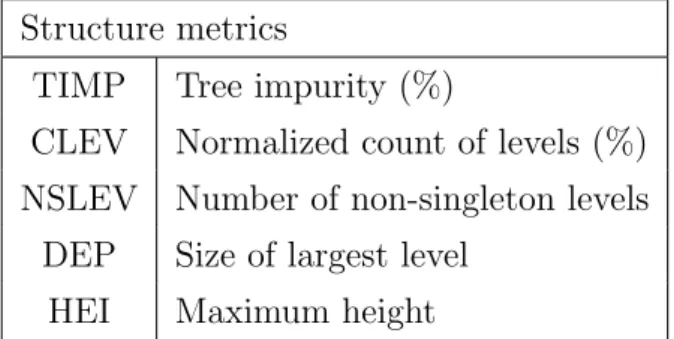
Figure 3.1 lists a number of size and complexity metrics for grammars. These metrics are defined for BNF in [83]. The number of terminals (TERM) and non-terminals (VAR) are simple metrics applicable both to BNF and SDF grammars. McCabe’s cyclometric complexity (MCC), originally defined for program complexity, was adapted for BNF grammars, based on an analogy between grammar production rules and program procedures. Using the same analogy, MCC can be extended easily to cover the operators that SDF adds to BNF.
Structure metrics
TIMP Tree impurity (%)
CLEV Normalized count of levels (%)
NSLEV Number of non-singleton levels
DEP Size of largest level
HEI Maximum height
Figure 3.2: Structure metrics for grammars.
The average size of right-hand sides (AVS) needs to be adapted to SDF with more care. In (E)BNF the definition of AVS is trivial: count the number of terminals and non-terminals on the right-hand side of each grammar rule, sum these, and divide by the number of rules. In SDF, this definition can be interpreted in two ways, because each non-terminal can have several productions associated to it. Therefore, we decided to split AVS into two separate metrics: average size of right-hand sides per production (AVS-P) and average size of right-hand sides per non-terminal (AVS-N). For grammars where each non-terminal has a single production rule, as is the case for (E)BNF grammars, these metrics will present the same value. For SDF grammars, the values can be different. While the AVS-N metric is more appropriate to compare with other formalisms (like BNF and EBNF), the AVS-P metric provides more precision.
Structure metrics
Figure 3.2 lists a number of structure metrics also previously defined in [83]. Each of these metrics is based on the representation of a grammar as a graph which has non-terminals as nodes, and which contains edges between two non-terminals whenever one occurs in the right-hand side of the definition of the other. This graph is called the grammar’s flow graph.
Tree impurity (TIMP) measures how much the flow graph resembles a tree, expressed as a percentage. A tree impurity of 0 percent means that the graph is a tree and a tree impurity of 100 percent means that it a fully
connected graph.
Only the tree impurity metric (TIMP) is calculated directly from the flow graph, all the other structure metrics are calculated from the corresponding strongly connected components graph. This latter graph is obtained from the flow graph by grouping the non-terminals that are strongly connected (reachable from each other) into nodes (called components of levels of the grammar). An edge is created from one component to another if in the flow graph at least one non-terminal from one component has an edge to a non-terminal of the other component. This graphs is called the grammar’s level graph or graph of strongly connected components.
Normalized count of levels (CLEV) expresses the number of nodes in the level graph (graph of strongly connected components) as a percentage of the number of nodes in the flow graph. A normalized count of levels of 100 percent means that there are as many levels in the level graph as non-terminals in the flow graph. In other words, there are no circular connections in the flow graph, and the level graph only contains singleton components. A normalized count of levels of 50 percent means that about half of the non-terminals of the flow graph are involved in circularities and are grouped into non-singleton components in the level graph.
Number of non-singleton levels (NSLEV) indicates how many of the grammar levels (or strongly connected components) contain more than a single non-terminal.
Size of the largest level (DEP) measures the depth (or width) of the level graph as the maximum number of non-terminals per level.
Maximum height (HEI) measures the height of the level graph as the longest vertical path through the level graph, i.e. the largest path length from a source of the level graph to a sink.
Halstead metrics
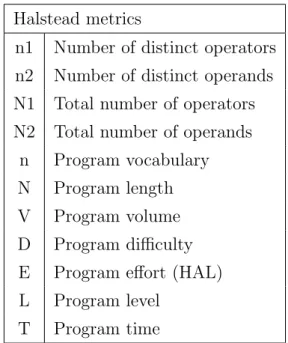
The Halstead Effort metric [41] has also been adapted for (E)BNF grammars in [83]. We compute values not only for Halstead’s effort metric but also
Halstead metrics
n1 Number of distinct operators
n2 Number of distinct operands
N1 Total number of operators
N2 Total number of operands
n Program vocabulary
N Program length
V Program volume
D Program difficulty
E Program effort (HAL)
L Program level
T Program time
Figure 3.3: Halstead metrics for grammars.
for some of its ingredient metrics and related metrics. Figure 3.3 shows the full list. The essential step in adapting Halstead’s metrics to grammars is to interpret the notions of operand and operator in the context of grammars. For details of how we extend this interpretation from BNF to SDF we refer the reader again to [8].
The theory of software science behind Halstead’s metrics has been widely questioned. In particular, the meaningfulness and validity of the effort and time metrics have been called into question [30]. Below, we will still report HAL-E, for purposes of comparison to data reported in [83].
Ambiguity metrics
In SDF, disambiguation constructs are provided in the same formalism as the syntax description itself. To quantify this part of SDF grammars, we define a series of metrics, which are shown in Figure 3.4. These metrics are simple counters for each type of ambiguity construct offered by the SDF notation.
Ambiguity metrics
FRST Number of follow restrictions
ASSOC Number of associativity attributes
REJP Number of reject productions
UPP Number of unique productions in priorities
Figure 3.4: Ambiguity metrics for grammars.
3.1.3
Grammar testing
In software testing, a global distinction can be made between white box testing and black box testing. In black box testing, also called functional or behavioral testing, only the external interface of the subject system is available. In white box testing, also called unit testing, the internal composition of the subject system is taken into consideration, and the individual units of this composition can be tested separately.
In grammar testing, we make a similar distinction between functional tests and unit tests. A functional grammar test will use complete files as test data. The grammar is tested by generating a parser from it and running this parser on such files. Test observations are the success or failure of parsing input files, possibly including time and space consumption. A unit test will use fragments of files as test data. Typically, such fragments are composed by grammar developers to help in detecting and solving specific errors in the grammar, and to protect themselves from reintroducing the error in subsequent development iterations. In addition to success and failure observations, unit tests may observe the number of ambiguities that occur during parsing, or the shape of the parse trees that are produced.
For both functional and unit testing we have used the parse-unit util-ity [18]. Tests are specified in a simple unit test description language with which it is possible to declare whether a certain input should parse or not, or that a certain input sentence should produce a specific parse tree (tree shape testing). Taking such test descriptions as input, the parse-unit utility allows batches of unit tests to be run automatically and repeatedly.
3.1.4
Coverage metrics
To determine how well a given grammar has been tested, a commonly used indicator is the number of non-empty lines in the test suites.
A more reliable tool to determine grammar test quality is coverage analysis. We have adopted the rule coverage (RC) metric [84] for this purpose. The RC metric simply counts the number of production rules used during parsing of a test suite, and expresses it as a percentage of the total number of production rules of the grammar.
SDF allows for two possible interpretations of RC, due to the fact that a single non-terminal may be defined by multiple productions. (Above, we discussed a similar interpretation problem for the AVS metric.) One way is to count each of these alternative productions separately. Another way is to count different productions of the same non-terminal as one. For comparison with rule coverage for (E)BNF grammars, the latter is more appropriate. However, the former gives a more accurate indication of how extensively a grammar is covered by the given test suite. Below we report both, under the names of RC (rule coverage) and NC (non-terminal coverage), respectively. These numbers were computed for our functional test suite and unit test suite by a tool developed for this purpose, called SdfCoverage [8].
An even more accurate indication can be obtained with context-dependent rule coverage [60]. This metric takes into account not just whether a given production is used, but also whether it has been used in every context (use site) where it can actually occur. However, implementation and computation of this metric is more involved.
3.2
Development of the VDM grammar
We have applied the grammar engineering techniques described above during the iterative development of an SDF grammar of VDM-SL.
In this section we describe the scope, priorities, and planned deliverables of the project, as well as its execution. We refer to the evolution of the grammar
during its development both in qualitative and quantitative terms, using the metrics described above. The test effort during the project is described in terms of the test suites used and the evolution of the unit tests and test coverage metrics during development.
3.2.1
Scope, priorities, and planned deliverables
Language Though we are interested in eventually developing grammars for various existing VDM dialects, such as IFAD VDM and VDM++ [40, 39], we limited the scope of the initial project to the VDM-SL language as described in the ISO VDM-SL standard [50].
Grammar shape Not only should the parser generate the VDM-SL
lan-guage exactly as defined in the standard, but also the shape of the grammar, the names of the non-terminals, and the module structure should correspond closely to the grammar. Moreover, we want to take advantage of SDF’s advanced regular expression-style constructs wherever this leads to additional conciseness and understandability.
Parsing and parse trees Though the grammar should be suitable for
generation of a wide range of tool components and tools, we limited the scope of the initial project to developing a grammar from which a GLR parser cold be generated. The generated parser should be well-tested, exhibit acceptable time and space consumption, parse without ambiguities, and build abstract syntax trees that correspond as closely as possible to the abstract syntax as defined in the ISO standard.
Planned deliverables Based on the defined scope and priorities, a release plan was drawn up with three releases within the scope of the initial project: Initial grammar Straightforward transcription of the concrete syntax BNF specification of the ISO standard into SDF notation. Introduction of SDF’s regular expression-style constructs.
Disambiguated grammar Addition of disambiguation information to the grammar, to obtain a grammar from which a non-ambiguous GLR parser can be generated.
Refactored grammar Addition of constructor attributes to context-free productions to allow generated parsers to automatically build ASTs with constructor names corresponding to abstract syntax of the standard. The grammar’s shape should be changed to better reflect the tree shape as intended by the abstract syntax in the standard.
3.2.2
Grammar creation and evolution
To accurately keep track of all grammar changes, a new revision was created for each grammar evolution step. This led to the creation of a total of 48 development versions. While the first and the latest release versions (initial and refactored) correspond to development versions 1 and 48 of the grammar, respectively, the intermediate release version (disambiguated) corresponds to development version 32.
The initial grammar
The initial version of the grammar was typed in from the hardcopy of the ISO Standard [50]. In this document, context-free syntax, lexical syntax and dis-ambiguation information are specified in a semi-formal notation. Context-free syntax is specified in EBNF, but the terminals are specified as mathematical symbols. Translating these mathematical symbols to ASCII symbols involves an interchange table. Lexical syntax is specified in tables by enumerating all possible symbols. Finally, disambiguation information is specified in terms of precedence in tables and equations.
Apart from changing syntax from EBNF to SDF and using the interchange table to replace mathematical symbols by their parseable representation, the following actions were involved in the transcription.
Added SDF constructs Although a direct transcription from the EBNF specification was possible, we preferred to use SDF specific regular-expression-style constructs. For instance consider the following excerpt from the ISO VDM-SL EBNF grammar:
product type = type, "*", type, { "*", type} ;
During transcription this was converted to:
{ Type "*" }2+ -> ProductType
Both excerpts define the same language. Apart from the syntactic differences from EBNF to SDF, the difference is that SDF has special constructs for definition of the repetition of a non-terminal separated by a terminal. In this case, the non-terminal Type appears at least twice and is always separated by the terminal "*".
Detected top and bottom non-terminals To help in the manual process of typing the grammar, a small tool was developed to detect top and bottom non-terminals. This tool helped to detect typos. More than one top non-terminal, or a bottom non-terminal indicates that a part of the grammar is not connected. This tool provided a valuable help not only in this phase but also during the overall development of the grammar. Modularized the grammar EBNF does not support modularization. The ISO Standard separates concerns by dividing the EBNF rules over sec-tions. SDF does support modules, which allowed us to modularize the grammar following the sectioning of the ISO standard. Moreover, an-other small tool was implemented to discover the dependencies between modules.
Added lexical syntax In SDF, lexical syntax can be defined in the same grammar as context-free syntax, using the same notation. In the ISO standard, lexical syntax is described in an ad hoc notation resembling
BNF, without clear semantics. We interpreted this lexical syntax de-scription and converted it into SDF. Obtaining a complete and correct definition required renaming some lexical non-terminals and providing additional definitions. Detection of top and bottom non-terminals in this case helped to detect some inconsistencies in the standard such as name consistency.
Disambiguation
In SDF, disambiguation is specified by means of dedicated disambiguation constructs [17]. These are specified more or less independently from the context-free grammar rules. The constructs are associativity attributes, priorities, reject productions and lookahead restrictions.
In the ISO standard, disambiguation is described in detail by means of tables and a semi-formal textual notation. We interpreted these descriptions and expressed them with SDF disambiguation constructs. This was not a completely straightforward process, in the sense that it is not possible to simply translate the information of the standard document to SDF notation. In some cases, the grammar must respect specific patterns in order to enable disambiguation. For each disambiguation specified, a unit test was created. Refactoring
As already mentioned, the purpose of this release was to automatically generate ASTs that follow the ISO standard as close as possible. Two operations were performed:
• adding constructor attributes to the contex-free rules to specify AST node labels
• removing injections to make the grammar and the ASTs nicer to read How the AST will look with the construct attributes depends to the target language. An example of a construct attribute and the result in Haskell can be read as follows:
Version term var mcc avs-n avs-p hal-e timp clev nslev dep hei
initial 138 161 234 4.4 2.3 55.4 1% 34.9 4 69 16
disambiguated 138 118 232 6.4 2.8 61.1 1.5% 43.9 4 39 16
refactored 138 71 232 10.4 3.3 68.2 3% 52.6 3 27 14
Table 3.1: Grammar metrics for the three release versions.
Type "*" Type -> Type { left, const("ProducType") } ...
data Type = ProductType Type Type | ...
Note that the construct attribute name was used as selector from the type, while the name of type of the rule was used as the Haskell type.
The removal of the injections needs further explanation. We call a production rule an injection when it is the only defining production of its non-terminal, and its right-hand side contains exactly one (different) non-terminal. Such injections, which already exist in the original EBNF grammar, were actively removed, because they needlessly increase the size of the grammar (which can be observed in the measurements) and degrade readability. Also, the corresponding automatically built ASTs are more compact after injection removal.
3.2.3
Grammar metrics
We measured grammar evolution in terms of the size, complexity, structure, and Halstead metrics introduced above. The data is summarized in Table 3.1. This table shows the values of all metrics for the three released versions. In addition, Figure 3.5 plots the evolution of a selection of these metrics for all 48 development versions.
0 50 100 150 200 250 300 1 2 3 4 5 6 7 8 9 10 11 12 13 14 15 16 17 18 19 20 21 22 23 24 25 26 27 28 29 30 31 32 33 34 35 36 37 38 39 40 41 42 43 44 45 46 47 48 VAR HAL (K) CLEV
Figure 3.5: The evolution of VAR, HAL-E, and CLEV grammar metrics during development. The x-axis represents the 48 development versions.
Size and complexity metrics
A first important observation to make is that the number of terminals (TERM) is constant throughout grammar development.
This is conform to expectation, since all keywords and symbols of the language are present from the first grammar version onward.
The initial number of 161 non-terminals (VAR) decreases via 118 after disambiguation to 71 after refactoring. These numbers are the consequence of changes in grammar shape where non-terminals are replaced by their definition. In the disambiguation phase (43 non-terminals removed), such non-terminal inlining (unfolding) was performed to make formulation of the disambiguation information possible, or easier. For instance, after inlining, simple associativity attributes would suffice to specify disambiguation, while without inlining more elaborate reject productions might have been necessary. In the refactoring phase (47 non-terminals removed), the inlinings performed were mainly removals of injections. These were performed to make the grammar easier to read, more concise, and suitable for creation of ASTs closer to the abstract syntax specification in the standard.
The value of the McCabe cyclometric complexity metric decreases by 2 during disambiguation, meaning that we eliminated two paths in the flow graph of the grammar. This was caused by refactoring the syntax of product
types and union types in similar ways. The reason for this refactoring during the disambiguation phase was to make disambiguation easier. In case of product types, the following two production rules:
ProductType -> Type
{ Type "*" }2+ -> ProductType
were replaced by a single one:
Type "*" Type -> Type
For union types, the same replacement was performed. The language gen-erated by the grammar remained the same after these refactorings, but disambiguation using priorities became possible.
The average rule size metrics, AVS-N and AVS-P increase significantly. These increases are also due to inlining of non-terminals. Naturally, when a non-terminal with a right-hand size of more than 1 is inlined, the number of non-terminals decreases by 1, and the size of the right-hand sides of the productions in which the non-terminal was used goes up. The increase of AVS-N is roughly by a factor of 2.4, while the increase of AVS-P is by a factor of 1.4.
Halstead metrics
The value of the Halstead Effort metric (HAL-E) fluctuates during develop-ment. It starts at 228K in the initial grammar, and immediately rises to 255K. This initial rise is directly related to the removal of 32 non-terminals. The value then rises more quietly to 265K, but drops again abruptly towards the end of the disambiguation phase, to the level of 236K. During refactoring, the value rises again to 255K, drops briefly to 224K, and finally stabilizes at 256K. Below, a comparison of these values with those of other grammars will be offered.
Structure metrics
Tree impurity (TIMP) measures how much the grammar’s flow graph resembles a tree, expressed as a percentage. The low values for this measure indicates that our grammar is almost a tree, or, in other words, that complexity due to circularities is low. As the grammar evolves, the tree impurity increases steadily, from little more than 1%, to little over 3%. This development can be attributed directly to the non-terminal inlining that was performed. When a non-terminal is inlined, the flow graph becomes smaller, but the number of cycles remains equal, i.e. the ratio of the latter becomes higher.
Normalized count of levels (CLEV) indicates roughly the percentage of modularizability, if grammar levels (strongly connected components in the flow graph) are considered as modules. Throughout development, the number of levels goes down (from 58 to 40; values are not shown), but the potential number of levels, i.e. the number of non-terminals, goes down more drastically (from 161 to 71). As a result, CLEV rises from 34% to 53%, meaning that the percentage of modularizability increases.
The number of non-singleton levels (NSLEV) of the grammar is 4 through-out most of its development, except at the end, where it goes down to 3. Inspection of the grammar tells us that these 4 levels roughly correspond to Expressions, Statement, Type and StateDesignators. The latter becomes a singleton level towards the end of development due to inlining.
The size of the largest grammar level (DEP) starts initially very high at 69 non-terminals, but drops immediately to only 39. Towards the end of development, this number drops further to 27 non-terminals in the largest level, which corresponds to Expressions. The decrease in level sizes is directly attributable to inlining of grammar rules involved in cycles.
The height of the level graph (HEI) is 16 throughout most of the evolution of the grammar, but sinks slightly to 14 towards the end of development. Only inlining of production rules not involved in cycles leads to reduction of path length through the level graph. This explains why the decrease of HEI is modest.
Figure 3.6: The evolution of the ASSOC and UPP ambiguity metrics compared with the evolution of the number of productions (PROD). The x-axis represents the 48 development versions.
Ambiguity metrics
In Figure 3.6 we plot the evolution of two ambiguity metrics and compare them to the number of productions metric (PROD). Although we computed more metrics, we chose to show only the number of associativity attributes (ASSOC) and the number of unique productions in priorities (UPP) because these are the two types of disambiguation information most used during the development.
In the disambiguation phase, 31 development versions were produced (version 32 corresponds to the disambiguated grammar). Yet, by analyzing the chart we can see that the ASSOC and the UPP metrics stabilize after the 23rd version. This is because after this version other kind of disambiguation information was added (reject productions and lookahead restrictions) which are not covered by the chosen metrics.
Also, it is interesting to see that in the 2nd development version no disambiguation information was added but the number of productions drops significantly. This was due to injection removal necessary to prepare for disambiguation.
Between versions 2 and 9, the UPP and ASSOC metrics grow, in most cases, at the same rate. In these steps, the binary expressions were disambiguated
using associativity attributes (to remove ambiguity between a binary operator and itself) and priorities (to remove ambiguity between a binary operator and other binary operators). Between versions 9 and 10, a large number of unary expressions were disambiguated, involving priorities (between the unary operator and binary operators) but not associativity attributes (unary operators are not ambiguous with themselves).
From versions 9 to 16 both metrics increase fairly gradually. But in version 17, there is a surge in the number of productions in priorities. This was caused by the simultaneous disambiguation of a group of expressions with somewhat similar syntax (let, def, if, foreach, exits, etc. expressions) which do not have associativity information.
From versions 18 to 24 the number of production in priorities grows simultaneously while the total number of productions decreases. This shows that, once more, disambiguation was only enabled by injection removal or by inlining.
Although not shown in the chart, from the 24th version until the 32th disambiguation was continued by adding lookahead restrictions and reject productions. In this phase lexicals were disambiguated by keyword reservation or by preferring the longer match in lexical recognition. For that reason, the total number of productions remains practically unchanged.
3.2.4
Observations
Some errors were found in the ISO standard, caused by ambiguities between production rules.
Three cases are particular relevant, since changes to the grammar language were made.
Incomplete definition: We noted some omissions in the ISO standard in respect to language keywords. Some of the used language keywords were not specified as reserved, meaning that in our first approach some keywords were incorrectly parsed as identifiers.


![Figure 3.1 lists a number of size and complexity metrics for grammars. These metrics are defined for BNF in [83]](https://thumb-eu.123doks.com/thumbv2/123dok_br/17961896.854468/36.892.279.671.187.360/figure-lists-number-complexity-metrics-grammars-metrics-defined.webp)