Energy Policy 35 (2007) 3025–3035
Linking consumer energy efficiency with security of supply
J.P. Rutherford
a, E.W. Scharpf
b, C.G. Carrington
a, aDepartment of Physics, University of Otago, P.O. Box 56, Dunedin, New ZealandbDelta S Technology Limited, 278 Blueskin Road, Port Chalmers, New Zealand
Received 7 July 2006; accepted 30 October 2006 Available online 14 December 2006
Abstract
Most modern energy policies seek to achieve systematic ongoing incremental increases in consumer energy efficiency, since this contributes to improved security of supply, favourable environmental outcomes and increased economic efficiency. Yet realised levels of efficiency are typically well below the most cost-effective equilibrium due to variety of behavioural and organisational barriers, which are often linked to information constraints. In addition efficient users are normally unrewarded for collective benefits to system security and to the environment, thus reducing the incentives for energy consumers to invest in efficiency improvements. This paper examines the dichotomies and symmetries between supply- and demand-side solutions to energy security concerns and reviews opportunities to overcome barriers to improved consumer efficiency. A security market is identified as a mechanism to promote both demand- and supply-side investments that support electricity system security. Such a market would assist in setting the optimal quantity of reserves while achieving an efficient balance between supply- and demand-side initiatives. It would also help to smooth overall investment throughout the energy system by encouraging incremental approaches, such as distributed generation and demand-side alternatives where they provide competitive value. Although the discussion is applicable to energy systems in general, it focuses primarily on electricity in New Zealand.
r2006 Elsevier Ltd. All rights reserved.
Keywords:Security market; Consumer efficiency; Electricity markets
1. Introduction
Without question improved consumer energy efficiency provides direct benefits to efficient users. But there are other benefits to the economy as a whole, for which efficient users are normally unrewarded. As a result, there are often insufficient incentives for users to improve their efficiency and the economy misses out on important benefits such as decoupling economic growth from overall energy demand, improved environmental outcomes and increased supply security (Langniss and Praetorius, 2006). This paper analyses the dichotomies and symmetries between supply- and demand-side solutions to energy security concerns and identifies ways to overcome some of the barriers to improved consumer efficiency through linked improvements in security of supply. Potential mechanisms are identified to use some of the supply
security values resulting from energy efficiency improve-ments as an incentive to those who create them. The paper focuses on harnessing natural market processes to avoid the difficulties of a mandated market, such as that created by Tradable White Certificates (Bertoldi and Huld, 2006;
Perrels et al., 2006). Although much of the discussion is applicable to energy systems in general, the analysis focuses primarily on electricity in New Zealand.
2. New Zealand electricity market
2.1. Demand growth and security
Electricity consumption in New Zealand is 40 TWh per annum at a cost to consumers of $NZ3.5 billion (MED, 2004). Fig. 1 shows the contributions of residential, commercial and industrial users to the total demand since the mid-1970s. Between 1973 and 2002, total electricity generated increased at an average rate of 2.6% pa and the GDP (in constant $US) increased at 1.9% pa (IEA, 2003).
www.elsevier.com/locate/enpol
0301-4215/$ - see front matterr2006 Elsevier Ltd. All rights reserved. doi:10.1016/j.enpol.2006.10.031
The large-scale heritage-hydro stations, built during the mid-20th century, together with the abundance of locally sourced natural gas, allowed New Zealand to price its electricity at the low end of the international spectrum for a significant part of the 20th century. Over the years, demand growth has compounded in an environment of a relatively secure energy supply to take New Zealand to a high energy intensity (kWh consumed/GDP) relative to other OECD countries (Verbuggen, 2003).
In the context of this paper, we will use the term energy security to refer to a generally low business risk related to energy with ready access to a stable supply of electricity/ energy at a predicable price without threat of disruption from major price spikes, brown-outs or externally imposed limits. Despite these positive elements, a secure electricity supply is not a pure public good in the economic sense, although it has commonly been treated as such (Perrels et al., 2006). In particular, it does not meet the non-rival requirement where one party’s use does not diminish another’s access to it. Similarly, since it is possible to remove supply from individual users, a secure supply does not fully meet the requirement of being non-excludable either. Despite these issues, all users place some level of value on, and receive some degree of benefit from, electricity supply security through the stable collective behaviour of other users in the market. Also, there are only the most limited mechanisms to exclude poorly behaved users from the benefits of a secure electricity supply. Thus, in practice, users all receive some degree of public good benefit from a secure supply of electricity which comes in part from the incompletely rewarded/penalised behaviour of other users.
In New Zealand’s case, it has become well accepted that its traditional low-cost hydro and Maui gas options cannot provide future electricity security in the face of continuing demand growth. Uncertainties surrounding resource con-sent issues for hydro and wind plus the questions regarding continued availability of natural gas place future energy
supply security at significant risk. While large supply extensions are feasible using wind or coal, they will only come into use at higher prices (MED, 2002). A trend toward higher prices will be exacerbated as, even with the current push to increase renewable energy use, New Zealand will face significant costs on the international market due to its carbon emissions in the first Kyoto commitment period from 2008 to 2012 (Hodgson, 2005).
2.2. Impediments to investment
Marsden et al. (2004) have pointed out that wholesale prices in New Zealand are presently inadequate to secure investment in new generating capacity. This raises concerns about whether the electricity market is able to maintain adequate supply security in the face of demand growth. Warnings about future security of supply in New Zealand are frequently raised in the public media in relation to both electricity generating and grid transmission capacity (TVNZ, 2006). These issues echo international concerns about the adequacy of investment in electricity production and networks, especially in liberalised markets (Borner and MacKerron, 2003;Vries, 2003;Lijesen, 2003).
Decisions to make long-term investments in generation are primarily based on the beneficial interests of the generation investor, without necessarily considering overall system security (Borner and MacKerron, 2003). Borner and MacKerron (2003)further note that there is no direct market for security of supply nor are there adequate long-term instruments to act as a proxy for this market. Reserve generation is essential for supply security, but the current market incentives for investing in reserve generation are limited to either high spot prices in periods of shortage or premiums paid for long-term contracts. Due to the absence of a short-term demand response mechanism for many consumers, spot prices can be extremely high during a shortage and yet still not fully reflect the value consumers place on the load. Also, with the advent of competition at the retail level, suppliers cannot expect to pass this price risk directly to consumers (Helm, 2002). Further, there is little incentive for individual consumers to contract for grid-connected reserve generation as the cost would be covered by those consumers alone while the additional reserves/security benefits the entire grid (Vries, 2003). There is the additional uncertainty for potential supply security investors that the government will intervene to underwrite overall security if it is severely at risk, which is already the case in New Zealand with the Electricity Commission.
Other challenges to security of supply stem from the nature of the New Zealand generation portfolio. Although it is dropping, the percentage of New Zealand electricity generated by hydro and geothermal is still greater than 67% (MED, 2004). These generating systems are char-acterised by high capital costs coupled with inherently low operating costs. Since the capital is already invested, the marginal cost of generating electricity from these sources is
0 2 4 6 8 10 12 14 16
Consumer Electricity (TWh pa).
Population (millions)
Industrial 3.3% pa Residential 1.5% pa Commercial 3.9% pa Population 0.82% pa
1980
1970 1990 2000
extremely low. Thus they can effectively maintain an operating profit during long periods of low wholesale power prices. With more than 60% of generation from hydro, which has a limited storage capacity, combined with low winter inflows and a winter demand peak, there is inevitably a wide range in the New Zealand wholesale price of electricity. If there is a wet year with a large amount of hydro power available, the wholesale price can be extremely low for long periods of time. This means that any fuel-fired generator with significant costs for fuel will operate at a loss during these periods. Furthermore, if there is an increase in generating capacity from high-capital low-operating cost generation such as wind, then extended periods of low wholesale electricity prices will continue. These unpredictable long periods of low prices act to discourage new generators from entering the market with systems that will only be profitable during the high price spikes. Thus the equilibrium level of supply security must drop to a point low enough to make them profitable overall before the new investments are made. Combining this with the long lead time on resource approvals and construction, New Zealand will inevitably have a relatively insecure supply of electricity for a considerable fraction of the investment cycle.
2.3. Cost of insecurity
As an indicator of the cost of supply insecurity to the New Zealand economy, one may consider the economic costs associated with the dry-year shortages in 1992, 2001 and 2003. In these cases, the costs were 1.5% of GDP in 1992 (approx $US800M), several hundred million dollars for the 2001 drought and a similar amount for 2003 (McKerchar and Woods, 2003). Another cost analysis determined that the value of the electricity not provided during a shortage or the Value of Lost Load (VoLL) is approximately $NZ5.6 per kWh based on a linear relation between economic activity and electricity use (CAE, 2004).
Concept (2004)estimates the VoLL to be $NZ7.8 per kWh based on the government’s 1 in 60 year dry spell security of supply programme. It is worth noting that the VoLL is roughly 100 times the recent average wholesale price for electricity by all of these measures. So despite the range of opinions on the best measurement (McKerchar and Woods, 2003; CAE, 2004; Concept, 2004), these methods all show that there would be significant direct savings in dry years through improving the security of New Zealand’s electricity supply.
2.4. Market restructuring
There is inevitably some level of trade-off between the price of energy and energy security. Nevertheless it is feasible to improve both the security of supply and keep prices more stable by applying some form of demand growth management with its inherently shorter response time relative to the installation of new generation capacity
(Perrels et al., 2006). Energy conservation can reduce the growth in consumer energy demand, which can be counter-productive if foregoing energy consumption results in a reduction in economic growth. This need not happen in all situations, but it is likely to occur in commercial or industrial energy conservation. Improved consumer effi-ciency, on the other hand, provides another path to reduce growth in consumer energy demand without necessarily reducing economic growth. In fact, it can have a positive growth aspect if the efficiency methods and equipment provide a business advantage to the users and provide a saleable service or product to the providers. As a further benefit, if the cost of increasing net supply capacity can be done more cheaply with efficiency improvements than with new generating capacity, lower overall prices may be possible as well. Hence, consumer efficiency offers New Zealand an opportunity for a smooth transition, without significant economic and social disruption, from heritage-hydro and low-cost Maui gas to more expensive, but available and acceptable, sources.
To illustrate the nature of this transition, Fig. 2 shows the relationship between the average national price for electricity in $US per kWh and the structural electricity intensity of 24 OECD nations, expressed in kWh per $GDP in $US. The figure uses data published by Verbuggen (2003). The fitted curve, which is close to hyperbolic, shows that when prices are higher, OECD economies tend to have lower electricity intensity. Currently New Zealand’s econ-omy has a relatively high electricity intensity, which is the expected result of the relatively low current and historic electricity prices. It can be anticipated that New Zealand’s transition away from heritage-hydro and Maui gas will move it to the right, down the curve. The corresponding higher prices will place pressure on New Zealand’s electrically intensive industries and will test their economic viability. In the absence of other changing factors, this will lead, over time, to their departure from New Zealand. This would result in a restructured economy with lower electricity intensity. There are other potentially smoother paths for transition away from the heritage-hydro and
0 1
0 0.1
Intensity (kWh/$GDP)
New Zealand 0.8
0.6
0.4
0.2
Slovak Republic
I = 0.0183P -1.167
R2 = 0.82
Denmark
Price ($/kWh)
0.05 0.15 0.2
low-cost Maui gas supplies of the past. For example, if fossil fuel costs continue to rise in real terms and New Zealand undertakes a major increase in wind power generation to keep its electricity cost increase low relative to other economies, only some elements of restructuring would be required. However, realising this scale of investment in wind power is uncertain considering the other resource management act constraints noted earlier.
3. Demand management
3.1. Potential
In the event that New Zealand is obliged to restructure to reduce its energy intensity, there is a risk of significant economic disruption if it is not smoothed or moderated appropriately. One mechanism to achieve this smoothing is to identify physically inefficient demand and selectively increase its efficiency. This selective demand reduction would reduce the need for investment in both generation and transmission, with minimal negative impacts on the users who increase the physical efficiency of their demand. Delaying the supply-side investment could have a beneficial impact on prices by keeping them lower longer without reducing the profits on the supply side. This would both delay and moderate the impact on electrically intensive industries, as the present cost of future supply extensions tends to decrease with time as newer supply technologies emerge. From a system security perspective, reducing inefficient demand is an acceptable substitute for increasing supply since both methods increase reserve capacity. From an environmental perspective, reducing inefficient demand is an even more promising alternative because demand reductions usually do not incur the negative environmental consequences typically associated with supply extensions.
The potential to reduce inefficient demand is well accepted and recognised (MOE, 1986; EECA, 2001;
Cowart, 2001). Taking a global perspective, the World Energy Outlook (IEA, 2005) included an alternative scenario in which countries are assumed to implement the energy efficiency and environmental measures currently under consideration. These measures include encouraging energy efficiency as well as altering the fuel mix towards more environmentally benign sources. Under this scenario, primary energy demand would be 10% lower and CO2
emissions 16% lower than the business as usual projection by 2030. Increased energy efficiency would be responsible for 58% of this reduction in CO2.
Two important points emerge from the IEA alternative scenario. First, the scenario shows that energy efficiency measures can have a discernable and significant impact on global energy demand and carbon emissions. Second, it shows how improved energy efficiency transfers the requirement to invest across the meter from the supply to the demand side. Both the alternative and the reference scenario have similar total levels of investment; but, in the alternative scenario the obligation to make some $2.1
trillion of capital investment would be transferred from suppliers to consumers in the scenario period to 2030.
3.2. Incentives and benefits
In New Zealand, the current market incentives for investing in consumer efficiency are received in the form of increased service to the user from the energy actually purchased. When this results in a reduction in the amount of energy purchased, it can be argued that the consumer is receiving only a portion of the benefits arising from their investment, since decreased energy demand results in avoided supply. In the electricity sector, decreased elec-tricity demand, similar to increased elecelec-tricity supply capacity, improves system security as both enhance net reserves. Electricity consumers benefit from the increased security and suppliers also benefit since investment in both network and generation capacity can be delayed (Horii et al., 1994). This in turn delays any negative environmental effects associated with supply-side investments.
Energy efficiency improvements provide further quasi-public good benefits in the context of the Kyoto agreement. Here the benefit takes the form of deferred installation of new generating capacity, which has a net carbon output. This will be partially offset by the fact that not all new generating capacity has a net carbon output but it represents a clear and unrewarded benefit none the less. From a renewable energy perspective, the benefit of improved energy efficiency is undiluted, since deferring construction and installation of new generating capacity is one of the most purely renewable ways to increase the availability of supply.
3.3. Demand management limitations
users return to their original use patterns (Harrigan, 1994). Thus both mechanisms that contribute to energy demand reduction tend to be inherently damped.
On a macro-level, there is significant debate about the effects of increased consumer efficiency (Saunders, 2000;
Brookes, 2004). An increase in prices either artificially, through taxes as in the Netherlands, or through rising supply costs, as is currently underway in New Zealand, will naturally tend to mitigate any rebound effects and promote culture changes which may sustain conservation and efficiency behaviour in the longer term.Verbuggen (2003)
suggests that overall electrical intensity of the 24 OECD nations assessed in his study has responded to differences in the price of electricity so as to mitigate rebound effects. Thus in response to differences in electricity price, the electricity intensity of these economies has adjusted so that the portion of GDP spent on electricity is constant at 2.5–3%. This suggests that improved consumer efficiency enables consumers to obtain the same level of service in the face of price increases.
4. Barriers to demand management
4.1. Behavioural issues
Regardless of how much demand is reduced by improved consumer efficiency, the current level of efficiency is found to be below the optimum cost-effective levels derived using engineering and economic models (Sanstad and Howarth, 1994;Jaffe and Stavins, 1994;Weber, 1997). The reasons for the disparity between realised efficiency and the economic potential for efficiency are complex. Many are linked with organisational or behavioural factors which often arise from basic human nature. Thus they can be very difficult to modify and overcome.
DeCanio (1993) discusses bounded rationality resulting from the organisational structure of firms as a common theme in explaining this deviation from optimally efficient behaviour. He identifies four factors: the dislocation of individual and collective interests; the satisficing rather than maximising nature of investment decisions (Simon, 1957); asymmetric information; and moral hazard where one or more parties involved in an agreement have incentives to act contrary to the principles of that agreement. A tendency to focus on short-term cost decisions can also contribute to actions which are less than optimal over the long term. Such short-term decisions may relate to cases, where management compensation is tied to short-term performance and where there is rapid rotation of management staff. However, it also reflects the higher risk profile for longer-term decisions in the face of uncertainties in future economic and regulatory conditions. This biases capital decisions towards short payback projects whereas most energy security investments are inherently much longer term. Consequently with firms making satisficing decisions, small cost-cutting projects often lack attention due to the effort and expense of
information gathering and decision-making relative to their payoffs.
Robinson (1991), focusing on consumers rather than companies, suggests levels of energy use are affected by differing social status, feelings of competence, interest in technologies and general culture.Erickson (1987)finds that cultural and political differences between Swedes and Americans are important variables in explaining the differences in their energy use. Economic analysis views the energy users as investors, butStern and Aronson (1984)
suggest that viewing energy users as members of a social group and energy consumption as an expression of personal values helps to better explain the actions of individuals. Other organisational and behavioural barriers to energy efficiency include: perceived risk, dislocation of costs and benefits, lack of access to capital, imposed choice, newness of technology, additional expertise and attention required to maintain efficiency investments, split incentives and cultural preferences. These factors frequently bias decisions against energy efficiency or in some cases eliminate improved energy efficiency from consideration.
4.2. Information quality
Many would argue that, in the case of organisational and behavioural barriers, it is the role of the astute entrepreneur to overcome them. Yet barriers to energy efficiency are often underpinned or exacerbated by intrinsic information problems. Objective information has many public good aspects, so it tends to be in short supply. Indeed,Huntington et al. (1994)assert that the market fails to provide the levels of consumer efficiency indicated by the cost-effective potential primarily because of informational problems. Consumers are relatively unfamiliar with many energy efficiency measures and the benefits of energy efficiency are often difficult to quantify before they are purchased. The public good nature of information, and therefore the tendency of the market to undersupply it, is a well documented barrier to energy efficiency (Jaffe and Stavins, 1994; Sanstad and Howarth, 1994). As a consequence transaction costs are increased because con-sumers must expend greater effort in gathering, assessing and applying information.
incentives or methods to reduce the perceived risk posed by energy efficiency improvements are needed in order for companies to adopt an active incremental learning approach to improve their energy efficiency.
Even when an energy user decides to purchase a more efficient product and is satisfied with its quality, it may be difficult to convey this to potential downstream buyers if the product is later resold. Thus without private knowledge of the supplier, sales agent or product, energy users have to rely on general market perceptions. They, therefore, become unwilling to pay a premium for quality since they cannot identify it in advance nor receive full value for it in later resale. If this informational asymmetry persists, suppliers in turn become unable to put quality products on the market at higher prices, even though the products provide good value. This is an example of Akerlof’s ‘market for lemons’ (Akerlof, 1970) which showed that information asymmetry can lead to the removal of the higher-priced, higher-quality products from the market, causing a downward spiral in both the price and quality of products. The problem is worse in the second-hand markets where the sellers have very good knowledge of the product, but the buyers have very little, and there are few institutional guarantees. Information asymmetry also explains many of the split incentives that are often cited as barriers to energy efficiency. Tenants are unwilling to pay a premium on the rent for efficiency measures whose quality they cannot ascertain.
5. Responses to demand management barriers
5.1. The challenge
The analysis presented above has shown that New Zealand has a history of relatively low energy prices with a reasonably high supply security, which has led to a relatively energy intensive economy. Both domestic and international energy pressures are forcing a transition to a less-secure and higher-cost energy future. One promising path to smooth this transition, and reduce the risk of associated economic disruption, is to manage the demand for energy through improving energy efficiency. Although this demand-side path should have much lower costs, and provide greater benefits than corresponding energy supply solutions, there are numerous barriers and insufficient incentives to overcome them. Since many of the benefits which come from an improved energy efficiency and demand management approach provide significant public good, there is a case for intervention on the demand side (Perrels et al., 2006). Here the main options for interven-tion are considered.
5.2. Information
In order to avoid the problem of Akerlof’s ‘market for lemons’ in other markets, institutional guarantees are offered to provide quality assurance. For instance
Under-writers Laboratories, an independent non-profit organisa-tion in the United States, offers a wide range of safety quality certifications for various electrical appliances to provide just such an assurance (UL, 2006). Frequently these institutional guarantees are backed by the govern-ment or by another organisation with high credibility. Government intervention is also used to some extent to inform consumers, so as to reduce some of the information asymmetries in the market. In New Zealand, newsletters like EECA’s EnergyWise News and schemes such as mandatory energy performance labelling are currently used. Similarly eco-labelling schemes allow consumers to exhibit their preferences towards products with a lower environmental impact (Hume, 2004). Another example is energy performance contracting methods for funding energy efficiency projects, which allow consumers to pay for the efficiency measures through the energy savings that they receive, while at the same time reducing the informa-tional requirements and risks prior to undertaking the initiative (Pan et al., 2000). Thus, support for information quality is arguably an effective measure, but it requires the endorsement of strong and credible institutions over the long term.
5.3. Regulation
Public intervention in the energy efficiency market typically takes the form of regulation or incentives to improve users’ energy efficiency. The majority of the policies cited in the World Alternative Energy scenario (IEA, 2005) are either regulation or incentive schemes such as minimum energy performance standards, subsidies and research support. Such measures are commonly used to fill the gap when existing market mechanisms stop short of achieving economically optimal energy efficiency. In many cases, intervention has proved to be highly effective.
obligations. On the other hand, minimum energy perfor-mance standards have been introduced for seven products, set and implemented in common with Australia. Six appliances are subject to energy performance labelling requirements and home insulation standards are being progressively tightened (IEA, 2006).
5.4. Incentives
Incentive schemes are arguably even more vulnerable to political change than informational or regulatory support mechanisms. For example, the New Zealand Electricity Commission has offered cash incentives to large industrial users in the upper South Island in return for demand reductions at critical times to avoid local shortages (Devereux, 2004). In addition to being politically vulner-able, schemes which focus on rewarding renewable energy generation, rather than energy efficiency projects, such as the New Zealand government’s carbon credit programme (NZCCO, 2006) actually work to increase the asymmetry of supply- and demand-side initiatives. Thus investment resources are deployed less effectively on the supply side to earn the additional renewable generation incentive. On the user side, incentives in the form of interest free loans to install solar hot water systems have also been implemented. However, this programme is currently under review (EECA, 2006). The primary concern with incentive processes is that they are difficult to maintain long term unless more formal mechanisms are put in place to institutionalise the desired behaviour so businesses can have the confidence to incorporate it into their regular operating plans.
5.5. Market measures
The prevailing New Zealand policy focus, which is on regulatory and incentive measures to achieve improve-ments in consumer energy efficiency, is not well aligned with deregulation of the supply side of the energy market. In theory it is desirable for these measures to be supported by natural market-based mechanisms in order to minimise distortions in the market and to more accurately reflect consumer preferences. For example, market-oriented mea-sures like energy performance contracting and industry-initiated environmental labelling (Hume, 2004) have the potential to create a robust demand for consumer efficiency. Although such measures may require initial activation, they offer the potential for spontaneous, embedded, long-term market-driven increases in energy efficiency, without the need for active political endorse-ment. However, for various reasons, possibly relating to the small size of the New Zealand market, energy performance contracting and industry-initiated efficiency labelling occur on only a small scale.
The results of market-based measures are less predictable than regulation and incentives, but reflect the consumer preferences more directly, so they are therefore unlikely to
lead to deleterious effects in the market. For example, consumer information programmes are generally seen as a market repair mechanism with very low costs and virtually no negative unintended consequences (CDMAG, 2003).
Robinson (1991) supports this view suggesting, ‘‘that the goal for energy efficiency policy must be to rely as far as possible, [y] on market mechanisms to achieve efficiency
targets, supplemented as required by measures intended to improve the functioning of those mechanisms where they exist and to substitute for them where they don’t’’.
6. Other ways to a secure energy supply
6.1. Demand-supply symmetry
The generally accepted goals of energy policy (security of supply, environmental sustainability and economic effi-ciency) are all supported by improved consumer efficiency energy savings (Boot et al., 2003;DTI, 2003). In addition, as we have argued above, a supply-side strategy alone brings higher costs and associated risks to the economy and the environment. Thus the ineffectiveness of existing responses to the various barriers to the demand manage-ment path is a matter of concern. It is appropriate, therefore, to consider other ways to support energy security.
The organisational and behavioural barriers described in previous sections provide substantive reasons why con-sumers under-invest in their own energy efficiency. The risks, both real and perceived, often outweigh the individual rewards. This observation is mirrored on the generation side where there is a similar reluctance to invest in new capacity because the perceived rewards of doing so are also not sufficient to overcome the perceived risks. Although the nature of these investments and the origins of the perceived risk are different, it is important to recognise the symmetry between the generation and consumption sides. In both there is an opportunity to reduce the impediments to rational investment if the benefits from increased supply security could be allocated more effec-tively.
6.2. Systems in current use
costs associated with the creation of the Electricity Commission for this purpose (NZ Gazette, 2005).
Concerns about the ability of the deregulated market option to provide adequate security of supply are not restricted to New Zealand. Argentina, Chile, Colombia and Spain have made similar arrangements to support supply security. These capacity charge arrangements have the regulator setting a form of security charge, which is eventually paid by consumers to the generators who provide the reserve generation. The drawback with these schemes is that they reduce the incentive for the market to independently provide new investment in reserve genera-tion. They could even provide a disincentive, leaving the responsibility for deciding the quantity, and thus the price, of reserve entirely with the regulator (Creti and Fabra, 2004).
A more market-focused option currently operates in the Pennsylvania, New Jersey and Maryland (PJM) pool in the US, where explicit markets have been created for security of supply. Under this regime, capacity markets have either price or quantity fixed by regulation, so they do not allow the market to determine the optimal level of supply security. PJM requires electricity retailers to own or purchase capacity resources equal to their expected peak loads plus a reserve margin (Creti and Fabra, 2004). Thus the market is able to determine the best way to provide a mandated level of energy supply security. However,
Barrera and Crespo (2003) suggest that these capacity markets may not provide the right signals due to their short-term focus.
6.3. Cost allocation
An important issue for all of these regulation schemes is that the cost of providing and monitoring the required reserve generation is generally not well allocated. This is specifically a concern with the current New Zealand approach and raises the question of who should carry these costs to achieve the best overall outcome. Economic efficiency would suggest that all costs incurred by a particular action should be internal to the market. Hence, consumers who place new demand on the network should contribute to these costs, since new demand specifically reduces the security of supply. Conversely, a reduction of existing demand or provision of new supply tends to improve supply security. To the extent that such behaviour is desirable, those who take such initiatives should share in the benefit of doing so. Arguably, if these costs and benefits were more fully allocated to those actors, it would provide a more effective and sustainable solution to the market’s capacity problems and similarly smooth the transition to a more flexible energy future.
As discussed in our previous paper (Carrington et al., 2004), there is merit in considering a market mechanism to translate some of the value all users derive from a secure supply of electricity into an additional incentive for both users and suppliers to manage their use and generation to
improve that security. Here we summarise an option for a long-term decentralised market for secure electricity that could address the challenges of the current system.
6.4. A security market
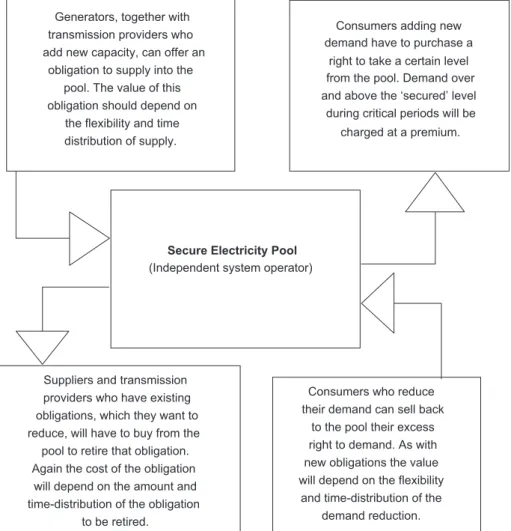
In the proposed Electricity Security Market, the right to draw a specific quantity of energy from the network in any time period under certain pre-determined conditions would be purchased by new electricity consumers. Conversely, drawing rights would be sold by suppliers who are able to guarantee, subject to clear requirements that the additional electricity will be provided according to an agreed schedule. One form this could take would be through a series of security levels where suppliers of capacity (through either increased generation or reduced consumption of its other customers relative to established base loads) would have to release or provide that additional capacity to the grid. Shown schematically in Fig. 3, the market would be constructed to create greater symmetry in investment between supply- and demand-side options for increasing security. Thus the market would provide an item of value, access to a guaranteed level of supply security, as a trade between a buyer and a seller. The scheme would be different from a consumer tax or fixed hook-up fee, because the cost of purchasing an allocation would be set by the buyers and sellers. This will change the way new capacity, or new efficiency upgrades, are paid for, by requiring new demand to invest up-front. Any cost of administration could be recovered through a small transaction or service fee. Although not shown in the figure, there would need to be involvement from the transmission grid owners as well, since the security of supply is required at the point of use, not just at the point of generation. The market could be based on the trading of an obligation to offer a particular level of guaranteed supply at particular grid reference points into the market at varying degrees of security. It would be expected that most users would be able to offer some degree of demand reduction into the market through increased physical efficiency. The degrees of security could be based on electricity market price thresholds or other supply and demand based metrics in the existing spot market and would ideally integrate with the existing spot market.
that they can use the electricity when they choose. In a second case, an existing supplier is considering adding a wind turbine or a diesel generator to the network. Here the supplier would be able to sell a higher level of security with the diesel generation option (provided they have the fuel reserves) than they would with the wind turbine, thus giving them a reward for providing a higher security supply. These two examples are simply intended to show that both suppliers and users are able to symmetrically participate in the market providing the same effective product of a secure supply of electricity. Clearly the details regarding the conditions of secure supply would need to be developed but the intention here is simply to present the concept.
Although the concept is not fully developed in detail, the suggested Electricity Security Market has the potential to improve security of supply through enforcing the obliga-tion to release or provide capacity with financial penalties as needed. It would discourage new uncompensated demand that would stress the grid, by securing matching new supply or reduced demand to relieve the stress. Such a system has the potential to offer a market-allocated level of security of supply and provide stimulus for driving demand
for energy efficiency commensurate with the benefits derived by all users of the grid.
7. Summary
Maintaining security of supply, whilst improving envir-onmental outcomes and economic efficiency, forms the basis of modern energy policy. Energy efficiency is complementary to all three (DTI, 2003) yet realised levels of efficiency remain well below the most cost-effective equilibrium. The IEA (2005)has shown that in order for the level of energy efficiency to increase significantly, there must be a major shift in investment across the meter to the demand side. But a variety of behavioural or organisa-tional barriers, often underpinned or exacerbated by information constraints, inhibit investment in energy efficiency. There are many public-good reasons for addressing these impediments, since improved energy consumer efficiency provides significant benefits to both the environment and to supply security. These benefits are currently not allocated to the actors that invest in improved consumer efficiency. The existence of these public-good attributes of energy efficiency has motivated some
Generators, together with transmission providers who add new capacity, can offer an
obligation to supply into the pool. The value of this obligation should depend on
the flexibility and time distribution of supply.
Consumers who reduce their demand can sell back
to the pool their excess right to demand. As with new obligations the value will depend on the flexibility
and time-distribution of the demand reduction.
Secure Electricity Pool
(Independent system operator)
Consumers adding new demand have to purchase a
right to take a certain level from the pool. Demand over and above the ‘secured’ level
during critical periods will be charged at a premium.
Suppliers and transmission providers who have existing obligations, which they want to reduce, will have to buy from the
pool to retire that obligation. Again the cost of the obligation
will depend on the amount and time-distribution of the obligation
to be retired.
governments to intervene with regulations or incentives to overcome these barriers. While there are instances of these being effective, they are fragile in the long-term because they require sustained political endorsement. Market-based solutions, which improve the alignment between invest-ment and reward, have the potential to produce increases in energy efficiency more naturally and equitably, but have often been overlooked.
An electricity security market as suggested would assist in setting the optimal quantity of reserves while auto-matically achieving an efficient balance between supply-and demsupply-and-side initiatives. It would also have the advantage of removing the need for ongoing political support and intervention. If the market were successful at providing a longer-term signal for investment, it could smooth overall investment throughout the energy system. Furthermore it would encourage incremental approaches to investment in the energy system, supporting distributed generation and demand-side alternatives where they provide competitive value. It would reward essentially all actions that increase the security of the system and would be paid for by those who would otherwise reduce system security through new unmitigated demand. This would link the impact of actions affecting system security to greater financial motivations, encouraging valuable activities like diversifying the fuel mix of generators or demand reduc-tions through to increased energy efficiency by consumers. Such a market could also stimulate investment in efficiency by large industrial consumer companies, which have costs of capital similar to that of energy suppliers as opposed to the higher cost of capital for household consumers.
The New Zealand example presented here illustrates the need to identify additional ways to improve electricity supply security for those who need that security the most. This example illustrates the feasibility of mobilising the demand side of the energy market to provide some of this security through increased incentives to improve consu-mers’ efficiency, providing benefits to be shared by all consumers. Since many of these benefits do not currently carry a price, and since their value varies from user to user, there is a case for developing a market mechanism to harness this value as effectively as possible. The authors acknowledge that there would be many other possible consequences of introducing such a security market. For example, it will be necessary to anticipate the effects of speculative and anti-competitive activities, as part of the concept development. At this point a security market is suggested as one possible means to moderate the impact of an otherwise insecure and high-cost energy future, which deserves further analysis.
Acknowledgements
The authors wish to thank the New Zealand Foundation for Research Science and Technology for supporting the work presented in this paper through contract UOOX0212 awarded to the University of Otago.
References
Akerlof, G., 1970. The market for ‘‘lemons’’: quality uncertainty and the market mechanism. Quarterly Journal of Economics 84 (3), 488–500. Barrera, F., Crespo, J., 2003. Security of Supply: What Role can Capacity
Markets Play? Research Symposium European Electricity Markets, The Hague.
Bertoldi, P., Huld, T., 2006. Tradable certificates for renewable electricity and energy savings. Energy Policy 34, 212–222.
Boardman, B., 2004. Energy efficiency through product policy: the UK experience. Environmental Science and Policy 7, 165–216.
Boot, P., Brinkhoff, J., Roukens, B., 2003. European Energy Markets: Challenges for Policy and Research. Research Symposium European Electricity Markets, The Hague.
Borner, A., MacKerron, G., 2003. Who secures the security of supply? European perspectives on security, competition and liability. Elec-tricity Journal December, 10–19.
Brookes, L., 2004. Energy efficiency fallacies—a postscript. Energy Policy 32, 945–957.
CAE, 2004. Assessment of the value of lost load. The NZ Electricity Commission: Consultation Discussion Paper, Centre for Advanced Engineering, University of Canterbury, New Zealand.
Carrington, G., Sun, Z., Bannister, P., Chen, G., 2002. Opportunities for dehumidifier dryers in the timber industry. In: Proceedings of the IRHACE Technical Conference, The Institute of Refrigeration, Heating, and Air Conditioning Engineers of New Zealand, Christch-urch, pp. 64–69.
Carrington, G., Rutherford, J., Scharpf, E., 2004. The challenge of consumer energy efficiency. In: Proceedings of a Conference Organised by the Royal Society of New Zealand, Christchurch, NZ, pp. 34–46.
CDMAG, 2003. Report of the advisory group on demand-side manage-ment and demand response in Ontario in response to the Minister’s directive to the Ontario Energy Board. Retrieved 6 November 2004 from /http://www.oeb.gov.on.ca/documents/directive_dsm_Advisory %20Group%20Document121203.pdfS.
Concept, 2004. Security of supply policy development discussion paper. Prepared for the NZ Electricity Commission by Concept Consulting Group. Retrieved on 6 March 2006 from /http://www.electricity commission.govt.nz/consultation/sospolicyS.
Cowart, R., 2001. Efficient reliability. The critical role of demand-side resources in power systems and markets. National Association of Regulatory Utility Commissioners Report, USA.
Creti, A., Fabra, N., 2004. Capacity Markets for Electricity. University of California Energy Institute.
DeCanio, S., 1993. Barriers within firms to energy-efficient investments. Energy Policy 21, 906–914.
Devereux, M., 2004. Cash incentives in bid to stop electricity blackouts. New Zealand Herald, 26 May.
DTI, 2003. Department of Trade and Industry Energy White Paper: Our Energy Future—Creating a Low Carbon Economy. The Stationery Office, UK,/www.tso.co.uk/bookshopS.
EECA, 2001. National Energy Efficiency and Conservation Strategy: Towards a Sustainable Energy Future. NZ Energy Efficiency and Conservation Authority and Ministry for the Environment.
EECA, 2006. Increasing the uptake of solar water heating. Retrieved 27 October 2006 from /http://www.eeca.govt.nz/eeca-library/ renewable-energy/solar/report/solar-water-heating-discussion-document-06.pdfS.
Erickson, R., 1987. Household energy use in Sweden and Minnesota: individual behavior in cultural context. I. In: Kempton, W., Nieman, M. (Eds.), Energy Efficiency: Perspectives on Individual Behavior. American Council for an Energy-Efficient Economy, Washington, DC, pp. 213–228.
Greening, L., Greene, D., Difiglio, C., 2000. Energy efficiency and consumption—the rebound effect—a survey. Energy Policy 28, 389–401.
Harrigan, M., 1994. Can we transform the market without transforming the customer? Home Energy Magazine Online. January/February 1994. Retrieved on 6 March 2006 from/http://www.homeenergy.org/ archive/hem.dis.anl.gov/eehem/94/940109.htmlS.
Helm, D., 2002. Energy policy: security of supply, sustainability and competition. Energy Policy 30, 173–184.
Hodgson, P., 2005. Climate change challenge increases in New Zealand. 16 June 2005. Retrieved on 2 March 2006 from /http://www.beehive. govt.nz/ViewDocument.aspx?DocumentID=23376S.
Horii, B., Orans, R., Woo, C.K., 1994. Targeting demand-side manage-ment for electricity transmission and distribution benefits. Managerial and Decision Economics 15, 169–175.
Hume, J., 2004. Do our customers care about the sustainability of New Zealand’s key exports? Winston Churchill Fellowship Report. Co-sponsored by the New Zealand Business Council for Sustainable Development.
Huntington, H., Schipper, L., Sanstad, A., 1994. Editors’ introduction. Energy Policy 22, 795–797.
IEA, 2003. Electricity Information (2003 Edition) Part II. International Energy Agency, Paris.
IEA, 2005. World Energy Outlook 2005. International Energy Agency, Paris.
IEA, 2006. Energy Policies of IEA countries: New Zealand 2006 Review. International Energy Agency, Paris.
Jaffe, A., Stavins, R., 1994. The energy efficiency gap—what does it mean? Energy Policy 22, 804–810.
Langniss, O., Praetorius, B., 2006. How much market do market-based instruments create? An analysis for the case of ‘‘white’’ certificates. Energy Policy 34, 200–211.
Lijesen, M., 2003. Can Capacity Markets Solve Security of Supply Issues in Electricity Markets? Research Symposium European Electricity Markets, The Hague.
Marsden, A., Poskitt, R., Small, J., 2004. Investment in the New Zealand Electricity Industry. UniServices Ltd., Auckland Ref 10679.00. McKerchar, A., Woods, R., 2003. The drought of summer–autumn 2003.
Water Resources Update, NZ National Institute for Water and Atmosphere, No. 3.
MED, 2002. Availabilities and costs of renewable sources of energy for generating electricity and heat. Report to the Ministry of Economic Development, East Harbour Management Services Ltd.
MED, 2003a. New Zealand Energy Data File, January 2003. NZ Ministry for Economic Development, Wellington, New Zealand.
MED, 2003b. Electricity Supply Security: Questions and Answers, May 2003. NZ Ministry for Economic Development, Wellington, New Zealand.
MED, 2004. New Zealand Energy Data File, July 2004. NZ Ministry for Economic Development, Wellington, New Zealand.
MOE, 1986. Supply Curves of Conserved Energy: the Potential for Conservation in New Zealand’s Houses. Ministry of Energy, Well-ington, New Zealand.
New Zealand Gazette, 2005. Notice of annual levy rates for the financial year ending 30 June 2006. No. 100, p. 2389.
NZCCO, 2006. Eligibility and selection criteria. New Zealand climate change office. Retrieved on 22 April 2006 from /http://www. climatechange.govt.nz/policy-initiatives/projects/eligibility-selection.htmlS. Pan, H., Wells, C., Bannister, P., 2000. A new methodology on risk profiling in EPC. Electrical Engineering Association of New Zealand, Annual Conference, 15–19 June 2000, Auckland, New Zealand. Perrels, A., Ostertag, K., Henderson, G., 2006. Reshaping markets for the
benefit of energy saving. Energy Policy 34, 121–128.
Robinson, J., 1991. The proof of the pudding: making energy efficiency work. Energy Policy 19, 631–645.
Sanstad, A., Howarth, R., 1994. ‘Normal’ markets, market imperfections and energy efficiency. Energy Policy 22, 811–818.
Saunders, H., 2000. A view from the macro side: rebound, backfire and Khazzoom-Brookes. Energy Policy 28, 439–449.
Simon, H.A., 1957. Administrative behaviour (2nd ed.). Free Press, New York (first published 1945). Extracted from Minkes, A., Foxall, G. 2003. Herbert Simon and the concept of dispersed entrepreneurship. Journal of Economic Psychology 24, 221–228.
Stern, P., Aronson, E. (Eds.), 1984. Energy Use: the Human Dimension. Freeman, New York, NY.
TVNZ, 2006. Meridian calls for grid upgrade. Broadcast 2 March 2006. Retrieved 3 March 2006 from /http://tvnz.co.nz/view/page/411749/ 671316S.
UL, 2006. About UL. Retrieved 6 March 2006 from/http://www.ul.com/ about/S.
Verbuggen, A., 2003. Stalemate in energy markets: supply extension versus demand reduction. Energy Policy 31, 1431–1440.
Vries, L., 2003. The instability of competitive energy-only markets. Research Symposium. European Electricity Markets, The Hague. Weber, L., 1997. Some reflections on barriers to the efficient use of energy.