http://www.uem.br/acta ISSN printed: 1679-9275 ISSN on-line: 1807-8621
Acta Scientiarum
Doi: 10.4025/actasciagron.v35i4.17655
Effect of salinity and priming on seedling growth in rapeseed
(
Brassica napus
var
oleifera
Del.)
Paolo Benincasa1*, Roberta Pace1, Muriel Quinet2 and Stanley Lutts2
1
Department of Agricultural and Environmental Sciences, University of Perugia, Borgo XX Giugno, 74-06121 Perugia, Italy. 2
Groupe de Recherche en Physiologie Végétale, Earth and Life Institute, Agronomy, Université Catholique de Louvain, Louvain-la-Neuve, Belgium. *Author for
correspondence. E-mail: [email protected]
ABSTRACT. Experiments were performed to examine the effect of salt stress and GA3-priming on initial growth of two rapeseed cultivars, one tolerant and one sensitive to salt stress during germination. Seedlings from seeds germinated in salty (as NaCl) and non salty substrate were grown in salty and non salty hydroponics. Salt stress reduced seedling growth of the two genotypes consistently with their degree of stress tolerance during germination. Seedlings from stress sensitive seeds germinated under high salinity showed a rapid recover of growth in non stressing conditions. The effect of salt stress on shoot/root ratio was controversial, increased for lab and decreased for greenhouse experiments, probably due to different timing of stress application and additional experimental conditions. Salt stress decreased leaf photosynthesis and increased thermal dissipation in sensitive seedlings (decrease of ΦPSII and qP, increase of NPQ). The GA3-priming did not affect seedling growth of the stress sensitive cultivar subjected to stress, while it greatly improved the performance of the stress tolerant cultivar.
Keywords:NaCl, GA3, root, shoot, fluorescence, stomatal conductance.
Efeito da salinidade e condicionamento osmótico sobre o crescimento das plântulas em
colza
(
Brassica napus
var
oleifera
Del.)
RESUMO. Os experimentos foram realizados para examinar o efeito de sal e o período de condicionamento osmótico do GA3 sobre o crescimento inicial de duas cultivares de colza, sendo uma tolerante e uma sensível ao estresse salino durante a germinação. As mudas provenientes de sementes germinadas em meio salino (como NaCl) e não salgado foram cultivadas em hidroponia na presença ou ausência de salinidade. O estresse salino reduziu o crescimento das plântulas dos dois genótipos de forma consistente com o seu grau de tolerância ao estresse durante a germinação. As mudas provenientes de sementes sensíveis germinadas sob alta salinidade mostrou uma recuperação rápida do crescimento em condições não estressantes. O efeito do estresse salino sobre relação parte aérea / raiz foi controverso, aumentando em condições laboratoriais e diminuindo para os experimentos em casa de vegetação, provavelmente devido a épocas de estresse e outras condições experimentais. O estresse salino reduziu a fotossíntese foliar e aumentou a dissipação térmica em mudas sensíveis (queda de
ΦPSII e qP, aumento do NPQ). O condicionamento osmótico do GA3 não afetou o crescimento das plântulas da cultivar sensível estresse submetido ao estresse, ao mesmo tempo que melhorou significativamente o desempenho da cultivar tolerante estresse.
Palavras-chave: NaCl, GA3, raiz, parte aérea, fluorescência, condutância estomática.
Introduction
High salinity in the soil during rapeseed (Brassica napus var. oleifera Del.) crop establishment may occur in semi-arid and coastal environments like the Mediterranean regions, where the species is mainly cultivated in fall-winter with late summer-early autumn sowing. Recently, Pace et al. (2012) examined the effect of salinity and low water potential induced by PEG on germination of one stress tolerant and one stress sensitive rapeseed cultivar and evaluated several priming techniques as a tool to improve germination in those conditions.
either stressing or optimal conditions might be worsened or improved.
The osmotic stress associated to salinity may cause a decrease in leaf area and photosynthetic rate (KAUSER et al., 2006; LAWLOR, 2002; SHAH, 2007) in relation to stomatal closure (MARTINEZ et al., 2007), alteration of the light phase of photosynthesis (GARCÍA-MORALES et al., 2012; QIU et al., 2003) or decrease in Rubisco activities (PARRY et al., 2002). Moreover, salinity causes either a nutritional imbalance due to ions and low soil water potential in both uptake and translocation processes or a toxic effect due to accumulation of Na+ and Cl- ions in the cytoplasm
(VILLALTA et al., 2008). To limit this effect, plants evolve a great variety of adaptation mechanisms, from reduced leaf growth, early senescence and abscission of older leaves (ATHAR; ASHRAF, 2005) to osmotic adjustment, selective ion uptake and vacuolar ion compartmentation (MUNNS; TESTER, 2008). Salinity reduces shoot growth more than root growth (MUNNS, 2002). Consequently, many studies devoted to salt stress in Brassica species reported a decrease of the shoot/root ratio (BADRUDDIN et al., 2005; MAGGIO et al., 2004; JAMIL et al., 2005), although there are also opposite evidences (JAMIL et al., 2006).
Seed priming is widely adopted as a tool to improve seed germination under both optimal and adverse conditions, but benefits have also been found for subsequent seedling growth (ÇALIŞKAN et al., 2012). In Brassica napus, hydropriming and osmopriming with polyethylene glycol have been found to improve growth parameters in non stressing conditions (BASRA et al., 2003) while halopriming had a beneficial effect on seedling growth under salt stress (FARHOUDI; SHARIFZADEH, 2006). Hormopriming with gibberellic acid has been found to improve germination and seedling growth of sugar beet under salt stress (JAMIL; RHA 2007) and of rapeseed under drought stress (LI et al., 2010). To the best of our knowledge, no data are available concerning the impact of hormopriming on the growth of salt stressed seedlings in Brassica napus.
The present study was therefore carried out to determine the effect of salt stress on seedling growth of two rapeseed cultivars, one tolerant and one sensitive to salinity during germination, and to test hormo-priming with GA3 as a tool to improve initial plant
growth under salt conditions.
Material and methods
Seeds of two rapeseed cultivars, that were found to be tolerant (Exagone, Monsanto) or sensitive (Toccata, Maisadour Semences) to salt and water stresses during
germination (PACE et al., 2012), were incubated in distilled water (0 mM) and in NaCl solution (250 mM). For each treatment, seven replicates of 70 seeds each were incubated on absorbent paper (Whatman no. 1) in 9-cm-diameter Petri dishes placed in a controlled-temperature chamber at darkness at 20°C. Four days after the start of incubation (i.e. one day after germination), seedlings were transferred in plexiglass boxes with drilled lid and walls (21 holes of 3 mm Ø) for slant test (WURR; FELLOWS, 1985). Seedlings were placed 1 cm apart in a horizontal row along the long axis of 10 x 16 cm rectangular piece of Whatman®
n. 1 chromatography paper held on 10 x 18.5 cm clear plastic plate 3 mm thick. The plate was held at an angle of 20° from the vertical by a slotted rack in the base 20 x 30 cm seed tray. The chromatography paper was kept moist by dipping into solution in the tray. Each plate held up to 10 seedlings and each tray held 10 plates. Seedlings from each treatment (i.e. Exagone and Toccata germinated in either 0 or 250 mM NaCl) were placed in boxes containing distilled water (0 mM) or a NaCl solution (100 mM), both added with Flory 9 (Agrimport), a liquid fertilizer for hydroponics. Therefore the following four combinations for “germination-growth” conditions were obtained for each cultivar: optimum (O-O); optimum-stress (O-S); optimum-stress-optimum (S-O); optimum-stress-optimum-stress (S-S). The lower concentration of NaCl in the growth medium (100 mM) with respect to that of the germination medium (250 mM) was necessary because concentration higher than 100 mM caused weakness and death of most seedlings few days after plant transfer. The boxes for the slant test were placed in a growing room for 14 days at day/night temperature of 25/15°C with a photoperiod of 14 hour light and 10h darkness. A randomized block design with three replicates per treatment (cultivar x growing conditions) was adopted. The root and shoot lengths and the total plant fresh and dry weights of seedlings were measured at 4, 7, 11, 14 days after the start of incubation.
In another experiment, the effect of hormo-priming with GA3 on initial growth was investigated.
Rapeseed seedling growth under salt stress 481
A third experiment was carried out in greenhouse. Seedlings of each cultivar obtained from seeds sown in pots containing soil were transferred (7 days after the start of incubation, i.e. 4 days after germination) in hydroponics with Hoagland’s solution added with no (control) or 100 mM NaCl (stress) starting from 7 days after plant transfer (i.e. 11 days after germination). A randomized block design with two replicates (of 24 plants each) per treatment (cultivar x growing conditions) was adopted. The lengths and fresh and dry weights of root and shoot were recorded at 0, 7, 14 days after salt application. Stomatal conductance and chlorophyll fluorescence were measured at mid-day on 6 leaves per treatment after 0, 4, 7, 14 days of treatment, by using a porometer (AP4, Delta-T Devices, Cambridge, UK) and a fluorescence monitoring system (Hansatech Instruments), respectively. To measure chlorophyll fluorescence a leaf, dark-adapted for 30 min. by leaf-clips (PEA/LC, Hansatech Instruments), was initially exposed to a modulated measuring beam of far-red light (LED source with typical peak at wavelength 735 nm). Initial (F0) and
maximum (Fm) fluorescence were measured under
weak modulated red light (<0.5 μmol m-2 s-1) with 1.6
s pulse of saturating light (18,000 μmol photons m-2 s-1)
and auto-calculated by FMS software for Windows®.
The efficiency of photosystem II photochemistry (ΦPSII), the photochemical quenching (qP, that gives an indication of the proportion of PSII reaction centres that are open) and the non-photochemical quenching (NPQ, proportional to the constant rate of thermal
energy dissipation) were calculated according to Maxwell and Johnson (2000).
Data on seedling growth were analyzed by Student’s t-test. Means were compared between cultivars and treatments by LSD (least significant difference) at the 0.05 confidence level, using the software R Development Core Team (2010).
Results and discussion
Similar trends were observed in Exagone and Toccata for the 4 combinations of ‘germination-growth’ conditions for either shoot and root length or total plant fresh and dry weight (Figure 1). The O-O treatment showed the highest values at all dates after seedling transfer, while S-S always showed the lowest ones. The S-O treatment showed a progressive recovery for all parameters while O-S generally showed slight variations, so that values of the former at the end of the experiment were always higher than those of the latter. The ratio between shoot and root length was increased in both cultivars in response to NaCl at any time of stress occurrence (i.e. O-S, S-O and S-S treatments). Such an increase was however, from a relative point of view, always higher for Toccata than for Exagone, especially in S-S treatment. In fact, at the last sampling date, this ratio was 0.88 for O-O in Exagone and increased by 20, 37 and 220% for O-S, S-O and S-S, respectively, while it was 0.83 for S-O-S-O in Toccata and increased by 40, 93 and 444% for O-S, S-O and S-S, respectively.
0 2 4 6 8 10 12 14
Sho
o
t len
g
th (
m
m
)
0 20 40 60 80 100 120
A
0 2 4 6 8 10 12 14
S
hoo
t leng
th (
m
m
)
0 20 40 60 80 100 120
B
0 2 4 6 8 10 12 14
Ro
ot len
g
th (m
m
)
0 20 40 60 80 100 120
0 2 4 6 8 10 12 14
Roo
t leng
th (m
m
)
0 20 40 60 80 100 120
0 2 4 6 8 10 12 14
T
o
ta
l plan
t f
res
h w
e
ig
th (
m
g
)
0 50 100 150 200 250
0 2 4 6 8 10 12 14
T
o
tal p
lan
t f
res
h
w
e
igth
(
m
g)
0 50 100 150 200 250
0 2 4 6 8 10 12 14
T
o
tal p
lan
t d
ry
w
e
igth (m
g)
0 3 6 9
0 2 4 6 8 10 12 14
T
o
ta
l pla
n
t dr
y
w
e
igth
(
m
g)
0 3 6 9
Days after sowing
O-O O-S S-O S-S
O-O O-S S-O S-S
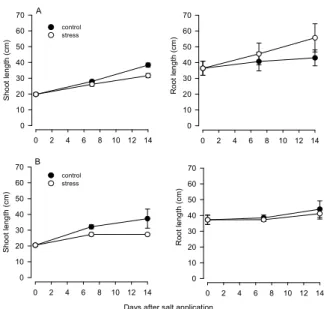
In hydroponics shoot length was reduced by salt stress in both cultivars, while root length was not significantly affected (if not increased in Exagone) (Figure 2). Thus the shoot/root ratio was reduced in both cultivars: -32% in Exagone and -15% in Toccata, as compared to their unsalted controls (0.88 in Exagone and 0.81 in Toccata).
The effect of salt stress was substantially the same for fresh weights while some discrepancies were observed for dry weights (Figure 3): salt stress indeed did not affect shoot and root dry weight in Exagone but markedly reduced them in Toccata. As a consequence, the shoot/root ratio estimated on a dry weight basis was not affected by salt stress
The similar response of Exagone and Toccata for seedling growth in any of the four combinations of germination-growth conditions (Figure 1) was not expected, standing their different salt stress tolerance during germination (PACE et al., 2012). On the other hand, the reduced growth of Toccata in the greenhouse experiment (Figure 2) as compared to Exagone indicates that the higher sensitivity of Toccata is present also during seedling growth and not only at the germination stage. Indeed, Ashraf and McNeilly (2004) observed that Brassica species present different response to salinity at different plant developmental stages, but maintain their relative degree of salt tolerance throughout plant ontogeny. These data suggest that in rapeseed, in contrast to what occurs in other plant species such as rice (LUTTS et al. 1995), screening for salt resistance may be performed at the germination stage.
A
Days after salt application
0 2 4 6 8 10 12 14
Ro ot l e ng th (cm ) 0 10 20 30 40 50 60 70
0 2 4 6 8 10 12 14
Ro ot l e ng th (cm) 0 10 20 30 40 50 60 70
0 2 4 6 8 10 12 14
S h oo t l e ngth (cm ) 0 10 20 30 40 50 60 70 B
0 2 4 6 8 10 12 14
Sh oo t le ngth (cm ) 0 10 20 30 40 50 60 70 control stress control stress
Figure 2. Shoot and root lengths in Exagone (A) and Toccata (B) grown in hydroponics with a NaCl concentration of 0 (control) and 100 mM (stress). Values are means of 2 replicates. Bars on data points represent ± SEs of the mean.
Differences between our two experiments are probably due to the timing of stress application (1 vs 11 days after germination in the slant test and greenhouse experiment, respectively) which should have affected Exagone more than Toccata performance. In fact, regardless of Toccata, it was seedling sensitivity of Exagone in the slant test experiment that was not expected and that was then disproved by the greenhouse experiment (i.e. consider the O-S treatment for comparison).
A
B
Days after salt application
0 2 4 6 8 10 12 14
Shoot f resh w e igh t ( g ) 0 10 20 30 40 50
0 2 4 6 8 10 12 14
Shoot f res h w e ig ht ( g ) 0 10 20 30 40 50
0 2 4 6 8 10 12 14
Shoot dr y w e ight ( g )
0 2 4 6 8 10 12 14
Shoot dr y w e ight ( g )
0 2 4 6 8 10 12 14
Root f resh w e ight ( g ) 0 1 2 3 4 5 6 7
0 2 4 6 8 10 12 14
Root dr y w e ight ( g )
0 2 4 6 8 10 12 14
Root f resh w e ight (g ) 0 1 2 3 4 5 6 7
0 2 4 6 8 10 12 14
R o o t dr y w e ight ( g ) 0 0.5 1.0 1.5 2.0 2.5 3.0 3.5 0 0.5 1.0 1.5 2.0 2.5 3.0 3.5 0 0.1 0.2 0.3 0.4 0 0.1 0.2 0.3 0.4 control stress control stress
Rapeseed seedling growth under salt stress 483
One possible explanation would be that 11-days old plants already differentiated an efficient endodermis barrier that could limit toxic ion translocation to the shoot, in contrast to young elongating root in germinating seeds.
With regard to Toccata, since the recovery of seedling growth for the S-O treatment was good and similar to that of Exagone (Figure 1), it can be argued that even a very high salinity during germination (i.e. about 23 dS m-1 EC, or -1.28 MPa) did not cause any
irreversible damage to stress sensitive seeds. Almansouri et al. (2001) demonstrated that salt-induced inhibition in durum wheat seed germination was directly linked to Na+ and Cl- accumulation
within embryonic axes and that these damages are irreversible. We hypothesize that the situation could be different in rapeseed since early seedling growth was not drastically compromised after the stress relief.
The reduced growth of seedlings in salt stress conditions observed for both cultivars is in line with findings of Badruddin et al. (2005) who observed a total plant dry weight at the highest stress intensity (i.e. EC= 15 dS m-1) corresponding to 25% of that
observed in the unsalted control.
Also the increase of shoot/root length ratio with salinity in the slant test experiment (Figure 1) was then disproved by the reduced ratio recorded in the greenhouse experiment (Figure 2), although the ratio did not vary on a dry weight basis (Figure 3). Actually, a higher decrease of shoot length as compared to root in salt stressed plants is a common evidence in many species (MUNNS, 2002), and Jamil et al. (2005) obtained similar results in three Brassica species including Brassica oleracea and Brassica napus at NaCl concentration up to 14.10 dS m-1. Similarly, on a dry
weight basis Badruddin et al. (2005) found that the shoot/root ratio was more than halved with a salinity of 15 dS m-1 EC. On the other hand, Jamil et al. (2006)
observed an increase of shoot/root ratio in two Brassica species, including Brassica oleracea at 14.10 dS m-1 and
Kaya and Ipek (2003) observed a similar result in safflower at 23 dS m-1. Differences found in literature
and between our slant test and greenhouse experiments are probably due to additional experimental conditions (e.g. light and temperature regimes, air and water stirring) and the timing of stress application. A low air humidity was also shown to increase Na+ and Cl- translocation from the root to the
shoot. Nevertheless, the ability of the considered cultivar to close stomata did not appear to be an exhaustive criterium of salt resistance in the present work, and the maintenance of the gas exchange in relation to photosynthesis may be crucial for plant survival in salt conditions.
The chlorophyll fluorescence parameters are shown in Figure 4. In Exagone, salt-induced decrease in ΦPSII and qP recorded after 4 days of treatment were followed by a progressive recovery after 6 days of stress. On the contrary, salt stress permanently reduced
ΦPSII and qP with respect to control and caused a slight increase of NPQ until 7 days after salt application (Figure 4B).
The leaf stomatal conductance of salt stressed plants was slightly reduced in Exagone (Figure 5A), while the reduction was much greater in Toccata except for the measurement at 7 days after salt application (Figure 5B).
The decrease of ΦPSII and qP and stomatal conductance and the increase of NPQ in salt stressed Toccata confirm the higher salt sensitivity of this cultivar, where salinity compromises the light phase of photosynthesis and induces an increase of thermal dissipation in order to avoid photodamage. In contrast, Exagone only transiently suffered from light phase inhibition and was able to trigger efficient adaption allowing plant to re-increase both ΦPSII and qP after an initial decrease. Several osmoprotectants, especially carbohydrates or quaternary ammonium compounds are known to protect photosystem from the deleterious impact of salt accumulation within chloroplasts (QIU et al., 2003). Further studies are required to identify those compounds in our tested material.
The effect of seed priming with GA3 on
seedling growth was different in the two cultivars (Figure 6). In Exagone there was a general increase of shoot and root length and total plant weight in all treatments except in O-O, in which no sensible variation was observed (Figure 6A). In Toccata, the benefit was observed only in O-O, while there was a general worsening of growth parameters for other treatments (Figure 6B).
The positive effect of GA3-priming on the
initial growth of salt stressed Exagone was not expected since this treatment was found to have only marginal impact on the germination of this cultivar under salinity Pace et al. (2012). On the other hand, the lack of effect of GA3-priming on
the initial growth of salt stressed Toccata suggests that the salt sensitivity of this genotype was not directly related to the deleterious impact of salinity on gibberellins synthesis. An alternative explanation could also be that the positive effect of GA3 on cell elongation, mainly due to Ca
resistant genotype. In any case, the overall effect of GA3-priming on the whole germination-initial
growth process comes out positive for this cultivar either for optimal or salt stress conditions. With this regard, our results are in
line with those obtained in other experiments (JAMIL; RHA, 2007) where similar GA3
concentrations (100 and/or 200 mg L-1) for
priming and salt concentrations (10-20 dS m-1 of
EC) for the growing medium were adopted.
0 2 4 6 8 10 12 14
0 2 4 6 8 10 12 14
N
o
n-ph
o
te
c
he
m
ic
a
l que
nc
h
in
g
0 2 4 6 8 10 12 14 0 2 4 6 8 10 12 14
Q
uant
um
yi
el
d of
P
S
II
A
B
control stress
Days after salt application
0 2 4 6 8 10 12 14 0 2 4 6 8 10 12 14
Non-phot
echem
ic
a
l quenchi
ng
0 0.2 0.4 0.6 0.8 1.0
0 0.2 0.4 0.6 0.8 1.0
control stress
Q
uan
tum
y
ie
ld
of
P
S
II
0 0.2 0.4 0.6 0.8 1.0
0 0.2 0.4 0.6 0.8 1.0
P
hot
echem
ic
al
quenchi
ng
P
hot
echem
ic
al
quenchi
ng
0 0.2 0.4 0.6 0.8 1.0
0 0.2 0.4 0.6 0.8 1.0
Non-phot
echem
ic
al
quenchi
ng
Figure 4. Time-course variation of photosystem II efficiency (ΦPSII), photochemical quenching (qP), and non-photochemical quenching of fluorescence (NPQ) in Exagone (A) and Toccata (B) grown in hydroponics with a NaCl concentration of 0 (control) and 100 mM (stress). Values are means of 2 replicates. Bars on data points represent ± SEs of the mean.
0 2 4 6 8 10 12 14 0
200 400 600 800 1000 1200 1400
control stress A
0 2 4 6 8 10 12 14 B
Days after salt application
St
om
a
tal
c
o
nduct
a
n
c
e
(m
m
ol
m
-2
s
-1)
0 2 4 6 8 10 12 14 0
200 400 600 800 1000 1200 1400
control stress A
0 2 4 6 8 10 12 14 B
Days after salt application
St
om
a
tal
c
o
nduct
a
n
c
e
(m
m
ol
m
-2
s
-1)
Rapeseed seedling growth under salt stress 485
0 2 4 6 8 10 12 14
S h oo t l e ng h t (m m ) 0 20 40 60 80 100 120 O-O O-S S-O S-S A
0 2 4 6 8 10 12 14
S h oot l e n g ht (m m ) 0 20 40 60 80 100 120 O-O O-S S-O S-S B
0 2 4 6 8 10 12 14
Ro ot l e ng ht ( m m ) 0 20 40 60 80 100 120
0 2 4 6 8 10 12 14
R o o t l e ngh t (m m ) 0 20 40 60 80 100 120
0 2 4 6 8 10 12 14
T o tal p la n t fre s h w e ig ht ( m g) 0 50 100 150 200 250 300 350
0 2 4 6 8 10 12 14
T o ta l pla n t fr e s h we ig h t ( m g ) 0 50 100 150 200 250 300 350
0 2 4 6 8 10 12 14
T o ta l pl a n t d ry w e ig ht (m g) 0 3 6 9 12 15
0 2 4 6 8 10 12 14
T o ta l pl a nt dry w e ig ht ( m g) 0 3 6 9 12 15
Days after sowing
Figure 6. Shoot and root lengths and total plant fresh and dry weights of seedlings from seeds of Exagone (A) and Toccata (B) primed in distilled water with GA3 1 mM for the four combinations of “germination-growth” conditions (O-O, O-S, S-O, S-S): O (optimum)
corresponds to 0 mM NaCl for both germination and growth conditions, S (salt stress) corresponds to 250 mM NaCl for germination and 100 mM NaCl for growth. Values are means of 3 replicates. Bars on data points represent ± SEs of the mean.
Conclusion
Salt stress reduced seedling growth of the two genotypes consistently with the degree of stress tolerance observed during germination, although a very early application of severe stress to seedlings strongly compromised growth also for the tolerant cultivar. The salt sensitive seedlings subjected to stress showed a decrease in light capture efficiency and a concurrent increase of thermal dissipation as indicated by the chlorophyll fluorescence parameters and stomatal conductance. On the other hand, seedlings from stress sensitive seeds germinated under very high salinity levels showed a rapid growth recovery if non stressing conditions were applied, indicating that salinity did not cause any irreversible damage to germinating seeds. The effect of salt stress on shoot/root ratio was controversial in the two experiments (increased for slant test and decreased for greenhouse), probably due to the different timing of stress application and additional experimental conditions. The GA3
-priming did not affect seedling growth of the stress sensitive cultivar subjected to stress, while it greatly improved the performance of the stress tolerant cultivar.
Acknowledgements
We gratefully acknowledge Mr. Silvano Locchi for technical assistance.
References
ALMANSOURI, M.; KINET, J. M.; LUTTS, S. Effect of salt and osmotic stresses on germination in durum wheat
(Triticum durum Desf.). Plant and Soil, v. 231, n. 2,
p. 243-254, 2001.
ASHRAF, M.; MCNEILLY, T. Salinity tolerance in
Brassica oilseeds. Critical Reviews in Plant Sciences,
v. 23, n. 2, p. 157-174, 2004.
ATHAR, H.; ASHRAF, M. Photosynthesis under drought
stress. In: PESSARAKLI, M. (Ed.). Hand book
photosynthesis. New York: C. R. C. Press, 2005. p. 795-810. BADRUDDIN, M.; RHAMAN, M. M.; NEHAR, N. A.; HOSSAIN, M. M.; HASAN, M. B. Physiological characterization of mustard (Brassica sp.) genotypes for
their salt tolerance. Pakistan Journal of Biological
Sciences, v. 8, n. 3, p. 433-438, 2005.
BASRA, S. M. A.; ULLAH, E.; WARRAICH, E. A.; CHEEMA, M. A.; AFZAL, I. Effect of storage on growth
and yield of primed canola (Brassica napus) seeds.
International Journal of Agriculture and Biology, v. 5, n. 2, p. 117-120, 2003.
ÇALIŞKAN, O.; MAVI, K.; POLAT, A. Influences of
presowing treatments on the germination and emergence
of fig seeds (Ficus carica L.). Acta Scientiarum.
Agronomy, v. 34, n. 3, p. 293-297, 2012.
FARHOUDI, R.; SHARIFZADEH, F. The effects of NaCl priming on salt tolerance in canola (Brassica napus
L.) seedlings grown under saline conditions. Indian
photosynthetic activity, and potassium and sodium concentration in rice plants under salt stress. Acta Scientiarum. Agronomy, v. 34, n. 3, p. 317-324, 2012. JAMIL, M.; RHA, E. S. Gibberellic acid (GA3) enhance seed water uptake, germination and early seedling growth
in sugar beet under salt stress. Pakistan Journal of
Biological Sciences, v. 10, n. 4, p. 654-658, 2007. JAMIL, M.; LEE, D. B.; YUNG, K. Y.; ASHRAF, M.; LEE, S. C.; RHA, E. S. Effect of salt (NaCl) stress on germination and early seedling growth of four vegetables species.Journal of Central European Agriculture, v. 7, n. 2, p. 273-281, 2006.
JAMIL, M.; LEE, C. C.; REHMAN, S. U.; LEE, D. B.;
ASHRAF, M.; RHA, E. S. Salinity (NaCl) tolerance of
Brassica species at germination and early seedling growth.
Electronic Journal of Environmental, Agricultural and Food Chemistry, v. 4, n. 4, p. 970-976, 2005. KAUSER, R.; ATHAR, H.; ASHRAF, M. Chlorophyll fluorescence: a potential indicator for rapid assessment of water stress tolerance in canola (Brassica napus L.). Pakistan Journal of Botany, v. 38, n. 5, p. 1501-1509, 2006.
KAYA, M. D.; IPEK, A. Effects of different soil salinity levels on germination and seedling growth of safflower
(Carthamus tinctorius L.). Turkish Journal of Agriculture
and Forestry, v. 27, n. 4, p. 221-227, 2003.
LAWLOR, D. W. Limitation to photosynthesis in water stressed leaves: stomata vs. metabolism and the role of ATP. Annals of Botany, v.89, n. 7, p. 871-885, 2002. LI, Z.; LU, G. Y.; ZHANG, X. K.; ZOU, C. S.; CHENG, Y.; ZHENG, P. Y. Improving drought tolerance of germinating seeds by exogenous application of gibberellic acid (GA3) in rapeseed (Brassica napus L.). Seed Science
and Technology, v. 38, n. 2, p. 432-440, 2010.
LUTTS, S.; KINET, J. M.; BOUHARMONT, J. Changes in plant response to NaCl during development of rice (Oryza
sativa L.) varieties differing in salinity resistance. Journal of
Experimental Botany, v. 46, n. 12, p. 1843-1852, 1995. MAGGIO, A.; PASCALE, S.; RUGGIERO, C.; BARBIERI, G. Physiological response of field-grown cabbage to salinity and drought stress. European Journal of Agronomy, v. 23, n. 1, p. 57-67, 2004.
MARTINEZ, J. P.; SILVA, H.; LEDENT, J. F.; PINTO, M. Effect of drought stress on the osmotic adjustment, cell wall elasticity and cell volume of six cultivars of common beans (Phaseolus vulgaris L.). European Journal of Agronomy, v. 26, n. 1, p. 30-38, 2007.
MAXWELL, K.; JOHNSON, G. N. Chlorophyll
fluorescence - a practical guide. Journal of
Experimental Botany, v. 51, n. 345, p. 659-668, 2000.
MUNNS, R. Comparative physiology of salt and water
stress. Plant Cell and Environment, v. 25, n. 2,
p. 239-250, 2002.
MUNNS, R.; TESTER, M. Mechanisms of salinity
tolerance. Annual Review of Plant Biology v. 59,
p. 651-681, 2008.
PACE, R.; BENINCASA, P.; GHANEM, M. E.; QUINET, M.; LUTTS, S. Germination of untreated and primed seeds in rapeseed (Brassica napus var Oleifera Del.) under salinity and low matric potential. Experimental Agriculture, v. 48, n. 2, p. 238-251, 2012.
PARRY, M. A.; ANDRALOJC, P. J.; KHAN, S.; LEA, P. J.; KEYS, A. J. Rubisco activity: effects of drought stress.
Annals of Botany, v.89, n. 7, p. 833-839, 2002.
QIU, N.; LU, Q.; LU, C. Photosynthesis, photosystem II efficiency and the xantophyll II cycle in the salt-adapted halophyte Atriplex centralasiatica. New Phytologist, v. 159, n. 2, p. 479-486, 2003.
R DEVELOPMENT CORE TEAM. R: A language and
environment for statistical computing. Version 2.12.1. Vienna: R Foundation for Statistical Computing, 2010. SHAH, S. H. Effect of salt stress on mustard as affected by giberellic acid application. General and Applied Plant Physiology, v. 33, n. 1-2, p. 97-106, 2007.
UNGAR, I. A. Seed germination and seed-bank ecology
of halophytes. In: KIGEL, J.; GALILI G. (Ed.). Seed
Development and Germination. New York: Marcel
Dekker Inc., 1995. p. 599-628.
VILLALTA, I.; REINA-SANCHEZ, A.; BOLARIN, M. C.; CUARTERO, J.; BELVER, A.; VENEMA, K.; CARBONELL, E. A.; ASINS, M. J. Genetic analysis of Na+ and K+ concentrations in leaf and stem as physiological components of salt tolerance in tomato. Theoretical and Applied Genetics, v. 116, n. 6, p. 869-880, 2008.
WURR, D. C.; FELLOWS, J. R. A determination of the seed vigour and field performance of crisp lettuce seedstocks. Seed Science and Technology, v.13, n. 1, p. 11-17, 1985.
Received on June 22, 2012. Accepted on September 20, 2012.