KINETICS OF PHOSPHORUS UPTAKE AND ROOT
MORPHOLOGY OF LOCAL AND IMPROVED
VARIETIES OF MAIZE
Cynthia Torres de Toledo Machado1; Ângela Maria Cangiani Furlani2*
1
Embrapa Cerrados, C.P. 08223, 73301-970 - Planaltina, DF - Brasil. 2
Instituto Agronômico, Centro de Pesquisa e Desenvolvimento de Solos e Recursos Ambientais/IAC, C.P. 28 13001-970 - Campinas, SP - Brasil.
*Corresponding author <[email protected]>
ABSTRACT: Interspecific and intraspecific differences in the efficiency of utilization of soil phosphorus (P) are explained, in part, by plant morphological and physiological variations, which characterize the plant for nutrient acquisition. As part of a study on maize genotypes characterization for P-uptake and use efficiency, kinetic parameters of P uptake and root morphological characters were evaluated for six local and improved maize varieties, grown in nutrient solution. The kinetic parameters related to P influx were: maximal transport rate (Vmax), the Michaelis-Menten constant (Km), and the external concentration when net uptake is zero (Cmin). Measured root morphological characters were: root length, radius, and surface area. Shoot and root dry matter yield and the P content in these parts were also determined. Diferences among varieties were observed in the kinetic parameters Vmax and Km, root length and in root/shoot dry matter ratio. Lower Km values were better indicatives of P uptake ability of the varietes and were significantly correlated to higher dry matter production and P-efficiency index.
Key words: genetic variability, phopshorus acquisition, kinetics parameters, root system, nutritional efficiency
CINÉTICA DE ABSORÇÃO DE FÓSFORO E MORFOLOGIA
RADICULAR DE VARIEDADES LOCAIS E MELHORADAS
DE MILHO
RESUMO: Diferenças inter e intraespecíficas na capacidade de utilizar o fósforo (P) do solo são explicadas, em parte, por variações na morfologia e fisiologia das raízes, as quais caracterizam as plantas quanto à aquisição do nutriente. Como parte de um estudo de caracterização de genótipos de milho quanto à eficiência na absorção e utilização de P, avaliou-se a cinética de absorção e as características morfológicas do sistema radicular de seis variedades locais e melhoradas cultivadas em solução nutritiva. Foram determinados os parâmetros cinéticos de absorção de P: velocidade máxima (Vmax), a constante de Michaelis-Menten (Km) e a concentração mínima para a qual o influxo líquido é zero (Cmin); os parâmetros morfológicos da raiz: comprimento, raio e área do sistema radicular; e as variáveis de produção de matéria seca (MS) da parte aérea e raízes, da relação raiz/parte aérea, do conteúdo de P nessas partes e do índice de eficiência de utilização de P. Essas variáveis foram relacionadas às características cinéticas e morfológicas. As variedades diferiram quanto aos parâmetros Vmax, Km, comprimento de raízes e relação raiz/parte aérea. Os menores valores de Km e Cmin foram bons indicadores da capacidade de absorção de P das variedades, tendo se relacionado com as maiores produções de matéria seca e os maiores índices de eficiência de utilização de P.
Palavras-chave: variabilidade genética, aquisição de fósforo, parâmetros cinéticos, sistema radicular, eficiência nutricional
INTRODUCTION
Variations in root morphology and physiology have been shown to be correlated with genotypic differ-ences in the plant utilization ability of soil available P. Root morphology refers to root length and radius, total root surface area, root surface area per unit of shoot and root hair density. Larger and ramified root systems with larger surface area and smaller root diameters are highly desirable for P acquisition, allowing plants to explore soil
P more effectively. The kinetics of P uptake and the plant ability of maintaining a normal metabolic level with lower P tissue concentrations, guaranteeing satisfactory dry matter or grain yields, are physiological mechanisms that plant deals with to achieve higher P utilization efficiency. The allosteric control of the aerial plant part demand for nutrients involves also the modulation of the kinetic pa-rameters of root uptake (Marschner, 1995).
the conditioning environment action, mainly soil factors. Such variability in maize genotypes, and in other plant spe-cies, has been considered as a plant adaptation alternative to the higher or lower soil P availability, since this nutri-ent moves from soil to root surface by diffusion, a process which depends strongly on physical and chemical soil atributes (Nielsen & Barber, 1978; Baligar & Barber, 1979; Schenk & Barber, 1979a, 1979b; 1980; Anghinoni et al., 1989; Alves et al., 1998; Ciarelli et al., 1998).
The active uptake of nutrients by plants follows the saturation kinetics of Michaelis-Menten, described by the parameters Vmax, Km and Cmin, the same that de-fine enzime activity. The maximal uptake rate or influx (Vmax or Imax) is obtained when all the available
car-rier sites are loaded, that is, the maximal transport rate. During the uptake process of a certain nutrient, only the net uptake of ions is determined, resultant of the inflow and outflow of ions at root surface.
Km is the Michaelis-Menten constant, equal to the
substrate ion concentration that gives half of the maxi-mal transport rate; the lower this constant, the higher the affinity between the carrier sites and ions. Cmin is the
concentration at which net uptake of ions ceases before the solution is completely depleted of ions; it is the low-est concentration at which roots can extract ions from the soil solution (Marschner, 1995). Cmin concentrations dif-fer considerably among plant species.
Roots are able to alter the uptake kinetics in re-sponse to low P availability by increasing Vmax (Nielsen & Barber, 1978; Schenk & Barber, 1980; Jungk et al., 1990; Alves et al., 1998). However, studies with wild spe-cies showed that a lower P uptake rate might be a charac-teristic of plant adaptation to infertile soils, since P diffu-sion from the soil to root surface would be the main re-striction in such environment (Chapin III, 1983). Working with contrasting rice inbred lines for P efficiency, Furlani (1988) found lower values of Vmax and Km for a P-effi-cient genotype during a kinetics trial under low available P concentration. In sorghum, P-efficient inbred lines un-der low P developed larger root systems, lower P uptake rates and transported more P from older to younger leaves (Furlani et al., 1984). In maize, Ciarelli et al. (1998) ob-served inverse relation between P-uptake rate and length of root system among single and double hybrids, and among inbred lines and their progenies.
Differences in root morphology and physiology among maize genotypes were related to different P ac-cumulation by plants in nutrient solution and/or soil. Genotypes with larger and longer root systems presented also higher dry matter yield of shoot and root (Warncke & Barber, 1974; Schenk & Barber, 1979a, 1979b; Baligar & Barber, 1979; Furlani et al., 1984; Furlani, 1988). Sig-nificant differences in root surface area of field grown maize genotypes were positively correlated with shoot and root dry matter yield at flowering stage (Schenk &
Barber, 1980). Similar correlation between root length and dry matter yield of shoot and root was also observed among maize inbred lines and their F1 hybrids grown in nutrient solution (Furlani et al., 1984; Ciarelli et al., 1998). These results are evidences of the effect of root morphology and P-uptake kinetic characteristics on shoot and root growth and on dry matter yield of plants, grown either in soil or nutrient solution, and that such param-eters are inheritable characters, passive of being selected and improved through a plant breeding program.
Machado et al. (1999; 2001) evaluated local and improved maize varieties under low external P concen-tration and observed differences among them in relation to grain, shoot and root dry matter yield, and P-concen-tration and accumulation in plant parts. As a subsequent study, the present research determined the kinetics of P uptake and root morphological characters for six local and improved maize varieties, contrasting by yield and P ac-cumulation characteristics.
MATERIAL AND METHODS
The experiment was carried out in a greenhouse and a growth chamber, in Campinas, SP, Brazil, during 1997, using young plants grown in nutrient solution. The experimental design consisted of randomized complete blocks with five replications. Six contrasting maize vari-eties for the P-efficiency characters were used, according to the criteria proposed in previous studies (Machado, 2000; Machado et al., 2001): three local varieties - ‘Caiano de Sobrália’, ‘Carioca’ and ‘Catetão’ - and three improved varieties - ‘Nitrodente’, ‘Sol da Manhã NF’ and ‘BR 106’. Seeds were germinated between moist paper tow-els, and seven-day-old, uniform-sized seedlings were transferred to 3.0 L plastic pots, provided with lids, con-taining nutrient solution. Three seedlings of each variety were left per pot, suspended in the nutrient solution. The nutrient solution used for plant growth had the follow-ing composition, accordfollow-ing to Furlani & Furlani (1988), using p.a. reagents and deionized water (mg L-1): Ca =
151; K = 141; Mg = 17; N-NO3 = 138; N-NH4 = 20; S = 56; Cl = 33; Fe = 3.6; Mn = 0.5; B = 0.27; Zn = 0.15; Cu = 0.04; Mo = 0.08, as Ca(NO3)2.4H2O; NH4NO3; KCl; K2SO4; KNO3; MgSO4.7H2O, respectively; Fe-EDTA was prepared with HEDTA and FeSO4.7H2O; MnCl2.4H2O; H3BO3; ZnSO4.7H2O; CuSO4.5H2O and Na2MoO4.2H2O. Phosphorus was added at 4 mg L-1 (0.13 mmol L-1), as
Plants were grown in these nutrient solutions up to 24 days of age and only deionized water was frequently added to the pots, readjusting the initial volume, accord-ing to the technique proposed for the evaluation of a rela-tively high number of young plants under P-stress (Furlani et al., 1984; Furlani & Furlani, 1988). The conditions in the greenhouse during plant growth were: maximum day temperature = 36 ± 6 oC; and minimum night
tempera-ture = 24 ± 1oC.
When plants were 24-day-old, before running the kinetics experiment, an addicional trial was carried out with the objective of defining the adequate P concentra-tion for P depleconcentra-tion to occur within 24 hours. Three P concentrations (4, 8 and 12 mg L-1 or 0.13, 0.26 and 0.40
mmol L-1), two contrasting maize varieties (‘BR 106’ and
‘Catetão’), previously evaluated and selected (Machado, 2000; Machado et al., 2001) and three replications were used in this test. The P concentration defined for the short term kinetics experiment was 8 mg L-1 or 0.26 mmol L-1.
Considering that maize plants at this age already present relatively extensive root systems and were grown under P-stress pressure, P was fastly depleted from solution in less than 24 hours.
Determination of P uptake kinetic parameters and root morphological characters
The 24-day-old plants were transferred to other 3.0-L containers with fresh nutrient solutions of the same composition, but without phosphorus, in a growth cham-ber with controlled light and temperature (200 µmol m-2
s-1; temperature = 30 ±1oC; and relative humidity = 55%).
Plants remained 24 hours in the P-free nutrient solution, after what they were suspended from solution, so that P was added to the pots at the concentration of 8 mg P L-1
(or 0.26 mmol P L-1). Solutions were carefully agitated
and a 10 mL aliquot sample was taken from each pot for the initial P concentration determination. Plants were put into nutrient solutions and P depletion from solutions was followed by taking 10 mL aliquot samples from each pot at 90 minute intervals. The solution level in each pot was readjusted to its initial volume with deionized water be-fore each sample was taken. During 10 hours and 30 min-utes seven samples were taken at 90 minute intervals, and a last one 24 hours after the beginning of the test. The aliquot samples were stored in small, capped glass vials under refrigeration, until P analyses were performed colo-rimetrically, according the method of Murphy & Riley (1962).
Plants were rinsed in distilled water and separated into shoot and root. Samples of fresh roots were taken for the determination of root length and surface area, us-ing the software ‘SIARCS’ developed by EMBRAPA-CNPDIA (Jorge, 1996). The average root radius was es-timated as described by Rossiello et al. (1995). Shoot and root were dried in a forced air oven at 70oC, for dry
mat-ter demat-termination, and afmat-ter that, ground in a Wiley-type grinder and analysed for P using the ammonium vanado-molybdate method described in Bataglia et al. (1983). The P-efficiency index (EI) proposed by Siddiqi & Glass (1981), evaluates the quantity of dry matter (DM) pro-duced per unit of P concentration in the tissue and was calculated according to: EI = (DM)2 / total P content.
Kinetic parameters were estimated using the soft-ware ‘Cinetica’ proposed by Ruiz (1985), which plots the quantity of P in the solution (Q) against time (t) and grafically represents two equations: the first, a linear re-gression and the second, a potential or exponential regres-sion, chosing the one that best fits the data. Vmax is cal-culated from the linear equation, and Km from both tions (Ruiz, 1985). Cmin was estimated from the equa-tion adjusted to the data for the last interval of P deple-tion from soludeple-tion. The values for Vmax, Km and Cmin were calculated for each replication and submitted to analyses of variance, comparison of means using the Duncan (P = 0.05) and simple correlation tests.
RESULTS AND DISCUSSION
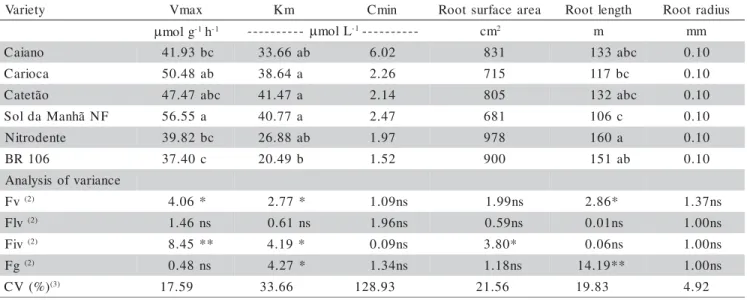
Differences among varieties were observed for the maximal P uptake rate (Vmax), Michaelis-Menten constant (Km) and root length (Table 1). ‘Sol da Manhã NF’ and ‘BR 106’ presented the highest and lowest Vmax, respectively, the other varieties having interme-diate values, not different from each other. Values ob-tained for the Vmax of the maize varieties were very close to those observed by Ciarelli et al. (1998) for maize hy-brids grown in nutrient solution under similar conditions and P concentration. ‘BR 106’ presented the lowest value for the constant Km, followed by ‘Nitrodente’ and ‘Caiano’ (Table 1).
The group of improved varieties had lower aver-age Km (29.38 µmol L-1) as compared to the group of
lo-cal varieties (37.92 µmol L-1). No significant contrast was
observed among local and improved varieties for Vmax and Km parameters. Variations within groups were only observed for the improved varieties, as evidenced by the contrasting behaviour of ‘Sol da Manhã NF’ and ‘BR 106’ (Table 1). Results obtained for the minimal concen-tration (Cmin) did not differ among varieties, probably because of the large variation observed among replicates, resulting in a high coefficient of variation (Table 1).
groups, variation in root surface area was only observed for the improved varieties, pointing out ‘Nitrodente’ with the largest and ‘Sol da Manhã NF’ with the smallest val-ues (Table 1).
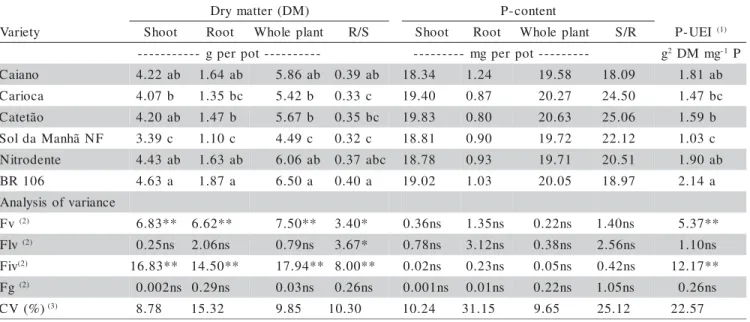
Results related to dry matter yield, P accumula-tion and P utilizaaccumula-tion efficiency are presented in Table 2. Differences among varieties were observed for dry mat-ter yield, dry matmat-ter partition and P utilization efficiency index (EI). ‘BR 106’ and ‘Sol da Manhã NF’ presented the highest and lowest shoot and root dry matter yield, respectively. Local and improved varieties produced simi-lar quantities of shoot and root dry matter. No significant differences were observed between these groups for plant parts or total dry matter yield and root to shoot ratio. Dif-ferences within the groups were observed only for the improved varieties, evidenced by the ‘BR 106’ and ‘Sol da Manhã NF’, contrasting varieties for dry matter yield and shoot/root dry matter partition (Table 2). These ob-servation confirmed previous results obtained by Machado et al. (2001) with the same varieties.
The root to shoot dry matter ratio is one of the characters used to describe the morphology of root sys-tems (Schenk & Barber, 1979a; 1979b). High root/shoot dry matter ratios have been related to a higher suscepti-bility of the plant to P deficiency. Higher values for root/ shoot dry matter ratios have been observed in several genotypes of diferent plant species grown under P-stress conditions, in comparison to those obtained under regu-lar P supply (Föhse et al., 1988; Gill et al., 1992; Fageria & Baligar, 1989). Similar results were obtained with maize varieties used in the present and previous studies
(Machado, 1995; Machado et al., 2001), and may be at-tributed to plant growth inhibition under P deficiency con-ditions that occurs firstly on the aerial part, resulting in an initial relative higher root growth. This plant perfomance may also be attributed to different phenotypic responses to the lower external P availability, being a plant adaptation expression which may provide a higher efficiency of P uptake (Föhse et al., 1988). The higher root/shoot ratios for dry matter yield observed in ‘BR 106’, ‘Caiano’ and ‘Nitrodente’ were also related to large shoots and roots, not meaning that these varieties were more susceptible to P deficiency than the others (Table 2). No differences among varieties were observed for P contents in shoot, root and whole plant, as well as for the P distribution in plant parts, indicating that plants were very similar in relation to their nutritional status under the conditions of this experiment (Table 2).
Differences among varieties were observed for the utilization of the efficiency index (E.I.), whose varia-tion followed the dry matter yield variavaria-tion. Varieties with higher yield - ‘BR 106’, ‘Nitrodente’ and ‘Caiano’ - pre-sented also higher ability to use the P absorbed, and ‘Sol da Manhã NF’ had the lowest E.I. (Table 2). These re-sults confirmed those obtained with ‘Nitrodente’ and ‘BR 106’, when plants were grown in nutrient solution with increasing P concentrations and presented higher E.I. val-ues in comparison to other varieties (Machado et al., 2001). No differences were found between groups for the E.I.values, evidencing that local and improved varieties had similar efficiency for P utilization. Within groups, no differences were observed among local varieties; among
y t e i r a
V Vmax Km Cmin Rootsurfacearea Rootlength Rootradius
µmolg-1h-1 ---------- µmolL-1---------- cm2 m mm
o n a i a
C 41.93bc 33.66ab 6.02 831 133abc 0.10
a c o i r a
C 50.48ab 38.64a 2.26 715 117bc 0.10
o ã t e t a
C 47.47abc 41.47a 2.14 805 132abc 0.10
F N ã h n a M a d l o
S 56.55a 40.77a 2.47 681 106c 0.10
e t n e d o r t i
N 39.82bc 26.88ab 1.97 978 160a 0.10
6 0 1 R
B 37.40c 20.49b 1.52 900 151ab 0.10
e c n a i r a v f o s i s y l a n A
v
F (2) 4.06* 2.77* 1.09ns 1.99ns 2.86* 1.37ns
v l
F (2) 1.46ns 0.61ns 1.96ns 0.59ns 0.01ns 1.00ns
v i
F (2) 8.45** 4.19* 0.09ns 3.80* 0.06ns 1.00ns
g
F (2) 0.48ns 4.27* 1.34ns 1.18ns 14.19** 1.00ns
) % ( V
C (3) 17.59 33.66 128.93 21.56 19.83 4.92
Table 1 - Kinetic parameters(1) of P uptake and root morphological characters of maize varieties grown up to 24 days of age
in nutrient solution (pots with three plants; average of five replications).
Means followed by common letters are not different by Duncan´s test (P = 0.05).
(1)Vmax = maximal P uptake rate (per unit of root dry matter); Km = Michaelis-Menten constant; Cmin = minimal external concentration. (2)Fv = F test for varieties; Flv = F test for local varieties; Fiv = F test for improved varieties; Fg = F test for variety groups; ; ** Statistical
significance at P = 0.01; * Statistical significance at P = 0.05; ns = statistically not significant.
the improved varieties, ‘BR 106’ differed significantly from ‘Sol da Manhã NF’ (Table 2).
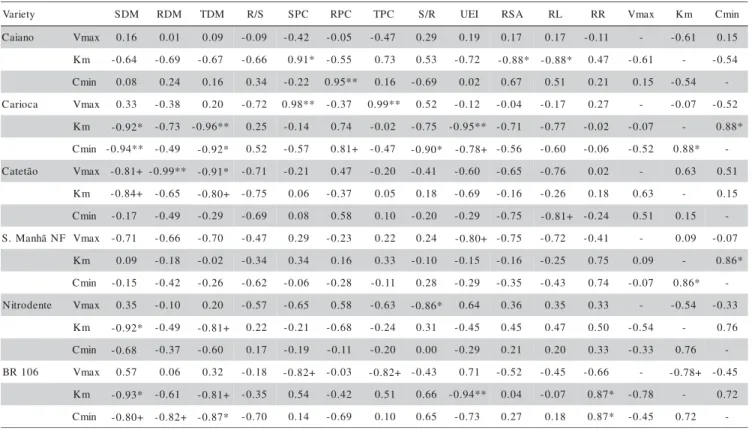
Table 3 presents the correlation coeficients be-tween the kinetic parameters (Vmax, Km and Cmin) and other evaluated characteristics. ‘BR 106’ had a negative correlation between Vmax and Km, evidencing ability of adaptation of its P uptake kinetics to the external avail-able P. Schenk & Barber (1979b) observed positive cor-relations among Vmax, Km and Cmin for five maize genotypes which presented variability for root morpho-logical and physiomorpho-logical characters. In this case, geno-types presented high Vmax, Km and Cmin combinations and were superior under high P conditions, or presented low values for Vmax, Km and Cmin and were superior under low P conditions. None of the genotypes exhibited combinations of high and low values for the kinetic pa-rameters. ‘Carioca’ and ‘Sol da Manhã NF’ presented positive correlations between Km and Cmin, indicating that these varieties presented high values for Km (low af-finity of the carrier sites for Pi) associated to high values for Cmin (minimal concentrations) (Table 3). Some vari-eties showed also negative correlation between Km and dry matter yields of shoot, root, whole plant, and E.I. (Table 3).
‘Sol da Manhã NF’ presented positive correla-tions between surface area, root length and dry matter yield and efficiency index (E.I.). The variety Caiano pre-sented positive correlation only between root length and dry matter yield and E.I. (Table 4).
Baligar & Barber (1979), in a study with several maize genotypes, observed that the genotype with the highest values for Vmax and Km presented the lowest Cmin and root length. The relationships between the P-uptake kinetic parameters and the root dimension char-acters were not uniform for all evaluated genotypes, in accordance to the results found in the present experiment. Anghinoni et al. (1989) evaluated four maize genotypes (‘Save 342’, ‘Agroceres 28’, ‘Pionner Px301’ and ‘Caçador’) and concluded that ‘Caçador’ had favorable characteristics for P uptake because of its high value for Vmax and low value for Cmin. The hybrid Pionner Px301 had high Cmin indicating to be P-inefficient under low P conditions, and ‘Save 342’ presented a short root sys-tem with a restricted action range in the soil.
Theoretically, some authors have suggested that plants which are efficient for nutrient uptake should present high Vmax, which means having high uptake rates under high external concentrations, and low Km and Cmin, which means to be able of taking up the nutrient from di-luted solutions, such as the low fertile soil solutions (Schenk & Barber, 1979b; 1980). Efficient plants should also have an extensive root system, a highly desirable char-acter for selecting genotypes for P uptake efficiency (Nielsen & Barber, 1978; Schenk & Barber, 1979b).
Results obtained with ‘Nitrodente’ and ‘BR 106’ evidenced that these varieties are adapted to low external P conditions because of the characteristics of low Vmax and Km and larger root systems, with longer roots and higher
) M D ( r e t t a m y r
D P-content
y t e i r a
V Shoot Root Whole plant R/S Shoot Root Whole plant S/R P-UEI (1)
-t o p r e p g
-- --- mgper pot--- g2DMmg-1P
o n a i a
C 4.22ab 1.64 ab 5.86ab 0.39ab 18.34 1.24 19.58 18.09 1.81ab
a c o i r a
C 4.07b 1.35 bc 5.42b 0.33c 19.40 0.87 20.27 24.50 1.47bc
o ã t e t a
C 4.20ab 1.47 b 5.67b 0.35bc 19.83 0.80 20.63 25.06 1.59b
F N ã h n a M a d l o
S 3.39c 1.10 c 4.49c 0.32c 18.81 0.90 19.72 22.12 1.03c
e t n e d o r t i
N 4.43ab 1.63 ab 6.06ab 0.37abc 18.78 0.93 19.71 20.51 1.90ab
6 0 1 R
B 4.63a 1.87 a 6.50a 0.40a 19.02 1.03 20.05 18.97 2.14a
e c n a i r a v f o s i s y l a n A v
F (2) 6.83** 6.62** 7.50** 3.40* 0.36ns 1.35ns 0.22ns 1.40ns 5.37**
v l
F (2) 0.25ns 2.06ns 0.79ns 3.67* 0.78ns 3.12ns 0.38ns 2.56ns 1.10ns
v i
F (2) 16.83** 14.50** 17.94** 8.00** 0.02ns 0.23ns 0.05ns 0.42ns 12.17**
g
F (2) 0.002ns 0.29ns 0.03ns 0.26ns 0.001ns 0.01ns 0.22ns 1.05ns 0.26ns
) % ( V
C (3) 8.78 15.32 9.85 10.30 10.24 31.15 9.65 25.12 22.57
Table 2 - Dry matter yield and root/shoot ratio of dry matter (R/S); plant part and total P content, and shoot/root ratio of P-content (S/R); and P-utilization efficiency index of maize varieties grown up to 24 days of age in nutrient solution (pots with three plants; average of five replications).
Means followed by common letters are not different by Duncan´s test (P = 0.05).
(1)P-UEI = phosphorus utilization efficiency index = (unity of dry matter)2/unit P absorbed.
(2)Fv = F test for varieties; Flv = F test for local varieties; Fiv = F test for improved varieties; Fg = F test for variety groups; ** Statistical
significance at P = 0.01; * Statistical significance at P = 0.05; ns = statistically not significant.
surface area, in agreement to the results of Chapin III (1980, 1983) and Furlani (1988). These authors suggest that lower P uptake rates defined by lower Vmax values, might be a character of highly adapted plants to infertile soils. On the other hand, ‘Sol da Manhã NF’ is the vari-ety with the smallest root length and surface area, pre-senting high values for Vmax and Km, suggesting that it might be efficient in P acquisition under high external P conditions.
Total P contents of plants were not different among varieties in this experiment (Table 2), indicating that plants absorbed similar quantities of P. Thereafter, it was inferred from these results that ‘Sol da Manhã NF’ might have its shorter root system compensated by higher Vmax values, accelerating the P uptake kinetics, although this variety also presented a higher Km value, meaning lower afinity of the carrier binding sites for the P ions.
In previous studies (Machado et al., 2001) ‘Sol da Manhã NF’ presented lower total P contents, dry mat-ter yields and P- efficiency indexes, in comparison to the other varieties. However, positive increasing responses were observed as P concentration in nutrient solution also increased (Machado et al., 2001), which evidences the
Table 3 - Simple correlation coefficients (r) between P uptake kinetic parameters(1) and the other evaluated variables(2) in
24-day-old maize varieties grown in nutrient solution (pots with three plants; average of five replications).
(1)Vmax = maximal P uptake rate (per unit of root dry matter); Km = Michaelis-Menten constant; Cmin = minimal external concentration; (2)SDM, RDM, TDM = shoot, root and total dry matter, respectively; R/S = root/shoot DM ratio; SPC, RPC, TPC = shoot, root and total
P content, respectively; S/R = shoot/root P-content ratio; RSA, RL, RR = root surface area, length and radius, respectively; UEI = utilization efficiency index.
** Statistical significance at P = 0.01; * Statistical significance at P = 0.05; + Statistical significance at P = 0.10 using ‘Student t’ test; other values statistically not significant.
hypothesis that this is a P uptake-efficient variety only when external P is not limitant.
In the field, as compared to the other varieties, ‘Sol da Manhã NF’ showed the highest P uptake effi-ciency index (total P in shoots and grains/total P applied as fertilizer), under adequate P level applied to the soil, as compared to other varieties (Machado et al., 2001). However, under low soil P conditions and without P fer-tilization, ‘Sol da Manhã NF’ had the lowest grain yield among the seven maize varieties (within them ‘Caiano’, ‘Catetão’ and ‘Carioca’), although being responsive to P when applications to the soil increased from 8.7 to 140 kg ha-1 (Machado et al., 1999).
‘BR 106’ and ‘Nitrodente’ had higher efficiency for P uptake, higher dry matter yield and higher P-utili-zation efficiency indexes under low and high external P availability, evidencing that these maize varieties are adapted to P deficient or P sufficient conditions. Under adequate external P in the field, BR 106’ and ‘Nitrodente’ had lower P uptake efficiency indexes, but superior P uti-lization efficiency indexes, as compared to ‘Sol da Manhã NF’, evidencing their adaptability to P stress conditions (Machado et al., 2001).
y t e i r a
V SDM RDM TDM R/S SPC RPC TPC S/R UEI RSA RL RR Vmax Km Cmin
o n a i a
C Vmax 0.16 0.01 0.09 -0.09 -0.42 -0.05 -0.47 0.29 0.19 0.17 0.17 -0.11 - -0.61 0.15
m
K -0.64 -0.69 -0.67 -0.66 0.91* -0.55 0.73 0.53 -0.72 -0.88* -0.88* 0.47 -0.61 - -0.54
n i m
C 0.08 0.24 0.16 0.34 -0.22 0.95** 0.16 -0.69 0.02 0.67 0.51 0.21 0.15 -0.54
-a c o i r a
C Vmax 0.33 -0.38 0.20 -0.72 0.98** -0.37 0.99** 0.52 -0.12 -0.04 -0.17 0.27 - -0.07 -0.52
m
K -0.92* -0.73 -0.96** 0.25 -0.14 0.74 -0.02 -0.75 -0.95** -0.71 -0.77 -0.02 -0.07 - 0.88*
n i m
C -0.94** -0.49 -0.92* 0.52 -0.57 0.81+ -0.47 -0.90* -0.78+ -0.56 -0.60 -0.06 -0.52 0.88*
-o ã t e t a
C Vmax -0.81+ -0.99** -0.91* -0.71 -0.21 0.47 -0.20 -0.41 -0.60 -0.65 -0.76 0.02 - 0.63 0.51
m
K -0.84+ -0.65 -0.80+ -0.75 0.06 -0.37 0.05 0.18 -0.69 -0.16 -0.26 0.18 0.63 - 0.15
n i m
C -0.17 -0.49 -0.29 -0.69 0.08 0.58 0.10 -0.20 -0.29 -0.75 -0.81+ -0.24 0.51 0.15
-F N ã h n a M .
S Vmax -0.71 -0.66 -0.70 -0.47 0.29 -0.23 0.22 0.24 -0.80+ -0.75 -0.72 -0.41 - 0.09 -0.07
m
K 0.09 -0.18 -0.02 -0.34 0.34 0.16 0.33 -0.10 -0.15 -0.16 -0.25 0.75 0.09 - 0.86*
n i m
C -0.15 -0.42 -0.26 -0.62 -0.06 -0.28 -0.11 0.28 -0.29 -0.35 -0.43 0.74 -0.07 0.86*
-e t n e d o r t i
N Vmax 0.35 -0.10 0.20 -0.57 -0.65 0.58 -0.63 -0.86* 0.64 0.36 0.35 0.33 - -0.54 -0.33
m
K -0.92* -0.49 -0.81+ 0.22 -0.21 -0.68 -0.24 0.31 -0.45 0.45 0.47 0.50 -0.54 - 0.76
n i m
C -0.68 -0.37 -0.60 0.17 -0.19 -0.11 -0.20 0.00 -0.29 0.21 0.20 0.33 -0.33 0.76
-6 0 1 R
B Vmax 0.57 0.06 0.32 -0.18 -0.82+ -0.03 -0.82+ -0.43 0.71 -0.52 -0.45 -0.66 - -0.78+ -0.45
m
K -0.93* -0.61 -0.81+ -0.35 0.54 -0.42 0.51 0.66 -0.94** 0.04 -0.07 0.87* -0.78 - 0.72
n i m
-y t e i r a
V SDM RDM TDM R/S SPC RPC TPC S/R UEI
o n a i a
C RSA 0.63 0.80+ 0.72 0.83+ -0.84+ 0.79+ -0.56 -0.87* 0.70
L
R 0.79+ 0.91* 0.86* 0.92* -0.90* 0.64 -0.68 -0.78+ 0.85+
R
R 0.96** -0.87* -0.93* -0.79+ 0.67 0.09 0.74 0.13 -0.93*
a c o i r a
C RSA 0.41 0.62 0.50 0.25 -0.13 -0.07 -0.16 0.17 0.56
L
R 0.50 0.90* 0.64 0.36 -0.21 -0.20 -0.27 0.25 0.75
R
R -0.09 -0.44 -0.18 -0.20 0.16 0.23 0.22 -0.12 -0.28
o ã t e t a
C RSA 0.52 0.65 0.58 0.48 -0.39 -0.62 -0.42 0.00 0.67
L
R 0.56 0.75 0.65 0.61 -0.25 -0.65 -0.27 0.13 0.65
R
R 0.16 0.01 0.11 -0.21 -0.82+ -0.23 -0.83+ -0.50 0.52
ã h n a M .
S RSA 0.96** 0.97** 0.98** 0.89* 0.23 0.76 0.35 -0.68 0.96**
L
R 0.93+ 0.97** 0.96** 0.90* 0.24 0.73 0.35 0.65 0.95**
R
R 0.39 0.19 0.31 0.02 -0.19 0.26 -0.12 -0.37 0.32
e t n e d o r t i
N RSA -0.43 -0.24 -0.38 0.03 -0.92* -0.18 -0.93* -0.55 0.44
L
R -0.45 -0.26 -0.40 0.01 -0.91* -0.21 -0.93* -0.52 0.41
R
R -0.44 -0.21 -0.38 0.09 -0.93* -0.11 -0.94* -0.58 0.46
6 0 1 R
B RSA 0.05 0.32 0.20 0.36 0.30 0.31 0.33 -0.10 0.02
L
R 0.17 0.40 0.31 0.41 0.29 0.36 0.31 -0.15 0.11
R
R -0.94** -0.62 -0.82 -0.37 0.20 -0.34 0.18 0.42 -0.73
Table 4 - Simple correlation coefficients (r) between root morphological characters(1) and the other evaluated variables(2) in
24-day-old maize varieties grown in nutrient solution (pots with three plants; average of five replications).
(1)RSA, RL, RR = root surface area, length and radius, respectively.
(2)SDM, RDM, TDM = shoot, root and total dry matter, respectively; R/S = root/shoot DM ratio; SPC, RPC, TPC = shoot, root and total
P content, respectively; S/R = shoot/root P-content ratio; UEI = utilization efficiency index.
** Statistical significance at P = 0.01; *Statistical significance at P = 0.05; + Statistical significance at P = 0.10, by ‘Student´s t’ test; other values, statistically not significant.
Less variation in P uptake kinetic parameters and related P-efficiency characters has been observed for ge-netically more stable and homogeneous genotypes like inbred lines and hybrids of maize and other species. Dif-ferences in these kinetic parameters (Vmax, Km and Cmin) among inbred lines and hybrids have been success-fully correlated to the plant production characteristics, like plant P content, dry matter and grain yield and root dimension characters (Nielsen & Barber, 1978; Nielsen & Schjørring, 1983; Machado, 2000). The nutrient up-take kinetic parameters Vmax, Km and Cmin are impor-tant plant attributes to be considered when looking for efficient genoma, evaluating and selecting genotypes for higher efficiency of P uptake under low or high external P concentrations.
CONCLUSIONS
The maize varieties differed in relation to the P uptake kinetic parameters (Vmax and Km) and to the root length and root / shoot dry matter ratio. ‘BR 106’ and ‘Nitrodente’, adapted varieties to low external P conditions, presented the lowest values for the kinetic parameters, which were good indicators of P-uptake efficiency of maize varieties in this experiment and were related to higher dry matter yield, higher
P-utili-zation efficiency indexes and higher root lengths. The P uptake kinetic parameters Vmax, Km and Cmin ‘per se’ allow the identification of genotypes adapted to low
or high external P availability, but in order to be used as criteria for plant efficiency in P uptake and P utili-zation they need to be correlated to other P efficiency characters.
ACKNOWLEDGEMENTS
To FAPESP and CNPq for financial support.
REFERENCES
ALVES, V.M.C.; NOVAIS, R.F. de; OLIVEIRA, M.F.G. de; SANT’ANNA, R. Cinética e translocação de fósforo em híbridos de milho. Pesquisa Agropecuária Brasileira, v.33, p.1047-1052, 1998.
ANGHINONI, I.; VOLKART, C.R.; FATTORE, N.; ERNANI, P.R. Morfologia de raízes e cinética da absorção de nutrientes em diversas espécies e genótipos de plantas. Revista Brasileira de Ciência do Solo, v.13, p.355-361, 1989.
BALIGAR, V.C.; BARBER, S.A. Genotypic differences of corn for ion uptake. Agronomy Journal, v.71, p.870-873, 1979.
BATAGLIA, O.C.; FURLANI, A.M.C.; TEIXEIRA, J.P.F.; FURLANI, P.R.; GALLO, J.R. Métodos de análise química de plantas. Campinas: Instituto Agronômico, 1983. 48p. (Boletim, 78).
CHAPIN III, F.S. The mineral nutrition of wild plants. Annual Review of Ecology and Systematics,v.11, p.233-260, 1980.
CIARELLI, D.M.; FURLANI, A.M.C.; DECHEN, A.R.; LIMA, M. Genetic variation among maize genotypes for phosphorus-uptake and phosphorus-use efficiency in nutrient solution. Journal of Plant Nutrition, v.21, p.2219-2229, 1998.
FAGERIA, N.K.; BALIGAR, V.C. Response of legumes and cereals to phosphorus in solution culture. Journal of Plant Nutrition, v.12, p.1005-1019, 1989.
FÖHSE, D.; CLAASSEN, N.; JUNGK, A. Phosphorus efficiency of plants. I. External and internal P requirement and P uptake efficiency of different plant species. Plant andSoil, v.110, p.101-109, 1988.
FURLANI, A.M.C. Variações em parâmetros de cinética de absorção de fósforo de três linhagens de arroz. Revista Brasileira de Ciência do Solo, v.12, p.77-80, 1988.
FURLANI, A.M.C.; FURLANI, P.R. Composição e pH de soluções nutritivas para estudos fisiológicos e seleção de plantas em condições nutricionais adversas. Campinas: Instituto Agronômico, 1988. 34p. (Boletim, 121).
FURLANI, A.M.C.; CLARK, R.B.; MARANVILLE, J.W.; ROSS, W.M. Sorghum genotype differences in phosphorus uptake rate and distribution in plant parts. Journal of Plant Nutrition, v.7, p.1113-1126, 1984. GILL, M.A.; SALIM, R.M.; ZIA, M.S. Maize growth and uptake of
phosphate and copper at different ambient phosphate concentrations. Soil Science and Plant Nutrition, v.38, p.631-636, 1992.
JORGE, L.A. de C. Recomendações práticas para aquisição de imagens digitais analisadas através do SIARCS.São Carlos: EMBRAPA,
Instrumentação Agropecuária, 1996. 44p. (Circular Técnica, 1) JUNGK, A.; ASHER, C.J.; EDWARDS, D.G.; MEYER, D. Influence of
phosphate status on phosphate uptake kinetics of maize (Zea mays) and
soybean (Glycine max). Plant and Soil, v.124, p.175-182, 1990. MACHADO, C.T. de T. Avaliação da eficiência de utilização de fósforo de
variedades locais de milho (Zea mays L.) Itaguaí: UFRRJ, 1995. 131p. (Dissertação - Mestrado).
MACHADO, C.T. de T. Caracterização de genótipos de milho quanto a parâmetros morfológicos, fisiológicos e microbiológicos associados à eficiência de absorção e uso de fósforo.Seropédica: UFRRJ, 2000. 365p. (Tese - Doutorado).
Received October 11, 2002 Accepted October 23, 2003
MACHADO, C.T. de T.; FURLANI, A.M.C.; MACHADO, A.T. Índices de eficiência de variedades locais e melhoradas de milho ao fósforo. Bragantia, v.60, p.225-238, 2001.
MACHADO, C.T. de T.; GUERRA, J.G.M.; ALMEIDA, D.L. de; MACHADO, A.T. Variabilidade entre genótipos de milho para eficiência no uso de fósforo. Bragantia, v.58, p.109-124, 1999.
MARSCHNER, H. Mineral nutrition of higher plants. London: Academic Press, 1995. 889p.
MURPHY, J.; RILEY, J.P. A modified single solution method for determination of phosphate in natural waters. Analytica Chimica Acta,
v.27, p.31-36, 1962.
NIELSEN, N.E.; BARBER, S.A. Differences among genotypes of corn in the kinetics of P uptake. Agronomy Journal, v.70, p.695-698, 1978.
NIELSEN, N.E.; SCHJØRRING, J.K. Efficiency and kinetics of phosphorus uptake from soil by various barley genotypes. Plant and Soil, v.72,
p.225-230, 1983.
ROSSIELLO, R.O.P.; ARAÚJO, A.P.; MANZATTO, C.V.; FERNANDES, M.S. Comparação dos métodos fotoelétrico e da interseção na determinação de área, comprimento e raio médio radicular. Pesquisa Agropecuária Brasileira, v.30, p.633-638, 1995.
RUIZ, H.A. Estimativa dos parâmetros cinéticos Km e Vmax por uma aproximação gráfico-matemática. Revista Ceres, v.32, p.79-84, 1985. SCHENK, M.K.; BARBER, S.A. Root characteristics of corn genotypes as
related to P uptake. Agronomy Journal, v.71, p.921-924, 1979a. SCHENK, M.K.; BARBER, S.A. Root characteristics of corn genotypes as
related to P uptake. Agronomy Journal, v.71, p.921-924, 1979b. SCHENK, M.K. ; BARBER, S.A. Potassium and phosphorus uptake by
corn genotypes grown in the field as influenced by root characteristics. Plant and Soil, v.54, p.65-76, 1980.