UNIVERSIDADE DO ALGARVE
Radio over fiber broadband access networks
architectures based on wavelength division
multiplexing techniques
(Arquiteturas de redes de acesso de banda larga para redes rádio sobre fibra baseadas em técnicas de multiplexagem de comprimento de onda)
Ricardo Pedro Custodinho da Avó
Tese
Doutoramento em Engenharia Eletrónica e Telecomunicações Especialidade em Telecomunicações e Redes
Trabalho efetuado sob a orientação de:
Professora Doutora Maria do Carmo Raposo de Medeiros
UNIVERSIDADE DO ALGARVE
Radio over fiber broadband access networks
architectures based on wavelength division multiplexing
techniques
(Arquiteturas de redes de acesso de banda larga para redes rádio sobre fibra baseadas em técnicas de multiplexagem de comprimento de onda)
Ricardo Pedro Custodinho da Avó
Tese
Doutoramento em Engenharia Eletrónica e Telecomunicações Especialidade em Telecomunicações e Redes
Trabalho efetuado sob a orientação de:
Professora Doutora Maria do Carmo Raposo de Medeiros
Declaração de autoria de trabalho
“Radio over fiber broadband access networks architectures based on wavelength division multiplexing techniques”
Declaro ser o autor deste trabalho, que é original e inédito. Autores e trabalhos consultados estão devidamente citados no texto e constam da listagem de referências incluída.
(Ricardo Pedro Custodinho da Avó)
Copyright
A Universidade do Algarve tem o direito perpétuo e sem limites geográficos, de arquivar e publicitar este trabalho através de exemplares impressos reproduzidos em papel ou de forma digital, ou por qualquer outro meio conhecido ou que venha a ser inventado, de o divulgar através de repositórios científicos e de admitir a sua cópia e distribuição com objetivos educacionais ou de investigação, não comerciais, desde que seja dado crédito ao autor e editor.
Acknowledgments
I would like to express my sincere gratitude to my supervisor Professor Maria do Carmo Raposo de Medeiros, for accepting me as her student and for introducing me to the research area of radio over fiber networks. Professor Carmo has always been a very supportive supervisor, available for fruitful discussions and exchanges of ideas.
I want to thank my research center, CEOT, for the access to the laboratory and computing equipment. I am also grateful to FCT, the Portuguese Foundation for Science and Technology, for funding my work with the PhD grand (SFRH/BD/29138/2006) and research projects within CEOT.
I would like to give a special thanks to my former lab colleague, Mark Guerreiro for all his support, particularly with the laboratory work, especially on the test of devices and the never ending search for reflections on the optical connections.
I would also like to thank all my current and former research colleagues from CEOT, in particular José, Paulo, Hélio, Professor Álvaro Barradas and Professor Paula Laurêncio for their enthusiasm and fruitful discussions at CEOT.
Finally, my sincere gratitude to all my family, for all their support and their extreme patience.
Abstract
The recent remarkable growth in bandwidth of both wired optical and wireless access networks supports a burst of new high bandwidth Internet applications such as: peer-to-peer file sharing, cloud storage, on-line gaming, video streaming, etc. Within this scenario, the convergence of fixed and wireless access networks offers significant opportunities for network operators to satisfy user demands, and simultaneously reduce the cost of implementing and running separated wireless and wired networks.
The integration of wired and wireless network can be accomplished within several scenarios and at several levels. In this thesis we will focus on converged radio over fiber architectures, particularly on two application scenarios: converged optical 60 GHz wireless networks and wireless overlay backhauling over bidirectional colorless wavelength division multiplexing passive optical networks (WDM-PONs).
In the first application scenario, optical 60 GHz signal generation using external modulation of an optical carrier by means of lithium niobate (LiNbO3) Mach- Zehnder
modulators (MZM) is considered. The performance of different optical modulation techniques, robust against fiber dispersion is assessed and dispersion mitigation strategies are identified. The study is extended to 60 GHz carriers digitally modulated with data and to systems employing subcarrier multiplexed (SCM) mm-wave channels.
In the second application scenario, the performance of WDM-PONs employing reflective semiconductor optical amplifiers (RSOAs), transmitting an overlay orthogonal frequency-division multiplexing (OFDM) wireless signal is assessed analytically and experimentally, with the relevant system impairments being identified. It is demonstrated that the intermodulation due to the beating of the baseband signal and wireless signal at the receiver can seriously impair the wireless channel. Performance degradation of the wireless channel caused by the RSOA gain modulation owing to the downstream baseband data is also assessed, and system design guidelines are provided.
Keywords: (4 a 6)
Wavelength-division-multiplexed passive optical network (WDM-PON), Broadband access networks, Wireless backhauling, Radio-over-fiber, 60 GHz radio over fiber.
Resumo
As redes óticas estão-se a tornar muito populares como redes de acesso, isto é, o último troço que liga a rede do operador às instalações do cliente. Os operadores incumbentes que baseiam as suas redes de acesso em pares de cobre, as chamadas linhas telefónicas, estão ativamente a estudar a instalação em massa de redes óticas como novo método de acesso. A tendência, na Europa e Estados Unidos da América, tem sido a instalação de redes óticas passivas partilhadas por vários utilizadores, através da técnica de multiplexagem no tempo.
Tal como outras tecnologias, as redes óticas estão em constante evolução. Já existem novas versões em desenvolvimento e entre elas uma das hipóteses é converter o método de partilha do meio, de multiplexagem no tempo para multiplexagem de comprimento de onda. Caso sejam atribuídos comprimentos de onda dedicados por utilizador isto possibilitaria aumentos na largura de banda por utilizador de aproximadamente 32 vezes com tecnologia atual, rede ótica passiva gigabit - gigabit
passive optical network (GPON), e de 128 vezes com o que se espera ser o sucessor,
ainda baseado em multiplexagem no tempo, 10GPON.
Mas enquanto as redes de acesso óticas permitem levar grandes larguras de banda até casas e escritórios, os clientes finais ficam limitados a uma utilização fixa dentro das suas instalações, porque as tecnologias sem fios atuais têm dificuldade ou simplesmente não conseguem fornecer largura de banda suficiente para tirar partido completo do serviço. Para tal é necessário desenvolver novos padrões para redes sem fios que, em princípio, terão que utilizar partes do espectro radio elétrico ainda pouco utilizado. Uma banda que se encontra em estudo para responder a este desafio é a banda milimétrica, nomeadamente os 60 GHz. Esta banda tem disponível uma quantidade de espectro disponível considerável, por exemplo 9 GHz na Europa. Além de ser definida como livre de licenciamento em muitas regiões do mundo, por exemplo Europa, Estados Unidos da América, Japão e Coreia do Sul.
Esta tese estuda a transmissão de ondas milimétricas de forma transparente através de fibra ótica, propondo uma arquitetura utilizando um amplificador ótico semicondutor refletivo – reflective semiconductor optical amplifier (RSOA) como a fonte ótica nos nós remotos da rede. Este estudo está dividido em duas partes.
Resumo
A primeira parte é o estudo por simulação da transmissão ótica de ondas milimétricas da estação central até ao nó remoto. O foco deste estudo é colocado na dispersão cromática da fibra e na intermodulação entre os vários canais de radio, utilizando-se quatro modulações óticas geradas através de um modelador do tipo Mach-Zehnder.
O problema da dispersão cromática é particularmente relevante na transmissão de sinais de elevada rádio frequência (RF). Ao modular um sinal deste tipo com a modulação tradicional de banda lateral dupla – optical double side band (ODSB) iremos ter, pelo menos três componentes óticos. A portadora ótica numa determinado comprimento de onda (λ), e as duas bandas laterais do sinal a enviar, centradas em λ + comprimento de onda do sinal RF (λRF) e em λ - λRF. O recetor ótico considerado nesta tese é um recetor de
deteção direta. Ou seja, um sinal ODSB detetado no recetor como um batimento entre λ e o sinal em λ +λRF, resultando num sinal localizado em RF, o batimento entre λ e o sinal
em λ - λRF resultando num sinal em RF, e o batimento entre as duas bandas laterais
inferior e superior, resultando num sinal localizado no dobro da frequência original. Esta última componente é normalmente ignorada pois a largura de banda do recetor ótico é escolhida com base na frequência do sinal que interessa receber. Os outros dois sinais irão somar-se e gerar apenas um sinal elétrico. O conceito de dispersão cromática vem do facto que a velocidade de propagação de um sinal ótico depende do seu comprimento de onda. Ao trabalhar com sinais da ordem dos 60 GHz, a diferença na velocidade de propagação irá fazer que com suficiente comprimento de fibra, os dois sinais RF, irão chegar ao recetor com fases diferentes. O sinal resultante da soma das duas componentes irá fazer com que haja efeitos construtivos ou destrutivos conforme a distância percorrida. Uma das possíveis soluções para evitar o problema, será usar uma modulação que apenas gere uma componente RF, para que ao chegar ao recetor ótico, seja apenas detetado um sinal. Por exemplo a modulação ótica de banda lateral única - optical single side band (OSSB). As modulações estudadas nesta tese são a clássica modulação ODSB, a modulação OSSB e duas variantes desta última. As variantes são: banda lateral única com filtragem (F-OSSB) por forma a ter apenas a transmissão da portadora ótica e harmónica fundamental; a segunda variante consiste em utilizar apenas a harmónica fundamental e reintroduzir a portadora ótica antes da modulação do sinal elétrico, obtendo desta forma um sinal OSSB puro (P-OSSB). Estas duas modulações permitem identificar as causas da degradação do sinal OSSB gerado pelo MZM, quando aplicadas profundidades de modulação altas.
Resumo A segunda parte é a demonstração da transmissão bidirecional experimental de um sinal rádio, utilizando o padrão 802.11g nos 2.4 GHz, em conjunto com um sinal de banda base com 1 gigabit por segundo utilizando para tal um RSOA com uma largura de banda de 1.2 GHz sem recorrer a frequências intermédias. É estudado o impacto que a largura da banda do sinal banda base tem no sistema, assim como o nível de potência ótica que chega ao RSOA e a sua corrente de polarização.
O trabalho aqui apresentado tem como objetivo indicar um conjunto de regras sobre que modulações óticas utilizar, o seu comportamento em relação à profundidade de modulação para transmissão de sinais rádio na banda milimétrica. Também é demonstrado que o RSOA pode ser utilizado como fonte ótica nos nós remotos, utilizando para tal o dobro da largura de banda especificada pelo fabricante. Potenciando o seu uso com os sinais milimétricos quando os mesmos forem passados para frequências intermédias. Numa aplicação mais direta, a arquitetura apresentada nesta experiencia permite expandir o uso das redes óticas passivas. Já que poderão ser colocados sinais rádios gerados numa estação central utilizando os diversos padrões atuais, GSM, UMTS, LTE, e transmitindo-os de forma transparente para nós remotos. Nós remotos que poderão ser muito mais simples e de reduzida dimensão, pois apenas necessitarão de filtros, amplificadores e antenas. Dispensando todos os componentes de geração de sinal e gestão a nível lógico, que serão colocadas na estação central.
Palavras-chave: 4 a 6
Rede ótica passiva com multiplexagem de comprimentos de onda (WDM-PON), Redes de acesso de banda larga, Alimentação de estações-base sem fios, Radio sobre fibra, 60 GHz sobre fibra.
Table of contents
Declaração de autoria de trabalho ... v
Acknowledgments... vii
Abstract ... ix
Resumo ... xi
List of figures ... xix
List of tables ... xxiii
Acronyms ... xxv
1 Introduction ... 1
1.1 Context ... 1
1.2 Motivation and objectives ... 4
1.3 Thesis outline ... 6
1.4 Main contributions ... 7
1.5 References ... 11
2 Optical access networks ... 13
2.1 Introduction ... 13
2.2 PON evolution motivation ... 14
2.3 PON architectures ... 16 2.4 P2MP evolution ... 18 2.4.1 BPON ... 18 2.4.2 EPON ... 19 2.4.3 10EPON ... 19 2.4.4 G-PON ... 19
2.4.5 Portuguese PON landmarks ... 20
Table of contents
2.5 WDM based PONs ... 23
2.5.1 WDM-PON employing RSOAs ... 26
2.6 Summary ... 28
2.7 References ... 30
3 Converged optical-60 GHz wireless networks ... 33
3.1 Introduction ... 33
3.2 60 GHz wireless networks state of the art ... 35
3.3 Radio over fiber ... 37
3.4 60 GHz wireless-optical network application scenarios ... 39
3.5 Techniques for generating and transporting radio signals over optical fiber ………..40
3.5.1 Optical Mach-Zehnder modulator model ... 40
3.5.2 Optical double side band modulation ... 41
3.5.3 Optical single side band modulation ... 42
3.5.4 Optical carrier suppression modulation... 45
3.5.5 60 GHz generation by up-conversion strategies ... 47
3.6 Optical fiber dispersion effects on radio over fiber systems... 47
3.7 Dispersion effects mitigation strategies ... 51
3.7.1 Dispersion robustness characteristics of OSSB modulation ... 51
3.8 Summary ... 52
3.9 References ... 53
4 Transmission performance assessment of 60 GHz RoF systems ... 57
4.1 Introduction ... 57
4.1.1 Simulation model description ... 58
4.1.2 Simulation environment ... 60
4.2 Transmission limitations of OSSB modulation with data ... 60
Table of contents
4.2.2 Impact of the modulation depth on BER for 0 km ... 64
4.2.3 BER versus modulation depth for 14 km ... 67
4.2.4 BER versus optical fiber length ... 69
4.3 Performance comparison between OSSB and OCS ... 71
4.3.1 Results and discussion ... 72
4.4 The effect of the finite extinction ratio of MZMs ... 73
4.4.1 Performance assessment in presence of data ... 75
4.4.2 The effect of the optical amplifier noise ... 77
4.5 Subcarrier multiplexed channel transmission using OSSB ... 78
4.5.1 The effect of intermodulation distortion ... 79
4.5.2 Results and discussion ... 80
4.5.3 BER versus modulation depth ... 80
4.5.4 BER versus receiver sensitivity... 81
4.5.5 BER versus optical fiber length ... 83
4.6 Summary ... 85
4.7 References ... 86
5 Wireless overlay backhauling over bidirectional colorless WDM-PONs ... 87
5.1 Introduction ... 87
5.2 Motivation ... 88
5.3 IEEE 802.11 ... 89
5.3.1 Medium access ... 91
5.4 System architecture and experimental setup ... 93
5.4.1 Methodology ... 96
5.4.2 Performance evaluation ... 97
5.4.3 Reference values ... 98
5.4.4 System transfer function and RSOA characteristics ... 99
Table of contents
5.5.1 BB on the downlink... 101
5.5.2 BB on the uplink ... 104
5.6 System performance versus baseband bit rate ... 105
5.6.1 BB on the downlink... 105
5.6.2 Intermodulation analysis ... 105
5.6.3 BB on the uplink ... 110
5.7 System performance versus RSOA bias current ... 112
5.7.1 BB on the downlink... 112
5.7.2 BB on the uplink ... 113
5.8 System performance versus optical power at the input of the RSOA ... 114
5.8.1 BB on the downlink... 114
5.8.2 BB on the uplink ... 117
5.9 Bidirectional wireless transmission performance versus fiber length ... 120
5.10 Summary ... 121
5.11 References ... 122
6 Conclusions and future work ... 123
6.1 Summary and conclusions ... 123
6.2 Future work ... 126
Appendix A – System architecture ... 129
List of figures
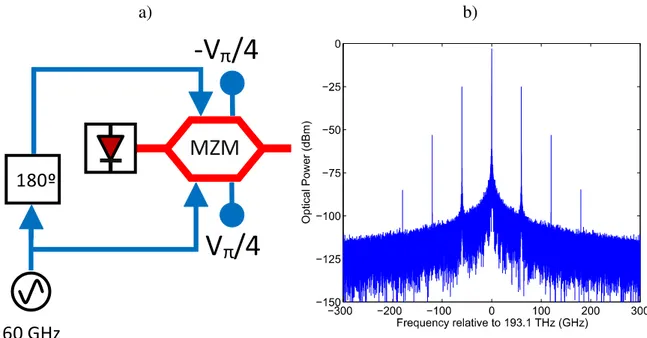
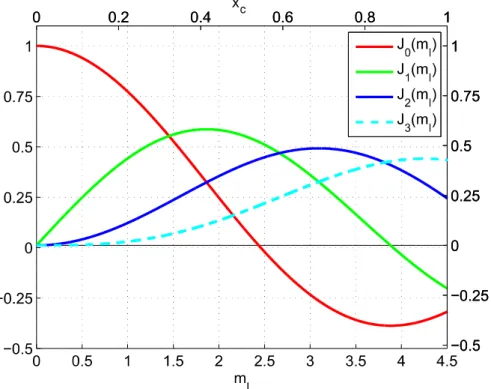
Figure 2.1 - Line rate performance as function of line length for ADSL, ADSL2, ADSL2+ and VDSL, based on [2.3, 2.4]. ... 16 Figure 2.2 - a) Point-to-point architecture. b) Point-to-multipoint network architecture. . 17 Figure 2.3 - Wavelength allocation in nm for G-PON and XG-PON1, based on [2.36]. .. 23 Figure 2.4 - Generic WDM-PON architecture. (OLT – optical line terminal; ONT – optical network terminal; DL – downlink; UL – uplink – λ wavelength) ... 24 Figure 2.5 - Generic WDM-PON with RSOA architecture (OLT – optical line terminal; ONT – optical network terminal; DL – downlink; UL – uplink – λ wavelength, OS - optical source, MZ – Mach-Zehnder modulator, AWG - arrayed waveguide grating, PD – photodetector, RSOA – reflective semiconductor optical amplifier). ... 27 Figure 2.6 - Possible evolution paths for the two most used standards families. ... 29 Figure 3.1 - Atmospheric attenuation at sea level with 20º C temperature, based on [3.14, 3.15]. ... 38 Figure 3.2 - a) MZM with ODSB configuration; b) ODSB spectrum at the MZM output. ... 42 Figure 3.3 - a) MZM with OSSB configuration; b) OSSB signal at the MZM output. ... 43 Figure 3.4 - a) MZM with OCS configuration; b) OCS signal at the MZM output. ... 46 Figure 3.5 - First kind Bessel function for several orders in function of mI and the
corresponding xc. ... 50
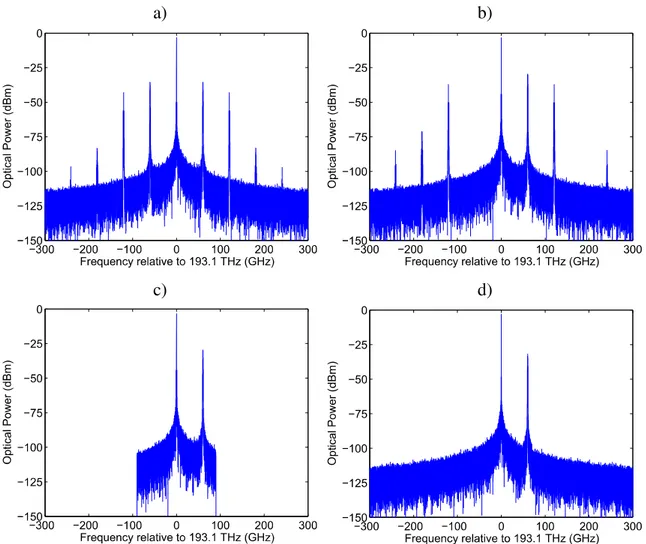
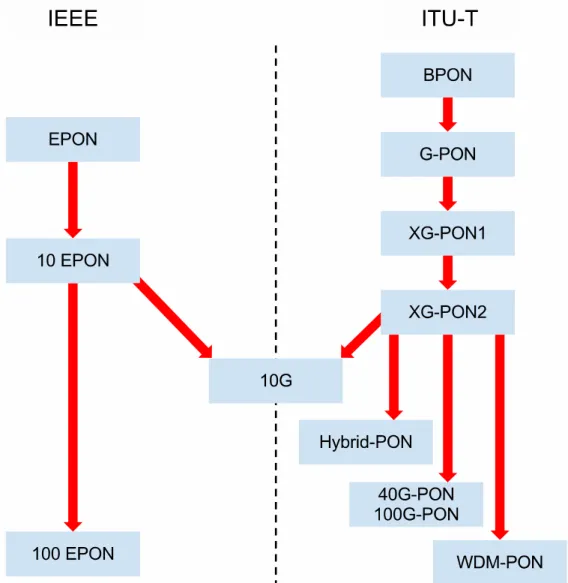
Figure 3.6 - Normalized received optical power for an ideal optical system employing ODSB. Three RF carrier frequencies are considered, 20 GHz, 40 GHz and 60 GHz. ... 50 Figure 3.7 - Normalized received power for: a) OSSB modulation b) OCS modulation. (power normalized to the received power at a fiber length of 0 km) ... 52 Figure 4.1 - Network schematic overview. ... 59 Figure 4.2 - OSSB spectrum for a 60 GHz RF signal a) without data b) with data... 61 Figure 4.3 - Spectrum at output of optical modulator for a) ODSB; b) OSSB; c) F-OSSB; d) P-OSSB. ... 62 Figure 4.4 - BER versus modulation factor xc for the 4 optical modulations with a single
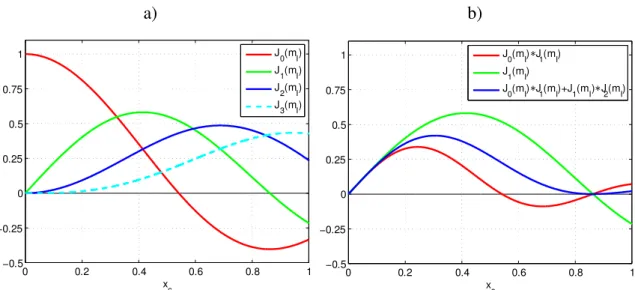
List of figures
Figure 4.5 - First kind Bessel function a) for the first 4 orders b) considering some of the
optical beatings at the receiver. ... 64
Figure 4.6 - BER in function of received optical power in a back-to-back configuration, for several xcwith a single channel. ... 65
Figure 4.7 - System sensitivity for a fiber length of 0 km with a single channel. ... 66
Figure 4.8 - BER in function of received optical power with 14 km of fiber, for several xc valueswith a single channel. ... 68
Figure 4.9 - System sensitivity for a fiber length of 14 km with a single channel. ... 69
Figure 4.10 - BER in function of fiber length, for several xc with a single channel. ... 70
Figure 4.11 - BER versus modulation depth considering fiber lengths from 0 km to 80 km. a) OSSB. b) OCS. ... 73
Figure 4.12 - Optical power spectra at the dual-arm MZM considering a modulation depth xc=0.2, OCS and OSSB modulation are considered. a) OCS, rps=0.5; b) OCS, rps=0.48; c) OSSB, rps=0.5; d) OSSB, rps=0.48 . ... 75
Figure 4.13 - BER versus fiber length with xc = 0.2 for a) OCS modulation b) OSSB modulation. ... 76
Figure 4.14 - BER versus power splitting ratio rps considering different fiber lengths for a) OCS modulation b) OSSB modulation. ... 77
Figure 4.15 - a) BER versus modulation depth considering different amplifier noise figures for OCS modulation; b) BER versus modulation depth without amplifier and for two fiber lengths. ... 78
Figure 4.16 - BER versus modulation depth factor xc for the 4 optical modulations schemes with four channels. ... 81
Figure 4.17 - BER in function of received optical power in a back-to-back configuration, for several xc with a four channels. ... 82
Figure 4.18 - System sensitivity for a fiber length of 0 km with four channels. ... 83
Figure 4.19 - BER in function of fiber length, for several xc with four channels. ... 84
Figure 5.1 - 802.11 2.4 GHz channel map. ... 91
Figure 5.2 - Hidden node problem. ... 92
Figure 5.3 - Complete system schematic. ... 94
Figure 5.4 - Downlink schematic. ... 95
Figure 5.5 - Uplink schematic. ... 95
Figure 5.6 - AIDA32 network benchmark screenshot. ... 98
List of figures
Figure 5.8 - RSOA gain versus input power for different bias currents. ... 100
Figure 5.9 - RSOA gain versus current, considering different input optical powers, Pin = -7 dBm, Pin = -10 dBm, Pin = -13, dBm, Pin = -15 dBm and Pin = -17 dBm. ... 101
Figure 5.10 - System performance versus band base signal amplitude. ... 102
Figure 5.11 - Electric absorption modulator output power as function of band base signal amplitude... 103
Figure 5.12 - Third order intermodulation distortion in function of band base signal amplitude, measured at 1.99 GHz. ... 103
Figure 5.13 - System performance versus baseband signal voltage amplitude. ... 104
Figure 5.14 - System performance versus baseband bit rate. ... 105
Figure 5.15 - Illustrative power spectral density resulting from the beating of the baseband and wireless signals. ... 108
Figure 5.16 - Electrical spectrum at the base station photodetector for a) 100 Mbit/s baseband signal b) 2 Gbit/s baseband signal... 108
Figure 5.17 - Electrical spectrum at the base station photodetector in the wireless band for a) 100 Mbit/s baseband signal b) 2 Gbit/s baseband signal. ... 109
Figure 5.18 - System performance versus baseband bit rate. ... 110
Figure 5.19 - Electrical spectrum at the central office photodetector in the wireless band for a) 100 Mbit/s baseband signal b) 2 Gbit/s baseband signal. ... 111
Figure 5.20 - System performance versus RSOA bias current. ... 112
Figure 5.21 - Optical coupler connections diagram. ... 113
Figure 5.22 - System performance versus RSOA bias current. ... 114
Figure 5.23 - Measured back reflected signal at the CO, considering different levels of optical power injected into the RSOA. ... 115
Figure 5.24 - RF spectra corresponding to the signals depicted in Figure 5.23. ... 116
Figure 5.25 - System performance versus RSOA input power, baseband on the downlink. ... 116
Figure 5.26 - System performance versus RSOA input power, baseband on the uplink. 118 Figure 5.27 - Wireless data rate versus averaged power at the RSOA input for back-to-back and 11 km of fiber. ... 120
List of tables
Table 2.1 - Optical access networks landmarks. ... 21 Table 3.1 - 60 GHz main standardization efforts [3.3-3.8]. ... 36 Table 5.1 - Selected IEEE 802 standards. ... 90 Table 5.2 - IEEE 802 lower OSI layers. ... 91 Table 5.3 - Reference wireless data rates. ... 99 Table 5.4 - Configuration parameters for bidirectional wireless and baseband
Acronyms
ADC Analog-to-Digital Converter
ADSL Asymmetric Digital Subscriber Line
AM Amplitude Modulation
AP Access Point (wireless)
APON ATM Passive Optical Network
ASK Amplitude Shift Keying
ATM Asynchronous Transfer Mode
AWG Arrayed Waveguide Gratings
BB Band Base
BER Bit Error Rate
BLS Broadband Light Sources
BPON Broadband Passive Optical Network BPSK Binary Phase Shift Keying
BS Base Station
B-t-B Back-to-Back
CAPEX CAPital EXpenditures
CDWM Coarse Wavelength Division Multiplexing CMOS Complementary Metal–Oxide–Semiconductor
CO Central Office
CPRI Common Public Radio Interface
CSMA/CA Carrier Sense Multiple Access with Collision Avoidance
CTS Clear To Send
CW Continuous Wave
DAC Digital-to-Analog Converter
DD Direct Detection
DFB Distributed FeedBack (laser)
DL DownLink
DOCSIS Data Over Cable Service Interface Specification DSL Digital Subscriber Line
Acronyms
DSSS Direct-Sequence Spread Spectrum DWDM Dense Wavelength Division Multiplexing EAM Electro-Absorption Modulator
EDFA Erbium Doped Fiber Amplifier EPON Ethernet Passive Optical Network FDMA Frequency Division Multiple Access FEC Forward Error Correction
FM Frequency Modulation
F-OSSB Filtered Optical Single Side Band FHSS Frequency Hopping Spread Spectrum FTTB Fiber-To-The-Building
FTTC Fiber-To-The-Curb
FTTH Fiber-To-The-Home
FTTx Fiber-To-The-x
GEM Gigabit-capable passive optical network Encapsulation Mode GE-PON Gigabit Ethernet Passive Optical Network
G-PON Gigabit-capable Passive Optical Network GPS Global Positioning System
GSM Global System for Mobile communications GVD Group Velocity Dispersion
HD High Definition
HDMI High-Definition Multimedia Interface HDTV High Definition TeleVision
Hi-Fi High Fidelity (home stereo)
HS/DSSS High Speed Direct-Sequence Spread Spectrum HSPA High Speed Packet Access
IEEE Institute of Electrical and Electronics Engineers
IF Intermediate Frequency
IM Intensity Modulation
IMD3 Third order InterModulation Distortion
IPTV Internet Protocol TeleVision
IR InfraRed
Acronyms ITU-T Telecommunication standardization sector for the International
Telecommunication Union
LAN Local Area Network
LDPC Low-Density Parity-check Code LiNbO3 Lithium Niobate
LLC Logical Link Control
LPF Low Pass Filter
LTE Long Term Evolution
LTE-A Long Term Evolution Advanced
MAC Media Access Control
MC Multi Carrier
mI Modulation Index
MIMO Multiple Input Multiple Output
MZM Mach-Zehnder Modulator
NEXT Near End crossTalk
NF Noise Figure
NG-PON Next Generation Passive Optical Network
NRZ Non Return to Zero
OBSAI Open Base Station Architecture Initiative OCDMA Optical Code-Division-Multiple-Access OCS Optical Carrier Suppression
ODN Optical Distribution Network ODSB Optical Double Side Band
OFDM Orthogonal Frequency Division Multiplexing
OLT Optical Line Terminal
ONT Optical Network Terminal
O-OFDM Optical Orthogonal Frequency Division Multiplexing
OOK On-Off Keying
OPEX OPerational EXpenditures OSSB Optical Single Side Band P2MP Point-to-Multi-Point
P2P Point-to-Point
Acronyms
PM Phase Modulator
PON Passive Optical Network P-OSSB Pure Optical Single Side Band POTS Plain Old Telephone Service QAM Quadrature Amplitude Modulation QPSK Quadrature Phase Shift Keying
RF Radio Frequency
RIN Relative Intensity Noise
RN Remote Node
RoF Radio over Fiber
RSOA Reflective Semiconductor Optical Amplifier
RTS Request To Send
SC Single Carrier
SCM SubCarrier Multiplexing
SMF Single Mode Fiber
SNR Signal to Noise Ratio
SOA Semiconductor Optical Amplifier TDM Time Division Multiplexing TDMA Time Division Multiple Access
UL UpLink
VOA Variable Optical Attenuator
VoD Video on Demand
WDM Wavelength Division Multiplexing
WDM-PON Wavelength Division Multiplexed Passive Optical Network WiMAX Worldwide Interoperability for Microwave Access
WLAN Wireless Local Area Network
WMAN Wireless Metropolitan Area Network WPAN Wireless Personal Area Network WWAN Wireless Wide Area Network
xc modulation depth
1
Introduction
1.1
Context
Telecommunication technologies are one of the most exciting markets to work in. It is impressive to analyze its remarkable growth and innovation, for example, the percentage of worldwide mobile-cellular telephone subscriptions has grown from around 18% to 85.7% in the last ten years [1.1], and extra grown is still forecasted for the near future.
Telecommunication technologies have come a long way before providing Gbit/s on wired connections or hundred of megabits on wireless connections. In the wired communications three main transmission medium technologies can be identified, namely: the copper twisted-pair, the coaxial cable and the optical fiber. The twisted-pair traditionally was deployed to support the plain old telephone (POTS) services using a mere 4 kHz of bandwidth, however nowadays it also supports well established digital
Chapter 1 - Introduction
subscriber lines (DSL). Typically, DSL connections work by dividing the frequencies used in a single telephone line into two transmission bands, the data is transmitted over the high frequency band (25 kHz and above) whereas the voice is transmitted over the lower frequency band (4 kHz and below). The second transmission medium is the coaxial cable, initially used to connect one or more external antennas to TV receivers. Each cable transporting tens of analog television channels, each channel using 6 to 8 MHz of bandwidth. In some regions of the world, notably the US, local cable networks started to appear, mainly in areas where the broadcast signal were difficult to acquire in each individual home. A collective antenna was then installed in a privileged location with access to the signal, and a coaxial cable network used to distribute the signal to each individual home. It was the beginning of the cable companies. Nowadays, cable networks also provide cable modem-based services.
However, both the twisted-pair and coaxial cable are not able to provide the necessary bandwidth required to support the ever-increasing video-based applications. To overcome this limitation, it is essential to use single mode fiber (SMF) as the transmission media in future access networks. SMF provides essentially infinite bandwidth and very small attenuation when compared with copper pairs and coaxial cables. Due to the system cost, optical fiber cables were primarily deployed in the backbone network where high bandwidth was necessary.
On the wireless front no new means of transmission was developed, it always relies on air transmission1. However, the demand for higher bandwidth was accomplished mainly by the use of modulation schemes. Wireless communications started with the wireless telegraphy where virtually no bandwidth was necessary, a continuous waveform was switched on and off to represent the Morse code symbols. Shortly after, voice radio was developed, having in mind mainly military and marine applications. Commercial applications were initiated afterwards, among them radio broadcast technology that stills being used nowadays. Roughly, after 100 years of the amplitude modulated (AM) radio invention one can still find it on most high fidelity (Hi-Fi) equipment or car radios. AM radio uses less than 10 kHz of bandwidth with a frequency under 2 MHz (except for short wave, which can broadcast at up to 26 MHz). Audio communications continued to be the main focus, with the development of frequency modulated (FM) radio. Using a different modulation scheme, the system resistance to noise interference was improved; it also used
1 Communications based on light transmission on free space, such as IR communications, were ignored for the sake of simplification.
Chapter 1 - Introduction higher bandwidths, improving the audio quality. Later came the television broadcast with 6 to 8 MHz bandwidth and transmitting in frequencies from 50 MHz to near 900 MHz. On the bidirectional wireless communications, the 80s saw the invention of the mobile phone. Up to that point several entities could use wireless communications, but were mainly used by military, public safety, amateur radio operators and very specific business users. The 90s saw the development of the digital mobile phone, wireless communications would never be the same. Several standards were developed, but only one could claim a worldwide success, the currently used global system for mobile communications (GSM) standard. The mobile phone benefited greatly from the developments in the semi-conductor industry, enabling smaller, cheaper devices, with more autonomy and more functionalities. This allowed the mobile phone to reach mass market. In recent years, the mobile phone has evolved from a voice calling machine to the currently multimedia device. From using 100 kHz bandwidth to, up to 20 MHz in the latest commercial technology, long term evolution (LTE).
The capacity increase of wireless networks also meant the need of higher capacity connections between base stations and the core network, thus the upgrade of the backhaul network. To cope with the need of high capacity connections wireless operators have even been forced to deploy fiber to connect their sites, but the technology used is not tailored for the transport of wireless signals. The present scenario is that optical fiber moved from strictly long haul and backbone connections to the backhaul of regional and local telephone exchanges and wireless base stations. In order to support hungry bandwidth applications, fiber has been deployed in the access network, closer to the end user and even entered the buildings and homes.
The interplay between wireless and optical technologies must be simplified. This simplification should lead to an overall cost reduction, particularly in long term operational expenditures (OPEX). Wireless optical convergence will also provide a reduction in terms of hardware footprint.
The overall objective of this thesis is to contribute to the study and development of efficient, low cost, network architectures able to support the convergence of wired optical access networks and high bandwidth wireless access/local networks.
Chapter 1 - Introduction
1.2
Motivation and objectives
The remarkable growth in bandwidth, both in wired and wireless networks, supports a burst of new Internet applications, such as peer-to-peer file transfers, cloud storage, on-line gaming, multimedia content streaming, etc. Internet technologies are now considered as the universal communication platform. In parallel to the growth of the Internet, wireless and mobile network technologies have witnessed a great development.
The convergence of fixed and wireless/mobile access platforms offers significant opportunities for network operators to satisfy user demands, by simultaneously reducing the cost of operating separated wireless and wired networks. The integration of wireless and wired network can be accomplished with several scenarios and at several levels. In this thesis we will focus on two application scenarios: converged optical 60 GHz wireless networks and wireless overlay backhauling over bidirectional colorless wavelength division multiplexing passive optical networks (WDM-PONs).
Consumer demands for high speed wireless networking video based interactive and multimedia applications are an increasing reality. These applications, at the consumer level, are supported by devices that have emerged and quickly improved over the past few years such as: smartphones, tablets, gaming consoles, etc. These devices rely on their capability of being always connected to the Internet and on high transmission bandwidths. Users want to use their devices with the same perceived quality both indoors and outdoors. For outdoors environments new standards such as LTE-advanced systems [1.2], or mobile worldwide interoperability for microwave access (WiMAX) 2, targeting data rates up to 1 Gbit/s can support the needed transmission speeds, while for indoors applications new high bandwidth wireless personal area networks (WPANs) are being developed [1.3]. Cooperative outdoor and indoor environments, can lead to a more efficient usage of the radio spectrum. Bi-standard equipment can operate in mobile outdoor mode while the user is in the outdoor environment and automatically switch to Wi-Fi mode as soon as the user enters a building. Such a seamless handover as well as increasing the bit rate provided to the user has also an economical impact for the radio-mobile operator, since it is possible to deactivate costly functionalities such as paging, handover management, power control or charging functionalities for this user. Another approach is to deliver the mobile wireless service indoors, transparently, in overlay mode using the installed fiber infrastructure and in combination with other services.
Chapter 1 - Introduction The abundant unlicensed spectrum around 60 GHz offers the potential for multi-gigabit indoor WPANs. Recently it was demonstrated that it is possible to produce low cost complementary metal–oxide–semiconductor (CMOS) components and circuits operating at 60 GHz, it was also demonstrated the wireless transmission of uncompressed broadband high definition television (HDTV) channels at 60 GHz. These advances combined with the increasing consumer demands for high-speed multimedia data communications are driving intense research on this area. However, 60 GHz WPAN networks cover relatively short distances (10-30 meters) and, additionally, 60 GHz signals cannot cross walls. Therefore, radio over fiber (RoF) technology, with its potential huge bandwidth, provides the perfect backbone technology for 60 GHz wireless WPANs. Nevertheless, to implement 60 GHz radio over fiber networks a number of key technological trends have to achieved, ranging from wireless networks to fiber optics transmission systems and supporting opto-electronic components. The 60 GHz WPANs standards already approved, ECMA-387 [1.4], IEEE 802.15.3c [1.5] and WirelessHD™ [1.6], consider both single carrier (SC) and multi carrier (MC) modulations schemes, especially the ones belonging to the orthogonal frequency division multiplexing (OFDM). It has been demonstrated that advanced RoF techniques can efficiently generate and deliver wave carriers to simplified antenna stations. This thesis focus on optical mm-wave signal generation using external modulation of an optical carrier by means of lithium niobate (LiNbO3) Mach- Zehnder modulators (MZM). The objective is to
evaluate the performance of different optical modulation techniques robustness against optical fiber dispersion, as well as to identify dispersion mitigation strategies. The study is extended to 60 GHz carriers digitally modulated with data and to systems employing subcarrier multiplexed (SCM) mm-wave channels.
The implementation of optical fiber backhauling links for wireless base stations is highly demanded by the industry and some commercial solutions are already available [1.7]. The emphasis is on low cost, low power consumption and technology integration. The widely deployed fiber-to-the-home (FTTH) infrastructure provides a cost-effective solution to provide backhaul to wireless base stations using the same optical infrastructure. This thesis focus on wireless base stations backhauling by WDM-PONs employing reflective semiconductor optical amplifiers (RSOAs). RSOAs are key components of next generation WDM-PON networks to be used at the customer premises equipment, enabling a colorless operation [1.8] and bidirectional transmission with only
Chapter 1 - Introduction
from the optical line terminal (OLT) or with the downstream signal. Such wavelength reuse strategy improves both the cost-effectiveness and wavelength control functionalities of WDM-PONs. Although, recently RSOA based systems, potentially providing 10 Gbit/s transmissions, have been reported [1.9, 1.10], in this thesis we consider conventional commercially available RSOA devices with 3 dB bandwidth around 1.3 GHz. However, since the RSOA frequency transfer characteristics decreases smoothly it is possible to use more than 1 GHz bandwidth, with less than 20 dB attenuation, beyond the device 3 dB bandwidth. Therefore, the usable bandwidth is around 2.4 GHz, which can be used by either down converting the wireless signals or by direct modulation of the RSOA by the wireless signals. Fortunately all major cellular technologies and wireless LANs can operate within the 2 GHz window, e.g. GSM at 900 MHz, 1.8 or 1.9 GHz, high speed packet access (HSPA) family at 1.7, 1.9 or 2.1 GHz, LTE at 800, 900 MHz or 2.6 GHz and 802.11g, n at 2.4 GHz. In this thesis an overlay approach followed which considers joint transmission of a baseband signal plus a wireless signal.
1.3
Thesis outline
Following this introduction, chapter 2 will provide a brief review of the main landmarks of optical fiber optic access networks, as well as key possible evolution scenarios, which are the foundation for converged radio over optical access networks studies developed within this thesis. Particular attention is given to passive optical networks (PONs) employing WDM combined with RSOAs.
Chapter 3 provides the motivation for 60 GHz wireless networks with the state of the art and a brief overview of the relevant 60 GHz wireless standards available. RoF is introduced as a key enabling technology for 60 GHz wireless networks. The remainder of the chapter is dedicated to the generation and transmission of optical 60 GHz signals considering three optical modulation schemes using MZM, optical double side band (ODSB), optical single side band (OSSB), and optical carrier suppression (OCS). The mathematical analysis necessary for the understanding of the behavior of the different modulation schemes is presented. Transmission impairments owing to optical fiber chromatic dispersion are analyzed and discussed, as well as, the main dispersion mitigation strategies.
In chapter 4 the performance of RF carriers digitally modulated with data transmitted over fiber, operating in the 60 GHz range, is studied through simulation. Basically, two
Chapter 1 - Introduction scenarios are considered, a single radio frequency (RF) carrier modulated using binary phase shift keying (BPSK) and a SCM with four RF carriers also modulated using BPSK. The effect of several system operating parameters, such us: optical modulation configuration, optical modulation parameters and fiber length are considered with the relevant system impairments being identified.
Chapter 5 considers the wireless overlay backhauling over bidirectional colorless WDM-PONs employing RSOAs. The wireless signals are transparently transmitted over the WDM-PON, thus creating a virtual dedicated network without incurring into additional network installation and maintenance costs. In this thesis, the performance of a WDM-PON operating at 1 Gbit/s and transmitting an overlay OFDM wireless signal is assessed analytically and experimentally, with the relevant system impairments being identified. The intermodulation due to the beating of the baseband signal and wireless signal at the receiver show that it can seriously impair the wireless channel. Performance degradation of the wireless channel caused by the RSOA gain modulation owing to the downstream baseband data is also assessed, and system design guidelines are provided.
Chapter 6 concludes the thesis by summarizing the main achievements and identifying areas of further research.
1.4
Main contributions
The main contributions of this research program may be organized in three groups, as follows: converged radio over fiber architectures; generation and transmission impairments of 60 GHz signals; and wireless overlay backhauling over bidirectional colorless WDM-PONs.
The majority of the work developed during the course of this research work is reported in scientific publications, presented at conferences, published in journals and written in technical reports. In the following paragraphs, the main contributions of the thesis are listed, along with the correspondent publications produced.
Converged radio over fiber architectures:
• Identification of network architectures able to combine wired-wireless access networks, combining low complexity with flexibility and cost effectiveness.
Chapter 1 - Introduction
• Identification of convergence scenarios of optical and 60 GHz broadband wireless access networks and assessment of their performance limitations. • Identification of intermodulation effects that arise in a hybrid WDM-PON
access network architecture supporting both wired and wireless users. Publications:
- M. C. R. Medeiros, R. Avó, P. Laurêncio, N. S. Correia, A. Barradas, H. J. A. da Silva, I. Darwazeh, J. E. Mitchell, and P. M. N. Monteiro, "RoFnet-Reconfigurable Radio over Fiber Network Architecture Overview," Journal of
Telecommunications and Information Technology, vol. 88, pp. 38-43, Nov 15
2009. (Journal Paper)
- M. C. R. Medeiros, R. Avó, P. Laurencio, I. Darwazeh, J. E. Mitchell, P. M. N. Monteiro, and H. J. A. da Silva, "Convergence of Optical and Millimeter-Wave Broadband Wireless Access Networks," ICTON: 2009 11th
International Conference on Transparent Optical Networks, Vols 1 and 2, pp.
192-195, 2009. (Conference Paper)
- R. Avó, P. Laurêncio, and M.C.R. Medeiros, "mm-wave networks over optical access network architecture employing reflective semiconductor optical amplifiers: intermodulation effects," 14th European Conference on Networks
and Optical Communications (NOC/OCI 2010) Proceedings, Valladolid, pp.
249-256, Mar 2009. (Conference Paper)
- M. C. R. Medeiros, R. Avó, P. Laurencio, N. S. Correia, A. Barradas, H. J. A. da Silva, I. Darwazeh, J. E. Mitchell, and P. M. N. Monteiro, "Radio over fiber access network architecture employing reflective semiconductor optical amplifiers," 2007 Icton Mediterranean Winter Conference, pp. 227-231, 2007. (Conference Paper)
Generation and transmission impairments of 60 GHz signals:
• Analysis of 60 GHz wireless networks state of the art and possible evolution scenarios.
Chapter 1 - Introduction • Comparative analysis of the optical dispersion robust modulation strategies
OSSB and OCS.
• Demonstration that the fiber chromatic dispersion combined with intermodulation distortion introduced by the optical modulator are key system parameters, in single carrier and subcarrier multiplexed mm-wave radio over fiber system employing OSSB modulation.
• Assessment of the modulation depth employed in OSSB modulation as a key operational factor. For low modulation depth the system performance is dominated by the system noise, however, as the modulation depth increases higher order optical DSB harmonics become significant leading to power fading at the receiver. Additionally, by increasing the modulation depth the value of intermodulation products that fall near the optical carrier also increases, leading to system degradation.
• Comparative study between OSSB and OCS, considering the finite extinction ratio of MZMs and the optical amplifier noise.
Publications:
- R. Avó, P. Laurêncio, and M. C. R. Medeiros, "Comparative Study of Optical Up-Conversion Schemes," ICTON 2011: Proceedings of the 13th
International Conference on Transparent Optical Networks, Vol 3, pp. 1-4,
July 2011. (Conference paper)
- P. Laurencio, H. Vargues, I. Fortes, R. Avó and M. C. R. Medeiros "Dispersion Robustness of Millimeter Waves Generated by Up-Conversion Strategies," Fiber and Integrated Optics, vol. 29, pp. 441-452, 2010. (Journal paper)
- R. Avó, P. Laurencio, and M. C. R. Medeiros, "Generation and transmission of millimeter wave signals employing optical frequency quadrupling," ICTON:
2010 12th International Conference on Transparent Optical Networks, Vols 1 and 2, pp. 1-4, 2010. (Conference paper)
- R. Avó, P. Laurêncio, and M. C. R. Medeiros, "60 GHz radio-over-fiber transmission impairments for broadband wireless signals," International
Chapter 1 - Introduction
Conference on Transparent Optical Networks (ICTON) Proceedings, pp. 1-4,
2010. (Conference paper)
- R. Avó, P. Laurencio, and M. C. R. Medeiros, "Transmission Performance of mm-Waves on Radio over Fiber Systems: Dispersion and Intermodulation Issues," Emerging Trends in Technological Innovation, vol. 314, pp. 289-296, 2010. (Conference paper)
- H. Vargues, R. Avó, P. Laurencio, and M. C. R. Medeiros, "Simulation of mm-Wave over Fiber Systems Employing Up-Conversion Using External Modulators," Icton: 2009 11th International Conference on Transparent
Optical Networks, Vols 1 and 2, pp. 308-311, 2009. (Conference paper)
- R. Avó, P. Laurêncio, and M. C. R. Medeiros, "mm-wave networks over optical access network architecture employing reflective semiconductor optical amplifiers: intermodulation effects," 14th European Conference on
Networks and Optical Communications (NOC/OCI 2010) Proceedings, Valladolid, pp. 249-256, Mar 2009. (Conference paper)
- R. Avó, P. Laurencio, and M. C. R. Medeiros, "Simulation of mm-Wave over Fiber Employing Optical Single Sideband Modulation Combined with Subcarrier Multiplexing," 2008 2ª ICTON Mediterranean Winter
(ICTON-MW), pp. 50-54, 2008. (Conference paper)
Wireless overlay backhauling over bidirectional colorless WDM-PONs:
• Mathematical analysis and experimental validation of the intermodulation resulting from the beating of the baseband signal and wireless overlay signal transmitted over colorless WDM-PONs employing RSOA.
• Demonstration of bidirectional transmission of 802.11g signals over a colorless bidirectional WDM PONs employing RSOAs.
• Optimum design guidelines and analysis tools to assess the performance limits of single fiber bidirectional WDM-PON, employing RSOAs supporting both baseband and wireless OFDM signals.
Chapter 1 - Introduction Publications:
- R. Avó and M.C.R. Medeiros, " Wireless Overlay Backhauling over Bidirectional Colorless WDM-PONs: the Impact of the Baseband Channel,"
JOCN, 2012 (Journal paper, submitted).
- T. Ravach, R. Avó, and M.C.R. Medeiros, “Transmission Performance of Multiplexed OFDM Signals over Optical Access Network Architectures Employing RSOAs”, WCNC 2012 Workshop on Hybrid Optical Wireless Access Networks, April 2012. (Conference paper)
- R. Avó, M. Guerreiro and M. C. R. Medeiros, "Bidirectional transmission of IEEE 802.11G over colorless WDM-PON employing a reflective semiconductor optical amplifier," Microwave and Optical Technology Letters, vol. 53, pp. 1464-1467, Jul 2011. (Journal paper)
- R. Avó, M. Guerreiro, and M. C. R. Medeiros, "Overlay services over WDM-PONs Employing Reflective Semiconductor Optical Amplifiers " 16th
European Conference on Networks and Optical Communications (NOC/OCI 2011) Proceedings, pp. 1-4, July 2011. (Conference paper)
- R. Avó, M. Guerreiro, and M. C. R. Medeiros, "Experimental transmission performance evaluation of IEEE 802.11g over a PON architecture using a RSOA," 15th European Conference on Networks and Optical
Communications (NOC/OCI 2010) Proceedings, pp. 227-232, June 2010.
(Conference paper)
1.5
References
[1.1] ITU. (2012). Measuring the Information Society 2012. Available: http://www.itu.int/ITU-D/ict/publications/idi/material/2012/MIS2012_without_Annex_4.pdf
[1.2] S. Sesia, et al., LTE, The UMTS Long Term Evolution: From Theory to Practice: Wiley, 2009.
[1.3] Z. Genc, et al., "Home networking at 60 GHz: challenges and research issues," Annals of
Telecommunications, vol. 63, pp. 501-509, 2008.
[1.4] ECMA, (December 2010). Standard ECMA-387: High Rate 60 GHz PHY, MAC and
HDMI PALs - 2nd edition. Available:
http://www.ecma-international.org/publications/files/ECMA-ST/ECMA-387.pdf, retrieved on October 20, 2011.
[1.5] "IEEE Standard for Information technology - Telecommunications and information exchange between systems - Local and metropolitan area networks - Specific requirements. Part 15.3: Wireless Medium Access Control (MAC) and Physical Layer
Chapter 1 - Introduction
(PHY) Specifications for High Rate Wireless Personal Area Networks (WPANs) Amendment 2: Millimeter-wave-based Alternative Physical Layer Extension," IEEE Std
802.15.3c-2009 (Amendment to IEEE Std 802.15.3-2003), pp. c1-187, 2009.
[1.6] WirelessHD, (May, 2010). WirelessHD Specification Version 1.1 Overview. Available: http://www.wirelesshd.org/pdfs/WirelessHD-Specification-Overview-v1.1May2010.pdf, retrieved on October 20, 2011.
[1.7] Alcatel-Lucent, lightRadio: Evolve your wireless broadband network. Website, Available: http://www.alcatel-lucent.com/lightradio/, retrieved on December 12, 2012. [1.8] P. Healey, et al., "Spectral slicing WDM-PON using wavelength-seeded reflective
SOAs," Electronics Letters, vol. 37, pp. 1181-1182, 2001.
[1.9] M. Omella, et al., "Full-Duplex Bidirectional Transmission at 10 Gbps in WDM PONs with RSOA-Based ONU Using Offset Optical Filtering and Electronic Equalization," 2009, p. OThA7.
[1.10] S.-C. Lin, et al., "Simple approach for bidirectional performance enhancement on WDM-PONs with direc tmodulation lasers and RSOAs," Opt. Express, vol. 16, pp. 3636-3643, 2008.
2
Optical access networks
2.1
Introduction
The recent and increasing demand for high bandwidth access networks have encouraged a shift towards optical fiber based access networks, which are widely accepted as the ultimate high bandwidth technology solution. Access networks based on optical technology, such as fiber to the home (FTTH) are rapidly and widely being deployed through the world [2.1], as well as, novel solutions are constantly being proposed within standardization bodies. This has been possible due to the cost reduction of optical components, optical fiber and in fiber deployment. The success of optical access networks relies on its capability to provide more bandwidth to more users at a lower cost per user.
Chapter 2 – Optical access networks
The deployment of an optical fiber access network is particularly appellative to new telecommunication operators who do not have any legacy access network. However recently, incumbent telecommunication operators who rely on traditional copper to provide broadband Internet access, and high definition (HD) IPTV2 are also upgrading their access networks with fiber optic technologies. Their main motivations are retaining current customers and attracting new ones. The sole business of fixed telephone is decreasing, and other services provided on top of copper suffer from bandwidth limitations, such as, Internet access and HD IPTV. The objective of this chapter is to provide a brief review of the main landmarks of optical fiber optic access networks, as well as, the key possible evolution scenarios, which are the foundation for converged radio over optical access networks studies developed within this thesis. Section 2.2 provides a brief review of access networks, focused on the limitations of non-optical access technologies. Section 2.3 presents actual passive optical networks (PONs) providing a comparison between the two most common types of PONs, point-to-point (P2P) and point-to-multi-point (P2MP). As the most common choice for deployment has been the P2MP, this network architecture is discussed as well as possible future evolution options in Section 2.4. Section 2.5 highlights relevant recent results of optical access technology and possible future network evolution, specifically PONs employing wavelength division multiplexing (WDM) combined with colorless devices such as reflective semiconductor optical amplifiers (RSOA). Finally, this chapter concludes with a brief summary.
2.2
PON evolution motivation
Traditionally telephone operators and cable operators only provided one service, telephone and TV respectively. Cable operators decided to upgrade their networks to provide bidirectional services, such as Internet access, which were being provided by telecoms using dialup. Telephone companies facing competition, decided to invest on their existing twisted pair access infrastructure to increase the available bandwidth. The most popular solution was the deployment of the asymmetric digital subscriber line (ADSL) and later ADSL2+ to provide broadband services. This technology is able to
2 IPTV – A form of transmitting television programs or complete TV channels using IP packets. Usually with the usage of extra protocols to ensure a quality of service comparable to traditional broadcast TV channels.
Chapter 2 – Optical access networks provide up to 24 Mbit/s (downlink), for very short loops, and 1 Mbit/s in the uplink for each user. While cable companies main access technology was data over cable service interface specification (DOCSIS) 1.0 and 2.0, which is able to provide up to 50 Mbit/s in the downstream and 9 or 27 Mbit/s in the upstream, shared with all the users in the same neighborhood.
Eventually cable companies embraced voice over IP (VoIP) to provide a complete solution for their customers, the so called “triple-play” (TV, Internet and telephone service). Traditional operators fearing they could become irrelevant starting studying TV distribution schemes, choosing IPTV over various digital subscriber line (DSL) variants. However, novel services such as HDTV and 3D HDTV, or more traditional ones such as multi-room TV, multi channel recording, easily reach the DSL bandwidth limits. By their side cable companies were also facing new challenges; IPTV revolutionized the VoD service, especially for non-live programming, such as movie rentals. The movie playback can start at any time the customer demands it, while traditional VoD services where similar to movie theater sessions, with movies being transmitted on a loop on encrypted channels, and being unlock after a “ticket” was bought for a specific session.
Novel Internet applications were being limited by the available bandwidth in the access network, particularly in the upstream. These high bandwidth demanding applications include peer to peer file sharing (Bit Torrent), HD video conferencing (Skype), uploading of photos and videos (Flickr, YouTube) and cloud storage (Dropbox, Google Drive, Skydrive).
Cable companies approach has been to upgrade their cable infrastructure to DOCSIS 3.0 [2.2], capable of at least 200 Mbit/s (in the European version), and to reduce the number of clients served by each node. This strategy increased the pressure for traditional telecoms to upgrade their networks.
Some telecoms followed the cable operators philosophy, to re-use the deployed infrastructure, but with newer DSL technology. The technology chosen was VDSL, but due to the short range as shown in Figure 2.1, it implies the deployment of a large number of remote digital subscriber line access multiplexers (DSLAM) connected to the central office with optical fiber, an architecture known as fiber-to-the-curb (FTTC). Nevertheless, this option only gives a slighter higher bandwidth to the twisted cooper wires, and demands significant investment on DSLAMs and operational expenditure (OPEX), mainly on electric power since DSLAMs are active equipments.
Chapter 2 – Optical access networks
Figure 2.1 - Line rate performance as function of line length for ADSL, ADSL2, ADSL2+ and VDSL, based on [2.3, 2.4].
Due to the increased competition with cable operators some traditional telecommunication operators decided to invest in a future proof network, with very high bandwidth, a clear path for future upgrades, with low maintenance and operational costs. This network solution is the PON, an all fiber access network from the central office to the customer household, with no active equipment in between.
2.3
PON architectures
The most important aspects in PONs architectures are their simplicity and low power consumption [2.1]. In a PON, a shared optical fiber infrastructure connects a central office (CO), where an optical line terminal (OLT) is located, to fiber terminating nodes, Optical Network Terminals (ONTs). The feeder network comprises the part of the network that connects the OLT to a remote node (RN), where typically the ONTs served by the OLT are connected by a power splitter/combiner. All the network between the OLT and the ONT is also known as the optical distribution network (ODN).
0 10 20 30 40 50 60 0 1 2 3 4 5 Li n e R a te ( M b it /s ) Link Length (km)
Optical fiber links were traditionally us networks usually use two
solutions are not cost effective. Single fiber solutions reduce the infrastructure cost, but at the same time also reduce
at the OLT and ONT to connect to each optical source and photoreceiver. Near end crosstalk (NEXT) interference might also be experienced.
P2P use a single star architecture, with dedicated links ONT using Ethernet based technology, 100BASE
This architecture allows for gradual activation of OLTs and when new standards are deployed they can be set
customer a higher level of privacy is provided as well as truly dedicated bandwidth, at least in the access network, this solution is also easier for the operation of several operators on the same deployed network. On the other hand
laying dedicated fibers, due to
underground ducts. The high number of fibers can also at the central office leading to
Another option is to use P2MP architectures where the OLT to ONT connection is shared. The most common P2MP architecture is the passive tree with passive splitters between the OLT and ONT, as used on PON networks. Another possibility is an active star, instead of using passive splitters an active device is used, this last configuration is not very common. Figure 2.2 presents the P2P and the most common P2MP architecture.
a) b)
Figure 2.2 - a) Point
Chapter 2 – Optical access networks Optical fiber links were traditionally used in core and metropolitan networks, such
fibers, one for each direction. For the access network dual fiber solutions are not cost effective. Single fiber solutions reduce the infrastructure cost, but at reduce the available power budget, since 3 dB couplers must be used at the OLT and ONT to connect to each optical source and photoreceiver. Near end crosstalk (NEXT) interference might also be experienced.
P2P use a single star architecture, with dedicated links between the OLT and each ONT using Ethernet based technology, 100BASE-BX10 or 1000BASE
This architecture allows for gradual activation of OLTs and when new standards are set-up on a client by client basis. With dedicated fi
level of privacy is provided as well as truly dedicated bandwidth, at least in the access network, this solution is also easier for the operation of several operators on the same deployed network. On the other hand, there is
due to the cost of the fiber itself and also due to the space used in underground ducts. The high number of fibers can also increase the management
leading to human errors.
on is to use P2MP architectures where the OLT to ONT connection is shared. The most common P2MP architecture is the passive tree with passive splitters between the OLT and ONT, as used on PON networks. Another possibility is an active g passive splitters an active device is used, this last configuration is not very common. Figure 2.2 presents the P2P and the most common P2MP architecture.
a) b)
-to-point architecture. b) Point-to-multipoint network architecture.
Splitter
Optical access networks ed in core and metropolitan networks, such , one for each direction. For the access network dual fiber solutions are not cost effective. Single fiber solutions reduce the infrastructure cost, but at the available power budget, since 3 dB couplers must be used at the OLT and ONT to connect to each optical source and photoreceiver. Near end between the OLT and each BX10 or 1000BASE-BX10 [2.5]. This architecture allows for gradual activation of OLTs and when new standards are
on a client by client basis. With dedicated fibers to each level of privacy is provided as well as truly dedicated bandwidth, at least in the access network, this solution is also easier for the operation of several there is a higher cost in to the space used in the management burden on is to use P2MP architectures where the OLT to ONT connection is shared. The most common P2MP architecture is the passive tree with passive splitters between the OLT and ONT, as used on PON networks. Another possibility is an active g passive splitters an active device is used, this last configuration is not very common. Figure 2.2 presents the P2P and the most common P2MP architecture.
Chapter 2 – Optical access networks
The major advantages of a P2MP architecture are the reduction of optical fibers and OLT cost sharing. The last feature allows for the use of cheaper components at the ONT, maintaining the same network requirements thanks to higher quality components at the OLT. Because the medium is shared by several ONTs, the media access control (MAC) layer is more complex than the MAC of P2P architectures. Also, as the bandwidth is shared by all ONTs connected to the same PON branch, higher aggregate bandwidths are needed to provide the same individual bandwidth, i.e. 100Mbit/s technology is enough to provide 100 Mbit/s in a P2P architecture, while 1 Gbit/s is needed if 10 clients are connected to the same OLT.
Current FTTH networks can be classified by, shared or dedicated, regarding the physical network topology and bandwidth offered. When the physical network is shared they can be classified by the medium access scheme employed such as: time division multiplexing (TDM) PONs, WDM PONs [2.6], optical code-division-multiple-access (OCDMA) [2.7], subcarrier multiplexing (SCM) [2.8] or orthogonal frequency division multiplexing (OFDM) [2.9].
In this thesis we will focus on WDM PONs, however, it should be noted that all PONs discussed here use some form of WDM, for example TDM PONs use independent wavelengths for downlink and uplink transmission, shared by all the users. While on a WDM-PON the physical medium is shared among users, the communication channels are logically separated by transmission wavelength, each user or group of users is assigned one or more wavelength channels.
Studies have been made to access the cost, benefit ratio for the different types of architectures [2.10]. For mass deployments operators have chosen P2MP architectures, which dominate in terms of deployments, particularly in the United States (Verizon) and Europe.
2.4
P2MP evolution
2.4.1
BPON
Broadband PON (BPON) was the first PON standard issued by ITU-T in 1998 as ‘ITU-T G.983 BPON’, with an aggregate of 622 Mbit/s in the downlink and 155 Mbit/s in the uplink [2.11], and later revised up to 1244 Mbit/s downlink and 622 Mbit/s uplink [2.12]. It uses a tree architecture, with an OLT feeding up to 32 ONTs. The maximum
![Figure 2.1 - Line rate performance as function of line length for ADSL, ADSL2, ADSL2+ and VDSL, based on [2.3, 2.4]](https://thumb-eu.123doks.com/thumbv2/123dok_br/18876554.931961/44.892.182.682.119.536/figure-line-performance-function-length-adsl-adsl-adsl.webp)
![Figure 3.1 - Atmospheric attenuation at sea level with 20º C temperature, based on [3.14, 3.15]](https://thumb-eu.123doks.com/thumbv2/123dok_br/18876554.931961/66.892.256.668.118.458/figure-atmospheric-attenuation-sea-level-º-temperature-based.webp)