IUL School of Social Sciences
Department of Social and Organizational Psychology
Public space, social representations and social memory in a
neighbourhood undergoing a regeneration program: living in Mouraria
Leonor Correia Bettencourt
Thesis specially presented for the fulfillment of the degree of Doctor in Psychology
Supervisor:
Ph.D. Fernanda Paula Martins e Castro, Full Professor Departamento de Psicologia Social e das Organizações, ISCTE – Instituto Universitário de Lisboa, Lisboa, Portugal
Co-supervisor:
Ph.D. John Dixon, Full Professor
Faculty of Arts & Social Sciences, School of Psychology & Counselling, The Open University, Milton Keynes, United Kingdom
IUL School of Social Sciences
Department of Social and Organizational Psychology
Public space, social representations and social memory in a
neighbourhood undergoing a regeneration program: living in Mouraria
Leonor Correia Bettencourt
Thesis specially presented for the fulfillment of the degree of Doctor in Psychology
Jury:
Ph.D. Sven Waldzus, Associate Professor with Aggregation, Departamento de Psicologia Social e das Organizações, ISCTE – Instituto Universitário de Lisboa (President)
Ph.D. Andrés Di Masso, Associate Professor, Departament de Psicologia Social, Universitat de Barcelona
Ph.D. Sabine Caillaud, Associate Professor, Département Psychologie Sociale et du Travail, Université Lumière Lyon 2
Ph.D. Sibila Marques, Assistant Professor, Departamento de Psicologia Social e das Organizações, ISCTE – Instituto Universitário de Lisboa
Ph.D. John Dixon, Full Professor, Faculty of Arts & Social Sciences, School of Psychology & Counselling, The Open University
Ph.D. Fernanda Paula Martins e Castro, Full Professor, Departamento de Psicologia Social e das Organizações, ISCTE – Instituto Universitário de Lisboa
The research reported in this thesis was supported by a Doctoral Grant (PD/BD/114075/2015) from the Portuguese Foundation for Science and Technology - Fundação para a Ciência e a Tecnologia, I.P. (FCT).
AGRADECIMENTOS
Após o trabalho árduo e desafiante, muitas vezes solitário, desenvolvido nos últimos anos, eis que é chegado o momento de finalizar o doutoramento, para o qual várias pessoas contribuíram.
Gostaria de começar por agradecer à Paula Castro pela orientação, apoio, ensinamentos, e desafios colocados durante o projeto, os quais impulsionaram a minha vontade de querer saber mais e melhor, levando-me a questionar o óbvio e a clarificar o que significa isto de ser investigadora.
I thank John Dixon, my co-supervisor, who kindly accepted to be part of this research and had a major contribution to it. I would also like to thank him for receiving me at The Open University, in Milton Keynes. His suggestions, true involvement and interest in the project over the years were crucial to successfully ending this thesis.
Aos moradores e associações locais da Mouraria, que direta ou indiretamente fizeram parte deste projeto, sem os quais este trabalho não teria existido, dirijo um agradecimento especial. Obrigada a todos os que da Mouraria fazem a sua casa, por me receberem, pela sua incansável disponibilidade para falarem comigo, por me deixarem fazer parte do seu dia-a-dia no bairro, por contarem as suas histórias, por me ajudarem a compreender o passado, o presente, e expectativas futuras deste bairro e da minha cidade, e como esta pode continuar a ter “praças
de palavras abertas” (Ary dos Santos, A Cidade é um Chão de Palavras Pisadas). Muito
obrigada.
Agradeço ao Programa de Doutoramento em Psicologia Social de Lisboa, e ao Programa de Doutoramento em Psicologia do ISCTE-IUL pelo acesso a uma vasta oferta formativa de qualidade, e ao ISCTE-IUL e ao CIS-IUL por proporcionarem os meios necessários à produção do trabalho. Agradeço igualmente à Fundação para a Ciência e a Tecnologia (FCT) pelo financiamento concedido, indispensável à concretização do projeto.
Aos amigos e família, os que me fazem manter o rumo e ao mesmo tempo me acompanham nos desvarios de outras estradas, e sempre contribuíram para que olhasse para além do doutoramento, e desconstruísse esta fase no meio de tantos outros momentos. À minha sobrinha, por simplesmente dizer “aqui” e fazer perceber quando parar.
Não podia terminar, sem deixar uma nota sobre o que se vive hoje, no instante em que escrevo estas palavras. Numa altura em que nos é “imposto” o isolamento, o abandono do espaço público, do contacto e da interação em comunidade, subitamente, a ironia deste trabalho é clara. A preocupação por compreender os desafios de manter os lugares vivos e vividos por todos poder-se-á transformar na preocupação em compreender os desafios de manter os lugares vazios. Talvez surjam novas formas de convivência no espaço público e de nos relacionarmos entre nós. A gravidade, imprevisibilidade e incerteza da situação não nos permitem prever se estas novas convivências resultarão da escolha de cada um, ou de receios, desconfiança do outro e fronteiras definidas. Quero acreditar que seja a primeira, a escolha e a liberdade de sermos e estarmos todos nos mesmos lugares, e não a vivência duma situação em que o medo “Rebenta
ABSTRACT
The present work integrates psychosocial explanations in studies about place, focusing on how people use public place and relate with each other in place, under processes of urban regeneration. It draws on the case-study of Mouraria, an inner-city neighbourhood in Lisbon, undergoing a mixed regeneration program since 2010, and experiencing two main processes of socio-urban transformation – (small-scale) gentrification and re-enforcement of immigrants. Today it comprises three main groups of residents – long-time residents; new gentrifiers; and immigrants – and is “officially” presented under two social representations, i.e. as a traditional and as a successful multicultural place. Three studies were conducted aiming at answering the following research question: how are the transformations of an inner-city historical and
multicultural neighbourhood stemming from a mixed urban regeneration program experienced by people, through their uses of public place, their intergroup relations in place, their social representations about place and others, and their place bonds? The first study showed the three
groups report using public places to socialize with others, and that the identification with the neighbourhood is a central predictor of such socialization. The second study evidenced patterns of micro-ecological spatial segregation in different public places. The last study revealed relatively stable representational profiles regarding the neighbourhood and its transformations: long-time residents tend to present a position of contestation; new gentrifiers depict a position of ambivalence; and the immigrants exhibit a general position of acceptance. Finally, it is offered a highlight of the main findings taken together, their contributions, limitations, and inputs for urban public policies.
Keywords: regenerated neighbourhood, public place use, place identification, micro-ecological segregation, intergroup relations, social representations
PsycINFO Codes:
2900 Social Processes & Social Issues 3000 Social Psychology
3020 Group & Interpersonal Processes 4050 Community & Environmental Planning
RESUMO
O presente trabalho integra explicações psicossociais nos estudos sobre o lugar, centrando-se na forma como os indivíduos usam o espaço público e se relacionam entre si no lugar, quando inseridos num contexto de reabilitação urbana. A investigação parte do estudo de caso da Mouraria, um bairro do centro histórico de Lisboa, alvo de um programa misto de reabilitação urbana desde 2010, e onde decorrem dois processos principais de transformação sócio-urbanística – gentrificação (em pequena escala) e reforço da instalação de imigrantes. Atualmente vivem no bairro três grupos de moradores – moradores antigos/de longa duração; novos gentrifiers; e imigrantes – sendo “oficialmente” apresentado sob duas representações sociais, i.e. simultaneamente como um lugar tradicional e multicultural. Foram desenvolvidos três estudos, procurando responder à seguinte pergunta de investigação: como é que as
transformações de um bairro histórico e multicultural, advindas dum programa misto de reabilitação urbana, são experienciadas pelos indivíduos, através dos seus usos do espaço público, das suas relações intergrupais no lugar, das suas representações sociais sobre o lugar e os outros, e dos seus vínculos ao lugar? O primeiro estudo demonstrou que os três grupos
relatam usarem os espaços públicos para conviver, e que a identificação com o bairro é um preditor central dessa convivência. O segundo estudo revelou existirem padrões de segregação espacial ao nível micro-ecológico, em diferentes espaços públicos. O último estudo revelou perfis representacionais relativamente estáveis sobre o bairro e as suas transformações: os moradores antigos tendem a apresentar uma posição de contestação; os novos gentrifiers demonstram uma posição ambivalente; e os imigrantes apresentam uma posição geral de
aceitação. O trabalho termina com uma síntese dos principais resultados, os seus contributos,
limitações e sugestões para políticas públicas urbanas.
Palavras-chave: bairro reabilitado, uso do espaço público, identificação com o lugar, segregação micro-ecológica, relações intergrupais, representações sociais
Categorias de classificação e códigos PsycINFO: 2900 Processos Sociais & Questões Sociais
3000 Psicologia Social
3020 Processos Grupais & Interpessoais 4050 Planeamento Comunitário & Ambiental
I TABLE OF CONTENTS
GENERAL INTRODUCTION ... 1
1. Introduction ... 2
2. Research question and two research lines in social-psychological literature ... 3
3. Organisation of the thesis ... 5
SECTION I – THEORETICAL FRAMEWORK ... 11
CHAPTER I - URBAN REGENERATION IN THE INNER-CITY:PROCESSES AND TRANSFORMATIONS IN THE NEIGHBOURHOOD ... 13
Chapter Presentation ... 14
1. Introduction ... 15
2. Different models of regeneration policies ... 16
3. Social and psychological challenges and consequences of urban regeneration ... 19
4. Concluding remarks ... 21
CHAPTER II - PLACE IDENTITY AND PLACE RELATIONS IN INCREASINGLY DIVERSIFIED URBAN PLACES ... 23
Chapter Presentation ... 24
1. Introduction ... 25
2. Theoretical perspectives on place identity: a brief overview ... 25
3. Place identity in changing urban environments and its relationship to cultural continuity and place knowledge ... 28
3.1. Cultural continuity for long-time and new residents ... 30
3.2. Place knowledge for people’s relations to urban places ... 32
4. Concluding remarks ... 34
CHAPTER III - USES OF PUBLIC PLACE: SHARING, INTERACTING AND SEGREGATING AT A MICRO-ECOLOGICAL SCALE ... 37
Chapter Presentation ... 38
1. Introduction ... 39
2. Public socio-spatial behaviour, citizenship and micro-segregation ... 40
3. Understanding how and why spatial segregation endures: a systematic review of recent research on intergroup relations at a micro-ecological scale ... 42
3.1. Methodology ... 44
II
3.3. Discussion and future directions ... 63
4. Concluding remarks ... 69
CHAPTER IV - SOCIAL REPRESENTATIONS:HOW PEOPLE MAKE SENSE OF SOCIAL CHANGE 71 Chapter Presentation ... 72
1. Introduction ... 73
2. Social representations: meaning and multiplicity ... 74
3. Changing representations through communication and time within diversity ... 75
4. Reception and interpretation of social change ... 77
5. How to link the Theory of Social Representations to urban regeneration ... 78
6. Concluding remarks ... 80
CHAPTER V- PRESENTING THE NEIGHBOURHOOD OF MOURARIA ... 83
Chapter Presentation ... 84
1. The story of a historical, traditional and cosmopolitan inner-city neighbourhood: a brief overview ... 85
2. Sociodemographic characterization of the neighbourhood ... 87
3. PDCM – QREN Mouraria: program of urban regeneration and community development of Mouraria ... 88
4. Concluding remarks ... 88
SECTION II – EMPIRICAL RESEARCH ... 91
CHAPTER VI - STUDY 1-PSYCHO-SOCIAL PROCESSES PREDICTING PUBLIC PLACE SOCIABILITY ... 93
1. Introduction ... 94
2. Changing inner-cities and relations through urban regeneration ... 95
3. Social-psychological processes associated to residents’ uses of public places ... 97
3.1. Perceiving continuity in changed places ... 97
3.2. People-place bonds: place and identity ... 99
3.3. People-place bonds: the importance of knowing the neighbourhood ... 100
3.4. Representation of intergroup interaction: finding familiarity in public places ... 101
3.5. A brief summary ... 102
4. Study A – Continuity and knowledge in a changing neighbourhood: comparing long-time residents and new gentrifiers ... 103
III
4.2. Methodology ... 104
4.3. Results ... 107
5. Study B – Representing intergroup interactions in a multicultural and changing neighbourhood: comparing long-time residents and immigrants ... 114
5.1. Research questions and specific aims ... 114
5.2. Methodology ... 115
5.3. Results ... 116
6. Discussion ... 124
7. Concluding remarks ... 129
CHAPTER VII - STUDY 2 - THE MICRO-ECOLOGY OF INTERGROUP RELATIONS IN THE NEIGHBOURHOOD OF MOURARIA ... 133
1. Introduction ... 134
2. Research questions and aims ... 135
3. Methodology ... 137
3.1. Procedure ... 138
4. Results ... 148
4.1. Mapping the inner place 1 - Largo da Severa ... 149
4.2. Mapping the inner place 2 - Largo dos Trigueiros ... 159
4.3. Mapping the transition place 1 - Largo de São Cristóvão ... 168
4.4. Mapping the transition place 2 - Rua do Benformoso ... 176
4.5. Spatial distribution of groups across different public places ... 184
5. Discussion ... 185
6. Concluding remarks ... 187
CHAPTER VIII - STUDY 3-DISCOURSES ABOUT MOURARIA:RESIDENTS MAKING SENSE OF THE NEIGHBOURHOOD TRANSFORMATIONS ... 190 1. Introduction ... 191 2. Analytic approach ... 193 3. Methodology ... 194 3.1. Interview procedure ... 194 3.2. Interviews ... 195 3.3. Participants ... 195 3.4. Analytic procedure ... 198
IV
4.1. Thematic analysis: what residents emphasize in their discourse ... 199
4.2. Pragmatic discourse analysis: highlighting a traditional and a multicultural neighbourhood - which processes and functions ... 200
5. Discussion ... 217
6. Concluding remarks ... 224
SECTION III – GENERAL DISCUSSION ... 228
CHAPTER IX - GENERAL DISCUSSION AND INTERPRETATION ... 230
Chapter Presentation ... 231
1. Introduction ... 232
2. Summary and main findings: how the research process was conducted ... 235
3. Connecting all findings to a further understanding of people-place relations in regenerated neighbourhoods ... 246
4. Empirical, theoretical and methodological contributions for Social and Environmental Psychology... 249
5. Limitations, remaining questions, and ideas for future research ... 253
6. Practical contributions to urban regeneration public policies ... 255
REFERENCES ... 260
APPENDICES ... 286
APPENDIX A - QUALITATIVE ANALYSIS OF THE SYSTEMATIC LITERATURE REVIEW: SUMMARY OF STUDIES (2009-2017) ... 288
APPENDIX B - QUESTIONNAIRE OF STUDY 1 ... 293
APPENDIX C - SOCIODEMOGRAPHIC DATA OF STUDY 1:NATIONALITY ... 305
V
INDEX OF TABLES
Table1. Summary of studies from 2001 to 2017 relative to studies’ type of segregation analysed, sample, context of study and methodology ... 48 Table 2. Exploratory factor analysis of place identification itens: Component Matrix ... 107 Table 3. Long-time residents and new gentrifiers: Multivariate tests ... 109 Table 4. Long-time residents and new gentrifiers: Descriptive statistics and t tests for main variables ... 109 Table 5. Pearson correlations between public place sociability and its predictors included in the parallel moderated mediation model ... 110 Table 6. Mediation model for the effect of perceived cultural continuity on public place sociability, with place identification and place knowledge as mediators for long-time residents and new gentrifiers ... 112 Table 7. Long-time residents and immigrants: Multivariate tests ... 117 Table 8. Long-time residents and immigrants: Descriptive statistics and t tests for main variables ... 117 Table 9. Pearson correlations between public place sociability and its predictors included in the moderated mediation model ... 118 Table 10. Mediation model for the effect of representation of intergroup interaction on public place sociability, with place identification as mediator, for long-time residents and immigrants ... 120 Table 11. Pearson correlations between public place sociability and its predictors included in the mediation model ... 122 Table 12. Mediation model for the effect of choice of residence due to having family or acquaintances in the neighbourhood on public place sociability, with place identification as mediator, for immigrants ... 124 Table 13. Codification table to register the observations (following Pérez-Tejera et al., 2011) ... 141 Table 14. Schematic maps legend ... 148 Table 15. Sociodemographic description of individuals and groups and type of uses observed in the inner place 1 - Largo da Severa. ... 151 Table 16. Sociodemographic description of individuals and groups and type of uses observed in the inner place 2 - Largo dos Trigueiros ... 160 Table 17. Sociodemographic description of individuals and groups and type of uses observed in the transition place 1 - Largo de São Cristóvão ... 169 Table 18. Sociodemographic description of individuals and groups and type of uses observed in the transition place 2 - Rua do Benformoso ... 177 Table 19. Entropy index (h) values for the different groups of residents and tourists in the neighbourhood of Mouraria ... 184 Table 20. Sociodemographic characterization of the interviewees (N= 40): gender, age, type of resident, nationality, time of residence and profession ... 195 Table 21. Thematic map, showing the final five themes identified and the respective distribution among the three groups of residents ... 199
VI Table 22. Functions and processes underlying the use of both ‘official’ social representations
of Mouraria: a summary ... 201
INDEX OF FIGURES Figure 1. General scheme of the thesis - outline of the problem, studies and research questions ... 10
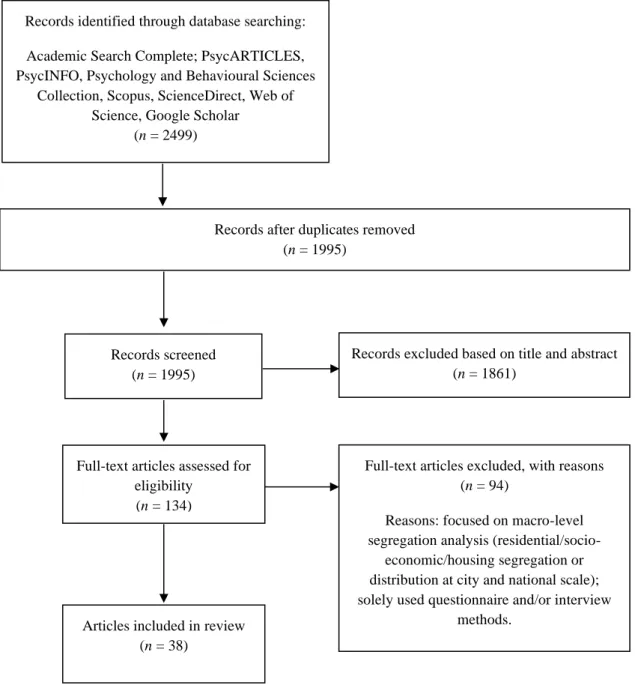
Figure 2. Results of the search strategy based on the PRISMA statement (Liberati et al., 2009) ... 46
Figure 3. Map of micro-ecological patterns of ethnic segregation on a beachfront in post-apartheid South Africa (see Durrheim & Dixon, 2005) ... 54
Figure 4. Map of the distribution of students in a school classroom according to students’ seating choice in terms of religious background and gender (see McKeown et al., 2016) ... 60
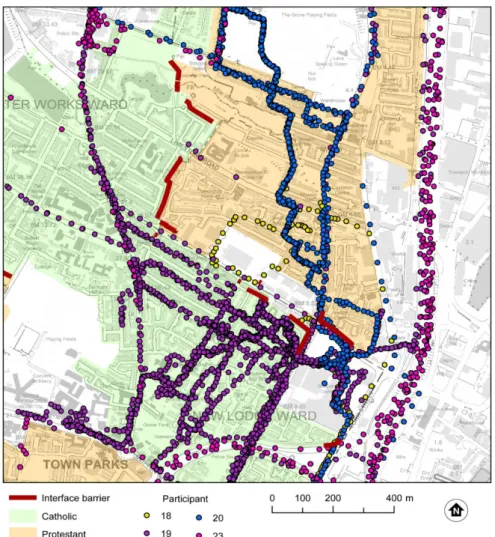
Figure 5. Capturing residents’ movements through everyday spaces in Belfast using GPS tracking and GIS data capture and representation (see Hocking et al., 2018) ... 66
Figure 6. Moderated parallel-mediation model of the relationship between perceived cultural continuity and public place sociability, with type of resident as moderator – long-time residents and new gentrifiers –, and place identification and place knowledge as mediators ... 104
Figure 7. Effect of perceived cultural continuity on public place sociability, through place identification and place knowledge for long-time residents and new gentrifiers ... 112
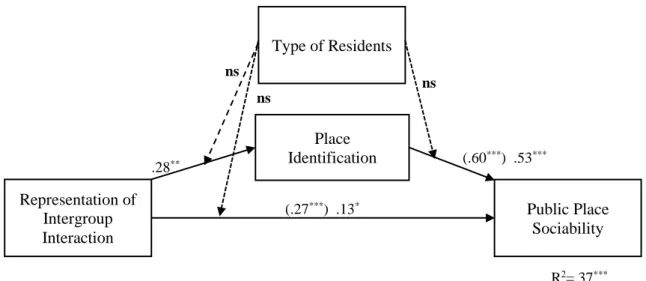
Figure 8. Moderated mediation model of the relationship between representation of intergroup interaction and public place sociability, with type of resident as moderator – long-time residents and immigrants –, and place identification as mediator ... 115
Figure 9. Effect of representation of intergroup interaction on public place sociability, through place identification for long-time residents and immigrants ... 119
Figure 10. Moderated mediation model of the relationship between choice of residence due to having family or acquaintances in the neighbourhood and public place sociability, with place identification as mediator, for immigrants ... 121
Figure 11. Effect of choice of residence due to having family or acquaintances in the neighbourhood on public place sociability, through place identification, for immigrants .... 123
Figure 12. Map of the neighbourhood of Mouraria identifying the four public places observed ... 140
Figure 13. Photos of each of the four public places observed: (A) inner place 1 - Largo da Severa; (B) inner place 2 - Largo dos Trigueiros; (C) transition place 1 - Largo de São Cristóvão; (D) transition place 2 - Rua do Benformoso. ... 140
Figure 14. Schematic map of the inner place 1 - Largo da Severa ... 144
Figure 15. Schematic map of the inner place 2 - Largo dos Trigueiros ... 145
Figure 16. Schematic map of the transition place 1 - Largo de São Cristóvão ... 146
Figure 17. Schematic map of the transition place 2 - Rua do Benformoso ... 147
Figure 18. Schematic map of the inner place 1 - Largo da Severa - 04/02/2019: 11h30-12h30 – 1st 10mn time (Monday) ... 149
Figure 19. Schematic map of the inner place 1 - Largo da Severa - 09/03/2019: 10h30-11h30 – 1st 10mn time (Saturday) ... 150
VII
Figure 20. Schematic map of the inner place 2 - Largo dos Trigueiros- 08/02/2019: 14h-15h –
1st 10mn time (Friday) ... 158
Figure 21. Schematic map of the inner place 2 - Largo dos Trigueiros- 02/03/2019: 14h-15h –
1st 10mn time (Saturday) ... 159
Figure 22. Schematic map of the transition place 1 - Largo de São Cristóvão - 11/02/2019:
14h-15h – 3rd 10mn time (Monday) ... 167
Figure 23. Schematic map of the transition place 1 - Largo de São Cristóvão - 16/02/2019:
14h-15h – 3rd 10mn time (Saturday) ... 168
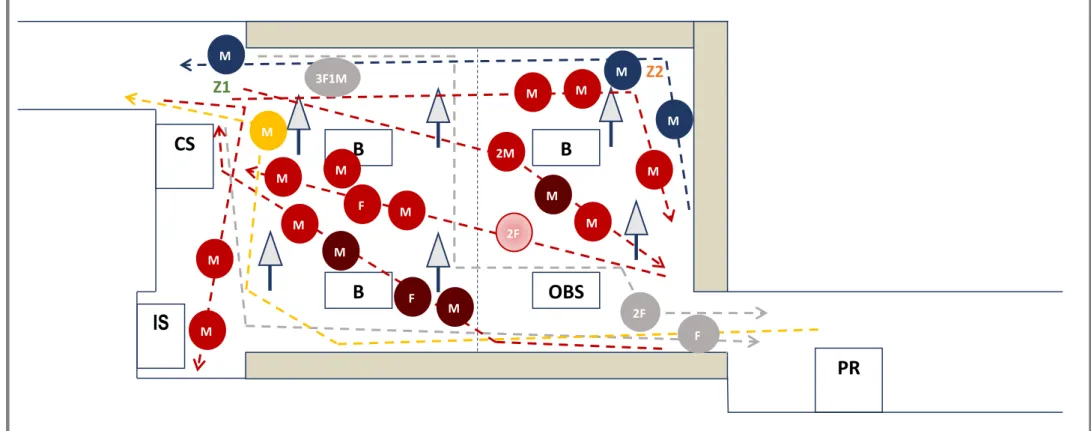
Figure 24. Schematic map of the transition place 2 - Rua do Benformoso - 08/03/2019:
14h-15h – 1st 10mn time (Friday) ... 175
Figure 25. Schematic map of the transition place 2 - Rua do Benformoso - 09/03/2019:
1
GENERAL INTRODUCTION
2
1. Introduction
The present thesis seeks to contribute to social and environmental psychological literature by integrating psychosocial explanations in studies about place, focused on how people use public place and relate with each other in place, under processes of urban regeneration. These processes present multiple social and psychological challenges to those who live and use public places, entailing people to constantly find different forms of adaptation to the social, cultural, human, and economic transformations they face (Lees, 2008). Adjusting to these transformations and responding to the inherent challenges is associated to how people are able to develop people-place bonds (Ujang & Zakariya, 2015), affirm identities in place (Di Masso, 2012), define norms of conviviality (Main & Sandoval, 2015), adopt patterns of segregation and integration among groups (Dixon & Durrheim, 2003), and negotiate, reproduce and transform social representations about place and others (Hopkins & Dixon, 2006; Castro, 2015). This is especially relevant in inner-city neighbourhoods undergoing major sociocultural and architectural transformations and receiving a lot of diverse newcomers due to processes of urban regeneration, across major European cities (Lees, 2008; Van Kempen & Murie, 2009; Freeman, Cassola, & Cai, 2016).
In southern European cities, specifically, many new policy programs of urban regeneration are happening in historical and traditional neighbourhoods, where public place sociability, tight social and neighbourly relations and a familiar and traditional environment were prominent (Tulumello, 2015; Zoppi & Mereu, 2015). Traditionally home to working-class tenants, and long-disinvested and in dire need of regeneration (Lees, 2008; Rodrigues, 2010; Gainza, 2016), these areas have lately been the object of interventions guided by different policy models: top-down, bottom-up or mixed (Pissourios, 2014). Hence, these neighbourhoods present a number of challenges to resident’s bonds to place, their uses of public places, and interpersonal and intergroup relations in place. Ultimately the challenge to achieve a neighbourhood able to accommodate both the traditional identity and memories of older residents with the challenges presented by the physical and social transformations of today, due to processes of gentrification (e.g., Clay, 1979; Rose 1984; Savage & Warde, 1993; Ley, 1996; Lees, 2008, Freeman et al., 2016) and ethnicisation (e.g., Smith, 1996; Malheiros, Carvalho, & Mendes, 2012), without losing people-place bonds and the vitality of the public places of the neighbourhood. Sociocultural diversity and multiculturality may not be sufficient by themselves for the promotion of intergroup interactions in place (Lelévrier, 2013) and for a real integrated neighbourhood truly shared by different social groups. Indeed, people’s spatial
3 positioning in place may materialize segregation relationships between different groups (e.g., Dixon, Tredoux, Durrheim, Finchilescu, & Clack, 2008), even in contexts legally desegregated (Dixon & Durrheim, 2003).
From a psycho-social and socio-political perspective, it is important to understand how the macro-level transformations under different policy models are affecting the micro-level of social relations in place and relations to place (Di Masso, 2015). Social and Environmental Psychology may play a crucial role in understanding this, by offering ways of examining which psychosocial processes are involved in how different groups use public place, give meaning to it and express their social representations of intergroup relations, within an increasingly changing environment, such as inner-city regenerated neighbourhoods. Research on the sociological (Blanco, Bonet, & Walliser, 2011; Lees, 2008), geographical (Tulumello, 2015) and urban planning (Davison, Dovey, & Woodcock, 2012; Freeman et al., 2016) dimensions and consequences of these inner-city neighbourhoods transformations and the models they follow – top-down or bottom-up – is now abundant. The social-psychological literature is, however, scarce, a lacuna this work proposes to start to fill.
In order to respond to this challenge, the present work takes Mouraria, an inner-city neighbourhood in Lisbon as a case study. Mouraria has undergone a program with a mixed/bottom-up regeneration strategy since 2010 (CML, 2010). Over the years, the neighbourhood experienced two main processes of socio-urban transformation, namely small-scale gentrification and re-enforcement of the established Asian immigrant population (Malheiros et al., 2012; Tulumello, 2015; Oliveira & Padilla, 2017). Now three main groups of residents are living in the neighbourhood: (1) long-time; (2) new gentrifiers; and (3) immigrants. However, it seems there is little intergroup interaction (Malheiros et al., 2012; Bettencourt & Castro, 2015), indicating potential patterns of segregation in place. “Officially”, today Mouraria is presented by the City Council of Lisbon and the Press both as a historical and traditional and a successful multicultural and cosmopolitan place (Bettencourt & Castro, 2015).
2. Research question and two research lines in social-psychological literature
Drawing on the context of the neighbourhood of Mouraria, the following emerges as a central research question: how are the transformations of an inner-city historical and
multicultural neighbourhood stemming from a mixed urban regeneration program (bottom-up and top-down) experienced by people, through their uses of public place, their intergroup
4
relations in place, their social representations about place and others, and their place attachment and identification? It is important to understand how the major transformations due
to mixed urban regeneration processes, involving influxes of new residents and an increasingly social diversity alter an inner-city neighbourhood subject to two ‘official’ social representations which praise the successful transformations and the neighbourhood’s current multiculturality (Tulumello, 2015; Oliveira & Padilla, 2017): (a) a traditional neighbourhood characterized by its lively public place sociability and close neighbourly relations; and (b) a multicultural and
cosmopolitan neighbourhood.
People’s relations to and in place and their underlying psychosocial processes have been studied under two main research lines, one focused on meaning making and the other on action. The first research line focuses on meaning, by examining how different groups view one another and their communities and analysing processes connected to place relations, such as place identity and place attachment (e.g., Dixon & Durrheim, 2000; Lewicka, 2008; Droseltis & Vignoles, 2010; Di Masso, Dixon, & Pol, 2011; Benages-Albert, Di Masso, Porcel, Pol, & Vall-Casas, 2015), and reciprocal social representations (Castro, 2012; 2015; Jovchelovitch, 2012; Vala & Castro, 2013). This line is focused on meaning construction through social interactions and experiences in place as a means to develop a stronger place identity (Dixon & Durrheim, 2000) and construct social representations about place, i.e. shared meaning systems (Castro, 2012), looking at personal memories, stories of different members of a community, and social memories (Lewicka, 2008; Rishbeth & Powell, 2012). Some research also explores the link between place identification and the perception of the continuity of core cultural features of a place (Main & Sandoval, 2015). Another central subject on people-place relations concerns place knowledge (Berkes, 2004; Naess, 2013; Castro & Mouro, 2016), still neglected in the literature. However, little is known about how all these processes are related to place uses, and most importantly place use in regenerated urban communities.
The second research line focuses on people’s actions in place, mostly by analysing the micro-ecology of intergroup segregation (Dixon et al., 2008). Drawing on a bottom-up approach, it relies on the direct observation of people’s uses of place and intergroup interactions (e.g., Dixon et al., 2008; Priest, Paradies, Ferdinand, Rouhani, & Kelaher, 2014). Studies show that the mere co-presence of different groups in the same place, such as educational (e.g., Schrieff, Tredoux, Finchilescu, & Dixon, 2010), leisure or recreational (e.g., Tredoux & Dixon, 2009), or public transport (Swyngedouw, 2013), is not sufficient condition for intergroup interaction (e.g., Dixon & Durrheim, 2003; McKeown, Stringer, & Cairns, 2016). Nevertheless,
5 there is no research on the micro-ecology of intergroup segregation on multicultural and regenerated urban communities, a lacuna that the present work proposes to address.
In sum, little is known about the underlying social psychological explanations involved in how people use public places and relate with each other in place (Di Masso & Dixon, 2015), and in their relation to the transformations caused by urban regeneration programs those following a mixed approach. Additionally, there are no studies of the micro-ecology of multicultural and regenerated urban communities. Therefore, this work presents an integrative approach by combining the two main research paths in Social and Environmental Psychology, i.e. it combines the analysis of meaning making in place relations with the examination of place use directly observed. Importantly, it extends this to the community level, specifically, to multicultural and regenerated urban communities, and to the understanding of the consequences of regeneration urban policies, particularly those following a mixed approach, from a psychosocial perspective. Taking the neighbourhood of Mouraria as a case-study, it relies on three main aims:
(1) to analyse what psychosocial processes underlie residents’ reported use of the public places of the neighbourhood to socialize with others;
(2) to analyse how the main groups of residents use the public places and if they interact at an intragroup or intergroup level;
(3) to understand what and how both ‘official’ social representations about Mouraria - as a historical and traditional inner-city neighbourhood, and as a multicultural and cosmopolitan neighbourhood - residents use to justify their positions and social representations about the self and the others, their relations in place, their uses of place, and neighbourhood transformations.
3. Organisation of the thesis
The present thesis is organized in three sections. Section I is composed by five chapters regarding the theoretical framework on which the thesis was developed and the characterization of the context of study, i.e. the neighbourhood of Mouraria. Section II comprises three chapters concerning the empirical multi-method research conducted, namely, a survey study, an observational study, and a study with interviews. Section III is dedicated to the general interpretation, discussion and conclusion of the thesis.
Chapter I reviews the literature on processes and transformations inherent to urban regeneration programs in the inner-city, in order to contextualize the social and psychological
6 challenges these may pose to residents. The chapter begins by distinguishing different urban policy approaches, such as top-down and bottom-up/mixed and its consequences for neighbourhoods (e.g., Pissourios, 2014; Zoppi & Mereu, 2015). Namely, the chapter explores the process of gentrification (Savage & Warde, 1993; Lees, 2008; Freeman et al., 2016) and how it can lead to influxes of new residents (gentrifiers and immigrants), new consumer landscapes, rising rents, a higher everyday life cost and to the displacement of long-time residents (e.g., Gainza, 2016). It follows with the potential consequences of such processes of regeneration and gentrification to the maintenance of the sociability and sociocultural diversity of public places (Lees, 2008), guaranteeing these as integrated places, rather than segregated ones, and to the development of new people-place bonds (Davison et al., 2012).
Chapter II presents a theoretical framework to address the main aims of the thesis, and particularly to support its first study, a survey study centered on analyzing the psycho-social processes predicting public place sociability. The chapter focuses on relevant literature and research on Social and Environmental Psychology on people-place bonds, specifically on place identity, and its relation to different psycho-social processes, namely, perceived cultural continuity, and place knowledge. It highlights the main theoretical contributions and the lacunae these present on understanding the psycho-social processes explaining people’s uses of public place, which this work aims to answer through Study 1.
First, it offers an overview on the significance of the concept of place identity, presenting the main theoretical perspectives. The literature shows how place identity can be conceptualized under two main paradigms. One describing place identity as an individual and cognitive structure (e.g., Proshansky, 1978; Graumann, 1983), and a second presenting place identity as a result of a social construction of place through social interactions (e.g., Dixon & Durrheim, 2000; Hopkins & Dixon, 2006). For the purpose of the aims of this thesis, place identity is considered in an integrative way, comprising cognitions and feelings which allow individuals to understand reality and guide their perceptions about place (e.g., Droseltis & Vignoles, 2010), and the discursive, meaning-making and relational process dimension (e.g., Di Masso, Dixon, & Durrheim, 2013).
Second, the chapter presents the prominent research on place identity within the context of urban environments and its connection with cultural continuity (Sani et al., 2007; Sani, Bowe, & Herrera, 2008; Smeekes & Verkuyten, 2014) and place knowledge (e.g., Benages-Albert et al., 2015). The chapter deals with distinct factors that influence place identity, and how this is linked to people’s perception of their place retaining core cultural elements (Smeekes & Verkuyten, 2014) or being able to reproduced past memories of previous places (Main &
7 Sandoval, 2015), and to their knowledge about its history and community (Benages-Albert et al., 2015). It also addresses how these relations may differ between different types of residents, namely, long-time residents and newcomers, such as immigrants and gentrifiers.
Chapter III reviews the literature on people’s uses of public places, providing the theoretical framework of Study 2, specifically the observational study focused on examining if different groups use the public places of the neighbourhood and if they interact at an intragroup or intergroup level. It begins by highlighting the importance of public place as an arena for the expression and production of citizenship (Stevenson, Dixon, Hopkins, & Luyta, 2015a; Di Masso, 2015). Not everyone may have equal access to place, as specific constructions of place may be dominant and lead people to, for instance, retreat from public conviviality (Buchecker, 2009) or adopt patterns of spatial segregation (Dixon et al., 2008). Some social groups may feel ‘out of place’ and no longer use its public places, which transforms these into segregated or abandoned places (Lees, 2008; Davidson & Lees, 2010). This is a particularly important issue when remaking and regenerating neighbourhoods, such as the neighbourhood of Mouraria. In order to understand the uses and interactions in neighbourhood’s public places, one must look at the everyday practices and encounters of its residents, through the analysis of the micro-ecology of intergroup segregation (e.g., Durrheim & Dixon, 2005; Dixon et al., 2008). Importantly, this field of research so far has not provided a systematic literature review on the topic in Social Psychology, which this chapter proposes to offer, addressing a central lacuna on the literature. Specifically, it provides a systematic literature review about research on micro-ecology of intergroup segregation in Social Psychology between 2001 and 2017, also pointing out social psychological processes explaining segregation spatial patterns (Bettencourt, Dixon, & Castro, 2019).
Chapter IV provides a literature review on the Theory of Social Representations (Moscovici, 1976; 1988), a theoretical framework sustaining this thesis in general, but mainly Study 3, which has focused on understanding which ‘official’ social representations about Mouraria residents use to justify their positions and social representations about the self, the others and place, through the analysis of interviews. First the chapter points out the relevance of the social representations’ paradigm to better understand how people make sense of social change (Castro & Batel, 2008; Castro, 2015), and how a multiplicity of social representations may emerge in different social groups (Jodelet, 1989) and within the same place (Howarth, 2002). Second, it gives some examples of research using the Theory of Social Representations to study several phenomena (e.g., Batel & Castro, 2009; Andreouli & Chryssochoou, 2015; Mouro & Castro, 2016). Drawing on the assumption that for a clarification of people’s uses of
8 place, it is important to understand how they interpret and represent place and the others, as the discursive constructions of a place are intertwined with material and social practices in place (Dixon & Durrheim, 2000; Hopkins & Dixon, 2006; Di Masso & Dixon, 2015; Spitz, 2015), the chapter ends by arguing how the social representations’ paradigm has the potential to contribute to the study of residents’ acceptance or contestation to urban transformations of regenerated neighbourhoods, as evidenced by Study 3.
Chapter V is dedicated to the presentation of the object of study of the thesis, the neighbourhood of Mouraria, in Lisbon. It presents a brief overview about the story and the development of the neighbourhood over the years, and its sociodemographic characterization, finishing with a description of the program of urban regeneration and community development of Mouraria (PDCM – QREN).
Chapter VI describes the first study of the thesis, the survey study, conducted to answer the first aim of the thesis, i.e., to analyse what psychosocial processes underlie residents’ reported use of the public places of the neighbourhood to socialize with others. It has focused on the individual level of analysis. A questionnaire was answered by the three main groups of residents of Mouraria: (1) long-time residents; (2) new gentrifiers; and (3) immigrants. This study comprised two sub-studies, each one focused on different psychosocial processes and group of residents: (a) Study A has focused on the predictive role of perceived cultural continuity (Sani et al., 2007; Smeekes & Verkuyten, 2014), place identification (Droseltis & Vignoles, 2010) and place knowledge (Naess, 2013), for long-time residents and new gentrifiers; and (b) Study B has focused on the predictive role of representation of intergroup interaction (Castro, 2015) and place identification (Droseltis & Vignoles, 2010), for long-time residents and immigrants, and on the predictive role of choice of residence due to having family or acquaintances in the neighbourhood, for immigrants.
Chapter VII reports Study 2, carried out to meet the second aim of the thesis, namely to analyse how the main groups of residents of Mouraria use the public places of the neighbourhood and if they interact at an intragroup or intergroup level. The micro-ecology of intergroup segregation (e.g., Dixon et al., 2008) has not yet developed studies on multicultural and regenerated urban communities, a lacuna Study 2 sought to respond, following the methodological proposals of this field of research. An observational study was conducted in different public places of the neighbourhood, centered on different individuals’ and groups’ uses of place and types of interaction.
Chapter VIII presents the interview study, developed to answer the third aim of the thesis, i.e. to understand what and how both ‘official’ social representations about Mouraria -
9 as a historical and traditional inner-city neighbourhood, and as a multicultural and cosmopolitan neighbourhood - residents use to justify their positions and social representations about the self and the others, in order to better comprehend the processes of acceptance or resistance regarding the transformations stemming from urban regeneration programs and gentrification. Residents from the main groups were interviewed in the neighbourhood. The analysis of the interviews relied on the Theory of Social Representations (Moscovici, 1976; 1988), and followed a two-step method: (1) Thematic Analysis (Braun & Clarke, 2006; 2012), identifying the main themes emerging on residents’ discourses about the changing neighbourhood, their place relations, the others and their uses; and (2) Pragmatic Discourse Analysis (Batel & Castro, 2018), analysing the main discursive strategies used in the receiving of the neighbourhood’s transformations, and which processes – acceptance or contestation – are involved in how social representations are reproduced, negotiated or transformed.
Finally, Chapter IX presents a summary of the main findings, highlighting the contributions of the present thesis, and discussing the impact of this research for the field of people-place relations on Social and Environmental Psychology, within the context of urban environments, particularly, within urban regeneration. Additionally, it is offered a reflection on the limitations of this work and potential future research directions. In conclusion, it is discussed the practical implications of this research and how it may contribute to institutional decision-makers on urban public policies and, ultimately, to contribute to more well thought out interventions on public place for a better quality of life of the city and its citizens.
10
Figure 1. General scheme of the thesis - outline of the problem, studies and research questions. Problem Overview
1. Little is known about the underlying social psychological explanations involved in how groups, within increasingly changing neighbourhoods under urban regeneration mixed programs:
> use public places
> relate with each other in place > give meaning to place
> express their social representations of intergroup relations in place
2. There are no studies of the micro-ecology of multicultural urban communities.
How are the transformations of an inner-city historical and multicultural neighbourhood stemming from a mixed urban regeneration program experienced by people, through their uses of public place, their
intergroup relations in place, their social representations about place and others, and their place attachment and identification?
Main Research Question
Case study: the neighbourhood of Mouraria
- Inner-city historical neighbourhood; lively sociability; two ‘official’ social
representations: (1) traditional neighbourhood and (2) a successful multicultural neighbourhood.
- Under a mixed urban regeneration program (since 2010), together with processes of gentrification and ethnicisation.
Chapter I - Urban regeneration in the
inner-city: processes and
transformations in the neighbourhood
Chapter II - Place identity and place
relations in increasingly diversified urban places
Chapter III - Uses of public place:
sharing, interacting and segregating at a micro-ecological scale
SECTION I
Chapter IV - Social representations:
how people make sense of social change
SECTION II
Study I. Questionnaire -
Psycho-social processes predicting public place sociability
Study II. Observation - The
micro-ecology of intergroup relations in the neighbourhood of Mouraria
Study III. Interview - Discourses
about Mouraria: residents making sense of the neighbourhood transformations
Systematic literature review on
micro-ecology of intergroup segregation
Research Question
Is the public place sociability formerly characteristic of Mouraria being maintained by its residents and
what social psychological processes explain it?
Research Question
Do residents interact at an intragroup or intergroup level?
Research Question
What ‘official’ representation(s) of Mouraria residents use to justify their
positions regarding others, place and the transformations and what are the functions of such representations?
11
SECTION I
THEORETICAL FRAMEWORK
13
CHAPTER I
U
RBAN
R
EGENERATION IN THE
I
NNER
-
CITY
:
P
ROCESSES AND
T
RANSFORMATIONS IN THE
14
Chapter Presentation
This chapter aims to review the literature on processes and transformations inherent to urban regeneration programs in the inner-city, in order to contextualize the social and psychological challenges these may pose to residents. It will also provide a better understanding of the context of the object of study on which this work focuses, a neighbourhood undergoing a bottom-up/mixed intervention, and how this kind of intervention may be connected to new people-place relations and uses of place. In this sense, the chapter begins by showing how urban regeneration has become a central goal of urban governance over the years, through the adoption of different urban policy approaches, such as top-down and bottom-up/mixed (Pissourios, 2014). Next, it explores the potential consequences of such policies (e.g., Pissourios, 2014; Zoppi & Mereu, 2015), highlighting the process of gentrification and how this may emerge and develop differently accordingly to the type of policy model implemented (Savage & Warde, 1993; Lees, 2008; Freeman et al., 2016). The chapter ends with a reflection on the potential social and psychological consequences of these processes of regeneration and gentrification on the maintenance of the sociability and sociocultural diversity of public places (Lees, 2008) and on the development of new people-place bonds (Davison et al., 2012).
15
1. Introduction
“The mobility of a city, reason of its life and its history, turn their transformations simultaneously physical and social. Frequently, social structures begin to transform before physical structures.” (Goitia, 1989; p.207)
The history of town planning has suffered, over the last decades, a transition from local government to local governance (Blanco et al., 2011). Within an increasingly globalized system, urban policies have sought to adjust to an uncertain economic and social future of cities (Bailey, Miles, & Stark, 2004), adopting various forms of local governance, namely within the context of urban regeneration. Specifically across Europe, in the end of the 1990’s, the tendency was to undertake an urban governance paradigm based on a coordination between the public and private sectors, rather than on a monopoly of one of these, also favouring citizen participation on political decision-making (Blanco et al., 2011). In order to follow this paradigm and to achieve a clear participation of the community, several urban regeneration programs have emerged, focusing on transforming underprivileged urban areas (Lees, 2008; Blanco et al., 2011). Alongside with the development of such policies, several historical inner-city areas of major European cities have been developed under different programs of urban regeneration (Lees, 2008; Van Kempen & Murie, 2009; Freeman et al., 2016).
In southern European cities, specifically, such historical inner-city areas were characterized by a long-disinvestment, in dire need of regeneration, and traditionally home to working-class tenants (Lees, 2008; Rodrigues, 2010; Gainza, 2016), where public place sociability, tight social and neighbours relations, and a familiar and traditional environment were prominent (Tulumello, 2015; Zoppi & Mereu, 2015). The urban planning under which these areas have been intervened has been defined by two main tendencies over the years (Pissourios, 2014). One oriented to centralism and de-politicizing decision-making and to the increased power of authorities and technical experts (Lees, 2008; Pissourios, 2014), and another directed towards a greater participation of the community in decision-making, together with a higher accountability on the part of local authorities and criticism of technical expertise (Pissourios, 2014). These two have been labelled in urban planning as top-down and bottom-up/mixed approaches respectively (Pissourios, 2014). It is important to explore central implications of each model for the development of historical inner-city areas, how social diversity and mixing in place are brought about and interrelated to different gentrification’s rhythms, and what consequences may these have for public place sociability and residents’ place relations and bonds, as follows.
16
2. Different models of regeneration policies
Urban regeneration has been conceived by two main policy tendencies: (1) top-down; and (2) bottom-up/mixed (Pissourios, 2014). Even though both models seek to create more social and cultural diversified neighbourhoods, both differ on the significance given to such diversity and on the strategies implemented to achieve it (Pissourios, 2014).
Top-down intervention models focus on incorporating cultural diversity (Lees, 2008),
simultaneously fostering territorial competitiveness and cultural innovation (Oliveira & Padilla, 2017). These models stem from the idea that diversity can bring economic growth by setting the proper conditions for hosting a plurality of cultural values adjusted to new creative classes (Florida, 2002; Oliveira & Padilla, 2017), ultimately creating more tolerant cities (Lees, 2008). The core strategy of urban governance authorities to achieve this and therefore to respond to the aforementioned challenges has been to commit to city-branding and the reinforcement of ethnic commerce to attract investment, tourism and new middle classes (Oliveira & Padilla, 2017). A prominent and highly academically debated consequence of such strategy is the gentrification of regenerated places (e.g., Lees, 2008; Bélanger, 2007; 2010; Davidson & Lees, 2010; Davison et al., 2012; Freeman et al., 2016; Gainza, 2016; Mösgen, Rosol, & Schipper, 2019).
Gentrification has been linked to appeals to diversity and social mixing (Lees, 2008), yet there is not a consensus in the literature on what actually makes gentrification ‘gentrification’ (Bélanger, 2010). Its definition may comprise everything from decisions to regenerate buildings to real estate regenerations in working class neighbourhoods (Bélanger, 2010), or even in areas previously thought as ‘ungentrifiable’ (Mösgen et al., 2019). Notwithstanding, the effects of gentrification on displacement may vary at different stages (Freeman et al., 2016). Following a
top-down model, central and/or local authorities enforce expert-led change to the areas, assuring
their “middle-class upgrading” (Lees, 2008) by the partial replacement of extant public housing by new market properties (Davison et al., 2012), or the a priori definition of quotas for different socio-economic groups (Lelévrier, 2013). This model thus brings social diversity by imposed
gentrification (Bailey et al., 2004; Freeman et al., 2016; Heath, Rabinovich, & Barreto, 2017;
Pissourios, 2014). Under this state-led gentrification (Lees, 2008; Davidson & Lees, 2010), neighbourhoods rapidly enter the third and fourth phases of the gentrification process (Freeman et al., 2016), becoming a target for wealthier individuals and developers (Pacione, 2003). Many first and second stage gentrifiers abandon the neighbourhood, renovated dwellings return to the
17 market and are purchased by affluent individuals, and ultimately any form of sociocultural diversity is eradicated (Shaw, 2008; Lees, 2008; Freeman et al., 2016; Gainza, 2016).
Local authorities are not concerned with involving the community on the decision-making process, disregarding residents’ views about the neighbourhood (Lees, 2008; Pissourios, 2014). Concomitantly social diversity may be commodified through tourism, strategic actions to promote a cultural creative neighbourhood, by creating an image of a simultaneously ethnically and gentrified place (Fincher, Iveson, Leitner, & Preston, 2014), which often translates into a segregated place (Lees, 2008). The movement of middle-class groups into rundown and marginal inner-city neighbourhoods, and the consequent highly acceleration of gentrification, is usually defined by local authorities as forcing social mixed communities, and as the desegregating solution to an isolation by class, income or ethnicity (Lees, 2008; Davidson & Lees, 2010). However, under such rapidly development of gentrification, neighbourhoods may experience patterns of segregation and polarisation (Lees, 2008; Davison et al., 2012) in their public places, contrary to an integrated and inclusive everyday life in place, defined by a real sociocultural diversity.
In contrast, in bottom-up/mixed models, authorities directly assure the regeneration of public places and buildings (Gainza, 2016; Padilla, Azevedo, & Olmos-Alcaraz, 2014), but offer subsidies and/or fiscal incentives to owners assuring renewal of their decaying properties, and implement community consultation for supporting the creation of local jobs, helping fight poverty and stigmatization (Bettencourt & Castro, 2015; Oliveira & Padilla, 2017; Pissourios, 2014; Tulumello, 2015). This brings diversity by initiating small-scale gentrification, a process occurring in a more gradually manner and slower rate, with minimal impact on the physical and social environment of the neighbourhood (Davison et al., 2012; Malheiros et al., 2012; Oliveira & Padilla, 2017). The process begins with the arrival of middle-class young adults well-educated but economically struggling, with an unstable professional situation and a stronger cultural and academic capital than long-time residents (Smith, 1996; Davison et al., 2012; Malheiros et al., 2012). These pioneers of the gentrification process, or marginal/new gentrifiers (Clay, 1979; Rose 1984; Caulfield, 1994; Ley, 1996; Butler, 1997; Malheiros et al., 2012), prefer to live in central areas of the city due to their liberal and cosmopolitan lifestyle and the socially and ethnically tolerant environment that these offer (Rodrigues, 2010). At this phase, although rental costs are increasing, they are still affordable for the gentrifiers, and long-time residents can also still afford to remain in the neighbourhood (Rodrigues, 2010). Therefore, changes to the physical space by these newcomers are minimal (Rodrigues, 2010) and gentrifiers and working classes still live side-by-side (Davison et al., 2012).
18 The implementation of these kind of more participatory processes of regeneration, involving residents is also important to help maintaining a sense of identity of residents (Zoppi & Mereu, 2015). Public place is not only a place of economic activity, but also and importantly a place of sociability and identity (Bélanger, 2010). This is particularly relevant in contexts traditionally characterized by diversity, influxes of immigration, and a simultaneous familiar environment, such as inner-city historical neighbourhoods, for instance, in Lisbon (Bettencourt & Castro, 2015), Cagliari (Zoppi & Mereu, 2015), Barcelona (Blanco et al., 2011), or Granada (Padilla et al., 2014). Diversity may be understood in two ways, one in terms of cross-cultural exchanges in local encounters in place, and another as a resource for social economic local development (Oliveira & Padilla, 2017). An intervention based on bottom-up/mixed policies seems to be more prepared to find a balance between these two, without displacing the different social groups living in the neighbourhood (Zoppi & Mereu, 2015) and preventing a de-ethnicisation, where foreigners cross paths and are not confined to social and ethnic belongings and segregated places (Oliveira & Padilla, 2017).
In sum, once abandoned by economic activities, long-disinvested and in dire need of a revitalisation (Gainza, 2016; Lees, 2008; Rodrigues, 2010), inner-city historical neighbourhoods become the target of different regeneration interventions adopted by local authorities – top-down or bottom-up/mixed (Pissourios, 2014). These will differently impact the neighbourhood and its residents, with the arrival of a new population (Bélanger, 2010), for instance, gentrifiers (Lees, 2008) and new immigrants (Oliveira & Padilla, 2017). Buildings, streets and squares get a facelift, and new commerce and service activities emerge in order to fulfill the needs and demands of this new population (e.g., Bélanger, 2010; Davison et al., 2012). However, the interventions adopted to achieve these changes comprise different strategies. Some defined by encouraging gentrification through top-down regeneration programs, ultimately leading to rising rents, higher everyday life cost, displacement of specific and more vulnerable groups of residents, lesser social mixing, and more local patterns of segregation (Shaw, 2008; Lees, 2008; Freeman et al., 2016; Gainza, 2016). Others focused on more participatory processes of regeneration, following a bottom-up/mixed approach, where the neighbourhood undergoes a small-scale gentrification and remains a place still affordable for both gentrifiers and long-time residents, guaranteeing a more social and cultural diversified place (Davison et al., 2012; Malheiros et al., 2012).
The changing image of these regenerated inner-city neighbourhoods will be attractive for different groups, which lifestyles may conflict with the cultural values, traditions and ways of life of long-time residents. Indeed, if the arrival of new middle classes and younger immigrants
19 to some of these neighbourhoods initiate processes of socio-ethnic transition and gentrification (Malheiros et al., 2012), new uses are developed and new representations of the public places generated, as well as new forms of relating to the city (Menezes, 2012). Therefore, the regeneration of these neighbourhoods may pose several social and psychological challenges to their residents, as argued next.
3. Social and psychological challenges and consequences of urban regeneration
Urban regeneration programs present several challenges to people living in and using the city, and may have multiple effects on city’s development. The impact the intensification of population in regenerated historical areas can have on the character and cultural features of such areas is one major challenge of regeneration policies (Davison et al., 2012). The maintenance of the character of a place is many times an underlying idea and priority disseminated by urban planners in order to justify the implementation of such policies (Davison et al., 2012; Zoppi & Mereu, 2015). Long-time residents may be resistant to the changes stemming from these policies, claiming how such changes can endanger their neighbourhood character and culture (Davison et al., 2012). Perceiving a loss of character of the neighbourhood may lead to weaker bonds to place. Residents may feel less identified with their place of residence, for not finding in public places social and cultural elements which represent them and the usual environment that distinguish their neighbourhood from the others (Davison et al., 2012; Ujang & Zakariya, 2015). Some pioneer studies in Social Psychology also reinforce the importance of feeling identified with the community, showing that bottom-up strategies lead to higher levels of community identification, which in turn predicts individual well-being (Heath et al., 2017).
The diminishing of identification with the neighbourhood may, in turn, lead to other potential consequence of urban regeneration, namely empty and abandoned public places (Buchecker, 2009). Socialization and social integration happen in public places, making these important to the development of people’s identity (Buchecker, 2009; Dixon & Durrheim, 2004), especially in historical inner-city areas (Tulumello, 2015). If residents no longer identify themselves to these places, they may tend to stay away from them and remain into the private sphere of their homes or other remote areas far away (Buchecker, 2009), happening a withdrawal from public life. This arises a central challenge to urban policies, that is how to accommodate different cultures in a way which the neighbourhood continues to represent their residents, and promotes social inclusion of old and new diversities (Bailey et al., 2004; Blanco et al., 2011; Oliveira & Padilla, 2017), also guarantying immigration (Oliveira & Padilla, 2017).
20 Indeed, urban regeneration is also a matter of revitalising cultural identities, emphasizing culture-led regeneration as a means to facilitate residents to re-establish their own sense of place and sense of history (Bailey et al., 2004), as bottom-up/mixed strategies seek to do (Pissourios, 2014). Nevertheless, even citizen participatory planning processes may encompass political ambivalent dynamics (Van Wymeersch, Oosterlynck, & Vanoutrive, 2019). These are not always successful in recognizing and negotiating multiple identities, promoting social inclusion of different groups, and mixing social uses (Davies, 2007; Lees, 2008; Oliveira & Padilla, 2017), often because the community actors involved are not truly representative of the population, and the interventions are dominated by institutional and institutionalized actors (Davies, 2007). At other times, even with the participation of the community, residents may simply feel that the physical and cultural features of the neighbourhood no longer match their affective perceptions and functional needs (Ujang & Zakariya, 2015).
In sum, even bottom-up/mixed interventions present several challenges for residents and not always have the same effects in different places (Lees, 2008; Blanco et al., 2011). It is important, then to examine what factors prevail and are able to maintain the necessary social conditions for residents continuing to feel connected to their neighbourhood. At the end, these emotional bonds to place may influence attitudes and behaviours (Ujang & Zakariya, 2015) and determine the sustainability of public places’ vitality (Buchecker, 2009). This suggests several reflections as relevant issues for the present work, which specifically focuses on a historical inner-city neighbourhood under a bottom-up/mixed intervention, the neighbourhood of Mouraria, in Lisbon (Malheiros et al., 2012). Particularly, reflecting on how the transformations in the neighbourhood stemming from urban regeneration relate to new people-place relations and bonds, new patterns of public place use, new intergroup relations in place, new place meanings, and new social representations about place and the others. It poses a relevant question for this work, namely to understand at what extent and how can a neighbourhood be transformed - examined in the context of a bottom-up/mixed policy model adopted - in order to ensure the maintenance of sociability and sociocultural diversity of its public places, guaranteeing these as integrated places, rather than segregated ones.
A final observation arises from the abovementioned. Although there is a well-established literature on the sociological (Blanco et al., 2011; Lees, 2008), geographical (Tulumello, 2015) and urban planning (Davison et al., 2012; Freeman et al., 2016) regarding the dimensions and consequences of inner-city neighbourhoods transformations and the policy models they follow, research on Social Psychology is scarce (e.g., Heath et al., 2017). This work seeks to contribute
21 to this literature, proposing to shed a light on which psychosocial processes are involved on people’s experiencing these transformations.
4. Concluding remarks
This chapter sought to reflect on the main processes and consequences of urban regeneration interventions in inner-city neighbourhoods, particularly in southern European cities. It highlighted how distinct urban policy models, namely top-down and bottom-up/mixed (Pissourios, 2014), have different consequences in the neighbourhoods and their residents (Bailey et al., 2004; Less, 2008; Heath et al., 2017). The first guided by an increased power of authorities and technical experts on de-politicizing decision-making processes (Lees, 2008; Pissourios, 2014), and the other directed towards a greater participation of the community and higher accountability on the part of local authorities and criticism of technical expertise (Pissourios, 2014; Gainza, 2016). The literature shows how top-down models foster a highly acceleration of gentrification, forcing social diversity (Lees, 2008; Davison et al., 2012). Under such imposed gentrification (Bailey et al., 2004; Freeman et al., 2016; Heath et al., 2017), neighbourhoods may experience patterns of segregation and polarisation (Lees, 2008; Davison et al., 2012) in their public places. Alternatively, bottom-up/mixed models bring diversity by initiating small-scale gentrification, with minimal impact on the physical and social environment of neighbourhoods (Davison et al., 2012; Malheiros et al., 2012; Oliveira & Padilla, 2017), where new gentrifiers and long-time residents can still live side-by-side (Davison et al., 2012).
It becomes clear that the regeneration of inner-city neighbourhoods may pose several social and psychological challenges to their residents. Different lifestyles and cultural values may conflict with each other, emerging new uses, new representations of public places, and new forms of relating to the city (Menezes, 2012). A central challenge to urban policies may involve finding ways to accommodate these differences, enabling the neighbourhood continuing to represent their residents, and to promote the social inclusion of old and new diversities (Bailey et al., 2004; Blanco et al., 2011; Oliveira & Padilla, 2017). Under processes of urban regeneration, residents may feel the physical and cultural features of the neighbourhood no longer match their affective perceptions and functional needs (Ujang & Zakariya, 2015). The social psychological literature also points out for the importance of feeling identified with the community, showing bottom-up strategies as forwarding higher levels of community identification than top-down interventions, which in turn predicts individual