(Annals of the Brazilian Academy of Sciences) ISSN 0001-3765
www.scielo.br/aabc
Characterization of DNA polymorphisms in
Caryocar brasiliense
(Camb.) in
populations with and without thorn at the endocarp by RAPD markers
LUCIANA N. LONDE1, CARLOS UEIRA-VIEIRA2, WARWICK E. KERR2 and ANA MARIA BONETTI2 1Empresa de Pesquisa Agropecuária de Minas Gerais (EPAMIG), Laboratório de Biotecnologia
Rodovia MGT 122, Km 155, Fazenda Experimental do Gorutuba, 39525-000 Nova Porteirinha, MG, Brasil
2Universidade Federal de Uberlândia – Instituto de Genética e Bioquímica
Laboratório de Genética, Campus Umuarama, Bloco 2E, sala 33, 38400-902 Uberlândia, MG, Brasil
Manuscript received on November 6, 2008; accepted for publication on April 8, 2010
ABSTRACT
Caryocar brasiliense(pequi), is one of the main species at the biome of the Brazilian savannah due to its use in culinary, popular medicine, industry in general, and iron and steel industry. At São José do Xingu (MT), a tree ofC. brasiliense
without thorn at the endocarp was found, which enables the improvement ofC. brasiliensenot only for consumption but
also to the high appreciation it already has. To detect the existing differences between the pequi with and without the thorn at the endocarp, RADP markers were used. The generated polymorphisms were cloned and sequenced in order to identify the sequences that are responsible for the fenotypical alteration. It was observed that the pequi without thorn is genetically isolated from the other populations of pequi with thorn at the endocarp, proving that this characteristic is related to the genetic divergence of the species. Analysis in BLASTn evidenced the similarity of the Dof1 genes of
Zea maysto its gene of phosphinotricin acetyl transferase. In the analysis of BLASTx, the similarity was verified to
the proteins responsible for the deficiency in ferric reductase 4, and catalase.
Key words:Caryocar brasiliense, pequi, thorn, RAPD.
INTRODUCTION
Caryocar brasilienseCamb. (Caryocaraceae), is one of the species that have been highlighted in the biome of the Brazilian savannah (Fig. 1). It is a tree of great im-portance in the North of Minas, where its fruit harvest is of great relevance for the feeding of the hinterland in-habitants, besides constituting an income source (Araujo 1995, Alencar 2000) (Figs. 2a and 2b).
This species has been highlighting itself by the use of its fruits (mesocarp) in the human feeding in many re-gions through the preparations by cooking typical dishes and preparing spices, oils and sugar sweetened bever-ages (Barradas 1972, Corner 1976, Almeida and Silva 1994, Lopes et al. 2003, Santos et al. 2007). It is con-sidered as a source of A and C vitamins, thiamine,
pro-Correspondence to: Luciana Nogueira Londe E-mail: [email protected]
teins and mineral salts, presenting elevated carotenoid tenors. It is also used in oils extraction for the manufac-turing of cosmetics (Almeida et al. 1998). In the popular medicine, it is used for the treatment of respiratory and ophtalmic problems, against bronchitis, colds, flus, and in tumors control (Almeida and Silva 1994). It is con-sidered as an aphrodisiac; and its leaves are adstringent, also stimulating the bile production (Almeida and Silva 1994, Ribeiro 1996, Brandão et al. 2002, Kerr et al. 2007). The nut, besides being used in tannery, is tinc-torial (Brandão et al. 2002). Its wood has excellent quality and high resistance (Almeida and Silva 1994), and it is a source of coal to iron and steel industries (Ribeiro 1996).
Fig. 1 – Map of Brazilian savannah regions. Source:<http://www.conservation.org.br/arquivos/Mapa%20desmat%20Cerrado.jpg>
(A) (B)
(A)
(A
(A)
(B)(B
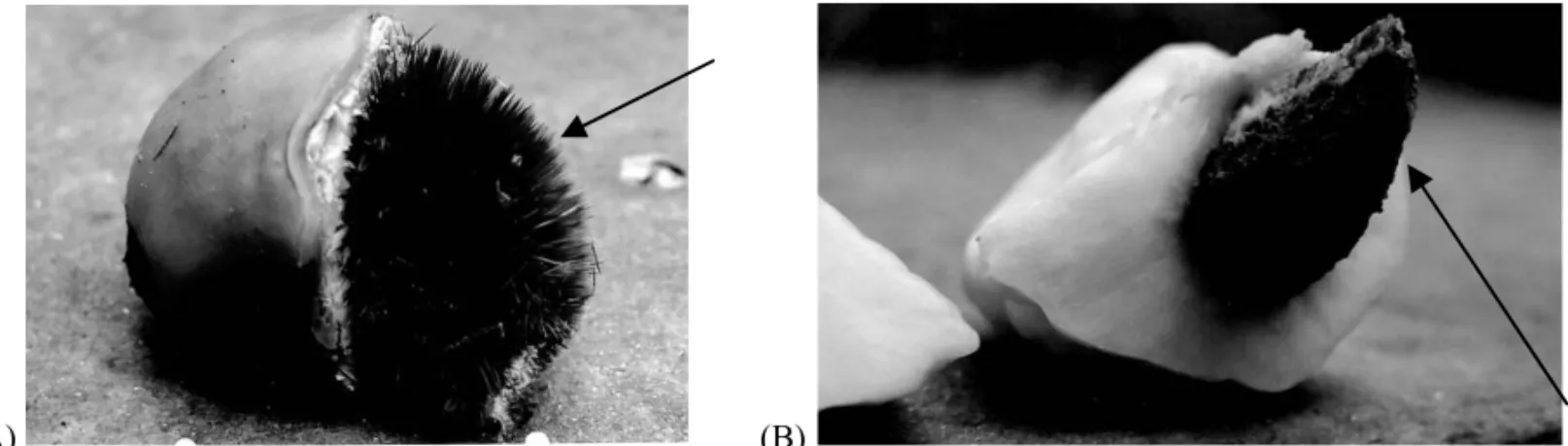
Fig. 3 – Comparison between the pequi with thorn and the one without it at the endocarp. Source: Kerr et al. (2007). (A) Pequi with thorn at the endocarp. Selected fruit showing the endocarp full of little thorns. (B) Pequi without thorn at the endocarp. Selected fruit showing the endocarp without thorns.
The pequi region is spread over almost 2,000 mu-nicipalities, with about 40,000 collectors to sell its fruits or the “seed kernels” to buyers or resellers. The small pharmacies and shamans of the villages and cities of these regions require about 3,000 people to remove the thorns left by the seed kernels at the palate of unaware eaters. This characteristic is the main flaw that eliminates the pequi from being cultivated at home and of being considered as market fruit (R. Gribel, unpublished data, Kerr et al. 2007).
At São José do Xingu, Kerr et al. (2007) interest-ingly found a plant with an endocarp without seed ker-nels, producing about 500 fruits on 2004 and only 30 on 2005, and being the “seed kernels” fleshy, a little sweeter than the common ones and much better than the others due to the absence of thorns (Figs. 3a and 3b).
This fact became a hope for us to have, from 4 to 8 years from now, a distribution ofpequiseedlings without thorn at the mesocarp. This “mutation” presents all the characteristics to turn pequi into a market fruit, as much for the poor populations as for the regular markets of national and foreign fruits. It improves pequi not only for a bigger consumption, but also for home harvesting. Many polymorphisms among pequi populations by using micro-satellites were described. However, the RAPD (Williams et al. 1990) will be used in this paper once it discriminates well the existing polymorphisms among the individuals without thorn from the popula-tions with thorn at the endocarp.
The aim of this paper was to identify standards of polymorphisms by means of RAPD markers, among
pe-qui populations with the prickly endocarp and the indi-viduals without thorns.
MATERIALS AND METHODS
COLLECTIONAREAS
Samples of expanded and healthy leaves were collected from 20 individuals from 5 populations of the Brazil-ian savannah: Clube Caça e Pesca Itororó de Uberlân-dia – UberlânUberlân-dia (MG); urban area of Porto Nacional – Tocantins (TO); Fazenda Arrependidos – Corumbaíba (GO); São José do Xingu – Mato Grosso (MT) (popula-tions with thorn) and São José do Xingu – Mato Gros-so (MT) (populations without thorn). The leaves were stored in an ultra-freezer (–80◦C) at the Laboratory of
Genetics, Institute of Genetics and Biochemistry, Uni-versidade Federal de Uberlândia (MG – Brazil).
GENOMICDNA EXTRACTION
The genomic DNA was extracted by the CTAB method with modifications according to Doyle and Doyle (1990) by using “bulks” of the 20 individuals of the populations with and without thorn, separately, with about 1g of veg-etable tissue.
When homogeneizing the genetic material, the tubes containing the DNA were maintained at the freezer at –20◦C, being unfreezed only before the use.
The amount of extracted DNA was estimated in spectrophotometer, model GBC-UV/VIS911A (SONY), by reading of absorbance at 260nm.
integrity of the extracted DNA. The quantified and eval-uated sample was diluted in milli-Q water for the con-centration of work of 5 ng/µL, and maintained in freezer at –20◦C.
RAPD REACTION(RANDOMAMPLIFIED
POLYMORPHISMDNA)
In order to evaluate the genetic diversity of the accesses, samples of DNAC. brasilienseleaves with and without thorn were amplified through PCR (Polymerase Chain Reaction) for the obtainment of RAPD markers. The re-actions of amplification were made in a volume of 20µL, with 2µL ofTaq10X cap, 3µL dNTP (4 mM), 1µL MgCl2 (2.5 mM), 1 µL of polymerase Taq (1U/mL), 1 µL of primer (10 pmoles), 1 µL of genomic DNA (5 ng) and 11.8µL of milli-Q water. 77 random primers were used, out of which 53 were selected for present-ing better standards of bands (Table I).
The amplifications were done in thermocycler (MJ Research, Inc., model PTC-100), programmed for 40 cycles of 1 minute at 94◦C, 1 minute at 35◦C, and 2
minutes at 72◦C. After the 40 cycles, an extension stage
was done with 8 cycles of 20 seconds at 40◦C, 7 minutes
at 72◦C, and reduction for 4◦C. After the amplification,
in each sample, 2µL of the bromophenol blue mixture (0.25% p/v) and glycerol (60% v/v) were added in wa-ter. 15 µL of each sample was applied in agarose gel 1.5%, colored with Ethidium Bromide (0.5µg/mL) and immersed in TBE 0.5X cap (Tris-Borate 90 mM, EDTA 1 mM). The electrophoretic separation was of 3 hours at 120 volts, after what the gels were visualized and pho-tographed in Image MaterTMVDS Software (Pharmacia Bioscience), and the polymorphic bands were cut under ultraviolet light.
DATAANALYSIS
The generated RAPD markers were converted into a matrix of binary data, from which the genetic distances among the different bulks were estimated. The matrix of genetic distance was done for the analysis of genetic diversity by means of the dendogram.
Duplicates of each gel were done and the bands in both gels were analyzed.
The matrix generated by the STATISTICA 4.5A (1993) program was used for the calculation of the
ge-netic distances and the grouping analysis. The first was calculated by the method of Percentage of Disagree-ment, which is given by the formula: N′
AB/NT, where N′
AB is the total number of polymorphic bands among the compared genotypes, and NTis the total number of generated bands at the process.
The analysis of groups or clusters was made by the non-ponderated method of grouping to pairs using arith-metic averages (UPGMA – “Unweighted pair – group method using arithmetic average”), which aggrupates in-dividuals according to their similarity.
PURIFICATION OF THEBANDS
The unique polymorphic bands visualized at the bulks were cut from the gel with a scalpel and put in a micro-tube of 1.5 ml. The purification occurred by the elution of the DNA in a microtube with three microholes and glass cotton at the bottom, and centrifugation for 5 min-utes at 5,000 rpm. 1/10 of the volume of ammonium acetate 7.5 M, 2 volumes of cold ethanol 100%, and 10µL of glycogen (20 mg/mL) to the centrifuged liq-uid, for overnight precipitation at –20◦C. The solution
was centrifuged for 15 minutes at 13,000 rpm, rejecting the supernatant and the precipitate washed with ethanol 70%, centrifuged again at 13,000 rpm during 5 minutes and re-suspended in 15µL of milli-Q water.
CLONING OF THEAMPLIFIEDPOLYMORPHICFRAGMENTS
The cloning of inserts of interest was done with the pGEMr-T Easy Vector Systems I (Promega) kit, fol-lowing the manufacturer’s recommendations.
PURIFICATION OF THEPLASMIDCONTAINING THEINSERT
The extraction of the DNA was done according to the PerfectpreprPlasmid Mini(EPPENDORF) kit, follow-ing the manufacturer’s protocol.
REACTION OFSEQUENCING INMICROTUBES
TABLE I
Primers used for the PCR reactions for the obtainment of RAPD markers.
Primers Access Nucleotides’ sequency
number
APO1 1 5’CACGGTCTGAGCTGATTGCGTGTTCTC 3’ APO2 2 5’CCCTCCAAAATCAAGTGG 3’
APO4 3 5’AAGTGCTGTAGGCCATTTAGATTAG 3’ OPA1 4 5’ CAGGCCCTTC 3’
OPA2 5 5’ TGCCGAGCTG 3’ OPA3 6 5’ AGTCAGCCAC 3’ OPA4 7 5’ AATCGGGCTG 3’ OPA5 8 5’ AGGGGTCTTG 3’ OPA7 9 5’ GAAACGGGTC 3’ OPA10 10 5’ GTGATCGCAG 3’ OPA11 11 5’ CAATCGTCCGT 3’ OPA12 12 5’ TCGGCGATAG 3’ OPA14 13 5’ TCTGTGCTGG 3’ OPA15 14 5’ TTCCGAACCC 3’ OPA19 15 5’ CAAACGTCGG 3’ OPA20 16 5’ GTTGCGATCC 3’ OPF18 17 5’ TTCCCGGGTT 3’ RCO01 18 5’GCGGTGACCCGGGA 3’ OPC06 19 5’ GAACGGACTC 3’ OPC18 20 5’ CTCACCGTCC 3’
OPI06 21 5’ AAGGCGGCAG 3’
G7 22 5’AAGCCCGACGACCTCACCCGCAGTGC 3’
B2 23 5’CTCGCGCCCGGGATGAAGGTCGTCTTCCXXCCGACGTCCCAGGTC3’ AI 24 5’ TCGGAGGTCAAGTCC 3’
H2 25 5’CTCTAAGCTTGTGACTCAGGCTGACAAATCAGTTGTC 3’ OPD02 26 5’ TGGCCACTGA 3’
OPV3 27 5’ CTCCCTGCAA 3’ OPM16 28 5’ GTAACCAGCC 3’ OPW10 29 5’ TCGCATCCCT 3’ OPC 13 30 5’AAGCCTCGTC 3’ OPC06 31 5’ GAACGGACTC 3’ OPC18 32 5’ TGAGTGGGTG 3’ OPI06 33 5’ TGCCCAGCCT 3’
E2 34 5’CAGAATTCGGAA(AG)TA(GT)ATGA(AG)GGGGTC3’ CL 35 5’ACCTGCAGGCATTCTCCAGAAT 3’
MYR1 36 5’ACACTGGAACGACTGTTACGAG 3’ MYR2 37 5’GGTAATAAGTTCACGAATGTTCATGG 3’ MYR3 38 5’ACAACGCTARAMTCGGACCGATG 3’ MYR4 39 5’TCTGAGTTGTGACGTCCATCG 3’ PRIMER1 40 5’CCATCCACCATCTCAGCATGATGAAA 3’ PRIMER2 41 5’GGTTACTAGTAGTGGGTTTGCTGG 3’ PRIMER3 42 5’TATCGGGCCCAACCCCGACAAT 3’ PRIMER4 43 5’CCTTGAAGCACTTCTGGGAATCAGA 3’ PRIMER5 44 5’CTGACCCTGCAAAGGTAGGCGTATTCACT 3’ PRIMER6 45 5’CTCCGGTCTGAACTCAGATCACGTAGG 3’ PRIMER7 46 5’AAACTGGGATTAGATACCCCACTAT 3’ PRIMER8 47 5’GAGGGTGACGGGCGGTGTGT 3’
R3 48 5’TCGTGTATTCAAATTGGCA 3’
G7 49 5’ ACGGAAGT 3’
G6 50 5’ AATGCGGGCG 3’
ANALYSIS OF THEIDENTITY INGENETICBANKS
An analysis of the identity of sequenced fragments was done using the GenBank data base. The BLAST program (Altschul et al. 1990) was used for the alignment of the sequences obtained from thepequiwith others already deposited at the specific bank of plants.
RESULTS AND DISCUSSION
The DNA standard obtained for the samples was of good quality, which favors the RAPD reactions.
The generated bands at the RAPD enabled the ana-lysis of the genetic variability among the five studied populations (Figs. 4a and 4b).
Out of the 77 primers that were used (Table I), 53 presented a good standard of bands and were selected for the analysis of the results, among these 21 generated polymorphisms (APO1, APO4, G6, G7, MYR1, MYR4, OPA1, OPA3, OPA4, OPA5, OPA7, OPA12, OPA14, OPA15, OPA19, OPI06, P2, P3, P7, P8, R3), which enabled to distinguish the population of pequiwithout thorn from the population with thorn.
The observed markers were as much for the pres-ence of bands in all populations with thorn and their re-spective absence in populations without thorn, as for the presence of bands in population without thorn and ab-sence in other populations with thorn at the endocarp.
The data obtained based on the 53 primers gen-erated 326 fragments of RAPD, which were submitted to the analysis of cluster generating the dendogram of genetic divergence among the populations (Fig. 5).
The populations with smaller genetic divergences are from Minas and Tocantins, presenting a difference of 25% among their genotypes. Minas and Goiás pres-ented a divergence of 30%, whereas these three regions with the Xingu region (population with thorn) pres-ented a genetic divergence of about 37%. The pequi populations without thorn from the Xingu region was genetically isolated from the others, presenting a diver-gence of about 53%.
The molecular characterization of the genotypes is a tool of great importance for the programs of genetic improvement, once crossbreeds among individuals with a greater genetic diversity may contribute to the amplifi-cation in segregating populations, thus enabling a greater genetic gain (Mesmer et al. 1993).
Despite the high genetic similarity among the ana-lyzed populations, it is suggested that the characteristic presence or absence of thorns at the endocarp is related to the genetic divergence of the populations. They may be caused by a punctual mutation or even by chromossomic differences between the individual without thorn and the population with thorn at the mesocarp.
The selection of bands for the purification was based on the polymorphisms detected on the five studied pop-ulations. The cloning and sequences of the fragments generated information about genetic differences (muta-tions) or conserved regions (monomorphisms) among in-dividuals selected for the absence and presence of thorn at the endocarp. The sequences of the clones were de-posited at the GenBank (Accesses numbers ET052997 until ET053017).
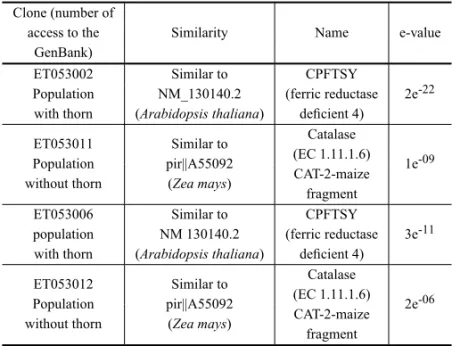
The analysis of BLAST of nucleotides (Table II) demonstrated that, in the population with thorn at the endocarp, the ET053010 clone was shown as similar to the Dof1 gene ofZea mays, whereas in the population without thorn, the ET053000 clone was similar to the phosphinotricin acetyl transferase gene ofZ. mays.
(A) (B)
Fig. 4 – Products amplified by primers of RAPD (OPA3, OPA2 and OPA7, respectively). (A) 1 – marker (100 pb); 2 – Goiás; 3 – Minas Gerais; 4 – Porto Nacional; 5 – São José do Xingu (populations with thorn); 6 – São José do Xingu (populations without thorn) showing polymorphism in the pequi without thorns (black arrows). (B) Monomorphism in the pequi with thorn and absence of the band detected in thepequiwithout thorn (blank arrow). Agarose gel 2% colored with Ethidium Bromide.
Fig. 5 – Representative dendogram of the genetic distanceperpercentage of disagreement and grouping by the UPGMA method among five populations of pequi (Caryocar brasiliense) of the Brazilian savannah using 53 primers. Goiás: Corumbaíba – GO (Fazenda Arrependidos); Minas: Uberlândia – MG (Clube Itororó Caça e Pesca de Uberlândia); Tocantins: Porto Nacional – TO; Xingu_CE: São José do Xingu – MT (pequi with thorn); Xingu_SE: São José do Xingu – Mato Grosso – MT (pequi without thorn).
The phosphinotricin acetyl transferase gene, with which the pequi sequence without thorn demonstrated similarity, catalyses the phosphinotricin acetylation, an analogous of glutamate, a herbicide that exercises the phytotoxic effect on the plants, inhibiting the glutamine
synthetase (Hérout et al. 2005, Hoagland 1999, Gill et al. 2001).
TABLE II
Analysis of Bioinformatics (BLASTn) of the selected clones, by RAPD,
inCaryocar brasiliense(Camb.) with and without thorn at the endocarp.
Clone (number of
access to the Similarity Name e-value GenBank)
ET053010 Similar to Clone pGR25C22
Population DQ490965.1 disrupted DOF1 5e-160 with thorn (Zea mays) (Dof1) gene
ET053000 Similar to phosphinothricin
Population DQ156557.1 acetyltransferase 1e-25 without thorn (Zea mays) gene
TABLE III
Analysis of Bioinformatics (BLASTx) of the selected clones, by RAPD,
inCaryocar brasiliense(Camb.) with and without thorn at the endocarp.
Clone (number of
access to the Similarity Name e-value GenBank)
ET053002 Similar to CPFTSY
Population NM_130140.2 (ferric reductase 2e-22 with thorn (Arabidopsis thaliana) deficient 4)
ET053011 Similar to Catalase
Population pir||A55092 (EC 1.11.1.6) 1e-09 without thorn (Zea mays) CAT-2-maize
fragment
ET053006 Similar to CPFTSY
population NM 130140.2 (ferric reductase 3e-11 with thorn (Arabidopsis thaliana) deficient 4)
ET053012 Similar to Catalase
Population pir||A55092 (EC 1.11.1.6) 2e-06 without thorn (Zea mays) CAT-2-maize
fragment
The effect that these genes exercise in the pequi is un-known. The genomic markers developed in this paper will be able to contribute for an identification of the ge-netic causes of the absence of thorn in the endocarp in the restricted population of São José do Xingu. It is possible to search the metabolical way of these codified proteins in these genes, and their function in the obstruction of the appearance of thorn in the pequi.
The analysis of BLAST of proteins (Table III) de-monstrated similarities of the ET053002 and ET052006 clones to the CPFSTY protein (deficiency in ferric re-ductase 4) ofZ. maysin thepequiwithout thorn. The ET053011 and ET053012 clones presented similarity to the catalase protein ofArabidopsis thalianain thepequi with thorn.
Romheld 1994, Schmidt 1999, Orturk et al. 2007). The increase in the capacity of the roots to reduce iron chelants by the induction of ferric reductase in the plasmatic membrane is another answer for the defi-ciency of iron; the reduction of Fe3+in Fe2+ in the sur-face of roots is an obligatory process to the acquisition of iron in plants (Marschner and Romheld 1994, Robin-son et al. 1999). The acidification of the rhizosphere contributes to the increase of solubility of iron available to plants (Marschner et al. 1986). Catalase is one of the antioxidant enzymes that degradate the oxygenated water (Scandalios et al. 1997). It performs an impor-tant role in the defense of the plant, aging and senes-cence. The catalase activity is influenced by acetylsal-icylic acid and nitric oxide (Yang and Poovaiah 2002, Paterson et al. 1984). The balance between catalase and super-oxide dismutase is crucial in the determina-tion of the level of O2and H2O2in the cell. The process of photo-oxidation during abiotic stress is common in plants, being able to cause cellular destruction and lib-erating reactive species of the oxygen such as the oxy-genated water. (Foyer 1996). The super-reduction of the photosystem II (PSII) occurs when the assimilation of carbon is repressed during the environmental stress, and when the luminosity flow is elevated. In these states of excess of photons, the PSII becomes progressively re-duced and leads the plant to an oxidative stress, produc-ing free and possibly super-oxide oxygen (Krause 1994, Osmond and Grace 1995). In this sense, catalase acts with an antioxidant enzyme in the plants. The role of the protein responsible for the deficiency of ferric reductase and catalase is not known inCaryocar brasiliense. It can be suggested that the deficiency of iron in the roots leads the population without thorns to an environmental stress, repressing the production of thorns at the endo-carp, whereas in the populations with thorn the presence of catalase prevents the oxidative stress and a repression of the thorns production does not occur.
CONCLUSIONS
From the analyzed primers of RAPD, it could be observed that there is a genetic divergence among the populations of pequi with and without thorn at the en-docarp, and that the absence of thorn in the pequi might in part be due to differences in the metabolism route.
However, biochemical and genetic studies are needed to confirm these mechanisms.
ACKNOWLEDGMENTS
This study is part of the Doctoral thesis of the first au-thor and received financial aid of Universidade Fede-ral de Uberlândia, Conselho Nacional de Desenvolvi-mento Científico e Tecnológico (CNPq) and Coorde-nação de Aperfeiçoamento de Pessoal de Nível Superior (CAPES).
RESUMO
Pequi,Caryocar brasiliense, é uma das espécies de destaque no bioma do cerrado brasileiro, devido a sua utilização na medicina, na culinária popular, indústria em geral, e na do ferro e do aço. Na região de São José do Xingu (MT), uma árvore de pequi sem espinho no endocarpo foi encontrado e isso permite melhorar pequi não só para o consumo, aprovei-tando a alta apreciação que já possui. Para detectar as dife-renças existentes entre o genoma de pequi com e sem espinho no endocarpo, marcadores moleculares RAPD foram utiliza-dos. Os polimorfismos gerados foram clonados e sequencia-dos, a fim de identificar as sequências responsáveis pela al-teração fenotípica. Observou-se que o pequi sem espinho é geneticamente isolado de outras populações de pequi com es-pinho no endocarpo, provando que essa característica está rela-cionada com a divergência genética da espécie. Análise em Blastn evidenciou a similaridade dos genes Dof1 e com o gene da fosfinotricina-acetiltransferase deZ. mays. Na análise da
BLASTx, a similaridade foi verificada com as proteínas res-ponsáveis pela deficiência de ferro 4 redutase e catalase.
Palavras-chave: Caryocar brasiliense, pequi, espinho, RAPD.
REFERENCES
ALENCARG. 2000. Pequizeiros enfrentam riscos de extinção. Hoje em dia, 7 p.
ALMEIDASPANDSILVAJA. 1994. Pequi e buriti: importân-cia alimentar para a população dos cerrados. Planaltina: EMBRAPA-CPAC, (Documentos, 54), 38 p.
ALMEIDA SP, PROENÇA CEB, SANO EMAND RIBEIRO
JF. 1998. Cerrado: espécies vegetais úteis. Planaltina: EMBRAPA-CPAC, 464 p.
ALTSCHUL SF, GISHW, MYERS EW ANDLIPMAN DJ.
ARAUJOFDDE. 1995. A review ofCaryocar brasiliense
(Caryocaraceae) an economically valuable of central Brazilian Cerrados. Economic Botany 49: 40–48. BARRADASMM. 1972. Informações sobre a floração,
frutifi-cação e dispersão do pequi (Caryocar brasilienseCamb.) (Caryocaraceae). Cienc cult 24: 1063–1068.
BAUMANNK,DEPAOLISA, COSTANTINOP ANDGUAL
-BERTIG. 1999. The DNA binding site of the Dof protein NtBBF1 is essential for tissue-specific and auxin-regulated expression of the rolB oncogene in plantas. Plant Cell 11: 323–333.
BRANDÃOM, LACA-BUENDÍAJPANDMACEDOJF. 2002. Árvores nativas e exóticas do Estado de Minas Gerais. Belo Horizonte: EPAMIG, 528 p.
BUCKHOUTTJ, BELLPF, LUSTERDGANDCHANEYRL. 1989. Iron-stress induced redox activity in tomato ( Ly-copersicon esculentumMill) is localized on the plasma membrane. J Plant Physiol 90: 151–156.
CAVALAR M, PHLIPPEN Y, KREUZALER F AND PETER
-HANSELC. 2007. A drastic reduction in Dof 1 transcript levels does not affect C4-specific gene expression in maize. J Plant Physiol 164: 1665–1674.
CHEN W, CHÃO GANDSINGHKB. 1996. The promoter
of na H2O2-inducible,Arabidopsis glutathione
S-transfer-ase gene contains closely linkek OBF- and OBP1 binding sites. Plant J 11: 955–966.
COHENCK, NORVELLWAANDKOCHIANLV. 1997. In-duction of the root cell plasma membrane ferric reductase. J Plant Physiol 114: 1061–1069.
CORNEREJH. 1976. The seeds of dicotiledons. Cambridge:
Cambridge University 1: 311.
DOYLEJJ ANDDOYLE JL. 1990. Isolation of plant DNA from fresh tissue. Focus 12: 13–15.
FOXTC, SHAFFJE, GRUSAKMA, NORVELLWA, CHEN
Y, CHANEYRLANDKOCHIANLV. 1996. Direct
mea-surement of59Fe-labeled Fe2+influx in roots of pea using
a chelator buffer system to control free Fe2+in solution. J Plant Physiol 111: 93–100.
FOYERCH. 1996. Oxygen processin in photosynthesis. Bio-chem Soc Trans 24: 427–433.
GILLHS, PFLUEGL GMUANDEISENBEGD. 2001. The crystal structure of phosphinothricin in the active site of glutamine synthetase illuminates the mechanism of enzy-matic action. Biochemistry 40: 1903–1912.
HÉROUT C, ESDAILE DJ, MALLYON BA, DEBRUYNE E, SCHULZ A, CURRIERT, HENDRICKXK, KLISRAND
ROUAN D. 2005. Safety evaluation of the
phosphino-thricin acetyltransferase proteins encoded by the pat and
bar sequences that confer tolerance to glufosinate-ammo-nium herbicide in transgenic plants. Regul Toxicol Pharm 41: 134–149.
HOAGLAND RE. 1999. Biochemical interactions of the
microbial phytotoxin phosphinothricin and analogs with plants and microbes. In: CUTLERHGANDCUTLERSJ (Eds), Biologically active natural products: agrochemi-cal. Boca Raton, FL: CRC Press, 107 p.
INSKEEP WPAND BLOOMPR. 1987. Soil chemical
fac-tors associated with soybean chlorosis in calciaquolls of western Minnesota. Agron J 79: 779–786.
KANGHGANDSINGHKB. 2000. Characterization of sali-cylic acid-responsive,ArabidopsisDOF domain proteins: over-expression of OBP3 leads to growth defects. Plant J 21: 329–339.
KERRWE, SILVAFRDA ANDTCHUCARRAMAEB. 2007.
Pequi (Caryocar brasilienseCamb.). Informações preli-minares sobre um pequi sem espinhos no caroço. Rev Bras Frutic 29: 169–171.
KISU Y, ONO T, SHIMOFURUTANI N, SUZUKI M AND
ESAKA M. 1998. Characterization and expression of a
new class of zinc finger protein that binds to silencer re-gion of ascorbate oxidase gene. Plant Cell Physiol 39: 1054–1064.
KOCHIAN LV. 1991. Mechanisms of micronutrient uptake and translocation in plantas. In: MORTVEDT JJ, COX
FR, SHUMANLMANDWELCHRM (Eds), Micronutri-ents in Agriculture, 2nded., Soil Sci Soc Am J, Madison, WI, p. 229–296.
KRAUSEGH. 1994. The role of oxygen in photoinhibition of photosynthesis. In: FOYERCHANDMULLINEAUXPM
(Eds), Causes of photooxidative stress and amelioration of defense systems in plants. CRC Press, Boca Raton, FL, p. 43–79.
LOPESPSN, SOUZAJCDE, REISPR, OLIVEIRAJMAND
ROCHA IDF. 2003. Caracterização do ataque da broca dos frutos do pequizeiro. Rev Bras Frutic 25: 540–543. MARSCHNER H AND ROMHELD V. 1994. Strategies of
plants for acquisition of iron. Plant and Soil 165: 261– 274.
MARSCHNERH, ROMHELDVANDKISSELM. 1986. Dif-ferent strategies in higher plants in mobilization and up-take of iron. J Plant Nutr 6: 695–713.
MENA M, VICENTE-CARBAJOSA J, SCHMIDT RJ AND
CARBONEROP. 1998. Na endosperm-specific DOF
pro-tein from barley, highly conserved in wheat, binds to and activates trasncription from the prolamin-box of a native
β-hordein promoter in barley endosperm. Plant J 16:
MESMER MM, MELCHINGER AR, HERMANN RR AND
BOPPERNMAIERJ. 1993. Relationships among early
Eu-ropean maize inbreeds: I. Comparasion of pedigree and AFLP data. Crop Science 33: 944–950.
ORTURKL, YAZICIA, EKERS, GOKMENO, ROMHELDV
ANDCAKMAKI. 2007. Glyphosate inhibition of ferric reductase activity in iron deficient sunflower roots. New Phytologist 177: 899–906.
OSMONDCBANDGRACESC. 1995. Perspectives on
pho-toinhibition and photorespiration in the field: quintessen-tial inefficiencies of the light and dark reactions of photo-synthesis? J Exp Bot 46: 1351–1362.
PATERSON BD, MACRAEEAANDFERGUSONIB. 1984. Estimation of hydrogen peroxide in plant extracts usin ti-tanium (IV). Anal Biochem 139: 487–492.
RIBEIRO AE. 1996. O espaço, o homem e o seu destino
no norte de Minas. In:UNIVERSIDADE FEDERAL DE
LAVRAS. Departamento de Administração e Economia. Manejo sustentado do cerrado para uso múltiplo: subpro-jeto agroecologia e desenvolvimento. Lavras, p. 89–152. ROBINSONNJ, PROCTERCM, CONNOLLYELANDGUE -RINOTML. 1999. Aferric-chelate reductase for iron up-take from sils. Nature 397: 694–697.
SANTOS BR, PAIVA R, DOMBROSKI JLD, MARTINOTTO
C, NOGUEIRARCANDSILVAAAN. 2007. Pequizeiro (Caryocar brasilienseCamb.): uma espécie promissora
do cerrado brasileiro.
<http://www.editora.ufla.br/Boletim/pdf/bol_64.pdf>. Accessed on: Sept 3, 2007.
SCANDALIOS JG, GUAN LM AND POLIDOROS A. 1997. Oxidative Stress and the molecular biology of antioxidant defenses. In: SCANDALIOSJG (Ed), Cold spring Harbor Lab. Press, Plainveiew, NY, p. 343–406.
SCHMIDTW. 1999. Mechanisms and regulation of reduction-based iron uptake in plants. New Physiology 141: 1–26. SIJMONSPC,VAN DERBRIELWANDBIENFAITHF. 1984.
Cytosolic NADPH is the electron donor for extracellu-lar Fe(III) reduction in iron-deficient bean roots. J Plant Physiol 75: 219–221.
VICENTE-CARBAJOSA J, MOOSE SP, PARSONS E AND
SCHMIDTRJ. 1997. A maize zinc-finger protein binds
the prolamin box in zein gene promoters and interacts with the basics leucine zipper transcriptional activator Opaque2. Proc Natl Acad Sci USA 94: 7685–7690. WILLIAMS JGK, KUBELIK AR, LIVAK KJ, RAFALSKI
JAANDTINGEYSV. 1990. DNA polymorphisms
am-plified by arbitrary primers are useful as genetic markers. Nucleic Acid Res 18: 6531–6535.
YANAGISAWAS. 1996. DOF DNA binding proteins contain a novel zinc finger motif. Trends Plant Sci 1: 213–214. YANAGISAWAS. 2000. Dof1 and Dof2 transcription factors
are associated with expression of multiple genes involved in carbon metabolism in maise. Plant J 21: 281–288. YANAGISAWAS ANDIZUI K. 1993. Multiple interactions
between tissue-specific nuclear proteins and the promoter of the phosphoenolpyruvate carboxylase gene for C4 pho-tosynthesis inZea mays. Mol Gen Genet 224: 325–332. YANAGISAWASANDSHEENJ. 1998. Involvement of maize
Dof zinc finger proteins in tissue-specific and light-regu-lated gene expression. Plant Cell 17: 209–214.
YANAGISAWAS, AKIYAMA A, KISAKA H, UCHIMIYA H
ANDMIWAT. 2004. Metabolic engineering with Dof1
transcription factor in plants: Improved nitrogen assim-ilation and growth under low-nitrogen conditions. Proc Natl Acad Sci USA 10: 10.
YANG T AND POOVAIAH W. 2002. Hydrogen peroxide homeostasis: activation of plant catalase by calcium/cal-modulin. PNAS 99: 4097–4102.
ZHANGB, CHENW, FOLEYRC, BUTTNERMANDSINGH