(Annals of the Brazilian Academy of Sciences) ISSN 0001-3765
www.scielo.br/aabc
OSL age determinations of Pleistocene fluvial deposits in Central Amazonia
EMÍLIO A.A. SOARES1, SONIA H. TATUMI2 and CLAUDIO RICCOMINI3 1Departamento de Geociências, Universidade Federal do Amazonas
Av. Gal. Rodrigo O.J. Ramos, 3000, 69077-000 Manaus, AM, Brasil
2Faculdade de Tecnologia de São Paulo, Praça Cel. Fernandes Prestes, 30, 01124-060 São Paulo, SP, Brasil 3Departamento de Geologia Sedimentar e Ambiental, Programa de Pós-Graduação em Geoquímica e Geotectônica
Instituto de Geociências, Universidade de São Paulo, Rua do Lago, 562, 05508-080 São Paulo, SP, Brasil
Manuscript received on February 17, 2009; accepted for publication on July 21, 2009
ABSTRACT
Absolute dating methods have been used in chronological studies of geological processes and sedimentary units of Quaternary age in Central Amazonia, Brazil. Although radiocarbon dating has been very useful in archaeological research and soil studies, the temporal interval of this method is inefficient in evaluating the sedimentation aspects and geological events from the beginning of the Quaternary in the Amazon basin. The use of crystal luminescence dating has been one of the most promising tool for determining the absolute dating of Quaternary deposits in the Amazonian region. Optically stimulated luminescence (OSL) dating, following the MAR and SAR protocols, in a tectonic-sedimentary study of Quaternary fluvial deposits in the confluence area of the Negro and Solimões rivers, indicated ages from 1.3 (Holocene) to about 67.4 kyears (Late Pleistocene) for these sediments. Low radioactive isotope concentrations were found about 2ppm for235U and238U; 5ppm for232Th; and the40K concentrations were almost zero. A comparison was made between MAR and SAR protocols taking into account the fluvial depositional process.
Key words:crystal luminescence dating, Quaternary, fluvial terraces, Central Amazonia.
INTRODUCTION
The stratigraphy of Cretaceous and Cenozoic deposits in the Amazon basin has not yet been completely es-tablished due to the lack of geochronological dating. Isolated measurements based on palynomorphs allowed age-determinations of some intervals of Cretaceous and Miocene units, while radiocarbon dating is restricted to the most recent time-interval of the Quaternary. Further-more, the lack of sedimentary and stratigraphic studies has avoided the means by which to adequately analyze inter and intra-basin correlations among Quaternary de-posits. These deposits are relatively thick, reaching tens of meters, and have become homogenized due to weath-ering. A large part of Quaternary deposits in the con-fluence zone of the Negro and Solimões rivers has been
Correspondence to: Emílio Alberto Amaral Soares E-mail: [email protected]
In the last few decades, absolute dating of Qua-ternary deposits in Brazil has involved the use of the crystal luminescence method (J.C. Stevaux, unpublished data, S.R. Dillenburg, unpublished data, Suguio et al. 2003, Gianinni et al. 2003, Tatumi et al. 2006, among others). Although, in the Amazon the use of this tech-nique is still fairly new (Carneiro-Filho et al. 2002, Teeuw and Rhodes 2004, Tatumi et al. 2007), it has been shown to be efficient in analyses of Quaternary deposits taken from regions around the cities of Man-aus and Manacapuru. In this study, quartz crystals were dated utilizing the OSL method using single (SAR) and multiple aliquots regeneration (MAR) protocols (Mur-ray and Wintle 2003). Age results were correlated to the migration of past fluvial systems in the region.
QUATERNARY GEOCHRONOLOGICAL ASPECTS IN THE AMAZON
The chronology of the main geological processes of the Quaternary can be calibrated with measurements of short and middle half-life radioisotope concentrations. In the Amazon, the 14C method has been effectively used to date carbon included in ceramic fragments and organic carbon remains from archaeological sites (Pe-tersen et al. 2001, Hornborg 2005, Machado 2006, Schaan 2007) and soils (Sanford et al. 1985, Saldarriaga and West 1986, Bassini and Becker 1990, Santos et al. 1999a, Freitas et al. 2001, 2002), as well as identifying intervals of paleoclimatic changes (Absy 1982, Martin et al. 1993, Turcq et al. 1993, 1998, Behling et al. 2001). The chronological interval of the14C method, which is
restricted to the last thirty fo forty thousand years, has limited the study of older deposits from Amazonian flu-vial systems. Furthermore, the validity of previous age measurements for these deposits is now questioned, as well as the resolution of the 14C method being insuffi-cient for accurately dating such older deposits. Also, if collections were taken from areas close to the surface, these deposits could become contaminated by organic-rich soil material (Irion et al. 2005). Considering these limitation, dating by crystal luminescence has become one of the most promising tools for determining absolute age of diverse Quaternary sedimentary deposits (Suguio
those from fluvial systems (Page et al. 1996, Fuller et al. 1998, Mozzi et al. 2000, Nanson et al. 2005, Sylvia and Galloway 2006).
The methods of thermoluminescence (TL) and op-tically stimulated luminescense (OSL), following the MAR protocol, have been used for dating aeolian paleo-dunes in the middle Negro river (Carneiro-Filho et al. 2002, Teeuw and Rhodes 2004) and overlying sediments of the Barreiras Formation in northeastern Pará State (Tatumi et al. 2007). The application of the OSL method, in accordance with the MAR and SAR protocols, has also proved to be efficient in the study of Quaternary fluvial deposits from the confluence area of the Negro and Solimões rivers in Amazonas State (E.A.A. Soares, unpublished data) (Fig. 1). In the present study, the as-sociation of geochronological data with sedimentary and stratigraphic analyses has set the foundation for inter-preting regional tectonics dating back to 420,000 years, as well as the evolution of fluvial dynamics over the last 62,000 years. These developments, in turn, have cre-ated new perspectives for understanding the last phase of sedimentation in the Amazon basin.
GEOLOGICAL SETTING
Evidence of the Quaternary tectonic and sedimentary history of the Solimões-Amazon river system is regis-tered in fluvial terrace deposits found in the confluence zone of the Negro and Solimões rivers, developed over the Cretaceous (Alter do Chão Formation) and Neogene (Novo Remanso Formation) siliciclastic units (Fig. 1). Extensional tectonics originated tectonic depressions that have controlled the Pleistocene sedimentation in-fluenced by Solimões river (Paraná do Ariaú – GPA and Lago do Miriti – GLM grabens) and Negro river (Ca-cau do Pirera – GCP and Cachoeira do Castanho – GCC grabens) dynamics.
Cre-Fig. 1 – Geological setting and location of studied sites.
taceous and Miocene rocks and with restricted alluvial plain, whereas the fluvial pattern of the Solimões river has changed during the Holocene. The terraces of So-limões river show scroll-bars morphology with inclined heterolithic stratification, indicating a meandering chan-nel pattern.
During the Late Pleistocene and Early Holocene, sea level rise, together with the change to a more hu-mid climate, caused an increased aggradation rate of suspended fine-grained sediments that allowed a greater cohesion of channel margin stabilized by the growth of abundant vegetation. Such conditions favored the devel-opment of the current anastomosing-anabranchingstyle of the Solimões-Amazonas system.
METHODS
For OSL dating procedure, the samples were collected with PVC and aluminum tubes of 25-50 cm in length, and 5 cm in diameter at the locations shown on the ge-ological map (Fig. 1). All the samples are sediments deposited by fluvial system, and those collected at high points of the terrace, where the water contents are about 2-3%, and they did not remain immersed during long
periods of the year. However, for 5 samples we con-sidered water saturated content and the samples were submerged during half year; therefore, we adopted the value of 15% in these cases (Table I).
Pure quartz grains of 180-250µm in grain size
were separated after being treated with H2O2for 4 hours,
20% HF for 45 min, 20% HCl for 2 hours, and heavy liquid (SPT) treatments. Feldspar crystals were not ob-served in the samples during a test using OSL measure-ments with IR stimulation. OSL measuremeasure-ments were recorded with a model 1100-series automated TL/OSL system, of Daybreak Nuclear and Medical Systems Inc. For quartz stimulation, green and blue lights were ap-plied and the OSL signal detected with a U-340 optical filter. The samples amounts were weighted before each measurement for intensities normalizations. Gamma ir-radiations were carried out with a60Co source delivering
(110.0±5.5) mGy/s, and lucite plates were used to
U Th K-40 Water ADc.r. AD Age (ka) Age (ka) Sample
(ppm) (ppm) (%) content P (Gy) (µGy/a) (Gy/ka) MAR SAR
(%)
NS-20A 1.90±0.25 4.95±0.18 0.14±0.02 2 53±12 178 1.16±0.9 45.6±14.0 65.0±2.4 NS-28A 0.99±0.08 2.22±0.08 0.07±0.02 2 36.6±8.6 178 0.66±0.04 55.3±16.3 65.0±2.4
NS-74B 1.80±0.21 4.38±0.16 0.84±0.12 15 76±10 178 1.56±0.19 48.6±12.3 44.7±1.8
NS-143 2.04±0.22 5.79±0.21 0.31±0.05 15 8.7±1.8 178 1.25±0.12 7±2 8.9–13.0 NS-268 2.13±0.13 6.30±0.23 0.79±0.11 15 2.3±0.4 178 1.71±0.16 1.3±0.4 1.6±0.1
NS-198 1.75±0.04 5.27±0.13 0.02±0.01 2 68.2±7.2 198 1.05±0.03 65.2±8.8
NS-230 1.45±0.03 4.37±0.11 0.01±0,01 3 53.9±4.3 198 0.89±0.26 60.7±6.6 NS-242 1.58±0.04 4.76±0.12 0.01±0.01 15 6.4±0.5 198 0.85±0.03 7.5±0.9
NS-238 1.66±0.04 4.98±0.13 0.08±0.01 15 32.4±3.1 198 0.94±0.03 34.5±4.4
NS-224 0.70±0.02 2.10±0.05 0.01±0.01 2 229±20 198 0.54±0.09 427±44 NS-030 1.84±0.04 5.69±0.04 0.02±0.001 2 284±26 198 1.10±0.26 249±30
51×13mm, and a lead shield was used, model 727
(Can-berra). Each sample contained 100 g and was measured for 7 days. To calibrate the method, four standard soils samples were used (JR-1, JB-3, JG-1a and JG-3) and the applied energy peaks were: 295, 609 and 1120keV for U; 338 and 2620keV for Th; and 1460keV for K. Cosmic rays contribution was measured in situ (S 01◦ 28.894′; W 048◦ 27.207′), giving a value of 178µGy/ year, and for another sampling sites the rate was cor-rected by equations cited in Prescott and Hutton (1994). A total of eleven samples were dated by MAR, and five samples were selected to be dated by SAR (Murray and Wintle 2000, 2003). In the adopted MAR proto-col, using the total regeneration method, all the aliquots (with the exception of the natural aliquots, about 10) are bleached to near zero by sunlight exposure during 16 hours and then given laboratory doses. Preheating tem-perature was chosen after a series of experiments with effects of preheating at 200, 220 and 240◦C on the re-generative signals; these experiments demonstrated that the temperatures of 200◦C yielded the most reproduc-tive paleodoses. Following preheating, the OSL shine down curves of the aliquots were measured, the late-light regions were subtracted (Aitken and Xie 1992), and the paleodose values were obtained by direct comparison of the natural OSL with the ones resulting from artificial irradiations.
SAR protocols were performed following Murray and Wintle (2000). Preheating temperature was the same used for MAR protocol. Test for dose recovery was
performed and the results showed that recovered dose matches the given dose. For the paleodose determina-tions, at least 20 aliquots were measured per sample.
RESULTS AND DISCUSSION
In order to study fluvial system deposits in the Ama-zon, geochronological data obtained by radiocarbon dat-ing and crystal luminescence should be associated with reliable stratigraphic analyses. Samples must be col-lected from layers that do not show signs of them being re-exposed, reworked or contaminated by surficial pro-cesses, which means all factors that compromise the effi-ciency of the used methods. Elevated levels of precipita-tion, humidity and weathering (predominantly chemical) in tropical regions can cause erroneous dating calcula-tions. For example, in radiocarbon dating, the contam-ination of a sample by present-day carbon can result in mistaking a much older sample for a younger one (Santos et al. 1999a, b). Therefore, the application of radiocar-bon dating should be restricted to more recent units.
dissolution and/or remobilization caused by interstitial solutions, the calculated age could be determined to be older than the actual age because of an underestimation of the actual radiation rate.
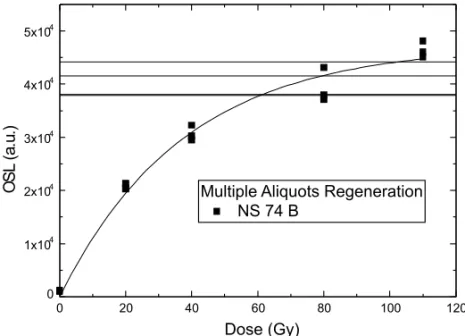
A typical calibration curve obtained for the sam-ples employed in this study using MAR displays an ex-ponential growth with saturation. Figure 2 shows an example curve obtained for sample NS-74B, with the paleodose of 76±10 Gy. The paleodose uncertainties
adopted for MAR are the standard deviation of the mean. Although the natural fluctuations in TL levels are large, the OSL values of aliquots recuperated with irradiation in the laboratory oscillated with the same uncertainty observed in natural OSL conditions. Therefore, either the OSL signal of the sample had not decayed homoge-neously during deposition, or this fluctuation is due to intrinsic properties associated with defects found within the grains. The uncertainties of P were found to be ap-proximately 20%, with the exception of NS-143, which was 44% (Fig. 3). These percentages will be later dis-cussed in reference to the results of the SAR experi-ments. The P results and dating measurements in accor-dance with the MAR are shown in Table I.
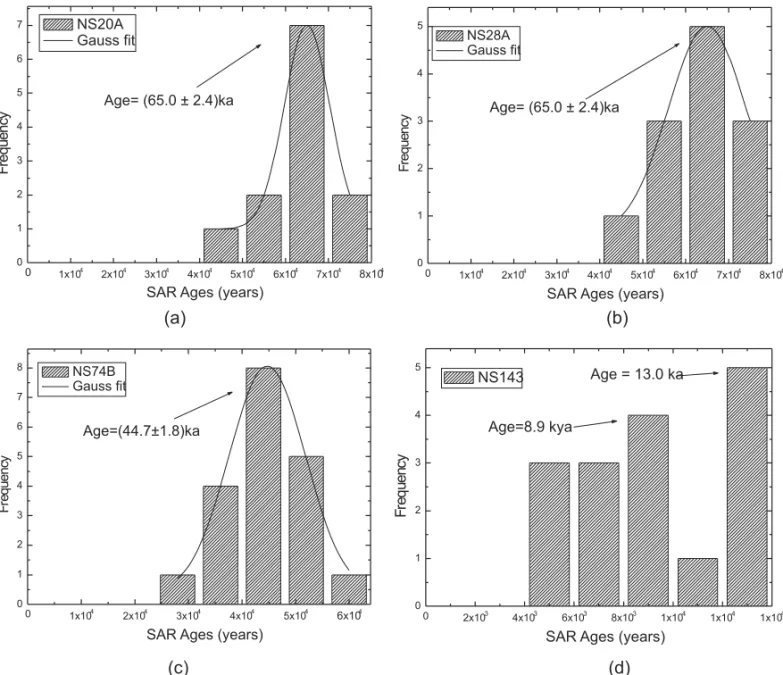
Equivalent dose, De, was evaluated by SAR, and the age histogram frequencies were fitted with Gaussian equation; in the cases when it was observed a broad dis-tribution, the outliers are omitted from the calculation. The number of the aliquots ranges from 12 to 19.
In Figure 3a, one can observe that almost symmet-rical frequency of the ages was obtained, for sample NS-20A, after the adjustment of the data to a Gaussian dis-tribution. The average age of the sample was calculated at 63.3±2.4 kyears. The correct age using Gaussian
fitting is most likely 65.0±2.4 kyears. Ages
uncertain-ties that were used are standard errors on the mean. The symmetry of the curve indicates that, at the time of de-position, the OSL value of the sample was essentially erased. As the width of the Gaussian distribution is not so large, about 10.6 kyears, and most of the frequency is centered on the average, one can deduce that the deposi-tion of this layer occurred within a short span of time.
The result of sample NS-28A (Fig. 3b) also pres-ents a symmetrical frequency. Considering the Gaussian frequency curve, the age of this sample is about 65.0±
2.4 kyears, and the average age was almost the same at
65.5±2.4 kyears. The coincidence of ages presented
by samples NS-20A and NS-28A, from the GPA, rein-forces the age of upper terrace of Ariaú river.
For sample NS-74B (Fig. 3c), the histogram pres-ents a normal distribution centered at the age of 44.7±
1.8 kyears. Curve symmetry maybe indicates that, at the moment of deposition, the OSL values were near to zero and the grains were practically bleached homoge-neously. As with sample NS-20A (Fig. 3a), the width of the Gaussian distribution is about 10 to 15%, and most of the frequency is centered near the average. In the frequency histogram of sample NS-143 (Fig. 3d), an ir-regular distribution was obtained and the values suggest that the deposition occurred within a time interval of be-tween 8.9 and 13 kyears. The age of sediments from the GCC (sample NS-74B) indicates the beginning of the deposition in the Negro river.
Sample NS-268 mainly presented low age values, with the largest concentration at 1.6±0.1 kyears and
other smaller fluctuations dating up to 2.3 kyears. Based on stratigraphy data of E.E.A. Soares (unpublished data), the age of this sample should be intermediary be-tween the ages obtained for samples 20A and NS-143. Therefore, this low age is probably due to sub-aerial exposure of reworked sediments by the dynamics of secondary channels on alluvial plain. It should be noted that, currently, there are not sediments deposited above this unit.
The oldest fluvial terrace deposit of the Solimões river, represented by the sites NS-198 and NS-230 (Fig. 1, Table I), were also dated by OSL dating using the MAR protocol, yielding ages of 65.2 ±8.8 and 60.7
±6.6 kyears, respectively. These dates are compatible
with those obtained from the oldest terrace deposits of the Ariaú river (from the GPA) (Fig. 3a and b), and re-flect the beginning of the Quaternary sedimentation in the region, which relates directly to the establishment of meandering fluvial systems of the Solimões and Ariaú rivers during this time-interval. Deposits from the lower terrace, represented by the sites NS-242 and NS-238 (Fig. 1), yielded ages between 7.5 ± 0.9 and 34.5 ±
Fig. 2 – OSL calibration curve using the method of multiple aliquots and total re-generation method for the sample NS-74. See figure 1 for the location of the sample.
and at the same time it was recorded the final mean-dering phase of the rivers in the region. An older age (sample NS-030) of about 249 kyears was determined for intermediate terrace deposits of the Solimões river through extrapolation of the age intervals obtained for the upper and lower terraces. This result means that the OSL signal of the grains was not erased at the time of deposition probably due to rapid sedimentation and/or sub-aqueous transport.
Using the MAR protocol, the material from the GCP tectonic depression (Fig. 1) was dated at 427 ±
44 kyears (sample NS-224) (Table I). The age of this material probably reflects the last period of sub-aerial exposure of the Miocene Novo Remanso Formation be-fore the Pleistocene sedimentaion. During the exposure, the quartz grains had their previous OSL signal erased and were submitted to forceful ionizing radiation (cos-mic rays and radioactive isotopes), which started a new accumulation of energy in the crystalline perimeter of the mineral.
CONCLUSIONS
The application of crystal luminescence dating methods in sediments, in accordance with the MAR and SAR pro-tocols, has contributed to a better understanding of the tectonic-sedimentary evolution in the confluence of the Negro and Solimões rivers, in Central Amazonia.
Dating of approximately 430 kyears was deter-mined for the material from the top layer of the Miocene Novo Remanso Formation in the GCP and indicates the last phase of sub-aerial exposure of this unit before the Pleistocene deposition.
The age of approximately 44 kyears obtained for sediments from the GCC indicates the beginning of sed-imentation in the Negro river.
The OSL results for the deposits of fluvial terraces of the Solimões and Ariaú rivers revealed a continuous range of ages arranged along the analyzed units, which ranged from 65.2 to 7.5 kyears. This variation represents lateral accretion events that occurred during the phases of channel migration of fluvial systems in the region.
Fig. 3 – Histograms of ages utilizing the OSL method with SAR protocols for Quaternary sedimentary deposits of the alluvial floodplain of the GPA (NS20A, NS28B, NS143) and CGC (NS74) grabens.
ACKNOWLEDGMENTS
We thank the two anonymous reviewers for their con-structive suggestions which helped in improving this paper. This study is a part of the doctoral thesis of the senior author developed with financial support of Coor-denação de Aperfeiçoamento de Pessoal de Nível Supe-rior (CAPES-PQI, grant 00044/03-2). S.H. Tatumi and C. Riccomini are research fellows of Conselho Nacional de Desenvolvimento Científico e Tecnológico (CNPq, Brazil).
RESUMO
Métodos de datação absoluta têm sido usados em estudos cro-nológicos de processos geológicos e unidades sedimentares de
se os processos deposicionais fluviais envolvidos.
Palavras-chave: datação por luminescência de cristais, Qua-ternário, terraços fluviais, Amazônia Central.
REFERENCES
ABSY ML. 1982. Quaternary palynological studies in the
Amazon Basin. In: PRANCEGT (Ed), Biological diver-sification in the tropics. New York: Columbia University Press, p. 67–73.
AITKENMJANDXIEJ. 1992. Optical dating using infrared
diodes: young samples. Quat Sci Rev 11: 147–152. BARRETOAMF, SUGUIOK, BEZERRAFHR, TATUMISH,
YEEMANDGIANNINIPC. 2004. Geologia e
geomor-fologia do Quaternário Costeiro do Estado do Rio Grande do Norte. Geol USP Ser Cient 4: 1–12.
BASSINI F ANDBECKER P. 1990. Charcoal’s occurrence in soil depends on topography in terra firme forest near Manaus, Brazil. Biotropica 22: 420–422.
BEHLING H, KEIM G, IRION G, JUNK W AND MELLO
JN. 2001. Holocene environmental changes in the Cen-tral Amazon Basin inferred from Lago Calado (Brazil). Palaeogeogr Palaeoclimatol Palaeoecol 173: 87–101. BLUMMD ANDTÖRNQVISTT. 2000. Fluvial response to
climate and sea-level change: a review and look forward. Sedimentology 47: 2–48.
CARNEIRO-FILHOA, SCHWARTZD, TATUMISHANDRO
-SIQUET. 2002. Amazonian paleodunes provide evidence for drier climate phases during the Late Pleistocene-Holo-cene. Quat Res 58: 205–209.
CARTAGEOLÓGICA DOBRASIL AOMILIONÉSIMO. 2004. Brasília: Ministério de Minas e Energia/CPRM/Serviço Geológico do Brasil.
FRANZINELLIE ANDIGREJA H. 2002. Modern sedimen-tation in the lower Negro River, Amazonas State, Brazil. Geomorphology 44: 259–272.
FRANZINELLIEANDLATRUBESSEE. 1993. The use of re-mote sensing in a neotectonic study in the Amazon Basin. Bull INQUA 16: 10–13.
FRANZINELLIEANDPIUCCIJ. 1988. Evidências de
neotec-tonismo na Bacia Amazônica. In: CONGRESSOLATINO -AMERICANO DEGEOLOGIA 7, São Paulo, Boletim de Resumos Expandidos, SBG, p. 80–90.
FRANZINELLIEANDROSSIA. 1996. Contribuição ao estudo
petrográfico e geoquímico do Arenito Manaus. In: SIM
-FREITAS HA, PESSENDA LCR, AVARENA R, GOUVEIA
SEM, RIBEIROASANDBOULETR. 2001. Late
Quater-nary vegetation dynamics in the southern Amazon Basin inferred from carbon isotopes in soils organic matter. Quat Res 55: 39–46.
FREITAS HA, PESSENDA LCR, AVARENA R, GOUVEIA
SEM, RIBEIROASANDBOULETR. 2002. Savana no passado da Amazônia. Cienc Hoje 32: 41–46.
FULLERIC, MACKLINMG, LEWINJ, PASSMOREDGAND
WINTLEAG. 1998. River response to high-frequency climate oscillations in southern Europe over the past 200 K.y. Geology 26: 275–278.
GIANNINIPCF, GUEDESCCF, ASSINEML, ANGULORJ,
SOUZAMC, PESSENDALCRANDTATUMISH. 2003. Variação transversal e longitudinal de propriedades sedi-mentológicas nos cordões litorâneos da ilha Comprida, litoral sul paulista. In: ABEQUA, 9, Boletim de Resumos, CD-ROM.
HORNBORG A. 2005. Ethnogenesis, regional integration,
and ecology in Prehistoric Amazonia. Curr Anthropol 46: 497–527.
IRIONG, RASANENM, NUNES DE MELLO JAS, HOORN
C, JUNKWANDWESSELINGHF. 2005. Quat Res 64:
279-280, 2005. [Comments]. ROSSETTID, TOLEDOPM
ANDGÓESAM. New geological framework for western Amazonia (Brasil) and implications for biogeography and evolution. Quat Res 63: 78–89.
LATRUBESSE EMANDFRANZINELLIE. 1998. Late Qua-ternary alluvial sedimentation in the Upper Rio Negro River Basin, Amazon, Brazil: palaeohydrological impli-cations. In: BENITOG, BACKERV ANDGREORY K (Eds), Palaeohydrology and Environmental Change: J Wiley & Sons, p. 259–271.
LATRUBESSEEMANDFRANZINELLIE. 2002. The Holo-cene alluvial plain of the middle Amazon River, Brazil. Geomorphology 44: 241–257.
LOURENÇORS, MONTALVÃO RMG, PINHEIROSS, FER -NANDESP, PEREIRAER, FERNANDESCACANDTEI
-XEIRA W. 1978. Geologia, geomorfologia, pedologia, vegetação e uso potencial da terra. In: BRASIL. PROJETO
RADAM. Geologia da Folha SA.20 Manaus. Rio de Ja-neiro, RJ, DNPM, p. 17–164.
MARTINL, FOURNIERM, MOURGUIARTP, SIFEDDINEA, TURCQB, ABSYMLANDFLEXORJM. 1993. Southern oscillation signal in South American Paleoclimatic data of the last 7.000 years. Quat Res 39: 338–346.
MOZZIP, AZEVEDOMT, NUNESEANDRAPOSOL. 2000. Middle terrace deposits of the Tagus River in Alpiarça, Portugal, in relation to Early Human Occupation. Quat Res 54: 359–371.
MURRAYASANDWINTLEAG. 2000. Luminescence dating of quartz using an improved single-aliquot regenerative-dose protocol. Radiat Meas 32: 57–73.
MURRAYAS ANDWINTLEAG. 2003. The single aliquot regenerative dose protocol: potential for improvements in reliability. Radiat Meas 37: 377–381.
NANSON GC, JONES BG, PRICE DM ANDPIETSCH TJ.
2005. River turned to rock: Late Quaternary alluvial induration influencing the behaviour and morphology of an anabranching river in the Australian monsoon tropics. Geomorphology 70: 398–420.
PAGEK, NANSONGANDPRICE D. 1996. Chronology of Murrumbidgee River paleochannels on the riverine plain, southeastern Australia. J Quat Sci 11: 311–326. PETERSENJ, HECKENBERGERMANDNEVESE. 2001. A
Prehistoric Ceramic Sequence from the Central Amazon and its Relationship to the Caribbean. In: INTERNA -TIONALCONGRESS FORCARIBBEANARCHAEOLOGY
19, Aruba 1: 250–259.
PRESCOTTJRANDHUTTONJT. 1994. Cosmic ray contri-butions to dose rates for luminescence and ESR dating large depths and log-term time variations. Radiat Meas 23: 497–500.
ROSSETTIDF, TOLEDOPM ANDGÓESAM. 2005. New
geological framework for Western Amazonia (Brazil) and implications for biogeography and evolution. Quat Res 63: 78–89.
SALDARRIAGAJGANDWESTDC. 1986. Holocene fires in
the northern Amazon Basin. Quat Res 26: 358–366. SANFORDJRRL, SALDARRIAGAJG, CLARCKKE, UHLC
ANDHERRERAR. 1985. Amazon rain-forest fires.
Sci-ence 227: 53–55.
SANTOS GM, GOMESPRS, ANJOSRM, CORDEIRO RC, TURCQBJ, SIFEDDINEA, DITADAML, CRESSWELL
RGANDFIFIELDJLK. 1999a. Utilização da técnica de AMS –14C em datação de fragmentos de carvão de solos, do Período Holoceno, na floresta Amazônica (região de Manaus). Rev Fis Apl Instrum 14: 1–11.
SANTOSGM, GOMESPRS, YOKOYAMAY, DITADAML,
CRESSWELLRGANDFIFIELDJLK. 1999b. Datação por 14C utilizando espectometria de massa com acelerador de partículas. Rev Fis Apl Instrum 14: 18–26.
SCHAANDP. 2007. Uma janela para a história pré-colonial da
Amazônia: olhando além – e apesar – das fases e tradições. Bol Mus Para Emilio Goeldi Cienc Hum 2: 77–89. SUGUIO K, TATUMISH, KOWATA EA, MUNITACS AND
PAIVARP. 2003. Upper Pleistocene deposits of the Com-prida Island (São Paulo State) dated by thermolumines-cence method. An Acad Bras Cienc 75: 91–96.
SYLVIADAANDGALLOWAYWE. 2006. Morphology and
stratigraphy of the late Quaternary lower Brazos valley: Implications for paleo-climate, discharge and sediment delivery. Sediment Geol 190: 159–175.
TATUMISH, GROZZIG, YEEM, OLIVEIRAVI, SALLUM
AEMANDSUGUIOK. 2006. Luminescence dating of quaternary deposits in geology in Brazil. Rad Protec Dos 119: 462–469.
TATUMI SH, SILVA LP, PIRES EL, ROSSETTI DF AND
GÓESAM. 2007. Datação de sedimentos Pós-Barreiras no norte do Brasil por Luminescência Opticamente Esti-mulada (LOE). In: CONGRESSO DAABEQUA11, Belém, CD-ROM.
TEEUW RM ANDRHODES EJ. 2004. Aeolian activity in northern Amazonia: optical dating of Late Pleistocene and Holocene paleodunes. J Quat Sci 19: 49–54.
TURCQB, SUGUIOK, MARTINLANDFLEXORJM. 1993. Registros milenares nos sedimentos dos lagos de Serra dos Carajás. Cienc Hoje 16: 1–35.
TURCQ B, SIFEDDINE A, MARTIN L, ABSY ML, SOU