Applied nutritional investigation
Ac¸ai (Euterpe oleracea Mart.) pulp dietary intake improves cellular
antioxidant enzymes and biomarkers of serum in healthy women
Priscila Oliveira Barbosa B.Sc.(Nutr), M.Sc.
a, Daniela Pala B.Sc.(Nutr), M.Sc.
a,
Carla Teixeira Silva B.Sc.(Nutr), M.Sc.
a,
Melina Oliveira de Souza B.Sc.(Nutr), M.Sc., Ph.D.
a,
Joana Ferreira do Amaral B.Sc.(Nutr), M.Sc., Ph.D.
b,
Renata Adrielle Lima Vieira B.Sc.(Nutr), M.Sc.
b,
Gilce Andrezza de Freitas Folly B.Sc.(Nutr), M.Sc.
b,
Ana Carolina Pinheiro Volp B.Sc.(Nutr), M.Sc., Ph.D.
b,
Renata Nascimento de Freitas B.Sc.(Nutr), M.Sc., Ph.D.
a,b,*aResearch Nucleus on Biological Sciences-NUPEB, Federal University of Ouro Preto, Morro do Cruzeiro Campus, Bauxita, Ouro Preto, MG, Brazil bSchool of Nutrition, Federal University of Ouro Preto. Morro do Cruzeiro Campus, Bauxita, Ouro Preto, MG, Brazil
a r t i c l e
i n f o
Article history:
Received 5 August 2015 Accepted 14 December 2015
Keywords:
Euterpe oleracea martius Ac¸ai
Redox metabolism Antioxidants Intervention study
a b s t r a c t
Objectives:The aim of the present study was to evaluate the effect of ac¸ai pulp (Euterpe oleracea
Martius) intake on the prevention of oxidative damage by measuring the activity of antioxidant enzymes and biomarkers of protein oxidation in women.
Methods:A nutritional intervention study was conducted with thirty-five healthy women who were asked to consume 200 g/d of ac¸ai pulp for 4 wk. Blood samples were collected, and blood pressure and anthropometric parameters were measured before and after the experimental period. Antioxidant enzymes, superoxide dismutase, catalase, glutathione, production of reactive oxygen species, and total antioxidant capacity were evaluated in polymorphonuclear cells. Serum con-centration of protein carbonyl and sulfhydryl groups were also determined.
Results:The ac¸ai intake increased catalase activity, total antioxidant capacity, and reduced the production of reactive oxygen species. Furthermore, it reduced serum concentration of protein carbonyl and increased total serum sulfhydryl groups.
Conclusions:These results show the antioxidant benefit of dietary ac¸ai for the healthy women included in the present study, and may increase understanding of the beneficial health properties of this fruit.
Ó2016 Elsevier Inc. All rights reserved.
Introduction
Ac¸ai is a fruit of the native Amazon palm treeEuterpe oleracea Martius. The fruit, considered one of the most important fruits of
the Amazon estuary, is widely consumed in Northern Brazil[1]. In the past 10 y, sales of ac¸ai and related products, such as tablets, capsules, juice, and instant drink powders, have increased in Brazil and abroad, including the United States, Japan, and Europe
We thank Professor Roney Luiz de Carvalho Nicolato, Cassio Zumerle Masioli, and Camila Guimar~aes Santiago for helping with the laboratory measurements. Renata N. Freitas designed and coordinated the study and revised the manu-script; Ana C. P. Volp coordinated thefield work and revised the manuscript; Priscila O. Barbosa, Daniela Pala, Carla T. Silva, and Melina O. Souza collected and analyzed the data, performed laboratorial and statistical analyses, and drafted the manuscript; Joana F. Amaral analyzed the data and revised the manuscript; Renata A. L. Vieira and Gilce A. F. Folly collected the data. This research was
supported by the Research Support Foundation of the State of Minas Gerais (FAPEMIG, Belo Horizonte, Brazil), the Higher Education Personnel Improvement Coordination (CAPES, Brasilia, Brazil), the National Council for Scientific and Techological Development (CNPq, Brasilia, Brazil) and the Federal University of Ouro Preto (UFOP, Minas Gerais, Brazil). The authors report no conflicts of interest.
*Corresponding author. Tel.:þ55 31 3559 1811; fax:þ55 31 3559 1826.
E-mail address:[email protected](R. Nascimento de Freitas). http://dx.doi.org/10.1016/j.nut.2015.12.030
0899-9007/Ó2016 Elsevier Inc. All rights reserved.
Contents lists available atScienceDirect
Nutrition
[2,3]. The growing interest in ac¸ai is mainly due to its health benefits[4–6]. The antioxidant effect is attributable especially to its polyphenolic fraction rich in anthocyanins, mainly cyanidin 3-glucoside and cyanidin 3-rutinoside, as well as monomeric catechin and epicatechin or oligomeric procyanidins[7,8].
Polyphenols are capable of donating hydrogen atoms, which break oxidation chains and chelate transition metal ions, inhib-iting the formation of free radicals[9]. Additionally, they may upregulate antioxidant enzymes by activating the NRF2/KEAP1 pathway [10]. In a normal state, when NRF2 interacts with KEAP1, the product is rapidly degraded by proteasomes. Poly-phenols promote KEAP1/NRF2 dissociation[11], allowing NRF2 to translocate to the nucleus and heterodimerize with the small MAF protein. The heterodimer then binds to antioxidant-responsive elements within the regulatory regions of multiple antioxidant genes, inducing robust expression of antioxidant enzymes, such superoxide dismutase (SOD), catalase (CAT), and glutathione peroxidase (GPx)[12]. These enzymes are reactive oxygen species (ROS) scavengers; SOD converts almost all of the superoxide anions produced in the cell to hydrogen peroxide, which is further reduced to water by CAT or GPx[13–15].
High intracellular levels of ROS are often defined as oxidative stress[16]. In addition to this classic definition, oxidative stress is synonymous with a disruption of the redox signaling control
[17]. Most clinical studies of the oxidative metabolism rely on the measurement of oxidative damage in biomolecules and bio-markers, such as oxidant and antioxidant molecules[18,19]. For example, protein carbonyl and sulfhydryl groups are considered biomarkers of protein oxidative damage[20]. Sulfhydryl groups represent all protein thiol groups that can form disulfide bonds when oxidized, decreasing in number as oxidative stress in-creases[21,22].
Some in vitro and animal studies have reported the strong antioxidant effect of ac¸ai [23–26], but few studies have been conducted in human beings. The kinetics of anthocyanin absorption and a significant increase in the total antioxidant ca-pacity (TAC) of plasma were demonstrated in healthy individuals after a single dose of ac¸ai juice[27]. To the best of our knowledge, the effect of habitual dietary ac¸ai intake on the activity of anti-oxidant enzymes and biomarkers of oxidation in subjects has not yet been clarified. Hence, we hypothesized that the phytochem-ical composition of ac¸ai prevents oxidative damage and improves the antioxidant and prooxidant status of healthy humans.
In this study, we aimed to assess the effect of ac¸ai daily intake on ROS production, TAC, the activity of SOD, CAT, and GPx on polymorphonuclear (PMN) cells and serum protein carbonyl and sulfhydryl groups of healthy women.
Materials and methods
Study design and subjects
This prospective nutritional intervention study recruited healthy women through advertisements at the Federal University of Ouro Preto (UFOP) website, local radio, and folders distributed in the city of Ouro Preto. The inclusion criteria were: healthy women aged 18–35 y with a body mass index (BMI) of 18.5 to 29.9 kg/m2. The exclusion criteria were: illiteracy, body weight change>10% in the past 2 mo, smoking, presence of inflammatory or chronic disease, presence of eating disorders, use of nutritional supplements, being an elite athlete, chronic medication use (except for contraceptives), pregnancy, lactation, and physical disabilities.
One hundred women were recruited, 42 met the inclusion criteria, and 35 completed the study. Seven women did not complete the protocol because they failed to eat ac¸ai daily or missed one of the appointments.
All participants signed an informed consent form. This study complied with the guidelines provided by the Declaration of Helsinki and resolution 196/96 of
the Brazilian Health Council. All procedures were approved by the Human Research Ethics Committee of the UFOP-CAAE 0062.0.238.000- 10.
Experimental design
The study was conducted from April to December 2013 at the outpatient Clinical Nutrition Clinic at the School of Nutrition of the UFOP. The intervention lasted 4 wk, each participant meeting with the researchers once a week to receive the ac¸ai pulp enough for intake in the following week and to verify the partici-pants’adherence to the protocol. Thefirst meeting included instructing the participants about the experimental period, collecting a fasting blood sample and blood pressure, anthropometric measurements, level of physical activity, and diet. The participants were asked to eat 200 g of ac¸ai pulp per day and to maintain their habitual diet and level of physical activity throughout the period. At the end of the 4 wk, lifestyle and anthropometric data, blood pressure, and fasting blood sample were collected again.
Ac¸ai pulp
A single lot of pasteurized, frozen ac¸ai pulp without colorants or pre-servatives to ensure homogeneity was bought at a local supermarket (IceFruit, Auckland, New Zealand). The centesimal analysis[28]showed that the pulp had a moisture content of 90% and a dry content of 10%. Each 10 g of dry weight con-tained 4.7 g of lipids, 1.1 g of protein, 1.5 g of carbohydrates, 2.7 g offibers, and 52.7 kcal. The product was kept at 80
C. Total polyphenol content was deter-mined by the Folin-Ciocalteu method[29]. Different concentrations of gallic acid (Sigma-Aldrich, Saint Louis, MO, USA) were used to construct a standard curve for quantifying total polyphenols, and the values were expressed in mg of gallic acid equivalent (GAE) in 100 g of ac¸ai pulp. The ac¸ai pulp had 131 mg GAE/100 g.
The antioxidant activity of ac¸ai pulp was determined by the 2,2-diphenyl-1-picrylhydrazylassay (DPPH), which evaluates the ability of a substance to sequester the free radical DPPH[30]. The pulp had an EC50 of 512 mg/mL, while the EC50 of trolox standard antioxidant was 214 mg/mL.
Dietary intake and level of physical activity
The researchers administered a previously validated food frequency ques-tionnaire [31]containing 86 food items, including leaf vegetables, legumes, meats, dairy products, snacks and other processed meats and sausages, bread and similar items, grains and starches, fruits, and juices. Dietary data were collected before and after the experimental period to check the food intake pattern of the participants’habitual diet. Dietary nutrient intakes were calculated by the soft-ware Avanutri & Nutric¸ao (Tres Rios, Brazil).~
A self-reported physical activity questionnaire was applied at the baseline and endpoint. The total amount of habitual physical activity performed in 24 h of a typical workday, including activities performed at work, leisure, and sports was calculated and the metabolic equivalent of task (MET) was estimated[32].
Anthropometric and blood pressure measurements
Weight was measured by the digital scale (Welmy, Campinas, Brazil), with the participants wearing light clothing and barefoot. BMI and waist circumfer-ence were measured as recommended by the World Health Organization[33]. Percentage of body fat was determined by horizontal tetrapolar bioimpedance (Biodynamics, Seattle, WA, USA).
Systolic and diastolic blood pressures were given by taking the mean of three alternate measurements using the oscillometric device OMRON 795 CP (Onrom Healthcare, Kyoto, Japan).
Biochemical parameters
Blood samples were collected at baseline and at endpoint after an overnight fast of 12 h by venipuncture of the antecubital region using a vacuum system. Serum glucose, total cholesterol, high-density lipoprotein cholesterol, tri-acylglycerols, and total protein were measured by the enzymatic colorimetric assays (Labtest Diagnostic, Minas Gerais, Brazil). The concentration of low-density lipoprotein cholesterol was given by the Friedewald formula[34]. Fast-ing plasma insulin was determined by chemiluminescence immunoassay (Access Immunoassay System, Parana, Brazil). The homeostasis model assessment of insulin resistance evaluated insulin resistance[35].
PMN cells
Production of reactive oxygen species in PMN cells
The ROS production was evaluated using a chemiluminescence assay amplified by luminol (5-1,4 phthalozinedione), as described by Chaves et al.[36]. To perform the assay, 1106PMN cells in Hank’s pH 7.4 solution, were incubated with 500mL of luminol in siliconized tubes. The photons emitted were recorded for 30 min at intervals of 1 min and recorded by a computer adapted at the luminometer Berthold Sirius. The values were expressed in relative light unit per minute (RLU/min).
Total antioxidant capacity in PMN cells
Samples were thawed to room temperature and TAC was measured by quantitative colorimetric (BioAssay Systems, San Diego, CA, USA). TAC was expressed in mM Trolox equivalents.
Antioxidant enzymes measured PMN cells
The commercial kits (BioAssay System, San Diego, CA, USA) determined the activities of the enzymes SOD, CAT, and GPx in PMN cells. The activity of enzymes was expressed in U/L.
Protein carbonyl in serum
The concentration of protein carbonyl was determined as described else-where[37]. Briefly, 100mL of serum were transferred to a microcentrifuge tube containing 600mL of DNPH (2,4-dinitrophenylhydrazine). Then, 600mL of tri-chloroacetic acid 20% were added, and the mixture was centrifuged at 10.000 g for 10 min at 4
C. The supernatant was discarded and 800mL of ethanol-ethyl acetate were added. The mixture was vortexed until complete dissolution of the pellet and again centrifuged. At the end, the supernatant was discarded and 900mL of guanidine were added. The mixture was centrifuged, the supernatant was removed, transferred to a quartz cuvette, and read in a spectrophotometer at 360 nm. A guanidine-containing cuvette was used to reset the device. The con-centration of protein carbonyl was expressed as nmol/mg of protein total.
Sulfhydryl groups in serum
The concentration of total serum sulfhydryl groups before and after the intervention was determined by Ellman’s reagent (5,5’-dithiobis-2-nitrobenzoic acid-DTNB)[38]. Briefly, to a microcentrifuge tube were added 800mL of meth-anol, 150mL of Tris-HCl pH 8.2, 50mL of DTNB, and 40mL of serum. The mixture was centrifuged at 10.000 g for 15 min. The absorbances were read in a spec-trophotometer at 412 nm. A blank tube containing DTNB was used to reset the device. The results were expressed in mM/L.
Statistical analyses
The data were tested for normality distribution by the Shapiro-Wilk test and are presented as means and standard error (meanSE). All variables were compared using paired Student’sttest.P<0.05 was considered statically sig-nificant. The statistical analyses were performed by the software PASW 18.0 (SPSS, Chicago, IL).
Results
Effect of ac¸ai pulp on anthropometric, clinical, and biochemical characteristics
The study included 35 women (24.3 y8.8).Table 1shows the anthropometric parameters, the systemic arterial pressure values and blood biochemistry parameters at the baseline and at the endpoint. All evaluated characteristics were not changed by the dietary intervention.
Estimative summary of dietary intake and physical activity
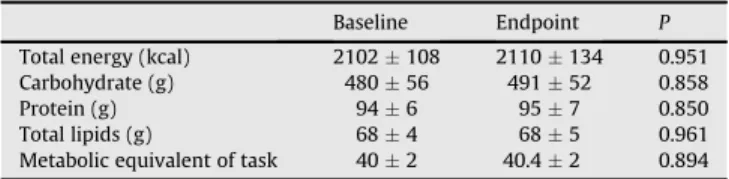
Table 2shows the daily total energy, macronutrient intake, and quantitative evaluation of physical activity. The total energy intake, carbohydrate, protein, total lipids, and metabolic equiv-alent of task were unchanged.
Production of reactive oxygen species in PMN cells
Consumption of ac¸ai pulp decreased the levels of ROS from 1371.1730 RLU/30 min to 289.5300 RLU/30 min (Fig. 1).
Total antioxidant capacity in PMN cells
The intervention increased TAC of PMN cells by 104%, from 241.436.01
m
M Trolox equivalents to 493.649.37m
M Trolox equivalents (Fig. 2).Table 1
Effect of ac¸ai pulp on anthropometric, clinical and biochemical characteristics of women after ac¸ai consumption for 4 wk
Parameters Baseline Endpoint P
Body weight (kg) 65.72.4 66.02.3 0.23
Body mass index (kg/m2) 24.10.7 24.30.7 0.07 Waist circumference (cm) 75.31.6 74.91.6 0.16
Body fat (%) 31.31 31.71 0.10
Systolic blood pressure (mmHg) 1042 1032 0.48 Diastolic blood pressure (mmHg) 721 721 0.83 Cholesterol total (mg/dL) 18235 18943 0.33
LDL (mg/dL) 1005 1046 0.61
HDL (mg/dL) 642 652 0.64
Triacylglycerols (mg/dL) 826 826 0.98
Glucose (mg/dL) 79.61.1 80.31.2 0.59
Insulin (mIU/mL) 6.20.4 6.60.5 0.36
HOMA-IR 1.20.1 1.30.1 0.32
HDL, high-density lipoprotein; HOMA-IR, homeostatic model assessment of in-sulin resistance; LDL, low-density lipoprotein
Values are means and standard error.Pvalue for paired-ttest at baseline and at endpoint, n¼35
Table 2
Estimative by dietary intake and physical activity through questionnaire of women after ac¸ai consumption for 4 wk
Baseline Endpoint P
Total energy (kcal) 2102108 2110134 0.951
Carbohydrate (g) 48056 49152 0.858
Protein (g) 946 957 0.850
Total lipids (g) 684 685 0.961
Metabolic equivalent of task 402 40.42 0.894
Values are means and standard error.Pvalue for paired-ttest at baseline and at endpoint, n¼35
Antioxidant enzyme activities in PMN cells
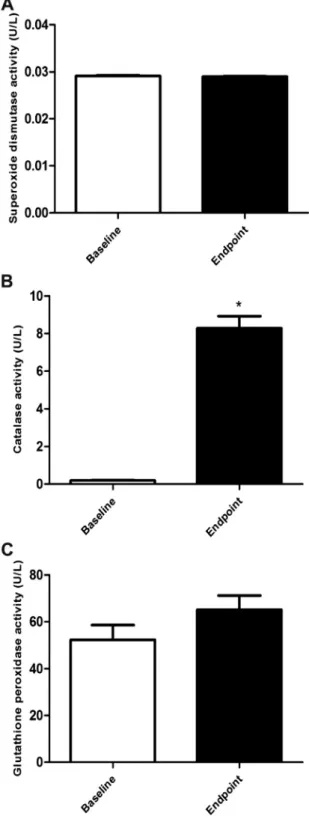
Antioxidative enzymes status was evaluated by SOD, CAT, and GPx activities in PMN cells at baseline and at endpoint after the experimental period (Fig. 3). CAT activity increased significantly from 0.200.02 U/L to 8.300.64 U/L (Fig. 3B). The activities of the other enzymes did not change.
Serum protein carbonyl and sulfhydryl groups
In order to evaluate the potential antioxidant effects of ac¸ai, we determined the levels of serum protein carbonyl and total sulfhydryl groups at baseline and endpoint (Fig. 4). At endpoint, protein carbonyl had decreased from 1.460.05 nmol/mg of protein total to 1.260.09 nmol/mg of protein total (P¼0.027) and sulfhydryl groups had increased from 370.5912.21 mM/L to 454.9813.66 mM/L (P<0.001).
Discussion
In order to evaluate the effects of the antioxidant-rich fruit ac¸ai in humans, we conducted a dietary intervention to measure oxidative status in healthy women. The women were asked to maintain their habitual dietary intake and physical activity levels throughout the study period. Our results showed that the daily intake of 200 g of ac¸ai pulp for 4 wk improved the antioxidant status. Activity of the antioxidant enzyme CAT and TAC in PMNs cells increased and the production of ROS decreased significantly. Additionally, serum protein carbonyl concentration decreased and the total serum sulfhydryl groups were increased.
Overproduction of ROS can cause oxidative damage to bio-molecules and promote the development and progression of many chronic diseases, including atherosclerosis, cancer, and other degenerative diseases [39–41]. Regular intake of fruits, vegetables, and other antioxidant-rich foods is associated with numerous beneficial health effects, reducing the incidence of these diseases[42,43].
In the physiopathology of various chronic diseases, the pro-duction of ROS seems to be directly related to the activation of PMN cells, the principal effector cells of innate immunity[44,45]. The activation of phagocytic cells leads to the production of ROS through oxidative metabolism, so the discovery of new dietary
compounds that can modulate this process is of great interest. In this regard, studies have demonstrated that ac¸ai inhibits ROS production in isolated neutrophils[5,25,46]. In the same direc-tion, in our in vivo study we found a reduction on ROS produc-tion by PMN cells of the women after ac¸ai intake. We also found an increased CAT activity and the TAC in the same cells. CAT is Fig. 2.Effect of ac¸ai pulp intake on total antioxidant capacity of polymorphonuclear
cells obtained, n¼35. Data are presented as mean and standard error, and were analyzed with paired-t test. *P<0.001.
part of the main antioxidant defense of the cell and other studies have found that its activity can be improved by dietary com-pounds improving the antioxidant systems[47,48]. TAC appears to reflect the capacity of an individual to neutralize free radicals as it is an element of the nonenzymatic part of the system, protecting the body against ROS[49], and we found an increment of 104% of TAC in PMN cells. Previous studies have shown that an acute dose of ac¸ai significantly increased TAC in the plasma of healthy subjects [27,50], reinforcing our observation that long-term intake of ac¸ai may improve the antioxidant status of healthy women. The dietary intake of wild blueberries, another fruit rich in antioxidants, enhanced the total serum antioxidant status of healthy subjects after the consumption of a high-fat meal[51]. Taken together, these results reinforce the putative effect of dietary ac¸ai intake on ROS modulation and antioxidant defense improvements in PMN cells.
In addition to evaluating how a compound modulates anti-oxidant enzymes, biomarkers of oxidative damage can be used to assess individual oxidative (antioxidant/prooxidant) status. Products of protein oxidation are commonly used for this pur-pose because free radicals also attack proteins, which are abun-dant in the body[52]. We found that serum protein carbonyl had decreased after ac¸ai intake. The accumulation of protein carbonyl has been observed in many diseases, including Alzheimer’s dis-ease, diabetes, and others[53]. Moreover, the levels of protein carbonyl of young individuals with features of nonalcoholic fatty liver disease decreased significantly after 4 wk of blueberry juice treatment[54].
Ac¸ai intake also effectively modulated serum protein thiol levels. Sulfhydryl groups contribute to 50% of the total antioxi-dant capacity of healthy subjects [55], and polyphenol-rich beverages have been found to increase the number of sulfhy-dryl groups[56,57]. Taken together, lower protein carbonyl and higher sulfhydryl group levels after ac¸ai experimental period confirm that ac¸ai prevents oxidative damage. The same was observed in hypercholesterolemic rats fed a diet with 2% ac¸ai pulp[58].
Del Pozo-Insfran et al.[7]estimated the antioxidant capacity of ac¸ai pulp to be 48.6
m
mol Trolox equivalents/mL. Compared with other antioxidant-rich fruits studied by Silva et al.[59], ac¸ai has 4.8, 6.1, and 7.5 times the antioxidant capacity of black-berries, blueblack-berries, and strawblack-berries, respectively. The antioxi-dant effect of ac¸ai has been attributed to its phytochemicalcomposition comprising hydroxybenzoic acids andflavan-3-ols, along with cyanidin 3-O-rutinoside and cyanidin 3-O-glucoside as the predominant anthocyanins[8]. Since anthocyanins are the least bioavailable polyphenols[60], studies of the antioxidant effect of ac¸ai in humans are necessary before to include them in the antioxidant food list.
Besides its antioxidant effect, an antiinflammatory and a hypocholesterolemic effect of the ac¸ai pulp has been shown
[5,58], and the pulp presents a high content of polyunsaturated fatty acids, phytosterols, andfiber[8]. An extensive nutritional analysis of the freeze-dried pulp did not reveal a remarkable content of other antioxidant compounds[8]. We believe that the benefits of the fruit are probably due to a synergistic effect of its phytochemical and nutrient composition.
Expectedly, ac¸ai intake did not affect the anthropometric parameters because, according to the lifestyle questionnaires, the total energy intake, macronutrients, or level of physical ac-tivity were unchanged. The biochemical parameters and blood pressure also did not change, contrary to Udani et al.[61], who reported better glucose, insulin, and total cholesterol levels in their pilot study. However, in this study, subjects were advised to avoid foods containing nitrates, such as bacon and hot dogs, which could lead to the results observed in the glucose, insulin and cholesterol concentrations. On the other hand, Kardum et al.
[62] reported that intake of chokeberry, a fruit source of polyphenol-rich juice, for 12 wk did not affect their volunteers’ systemic arterial pressure values or anthropometric and blood biochemistry parameters.
One limitation of our study was determining whether or not the participants maintained their habitual diet and/or levels of physical activity during the intervention. However, these data were collected by trained interviewers, so measurement errors were most likely avoided. We wanted the study to have minimal impact on the participants’lives and to assess the effect of the fruit as it is usually consumed, not as tablets or supplements. We believe that this is the strength of our study, in addition to the high number of subjects, the use of several biomarkers of oxidative status, and other risk variables associated.
Conclusion
antioxidant effects of ac¸ai may stem from the neutralization of free radicals, preventing their attack on other molecules, and/or from the modulation of enzymes involved in oxidative stress. These results pave the way for better understanding the effects of the daily dietary intake of ac¸ai in humans. Future studies will be needed to determine how much of this potential“functional food” is necessary to maintain health and prevent chronic diseases.
References
[1] Menezes FS, Falc~ao DQ, Mendonc¸a Filho RF, Silveira CS, Renno MN, Rodrigues VP, et al. Chemical and pharmacological survey on Brazilian medicinal plants using ethnopharmacological information as a tool. Acta Horticulturae 2005;675:89–95.
[2] Sabbe S, Verbeke W, Deliza R, Matta VM, Van Damme P. Consumer liking of fruit juices with different ac¸aı(Euterpe oleracea Mart.) concentrations. J Food Sci 2009;74:S171–6.
[3] Schreckinger ME, Lotton J, Lila MA, de Mejia EG. Berries from South America: a comprehensive review on chemistry, health potential, and commercialization. J Med Food 2010;13:233–46.
[4] Lichtenthäler R, Rodrigues RB, Maia JG, Papagiannopoulos M, Fabricius H, Marx F. Total oxidant scavenging capacities of Euterpe oleracea Mart. (Acai) fruits. Int J Food Sci Nutr 2005;56:53–64.
[5] Schauss AG, Wu X, Prior RL, Ou B, Huang D, Owens J, et al. Antioxidant capacity and other bioactivities of the freeze-dried Amazonian palm berry, Euterpe oleraceae mart (acai). J Agric Food Chem 2006;54:8604–10. [6] Marcason W. What is the ac¸aıberry and are there health benefits? J Am
Diet Assoc 2009;109:1968.
[7] Del Pozo-Insfran D, Brenes CH, Talcott ST. Phytochemical composition and pigment stability of Ac¸ai (Euterpe oleracea Mart.). J Agric Food Chem 2004;52:1539–45.
[8] Schauss AG, Wu X, Prior RL, Ou B, Patel D, Huang D, et al. Phytochemical and nutrient composition of the freeze-dried amazonian palm berry, Euterpe oleraceae mart (acai). J Agric Food Chem 2006;54:8598–603. [9] van Acker SA, van den Berg DJ, Tromp MN, Griffioen DH, van
Bennekom WP, van der Vijgh WJ, et al. Structural aspects of antioxidant activity offlavonoids. Free Radic Biol Med 1996;20:331–42.
[10] Kobayashi M, Yamamoto M. Molecular mechanisms activating the Nrf2-Keap1 pathway of antioxidant gene regulation. Antioxid Redox Signal 2005;7:385–94.
[11] Tsuji PA, Stephenson KK, Wade KL, Liu H, Fahey JW. Structure-activity analysis of flavonoids: Direct and indirect antioxidant, and antiin-flammatory potencies and toxicities. Nutr Cancer 2013;65:1014–25. [12] Lee WL, Huang JY, Shyur LF. Phytoagents for cancer management:
Regu-lation of nucleic acid oxidation, ROS, and related mechanisms. Oxid Med Cell Longev 2013;2013:925804.
[13] Lambeth JD. NOX enzymes and the biology of reactive oxygen. Nat Rev Immunol 2004;4:181–9.
[14] Lei XG, Cheng WH, McClung JP. Metabolic regulation and function of glutathione peroxidase-1. Annu Rev Nutr 2007;27:41–61.
[15] Chen Y, Azad MB, Gibson SB. Superoxide is the major reactive oxygen species regulating autophagy. Cell Death Differ 2009;16:1040–52. [16] Sies H. Oxidative Stress: introductory remarks. London: Academic Press;
1985.
[17] Sies H, Jones D. Oxidative Stress. 2nd ed. Amsterdam: Elsevier; 2007. [18]Jacob K, Periago MJ, Böhm V, Berruezo GR. Influence of lycopene and
vitamin C from tomato juice on biomarkers of oxidative stress and inflammation. Br J Nutr 2008;99:137–46.
[19] Ho E, Galougahi KK, Liu CC, Bhindi R, Figtree GA. Biological markers of oxidative stress: Applications to cardiovascular research and practice. Redox Biology 2013;1:483–91.
[20] Dasgupta A, Zheng J, Perrone-Bizzozero NI, Bizzozero OA. Increased carbon-ylation, protein aggregation and apoptosis in the spinal cord of mice with experimental autoimmune encephalomyelitis. ASN Neuro 2013;5:e00111. [21] Biswas S, Chida AS, Rahman I. Redox modifications of protein-thiols:
Emerging roles in cell signaling. Biochem Pharmacol 2006;71:551–64. [22] Knorre DG, Kudryashova NV, Godovikova TS. Chemical and functional
as-pects of posttranslational modification of proteins. Acta Naturae 2009;1:29–51.
[23] Pacheco-Palencia LA, Mertens-Talcott S, Talcott ST. Chemical composition, antioxidant properties, and thermal stability of a phytochemical enriched oil from Acai. J Agric Food Chem 2008;56:4631–6.
[24] Kang J, Li Z, Wu T, Jensen GS, Schauss AG, Wu X. Anti-oxidant capacities of flavonoid compounds isolated from acai pulp. Food Chem 2010;122:610–7. [25] Guerra JF, Magalh~aes CL, Costa DC, Silva ME, Pedrosa ML. Dietary ac¸ai modulates ROS production by neutrophils and gene expression of liver antioxidant enzymes in rats. J Clin Biochem Nutr 2011;49:188–94.
[26] Bonomo Lde F, Silva DN, Boasquivis PF, Paiva FA, Guerra JF, Martins TA, et al. Ac¸aımodulates oxidative stress resistance in Caenorhabditis elegans by direct and indirect mechanisms. PLoS One 2014;9:e89933.
[27] Mertens-Talcott SU, Rios J, Jilma-Stohlawetz P, Pacheco-Palencia LA, Meibohm B, Talcott ST, et al. Pharmacokinetics of anthocyanins and antioxidant effects after the consumption of anthocyanin-rich acai juice and pulp in human healthy volunteers. J Agric Food Chem 2008;56:7796– 802.
[28] Lutz IA. Cap. IV–Procedimentos e Determinac¸~oes Gerais. In: Normas analıticas do Instituto Adolfo Lutz: Metodos quımicos e fısicos para analises de alimentos. 4th ed., Volume 1. Brasılia; 2008. p. 98–123.
[29] Shahidi FZ, Naczk M. Food phenolics: Sources, chemistry, effects and ap-plications. 1st ed. Lancaster: Technomic Publishing CO; 1995.
[30] Brand-Wiliams W, Cuvelier ME, Berset C. Use of a free radical method to evaluate antioxidant activity. Food Science and Technology 1995;28:25–30. [31] Sicheiri R, Everhart JE. Validity of a Brazilian food frequency questionnaire against dietary recalls and estimated energy intake. Nut Res 1998;18: 1649–59.
[32] Aadahl M, Jørgensen T. Validation of a new self-report instrument for measuring physical activity. Med Sci Sports Exerc 2003;35:1196–202. [33] World Health Organization. Obesity: Preventing and managing the global
epidemic. Geneva: Report of WHO Consultation on obesity; 1998. [34] Friedewald WT, Levy RI, Fredrickson DS. Estimation of the concentration of
low-density lipoprotein cholesterol in plasma, without use of the prepar-ative ultracentrifuge. Clin Chem 1972;18:499–502.
[35] Matthews DR, Hosker JP, Rudenski AS, Naylor BA, Treacher DF, Turner RC. Homeostasis model assessment: Insulin resistance and beta-cell function from fasting plasma glucose and insulin concentrations in man. Dia-betologia 1985;28:412–9.
[36] Chaves MM, Rocha-Vieira E, Lima e Silva R, Gerzstein N, Nogueira-Machado J. Increase of reactive oxygen and nitrogen species generated by phagocyting granulocytes related to age. Mech Ageing Dev 2000;119:1–8. [37] Levine RL, Williams JA, Stadtman ER, Shacter E. Carbonyl assays for determination of oxidatively modified proteins. Meth Enzymol 1994;233:346–57.
[38] Sedlak J, Lindsay RH. Estimation of total, protein-bound, and nonprotein sulfhydryl groups in tissue with Ellman’s reagent. Anal Biochem 1968;25:192–205.
[39] Valko M, Rhodes CJ, Moncol J, Izakovic M, Mazur M. Free radicals, metals and antioxidants in oxidative stress-induced cancer. Chem Biol Interact 2006;160:1–40.
[40] Giacco F, Brownlee M. Oxidative stress and diabetic complications. Circ Res 2010;107:1058–70.
[41] Strobel NA, Fassett RG, Marsh SA, Coombes JS. Oxidative stress biomarkers as predictors of cardiovascular disease. Int J Cardiol 2011;147:191–201. [42] Arts IC, Hollman PC. Polyphenols and disease risk in epidemiologic studies.
Am J Clin Nutr 2005;81:317S–25S.
[43] Hooper L, Kroon PA, Rimm EB, Cohn JS, Harvey I, Le Cornu KA, et al. Fla-vonoids,flavonoid-rich foods, and cardiovascular risk: A meta-analysis of randomized controlled trials. Am J Clin Nutr 2008;88:38–50.
[44] Weiss SJ. Tissue destruction by neutrophils. N Engl J Med 1989;320:365– 76.
[45] Shurtz-Swirski R, Sela S, Herskovits AT, Shasha SM, Shapiro G, Nasser L, et al. Involvement of peripheral polymorphonuclear leukocytes in oxida-tive stress and inflammation in type 2 diabetic patients. Diabetes Care 2001;24:104–10.
[46] Honzel D, Carter SG, Redman KA, Schauss AG, Endres JR, Jensen GS. Com-parison of chemical and cell-based antioxidant methods for evaluation of foods and natural products: Generating multifaceted data by parallel testing using erythrocytes and polymorphonuclear cells. J Agric Food Chem 2008;56:8319–25.
[47] Rossoni Junior JV, Araujo GR, Padua Bda C, Magalh ~aes CL, Chaves MM, Pedrosa ML, et al. Annatto extract andb-carotene enhances antioxidant status and regulate gene expression in neutrophils of diabetic rats. Free Radic Res 2012;3:329–38.
[48] Kasperczyk S, Dobrakowski M, Kasperczyk J, Osta1owska A, Zalejska-Fiolka J, Birkner E. Beta-carotene reduces oxidative stress, improves glutathione metabolism and modifies antioxidant defense systems in lead-exposed workers. Toxicol Appl Pharmacol 2014;280:36–41.
[49] Erel O. A new automated colorimetric method for measuring total oxidant status. Clin Biochem 2005;38:1103–11.
[50] Jensen GS, Wu X, Patterson KM, Barnes J, Carter SG, Scherwitz L, et al. In vitro and in vivo antioxidant and antiinflammatory capacities of an antioxidant-rich fruit and berry juice blend. Results of a pilot and ran-domized, double-blinded, placebo-controlled, crossover study. J Agric Food Chem 2008;56:8326–33.
[51] Kay CD, Holub BJ. The effect of wild blueberry consumption on postprandial serum antioxidant status in human subjects. Br J Nutr 2002;88:389–98. [52] Dalle-Donne I, Rossi R, Colombo R, Giustarini D, Milzani A. Biomarkers of
oxidative damage in human disease. Clin Chem 2006;52:601–23. [53] Chevion M, Berenshtein E, Stadtman ER. Human studies related to protein
[54] Guo H, Zhong R, Liu Y, Jiang X, Tang X, Li Z, et al. Effects of bayberry juice on inflammatory and apoptotic markers in young adults with features of non-alcoholic fatty liver disease. Nutrition 2014;30:198–203.
[55] Ellman GL. Tissue sulfhydryl groups. Arch Biochem Biophys 1959;82: 70–7.
[56] Rosenblat M, Volkova N, Attias J, Mahamid R, Aviram M. Consumption of polyphenolic-rich beverages by healthy subjects for a short term increased serum antioxidant status, and the serum’s ability to atten-uate macrophage cholesterol accumulation. Food Funct 2010;1:99– 109.
[57] Kedzierska M, G1owacki R, Czernek U, Szyd1owska-Pazera K, Potemski P, Piekarski J, et al. Changes in plasma thiol levels induced by different phases of treatment in breast cancer; the role of com-mercial extract from black chokeberry. Mol Cell Biochem 2013;372: 47–55.
[58] de Souza MO, Silva M, Silva ME, Oliveira Rde P, Pedrosa ML. Diet supple-mentation with acai pulp improves biomarkers of oxidative stress and the serum lipid profile in rats. Nutrition 2010;26:804–10.
[59] Silva RS, Vendruscolo JL, Toralles RP. Evaluation of the antioxidant capacity in the fruits cultivated in the south of RS. Revista Brasileira de Engenharia Agrıcola e Ambiental 2011;17:392–400.
[60] Manach C, Williamson G, Morand C, Scalbert A, Remesy C. Bioavailability and bioefficacy of polyphenols in humans. I. Review of 97 bioavailability studies. Am J Clin Nutr 2005;81:230S–42S.
[61] Udani JK, Singh BB, Singh VJ, Barrett ML. Effects of Ac¸ai berry preparation on metabolic parameters in a healthy overweight population: A pilot study. Nutr J 2011;10:45.