Rev Saúde Pública 2005;39(6) www.fsp.usp.br/rsp
INTRODUCTION
In recent decades, lower fertility and mortality rates have gradually increased longevity, generating the phenomenon of population aging which in turn en-tails new social demands.11
As chronological age increases, the elderly become exposed to numerous risks and vulnerabilities, among which the most remarkable are multiple disease con-ditions,9 poor socioeconomic condition,11 hospitali-zations in the last 12 months,8 use of multiple medi-cines,4,10 and adverse drug effects.6,14
D rug use by the elderly in Southern Brazil
Liziane M aahs Flores* and Sotero Serrate M engue
Programa de Pós-Graduação em Ciências Farmacêuticas. Faculdade de Farmácia. Universidade Federal do Rio Grande do Sul. Porto Alegre, RS, Brasil
Based on a Master’s dissertation presented to the Universidade Federal do Rio Grande do Sul, in 2003. Presented at the VI Brazilian Meeting of Epidemiology. Recife, June 19–23, 2004.
*Fellowship holder from Coordenação Pessoal de Nível Superior (CAPES - Process n. 42001013023P9) Received on 29/9/2004 Reviewed on 2/5/2005 Approved on 30/7/2005
Correspondence:
Sotero Serrate Mengue Faculdade de Farmácia - UFRGS Av. Ipiranga, 2752
90610-000 Porto Alegre, RS, Brasil E-mail: [email protected]
Keywords
Use of medications. Elderly. Over-the-counter drugs. Polypharmacy. Socioeconomic characteristics.
Abstract
Objective
To describe self-reported drug use by the elderly, evaluating the occurrence of polypharmacy and the influence of sociodemographic and health conditions on the use of medications.
Methods
A cross-sectional study comprising a sample of 215 elderly was carried out in Porto Alegre, Southern Brazil, in 2001 and 2002. Data on the use of medications were collected using questionnaires filled out during home visits. Drugs were classified according to the Anatomical-Therapeutical-Chemical Classification System. Results
Of all respondents, 141 (66%) were women, 117 (54%) aged between 60 and 70 years old, 157 (73%) were white, 115 (53%) lived with a partner, and 145 (67%) had some schooling. The prevalence of the use of medications by the elderly was 91% (n=195). In the week previous to the interview, 697 drugs were used, an average of 3.2 drugs per person (SD= 2.5). A total of 187 (87%) subjects had attended at least one medical visit in the last year and 71 (33%) confirmed the use of over-the-counter drugs. Polypharmacy was evidenced in 57 (27%) cases.
Conclusions
There is a pattern of increased drug use by the elderly aged 60 years or more who lives in the study community and slight differences were determined by their health conditions and socioeconomic factors.
It is estimated 23% of the Brazilian population use 60% of the national drug production, and most users are aged over 60.12 High drug use among the commu-nity elderly has been described in other studies in Brazil5 and worldwide.2,10,13,14
administra-Rev Saúde Pública 2005;39(6) www.fsp.usp.br/rsp
Drug use by the elderly Flores LM & Mengue SS
*Converted at the rate of $1.00 = R$ 2.25 as of October 17, 2005.
(0.8%) did not want to answer the questionnaire; and one (0.2%) was excluded due to missing informa-tion. To attain the calculated sample size, 1,006 at-tempts of either successful or unsuccessful contact were made, ranging from one to 11 home visits, re-sulting in on average two attempts per subject drawn.
The patient’s enrollment list of each CHP in the area covered in the study was used for identifying each subject drawn.
First the interviewer would ask the subject to bring over the drugs they were using at that time. The preva-lence of drug use in this population was assessed through an open question followed by a closed one. The last time of use was also asked and recorded for each drug in an attempt to avoid potential analysis inaccuracies.
After collection, data was gathered in a database and coded and drugs were classified according to the Anatomical-Therapeutic-Chemical (ATC) Classifica-tion System. In the ATC classification system, drugs are grouped according to the organ or system on which they act and their chemical, therapeutic and pharma-cological properties. Information was collected through open and closed questions and included pre-scription and OTC drugs regardless of the time they were used. However, to assess polypharmacy, only those cases where five or more drugs were used at the same time in the last seven days were taken into ac-count. Data entry and analysis was performed using Epi Info version 6.04d and SPSS version 8.0. The logistic regression model included polypharmacy as outcome and the variables age, gender, skin color, income, schooling, marital status, hospitalization in the last year, medical care in the last year and cover-age area of the health unit.
The study was approved by the Research Ethics Review Board of the Conceição Hospital Center, in Porto Alegre, Southern Brazil.
RESU LTS
Of all respondents, 141 (66%) were women; 117 (54%) aged between 60 and 70 years; 157 (73%) were white; 115 (53%) had a partner and 145 (67%) had completed elementary school. Their monthly family income ranged from R$ 80.00 and R$ 5,000.00, about US$ 35.54 and US$ 2,221.14, respectively.*
As for the patients, 163 of the elderly (76%) re-ported seeking health care but 32 (15%) said they tion above a certain level clinically recommended
according to specif ic criteria.9,10 Quantitatively speaking, some authors have described polypharmacy as the simultaneous use of five or more drugs.4,10 Flaherty et al (2000) divided the levels of polyphar-macy as follows: five to six; seven to nine and over 10 drugs.8
Understanding drug use behavior is key to evalu-ating the impact of new therapies and planning and implementing better healthcare programs.4 Knowing the actual situation of the elderly in Brazil is there-fore necessary in order to assess their concerns and needs for achieving a healthier life and a more ra-tional drug use. The main purpose of the present study was to explore drug use among community elderly as well as to assess polypharmacy and the influence of sociodemographic factors on their health condition and drug use.
M ETH O D S
A cross-sectional study was carried out in the city of Porto Alegre, Southern Brazil, between 2001 and 2002. The study population comprised both men and women aged 60 years and over, who were not bedrid-den or hospitalized, able to communicate and take their medications by themselves and lived within the coverage area of a hospital-associated Community Health Program (CHP). All those who agreed in par-ticipate in the study signed an informed consent.
The CHP covers 12 health units providing care to approximately 125,000 people, i.e., 10% of the city’s population. In three of the CHP-covered areas —Barão de Bagé, Coinma and Margarita—, most of the popu-lation attending the program are elderly.
The study sample size estimate was based on Wilcox data (1994) who estimated 80% prevalence of drug use among community elderly.13 A 95% con-fidence interval, 5% predicted relative error and preva-lence between 75% and 85% were set.
!
Rev Saúde Pública 2005;39(6) www.fsp.usp.br/rsp
Drug use by the elderly Flores LM & Mengue SS
sought care only sometimes and 20 (9%) did not seek any care at all. Of all, 187 (87%) had attended at least one medical visit in the last year. In regard to health-care services, 107 (50%) reported using them occa-sionally (zero to four visits per year); 89 (42%) used them regularly (four to12 visits per year), mostly when they had a reason for that (an event justifying the medical visit); and 18 (8%) reported using the serv-ices very often (over 12 visits per year).
Of all study respondents, 71 (33%) had used drugs without asking medical advice and the main reason for that was generic pain (53%). Also, 34 (16%) men-tioned checking old medical prescriptions for look-ing for previously prescribed drugs.
There were reported 28 cases (13%) in which other people also used the same medicines taken by the respondent. This practice of drug sharing did not fol-low a pattern, i.e., it occurred due to physical proxim-ity (neighbors) as well as at different degrees of kin-ship (ascending, descending or lateral).
The prevalence of drug use in this population was assessed through two questions: an open and a closed one. The open question provided 86% prevalence, i.e., 185 subjects over 60 years of age reported the use of medications, making a total of 728 drugs used. Of the elderly taking any drug, 106 (57%) took some kind of tea at the same time. There was 56% preva-lence (n=120) of tea consumption although 14 (12%) of the respondents did not consider tea a medicine.
On the other hand, the closed question provided 39% prevalence, i.e., 85 respondents reported the use of medications. Of them, 10 (12%) had answered “no” to the open question, resulting in a 33%
in-crease of “yes” answers to drug use. From that, an additional 104 drugs were included in the initial list, making a total of 832 drugs used reported by 195 subjects (91%). The drugs in this list were cat-egorized according to the last date they were used: 365 (44%) had been used at the same day of the interview; 332 (40%) had been used in the last week, excluding the day of the interview; and 122 (15%) had been used previously to the last week. In 13 (2%) cases, the respondents did not recall when they had last used the drugs.
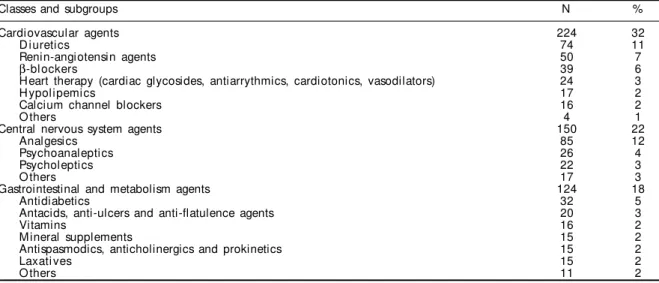
The analysis included only 697 (84%) drugs used in the last week (including the day of the interview). The average number of drugs used per person was 3.2 (SD=2.5) and polypharmacy was ascertained in 57 (27%) cases. Table 1 shows the therapeutic drug classes most used for the cardiovascular system (224; 32%), nervous system (150; 22%) and gastrointestinal tract and metabolism (124; 18%).
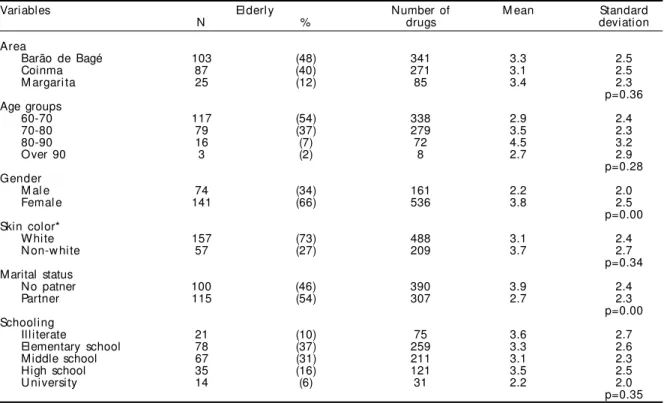
The amount of drugs used by the 215 elderly re-spondents can be associated to sociodemographic characteristics, as showed in Table 2. For instance, the number of drugs used tended to increase with age.
Women and the elderly who had no partner reported a higher mean drug use. The same could be seen in the multivariable analysis using logistic regression (Table 3), adjusted for the variables of interest and CHP-covered areas.
D ISCU SSIO N
The high mean drug use found in the study seems to be similar to the findings of other studies.2,4,8-10 Easy access to drugs and low non-pharmacological Table 1 - Classes and subgroups of the most frequently used drugs by the elderly in the week previous to the interview. Porto Alegre, 2001-2002.
Classes and subgroups N %
Cardiovascular agents 224 32
D iuretics 74 11
Renin-angiotensin agents 50 7
β-blockers 39 6
Heart therapy (cardiac glycosides, antiarrythmics, cardiotonics, vasodilators) 24 3
H ypolipemics 17 2
Calcium channel blockers 16 2
O thers 4 1
Central nervous system agents 150 22
Analgesics 85 12
Psychoanaleptics 26 4
Psycholeptics 22 3
O thers 17 3
Gastrointestinal and metabolism agents 124 18
Antidiabetics 32 5
Antacids, anti-ulcers and anti-flatulence agents 20 3
Vitamins 16 2
Mineral supplements 15 2
Antispasmodics, anticholinergics and prokinetics 15 2
Laxati ves 15 2
" Rev Saúde Pública 2005;39(6) www.fsp.usp.br/rsp
Drug use by the elderly Flores LM & Mengue SS
Table 2 - Distribution of the main sociodemographic characteristics of the elderly and number of drugs used by them in the week previous to the interview. Porto Alegre, 2001–2002
Variables El derl y Number of M ean Standard
N % drugs deviation
Area
Barão de Bagé 103 (48) 341 3.3 2.5
Coinma 87 (40) 271 3.1 2.5
M argari ta 25 (12) 85 3.4 2.3
p=0.36 Age groups
60-70 117 (54) 338 2.9 2.4
70-80 79 (37) 279 3.5 2.3
80-90 16 (7) 72 4.5 3.2
Over 90 3 (2) 8 2.7 2.9
p=0.28 Gender
M al e 74 (34) 161 2.2 2.0
Femal e 141 (66) 536 3.8 2.5
p=0.00 Skin color*
W hite 157 (73) 488 3.1 2.4
N on-w hite 57 (27) 209 3.7 2.7
p=0.34 Marital status
No patner 100 (46) 390 3.9 2.4
Partner 115 (54) 307 2.7 2.3
p=0.00 Schooling
Illiterate 21 (10) 75 3.6 2.7
Elementary school 78 (37) 259 3.3 2.6
Middle school 67 (31) 211 3.1 2.3
High school 35 (16) 121 3.5 2.5
U niversity 14 (6) 31 2.2 2.0
p=0.35 *One missing piece of information
*Adjusted to the described variables and areas of residence Table 3 - Results of the logistic regression analysis and the respective odds ratios and 95% confidence intervals. Porto Alegre, 2001-2002.
Variables* O R 95% CI
Gender 0.40 0.16-0.98
Age 1.85 0.86-4.0
Skin color 0.47 0.22-1.02
Schooling 0.53 0.24-1.17
Income 0.80 0.39-1.64
Marital status 2.33 1.09-5.00
Hospitalization in the last year 0.85 0.41-1.78 Medical visit in the last year 12.18 1.53-96.89 management of medical conditions are contributors
for this practice among the elderly.
In regard to the therapeutic drug classes used by the elderly, the study findings were similar to those de-scribed in the literature.2,4,10 As cardiovascular diseases are the leading cause of disease burden and mortality among individuals aged 65 years or more, cardiovas-cular drugs have been widely prescribed by doctors.1
High use of analgesics and gastrointestinal drugs (Table 1) was also found, suggesting that the elderly have a strong urge to relieve or eliminate any acute pain. Health providers should bear that in mind to advise their patients on the event of any drug interac-tion or redundancy.
It can also be implied that, though these drugs were sporadically used for a short while, they were more often recalled because users had striking recollec-tions of they being associated with unpleasant events of acute illness and, thus, more easily recollected. On the other hand, cardiovascular drugs are used on a daily basis for long term and thus can also be easily retrieved by the elderly from their recent memory. Cardiovascular drug use can often be underestimated in long-term memory as they have already been inte-grated to one’s daily routine.
The high number of medical visits in the last year
reflects the relative disease burden of the study popu-lation. Although community elderly have equal ac-cess to health services, there are still inequalities in access to drugs, which varies according to the fre-quency of medical visits, socioeconomic conditions, and drug sharing by relatives, friends and neighbors, among others.
dis-#
Rev Saúde Pública 2005;39(6) www.fsp.usp.br/rsp
Drug use by the elderly Flores LM & Mengue SS
eases11 while women show higher morbidity due to non-fatal chronic diseases3 and, in particular, due to lower exposure to risk factors, especially work-related factors. Besides, both men and women take different attitudes toward health and disease; women pay more attention to signs and symptoms and seek help more often than men.3 Consequently, the variable gender can affect the use of medications and women are more likely to be users.3,4,10
The increased prevalence of the use of medications seen with the closed question may indicate this popula-tion’s lack of knowledge on the concept of medication. They did not see as medications drugs for losing weight, allergies, pain, diarrhea, kidney, bladder and stomach conditions, colds or any other sort of vitamins.
Polypharmacy increased with age, which could be explained by many factors such as increased morbid-ity. This finding is consistent with other studies car-ried out in Brazil, England and Wales,4,5 but it was not significant in the study multivariate analysis. Also, the study did not show an effect of skin color in the use of medications, as other studies7 described to be higher among white elderly.
Regardless of the socioeconomic condition, in Bra-zil, home and community care still have an impor-tant role and are prioritized over institutional care.8,11 In this sense, the role of the partner in the elderly life should be stressed as those who lived alone used on average more medications.
As the study was conducted in the southern region
of Rio Grande do Sul, one of its limitations was that the season (spring-summer), which might have had an effect on the amount and type of drugs used. It might be that, during fall/winter season, there would be a higher use of respiratory and anti-infection drugs.
The association between polypharmacy and in-creased cardiovascular and diabetes drug use among community elderly can indicate that exposure to multiple drugs is generally related to long-term treat-ment of chronic diseases (cardiovascular diseases, hypertension, and diabetes) and that this practice is practically followed for years.
In regard to the sociodemographic characteristics studied, being a woman, living alone and attending at least one medical visit in the last year are factors that should be taking into account as they are strongly associated to higher use of medications by the eld-erly. Some of the challenges pharmaceutical provid-ers have to face are promoting rational drug use and educating users on the risks of self-medication, inter-rupting drug treatment and changing the prescribed treatment as well as the need for medical prescrip-tions; and routinely reassessing drug use by the eld-erly as for dosages, costs, and treatment compliance.
ACKN O W LED GM EN TS
The authors wish to thank Prof. Dr. Eloir Paulo Schenkel, Universidade Federal de Santa Catarina, and Dr. Isabela Heineck and Dr. Teresa Dalla Costa, Universidade Federal do Rio Grande do Sul, for their suggestions.
REFEREN CES
1. Ali Raza J, Movahed A. Use of cardiovascular medications in the elderly. Int J Cardiol 2002;85(2-3):203-15.
2. Barat I, Andreasen F, Damsgaard EM. Pharmacoepidemiology and prescription: the consumption of drugs by 75-year-old individuals living in their own homes. Eur J Clin Pharmacol 2000;56(6-7):501-9.
3. Bardel A, Wallander MA, Svärdsudd K. Reported current use of prescription drugs and some of its determinants among 35 to 65-year-old women in mid-Sweden: a population-based study. J Clin Epidemiol 2000;53(6):637-43.
4. Chen YF, Dewey ME, Avery AJ; Analysis group of the MRCCFA study. Self-reported medication use for older people in England and Wales. J Clin Pharm Ther 2001;26(2):129-40.
5. Coelho Filho JM, Marcopito LF, Castelo A. Perfil de utilização de medicamentos por idosos em área urbana do nordeste do Brasil. Rev Saúde Pública 2004;38(4):557-64.
6. Fialová D, Topinkova E, Gambassi G, Finne-Soveri H, Jonsson PV, Carpenter I, et al. Potentially
inappropriate medication use among elderly home care patients in Europe. JAMA 2005;93(11):1348-58.
7. Fillenbaum GG, Horner RD, Hanlon JT, Landerman LR, Dawson DV, Cohen HJ. Factors predicting change in prescription and nonprescription drug use in a community-residing black and white elderly population. J Clin Epidemiol 1996;49(5):587-93.
8. Flaherty JH, Perry HM, Lynchard GS, Morley JE. Polypharmacy and hospitalization among older home care patients. J Gerontol A Biol Sci Med Sci
$ Rev Saúde Pública 2005;39(6) www.fsp.usp.br/rsp
Drug use by the elderly Flores LM & Mengue SS
9. Hanlon JT, Schmader KE, Ruby CM, Weinberger M. Suboptimal prescribing in older inpatients and outpatients. J Am Geriatr Soc 2001;49(2):200-9.
10. Linjakumpu T, Hartikainen S, Klaukka T, Veijola J, Kivelä SL, Isoaho R. Use of medications and polypharmacy are increasing among the elderly. J Clin Epidemiol 2002;55(8):809-17.
11. Lloyd-Sherlock P. Population ageing in developed and developing regions: implications for health policy. Soc Sci Med 2000;51(6):887-95.
12. Teixeira JJ, Lefèvre F. A prescrição medicamentosa sob a ótica do paciente idoso. Rev Saúde Pública 2001;35(2):207-13.
13. Willcox SM, Himmelstein DU, Woolhandler S. Inappropriate drug prescribing for the community-dwelling elderly. JAMA 1994;272(4):292-6.