Francisco I Bastos Cynthia B Cunha Neilane Bertoni Grupo de Estudos em
População, Sexualidade e Aids*
Laboratório de Informações em Saúde. Instituto de Comunicação e Informação Científi ca e Tecnológica em Saúde. Fundação Oswaldo Cruz. Rio de Janeiro, RJ, Brasil * (Study Group on Population, Sexuality and AIDS) members: Elza Berquó, Francisco Inácio Pinkusfeld Bastos, Ivan França Junior, Regina Barbosa, Sandra Garcia, Vera Paiva, Wilton Bussab.
Correspondence:
Francisco I. Bastos
Laboratório de Informações em Saúde Instituto de Comunicação e Informação Científi ca e Tecnológica em Saúde Fundação Oswaldo Cruz
Av. Brasil, 4.365 - Pavilhão Haity Moussatché 21040-900 Rio de Janeiro, RJ, Brasil E-mail: [email protected] ocruz.br Received: 8/27/2007 Reviewed: 1/28/2008 Approved: 3/5/2008
Use of psychoactive substances
and contraceptive methods by
the Brazilian urban population,
2005
ABSTRACT
OBJECTIVE: To analyze the relationship between utilization patterns for condoms and other contraceptive methods and the consumption of alcohol and drugs.
METHODS: Exploratory study based on data from a probabilistic sample of 5,040 interviewees aged 16 to 65 years living in large urban regions of Brazil in 2005. The data were collected by means of questionnaires. The chi-square automatic interaction classifi cation tree technique was used to study the use of condoms among interviewees of both sexes and other contraceptive methods among women, at the time of the last vaginal sexual intercourse.
RESULTS: Among young and middle-aged adults of both sexes and young men in stable relationships, condom use was less frequent among those who said they used psychoactive substances (alcohol and/or illegal drugs). The possible modulating effect of psychoactive substances on contraceptive practices among mature women seems to be more straightforward, compared to the more subtle effects observed among younger women, for whom the different social classes they belonged to seemed to play a more important role. CONCLUSIONS: Despite the limitations resulting from an exploratory study, the fact that this was a representative sample of the urban population of Brazil and not from vulnerable populations, reinforces the need to implement integrated public policies directed towards the general population, with regard to preventing drug consumption, alcohol abuse, sexually transmitted infections, HIV/AIDS and unwanted pregnancy and promoting sexual and reproductive health.
DESCRIPTORS: Contraception, utilization. Condoms, utilization. Alcohol Drinking. Street Drugs. Population Studies in Public Health. Brazil. Cross-sectional Studies.
INTRODUCTION
signatory. In terms of the impact on public health and the damage and risks associated with alcohol and drug consumption, it is more realistic and advantageous to think of abuse of these substances in an integrated manner, as psychoactive substances, i.e. as substances that act on the psyche and on behavior. The discussion on the different types of damage that are potentially associated with alcohol and drug abuse goes beyond the scope of the present article, which solely analyzes the possible modulating effect of alcohol and different illegal drugs on specifi c aspects of sexual and repro-ductive health.
Unprotected sexual activity, i.e. not including the use of condoms (male or female), has consistently been shown to be associated with greater risk of acquiring sexually transmissible diseases, among which HIV infection.8 Consistent use of condoms, just like other contraceptive methods, also constitutes a fundamental alternative for preventing unwanted pregnancy.
The specialized literature has documented an associa-tion between the consumpassocia-tion of alcohol6,9,12 and drugs such as cocaine/crack15 and methamphetamines5 and the inconsistent use of condoms.
The objective of the present article was to analyze the relationship between patterns of using condoms and other contraceptive methods and the consumption of alcohol and drugs in the urban population of Brazil.
METHODS
The present study was of exploratory nature and used data from the 2005 version of the survey “Sexual behav-ior and perceptions of the Brazilian population regarding HIV/AIDS”, which was coordinated by the Brazilian Center for Analysis and Planning (Centro Brasileiro de
Análise e Planejamento, CEBRAP) and the Ministry
of Health.a The 2005 survey systematized data from a multistage probabilistic sample consisting of 5,040 interviewees living in large urban regions of Brazil. The samples obtained were representative of the urban population of Brazil, in accordance with microregions defi ned by the Brazilian Institute for Geography and Statistics (Instituto Brasileiro de Geografi a e
Estatísti-ca, IBGE). The sampling plan was stratifi ed into four
stages that reduced to three in the strata that contained the state capitals. It consisted of successively drawing census tracts, private households and individuals aged 16 to 65 years, in each microregion. The data analyzed corresponded to post-strata that were defi ned from weightings that corrected for the likelihood of including households in the sample, as detailed by Bussab.4
The possible interrelations between regular consump-tion of alcohol and protected sexual activity and/or the use of other contraceptive methods were explored. Adopting the concept that sexual behavior is modulated through the use of psychoactive substances (whether these are legal or illegal), it was decided to work with a summary variable defi ned from the responses to the following questions, which formed part of the survey questionnaire on which the present article was based:a “Have you, at any time of life, started to drink regularly (more than four times a week)” and “Over the last 12 months, have you used any type of drug (excluding alcohol and cigarettes)? If so, what?”.
Two strata were defi ned. The fi rst was composed of interviewees who said that they had drunk regularly at some time during their lives and/or had used drugs over the last 12 months. The second was composed of inter-viewees who said that they had not used illegal drugs over the last 12 months and had not regularly made use of alcoholic drinks at any time of their lives.
The classifi cation tree technique known as the
Chi-square Automatic Interaction Detector (CHAID) was
used as an alternative to logistic regression or similar multivariate analysis techniques because of the impos-sibility of establishing time relationships between the different variables (defi ned according to different time frames). It was also used because of the complexity of the interrelations between regular use of alcohol and/or consumption of drugs and the adoption of safer sexual practices and contraceptive practices other than the use of contraceptives (as discussed later on).
The outcomes analyzed were the use/nonuse of con-doms (male or female) and the use/nonuse of contra-ceptive methods other than condoms, at the time of the last vaginal sexual intercourse (either with regular or with casual partners).
With regard to analysis of the use of other contracep-tive methods (methods other than condoms), the study population consisted only of the female respondents, because of the limited number of male contraceptive alternatives, basically comprising condoms and vasec-tomy. The latter is relatively rare among the general population in Brazil.
Using the CHAID technique, the sample was parti-tioned into homogenous groups/subgroups until the stratum size had been reduced to a previously specifi ed number of respondents, or until there were no further variables with a statistically signifi cant association with the outcome.
The minimum size for each subgroup was 50 observa-tions, for each of the models (one model for each of the two different outcomes considered). A cross-validation
procedure with a factor of ten was also performed, with the aim of obtaining more accurate results.3 Observations with unknown values were excluded from the analysis.
The variables used were: age group (16 to 24 years; 25 to 44 years; 45 to 65 years); nature of interviewee’s relationship with his/her partner (stable/casual); educa-tional level (no schooling; elementary education; high school education; university-level education; post-graduate-level education); social class (classes A, B and C; classes D and E); and interviewee’s self-assessment regarding his/her risk of getting Aids (high; medium/ low/none). Using the CHAID technique on the female population alone, age groups within the fertile age range were categorized (16 to 24; 25 to 34; 35 to 49). The variable “nature of relationship with partner” was defi ned as “stable” for interviewees who reported having a relationship consisting of boyfriend/girlfriend, engage-ment, marriage or “lovers” that represented involvement or commitment, and “casual” for interviewees who did not establish any link or commitment towards continuity in their affective-sexual relationship.
Because of the complex structure of the data under analysis, pertinent weightings were incorporated into the complex samples for proper estimation of the vari-ances. However, for the CHAID procedure, there is no implemented routine for complex samples in the SPSS for Windows statistical package (SPSS Inc., Chicago, United States), even in its most recent versions. At pres-ent, the modules available for analyzing complex data have a limited repertoire of statistical procedures. On the other hand, packages that present great fl exibility regarding data handling in complex samples, such as the most recent versions of Stata (Stata Corporation, USA), which have been used in other analyses on the same database (see the other articles in the present supplement), do not include the CHAID option among their procedures.
The project of the survey “Comportamento Sexual e
Percepções da População Brasileira Sobre HIV/Aids”
was approved by the Ethics Committee of Faculdade de Saúde Pública of Universidade de São Paulo.
RESULTS
Through applying the CHAID technique to “use of condom” (male or female) during the last vaginal sexual intercourse, a tree with four levels and 13 nodes was obtained (Figure 1), relating to the population that re-ported having had sexual intercourse over the preceding 12 months (N = 2,591).
The variable of greatest relevance in discriminating between use and nonuse of a condom was whether this last sexual intercourse was with a stable or with a casual
partner. Taking this variable alone, 78.9% (224/284) of the individuals whose last occasion of sexual inter-course was with a casual partner said that they used a condom, versus 26.7% (617/2307) of those who said they had intercourse with a stable partner.
Among the individuals whose last sexual intercourse was with a stable partner, a difference regarding use/nonuse of a condom was observed in relation to age. The youngest age group (16 to 24 years) reported the most frequent use of condoms (85.0%; 136/160). Among the individuals in stable relationships, their use of condoms decreased with advancing age, i.e. a greater proportion of younger individuals used condoms within the context of stable relationships (Table 1).
Regular use of alcohol or illegal drugs seemed to modu-late the use of condoms among the individuals in stable relationships, both for individuals of both sexes aged 25 to 44 years and for men aged 16 to 24 years.
Comparing the eight strata obtained from the fi rst CHAID model (Table 1), the stratum relating to in-dividuals aged 16 to 24 years who reported that their last occasion of vaginal sexual intercourse was with a casual partner was the one that reported the most frequent use of condoms: 85.0% (136/160). On the other hand, the stratum in which the use of condoms was least frequently reported was the one consisting of individuals aged 45 to 65 years who reported that their last occasion of sexual intercourse was with a stable partner. Applying the CHAID technique for discriminating analysis relating to the use of other contraceptive methods on the last occasion of sexual intercourse among women who said they had had intercourse over the last 12 months, data relating to 986 women were analyzed. This generated a tree with three levels and eight nodes (Figure 2). The age of the interviewees was the most important variable for discriminating between patterns of use among contra-ceptive methods other than male of female condoms. Younger women (16 to 34 years) reported making more frequent use of at least one of these methods (59.8%, 360/602), in comparison with women aged 35 to 49 years (41.7%, 160/384).
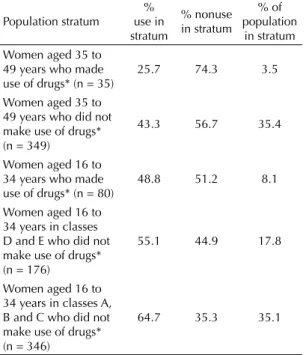
In the second hierarchical level of the model (Figure 2), for both the node of women aged 16 to 34 years and the node of women aged 35 to 49 years, the effect of the variable relating to regular use of alcohol or illegal drugs was observed. Among the women who said they used these substances, 25.7% (9/35) of the ones aged 35 to 49 years used contraceptive methods other than condoms, whereas 48.8% (39/80) of the ones aged 16 to 34 years did so.
making regular use of alcohol or illegal drugs. Among the women in this stratum of higher social level (population classes A, B and C), it was observed that contraceptive methods other than condoms were used more frequently than among the women in classes D and E, with proportions of 64.7% (224/346) and 55.1% (97/176), respectively.
Table 2 compares the strata obtained according to the CHAID technique and indicates that the stratum that presented the smallest proportion of use of contraceptive methods was that of the women aged 35 to 49 years who reported regularly using alcohol and illegal drugs. The fi ndings also indicate that the women in classes A, B and C aged 16 to 34 years who reported not making regular use of alcohol and illegal drugs were the ones who most frequently used other contraceptive procedures.
DISCUSSION
In the strata of young and middle-aged adults of both sexes and in the stratum of young men in stable rela-tionships, the use of condoms was less frequent among those who said they used psychoactive substances. These fi ndings may contribute towards formulating public policies relating to alcohol and drug consump-tion, and towards preventing sexually transmissible infections (STIs) and HIV/AIDS, since they suggest that psychoactive substances may have a modulating effect on the sexual practices of a signifi cant proportion of the general population. Moreover, they indicate that there are individuals and groups of individuals with
lifestyles presenting greater risk, including both their regular use of alcohol and/or illegal drugs and their greater potential exposure to STIs, along the lines of the concept of lifestyles of greater/lesser risk put forward
Table 1. Population strata according to use of male or female condom at the last vaginal sexual intercourse. Brazil, 2005. (N = 2591)
Population stratum % use in
stratum
% nonuse in stratum
% of population in stratum Individuals aged 45 to 65 years whose last sexual intercourse was with
a stable partner** (n = 588) 13.4 86.6 22.7
Individuals aged 25 to 44 years who made use of drugs* and whose
last sexual intercourse was with a stable partner** (n = 216) 17.1 82.9 8.3
Individuals aged 25 to 44 years who did not make use of drugs* and
whose last sexual intercourse was with a stable partner** (n = 1010) 25.1 74.9 39.9
Women aged 16 to 24 years whose last sexual intercourse was with a
stable partner** (n = 246) 42.3 57.7 9.5
Men aged 16 to 24 years who made use of drugs* and whose last
sexual intercourse was with a stable partner** (n = 79) 45.6 54.4 3.0
Men aged 16 to 24 years who did not make use of drugs* and whose
last sexual intercourse was with a stable partner** (n = 168) 63.7 36.3 6.5
Individuals aged 25 to 65 years whose last sexual intercourse was with
a casual partner*** (n = 124) 71.0 29.0 4.8
Individuals aged 16 to 24 years whose last sexual intercourse was with
a casual partner*** (n = 160) 85.0 15.0 6.2
* Relating to regular use of alcohol (four or more times a week) or use of illegal drugs
** Stable partners were defi ned as those with whom there was a relationship consisting of boyfriend/girlfriend, engagement, marriage or “lovers” that implied involvement or commitment
*** Casual partners were defi ned as those with whom no link or commitment towards continuation of the relationship was established
Table 2. Population strata according to use, among women, of contraceptive methods other than condoms at the last vaginal sexual intercourse. Brazil, 2005. (n = 986)
Population stratum
% use in stratum
% nonuse in stratum
% of population
in stratum Women aged 35 to
49 years who made use of drugs* (n = 35)
25.7 74.3 3.5
Women aged 35 to 49 years who did not make use of drugs* (n = 349)
43.3 56.7 35.4
Women aged 16 to 34 years who made use of drugs* (n = 80)
48.8 51.2 8.1
Women aged 16 to 34 years in classes D and E who did not make use of drugs* (n = 176)
55.1 44.9 17.8
Women aged 16 to 34 years in classes A, B and C who did not make use of drugs* (n = 346)
64.7 35.3 35.1
by authors such as Fortenberry et al.7
The modulating effect of psychoactive substances on sexual practices has been little investigated in popula-tion-based studies exploring such interrelationships through multivariate analyses. Two Brazilian
stud-ies have analyzed the consumption of psychoactive substances (cocaine and crack) as predictors of risky behavior among (respectively) professional female sex workers in Santos, State of São Paulo,17 and in a cohort of men who had sex with men in Rio de Janeiro.15 In
Note: 0
Category % n
Yes 32.5 841
No 67.5 1750
Total 100.0 2591
Regular use of alcohol or drugs p-value = 0.012 χ2 = 6.321 df = 1
Regular use of alcohol or drugs p-value = 0.007 χ2 = 7.238 df = 1
Last sexual intercourse with stable or casual partner Use of male or female condom
in the last vaginal sexual intercourse
Age group
p-value = 0.000 χ2 = 196.105 df = 2
Sex
p-value = 0.001 χ2 = 12.026 df = 1
Age group
p-value = 0.012 χ2 = 8.255 df = 1
Male Female
No Yes
Stable Casual
25-44 16-24
No Yes
45-65 25-44; 45-65 16-24
Note: 6
Category % n
Yes 71.0 88
No 29.0 36
Total 4.8 124
Note: 11
Category % n
Yes 42.3 104
No 57.7 142
Total 9.5 246
Note: 13
Category % n
Yes 45.6 36
No 54.4 43
Total 3.0 79
Note: 12
Category % n
Yes 63.7 107
No 36.3 61
Total 6.5 168
Note: 8
Category % n
Yes 25.1 254
No 74.9 756
Total 39.9 1010
Note: 9
Category % n
Yes 17.1 37
No 82.9 179
Total 8.3 216
Note: 10
Category % n
Yes 57.9 143
No 42.1 104
Total 9.5 247
Note: 4
Category % n
Yes 50.1 247
No 49.9 246
Total 19.9 493
Note: 3
Category % n
Yes 23.7 291
No 76.3 935
Total 47.3 1226
Note: 5
Category % n
Yes 13.4 79
No 86.6 509
Total 22.7 588
Note: 7
Category % n
Yes 85.0 136
No 15.0 24
Total 6.2 160
Note: 2
Category % n
Yes 78.9 224
No 21.1 60
Total 11.0 284
Note: 1
Category % n
Yes 26.7 617
No 73.3 1690
Total 89.0 2307
both of these studies, the consumption of cocaine and crack was shown to be an independent predictor for unprotected sexual activity, with a signifi cant difference between social classes, to the detriment of those who used drugs and belonged to less favored social strata. Studies conducted in sub-Saharan Africa have es-tablished a consistent association between abusive consumption of alcohol and the risk of engaging in risky sexual practices, both among patients seeking at-tendance in a clinical for treating STIs in South Africa14 and in a representative sample of the general population in Botswana.19 In both of these studies, abusive use of
alcohol was shown to be associated with risky sexual practices, with a signifi cant difference between genders. Among men, it was shown to be associated with pay-ing for sexual partners (in cash, goods or psychoactive substances), regardless of whether the women were sex workers or had no previous involvement with commer-cial sex. Among the women, complementary behavior relating to such conduct among men was observed, which was translated into receiving money, favors or abused substances in exchange for sex.
In a study developed among injecting drug users and their social relationship networks in a peripheral district
Note: 5
Category % n
Yes 43.3 151
No 56.7 198
Total 35.4 349
Note: 2
Category % n
Yes 41.7 160
No 58.3 224
Total 38.9 384
Note: 0
Category % n
Yes 52.7 520
No 47.3 466
Total 100.0 986
Note: 1
Category % n
Yes 59.8 360
No 40.2 242
Total 61.1 602
Note: 3
Category % n
Yes 61.5 321
No 38.5 201
Total 52.9 522
Note: 4
Category % n
Yes 48.8 39
No 51.2 41
Total 8.1 80
Note: 8
Category % n
Yes 55.1 97
No 44.9 79
Total 17.8 176
Note: 7
Category % n
Yes 64.7 224
No 35.3 122
Total 35.1 346
Note: 6
Category % n
Yes 25.7 9
No 74.3 26
Total 3.5 35
Use of any other contraceptive method in the last sexual intercourse
Age group (within fertile age range) p-value = 0.000 χ2 = 30.932 df = 1
Regular use of alcohol or drugs p-value = 0.030 χ2 = 4.687 df = 1
Regular use of alcohol or drugs p-value = 0.045 χ2 = 4.032 df = 1
Social class
p-value = 0.033 χ2 = 4.565 df = 1
16-24; 25-34
Classes D/E Classes A/B/C
No Yes No Yes
35-49
of Porto Alegre (Southern Brazil) Piccolo & Knauth10 showed that it is essential to understand drug consump-tion and behavior presenting the risk of contracting HIV/AIDS in a contextualized manner. They found that drug consumption was associated with risky behavior because of the nature of the affective and sexual rela-tionships, the subjective role of the individuals involved in such relationships and their representations regarding individual and group vulnerability to HIV/AIDS, within a context of marginalization and violence.
Therefore, better comprehension of different ways of living may provide backing for assessments and pro-posals for preventive interventions that are sensitive to the specifi c contexts in which these practices and behavioral patterns occur, and to the values and atti-tudes of different strata of society. Interventions aimed at particularly vulnerable strata, such as injecting drug users, may be shown to be inappropriate for the general population, and vice versa. This makes it necessary to understand the behavioral patterns, practices, attitudes and cultural values of each stratum, to the required depth and detail.
In a population-based study developed in the United States between the end of the 1980s and the middle of the 1990s, Bradner et al2 showed an association be-tween older age groups and greater prevalence of STIs among male interviewees. They also observed that male adolescents had a greater chance, in comparison with older males, of having received preventive education regarding HIV/Aids or STIs. In this respect, the more consistent use of condoms among younger individu-als in the present study is auspicious. Nevertheless, it must be taken in its relative context, considering that older individuals in long-duration stable relationships experience a progressive decline in motivation to use condoms within the context of such relationships. To investigate this possibility would require additional analyses taking into account the possible effects of placing these individuals in different age groups and in stable relationships of differing duration.
Even after taking into consideration the limitations resulting from an exploratory study based solely on interviewees’ reports, the fact that this was a sample representative of the urban population of Brazil and not of particularly vulnerable populations (such as samples selected from among injecting drug users and/ or drug-dependent individuals16) reinforces the need to implement public policies directed towards the general population, with regard to preventing drug consump-tion, alcohol use, STIs and HIV/AIDS. Such policies should provide backing for structural interventions that,
in addition to enabling changes in individual behavior, may contribute towards changing the adverse condi-tions to which particularly vulnerable individuals are subjected. Initiatives of this nature have been shown to be fruitful in a variety of contexts, including among populations of illegal drug users. A prejudiced view that such individuals would be impervious to major changes almost continually lingers around them, although this has repeatedly been disavowed in the literature.1 The interrelationships between sociodemographic vari-ables and the consumption of psychoactive substances seems to be even more complex in relation to contra-ceptive practices other than condom use. In this case, a pronounced age-related effect was observed among the women, along with a differential due to social class among the younger women. The possible modulating effect of psychoactive substances on contraceptive practices seemed to be clearer in relation to the more mature women, with more evident interrelationships. Among younger women, social class seemed to perform a more important role.
1. Blankenship KM, Friedman SR, Dworkin S, Mantell JE. Structural interventions: concepts, challenges and opportunities for research. J Urban Health. 2006;83(1):59-72.
2. Bradner CH, Ku L, Lindberg LD. Older, but not wiser: how men get information about AIDS and sexually transmitted diseases after high school. Fam Plann Perspect. 2000;32(1):33-8.
3. Breiman L, Friedman J, Stone CJ, Olshen R.
Classifi cation and regression trees. Pacifi c Grove, CA: Wadsworth; 1984.
4. Bussab W de O, Grupo de Estudos em População, Sexualidade e Aids. Plano amostral da Pesquisa Nacional sobre Comportamento Sexual e Percepções sobre HIV/Aids, 2005. Rev Saude Publica.
2008;42(Supl 1):12-20.
5. Centers for Disease Control and Prevention (CDC). Methamphetamine use and HIV risk behaviors among heterosexual men preliminary results from fi ve northern California counties, December 2001-November 2003. MMWR Morb Mortal Wkly Rep. 2006;55(10):273-7.
6. Ehrenstein V, Horton NJ, Samet JH. Inconsistent condom use among HIV-infected patients with alcohol problems. Drug Alcohol Depend. 2004;73(2):159-66.
7. Fortenberry JD, Orr DP, Katz BP, Brizendine EJ, Blythe MJ. Sex under the infl uence. A diary self-report study of substance use and sexual behavior among adolescent women. Sex Transm Dis. 1997;24(6):313-9.
8. Holmes KK, Levine R, Weaver M. Effectiveness of condoms in preventing sexually transmitted infections.
Bull World Health Organ. 2004;82(6):454-61.
9. National Institute of Mental Health (NIMH). Demographic and behavioral predictors of sexual risk in the NIMH multisite HIV prevention trial. AIDS.
1997;11(Suppl 2):2-27.
10. Piccolo FD, Knauth DR. Uso de drogas e sexualidade em tempos de AIDS e redução de danos. Horiz Antropol. 2002;8(17):127-45.
11. Rehm J, Taylor B, Room R. Global burden of disease from alcohol, illicit drugs and tobacco. Drug Alcohol Rev. 2006;25(6):503-13.
12. Room R, Graham K, Rehm J, Jernigan D, Monteiro M. Drinking and its burden in a global perspective: policy considerations and options. Eur Addict Res.
2003;9(4):165-75.
13. Schor N, Ferreira AF, Machado VL, França AP, Pirotta KCM, Alvarenga AT, et al. Mulher e anticoncepção: conhecimento e uso de métodos anticoncepcionais. Cad Saude Publica. 2000;16(2):377-84.
14. Simbayi LC, Kalichman SC, Cain D, Cherry C, Jooste S, Mathiti V. Alcohol and risks for HIV/AIDS among sexually transmitted infection clinic patients in Cape Town, South Africa. Subst Abus. 2006;27(4):37-43.
15. Souza CT, Diaz T, Sutmoller F, Bastos FI. The association of socioeconomic status and use of crack/ cocaine with unprotected anal sex in a cohort of men who have sex with men in Rio de Janeiro, Brazil. J Acquir Immune Defi c Syndr. 2002;29(1):95-100.
16. Strathdee SA, Sherman SG. The role of sexual transmission of HIV infection among injection and non-injection drug users. J Urban Health. 2003;80(4 Suppl 3):iii7-14.
17. Szwarcwald CL, Bastos FI, Gravato N, Lacerda R, Chequer PN, Castilho EA. The relationship of illicit drug consume to HIV-infection among commercial sex workers (CSWs) in the city of Santos, São Paulo, Brazil.
Int J Drug Policy. 1998;9(6):427-36.
18. Vieira EM, Badiani R, Dal Fabbro AL, Rodrigues Junior AL. Características do uso de métodos anticoncepcionais no Estado de São Paulo. Rev Saude Publica. 2001;36(3):263-70.
19. Weiser SD, Leiter K, Heisler M, McFarland W, Percy-de Korte F, DeMonner et al. A population-based study on alcohol and high-risk sexual behaviors in Botswana.
PLoS Med. 2006;3(10):e392.
20. West R. Addiction, ethics and public policy. Addiction. 1997;92(9):1061-70.
REFERENCES
Study funded by the Brazilian Ministry of Health, with additional resources provided by a donation from the Ford Foundation and the PAPES IV program of Fiocruz.
Article based on the data from the survey “Comportamento sexual e percepções da população brasileira sobre HIV/Aids (Sexual behavior and perceptions of Brazilian population on HIV/AIDS)”, sponsored by the Brazilian Ministry of Health through the Centro Brasileiro de Análise e Planejamento (Process n. ED 213427/2004).
This article followed the same peer-review process as any other manuscript submitted to this journal, anonymity was guaranteed for both authors and reviewers.