Major Article
Corresponding author: Dr. Cristiano Schetini de Azevedo. e-mail: [email protected]
Received 3 February 2017 Accepted 18 May 2017
Inluence of environmental enrichment on the behavior
and physiology of mice infected by
Trypanosoma cruzi
Déborah Maria Moreira da Silva
[1],
Laila Pinheiro
[1],
Cristiano Schetini Azevedo
[1],[2],
Guilherme de Paula Costa
[3]and André Talvani
[2],[3],[4],[5][1]. Departamento de Biodiversidade, Evolução e Meio Ambiente, Campus Morro do Cruzeiro, Universidade Federal de Ouro Preto, Ouro Preto, MG, Brasil. [2]. Programa de Pós-Graduação em Biomas Tropicais, Campus Morro do Cruzeiro, Universidade Federal de Ouro Preto, Ouro Preto, MG, Brasil. [3]. Programa de Pós-Graduação em Ciências Biológicas, Campus Morro do Cruzeiro, Universidade Federal de Ouro Preto, Ouro Preto, MG, Brasil.
[4]. Departamento de Ciências Biológicas, Campus Morro do Cruzeiro, Universidade Federal de Ouro Preto, Ouro Preto, MG, Brasil. [5]. Programa de Pós-Graduação em Saúde e Nutrição, Campus Morro do Cruzeiro, Universidade Federal de Ouro Preto, Ouro Preto, MG, Brasil.
Abstract
Introduction: Enriched environments normally increase behavioral repertoires and diminish the expression of abnormal
behaviors and stress-related physiological problems in animals. Although it has been shown that experimental animals infected with microorganisms can modify their behaviors and physiology, few studies have evaluated how environmental enrichment affects these parameters. This study aimed to evaluate the effects of environmental enrichment on the behavior and physiology
of conined mice infected with Trypanosoma cruzi. Methods: The behaviors of 20 T. cruzi-infected mice and 20 non-infected mice were recorded during three treatments: baseline, enrichment, and post-enrichment. Behavioral data were collected using scan sampling with instantaneous recording of behavior every 30s, totaling 360h. Plasma TNF, CCL2, and IL-10 levels and parasitemia were also evaluated in infected enriched/non-enriched mice. Behavioral data were evaluated by Friedman’s test and physiological data by one-way ANOVA and area under the curve (AUC) analysis. Results: Results showed that environmental
enrichment signiicantly increased exploratory behaviors and diminished inactivity. The use of environmental enrichment did
not diminish circulating levels of TNF and IL-10 but diminished circulating levels of CCL2 and parasitemia. Conclusions:
Positive behavioral and physiological effects of environmental enrichment were observed in mice living in enriched cages. Thus, environmental enrichment improved the welfare of these animals.
Keywords: Chagas disease. Inlammation. Laboratory animals. Welfare.
INTRODUCTION
Stress can be deined as the biological response elicited
when an individual perceives a threat to its homeostasis1. Chronic stress provoked by poor captive environments should
be avoided, as it can change animal behavior. Speciically,
animals may express more stereotypical abnormal behaviors (e.g. repetitive behaviors that have no apparent function)2. Moreover, chronic stress may diminish animals’ immune responses, which is associated with the development of pathologies that affect not only physical3 but also emotional status (e.g., increased anxiety and fear)4. Since stress can inluence the immune system, as well as the physiology and
behavior of animals, results originating from studies with animals housed under such conditions can be biased and conclusions wrongly interpreted5-7.
One approach for avoiding, decreasing, or eliminating stress-related problems when researching captive animals is environmental enrichment8. Environmental enrichment is a method that involves the introduction of different items into enclosures to stimulate physical and psychological activities that improve animal welfare9. In other words, enrichment transforms a monotonous environment into a dynamic, complex, and unpredictable one, resulting in improvements in animal health10.
Experimental animals used in studies involving infection
with pathogenic organisms can exhibit modiied behavior in
the presence of these infective agents11. If these animals are captive, they can also suffer from a lack of stimuli and the high predictability of their environment12,13. The synergistic effects of parasitism and living in a non-enriched captive environment may rapidly diminish the welfare of the animals14, increasing the morbidity and mortality rates of the experimentally infected animals15.
Trypanosoma cruzi is a flagellated protozoan and the causative agent of Chagas disease in humans. It is largely
used in experimental infections to study the inlammatory
hosts, this parasite disseminates through the blood system, promoting systemic and local activation of the immune response and provoking pathologies mainly in the heart and central nervous system16-19. Experimental mice infected with T. cruzi normally exhibit diminished locomotive-explorative behaviors, showing a tendency to run in a circular pattern and displaying a humpback walk11. In this initial phase of infection, the antigenic molecule of T. cruzi promotes the
activation and release of inlammatory mediators and oxygen
and/or nitrogen intermediary radicals20,21. In particular, IFN-γ (gamma interferon) released by T lymphocyte and NK (natural killer) cells is the main cytokine responsible for controlling parasitism during the acute phase and is pivotal in intensifying the activation of phagocyte cells and other immune cells. Meanwhile, interleukin-10 (IL-10) regulates the host immune response22,23. Of similar importance, chemokines are known for their capacity to induce leukocyte migration and activation of immune system cells, driving these cells to parasite infection sites24. The chemokines CCL2 [chemokine (C-C motif) ligand 2] (MCP-1 – monocyte chemoattractant protein-1) and CCL5 [chemokine (C-C motify) ligand 5] (RANTES – Regulated on Activation Normal T cell Expressed and Secreted)) are directly linked to lymphocyte migration and control of parasite replication, respectively25. Similarly, the lack of CCR5 (C-C chemokine receptor type 5) eliminates the ability of lymphocytes to migrate to the infection site and control parasite replication26. Thus, the balance between cytokine and chemokine production during this initial phase might determinate the intensity and severity of pathogenesis27,28, affecting the behavior and survival of these animals.
Since environmental enrichment enhances animal welfare, we hypothesize that enriched environment-reared animals will display more locomotive-explorative behaviors and fewer abnormal behaviors compared to animals reared
in conventional cages. We also speculate that modulation
of the immune response through reductions in TNF (Tumor Necrosis Factor), CCL2, and IL-10 will allow enriched environment-reared animals to better manage T. cruzi
infection29. Thus, the aim of this study was to evaluate whether different physical environmental enrichment items affected the behavioral and immune responses of mice infected with T. cruzi.
METHODS
Animals and maintenance
Forty healthy male C57BL/6 mice aged 9-10 weeks and weighing 16-18g from the Center of Animal Science of the Federal University of Ouro Preto were used in this study.
Ethical considerations
The study was approved by the Animal Ethics Committee of the Federal University of Ouro Preto under license number 2012-60.
Mice were kept in standard autoclavable polypropylene boxes (30.3 × 19.3 × 12.6cm; Beira-Mar®) with a stainless steel lid, arranged on conventional shelves, placed in a room with a
controlled temperature (22ºC), and submitted to a 12 light/12 dark cycle (white light on from 07:00 to 19:00; acclimation period: 4 weeks). Food pellets (Nuvilab CR1®) and a bottle of
iltered water were provided ad libitum. Autoclaved sawdust (Oeste®) was used as bedding and changed twice a week. Five mice were housed together in each box. All boxes were autoclaved before use.
Mice were infected with 5,000 blood trypomastigotes of the
VL-10 (Virgem da Lapa) T. cruzi strain, which belongs to the
TcII discrete typing unit (DTU)30 and presents cardiac tropism
and slight ibrosing inlammation in C57BL/6 mice31. Blood was diluted in 0.9% saline solution to adjust the concentration, and it was injected into mice intraperitoneally. Infected and non-infected animals were exposed to either standard or enriched housing environment (n = 10 animals in each group). After
experiments, mice were euthanized in a CO2 chamber (10L/min
of CO2)32, and hearts were collected and weighed.
Experimental protocol
Three structural enrichment items were used in this study: PVC (polyvinyl chloride) pipes, egg boxes, and straw nests. The PVC pipe was cleaned every week with 70% alcohol and reused whenever needed. Straw nests and egg boxes were autoclaved and exchanged twice a week. The order of items for testing was
deined following the Latin square design, and all items were
provided separately.
The study was divided into three treatments: 1) baseline, in which data were collected before the introduction of the environmental enrichment items; 2) enrichment, in which data were collected when the enrichment items were offered; 3) post-enrichment, in which data were collected after the removal of the enrichment items when the conditions returned to those of baseline treatment. Thirty hours of behavioral data distributed over six weeks were collected for each treatment (10h for each enrichment item during enrichment treatment). Data were collected from Monday to Friday, with 1-week intervals between treatments.
Behavioral data were collected using scan sampling
with instantaneous recording of behaviors every 30s33. Each
behavioral sampling lasted 30 min, totaling 360h of behavioral data; samplings occurred from 12:00 to 12:30 and from 16:00 to 16:30, since mice were most active during these hours based
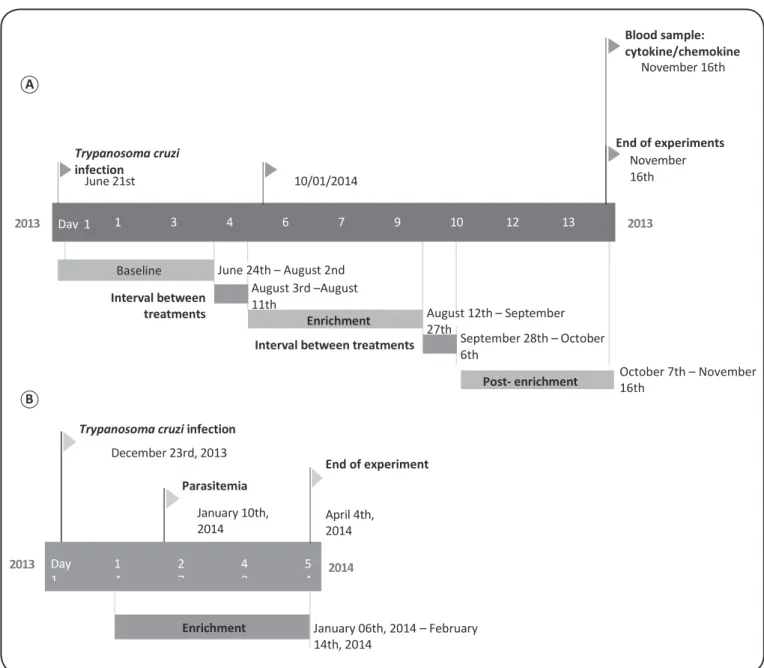
on 20h of preliminary observations (Figure 1A). All data
were collected with the researcher 1m from the boxes to avoid researcher interference in mouse behavior.
Ethogram
An ethogram for mice was built based on 20h of preliminary
observation using an ad libitum recording method33 and
consultation with the scientiic literature34 (Table 1). Parasitemia
A
B
FIGURE 1 - Graphic timeline for the recording of behavioral and physiological data of C57BL/6 mice. A. Timeline for behavioral and physiological data recording. B. Timeline for parasitemia data recording.
Behavior Acronym Description
Allogrooming AG Mouse cleans the fur of another mouse.
Grooming GRO Mouse cleans its own fur.
Exploration EXP Mouse explores the box, snifing and walking, without exploring the roof of the box.
Roof exploration EXR Mouse explores the roof of the box, snifing and hanging on lid.
Inactivity IN Mouse stands still (inactive) or sleeps.
Negative social interaction IS- Mouse intimidates, attacks, or bites another mouse, mutilating it.
Abnormal behaviors ABN Mouse bites the lid or jumps in a repetitive or stereotypical way or exhibits negative allogrooming of another mouse (when the grooming is so intense and repetitive that the fur of the groomed mouse is
plucked).
Not visible NV Mouse not visible.
AG: allogrooming, GRO: grooming, EXP: exploration; EXR: roof exploration; IN: inactivity; IS-: negative social interaction; ABN: abnormal behaviors; NV: not visible.
TABLE 1
Ouro Preto. These mice were maintained under the same conditions as the other animals (acclimation period: 4 weeks). New animals
were required since the peak of parasitemia occurred 27 days
after infection; in the original group, this peak occurred before the enrichment treatment, preventing assessment of parasitemia35. Parasitemia analysis was initiated 19 days after infection of mice with T. cruzi, according to Brener’s technique36; this was 4 days after the implementation of environmental enrichment. Parasitemia was evaluated during enrichment treatment only, and the behaviors displayed by mice were grouped for analyses (Figure 1B). Blood (5µL) extracted from each mouse’s caudal vein was placed on a microscope slide with a 22 × 22mm glass slide coverslip. Microscope slides were analyzed under a
4,000-factor microscope at 40× magniication. The slides were divided into 50 random ields for parasite counts. After counting,
the number of parasites was multiplied by the microscope’s factor to achieve the true parasitemia value. Parasitemia curves for enriched and non-enriched mice were compared.
Inlammatory mediators
Plasma samples from mice collected from the orbital venous sinus were also used to assess circulating levels of monocyte chemoattractant protein (CCL2) (Mouse CCL2/JE/MCP-1 DuoSet Elisa Kit, R&D Systems, MN, USA), IL-10 (Mouse interleukin 10, IL-10 Elisa kit, BioSource, CA, USA), and TNF
(Mouse TNF-alpha quantitative Elisa kit, R&D Systems, MN,
USA). All procedures followed manufacturer protocols. Blood samples for cytokine/chemokine analysis were collected from subject mice at 14:00 on the last day of the post-enrichment treatment as a terminal procedure, 148 days after infection by
T. cruzi. All samples were measured simultaneously in duplicate.
Statistical analysis
Behavioral data did not follow a normal distribution according to the Anderson-Darling normality test; thus, non-parametric statistics were used throughout. The Friedman test with Dunn’s post-hoc analysis was used to evaluate behavioral differences among the three treatments and the three environmental enrichment items; Bonferroni correction
was applied, and thus signiicant values were achieved at α = 0.02. A Mann-Whitney test was used to evaluate behavioral
differences between infected and non-infected mice and between enriched and non-enriched mice (for enriched mice, behavioral data collected for all three environmental enrichment items were pooled and analyzed together). These analyses were run
with a conidence level of 95% (α = 0.05) using Minitab 16
and Prisma 5.037.
Physiological data were normally distributed, according to the Anderson-Darling normality test; thus, parametric tests were used throughout. One-way ANOVA was used to evaluate
differences in inlammatory mediators and heart weight among
the experimental groups. An independent sample t-test was used to evaluate differences in parasitemia in the experimental groups. Areas under the curve (AUCs) were calculated to determine if numbers of blood parasites differed between enriched and non-enriched mice. The AUC was derived from parasite concentration and time, measuring how long parasites
remain in mouse blood. All tests were run with a conidence level of 95% (α = 0.05) using Minitab 16 and Prisma 5.037.
RESULTS
Behavioral data
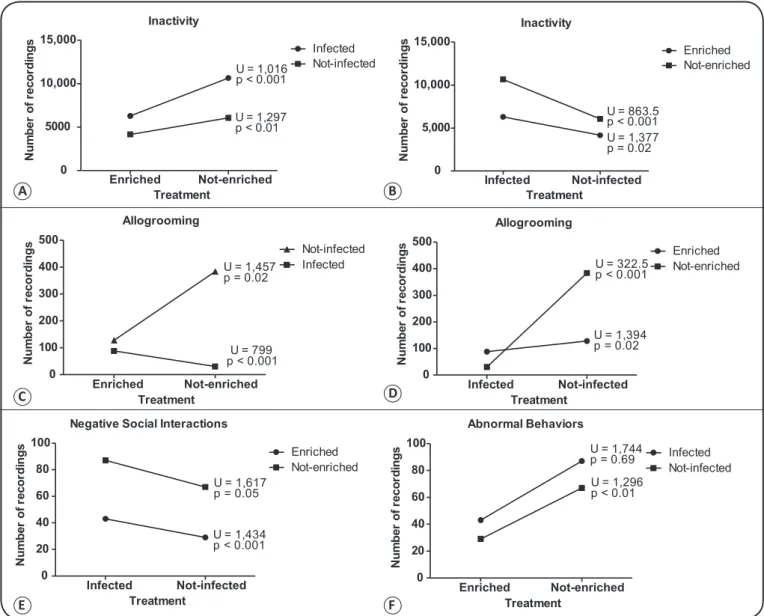
Mouse behavior was signiicantly affected by enrichment treatment. Inactivity was signiicantly more common in the
non-enriched group than in the non-enriched group, both for infected and
non-infected mice (Figure 2 A, B). In addition, both infected and
non-infected mice showed an increase in cage exploration during
enrichment treatment, but this increase was only signiicant for
the non-infected group (Table 2). Invisibility increased during
enrichment treatment in both groups, while roof exploration decreased during enrichment treatment only in the infected group (Table 2).Grooming was less frequent in both the non-infected
and infected groups during enrichment treatment (Table 2).
Allogrooming occurred at different rates in the enriched and non-enriched groups. Among enriched mice, it was more commonly performed in the infected group than in the non-infected group, while among non-enriched mice, allogrooming was more common among non-infected than infected mice (Figure 2 C, D). Allogrooming was signiicantly more common in the enriched group, both among infected and
non-infected mice (Figure 2 C, D). Negative social interactions were
also exhibited signiicantly more frequently by the non-enriched
group, both among infected and non-infected mice (Figure 2 E).
Abnormal behaviors in infected mice did not signiicantly
differ between the enriched and non-enriched groups, although they were recorded more often in the non-enriched group (Figure 2 F). Among non-infected mice, the expression of
abnormal behaviors was signiicantly lower in the enriched
group than in the non-enriched group (Figure 2 F). Abnormal
behaviors diminished post-enrichment only in the infected
group (Table 2).
In comparing the three enrichment treatments, grooming
occurred more frequently when the PVC pipe was used for enrichment and less frequently when the egg box was used in
both infected and non-infected groups [infected: F = 20.68, p < 0.01; non-infected: F = 18.00, p < 0.01; n = 20, degrees of freedom (DF) = 2 for both tests]. Infected mice became more inactive when the straw nest was offered, and non-infected mice became more inactive when the PVC pipe was offered (infected: F = 19.30, p < 0.01; non-infected: F = 21.19, p < 0.01; n = 20,
DF = 2 for both tests). The category not visible was recorded
more frequently when the egg box was offered in both groups
(infected: F = 30.10, p < 0.01; non-infected: F = 30.10, p < 0.01; n = 20, DF = 2 for both tests).
Physiological data
For most days, the parasitemia curves of enriched mice were lower than those of non-enriched mice, but this was only
signiicant on day 33 (t-test = 2.1, p = 0.04, DF = 18). The
numbers of parasites in the enriched mice were signiicantly
Inactivity
Enriched Not-enriched
0 5000
10 000,
15 000,
Infected Not-infected U = 1,016
p < 0.001
U = 1,297 p < 0.01
Treatment Nu mb er of re co rd in gs Inactivity Infected Not-infected 0 5,000
10 000,
15 000,
Enriched Not-enriched
U = 863.5 p < 0.001 U = 1,377 p = 0.02
Treatment Nu mber of reco rd in gs Allogrooming Enriched Not-enriched 0 100 200 300 400 500 Infected Not-infected U = 1,457
p = 0.02
U = 799 p < 0.001
Treatment Nu mb er of re co rd ings Allogrooming Infected Not-infected 0 100 200 300 400 500 Enriched Not-enriched
U = 1,394 p = 0.02 U = 322.5 p < 0.001
Treatment Nu mb er of re co rd in gs
Negative Social Interactions
Infected Not-infected 0 20 40 60 80 100 Enriched Not-enriched
U = 1,434 p < 0.001 U = 1,617 p = 0.05
Treatment Nu mb er of re co rd in gs Abnormal Behaviors Enriched Not-enriched 0 20 40 60 80 100 Infected Not-infected U = 1,744
p = 0.69
U = 1,296 p < 0.01
Treatment Nu mb er of re co rd in gs A B C D E F
FIGURE 2 - Behavioral comparisons of the effects of Trypanosoma cruzi infection on the enriched and non-enriched groups and between the effects of enrichment on the infected and non-infected groups. U: Mann-Whitney test, n = 40, DF = 2.
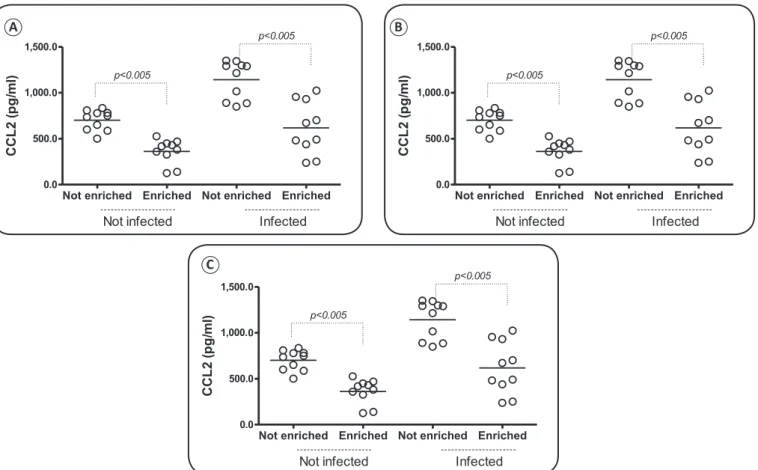
Infected mice produced more TNF than non-infected mice,
especially under non-enrichment conditions (Figure 3A). Generally, enriched mice produced less TNF than non-enriched mice in both infected and non-infected groups; however, these differences were not statistically significant (Figure 3A). Environmental enrichment decreased the production of CCL2 both in infected and non-infected mice (Figure 3B). While no
signiicant differences were found among groups in terms of
IL-10 production, there was slightly reduced production of this cytokine in the enriched groups (Figure 3C).
Finally, no differences were found in heart weight among the groups (F = 1.39, p = 0.26, n = 10, DF = 3), with an average weight (± SD) of 5.2 × 10⁻³ ± 2.3 × 10⁻⁴ in infected and enriched mice, 5.4 × 10⁻³ ± 5.4 × 10⁻⁴ in infected and non-enriched mice, 4.0 × 10⁻³ ± 6.2 × 10⁻⁴ in non-infected and enriched mice, and 4.0 × 10⁻³ ± 6.2 × 10⁻⁴ in non-infected and non-enriched mice.
DISCUSSION
In this study, we found that environmental enrichment decreased inactivity in both T. cruzi-infected and non-infected mice and decreased roof exploration in the infected group. The non-infected group showed an increase in cage exploration and a reduction in grooming. Abnormal behaviors decreased only for the infected group and only in the post-enrichment period. Similar increases in activity and decreases in inactivity have been observed in many studies of environmental enrichment8,38-40. With an increase in stimulation inside the cage, mice have more
opportunities to explore items, resulting in more activity and
less inactivity. Increased activity levels beneit captive animals
TABLE 2
Comparisons between the behaviors expressed by the infected and non-infected C57BL/6 mice during the baseline, enrichment, and post-enrichment treatments (mean ± standard error).
Treatments Behaviors
baseline enrichment post-enrichment Friedman statistic p-value
GRO EI 31.08± 1.67 25.13 ± 2.47 44.13 ± 3.12 5.70 0.06
GRO ENI 36.10 ± 2.69a 19.52 ± 2.05b 37.12 ± 2.61a,c 28.46 < 0.0001*
EXP EI 24.77 ± 2.99 29.50 ±4.49 20.78 ± 3.31 1.32 0.52
EXP ENI 25.53 ± 2.15a 53.28 ± 5.55b 54.00 ± 6.34b,c 27.58 <0.0001*
EXR EI 14.00 ± 2.35a 6.58 ± 0.51b 3.93 ± 0.96b,c 22.34 < 0.0001*
EXR ENI 10.47 ± 1.18 11.57 ± 1.66 8.13 ± 1.38 4.10 0.13
IS- EI 0.08 ± 0.05 0.13 ± 0.09 0.00 ± 0.00 2.00 0.37
IS- ENI 0.02 ± 0.02 0.75 ± 0.28 0.07 ± 0.05 7.82 0.02*
IN EI 169.70 ± 8.21a 104.70 ± 12.85b 201.80 ± 8.80a,c 26.53 < 0.0001*
IN ENI 175.30 ± 7.32a 69.18 ± 10.06b 141.50 ± 9.28c 46.02 < 0.0001*
ABN EI 0.57 ± 0.18a 0.73 ± 0.33a 0.03 ± 0.03b 8.000 0.02*
ABN ENI 0.52 ± 0.24 0.43 ± 0.16 0.40 ± 0.16 0.1600 0.92
NV EI 8.53 ± 1.04a 88.28 ± 14.30a,b 1.97 ± 0.51c 59.23 < 0.0001*
NV ENI 9.10 ± 1.30a 79.57 ± 11.91b 1.15 ± 0.49c 63.17 < 0.0001*
GRO: grooming; EXP: exploration; EXR: roof exploration; IS-: negative social interaction; IN: inactive; ABN: abnormal behaviors; NV: not visible; EI: enriched and infected; ENI: enriched and non-infected. a,b,c Different superscript letters indicate statistical differences. *Signiicant values after Bonferroni correction.
FIGURE 3 - Comparisons of the production of inlammatory mediators in infected and non-infected and enriched and non-enriched groups. (A): TNF (Tumor Necrosis Factor). (B): CCL2 [chemokine (C-C motif) ligand 2]. (C): IL-10 (interleukin-10.)
Not infected Infected
Not enriched Enriched Not enriched Enriched
0.0 500.0 1,000.0 1,500.0
Not infected Infected
p<0.005
p<0.005
CCL
2(
pg
/m
l)
Not infected Infected
Not enriched Enriched Not enriched Enriched
0.0 500.0 1,000.0 1,500.0
Not infected Infected
p<0.005
p<0.005
CCL
2(
pg
/m
l)
Not infected Infected
Not enriched Enriched Not enriched Enriched
0.0 500.0 1,000.0 1,500.0
Not infected Infected
p<0.005
p<0.005
CCL
2(
pg
/m
l)
A B
in non-enriched cages presented higher activity levels than mice kept in enriched cages42.The authors argued that mice explore cages more when no novelty is provided or maintain higher activity levels due to the impossibility of building nests or sleeping or due to increased attempts to escape from the cage. In the present study, when an item was available, mice explored the item more than an empty cage. However, infected mice showed only a slight increase in activity, and this could
be a direct relection of infection with T. cruzi, as this parasite increases lethargy in animals43.
Environmental enrichment techniques are known to
diminish the expression of abnormal behaviors in many animal species8,38,44-47. In the present study, abnormal behaviors did not decrease signiicantly during enrichment treatment in infected groups, showing that the items used may not be adequate for this. A signiicant reduction in the expression of abnormal
behaviors during the post-enrichment period in the infected
group, however, showed that the beneits of environmental
enrichment can be enduring. For the non-infected groups, environmental enrichment decreased the expression of abnormal behaviors.
Egg boxes elicited more activity from mice than the other enrichment items and could also be used as hiding places. According to the Royal Society for the Prevention of Cruelty to Animals48, hiding places are crucial for the maintenance of rodents in laboratories and captivity, increasing their welfare by making them feel safe. The mice in the present study used the egg boxes to hide, reducing the visibility of mice more than the other enrichment items. PVC pipes are cold, poorly ventilated
items that are dificult to manipulate, and these characteristics
may have induced the mice to avoid them38. Straw nests and egg boxes, in contrast, are well-ventilated and more easily manipulated items, permitting all individuals to use them concomitantly, and these characteristics may have been more attractive to animals.
The increase in social interactions in the infected and
enriched group suggests a positive inluence of environmental enrichment in decreasing the depressive proile generated
by the parasite T. cruzi11,49. The non-enriched non-infected group exhibited higher levels of allogrooming, corroborating the results of a study42 in which mice kept in conventional environments expressed more allogrooming behaviors than mice kept in enriched environments. Similarly, we found that overall, infected mice exhibited less allogrooming than non-infected mice. A further reduction in allogrooming in non-infected and enriched mice was due to the use of the enrichment items by the animals.
Negative social interactions were recorded signiicantly less frequently in infected mice than in non-infected mice.
Infected animals were less aggressive to other individuals,
and this was probably due to their depressive proiles11. These animals initiated negative social interactions but soon gave up the confrontations, remaining immobile and inactive, which was also previously reported43. Some studies showed that enriched CFLP mice exhibited more aggressive behaviors than non-enriched mice and concluded that environmental enrichment
may exacerbate welfare problems50,51,52. However, since the expression of negative social interactions did not increase during enrichment treatment in our study, we conclude that the use of enriched environments does not increase stress or aggression49.
Trypanosoma cruzi infection alters the immune system of the host, increasing the concentrations of the cytokine TNF and chemokine CCL253,54. While environmental enrichment significantly decreased the production of CCL2, TNF
concentrations were not signiicantly altered, although they did decrease in the enriched groups; both are inlammatory mediators that recruit and activate cells to the inlammatory
site20. IL-10 did not decrease with enrichment, which was expected since expression of this cytokine normally changes only when it is necessary to regulate the inflammatory response21. The regulatory cytokine IL-10 acts mainly to control the parasite in the acute phase of infection, inhibiting the action
of TNF, which intensiies the inlammatory process55. Thus, it is assumed that the presence of TNF at the beginning stage of infection is essential for controlling parasite infection, but its
intensiication and persistence during longer periods of infection
would prejudice the host due to the intensification of the
tecidual inlammatory response and consequent functional organ sequel56. By decreasing the TNF concentration, environmental enrichment enhanced the immune responses of the mice56.
The chemokine CCL2 promotes the attraction of
inlammatory cells to inlammatory sites, and together with TNF,
it is responsible for the myocarditis induced by parasitism17. However, in this study, environmental enrichment did not alter TNF production in infected animals. In contrast, via an unknown pathway, the chemokine CCL2 was reduced in infected mice under environmental enrichment. This pattern is, at least, a
precondition for reducing the inlammation in tissues.
The parasitic loads of the enriched mice were also lower than those in the non-enriched mice, showing that environmental enrichment allowed animals to better cope with the parasites by increasing their welfare. Mice infected with
Babesia microti and exposed to environmental enrichment took longer to reach a peak of parasitemia, probably due to changes in behavioral, hormonal, and immunocompetence parameters49. Environmental enrichment, in this case, promoted more resistance to the parasite. Similar results were found for turkeys (Meleagris gallopavo)58. The authors found a detrimental effect of environmental enrichment offered
during the irst two weeks of life in turkeys, showing that
they become more susceptible to bacterial infections later
in life. In contrast, two studies found beneicial effects of
environmental enrichment on mice infected with encephalitis
and inluenza virus57,59. Finally, environmental enrichment does not compromise the immune response in mice chronically infected with Mycobacterium avium60. These studies highlight the importance of evaluating different physiological and behavioral parameters to better understand the effects of environmental enrichment on animals infected with parasites.
In conclusion, environmental enrichment improved the
of abnormal behaviors decreased in the infected group during enrichment treatment, the items used were unable to stimulate mice
to eliminate or signiicantly reduce these behaviors. Environmental enrichment also improved the physiological proile of T. cruzi
-infected mice, reducing the production of some inlammatory
mediators and parasitemia. Thus, enriched mice should be used
preferentially in parasitological studies, as it enhances the quality
of the results. This should facilitate the development of better
treatments for diseases, consequently beneitting public health.
Acknowledgements
The authors would like to thank R.J.Y. for invaluable suggestions on the irst
draft of this paper. Special thanks to the Laboratory of Vertebrate Zoology/ Departamento de Biodiversidade, Evolução e Meio Ambiente, Fundação de Amparo à Pesquisa de Minas Gerais,Conselho Nacional de Desenvolvimento
Cientíico e Tecnológico, and the Federal University of Ouro Preto. A.T. is also
supported by a fellowship for research productivity from Conselho Nacional
de Desenvolvimento Cientíico e Tecnológico.
Financial Support
There is no inancial support to acknowledge for this study.
Conlict of interest
The authors declare that have no conlicts of interest.
REFERENCES
1. Comitee on Recognition and Alleviation of Distress in Laboratory Animals. Recognition and Alleviation of Distress in Laboratory
Animals. Washington: The National Academies Press; 2008. 132p.
2. Mason G, Rushen J. Stereotypic animal behaviour: fundamentals
and applications to welfare. Wallingford: CABI; 2006. 367p.
3. Gröer M, Meagher MW, Kendall-Tackett K. An overview of stress and immunity. In: Kendall-Tackett KA, editor. The psychoneuroimmunology of chronic disease: exploring the links
between inlammation, stress, and illness. Whasington: American
Psychological Association; 2009. p. 9-22.
4. Pinheiro AA, Brito IF. Bem-estar e produção animal. Sobral: Embrapa Caprinos; 2009. 27p.
5. Bayne K, Wurbel H. The impact of environmental enrichment on
the outcome variability and scientiic validity of laboratory animal
studies. Rev Sci Tech Off Int Epiz. 2014;33(1):273-80.
6. Bayne K. Potential for unintended consequences of environmental enrichment for laboratory animals and research results. ILAR J. 2005;46(2):129-39.
7. Coleman K, Weed JL, Schapiro SJ. Environmental enrichment for animals used in research. In: Conn PM, editor. Animal models for the study of human disease. London: Academic Press; 2013. p. 75-94.
8. Young RJ. Environmental enrichment for captive animals. Oxford: Blackwell Science; 2003. 240p.
9. Shepherdson DJ, Mellen JD, Hutchins M. Second nature:
environmental enrichment for captive animals. Washington:
Smithsonian Institution Press; 1998. 376p.
10. Reinhardt V, Reinhardt A. Variables, reinement and environmental enrichment for rodents and rabbits kept in research institutions:
making life easier for animals in laboratories. Washington: Animal Welfare Institute; 2006. 71p.
11. Silva AA, Pereira GV, Souza AS, Silva RR, Rocha MS, Lannes-Vieira J. Trypanosoma cruzi-induced central nervous system
alterations: from the entry of inlammatory cells to potential
cognitive and psychiatric abnormalities. J Neuroparasit. 2010; 1:1-13.
12. Pizzutto CS, Sgai MGFG, Lopes DA, Pessutti C, Nunes A, Furtado PV, et al. Relation between the level of self-mutilation and the concentration of fecal metabolites of glucocorticoids in captive chimpanzees (Pan troglodytes). Pesq Vet Bras. 2015;35(1):62-6.
13. Morgan KN, Tromborg CT. Sources of stress in captivity. Appl Anim Behav Sci. 2007;102:262-302.
14. Mason GJ. Species differences in responses to captivity: stress, welfare and the comparative method. Trends Ecol Evol. 2010;25(12):712-21.
15. Martin LB, Kidd L, Liebl AL, Coon CAC. Captivity induces
hyperinlammation in the house sparrow (Passer domesticus). J Exp Biol 2011;214(Pt 15):2579-85.
16. Chagas C. Nova tripanozomiase humana: estudos sobre a morfologia e o ciclo evolutivo do Schizotrypanum cruzi n. gen., n. sp., agente etiológico de nova entidade mórbida do homem. Mem Inst Oswaldo Cruz. 1909;1:159-218.
17. Talvani A, Rocha MOC, Barcelos LS, Gomes YM, Ribeiro AL, Teixeira MM. Elevated concentrations of CCL2 and tumor necrosis fator-alpha in chagasic cardiomyopathy. Clin Infec Dis. 2004;38(7):943-50.
18. Arantes JM, Francisco AF, de Abreu Vieira PM, Silva M, Araujo MSS, de Carvalho AT, et al. Trypanosoma cruzi: desferrioxamine decreases mortality and parasitemia in infected mice through a trypanostatic effect. Exp Parasitol. 2011;128(4):401-8.
19. Engman DM, Leon JS. Pathogenesis of Chagas heart disease: role of autoimmunity. Acta Trop. 2002;81(2):123-32.
20. Talvani A, Ribeiro CS, Alberti JC, Michailowsky V, Santos PV, Murta SM, et. al. Kinetics of cytokine gene expression in experimental chagasic cardiomyopathy: tissue parasitism and endogenous IFN-gamma as important determinants of chemokine mRNA expression during infection with Trypanosoma cruzi. Microbes Infect. 2000;2(8):851-66.
21. Talvani A, Teixeira MM. Inlammation and Chagas disease: some mechanisms and relevance. Adv Parasitol. 2011;76:171-94.
22. Hunter CA, Ellis-Neyes LA, Slifer T, Kanaly S, Grunig G, Fort M,
et. al. IL-10 is required to prevent immune hyperactivity during
infection with Trypanosoma cruzi. J Immunol. 1997;158(7):3311-16.
23. Golgher D, Gazzinelli RT. Innate and acquired immunity in the pathogenesis of Chagas disease. Autoimmunity. 2004;37(5): 399-409.
24. Moser B, Loetscher P. Lymphocyte trafic control by chemokines. Nat Immunol. 2001;2(2):123-8.
25. Machado FS, Koyama NS, Carregaro V, Ferreira VR, Milanezi CM, Teixeira MM, et. al. CCR5 plays a critical role in the development of myocarditis and host protection in mice infected with Trypanosoma cruzi. J Infect Dis. 2005; 191(4):627-36.
26. Hardison JL, Wrightsman RA, Carpenter PM, Lane TE, Manning JE. The chemokines CXCL9 and CXCL10 promote a protective
immune response but do not contribute to cardiac inlammation
following infection with Trypanosoma cruzi. Infect Immun. 2006;74(1):125-34.
28. Esper L, Talvani A, Pimentel P, Teixeira MM, Machado FS. Molecular mechanisms of myocarditis caused by Trypanosoma cruzi. Curr Opin Infect Dis. 2015;28(3):246-52.
29. Müller GCK, Greinert JA, Silva-Filho HH. Frequência de parasitas
intestinais em felinos mantidos em zoológicos. Arq Bras Med Vet
Zootec. 2005;57(4):559-61.
30. Zingales B, Andrade SG, Briones MRS, Campbell DA, Chiari E, Fernandes O, et al. A new consensus for Trypanosoma cruzi intraspeciic nomenclature: second revision meeting recommends
TcI to TcVI. Mem Inst Oswaldo Cruz. 2009;104(7):1051-4.
31. Silva RR, Shrestha-Bajracharya D, Almeida-Leite CM, Leite R, Bahia MT, Talvani A. Short-term therapy with simvastatin reduces
inlammatory mediators and heart inlammation during the acute
phase of experimental Chagas disease. Mem Inst Oswaldo Cruz. 2012;107(4):513-21.
32. Conselho Nacional de Controle e Experimentação Animal (CONCEA). Diretrizes de prática de eutanásia do CONCEA. Brasília: Diretriz; 2013. 24p.
33. Martin P, Bateson P. Measuring Behaviour: an introductory guide. 2nd ed. Cambridge: Cambridge University Press; 2007. 186p.
34. Olsson IAS, Sherwin CM. Behaviour of laboratory mice in different housing conditions when allowed to self-administer an anxiolytic. Lab Anim 2006;40(4):392-9.
35. Penitente AR, Leite AL, Costa GP, Shrestha D, Horta AL, Natali AJ, et. al. Enalapril in Combination with Benznidazole Reduces Cardiac
Inlammation and Creatine Kinases in Mice Chronically Infected
with Trypanosoma cruzi. Am J Trop Med Hyq. 2015;93(5):976-82.
36. Brener Z. Therapeutic activity and criterion of cure on mice experimentally infected with Trypanosoma cruzi. Rev Inst Med Trop São Paulo. 1962;4:389-96.
37. Zar JH. Biostatistical Analysis. 5th ed. New Jersey: Prentice Hall;
2009. 960p.
38. Brice BD, Stephens MR, Georges SJ, Venancio AR, Bermont PC,
Warncke AV, et al. Environmental enrichment induces pericyte
and IgA-dependent wound repair and lifespan extension in a colon tumor model. Cell Rep. 2017;19(4):760-73.
39. Würbel H. Environmental enrichment does not disrupt stardardization of animal experiments. Altex. 2007;24 (spe issue):70-3.
40. Andrade AA, Azevedo CS. Efeitos do enriquecimento ambiental na diminuição de comportamentos anormais exibidos por papagaios-verdadeiros (Amazona aestiva, Psittacidae) cativos. Rev Bras Ornitol. 2011;19(1):56-62.
41. Van de Weerd HA, Aarsen EL, Mulder A, Kruitwagen CL, Hendriksen CF, Baumans V. Effects of environmental enrichment for mice: variation in experimental results. Appl Anim Behav Sci. 2002;5(2):87-109.
42. Marques JM, Olsson IAS. The effect of preweaning and postweaning housing on the behaviour of the laboratory mouse (Mus musculus). Lab Anim. 2007;41(1):92-102.
43. Pereira GV, Silva AA, Pereira IR, Silva RR, Moreira OC, de Almeida LR, et. al. Trypanosoma cruzi-induced depressive like behaviour is independent of meningoencephalitis but responsive to parasiticide and TNF-targeted therapeutic interventions. Brain Behav Immun. 2012;26(7):1136-49.
44. Ceballos MC, Góis KCR, Carvalhal MVL, Costa FO, Costa MP. Environmental enrichment for rabbits reared in cages reduces abnormal behaviors and inactivity. Cienc Rural 2016;46(6):1088-93.
45. Swaisgood RR, Shepherdson DJ. Scientiic approaches to enrichment and stereotypies in zoo animals: what’s been done and where should we go next? Zoo Biol. 2005;24(6):499-518.
46. Bechard A, Meagher R, Mason G. Environmental enrichment reduces the likelihood of alopecia in adult C57BL/6J mice. J Am Assoc Lab Anim Sci. 2011;50(2):171-4.
47. Azevedo CS, Lima MFF, Cipreste CF, Young RJ, Rodrigues M. Using environmental enrichment to reduce the expression of abnormal behaviours in greater rhea Rhea americana at Belo Horizonte Zoo. Int Zoo Yearb. 2013;47(1):163-70.
48. Royal Society for the Prevention of Cruelty to Animals (RSPCA). Recursos suplementares para membros de processos locais de
revisão ética: camundongos. West Sussex: RPCA; 2008. 8p.
49. Vilar-Pereira G, Silva AA, Pereira IR, Silva RR, Moreira OC, Almeida LR, et al. Trypanosoma cruzi-induced depressive-like behaviour is independent of meningocephalitis but responsive to parasiticide and TNF-targeted therapeutic interventions. Brain Behav Immun. 2012;26(7):1136-49.
50. Abou-Ismail UA. The effects of cage enrichment on agonistic behaviour and dominance in male laboratory rats (Rattus norvegicus). Res Vet Sci. 2011;90(2):346-51.
51. Van de Weerd HA, Aarsen EL, Mulder A, Kruitwagen CL, Hendriksen CF, Baumans V. Effects of environmental enrichment for mice: variation in experimental results. Appl Anim Behav Sci. 2002;5(2):87-109.
52. Toth LA, Kregel K, Lean L, Musch TI. Environmental enrichment
of laboratory rodents: the answer depends on the question.
Comparative Med. 2011;61(4):314-21.
53. Machado FS, Martins GA, Aliberti JCS, Mestriner FL, Cunha FQ, Silva JS. Trypanosoma cruzi-infected cardiomyocytes produce chemokines and cytokines that trigger potente nitric oxide-dependent trypanocidal activity. Circulation 2000;102:3003-8.
54. Teixeira MM, Gazzinelli RT, Silva JS. Chemokines, inlammation and Trypanosoma cruzi infection. Trends Parasitol. 2002;18(6): 262-65.
55. Moore KW, Malefyt RW, Robert L, O’Garra A. Interleukin-10 and the interleukin-10 receptor. Annu Rev Immun. 2001;19:683-765.
56. Kroll-Palhares K, Silvério JC, Silva AA, Michailowsky V, Marino AP, Silva NM, et. al. TNF/TNFR1 signaling up-regulates CCR5 expression by CD8+ lymphocytes and promotes heart tissue damage during Trypanosoma cruzi infection: beneicial effects of TNF-α blockade. Mem Inst Oswaldo Cruz. 2008;103(4):375-85.
57. Jurgens HA, Johnson RW. Environmental enrichment attenuates
hippocampal neuroinlammation and improves cognitive function during inluenza infection. Brain Behav Immun. 2012;26(6):
1006-16.
58. Huff GR, Huff WE, Balog JM, Rath NC. The effects of behaviour and environmental enrichment on disease resistance of turkeys. Brain Behav Immun. 2003;17:339-49.
59. Sousa AA, Reis R, Bento-Torres J, Trévia N, Lins NA, Passos
A, et. al. Inluence of enriched environment on viral encephalitis
outcomes: behavioral and neuropathological changes in albino swiss mice. Plos One. 2011;6(1):e15597.