ABSTRACT
ORIGINAL AR
Universidade Católica de Pelotas, Pelotas, Rio Grande do Sul, Brazil
INTRODUCTION Diabetes mellitus is a public health problem both in developed and in develo-ping countries. There are about 5 million diabetics in Brazil, although half of them are unaware of their condition.1 It has been estimated that, by 2025, this disease will affect 11.6 million Brazilians and that Brazil will be among the 10 countries with the highest prevalence of this disease. Diabetes is among the 10 major mortality causes in the country.2
It is well documented that individuals with type 1 diabetes face a complex treat-ment regimen after their disease has been diagnosed, encompassing a series of daily decisions that demand active behavioral involvement by the patient. One study has indicated that patients consider the daily self-care regimen to be more diffi cult than the diagnosis.3 Adherence to treatment is low according to data in the literature,4 and inadequate control of the disease may lead to acute and chronic complications in several organs, such as the kidneys, eyes and heart, and in the circulation.5,6 Therefore, it is important to have good glycemic control, and self-effi cacy is the key factor in success-fully achieving behavioral goals.
According to Bandura, self-efficacy reflects the individual’s belief in his/her ability to successfully perform specifi c ac-tivities. Belief infl uences goals, motivation and perseverance relating to the quality of analytical thought and causal attribution of success and failure.7 The sense of selfeffi -cacy is based on four sources: the individual’s own signifi cant experiences, resulting from interpreting proposed performance; vicarious experiences that alter opinions about effi cacy through transmission of competencies and comparison with other patients’ accomplish-ments; verbal persuasion that the individual
possesses certain abilities, and similar types of social infl uence; and physiological and affec-tive states, from which people partially judge their abilities, resistance and vulnerability to dysfunction.8 Belief in personal ability to un-dertake certain behavior infl uences choices, situations that will be attempted or avoided and perseverance in performing the task.9
The value of self-efficacy in predic-ting self-care behavior relapredic-ting to diabetes has been verifi ed in the literature, through studies in which self-effi cacy was associated with self-reporting of adherence to treatment among adolescents10-15 and adults.16,17 It has been related to good glycemic control18 and to perceived improvement of general health and social functioning.19
Self-effi cacy has been successfully used in educational programs for diabetes patients.20-23 The lack of instruments adapted and vali-dated for the Brazilian population has been a barrier for conducting studies relating to this population. We found in the literature many instruments that evaluate self-effi cacy in diabetes cases: the Diabetes Empowerment Scale(DES) and the Diabetes Self-Effi cacy Scale (DSES), which evaluate self-effi cacy in type 1 and 2 diabetics;24,25 the Self-Effi cacy in Adolescent Girls and Boys With Insulin-Dependent Diabetes Mellitus scale, which is specifi c for type 1 diabetics;16 and the Insulin Management Diabetes Self-Effi cacy Scale (IMDSES).
The instrument chosen for adaptation was the IMDSES, which is from the United States and was developed by Hurley and Harvey to evaluate self-effi cacy among diabetics.26
OBJECTIVE This study was carried out in order to translate, adapt and evaluate the psychometric properties of the IMDSES, in a sample of type 1 diabetics from southern Brazil.
CONTEXT AND OBJECTIVE: Diabetes is a public health problem and good glycemic control is able to prevent or contain its complications. Self-efficacy is a key factor in successfully achieving behavior goals. The aim of this study was to analyze the psychometric properties of the insulin management diabetes self-effi cacy scale (IMDSES) on type 1 diabetes patients from southern Brazil.
DESIGN AND SETTING: Validation study in two cities in southern Brazil.
METHODS: The psychometric properties of IMDSES were evaluated in a population of type 1 diabetes patients (n = 213), from September to December 2004, who were attended within the Brazilian public healthcare system. Principal component analysis was conducted to develop the subscales. Cronbach’s alpha was used as the reliability coeffi cient.
RESULTS: The analysis of psychometric properties resulted in an IMDSES consisting of 20 items and three subscales: diet (alpha: 0.83), insulin (alpha: 0.92) and general management (alpha: 0.78) and accounted for 53% of the variance. Criteria validity was investigated through two parameters: glycohemoglobin, which showed signifi cant association with self-effi cacy on the insulin subscale (p = 0.04), and the variable “adherence”, which was signifi cantly associated with self-effi cacy on two subscales (p < 0.05).
CONCLUSIONS: This study shows that the IMDSES is valid and reliable, and can be used to meas-ure results from diabetes educational programs and to measure self-effi cacy relating to diabetes management, for possible interventions.
METHODS
Sample
Sample
The sample was made up of 213 individuals. The sample size was calculated using an average of 7 individuals per scale item with a margin of 10%.27 The participants were individuals with a diagnosis of type 1 diabetes who were registered within the Brazilian national health system (Sistema Único de Saúde, SUS) in two cities in southern Brazil. The study was conducted between September and December 2004.
The patients were selected at random according to their respective registrations in public service pharmacies that provided insulin. The inclusion criteria were: age of 14 years or older (data in the literature indicates that from this age on the individual realizes his/her need for self-help16); type 1 diabetes (defi ned as beginning before reaching 40 years of age and treated with insulin from the time of diagnosis); diabetes diagnosed more than six months be-fore the study period; and self-care of diabetes, meaning that the patients were looking after themselves without the aid of third parties. Pregnant women were excluded.
Original instrument
Original instrument
The IMDSES instrument evaluates self-effi cacy relating to self-care of diabetes, among subjects who need to take insulin. It was devised in the United States and contained 28 items, with questions for which the responses were on a Likert-like scale of six points, from 1 (strongly agree) to 6 (strongly disagree).28 Seven types of behavior were evaluated: general management, diet, exercise, care with feet, glycemia monitoring, insulin administration and detection, prevention or treatment of hypoglycemia/hyperglycemia. It was originally validated among 142 adults who were insulin-requiring diabetics. The psychometric properties of the original version were adequate. Cronbach’s alpha for the whole scale was α = 0.82, and for the three domains (described below) it was: general management, α = 0.67; diet, α = 0.78; and insulin, α = 0.77. The test-retest stability was acceptable (r = 0.58, p < 0.002) and was followed up two weeks later. An item-by-item self-reported assesment instrument called the insulin management diabetes self-care scale (IMDSCS) was devel-oped and applied to all participants, before they responded to the IMDSES and under-went the glycohemoglobin test.26
Procedures for adaptation
Procedures for adaptation
After approval of the study by the Re-search Ethics Committee of Hospital Santa Casa de Misericórdia de Pelotas, in Pelotas,
Rio Grande do Sul, the work of adapting the instrument started from a theoretical analysis of the items.27
The instrument was translated from English to Portuguese by two bilingual ex-perts, and then a back translation was made by other two translators who had not seen the original scale, in order to verify the equivalence of terms between the two versions.
For the theoretical analysis of the items, 20 doctors from Rio Grande do Sul who were spe-cialists in diabetes evaluated the adequacy of these items and their pertinence to the respective beha-viours. Any item with an 80% agreement between these judges was considered satisfactory.26
Semantic analysis was done among 10 insulin-requiring patients, to analyze their understanding of the questions and instruc-tions of the scale, and then a pilot study was conducted with another 10 patients. In this study, we found that there was some diffi culty in understanding some items about insulin management, but not with regard to type 1 diabetics, and therefore we decided to adapt the scale for use only among type 1 diabetics.
Some changes were made to the instrument to improve understanding. All the items were set in an affi rmative mode, whereas the original instru-ment had positive and negative items. We changed the Likert scale to use only four points: 1- strongly agree; 2- agree; 3- disagree; and 4- strongly disa-gree. We also introduced the possibility of marking a fi fth alternative, named “not applicable”, which was computed as missing information. Items 6 and 10 were changed by adding examples. The fi nal instrument is presented in Annex 1.
For interpreting the scale, reverse scoring was used. This corresponded to the mean scores computed for each item of the respective sub-scale. As in the original scale, no cutoff point was recommended in this scale, because self-ef-fi cacy is a dynamic concept. If we had had to recommend a cutoff point it would have been located in the upper third of the total score for the scale, because within this range there was greater correlation with high levels of self-ef-fi cacy in the statistical analysis.
To the initial instrument was added a questionnaire on the sociodemographic char-acteristics of the study population, which in-cluded the following questions: name, address, telephone number, skin complexion, birth date, sex, schooling in completed years of study, social class as evaluated by the criteria of the Brazilian Association for Population Studies (Associação Brasileira de Estudos Populacionais, Abep), date of diabetes diagnosis, date of starting insulin use, types of insulin used, amounts of insulin and number of bottles used in a month, and
whether the individual carried out his/her self-help without the aid of third parties.
After agreeing to take part in the study, the patients signed a consent form and, in the case of patients under 18 years of age, their parents gave their consent in writing. The data were collected in the laboratory recommended by the researcher or in the homes of interviewees who lived out of town or who had diffi culty in reach-ing the indicated location. The instrument was administered by previously trained psychology students from the Catholic University of Pelotas (Universidade Católica de Pelotas, UCPEL) in the form of a dialogue interview. Blood was col-lected to carry out the glycohemoglobin test.
Two months later, the retest was per-formed on 54 patients who were selected randomly from among the initial sample.
Data analysis
Data analysis
The Statistical Package for the Social Sci-ences (SPSS) for Windows software, version 8.0,29 was used for processing the analysis.
To study the construct validity of the instrument, i.e. whether the test does in fact measure what it proposes to, multivariate analysis was carried out using principal com-ponents analysis.30,31
Univariate analysis (frequencies and means) was conducted to observe the distri-bution and to establish cutoff points when necessary, both for sociodemographic variables and for subscales of the instrument.
To study criterion validity, two parameters were utilized: glycohemoglobin (GHb) and “adherence”. Unlike in the original IMDSES scale, the IMCSCS scale was not used because this is not considered to be valid in Brazil. GHb was measured using the high-performance liquid chromatography (HAPLY) method through ion exchange (reference: < 7%) in a single labora-tory and was treated as an ordinal variable. The variable “adherence”, which is behavioral, was measured by calculating the relationship between number of units used and number of insulin bottles consumed during the period. The latter was given by an external criterion (number of bottles supplied by pharmacies to diabetics dur-ing that period). Therefore, a categorical variable was established (yes or no). Analogies for using this criterion was made with studies that have correlated adherence with the accurate method of counting pills.32-35
logistic regression (multivariate) to evaluate possible confounding factors in the results.
The reliability of the instrument was deter-mined by internal consistency analysis, using Cronbach’s alpha. To evaluate temporal stability we used test-retest and Pearson’s correlation.
RESULTS
General characteristics
General characteristics of the sample
of the sample
221 subjects had been selected to take part in the study, but eight dropped out: one because he was dependent on third-party help and seven because they refused to take part. Thus, the resultant fi nal sample was 213, of which 47.9% were men and 52.1% were women. Their mean age was 33.9 ± 14.97 years and most of them were fair-skinned (90.1%). The predominant social class was C (44.1%), and the mean school-ing level in completed years of study was 8.9 ± 0.27 years. The length of time since
diagnosis was 12.1 years. The marital status of 49% was single. The mean GHb level was 10.28 ± 2.3%.
The retest sample comprised 54 patients. This sample presented some differences in characteristics, in relation to the test sample, with majorities of men (58.2%) and singles (61.8%). The mean age was lower: 30.9 ± 15.2 years. The predominant social classes were B and C (73%) and 45% had studied for up to eight years. The mean length of time since diagnosis was 11.4 years and the mean GHb level 9.7 ± 2.6 %. However, the dif-ferences between the test and retest samples were not signifi cant.
Psychometric characteristics
Psychometric characteristics of the instrument
of the instrument
In the initial analysis with 28 items, it was found that eight of them presented factorial loads of less than 0.30, which led to their removal.
In the study of construct validity with 20 items, factorability was shown by KMO
coeffi cient of 0.86, Bartlett’s sphericity test (p < 0.001), signifi cant inter-item correlation coeffi cients (p < 0.001) and communalities that oscillated from 0.55 to 0.86.
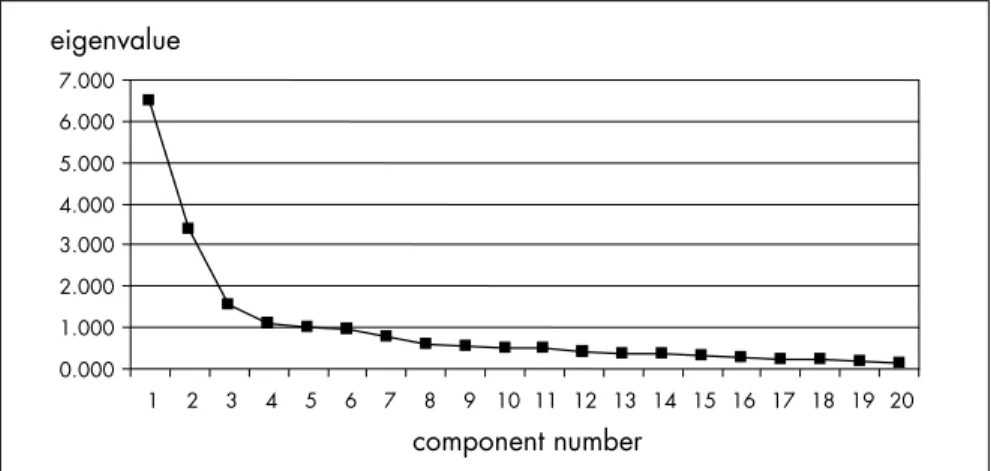
Five components presented eigenvalues greater than 1.0 in the initial principal com-ponents solution. The scree plot showed three distinct visual components that accounted for 53.6% of the variance (Figure 1). After conside-ring the interpretability of the components and analyzing possible solutions, it was decided to extract three subscales (diet, insulin and general management). Their factorial loads ranged from 0.49 to 0.90, and it had been previously decided that only items with factorial loads greater than 0.30 would be considered27 (Table 1).
In the criterion validity analysis for the GHb level, ANOVA testing on the insulin subscale was signifi cant (p = 0.040), showing a linear tendency (p = 0.01) between groups: the higher the self-effi cacy level was, the lower the GHb level was (Figure 2). Regarding “ad-herence”, it was seen that the higher it was, the higher the levels of self-effi cacy were on the two subscales of diet and insulin. The chi-squared test showed a signifi cant association on the subscales of diet (p = 0.04) and insulin (p = 0.03), but not on the general management subscale (p = 0.24). In the logistic regression analysis, after adjustment for age, sex, social class and schooling, it was seen that subjects with low self-effi cacy had approximately twice the chance of showing “non-adherence” on the subscales of diet and insulin, in comparison with the 33% who showed the best self-effi cacy on these subscales.
The reliability of the instrument was determined by internal consistency analysis using Cronbach’s alpha (α), which verifi ed whether the subscales identifi ed were consist-ent and homogeneous. The coeffi ciconsist-ents were as follows: diet (α = 0.83), insulin (α = 0.92) and general management (α = 0.78).
The test-retest technique verifi ed the scale stability over a two-month period. This was evaluated using Pearson’s correlation, giving the following subscale results: diet (r = 0.33; p = 0.01), insulin (r = 0.13; p = 0.30) and general management (r = 0.61; p = 0.00).
DISCUSSION The results from this investigation rela-ting to psychometric properties are promising. The content validity, as verifi ed by theoretical analysis of the items and semantic analysis of the scale, was adequate. In the semantic analysis, we tried to evaluate the items with subjects from extremes of social classes, so that the language would be adequate for all levels,
Figure 1. Scree plot: eigenvalues versus component numbers.
0.000 1.000 2.000 3.000 4.000 5.000 6.000 7.000
1 2 3 4 5 6 7 8 9 10 11 12 13 14 15 16 17 18 19 20 eigenvalue
component number
10.74
10.24
9.2 9.4 9.6 9.8 10 10.2 10.4 10.6 10.8 11
9.79
glycohemoglobin
low moderate
self-efficacy
high
as recommended in the literature.27 In the pilot study, it was decided to make changes in three items and to reduce the number of scores on the Likert scale, in order to improve understanding. Diffi culty in understanding Likert-like scales with many score options have been reported in the literature among popula-tions of low socioeconomic level.28
Regarding construct validity, three sub-scales were maintained, as in the original instrument, but the number of items was reduced to 20 and the instrument obtained more reliable measurements. The wording of item number one was modifi ed, after being identifi ed in the diet subscale. In the original instrument, it had belonged to the general management subscale (Annex 1).
Among the parameters used for analyz-ing the external criterion validity, GHb is an important test that refl ects the mean glycemic control over the preceding three months. Its mean in our sample was above the recom-mendations for the method (10.28 ± 2.33) and the mean from the original scale (10.99 ± 2.36), thus showing ina-dequate metabolic control in both populations.
If the GHb level is adequate, it may prevent or delay diabetes complications.36,37 It was found
that there was a signifi cant association between the self-effi cacy level on the insulin subscale and GHb, which was confi rmed by ANOVA. There was a linear trend in which the higher the self-effi cacy level was, the lower the GHb level was. In the original instrument, there were signifi cant associations with GHb on all subscales, which was not observed in the present study.
Studies in the literature have corre-lated self-effi cacy with glycemic control using GHb14,15 but, according to Glasgow et al. (1999),36 it is inappropriate to use GHb as an indicator for a patient’s behavior. High GHb may be attributable to behavioral problems or other factors (inadequate prescription or diseases, among others) that must be ana-lyzed. Adherence is an important contributor towards good control, but it is not the same as control and should not be interpreted on the basis of a single laboratory test.36 After searching for a behavioral characteristic that would reflect diabetes management, the variable “adherence” was defi ned. It was ob-served that there was a signifi cant association between “adherence” and self-effi cacy in the correlation analysis, on the subscales of diet (p < 0.02) and insulin (p < 0.02). This was also found in the logistic regression analysis, thus
Table 1. Psychometric parameters of the adapted instrument (n = 213) Components
Diet subscale Insulin subscale General management
subscale
1 2 3
1 0.52
5 0.53
6 0.73
7 0.69
8 0.72
9 0.68
10 0.55
11 0.67
14 0.88
15 0.90
16 0.79
17 0.88
18 0.76
02 0.78
03 0.80
04 0.50
12 0.52
13 0.61
19 0.49
20 0.59
Eigenvalue 5.5 3.4 1.6
Total variance (%) 27.9 17.2 8.4
Number of items 8 5 7
Internal consistency (α) 0.83 0.92 0.78
indicating that the scale has criteria validity, i.e. the subscales of diet and insulin predict “adherence” or diabetes management. Hence, in the multivariate analysis, after adjustment for age, sex, schooling and social class, and using a cutoff point of 33% for subjects with better self-effi cacy levels, there was a signifi cant association between self-effi cacy and “adherence” (adequate behavior regarding the use of insulin and diet).
In the reliability study, Cronbach’s alpha for the subscales ranged from 0.92 for insulin factor to 0.78 for general management. Alpha values can range from 0 to 1, and 0.65 is the lowest accept-able value for the scale to be considered reliaccept-able.38 But considering 0.80 as the expected index for a measurement with less error, the value for the general management subscale was acceptable.27
The evaluation of temporal stability using test-retest did not show any signifi cant associa-tion with the insulin subscale. It is likely that the two-month period was too long and interfered with the results, considering that self-effi cacy is a dynamic concept and can change with time. In the original instrument, the second test was performed after two weeks because of this possibility.
There is evidence that behavioral patterns relating to diabetes care are relatively independ-ent. Characterization for the specifi c behavioral area that presents impairment allows more effective interventions.37 It is known that self-effi cacy is specifi c for each behavioral pattern,7 thus explaining the fi ndings from this study.
Our study presented certain limitations such as the way in which the instrument was applied: it was done by interview and not self-application as the original, and this may have affected the replies.27 Considering that the origi-nal instrument was designed for insulin-requir-ing diabetics, whereas for our population it was decided to adapt it only for type 1 diabetics, no generalization for all diabetics is possible.
CONCLUSION It was concluded that, despite the modi-fi cations made to the instrument, in relation to the original questionnaire, there was no loss in internal consistency in its adaptation. It presents adequate psychometric parameters and can be used to evaluate self-effi cacy in the management of type 1 diabetes.
1. Malerbi DA, Franco LJ. Multicenter study of the prevalence of diabetes mellitus and impaired glucose tolerance in the urban Brazilian population aged 30-69 yr. The Brazilian Cooperative Group on the Study of Diabetes Prevalence. Diabetes Care. 1992;15(11):1509-16.
2. Chacra AR, Moisés RCMS. Diabetes melito: classifi cação e diagnóstico. In: Coronho V, Petroniau A, Santana EM, Pimenta LG, editors. Tratado de endocrinologia e cirurgia endócrina. Rio de Janeiro: Guanabara Koogan; 2001. p. 924-7.
3. Anderson RM. Is the problem of noncompliance all in our heads? Diabetes Educ. 1985;11(1):31-4.
4. Ary DV, Toobert D, Wilson W, Glasgow RE. Patient perspective on factors contributing to nonadherence to diabetes regimen. Diabetes Care. 1986;9(2):168-72.
5. The effect of intensive treatment of diabetes on the development and progression of long-term complications in insulin-depend-ent diabetes mellitus. The Diabetes Control and Complications Trial Research Group. N Engl J Med. 1993;329(14):977-86. 6. Intensive blood-glucose control with sulphonylureas or insulin
compared with conventional treatment and risk of complications in patients with type 2 diabetes (UKPDS 33). UK Prospective Diabetes Study (UKPDS) Group. Lancet. 1998;352(9131):837-53. 7. Bandura A. Self-effi cacy: The exercise of control. New York: W.
H. Freeman and Company; 1997.
8. Maibach E, Murphy DA. Self-effi cacy in health promoting research and practice: conceptualization and measurement. Health Educ Res. 1995;10(1):37-50.
9. Bandura A. Self-effi cacy: toward a unifying theory of behavioral change. Psychol Rev. 1977;84(2):191-215.
10. McCaul KD, Glasgow RE, Schafer LC. Diabetes regimen be-haviors. Predicting adherence. Med Care. 1987;25(9):868-81. 11. Glasgow RE, Toobert DJ, Riddle M, Donnelly J, Mitchell DL, Calder D. Diabetes-specifi c social learning variables and self-care behaviors among persons with type II diabetes. Health Psychol. 1989;8(3):285-303.
12. Hurley AC, Shea CA. Self-effi cacy: strategy for enhancing diabetes self-care. Diabetes Educ. 1992;18(2):146-50. 13. Padgett DK. Correlates of self-effi cacy beliefs among patients
with non-insulin dependent diabetes mellitus in Zagreb, Yugo-slavia. Patient Educ Couns. 1991;18:139-47.
14. Aalto AM, Uutela A. Glycemic control, self-care behaviors, and psychosocial factors among insulin treated diabetics: a test of an extended health belief model. Int J Behav Med. 1997;4(3):191-214.
15. Kavanagh DJ, Gooley S, Wilson PH. Prediction of adherence and control in diabetes. J Behav Med. 1993;16(5):509-22. 16. Grossman HY, Brink S, Hauser ST. Self-effi cacy in adolescent
girls and boys with insulin-dependent diabetes mellitus. Diabetes Care. 1987;10(3):324-9.
17. Littlefi eld CH, Craven JL, Rodin GM, Daneman D, Murray MA, Rydall AC. Relationship of self-effi cacy and binging to adherence to diabetes regimen among adolescents. Diabetes Care. 1992;15(1):90-4.
18. Griva K, Myers LB, Newman S. Illness perceptions and self ef-fi cacy beliefs in adolescents and young adults with insulin depend-ent diabetes mellitus. Psychology and Health. 2000;15:733-50. 19. Aalto AM, Uutela A, Aro AR. Health related quality of life
among insulin-dependent diabetics: disease-related and psy-chosocial correlates. Patient Educ Couns. 1997;30(3):215-25. 20. Glasgow RE, Osteen VL. Evaluating diabetes education. Are
we measuring the most important outcomes? Diabetes Care. 1992;15(10):1423-32.
21. Johnson JA. Self-effi cacy theory as a framework for community pharmacy-based diabetes education programs. Diabetes Educ. 1996;22(3):237-41.
22. Engel SS, Crandall J, Basch CE, Zybert P, Wylie-Rosett J. Computer-assisted diabetes nutrition education increases knowledge and self-effi cacy of medical students. Diabetes Educ. 1997;23(5):545-9.
23. Corbett CF. Research-based practice implications for patients with diabetes. Part II: Diabetes self-effi cacy. Home Healthc Nurse. 1999;17(9):587-96.
24. Anderson RM, Funnell MM, Butler PM, Arnold MS, Fitzgerald JT, Feste CC. Patient empowerment. Result of a randomized controlled trial. Diabetes Care. 1995;18(7):943-9. 25. Crabtree MK. Self-effi cacy and social support as predictors of
diabetic self-care. [Dissertation]. San Francisco: University of California; 1986.
26. Hurley AC, Harvey RM. The Insulin Management Diabetes Self-effi cacy Scale. In: Strickland O, Dilorio C, editors. Meas-urement of nursing outcomes. New York: Springer Publishing Company; 1990. p. 526-726.
27. Pasquali L. Testes referentes à construto: teoria e modelo de con-strução. In: Pasquali L, (org). Instrumentos psicológicos: manual prático de elaboração. Brasília: LabPAN, IBAPP; 1990. p. 37-51. 28. Statistical Package for the Social Sciences [computer pro-gram]. SPSS base 8.0 for Windows. Chicago: Users Guide, SPSS; 1998.
29. Floyd FJ, Widaman KF. Factor analysis in development and refi nement of clinical Assessment Instruments. Psychological Assessment. 1995;7(3):286-99.
30. Zwick WR, Velicer WF. Comparison of fi ve rules for determining the number of components to retain. Psychol Bull. 1986;99(3):432-42. 31. Balakrishnan S, Kumar A, Rao BR, Patro TP. Implementation
of tests for monitoring drug compliance of leprosy out-patients under multi-drug therapy. Indian J Lepr. 1986;58(4):555-9.
32. Botelho RJ, Dudrak R 2nd. Home assessment of adherence to
long-term medication in the elderly. J Fam Pract. 1992;35(1):61-5. 33. Farmer KC. Methods for measuring and monitoring medication
regimen adherence in clinical trials and clinical practice. Clin Ther. 1999;21(6):1074-90; discussion 1073.
34. Thompson C, Peveler RC, Stephenson D, McKendrick J. Compliance with antidepressant medication in the treatment of major depressive disorder in primary care: a randomized comparison of fl uoxetine and tricyclic antidepressant. Am J Psychiatry. 2000;157(3):338-43.
35. Bernal H, Wooley S, Schensul JJ. The challenge of using Lik-ert-type scales with low-literate ethnic populations. Nurs Res. 1997;46(3):179-81.
36. Glasgow RE, Fisher EB, Anderson BJ, et al. Behavioral science in diabetes. Contributions and opportunities. Diabetes Care. 1999;22(5):832-43.
37. Van Der Ven NC, Weinger K, Yi J, et al. The confi dence in diabetes self-care scale: psychometric properties of a new measure of diabetes-specifi c self-effi cacy in Dutch and US patients with type 1 diabetes. Diabetes Care. 2003;26(3):713-8. 38. DeVellis RF. Scale development: theory and applications. (Applied
Social Research Methods). London: Sage Publications; 1991.
Acnowledgements: This project was partially supported by Fudação de Apoio à Pesquisa do Rio Grande do Sul (FAPERGS). We would like to thank Dr. Vera Figueiredo for guidance in the psychometric analysis of the instrument and Dr. Aída Meirelles, coordinator of the Comprehensive Care Program for Diabetics of the Fundação Universidade do Rio Grande (FURG), for allowing us to perform the pilot study.
Sources of funding: Fundação de apoio à pesquisa do estado do Rio Grande do Sul (FAPERGS) – Grant number 02/60044.4DO.
Confl ict of interest: None
Date of fi rst submission: May 8, 2006 Last received: March 23, 2007 Accepted: April 13, 2007
AUTHOR INFORMATION
Daniela Alves Gastal, MSc. School of Medicine and Psycho-logy, Universidade Católica de Pelotas, Pelotas, Rio Grande do Sul, Brazil.
Ricardo Tavares Pinheiro, MD, PhD. School of Medicine and Psychology, Universidade Católica de Pelotas, Pelotas, Rio Grande do Sul, Brazil.
Débora Potter Vazquez, MSc. School of Medicine and Psy-chology, Universidade Católica de Pelotas, Pelotas, Rio Grande do Sul, Brazil.
Address for correspondence:
Daniela Alves Gastal
Rua Gonçalves Chaves, 4.041 — Apto. 304 Pelotas (RS) — Brasil — CEP 96015 085 Tel. (+55 53) 3222-7448 — (+55 53) 3028-7774 (+55 53) 3284-8104
E-mail: [email protected]
Copyright © 2007, Associação Paulista de Medicina
RESUMO Escala de auto-efi cácia para brasileiros com diabetes tipo 1
CONTEXTO E OBJETIVOS: Diabetes é um problema de saúde pública e sabe-se que o controle glicêmico adequado pode prevenir ou retardar as complicações e, sendo a auto-efi cácia fator chave para atingir as metas comportamentais com sucesso, o objetivo deste estudo foi analisar as propriedades psicométricas da escala de auto-efi cácia no manejo da insulina (IMDSES) em uma população de diabéticos tipo 1 do sul do Brasil.
TIPO DE ESTUDO E LOCAL: Estudo de validação, realizado em uma população de diabéticos tipo 1 de duas cidades do sul do Brasil.
METODOS: As propriedades psicométricas da IMDSES foram avaliadas em 213 diabéticos tipo 1, de setembro a dezembro de 2004, que eram atendidos pelo sistema único de saúde (SUS). A análise dos componentes principais para o desenvolvimento de subescalas e o coefi ciente alfa de Cronbach foi utilizado na avaliação de confi abilidade da escala.
RESULTADOS: Após analise das propriedades psicométricas, a escala fi cou com 20 itens e três sub-escalas, dieta (alpha = 0,83), insulina (alpha = 0,92) e cuidados gerais (alpha = 0,78) que correspondiam a 53% da variância. Validade de critério foi investigada através de dois parâmetros: glicohemoglobina, através da qual foi possível verifi car associação signifi cativa com auto-efi cácia na subescala insulina (p = 0,04) e com a variável “adesão”, que foi signifi cativamente associada com auto-efi cácia em duas sub-escalas (p < 0,05).
CONCLUSÃO: Este estudo verifi cou que IMDSES é válida e confi ável e pode ser utilizada para avaliar resultados de programas educacionais em diabetes e auto-efi cácia no manejo do diabetes para possíveis intervenções.
PALAVRAS-CHAVE: Diabetes mellitus. Escalas. Auto-efi cácia. Psicometria. Paciente. Questions
Strongly Agree
Agree
Disagree
Strongly Disagree
Not
applicab
le
1. I can follow the diet most of the time in my routine. 1 2 3 4 NA
2. I believe in my ability to deal with diabetes. 1 2 3 4 NA
3. I feel confi dent in using my knowledge about diabetes in my daily treatment. 1 2 3 4 NA
4. I believe I can follow diabetes routines daily. 1 2 3 4 NA
5. I can have the meals at the same time every day. 1 2 3 4 NA
6. I can maintain my diet when eating outside of my home in known places (e.g. a friend’s house). 1 2 3 4 NA
7. I can maintain my diet when eating outside of my home in unknown places. 1 2 3 4 NA
8. I am sure I will be able to maintain my diet when the people around me don’t know I am diabetic. 1 2 3 4 NA
9. I am sure I can maintain my diet every day. 1 2 3 4 NA
10. I can correctly replace one type of food with another in the same group (e.g. replacing rice with potato). 1 2 3 4 NA
11. I can maintain my diet when I attend parties. 1 2 3 4 NA
12. I can apply insulin using the correct technique. 1 2 3 4 NA
13. I have the capability of applying insulin when I am not at home. 1 2 3 4 NA
14. I can adjust my insulin amount on the basis of the results from sugar tests in blood or urine, when necessary. 1 2 3 4 NA
15. I am sure I can adjust my insulin amount when there are changes in my daily routine. 1 2 3 4 NA
16. I know how to adjust my insulin amount in order to avoid hypoglycemia when I am exercising. 1 2 3 4 NA
17. I know what type of adjustment in the insulin amount I have to make when my blood sugar is higher than it should be. 1 2 3 4 NA
18. I can adjust my insulin amount when I have a cold or fl u. 1 2 3 4 NA
19. I am sure diabetes treatment does not interfere with my daily routine. 1 2 3 4 NA
20. I think I am capable of following the planned treatment for diabetes, even when there are changes in my daily routine. 1 2 3 4 NA